

ISO 11299-3:2018
(Main)Plastics piping systems for renovation of underground gas supply networks — Part 3: Lining with close-fit pipes
General Information
- Abstract
This document, in conjunction with ISO 11299‑1, specifies requirements and test methods for close-fit lining systems intended to be used for the renovation of gas supply networks. It applies to pipes and fittings, as manufactured, as well as to the installed lining system. It is applicable to polyethylene (PE) pipe of either solid wall single layer or co-extruded layer construction, which is reduced in the factory or on site to provide a close-fitting independent or interactive pressure pipe liner, as well as associated fittings and joints for the construction of the lining system. This document is not applicable for coated PE pipes having a peelable, contiguous, thermoplastics additional layer on the outside of the pipes. It is applicable to PE pipes, fittings and assemblies intended to be used at an operating temperature of 20 °C as the reference temperature. NOTE For other operating temperatures, guidance is given in ISO 4437‑5:2014.
- Status
- Withdrawn
- Publication Date
- 25-Oct-2018
- Technical Committee
- ISO/TC 138/SC 8 - Rehabilitation of pipeline systems
- Current Stage
- 9599 - Withdrawal of International Standard
- Start Date
- 16-Jul-2026
- Completion Date
- 29-Aug-2026
Buy Documents
ISO 11299-3:2018 - Plastics piping systems for renovation of underground gas supply networks
REDLINE ISO 11299-3:2018 - Plastics piping systems for renovation of underground gas supply networks — Part 3: Lining with close-fit pipes Released:10/26/2018
ISO 11299-3:2018 - Plastics piping systems for renovation of underground gas supply networks — Part 3: Lining with close-fit pipes/26/2018
ISO 11299-3:2018 - Systemes de canalisations en plastique pour la rénovation des réseaux enterrés de distribution de gaz
ISO 11299-3:2018 - Systèmes de canalisations en plastique pour la rénovation des réseaux enterrés de distribution de gaz — Partie 3: Tubage par tuyau continu sans espace annulaire/26/2018
Overview - ISO 11299-3:2018 (Close-fit lining for gas networks)
ISO 11299-3:2018, titled Plastics piping systems for renovation of underground gas supply networks - Part 3: Lining with close-fit pipes, specifies requirements and test methods for close-fit lining systems used to renovate existing underground gas distribution pipelines. It is a part of the ISO 11299 series and is intended to be used in conjunction with ISO 11299‑1 (General). The standard applies to polyethylene (PE) pipes (solid wall single layer or co‑extruded) that are factory‑ or site‑reduced to form a close‑fitting independent or interactive pressure liner, plus associated fittings and joints and the installed lining system. Reference operating temperature is 20 °C; guidance for other temperatures is given in ISO 4437‑5:2014.
Key topics and technical requirements
- Scope & applicability: Covers materials, manufacturing, installation condition (“as‑manufactured” and “as‑installed”), and excludes PE pipes with a peelable outer thermoplastic coating.
- Materials & compounds: PE compound requirements reference ISO 4437 series; each co‑extruded layer must meet MFR and OIT requirements where specified.
- Product stages: Defines “M” (manufactured/processed) and “I” (installed) stages and requires verification of certain characteristics in the installed condition - a key distinction for renovation standards.
- Mechanical & physical tests: Includes hydrostatic strength testing (example: hydrostatic strength at 80 °C, 165 h is referenced), memory/heat‑reversion properties for folded pipes, and other performance tests to demonstrate fitness for purpose.
- Joints & jointing methods: Butt fusion and electrofusion joints are covered; butt fusion must conform to ISO 4437‑2 and ISO 4437‑5 and be properly de‑beaded where required.
- Design parameters & symbols: Uses standard piping design concepts such as MRS (Minimum Required Strength), MOP (Maximum Operating Pressure), LPL (Lower Confidence Limit), SDR and dimensional tolerances.
- Marking & documentation: Pipe and fitting marking requirements are aligned with ISO 11299‑1 and ISO 4437 series; manufacturers must declare “M” stage dimensions needed to achieve “I” stage geometry.
Practical applications and who uses this standard
ISO 11299‑3:2018 is designed for:
- Gas utility owners and network operators planning trenchless renovation using close‑fit liners
- Pipeline engineers and designers specifying PE close‑fit lining systems
- Manufacturers of PE close‑fit pipes, fittings and joints who need to demonstrate conformity
- Contractors and installation teams performing factory or on‑site pipe reduction, reversion and jointing
- Testing laboratories and conformity assessment bodies validating “as‑installed” performance
Typical applications include rehabilitation of aging buried gas mains where a close‑fitting PE liner restores pressure integrity without full pipe replacement.
Related standards
- ISO 11299‑1 (General requirements for renovation systems)
- ISO 4437 series / EN 1555 series (PE piping for gaseous fuels)
- ISO 3126 (Dimensions), ISO 12176 (fusion equipment)
- Other parts of ISO 11299 (Parts 2, 4, 6, 11) for alternative lining techniques
Keywords: ISO 11299-3:2018, close-fit lining, polyethylene (PE) pipe, renovation of underground gas supply networks, lining systems, trenchless rehabilitation, MRS, MOP, hydrostatic strength, butt fusion, electrofusion.
Relations
- Effective Date
- 11-Mar-2026
- Effective Date
- 12-Feb-2026
- Effective Date
- 06-Jun-2022
- Effective Date
- 05-Nov-2022
- Effective Date
- 14-Nov-2015
Buy Documents
ISO 11299-3:2018 - Plastics piping systems for renovation of underground gas supply networks
REDLINE ISO 11299-3:2018 - Plastics piping systems for renovation of underground gas supply networks — Part 3: Lining with close-fit pipes Released:10/26/2018
ISO 11299-3:2018 - Plastics piping systems for renovation of underground gas supply networks — Part 3: Lining with close-fit pipes/26/2018
ISO 11299-3:2018 - Systemes de canalisations en plastique pour la rénovation des réseaux enterrés de distribution de gaz
ISO 11299-3:2018 - Systèmes de canalisations en plastique pour la rénovation des réseaux enterrés de distribution de gaz — Partie 3: Tubage par tuyau continu sans espace annulaire/26/2018
Get Certified
Connect with accredited certification bodies for this standard

Element Materials Technology
Materials testing and product certification.

ABS Group Brazil
ABS Group certification services in Brazil.

ABS Quality Evaluations Inc.
American Bureau of Shipping quality certification.
Sponsored listings
Frequently Asked Questions
ISO 11299-3:2018 is a standard published by the International Organization for Standardization (ISO). Its full title is "Plastics piping systems for renovation of underground gas supply networks — Part 3: Lining with close-fit pipes". This standard covers: This document, in conjunction with ISO 11299‑1, specifies requirements and test methods for close-fit lining systems intended to be used for the renovation of gas supply networks. It applies to pipes and fittings, as manufactured, as well as to the installed lining system. It is applicable to polyethylene (PE) pipe of either solid wall single layer or co-extruded layer construction, which is reduced in the factory or on site to provide a close-fitting independent or interactive pressure pipe liner, as well as associated fittings and joints for the construction of the lining system. This document is not applicable for coated PE pipes having a peelable, contiguous, thermoplastics additional layer on the outside of the pipes. It is applicable to PE pipes, fittings and assemblies intended to be used at an operating temperature of 20 °C as the reference temperature. NOTE For other operating temperatures, guidance is given in ISO 4437‑5:2014.
This document, in conjunction with ISO 11299‑1, specifies requirements and test methods for close-fit lining systems intended to be used for the renovation of gas supply networks. It applies to pipes and fittings, as manufactured, as well as to the installed lining system. It is applicable to polyethylene (PE) pipe of either solid wall single layer or co-extruded layer construction, which is reduced in the factory or on site to provide a close-fitting independent or interactive pressure pipe liner, as well as associated fittings and joints for the construction of the lining system. This document is not applicable for coated PE pipes having a peelable, contiguous, thermoplastics additional layer on the outside of the pipes. It is applicable to PE pipes, fittings and assemblies intended to be used at an operating temperature of 20 °C as the reference temperature. NOTE For other operating temperatures, guidance is given in ISO 4437‑5:2014.
ISO 11299-3:2018 is classified under the following ICS (International Classification for Standards) categories: 23.040.20 - Plastics pipes; 23.040.45 - Plastics fittings; 75.200 - Petroleum products and natural gas handling equipment. The ICS classification helps identify the subject area and facilitates finding related standards.
ISO 11299-3:2018 has the following relationships with other standards: It is inter standard links to CEN ISO/TS 23818-1:2020, EN ISO 11299-3:2018, ISO 12609-1:2021, ISO 11301-1:2026, ISO 11299-3:2011. Understanding these relationships helps ensure you are using the most current and applicable version of the standard.
ISO 11299-3:2018 is available in PDF format for immediate download after purchase. The document can be added to your cart and obtained through the secure checkout process. Digital delivery ensures instant access to the complete standard document.
Standards Content (Sample)
INTERNATIONAL ISO
STANDARD 11299-3
Second edition
2018-10
Plastics piping systems for renovation
of underground gas supply
networks —
Part 3:
Lining with close-fit pipes
Systèmes de canalisations en plastique pour la rénovation des réseaux
enterrés de distribution de gaz —
Partie 3: Tubage par tuyau continu sans espace annulaire
Reference number
©
ISO 2018
© ISO 2018
All rights reserved. Unless otherwise specified, or required in the context of its implementation, no part of this publication may
be reproduced or utilized otherwise in any form or by any means, electronic or mechanical, including photocopying, or posting
on the internet or an intranet, without prior written permission. Permission can be requested from either ISO at the address
below or ISO’s member body in the country of the requester.
ISO copyright office
CP 401 • Ch. de Blandonnet 8
CH-1214 Vernier, Geneva
Phone: +41 22 749 01 11
Fax: +41 22 749 09 47
Email: copyright@iso.org
Website: www.iso.org
Published in Switzerland
ii © ISO 2018 – All rights reserved
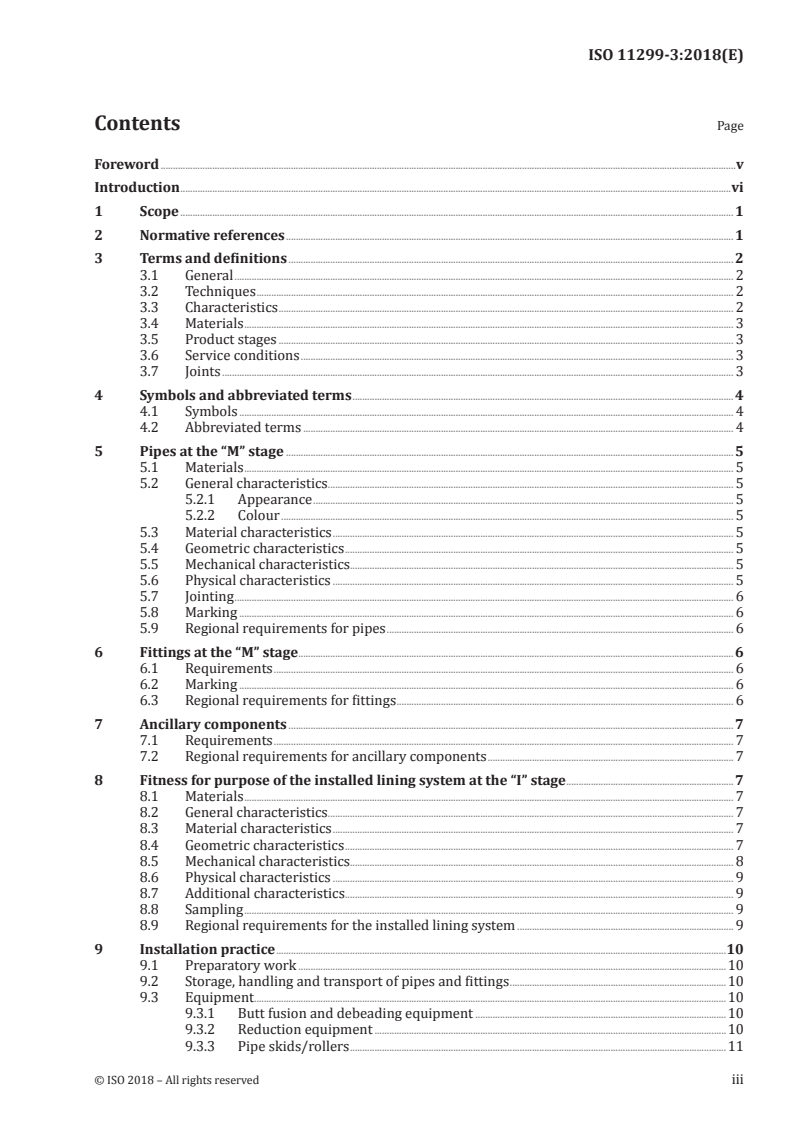
Contents Page
Foreword .v
Introduction .vi
1 Scope . 1
2 Normative references . 1
3 Terms and definitions . 2
3.1 General . 2
3.2 Techniques . 2
3.3 Characteristics . 2
3.4 Materials . 3
3.5 Product stages . 3
3.6 Service conditions . 3
3.7 Joints . 3
4 Symbols and abbreviated terms . 4
4.1 Symbols . 4
4.2 Abbreviated terms . 4
5 Pipes at the “M” stage . 5
5.1 Materials . 5
5.2 General characteristics . 5
5.2.1 Appearance . 5
5.2.2 Colour . 5
5.3 Material characteristics . 5
5.4 Geometric characteristics . 5
5.5 Mechanical characteristics. 5
5.6 Physical characteristics . 5
5.7 Jointing . 6
5.8 Marking . 6
5.9 Regional requirements for pipes . 6
6 Fittings at the “M” stage . 6
6.1 Requirements . 6
6.2 Marking . 6
6.3 Regional requirements for fittings . 6
7 Ancillary components . 7
7.1 Requirements . 7
7.2 Regional requirements for ancillary components . 7
8 Fitness for purpose of the installed lining system at the “I” stage .7
8.1 Materials . 7
8.2 General characteristics . 7
8.3 Material characteristics . 7
8.4 Geometric characteristics . 7
8.5 Mechanical characteristics. 8
8.6 Physical characteristics . 9
8.7 Additional characteristics . 9
8.8 Sampling . 9
8.9 Regional requirements for the installed lining system . 9
9 Installation practice .10
9.1 Preparatory work .10
9.2 Storage, handling and transport of pipes and fittings .10
9.3 Equipment .10
9.3.1 Butt fusion and debeading equipment .10
9.3.2 Reduction equipment .10
9.3.3 Pipe skids/rollers .11
9.3.4 Winching and rod-pulling equipment .11
9.3.5 Pipe entry guides .11
9.3.6 Reforming equipment .11
9.3.7 Electrofusion equipment .11
9.3.8 Inspection equipment .11
9.3.9 Lifting equipment .12
9.4 Installation .12
9.5 Process-related inspection and testing .12
9.6 Lining termination .13
9.7 Reconnection to existing laterals .13
9.8 Final inspection and testing .13
9.9 Documentation .13
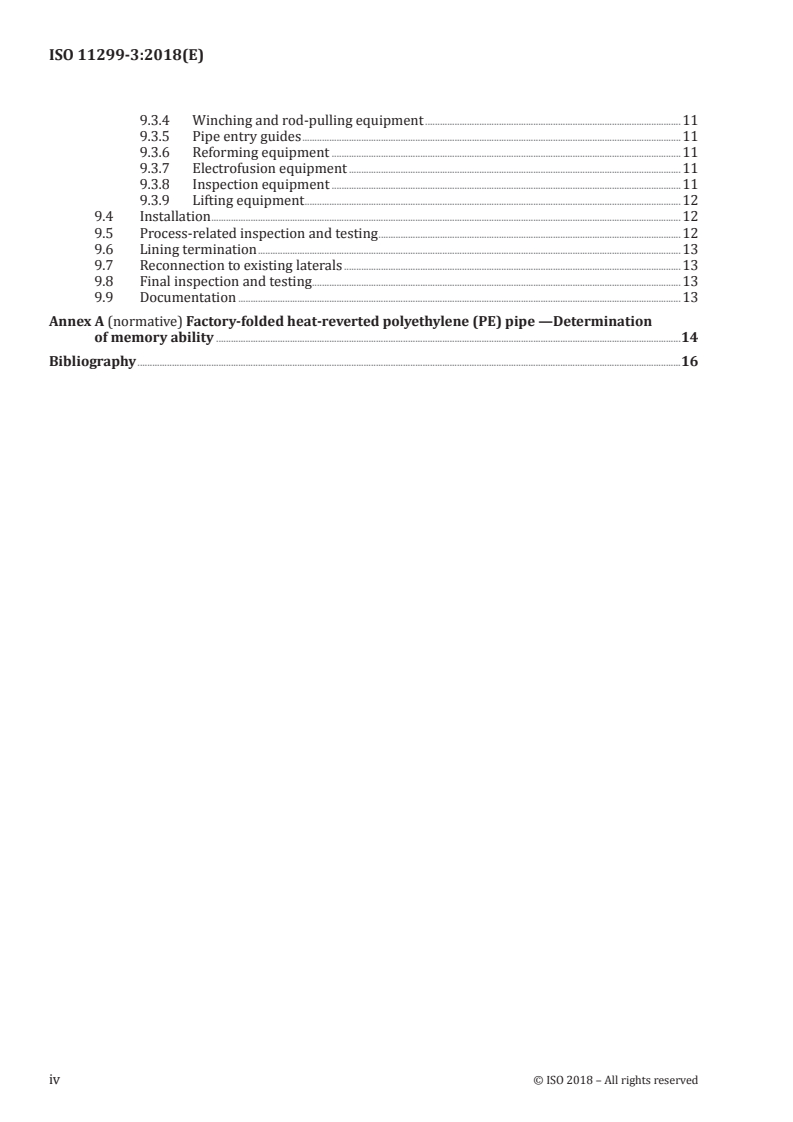
Annex A (normative) Factory-folded heat-reverted polyethylene (PE) pipe —Determination
of memory ability .14
Bibliography .16
iv © ISO 2018 – All rights reserved
Foreword
ISO (the International Organization for Standardization) is a worldwide federation of national standards
bodies (ISO member bodies). The work of preparing International Standards is normally carried out
through ISO technical committees. Each member body interested in a subject for which a technical
committee has been established has the right to be represented on that committee. International
organizations, governmental and non-governmental, in liaison with ISO, also take part in the work.
ISO collaborates closely with the International Electrotechnical Commission (IEC) on all matters of
electrotechnical standardization.
The procedures used to develop this document and those intended for its further maintenance are
described in the ISO/IEC Directives, Part 1. In particular the different approval criteria needed for the
different types of ISO documents should be noted. This document was drafted in accordance with the
editorial rules of the ISO/IEC Directives, Part 2 (see www .iso .org/directives).
Attention is drawn to the possibility that some of the elements of this document may be the subject of
patent rights. ISO shall not be held responsible for identifying any or all such patent rights. Details of
any patent rights identified during the development of the document will be in the Introduction and/or
on the ISO list of patent declarations received (see www .iso .org/patents).
Any trade name used in this document is information given for the convenience of users and does not
constitute an endorsement.
For an explanation of the voluntary nature of standards, the meaning of ISO specific terms and
expressions related to conformity assessment, as well as information about ISO's adherence to the
World Trade Organization (WTO) principles in the Technical Barriers to Trade (TBT), see www .iso
.org/iso/foreword .html.
This document was prepared by Technical Committee ISO/TC 138, Plastics pipes, fittings and valves for
the transport of fluids, Subcommittee SC 8, Rehabilitation of pipeline systems
This second edition cancels and replaces the first edition (ISO 11299-3:2011), which has been technically
revised.
The main changes compared to the previous edition are as follows:
Figure 1 and Clauses 1, 2, 3.3, 3.4, 3.6, 5.7, 5.8, 6, 8.4, 8.5, and 9.2 to 9.8 have been technically revised.
A list of all parts in the ISO 11299 series can be found on the ISO website.
Any feedback or questions on this document should be directed to the user’s national standards body. A
complete listing of these bodies can be found at www .iso .org/members .html.
Introduction
This document is a part of a System Standard for plastics piping systems of various materials used for
the renovation of existing pipelines in a specified application area. System Standards for renovation
dealing with the following applications are either available or in preparation:
— ISO 11296, Plastics piping systems for renovation of underground non-pressure drainage and sewerage
networks;
— ISO 11297, Plastics piping systems for renovation of underground drainage and sewerage networks
under pressure;
— ISO 11298, Plastics piping systems for renovation of underground water supply networks;
— ISO 11299, Plastics piping systems for renovation of underground gas supply networks (this series of
standards).
These System Standards are distinguished from those for conventionally installed plastics piping
systems by the requirement to verify certain characteristics in the “as-installed” condition, after site
processing. This is in addition to specifying requirements for plastics piping systems components “as
manufactured”.
This System Standard comprises a:
— Part 1: General
and all applicable renovation technique family-related parts, which, for gas supply networks , include or
potentially include the following:
— Part 2: Lining with continuous pipes;
— Part 3: Lining with close-fit pipes (this document);
— Part 4: Lining with cured-in-place pipes;
— Part 6: Lining with adhesive-backed hoses;
— Part 11: Lining with inserted hoses.
The requirements for any given renovation technique family are given in Part 1, applied in conjunction
with the relevant other part. For example, ISO 11299-1 and this document together specify the
requirements relating to lining with close-fit pipes. For complementary information, see ISO 11295. Not
all technique families are pertinent to every area of application and this is reflected in the part numbers
included in each System Standard.
A consistent structure of clause headings has been adopted for all parts of ISO 11299, in order to
facilitate direct comparisons across renovation technique families.
Figure 1 shows the common part and clause structure and the relationship between ISO 11299 and the
System Standards for other application areas.
vi © ISO 2018 – All rights reserved
Figure 1 — Format of the renovation system standards
INTERNATIONAL STANDARD ISO 11299-3:2018(E)
Plastics piping systems for renovation of underground gas
supply networks —
Part 3:
Lining with close-fit pipes
1 Scope
This document, in conjunction with ISO 11299-1, specifies requirements and test methods for close-fit
lining systems intended to be used for the renovation of gas supply networks.
It applies to pipes and fittings, as manufactured, as well as to the installed lining system. It is applicable
to polyethylene (PE) pipe of either solid wall single layer or co-extruded layer construction, which is
reduced in the factory or on site to provide a close-fitting independent or interactive pressure pipe
liner, as well as associated fittings and joints for the construction of the lining system. This document is
not applicable for coated PE pipes having a peelable, contiguous, thermoplastics additional layer on the
outside of the pipes.
It is applicable to PE pipes, fittings and assemblies intended to be used at an operating temperature of
20 °C as the reference temperature.
NOTE For other operating temperatures, guidance is given in ISO 4437-5:2014.
2 Normative references
The following documents are referred to in the text in such a way that some or all of their content
constitutes requirements of this document. For dated references, only the edition cited applies. For
undated references, the latest edition of the referenced document (including any amendments) applies.
ISO 3126, Plastics piping systems — Plastics components — Determination of dimensions
ISO 4437-1, Plastics piping systems for the supply of gaseous fuels — Polyethylene (PE) — Part 1: General
ISO 4437-2, Plastics piping systems for the supply of gaseous fuels — Polyethylene (PE) — Part 2: Pipes
ISO 4437-3, Plastics piping systems for the supply of gaseous fuels — Polyethylene (PE) — Part 3: Fittings
ISO 4437-4, Plastics piping systems for the supply of gaseous fuels — Polyethylene (PE) — Part 4: Valves
ISO 4437-5:2014, Plastics piping systems for the supply of gaseous fuels — Polyethylene (PE) — Part 5:
Fitness for purpose of the system
ISO 11299-1:2018, Plastics piping systems for renovation of underground gas supply networks —
Part 1: General
ISO 12176-1, Plastics pipes and fittings — Equipment for fusion jointing polyethylene systems — Part 1:
Butt fusion
ISO 12176-2, Plastics pipes and fittings — Equipment for fusion jointing polyethylene systems — Part 2:
Electrofusion
EN 1555-1, Plastics piping systems for the supply of gaseous fuels — Polyethylene (PE) — Part 1: General
EN 1555-2, Plastics piping systems for the supply of gaseous fuels — Polyethylene (PE) — Part 2: Pipes
EN 1555-3, Plastics piping systems for the supply of gaseous fuels — Polyethylene (PE) — Part 3: Fittings
EN 1555-4, Plastics piping systems for the supply of gaseous fuels — Polyethylene (PE) — Part 4: Valves
EN 1555-5:2010, Plastics piping systems for the supply of gaseous fuels — Polyethylene (PE) — Part 5:
Fitness for purpose of the system
3 Terms and definitions
For the purposes of this document, the terms and definitions given in ISO 11299-1 and the following apply.
ISO and IEC maintain terminological databases for use in standardization at the following addresses:
— IEC Electropedia: available at http: //www .electropedia .org/
— ISO Online browsing platform: available at https: //www .iso .org/obp
3.1 General
3.1.1
compound formulation
clearly defined homogenous mixture of base polymer with additives, e.g. antioxidants, pigments,
stabilizers and others, at a dosage level necessary for the processing and intended use of the final product
3.1.2
solid wall single layered pipe
pipe with smooth internal and external surface, extruded from the same compound/formulation
throughout the wall
3.1.3
pipe with co-extruded layers
pipe with smooth internal and external surface, having co-extruded layers on either or both the outside
and inside of the pipe, where all layers have the same MRS rating
3.1.4
close fit
situation of the outside of the installed liner relative to the inside of the existing pipeline, which can
either be an interference fit or include a small annular gap resulting from shrinkage and tolerances only
3.1.5
close-fit pipe
continuous lining pipe of thermoplastic material reshaped or otherwise expanded after insertion to
achieve a close fit to the existing pipeline
3.2 Techniques
No additional definitions apply.
3.3 Characteristics
3.3.1
MRS
minimum required strength
value of σ rounded down to the next smaller value of the R10 series or R20 series, depending on the
LPL
value of σ
LPL
Note 1 to entry: R10 and R20 series are the Renard number series according to ISO 3 and ISO 497.
2 © ISO 2018 – All rights reserved
3.3.2
MFR
melt mass-flow rate
rate of extrusion of a molten resin through a die of specified length and diameter under prescribed
conditions of temperature, load and piston position in the cylinder of an extrusion plastometer, the rate
being determined as the mass extruded over a specified time
Note 1 to entry: MFR is expressed in units of grams per 10 min.
[SOURCE: ISO 1133-1:2011, 3.1]
3.4 Materials
3.4.1
crazing
microstructural phenomenon associated with the short-term application of tensile bending strain
exceeding the material-related critical yield strain
3.5 Product stages
No additional definitions apply.
3.6 Service conditions
3.6.1
maximum operating pressure
MOP
1)
maximum effective pressure of gas in a piping system, expressed in bar , which is allowed in
continuous use
Note 1 to entry: It takes into account the physical and mechanical characteristics of the components of the piping
system (and the influence of the gas on these characteristics) and it is calculated using the following formula:
20×MRS
MOP=
C×−SDR 1
()
[SOURCE: ISO 17885:2015, 3.1.11]
3.6.2
design coefficient
C
coefficient with a value greater than 2, which takes into consideration service conditions as well
as properties of the components of a piping system other than those represented in the lower
confidence limit
3.7 Joints
3.7.1
electrofusion joint
joint between a PE socket or saddle electrofusion fitting and a pipe or fitting with spigotted ends, made
by heating the electrofusion fittings by the Joule effect of the heating element incorporated at their
jointing surfaces, causing the material adjacent to them to melt and pipe and fitting surfaces to fuse
2 5 2
1) 1 bar =0,1 MPa = 0,1 N/mm = 10 ⋅N/m .
3.7.2
butt fusion joint
joint made by heating the planed ends of matching surfaces by holding them against a flat heating plate
until the PE material reaches fusion temperature, quickly removing the heating plate and pushing the
two softened ends against one another
3.7.3
mechanical joint
joint made by assembling a PE pipe to another PE pipe, or any other element of the piping system, using
a fitting that generally includes a compression part, to provide for pressure integrity, leaktightness and
a gripping part to provide resistance to end loads
Note 1 to entry: A support sleeve inserted into the pipe bore
...
ISO/TC 138/SC 8
Date: 2018-06-0610
ISO/FDIS 11299-3:2018(E)
ISO/TC 138/SC 8/WG 4
Secretariat: JISC
Plastics piping systems for renovation of underground gas supply
networks — Part 3: Lining with close-fit pipes
Systèmes de canalisations en plastique pour la rénovation des réseaux enterrés
de distribution de gaz -- Partie 3: Tubage par tuyau continu sans espace annulaire
Document type: Error! Reference source not found.
Document subtype:
Document stage: Error! Reference source not found.
Document language: Error! Reference source not found.
Macintosh HD:Users:johngumbel2:Documents:Work:ISO TC138:SC8:WG4:Editing
Group:ISO_DIS_11299-3-Word_(DIS_edit)(en)_6June 2018(clean).docx Error! Reference source not
found.
ISO/FDIS 11299-3:2018(E)
All rights reserved. Unless otherwise specified, no part of this publication may be reproduced or
utilized otherwise in any form or by any means, electronic or mechanical, including photocopying,
or posting on the internet or an intranet, without prior written permission. Permission can be
requested from either ISO at the address below or ISO’s member body in the country of the
requester.
ISO copyright office
Ch. de Blandonnet 8 • CP 401
CH-1214 Vernier, Geneva, Switzerland
Tel. + 41 22 749 01 11
Fax + 41 22 749 09 47
copyright@iso.org
www.iso.org
ii
ISO/FDIS 11299-3:2018(E)
Foreword
ISO (the International Organization for Standardization) is a worldwide federation of national standards
bodies (ISO member bodies). The work of preparing International Standards is normally carried out
through ISO technical committees. Each member body interested in a subject for which a technical
committee has been established has the right to be represented on that committee. International
organizations, governmental and non-governmental, in liaison with ISO, also take part in the work. ISO
collaborates closely with the International Electrotechnical Commission (IEC) on all matters of
electrotechnical standardization.
The procedures used to develop this document and those intended for its further maintenance are
described in the ISO/IEC Directives, Part 1. In particular the different approval criteria needed for the
different types of ISO documents should be noted. This document was drafted in accordance with the
editorial rules of the ISO/IEC Directives, Part 2 (see www.iso.org/directives).
Attention is drawn to the possibility that some of the elements of this document may be the subject of
patent rights. ISO shall not be held responsible for identifying any or all such patent rights. Details of any
patent rights identified during the development of the document will be in the Introduction and/or on
the ISO list of patent declarations received (see www.iso.org/patents).
Any trade name used in this document is information given for the convenience of users and does not
constitute an endorsement.
For an explanation of the voluntary nature of standards, the meaning of ISO specific terms and
expressions related to conformity assessment, as well as information about ISO's adherence to the World
Trade Organization (WTO) principles in the Technical Barriers to Trade (TBT), see
www.iso.org/iso/foreword.html.
This document was prepared by Technical Committee ISO/TC 138, Plastics pipes, fittings and valves for
the transport of fluids, Subcommittee SC 8, Rehabilitation of pipeline systems
This second edition cancels and replaces the first edition (ISO 11299-3:2011), which has been technically
revised.
The main changes compared to the previous edition are as follows:
Figure 1 and Clauses 1, 2, 3.3, 3.4, 3.6, 5.7, 5.8, 6, 8.4, 8.5, and 9.2 to 9.8 have been technically revised.
A list of all parts in the ISO 11299 series can be found on the ISO website.
Any feedback or questions on this document should be directed to the user’s national standards body. A
complete listing of these bodies can be found at www.iso.org/members.html.
iii
ISO/FDIS 11299-3:2018(E)
Introduction
This document is a part of a System Standard for plastics piping systems of various materials used for the
renovation of existing pipelines in a specified application area. System Standards for renovation dealing
with the following applications are either available or in preparation:
— ISO 11296, Plastics piping systems for renovation of underground non-pressure drainage and sewerage
networks;
— ISO 11297, Plastics piping systems for renovation of underground drainage and sewerage networks
under pressure;
— ISO 11298, Plastics piping systems for renovation of underground water supply networks;
— ISO 11299, Plastics piping systems for renovation of underground gas supply networks (this series of
standards).
These System Standards are distinguished from those for conventionally installed plastics piping systems
by the requirement to verify certain characteristics in the “as-installed” condition, after site processing.
This is in addition to specifying requirements for plastics piping systems components “as manufactured”.
This System Standard comprises a:
— Part 1: General
and all applicable renovation technique family-related parts, which, for gas supply networks , include or
potentially include the following:
— Part 2: Lining with continuous pipes;
— Part 3: Lining with close-fit pipes (this document);
— Part 4: Lining with cured-in-place pipes;
— Part 6: Lining with adhesive-backed hoses;
— Part 11: Lining with inserted hoses.
The requirements for any given renovation technique family are given in Part 1, applied in conjunction
with the relevant other part. For example, ISO 11299-1 and this document together specify the
requirements relating to lining with close-fit pipes. For complementary information, see ISO 11295. Not
all technique families are pertinent to every area of application and this is reflected in the part numbers
included in each System Standard.
A consistent structure of clause headings has been adopted for all parts of ISO 11299, in order to facilitate
direct comparisons across renovation technique families.
Figure 1 shows the common part and clause structure and the relationship between ISO 11299 and the
System Standards for other application areas.
iv
ISO/FDIS 11299-3:2018(E)
v
ISO/FDIS 11299-3:2018(E)
Figure 1 — Format of the renovation system standards
vi
FINAL DRAFT INTERNATIONAL STANDARD ISO/FDIS 11299-:2018(E)
Plastics piping systems for renovation of underground gas
supply networks — Part 3: Lining with close-fit pipes
1 Scope
This document, in conjunction with ISO 11299-1, specifies requirements and test methods for close-fit
lining systems intended to be used for the renovation of gas supply networks.
It applies to pipes and fittings, as manufactured, as well as to the installed lining system. It is applicable
to polyethylene (PE) pipe of either solid wall single layer or coextrudedco-extruded layer construction,
which is reduced in the factory or on site to provide a close-fitting independent or interactive pressure
pipe liner, as well as associated fittings and joints for the construction of the lining system. This document
is not applicable for PE coated pipes having a peelable, contiguous, thermoplastics additional layer on the
outside of the pipes.
It is applicable to PE pipes, fittings and assemblies intended to be used at an operating temperature of
20 °C as the reference temperature.
NOTE For other operating temperatures, guidance is given in ISO 4437-5:2014.
2 Normative references
The following documents are referred to in the text in such a way that some or all of their content
constitutes requirements of this document. For dated references, only the edition cited applies. For
undated references, the latest edition of the referenced document (including any amendments) applies.
ISO 3126, Plastics piping systems — Plastics components — Determination of dimensions
ISO 4437-1, Plastics piping systems for the supply of gaseous fuels — Polyethylene (PE) — Part 1: General
ISO 4437-2, Plastics piping systems for the supply of gaseous fuels — Polyethylene (PE) — Part 2: Pipes
ISO 4437-3, Plastics piping systems for the supply of gaseous fuels — Polyethylene (PE) — Part 3: Fittings
ISO 4437-4, Plastics piping systems for the supply of gaseous fuels — Polyethylene (PE) — Part 4: Valves
ISO 4437-5:2014, Plastics piping systems for the supply of gaseous fuels — Polyethylene (PE) — Part 5:
Fitness for purpose of the system
ISO 11299-1:— :2018, Plastics piping systems for renovation of underground water supply networks —
Part 1: General
ISO 12176-1, Plastics pipes and fittings — Equipment for fusion jointing polyethylene systems — Part 1:
Butt fusion
nd
2 edition, to be published.
ISO/FDIS 11299-3:2018(E)
ISO 12176-2, Plastics pipes and fittings — Equipment for fusion jointing polyethylene systems — Part 2:
Electrofusion
EN 1555-1, Plastics piping systems for the supply of gaseous fuels — Polyethylene (PE) — Part 1: General
EN 1555-2, Plastics piping systems for the supply of gaseous fuels — Polyethylene (PE) — Part 2: Pipes
EN 1555-3, Plastics piping systems for the supply of gaseous fuels — Polyethylene (PE) — Part 3: Fittings
EN 1555-4, Plastics piping systems for the supply of gaseous fuels — Polyethylene (PE) — Part 4: Valves
EN 1555-5:2010, Plastics piping systems for the supply of gaseous fuels — Polyethylene (PE) — Part 5:
Fitness for purpose of the system
3 Terms and definitions
For the purposes of this document, the terms and definitions given in ISO 11299-1:— and the following
apply.
ISO and IEC maintain terminological databases for use in standardization at the following addresses:
— IEC Electropedia: available at http://www.electropedia.org/
— ISO Online browsing platform: available at https://www.iso.org/obp
3.1 General
3.1.1
compound formulation
clearly defined homogenous mixture of base polymer with additives, e.g. antioxidants, pigments,
stabilizers and others, at a dosage level necessary for the processing and intended use of the final product
3.1.2
solid wall single layered pipe
pipe with smooth internal and external surface, extruded from the same compound/formulation
throughout the wall
3.1.23
pipe with co-extruded layers
pipe with smooth internal and external surface, having co-extruded layers on either or both the outside
and inside of the pipe, where all layers have the same MRS rating
3.1.34
close fit
situation of the outside of the installed liner relative to the inside of the existing pipeline, which can either
be an interference fit or include a small annular gap resulting from shrinkage and tolerances only
3.1.45
close-fit pipe
continuous lining pipe of thermoplastic material reshaped or otherwise expanded after insertion to
achieve a close fit to the existing pipeline
ISO/FDIS 11299-3:2018(E)
3.2 Techniques
No additional definitions apply.
3.3 Characteristics
3.3.1
MRS
minimum required strength
MRS
value of σ rounded down to the next smaller value of the R10 series or R20 series, depending on the
LPL
value of σ
LPL
Note 1 to entry: R10 and R20 series are the Renard number series according to ISO 3 and ISO 497.
3.3.2
MFR
melt mass-flow rate
MFR
rate of extrusion of a molten resin through a die of specified length and diameter under prescribed
conditions of temperature, load and piston position in the cylinder of an extrusion plastometer, the rate
being determined as the mass extruded over a specified time
Note 1 to entry: MFR is expressed in units of grams per 10 min.
[SOURCE: ISO 1133-1:2011, 3.1]
3.4 Materials
3.4.1
crazing
microstructural phenomenon associated with the short-term application of tensile bending strain
exceeding the material-related critical yield strain
3.5 Product stages
No additional definitions apply.
3.6 Service conditions
3.6.1
maximum operating pressure
MOP
maximum effective pressure of gas in a piping system, expressed in bar , which is allowed in continuous
use
Note 1 to entry: It takes into account the physical and mechanical characteristics of the components of the piping
system (and the influence of the gas on these characteristics) and it is calculated using the following formula:
2 5 2
1 bar =0,1 MPa = 0,1 N/mm = 10 ⋅N/m .
ISO/FDIS 11299-3:2018(E)
20MRS
MOP=
CSDR 1
[SOURCE: ISO 17885:2015, 3.1.11]
3.6.2
design coefficient
C
coefficient with a value greater than 2, which takes into consideration service conditions as well as
properties of the components of a piping system other than those represented in the lower confidence
limit
3.7 Joints
3.7.1
electrofusion joint
joint between a PE socket or saddle electrofusion fitting and a pipe or fitting with spigotted ends, made
by heating the electrofusion fittings by the Joule effect of the heating element incorporated at their
jointing surfaces, causing the material adjacent to them to melt and pipe and fitting surfaces to fuse
3.7.2
butt fusion joint
joint made by heating the planed ends of matching surfaces by holding them against a flat heating plate
until the PE material reaches fusion temperature, quickly removing the heating plate and pushing the two
softened ends against one another
3.7.3
mechanical joint
joint made by assembling a PE pipe to another PE pipe, or any other element of the piping system, using
a fitting that generally includes a compression part, to provide for pressure integrity, leaktightness and a
gripping part to provide resistance to end loads
Note 1 to entry: A support sleeve inserted into the pipe bore can be used to provide a permanent support for the PE
pipe to prevent creep in the pipe wall under radial compressive forces.
3.7.4
fusion compatibility
ability of two similar or dissimilar PE materials to be fused together to form a joint which conforms to
the performance requirements of this document.
4 Symbols and abbreviated terms
4.1 Symbols
For the purposepurposes of this document, the symbols given in ISO 11299-1 and the following apply.
C design coefficient
d outside diameter (at any point)
e
d original circular outside diameter of the pipe (before processing for insertion)
manuf
e maximum mean wall thickness
m, max
ISO/FDIS 11299-3:2018(E)
σ quantity with the dimensions of stress, which represents the 97,5 % lower confidence limit of
LPL
the predicted hydrostatic strength at temperature T, and time t
T temperature at which stress rupture data have been determined
t time to occurrence of a leak in the pipe
4.2 Abbreviated terms
For the purposes of this document the following abbreviated terms apply:
LPL lower confidence limit of the predicted hydrostatic strength
MFR melt mass-flow rate
MOP maximum operating pressure
MRS minimum required strength
PE polyethylene
R series of preferred numbers, conforming to the Renard series
5 Pipes at the “M” stage
5.1 Materials
The compound(s) from which the pipes are made shall conform to ISO 4437-1 and ISO 4437-2.
5.2 General characteristics
General characteristics of solid wall single layered pipes and pipes with co-extruded layers shall conform
to the requirements of ISO 4437-2.
5.2.1 Appearance
When viewed without magnification, the internal and external surfaces of the pipe shall be smooth, clean
and free from scoring, cavities and other defects, which would prevent conformity to this document.
5.2.2 Colour
Pipes shall be black (PE 80 or PE 100), yellow (PE 80), or orange (PE 100). In addition, black PE 80 pipes
can be identified by yellow stripes and black PE 100 pipes can be identified by yellow or orange stripes,
according to national preference.
5.3 Material characteristics
The material from which the pipes are made shall conform to the requirements specified in ISO 4437-2.
The requirements for OIT and MFR shall apply to each individual layer.
5.4 Geometric characteristics
The pipe diameter, wall thickness and shape in the “M” stage depend on the specific close-fit lining
technique. “M” stage dimensions needed to obtain specified “I” stage dimensions (see 8.4) shall be
declared, with their tolerances, by the manufacturer.
In the case of factory-folded pipes, variations in wall thickness in one cross-section can be present at the
“M” stage. This is acceptable, as long as the folded pipe has the property to obtain a wall thickness in
accordance with 8.4 when installation is complete.
ISO/FDIS 11299-3:2018(E)
5.5 Mechanical characteristics
When tested in accordance with the method given in Table 2, the pipe shall conform to the requirements
in the table.
Table 2 — Mechanical characteristics of pipes
Characteristic Requirement Test parameters Test method
Parameter Value
a
Hydrostatic strength at 80 °C (165 h) ISO 4437-2
a
The pipe shall be reverted in the case of factory-folded pipes.
5.6 Physical characteristics
Physical characteristics shall conform to those specified in ISO 4437-2.
Longitudinal heat reversion shall be applicable to the pipe, inclusive of any coloured identification layer.
In the case of factory-folded heat-reverted pipes, the pipe shall additionally conform to the requirement
for memory ability specified in Annex A.
5.7 Jointing
Butt fusion joints shall conform to ISO 4437-2 and ISO 4437-5. All butt fusion joints shall be externally,
and if required by the client, internally de-beaded.
Butt fusion joints shall not be made between folded pipes prior to reversion.
NOTE The joining of circular pipes to form a string prior to site processing is considered as part of the “M”
stage.
5.8 Marking
Pipes shall be marked in accordance with ISO 11299-1.
Where marked in accordance with ISO 11299-1:
— Under item c) specified in ISO 11299-1:—,:2018, 5.8, the nominal size marked shall be DN/OD;
— Under item d) specified in ISO 11299-1:—,:2018, 5.8, the dimension marked shall be SDR.
In addition, the pipe can be marked with the following optional information: MFR.
5.9 Regional requirements for pipes
In countries of the Single European Market, the parts of ISO 4437 (e.g. ISO 4437-1, ISO 4437-2, ISO 4437-
5) specified as normative references in 5.1 to 5.8 are replaced by the corresponding parts of EN 1555
(EN 1555-1, EN 1555-2, EN 1555-5).
6 Fittings at the “M” stage
6.1 Requirements
Fittings shall conform to the requirements of ISO 4437-3. Where required for compatibility with pipe
dimensions in accordance with Table 3, fittings with other geometric characteristics are acceptable.
ISO/FDIS 11299-3:2018(E)
6.2 Marking
Each fitting shall be marked either in accordance with ISO 11299-1 or in accordance with ISO 4437-3.
6.3 Regional requirements for fittings
In countries of the Single European Market, ISO 4437-3 specified as normative reference in 6.1 to 6.2 is
replaced by EN 1555-3.
7 Ancillary components
7.1 Requirements
Plastic bodied valves shall conform to the requirements of ISO 4437-4. If valves constructed of other
materials are specified, full details including reference standards shall be documented in the installation
manual.
NOTE Interactive pressure pipe liners can rely on the use of technique-dependent, mechanical fittings for end
connections and service connections. The mechanical fittings provide the connection between the liner, which is
generally thin walled, and the rest of the pipeline system, by clamping the liner wall inside/outside. By means of a
compression part, the fitting provides pressure integrity, leaktightness and resistance to end loads. The fitting
generally includes a support sleeve, either inserted into or assembled around the liner, and can also include a grip
ring. The mechanical fitting can be supplied for field assembly. See also ISO 17885.
7.2 Regional requirements for ancillary components
In countries of
...
INTERNATIONAL ISO
STANDARD 11299-3
Second edition
2018-10
Plastics piping systems for renovation
of underground gas supply
networks —
Part 3:
Lining with close-fit pipes
Systèmes de canalisations en plastique pour la rénovation des réseaux
enterrés de distribution de gaz —
Partie 3: Tubage par tuyau continu sans espace annulaire
Reference number
©
ISO 2018
© ISO 2018
All rights reserved. Unless otherwise specified, or required in the context of its implementation, no part of this publication may
be reproduced or utilized otherwise in any form or by any means, electronic or mechanical, including photocopying, or posting
on the internet or an intranet, without prior written permission. Permission can be requested from either ISO at the address
below or ISO’s member body in the country of the requester.
ISO copyright office
CP 401 • Ch. de Blandonnet 8
CH-1214 Vernier, Geneva
Phone: +41 22 749 01 11
Fax: +41 22 749 09 47
Email: copyright@iso.org
Website: www.iso.org
Published in Switzerland
ii © ISO 2018 – All rights reserved
Contents Page
Foreword .v
Introduction .vi
1 Scope . 1
2 Normative references . 1
3 Terms and definitions . 2
3.1 General . 2
3.2 Techniques . 2
3.3 Characteristics . 2
3.4 Materials . 3
3.5 Product stages . 3
3.6 Service conditions . 3
3.7 Joints . 3
4 Symbols and abbreviated terms . 4
4.1 Symbols . 4
4.2 Abbreviated terms . 4
5 Pipes at the “M” stage . 5
5.1 Materials . 5
5.2 General characteristics . 5
5.2.1 Appearance . 5
5.2.2 Colour . 5
5.3 Material characteristics . 5
5.4 Geometric characteristics . 5
5.5 Mechanical characteristics. 5
5.6 Physical characteristics . 5
5.7 Jointing . 6
5.8 Marking . 6
5.9 Regional requirements for pipes . 6
6 Fittings at the “M” stage . 6
6.1 Requirements . 6
6.2 Marking . 6
6.3 Regional requirements for fittings . 6
7 Ancillary components . 7
7.1 Requirements . 7
7.2 Regional requirements for ancillary components . 7
8 Fitness for purpose of the installed lining system at the “I” stage .7
8.1 Materials . 7
8.2 General characteristics . 7
8.3 Material characteristics . 7
8.4 Geometric characteristics . 7
8.5 Mechanical characteristics. 8
8.6 Physical characteristics . 9
8.7 Additional characteristics . 9
8.8 Sampling . 9
8.9 Regional requirements for the installed lining system . 9
9 Installation practice .10
9.1 Preparatory work .10
9.2 Storage, handling and transport of pipes and fittings .10
9.3 Equipment .10
9.3.1 Butt fusion and debeading equipment .10
9.3.2 Reduction equipment .10
9.3.3 Pipe skids/rollers .11
9.3.4 Winching and rod-pulling equipment .11
9.3.5 Pipe entry guides .11
9.3.6 Reforming equipment .11
9.3.7 Electrofusion equipment .11
9.3.8 Inspection equipment .11
9.3.9 Lifting equipment .12
9.4 Installation .12
9.5 Process-related inspection and testing .12
9.6 Lining termination .13
9.7 Reconnection to existing laterals .13
9.8 Final inspection and testing .13
9.9 Documentation .13
Annex A (normative) Factory-folded heat-reverted polyethylene (PE) pipe —Determination
of memory ability .14
Bibliography .16
iv © ISO 2018 – All rights reserved
Foreword
ISO (the International Organization for Standardization) is a worldwide federation of national standards
bodies (ISO member bodies). The work of preparing International Standards is normally carried out
through ISO technical committees. Each member body interested in a subject for which a technical
committee has been established has the right to be represented on that committee. International
organizations, governmental and non-governmental, in liaison with ISO, also take part in the work.
ISO collaborates closely with the International Electrotechnical Commission (IEC) on all matters of
electrotechnical standardization.
The procedures used to develop this document and those intended for its further maintenance are
described in the ISO/IEC Directives, Part 1. In particular the different approval criteria needed for the
different types of ISO documents should be noted. This document was drafted in accordance with the
editorial rules of the ISO/IEC Directives, Part 2 (see www .iso .org/directives).
Attention is drawn to the possibility that some of the elements of this document may be the subject of
patent rights. ISO shall not be held responsible for identifying any or all such patent rights. Details of
any patent rights identified during the development of the document will be in the Introduction and/or
on the ISO list of patent declarations received (see www .iso .org/patents).
Any trade name used in this document is information given for the convenience of users and does not
constitute an endorsement.
For an explanation of the voluntary nature of standards, the meaning of ISO specific terms and
expressions related to conformity assessment, as well as information about ISO's adherence to the
World Trade Organization (WTO) principles in the Technical Barriers to Trade (TBT), see www .iso
.org/iso/foreword .html.
This document was prepared by Technical Committee ISO/TC 138, Plastics pipes, fittings and valves for
the transport of fluids, Subcommittee SC 8, Rehabilitation of pipeline systems
This second edition cancels and replaces the first edition (ISO 11299-3:2011), which has been technically
revised.
The main changes compared to the previous edition are as follows:
Figure 1 and Clauses 1, 2, 3.3, 3.4, 3.6, 5.7, 5.8, 6, 8.4, 8.5, and 9.2 to 9.8 have been technically revised.
A list of all parts in the ISO 11299 series can be found on the ISO website.
Any feedback or questions on this document should be directed to the user’s national standards body. A
complete listing of these bodies can be found at www .iso .org/members .html.
Introduction
This document is a part of a System Standard for plastics piping systems of various materials used for
the renovation of existing pipelines in a specified application area. System Standards for renovation
dealing with the following applications are either available or in preparation:
— ISO 11296, Plastics piping systems for renovation of underground non-pressure drainage and sewerage
networks;
— ISO 11297, Plastics piping systems for renovation of underground drainage and sewerage networks
under pressure;
— ISO 11298, Plastics piping systems for renovation of underground water supply networks;
— ISO 11299, Plastics piping systems for renovation of underground gas supply networks (this series of
standards).
These System Standards are distinguished from those for conventionally installed plastics piping
systems by the requirement to verify certain characteristics in the “as-installed” condition, after site
processing. This is in addition to specifying requirements for plastics piping systems components “as
manufactured”.
This System Standard comprises a:
— Part 1: General
and all applicable renovation technique family-related parts, which, for gas supply networks , include or
potentially include the following:
— Part 2: Lining with continuous pipes;
— Part 3: Lining with close-fit pipes (this document);
— Part 4: Lining with cured-in-place pipes;
— Part 6: Lining with adhesive-backed hoses;
— Part 11: Lining with inserted hoses.
The requirements for any given renovation technique family are given in Part 1, applied in conjunction
with the relevant other part. For example, ISO 11299-1 and this document together specify the
requirements relating to lining with close-fit pipes. For complementary information, see ISO 11295. Not
all technique families are pertinent to every area of application and this is reflected in the part numbers
included in each System Standard.
A consistent structure of clause headings has been adopted for all parts of ISO 11299, in order to
facilitate direct comparisons across renovation technique families.
Figure 1 shows the common part and clause structure and the relationship between ISO 11299 and the
System Standards for other application areas.
vi © ISO 2018 – All rights reserved
Figure 1 — Format of the renovation system standards
INTERNATIONAL STANDARD ISO 11299-3:2018(E)
Plastics piping systems for renovation of underground gas
supply networks —
Part 3:
Lining with close-fit pipes
1 Scope
This document, in conjunction with ISO 11299-1, specifies requirements and test methods for close-fit
lining systems intended to be used for the renovation of gas supply networks.
It applies to pipes and fittings, as manufactured, as well as to the installed lining system. It is applicable
to polyethylene (PE) pipe of either solid wall single layer or co-extruded layer construction, which is
reduced in the factory or on site to provide a close-fitting independent or interactive pressure pipe
liner, as well as associated fittings and joints for the construction of the lining system. This document is
not applicable for coated PE pipes having a peelable, contiguous, thermoplastics additional layer on the
outside of the pipes.
It is applicable to PE pipes, fittings and assemblies intended to be used at an operating temperature of
20 °C as the reference temperature.
NOTE For other operating temperatures, guidance is given in ISO 4437-5:2014.
2 Normative references
The following documents are referred to in the text in such a way that some or all of their content
constitutes requirements of this document. For dated references, only the edition cited applies. For
undated references, the latest edition of the referenced document (including any amendments) applies.
ISO 3126, Plastics piping systems — Plastics components — Determination of dimensions
ISO 4437-1, Plastics piping systems for the supply of gaseous fuels — Polyethylene (PE) — Part 1: General
ISO 4437-2, Plastics piping systems for the supply of gaseous fuels — Polyethylene (PE) — Part 2: Pipes
ISO 4437-3, Plastics piping systems for the supply of gaseous fuels — Polyethylene (PE) — Part 3: Fittings
ISO 4437-4, Plastics piping systems for the supply of gaseous fuels — Polyethylene (PE) — Part 4: Valves
ISO 4437-5:2014, Plastics piping systems for the supply of gaseous fuels — Polyethylene (PE) — Part 5:
Fitness for purpose of the system
ISO 11299-1:2018, Plastics piping systems for renovation of underground gas supply networks —
Part 1: General
ISO 12176-1, Plastics pipes and fittings — Equipment for fusion jointing polyethylene systems — Part 1:
Butt fusion
ISO 12176-2, Plastics pipes and fittings — Equipment for fusion jointing polyethylene systems — Part 2:
Electrofusion
EN 1555-1, Plastics piping systems for the supply of gaseous fuels — Polyethylene (PE) — Part 1: General
EN 1555-2, Plastics piping systems for the supply of gaseous fuels — Polyethylene (PE) — Part 2: Pipes
EN 1555-3, Plastics piping systems for the supply of gaseous fuels — Polyethylene (PE) — Part 3: Fittings
EN 1555-4, Plastics piping systems for the supply of gaseous fuels — Polyethylene (PE) — Part 4: Valves
EN 1555-5:2010, Plastics piping systems for the supply of gaseous fuels — Polyethylene (PE) — Part 5:
Fitness for purpose of the system
3 Terms and definitions
For the purposes of this document, the terms and definitions given in ISO 11299-1 and the following apply.
ISO and IEC maintain terminological databases for use in standardization at the following addresses:
— IEC Electropedia: available at http: //www .electropedia .org/
— ISO Online browsing platform: available at https: //www .iso .org/obp
3.1 General
3.1.1
compound formulation
clearly defined homogenous mixture of base polymer with additives, e.g. antioxidants, pigments,
stabilizers and others, at a dosage level necessary for the processing and intended use of the final product
3.1.2
solid wall single layered pipe
pipe with smooth internal and external surface, extruded from the same compound/formulation
throughout the wall
3.1.3
pipe with co-extruded layers
pipe with smooth internal and external surface, having co-extruded layers on either or both the outside
and inside of the pipe, where all layers have the same MRS rating
3.1.4
close fit
situation of the outside of the installed liner relative to the inside of the existing pipeline, which can
either be an interference fit or include a small annular gap resulting from shrinkage and tolerances only
3.1.5
close-fit pipe
continuous lining pipe of thermoplastic material reshaped or otherwise expanded after insertion to
achieve a close fit to the existing pipeline
3.2 Techniques
No additional definitions apply.
3.3 Characteristics
3.3.1
MRS
minimum required strength
value of σ rounded down to the next smaller value of the R10 series or R20 series, depending on the
LPL
value of σ
LPL
Note 1 to entry: R10 and R20 series are the Renard number series according to ISO 3 and ISO 497.
2 © ISO 2018 – All rights reserved
3.3.2
MFR
melt mass-flow rate
rate of extrusion of a molten resin through a die of specified length and diameter under prescribed
conditions of temperature, load and piston position in the cylinder of an extrusion plastometer, the rate
being determined as the mass extruded over a specified time
Note 1 to entry: MFR is expressed in units of grams per 10 min.
[SOURCE: ISO 1133-1:2011, 3.1]
3.4 Materials
3.4.1
crazing
microstructural phenomenon associated with the short-term application of tensile bending strain
exceeding the material-related critical yield strain
3.5 Product stages
No additional definitions apply.
3.6 Service conditions
3.6.1
maximum operating pressure
MOP
1)
maximum effective pressure of gas in a piping system, expressed in bar , which is allowed in
continuous use
Note 1 to entry: It takes into account the physical and mechanical characteristics of the components of the piping
system (and the influence of the gas on these characteristics) and it is calculated using the following formula:
20×MRS
MOP=
C×−SDR 1
()
[SOURCE: ISO 17885:2015, 3.1.11]
3.6.2
design coefficient
C
coefficient with a value greater than 2, which takes into consideration service conditions as well
as properties of the components of a piping system other than those represented in the lower
confidence limit
3.7 Joints
3.7.1
electrofusion joint
joint between a PE socket or saddle electrofusion fitting and a pipe or fitting with spigotted ends, made
by heating the electrofusion fittings by the Joule effect of the heating element incorporated at their
jointing surfaces, causing the material adjacent to them to melt and pipe and fitting surfaces to fuse
2 5 2
1) 1 bar =0,1 MPa = 0,1 N/mm = 10 ⋅N/m .
3.7.2
butt fusion joint
joint made by heating the planed ends of matching surfaces by holding them against a flat heating plate
until the PE material reaches fusion temperature, quickly removing the heating plate and pushing the
two softened ends against one another
3.7.3
mechanical joint
joint made by assembling a PE pipe to another PE pipe, or any other element of the piping system, using
a fitting that generally includes a compression part, to provide for pressure integrity, leaktightness and
a gripping part to provide resistance to end loads
Note 1 to entry: A support sleeve inserted into the pipe bore
...
NORME ISO
INTERNATIONALE 11299-3
Deuxième édition
2018-10
Systèmes de canalisations en plastique
pour la rénovation des réseaux
enterrés de distribution de gaz —
Partie 3:
Tubage par tuyau continu sans espace
annulaire
Plastics piping systems for renovation of underground gas supply
networks —
Part 3: Lining with close-fit pipes
Numéro de référence
©
ISO 2018
DOCUMENT PROTÉGÉ PAR COPYRIGHT
© ISO 2018
Tous droits réservés. Sauf prescription différente ou nécessité dans le contexte de sa mise en œuvre, aucune partie de cette
publication ne peut être reproduite ni utilisée sous quelque forme que ce soit et par aucun procédé, électronique ou mécanique,
y compris la photocopie, ou la diffusion sur l’internet ou sur un intranet, sans autorisation écrite préalable. Une autorisation peut
être demandée à l’ISO à l’adresse ci-après ou au comité membre de l’ISO dans le pays du demandeur.
ISO copyright office
Case postale 401 • Ch. de Blandonnet 8
CH-1214 Vernier, Genève
Tél.: +41 22 749 01 11
Fax: +41 22 749 09 47
E-mail: copyright@iso.org
Web: www.iso.org
Publié en Suisse
ii © ISO 2018 – Tous droits réservés
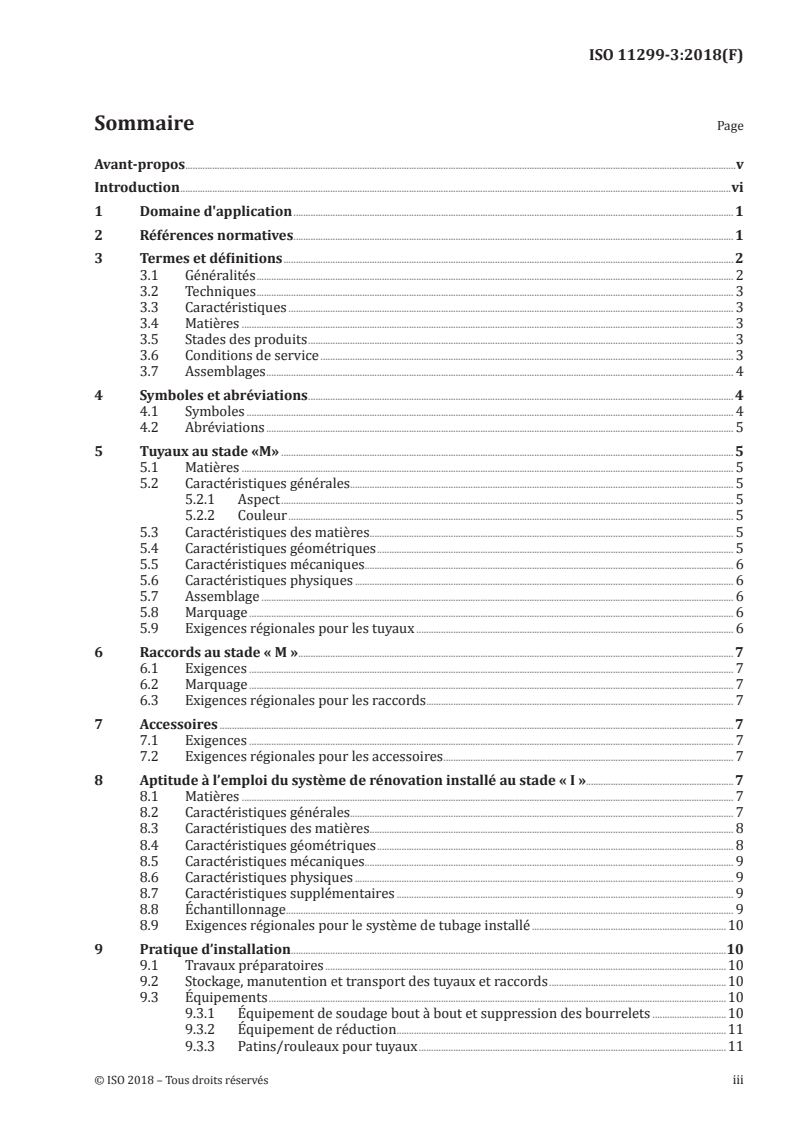
Sommaire Page
Avant-propos .v
Introduction .vi
1 Domaine d'application . 1
2 Références normatives . 1
3 Termes et définitions . 2
3.1 Généralités . 2
3.2 Techniques . 3
3.3 Caractéristiques . 3
3.4 Matières . 3
3.5 Stades des produits . 3
3.6 Conditions de service . 3
3.7 Assemblages . 4
4 Symboles et abréviations . 4
4.1 Symboles . 4
4.2 Abréviations . 5
5 Tuyaux au stade «M» . 5
5.1 Matières . 5
5.2 Caractéristiques générales. 5
5.2.1 Aspect . 5
5.2.2 Couleur . 5
5.3 Caractéristiques des matières . 5
5.4 Caractéristiques géométriques . 5
5.5 Caractéristiques mécaniques . 6
5.6 Caractéristiques physiques . 6
5.7 Assemblage . 6
5.8 Marquage . 6
5.9 Exigences régionales pour les tuyaux . 6
6 Raccords au stade « M » . 7
6.1 Exigences . 7
6.2 Marquage . 7
6.3 Exigences régionales pour les raccords . 7
7 Accessoires . 7
7.1 Exigences . 7
7.2 Exigences régionales pour les accessoires . 7
8 Aptitude à l’emploi du système de rénovation installé au stade « I » .7
8.1 Matières . 7
8.2 Caractéristiques générales. 7
8.3 Caractéristiques des matières . 8
8.4 Caractéristiques géométriques . 8
8.5 Caractéristiques mécaniques . 9
8.6 Caractéristiques physiques . 9
8.7 Caractéristiques supplémentaires . 9
8.8 Échantillonnage . 9
8.9 Exigences régionales pour le système de tubage installé .10
9 Pratique d’installation .10
9.1 Travaux préparatoires .10
9.2 Stockage, manutention et transport des tuyaux et raccords .10
9.3 Équipements .10
9.3.1 Équipement de soudage bout à bout et suppression des bourrelets .10
9.3.2 Équipement de réduction .11
9.3.3 Patins/rouleaux pour tuyaux .11
9.3.4 Équipement de treuillage et d’extraction à tige .11
9.3.5 Guides pour l’insertion des tuyaux .11
9.3.6 Équipement de remise à la forme initiale .11
9.3.7 Appareillage d’électrosoudage .12
9.3.8 Équipement d’inspection .12
9.3.9 Équipement de levage .12
9.4 Installation .12
9.5 Contrôle et essais relatifs au processus d’installation .13
9.6 Achèvement du tubage .13
9.7 Raccordement aux branchements existants .13
9.8 Inspection et essais finaux .13
9.9 Documentation .13
Annexe A (normative) Tuyau en polyéthylène (PE) plié en usine, rétabli à son état initial à
chaud — Détermination de la capacité de mémoire .14
Bibliographie .16
iv © ISO 2018 – Tous droits réservés
Avant-propos
L'ISO (Organisation internationale de normalisation) est une fédération mondiale d'organismes
nationaux de normalisation (comités membres de l'ISO). L'élaboration des Normes internationales est
en général confiée aux comités techniques de l'ISO. Chaque comité membre intéressé par une étude
a le droit de faire partie du comité technique créé à cet effet. Les organisations internationales,
gouvernementales et non gouvernementales, en liaison avec l'ISO participent également aux travaux.
L'ISO collabore étroitement avec la Commission électrotechnique internationale (IEC) en ce qui
concerne la normalisation électrotechnique.
Les procédures utilisées pour élaborer le présent document et celles destinées à sa mise à jour sont
décrites dans les Directives ISO/IEC, Partie 1. Il convient, en particulier de prendre note des différents
critères d'approbation requis pour les différents types de documents ISO. Le présent document a été
rédigé conformément aux règles de rédaction données dans les Directives ISO/IEC, Partie 2 (voir www
.iso .org/directives).
L'attention est attirée sur le fait que certains des éléments du présent document peuvent faire l'objet de
droits de propriété intellectuelle ou de droits analogues. L'ISO ne saurait être tenue pour responsable
de ne pas avoir identifié de tels droits de propriété et averti de leur existence. Les détails concernant
les références aux droits de propriété intellectuelle ou autres droits analogues identifiés lors de
l'élaboration du document sont indiqués dans l'Introduction et/ou dans la liste des déclarations de
brevets reçues par l'ISO (voir www .iso .org/brevets).
Les appellations commerciales éventuellement mentionnées dans le présent document sont données
pour information, par souci de commodité, à l’intention des utilisateurs et ne sauraient constituer un
engagement.
Pour une explication de la nature volontaire des normes, la signification des termes et expressions
spécifiques de l'ISO liés à l'évaluation de la conformité, ou pour toute information au sujet de l'adhésion
de l'ISO aux principes de l’Organisation mondiale du commerce (OMC) concernant les obstacles
techniques au commerce (OTC), voir le lien suivant: www .iso .org/iso/fr/avant -propos.
Le comité chargé de l’élaboration du présent document est l’ISO/TC 138/SC 8, Tubes, raccords et
robinetterie en matières plastiques pour le transport des fluides, Sous-comité SC 8, Réhabilitation des
systèmes de canalisations.
Cette deuxième édition annule et remplace la première édition (ISO 11299-3:2011), qui a fait l'objet
d'une révision technique.
Les principales modifications par rapport à l’édition précédente sont les suivantes:
La Figure 1, les Articles 1, 2, 3.3, 3.4, 3.6, 5.7, 5.8, 6, 8.4, 8.5 et de 9.2 à 9.8 ont fait l’objet d’une révision
technique.
Une liste de toutes les parties de la série ISO 11299 est disponible sur le site web de l’ISO.
Il convient que l’utilisateur adresse tout retour d’information ou toute question concernant le présent
document à l’organisme national de normalisation de son pays. Une liste exhaustive desdits organismes
se trouve à l’adresse www .iso .org/fr/members .html.
Introduction
Le présent document est une partie d’une Norme de Système pour les systèmes de canalisations en
plastique à base de matériaux variés, utilisés pour la rénovation de canalisations existantes pour
une zone d’application spécifiée. Les Normes de Systèmes relatives à la rénovation qui traitent des
applications suivantes sont disponibles ou en préparation:
— ISO 11296, Systèmes de canalisations en plastique pour la rénovation des réseaux de branchements et
de collecteurs d’assainissement enterrés sans pression;
— ISO 11297, Systèmes de canalisations en plastique pour la rénovation des réseaux de branchements et
de collecteurs d’assainissement enterrés sous pression;
— ISO 11298, Systèmes de canalisations en plastique pour la rénovation des réseaux d’alimentation en eau
enterrés;
— ISO 11299, Systèmes de canalisations en plastique pour la rénovation des réseaux enterrés de distribution
de gaz (la présente série de normes).
Ces Normes de Systèmes se distinguent de celles relatives aux systèmes de canalisations en plastique
installées traditionnellement par des exigences de vérification de certaines caractéristiques liées aux
conditions « tel qu'installé », après mise en œuvre sur le site. Cela s’ajoute aux exigences spécifiques
pour les composants du système de canalisations en plastique « tels que fabriqués ».
Chacune des Normes de Systèmes comprend une:
— Partie 1: Généralités;
et des parties relatives à toutes les familles de techniques de rénovation applicables qui, pour les
réseaux de distribution de gaz, comprennent ou peuvent comprendre ce qui suit:
— Partie 2: Tubage par tuyau continu avec espace annulaire;
— Partie 3: Tubage par tuyau continu sans espace annulaire (le présent document);
— Partie 4: Tubage continu polymérisé en place;
— Partie 6: Tubage par gaines souples revêtues d’un adhésif;
— Partie 11: Tubage par insertion de gaines souples.
Les exigences applicables à toute famille de techniques de rénovation donnée sont indiquées dans la
Partie 1, appliquée conjointement avec l’autre partie concernée. Par exemple, l’ISO 11299-1 et le présent
document spécifient ensemble les exigences se rapportant au tubage par tuyau continu sans espace
annulaire. Pour toute information complémentaire, voir l’ISO 11295. Toutes les familles de techniques
ne sont pas applicables pour chaque domaine d’application et cela se reflète dans les numéros de parties
compris dans chaque Norme de Système.
Une structure cohérente des titres des articles a été adoptée pour toutes les parties de l’ISO 11299 afin
de faciliter des comparaisons directes entre les différentes familles de techniques de rénovation.
La Figure 1 illustre la structure commune des parties et des articles et la relation entre l’ISO 11299 et
les Normes de Systèmes concernant d’autres domaines d’application.
vi © ISO 2018 – Tous droits réservés
Figure 1 — Présentation des normes de systèmes de rénovation
NORME INTERNATIONALE ISO 11299-3:2018(F)
Systèmes de canalisations en plastique pour la rénovation
des réseaux enterrés de distribution de gaz —
Partie 3:
Tubage par tuyau continu sans espace annulaire
1 Domaine d'application
Le présent document, conjointement à l’ISO 11299-1, spécifie les exigences et les méthodes d’essai
pour les systèmes de tubage par tuyau continu sans espace annulaire destinés à être utilisés pour la
rénovation des réseaux de distribution de gaz.
Il s’applique aux tuyaux et raccords, tels que fabriqués, ainsi qu’au système de rénovation installé. Il
s’applique aux tuyaux en polyéthylène (PE) ayant soit une construction monocouche à paroi compacte
soit une construction à couches co-extrudées, laquelle est réduite en usine ou sur site pour fournir un
tubage autostructurant ou un tubage nécessitant le maintien de l’enveloppe sans espace annulaire,
ainsi qu’aux raccords associés et aux assemblages pour la construction du système de rénovation. Le
présent document ne s’applique pas aux tuyaux en PE revêtus comportant une couche thermoplastique
supplémentaire pelable et contiguë à l’extérieur du tuyau.
Il s’applique aux tuyaux, raccords et montages en PE destinés à être utilisés à une température de
fonctionnement de 20 °C, qui est la température de référence.
NOTE Pour d’autres températures de services, des lignes directrices sont données dans l’ISO 4437-5:2014.
2 Références normatives
Les documents suivants cités dans le texte constituent, pour tout ou partie de leur contenu, des
exigences du présent document. Pour les références datées, seule l’édition citée s’applique. Pour les
références non datées, la dernière édition du document de référence s'applique (y compris les éventuels
amendements).
ISO 3126, Systèmes de canalisations en plastiques — Composants en plastiques — Détermination des
dimensions
ISO 4437-1, Systèmes de canalisations en matières plastiques pour la distribution de combustibles gazeux —
Polyéthylène (PE) — Partie 1: Généralités
ISO 4437-2, Systèmes·de·canalisations·en·matières·plastiques·pour·la·distribution·de·combustibles·gaze
ux — Polyéthylène·(PE) — Partie 2: Tuyaux
ISO 4437-3, Systèmes de canalisations en matières plastiques pour la distribution de combustibles
gazeux — Polyéthylène (PE) — Partie 3: Raccords
ISO 4437-5:2014, Systèmes de canalisations en matières plastiques pour la distribution de combustibles
gazeux — Polyéthylène (PE) — Partie 5: Aptitude à l’emploi
ISO 11299-1:2018, Systèmes de canalisations en plastique pour la rénovation des réseaux de gaz enterrés —
Partie 1: Généralités
ISO 12176-1, Tubes et raccords en matières plastiques — Appareillage pour l'assemblage par soudage des
systèmes en polyéthylène — Partie 1: Soudage bout à bout
ISO 12176-2, Tubes et raccords en matières plastiques — Appareillage pour l'assemblage par soudage des
systèmes en polyéthylène — Partie 2: Électrosoudage
EN 1555-1, Systèmes de canalisations en plastique pour la distribution de combustibles gazeux —
Polyéthylène (PE) —Partie 1: Généralités
EN 1555-2, Systèmes de canalisations en plastique pour la distribution de combustibles gazeux —
Polyéthylène (PE) —Partie 2: Tubes
EN 1555-3, Systèmes de canalisations en plastique pour la distribution de combustibles gazeux —
Polyéthylène (PE) —Partie 3: Raccords
EN 1555-4, Systèmes de canalisations en plastique pour la distribution de combustibles gazeux —
Polyéthylène (PE) —Partie 4: Robinets
EN 1555-5:2010, Systèmes de canalisations en plastique pour la distribution de combustibles gazeux —
Polyéthylène (PE) —Partie 5: Aptitude à l’emploi du système
3 Termes et définitions
Pour les besoins du présent document, les termes et définitions donnés dans l’ISO 11299-1 ainsi que les
suivants s'appliquent.
L'ISO et l'IEC tiennent à jour des bases de données terminologiques destinées à être utilisées en
normalisation, consultables aux adresses suivantes:
— IEC Electropedia: disponible à l'adresse http: //www .electropedia .org/
— ISO Online browsing platform: disponible à l'adresse https: //www .iso .org/obp
3.1 Généralités
3.1.1
composition/formulation
mélange homogène clairement défini du polymère de base avec des additifs, à savoir des anti-oxydants,
des pigments, des stabilisateurs et autres, au niveau de dosage nécessaire pour le traitement et
l’application prévue du produit final
3.1.2
tuyau monocouche à paroi compacte
tuyau ayant une surface interne et externe lisse, extrudé en utilisant la même composition/formulation
sur toute la paroi
3.1.3
tuyau à couches co-extrudées
tuyau ayant une surface interne et externe lisse, avec des couches co-extrudées à l’extérieur et/ou à
l’intérieur du tuyau, toutes les couches ayant la même classification MRS
3.1.4
sans espace annulaire
situation de l’extérieur du tubage installé par rapport à l’intérieur de la canalisation existante, qui peut
soit être un contact avec interférence, soit inclure un petit espace annulaire dû uniquement au retrait et
aux tolérances
3.1.5
tuyau continu sans espace annulaire
tuyau de rénovation continu en matière thermoplastique reformé, ou dilaté d’une autre manière après
l’insertion, assurant l’absence d’espace annulaire avec la canalisation existante
2 © ISO 2018 – Tous droits réservés
3.2 Techniques
Aucune définition supplémentaire ne s’applique.
3.3 Caractéristiques
3.3.1
MRS
résistance minimale requise
valeur de σ arrondie à la valeur inférieure la plus proche dans la série R10 ou dans la série R20, en
LPL
fonction de la valeur de σ
LPL
Note 1 à l'article: Les séries R10 et R20 correspondent aux séries de Renard conformément à l’ISO 3 et l’ISO 497.
3.3.2
MFR
indice de fluidité à chaud en masse
vitesse d’extrusion d’une résine fondue dans une filière de longueur et de diamètre spécifiés dans
des conditions prescrites de température, de charge et de position du piston dans le cylindre d’un
plastomètre d’extrusion, déterminée en termes de masse extrudée par intervalle de temps spécifié
Note 1 à l'article: Le MFR est exprimé en unités de grammes pour 10 min.
[SOURCE: ISO 1133-1:2011, 3.1]
3.4 Matières
3.4.1
fissuration
phénomène microstructural associé à une application à court-terme d’une déformation de traction
flexion excédant le seuil d’écoulement critique lié à la matière
3.5 Stades des produits
Aucune définition supplémentaire ne s’applique.
3.6 Conditions de service
3.6.1
pression maximale de service
MOP
1)
pression effective maximale du gaz dans le système de canalisation, exprimée en bar , qui est admise
en utilisation continue
Note 1 à l'article: Elle tient compte des caractéristiques physiques et mécaniques des composants du système de
canalisations (et de l’influence du gaz sur ces caractéristiques) et est calculée en utilisant la formule suivante:
20×MRS
MOP=
C×−()SDR 1
[SOURCE: ISO 17885:2015, 3.1.11]
2 5 2
1) 1 bar =0,1 MPa = 0,1 N/mm = 10 ⋅N/m
3.6.2
coefficient de calcul
C
coefficient de valeur supérieure à 2, qui tient compte à la fois des conditions de service et des propriétés
des composants d’un système de canalisations autres que celles qui sont prises en compte par la limite
inférieure de confiance
3.7 Assemblages
3.7.1
assemblage électrosoudable
assemblage entre un raccord à emboîture électrosoudable ou une selle électrosoudable en PE et un
tuyau ou un raccord à bouts mâles, réalisé en chauffant les raccords électrosoudables par effet Joule de
l’élément chauffant incorporé au niveau de leurs surfaces de raccordement, ce qui provoque la fusion du
matériau/de la matière adjacent(e) et le soudage des surfaces du tuyau et du raccord
3.7.2
assemblage par soudage bout à bout
assemblage réalisé par chauffage des extrémités planes des surfaces qui coïncident, en les maintenant
contre une plaque chauffante plane jusqu’à ce que la matière PE atteigne la température de fusion, en
retirant la plaque chauffante rapidement et en appliquant les deux extrémités ramollies l’une contre l’autre
3.7.3
assemblage mécanique
assemblage effectué par assemblage d’un tuyau en PE avec un autre tuyau en PE ou tout autre
élément du système de canalisations, au moyen d’un raccord qui comprend généralement un élément
de compression qui assure la tenue à la pression, l’étanchéité et un élément de pinçage qui assure la
résistance à l’effet de fond
Note 1 à l'article: Un manchon de support inséré à l’intérieur du trou du tuyau peut être utilisé pour fournir un
support permanent pour le tuyau en PE afin d’empêcher un fluage dans la paroi du tuyau soumise à des forces de
compression radiales.
3.7.4
compatibilité au soudage
capacité de deux matières PE semblables ou différentes à être soudées ensemble pour former un
assemblage qui réponde aux exigences de performance du présent document
4 Symboles et abréviations
4.1 Symboles
Pour les besoins du présent document, les symboles donnés dans l’ISO 11299-1 ainsi que les suivants
s’appliquent.
C coefficient de calcul
d diamètre extérieur (en un point quelconque)
e
d diamètre extérieur circulaire d’origine du tuyau (avant traitement pour insertion)
manuf
e épaisseur de paroi moyenne maximale
m,max
σ grandeur ayant les dimensions d’une contrainte, qui représente la limite inférieure de confiance
LPL
à 97,5 % de la résistance hydrostatique prévue à une température T et un temps t
T température à laquelle les données de contraintes de rupture ont été déterminées
t tenue du tuyau avant l’apparition d’une fuite
4 © ISO 2018 – Tous droits réservés
...
NORME ISO
INTERNATIONALE 11299-3
Deuxième édition
2018-10
Systèmes de canalisations en plastique
pour la rénovation des réseaux
enterrés de distribution de gaz —
Partie 3:
Tubage par tuyau continu sans espace
annulaire
Plastics piping systems for renovation of underground gas supply
networks —
Part 3: Lining with close-fit pipes
Numéro de référence
©
ISO 2018
DOCUMENT PROTÉGÉ PAR COPYRIGHT
© ISO 2018
Tous droits réservés. Sauf prescription différente ou nécessité dans le contexte de sa mise en œuvre, aucune partie de cette
publication ne peut être reproduite ni utilisée sous quelque forme que ce soit et par aucun procédé, électronique ou mécanique,
y compris la photocopie, ou la diffusion sur l’internet ou sur un intranet, sans autorisation écrite préalable. Une autorisation peut
être demandée à l’ISO à l’adresse ci-après ou au comité membre de l’ISO dans le pays du demandeur.
ISO copyright office
Case postale 401 • Ch. de Blandonnet 8
CH-1214 Vernier, Genève
Tél.: +41 22 749 01 11
Fax: +41 22 749 09 47
E-mail: copyright@iso.org
Web: www.iso.org
Publié en Suisse
ii © ISO 2018 – Tous droits réservés
Sommaire Page
Avant-propos .v
Introduction .vi
1 Domaine d'application . 1
2 Références normatives . 1
3 Termes et définitions . 2
3.1 Généralités . 2
3.2 Techniques . 3
3.3 Caractéristiques . 3
3.4 Matières . 3
3.5 Stades des produits . 3
3.6 Conditions de service . 3
3.7 Assemblages . 4
4 Symboles et abréviations . 4
4.1 Symboles . 4
4.2 Abréviations . 5
5 Tuyaux au stade «M» . 5
5.1 Matières . 5
5.2 Caractéristiques générales. 5
5.2.1 Aspect . 5
5.2.2 Couleur . 5
5.3 Caractéristiques des matières . 5
5.4 Caractéristiques géométriques . 5
5.5 Caractéristiques mécaniques . 6
5.6 Caractéristiques physiques . 6
5.7 Assemblage . 6
5.8 Marquage . 6
5.9 Exigences régionales pour les tuyaux . 6
6 Raccords au stade « M » . 7
6.1 Exigences . 7
6.2 Marquage . 7
6.3 Exigences régionales pour les raccords . 7
7 Accessoires . 7
7.1 Exigences . 7
7.2 Exigences régionales pour les accessoires . 7
8 Aptitude à l’emploi du système de rénovation installé au stade « I » .7
8.1 Matières . 7
8.2 Caractéristiques générales. 7
8.3 Caractéristiques des matières . 8
8.4 Caractéristiques géométriques . 8
8.5 Caractéristiques mécaniques . 9
8.6 Caractéristiques physiques . 9
8.7 Caractéristiques supplémentaires . 9
8.8 Échantillonnage . 9
8.9 Exigences régionales pour le système de tubage installé .10
9 Pratique d’installation .10
9.1 Travaux préparatoires .10
9.2 Stockage, manutention et transport des tuyaux et raccords .10
9.3 Équipements .10
9.3.1 Équipement de soudage bout à bout et suppression des bourrelets .10
9.3.2 Équipement de réduction .11
9.3.3 Patins/rouleaux pour tuyaux .11
9.3.4 Équipement de treuillage et d’extraction à tige .11
9.3.5 Guides pour l’insertion des tuyaux .11
9.3.6 Équipement de remise à la forme initiale .11
9.3.7 Appareillage d’électrosoudage .12
9.3.8 Équipement d’inspection .12
9.3.9 Équipement de levage .12
9.4 Installation .12
9.5 Contrôle et essais relatifs au processus d’installation .13
9.6 Achèvement du tubage .13
9.7 Raccordement aux branchements existants .13
9.8 Inspection et essais finaux .13
9.9 Documentation .13
Annexe A (normative) Tuyau en polyéthylène (PE) plié en usine, rétabli à son état initial à
chaud — Détermination de la capacité de mémoire .14
Bibliographie .16
iv © ISO 2018 – Tous droits réservés
Avant-propos
L'ISO (Organisation internationale de normalisation) est une fédération mondiale d'organismes
nationaux de normalisation (comités membres de l'ISO). L'élaboration des Normes internationales est
en général confiée aux comités techniques de l'ISO. Chaque comité membre intéressé par une étude
a le droit de faire partie du comité technique créé à cet effet. Les organisations internationales,
gouvernementales et non gouvernementales, en liaison avec l'ISO participent également aux travaux.
L'ISO collabore étroitement avec la Commission électrotechnique internationale (IEC) en ce qui
concerne la normalisation électrotechnique.
Les procédures utilisées pour élaborer le présent document et celles destinées à sa mise à jour sont
décrites dans les Directives ISO/IEC, Partie 1. Il convient, en particulier de prendre note des différents
critères d'approbation requis pour les différents types de documents ISO. Le présent document a été
rédigé conformément aux règles de rédaction données dans les Directives ISO/IEC, Partie 2 (voir www
.iso .org/directives).
L'attention est attirée sur le fait que certains des éléments du présent document peuvent faire l'objet de
droits de propriété intellectuelle ou de droits analogues. L'ISO ne saurait être tenue pour responsable
de ne pas avoir identifié de tels droits de propriété et averti de leur existence. Les détails concernant
les références aux droits de propriété intellectuelle ou autres droits analogues identifiés lors de
l'élaboration du document sont indiqués dans l'Introduction et/ou dans la liste des déclarations de
brevets reçues par l'ISO (voir www .iso .org/brevets).
Les appellations commerciales éventuellement mentionnées dans le présent document sont données
pour information, par souci de commodité, à l’intention des utilisateurs et ne sauraient constituer un
engagement.
Pour une explication de la nature volontaire des normes, la signification des termes et expressions
spécifiques de l'ISO liés à l'évaluation de la conformité, ou pour toute information au sujet de l'adhésion
de l'ISO aux principes de l’Organisation mondiale du commerce (OMC) concernant les obstacles
techniques au commerce (OTC), voir le lien suivant: www .iso .org/iso/fr/avant -propos.
Le comité chargé de l’élaboration du présent document est l’ISO/TC 138/SC 8, Tubes, raccords et
robinetterie en matières plastiques pour le transport des fluides, Sous-comité SC 8, Réhabilitation des
systèmes de canalisations.
Cette deuxième édition annule et remplace la première édition (ISO 11299-3:2011), qui a fait l'objet
d'une révision technique.
Les principales modifications par rapport à l’édition précédente sont les suivantes:
La Figure 1, les Articles 1, 2, 3.3, 3.4, 3.6, 5.7, 5.8, 6, 8.4, 8.5 et de 9.2 à 9.8 ont fait l’objet d’une révision
technique.
Une liste de toutes les parties de la série ISO 11299 est disponible sur le site web de l’ISO.
Il convient que l’utilisateur adresse tout retour d’information ou toute question concernant le présent
document à l’organisme national de normalisation de son pays. Une liste exhaustive desdits organismes
se trouve à l’adresse www .iso .org/fr/members .html.
Introduction
Le présent document est une partie d’une Norme de Système pour les systèmes de canalisations en
plastique à base de matériaux variés, utilisés pour la rénovation de canalisations existantes pour
une zone d’application spécifiée. Les Normes de Systèmes relatives à la rénovation qui traitent des
applications suivantes sont disponibles ou en préparation:
— ISO 11296, Systèmes de canalisations en plastique pour la rénovation des réseaux de branchements et
de collecteurs d’assainissement enterrés sans pression;
— ISO 11297, Systèmes de canalisations en plastique pour la rénovation des réseaux de branchements et
de collecteurs d’assainissement enterrés sous pression;
— ISO 11298, Systèmes de canalisations en plastique pour la rénovation des réseaux d’alimentation en eau
enterrés;
— ISO 11299, Systèmes de canalisations en plastique pour la rénovation des réseaux enterrés de distribution
de gaz (la présente série de normes).
Ces Normes de Systèmes se distinguent de celles relatives aux systèmes de canalisations en plastique
installées traditionnellement par des exigences de vérification de certaines caractéristiques liées aux
conditions « tel qu'installé », après mise en œuvre sur le site. Cela s’ajoute aux exigences spécifiques
pour les composants du système de canalisations en plastique « tels que fabriqués ».
Chacune des Normes de Systèmes comprend une:
— Partie 1: Généralités;
et des parties relatives à toutes les familles de techniques de rénovation applicables qui, pour les
réseaux de distribution de gaz, comprennent ou peuvent comprendre ce qui suit:
— Partie 2: Tubage par tuyau continu avec espace annulaire;
— Partie 3: Tubage par tuyau continu sans espace annulaire (le présent document);
— Partie 4: Tubage continu polymérisé en place;
— Partie 6: Tubage par gaines souples revêtues d’un adhésif;
— Partie 11: Tubage par insertion de gaines souples.
Les exigences applicables à toute famille de techniques de rénovation donnée sont indiquées dans la
Partie 1, appliquée conjointement avec l’autre partie concernée. Par exemple, l’ISO 11299-1 et le présent
document spécifient ensemble les exigences se rapportant au tubage par tuyau continu sans espace
annulaire. Pour toute information complémentaire, voir l’ISO 11295. Toutes les familles de techniques
ne sont pas applicables pour chaque domaine d’application et cela se reflète dans les numéros de parties
compris dans chaque Norme de Système.
Une structure cohérente des titres des articles a été adoptée pour toutes les parties de l’ISO 11299 afin
de faciliter des comparaisons directes entre les différentes familles de techniques de rénovation.
La Figure 1 illustre la structure commune des parties et des articles et la relation entre l’ISO 11299 et
les Normes de Systèmes concernant d’autres domaines d’application.
vi © ISO 2018 – Tous droits réservés
Figure 1 — Présentation des normes de systèmes de rénovation
NORME INTERNATIONALE ISO 11299-3:2018(F)
Systèmes de canalisations en plastique pour la rénovation
des réseaux enterrés de distribution de gaz —
Partie 3:
Tubage par tuyau continu sans espace annulaire
1 Domaine d'application
Le présent document, conjointement à l’ISO 11299-1, spécifie les exigences et les méthodes d’essai
pour les systèmes de tubage par tuyau continu sans espace annulaire destinés à être utilisés pour la
rénovation des réseaux de distribution de gaz.
Il s’applique aux tuyaux et raccords, tels que fabriqués, ainsi qu’au système de rénovation installé. Il
s’applique aux tuyaux en polyéthylène (PE) ayant soit une construction monocouche à paroi compacte
soit une construction à couches co-extrudées, laquelle est réduite en usine ou sur site pour fournir un
tubage autostructurant ou un tubage nécessitant le maintien de l’enveloppe sans espace annulaire,
ainsi qu’aux raccords associés et aux assemblages pour la construction du système de rénovation. Le
présent document ne s’applique pas aux tuyaux en PE revêtus comportant une couche thermoplastique
supplémentaire pelable et contiguë à l’extérieur du tuyau.
Il s’applique aux tuyaux, raccords et montages en PE destinés à être utilisés à une température de
fonctionnement de 20 °C, qui est la température de référence.
NOTE Pour d’autres températures de services, des lignes directrices sont données dans l’ISO 4437-5:2014.
2 Références normatives
Les documents suivants cités dans le texte constituent, pour tout ou partie de leur contenu, des
exigences du présent document. Pour les références datées, seule l’édition citée s’applique. Pour les
références non datées, la dernière édition du document de référence s'applique (y compris les éventuels
amendements).
ISO 3126, Systèmes de canalisations en plastiques — Composants en plastiques — Détermination des
dimensions
ISO 4437-1, Systèmes de canalisations en matières plastiques pour la distribution de combustibles gazeux —
Polyéthylène (PE) — Partie 1: Généralités
ISO 4437-2, Systèmes·de·canalisations·en·matières·plastiques·pour·la·distribution·de·combustibles·gaze
ux — Polyéthylène·(PE) — Partie 2: Tuyaux
ISO 4437-3, Systèmes de canalisations en matières plastiques pour la distribution de combustibles
gazeux — Polyéthylène (PE) — Partie 3: Raccords
ISO 4437-5:2014, Systèmes de canalisations en matières plastiques pour la distribution de combustibles
gazeux — Polyéthylène (PE) — Partie 5: Aptitude à l’emploi
ISO 11299-1:2018, Systèmes de canalisations en plastique pour la rénovation des réseaux de gaz enterrés —
Partie 1: Généralités
ISO 12176-1, Tubes et raccords en matières plastiques — Appareillage pour l'assemblage par soudage des
systèmes en polyéthylène — Partie 1: Soudage bout à bout
ISO 12176-2, Tubes et raccords en matières plastiques — Appareillage pour l'assemblage par soudage des
systèmes en polyéthylène — Partie 2: Électrosoudage
EN 1555-1, Systèmes de canalisations en plastique pour la distribution de combustibles gazeux —
Polyéthylène (PE) —Partie 1: Généralités
EN 1555-2, Systèmes de canalisations en plastique pour la distribution de combustibles gazeux —
Polyéthylène (PE) —Partie 2: Tubes
EN 1555-3, Systèmes de canalisations en plastique pour la distribution de combustibles gazeux —
Polyéthylène (PE) —Partie 3: Raccords
EN 1555-4, Systèmes de canalisations en plastique pour la distribution de combustibles gazeux —
Polyéthylène (PE) —Partie 4: Robinets
EN 1555-5:2010, Systèmes de canalisations en plastique pour la distribution de combustibles gazeux —
Polyéthylène (PE) —Partie 5: Aptitude à l’emploi du système
3 Termes et définitions
Pour les besoins du présent document, les termes et définitions donnés dans l’ISO 11299-1 ainsi que les
suivants s'appliquent.
L'ISO et l'IEC tiennent à jour des bases de données terminologiques destinées à être utilisées en
normalisation, consultables aux adresses suivantes:
— IEC Electropedia: disponible à l'adresse http: //www .electropedia .org/
— ISO Online browsing platform: disponible à l'adresse https: //www .iso .org/obp
3.1 Généralités
3.1.1
composition/formulation
mélange homogène clairement défini du polymère de base avec des additifs, à savoir des anti-oxydants,
des pigments, des stabilisateurs et autres, au niveau de dosage nécessaire pour le traitement et
l’application prévue du produit final
3.1.2
tuyau monocouche à paroi compacte
tuyau ayant une surface interne et externe lisse, extrudé en utilisant la même composition/formulation
sur toute la paroi
3.1.3
tuyau à couches co-extrudées
tuyau ayant une surface interne et externe lisse, avec des couches co-extrudées à l’extérieur et/ou à
l’intérieur du tuyau, toutes les couches ayant la même classification MRS
3.1.4
sans espace annulaire
situation de l’extérieur du tubage installé par rapport à l’intérieur de la canalisation existante, qui peut
soit être un contact avec interférence, soit inclure un petit espace annulaire dû uniquement au retrait et
aux tolérances
3.1.5
tuyau continu sans espace annulaire
tuyau de rénovation continu en matière thermoplastique reformé, ou dilaté d’une autre manière après
l’insertion, assurant l’absence d’espace annulaire avec la canalisation existante
2 © ISO 2018 – Tous droits réservés
3.2 Techniques
Aucune définition supplémentaire ne s’applique.
3.3 Caractéristiques
3.3.1
MRS
résistance minimale requise
valeur de σ arrondie à la valeur inférieure la plus proche dans la série R10 ou dans la série R20, en
LPL
fonction de la valeur de σ
LPL
Note 1 à l'article: Les séries R10 et R20 correspondent aux séries de Renard conformément à l’ISO 3 et l’ISO 497.
3.3.2
MFR
indice de fluidité à chaud en masse
vitesse d’extrusion d’une résine fondue dans une filière de longueur et de diamètre spécifiés dans
des conditions prescrites de température, de charge et de position du piston dans le cylindre d’un
plastomètre d’extrusion, déterminée en termes de masse extrudée par intervalle de temps spécifié
Note 1 à l'article: Le MFR est exprimé en unités de grammes pour 10 min.
[SOURCE: ISO 1133-1:2011, 3.1]
3.4 Matières
3.4.1
fissuration
phénomène microstructural associé à une application à court-terme d’une déformation de traction
flexion excédant le seuil d’écoulement critique lié à la matière
3.5 Stades des produits
Aucune définition supplémentaire ne s’applique.
3.6 Conditions de service
3.6.1
pression maximale de service
MOP
1)
pression effective maximale du gaz dans le système de canalisation, exprimée en bar , qui est admise
en utilisation continue
Note 1 à l'article: Elle tient compte des caractéristiques physiques et mécaniques des composants du système de
canalisations (et de l’influence du gaz sur ces caractéristiques) et est calculée en utilisant la formule suivante:
20×MRS
MOP=
C×−()SDR 1
[SOURCE: ISO 17885:2015, 3.1.11]
2 5 2
1) 1 bar =0,1 MPa = 0,1 N/mm = 10 ⋅N/m
3.6.2
coefficient de calcul
C
coefficient de valeur supérieure à 2, qui tient compte à la fois des conditions de service et des propriétés
des composants d’un système de canalisations autres que celles qui sont prises en compte par la limite
inférieure de confiance
3.7 Assemblages
3.7.1
assemblage électrosoudable
assemblage entre un raccord à emboîture électrosoudable ou une selle électrosoudable en PE et un
tuyau ou un raccord à bouts mâles, réalisé en chauffant les raccords électrosoudables par effet Joule de
l’élément chauffant incorporé au niveau de leurs surfaces de raccordement, ce qui provoque la fusion du
matériau/de la matière adjacent(e) et le soudage des surfaces du tuyau et du raccord
3.7.2
assemblage par soudage bout à bout
assemblage réalisé par chauffage des extrémités planes des surfaces qui coïncident, en les maintenant
contre une plaque chauffante plane jusqu’à ce que la matière PE atteigne la température de fusion, en
retirant la plaque chauffante rapidement et en appliquant les deux extrémités ramollies l’une contre l’autre
3.7.3
assemblage mécanique
assemblage effectué par assemblage d’un tuyau en PE avec un autre tuyau en PE ou tout autre
élément du système de canalisations, au moyen d’un raccord qui comprend généralement un élément
de compression qui assure la tenue à la pression, l’étanchéité et un élément de pinçage qui assure la
résistance à l’effet de fond
Note 1 à l'article: Un manchon de support inséré à l’intérieur du trou du tuyau peut être utilisé pour fournir un
support permanent pour le tuyau en PE afin d’empêcher un fluage dans la paroi du tuyau soumise à des forces de
compression radiales.
3.7.4
compatibilité au soudage
capacité de deux matières PE semblables ou différentes à être soudées ensemble pour former un
assemblage qui réponde aux exigences de performance du présent document
4 Symboles et abréviations
4.1 Symboles
Pour les besoins du présent document, les symboles donnés dans l’ISO 11299-1 ainsi que les suivants
s’appliquent.
C coefficient de calcul
d diamètre extérieur (en un point quelconque)
e
d diamètre extérieur circulaire d’origine du tuyau (avant traitement pour insertion)
manuf
e épaisseur de paroi moyenne maximale
m,max
σ grandeur ayant les dimensions d’une contrainte, qui représente la limite inférieure de confiance
LPL
à 97,5 % de la résistance hydrostatique prévue à une température T et un temps t
T température à laquelle les données de contraintes de rupture ont été déterminées
t tenue du tuyau avant l’apparition d’une fuite
4 © ISO 2018 – Tous droits réservés
...