


ISO 9012:2008
(Main)Gas welding equipment — Air-aspirated hand blowpipes — Specifications and tests
Gas welding equipment — Air-aspirated hand blowpipes — Specifications and tests
ISO 9012:2008 specifies requirements and test methods for air-aspirated hand blowpipes. ISO 9012:2008 applies to blowpipes for brazing, soldering, heating, fusion and other allied thermal processes, which use a fuel gas and aspirated air (injector-type blowpipes), and are intended for manual use. ISO 9012:2008 is applicable to: air-aspirated hand blowpipes which are fed with a fuel gas in the gaseous phase, at a controlled pressure by a regulator, through a gas supply hose; air-aspirated hand blowpipes which are fed with a liquefied fuel gas in the gaseous phase at the container pressure, through a gas supply hose; so-called liquid-phase blowpipes which are fed with a fuel gas in the liquid phase, and where thermal evaporation takes place within the blowpipe.
Équipement de soudage aux gaz — Chalumeaux manuels aéro-gaz à air aspiré — Spécifications et essais
L'ISO 9012:2008 spécifie les exigences et les méthodes d'essai des chalumeaux manuels aéro-gaz à air aspiré. L'ISO 9012:2008 s'applique aux chalumeaux destinés au brasage fort, au brasage tendre, au chauffage, à la fusion et aux autres procédés thermiques similaires, utilisant un gaz combustible et de l'air aspiré (chalumeau à air induit), conçus pour une utilisation manuelle. L'ISO 9012:2008 s'applique également aux chalumeaux manuels aéro-gaz à air aspiré, alimentés par un gaz combustible en phase gazeuse, sous une pression régulée par un détendeur, à travers un tuyau d'amenée de gaz, aux chalumeaux manuels aéro-gaz à air aspiré, alimentés par un gaz combustible liquéfié en phase gazeuse sous la pression du réservoir, à travers un tuyau d'amenée de gaz et aux chalumeaux dits à phase liquide, alimentés par un gaz combustible en phase liquide et dans lesquels se produit une évaporation thermique.
General Information
- Status
- Withdrawn
- Publication Date
- 06-Feb-2008
- Technical Committee
- ISO/TC 44/SC 8 - Equipment for gas welding, cutting and allied processes
- Drafting Committee
- ISO/TC 44/SC 8 - Equipment for gas welding, cutting and allied processes
- Current Stage
- 9599 - Withdrawal of International Standard
- Start Date
- 17-Oct-2023
- Completion Date
- 14-Feb-2026
Relations
- Revised
ISO 9012:2023 - Gas welding equipment — Air-aspirated hand blowpipes — Specifications and tests - Effective Date
- 23-Apr-2020
- Revises
ISO 9012:1998 - Gas welding equipment — Air-aspirated hand blowpipes — Specifications and tests - Effective Date
- 15-Apr-2008
Buy Documents
ISO 9012:2008 - Gas welding equipment -- Air-aspirated hand blowpipes -- Specifications and tests
ISO 9012:2008 - Équipement de soudage aux gaz -- Chalumeaux manuels aéro-gaz a air aspiré -- Spécifications et essais
Get Certified
Connect with accredited certification bodies for this standard

National Aerospace and Defense Contractors Accreditation Program (NADCAP)
Global cooperative program for special process quality in aerospace.
CARES (UK Certification Authority for Reinforcing Steels)
UK certification for reinforcing steels and construction.
DVS-ZERT GmbH
German welding certification society.
Sponsored listings
Frequently Asked Questions
ISO 9012:2008 is a standard published by the International Organization for Standardization (ISO). Its full title is "Gas welding equipment — Air-aspirated hand blowpipes — Specifications and tests". This standard covers: ISO 9012:2008 specifies requirements and test methods for air-aspirated hand blowpipes. ISO 9012:2008 applies to blowpipes for brazing, soldering, heating, fusion and other allied thermal processes, which use a fuel gas and aspirated air (injector-type blowpipes), and are intended for manual use. ISO 9012:2008 is applicable to: air-aspirated hand blowpipes which are fed with a fuel gas in the gaseous phase, at a controlled pressure by a regulator, through a gas supply hose; air-aspirated hand blowpipes which are fed with a liquefied fuel gas in the gaseous phase at the container pressure, through a gas supply hose; so-called liquid-phase blowpipes which are fed with a fuel gas in the liquid phase, and where thermal evaporation takes place within the blowpipe.
ISO 9012:2008 specifies requirements and test methods for air-aspirated hand blowpipes. ISO 9012:2008 applies to blowpipes for brazing, soldering, heating, fusion and other allied thermal processes, which use a fuel gas and aspirated air (injector-type blowpipes), and are intended for manual use. ISO 9012:2008 is applicable to: air-aspirated hand blowpipes which are fed with a fuel gas in the gaseous phase, at a controlled pressure by a regulator, through a gas supply hose; air-aspirated hand blowpipes which are fed with a liquefied fuel gas in the gaseous phase at the container pressure, through a gas supply hose; so-called liquid-phase blowpipes which are fed with a fuel gas in the liquid phase, and where thermal evaporation takes place within the blowpipe.
ISO 9012:2008 is classified under the following ICS (International Classification for Standards) categories: 25.160.30 - Welding equipment. The ICS classification helps identify the subject area and facilitates finding related standards.
ISO 9012:2008 has the following relationships with other standards: It is inter standard links to ISO 9012:2023, ISO 9012:1998. Understanding these relationships helps ensure you are using the most current and applicable version of the standard.
ISO 9012:2008 is available in PDF format for immediate download after purchase. The document can be added to your cart and obtained through the secure checkout process. Digital delivery ensures instant access to the complete standard document.
Standards Content (Sample)
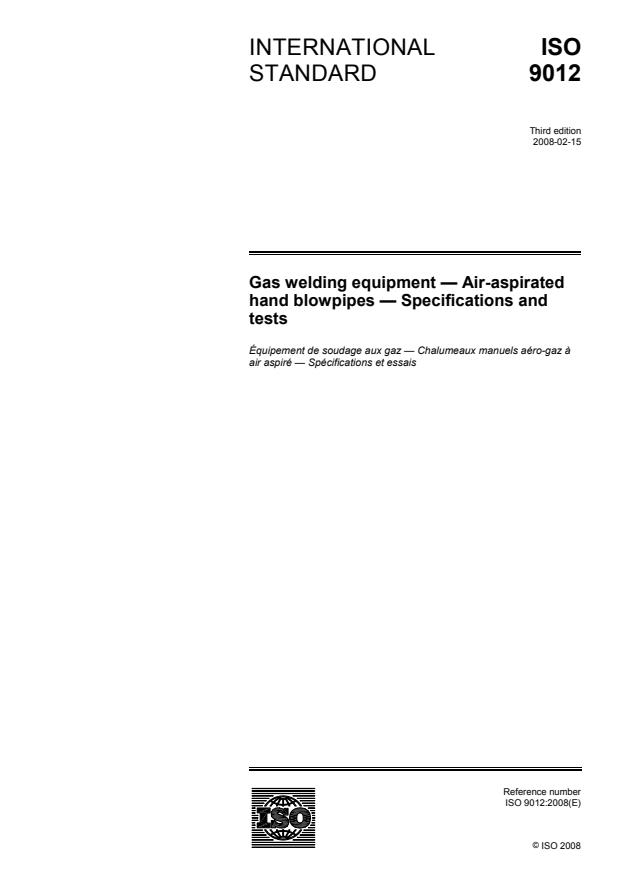
INTERNATIONAL ISO
STANDARD 9012
Third edition
2008-02-15
Gas welding equipment — Air-aspirated
hand blowpipes — Specifications and
tests
Équipement de soudage aux gaz — Chalumeaux manuels aéro-gaz à
air aspiré — Spécifications et essais
Reference number
©
ISO 2008
PDF disclaimer
This PDF file may contain embedded typefaces. In accordance with Adobe's licensing policy, this file may be printed or viewed but
shall not be edited unless the typefaces which are embedded are licensed to and installed on the computer performing the editing. In
downloading this file, parties accept therein the responsibility of not infringing Adobe's licensing policy. The ISO Central Secretariat
accepts no liability in this area.
Adobe is a trademark of Adobe Systems Incorporated.
Details of the software products used to create this PDF file can be found in the General Info relative to the file; the PDF-creation
parameters were optimized for printing. Every care has been taken to ensure that the file is suitable for use by ISO member bodies. In
the unlikely event that a problem relating to it is found, please inform the Central Secretariat at the address given below.
© ISO 2008
All rights reserved. Unless otherwise specified, no part of this publication may be reproduced or utilized in any form or by any means,
electronic or mechanical, including photocopying and microfilm, without permission in writing from either ISO at the address below or
ISO's member body in the country of the requester.
ISO copyright office
Case postale 56 • CH-1211 Geneva 20
Tel. + 41 22 749 01 11
Fax + 41 22 749 09 47
E-mail copyright@iso.org
Web www.iso.org
Published in Switzerland
ii © ISO 2008 – All rights reserved
Contents Page
Foreword. iv
1 Scope . 1
2 Normative references . 1
3 Terms and definitions. 1
4 Main types of aspiration. 2
5 Description of components . 5
5.1 Shank or handle . 5
5.2 Attachment . 5
5.3 Self-closing on/off valve control . 6
5.4 Device to prevent inadvertent operation. 6
6 Requirements . 6
6.1 General. 6
6.2 Materials . 6
6.3 Valves. 6
6.4 Shank . 6
6.5 Hose connection. 7
6.6 Gas tightness . 7
6.7 Gas-flow rate . 7
6.8 Safety against sustained backfiring and blowing-off of the flame . 7
6.9 Flame adjustment . 7
6.10 Stability in air currents. 7
6.11 Ignition . 8
7 Tests. 8
7.1 General. 8
7.2 General checks . 8
7.3 Operational tests. 8
7.4 Shank-overheating tests . 8
7.5 Gas tightness . 8
7.6 Valve endurance test. 9
7.7 Checking gas-flow rates . 9
7.8 Safety against sustained backfire and blowing-off of the flame . 9
7.9 Stability in air currents. 9
7.10 Verification of the device against inadvertent operation. 9
8 Marking . 9
8.1 General. 9
8.2 Marking of the shank. 10
8.3 Marking of the attachment . 10
9 Code letters identifying the gas(es) used . 10
10 Instructions for use . 10
Bibliography . 12
Foreword
ISO (the International Organization for Standardization) is a worldwide federation of national standards bodies
(ISO member bodies). The work of preparing International Standards is normally carried out through ISO
technical committees. Each member body interested in a subject for which a technical committee has been
established has the right to be represented on that committee. International organizations, governmental and
non-governmental, in liaison with ISO, also take part in the work. ISO collaborates closely with the
International Electrotechnical Commission (IEC) on all matters of electrotechnical standardization.
International Standards are drafted in accordance with the rules given in the ISO/IEC Directives, Part 2.
The main task of technical committees is to prepare International Standards. Draft International Standards
adopted by the technical committees are circulated to the member bodies for voting. Publication as an
International Standard requires approval by at least 75 % of the member bodies casting a vote.
Attention is drawn to the possibility that some of the elements of this document may be the subject of patent
rights. ISO shall not be held responsible for identifying any or all such patent rights.
ISO 9012 was prepared by Technical Committee ISO/TC 44, Welding and allied processes, Subcommittee
SC 8, Equipment for gas welding, cutting and allied processes.
This third edition cancels and replaces the second edition (ISO 9012:1998), which has been technically
revised.
Requests for official interpretations of any aspect of this International Standard should be directed to the
Secretariat of ISO/TC 44/SC 8 via your national standards body. A complete listing of these bodies can be
found at www.iso.org.
iv © ISO 2008 – All rights reserved
INTERNATIONAL STANDARD ISO 9012:2008(E)
Gas welding equipment — Air-aspirated hand blowpipes —
Specifications and tests
1 Scope
This International Standard specifies requirements and test methods for air-aspirated hand blowpipes.
This International Standard applies to blowpipes for brazing, soldering, heating, fusion and other allied thermal
processes, which use a fuel gas and aspirated air (injector-type blowpipes), and are intended for manual use.
This International Standard is applicable to:
⎯ air-aspirated hand blowpipes which are fed with a fuel gas in the gaseous phase, at a controlled pressure
by a regulator, through a gas supply hose;
⎯ air-aspirated hand blowpipes which are fed with a liquefied fuel gas in the gaseous phase at the container
pressure, through a gas supply hose;
⎯ so-called liquid-phase blowpipes which are fed with a fuel gas in the liquid phase, and where thermal
evaporation takes place within the blowpipe.
It does not apply to blowpipes in which the fuel gas leaves the injector in the liquid phase, or to so-called
“cartridge” blowpipes where the gas supply is fixed directly onto the blowpipe and possibly constitutes the
shank.
NOTE Figures 1 to 4 of this International Standard are given for guidance only, to facilitate the explanation of the
terms. They do not specify the construction details which are left to the discretion of the manufacturer.
2 Normative references
The following referenced documents are indispensable for the application of this document. For dated
references, only the edition cited applies. For undated references, the latest edition of the referenced
document (including any amendments) applies.
ISO 554, Standard atmospheres for conditioning and/or testing — Specifications
ISO 9090, Gas tightness of equipment for gas welding and allied processes
ISO 9539, Materials for equipment used in gas welding, cutting and allied processes
3 Terms and definitions
For the purposes of this document, the following terms and definitions apply.
3.1
air-aspirated blowpipe
blowpipe in which the fuel gas leaves the injector in the gaseous phase, being subsequently mixed in the
mixing zone with a sufficient quantity of air, aspirated from the ambient atmosphere, to produce a technically
usable flame
See Figure 1.
NOTE See Table 1 for the key to Figure 1.
Figure 1 — Schematic drawing of the mixing zone
3.2
sustained backfire
penetration of the flame into the blowpipe, with continued burning upstream of the part intended for this
purpose, i.e. within:
⎯ the blowpipe nozzle, behind the grid or flame-supporting devices;
⎯ the tube;
⎯ the blowpipe shank.
3.3
blowing-off of the flame
detachment of the flame from the blowpipe nozzle, possibly causing the flame to be extinguished
4 Main types of aspiration
Depending on the location of the mixing zone, a distinction is made between blowpipes with air aspiration in
the:
a) attachment (see Figure 2);
b) nozzle (see Figure 3);
c) shank (see Figure 4).
2 © ISO 2008 – All rights reserved
NOTE See Table 1 for the key to Figure 2.
Figure 2 — Examples of blowpipes with air aspiration in the attachment
NOTE See Table 1 for the key to Figure 3.
Figure 3 — Examples of blowpipes with air aspiration in the nozzle
NOTE See Table 1 for the key to Figure 4.
Figure 4 — Examples of blowpipes with air aspiration in the shank
Table 1 — Labels for Figures 1 to 4
Assemblies Items
A hose 1 handle
B shank 2 valve
C attachment with air aspiration 3 hose connection
D soldering attachment with air aspiration with a copper bit 4 head connection
E bent tube 5 injector
F straight tube 6 air inlet
G blowpipe nozzle with air aspiration 7 tube (may include air inlet)
H liquid-phase nozzle with air aspiration 8 blowpipe nozzle
I injector-type shank 9 soldering bit
J attachment for bit soldering 10 bit support
K attachment (without injector) 11 connection
12 a
...
NORME ISO
INTERNATIONALE 9012
Troisième édition
2008-02-15
Équipement de soudage aux gaz —
Chalumeaux manuels aéro-gaz à air
aspiré — Spécifications et essais
Gas welding equipment — Air-aspirated hand blowpipes —
Specifications and tests
Numéro de référence
©
ISO 2008
PDF – Exonération de responsabilité
Le présent fichier PDF peut contenir des polices de caractères intégrées. Conformément aux conditions de licence d'Adobe, ce fichier
peut être imprimé ou visualisé, mais ne doit pas être modifié à moins que l'ordinateur employé à cet effet ne bénéficie d'une licence
autorisant l'utilisation de ces polices et que celles-ci y soient installées. Lors du téléchargement de ce fichier, les parties concernées
acceptent de fait la responsabilité de ne pas enfreindre les conditions de licence d'Adobe. Le Secrétariat central de l'ISO décline toute
responsabilité en la matière.
Adobe est une marque déposée d'Adobe Systems Incorporated.
Les détails relatifs aux produits logiciels utilisés pour la création du présent fichier PDF sont disponibles dans la rubrique General Info
du fichier; les paramètres de création PDF ont été optimisés pour l'impression. Toutes les mesures ont été prises pour garantir
l'exploitation de ce fichier par les comités membres de l'ISO. Dans le cas peu probable où surviendrait un problème d'utilisation,
veuillez en informer le Secrétariat central à l'adresse donnée ci-dessous.
DOCUMENT PROTÉGÉ PAR COPYRIGHT
© ISO 2008
Droits de reproduction réservés. Sauf prescription différente, aucune partie de cette publication ne peut être reproduite ni utilisée sous
quelque forme que ce soit et par aucun procédé, électronique ou mécanique, y compris la photocopie et les microfilms, sans l'accord écrit
de l'ISO à l'adresse ci-après ou du comité membre de l'ISO dans le pays du demandeur.
ISO copyright office
Case postale 56 • CH-1211 Geneva 20
Tel. + 41 22 749 01 11
Fax. + 41 22 749 09 47
E-mail copyright@iso.org
Web www.iso.org
Publié en Suisse
ii © ISO 2008 – Tous droits réservés
Sommaire Page
Avant-propos. iv
1 Domaine d'application. 1
2 Références normatives . 1
3 Termes et définitions. 2
4 Principaux types d'aspiration. 2
5 Description des composants. 5
5.1 Manche ou poignée . 5
5.2 Lance. 5
5.3 Robinet de commande d'ouverture/de fermeture automatique. 6
5.4 Dispositif de sécurité empêchant la mise en marche accidentelle . 6
6 Exigences . 6
6.1 Généralités . 6
6.2 Matériaux . 6
6.3 Robinets. 6
6.4 Manche. 6
6.5 Raccords de tuyaux. 7
6.6 Étanchéité aux gaz. 7
6.7 Débit de gaz. 7
6.8 Sécurité contre les rentrées de flamme et les décollements de flamme . 7
6.9 Réglage de la flamme . 7
6.10 Stabilité aux vents . 8
6.11 Allumage. 8
7 Essais. 8
7.1 Généralités . 8
7.2 Vérifications générales. 8
7.3 Essais de fonctionnement . 8
7.4 Essais d'échauffement du manche. 8
7.5 Étanchéité aux gaz. 9
7.6 Essais d'endurance des robinets. 9
7.7 Vérification des débits. 9
7.8 Sécurité contre les rentrées de flamme et les décollements de flamme . 9
7.9 Stabilité aux vents . 9
7.10 Vérification du dispositif empêchant la mise en marche accidentelle. 9
8 Marquage . 10
8.1 Généralités . 10
8.2 Marquage du manche. 10
8.3 Marquage de la lance. 10
9 Lettres codes identifiant le(s) gaz utilisé(s). 10
10 Notice d'emploi . 10
Bibliographie . 12
Avant-propos
L'ISO (Organisation internationale de normalisation) est une fédération mondiale d'organismes nationaux de
normalisation (comités membres de l'ISO). L'élaboration des Normes internationales est en général confiée
aux comités techniques de l'ISO. Chaque comité membre intéressé par une étude a le droit de faire partie du
comité technique créé à cet effet. Les organisations internationales, gouvernementales et non
gouvernementales, en liaison avec l'ISO participent également aux travaux. L'ISO collabore étroitement avec
la Commission électrotechnique internationale (CEI) en ce qui concerne la normalisation électrotechnique.
Les Normes internationales sont rédigées conformément aux règles données dans les Directives ISO/CEI,
Partie 2.
La tâche principale des comités techniques est d'élaborer les Normes internationales. Les projets de Normes
internationales adoptés par les comités techniques sont soumis aux comités membres pour vote. Leur
publication comme Normes internationales requiert l'approbation de 75 % au moins des comités membres
votants.
L'attention est appelée sur le fait que certains des éléments du présent document peuvent faire l'objet de
droits de propriété intellectuelle ou de droits analogues. L'ISO ne saurait être tenue pour responsable de ne
pas avoir identifié de tels droits de propriété et averti de leur existence.
L'ISO 9012 a été élaborée par le comité technique ISO/TC 44, Soudage et techniques connexes, sous-comité
SC 8, Matériel pour le soudage au gaz, le coupage et les techniques connexes.
Cette troisième édition annule et remplace la deuxième édition (ISO 9012:1998), qui a fait l'objet d'une
révision technique.
Les demandes d'interprétations officielles de l'un quelconque des aspects de la présente Norme internationale
sont à faire parvenir au Secrétariat de l'ISO/TC 44/SC 8 via le Comité membre national dont une liste
exhaustive peut être trouvée à l'adresse www.iso.org.
iv © ISO 2008 – Tous droits réservés
NORME INTERNATIONALE ISO 9012:2008(F)
Équipement de soudage aux gaz — Chalumeaux manuels aéro-
gaz à air aspiré — Spécifications et essais
1 Domaine d'application
La présente Norme internationale spécifie les exigences et les méthodes d'essai des chalumeaux manuels
aéro-gaz à air aspiré.
La présente Norme internationale s'applique aux chalumeaux destinés au brasage fort, au brasage tendre, au
chauffage, à la fusion et aux autres procédés thermiques similaires, utilisant un gaz combustible et de l'air
aspiré (chalumeau à air induit), conçus pour une utilisation manuelle.
La présente Norme internationale s'applique également
⎯ aux chalumeaux manuels aéro-gaz à air aspiré, alimentés par un gaz combustible en phase gazeuse,
sous une pression régulée par un détendeur, à travers un tuyau d'amenée de gaz,
⎯ aux chalumeaux manuels aéro-gaz à air aspiré, alimentés par un gaz combustible liquéfié en phase
gazeuse sous la pression du réservoir, à travers un tuyau d'amenée de gaz,
⎯ aux chalumeaux dits à phase liquide, alimentés par un gaz combustible en phase liquide et dans lesquels
se produit une évaporation thermique.
Elle ne s'applique pas aux chalumeaux dans lesquels le gaz combustible sort de l'injecteur en phase liquide,
ni aux chalumeaux dits «à cartouche» comportant une réserve de gaz directement fixée sur le chalumeau et
pouvant éventuellement servir de manche.
NOTE Les dessins figurant dans la présente Norme internationale sont donnés à titre indicatif pour faciliter
l'explication des termes. Ils ne spécifient pas les détails de construction qui sont laissés à la discrétion du fabricant.
2 Références normatives
Les documents de référence suivants sont indispensables pour l'application du présent document. Pour les
références datées, seule l'édition citée s'applique. Pour les références non datées, la dernière édition du
document de référence s'applique (y compris les éventuels amendements).
ISO 554, Atmosphères normales de conditionnement et/ou d'essai — Spécifications
ISO 9090, Étanchéité aux gaz des appareils pour soudage aux gaz et techniques connexes
ISO 9539, Matériaux utilisés pour les matériels de soudage aux gaz, coupage et techniques connexes
3 Termes et définitions
Pour les besoins du présent document, les termes et définitions suivants s'appliquent.
3.1
chalumeau aéro-gaz à air aspiré
chalumeau aéro-gaz à air induit
chalumeau dans lequel le gaz combustible sort à l'état gazeux d'un injecteur et est ensuite mélangé, dans une
zone de mélange, en aspirant de l'atmosphère environnant une quantité d'air suffisante pour obtenir une
flamme techniquement utilisable
Voir Figure 1.
NOTE Pour la légende de la Figure 1, se référer au Tableau 1.
Figure 1 — Schéma de principe de la zone de mélange
3.2
rentrée de flamme
pénétration de la flamme dans le chalumeau avec entretien de la combustion en amont de la partie prévue à
cet effet, c'est-à-dire
⎯ à l'intérieur de la tête du chalumeau, derrière la grille ou les dispositifs d'accrochage de la flamme,
⎯ dans le tube,
⎯ dans le manche du chalumeau
3.3
décollement de flamme
détachement de la flamme de la tête du chalumeau, pouvant conduire à l'extinction de la flamme
4 Principaux types d'aspiration
Selon l'emplacement de la zone de mélange, on distingue
a) les chalumeaux à aspiration d'air dans la lance (voir Figure 2),
b) les chalumeaux à aspiration d'air dans la tête du brûleur (voir Figure 3),
c) les chalumeaux à aspiration d'air dans le manche (voir Figure 4).
2 © ISO 2008 – Tous droits réservés
NOTE Pour la légende de la Figure 2, se référer au Tableau 1.
Figure 2 — Exemples de chalumeaux à aspiration d'air dans la lance
NOTE Pour la légende de la Figure 3, se référer au Tableau 1.
Figure 3 — Exemples de chalumeaux à aspiration d'air dans la tête du brûleur
NOTE Pour la légende de la Figure 4, se référer au Tableau 1.
Figure 4 — Exemples de chalumeaux à aspiration d'air dans le manche
Tableau 1 — Légendes des Figures 1 à 4
Ensemble Point
A tuyau souple 1 poignée
B manche 2 robinet
C lance à aspiration d'air 3 raccord porte-tuyau
D lance à aspiration d'air pour brasage tendre avec 4 raccordement de la lance
panne en cuivre
E tube de liaison cintré 5 injecteur
F tube de liaison droit 6 entrée d'air
G tête de chalumeau avec système d'aspiration d'air 7 tube (pouvant comporter l'entrée d'air)
H tête de chalumeau à phase liquide avec système 8 tête de chalumeau
d'aspiration d'air
I manche à injecteur 9 panne de brasage
J lance pour brasage tendre à la panne 10 support de panne
K lance (sans injecteur) 11 élément de raccordement
12 réglage du débit d'air
13 commande du dispositif de mise en veilleuse
14 système de vaporisation pour chalumeau à phase
liquide
...
МЕЖДУНАРОДНЫЙ ISO
СТАНДАРТ 9012
Третье издание
2008-02-15
Оборудование для газовой сварки.
Газовоздушные ручные горелки.
Технические требования и испытания
Gas welding equipment – Air-aspirated hand blowpipes –
Specifications and tests
Ответственность за подготовку русской версии несёт GOST R
(Российская Федерация) в соответствии со статьёй 18.1 Устава ISO
Ссылочный номер
©
ISO 2008
Отказ от ответственности при работе в PDF
Настоящий файл PDF может содержать интегрированные шрифты. В соответствии с условиями лицензирования, принятыми
фирмой Adobe, этот файл можно распечатать или смотреть на экране, но его нельзя изменить, пока не будет получена
лицензия на установку интегрированных шрифтов в компьютере, на котором ведется редактирование. В случае загрузки
настоящего файла заинтересованные стороны принимают на себя ответственность за соблюдение лицензионных условий
фирмы Adobe. Центральный секретариат ISO не несет никакой ответственности в этом отношении.
Adobe - торговый знак Adobe Systems Incorporated.
Подробности, относящиеся к программным продуктам, использованным для создания настоящего файла PDF, можно найти в
рубрике General Info файла; параметры создания PDF оптимизированы для печати. Были приняты во внимание все меры
предосторожности с тем, чтобы обеспечить пригодность настоящего файла для использования комитетами – членами ISO. В
редких случаях возникновения проблемы, связанной со сказанным выше, просим информировать Центральный секретариат
по адресу, приведенному ниже.
ДОКУМЕНТ ЗАЩИЩЕН АВТОРСКИМ ПРАВОМ
© ISO 2008
Все права сохраняются. Если не указано иное, никакую часть настоящей публикации нельзя копировать или использовать в
какой-либо форме или каким-либо электронным или механическим способом, включая фотокопии и микрофильмы, без
предварительного письменного согласия ISO по адресу ниже или членов ISO в стране регистрации пребывания.
ISO copyright office
Case postale 56 • CH-1211 Geneva 20
Tel. + 41 22 749 01 11
Fax + 41 22 749 09 47
E-mail copyright@iso.org
Web www.iso.org
Опубликовано в Швейцарии
ii © ISO 2008 – Все права сохраняются
Содержание Страница
Предисловие .iv
1 Область применения .1
2 Нормативные ссылки .1
3 Термины и определения .2
4 Главные типы подсоса.2
5 Описание компонентов .5
5.1 Ствол или ручка (см. Рисунки 2 и 3, узлы в сборе B и I) .5
5.2 Присоединяемое устройство .5
5.3 Автоматическое клапанное управление включением/выключением .6
5.4 Устройство предотвращения неосторожного обращения .6
6 Требования .6
6.1 Общие положения .6
6.2 Материалы .6
6.3 Вентили .6
6.4 Ствол.6
6.5 Соединение шланга.7
6.6 Газонепроницаемость .7
6.7 Расход газа .7
6.8 Меры безопасности против непрерывного обратного удара и отсечки пламени .7
6.9 Регулирование пламени.8
6.10 Стабильность воздушных потоков .8
6.11 Зажигание.8
7 Испытания.8
7.1 Общие положения .8
7.2 Общие проверки .8
7.3 Эксплуатационные испытания .8
7.4 Испытания ствола на перегрев .8
7.5 Газонепроницаемость .9
7.6 Испытание на долговечность вентиля .9
7.7 Проверка расходов газа.9
7.8 Меры безопасности против непрерывного обратного удара и отсечки пламени .9
7.9 Стабильность воздушных потоков .9
7.10 Проверка устройства против неосторожного обращения .10
8 Маркировка .10
8.1 Общие положения .10
8.2 Маркировка ствола .10
8.3 Маркировка присоединяемого устройства .10
9 Буквы кода идентификации используемого газа (ов) .10
10 Инструкции по эксплуатации .10
Библиография.12
© ISO 2008 – Все права сохраняются iii
Предисловие
Международная организация по стандартизации (ISO) является всемирной федерацией национальных
организаций по стандартизации (комитетов-членов ISO). Разработка международных стандартов
обычно осуществляется техническими комитетами ISO. Каждый комитет-член, заинтересованный в
деятельности, для которой был создан технический комитет, имеет право быть представленным в этом
комитете. Международные правительственные и неправительственные организации, имеющие связи с
ISO, также принимают участие в работах. Что касается стандартизации в области электротехники, то
ISO работает в тесном сотрудничестве с Международной электротехнической комиссией (IEC).
Проекты международных стандартов разрабатываются в соответствии с правилами Директив ISO/IEC,
Часть 2.
Основной задачей технических комитетов является подготовка международных стандартов. Проекты
международных стандартов, принятые техническими комитетами, рассылаются комитетам-членам на
голосование. Их опубликование в качестве международных стандартов требует одобрения не менее
75 % комитетов-членов, принимающих участие в голосовании.
Следует иметь в виду, что некоторые элементы настоящего международного стандарта могут быть
объектом патентных прав. Международная организация по стандартизации не может нести
ответственность за идентификацию какого-либо одного или всех патентных прав.
ISO 9012 подготовил Технический комитет ISO/TC 44, Сварка и родственные процессы, Подкомитет
SC 8, Оборудование для газовой сварки, резки и родственные процессы.
Настоящее третье издание отменяет и замещает второе (ISO 9012:1998), которое технически
пересмотрено.
Запросы на официальную интерпретацию любого аспекта настоящего международного стандарта
следует направлять в секретариат ISO/TC 44/SC 8 через национальную организацию стандартов.
Полный список этих организаций можно найти по адресу www.iso.org.
iv © ISO 2008 – Все права сохраняются
МЕЖДУНАРОДНЫЙ СТАНДАРТ ISO 9012:2008(R)
Оборудование для газовой сварки. Газовоздушные ручные
горелки. Технические требования и испытания
1 Область применения
Настоящий международный стандарт задает требования и методы испытаний для газовоздушных
ручных горелок.
Настоящий международный стандарт применяется к горелкам для пайки твердым и легкоплавким
припоем, нагрева, расплавления и других родственных процессов, которые используют горючий газ и
подсос воздуха из атмосферы. Эти горелки инжекторного типа предназначаются для ручного
использования.
Настоящий международный стандарт применяется к следующим горелкам:
⎯ газовоздушные ручные горелки, в которых применяется подача по шлангу горючего газа в
газообразной фазе под давлением, управляемым с помощью регулятора, а также подсос воздуха
из атмосферы;
⎯ газовоздушные ручные горелки, в которые сжиженный газ в газообразной фазе подается по
шлангу из баллона под давлением и с подсосом воздуха из атмосферы,
⎯ горелки, в которые горючий газ подается в жидкой фазе с последующим термовакуумным
испарением в пределах горелки.
Он не применяется к горелкам, в которых горючий газ выходит из инжектора в жидкой фазе, а также к
горелкам “картриджного типа”, где подсоединение подачи газа осуществляется непосредственно на
горелке и возможно составляет ствол этой горелки.
ПРИМЕЧАНИЕ Рисунки 1 - 4 настоящего международного стандарта даются только для ориентировки, чтобы
облегчить объяснение терминов. Они не определяют подробности конструкции, которые оставляются на
усмотрение производителя.
2 Нормативные ссылки
Следующие нормативные документы являются обязательными для применения с настоящим
международным стандартом. Для ссылок с указанием срока действия применяется только указанное
по тексту издание. Для недатированных ссылок необходимо использовать самое последнее издание
нормативного ссылочного документа (включая любые изменения).
ISO 554, Атмосферы стандартные для кондиционирования и/или испытаний. Общие требования
ISO 9090, Герметичность оборудования для газовой сварки и смежных процессов
ISO 9539, Материалы для оборудования, применяемого в газовой сварке, резке и родственных
процессах
© ISO 2008 – Все права сохраняются 1
3 Термины и определения
В настоящем документе применяются следующие термины и определения.
3.1
air-aspirated blowpipe
гозовоздушная горелка
горелка, в которой горючий газ выходит из инжектора в газообразной фазе с последующим
смешиванием в смесительной зоне с достаточным количеством воздуха, подсасываемого из
атмосферы, чтобы образовать технически годное к применению пламя
См. Рисунок 1.
ПРИМЕЧАНИЕ См. Таблицу 1 для пояснения к Рисунку 1.
Рисунок 1 — Схематический чертеж смесительной зоны
3.2
sustained backfire
непрерывный обратный удар пламени (с погасанием внутри горелки без взрыва)
проникновение пламени в горелку с непрерывном горением до детали, предназначенной для этой
цели; т. е. в пределах:
⎯ мундштука горелки, за решеткой или устройствами поддержки пламени;
⎯ трубки;
⎯ ствола сварочной горелки.
3.3
blowing-off of the flame
отсечение пламени
отрыв пламени от мундштука горелки, возможно вызывающий гашение пламени
4 Главные типы подсоса
В зависимости от расположения зоны смешивания различаются горелки с подсосом атмосферного
воздуха в:
a) присоединяемом устройстве (см. Рисунок 2);
b) мундштуке (см. Рисунок 3);
c) стволе (см. Рисунок 4).
2 © ISO 2008 – Все права сохраняются
ПРИМЕЧАНИЕ См. Таблицу 1 для пояснений к Рисунку 2.
Рисунок 2 — Примеры горелок с подсосом воздуха в присоединяемом устройстве
ПРИМЕЧАНИЕ См. Таблицу 1 для пояснений к Рисунку 3.
Рисунок 3 — Примеры горелок с подсосом воздуха в мундштуке
© ISO 2008 – Все права сохраняются 3
ПРИМЕЧАНИЕ См. Таблицу 1 для пояснений к Рисунку 4.
Рисунок 4 — Примеры горелок с подсосом воздуха в стволе
Таблица 1 — Пояснения к рисункам 1 – 4
Узлы в сборе Пункты
A шланг 1 ручка
B ствол 2 вентиль
C присоединяемое устройство с подсосом воздуха 3 хвостик для подсоединения шланга
D паяльное присоединяемое устройство с подсосом 4 подсоединение головки
воздуха и медным жалом паяльника
E изогнутая трубка 5 инжектор
F прямая трубка 6 всасывание воздуха
G мундштук (стакан) горелки с подсосом воздуха 7 трубка (может включать впуск воздуха)
H стакан жидкой фазы с подсосом воздуха 8 мундштук (стакан) горелки
I ствол инжекторного типа 9 жало пайки
J присоединение жало паяльника 10 опора жало
K присоединяемое устройство (без инжектора) 11 соединение
12 регулировка впуска воздуха
13 управление автоматическим устройством
уменьшения пламени
14 испарение для горелки с системой подачи
жидкой фазы горючего газа
15 система зажигания
16 управление вентилем в
...
Questions, Comments and Discussion
Ask us and Technical Secretary will try to provide an answer. You can facilitate discussion about the standard in here.
Loading comments...