

ISO 7447:2024
(Main)Underwater acoustics — Measurement of radiated underwater sound from percussive pile driving — In situ determination of the insertion loss of barrier control measures underwater
General Information
- Abstract
This document specifies two procedures for the in situ determination of the insertion loss of underwater noise abatement measures (noise abatement systems). The impulsive sound of pile driving is used as the sound source for the investigation of noise abatement systems. This document does not apply to artificial sound sources and investigations under laboratory conditions. Apart from the correct application of the respective noise abatement system, the achieved sound attenuation also depends on the installation conditions (e.g. type of hammer, driving energy, pile dimensioning) as well as on the environmental conditions (e.g. water depth, seafloor classification and bathymetry, current and wind conditions) and the flanking transmission via the seafloor.
- Status
- Published
- Publication Date
- 03-Sep-2024
- Technical Committee
- ISO/TC 43/SC 3 - Underwater acoustics
- Drafting Committee
- ISO/TC 43/SC 3 - Underwater acoustics
- Current Stage
- 6060 - International Standard published
- Start Date
- 04-Sep-2024
- Due Date
- 27-Sep-2024
- Completion Date
- 04-Sep-2024
Buy Documents

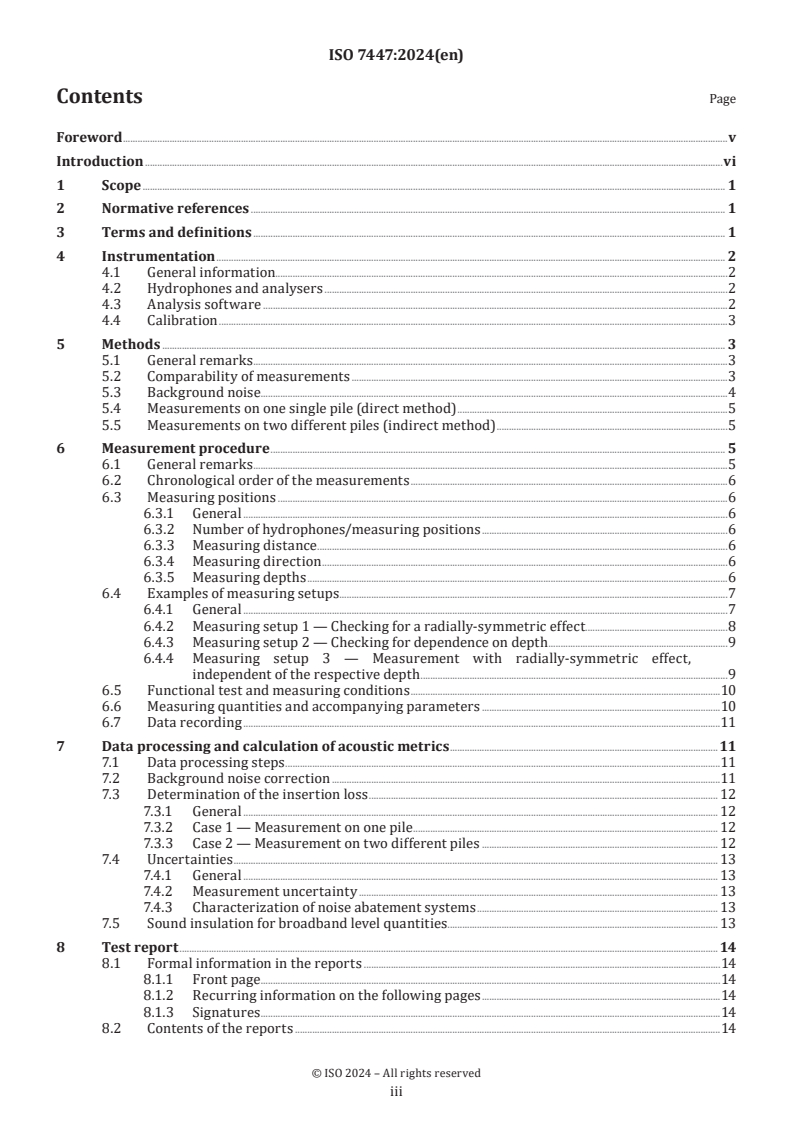

ISO 7447:2024 - Underwater acoustics — Measurement of radiated underwater sound from percussive pile driving — In situ determination of the insertion loss of barrier control measures underwater Released:4. 09. 2024
Overview
ISO 7447:2024 - Underwater acoustics - Measurement of radiated underwater sound from percussive pile driving - specifies in situ procedures to determine the insertion loss of underwater noise abatement measures. The standard uses the impulsive sound from percussive pile driving (e.g., impact hammer) as the sound source to evaluate barriers such as bubble curtains and cofferdams. ISO 7447:2024 applies to field (in situ) measurements only - it does not cover artificial sound sources or laboratory testing - and emphasizes that measured attenuation depends on installation and environmental conditions (hammer type, driving energy, pile geometry, water depth, seabed type, bathymetry, currents, wind, and flanking transmission through the seafloor).
Key topics and technical requirements
- Two measurement procedures: a direct method (measurements on a single pile with/without the abatement system) and an indirect method (comparative measurements on two different piles).
- Insertion loss definition: the difference in sound pressure level (SPL) at specified receiver positions before and after barrier installation, typically reported in one‑third octave bands and/or sound exposure level.
- Instrumentation and calibration: requirements for hydrophones, analysers, analysis software and traceable calibration to ensure data comparability.
- Measurement geometry: guidance on measuring positions, distances, depths, and directions; recommended numbers of hydrophones and setups to assess radial symmetry or depth dependence.
- Data quality and processing: background noise assessment and correction, data recording practices, steps for processing signals, and calculation of acoustic metrics including uncertainty evaluation.
- Reporting: structured test report content, required metadata, measurement descriptions and presentation of results.
- Informative annexes: Annex A covers near‑shore piling considerations; Annex B discusses sound particle motion and seabed vibration.
Practical applications and users
ISO 7447:2024 is intended for practical use in:
- Environmental consultants conducting marine impact assessments
- Offshore wind farm developers and marine construction companies validating noise mitigation
- Acousticians and measurement teams performing in situ underwater noise monitoring
- Regulators and permitting authorities requiring proof of mitigation performance
- R&D teams comparing or improving noise abatement systems (bubble curtains, cofferdams)
Common uses include demonstrating compliance for licensing/approval, comparing effectiveness of different noise abatement systems, and supporting mitigation design and environmental impact mitigation strategies.
Related standards
- ISO 18405 - Underwater acoustics - Terminology
- ISO 18406:2017 - Underwater acoustics - Measurement of radiated underwater sound from percussive pile driving
Keywords: ISO 7447:2024, underwater acoustics, insertion loss, pile driving, noise abatement, bubble curtain, in situ measurement, radiated underwater sound, hydrophones, sound exposure level.
Buy Documents
ISO 7447:2024 - Underwater acoustics — Measurement of radiated underwater sound from percussive pile driving — In situ determination of the insertion loss of barrier control measures underwater Released:4. 09. 2024
Get Certified
Connect with accredited certification bodies for this standard

BSMI (Bureau of Standards, Metrology and Inspection)
Taiwan's standards and inspection authority.
Sponsored listings
Frequently Asked Questions
ISO 7447:2024 is a standard published by the International Organization for Standardization (ISO). Its full title is "Underwater acoustics — Measurement of radiated underwater sound from percussive pile driving — In situ determination of the insertion loss of barrier control measures underwater". This standard covers: This document specifies two procedures for the in situ determination of the insertion loss of underwater noise abatement measures (noise abatement systems). The impulsive sound of pile driving is used as the sound source for the investigation of noise abatement systems. This document does not apply to artificial sound sources and investigations under laboratory conditions. Apart from the correct application of the respective noise abatement system, the achieved sound attenuation also depends on the installation conditions (e.g. type of hammer, driving energy, pile dimensioning) as well as on the environmental conditions (e.g. water depth, seafloor classification and bathymetry, current and wind conditions) and the flanking transmission via the seafloor.
This document specifies two procedures for the in situ determination of the insertion loss of underwater noise abatement measures (noise abatement systems). The impulsive sound of pile driving is used as the sound source for the investigation of noise abatement systems. This document does not apply to artificial sound sources and investigations under laboratory conditions. Apart from the correct application of the respective noise abatement system, the achieved sound attenuation also depends on the installation conditions (e.g. type of hammer, driving energy, pile dimensioning) as well as on the environmental conditions (e.g. water depth, seafloor classification and bathymetry, current and wind conditions) and the flanking transmission via the seafloor.
ISO 7447:2024 is classified under the following ICS (International Classification for Standards) categories: 17.140.20 - Noise emitted by machines and equipment. The ICS classification helps identify the subject area and facilitates finding related standards.
ISO 7447:2024 is available in PDF format for immediate download after purchase. The document can be added to your cart and obtained through the secure checkout process. Digital delivery ensures instant access to the complete standard document.
Standards Content (Sample)
International
Standard
ISO 7447
First edition
Underwater acoustics —
2024-09
Measurement of radiated
underwater sound from percussive
pile driving — In situ determination
of the insertion loss of barrier
control measures underwater
Acoustique sous-marine — Mesurage de l’émission sonore sous-
marine lors de l’enfoncement de pieux marins par percussion
— Détermination in situ de la perte par insertion de barrières
sous-marines
Reference number
© ISO 2024
All rights reserved. Unless otherwise specified, or required in the context of its implementation, no part of this publication may
be reproduced or utilized otherwise in any form or by any means, electronic or mechanical, including photocopying, or posting on
the internet or an intranet, without prior written permission. Permission can be requested from either ISO at the address below
or ISO’s member body in the country of the requester.
ISO copyright office
CP 401 • Ch. de Blandonnet 8
CH-1214 Vernier, Geneva
Phone: +41 22 749 01 11
Email: copyright@iso.org
Website: www.iso.org
Published in Switzerland
ii
Contents Page
Foreword .v
Introduction .vi
1 Scope . 1
2 Normative references . 1
3 Terms and definitions . 1
4 Instrumentation . 2
4.1 General information.2
4.2 Hydrophones and analysers .2
4.3 Analysis software .2
4.4 Calibration .3
5 Methods . 3
5.1 General remarks .3
5.2 Comparability of measurements .3
5.3 Background noise.4
5.4 Measurements on one single pile (direct method) .5
5.5 Measurements on two different piles (indirect method) .5
6 Measurement procedure . 5
6.1 General remarks .5
6.2 Chronological order of the measurements .6
6.3 Measuring positions .6
6.3.1 General .6
6.3.2 Number of hydrophones/measuring positions .6
6.3.3 Measuring distance . .6
6.3.4 Measuring direction .6
6.3.5 Measuring depths .6
6.4 Examples of measuring setups.7
6.4.1 General .7
6.4.2 Measuring setup 1 — Checking for a radially-symmetric effect.8
6.4.3 Measuring setup 2 — Checking for dependence on depth .9
6.4.4 Measuring setup 3 — Measurement with radially-symmetric effect,
independent of the respective depth .9
6.5 Functional test and measuring conditions .10
6.6 Measuring quantities and accompanying parameters .10
6.7 Data recording .11
7 Data processing and calculation of acoustic metrics .11
7.1 Data processing steps .11
7.2 Background noise correction .11
7.3 Determination of the insertion loss . 12
7.3.1 General . 12
7.3.2 Case 1 — Measurement on one pile . 12
7.3.3 Case 2 — Measurement on two different piles . 12
7.4 Uncertainties . 13
7.4.1 General . 13
7.4.2 Measurement uncertainty . 13
7.4.3 Characterization of noise abatement systems . 13
7.5 Sound insulation for broadband level quantities . 13
8 Test report . 14
8.1 Formal information in the reports .14
8.1.1 Front page . .14
8.1.2 Recurring information on the following pages .14
8.1.3 Signatures . .14
8.2 Contents of the reports .14
iii
8.2.1 Structuring of contents .14
8.2.2 Description of the measurements . 15
8.2.3 Presentation of the results .16
Annex A (informative) Considerations for near shore piling applications . 17
Annex B (informative) Sound particle motion and seabed vibration . 19
Bibliography .23
iv
Foreword
ISO (the International Organization for Standardization) is a worldwide federation of national standards
bodies (ISO member bodies). The work of preparing International Standards is normally carried out through
ISO technical committees. Each member body interested in a subject for which a technical committee
has been established has the right to be represented on that committee. International organizations,
governmental and non-governmental, in liaison with ISO, also take part in the work. ISO collaborates closely
with the International Electrotechnical Commission (IEC) on all matters of electrotechnical standardization.
The procedures used to develop this document and those intended for its further maintenance are described
in the ISO/IEC Directives, Part 1. In particular, the different approval criteria needed for the different types
of ISO document should be noted. This document was drafted in accordance with the editorial rules of the
ISO/IEC Directives, Part 2 (see www.iso.org/directives).
ISO draws attention to the possibility that the implementation of this document may involve the use of (a)
patent(s). ISO takes no position concerning the evidence, validity or applicability of any claimed patent
rights in respect thereof. As of the date of publication of this document, ISO had not received notice of (a)
patent(s) which may be required to implement this document. However, implementers are cautioned that
this may not represent the latest information, which may be obtained from the patent database available at
www.iso.org/patents. ISO shall not be held responsible for identifying any or all such patent rights.
Any trade name used in this document is information given for the convenience of users and does not
constitute an endorsement.
For an explanation of the voluntary nature of standards, the meaning of ISO specific terms and expressions
related to conformity assessment, as well as information about ISO's adherence to the World Trade
Organization (WTO) principles in the Technical Barriers to Trade (TBT), see www.iso.org/iso/foreword.html.
This document was prepared by Technical Committee ISO/TC 43, Acoustics, Subcommittee SC 3, Underwater
acoustics.
Any feedback or questions on this document should be directed to the user’s national standards body. A
complete listing of these bodies can be found at www.iso.org/members.html.
v
Introduction
Within the scope of approval and licensing procedures for offshore wind energy farms worldwide an
assessment is required of whether sound caused by the construction, operation and demolition of wind
energy farms represents a possible hazard for the marine environment. To reduce the noise output
effective noise abatement systems (noise control measures underwater) can be used to protect the marine
environment, see References [12] to [25].
Examples of noise-generating activities are pile driving (e.g. by impact hammer) or pile extraction.
Examples for noise abatement systems are bubble curtains and cofferdams whose acoustic efficiency can be
demonstrated by applying the methodology described in this document.
This document describes measuring methods for the in situ characterization of the effectiveness of noise
abatement systems underwater. The acoustic effectiveness of a system can be derived from measurements
carried out with and without the considered noise abatement system, e.g. References [10] and [11]. This
acoustic effectiveness of the system is given as insertion loss.
The principles of the method can also be applied in other cases such as construction of docks, piers, wharfs,
bridge supports, etc., a procedure is described in Annex A. Sound particle motion and seabed vibration are
of increasing interest in ocean acoustics and are dealt with in Annex B.
In general, in acoustic underwater measurements, the influences of the noise source and the noise
propagation cannot be completely separated. For example, the soil properties have a direct influence on the
noise source. Another influence is the sound propagation and sound radiation via the sea bottom.
Results acquired in accordance with this specification are necessary and useful for
— comparison with acoustical specifications, e.g. within the scope of approval procedures,
— comparison with different noise abatement systems, and
— further development and improvement of noise abatement systems.
vi
International Standard ISO 7447:2024(en)
Underwater acoustics — Measurement of radiated
underwater sound from percussive pile driving — In situ
determination of the insertion loss of barrier control
measures underwater
1 Scope
This document specifies two procedures for the in situ determination of the insertion loss of underwater
noise abatement measures (noise abatement systems). The impulsive sound of pile driving is used as the
sound source for the investigation of noise abatement systems. This document does not apply to artificial
sound sources and investigations under laboratory conditions.
Apart from the correct application of the respective noise abatement system, the achieved sound attenuation
also depends on the installation conditions (e.g. type of hammer, driving energy, pile dimensioning) as well
as on the environmental conditions (e.g. water depth, seafloor classification and bathymetry, current and
wind conditions) and the flanking transmission via the seafloor.
2 Normative references
The following documents are referred to in the text in such a way that some or all of their content constitutes
requirements of this document. For dated references, only the edition cited applies. For undated references,
the latest edition of the referenced document (including any amendments) applies.
ISO 18405, Underwater acoustics — Terminology
ISO 18406:2017, Underwater acoustics — Measurement of radiated underwater sound from percussive pile driving
3 Terms and definitions
For the purpose of this document, the terms and definitions given in ISO 18405, ISO 18406 and the
following apply.
ISO and IEC maintain terminological databases for use in standardization at the following addresses:
— ISO Online browsing platform: available at https:// www .iso .org/ obp
— IEC Electropedia: available at https:// www .electropedia .org/
3.1
insertion loss of barriers
D ( f )
p
difference, in sound pressure levels at a specified receiver position before and after the installation of a barrier
Note 1 to entry: D ( f ) is the sound pressure level without barrier minus the sound pressure level with barrier, in one-
p
third octave (base 10) bands. According to ISO 18405, an alternative name for one-third octave (base 10) is decidecade.
Note 2 to entry: The sound pressure level is determined over multiple pulses.
Note 3 to entry: The insertion loss can also be calculated with sound exposure level. The results are identical to the
calculations with sound pressure level using the same integration time T.
Note 4 to entry: For calculation of insertion loss, see 7.3.
Note 5 to entry: Insertion loss is expressed in decibels.
[SOURCE: ISO 10847:1997, 3.5, modified — Abbreviation modified and Notes 1 to 4 to entry added.]
3.2
noise abatement system
mitigation measure that attenuates the sound output from the sound source
Note 1 to entry: There are near-pile noise abatement systems, such as cofferdams, where a pipe is built into the water
enclosing the pile and the water is pumped out between the pile and the pipe. Applications away from the pile are
mostly bubble curtains, see References [12] to [25].
3.3
flanking transmission
transmission of sound from a source (pile) to receiver point but not via the noise abatement system (3.2)
[SOURCE: IEC 60050-801-31-40:1994, modified — Term from building acoustics, changed for underwater
applications.]
4 Instrumentation
4.1 General information
Clause 4 describes relevant information on instrumentation for underwater measurements. ISO 18406
provides further considerable details on the type of measurements and instrumentation.
4.2 Hydrophones and analysers
The measurement chain for hydroacoustic measurements consists of the following components:
— omnidirectional hydrophone (with preamplifier) with a constant sensitivity that deviates by less than
2 dB over the analysed frequency range;
— analogue high-pass filter (which may be integrated in the measuring amplifier) to limit the low-frequency
dynamics of the measuring data;
— measuring device, including the possibility to record time raw data, consisting of low-pass filters (anti-
aliasing filters), amplifiers, and A/D converters;
— cables, connecting components, etc.
Furthermore, the following test equipment, devices and recording equipment are required:
— pistonphone for checking the calibration of the hydrophone measuring chain before and after each
measurement;
— distance meter (e.g. laser, GPS based);
— equipment to record the data required to determine the sound speed profile (sound speed as a function
of depth). For example, CTD sensors are used to determine the temperature, conductivity and the depth
below the water surface at the CTD probe. With the measured quantities the sound speed profile can be
determined.
4.3 Analysis software
For data post-processing and evaluation, an analysis software is required which comprises the following
methods:
— one-third octave (base 10) bands analysis, with the filters corresponding to the requirements in
IEC 61260-1;
— narrow-band analysis;
— time averaging.
Filtering may be accomplished using analogue electronic filters, but is more commonly undertaken using
digital processing. The digital methods can either utilise implementations of digital filters, or may be
achieved by aggregating levels in the frequency domain over the requisite bands (subsequent to a Fourier
transform of the time-domain waveform).
Data processing can also be carried out within the measuring device.
4.4 Calibration
The organization performing the measurements shall make sure that the devices of the acoustic measuring
chain (including hydrophones) are calibrated traceable to appropriate standards using a suitable method
(IEC 60565-1 and IEC 60565-2).
The calibration interval shall be 24 months at maximum. The required calibration certificates shall be kept
available for at least 10 years.
5 Methods
5.1 General remarks
Two methods are common for the in situ characterization of noise abatement systems underwater: the
direct method (see 5.4) and the indirect method (see 5.5).
5.2 Comparability of measurements
Two methods are described in this document. Both have the objective to determine the in situ insertion
loss of an underwater noise abatement system. The descriptions for both approaches are to ensure that
excitation and conditions of the sound source as well as transmission properties to the hydrophone positions
are comparable for the situation with and without noise mitigation system.
In the following, parameters are listed that could have an influence on the direct and indirect measurements:
a) configuration and pile characteristics relating to
— pile geometry (e.g. diameter, length, wall thickness distribution),
— material,
— pile head design (e.g. flange), and
— slant angle to the seabed;
b) environmental conditions:
— water depth at pile and hydrophone location and in between pile and hydrophone (bathymetry);
— distance between pile and noise mitigation system;
— distance between hydrophone and noise mitigation system;
— hydrophone depth;
— properties and layering of the seabed, cpt ( cone penetration test ) values at site;
[27]
— ocean current ;
[27]
— wind conditions ;
[27]
— significant wave height and direction;
[27]
— swell height and direction;
c) operating conditions:
— type of pile driver (e.g. manufacturer, driving/rotational mass, maximum blow energy/operating
frequency);
— type of force-conducting connecting elements between pile driver and pile (e.g. anvil);
— hammer energy;
— pulse repetition rate;
— penetration depth;
— number of blows in the noise measurement period.
Any changes in the above conditions that occur between measurements with and without the noise
attenuation in place shall be determined and documented.
To ensure comparability of measurements between the unmitigated and mitigated situation, these
parameters should all be sufficiently equal.
Ideal equal conditions cannot always be achieved, so quantitative minimum requirements are listed below:
— pile material should be equal, and pile and pile head geometry should not differ more than 10 %;
— flat bathymetry is required: the variation in water depth should not exceed 10 % between source and
measurement site;
— measurement geometry (distance between noise mitigation measure and hydrophones to pile and
hydrophone depths should not differ more than 10 %);
— hammer energy and pulse repetition rate should not differ more than 10 %.
The combined standard uncertainty should remain <20 %, so that the error in the determination of the
insertion loss is <1 dB, see also 7.4 on the uncertainty of measurement according to ISO/IEC Guide 98-3.
NOTE 1 Experience shows that the background noise which includes self-noise of the hydrophone measurement
device including mooring concept and measurement device can limit the validity of the determination of the in situ
insertion loss. In concrete terms, this means that the noise abatement system used can have a higher insertion loss
than can be verified by measurement. However, this case would be excluded if requirement 5.3. is considered.
NOTE 2 The measurements describe an in situ "insertion loss". The in situ determined insertion loss is therefore
dependent on the environmental parameters and the selected measurement configuration. Thus, for each measurement
report, the validity range is documented by representations of the above-mentioned parameters, see also Clause 8.
NOTE 3 The parameters water depth, wind, significant wave height and current are important for the documentation
of acoustic measures such as the bubble curtain, as the properties can be/are influenced by these parameters. Up to a
significant wave height (Hs) of 2 m, no relevant effects on the performance of the noise abatement systems are known
from experience. For currents above ~0,75 m/s (and water depths up to ~40 m), experience has shown that the noise
reduction in the direction of flow decreases significantly due to drift effects, see Reference [24].
NOTE 4 The parameter soil or soil layering is fundamentally important to document for all noise abatement
systems, as this parameter can influence the properties of the insertion loss determined in situ.
5.3 Background noise
According to ISO 18406, the background noise is all sound recorded by the hydrophone in the absence of the
pile driving signal for a specified pile driving signal being measured. The sound pressure level of the sound
source shall be high enough to create a sound pressure level at the measuring location which exceeds – with
and without the respective noise abatement system – the background noise level in the frequency bands
of interest by at least 6 dB, or 10 dB ideally, (see 7.2). Background noise such as chain rattling (anchor
chains), pitching noise caused by sea state, ship aggregates, or movement of crew, sea markers, buoys, etc.,
in the immediate vicinity of the measurement device shall be avoided. Background noise shall be recorded
and documented. If additional noise is caused by the operation of the respective measure, it shall also be
recorded and documented.
Background noise measurements shall be performed before and after each single measurement with and
without sound mitigation measure to record the time-dependent change of the noise at least for 10 minutes.
5.4 Measurements on one single pile (direct method)
The measurement is performed on one pile and consists of two parts which are carried out in quick succession
to reduce the influence of the pile penetration depth on the sound radiation. One of the measurement setups
described in 6.4 is used for this kind of measurement. Firstly, the measurement is preferably performed
without the noise mitigation measure while the pile driver is running (see 6.2). After these measurements,
the noise mitigation measure is put into operation, and the measurement is repeated with active noise
abatement system. Comparability of the conditions without and with noise control measure shall be ensured
(see 5.2).
Advantage of this measuring method: For both parts of the measurement the comparability of the conditions
can easily be ensured if both the penetration depth of the pile and the coupled seabed layers are comparable
during both measurements.
Disadvantage of this measuring method: Only a short period can be evaluated for each of the two
measurements to be compared to fulfil the requirement of comparable penetration depth. The propagation
conditions underwater before, on and after activation of the noise abatement system vary. Statements
on changed flanking transmission, depending on penetration depth, soil layer, etc., can only be made if
comparing measurements are carried out for different penetration depths.
5.5 Measurements on two different piles (indirect method)
This type of measurement is based on carrying out two measurements at two different piles, where both
measuring positions shall have the same distance to the respective pile (6.3.3). One measurement shall be
carried out at the pile without the noise abatement system (measure not applied), and another measurement
is carried out at the pile with the noise abatement system (measure applied) according to one of the
measurement setups described in 6.4. For this method, it is necessary that the environmental conditions
and the measurement setup for both separate measurements are comparable (see 5.2).
Advantage of this measuring method: Taking into account the environmental and acoustical conditions,
this method can be used to evaluate the insertion loss for the whole pile-driving process (with and without
measure applied) and not only for a short period as described in 5.4.
Disadvantage of this measuring method: It is unlikely that completely identical conditions exist at the two
different measuring locations. Especially the flanking transmission of sound via the seafloor can have an
influence on the results and increase the uncertainty of the judgement concerning the effectiveness of the
noise abatement system. Additionally, different soil conditions can lead to changed radiation characteristics
of the source.
6 Measurement procedure
6.1 General remarks
The measuring positions are linked to the installation process and to the basic conditions dictated by
the acoustical environment. For security reasons and to avoid a measurement in the acoustic near field,
a minimum distance of the acoustic measuring system to the pile-driving location (safety zone) shall be
observed. According to ISO 18406 a preferable distance to the pile is 750 m. See Annex A for minimum
monitoring distance requirements for near shore applications.
6.2 Chronological order of the measurements
If the acoustic conditions can be influenced by the noise abatement system after switching it off or
removing it (e.g. due to air transferred into the water in the form of bubble curtains and changing the sound
propagation due to the air/water mixture (impedance)), measurements shall be taken first without and then
with noise mitigation measure.
6.3 Measuring positions
6.3.1 General
The selection of the measuring positions depends on the respective task. The following compilation
describes the minimum number of measuring positions and hydrophones and proposes an extension of the
measurement setup. The parameters of the measuring positions shall be defined and documented. Examples
for measurement setups are given in 6.4.
6.3.2 Number of hydrophones/measuring positions
First of all, it shall be checked whether a dependence on the directivity of the radiated sound (due to the
source or the noise mitigation measure) is to be expected. To estimate these factors, the parameters given
in 5.2 shall be verified. Such measures are, for example, bubble curtains in current, or a measurement setup
with a bathymetry strongly depending on the respective measuring direction. If there is no prior knowledge
about the directivity, at least two measuring directions and two different measurement depths shall be
considered (see case examples in 6.4).
The measuring positions shall be kept constant during the whole measurement. For the indirect method, the
hydrophones shall be installed at exactly the same geometrical positions in relation to the sound sources.
NOTE For near shore applications, it is important that any range-dependent bathymetry between the source and
the hydrophone also be consistent between measurements, see Annex A.
6.3.3 Measuring distance
The preferred measuring distance is 750 m. This is the specified value in ISO 18406. However, the distance
may be changed for operational reasons. The measuring distance shall not fall below 750 m and shall not
exceed 1 100 m. A second hydrophone shall be installed at twice the measuring distance (at least 1 500 m
and not farther than 2 200 m). See Annex A for monitoring distance requirements for near shore applications.
6.3.4 Measuring direction
For measurement setups for which a dependence on directivity is to be expected (e.g. due to non-radially-
symmetric noise abatement system such as an oval, eccentric bubble curtain) at least two hydrophones shall
be applied in different measuring directions but at the same distance to the sound source. If there is no
other knowledge available, both hydrophones shall preferably be arranged at an azimuth angle of 90° ± 30°
between the measuring directions (see Figure 2).
With respect to the section about the measuring distance above, a third hydrophone should be installed at
the given aspect angle but at double measuring distance of the mentioned hydrophones. See Annex A for
measuring direction requirements for near shore applications.
6.3.5 Measuring depths
Provisions shall be made so that the hydrophone depth (height above seafloor) can be kept constant during
the measurements.
In accordance with ISO 18406, the measuring hydrophone shall be positioned in the lower half of the water
column, between a height 2 m above the sea floor and one-half the total water depth (measured from the sea
surface). It is common to install at least one hydrophone at 2 m to 3 m above the seafloor. Other hydrophone
configurations are also possible, e.g. one or more hydrophones in different depths at the same distance and
aspect angle to the sound source.
NOTE If the bathymetry is not flat (e.g. rocks, etc.), the position near the seafloor can be affected by shadowing
effects, and measurement positions at half the total water depth are then preferred.
It is recommended to determine the influence of the measuring depth on the insertion loss (see Figure 3) to
avoid misinterpretation of the measurement results, for example, due to a strong layering of water and the
resulting varying sound speed profiles relating to the water depth.
If the measuring depth of the hydrophones cannot be kept constant, the influence on the measurement
results (uncertainties) shall be described separately, see 7.4.
6.4 Examples of measuring setups
6.4.1 General
The objective is to determine the in situ insertion loss of the noise abatement system. It may be required to
define measurement positions in different directions and depths. Thus, the task of the acoustician is to find
a suitable measuring setup with representative measuring points prior to the measurements.
Firstly, a coordinate system shall be defined. One possible coordinate system is shown in Figure 1.
Key
r radial direction 1 sound source
h vertical direction 2 acoustic pulse (time response)
φ azimuth angle
Figure 1 — Coordinate system
Before the measuring setup is determined, several criteria shall be checked, which can describe the
respective measuring situation. For example, the acoustician should verify in advance if the sound source
and the sound abatement measure have a radially-symmetric propagation characteristic. For verification
measuring setup 1 (see 6.4.2) can be used.
Furthermore, it is to be clarified whether the sound radiation of the sound source and the sound propagation
behind the sound mitigation measure depend on the vertical position of the hydrophone in the water
column. Potential depth-dependent acoustic effects of a sound abatement measure and of the sound source
respectively can be verified by using the measuring setup 2 (see 6.4.3).
If the effectiveness of the sound mitigation measure and the sound radiation of the sound source are depth-
independent and radially-symmetric, using measuring setup 3 (see 6.4.4) is sufficient.
In some cases, these criteria have already been verified for previous measurements. If no knowledge about
the three mentioned criteria can be gained prior to the planned campaign, measurements for verifying
these criteria shall be carried out in any case before sound mitigation measures can be deployed. These
preliminary measurements shall be carried out on at least one pile without having taken any sound abatement
measures to exclude a potential directivity of the sound source (e.g. pile driver). Only if the sound level and
the sound propagation characteristics of the sound source are comparable for each pile, statements on the
effectiveness of a sound abatement measure can be made. Furthermore, in order to guarantee comparability
of the measurements to be taken, it is indispensable to know how the respective sound levels of the sound
source (e.g. pile driver) depend on the driving energy, the pile penetration depth, the soil conditions and the
other conditions listed in 5.2.
6.4.2 Measuring setup 1 — Checking for a radially-symmetric effect
A radially-symmetric effect of a sound abatement measure can be assumed for a measure which is not
influenced by current and if the bathymetry near the pile can be estimated to be radial-symmetric,
additionally. If there are uncertainties concerning an existing situation, the following measuring setup
(Figure 2) can be used to check the propagation conditions and the directivity.
Key
φ azimuth angle r hydrophone 1
1,φ1
r radial direction r hydrophone 2
1,φ2
1 sound source (pile) r hydrophone 3
1,φ3
2 cofferdam, sound mitigation measure example r hydrophone 4
2,φ1
3 bubble curtain, sound mitigation measure example r hydrophone 5
2,φ2
r hydrophone 6
2,φ3
Figure 2 — Measuring setup 1— Checking for dependence on directivity
Figure 2 shows a measuring setup with hydrophone measuring points in different directions. The efficiency
of a noise abatement measure can be checked by installing hydrophones in different directions. Typically,
with this approach only the existence of a directional behaviour can be shown, but not the complete
distribution of the directivity. The choice of measuring points depends on the application and shall be
described by the user. For noise mitigation measures that are influenced by the ocean current, e.g. bubble
curtains, measuring points should be selected in the direction of ocean current (azimuth angle φ ) and
perpendicular to it (angle φ = φ + 90° ± 30°). A further measuring point can be freely selected and could be
2 1
180 degrees to the direction of the ocean current (angle φ = φ + 180° ± 30°).
3 1
6.4.3 Measuring setup 2 — Checking for dependence on depth
If a depth dependence of the effectiveness of the sound mitigation measure cannot be excluded, the following
measuring setup (see Figure 3) should be used to verify this situation.
An example for depth dependence of the measuring results is bubble curtains in deep water. Due to the
forces affecting them, the ascending bubbles have different sizes, forms and densities, etc. depending on the
respective depth. To assess these effects, at least two hydrophones at different measuring depths shall be
used at the respective measuring point (see Figure 3). The distance of the hydrophone to the seafloor should
be 2 m to 3 m.
Further hydrophones should be positioned at half of the water depth and/or at one third of the water depth
from seabed.
Key
1 sound source (pile) h vertical direction
2 cofferdam, sound mitigation measure example r radial direction
3 bubble curtain, sound mitigation measure example r distance 1
4 hydrophone chain 1 r distance 2
5 hydrophone chain 2
NOTE At least two hydrophones at each distance.
Figure 3 — Checking for dependence on depth
6.4.4 Measuring setup 3 — Measurement with radially-symmetric effect, independent of the
respective depth
If the radial-symmetric effect of a sound mitigation measure and the independence of the measuring results
from depth have been determined by means of another method, it is sufficient to perform the measurement
at two measuring points at different distances to the sound source. The data at both measuring points shall
be recorded simultaneously. The measuring point at the distance r to the sound source serves for checking
the level differences to be expected between the measuring positions r and r . In case the sound mitigation
1 2
measure is independent of depth and directivity, the measuring results in both measuring distances shall be
convertible into each other.
Figure 4 shows the measuring setup 3 where the hydrophone is positioned near the ground or in the middle
of the water column.
Key
1 sound source (pile) h vertical direction
2 cofferdam, sound mitigation measure example r radial direction
3 bubble curtain, sound mitigation measure example r distance 1
4 hydrophone 1 (ground system or middle of water column) r distance 2
5 hydrophone 2 (ground system or middle of water column)
Figure 4 — Measurement with radially-symmetric effect, independent from the respective depth
6.5 Functional test and measuring conditions
The function of the hydrophone measuring chain shall be checked before and after the measurements with
a suitable pistonphone. The pistonphone signal shall be recorded for the purpose of documentation and
further analysis.
While installing the hydrophones, it shall be ensured that disturbing structure-borne noise transmission
during the measurements is avoided as far as possible.
If noisy work or events which are not associated with the present project take place at the same time as the
measurements, the background noise caused by this shall be recorded and documented.
6.6 Measuring quantities and accompanying parameters
The time raw data of the unweighted sound pressure shall be recorded at the single measuring positions.
The sample rate shall be chosen according to the frequency range to be evaluated, see 7.1.
NOTE High-pass filters are usually applied with a cut-off frequency between 1 Hz and 3 Hz.
The measurement duration for each s
...