

ISO 21902:2021
(Main)Tourism and related services — Accessible tourism for all — Requirements and recommendations
General Information
- Abstract
This document establishes requirements and provides guidelines for “accessible tourism for all” with the aim of ensuring equal access and enjoyment of tourism by the widest range of people of all ages and abilities. This document provides information on the key aspects of policy making, strategy, infrastructure, products and services and is addressed to all stakeholders involved in the tourism supply chain, whether from the public or private sector. It applies at local, regional, national and international levels. NOTE Stakeholders include, but are not limited to, public administrations, accommodation services, catering and restaurant services, transport, tour operators and travel agencies, MICE and leisure activities, as well as service providers from other economic sectors related to tourism, travel and destination management, including their contractors and suppliers.
- Status
- Published
- Publication Date
- 05-Jul-2021
- Technical Committee
- ISO/TC 228 - Tourism and related services
- Drafting Committee
- ISO/TC 228/WG 14 - Accessible tourism
- Current Stage
- 9020 - International Standard under periodical review
- Start Date
- 15-Jul-2026
- Completion Date
- 15-Jul-2026
Buy Documents




ISO 21902:2021 - Tourism and related services -- Accessible tourism for all -- Requirements and recommendations
ISO 21902:2021 - Tourism and related services — Accessible tourism for all — Requirements and recommendations/6/2021
Overview
ISO 21902:2021 - Tourism and related services: Accessible tourism for all - Requirements and recommendations defines requirements and guidance to ensure tourism is accessible and enjoyable for the widest range of people of all ages and abilities. The standard targets public and private stakeholders across the tourism supply chain - from public administrations and destination managers to accommodation, transport operators, tour operators, MICE and leisure providers - and applies at local, regional, national and international levels.
Key topics and technical requirements
ISO 21902:2021 combines normative requirements with practical recommendations addressing the full visitor experience:
- Policy, strategy and governance
- Accessibility management for destinations, public-sector proposals, legislation and policy integration.
- Design of accessible services
- Product development, access planning, monitoring, evaluation and continual improvement.
- Information and communication
- Requirements for written, face-to-face, telephone/video and digital communications to ensure clarity and accessibility.
- Training
- Staff competence, awareness-raising and training content for frontline and management roles.
- Built environment and functional requirements
- Approach routes, parking, ramps, entrances, accessible routes, doors, lifts, toilets, signage, lighting, emergency procedures and maintenance.
- Self-service equipment
- Design and placement of kiosks, ticket machines and digital interfaces to be usable by diverse users.
- Transport
- Information and booking, assistance services, terminals, boarding/disembarking features and vehicle interiors.
- Urban, rural and leisure spaces
- Pedestrian tourist routes, wayfinding, heritage sites, beaches, natural environments, cultural venues, shopping and recreational activities.
Practical applications - who uses ISO 21902
ISO 21902 is used to:
- Guide public administrations in destination accessibility planning, policy-making and procurement.
- Support hotels, restaurants and attractions in auditing and adapting facilities and services.
- Inform transport operators and terminals on accessible boarding, information systems and passenger assistance.
- Help tour operators, travel agencies and MICE organizers design inclusive products and communications.
- Provide a framework for contractors, designers and suppliers to meet accessibility requirements in new and retrofit projects.
Benefits include improved visitor inclusion, compliance alignment, enhanced customer experience, and better market reach to seniors and people with disabilities.
Related standards and references
ISO 21902 complements national accessibility regulations, building codes and digital accessibility guidance (for example, web and digital content accessibility standards). Organizations should align ISO 21902 guidance with applicable local laws and sector-specific standards when implementing accessible tourism solutions.
Keywords: ISO 21902, accessible tourism, tourism for all, accessibility standard, tourism accessibility, inclusive tourism, travel accessibility.
Buy Documents
ISO 21902:2021 - Tourism and related services -- Accessible tourism for all -- Requirements and recommendations
ISO 21902:2021 - Tourism and related services — Accessible tourism for all — Requirements and recommendations/6/2021
Get Certified
Connect with accredited certification bodies for this standard

Great Wall Tianjin Quality Assurance Center
Established 1993, first batch to receive national accreditation with IAF recognition.
Hong Kong Quality Assurance Agency (HKQAA)
Hong Kong's leading certification body.

Innovative Quality Certifications Pvt. Ltd. (IQCPL)
Known for integrity, providing ethical & impartial Assessment & Certification. CMMI Institute Partner.
Sponsored listings
Frequently Asked Questions
ISO 21902:2021 is a standard published by the International Organization for Standardization (ISO). Its full title is "Tourism and related services — Accessible tourism for all — Requirements and recommendations". This standard covers: This document establishes requirements and provides guidelines for “accessible tourism for all” with the aim of ensuring equal access and enjoyment of tourism by the widest range of people of all ages and abilities. This document provides information on the key aspects of policy making, strategy, infrastructure, products and services and is addressed to all stakeholders involved in the tourism supply chain, whether from the public or private sector. It applies at local, regional, national and international levels. NOTE Stakeholders include, but are not limited to, public administrations, accommodation services, catering and restaurant services, transport, tour operators and travel agencies, MICE and leisure activities, as well as service providers from other economic sectors related to tourism, travel and destination management, including their contractors and suppliers.
This document establishes requirements and provides guidelines for “accessible tourism for all” with the aim of ensuring equal access and enjoyment of tourism by the widest range of people of all ages and abilities. This document provides information on the key aspects of policy making, strategy, infrastructure, products and services and is addressed to all stakeholders involved in the tourism supply chain, whether from the public or private sector. It applies at local, regional, national and international levels. NOTE Stakeholders include, but are not limited to, public administrations, accommodation services, catering and restaurant services, transport, tour operators and travel agencies, MICE and leisure activities, as well as service providers from other economic sectors related to tourism, travel and destination management, including their contractors and suppliers.
ISO 21902:2021 is classified under the following ICS (International Classification for Standards) categories: 03.200.01 - Leisure and tourism in general. The ICS classification helps identify the subject area and facilitates finding related standards.
ISO 21902:2021 is available in PDF format for immediate download after purchase. The document can be added to your cart and obtained through the secure checkout process. Digital delivery ensures instant access to the complete standard document.
Standards Content (Sample)
SLOVENSKI STANDARD
01-september-2021
Turizem in sorodne storitve - Dostopen turizem za vse - Zahteve in priporočila
Tourism and related services - Accessible tourism for all - Requirements and
recommendations
Tourisme et services connexes - Tourisme accessible pour tous - Exigences et
recommandations
Ta slovenski standard je istoveten z: ISO 21902:2021
ICS:
03.200.01 Prosti čas in turizem na Leisure and tourism in
splošno general
2003-01.Slovenski inštitut za standardizacijo. Razmnoževanje celote ali delov tega standarda ni dovoljeno.
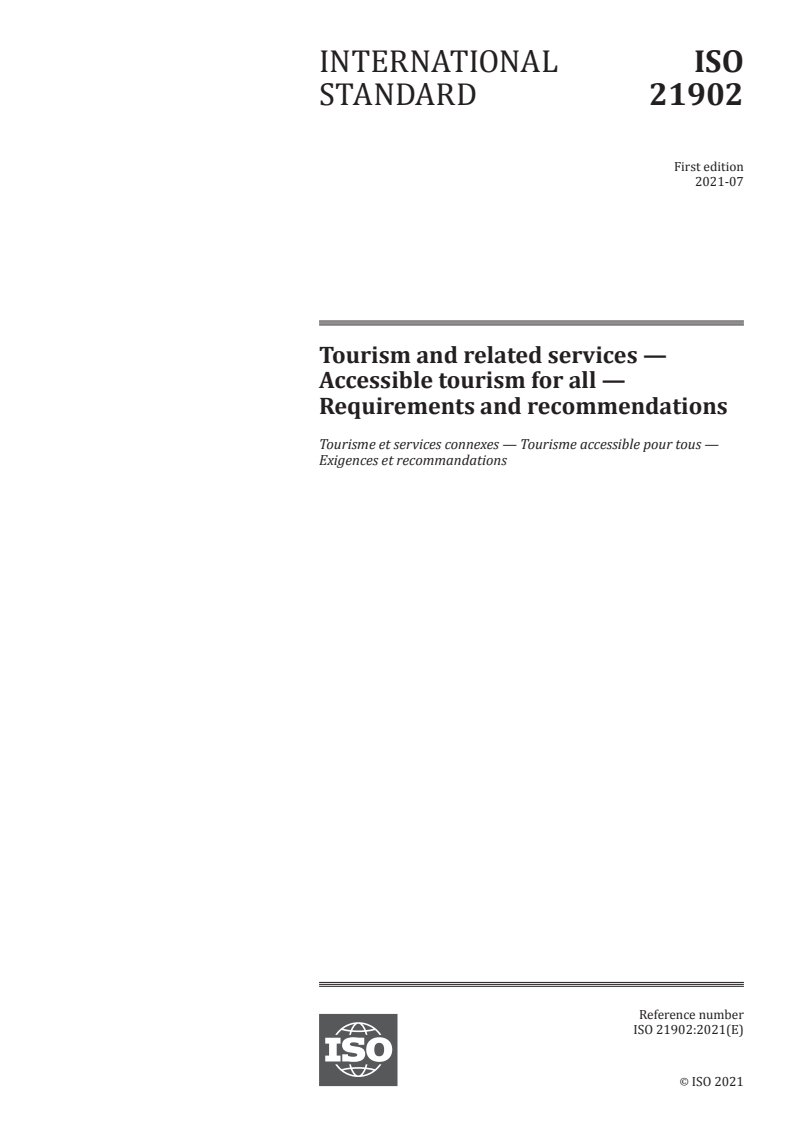
INTERNATIONAL ISO
STANDARD 21902
First edition
2021-07
Tourism and related services —
Accessible tourism for all —
Requirements and recommendations
Tourisme et services connexes — Tourisme accessible pour tous —
Exigences et recommandations
Reference number
©
ISO 2021
© ISO 2021
All rights reserved. Unless otherwise specified, or required in the context of its implementation, no part of this publication may
be reproduced or utilized otherwise in any form or by any means, electronic or mechanical, including photocopying, or posting
on the internet or an intranet, without prior written permission. Permission can be requested from either ISO at the address
below or ISO’s member body in the country of the requester.
ISO copyright office
CP 401 • Ch. de Blandonnet 8
CH-1214 Vernier, Geneva
Phone: +41 22 749 01 11
Email: copyright@iso.org
Website: www.iso.org
Published in Switzerland
ii © ISO 2021 – All rights reserved
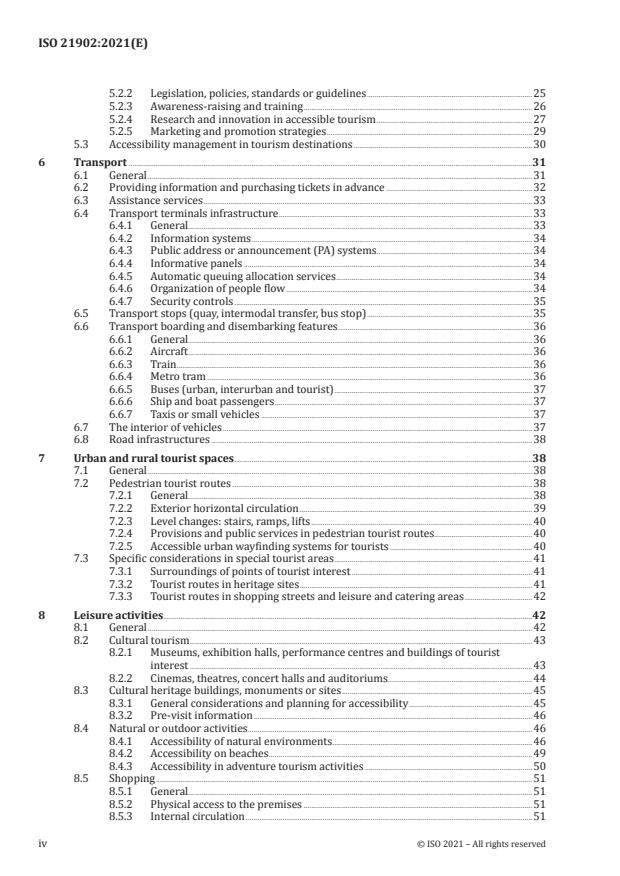
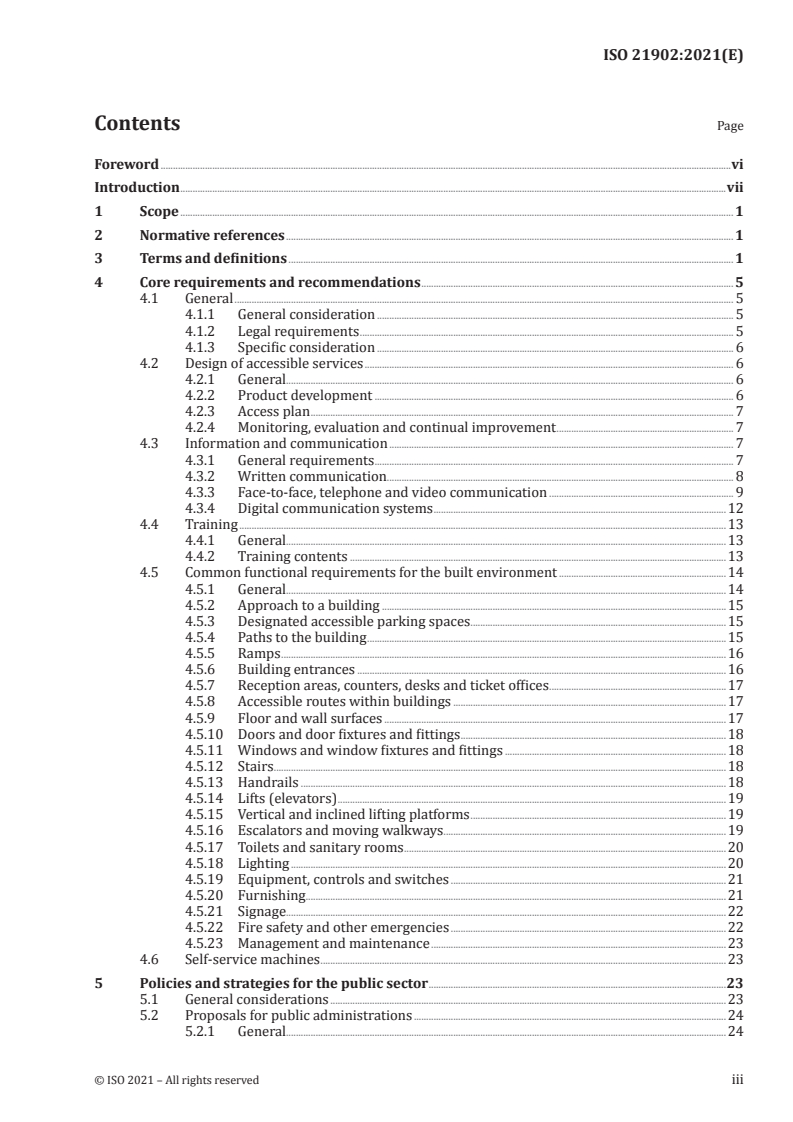
Contents Page
Foreword .vi
Introduction .vii
1 Scope . 1
2 Normative references . 1
3 Terms and definitions . 1
4 Core requirements and recommendations . 5
4.1 General . 5
4.1.1 General consideration . 5
4.1.2 Legal requirements . 5
4.1.3 Specific consideration . 6
4.2 Design of accessible services . 6
4.2.1 General. 6
4.2.2 Product development . 6
4.2.3 Access plan . 7
4.2.4 Monitoring, evaluation and continual improvement . 7
4.3 Information and communication . 7
4.3.1 General requirements . 7
4.3.2 Written communication. 8
4.3.3 Face-to-face, telephone and video communication . 9
4.3.4 Digital communication systems .12
4.4 Training .13
4.4.1 General.13
4.4.2 Training contents .13
4.5 Common functional requirements for the built environment .14
4.5.1 General.14
4.5.2 Approach to a building .15
4.5.3 Designated accessible parking spaces .15
4.5.4 Paths to the building .15
4.5.5 Ramps .16
4.5.6 Building entrances .16
4.5.7 Reception areas, counters, desks and ticket offices .17
4.5.8 Accessible routes within buildings .17
4.5.9 Floor and wall surfaces .17
4.5.10 Doors and door fixtures and fittings .18
4.5.11 Windows and window fixtures and fittings .18
4.5.12 Stairs .18
4.5.13 Handrails .18
4.5.14 Lifts (elevators) .19
4.5.15 Vertical and inclined lifting platforms .19
4.5.16 Escalators and moving walkways .19
4.5.17 Toilets and sanitary rooms .20
4.5.18 Lighting .20
4.5.19 Equipment, controls and switches .21
4.5.20 Furnishing . .21
4.5.21 Signage.22
4.5.22 Fire safety and other emergencies .22
4.5.23 Management and maintenance .23
4.6 Self-service machines .23
5 Policies and strategies for the public sector .23
5.1 General considerations .23
5.2 Proposals for public administrations .24
5.2.1 General.24
5.2.2 Legislation, policies, standards or guidelines .25
5.2.3 Awareness-raising and training .26
5.2.4 Research and innovation in accessible tourism .27
5.2.5 Marketing and promotion strategies .29
5.3 Accessibility management in tourism destinations .30
6 Transport .31
6.1 General .31
6.2 Providing information and purchasing tickets in advance .32
6.3 Assistance services .33
6.4 Transport terminals infrastructure .33
6.4.1 General.33
6.4.2 Information systems .34
6.4.3 Public address or announcement (PA) systems.34
6.4.4 Informative panels .34
6.4.5 Automatic queuing allocation services .34
6.4.6 Organization of people flow .34
6.4.7 Security controls .35
6.5 Transport stops (quay, intermodal transfer, bus stop) .35
6.6 Transport boarding and disembarking features .36
6.6.1 General.36
6.6.2 Aircraft .36
6.6.3 Train .36
6.6.4 Metro tram .36
6.6.5 Buses (urban, interurban and tourist) .37
6.6.6 Ship and boat passengers .37
6.6.7 Taxis or small vehicles .37
6.7 The interior of vehicles .37
6.8 Road infrastructures .38
7 Urban and rural tourist spaces .38
7.1 General .38
7.2 Pedestrian tourist routes .38
7.2.1 General.38
7.2.2 Exterior horizontal circulation .39
7.2.3 Level changes: stairs, ramps, lifts .40
7.2.4 Provisions and public services in pedestrian tourist routes.40
7.2.5 Accessible urban wayfinding systems for tourists .40
7.3 Specific considerations in special tourist areas .41
7.3.1 Surroundings of points of tourist interest .41
7.3.2 Tourist routes in heritage sites .41
7.3.3 Tourist routes in shopping streets and leisure and catering areas .42
8 Leisure activities.42
8.1 General .42
8.2 Cultural tourism .43
8.2.1 Museums, exhibition halls, performance centres and buildings of tourist
interest .43
8.2.2 Cinemas, theatres, concert halls and auditoriums .44
8.3 Cultural heritage buildings, monuments or sites .45
8.3.1 General considerations and planning for accessibility .45
8.3.2 Pre-visit information .46
8.4 Natural or outdoor activities . .46
8.4.1 Accessibility of natural environments .46
8.4.2 Accessibility on beaches .49
8.4.3 Accessibility in adventure tourism activities .50
8.5 Shopping .51
8.5.1 General.51
8.5.2 Physical access to the premises .51
8.5.3 Internal circulation .51
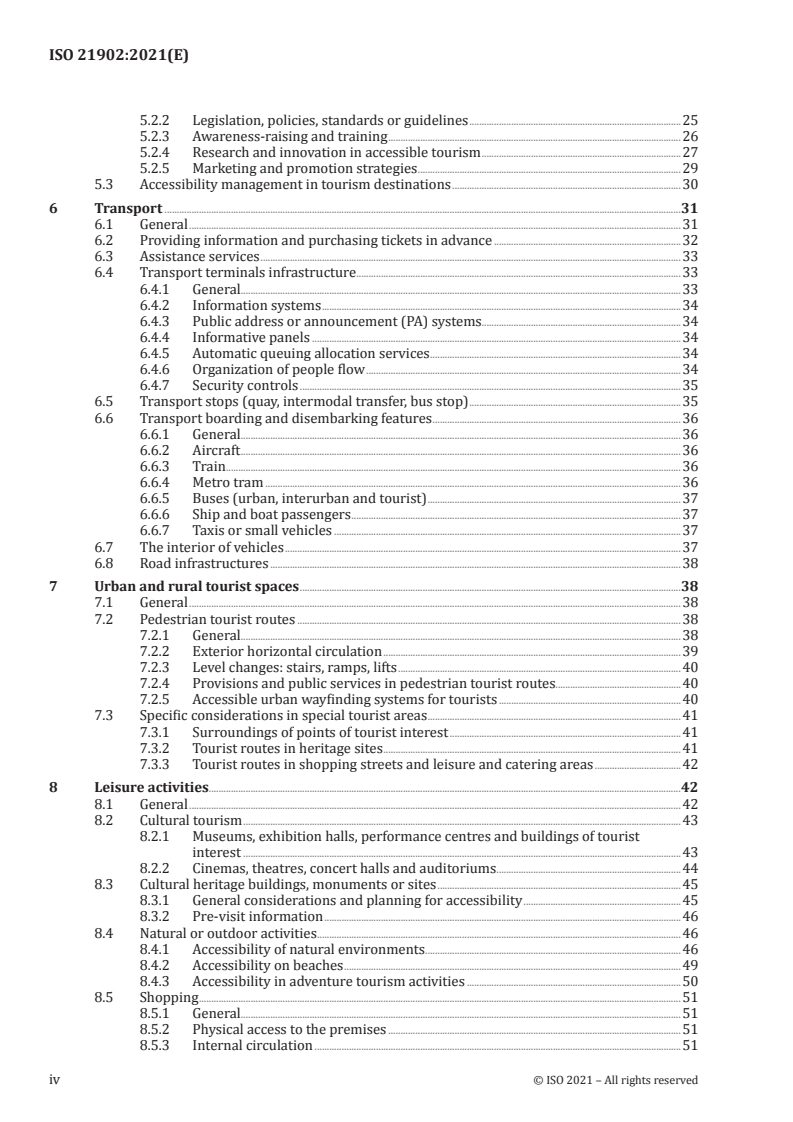
iv © ISO 2021 – All rights reserved
8.5.4 Display areas and storage .52
8.5.5 Counters and checkouts .52
8.5.6 Storage and sales equipment .52
8.5.7 Fitting rooms .52
8.5.8 Sanitary facilities, baby-changing and toilets .52
8.5.9 Information and signage .53
8.5.10 Provision of wheelchairs on loan .53
9 Meetings, incentives, conventions and exhibitions (MICE) .53
9.1 General .53
9.2 Planning of the e vent .53
9.3 Planning the pr ogramme .53
9.4 Interpretation services and supports . .54
9.5 Choosing a venue .54
9.6 Getting to the venue .54
9.7 Parking facilities .54
9.8 Physical access at the venue .55
9.9 Outdoor events and venues.56
10 Accommodation .56
10.1 General .56
10.2 Services .57
10.3 Accessibility in guest rooms .58
10.3.1 General.58
10.3.2 General accessibility considerations for all guest rooms .58
10.3.3 Accessible guest rooms .59
10.4 Common areas .60
11 Food and beverage services (catering spaces) .61
11.1 General .61
11.2 Service point .61
11.3 Type of service .61
11.4 Information provision .61
11.5 Service provision .61
11.6 Dining room or services room .62
12 Tour operators and travel agencies .62
12.1 General .62
12.2 Point of sale .62
12.3 Collecting and transmitting pre-departure information .62
12.4 Property information .63
12.5 Other services .63
Annex A (informative) The seven principles and 29 guidelines of Universal Design .64
Annex B (informative) Tables for using the Universal Design principles and guidelines in
tourism communication design .66
Annex C (informative) Colour contrast.69
Annex D (informative) Reception counter .70
Annex E (informative) Accessible public toilets .71
Annex F (informative) Accessible guest rooms in accommodation establishments .72
Annex G (informative) Property information .74
Annex H (informative) IATA codes.78
Bibliography .79
Foreword
ISO (the International Organization for Standardization) is a worldwide federation of national standards
bodies (ISO member bodies). The work of preparing International Standards is normally carried out
through ISO technical committees. Each member body interested in a subject for which a technical
committee has been established has the right to be represented on that committee. International
organizations, governmental and non-governmental, in liaison with ISO, also take part in the work.
ISO collaborates closely with the International Electrotechnical Commission (IEC) on all matters of
electrotechnical standardization.
The procedures used to develop this document and those intended for its further maintenance are
described in the ISO/IEC Directives, Part 1. In particular, the different approval criteria needed for the
different types of ISO documents should be noted. This document was drafted in accordance with the
editorial rules of the ISO/IEC Directives, Part 2 (see www .iso .org/ directives).
Attention is drawn to the possibility that some of the elements of this document may be the subject of
patent rights. ISO shall not be held responsible for identifying any or all such patent rights. Details of
any patent rights identified during the development of the document will be in the Introduction and/or
on the ISO list of patent declarations received (see www .iso .org/ patents).
Any trade name used in this document is information given for the convenience of users and does not
constitute an endorsement.
For an explanation of the voluntary nature of standards, the meaning of ISO specific terms and
expressions related to conformity assessment, as well as information about ISO's adherence to the
World Trade Organization (WTO) principles in the Technical Barriers to Trade (TBT), see www .iso .org/
iso/ foreword .html.
This document was prepared by Technical Committee ISO/TC 228, Tourism and related services.
Any feedback or questions on this document should be directed to the user’s national standards body. A
complete listing of these bodies can be found at www .iso .org/ members .html.
vi © ISO 2021 – All rights reserved
Introduction
Tourism is one of the fastest growing sectors of the global economy. At the time of writing, there
are around 1,4 billion people travelling the world and the sector is responsible for 1 out of 11 jobs
worldwide. However, travelling can be a challenging process throughout the entire tourism supply
chain for the 15 % of the world's population who live with some form of disability and people with
access requirements.
An improvement in accessibility in the tourism sector would equally benefit elderly people, in particular
considering that the share of people aged 65 and over is projected to increase from 9 % in 2019 to 16 %
in 2050. (Source: UN Commission on Population and Development reports, https:// population .un .org/ P
rofilesOfA geing2019/ index .html)
People with disabilities or other access requirements can face physical, sensory, cognitive and cultural
barriers within the tourism sector and in many destinations. When searching for suitable venues and
tourism services, it can be difficult to find clear and accurate information on the accessibility of the
offer, service or the destination facility. This situation can be improved with more consistently applied
standards and better training of tourism professionals.
Some documents exist (e.g. codes, standards and guides) which outline the recommendations and
requirements for some of the key aspects of accessibility in different environments and services (e.g.
aviation). In addition, there are also standards which refer to Universal Design for transport services
and work environments without taking into account the core aspects of travel and tourism. However,
the existing standards present gaps and can differ between countries and even between different
regions within the same country. This can create unrealistic expectations about the accessibility of
services and facilities that the visitor is expecting to find at the destination.
Most studies of accessible tourism have shown that one of the major difficulties for the application
of standards is the lack of knowledge among tourism providers about the existing tools and possible
solutions. There is a lack of information on where to find guidance and there can be contradictory
information in different standards between different countries and regions, while in some countries
there are no available standards. Furthermore, tourism providers face difficulties in knowing how to
proceed in situations for which no International Standards have been adopted yet.
The public sector has a responsibility to promote universally accessible tourism environments
and services for citizens and visitors. This can be achieved by establishing procedures to require
accessibility for every project that receives public funding. It is estimated that public procurement
1)
makes up between 15 % and 20 % of global GDP . Thus, public authorities can show leadership in
tourism development by requiring Universal Design in public procurement tenders and when awarding
contracts for infrastructure, buildings, transportation and equipment. In this way – where public
investments are directed towards tourism development – planners, designers, manufacturers and
tourism suppliers will be encouraged to create accessible tourism environments and destinations, thus
bringing benefits to visitors, businesses and local communities.
Currently there is a relatively low supply of accessible services in the tourism supply chain, while the
demand for such services is growing. The development and application of an International Standard
will assist travel providers and their suppliers in addressing their current accessibility provisions.
This aspirational document sets out best practice requirements and recommendations. It is possible
that for some travel providers in some settings, meeting these requirements will be a disproportionate
or undue burden, in which case these travel providers will possibly not be able to apply this document.
A mapping exercise has been completed to inform the development of this document.
This document takes into account the following aspects:
a) Core requirements and recommendations (applicable to all stakeholders) dealing with design of
services, information and communication, training and built environment.
1) https:// ec .europa .eu/ growth/ single -market/ public -procurement _en
b) Separate clauses for different types of stakeholders:
— policies and strategies for the public sector;
— transport;
— urban and rural tourist spaces;
— leisure activities;
— MICE (meetings, incentives, conventions and exhibitions);
— accommodation;
— food and beverage services;
— tour operators and travel agencies.
This document is addressed to a wide range of stakeholders in order to cover the whole accessible
tourism value chain:
— national or regional public administrations [including national tourism administrations (NTAs),
national or regional tourism promotion boards, destination management organizations (DMOs),
municipalities, public entities in charge of infrastructure polices, development and legislative or
regulatory frameworks, organizations or professionals working in the field of cultural heritage
management and protection);
— travel and tourism industry stakeholders [investors in destinations and tourism industry, travel
and tourism businesses, especially small and medium enterprises (SMEs) across the tourism sector:
transportation, accommodation, tour operators and travel agencies, transport manufacturers,
hospitality and catering, other tourism providers and trade associations];
— enterprises and organizations from the support sectors: for example, companies entrusted with
the execution of construction works within destinations, architects, developers and promoters
of support tools and services for people with specific access requirements, and companies or
professionals operating in the area of information and communication technology (ICT);
— tourism destinations;
— end users (i.e. tourists and the local population with or without specific access requirements).
viii © ISO 2021 – All rights reserved
INTERNATIONAL STANDARD ISO 21902:2021(E)
Tourism and related services — Accessible tourism for all
— Requirements and recommendations
1 Scope
This document establishes requirements and provides guidelines for “accessible tourism for all” with
the aim of ensuring equal access and enjoyment of tourism by the widest range of people of all ages and
abilities.
This document provides information on the key aspects of policy making, strategy, infrastructure,
products and services and is addressed to all stakeholders involved in the tourism supply chain,
whether from the public or private sector. It applies at local, regional, national and international levels.
NOTE Stakeholders include, but are not limited to, public administrations, accommodation services, catering
and restaurant services, transport, tour operators and travel agencies, MICE and leisure activities, as well as
service providers from other economic sectors related to tourism, travel and destination management, including
their contractors and suppliers.
2 Normative references
The following documents are referred to in the text in such a way that some or all of their content
constitutes requirements of this document. For dated references, only the edition cited applies. For
undated references, the latest edition of the referenced document (including any amendments) applies.
IEC 60118-4, Electroacoustics — Hearing aids — Part 4: Induction-loop systems for hearing aid purposes —
System performance requirements
3 Terms and definitions
For the purposes of this document, the following terms and definitions apply.
ISO and IEC maintain terminological databases for use in standardization at the following addresses:
— ISO Online browsing platform: available at https:// www .iso .org/ obp
— IEC Electropedia: available at http:// www .electropedia .org/
3.1
accessibility
extent to which products, systems, services, environments and facilities can be used by people from a
population with the widest range of user needs, characteristics and capabilities to achieve identified
goals in identified contexts of use
Note 1 to entry: Context of use includes direct use or use supported by assistive technologies.
[SOURCE: ISO 9241-112:2017, 3.15]
3.2
accessible guest room
room that has specific characteristics that allow accommodation for persons with disabilities and that
facilitates independence, comfort and a safe environment
3.3
accessible tourism
tourism that involves a collaborative Universal Design (3.19) process with stakeholders that enables
people with access requirements, including mobility, vision, hearing and cognitive dimensions of
access, to function independently and with equity through the delivery of accessible products, services
and environments
3.4
accessible tourism observatory
monitoring body that carries out systematic, timely and regular analysis of the tourism sector’s
performance in terms of accessibility (3.1) with a view to the continuous improvement of accessible
tourism policies and strategies
3.5
alternative format
multiple means of presentation
different ways of presenting information
Note 1 to entry: Providing different ways of manipulation and control can improve the accessibility of systems.
Note 2 to entry: Alternative formats ensure equal access to the information for the user.
3.6
assistance dog
dog specifically trained by professionals to perform tasks to mitigate the limitations of a person with a
disability
Note 1 to entry: There are three recognized categories of assistance dog: guide dogs, hearing dogs and service
dogs for persons with disabilities (see https:// assista ncedogsint ernational .org/ ).
Note 2 to entry: Other type of animals can sometimes be assimilated in this category.
3.7
destination management organization
DMO
leading organizational entity which can encompass the various authorities, stakeholders and
professionals and facilitates tourism sector partnerships towards a collective destination vision
Note 1 to entry: The governance structures of DMOs vary from a single public authority to a public or private
partnership model with the key role of initiating, coordinating and managing certain activities such as
implementation of tourism policies, strategic planning, product development, promotion and marketing and
convention bureau activities.
Note 2 to entry: The functions of DMOs can vary from national to regional and local levels depending on the
current and potential needs as well as on the decentralization level of public administration. Not every tourism
destination has a DMO.
[SOURCE: United Nations World Tourism Organization (UNWTO), UNWTO Tourism Definitions, available
at https:// www .e -unwto .org/ doi/ pdf/ 10 .18111/ 9789284420858]
3.8
disability
physical, mental, intellectual or sensory impairments (3.10) which in interaction with various barriers
can hinder a person’s full and effective participation in society on an equal basis with others
[SOURCE: United Nations Convention on the Rights of Persons with Disabilities, Article 2, available
at https:// www .un .org/ development/ desa/ disabilities/ convention -on -the -rights -of -persons -with
-disabilities .html]
2 © ISO 2021 – All rights reserved
3.9
hearing enhancement system
piece of equipment, product system, hardware, software or service that is used to increase, maintain or
improve listening capabilities of individuals with hearing impairments
Note 1 to entry: Hearing enhancement systems amplify audible communication and can be helpful to people who
have hearing loss. They include a direct wire system, an induction loop system, an infrared system or a radio
frequency system. All of these systems transmit a signal. Special-purpose receivers are required for infrared and
radio frequency systems, while hearing aids equipped with a T-switch can receive the signal from an induction
loop system. Receivers can be equipped to be compatible with hearing aids.
[SOURCE: ISO 2
...
INTERNATIONAL ISO
STANDARD 21902
First edition
2021-07
Tourism and related services —
Accessible tourism for all —
Requirements and recommendations
Tourisme et services connexes — Tourisme accessible pour tous —
Exigences et recommandations
Reference number
©
ISO 2021
© ISO 2021
All rights reserved. Unless otherwise specified, or required in the context of its implementation, no part of this publication may
be reproduced or utilized otherwise in any form or by any means, electronic or mechanical, including photocopying, or posting
on the internet or an intranet, without prior written permission. Permission can be requested from either ISO at the address
below or ISO’s member body in the country of the requester.
ISO copyright office
CP 401 • Ch. de Blandonnet 8
CH-1214 Vernier, Geneva
Phone: +41 22 749 01 11
Email: copyright@iso.org
Website: www.iso.org
Published in Switzerland
ii © ISO 2021 – All rights reserved
Contents Page
Foreword .vi
Introduction .vii
1 Scope . 1
2 Normative references . 1
3 Terms and definitions . 1
4 Core requirements and recommendations . 5
4.1 General . 5
4.1.1 General consideration . 5
4.1.2 Legal requirements . 5
4.1.3 Specific consideration . 6
4.2 Design of accessible services . 6
4.2.1 General. 6
4.2.2 Product development . 6
4.2.3 Access plan . 7
4.2.4 Monitoring, evaluation and continual improvement . 7
4.3 Information and communication . 7
4.3.1 General requirements . 7
4.3.2 Written communication. 8
4.3.3 Face-to-face, telephone and video communication . 9
4.3.4 Digital communication systems .12
4.4 Training .13
4.4.1 General.13
4.4.2 Training contents .13
4.5 Common functional requirements for the built environment .14
4.5.1 General.14
4.5.2 Approach to a building .15
4.5.3 Designated accessible parking spaces .15
4.5.4 Paths to the building .15
4.5.5 Ramps .16
4.5.6 Building entrances .16
4.5.7 Reception areas, counters, desks and ticket offices .17
4.5.8 Accessible routes within buildings .17
4.5.9 Floor and wall surfaces .17
4.5.10 Doors and door fixtures and fittings .18
4.5.11 Windows and window fixtures and fittings .18
4.5.12 Stairs .18
4.5.13 Handrails .18
4.5.14 Lifts (elevators) .19
4.5.15 Vertical and inclined lifting platforms .19
4.5.16 Escalators and moving walkways .19
4.5.17 Toilets and sanitary rooms .20
4.5.18 Lighting .20
4.5.19 Equipment, controls and switches .21
4.5.20 Furnishing . .21
4.5.21 Signage.22
4.5.22 Fire safety and other emergencies .22
4.5.23 Management and maintenance .23
4.6 Self-service machines .23
5 Policies and strategies for the public sector .23
5.1 General considerations .23
5.2 Proposals for public administrations .24
5.2.1 General.24
5.2.2 Legislation, policies, standards or guidelines .25
5.2.3 Awareness-raising and training .26
5.2.4 Research and innovation in accessible tourism .27
5.2.5 Marketing and promotion strategies .29
5.3 Accessibility management in tourism destinations .30
6 Transport .31
6.1 General .31
6.2 Providing information and purchasing tickets in advance .32
6.3 Assistance services .33
6.4 Transport terminals infrastructure .33
6.4.1 General.33
6.4.2 Information systems .34
6.4.3 Public address or announcement (PA) systems.34
6.4.4 Informative panels .34
6.4.5 Automatic queuing allocation services .34
6.4.6 Organization of people flow .34
6.4.7 Security controls .35
6.5 Transport stops (quay, intermodal transfer, bus stop) .35
6.6 Transport boarding and disembarking features .36
6.6.1 General.36
6.6.2 Aircraft .36
6.6.3 Train .36
6.6.4 Metro tram .36
6.6.5 Buses (urban, interurban and tourist) .37
6.6.6 Ship and boat passengers .37
6.6.7 Taxis or small vehicles .37
6.7 The interior of vehicles .37
6.8 Road infrastructures .38
7 Urban and rural tourist spaces .38
7.1 General .38
7.2 Pedestrian tourist routes .38
7.2.1 General.38
7.2.2 Exterior horizontal circulation .39
7.2.3 Level changes: stairs, ramps, lifts .40
7.2.4 Provisions and public services in pedestrian tourist routes.40
7.2.5 Accessible urban wayfinding systems for tourists .40
7.3 Specific considerations in special tourist areas .41
7.3.1 Surroundings of points of tourist interest .41
7.3.2 Tourist routes in heritage sites .41
7.3.3 Tourist routes in shopping streets and leisure and catering areas .42
8 Leisure activities.42
8.1 General .42
8.2 Cultural tourism .43
8.2.1 Museums, exhibition halls, performance centres and buildings of tourist
interest .43
8.2.2 Cinemas, theatres, concert halls and auditoriums .44
8.3 Cultural heritage buildings, monuments or sites .45
8.3.1 General considerations and planning for accessibility .45
8.3.2 Pre-visit information .46
8.4 Natural or outdoor activities . .46
8.4.1 Accessibility of natural environments .46
8.4.2 Accessibility on beaches .49
8.4.3 Accessibility in adventure tourism activities .50
8.5 Shopping .51
8.5.1 General.51
8.5.2 Physical access to the premises .51
8.5.3 Internal circulation .51
iv © ISO 2021 – All rights reserved
8.5.4 Display areas and storage .52
8.5.5 Counters and checkouts .52
8.5.6 Storage and sales equipment .52
8.5.7 Fitting rooms .52
8.5.8 Sanitary facilities, baby-changing and toilets .52
8.5.9 Information and signage .53
8.5.10 Provision of wheelchairs on loan .53
9 Meetings, incentives, conventions and exhibitions (MICE) .53
9.1 General .53
9.2 Planning of the e vent .53
9.3 Planning the pr ogramme .53
9.4 Interpretation services and supports . .54
9.5 Choosing a venue .54
9.6 Getting to the venue .54
9.7 Parking facilities .54
9.8 Physical access at the venue .55
9.9 Outdoor events and venues.56
10 Accommodation .56
10.1 General .56
10.2 Services .57
10.3 Accessibility in guest rooms .58
10.3.1 General.58
10.3.2 General accessibility considerations for all guest rooms .58
10.3.3 Accessible guest rooms .59
10.4 Common areas .60
11 Food and beverage services (catering spaces) .61
11.1 General .61
11.2 Service point .61
11.3 Type of service .61
11.4 Information provision .61
11.5 Service provision .61
11.6 Dining room or services room .62
12 Tour operators and travel agencies .62
12.1 General .62
12.2 Point of sale .62
12.3 Collecting and transmitting pre-departure information .62
12.4 Property information .63
12.5 Other services .63
Annex A (informative) The seven principles and 29 guidelines of Universal Design .64
Annex B (informative) Tables for using the Universal Design principles and guidelines in
tourism communication design .66
Annex C (informative) Colour contrast.69
Annex D (informative) Reception counter .70
Annex E (informative) Accessible public toilets .71
Annex F (informative) Accessible guest rooms in accommodation establishments .72
Annex G (informative) Property information .74
Annex H (informative) IATA codes.78
Bibliography .79
Foreword
ISO (the International Organization for Standardization) is a worldwide federation of national standards
bodies (ISO member bodies). The work of preparing International Standards is normally carried out
through ISO technical committees. Each member body interested in a subject for which a technical
committee has been established has the right to be represented on that committee. International
organizations, governmental and non-governmental, in liaison with ISO, also take part in the work.
ISO collaborates closely with the International Electrotechnical Commission (IEC) on all matters of
electrotechnical standardization.
The procedures used to develop this document and those intended for its further maintenance are
described in the ISO/IEC Directives, Part 1. In particular, the different approval criteria needed for the
different types of ISO documents should be noted. This document was drafted in accordance with the
editorial rules of the ISO/IEC Directives, Part 2 (see www .iso .org/ directives).
Attention is drawn to the possibility that some of the elements of this document may be the subject of
patent rights. ISO shall not be held responsible for identifying any or all such patent rights. Details of
any patent rights identified during the development of the document will be in the Introduction and/or
on the ISO list of patent declarations received (see www .iso .org/ patents).
Any trade name used in this document is information given for the convenience of users and does not
constitute an endorsement.
For an explanation of the voluntary nature of standards, the meaning of ISO specific terms and
expressions related to conformity assessment, as well as information about ISO's adherence to the
World Trade Organization (WTO) principles in the Technical Barriers to Trade (TBT), see www .iso .org/
iso/ foreword .html.
This document was prepared by Technical Committee ISO/TC 228, Tourism and related services.
Any feedback or questions on this document should be directed to the user’s national standards body. A
complete listing of these bodies can be found at www .iso .org/ members .html.
vi © ISO 2021 – All rights reserved
Introduction
Tourism is one of the fastest growing sectors of the global economy. At the time of writing, there
are around 1,4 billion people travelling the world and the sector is responsible for 1 out of 11 jobs
worldwide. However, travelling can be a challenging process throughout the entire tourism supply
chain for the 15 % of the world's population who live with some form of disability and people with
access requirements.
An improvement in accessibility in the tourism sector would equally benefit elderly people, in particular
considering that the share of people aged 65 and over is projected to increase from 9 % in 2019 to 16 %
in 2050. (Source: UN Commission on Population and Development reports, https:// population .un .org/ P
rofilesOfA geing2019/ index .html)
People with disabilities or other access requirements can face physical, sensory, cognitive and cultural
barriers within the tourism sector and in many destinations. When searching for suitable venues and
tourism services, it can be difficult to find clear and accurate information on the accessibility of the
offer, service or the destination facility. This situation can be improved with more consistently applied
standards and better training of tourism professionals.
Some documents exist (e.g. codes, standards and guides) which outline the recommendations and
requirements for some of the key aspects of accessibility in different environments and services (e.g.
aviation). In addition, there are also standards which refer to Universal Design for transport services
and work environments without taking into account the core aspects of travel and tourism. However,
the existing standards present gaps and can differ between countries and even between different
regions within the same country. This can create unrealistic expectations about the accessibility of
services and facilities that the visitor is expecting to find at the destination.
Most studies of accessible tourism have shown that one of the major difficulties for the application
of standards is the lack of knowledge among tourism providers about the existing tools and possible
solutions. There is a lack of information on where to find guidance and there can be contradictory
information in different standards between different countries and regions, while in some countries
there are no available standards. Furthermore, tourism providers face difficulties in knowing how to
proceed in situations for which no International Standards have been adopted yet.
The public sector has a responsibility to promote universally accessible tourism environments
and services for citizens and visitors. This can be achieved by establishing procedures to require
accessibility for every project that receives public funding. It is estimated that public procurement
1)
makes up between 15 % and 20 % of global GDP . Thus, public authorities can show leadership in
tourism development by requiring Universal Design in public procurement tenders and when awarding
contracts for infrastructure, buildings, transportation and equipment. In this way – where public
investments are directed towards tourism development – planners, designers, manufacturers and
tourism suppliers will be encouraged to create accessible tourism environments and destinations, thus
bringing benefits to visitors, businesses and local communities.
Currently there is a relatively low supply of accessible services in the tourism supply chain, while the
demand for such services is growing. The development and application of an International Standard
will assist travel providers and their suppliers in addressing their current accessibility provisions.
This aspirational document sets out best practice requirements and recommendations. It is possible
that for some travel providers in some settings, meeting these requirements will be a disproportionate
or undue burden, in which case these travel providers will possibly not be able to apply this document.
A mapping exercise has been completed to inform the development of this document.
This document takes into account the following aspects:
a) Core requirements and recommendations (applicable to all stakeholders) dealing with design of
services, information and communication, training and built environment.
1) https:// ec .europa .eu/ growth/ single -market/ public -procurement _en
b) Separate clauses for different types of stakeholders:
— policies and strategies for the public sector;
— transport;
— urban and rural tourist spaces;
— leisure activities;
— MICE (meetings, incentives, conventions and exhibitions);
— accommodation;
— food and beverage services;
— tour operators and travel agencies.
This document is addressed to a wide range of stakeholders in order to cover the whole accessible
tourism value chain:
— national or regional public administrations [including national tourism administrations (NTAs),
national or regional tourism promotion boards, destination management organizations (DMOs),
municipalities, public entities in charge of infrastructure polices, development and legislative or
regulatory frameworks, organizations or professionals working in the field of cultural heritage
management and protection);
— travel and tourism industry stakeholders [investors in destinations and tourism industry, travel
and tourism businesses, especially small and medium enterprises (SMEs) across the tourism sector:
transportation, accommodation, tour operators and travel agencies, transport manufacturers,
hospitality and catering, other tourism providers and trade associations];
— enterprises and organizations from the support sectors: for example, companies entrusted with
the execution of construction works within destinations, architects, developers and promoters
of support tools and services for people with specific access requirements, and companies or
professionals operating in the area of information and communication technology (ICT);
— tourism destinations;
— end users (i.e. tourists and the local population with or without specific access requirements).
viii © ISO 2021 – All rights reserved
INTERNATIONAL STANDARD ISO 21902:2021(E)
Tourism and related services — Accessible tourism for all
— Requirements and recommendations
1 Scope
This document establishes requirements and provides guidelines for “accessible tourism for all” with
the aim of ensuring equal access and enjoyment of tourism by the widest range of people of all ages and
abilities.
This document provides information on the key aspects of policy making, strategy, infrastructure,
products and services and is addressed to all stakeholders involved in the tourism supply chain,
whether from the public or private sector. It applies at local, regional, national and international levels.
NOTE Stakeholders include, but are not limited to, public administrations, accommodation services, catering
and restaurant services, transport, tour operators and travel agencies, MICE and leisure activities, as well as
service providers from other economic sectors related to tourism, travel and destination management, including
their contractors and suppliers.
2 Normative references
The following documents are referred to in the text in such a way that some or all of their content
constitutes requirements of this document. For dated references, only the edition cited applies. For
undated references, the latest edition of the referenced document (including any amendments) applies.
IEC 60118-4, Electroacoustics — Hearing aids — Part 4: Induction-loop systems for hearing aid purposes —
System performance requirements
3 Terms and definitions
For the purposes of this document, the following terms and definitions apply.
ISO and IEC maintain terminological databases for use in standardization at the following addresses:
— ISO Online browsing platform: available at https:// www .iso .org/ obp
— IEC Electropedia: available at http:// www .electropedia .org/
3.1
accessibility
extent to which products, systems, services, environments and facilities can be used by people from a
population with the widest range of user needs, characteristics and capabilities to achieve identified
goals in identified contexts of use
Note 1 to entry: Context of use includes direct use or use supported by assistive technologies.
[SOURCE: ISO 9241-112:2017, 3.15]
3.2
accessible guest room
room that has specific characteristics that allow accommodation for persons with disabilities and that
facilitates independence, comfort and a safe environment
3.3
accessible tourism
tourism that involves a collaborative Universal Design (3.19) process with stakeholders that enables
people with access requirements, including mobility, vision, hearing and cognitive dimensions of
access, to function independently and with equity through the delivery of accessible products, services
and environments
3.4
accessible tourism observatory
monitoring body that carries out systematic, timely and regular analysis of the tourism sector’s
performance in terms of accessibility (3.1) with a view to the continuous improvement of accessible
tourism policies and strategies
3.5
alternative format
multiple means of presentation
different ways of presenting information
Note 1 to entry: Providing different ways of manipulation and control can improve the accessibility of systems.
Note 2 to entry: Alternative formats ensure equal access to the information for the user.
3.6
assistance dog
dog specifically trained by professionals to perform tasks to mitigate the limitations of a person with a
disability
Note 1 to entry: There are three recognized categories of assistance dog: guide dogs, hearing dogs and service
dogs for persons with disabilities (see https:// assista ncedogsint ernational .org/ ).
Note 2 to entry: Other type of animals can sometimes be assimilated in this category.
3.7
destination management organization
DMO
leading organizational entity which can encompass the various authorities, stakeholders and
professionals and facilitates tourism sector partnerships towards a collective destination vision
Note 1 to entry: The governance structures of DMOs vary from a single public authority to a public or private
partnership model with the key role of initiating, coordinating and managing certain activities such as
implementation of tourism policies, strategic planning, product development, promotion and marketing and
convention bureau activities.
Note 2 to entry: The functions of DMOs can vary from national to regional and local levels depending on the
current and potential needs as well as on the decentralization level of public administration. Not every tourism
destination has a DMO.
[SOURCE: United Nations World Tourism Organization (UNWTO), UNWTO Tourism Definitions, available
at https:// www .e -unwto .org/ doi/ pdf/ 10 .18111/ 9789284420858]
3.8
disability
physical, mental, intellectual or sensory impairments (3.10) which in interaction with various barriers
can hinder a person’s full and effective participation in society on an equal basis with others
[SOURCE: United Nations Convention on the Rights of Persons with Disabilities, Article 2, available
at https:// www .un .org/ development/ desa/ disabilities/ convention -on -the -rights -of -persons -with
-disabilities .html]
2 © ISO 2021 – All rights reserved
3.9
hearing enhancement system
piece of equipment, product system, hardware, software or service that is used to increase, maintain or
improve listening capabilities of individuals with hearing impairments
Note 1 to entry: Hearing enhancement systems amplify audible communication and can be helpful to people who
have hearing loss. They include a direct wire system, an induction loop system, an infrared system or a radio
frequency system. All of these systems transmit a signal. Special-purpose receivers are required for infrared and
radio frequency systems, while hearing aids equipped with a T-switch can receive the signal from an induction
loop system. Receivers can be equipped to be compatible with hearing aids.
[SOURCE: ISO 21542:2021, 3.14]
3.10
impairment
limitation in body function or structure such as a significant deviation or loss which can be temporary
or permanent, slight or severe and can fluctuate over time
[SOURCE: ISO 21542:2021, 3.16]
3.11
organization
person or group of people that has its own functions with responsibilities, authorities and relationships
to achieve its objectives
Note 1 to entry: The concept of organization includes, but is not limited to, sole-trader, company, corporation, firm,
enterprise, authority, partnership, association, non-governmental organisation (NGO), charity or institution, or
part or combination thereof, whether incorporated or not, public or private.
[SOURCE: ISO 9000:2015, 3.2.1, modified — Note 1 to entry has been modified and Note 2 to entry has
been deleted.]
3.12
participation
person’s involvement in a life situation
[SOURCE: WHO, International Classification of Functioning, Disability and Health
...
INTERNATIONAL ISO
STANDARD 21902
First edition
2021-07
Tourism and related services —
Accessible tourism for all —
Requirements and recommendations
Tourisme et services connexes — Tourisme accessible pour tous —
Exigences et recommandations
Reference number
©
ISO 2021
© ISO 2021
All rights reserved. Unless otherwise specified, or required in the context of its implementation, no part of this publication may
be reproduced or utilized otherwise in any form or by any means, electronic or mechanical, including photocopying, or posting
on the internet or an intranet, without prior written permission. Permission can be requested from either ISO at the address
below or ISO’s member body in the country of the requester.
ISO copyright office
CP 401 • Ch. de Blandonnet 8
CH-1214 Vernier, Geneva
Phone: +41 22 749 01 11
Email: copyright@iso.org
Website: www.iso.org
Published in Switzerland
ii © ISO 2021 – All rights reserved
Contents Page
Foreword .vi
Introduction .vii
1 Scope . 1
2 Normative references . 1
3 Terms and definitions . 1
4 Core requirements and recommendations . 5
4.1 General . 5
4.1.1 General consideration . 5
4.1.2 Legal requirements . 5
4.1.3 Specific consideration . 6
4.2 Design of accessible services . 6
4.2.1 General. 6
4.2.2 Product development . 6
4.2.3 Access plan . 7
4.2.4 Monitoring, evaluation and continual improvement . 7
4.3 Information and communication . 7
4.3.1 General requirements . 7
4.3.2 Written communication. 8
4.3.3 Face-to-face, telephone and video communication . 9
4.3.4 Digital communication systems .12
4.4 Training .13
4.4.1 General.13
4.4.2 Training contents .13
4.5 Common functional requirements for the built environment .14
4.5.1 General.14
4.5.2 Approach to a building .15
4.5.3 Designated accessible parking spaces .15
4.5.4 Paths to the building .15
4.5.5 Ramps .16
4.5.6 Building entrances .16
4.5.7 Reception areas, counters, desks and ticket offices .17
4.5.8 Accessible routes within buildings .17
4.5.9 Floor and wall surfaces .17
4.5.10 Doors and door fixtures and fittings .18
4.5.11 Windows and window fixtures and fittings .18
4.5.12 Stairs .18
4.5.13 Handrails .18
4.5.14 Lifts (elevators) .19
4.5.15 Vertical and inclined lifting platforms .19
4.5.16 Escalators and moving walkways .19
4.5.17 Toilets and sanitary rooms .20
4.5.18 Lighting .20
4.5.19 Equipment, controls and switches .21
4.5.20 Furnishing . .21
4.5.21 Signage.22
4.5.22 Fire safety and other emergencies .22
4.5.23 Management and maintenance .23
4.6 Self-service machines .23
5 Policies and strategies for the public sector .23
5.1 General considerations .23
5.2 Proposals for public administrations .24
5.2.1 General.24
5.2.2 Legislation, policies, standards or guidelines .25
5.2.3 Awareness-raising and training .26
5.2.4 Research and innovation in accessible tourism .27
5.2.5 Marketing and promotion strategies .29
5.3 Accessibility management in tourism destinations .30
6 Transport .31
6.1 General .31
6.2 Providing information and purchasing tickets in advance .32
6.3 Assistance services .33
6.4 Transport terminals infrastructure .33
6.4.1 General.33
6.4.2 Information systems .34
6.4.3 Public address or announcement (PA) systems.34
6.4.4 Informative panels .34
6.4.5 Automatic queuing allocation services .34
6.4.6 Organization of people flow .34
6.4.7 Security controls .35
6.5 Transport stops (quay, intermodal transfer, bus stop) .35
6.6 Transport boarding and disembarking features .36
6.6.1 General.36
6.6.2 Aircraft .36
6.6.3 Train .36
6.6.4 Metro tram .36
6.6.5 Buses (urban, interurban and tourist) .37
6.6.6 Ship and boat passengers .37
6.6.7 Taxis or small vehicles .37
6.7 The interior of vehicles .37
6.8 Road infrastructures .38
7 Urban and rural tourist spaces .38
7.1 General .38
7.2 Pedestrian tourist routes .38
7.2.1 General.38
7.2.2 Exterior horizontal circulation .39
7.2.3 Level changes: stairs, ramps, lifts .40
7.2.4 Provisions and public services in pedestrian tourist routes.40
7.2.5 Accessible urban wayfinding systems for tourists .40
7.3 Specific considerations in special tourist areas .41
7.3.1 Surroundings of points of tourist interest .41
7.3.2 Tourist routes in heritage sites .41
7.3.3 Tourist routes in shopping streets and leisure and catering areas .42
8 Leisure activities.42
8.1 General .42
8.2 Cultural tourism .43
8.2.1 Museums, exhibition halls, performance centres and buildings of tourist
interest .43
8.2.2 Cinemas, theatres, concert halls and auditoriums .44
8.3 Cultural heritage buildings, monuments or sites .45
8.3.1 General considerations and planning for accessibility .45
8.3.2 Pre-visit information .46
8.4 Natural or outdoor activities . .46
8.4.1 Accessibility of natural environments .46
8.4.2 Accessibility on beaches .49
8.4.3 Accessibility in adventure tourism activities .50
8.5 Shopping .51
8.5.1 General.51
8.5.2 Physical access to the premises .51
8.5.3 Internal circulation .51
iv © ISO 2021 – All rights reserved
8.5.4 Display areas and storage .52
8.5.5 Counters and checkouts .52
8.5.6 Storage and sales equipment .52
8.5.7 Fitting rooms .52
8.5.8 Sanitary facilities, baby-changing and toilets .52
8.5.9 Information and signage .53
8.5.10 Provision of wheelchairs on loan .53
9 Meetings, incentives, conventions and exhibitions (MICE) .53
9.1 General .53
9.2 Planning of the e vent .53
9.3 Planning the pr ogramme .53
9.4 Interpretation services and supports . .54
9.5 Choosing a venue .54
9.6 Getting to the venue .54
9.7 Parking facilities .54
9.8 Physical access at the venue .55
9.9 Outdoor events and venues.56
10 Accommodation .56
10.1 General .56
10.2 Services .57
10.3 Accessibility in guest rooms .58
10.3.1 General.58
10.3.2 General accessibility considerations for all guest rooms .58
10.3.3 Accessible guest rooms .59
10.4 Common areas .60
11 Food and beverage services (catering spaces) .61
11.1 General .61
11.2 Service point .61
11.3 Type of service .61
11.4 Information provision .61
11.5 Service provision .61
11.6 Dining room or services room .62
12 Tour operators and travel agencies .62
12.1 General .62
12.2 Point of sale .62
12.3 Collecting and transmitting pre-departure information .62
12.4 Property information .63
12.5 Other services .63
Annex A (informative) The seven principles and 29 guidelines of Universal Design .64
Annex B (informative) Tables for using the Universal Design principles and guidelines in
tourism communication design .66
Annex C (informative) Colour contrast.69
Annex D (informative) Reception counter .70
Annex E (informative) Accessible public toilets .71
Annex F (informative) Accessible guest rooms in accommodation establishments .72
Annex G (informative) Property information .74
Annex H (informative) IATA codes.78
Bibliography .79
Foreword
ISO (the International Organization for Standardization) is a worldwide federation of national standards
bodies (ISO member bodies). The work of preparing International Standards is normally carried out
through ISO technical committees. Each member body interested in a subject for which a technical
committee has been established has the right to be represented on that committee. International
organizations, governmental and non-governmental, in liaison with ISO, also take part in the work.
ISO collaborates closely with the International Electrotechnical Commission (IEC) on all matters of
electrotechnical standardization.
The procedures used to develop this document and those intended for its further maintenance are
described in the ISO/IEC Directives, Part 1. In particular, the different approval criteria needed for the
different types of ISO documents should be noted. This document was drafted in accordance with the
editorial rules of the ISO/IEC Directives, Part 2 (see www .iso .org/ directives).
Attention is drawn to the possibility that some of the elements of this document may be the subject of
patent rights. ISO shall not be held responsible for identifying any or all such patent rights. Details of
any patent rights identified during the development of the document will be in the Introduction and/or
on the ISO list of patent declarations received (see www .iso .org/ patents).
Any trade name used in this document is information given for the convenience of users and does not
constitute an endorsement.
For an explanation of the voluntary nature of standards, the meaning of ISO specific terms and
expressions related to conformity assessment, as well as information about ISO's adherence to the
World Trade Organization (WTO) principles in the Technical Barriers to Trade (TBT), see www .iso .org/
iso/ foreword .html.
This document was prepared by Technical Committee ISO/TC 228, Tourism and related services.
Any feedback or questions on this document should be directed to the user’s national standards body. A
complete listing of these bodies can be found at www .iso .org/ members .html.
vi © ISO 2021 – All rights reserved
Introduction
Tourism is one of the fastest growing sectors of the global economy. At the time of writing, there
are around 1,4 billion people travelling the world and the sector is responsible for 1 out of 11 jobs
worldwide. However, travelling can be a challenging process throughout the entire tourism supply
chain for the 15 % of the world's population who live with some form of disability and people with
access requirements.
An improvement in accessibility in the tourism sector would equally benefit elderly people, in particular
considering that the share of people aged 65 and over is projected to increase from 9 % in 2019 to 16 %
in 2050. (Source: UN Commission on Population and Development reports, https:// population .un .org/ P
rofilesOfA geing2019/ index .html)
People with disabilities or other access requirements can face physical, sensory, cognitive and cultural
barriers within the tourism sector and in many destinations. When searching for suitable venues and
tourism services, it can be difficult to find clear and accurate information on the accessibility of the
offer, service or the destination facility. This situation can be improved with more consistently applied
standards and better training of tourism professionals.
Some documents exist (e.g. codes, standards and guides) which outline the recommendations and
requirements for some of the key aspects of accessibility in different environments and services (e.g.
aviation). In addition, there are also standards which refer to Universal Design for transport services
and work environments without taking into account the core aspects of travel and tourism. However,
the existing standards present gaps and can differ between countries and even between different
regions within the same country. This can create unrealistic expectations about the accessibility of
services and facilities that the visitor is expecting to find at the destination.
Most studies of accessible tourism have shown that one of the major difficulties for the application
of standards is the lack of knowledge among tourism providers about the existing tools and possible
solutions. There is a lack of information on where to find guidance and there can be contradictory
information in different standards between different countries and regions, while in some countries
there are no available standards. Furthermore, tourism providers face difficulties in knowing how to
proceed in situations for which no International Standards have been adopted yet.
The public sector has a responsibility to promote universally accessible tourism environments
and services for citizens and visitors. This can be achieved by establishing procedures to require
accessibility for every project that receives public funding. It is estimated that public procurement
1)
makes up between 15 % and 20 % of global GDP . Thus, public authorities can show leadership in
tourism development by requiring Universal Design in public procurement tenders and when awarding
contracts for infrastructure, buildings, transportation and equipment. In this way – where public
investments are directed towards tourism development – planners, designers, manufacturers and
tourism suppliers will be encouraged to create accessible tourism environments and destinations, thus
bringing benefits to visitors, businesses and local communities.
Currently there is a relatively low supply of accessible services in the tourism supply chain, while the
demand for such services is growing. The development and application of an International Standard
will assist travel providers and their suppliers in addressing their current accessibility provisions.
This aspirational document sets out best practice requirements and recommendations. It is possible
that for some travel providers in some settings, meeting these requirements will be a disproportionate
or undue burden, in which case these travel providers will possibly not be able to apply this document.
A mapping exercise has been completed to inform the development of this document.
This document takes into account the following aspects:
a) Core requirements and recommendations (applicable to all stakeholders) dealing with design of
services, information and communication, training and built environment.
1) https:// ec .europa .eu/ growth/ single -market/ public -procurement _en
b) Separate clauses for different types of stakeholders:
— policies and strategies for the public sector;
— transport;
— urban and rural tourist spaces;
— leisure activities;
— MICE (meetings, incentives, conventions and exhibitions);
— accommodation;
— food and beverage services;
— tour operators and travel agencies.
This document is addressed to a wide range of stakeholders in order to cover the whole accessible
tourism value chain:
— national or regional public administrations [including national tourism administrations (NTAs),
national or regional tourism promotion boards, destination management organizations (DMOs),
municipalities, public entities in charge of infrastructure polices, development and legislative or
regulatory frameworks, organizations or professionals working in the field of cultural heritage
management and protection);
— travel and tourism industry stakeholders [investors in destinations and tourism industry, travel
and tourism businesses, especially small and medium enterprises (SMEs) across the tourism sector:
transportation, accommodation, tour operators and travel agencies, transport manufacturers,
hospitality and catering, other tourism providers and trade associations];
— enterprises and organizations from the support sectors: for example, companies entrusted with
the execution of construction works within destinations, architects, developers and promoters
of support tools and services for people with specific access requirements, and companies or
professionals operating in the area of information and communication technology (ICT);
— tourism destinations;
— end users (i.e. tourists and the local population with or without specific access requirements).
viii © ISO 2021 – All rights reserved
INTERNATIONAL STANDARD ISO 21902:2021(E)
Tourism and related services — Accessible tourism for all
— Requirements and recommendations
1 Scope
This document establishes requirements and provides guidelines for “accessible tourism for all” with
the aim of ensuring equal access and enjoyment of tourism by the widest range of people of all ages and
abilities.
This document provides information on the key aspects of policy making, strategy, infrastructure,
products and services and is addressed to all stakeholders involved in the tourism supply chain,
whether from the public or private sector. It applies at local, regional, national and international levels.
NOTE Stakeholders include, but are not limited to, public administrations, accommodation services, catering
and restaurant services, transport, tour operators and travel agencies, MICE and leisure activities, as well as
service providers from other economic sectors related to tourism, travel and destination management, including
their contractors and suppliers.
2 Normative references
The following documents are referred to in the text in such a way that some or all of their content
constitutes requirements of this document. For dated references, only the edition cited applies. For
undated references, the latest edition of the referenced document (including any amendments) applies.
IEC 60118-4, Electroacoustics — Hearing aids — Part 4: Induction-loop systems for hearing aid purposes —
System performance requirements
3 Terms and definitions
For the purposes of this document, the following terms and definitions apply.
ISO and IEC maintain terminological databases for use in standardization at the following addresses:
— ISO Online browsing platform: available at https:// www .iso .org/ obp
— IEC Electropedia: available at http:// www .electropedia .org/
3.1
accessibility
extent to which products, systems, services, environments and facilities can be used by people from a
population with the widest range of user needs, characteristics and capabilities to achieve identified
goals in identified contexts of use
Note 1 to entry: Context of use includes direct use or use supported by assistive technologies.
[SOURCE: ISO 9241-112:2017, 3.15]
3.2
accessible guest room
room that has specific characteristics that allow accommodation for persons with disabilities and that
facilitates independence, comfort and a safe environment
3.3
accessible tourism
tourism that involves a collaborative Universal Design (3.19) process with stakeholders that enables
people with access requirements, including mobility, vision, hearing and cognitive dimensions of
access, to function independently and with equity through the delivery of accessible products, services
and environments
3.4
accessible tourism observatory
monitoring body that carries out systematic, timely and regular analysis of the tourism sector’s
performance in terms of accessibility (3.1) with a view to the continuous improvement of accessible
tourism policies and strategies
3.5
alternative format
multiple means of presentation
different ways of presenting information
Note 1 to entry: Providing different ways of manipulation and control can improve the accessibility of systems.
Note 2 to entry: Alternative formats ensure equal access to the information for the user.
3.6
assistance dog
dog specifically trained by professionals to perform tasks to mitigate the limitations of a person with a
disability
Note 1 to entry: There are three recognized categories of assistance dog: guide dogs, hearing dogs and service
dogs for persons with disabilities (see https:// assista ncedogsint ernational .org/ ).
Note 2 to entry: Other type of animals can sometimes be assimilated in this category.
3.7
destination management organization
DMO
leading organizational entity which can encompass the various authorities, stakeholders and
professionals and facilitates tourism sector partnerships towards a collective destination vision
Note 1 to entry: The governance structures of DMOs vary from a single public authority to a public or private
partnership model with the key role of initiating, coordinating and managing certain activities such as
implementation of tourism policies, strategic planning, product development, promotion and marketing and
convention bureau activities.
Note 2 to entry: The functions of DMOs can vary from national to regional and local levels depending on the
current and potential needs as well as on the decentralization level of public administration. Not every tourism
destination has a DMO.
[SOURCE: United Nations World Tourism Organization (UNWTO), UNWTO Tourism Definitions, available
at https:// www .e -unwto .org/ doi/ pdf/ 10 .18111/ 9789284420858]
3.8
disability
physical, mental, intellectual or sensory impairments (3.10) which in interaction with various barriers
can hinder a person’s full and effective participation in society on an equal basis with others
[SOURCE: United Nations Convention on the Rights of Persons with Disabilities, Article 2, available
at https:// www .un .org/ development/ desa/ disabilities/ convention -on -the -rights -of -persons -with
-disabilities .html]
2 © ISO 2021 – All rights reserved
3.9
hearing enhancement system
piece of equipment, product system, hardware, software or service that is used to increase, maintain or
improve listening capabilities of individuals with hearing impairments
Note 1 to entry: Hearing enhancement systems amplify audible communication and can be helpful to people who
have hearing loss. They include a direct wire system, an induction loop system, an infrared system or a radio
frequency system. All of these systems transmit a signal. Special-purpose receivers are required for infrared and
radio frequency systems, while hearing aids equipped with a T-switch can receive the signal from an induction
loop system. Receivers can be equipped to be compatible with hearing aids.
[SOURCE: ISO 21542:2021, 3.14]
3.10
impairment
limitation in body function or structure such as a significant deviation or loss which can be temporary
or permanent, slight or severe and can fluctuate over time
[SOURCE: ISO 21542:2021, 3.16]
3.11
organization
person or group of people that has its own functions with responsibilities, authorities and relationships
to achieve its objectives
Note 1 to entry: The concept of organization includes, but is not limited to, sole-trader, company, corporation, firm,
enterprise, authority, partnership, association, non-governmental organisation (NGO), charity or institution, or
part or combination thereof, whether incorporated or not, public or private.
[SOURCE: ISO 9000:2015, 3.2.1, modified — Note 1 to entry has been modified and Note 2 to entry has
been deleted.]
3.12
participation
person’s involvement in a life situation
[SOURCE: WHO, International Classification of Functioning, Disability and Health
...