

ISO 52003-1:2017
(Main)Energy performance of buildings — Indicators, requirements, ratings and certificates — Part 1: General aspects and application to the overall energy performance
General Information
- Abstract
The set of EPB assessment standards produces a great number of overall and partial EPB indicators as outputs. ISO 52003-1:2017 provides general insight to both private parties and public regulators (and all stakeholders involved in the regulatory process) on how to make good use of these outputs for different purposes (post-processing). ISO 52003-1:2017 describes the relation between the EPB indicators and the EPB requirements and EPB ratings, and it discusses the importance of project-specific, tailored values as requirement or reference for certain EPB indicators. ISO 52003-1:2017 also includes a couple of possible EPB labels and it lists the different steps to be taken when establishing an EPB certification scheme. ISO 52003-1:2017 provides standardized tables for reporting in a structured and transparent manner the choices that are to be made with respect to overall EPB requirements. The tables are non-restrictive, thus allowing for full regulatory flexibility. ISO 52003-1:2017 does not provide such tables for partial EPB requirements (related to the fabric or technical buildings systems), as this is dealt with in other documents. NOTE Table 1 in the Introduction shows the relative position of ISO 52003-1:2017 within the set of EPB standards in the context of the modular structure as set out in ISO 52000-1.
- Status
- Published
- Publication Date
- 20-Jun-2017
- Technical Committee
- ISO/TC 163 - Thermal performance and energy use in the built environment
- Drafting Committee
- ISO/TC 163/WG 4 - Joint ISO/TC 163 - ISO/TC 205 WG: Energy performance of buildings using holistic approach
- Parallel Committee
- ISO/TC 205 - Building environment design
- Current Stage
- 9093 - International Standard confirmed
Buy Documents




ISO 52003-1:2017 - Energy performance of buildings -- Indicators, requirements, ratings and certificates

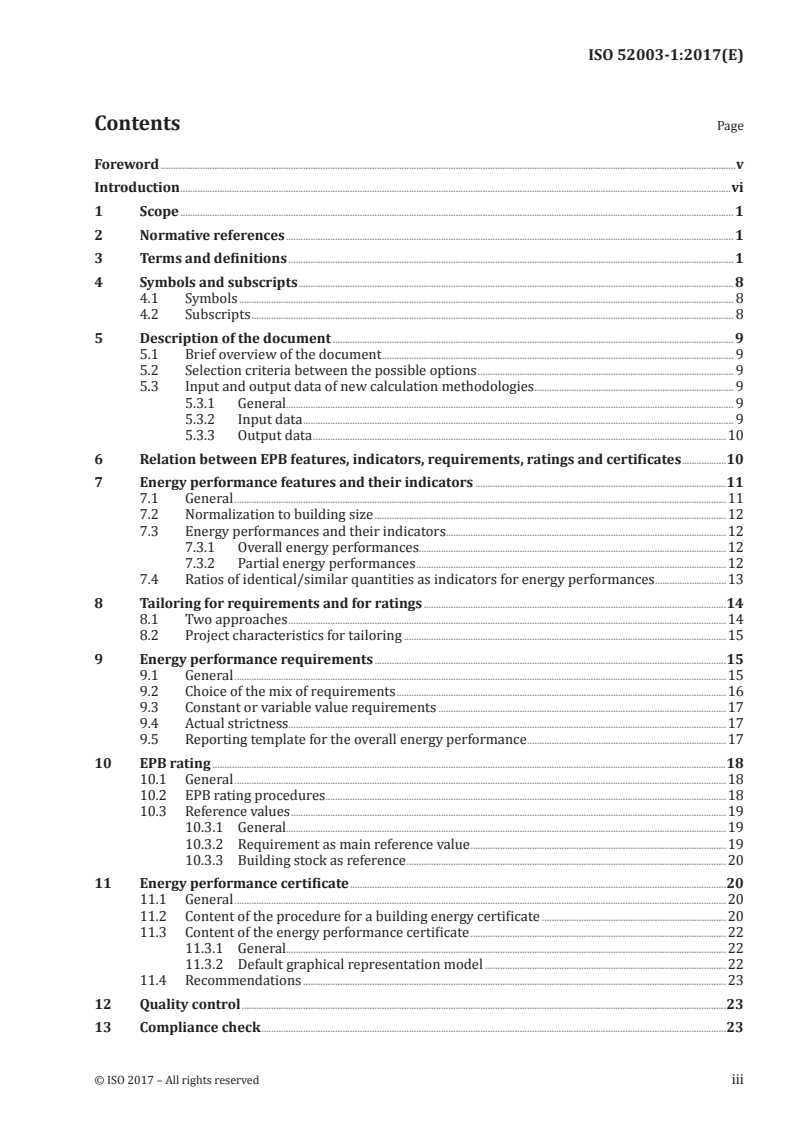

ISO 52003-1:2017 - Energy performance of buildings — Indicators, requirements, ratings and certificates — Part 1: General aspects and application to the overall energy performance/21/2017


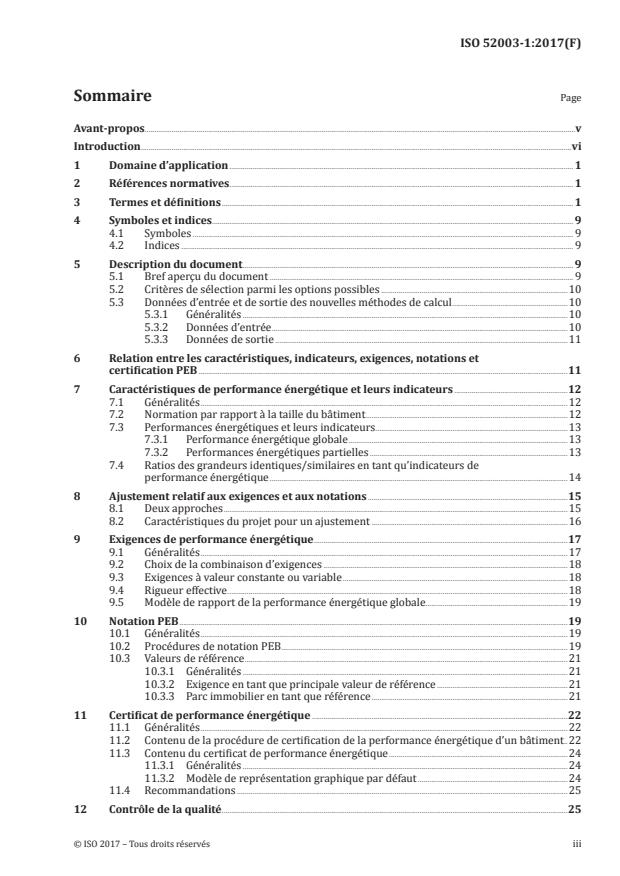

ISO 52003-1:2017 - Performance énergétique des bâtiments -- Indicateurs, exigences, appréciations et certificats


ISO 52003-1:2017 - Performance énergétique des bâtiments — Indicateurs, exigences, appréciations et certificats — Partie 1: Aspects généraux et application à la performance énergétique globale/29/2017
Overview - ISO 52003-1:2017 (Energy performance of buildings)
ISO 52003-1:2017 defines general aspects and post-processing uses of outputs from energy performance of buildings (EPB) assessment methods. It explains how overall EPB indicators relate to EPB requirements, EPB ratings, and energy performance certificates, and provides templates and standardized reporting tables to document choices for overall energy-performance requirements while preserving full regulatory flexibility. The standard is aimed at architects, engineers, regulators and other stakeholders involved in building energy assessment, certification and policy.
Key topics and requirements
- EPB indicators and outputs: Describes the types of overall and partial EPB indicators produced by EPB assessment standards and how they can be used.
- Relation between indicators, requirements and ratings: Clarifies how indicator outputs feed into regulatory requirements, rating schemes and certificates.
- Tailoring and project-specific values: Discusses the importance of project-specific (tailored) requirement or reference values for certain indicators and provides two approaches for tailoring.
- Reporting templates: Provides a normative template (Annex A) and informative default choices (Annex B) for reporting the selection of input data, calculation methods and overall EPB requirement choices in a structured, transparent way.
- EPB certification and labels: Includes possible EPB label models and lists steps for establishing an EPB certification scheme, including content for energy performance certificates.
- Quality control and compliance: Addresses quality control measures and compliance-check procedures linked to EPB assessments and certification.
- Scope limitations: Focuses on overall EPB indicators and does not provide tables for partial EPB requirements (fabric or technical building systems), which are covered in other standards.
Practical applications and users
- Regulators and policy makers: Use the standard to define and publish nationally or regionally mandated choices (via national annexes or data sheets) for EPB reporting and requirements.
- Certification bodies: Adopt the reporting templates and label models when designing energy performance certificates and certification schemes.
- Designers and engineers: Apply the guidance to interpret EPB outputs, set project-specific targets and support compliance checks.
- Building owners and asset managers: Use standardized EPB ratings and certificates to inform retrofit decisions, real-estate transactions and performance benchmarking.
Related standards
- ISO 52000-1 (modular structure for EPB standards)
- ISO/TR 52003-2 (informative technical report accompanying this standard)
- ISO 52018-1 / ISO/TR 52018-2 (partial EPB requirements for thermal balance and fabric)
- Relevant CEN EPB standards (technical building systems and specific energy uses)
Keywords: ISO 52003-1:2017, energy performance of buildings, EPB indicators, EPB requirements, EPB rating, energy performance certificate, building energy certification, energy performance assessment.
Relations
- Effective Date
- 25-Aug-2026
- Effective Date
- 12-Feb-2026
- Effective Date
- 28-Dec-2013
Buy Documents
ISO 52003-1:2017 - Energy performance of buildings -- Indicators, requirements, ratings and certificates
ISO 52003-1:2017 - Energy performance of buildings — Indicators, requirements, ratings and certificates — Part 1: General aspects and application to the overall energy performance/21/2017
ISO 52003-1:2017 - Performance énergétique des bâtiments -- Indicateurs, exigences, appréciations et certificats
ISO 52003-1:2017 - Performance énergétique des bâtiments — Indicateurs, exigences, appréciations et certificats — Partie 1: Aspects généraux et application à la performance énergétique globale/29/2017
Get Certified
Connect with accredited certification bodies for this standard

DIBt (Deutsches Institut für Bautechnik)
German Institute for Building Technology.
DIN CERTCO
DIN Group product certification.

Aboma Certification B.V.
Specialized in construction, metal, and transport sectors.
Sponsored listings
Frequently Asked Questions
ISO 52003-1:2017 is a standard published by the International Organization for Standardization (ISO). Its full title is "Energy performance of buildings — Indicators, requirements, ratings and certificates — Part 1: General aspects and application to the overall energy performance". This standard covers: The set of EPB assessment standards produces a great number of overall and partial EPB indicators as outputs. ISO 52003-1:2017 provides general insight to both private parties and public regulators (and all stakeholders involved in the regulatory process) on how to make good use of these outputs for different purposes (post-processing). ISO 52003-1:2017 describes the relation between the EPB indicators and the EPB requirements and EPB ratings, and it discusses the importance of project-specific, tailored values as requirement or reference for certain EPB indicators. ISO 52003-1:2017 also includes a couple of possible EPB labels and it lists the different steps to be taken when establishing an EPB certification scheme. ISO 52003-1:2017 provides standardized tables for reporting in a structured and transparent manner the choices that are to be made with respect to overall EPB requirements. The tables are non-restrictive, thus allowing for full regulatory flexibility. ISO 52003-1:2017 does not provide such tables for partial EPB requirements (related to the fabric or technical buildings systems), as this is dealt with in other documents. NOTE Table 1 in the Introduction shows the relative position of ISO 52003-1:2017 within the set of EPB standards in the context of the modular structure as set out in ISO 52000-1.
The set of EPB assessment standards produces a great number of overall and partial EPB indicators as outputs. ISO 52003-1:2017 provides general insight to both private parties and public regulators (and all stakeholders involved in the regulatory process) on how to make good use of these outputs for different purposes (post-processing). ISO 52003-1:2017 describes the relation between the EPB indicators and the EPB requirements and EPB ratings, and it discusses the importance of project-specific, tailored values as requirement or reference for certain EPB indicators. ISO 52003-1:2017 also includes a couple of possible EPB labels and it lists the different steps to be taken when establishing an EPB certification scheme. ISO 52003-1:2017 provides standardized tables for reporting in a structured and transparent manner the choices that are to be made with respect to overall EPB requirements. The tables are non-restrictive, thus allowing for full regulatory flexibility. ISO 52003-1:2017 does not provide such tables for partial EPB requirements (related to the fabric or technical buildings systems), as this is dealt with in other documents. NOTE Table 1 in the Introduction shows the relative position of ISO 52003-1:2017 within the set of EPB standards in the context of the modular structure as set out in ISO 52000-1.
ISO 52003-1:2017 is classified under the following ICS (International Classification for Standards) categories: 91.120.10 - Thermal insulation of buildings. The ICS classification helps identify the subject area and facilitates finding related standards.
ISO 52003-1:2017 has the following relationships with other standards: It is inter standard links to CEN ISO/TR 52003-2:2017, EN ISO 52003-1:2017, ISO 16343:2013. Understanding these relationships helps ensure you are using the most current and applicable version of the standard.
ISO 52003-1:2017 is available in PDF format for immediate download after purchase. The document can be added to your cart and obtained through the secure checkout process. Digital delivery ensures instant access to the complete standard document.
Standards Content (Sample)
INTERNATIONAL ISO
STANDARD 52003-1
First edition
2017-06
Energy performance of buildings —
Indicators, requirements, ratings and
certificates —
Part 1:
General aspects and application to the
overall energy performance
Performance énergétique des bâtiments — Indicateurs, exigences,
appréciations et certificats —
Partie 1: Aspects généraux et application à la performance
énergétique globale
Reference number
©
ISO 2017
© ISO 2017, Published in Switzerland
All rights reserved. Unless otherwise specified, no part of this publication may be reproduced or utilized otherwise in any form
or by any means, electronic or mechanical, including photocopying, or posting on the internet or an intranet, without prior
written permission. Permission can be requested from either ISO at the address below or ISO’s member body in the country of
the requester.
ISO copyright office
Ch. de Blandonnet 8 • CP 401
CH-1214 Vernier, Geneva, Switzerland
Tel. +41 22 749 01 11
Fax +41 22 749 09 47
copyright@iso.org
www.iso.org
ii © ISO 2017 – All rights reserved
Contents Page
Foreword .v
Introduction .vi
1 Scope . 1
2 Normative references . 1
3 Terms and definitions . 1
4 Symbols and subscripts . 8
4.1 Symbols . 8
4.2 Subscripts . 8
5 Description of the document . 9
5.1 Brief overview of the document . 9
5.2 Selection criteria between the possible options . 9
5.3 Input and output data of new calculation methodologies . 9
5.3.1 General. 9
5.3.2 Input data . 9
5.3.3 Output data .10
6 Relation between EPB features, indicators, requirements, ratings and certificates .10
7 Energy performance features and their indicators .11
7.1 General .11
7.2 Normalization to building size .12
7.3 Energy performances and their indicators .12
7.3.1 Overall energy performances.12
7.3.2 Partial energy performances .12
7.4 Ratios of identical/similar quantities as indicators for energy performances .13
8 Tailoring for requirements and for ratings .14
8.1 Two approaches .14
8.2 Project characteristics for tailoring .15
9 Energy performance requirements .15
9.1 General .15
9.2 Choice of the mix of requirements .16
9.3 Constant or variable value requirements .17
9.4 Actual strictness . .17
9.5 Reporting template for the overall energy performance .17
10 EPB rating .18
10.1 General .18
10.2 EPB rating procedures .18
10.3 Reference values .19
10.3.1 General.19
10.3.2 Requirement as main reference value .19
10.3.3 Building stock as reference .20
11 Energy performance certificate .20
11.1 General .20
11.2 Content of the procedure for a building energy certificate .20
11.3 Content of the energy performance certificate .22
11.3.1 General.22
11.3.2 Default graphical representation model .22
11.4 Recommendations .23
12 Quality control .23
13 Compliance check .23
Annex A (normative) Input and method selection data sheet — Template .24
Annex B (informative) Input and method selection data sheet — Default choices .29
Bibliography .35
iv © ISO 2017 – All rights reserved
Foreword
ISO (the International Organization for Standardization) is a worldwide federation of national standards
bodies (ISO member bodies). The work of preparing International Standards is normally carried out
through ISO technical committees. Each member body interested in a subject for which a technical
committee has been established has the right to be represented on that committee. International
organizations, governmental and non-governmental, in liaison with ISO, also take part in the work.
ISO collaborates closely with the International Electrotechnical Commission (IEC) on all matters of
electrotechnical standardization.
The procedures used to develop this document and those intended for its further maintenance are
described in the ISO/IEC Directives, Part 1. In particular the different approval criteria needed for the
different types of ISO documents should be noted. This document was drafted in accordance with the
editorial rules of the ISO/IEC Directives, Part 2 (see www .iso .org/ directives).
Attention is drawn to the possibility that some of the elements of this document may be the subject of
patent rights. ISO shall not be held responsible for identifying any or all such patent rights. Details of
any patent rights identified during the development of the document will be in the Introduction and/or
on the ISO list of patent declarations received (see www .iso .org/ patents).
Any trade name used in this document is information given for the convenience of users and does not
constitute an endorsement.
For an explanation on the voluntary nature of standards, the meaning of ISO specific terms and
expressions related to conformity assessment, as well as information about ISO’s adherence to the
World Trade Organization (WTO) principles in the Technical Barriers to Trade (TBT) see the following
URL: w w w . i s o .org/ iso/ foreword .html.
ISO 52003-1 was prepared by ISO Technical Committee TC 163, Thermal performance and energy use in
the built environment, in collaboration with Technical Committee TC 205, Building environment design,
and with the European Committee for Standardization (CEN) Technical Committee CEN/TC 89, Thermal
performance of buildings and building components, in accordance with the Agreement on technical
cooperation between ISO and CEN (Vienna Agreement).
This first edition of ISO 52003-1 cancels and replaces ISO 16343:2013, which has been technically
revised.
The necessary editorial revisions were made to comply with the requirements for each EPB standard.
The content of ISO 16343 has been reworked significantly, but it has been attempted not to lose
any substantial original information, even though the original text has sometimes been strongly
restructured and rephrased, and new content has been added throughout. The original text has been
split into 2 parts: a normative standard and an informative technical report.
A list of all parts in the ISO 52003 series can be found on the ISO website.
Introduction
This document is part of a series aimed at the international harmonization of the methodology for
assessing the energy performance of buildings. Throughout, this series is referred to as a “set of EPB
standards”.
All EPB standards follow specific rules to ensure overall consistency, unambiguity and transparency.
All EPB standards provide a certain flexibility with regard to the methods, the required input data and
references to other EPB standards, by the introduction of a normative template in Annex A and Annex B
with informative default choices.
For the correct use of this document, a normative template is given in Annex A to specify these choices.
Informative default choices are provided in Annex B.
The main target groups for this document are architects, engineers and regulators.
Use by or for regulators: In case the document is used in the context of national or regional legal
requirements, mandatory choices may be given at national or regional level for such specific
applications. These choices (either the informative default choices from Annex B or choices adapted to
national/regional needs, but in any case following the template of Annex A) can be made available as
national annex or as separate (e.g. legal) document (national data sheet).
NOTE 1 So in this case:
— the regulators will specify the choices;
— the individual user will apply the document to assess the energy performance of a building, and thereby use
the choices made by the regulators.
Topics addressed in this document can be subject to public regulation. Public regulation on the same
topics can override the default values in Annex B. Public regulation on the same topics can even, for
certain applications, override the use of this document. Legal requirements and choices are in general
not published in standards but in legal documents. In order to avoid double publications and difficult
updating of double documents, a national annex may refer to the legal texts where national choices
have been made by public authorities. Different national annexes or national data sheets are possible,
for different applications.
It is expected, if the default values, choices and references to other EPB standards in Annex B are not
followed due to national regulations, policy or traditions, that:
— national or regional authorities prepare data sheets containing the choices and national or regional
values, according to the model in Annex A. In this case a national annex (e.g. NA) is recommended,
containing a reference to these data sheets;
— or, by default, the national standards body will consider the possibility to add or include a national
annex in agreement with the template of Annex A, in accordance to the legal documents that give
national or regional values and choices.
Further target groups are parties wanting to motivate their assumptions by classifying the building
energy performance for a dedicated building stock.
More information is provided in the Technical Report accompanying this document (ISO/TR 52003-2).
The overall and partial EPB indicators, i.e. the quantitative output of EPB assessments, can be used for
different purposes:
1) Requirements: to set public or private requirements regarding the energy performance of buildings.
2) Decisions: to facilitate decisions or actions in the private or public domain.
vi © ISO 2017 – All rights reserved
3) Information and communication: for building designers, owners, operators, users, policy makers
and citizens (as sellers or renters, as prospective buyers or tenants).
This document and ISO/TR 52003-2 deal with several of these uses, which can generically be described
as the post-processing of the outputs of the EPB assessment methods (see 5.1).
The main focus of the actual (normative) standard, i.e. this document, is on basic concepts and relations
and on the actions that need to be taken. The accompanying (informative) technical report, i.e.
ISO/TR 52003-2, provides extensive further information to support actors in a judicious implementation.
For optimal understanding, both documents are therefore best read side-by-side, clause-by-clause.
This document and ISO/TR 52003-2 are complemented by
— ISO 52018-1 and ISO/TR 52018-2 that deal with partial EPB requirements related to thermal energy
balance and fabric features, and
— CEN EPB standards that deal with the same topics for specific technical building systems, servicing
specific types of energy use (such as heating, cooling, ventilation, domestic hot water and lighting).
Much of the content of these texts may be commonplace to those experienced in the domain. However,
it has been decided to document basic considerations with a view to fully informing any interested
party, including novices in the field. The texts thus partly serve as “institutional memory”. The aim is to
contribute to well-informed choices and also to any future revision of a regulation (choice of the mix of
EPB features and indicators, variable or constant value requirements and/or rating references, actual
requirement strictness).
Table 1 shows the relative position of this document within the set of EPB standards in the context of
the modular structure as set out in ISO 52000-1.
NOTE 2 In ISO/TR 52000-2, the same table can be found with, for each module, the numbers of the relevant
EPB standards and accompanying technical reports that are published or in preparation.
The modules represent EPB standards, although one EPB standard may cover more than one module
and one module may be covered by more than one EPB standard, for instance, a simplified and a detailed
method respectively. See also Clause 2 and Tables A.1 and B.1.
Table 1 — Position of this document (in casu M1–4) within the modular structure of the set of
EPB standards
Building
Overarching Technical Building Systems
(as such)
Build-
ing
Hu- De- Do-
auto-
De- Ven- mid- hu- mes- PV,
Sub- Descrip- Heat- Cool- Light- ma-
Descriptions scrip- tila- ifi mid- tic wind,
module tions ing ing ing tion
tions tion cati- ifica- hot .
and
on tion water
con-
trol
sub1 M1 M2 M3 M4 M5 M6 M7 M8 M9 M10 M11
1 General General General
Common terms
Building
and definitions;
a
2 energy Needs
symbols, units
needs
and subscripts
(Free)
Indoor Maxi-
condi- mum
3 Applications
tions load and
without power
systems
Ways to Ways to
Ways to express express express
4 energy perfor- ISO 52003-1 energy energy
mance perfor- perfor-
mance mance
Heat
Building catego- trans- Emis-
5 ries and building fer by sion and
boundaries trans- control
mission
Heat
trans-
Building occupan- fer by Distribu-
6 cy and operating infiltra- tion and
conditions tion and control
ventila-
tion
Aggregation of en- Internal Storage
7 ergy services and heat and
energy carriers gains control
Solar Genera-
8 Building zoning heat tion and
gains control
viii © ISO 2017 – All rights reserved
Table 1 (continued)
Building
Overarching Technical Building Systems
(as such)
Build-
ing
Hu- De- Do-
auto-
De- Ven- mid- hu- mes- PV,
Sub- Descrip- Heat- Cool- Light- ma-
Descriptions scrip- tila- ifi mid- tic wind,
module tions ing ing ing tion
tions tion cati- ifica- hot .
and
on tion water
con-
trol
sub1 M1 M2 M3 M4 M5 M6 M7 M8 M9 M10 M11
Building Load
dy- dispatch-
Calculated ener- namics ing and
gy performance (ther- operat-
mal ing con-
mass) ditions
Meas- Meas-
ured ured
Measured energy
10 energy energy
performance
perfor- perfor-
mance mance
Inspec- Inspec-
11 Inspection
tion tion
Ways to express
12 BMS
indoor comfort
External environ-
ment conditions
Economic calcu-
lation
a
The shaded modules are not applicable
INTERNATIONAL STANDARD ISO 52003-1:2017(E)
Energy performance of buildings — Indicators,
requirements, ratings and certificates —
Part 1:
General aspects and application to the overall energy
performance
1 Scope
The set of EPB assessment standards produces a great number of overall and partial EPB indicators as
outputs. This document provides general insight to both private parties and public regulators (and all
stakeholders involved in the regulatory process) on how to make good use of these outputs for different
purposes (post-processing).
This document describes the relation between the EPB indicators and the EPB requirements and EPB
ratings, and it discusses the importance of project-specific, tailored values as requirement or reference
for certain EPB indicators. This document also includes a couple of possible EPB labels and it lists the
different steps to be taken when establishing an EPB certification scheme.
This document provides standardized tables for reporting in a structured and transparent manner the
choices that are to be made with respect to overall EPB requirements. The tables are non-restrictive,
thus allowing for full regulatory flexibility. This document does not provide such tables for partial
EPB requirements (related to the fabric or technical buildings systems), as this is dealt with in other
documents.
NOTE Table 1 in the Introduction shows the relative position of this document within the set of EPB
standards in the context of the modular structure as set out in ISO 52000-1.
2 Normative references
The following documents are referred to in the text in such a way that some or all of their content
constitutes requirements of this document. For dated references, only the edition cited applies. For
undated references, the latest edition of the referenced document (including any amendments) applies.
ISO 7345:1987, Thermal insulation — Physical quantities and definitions
ISO 52000-1:2017, Energy performance of buildings — Overarching EPB assessment — Part 1: General
framework and procedures
NOTE Default references to EPB standards other than ISO 52000-1 are identified by the EPB module code
number and given in Annex A (normative template in Table A.1) and Annex B (informative default choice in
Table B.1).
EXAMPLE EPB module code number: M5–5, or M5–5.1 (if module M5–5 is subdivided), or M5–5/1 (if
reference to a specific clause of the standard covering M5–5).
3 Terms and definitions
For the purposes of this document, the terms and definitions given in ISO 7345 and ISO 52000-1 and the
following apply
ISO and IEC maintain terminological databases for use in standardization at the following addresses:
— IEC Electropedia: available at http:// www .electropedia .org/
— ISO Online browsing platform: available at http:// www .iso .org/ obp
NOTE The terms of ISO 52000-1 that are indispensable for the understanding of this document are
repeated here.
3.1 Building
3.1.1
assessed object
building, part of a building or portfolio of buildings that is the object of the energy performance
assessment
Note 1 to entry: The assessed object comprises all spaces and technical systems which may contribute to or
influence the energy performance assessment.
Note 2 to entry: The assessed object may include one or several building units, if these are not individually object
of the energy performance assessment.
Note 3 to entry: A distinction may be made between, e.g. a designed building, new building after construction,
existing building in the use phase and existing building after major renovation.
[SOURCE: ISO 52000-1:2017, 3.1.1]
3.1.2
building
construction as a whole, including the fabric and all technical building systems, where energy may be
used to condition the indoor environment, to provide domestic hot water and illumination and other
services related to the use of the building
Note 1 to entry: The term refers to the physical building as a whole, or to all parts thereof, that at least include the
spaces and technical building systems that are relevant for the energy performance assessment.
Note 2 to entry: Parts of a building can be physically detached, but are on the same building site. For example: a
canteen or a guard house or one or more classrooms of a school in a detached part of a building; or an essential
space in a dwelling (e.g. bedroom).
[SOURCE: ISO 52000-1:2017, 3.1.2]
3.1.3
building category
unit category
classification of buildings and/or building units related to their main use or their special status, for the
purpose of enabling differentiation of the energy performance assessment procedures and/or energy
performance requirements
EXAMPLE Buildings officially protected as part of a designated environment or because of their special
architectural or historical merit, buildings used as places of worship and for religious activities, residential
buildings, (a) single-family houses of different types;(b) apartment blocks;(c) offices;(d) educational buildings;(e)
hospitals;(f) hotels and restaurants;(g) sports facilities;(h) wholesale and retail trade services buildings;(i) data
centres; (j) other types of energy-consuming buildings.
Note 1 to entry: Building regulations often make a distinction between building categories.
Note 2 to entry: The building category, for instance, may determine if energy performance assessment is
mandatory (e.g., not for religious or historic buildings) and which are the minimum energy performance
requirements (e.g., for new buildings); in some countries measured energy performance of a building is
prescribed for specific categories of buildings (e.g., apartment buildings, large public buildings), etc. Another
type of categorization is the distinction between new and existing and renovated buildings.
2 © ISO 2017 – All rights reserved
Note 3 to entry: Many buildings or building units of a given (use) category contain spaces of different (use)
categories; for instance an office building may contain a restaurant; see 3.1.11.
Note 4 to entry: The allocation of a building category may also have a strong impact on other parts of the building
regulations, for instance on safety (e.g., emergency exits, strength of floor) or indoor environmental quality (e.g.,
minimum ventilation rates).
[SOURCE: ISO 52000-1:2017, 3.1.3]
3.1.4
building element
integral component of the technical building systems or of the fabric of a building
[SOURCE: ISO 52000-1:2017, 3.1.4]
3.1.5
building fabric
all physical elements of a building, excluding technical building systems
EXAMPLE 1 Roofs, walls, floors, doors, gates and internal partitions.
EXAMPLE 2 It includes elements both inside and outside of the thermal envelope, including the thermal
envelope itself.
Note 1 to entry: The fabric determines the thermal transmission, the thermal envelope airtightness and (nearly
all of) the thermal mass of the building (apart from the thermal mass of furniture and technical building
systems). The fabric also makes the building wind and water tight. The building fabric is sometimes described as
the building as such, i.e. the building without any technical building system.
[SOURCE: ISO 52000-1:2017, 3.1.5]
3.1.6
building portfolio
set of buildings and common technical building systems whose energy performance is determined
taking into account their mutual interactions
Note 1 to entry: An example of common equipment is an energy generation system (PV panels, wind turbine,
cogen unit, boiler, etc.) serving the building portfolio.
[SOURCE: ISO 52000-1:2017, 3.1.6]
3.1.7
building thermal zone
thermal zone
internal environment with assumed sufficiently uniform thermal conditions to enable a thermal
balance calculation according to the procedures in the standard under EPB module M2-2
Note 1 to entry: The EPB standard under module M2–2 is ISO 52016-1.
[SOURCE: ISO 52000-1:2017, 3.1.7]
3.1.8
building unit
section, floor or apartment within a building which is designed or altered to be used separately from
the rest of the building
EXAMPLE A shop in a shopping mall, an apartment in an apartment building or a rentable office space in an
office building.
Note 1 to entry: The building unit can be the assessed object.
[SOURCE: ISO 52000-1:2017, 3.1.8]
3.1.9
reference floor area
floor area used as a reference size
Note 1 to entry: See definition of reference size.
[SOURCE: ISO 52000-1:2017, 3.1.12]
3.1.10
reference size
relevant metric to normalize the overall or partial energy performance and energy performance
requirements to the size of the building or part of a building and for the comparison against benchmarks
[SOURCE: ISO 52000-1:2017, 3.1.13]
3.1.11
space category
classification of building spaces related to a specific set of use conditions
EXAMPLE Office space, restaurant space, entrance hall, toilet, living space, assembly hall, shop, residential
bed room, indoor car park, heated indoor stair case, unheated indoor stair case, etc.
Note 1 to entry: The space category is relevant for the calculation of the energy performance assessment and for
defining the reference size.
[SOURCE: ISO 52000-1:2017, 3.1.14]
3.1.12
thermal envelope area
total area of all elements of a building that enclose thermally conditioned spaces through which thermal
energy is transferred, directly or indirectly, to or from the external environment
Note 1 to entry: The thermal envelope area depends on whether internal, overall internal or external dimensions
are being used.
Note 2 to entry: The thermal envelope area does not include the area to adjacent buildings; see ISO 13789.
Note 3 to entry: The thermal envelope area may play a role in the ways to express the overall and partial energy
performance and energy performance requirements and comparison against benchmarks.
[1]
[SOURCE: ISO 13789:2017 , 3.9 — modified with addition of notes to entry 2 and 3]
3.1.13
useful floor area
area of the floor of a building needed as parameter to quantify specific conditions
of use that are expressed per unit of floor area and for the application of the simplifications and the
zoning and reallocation rules
[SOURCE: ISO 52000-1:2017, 3.1.18]
3.2 Indoor and outdoor conditions
3.2.1
conditions of use
requirement and/or restriction for the use of a building space category, related to the services for the
energy performance assessment and/or the boundary conditions
EXAMPLE Heating set-point, cooling set-point, minimum amount of ventilation related to air quality, net
domestic hot water needs (e.g. per m floor area or per person), lighting levels, internal heat gains, etc., including
the distribution over time (operation). Where relevant, the numbers are based on the number of occupants per
m per type of building space.
[SOURCE: ISO 52000-1:2017, 3.2.1]
4 © ISO 2017 – All rights reserved
3.3 Energy performance
3.3.1
actual measured energy
measured energy without any correction for standard climate and use
[SOURCE: ISO 52000-1:2017, 3.5.1]
3.3.2
as built energy performance
energy performance calculated with data for the building after construction (prior to or during
operation) and standard use data set
Note 1 to entry: This represents the calculated intrinsic annual energy use of a realized building under
standardized conditions. It is particularly relevant for the energy performance certificate and for regulation
(verification of compliance with requirements).
[SOURCE: ISO 52000-1:2017, 3.5.2]
3.3.3
calculated energy performance
energy performance based on calculations of the weighted net delivered energy for the EPB services
[SOURCE: ISO 52000-1:2017, 3.5.3]
3.3.4
design energy performance
energy performance with design data for the building and standard use and climate data set
Note 1 to entry: This represents the calculated intrinsic annual energy use of a designed building under
standardized conditions. It is particularly relevant to obtain a building permit at the design stage.
[SOURCE: ISO 52000-1:2017, 3.5.5]
3.3.5
energy feature
EPB feature
any element, component or property aspect of a building or building unit, single or combined, that may
have an effect on the energy performance of the assessed object
Note 1 to entry: An EPB feature may relate to a single building element (e.g. the thermal insulation of a wall) or
any combination of building elements (e.g. the heating needs, the performance of a heating system, the overall
energy performance, etc.), up to the entire building.
Note 2 to entry: Every EPB feature can be characterized by several possible EPB indicators. For instance, the
thermal insulation of a wall can be quantified by its thermal transmittance, its overall thermal resistance, its
[9]
temperature factor, etc. For more examples, see ISO 52018-1 .
[SOURCE: ISO 52000-1:2017, 3.5.6]
3.3.6
energy performance
overall energy performance
calculated or measured amount of (weighted) energy needed to meet the energy
demand associated with a typical use of the assessed object, which includes energy used for specific
services (EPB services)
Note 1 to entry: See definition of EPB services and definition of assessed object.
Note 2 to entry: Also called overall energy performance, to distinct from partial energy performance.
[SOURCE: ISO 52000-1:2017, 3.5.7]
3.3.7
energy performance certificate
certificate, for instance recognized by a country or by a legal person designated
by it, which indicates the energy performance of the assessed object, calculated or measured according
to one or more specified methodologies
Note 1 to entry: The meaning of the terms “certificate” and “certification” in this document differ from those in
[6]
ISO/IEC 17000 .
[SOURCE: ISO 52000-1:2017, 3.5.8]
3.3.8
energy performance certification
process of providing an energy performance certificate
[SOURCE: ISO 52000-1:2017, 3.5.9]
3.3.9
energy performance indicator
EPB indicator
calculated or measured numerical quantity that characterizes an energy feature of an assessed object
Note 1 to entry: EPB indicators are used for the energy performance rating, the energy performance requirements
and/or for the certificate. An EPB indicator can for example be expressed in energy performance per unit of floor
area or energy performance divided by the energy performance of a specific benchmark or another reference value.
Note 2 to entry: This covers both overall and partial energy performances.
[SOURCE: ISO 52000-1:2017, 3.5.10]
3.3.10
energy performance requirement
minimum level of the (partial or overall) energy performance that is to be achieved to obtain a right or
an advantage, e.g. right to build, lower interest rate, quality label
[SOURCE: ISO 52000-1:2017, 3.5.11]
3.3.11
energy rating
EPB rating
evaluation of the value of an energy performance indicator by comparison against one or more reference
values, possibly including a visualization of the position on a continuous or discrete scale
Note 1 to entry: This may concern overall or partial energy performance.
[SOURCE: ISO 52000-1:2017, 3.5.12]
3.3.12
EPB service
building service included in the assessment of the energy performance
Note 1 to entry: See definition of building service. Which services are included is a national or regional choice,
specified in ISO 52000-1:2017, Annexes A and B.
EXAMPLE Energy used for heating, cooling, ventilation, humidification, dehumidification, domestic hot
water and lighting.
[SOURCE: ISO 52000-1:2017, 3.5.13]
6 © ISO 2017 – All rights reserved
3.3.13
EPB standard
[7]
standard that complies with the requirements given in ISO 52000-1, CEN/TS 16628 and
[8]
CEN/TS 16629
Note 1 to entry: These three basic EPB documents were developed under a mandate given to CEN by the European
Commission and the European Free Trade Association (Mandate M/480), and support essential requirements of
EU Directive 2010/31/EU on the energy performance of buildings (EPBD). Several EPB standards and related
documents are developed or revised under the same mandate.
[SOURCE: ISO 52000-1:2017, 3.1.14]
3.3.14
measured energy indicator
energy performance indicator based on measured energy performance
[SOURCE: ISO 52000-1:2017, 3.5.16]
3.3.15
measured energy performance
energy performance based on weighted measured amounts of delivered and exported energy
Note 1 to entry: The measured energy performance is the weighted sum of all energy carriers used by the
building, as measured by meters or derived from measured energy by other means. It is a measure of the in-use
performance of the building after correction or extrapolation. This is particularly relevant to certification of
actual energy performance.
Note 2 to entry: Also known as “operational energy performance”.
[SOURCE: ISO 52000-1:2017, 3.5.16]
3.3.16
numerical indicator of primary energy use
primary energy use per unit of reference floor area
Note 1 to entry: Since primary energy use can be expressed in total primary energy, non-renewable primary
energy can be specified in the numerical indicator (e.g. non-renewable primary energy use).
[SOURCE: ISO 52000-1:2017, 3.5.18]
3.3.17
partial energy performance
energy performances of one or a combination of building elements or
components or other energy features of the assessed object
Note 1 to entry: Other energy features are for instance: energy needs for heating and cooling and air tightness.
[SOURCE: ISO 52000-1:2017, 3.5.19]
3.3.18
reference value
standard legal or calculated value against which an energy indicator is compared
Note 1 to entry: This can be a fixed value for specific types of buildings or for specific energy features, or a
variable value (formula or notional reference building) taking into account one or more data from the actual
building.
[SOURCE: ISO 52000-1:2017, 3.5.20]
3.3.19
standard energy indicator
energy performance indicator based on energy performance under a set of standard conditions
Note 1 to entry: Assessed under standard conditions (if calculated) or corrected for deviating conditions (if
measured).
[SOURCE: ISO 52000-1:2017, 3.5.22]
3.3.20
standard energy performance
energy performance using actual data for a building and a standard use and climate data set (if
calculated) or corrected for deviating conditions (if measured)
Note 1 to entry: This represents the intrinsic annual energy use of an assessed object, under standardized
conditions. It is particularly relevant to certification of standard energy performance.
Note 2 to entry: In case of calculated energy performance it can also be termed “asset energy performance”.
[SOURCE: ISO 52000-1:2017, 3.5.23]
3.3.21
tailored energy performance
calculated energy performance using actual data for a building and actual climate and occupancy data
[SOURCE: ISO 52000-1:2017, 3.5.24]
4 Symbols and subscripts
4.1 Symbols
For the purposes of this document, the symbols given in ISO 52000-1:2017, Clause 4 and Annex C and
the following apply.
Symbol Name of quantity Unit
I indicator (generic symbol) —
n number —
R reference same as the considered EPB indicator
X any physical quantity any (symbol U from Unit)
ɛ expenditure factor —
η efficiency —
4.2 Subscripts
For the purposes of this document, the subscripts given in ISO 52000-1:2017, Clause 4 and Annex C and
the following apply.
r regulation
ref reference
s stock
8 © ISO 2017 – All rights reserved
5 Description of the document
5.1 Brief overview of the document
The EPB assessment methods provide a large number of intermediate and final quantitative results,
here called EPB indicators. This document supports users in making intelligent use of these indicators
(sometimes after some further mathematical treatment of the primary numerical results). The users
can be either public authorities or private actors.
It is the responsibility of the competent authorities (regulators) to take all of the various decisions related to
the public EPB requirements, ratings, certificates, etc.
This document first explains the different concepts and their mutual relation (Clauses 6 and 7). It then
discusses two main uses that can be made of these numeric values, namely:
— EPB requirement setting (Clause 9);
— EPB rating (Clause 10).
For both uses, smart limiting or reference values are needed. Often it may be best that these values
are variable, tailored to the relevant characteristics of each individual project. Methods to establish
such variable values are discussed in Clause 8. Finally, any results and further information can be
documented in an energy performance certificate, possibly complemented by a further report, which is
treated in Clause 11.
Clauses 12 and 13 relate to quality control of the application of the procedures provided in this
document.
NOTE This document thus deals with what can be called the “post-processing” of the output of the EPB
assessment methods.
5.2 Selection criteria between the possible options
Clauses 8 to 11 comprise, in brief, considerations concerning the choices between alternative options or
combinations of options.
NOTE More extensive considerations, such as the rationale behind the options and the advantages and
[4]
drawbacks of different options are given in the corresponding clauses in ISO/TR 52003-2:2017 .
5.3 Input and output data of new calculation methodologies
5.3.1 General
Among other things, this document provides orientation and insight with respect to the setting of
requirements (see 8.2) and the establishment of ratings (see Clause 10). These two objectives may
require the establishment of additional calculation schemes (notably for tailored requirements and
references, see Clause 8). However, unlike the other EPB standards, this document does not provide
a readily applicable set of methods and equations, as it is the responsibility of the competent public
authorities or private actors to take the various related decisions as a function of their specific
purpose(s) and context. When specific methodologies are elaborated in full and practical detail, the
specifiers shall systematically report all the
...
INTERNATIONAL ISO
STANDARD 52003-1
First edition
2017-06
Energy performance of buildings —
Indicators, requirements, ratings and
certificates —
Part 1:
General aspects and application to the
overall energy performance
Performance énergétique des bâtiments — Indicateurs, exigences,
appréciations et certificats —
Partie 1: Aspects généraux et application à la performance
énergétique globale
Reference number
©
ISO 2017
© ISO 2017, Published in Switzerland
All rights reserved. Unless otherwise specified, no part of this publication may be reproduced or utilized otherwise in any form
or by any means, electronic or mechanical, including photocopying, or posting on the internet or an intranet, without prior
written permission. Permission can be requested from either ISO at the address below or ISO’s member body in the country of
the requester.
ISO copyright office
Ch. de Blandonnet 8 • CP 401
CH-1214 Vernier, Geneva, Switzerland
Tel. +41 22 749 01 11
Fax +41 22 749 09 47
copyright@iso.org
www.iso.org
ii © ISO 2017 – All rights reserved
Contents Page
Foreword .v
Introduction .vi
1 Scope . 1
2 Normative references . 1
3 Terms and definitions . 1
4 Symbols and subscripts . 8
4.1 Symbols . 8
4.2 Subscripts . 8
5 Description of the document . 9
5.1 Brief overview of the document . 9
5.2 Selection criteria between the possible options . 9
5.3 Input and output data of new calculation methodologies . 9
5.3.1 General. 9
5.3.2 Input data . 9
5.3.3 Output data .10
6 Relation between EPB features, indicators, requirements, ratings and certificates .10
7 Energy performance features and their indicators .11
7.1 General .11
7.2 Normalization to building size .12
7.3 Energy performances and their indicators .12
7.3.1 Overall energy performances.12
7.3.2 Partial energy performances .12
7.4 Ratios of identical/similar quantities as indicators for energy performances .13
8 Tailoring for requirements and for ratings .14
8.1 Two approaches .14
8.2 Project characteristics for tailoring .15
9 Energy performance requirements .15
9.1 General .15
9.2 Choice of the mix of requirements .16
9.3 Constant or variable value requirements .17
9.4 Actual strictness . .17
9.5 Reporting template for the overall energy performance .17
10 EPB rating .18
10.1 General .18
10.2 EPB rating procedures .18
10.3 Reference values .19
10.3.1 General.19
10.3.2 Requirement as main reference value .19
10.3.3 Building stock as reference .20
11 Energy performance certificate .20
11.1 General .20
11.2 Content of the procedure for a building energy certificate .20
11.3 Content of the energy performance certificate .22
11.3.1 General.22
11.3.2 Default graphical representation model .22
11.4 Recommendations .23
12 Quality control .23
13 Compliance check .23
Annex A (normative) Input and method selection data sheet — Template .24
Annex B (informative) Input and method selection data sheet — Default choices .29
Bibliography .35
iv © ISO 2017 – All rights reserved
Foreword
ISO (the International Organization for Standardization) is a worldwide federation of national standards
bodies (ISO member bodies). The work of preparing International Standards is normally carried out
through ISO technical committees. Each member body interested in a subject for which a technical
committee has been established has the right to be represented on that committee. International
organizations, governmental and non-governmental, in liaison with ISO, also take part in the work.
ISO collaborates closely with the International Electrotechnical Commission (IEC) on all matters of
electrotechnical standardization.
The procedures used to develop this document and those intended for its further maintenance are
described in the ISO/IEC Directives, Part 1. In particular the different approval criteria needed for the
different types of ISO documents should be noted. This document was drafted in accordance with the
editorial rules of the ISO/IEC Directives, Part 2 (see www .iso .org/ directives).
Attention is drawn to the possibility that some of the elements of this document may be the subject of
patent rights. ISO shall not be held responsible for identifying any or all such patent rights. Details of
any patent rights identified during the development of the document will be in the Introduction and/or
on the ISO list of patent declarations received (see www .iso .org/ patents).
Any trade name used in this document is information given for the convenience of users and does not
constitute an endorsement.
For an explanation on the voluntary nature of standards, the meaning of ISO specific terms and
expressions related to conformity assessment, as well as information about ISO’s adherence to the
World Trade Organization (WTO) principles in the Technical Barriers to Trade (TBT) see the following
URL: w w w . i s o .org/ iso/ foreword .html.
ISO 52003-1 was prepared by ISO Technical Committee TC 163, Thermal performance and energy use in
the built environment, in collaboration with Technical Committee TC 205, Building environment design,
and with the European Committee for Standardization (CEN) Technical Committee CEN/TC 89, Thermal
performance of buildings and building components, in accordance with the Agreement on technical
cooperation between ISO and CEN (Vienna Agreement).
This first edition of ISO 52003-1 cancels and replaces ISO 16343:2013, which has been technically
revised.
The necessary editorial revisions were made to comply with the requirements for each EPB standard.
The content of ISO 16343 has been reworked significantly, but it has been attempted not to lose
any substantial original information, even though the original text has sometimes been strongly
restructured and rephrased, and new content has been added throughout. The original text has been
split into 2 parts: a normative standard and an informative technical report.
A list of all parts in the ISO 52003 series can be found on the ISO website.
Introduction
This document is part of a series aimed at the international harmonization of the methodology for
assessing the energy performance of buildings. Throughout, this series is referred to as a “set of EPB
standards”.
All EPB standards follow specific rules to ensure overall consistency, unambiguity and transparency.
All EPB standards provide a certain flexibility with regard to the methods, the required input data and
references to other EPB standards, by the introduction of a normative template in Annex A and Annex B
with informative default choices.
For the correct use of this document, a normative template is given in Annex A to specify these choices.
Informative default choices are provided in Annex B.
The main target groups for this document are architects, engineers and regulators.
Use by or for regulators: In case the document is used in the context of national or regional legal
requirements, mandatory choices may be given at national or regional level for such specific
applications. These choices (either the informative default choices from Annex B or choices adapted to
national/regional needs, but in any case following the template of Annex A) can be made available as
national annex or as separate (e.g. legal) document (national data sheet).
NOTE 1 So in this case:
— the regulators will specify the choices;
— the individual user will apply the document to assess the energy performance of a building, and thereby use
the choices made by the regulators.
Topics addressed in this document can be subject to public regulation. Public regulation on the same
topics can override the default values in Annex B. Public regulation on the same topics can even, for
certain applications, override the use of this document. Legal requirements and choices are in general
not published in standards but in legal documents. In order to avoid double publications and difficult
updating of double documents, a national annex may refer to the legal texts where national choices
have been made by public authorities. Different national annexes or national data sheets are possible,
for different applications.
It is expected, if the default values, choices and references to other EPB standards in Annex B are not
followed due to national regulations, policy or traditions, that:
— national or regional authorities prepare data sheets containing the choices and national or regional
values, according to the model in Annex A. In this case a national annex (e.g. NA) is recommended,
containing a reference to these data sheets;
— or, by default, the national standards body will consider the possibility to add or include a national
annex in agreement with the template of Annex A, in accordance to the legal documents that give
national or regional values and choices.
Further target groups are parties wanting to motivate their assumptions by classifying the building
energy performance for a dedicated building stock.
More information is provided in the Technical Report accompanying this document (ISO/TR 52003-2).
The overall and partial EPB indicators, i.e. the quantitative output of EPB assessments, can be used for
different purposes:
1) Requirements: to set public or private requirements regarding the energy performance of buildings.
2) Decisions: to facilitate decisions or actions in the private or public domain.
vi © ISO 2017 – All rights reserved
3) Information and communication: for building designers, owners, operators, users, policy makers
and citizens (as sellers or renters, as prospective buyers or tenants).
This document and ISO/TR 52003-2 deal with several of these uses, which can generically be described
as the post-processing of the outputs of the EPB assessment methods (see 5.1).
The main focus of the actual (normative) standard, i.e. this document, is on basic concepts and relations
and on the actions that need to be taken. The accompanying (informative) technical report, i.e.
ISO/TR 52003-2, provides extensive further information to support actors in a judicious implementation.
For optimal understanding, both documents are therefore best read side-by-side, clause-by-clause.
This document and ISO/TR 52003-2 are complemented by
— ISO 52018-1 and ISO/TR 52018-2 that deal with partial EPB requirements related to thermal energy
balance and fabric features, and
— CEN EPB standards that deal with the same topics for specific technical building systems, servicing
specific types of energy use (such as heating, cooling, ventilation, domestic hot water and lighting).
Much of the content of these texts may be commonplace to those experienced in the domain. However,
it has been decided to document basic considerations with a view to fully informing any interested
party, including novices in the field. The texts thus partly serve as “institutional memory”. The aim is to
contribute to well-informed choices and also to any future revision of a regulation (choice of the mix of
EPB features and indicators, variable or constant value requirements and/or rating references, actual
requirement strictness).
Table 1 shows the relative position of this document within the set of EPB standards in the context of
the modular structure as set out in ISO 52000-1.
NOTE 2 In ISO/TR 52000-2, the same table can be found with, for each module, the numbers of the relevant
EPB standards and accompanying technical reports that are published or in preparation.
The modules represent EPB standards, although one EPB standard may cover more than one module
and one module may be covered by more than one EPB standard, for instance, a simplified and a detailed
method respectively. See also Clause 2 and Tables A.1 and B.1.
Table 1 — Position of this document (in casu M1–4) within the modular structure of the set of
EPB standards
Building
Overarching Technical Building Systems
(as such)
Build-
ing
Hu- De- Do-
auto-
De- Ven- mid- hu- mes- PV,
Sub- Descrip- Heat- Cool- Light- ma-
Descriptions scrip- tila- ifi mid- tic wind,
module tions ing ing ing tion
tions tion cati- ifica- hot .
and
on tion water
con-
trol
sub1 M1 M2 M3 M4 M5 M6 M7 M8 M9 M10 M11
1 General General General
Common terms
Building
and definitions;
a
2 energy Needs
symbols, units
needs
and subscripts
(Free)
Indoor Maxi-
condi- mum
3 Applications
tions load and
without power
systems
Ways to Ways to
Ways to express express express
4 energy perfor- ISO 52003-1 energy energy
mance perfor- perfor-
mance mance
Heat
Building catego- trans- Emis-
5 ries and building fer by sion and
boundaries trans- control
mission
Heat
trans-
Building occupan- fer by Distribu-
6 cy and operating infiltra- tion and
conditions tion and control
ventila-
tion
Aggregation of en- Internal Storage
7 ergy services and heat and
energy carriers gains control
Solar Genera-
8 Building zoning heat tion and
gains control
viii © ISO 2017 – All rights reserved
Table 1 (continued)
Building
Overarching Technical Building Systems
(as such)
Build-
ing
Hu- De- Do-
auto-
De- Ven- mid- hu- mes- PV,
Sub- Descrip- Heat- Cool- Light- ma-
Descriptions scrip- tila- ifi mid- tic wind,
module tions ing ing ing tion
tions tion cati- ifica- hot .
and
on tion water
con-
trol
sub1 M1 M2 M3 M4 M5 M6 M7 M8 M9 M10 M11
Building Load
dy- dispatch-
Calculated ener- namics ing and
gy performance (ther- operat-
mal ing con-
mass) ditions
Meas- Meas-
ured ured
Measured energy
10 energy energy
performance
perfor- perfor-
mance mance
Inspec- Inspec-
11 Inspection
tion tion
Ways to express
12 BMS
indoor comfort
External environ-
ment conditions
Economic calcu-
lation
a
The shaded modules are not applicable
INTERNATIONAL STANDARD ISO 52003-1:2017(E)
Energy performance of buildings — Indicators,
requirements, ratings and certificates —
Part 1:
General aspects and application to the overall energy
performance
1 Scope
The set of EPB assessment standards produces a great number of overall and partial EPB indicators as
outputs. This document provides general insight to both private parties and public regulators (and all
stakeholders involved in the regulatory process) on how to make good use of these outputs for different
purposes (post-processing).
This document describes the relation between the EPB indicators and the EPB requirements and EPB
ratings, and it discusses the importance of project-specific, tailored values as requirement or reference
for certain EPB indicators. This document also includes a couple of possible EPB labels and it lists the
different steps to be taken when establishing an EPB certification scheme.
This document provides standardized tables for reporting in a structured and transparent manner the
choices that are to be made with respect to overall EPB requirements. The tables are non-restrictive,
thus allowing for full regulatory flexibility. This document does not provide such tables for partial
EPB requirements (related to the fabric or technical buildings systems), as this is dealt with in other
documents.
NOTE Table 1 in the Introduction shows the relative position of this document within the set of EPB
standards in the context of the modular structure as set out in ISO 52000-1.
2 Normative references
The following documents are referred to in the text in such a way that some or all of their content
constitutes requirements of this document. For dated references, only the edition cited applies. For
undated references, the latest edition of the referenced document (including any amendments) applies.
ISO 7345:1987, Thermal insulation — Physical quantities and definitions
ISO 52000-1:2017, Energy performance of buildings — Overarching EPB assessment — Part 1: General
framework and procedures
NOTE Default references to EPB standards other than ISO 52000-1 are identified by the EPB module code
number and given in Annex A (normative template in Table A.1) and Annex B (informative default choice in
Table B.1).
EXAMPLE EPB module code number: M5–5, or M5–5.1 (if module M5–5 is subdivided), or M5–5/1 (if
reference to a specific clause of the standard covering M5–5).
3 Terms and definitions
For the purposes of this document, the terms and definitions given in ISO 7345 and ISO 52000-1 and the
following apply
ISO and IEC maintain terminological databases for use in standardization at the following addresses:
— IEC Electropedia: available at http:// www .electropedia .org/
— ISO Online browsing platform: available at http:// www .iso .org/ obp
NOTE The terms of ISO 52000-1 that are indispensable for the understanding of this document are
repeated here.
3.1 Building
3.1.1
assessed object
building, part of a building or portfolio of buildings that is the object of the energy performance
assessment
Note 1 to entry: The assessed object comprises all spaces and technical systems which may contribute to or
influence the energy performance assessment.
Note 2 to entry: The assessed object may include one or several building units, if these are not individually object
of the energy performance assessment.
Note 3 to entry: A distinction may be made between, e.g. a designed building, new building after construction,
existing building in the use phase and existing building after major renovation.
[SOURCE: ISO 52000-1:2017, 3.1.1]
3.1.2
building
construction as a whole, including the fabric and all technical building systems, where energy may be
used to condition the indoor environment, to provide domestic hot water and illumination and other
services related to the use of the building
Note 1 to entry: The term refers to the physical building as a whole, or to all parts thereof, that at least include the
spaces and technical building systems that are relevant for the energy performance assessment.
Note 2 to entry: Parts of a building can be physically detached, but are on the same building site. For example: a
canteen or a guard house or one or more classrooms of a school in a detached part of a building; or an essential
space in a dwelling (e.g. bedroom).
[SOURCE: ISO 52000-1:2017, 3.1.2]
3.1.3
building category
unit category
classification of buildings and/or building units related to their main use or their special status, for the
purpose of enabling differentiation of the energy performance assessment procedures and/or energy
performance requirements
EXAMPLE Buildings officially protected as part of a designated environment or because of their special
architectural or historical merit, buildings used as places of worship and for religious activities, residential
buildings, (a) single-family houses of different types;(b) apartment blocks;(c) offices;(d) educational buildings;(e)
hospitals;(f) hotels and restaurants;(g) sports facilities;(h) wholesale and retail trade services buildings;(i) data
centres; (j) other types of energy-consuming buildings.
Note 1 to entry: Building regulations often make a distinction between building categories.
Note 2 to entry: The building category, for instance, may determine if energy performance assessment is
mandatory (e.g., not for religious or historic buildings) and which are the minimum energy performance
requirements (e.g., for new buildings); in some countries measured energy performance of a building is
prescribed for specific categories of buildings (e.g., apartment buildings, large public buildings), etc. Another
type of categorization is the distinction between new and existing and renovated buildings.
2 © ISO 2017 – All rights reserved
Note 3 to entry: Many buildings or building units of a given (use) category contain spaces of different (use)
categories; for instance an office building may contain a restaurant; see 3.1.11.
Note 4 to entry: The allocation of a building category may also have a strong impact on other parts of the building
regulations, for instance on safety (e.g., emergency exits, strength of floor) or indoor environmental quality (e.g.,
minimum ventilation rates).
[SOURCE: ISO 52000-1:2017, 3.1.3]
3.1.4
building element
integral component of the technical building systems or of the fabric of a building
[SOURCE: ISO 52000-1:2017, 3.1.4]
3.1.5
building fabric
all physical elements of a building, excluding technical building systems
EXAMPLE 1 Roofs, walls, floors, doors, gates and internal partitions.
EXAMPLE 2 It includes elements both inside and outside of the thermal envelope, including the thermal
envelope itself.
Note 1 to entry: The fabric determines the thermal transmission, the thermal envelope airtightness and (nearly
all of) the thermal mass of the building (apart from the thermal mass of furniture and technical building
systems). The fabric also makes the building wind and water tight. The building fabric is sometimes described as
the building as such, i.e. the building without any technical building system.
[SOURCE: ISO 52000-1:2017, 3.1.5]
3.1.6
building portfolio
set of buildings and common technical building systems whose energy performance is determined
taking into account their mutual interactions
Note 1 to entry: An example of common equipment is an energy generation system (PV panels, wind turbine,
cogen unit, boiler, etc.) serving the building portfolio.
[SOURCE: ISO 52000-1:2017, 3.1.6]
3.1.7
building thermal zone
thermal zone
internal environment with assumed sufficiently uniform thermal conditions to enable a thermal
balance calculation according to the procedures in the standard under EPB module M2-2
Note 1 to entry: The EPB standard under module M2–2 is ISO 52016-1.
[SOURCE: ISO 52000-1:2017, 3.1.7]
3.1.8
building unit
section, floor or apartment within a building which is designed or altered to be used separately from
the rest of the building
EXAMPLE A shop in a shopping mall, an apartment in an apartment building or a rentable office space in an
office building.
Note 1 to entry: The building unit can be the assessed object.
[SOURCE: ISO 52000-1:2017, 3.1.8]
3.1.9
reference floor area
floor area used as a reference size
Note 1 to entry: See definition of reference size.
[SOURCE: ISO 52000-1:2017, 3.1.12]
3.1.10
reference size
relevant metric to normalize the overall or partial energy performance and energy performance
requirements to the size of the building or part of a building and for the comparison against benchmarks
[SOURCE: ISO 52000-1:2017, 3.1.13]
3.1.11
space category
classification of building spaces related to a specific set of use conditions
EXAMPLE Office space, restaurant space, entrance hall, toilet, living space, assembly hall, shop, residential
bed room, indoor car park, heated indoor stair case, unheated indoor stair case, etc.
Note 1 to entry: The space category is relevant for the calculation of the energy performance assessment and for
defining the reference size.
[SOURCE: ISO 52000-1:2017, 3.1.14]
3.1.12
thermal envelope area
total area of all elements of a building that enclose thermally conditioned spaces through which thermal
energy is transferred, directly or indirectly, to or from the external environment
Note 1 to entry: The thermal envelope area depends on whether internal, overall internal or external dimensions
are being used.
Note 2 to entry: The thermal envelope area does not include the area to adjacent buildings; see ISO 13789.
Note 3 to entry: The thermal envelope area may play a role in the ways to express the overall and partial energy
performance and energy performance requirements and comparison against benchmarks.
[1]
[SOURCE: ISO 13789:2017 , 3.9 — modified with addition of notes to entry 2 and 3]
3.1.13
useful floor area
area of the floor of a building needed as parameter to quantify specific conditions
of use that are expressed per unit of floor area and for the application of the simplifications and the
zoning and reallocation rules
[SOURCE: ISO 52000-1:2017, 3.1.18]
3.2 Indoor and outdoor conditions
3.2.1
conditions of use
requirement and/or restriction for the use of a building space category, related to the services for the
energy performance assessment and/or the boundary conditions
EXAMPLE Heating set-point, cooling set-point, minimum amount of ventilation related to air quality, net
domestic hot water needs (e.g. per m floor area or per person), lighting levels, internal heat gains, etc., including
the distribution over time (operation). Where relevant, the numbers are based on the number of occupants per
m per type of building space.
[SOURCE: ISO 52000-1:2017, 3.2.1]
4 © ISO 2017 – All rights reserved
3.3 Energy performance
3.3.1
actual measured energy
measured energy without any correction for standard climate and use
[SOURCE: ISO 52000-1:2017, 3.5.1]
3.3.2
as built energy performance
energy performance calculated with data for the building after construction (prior to or during
operation) and standard use data set
Note 1 to entry: This represents the calculated intrinsic annual energy use of a realized building under
standardized conditions. It is particularly relevant for the energy performance certificate and for regulation
(verification of compliance with requirements).
[SOURCE: ISO 52000-1:2017, 3.5.2]
3.3.3
calculated energy performance
energy performance based on calculations of the weighted net delivered energy for the EPB services
[SOURCE: ISO 52000-1:2017, 3.5.3]
3.3.4
design energy performance
energy performance with design data for the building and standard use and climate data set
Note 1 to entry: This represents the calculated intrinsic annual energy use of a designed building under
standardized conditions. It is particularly relevant to obtain a building permit at the design stage.
[SOURCE: ISO 52000-1:2017, 3.5.5]
3.3.5
energy feature
EPB feature
any element, component or property aspect of a building or building unit, single or combined, that may
have an effect on the energy performance of the assessed object
Note 1 to entry: An EPB feature may relate to a single building element (e.g. the thermal insulation of a wall) or
any combination of building elements (e.g. the heating needs, the performance of a heating system, the overall
energy performance, etc.), up to the entire building.
Note 2 to entry: Every EPB feature can be characterized by several possible EPB indicators. For instance, the
thermal insulation of a wall can be quantified by its thermal transmittance, its overall thermal resistance, its
[9]
temperature factor, etc. For more examples, see ISO 52018-1 .
[SOURCE: ISO 52000-1:2017, 3.5.6]
3.3.6
energy performance
overall energy performance
calculated or measured amount of (weighted) energy needed to meet the energy
demand associated with a typical use of the assessed object, which includes energy used for specific
services (EPB services)
Note 1 to entry: See definition of EPB services and definition of assessed object.
Note 2 to entry: Also called overall energy performance, to distinct from partial energy performance.
[SOURCE: ISO 52000-1:2017, 3.5.7]
3.3.7
energy performance certificate
certificate, for instance recognized by a country or by a legal person designated
by it, which indicates the energy performance of the assessed object, calculated or measured according
to one or more specified methodologies
Note 1 to entry: The meaning of the terms “certificate” and “certification” in this document differ from those in
[6]
ISO/IEC 17000 .
[SOURCE: ISO 52000-1:2017, 3.5.8]
3.3.8
energy performance certification
process of providing an energy performance certificate
[SOURCE: ISO 52000-1:2017, 3.5.9]
3.3.9
energy performance indicator
EPB indicator
calculated or measured numerical quantity that characterizes an energy feature of an assessed object
Note 1 to entry: EPB indicators are used for the energy performance rating, the energy performance requirements
and/or for the certificate. An EPB indicator can for example be expressed in energy performance per unit of floor
area or energy performance divided by the energy performance of a specific benchmark or another reference value.
Note 2 to entry: This covers both overall and partial energy performances.
[SOURCE: ISO 52000-1:2017, 3.5.10]
3.3.10
energy performance requirement
minimum level of the (partial or overall) energy performance that is to be achieved to obtain a right or
an advantage, e.g. right to build, lower interest rate, quality label
[SOURCE: ISO 52000-1:2017, 3.5.11]
3.3.11
energy rating
EPB rating
evaluation of the value of an energy performance indicator by comparison against one or more reference
values, possibly including a visualization of the position on a continuous or discrete scale
Note 1 to entry: This may concern overall or partial energy performance.
[SOURCE: ISO 52000-1:2017, 3.5.12]
3.3.12
EPB service
building service included in the assessment of the energy performance
Note 1 to entry: See definition of building service. Which services are included is a national or regional choice,
specified in ISO 52000-1:2017, Annexes A and B.
EXAMPLE Energy used for heating, cooling, ventilation, humidification, dehumidification, domestic hot
water and lighting.
[SOURCE: ISO 52000-1:2017, 3.5.13]
6 © ISO 2017 – All rights reserved
3.3.13
EPB standard
[7]
standard that complies with the requirements given in ISO 52000-1, CEN/TS 16628 and
[8]
CEN/TS 16629
Note 1 to entry: These three basic EPB documents were developed under a mandate given to CEN by the European
Commission and the European Free Trade Association (Mandate M/480), and support essential requirements of
EU Directive 2010/31/EU on the energy performance of buildings (EPBD). Several EPB standards and related
documents are developed or revised under the same mandate.
[SOURCE: ISO 52000-1:2017, 3.1.14]
3.3.14
measured energy indicator
energy performance indicator based on measured energy performance
[SOURCE: ISO 52000-1:2017, 3.5.16]
3.3.15
measured energy performance
energy performance based on weighted measured amounts of delivered and exported energy
Note 1 to entry: The measured energy performance is the weighted sum of all energy carriers used by the
building, as measured by meters or derived from measured energy by other means. It is a measure of the in-use
performance of the building after correction or extrapolation. This is particularly relevant to certification of
actual energy performance.
Note 2 to entry: Also known as “operational energy performance”.
[SOURCE: ISO 52000-1:2017, 3.5.16]
3.3.16
numerical indicator of primary energy use
primary energy use per unit of reference floor area
Note 1 to entry: Since primary energy use can be expressed in total primary energy, non-renewable primary
energy can be specified in the numerical indicator (e.g. non-renewable primary energy use).
[SOURCE: ISO 52000-1:2017, 3.5.18]
3.3.17
partial energy performance
energy performances of one or a combination of building elements or
components or other energy features of the assessed object
Note 1 to entry: Other energy features are for instance: energy needs for heating and cooling and air tightness.
[SOURCE: ISO 52000-1:2017, 3.5.19]
3.3.18
reference value
standard legal or calculated value against which an energy indicator is compared
Note 1 to entry: This can be a fixed value for specific types of buildings or for specific energy features, or a
variable value (formula or notional reference building) taking into account one or more data from the actual
building.
[SOURCE: ISO 52000-1:2017, 3.5.20]
3.3.19
standard energy indicator
energy performance indicator based on energy performance under a set of standard conditions
Note 1 to entry: Assessed under standard conditions (if calculated) or corrected for deviating conditions (if
measured).
[SOURCE: ISO 52000-1:2017, 3.5.22]
3.3.20
standard energy performance
energy performance using actual data for a building and a standard use and climate data set (if
calculated) or corrected for deviating conditions (if measured)
Note 1 to entry: This represents the intrinsic annual energy use of an assessed object, under standardized
conditions. It is particularly relevant to certification of standard energy performance.
Note 2 to entry: In case of calculated energy performance it can also be termed “asset energy performance”.
[SOURCE: ISO 52000-1:2017, 3.5.23]
3.3.21
tailored energy performance
calculated energy performance using actual data for a building and actual climate and occupancy data
[SOURCE: ISO 52000-1:2017, 3.5.24]
4 Symbols and subscripts
4.1 Symbols
For the purposes of this document, the symbols given in ISO 52000-1:2017, Clause 4 and Annex C and
the following apply.
Symbol Name of quantity Unit
I indicator (generic symbol) —
n number —
R reference same as the considered EPB indicator
X any physical quantity any (symbol U from Unit)
ɛ expenditure factor —
η efficiency —
4.2 Subscripts
For the purposes of this document, the subscripts given in ISO 52000-1:2017, Clause 4 and Annex C and
the following apply.
r regulation
ref reference
s stock
8 © ISO 2017 – All rights reserved
5 Description of the document
5.1 Brief overview of the document
The EPB assessment methods provide a large number of intermediate and final quantitative results,
here called EPB indicators. This document supports users in making intelligent use of these indicators
(sometimes after some further mathematical treatment of the primary numerical results). The users
can be either public authorities or private actors.
It is the responsibility of the competent authorities (regulators) to take all of the various decisions related to
the public EPB requirements, ratings, certificates, etc.
This document first explains the different concepts and their mutual relation (Clauses 6 and 7). It then
discusses two main uses that can be made of these numeric values, namely:
— EPB requirement setting (Clause 9);
— EPB rating (Clause 10).
For both uses, smart limiting or reference values are needed. Often it may be best that these values
are variable, tailored to the relevant characteristics of each individual project. Methods to establish
such variable values are discussed in Clause 8. Finally, any results and further information can be
documented in an energy performance certificate, possibly complemented by a further report, which is
treated in Clause 11.
Clauses 12 and 13 relate to quality control of the application of the procedures provided in this
document.
NOTE This document thus deals with what can be called the “post-processing” of the output of the EPB
assessment methods.
5.2 Selection criteria between the possible options
Clauses 8 to 11 comprise, in brief, considerations concerning the choices between alternative options or
combinations of options.
NOTE More extensive considerations, such as the rationale behind the options and the advantages and
[4]
drawbacks of different options are given in the corresponding clauses in ISO/TR 52003-2:2017 .
5.3 Input and output data of new calculation methodologies
5.3.1 General
Among other things, this document provides orientation and insight with respect to the setting of
requirements (see 8.2) and the establishment of ratings (see Clause 10). These two objectives may
require the establishment of additional calculation schemes (notably for tailored requirements and
references, see Clause 8). However, unlike the other EPB standards, this document does not provide
a readily applicable set of methods and equations, as it is the responsibility of the competent public
authorities or private actors to take the various related decisions as a function of their specific
purpose(s) and context. When specific methodologies are elaborated in full and practical detail, the
specifiers shall systematically report all the
...
NORME ISO
INTERNATIONALE 52003-1
Première édition
2017-06
Performance énergétique des
bâtiments — Indicateurs, exigences,
appréciations et certificats —
Partie 1:
Aspects généraux et application à la
performance énergétique globale
Energy performance of buildings — Indicators, requirements, ratings
and certificates —
Part 1: General aspects and application to the overall energy
performance
Numéro de référence
©
ISO 2017
DOCUMENT PROTÉGÉ PAR COPYRIGHT
© ISO 2017, Publié en Suisse
Droits de reproduction réservés. Sauf indication contraire, aucune partie de cette publication ne peut être reproduite ni utilisée
sous quelque forme que ce soit et par aucun procédé, électronique ou mécanique, y compris la photocopie, l’affichage sur
l’internet ou sur un Intranet, sans autorisation écrite préalable. Les demandes d’autorisation peuvent être adressées à l’ISO à
l’adresse ci-après ou au comité membre de l’ISO dans le pays du demandeur.
ISO copyright office
Ch. de Blandonnet 8 • CP 401
CH-1214 Vernier, Geneva, Switzerland
Tel. +41 22 749 01 11
Fax +41 22 749 09 47
copyright@iso.org
www.iso.org
ii © ISO 2017 – Tous droits réservés
Sommaire Page
Avant-propos .v
Introduction .vi
1 Domaine d’application . 1
2 Références normatives . 1
3 Termes et définitions . 1
4 Symboles et indices. 9
4.1 Symboles . 9
4.2 Indices . 9
5 Description du document . 9
5.1 Bref aperçu du document . 9
5.2 Critères de sélection parmi les options possibles .10
5.3 Données d’entrée et de sortie des nouvelles méthodes de calcul .10
5.3.1 Généralités .10
5.3.2 Données d’entrée .10
5.3.3 Données de sortie .11
6 Relation entre les caractéristiques, indicateurs, exigences, notations et
certification PEB .11
7 Caractéristiques de performance énergétique et leurs indicateurs .12
7.1 Généralités .12
7.2 Normation par rapport à la taille du bâtiment .12
7.3 Performances énergétiques et leurs indicateurs .13
7.3.1 Performance énergétique globale .13
7.3.2 Performances énergétiques partielles .13
7.4 Ratios des grandeurs identiques/similaires en tant qu’indicateurs de
performance énergétique .14
8 Ajustement relatif aux exigences et aux notations .15
8.1 Deux approches .15
8.2 Caractéristiques du projet pour un ajustement .16
9 Exigences de performance énergétique .17
9.1 Généralités .17
9.2 Choix de la combinaison d’exigences .18
9.3 Exigences à valeur constante ou variable .18
9.4 Rigueur effective .18
9.5 Modèle de rapport de la performance énergétique globale.19
10 Notation PEB .19
10.1 Généralités .19
10.2 Procédures de notation PEB .19
10.3 Valeurs de référence .21
10.3.1 Généralités .21
10.3.2 Exigence en tant que principale valeur de référence .21
10.3.3 Parc immobilier en tant que référence .21
11 Certificat de performance énergétique .22
11.1 Généralités .22
11.2 Contenu de la procédure de certification de la performance énergétique d’un bâtiment.22
11.3 Contenu du certificat de performance énergétique .24
11.3.1 Généralités .24
11.3.2 Modèle de représentation graphique par défaut .24
11.4 Recommandations .25
12 Contrôle de la qualité .25
13 Vérification de conformité.25
Annexe A (normative) Données d’entrée et fiche technique pour la sélection de la
méthode — Modèle .26
Annexe B (informative) Données d’entrée et fiche technique pour la sélection de la
méthode — Choix par défaut .31
Bibliographie .37
iv © ISO 2017 – Tous droits réservés
Avant-propos
L’ISO (Organisation internationale de normalisation) est une fédération mondiale d’organismes
nationaux de normalisation (comités membres de l’ISO). L’élaboration des Normes internationales est
en général confiée aux comités techniques de l’ISO. Chaque comité membre intéressé par une étude
a le droit de faire partie du comité technique créé à cet effet. Les organisations internationales,
gouvernementales et non gouvernementales, en liaison avec l’ISO participent également aux travaux.
L’ISO collabore étroitement avec la Commission électrotechnique internationale (IEC) en ce qui
concerne la normalisation électrotechnique.
Les procédures utilisées pour élaborer le présent document et celles destinées à sa mise à jour sont
décrites dans les Directives ISO/IEC, Partie 1. Il convient, en particulier de prendre note des différents
critères d’approbation requis pour les différents types de documents ISO. Le présent document a été
rédigé conformément aux règles de rédaction données dans les Directives ISO/IEC, Partie 2 (voir www
.iso .org/ directives).
L’attention est appelée sur le fait que certains des éléments du présent document peuvent faire l’objet de
droits de propriété intellectuelle ou de droits analogues. L’ISO ne saurait être tenue pour responsable
de ne pas avoir identifié de tels droits de propriété et averti de leur existence. Les détails concernant
les références aux droits de propriété intellectuelle ou autres droits analogues identifiés lors de
l’élaboration du document sont indiqués dans l’Introduction et/ou dans la liste des déclarations de
brevets reçues par l’ISO (voir www .iso .org/ brevets).
Les appellations commerciales éventuellement mentionnées dans le présent document sont données
pour information, par souci de commodité à l’intention des utilisateurs et ne sauraient constituer un
engagement.
Pour une explication de la nature volontaire des normes, la signification des termes et expressions
spécifiques de l’ISO liés à l’évaluation de la conformité, ou pour toute information au sujet de l’adhésion
de l’ISO aux principes de l’Organisation mondiale du commerce (OMC) concernant les obstacles
techniques au commerce (OTC) voir le lien suivant: w w w . i s o .org/ iso/ fr/ foreword .html.
Le présent document a été élaboré par le comité technique ISO/TC 163, Performance thermique et
utilisation de l’énergie en environnement bâti, en collaboration avec le comité technique ISO/TC 205,
Conception de l’environnement intérieur des bâtiment, et le Comité technique CEN/TC 89, Performance
thermique et utilisation de l’énergie en environnement bâti, du Comité européen de normalisation (CEN)
conformément à l’Accord de coopération technique entre l’ISO et le CEN (Accord de Vienne).
Cette première édition de l’ISO 52003-1 annule et remplace l’ISO 16343:2013 qui a fait l’objet d’une
révision technique.
Les révisions éditoriales nécessaires ont été effectuées pour satisfaire aux exigences applicables à
chaque norme PEB.
Le contenu de l’ISO 16343 a été considérablement remanié, mais l’on a veillé à ne pas supprimer toute
information initiale de fond; toutefois, le texte initial a parfois fait l’objet d’une restructuration et d’une
reformulation conséquentes et de l’ajout d’un nouveau contenu. Le texte initial a été divisé en deux
parties: une norme et un Rapport technique informatif.
Une liste de toutes les parties de la série ISO 52003 est disponible sur le site Web de l’ISO.
Introduction
Le présent document fait partie d’une série visant à l’harmonisation internationale de la méthodologie
d’évaluation de la performance énergétique des bâtiments. Cette série est appelée «ensemble de
normes PEB».
Toutes les normes PEB suivent des règles spécifiques pour assurer leur cohérence globale, leur univocité
et leur transparence.
Toutes les normes PEB offrent une certaine souplesse en ce qui concerne les méthodes, les données
d’entrée nécessaires et des références à d’autres normes PEB, par l’introduction d’un modèle normatif à
l’Annexe A et à l’Annexe B avec des choix par défaut indiqués à titre informatif.
Pour l’utilisation correcte du présent document, un modèle normatif est donné à l’Annexe A afin de
préciser ces choix. Les choix par défaut indiqués à titre informatif sont fournis à l’Annexe B.
Le principal groupe cible du présent document sont les architectes, les ingénieurs et les autorités de
réglementation).
Utilisation par ou pour les autorités de réglementation: Dans le cas où le document est utilisé dans
le cadre des exigences légales nationales ou régionales, des choix obligatoires peuvent être donnés au
niveau national ou régional pour ces applications spécifiques. Ces choix (les choix par défaut indiqués
à titre informatif issus de l’Annexe B ou des choix adaptés aux besoins nationaux/régionaux, mais en
tout cas suivant le modèle de l’Annexe A) peuvent être mis à la disposition comme annexe nationale ou
comme document séparé (par exemple légal) (fiche de données nationale).
NOTE 1 Par conséquent dans ce cas:
— les autorités de réglementation spécifieront les choix;
— l’utilisateur individuel appliquera le document pour évaluer la performance énergétique d’un bâtiment et
ainsi utiliser les choix effectués par les autorités de réglementation.
Les sujets abordés dans le présent document peuvent être soumis à une réglementation publique.
La réglementation publique sur les mêmes sujets peut remplacer les valeurs par défaut fournies à
l’Annexe B. La réglementation publique sur les mêmes sujets peut même, pour certaines applications,
remplacer l’utilisation du présent document. Les exigences légales et les choix ne sont généralement
pas publiés sous forme de normes mais plutôt sous forme de documents juridiques. Afin d’éviter des
doubles publications et une mise à jour difficile des documents en double, l’annexe nationale peut se
référer aux textes juridiques lorsque des choix nationaux ont été faits par les autorités publiques. Des
annexes nationales ou des fiches de données nationales différentes sont possibles pour des applications
différentes.
Il est prévu, si les valeurs par défaut, les choix et les références à d’autres normes PEB à l’Annexe B ne
sont pas respectés en raison de réglementations, de politique ou de traditions nationales, que:
— les autorités nationales ou régionales préparent des fiches de données contenant les choix et les
valeurs nationales ou régionales, selon le modèle de l’Annexe A. Dans ce cas, une annexe nationale
(par exemple NA) est recommandée, contenant une référence à ces feuilles de données;
— ou, par défaut, l’organisme national de normalisation examinera la possibilité d’ajouter ou d’inclure
une annexe nationale en accord avec le modèle de l’Annexe A, conformément aux documents
juridiques qui donnent des valeurs et des choix nationaux ou régionaux.
D’autres groupes cibles correspondent aux parties souhaitant motiver leurs hypothèses en classant la
performance énergétique des bâtiments d’un parc immobilier dédié.
De plus amples informations sont fournies dans le Rapport technique (ISO/TR 52003-2) accompagnant
le présent document.
vi © ISO 2017 – Tous droits réservés
Les indicateurs de Performance Énergétique du Bâtiment (PEB) globale ou partielle, c’est-à-dire les
résultats quantitatifs des évaluations PEB, peuvent être utilisés à différentes fins:
1) exigences: pour établir des exigences publiques ou privées concernant la performance énergétique
des bâtiments;
2) décisions: pour faciliter les décisions ou actions dans le domaine privé ou public;
3) information et communication: pour les concepteurs de bâtiments, les propriétaires, les exploitants,
les utilisateurs, les décideurs politiques et les citoyens (en tant que vendeurs ou copropriétaires, ou
en tant qu’acquéreurs ou locataires).
Le présent document et l’ISO/TR 52003-2 traitent de plusieurs de ces utilisations, qui peuvent être
décrites de façon générique comme le post-traitement du résultat des méthodes d’évaluation PEB
(voir 5.1).
La norme actuelle (normative), c’est-à-dire le présent document, est principalement axée sur les
concepts et relations fondamentaux et sur les actions devant être entreprises. Le Rapport technique
associé (informatif), c’est-à-dire l’ISO/TR 52003-2, fournit des informations supplémentaires détaillées
pour aider les acteurs à réaliser une mise en œuvre judicieuse. Pour une compréhension optimale, il est
donc recommandé de lire ces deux documents en parallèle, article par article.
Le présent document et l’ISO/TR 52003-2 sont complétés par:
— l’ISO 52018-1 et l’ISO/TR 52018-2 qui traitent d’exigences de PEB partielle relatives au bilan
énergétique thermique et aux éléments de l’enveloppe du bâtiment; et
— les normes PEB du CEN qui traitent du même sujet pour les systèmes techniques spécifiques du
bâtiment desservant des types spécifiques d’utilisation de l’énergie (tels que le chauffage, le
refroidissement, la ventilation, l’eau chaude sanitaire et l’éclairage).
Une grande partie du contenu de ces textes peut être similaire à celui rencontré dans le domaine.
Cependant, une décision a été prise pour documenter également des considérations de base dans le
but de fournir des informations exhaustives à toute partie intéressée, y compris aux novices dans le
domaine. Les textes servent donc en partie de «mémoire institutionnelle». Le but est de contribuer à des
choix bien informés, ainsi qu’à toute révision ultérieure d’une réglementation (choix de la combinaison
d’éléments et d’indicateurs PEB, exigences concernant les valeurs variables ou constantes et/ou
références de notation, sévérité réelle des exigences).
Le Tableau 1 indique la position relative du présent document dans l’ensemble de normes PEB dans le
cadre de la structure modulaire donnée dans l’ISO 52000-1.
NOTE 2 Le même tableau figure dans l’ISO/TR 52000-2 avec, pour chaque module, le numéro des normes PEB
correspondantes et les rapports techniques associés qui sont publiés ou en cours d’élaboration.
Les modules représentent des normes PEB, bien qu’une norme PEB puisse couvrir plus d’un module et
qu’un module puisse être couvert par plusieurs normes PEB, par exemple une méthode simplifiée et
détaillée respectivement. Voir également l’Article 2 et les Tableaux A.1 et B.1.
Tableau 1 — Position du présent document (en l’occurrence M1-4) dans la structure modulaire
de l’ensemble de normes PEB
Bâtiment
Globale Systèmes techniques de bâtiment
(en tant que tel)
Auto-
matisa-
Dés- Eau
Sous- Refroi- Humi- tion et PV,
Descrip- Descrip- Descrip- Chauf- Venti- humi- chaude Éclai-
mo- disse- difica- régula- vent,
tions tions tions fage lation difica- sani- rage
dule ment tion tion du etc.
tion taire
bâti-
ment
sub1 M1 M2 M3 M4 M5 M6 M7 M8 M9 M10 M11
Généra- Généra- Généra-
lités lités lités
Termes et
définitions Besoins
communs; énergé-
a
2 Besoins
symboles, tiques du
unités et bâtiment
indices
Condi-
tions Charge et
inté- puis-
Applica-
3 rieures sance —
tions
(libres) maxi-
sans males
système
Ma-
Manières
Manières nières
d’expri-
d’exprimer d’expri-
mer la
la perfor- mer la
4 ISO 52003-1 perfor- —
mance perfor-
mance
énergé- mance
énergé-
tique énergé-
tique
tique
Trans-
Catégories
fert ther-
de bâti- Émission
mique
5 ment et et régula-
par
limites du tion
trans-
bâtiment
mission
Trans-
Occupa-
fert ther-
tion du
mique Distri-
bâtiment
par bution et
6 et condi-
infiltra- régula-
tions de
tion et tion
fonction-
ventila-
nement
tion
Agréga-
tion des
services Apports
Stockage
énergé- de
7 et régula-
tiques et chaleur
tion
vecteurs internes
énergé-
tiques
Généra-
Zonage du Apports tion et
bâtiment solaires régula-
tion
Dyna- Réparti-
Perfor- mique tion de la
mance du charge et
9 éner- bâtiment condi-
gétique (masse tions de
calculée ther- fonction-
mique) nement
viii © ISO 2017 – Tous droits réservés
Tableau 1 (suite)
Bâtiment
Globale Systèmes techniques de bâtiment
(en tant que tel)
Auto-
matisa-
Dés- Eau
Sous- Refroi- Humi- tion et PV,
Descrip- Descrip- Descrip- Chauf- Venti- humi- chaude Éclai-
mo- disse- difica- régula- vent,
tions tions tions fage lation difica- sani- rage
dule ment tion tion du etc.
tion taire
bâti-
ment
sub1 M1 M2 M3 M4 M5 M6 M7 M8 M9 M10 M11
Perfor- Perfor- Perfor-
mance mance mance
10 éner- éner- éner-
gétique gétique gétique
mesurée mesurée mesurée
11 Contrôle Contrôle Contrôle
Systèmes
Manières de ges-
d’exprimer tion tech-
le confort nique du
intérieur bâtiment
(GTB)
Conditions
environne-
mentales
externe
Calculs
14 écono-
miques
a
Les modules grisés ne sont pas applicables.
NORME INTERNATIONALE ISO 52003-1:2017(F)
Performance énergétique des bâtiments — Indicateurs,
exigences, appréciations et certificats —
Partie 1:
Aspects généraux et application à la performance
énergétique globale
1 Domaine d’application
L’ensemble de normes d’évaluation PEB produit un grand nombre d’indicateurs de PEB globale et
partielle comme données de sortie. Le présent document donne aux parties privées et aux autorités
de réglementation (et à toutes les parties intéressées impliquées dans le processus de réglementation)
un aperçu général de la manière de faire bon usage de ces données de sortie à différentes fins (post-
traitement).
Le présent document décrit la relation entre les indicateurs PEB, les exigences PEB et les notations PEB,
et discute de l’importance de valeurs ajustées spécifiques au projet comme exigence ou référence pour
certains indicateurs PEB. Le présent document contient également une paire d’étiquettes PEB possibles
et énumère les différentes étapes à suivre lors de l’établissement d’un programme de certification PEB.
Le présent document fournit des tableaux normalisés permettant de consigner de manière structurée et
transparente les choix qui doivent être adoptés par rapport aux exigences de PEB globale. Les tableaux
ne sont pas restrictifs, permettant ainsi une totale souplesse réglementaire. Le document ne fournit pas
de tels tableaux pour les exigences de PEB partielle (liées à la structure ou aux systèmes techniques des
bâtiments), car celles-ci sont traitées dans d’autres documents.
NOTE Le Tableau 1 de l’Introduction indique la position relative du présent document dans la série de
normes PEB dans le contexte de la structure modulaire définie dans le présent document.
2 Références normatives
Les documents suivants cités dans le texte constituent, pour tout ou partie de leur contenu, des
exigences du présent document. Pour les références datées, seule l’édition citée s’applique. Pour les
références non datées, la dernière édition du document de référence s’applique (y compris les éventuels
amendements).
ISO 7345:2017, Isolation thermique — Grandeurs physiques et définitions
ISO 52000-1:2017, Performance énergétique des bâtiments — Évaluation globale de la PEB —
Partie 1: Cadre de travail général et procédures
NOTE Les références par défaut à des normes PEB différentes de l’ISO 52000-1 sont identifiées par le numéro
de code du module PEB et données à l’Annexe A (modèle normatif dans le Tableau A.1) et l’Annexe B (choix par
défaut indiqué à titre informatif dans le Tableau B.1).
EXEMPLE Numéro de code de module PEB: M5-5 ou M5-5.1 (si le module M5-5 est subdivisé) ou M5-5/1 (s’il
est fait référence à un article spécifique des documents traitant de M5-5).
3 Termes et définitions
Pour les besoins du présent document, les termes et définitions donnés dans l’ISO 7345 et l’ISO 52000-1
ainsi que les suivants s’appliquent.
L’ISO et l’IEC tiennent à jour des bases de données terminologiques destinées à être utilisées en
normalisation, consultables aux adresses suivantes:
— IEC Electropedia: disponible à l’adresse http:// www .electropedia .org/
— ISO Online browsing platform: disponible à l’adresse http:// www .iso .org/ obp
NOTE Les termes de l’ISO 52000-1 qui sont indispensables à la compréhension du présent document sont
repris ci-dessous.
3.1 Bâtiment
3.1.1
objet évalué
bâtiment, partie d’un bâtiment ou portefeuille de bâtiments, objet de l’évaluation de la performance
énergétique
Note 1 à l’article: L’objet évalué comprend l’ensemble des espaces et des systèmes techniques susceptibles de
contribuer à l’évaluation de la performance énergétique ou d’influer sur cette dernière.
Note 2 à l’article: L’objet évalué peut comprendre une ou plusieurs unités de bâtiment, si celles-ci ne font pas
individuellement l’objet d’une évaluation de la performance énergétique.
Note 3 à l’article: Il est possible de faire la distinction entre, par exemple, un bâtiment conçu, un bâtiment neuf
après construction, un bâtiment existant en phase d’utilisation et un bâtiment existant après une rénovation
importante.
[SOURCE: ISO 52000-1:2017, 3.1.1]
3.1.2
bâtiment
ensemble comprenant le bâti, l’enveloppe et tous les systèmes techniques du bâtiment, dans lequel de
l’énergie est utilisée afin de conditionner l’environnement intérieur, de fournir de l’eau chaude sanitaire
et d’assurer l’éclairage ainsi que d’autres services liés à l’usage du bâtiment
Note 1 à l’article: Le terme se rapporte au bâtiment physique dans son ensemble ou à toutes les parties de celui-
ci comprenant au moins les espaces et les systèmes techniques du bâtiment pertinents pour l’évaluation de la
performance énergétique.
Note 2 à l’article: Les parties d’un bâtiment peuvent être physiquement séparées, mais sont situées sur le même
site de bâtiment. Par exemple: une cantine, une loge de gardien ou une ou plusieurs salles de classe d’une école
dans une partie détachée d’un bâtiment, ou un espace essentiel dans un logement (chambre par exemple).
[SOURCE: ISO 52000-1:2017, 3.1.2]
3.1.3
catégorie de bâtiment
catégorie d’unité
classification des bâtiments et/ou des unités de bâtiment en fonction de leur usage principal ou de leur
statut particulier, dans le but de pouvoir différencier les procédures d’évaluation de la performance
énergétique et/ou les exigences en matière de performance énergétique
EXEMPLE bâtiments officiellement protégés comme faisant partie d’un environnement classé ou en raison
de leur valeur architecturale ou historique spécifique, bâtiments servant de lieux de culte et utilisés pour des
activités religieuses, bâtiments résidentiels, (a) maisons individuelles de différents types; (b) immeubles
d’appartements; (c) bureaux; (d) établissements d’enseignement; (e) hôpitaux; (f) hôtels et restaurants; (g)
installations sportives; (h) bâtiments abritant des services de vente en gros et au détail; (i) centre de données; (j)
autres types de bâtiments consommateurs d’énergie.
Note 1 à l’article: La réglementation sur le bâtiment fait souvent une distinction entre les catégories de bâtiment.
2 © ISO 2017 – Tous droits réservés
Note 2 à l’article: La catégorie de bâtiment, par exemple, peut déterminer si l’évaluation de la performance
énergétique est obligatoire (elle ne l’est pas, par exemple, pour les bâtiments religieux ou historiques) et quelles
sont les exigences de performance énergétique minimale (par exemple pour les bâtiments neufs); dans certains
pays, la performance énergétique mesurée d’un bâtiment est spécifiée pour des catégories de bâtiment spécifiques
(par exemple, immeubles d’habitation ou grands bâtiments publics), etc. Un autre type de catégorisation fait la
distinction entre les bâtiments neufs, existants et rénovés.
Note 3 à l’article: De nombreux bâtiments ou unités de bâtiment d’une catégorie (d’utilisation) donnée contiennent
des espaces de différentes catégories (d’utilisation); par exemple, un immeuble de bureaux peut contenir un
restaurant; voir 3.1.17 définition de la catégorie d’espace.
Note 4 à l’article: L’affectation d’une catégorie de bâtiment peut également avoir un impact important sur
d’autres parties des réglementations en matière de construction, par exemple sur la sécurité (par exemple issues
de secours, résistance du plancher) ou la qualité de l’environnement intérieur (par exemple débit minimal de
ventilation).
[SOURCE: ISO 52000-1:2017, 3.1.3]
3.1.4
élément de bâtiment
composant intégré des systèmes techniques d’un bâtiment ou de la structure d’un bâtiment
[SOURCE: ISO 52000-1:2017, 3.1.43]
3.1.5
structure du bâtiment
bâti
tous les éléments physiques d’un bâtiment, à l’exclusion des système technique du bâtiment
EXEMPLE Toits, murs, planchers, portes, portails et cloisons intérieures. Elle comprend des éléments situés
aussi bien à l’intérieur qu’à l’extérieur de l’enveloppe thermique, y compris l’enveloppe thermique elle-même.
Note 1 à l’article: Il comprend des éléments situés à l’intérieur et à l’extérieur de l’enveloppe thermique, y compris
l’enveloppe thermique elle-même.
Note 2 à l’article: Elle détermine le transfert thermique, l’étanchéité à l’air de l’enveloppe thermique et la (quasi-
totalité de la) masse thermique du bâtiment (hormis celle du mobilier et des systèmes techniques du bâtiment).
L’enveloppe crée également l’étanchéité au vent et à l’eau du bâtiment. La structure du bâtiment est parfois
décrite comme le bâtiment en tant que tel, c’est-à-dire le bâtiment sans aucun système technique.
[SOURCE: ISO 52000-1:2017, 3.1.5]
3.1.6
portefeuille de bâtiments
ensemble de bâtiments et de systèmes techniques de bâtiment communs dont la performance
énergétique est déterminée en tenant compte de leurs interactions mutuelles
Note 1 à l’article: Un exemple d’équipement commun est un système de production d’énergie (panneaux
photovoltaïques, éolienne, unité de cogénération, chaudière, etc.) desservant le portefeuille de bâtiments.
[SOURCE: ISO 52000-1:2017, 3.1.6]
3.1.7
zone thermique du bâtiment
zone thermique
espace intérieur dont les conditions thermiques sont supposées suffisamment uniformes pour
permettre le calcul d’un bilan thermique selon la méthode indiquée dans la norme PEB relative au
module M2-2
Note 1 à l’article: La norme PEB relative au module M2–2 est l’ISO 52016-1.
[SOURCE: ISO 52000-1:2017, 3.1.7]
3.1.8
unité de bâtiment
section, étage ou appartement dans un bâtiment qui est conçu ou modifié pour être utilisé séparément
du reste du bâtiment
EXEMPLE Un magasin dans un centre commercial, un appartement dans un immeuble d’habitation ou des
bureaux à louer dans un immeuble de bureaux
Note 1 à l’article: L’unité de bâtiment peut être l’objet évalué.
[SOURCE: ISO 52000-1:2017, 3.1.8]
3.1.9
surface de plancher de référence
surface de plancher utilisée comme dimension de référence
Note 1 à l’article: Voir la définition d’une dimension de référence.
[SOURCE: ISO 52000-1:2017, 3.1.12]
3.1.10
dimension de référence
mesure appropriée pour la normation de la performance énergétique globale ou partielle et des
exigences en matière de performance énergétique en fonction de la taille du bâtiment ou de la partie de
bâtiment et pour la comparaison à des référentiels
[SOURCE: ISO 52000-1:2017, 3.1.13]
3.1.11
catégorie d’espace
classification des espaces de bâtiment en lien avec un ensemble spécifique de conditions d’utilisation
EXEMPLE Bureaux, espace de restauration, hall d’entrée, toilettes, espace de vie, salle de réunion, boutique,
chambre résidentielle, parking couvert, cage d’escalier intérieure chauffée, cage d’escalier intérieure non
chauffée, etc.
Note 1 à l’article: La catégorie d’espace est pertinente pour le calcul de l’évaluation de la performance énergétique
et pour la définition de la dimension de référence.
[SOURCE: ISO 52000-1:2017, 3.1.14]
3.1.12
surface de l’enveloppe thermique
surface totale de tous les éléments d’un bâtiment contenant des espaces climatisés dans lesquels de
l’énergie thermique est transférée, directement ou indirectement, vers ou depuis l’environnement
extérieur
Note 1 à l’article: La surface de l’enveloppe thermique dépend des dimensions utilisées: intérieures, intérieures
totales ou extérieures.
Note 2 à l’article: La surface de l’enveloppe thermique l’aire vers des bâtiments contigus; voir l’ISO 13789.
Note 3 à l’article: La surface de l’enveloppe thermique peut jouer un rôle dans la manière d’exprimer la
performance énergétique globale et partielle, et les exigences en matière de performance énergétique ainsi que
dans la comparaison à des référentiels.
[1]
[SOURCE: ISO 13789:2017 , 3.9 — modifiée par l’ajout des notes à l’article 2 et 3]]
4 © ISO 2017 – Tous droits réservés
3.1.13
surface de plancher utile
surface de plancher d’un bâtiment requise comme paramètre pour
quantifier des conditions spécifiques d’utilisation qui sont exprimées par unité de surface de plancher
et pour l’application des simplifications, du zonage et des règles de (ré)attribution
[SOURCE: ISO 52000-1:2017, 3.1.18]
3.2 Conditions intérieures et extérieures
3.2.1
conditions d’utilisation
exigence et/ou restriction concernant l’utilisation d’une catégorie d’espace d’un bâtiment, liée aux
services pour l’évaluation de la performance énergétique et/ou aux conditions aux limites
EXEMPLE Point de consigne de chauffage, point de consigne de refroidissement, débit minimal de ventilation
lié à la qualité de l’air, besoins nets en eau chaude sanitaire (par exemple par m de surface de plancher ou
par personne), niveaux d’éclairage, apports de chaleur internes, etc.; y compris la distribution dans le temps
(fonctionnement). Le cas échéant, les valeurs sont basées sur le nombre d’occupants par m et par type d’espace
de bâtiment.
[SOURCE: ISO 52000-1:2017, 3.2.1]
3.3 Performance énergétique
3.3.1
énergie réelle mesurée
énergie mesurée sans correction pour tenir compte du climat et de l’utilisation standard
[SOURCE: ISO 52000-1:2017, 3.5.1]
3.3.2
performance énergétique après construction
performance énergétique calculée à l’aide des données relatives au bâtiment après construction (avant
ou durant le fonctionnement) et d’un ensemble de données d’utilisation standard
Note 1 à l’article: Elle représente la consommation annuelle d’énergie intrinsèque calculée pour un bâtiment
construit dans des conditions normalisées. Elle est particulièrement pertinente pour le certificat de performance
énergétique et pour la réglementation (vérification de la conformité aux exigences.
[SOURCE: ISO 52000-1:2017, 3.5.2]
3.3.3
performance énergétique calculée
performance énergétique basée sur des calculs de l’énergie nette pondérée reçue de l’extérieur pour les
services PEB
[SOURCE: ISO 52000-1:2017, 3.5.3]
3.3.4
performance énergétique à la conception
performance énergétique reposant sur les données de conception du bâtiment et un ensemble de
données d’utilisation et climatiques standard
Note 1 à l’article: Elle représente la consommation annuelle d’énergie intrinsèque calculée pour un bâtiment conçu
dans des conditions normalisées. Elle est particulièrement pertinente pour obtenir un permis de construire à
l’étape de la conception.
[SOURCE: ISO 52000-1:2017, 3.5.5]
3.3.5
élément d’énergie
élément PEB
tout élément, composant ou aspect de la propriété d’un bâtiment, seul ou en association, qui peut
influencer la performance énergétique de l’objet évalué
Note 1 à l’article: Un élément de PEB peut concerner un élément unique de bâtiment (par exemple l’isolation
thermique d’un mur) ou une combinaison d’éléments de bâtiment (par exemple les besoins en chauffage,
la performance d’un système de chauffage, la performance énergétique globale, etc.), pouvant aller jusqu’à
l’ensemble du bâtiment.
Note 2 à l’article: Chaque élément de PEB peut être caractérisé par plusieurs indicateurs PEB éventuels. Par
exemple, l’isolation thermique d’un mur peut être quantifiée par son coefficient de transmission thermique, sa
[9]
résistance thermique globale, son facteur de température, etc. Pour plus d’exemples, voir l’ISO 52018-1 .
[SOURCE: ISO 52000-1:2017, 3.5.6]
3.3.6
performance énergétique
performance énergétique globale
quantité d’énergie (pondérée) calculée ou mesurée requise pour répondre à la
demande énergétique associée à une utilisation type de l’objet évalué, qui inclut l’énergie utilisée pour
les services spécifiques (services PEB)
Note 1 à l’article: Voir définition de services PEB et définition d’objet évalué.
Note 2 à l’article: Elle est également appelée performance énergétique globale la distinguer de la performance
énergétique partielle.
[SOURCE: ISO 52000-1:2017, 3.5.7]
3.3.7
certificat de performance énergétique
certificat, par exemple reconnu par un pays ou par une personne morale désignée
par celui-ci, indiquant la performance énergétique de l’objet évalué, calculée ou mesurée selon une ou
plusieurs méthodologies spécifiées
Note 1 à l’article: La signification des termes «certificat» et «certification» dans le présent document est différente
[6]
de celle de l’ISO/IEC 17000 .
[SOURCE: ISO 52000-1:2017, 3.5.8]
3.3.8
certification de performance énergétique
processus fournissant un certificat de performance énergétique
[SOURCE: ISO 52000-1:2017, 3.5.9]
3.3.9
indicateur de performance énergétique
indicateur PEB
grandeur numérique mesurée ou calculée qui caractérise un élément d’énergie d’un objet évalué
Note 1 à l’article: Les indicateurs PEB sont utilisés pour l’évaluation de la performance énergétique, les exigences
de performance énergétique et/ou le certificat. Un indicateur PEB peut par exemple être exprimé en performance
énergétique par unité de surface de plancher ou la performance énergétique divisée par celle d’une référence
spécifique ou une autre valeur de référence.
Note 2 à l’article: Cet indicateur couvre les performances énergétiques globale et partielle.
[SOURCE: ISO 52000-1:2017, 3.5.10]
6 © ISO 2017 – Tous droits réservés
3.3.10
exigence de performance énergétique
niveau minimal de performance énergétique (partielle ou globale) devant être atteint pour obtenir un
droit ou un avantage, par exemple permis de construire, taux d’intérêt plus bas, label de qualité
[SOURCE: ISO 52000-1:2017, 3.5.11]
3.3.11
notation de performance énergétique
notation PEB
évaluation de la valeur d’un indicateur de performance énergétique par rapport à une ou plusieurs
valeurs de référence, pouvant inclure une visualisation de la position sur une échelle continue ou
discrète
Note 1 à l’article: Cela peut concerner la performance énergétique globale ou partielle.
[SOURCE: ISO 52000-1:2017, 3.5.12]
3.3.12
service PEB
service du bâtiment inclus dans l’évaluation de la performance énergétique
Note 1 à l’article: Voir définition de service du bâtiment. Dont les services sont inclus dans un choix national ou
régional, spécifiées dans l’ISO 52000-1:2017, Annexe A et Annexe B.
EXEMPLE Énergie utilisée pour le chauffage, le refroidissement, la ventilation, l’humidification, la
déshumidification, l’eau chaude sanitaire et l’éclairage.
[SOURCE: ISO 52000-1:2017, 3.5.13]
3.3.13
norme PEB
[7] [8]
norme satisfaisant aux exigences spécifiées dans l’ISO 52000-1, la CEN/TS 16628 et la CEN/TS 16629
Note 1 à l’article: Ces trois documents PEB de base ont été élaborés dans le cadre d’un mandat donné au CEN par
la Commission Européenne et l’Association Européenne de Libre Échange (Mandat M/480) et viennent à l’appui
des exigences essentielles de la Directive UE 2010/31/UE sur la performance énergétique des bâtiments (DPEB).
Plusieurs normes PEB et des documents connexes sont développés ou révisés dans le cadre du même mandat.
[SOURCE: ISO 52000-1:2017, 3.1.14]
3.3.14
indicateur énergétique mesuré
indicateur de performance énergétique basé sur la performance énergétique mesurée
[SOURCE: ISO 52000-1:2017, 3.5.16]
3.3.15
performance énergétique mesurée
performance énergétique basée sur les quantités mesurées pondérées d’énergie reçue de l’extérieur et
fournie à l’extérieur
Note 1 à l’article: La performance énergétique mesurée est la somme pondérée de tous les vecteurs énergétiques
utilisés par le bâtiment, mesurés par des compteurs ou calculés à partir de l’énergie mesurée par d’autres moyens.
Il s’agit d’une mesure de la performance du bâtiment en cours d’utilisation, après correction ou extrapolation.
Elle est particulièrement pertinente pour la certification de la performance énergétique réelle.
Note 2 à l’article: Aussi connue sous le nom de «performance énergétique opérationnelle».
[SOURCE: ISO 52000-1:2017, 3.5.18]
3.3.16
indicateur numérique de consommation d’énergie primaire
consommation d’énergie primaire par unité de surface de plancher de référence
Note 1 à l’article: Comme la consommation d’énergie primaire peut être exprimée
...
NORME ISO
INTERNATIONALE 52003-1
Première édition
2017-06
Performance énergétique des
bâtiments — Indicateurs, exigences,
appréciations et certificats —
Partie 1:
Aspects généraux et application à la
performance énergétique globale
Energy performance of buildings — Indicators, requirements, ratings
and certificates —
Part 1: General aspects and application to the overall energy
performance
Numéro de référence
©
ISO 2017
DOCUMENT PROTÉGÉ PAR COPYRIGHT
© ISO 2017, Publié en Suisse
Droits de reproduction réservés. Sauf indication contraire, aucune partie de cette publication ne peut être reproduite ni utilisée
sous quelque forme que ce soit et par aucun procédé, électronique ou mécanique, y compris la photocopie, l’affichage sur
l’internet ou sur un Intranet, sans autorisation écrite préalable. Les demandes d’autorisation peuvent être adressées à l’ISO à
l’adresse ci-après ou au comité membre de l’ISO dans le pays du demandeur.
ISO copyright office
Ch. de Blandonnet 8 • CP 401
CH-1214 Vernier, Geneva, Switzerland
Tel. +41 22 749 01 11
Fax +41 22 749 09 47
copyright@iso.org
www.iso.org
ii © ISO 2017 – Tous droits réservés
Sommaire Page
Avant-propos .v
Introduction .vi
1 Domaine d’application . 1
2 Références normatives . 1
3 Termes et définitions . 1
4 Symboles et indices. 9
4.1 Symboles . 9
4.2 Indices . 9
5 Description du document . 9
5.1 Bref aperçu du document . 9
5.2 Critères de sélection parmi les options possibles .10
5.3 Données d’entrée et de sortie des nouvelles méthodes de calcul .10
5.3.1 Généralités .10
5.3.2 Données d’entrée .10
5.3.3 Données de sortie .11
6 Relation entre les caractéristiques, indicateurs, exigences, notations et
certification PEB .11
7 Caractéristiques de performance énergétique et leurs indicateurs .12
7.1 Généralités .12
7.2 Normation par rapport à la taille du bâtiment .12
7.3 Performances énergétiques et leurs indicateurs .13
7.3.1 Performance énergétique globale .13
7.3.2 Performances énergétiques partielles .13
7.4 Ratios des grandeurs identiques/similaires en tant qu’indicateurs de
performance énergétique .14
8 Ajustement relatif aux exigences et aux notations .15
8.1 Deux approches .15
8.2 Caractéristiques du projet pour un ajustement .16
9 Exigences de performance énergétique .17
9.1 Généralités .17
9.2 Choix de la combinaison d’exigences .18
9.3 Exigences à valeur constante ou variable .18
9.4 Rigueur effective .18
9.5 Modèle de rapport de la performance énergétique globale.19
10 Notation PEB .19
10.1 Généralités .19
10.2 Procédures de notation PEB .19
10.3 Valeurs de référence .21
10.3.1 Généralités .21
10.3.2 Exigence en tant que principale valeur de référence .21
10.3.3 Parc immobilier en tant que référence .21
11 Certificat de performance énergétique .22
11.1 Généralités .22
11.2 Contenu de la procédure de certification de la performance énergétique d’un bâtiment.22
11.3 Contenu du certificat de performance énergétique .24
11.3.1 Généralités .24
11.3.2 Modèle de représentation graphique par défaut .24
11.4 Recommandations .25
12 Contrôle de la qualité .25
13 Vérification de conformité.25
Annexe A (normative) Données d’entrée et fiche technique pour la sélection de la
méthode — Modèle .26
Annexe B (informative) Données d’entrée et fiche technique pour la sélection de la
méthode — Choix par défaut .31
Bibliographie .37
iv © ISO 2017 – Tous droits réservés
Avant-propos
L’ISO (Organisation internationale de normalisation) est une fédération mondiale d’organismes
nationaux de normalisation (comités membres de l’ISO). L’élaboration des Normes internationales est
en général confiée aux comités techniques de l’ISO. Chaque comité membre intéressé par une étude
a le droit de faire partie du comité technique créé à cet effet. Les organisations internationales,
gouvernementales et non gouvernementales, en liaison avec l’ISO participent également aux travaux.
L’ISO collabore étroitement avec la Commission électrotechnique internationale (IEC) en ce qui
concerne la normalisation électrotechnique.
Les procédures utilisées pour élaborer le présent document et celles destinées à sa mise à jour sont
décrites dans les Directives ISO/IEC, Partie 1. Il convient, en particulier de prendre note des différents
critères d’approbation requis pour les différents types de documents ISO. Le présent document a été
rédigé conformément aux règles de rédaction données dans les Directives ISO/IEC, Partie 2 (voir www
.iso .org/ directives).
L’attention est appelée sur le fait que certains des éléments du présent document peuvent faire l’objet de
droits de propriété intellectuelle ou de droits analogues. L’ISO ne saurait être tenue pour responsable
de ne pas avoir identifié de tels droits de propriété et averti de leur existence. Les détails concernant
les références aux droits de propriété intellectuelle ou autres droits analogues identifiés lors de
l’élaboration du document sont indiqués dans l’Introduction et/ou dans la liste des déclarations de
brevets reçues par l’ISO (voir www .iso .org/ brevets).
Les appellations commerciales éventuellement mentionnées dans le présent document sont données
pour information, par souci de commodité à l’intention des utilisateurs et ne sauraient constituer un
engagement.
Pour une explication de la nature volontaire des normes, la signification des termes et expressions
spécifiques de l’ISO liés à l’évaluation de la conformité, ou pour toute information au sujet de l’adhésion
de l’ISO aux principes de l’Organisation mondiale du commerce (OMC) concernant les obstacles
techniques au commerce (OTC) voir le lien suivant: w w w . i s o .org/ iso/ fr/ foreword .html.
Le présent document a été élaboré par le comité technique ISO/TC 163, Performance thermique et
utilisation de l’énergie en environnement bâti, en collaboration avec le comité technique ISO/TC 205,
Conception de l’environnement intérieur des bâtiment, et le Comité technique CEN/TC 89, Performance
thermique et utilisation de l’énergie en environnement bâti, du Comité européen de normalisation (CEN)
conformément à l’Accord de coopération technique entre l’ISO et le CEN (Accord de Vienne).
Cette première édition de l’ISO 52003-1 annule et remplace l’ISO 16343:2013 qui a fait l’objet d’une
révision technique.
Les révisions éditoriales nécessaires ont été effectuées pour satisfaire aux exigences applicables à
chaque norme PEB.
Le contenu de l’ISO 16343 a été considérablement remanié, mais l’on a veillé à ne pas supprimer toute
information initiale de fond; toutefois, le texte initial a parfois fait l’objet d’une restructuration et d’une
reformulation conséquentes et de l’ajout d’un nouveau contenu. Le texte initial a été divisé en deux
parties: une norme et un Rapport technique informatif.
Une liste de toutes les parties de la série ISO 52003 est disponible sur le site Web de l’ISO.
Introduction
Le présent document fait partie d’une série visant à l’harmonisation internationale de la méthodologie
d’évaluation de la performance énergétique des bâtiments. Cette série est appelée «ensemble de
normes PEB».
Toutes les normes PEB suivent des règles spécifiques pour assurer leur cohérence globale, leur univocité
et leur transparence.
Toutes les normes PEB offrent une certaine souplesse en ce qui concerne les méthodes, les données
d’entrée nécessaires et des références à d’autres normes PEB, par l’introduction d’un modèle normatif à
l’Annexe A et à l’Annexe B avec des choix par défaut indiqués à titre informatif.
Pour l’utilisation correcte du présent document, un modèle normatif est donné à l’Annexe A afin de
préciser ces choix. Les choix par défaut indiqués à titre informatif sont fournis à l’Annexe B.
Le principal groupe cible du présent document sont les architectes, les ingénieurs et les autorités de
réglementation).
Utilisation par ou pour les autorités de réglementation: Dans le cas où le document est utilisé dans
le cadre des exigences légales nationales ou régionales, des choix obligatoires peuvent être donnés au
niveau national ou régional pour ces applications spécifiques. Ces choix (les choix par défaut indiqués
à titre informatif issus de l’Annexe B ou des choix adaptés aux besoins nationaux/régionaux, mais en
tout cas suivant le modèle de l’Annexe A) peuvent être mis à la disposition comme annexe nationale ou
comme document séparé (par exemple légal) (fiche de données nationale).
NOTE 1 Par conséquent dans ce cas:
— les autorités de réglementation spécifieront les choix;
— l’utilisateur individuel appliquera le document pour évaluer la performance énergétique d’un bâtiment et
ainsi utiliser les choix effectués par les autorités de réglementation.
Les sujets abordés dans le présent document peuvent être soumis à une réglementation publique.
La réglementation publique sur les mêmes sujets peut remplacer les valeurs par défaut fournies à
l’Annexe B. La réglementation publique sur les mêmes sujets peut même, pour certaines applications,
remplacer l’utilisation du présent document. Les exigences légales et les choix ne sont généralement
pas publiés sous forme de normes mais plutôt sous forme de documents juridiques. Afin d’éviter des
doubles publications et une mise à jour difficile des documents en double, l’annexe nationale peut se
référer aux textes juridiques lorsque des choix nationaux ont été faits par les autorités publiques. Des
annexes nationales ou des fiches de données nationales différentes sont possibles pour des applications
différentes.
Il est prévu, si les valeurs par défaut, les choix et les références à d’autres normes PEB à l’Annexe B ne
sont pas respectés en raison de réglementations, de politique ou de traditions nationales, que:
— les autorités nationales ou régionales préparent des fiches de données contenant les choix et les
valeurs nationales ou régionales, selon le modèle de l’Annexe A. Dans ce cas, une annexe nationale
(par exemple NA) est recommandée, contenant une référence à ces feuilles de données;
— ou, par défaut, l’organisme national de normalisation examinera la possibilité d’ajouter ou d’inclure
une annexe nationale en accord avec le modèle de l’Annexe A, conformément aux documents
juridiques qui donnent des valeurs et des choix nationaux ou régionaux.
D’autres groupes cibles correspondent aux parties souhaitant motiver leurs hypothèses en classant la
performance énergétique des bâtiments d’un parc immobilier dédié.
De plus amples informations sont fournies dans le Rapport technique (ISO/TR 52003-2) accompagnant
le présent document.
vi © ISO 2017 – Tous droits réservés
Les indicateurs de Performance Énergétique du Bâtiment (PEB) globale ou partielle, c’est-à-dire les
résultats quantitatifs des évaluations PEB, peuvent être utilisés à différentes fins:
1) exigences: pour établir des exigences publiques ou privées concernant la performance énergétique
des bâtiments;
2) décisions: pour faciliter les décisions ou actions dans le domaine privé ou public;
3) information et communication: pour les concepteurs de bâtiments, les propriétaires, les exploitants,
les utilisateurs, les décideurs politiques et les citoyens (en tant que vendeurs ou copropriétaires, ou
en tant qu’acquéreurs ou locataires).
Le présent document et l’ISO/TR 52003-2 traitent de plusieurs de ces utilisations, qui peuvent être
décrites de façon générique comme le post-traitement du résultat des méthodes d’évaluation PEB
(voir 5.1).
La norme actuelle (normative), c’est-à-dire le présent document, est principalement axée sur les
concepts et relations fondamentaux et sur les actions devant être entreprises. Le Rapport technique
associé (informatif), c’est-à-dire l’ISO/TR 52003-2, fournit des informations supplémentaires détaillées
pour aider les acteurs à réaliser une mise en œuvre judicieuse. Pour une compréhension optimale, il est
donc recommandé de lire ces deux documents en parallèle, article par article.
Le présent document et l’ISO/TR 52003-2 sont complétés par:
— l’ISO 52018-1 et l’ISO/TR 52018-2 qui traitent d’exigences de PEB partielle relatives au bilan
énergétique thermique et aux éléments de l’enveloppe du bâtiment; et
— les normes PEB du CEN qui traitent du même sujet pour les systèmes techniques spécifiques du
bâtiment desservant des types spécifiques d’utilisation de l’énergie (tels que le chauffage, le
refroidissement, la ventilation, l’eau chaude sanitaire et l’éclairage).
Une grande partie du contenu de ces textes peut être similaire à celui rencontré dans le domaine.
Cependant, une décision a été prise pour documenter également des considérations de base dans le
but de fournir des informations exhaustives à toute partie intéressée, y compris aux novices dans le
domaine. Les textes servent donc en partie de «mémoire institutionnelle». Le but est de contribuer à des
choix bien informés, ainsi qu’à toute révision ultérieure d’une réglementation (choix de la combinaison
d’éléments et d’indicateurs PEB, exigences concernant les valeurs variables ou constantes et/ou
références de notation, sévérité réelle des exigences).
Le Tableau 1 indique la position relative du présent document dans l’ensemble de normes PEB dans le
cadre de la structure modulaire donnée dans l’ISO 52000-1.
NOTE 2 Le même tableau figure dans l’ISO/TR 52000-2 avec, pour chaque module, le numéro des normes PEB
correspondantes et les rapports techniques associés qui sont publiés ou en cours d’élaboration.
Les modules représentent des normes PEB, bien qu’une norme PEB puisse couvrir plus d’un module et
qu’un module puisse être couvert par plusieurs normes PEB, par exemple une méthode simplifiée et
détaillée respectivement. Voir également l’Article 2 et les Tableaux A.1 et B.1.
Tableau 1 — Position du présent document (en l’occurrence M1-4) dans la structure modulaire
de l’ensemble de normes PEB
Bâtiment
Globale Systèmes techniques de bâtiment
(en tant que tel)
Auto-
matisa-
Dés- Eau
Sous- Refroi- Humi- tion et PV,
Descrip- Descrip- Descrip- Chauf- Venti- humi- chaude Éclai-
mo- disse- difica- régula- vent,
tions tions tions fage lation difica- sani- rage
dule ment tion tion du etc.
tion taire
bâti-
ment
sub1 M1 M2 M3 M4 M5 M6 M7 M8 M9 M10 M11
Généra- Généra- Généra-
lités lités lités
Termes et
définitions Besoins
communs; énergé-
a
2 Besoins
symboles, tiques du
unités et bâtiment
indices
Condi-
tions Charge et
inté- puis-
Applica-
3 rieures sance —
tions
(libres) maxi-
sans males
système
Ma-
Manières
Manières nières
d’expri-
d’exprimer d’expri-
mer la
la perfor- mer la
4 ISO 52003-1 perfor- —
mance perfor-
mance
énergé- mance
énergé-
tique énergé-
tique
tique
Trans-
Catégories
fert ther-
de bâti- Émission
mique
5 ment et et régula-
par
limites du tion
trans-
bâtiment
mission
Trans-
Occupa-
fert ther-
tion du
mique Distri-
bâtiment
par bution et
6 et condi-
infiltra- régula-
tions de
tion et tion
fonction-
ventila-
nement
tion
Agréga-
tion des
services Apports
Stockage
énergé- de
7 et régula-
tiques et chaleur
tion
vecteurs internes
énergé-
tiques
Généra-
Zonage du Apports tion et
bâtiment solaires régula-
tion
Dyna- Réparti-
Perfor- mique tion de la
mance du charge et
9 éner- bâtiment condi-
gétique (masse tions de
calculée ther- fonction-
mique) nement
viii © ISO 2017 – Tous droits réservés
Tableau 1 (suite)
Bâtiment
Globale Systèmes techniques de bâtiment
(en tant que tel)
Auto-
matisa-
Dés- Eau
Sous- Refroi- Humi- tion et PV,
Descrip- Descrip- Descrip- Chauf- Venti- humi- chaude Éclai-
mo- disse- difica- régula- vent,
tions tions tions fage lation difica- sani- rage
dule ment tion tion du etc.
tion taire
bâti-
ment
sub1 M1 M2 M3 M4 M5 M6 M7 M8 M9 M10 M11
Perfor- Perfor- Perfor-
mance mance mance
10 éner- éner- éner-
gétique gétique gétique
mesurée mesurée mesurée
11 Contrôle Contrôle Contrôle
Systèmes
Manières de ges-
d’exprimer tion tech-
le confort nique du
intérieur bâtiment
(GTB)
Conditions
environne-
mentales
externe
Calculs
14 écono-
miques
a
Les modules grisés ne sont pas applicables.
NORME INTERNATIONALE ISO 52003-1:2017(F)
Performance énergétique des bâtiments — Indicateurs,
exigences, appréciations et certificats —
Partie 1:
Aspects généraux et application à la performance
énergétique globale
1 Domaine d’application
L’ensemble de normes d’évaluation PEB produit un grand nombre d’indicateurs de PEB globale et
partielle comme données de sortie. Le présent document donne aux parties privées et aux autorités
de réglementation (et à toutes les parties intéressées impliquées dans le processus de réglementation)
un aperçu général de la manière de faire bon usage de ces données de sortie à différentes fins (post-
traitement).
Le présent document décrit la relation entre les indicateurs PEB, les exigences PEB et les notations PEB,
et discute de l’importance de valeurs ajustées spécifiques au projet comme exigence ou référence pour
certains indicateurs PEB. Le présent document contient également une paire d’étiquettes PEB possibles
et énumère les différentes étapes à suivre lors de l’établissement d’un programme de certification PEB.
Le présent document fournit des tableaux normalisés permettant de consigner de manière structurée et
transparente les choix qui doivent être adoptés par rapport aux exigences de PEB globale. Les tableaux
ne sont pas restrictifs, permettant ainsi une totale souplesse réglementaire. Le document ne fournit pas
de tels tableaux pour les exigences de PEB partielle (liées à la structure ou aux systèmes techniques des
bâtiments), car celles-ci sont traitées dans d’autres documents.
NOTE Le Tableau 1 de l’Introduction indique la position relative du présent document dans la série de
normes PEB dans le contexte de la structure modulaire définie dans le présent document.
2 Références normatives
Les documents suivants cités dans le texte constituent, pour tout ou partie de leur contenu, des
exigences du présent document. Pour les références datées, seule l’édition citée s’applique. Pour les
références non datées, la dernière édition du document de référence s’applique (y compris les éventuels
amendements).
ISO 7345:2017, Isolation thermique — Grandeurs physiques et définitions
ISO 52000-1:2017, Performance énergétique des bâtiments — Évaluation globale de la PEB —
Partie 1: Cadre de travail général et procédures
NOTE Les références par défaut à des normes PEB différentes de l’ISO 52000-1 sont identifiées par le numéro
de code du module PEB et données à l’Annexe A (modèle normatif dans le Tableau A.1) et l’Annexe B (choix par
défaut indiqué à titre informatif dans le Tableau B.1).
EXEMPLE Numéro de code de module PEB: M5-5 ou M5-5.1 (si le module M5-5 est subdivisé) ou M5-5/1 (s’il
est fait référence à un article spécifique des documents traitant de M5-5).
3 Termes et définitions
Pour les besoins du présent document, les termes et définitions donnés dans l’ISO 7345 et l’ISO 52000-1
ainsi que les suivants s’appliquent.
L’ISO et l’IEC tiennent à jour des bases de données terminologiques destinées à être utilisées en
normalisation, consultables aux adresses suivantes:
— IEC Electropedia: disponible à l’adresse http:// www .electropedia .org/
— ISO Online browsing platform: disponible à l’adresse http:// www .iso .org/ obp
NOTE Les termes de l’ISO 52000-1 qui sont indispensables à la compréhension du présent document sont
repris ci-dessous.
3.1 Bâtiment
3.1.1
objet évalué
bâtiment, partie d’un bâtiment ou portefeuille de bâtiments, objet de l’évaluation de la performance
énergétique
Note 1 à l’article: L’objet évalué comprend l’ensemble des espaces et des systèmes techniques susceptibles de
contribuer à l’évaluation de la performance énergétique ou d’influer sur cette dernière.
Note 2 à l’article: L’objet évalué peut comprendre une ou plusieurs unités de bâtiment, si celles-ci ne font pas
individuellement l’objet d’une évaluation de la performance énergétique.
Note 3 à l’article: Il est possible de faire la distinction entre, par exemple, un bâtiment conçu, un bâtiment neuf
après construction, un bâtiment existant en phase d’utilisation et un bâtiment existant après une rénovation
importante.
[SOURCE: ISO 52000-1:2017, 3.1.1]
3.1.2
bâtiment
ensemble comprenant le bâti, l’enveloppe et tous les systèmes techniques du bâtiment, dans lequel de
l’énergie est utilisée afin de conditionner l’environnement intérieur, de fournir de l’eau chaude sanitaire
et d’assurer l’éclairage ainsi que d’autres services liés à l’usage du bâtiment
Note 1 à l’article: Le terme se rapporte au bâtiment physique dans son ensemble ou à toutes les parties de celui-
ci comprenant au moins les espaces et les systèmes techniques du bâtiment pertinents pour l’évaluation de la
performance énergétique.
Note 2 à l’article: Les parties d’un bâtiment peuvent être physiquement séparées, mais sont situées sur le même
site de bâtiment. Par exemple: une cantine, une loge de gardien ou une ou plusieurs salles de classe d’une école
dans une partie détachée d’un bâtiment, ou un espace essentiel dans un logement (chambre par exemple).
[SOURCE: ISO 52000-1:2017, 3.1.2]
3.1.3
catégorie de bâtiment
catégorie d’unité
classification des bâtiments et/ou des unités de bâtiment en fonction de leur usage principal ou de leur
statut particulier, dans le but de pouvoir différencier les procédures d’évaluation de la performance
énergétique et/ou les exigences en matière de performance énergétique
EXEMPLE bâtiments officiellement protégés comme faisant partie d’un environnement classé ou en raison
de leur valeur architecturale ou historique spécifique, bâtiments servant de lieux de culte et utilisés pour des
activités religieuses, bâtiments résidentiels, (a) maisons individuelles de différents types; (b) immeubles
d’appartements; (c) bureaux; (d) établissements d’enseignement; (e) hôpitaux; (f) hôtels et restaurants; (g)
installations sportives; (h) bâtiments abritant des services de vente en gros et au détail; (i) centre de données; (j)
autres types de bâtiments consommateurs d’énergie.
Note 1 à l’article: La réglementation sur le bâtiment fait souvent une distinction entre les catégories de bâtiment.
2 © ISO 2017 – Tous droits réservés
Note 2 à l’article: La catégorie de bâtiment, par exemple, peut déterminer si l’évaluation de la performance
énergétique est obligatoire (elle ne l’est pas, par exemple, pour les bâtiments religieux ou historiques) et quelles
sont les exigences de performance énergétique minimale (par exemple pour les bâtiments neufs); dans certains
pays, la performance énergétique mesurée d’un bâtiment est spécifiée pour des catégories de bâtiment spécifiques
(par exemple, immeubles d’habitation ou grands bâtiments publics), etc. Un autre type de catégorisation fait la
distinction entre les bâtiments neufs, existants et rénovés.
Note 3 à l’article: De nombreux bâtiments ou unités de bâtiment d’une catégorie (d’utilisation) donnée contiennent
des espaces de différentes catégories (d’utilisation); par exemple, un immeuble de bureaux peut contenir un
restaurant; voir 3.1.17 définition de la catégorie d’espace.
Note 4 à l’article: L’affectation d’une catégorie de bâtiment peut également avoir un impact important sur
d’autres parties des réglementations en matière de construction, par exemple sur la sécurité (par exemple issues
de secours, résistance du plancher) ou la qualité de l’environnement intérieur (par exemple débit minimal de
ventilation).
[SOURCE: ISO 52000-1:2017, 3.1.3]
3.1.4
élément de bâtiment
composant intégré des systèmes techniques d’un bâtiment ou de la structure d’un bâtiment
[SOURCE: ISO 52000-1:2017, 3.1.43]
3.1.5
structure du bâtiment
bâti
tous les éléments physiques d’un bâtiment, à l’exclusion des système technique du bâtiment
EXEMPLE Toits, murs, planchers, portes, portails et cloisons intérieures. Elle comprend des éléments situés
aussi bien à l’intérieur qu’à l’extérieur de l’enveloppe thermique, y compris l’enveloppe thermique elle-même.
Note 1 à l’article: Il comprend des éléments situés à l’intérieur et à l’extérieur de l’enveloppe thermique, y compris
l’enveloppe thermique elle-même.
Note 2 à l’article: Elle détermine le transfert thermique, l’étanchéité à l’air de l’enveloppe thermique et la (quasi-
totalité de la) masse thermique du bâtiment (hormis celle du mobilier et des systèmes techniques du bâtiment).
L’enveloppe crée également l’étanchéité au vent et à l’eau du bâtiment. La structure du bâtiment est parfois
décrite comme le bâtiment en tant que tel, c’est-à-dire le bâtiment sans aucun système technique.
[SOURCE: ISO 52000-1:2017, 3.1.5]
3.1.6
portefeuille de bâtiments
ensemble de bâtiments et de systèmes techniques de bâtiment communs dont la performance
énergétique est déterminée en tenant compte de leurs interactions mutuelles
Note 1 à l’article: Un exemple d’équipement commun est un système de production d’énergie (panneaux
photovoltaïques, éolienne, unité de cogénération, chaudière, etc.) desservant le portefeuille de bâtiments.
[SOURCE: ISO 52000-1:2017, 3.1.6]
3.1.7
zone thermique du bâtiment
zone thermique
espace intérieur dont les conditions thermiques sont supposées suffisamment uniformes pour
permettre le calcul d’un bilan thermique selon la méthode indiquée dans la norme PEB relative au
module M2-2
Note 1 à l’article: La norme PEB relative au module M2–2 est l’ISO 52016-1.
[SOURCE: ISO 52000-1:2017, 3.1.7]
3.1.8
unité de bâtiment
section, étage ou appartement dans un bâtiment qui est conçu ou modifié pour être utilisé séparément
du reste du bâtiment
EXEMPLE Un magasin dans un centre commercial, un appartement dans un immeuble d’habitation ou des
bureaux à louer dans un immeuble de bureaux
Note 1 à l’article: L’unité de bâtiment peut être l’objet évalué.
[SOURCE: ISO 52000-1:2017, 3.1.8]
3.1.9
surface de plancher de référence
surface de plancher utilisée comme dimension de référence
Note 1 à l’article: Voir la définition d’une dimension de référence.
[SOURCE: ISO 52000-1:2017, 3.1.12]
3.1.10
dimension de référence
mesure appropriée pour la normation de la performance énergétique globale ou partielle et des
exigences en matière de performance énergétique en fonction de la taille du bâtiment ou de la partie de
bâtiment et pour la comparaison à des référentiels
[SOURCE: ISO 52000-1:2017, 3.1.13]
3.1.11
catégorie d’espace
classification des espaces de bâtiment en lien avec un ensemble spécifique de conditions d’utilisation
EXEMPLE Bureaux, espace de restauration, hall d’entrée, toilettes, espace de vie, salle de réunion, boutique,
chambre résidentielle, parking couvert, cage d’escalier intérieure chauffée, cage d’escalier intérieure non
chauffée, etc.
Note 1 à l’article: La catégorie d’espace est pertinente pour le calcul de l’évaluation de la performance énergétique
et pour la définition de la dimension de référence.
[SOURCE: ISO 52000-1:2017, 3.1.14]
3.1.12
surface de l’enveloppe thermique
surface totale de tous les éléments d’un bâtiment contenant des espaces climatisés dans lesquels de
l’énergie thermique est transférée, directement ou indirectement, vers ou depuis l’environnement
extérieur
Note 1 à l’article: La surface de l’enveloppe thermique dépend des dimensions utilisées: intérieures, intérieures
totales ou extérieures.
Note 2 à l’article: La surface de l’enveloppe thermique l’aire vers des bâtiments contigus; voir l’ISO 13789.
Note 3 à l’article: La surface de l’enveloppe thermique peut jouer un rôle dans la manière d’exprimer la
performance énergétique globale et partielle, et les exigences en matière de performance énergétique ainsi que
dans la comparaison à des référentiels.
[1]
[SOURCE: ISO 13789:2017 , 3.9 — modifiée par l’ajout des notes à l’article 2 et 3]]
4 © ISO 2017 – Tous droits réservés
3.1.13
surface de plancher utile
surface de plancher d’un bâtiment requise comme paramètre pour
quantifier des conditions spécifiques d’utilisation qui sont exprimées par unité de surface de plancher
et pour l’application des simplifications, du zonage et des règles de (ré)attribution
[SOURCE: ISO 52000-1:2017, 3.1.18]
3.2 Conditions intérieures et extérieures
3.2.1
conditions d’utilisation
exigence et/ou restriction concernant l’utilisation d’une catégorie d’espace d’un bâtiment, liée aux
services pour l’évaluation de la performance énergétique et/ou aux conditions aux limites
EXEMPLE Point de consigne de chauffage, point de consigne de refroidissement, débit minimal de ventilation
lié à la qualité de l’air, besoins nets en eau chaude sanitaire (par exemple par m de surface de plancher ou
par personne), niveaux d’éclairage, apports de chaleur internes, etc.; y compris la distribution dans le temps
(fonctionnement). Le cas échéant, les valeurs sont basées sur le nombre d’occupants par m et par type d’espace
de bâtiment.
[SOURCE: ISO 52000-1:2017, 3.2.1]
3.3 Performance énergétique
3.3.1
énergie réelle mesurée
énergie mesurée sans correction pour tenir compte du climat et de l’utilisation standard
[SOURCE: ISO 52000-1:2017, 3.5.1]
3.3.2
performance énergétique après construction
performance énergétique calculée à l’aide des données relatives au bâtiment après construction (avant
ou durant le fonctionnement) et d’un ensemble de données d’utilisation standard
Note 1 à l’article: Elle représente la consommation annuelle d’énergie intrinsèque calculée pour un bâtiment
construit dans des conditions normalisées. Elle est particulièrement pertinente pour le certificat de performance
énergétique et pour la réglementation (vérification de la conformité aux exigences.
[SOURCE: ISO 52000-1:2017, 3.5.2]
3.3.3
performance énergétique calculée
performance énergétique basée sur des calculs de l’énergie nette pondérée reçue de l’extérieur pour les
services PEB
[SOURCE: ISO 52000-1:2017, 3.5.3]
3.3.4
performance énergétique à la conception
performance énergétique reposant sur les données de conception du bâtiment et un ensemble de
données d’utilisation et climatiques standard
Note 1 à l’article: Elle représente la consommation annuelle d’énergie intrinsèque calculée pour un bâtiment conçu
dans des conditions normalisées. Elle est particulièrement pertinente pour obtenir un permis de construire à
l’étape de la conception.
[SOURCE: ISO 52000-1:2017, 3.5.5]
3.3.5
élément d’énergie
élément PEB
tout élément, composant ou aspect de la propriété d’un bâtiment, seul ou en association, qui peut
influencer la performance énergétique de l’objet évalué
Note 1 à l’article: Un élément de PEB peut concerner un élément unique de bâtiment (par exemple l’isolation
thermique d’un mur) ou une combinaison d’éléments de bâtiment (par exemple les besoins en chauffage,
la performance d’un système de chauffage, la performance énergétique globale, etc.), pouvant aller jusqu’à
l’ensemble du bâtiment.
Note 2 à l’article: Chaque élément de PEB peut être caractérisé par plusieurs indicateurs PEB éventuels. Par
exemple, l’isolation thermique d’un mur peut être quantifiée par son coefficient de transmission thermique, sa
[9]
résistance thermique globale, son facteur de température, etc. Pour plus d’exemples, voir l’ISO 52018-1 .
[SOURCE: ISO 52000-1:2017, 3.5.6]
3.3.6
performance énergétique
performance énergétique globale
quantité d’énergie (pondérée) calculée ou mesurée requise pour répondre à la
demande énergétique associée à une utilisation type de l’objet évalué, qui inclut l’énergie utilisée pour
les services spécifiques (services PEB)
Note 1 à l’article: Voir définition de services PEB et définition d’objet évalué.
Note 2 à l’article: Elle est également appelée performance énergétique globale la distinguer de la performance
énergétique partielle.
[SOURCE: ISO 52000-1:2017, 3.5.7]
3.3.7
certificat de performance énergétique
certificat, par exemple reconnu par un pays ou par une personne morale désignée
par celui-ci, indiquant la performance énergétique de l’objet évalué, calculée ou mesurée selon une ou
plusieurs méthodologies spécifiées
Note 1 à l’article: La signification des termes «certificat» et «certification» dans le présent document est différente
[6]
de celle de l’ISO/IEC 17000 .
[SOURCE: ISO 52000-1:2017, 3.5.8]
3.3.8
certification de performance énergétique
processus fournissant un certificat de performance énergétique
[SOURCE: ISO 52000-1:2017, 3.5.9]
3.3.9
indicateur de performance énergétique
indicateur PEB
grandeur numérique mesurée ou calculée qui caractérise un élément d’énergie d’un objet évalué
Note 1 à l’article: Les indicateurs PEB sont utilisés pour l’évaluation de la performance énergétique, les exigences
de performance énergétique et/ou le certificat. Un indicateur PEB peut par exemple être exprimé en performance
énergétique par unité de surface de plancher ou la performance énergétique divisée par celle d’une référence
spécifique ou une autre valeur de référence.
Note 2 à l’article: Cet indicateur couvre les performances énergétiques globale et partielle.
[SOURCE: ISO 52000-1:2017, 3.5.10]
6 © ISO 2017 – Tous droits réservés
3.3.10
exigence de performance énergétique
niveau minimal de performance énergétique (partielle ou globale) devant être atteint pour obtenir un
droit ou un avantage, par exemple permis de construire, taux d’intérêt plus bas, label de qualité
[SOURCE: ISO 52000-1:2017, 3.5.11]
3.3.11
notation de performance énergétique
notation PEB
évaluation de la valeur d’un indicateur de performance énergétique par rapport à une ou plusieurs
valeurs de référence, pouvant inclure une visualisation de la position sur une échelle continue ou
discrète
Note 1 à l’article: Cela peut concerner la performance énergétique globale ou partielle.
[SOURCE: ISO 52000-1:2017, 3.5.12]
3.3.12
service PEB
service du bâtiment inclus dans l’évaluation de la performance énergétique
Note 1 à l’article: Voir définition de service du bâtiment. Dont les services sont inclus dans un choix national ou
régional, spécifiées dans l’ISO 52000-1:2017, Annexe A et Annexe B.
EXEMPLE Énergie utilisée pour le chauffage, le refroidissement, la ventilation, l’humidification, la
déshumidification, l’eau chaude sanitaire et l’éclairage.
[SOURCE: ISO 52000-1:2017, 3.5.13]
3.3.13
norme PEB
[7] [8]
norme satisfaisant aux exigences spécifiées dans l’ISO 52000-1, la CEN/TS 16628 et la CEN/TS 16629
Note 1 à l’article: Ces trois documents PEB de base ont été élaborés dans le cadre d’un mandat donné au CEN par
la Commission Européenne et l’Association Européenne de Libre Échange (Mandat M/480) et viennent à l’appui
des exigences essentielles de la Directive UE 2010/31/UE sur la performance énergétique des bâtiments (DPEB).
Plusieurs normes PEB et des documents connexes sont développés ou révisés dans le cadre du même mandat.
[SOURCE: ISO 52000-1:2017, 3.1.14]
3.3.14
indicateur énergétique mesuré
indicateur de performance énergétique basé sur la performance énergétique mesurée
[SOURCE: ISO 52000-1:2017, 3.5.16]
3.3.15
performance énergétique mesurée
performance énergétique basée sur les quantités mesurées pondérées d’énergie reçue de l’extérieur et
fournie à l’extérieur
Note 1 à l’article: La performance énergétique mesurée est la somme pondérée de tous les vecteurs énergétiques
utilisés par le bâtiment, mesurés par des compteurs ou calculés à partir de l’énergie mesurée par d’autres moyens.
Il s’agit d’une mesure de la performance du bâtiment en cours d’utilisation, après correction ou extrapolation.
Elle est particulièrement pertinente pour la certification de la performance énergétique réelle.
Note 2 à l’article: Aussi connue sous le nom de «performance énergétique opérationnelle».
[SOURCE: ISO 52000-1:2017, 3.5.18]
3.3.16
indicateur numérique de consommation d’énergie primaire
consommation d’énergie primaire par unité de surface de plancher de référence
Note 1 à l’article: Comme la consommation d’énergie primaire peut être exprimée
...