

ISO 19921:2005
(Main)Ships and marine technology — Fire resistance of metallic pipe components with resilient and elastomeric seals — Test methods
General Information
- Abstract
ISO 19921:2005 specifies test procedures for determining the fire resistance of metallic valves, pipe couplings, and similar pipe components which contain a resilient or elastomeric seal and which are used in ship engineering systems. The purpose of ISO 19921:2005 is to determine whether, after the period of fire testing on a test bench which fulfils the requirements of ISO 19922, pipeline components remain tight, and without any failure which could affect their function, even when subjected to proof pressure.
- Status
- Published
- Publication Date
- 11-Oct-2005
- Technical Committee
- ISO/TC 8/SC 3 - Piping and machinery
- Drafting Committee
- ISO/TC 8/SC 3 - Piping and machinery
- Current Stage
- 9093 - International Standard confirmed
- Start Date
- 23-Jun-2026
- Completion Date
- 29-Aug-2026
Buy Documents

ISO 19921:2005 - Ships and marine technology — Fire resistance of metallic pipe components with resilient and elastomeric seals — Test methods Released:10/12/2005
ISO 19921:2005 - Ships and marine technology — Fire resistance of metallic pipe components with resilient and elastomeric seals — Test methods Released:3/4/2009
Overview
ISO 19921:2005 - Ships and marine technology - Fire resistance of metallic pipe components with resilient and elastomeric seals - Test methods specifies reproducible test procedures to determine whether metallic valves, couplings and similar piping components that contain resilient or elastomeric seals retain their function and remain leak-tight after exposure to fire. The tests are performed on a test bench that meets the requirements of ISO 19922. The standard is used to demonstrate fire resistance for shipboard piping systems and to produce formal test certificates.
Key topics and technical requirements
- Scope: Metallic pipeline components (valves, couplings, fittings, expansion joints, filters) containing elastomeric seals used in ship engineering systems.
- Test pieces: Minimum of three test pieces of different sizes; stored at ambient temperature for 24 h prior to testing. Test pieces may be tested with (F) or without (B) fire sleeve/protection.
- Measured values: Water temperature (inlet/outlet), flame temperature, water flow rate, internal pressure and gas consumption - recorded at intervals ≤ 2 minutes.
- Temperatures:
- Flowing water at inlet: 80 °C ± 2 °C
- Flowing water at outlet: max 85 °C
- Flame temperature at specimen center: 800 °C ± 50 °C
- Pressures:
- Working (during flame): 500 kPa ± 20 kPa (5 bar ± 0.2 bar) (alternatives by agreement)
- Proof (after flame at ambient temp): at least 1.5 × nominal/working pressure for 5 minutes
- Duration: 30 minutes flame exposure (designation example: Test ISO 19921 - 30 - 5 - 24 - F)
- Heat flux / fuel:
- Pre-mix propane flame with fuel flow 5 kg/h → total heat release ~65 kW
- Propane purity ≥ 95%; gas consumption measured to ± 3%
- For pipes >152 mm, additional burner rows to maintain heat flux (target 113.6 kW/m ± 10% at specified height)
- Preparation and procedure: Rinse test piece with water for at least 1 minute before test to evacuate air. Installation requires flame to completely enclose the specimen.
- Acceptance criteria: Component must remain tight during the fire test and pass the post-fire proof pressure. For non-flammable services, leakage ≤ 0.2 L/min may be acceptable.
Applications and users
ISO 19921:2005 is used by:
- Marine component manufacturers (valves, couplings, fittings) seeking fire-test qualification
- Shipyards and naval architects specifying fire-resistant piping systems
- Classification societies and certification bodies issuing test certificates
- Third‑party test laboratories operating ISO 19922-compliant test benches
- Procurement and safety engineers specifying compliance for shipboard systems
Practical uses include product qualification, compliance documentation, design verification, and procurement specifications for ship and offshore piping.
Related standards
- ISO 19922 - Requirements for the test bench used together with ISO 19921
- ISO 15837 - Gasketed mechanical couplings (referenced for coupling designs)
Keywords: ISO 19921:2005, fire resistance, metallic pipe components, elastomeric seals, ship engineering, test methods, ISO 19922, proof pressure, flame temperature.
Buy Documents
ISO 19921:2005 - Ships and marine technology — Fire resistance of metallic pipe components with resilient and elastomeric seals — Test methods Released:10/12/2005
ISO 19921:2005 - Ships and marine technology — Fire resistance of metallic pipe components with resilient and elastomeric seals — Test methods Released:3/4/2009
Get Certified
Connect with accredited certification bodies for this standard

DNV
DNV is an independent assurance and risk management provider.

Lloyd's Register
Lloyd's Register is a global professional services organisation specialising in engineering and technology.

FSC International
Forest Stewardship Council certification.
Sponsored listings
Frequently Asked Questions
ISO 19921:2005 is a standard published by the International Organization for Standardization (ISO). Its full title is "Ships and marine technology — Fire resistance of metallic pipe components with resilient and elastomeric seals — Test methods". This standard covers: ISO 19921:2005 specifies test procedures for determining the fire resistance of metallic valves, pipe couplings, and similar pipe components which contain a resilient or elastomeric seal and which are used in ship engineering systems. The purpose of ISO 19921:2005 is to determine whether, after the period of fire testing on a test bench which fulfils the requirements of ISO 19922, pipeline components remain tight, and without any failure which could affect their function, even when subjected to proof pressure.
ISO 19921:2005 specifies test procedures for determining the fire resistance of metallic valves, pipe couplings, and similar pipe components which contain a resilient or elastomeric seal and which are used in ship engineering systems. The purpose of ISO 19921:2005 is to determine whether, after the period of fire testing on a test bench which fulfils the requirements of ISO 19922, pipeline components remain tight, and without any failure which could affect their function, even when subjected to proof pressure.
ISO 19921:2005 is classified under the following ICS (International Classification for Standards) categories: 47.020.30 - Piping systems; 47.020.99 - Other standards related to shipbuilding and marine structures. The ICS classification helps identify the subject area and facilitates finding related standards.
ISO 19921:2005 is available in PDF format for immediate download after purchase. The document can be added to your cart and obtained through the secure checkout process. Digital delivery ensures instant access to the complete standard document.
Standards Content (Sample)
INTERNATIONAL ISO
STANDARD 19921
First edition
2005-10-01
Ships and marine technology — Fire
resistance of metallic pipe components
with resilient and elastomeric seals —
Test methods
Navires et technologie maritime — Résistance au feu des composants
de tuyaux métalliques avec joints élastiques ou élastomères —
Méthodes d'essai
Reference number
©
ISO 2005
PDF disclaimer
This PDF file may contain embedded typefaces. In accordance with Adobe's licensing policy, this file may be printed or viewed but
shall not be edited unless the typefaces which are embedded are licensed to and installed on the computer performing the editing. In
downloading this file, parties accept therein the responsibility of not infringing Adobe's licensing policy. The ISO Central Secretariat
accepts no liability in this area.
Adobe is a trademark of Adobe Systems Incorporated.
Details of the software products used to create this PDF file can be found in the General Info relative to the file; the PDF-creation
parameters were optimized for printing. Every care has been taken to ensure that the file is suitable for use by ISO member bodies. In
the unlikely event that a problem relating to it is found, please inform the Central Secretariat at the address given below.
© ISO 2005
All rights reserved. Unless otherwise specified, no part of this publication may be reproduced or utilized in any form or by any means,
electronic or mechanical, including photocopying and microfilm, without permission in writing from either ISO at the address below or
ISO's member body in the country of the requester.
ISO copyright office
Case postale 56 • CH-1211 Geneva 20
Tel. + 41 22 749 01 11
Fax + 41 22 749 09 47
E-mail copyright@iso.org
Web www.iso.org
Published in Switzerland
ii © ISO 2005 – All rights reserved
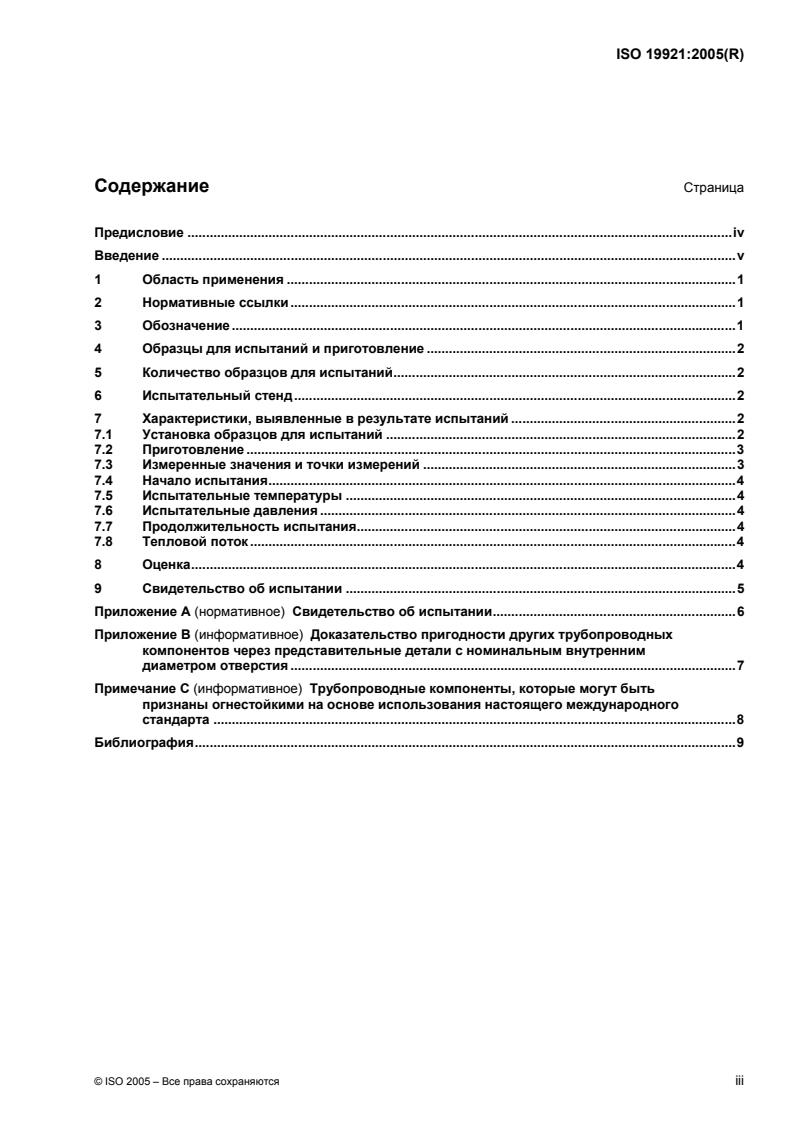
Contents Page
Foreword. iv
Introduction . v
1 Scope . 1
2 Normative references . 1
3 Designation . 1
4 Test pieces and preparation . 2
5 Number of test pieces . 2
6 Test bench . 2
7 Test performance. 2
7.1 Installation of test pieces. 2
7.2 Preparation . 3
7.3 Measured values and measuring points .3
7.4 Commencement of test . 4
7.5 Test temperatures. 4
7.6 Test pressures . 4
7.7 Test duration . 4
7.8 Heat flux. 4
8 Assessment. 4
9 Test certificate. 5
Annex A (normative) Test certificate. 6
Annex B (informative) Evidence of suitability of other pipeline components via representative
nominal bores . 7
Annex C (informative) Pipeline components that can be fire-test qualified using this International
Standard . 8
Bibliography . 9
Foreword
ISO (the International Organization for Standardization) is a worldwide federation of national standards bodies
(ISO member bodies). The work of preparing International Standards is normally carried out through ISO
technical committees. Each member body interested in a subject for which a technical committee has been
established has the right to be represented on that committee. International organizations, governmental and
non-governmental, in liaison with ISO, also take part in the work. ISO collaborates closely with the
International Electrotechnical Commission (IEC) on all matters of electrotechnical standardization.
International Standards are drafted in accordance with the rules given in the ISO/IEC Directives, Part 2.
The main task of technical committees is to prepare International Standards. Draft International Standards
adopted by the technical committees are circulated to the member bodies for voting. Publication as an
International Standard requires approval by at least 75 % of the member bodies casting a vote.
Attention is drawn to the possibility that some of the elements of this document may be the subject of patent
rights. ISO shall not be held responsible for identifying any or all such patent rights.
ISO 19921 was prepared by Technical Committee ISO/TC 8, Ships and marine technology, Subcommittee
SC 3, Piping and machinery.
iv © ISO 2005 – All rights reserved
Introduction
The purpose of this International Standard is to establish whether a metallic valve, fitting, coupling or similar
piping component that contains a resilient or elastomeric seal can be exposed to fire without losing its function,
i.e. without leaking when exposed to normal operating pressure.
Only water is permitted as the test medium. The use of combustible test media is prohibited in order to ensure
the safety of operators and the test bench.
The test method in this International Standard is intended to provide reproducible results when combined with
the test bench in accordance with ISO 19922.
In case of a request for a flame test under different test conditions, e.g. flame temperature, working pressure
or duration of flame application, the test is carried out in accordance with this International Standard with the
test bench in accordance with ISO 19922, but under the specific conditions requested.
INTERNATIONAL STANDARD ISO 19921:2005(E)
Ships and marine technology — Fire resistance of metallic pipe
components with resilient and elastomeric seals —
Test methods
1 Scope
This International Standard specifies test procedures for determining the fire resistance of metallic valves,
pipe couplings, and similar pipe components which contain a resilient or elastomeric seal and which are used
in ship engineering systems.
The purpose of this International Standard is to determine whether, after the period of fire testing on a test
bench which fulfils the requirements of ISO 19922, pipeline components remain tight, and without any failure
which could affect their function, even when subjected to proof pressure.
2 Normative references
The following referenced documents are indispensable for the application of this document. For dated
references, only the edition cited applies. For undated references, the latest edition of the referenced
document (including any amendments) applies.
ISO 19922, Ships and marine technology — Fire resistance of metallic pipe components with resilient and
elastomeric seals — Requirements imposed on the test bench
3 Designation
The designation of the test for determining the fire resistance is composed of the elements quoted in the
example below:
Test ISO 19921 — 30 — 5 — 24 — F
In this designation the elements have the following meaning:
Test: designation.
ISO 19921: number of this International Standard.
30: test du
...
МЕЖДУНАРОДНЫЙ ISO
СТАНДАРТ 19921
Первое издание
2005-10-01
Суда и морские технологии.
Огнестойкость компонентов
металлических труб с эластичными
уплотнениями. Методы испытания
Ships and marine technology − Fire resistance of metallic pipe
components with resilient and elastomeric seals − Test methods
Ответственность за подготовку русской версии несёт GOST R
(Российская Федерация) в соответствии со статьёй 18.1 Устава ISO
Ссылочный номер
©
ISO 2005
Отказ от ответственности при работе в PDF
Настоящий файл PDF может содержать интегрированные шрифты. В соответствии с условиями лицензирования, принятыми
фирмой Adobe, этот файл можно распечатать или смотреть на экране, но его нельзя изменить, пока не будет получена
лицензия на установку интегрированных шрифтов в компьютере, на котором ведется редактирование. В случае загрузки
настоящего файла заинтересованные стороны принимают на себя ответственность за соблюдение лицензионных условий
фирмы Adobe. Центральный секретариат ISO не несет никакой ответственности в этом отношении.
Adobe - торговый знак Adobe Systems Incorporated.
Подробности, относящиеся к программным продуктам, использованным для создания настоящего файла PDF, можно найти в
рубрике General Info файла; параметры создания PDF оптимизированы для печати. Были приняты во внимание все меры
предосторожности с тем, чтобы обеспечить пригодность настоящего файла для использования комитетами – членами ISO. В
редких случаях возникновения проблемы, связанной со сказанным выше, просим информировать Центральный секретариат
по адресу, приведенному ниже.
ДОКУМЕНТ ЗАЩИЩЕН АВТОРСКИМ ПРАВОМ
© ISO 2005
Все права сохраняются. Если не указано иное, никакую часть настоящей публикации нельзя копировать или использовать в
какой-либо форме или каким-либо электронным или механическим способом, включая фотокопии и микрофильмы, без
предварительного письменного согласия ISO по адресу ниже или членов ISO в стране регистрации пребывания.
ISO copyright office
Case postale 56 • CH-1211 Geneva 20
Tel. + 41 22 749 01 11
Fax + 41 22 749 09 47
E-mail copyright@iso.org
Web www.iso.org
Опубликовано в Швейцарии
ii © ISO 2005 – Все права сохраняются
Содержание Страница
Предисловие .iv
Введение .v
1 Область применения .1
2 Нормативные ссылки .1
3 Обозначение.1
4 Образцы для испытаний и приготовление .2
5 Количество образцов для испытаний.2
6 Испытательный стенд.2
7 Характеристики, выявленные в результате испытаний .2
7.1 Установка образцов для испытаний .2
7.2 Приготовление .3
7.3 Измеренные значения и точки измерений .3
7.4 Начало испытания.4
7.5 Испытательные температуры .4
7.6 Испытательные давления .4
7.7 Продолжительность испытания.4
7.8 Тепловой поток.4
8 Оценка.4
9 Свидетельство об испытании .5
Приложение A (нормативное) Свидетельство об испытании.6
Приложение B (информативное) Доказательство пригодности других трубопроводных
компонентов через представительные детали с номинальным внутренним
диаметром отверстия .7
Примечание C (информативное) Трубопроводные компоненты, которые могут быть
признаны огнестойкими на основе использования настоящего международного
стандарта .8
Библиография.9
Предисловие
Международная организация по стандартизации (ISO) является всемирной федерацией национальных
организаций по стандартизации (комитетов-членов ISO). Разработка международных стандартов
обычно осуществляется техническими комитетами ISO. Каждый комитет-член, заинтересованный в
деятельности, для которой был создан технический комитет, имеет право быть представленным в этом
комитете. Международные правительственные и неправительственные организации, имеющие связи с
ISO, также принимают участие в работах. Что касается стандартизации в области электротехники, то
ISO работает в тесном сотрудничестве с Международной электротехнической комиссией (IEC).
Проекты международных стандартов разрабатываются в соответствии с правилами Директив ISO/IEC,
Часть 2.
Основная задача технических комитетов заключается в подготовке международных стандартов.
Проекты международных стандартов, принятые техническими комитетами, рассылаются комитетам-
членам на голосование. Их опубликование в качестве международных стандартов требует одобрения
не менее 75 % комитетов-членов, принимающих участие в голосовании.
Следует иметь в виду, что некоторые элементы настоящего международного стандарта могут быть
объектом патентных прав. Международная организация по стандартизации не может нести
ответственность за идентификацию какого-либо одного или всех патентных прав.
Стандарт ISO 19921 подготовил Технический комитет ISO/TC 8, Суда и морские технологии,
Подкомитет SC 3, Система трубопроводов и машинное оборудование.
iv © ISO 2005 – Все права сохраняются
Введение
Цель настоящего международного стандарта – установить, может ли металлический клапан, фитинг,
соединительный или подобный трубопроводный компонент, содержащий упругое или эластичное
уплотнение из эластомера, подвергаться воздействию огня без потери своей функции, т.е. без утечки
под нормальным рабочим давлением.
Только вода разрешается в качестве испытательной среды. Использование воспламеняемой
испытательной среды запрещается, чтобы обеспечить безопасность операторов и испытательного
стенда.
Метод испытания в настоящем международном стандарте направлен на получение воспроизводимых
результатов, когда он применяется вместе с испытательным стендом в соответствии с ISO 19922.
В случае заявки на испытание в пламени при разных условиях его проведения, например, при разной
температуре пламени, рабочего давления или продолжительности воздействия огня, испытание
выполняется в соответствии с настоящим международным стандартом на испытательном стенде,
удовлетворяющем требования ISO 19922, но в заданном специфическом режиме.
МЕЖДУНАРОДНЫЙ СТАНДАРТ ISO 19921:2005(R)
Суда и морские технологии. Огнестойкость компонентов
металлических труб с эластичными уплотнениями. Методы
испытания
1 Область применения
Настоящий международный стандарт задает испытательные процедуры для определения
огнестойкости металлических клапанов, задвижек, кранов, трубных соединений и подобных
трубопроводных компонентов, которые содержат упругие или эластичные уплотнения из эластомера и
которые используются в технических системах судна.
Цель настоящего международного стандарта – установить, остаются ли непроницаемыми компоненты
трубопроводов после проверки их огнестойкости на испытательном стенде, удовлетворяющем
требования ISO 19922, и не имеют ли компоненты какую-либо неисправность, которая могла бы
нарушать их функционирование даже под воздействием давления опрессовки.
2 Нормативные ссылки
Следующие нормативные документы являются обязательными для применения с настоящим
международным стандартом. Для жестких ссылок применяются только указанное по тексту издание.
Для плавающих ссылок необходимо использовать самое последнее издание нормативного ссылочного
документа (включая любые изменения).
ISO 19922, Суда и морские технологии. Огнестойкость компонентов металлических труб с
эластичными уплотнениями. Требования к испытательному стенду
3 Обозначение
Обозначение испытания для определения огнестойкости составляется из элементов, показанных в
нижеследующем примере.
Test ISO 19921 — 30 — 5 — 24 — F
В этом обозначении элементы имеют следующий смысл:
Test: испытание.
ISO 19921: номер настоящего международного стандарта.
30: продолжительность испытания в минутах.
5: рабочее давление во время воздействия пламени, в барах.
24: давление опрессовки после воздействия пламени, в барах.
F: образец для испытания с огнестойкой соединительной муфтой.
4 Образцы для испытаний и приготовление
Трубопроводные компоне
...