


ISO 24034:2005
(Main)Welding consumables — Solid wires and rods for fusion welding of titanium and titanium alloys — Classification
Welding consumables — Solid wires and rods for fusion welding of titanium and titanium alloys — Classification
ISO 24034:2005 specifies requirements for the classification of solid wires and rods for fusion welding of titanium and titanium alloys. The classification of the solid wires and rods is based on their chemical composition.
Produits consommables pour le soudage — Fils pleins et baguettes pleines pour le soudage par fusion du titane et des alliages de titane — Classification
L'ISO 24034:2005 spécifie les exigences pour la classification des fils pleins et des baguettes pleines pour le soudage par fusion du titane et des alliages de titane. La classification des fils pleins et des baguettes pleines est basée sur la composition chimique.
General Information
- Status
- Withdrawn
- Publication Date
- 19-Sep-2005
- Withdrawal Date
- 19-Sep-2005
- Technical Committee
- ISO/TC 44/SC 3 - Welding consumables
- Drafting Committee
- ISO/TC 44/SC 3 - Welding consumables
- Current Stage
- 9599 - Withdrawal of International Standard
- Start Date
- 29-Sep-2010
- Completion Date
- 14-Feb-2026
Relations
- Effective Date
- 12-Feb-2026
- Effective Date
- 28-Feb-2023
- Effective Date
- 06-Jun-2022
- Effective Date
- 28-Feb-2009
- Effective Date
- 15-Apr-2008
Buy Documents
ISO 24034:2005 - Welding consumables -- Solid wires and rods for fusion welding of titanium and titanium alloys -- Classification
ISO 24034:2005 - Produits consommables pour le soudage -- Fils pleins et baguettes pleines pour le soudage par fusion du titane et des alliages de titane -- Classification
Get Certified
Connect with accredited certification bodies for this standard

National Aerospace and Defense Contractors Accreditation Program (NADCAP)
Global cooperative program for special process quality in aerospace.
CARES (UK Certification Authority for Reinforcing Steels)
UK certification for reinforcing steels and construction.
DVS-ZERT GmbH
German welding certification society.
Sponsored listings
Frequently Asked Questions
ISO 24034:2005 is a standard published by the International Organization for Standardization (ISO). Its full title is "Welding consumables — Solid wires and rods for fusion welding of titanium and titanium alloys — Classification". This standard covers: ISO 24034:2005 specifies requirements for the classification of solid wires and rods for fusion welding of titanium and titanium alloys. The classification of the solid wires and rods is based on their chemical composition.
ISO 24034:2005 specifies requirements for the classification of solid wires and rods for fusion welding of titanium and titanium alloys. The classification of the solid wires and rods is based on their chemical composition.
ISO 24034:2005 is classified under the following ICS (International Classification for Standards) categories: 25.160.20 - Welding consumables. The ICS classification helps identify the subject area and facilitates finding related standards.
ISO 24034:2005 has the following relationships with other standards: It is inter standard links to EN ISO 24034:2005, ISO 3680:1981, ISO 24034:2005/Amd 1:2008, ISO 24034:2010; is excused to ISO 24034:2005/Amd 1:2008. Understanding these relationships helps ensure you are using the most current and applicable version of the standard.
ISO 24034:2005 is available in PDF format for immediate download after purchase. The document can be added to your cart and obtained through the secure checkout process. Digital delivery ensures instant access to the complete standard document.
Standards Content (Sample)
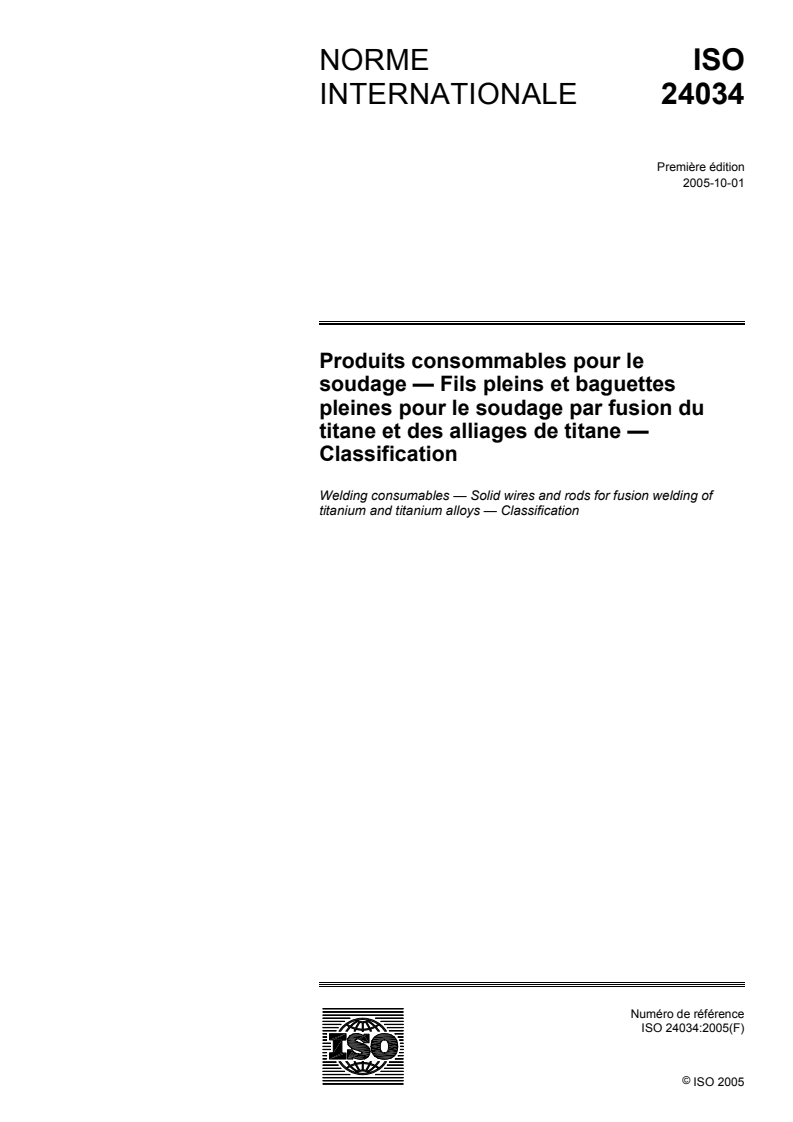
INTERNATIONAL ISO
STANDARD 24034
First edition
2005-10-01
Welding consumables — Solid wires and
rods for fusion welding of titanium and
titanium alloys — Classification
Produits consommables pour le soudage — Fils pleins et baguettes
pleines pour le soudage par fusion du titane et des alliages de titane —
Classification
Reference number
©
ISO 2005
PDF disclaimer
This PDF file may contain embedded typefaces. In accordance with Adobe's licensing policy, this file may be printed or viewed but
shall not be edited unless the typefaces which are embedded are licensed to and installed on the computer performing the editing. In
downloading this file, parties accept therein the responsibility of not infringing Adobe's licensing policy. The ISO Central Secretariat
accepts no liability in this area.
Adobe is a trademark of Adobe Systems Incorporated.
Details of the software products used to create this PDF file can be found in the General Info relative to the file; the PDF-creation
parameters were optimized for printing. Every care has been taken to ensure that the file is suitable for use by ISO member bodies. In
the unlikely event that a problem relating to it is found, please inform the Central Secretariat at the address given below.
Copyright notice
This ISO document is a Draft International Standard and is copyright-protected by ISO. Except as permitted
under the applicable laws of the user's country, neither this ISO draft nor any extract from it may be
reproduced, stored in a retrieval system or transmitted in any form or by any means, electronic,
photocopying, recording or otherwise, without prior written permission being secured.
Requests for permission to reproduce should be addressed to either ISO at the address below or ISO's
member body in the country of the requester.
ISO copyright office
Case postale 56 • CH-1211 Geneva 20
Tel. + 41 22 749 01 11
Fax + 41 22 749 09 47
E-mail copyright@iso.org
Web www.iso.org
Reproduction may be subject to royalty payments or a licensing agreement.
Violators may be prosecuted.
ii © ISO 2005 – All rights reserved
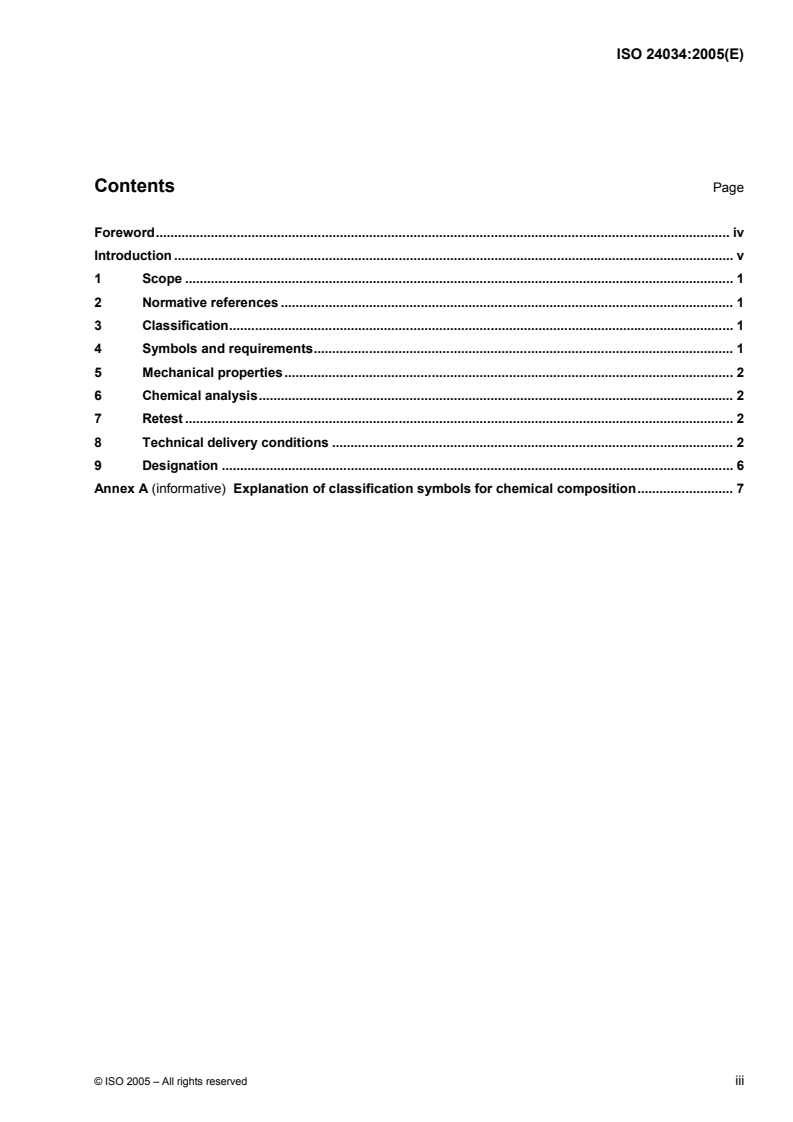
Contents Page
Foreword. iv
Introduction . v
1 Scope. 1
2 Normative references. 1
3 Classification. 1
4 Symbols and requirements. 1
5 Mechanical properties. 2
6 Chemical analysis. 2
7 Retest. 2
8 Technical delivery conditions . 2
9 Designation. 6
Annex A (informative) Explanation of classification symbols for chemical composition. 7
Foreword
ISO (the International Organization for Standardization) is a worldwide federation of national standards bodies
(ISO member bodies). The work of preparing International Standards is normally carried out through ISO
technical committees. Each member body interested in a subject for which a technical committee has been
established has the right to be represented on that committee. International organizations, governmental and
non-governmental, in liaison with ISO, also take part in the work. ISO collaborates closely with the
International Electrotechnical Commission (IEC) on all matters of electrotechnical standardization.
International Standards are drafted in accordance with the rules given in the ISO/IEC Directives, Part 2.
The main task of technical committees is to prepare International Standards. Draft International Standards
adopted by the technical committees are circulated to the member bodies for voting. Publication as an
International Standard requires approval by at least 75 % of the member bodies casting a vote.
Attention is drawn to the possibility that some of the elements of this document may be the subject of patent
rights. ISO shall not be held responsible for identifying any or all such patent rights.
ISO 24034 was prepared by Technical Committee ISO/TC 44, Welding and allied processes, Subcommittee
SC 3, Welding consumables.
iv © ISO 2005 – All rights reserved
Introduction
This International Standard proposes a classification in order to designate wire electrodes, wires and rods in
terms of their chemical composition.
For titanium-welding consumables, there is no unique relationship between the product form (wire electrodes,
wires or rods) and the welding process used (gas-shielded metal arc welding, gas tungsten arc welding,
plasma arc welding or laser welding). For this reason, wire electrodes, wires and rods may be classified in
terms of their chemical composition.
In this International Standard, the symbol of the welding process is not used, because
a) different joining processes are performed with the same chemical component consumable, and
b) the producer is not able to determine the process symbol before shipping.
Also, it should be noted that the mechanical properties of all-weld metal test specimens or welded joints
produced by welding consumables will vary from those obtained in production joints because of differences in
welding procedure and the base-metal alloy. For this reason, the mechanical properties of all-weld metal or
welded joints for titanium-welding consumables are not specified in this classification.
Requests for an official interpretation of technical aspects of this International Standard should be directed to
the secretariat of ISO/TC 44/SC 3 via the user's member body in the user's country; a listing of these bodies
can be found at www.iso.org.
INTERNATIONAL STANDARD ISO 24034:2005(E)
Welding consumables — Solid wires and rods for fusion
welding of titanium and titanium alloys — Classification
1 Scope
This International Standard specifies requirements for the classification of solid wires and rods for fusion
welding of titanium and titanium alloys. The classification of the solid wires and rods is based on their
chemical composition.
For titanium-welding consumables, the compositions of the wire electrodes for the MIG process (metal inert
gas welding) are the same as for the TIG process (tungsten inert-gas arc welding), the plasma arc process,
the laser beam process, and other fusion welding processes. Therefore, the use of the word “wires/rods” in
this classification refers to both “wire electrodes” and “wires and rods” in this International Standard.
NOTE In this International Standard, the word “titanium” is used for “titanium and titanium alloys”.
The classification of titanium wires/rods is based upon the chemical composition of the wires/rods.
2 Normative references
The following referenced documents are indispensable for the application of this document. For dated
references, only the edition cited applies. For undated references, the latest edition of the referenced
document (including any amendments) applies.
ISO 31-0:1992, Quantities and units — Part 0: General principles
ISO 544, Welding consumables — Technical delivery conditions for welding filler materials — Type of product,
dimensions, tolerances and markings
ISO 14344, Welding and allied processes — Flux and gas shielded electrical welding processes —
Procurement guidelines for consumables
3 Classification
The classification is divided into two parts:
a) the first part gives a symbol indicating the product to be identified, see 4.1.
b) the second part gives a symbol indicating the chemical composition of the wires/rods, see Table 1.
4 Symbols and requirements
4.1 Symbol for the product
The symbol for the solid wire and rod shall be S.
4.2 Symbol for the chemical composition
The numerical symbol in Table 1 indicates the chemical composition of a solid wire or rod, determined under
the conditions given in Clause 6. The first two digits indicate the alloy group. See Annex A for an explanation
of the numerical symbols.
4.3 Rounding-off procedure
For the purpose of determining compliance with the requirements of this International Standard, the actual test
values obtained shall be subjected to the rounding-off rules of ISO 31-0:1992, Annex B, Rule A. If the
measured values are obtained by equipment calibrated in units other than those of this International Standard,
the measured values shall be converted to the units of this International Standard before rounding off. If an
average value is to be compared to the requirements of this International Standard, rounding off shall be done
only after calculating the average. In the case where the testing standard cited in the normative references of
this International Standard contains instructions for rounding off that conflict with the instructions of this
International Standard, the rounding-off requirements of the testing standard shall apply. The rounded-off
results shall fulfill the requirements of the appropriate table for the classification under test.
5 Mechanical properties
Mechanical properties of all-weld metal or welded joints are not part of this classification.
6 Chemical analysis
Chemical analysis shall be performed on specimens of the product or the stock from which it is made. See
also footnote c to Table 1. Any analytical technique may be used but, in case of a dispute, reference shall be
made to established published methods, agreed upon between the contracting parties.
7 Retest
If a
...
NORME ISO
INTERNATIONALE 24034
Première édition
2005-10-01
Produits consommables pour le
soudage — Fils pleins et baguettes
pleines pour le soudage par fusion du
titane et des alliages de titane —
Classification
Welding consumables — Solid wires and rods for fusion welding of
titanium and titanium alloys — Classification
Numéro de référence
©
ISO 2005
PDF – Exonération de responsabilité
Le présent fichier PDF peut contenir des polices de caractères intégrées. Conformément aux conditions de licence d'Adobe, ce fichier
peut être imprimé ou visualisé, mais ne doit pas être modifié à moins que l'ordinateur employé à cet effet ne bénéficie d'une licence
autorisant l'utilisation de ces polices et que celles-ci y soient installées. Lors du téléchargement de ce fichier, les parties concernées
acceptent de fait la responsabilité de ne pas enfreindre les conditions de licence d'Adobe. Le Secrétariat central de l'ISO décline toute
responsabilité en la matière.
Adobe est une marque déposée d'Adobe Systems Incorporated.
Les détails relatifs aux produits logiciels utilisés pour la création du présent fichier PDF sont disponibles dans la rubrique General Info
du fichier; les paramètres de création PDF ont été optimisés pour l'impression. Toutes les mesures ont été prises pour garantir
l'exploitation de ce fichier par les comités membres de l'ISO. Dans le cas peu probable où surviendrait un problème d'utilisation,
veuillez en informer le Secrétariat central à l'adresse donnée ci-dessous.
© ISO 2005
Droits de reproduction réservés. Sauf prescription différente, aucune partie de cette publication ne peut être reproduite ni utilisée sous
quelque forme que ce soit et par aucun procédé, électronique ou mécanique, y compris la photocopie et les microfilms, sans l'accord écrit
de l'ISO à l'adresse ci-après ou du comité membre de l'ISO dans le pays du demandeur.
ISO copyright office
Case postale 56 • CH-1211 Geneva 20
Tel. + 41 22 749 01 11
Fax. + 41 22 749 09 47
E-mail copyright@iso.org
Web www.iso.org
Publié en Suisse
ii © ISO 2005 – Tous droits réservés
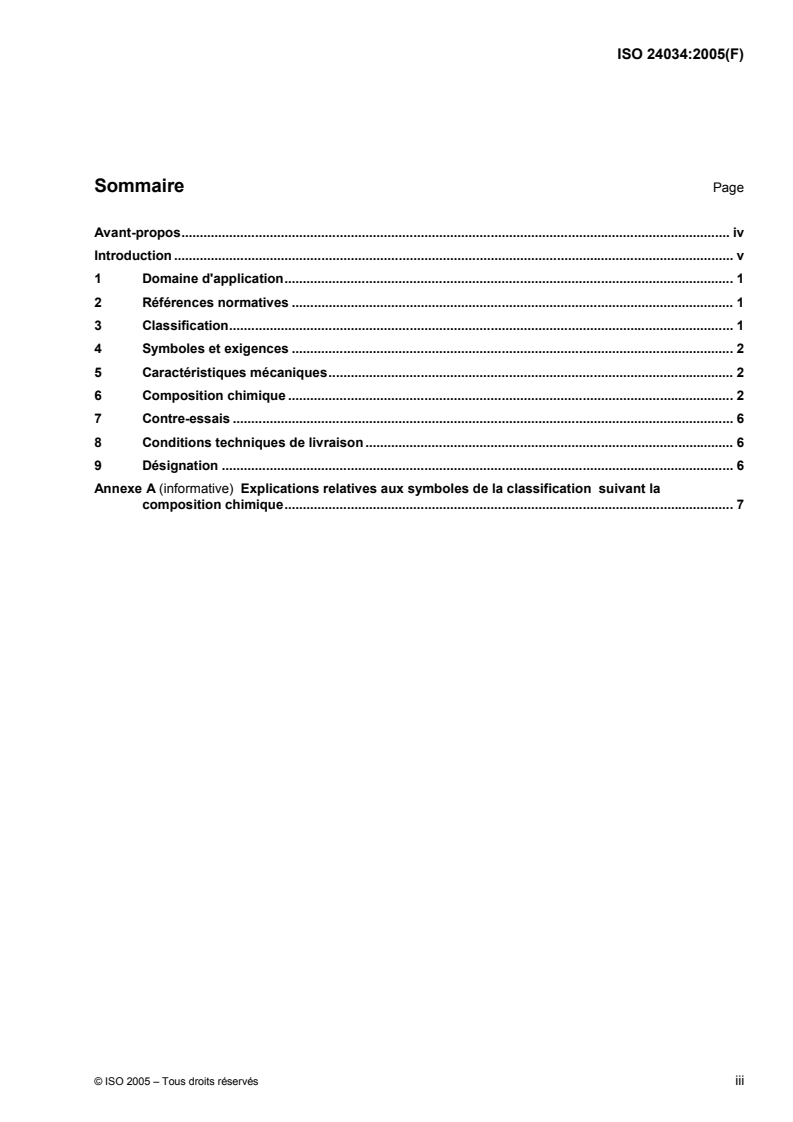
Sommaire Page
Avant-propos. iv
Introduction . v
1 Domaine d'application. 1
2 Références normatives. 1
3 Classification. 1
4 Symboles et exigences . 2
5 Caractéristiques mécaniques. 2
6 Composition chimique . 2
7 Contre-essais. 6
8 Conditions techniques de livraison. 6
9 Désignation. 6
Annexe A (informative) Explications relatives aux symboles de la classification suivant la
composition chimique. 7
Avant-propos
L'ISO (Organisation internationale de normalisation) est une fédération mondiale d'organismes nationaux de
normalisation (comités membres de l'ISO). L'élaboration des Normes internationales est en général confiée
aux comités techniques de l'ISO. Chaque comité membre intéressé par une étude a le droit de faire partie du
comité technique créé à cet effet. Les organisations internationales, gouvernementales et non
gouvernementales, en liaison avec l'ISO participent également aux travaux. L'ISO collabore étroitement avec
la Commission électrotechnique internationale (CEI) en ce qui concerne la normalisation électrotechnique.
Les Normes internationales sont rédigées conformément aux règles données dans les Directives ISO/CEI,
Partie 2.
La tâche principale des comités techniques est d'élaborer les Normes internationales. Les projets de Normes
internationales adoptés par les comités techniques sont soumis aux comités membres pour vote. Leur
publication comme Normes internationales requiert l'approbation de 75 % au moins des comités membres
votants.
L'attention est appelée sur le fait que certains des éléments du présent document peuvent faire l'objet de
droits de propriété intellectuelle ou de droits analogues. L'ISO ne saurait être tenue pour responsable de ne
pas avoir identifié de tels droits de propriété et averti de leur existence.
L'ISO 24034 a été élaborée par le comité technique ISO/TC 44, Soudage et techniques connexes,
sous-comité SC 3, Produits consommables pour le soudage.
iv © ISO 2005 – Tous droits réservés
Introduction
La présente Norme internationale propose une classification afin de désigner les fils-électrodes, les fils pleins
et les baguettes pleines en fonction de leur composition chimique.
En ce qui concerne les produits consommables pour le soudage du titane, il n'existe pas de relation unique
entre la forme du produit (fils-électrodes, fils et baguettes) et le procédé de soudage utilisé (soudage avec
électrode fusible sous protection gazeuse, soudage TIG, soudage au plasma et soudage par faisceau laser).
Pour cette raison, les fils-électrodes, les fils et les baguettes pleines peuvent être classés en fonction de leur
composition chimique.
Dans la présente Norme internationale, le symbole du procédé de soudage ne sera pas utilisé du fait que
a) plusieurs procédés de soudage utilisent un produit consommable de même composition chimique, et que
b) le fabricant n'est pas capable de déterminer le symbole du procédé avant expédition.
Également, il convient de remarquer que les caractéristiques mécaniques des éprouvettes en métal fondu
hors dilution ou que les joints soudés obtenus avec les produits consommables diffèrent de celles obtenues
en fabrication, du fait des différences relatives au mode opératoire de soudage et de l'alliage constituant le
métal de base. Pour cette raison, les caractéristiques mécaniques du métal fondu hors dilution obtenu ou des
joints soudés avec les produits consommables de soudage en titane ne sont pas spécifiées dans la présente
classification.
Il convient d'adresser les demandes d'interprétation officielle de tout aspect technique de la présente Norme
internationale au secrétariat de l'ISO/TC 44/SC 3, par l'intermédiaire du comité membre situé dans le pays de
l'utilisateur, dont une liste complète peut être obtenue à l'adresse www.iso.org.
NORME INTERNATIONALE ISO 24034:2005(F)
Produits consommables pour le soudage — Fils pleins et
baguettes pleines pour le soudage par fusion du titane et des
alliages de titane — Classification
1 Domaine d'application
La présente Norme internationale spécifie les exigences pour la classification des fils pleins et des baguettes
pleines pour le soudage par fusion du titane et des alliages de titane. La classification des fils pleins et des
baguettes pleines est basée sur la composition chimique.
En ce qui concerne les produits consommables de soudage en titane, les compositions des fils-électrodes
pour le procédé MIG (soudage à l'arc avec fil-électrode fusible sous gaz inerte) sont identiques à celles
utilisées pour le procédé TIG (soudage à l'arc avec électrode de tungstène sans gaz inerte), pour le soudage
plasma, pour le procédé par faisceau laser et pour les autres procédés de soudage par fusion. Pour cette
raison, l'utilisation du mot «fil/baguette» dans la présente classification fait référence, au sein de la présente
Norme internationale, à la fois aux «fils-électrodes» et aux «fils pleins et baguettes pleines».
NOTE Dans la présente Norme internationale, le mot «titane» est employé pour «titane et alliages de titane».
La classification des fils/baguettes en titane est basée sur la composition chimique des fils/baguettes.
2 Références normatives
Les documents de référence suivants sont indispensables pour l'application du présent document. Pour les
références datées, seule l'édition citée s'applique. Pour les références non datées, la dernière édition du
document de référence s'applique (y compris les éventuels amendements).
ISO 31-0:1992, Grandeurs et unités — Partie 0: Principes généraux
ISO 544, Produits consommables pour le soudage — Conditions techniques de livraison des matériaux
d'apport pour le soudage — Type de produit, dimensions, tolérances et marquage
ISO 14344, Soudage et techniques connexes — Procédés de soudage électrique sous protection gazeuse et
par flux — Lignes directrices relatives à l'approvisionnement en produits consommables
3 Classification
La classification est divisée en deux parties:
a) la première partie donne un symbole indiquant le produit à identifier, voir 4.1;
b) la seconde partie donne un symbole numérique indiquant la composition chimique des fils/baguettes, voir
Tableau 1.
4 Symboles et exigences
4.1 Symbole pour le produit
Le symbole pour les fils pleins et les baguettes pleines doit être S.
4.2 Symbole pour la composition chimique
Les symboles numériques du Tableau 1 indiquent la composition chimique des fils pleins et des baguettes
pleines, déterminée suivant les conditions de l'Article 6. Les deux premiers chiffres indiquent le groupe
d'alliage. Voir l'Annexe A pour une explication des symboles numériques.
4.3 Procédure d'arrondissage
Afin d'établir la conformité aux exigences de la présente Norme internationale, les valeurs réelles obtenues au
cours des essais doivent être soumises aux règles d'arrondissage données dans l'ISO 31-0:1992, Annexe B,
Règle A. Si les valeurs mesurées sont obtenues à partir de matériels étalonnés avec des unités autres que
celles de la présente Norme internationale, les valeurs mesurées doivent être converties dans les unités de la
présente Norme internationale avant d'être arrondies. S'il faut comparer une valeur moyenne aux exigences
de la présente Norme internationale, l'arrondissage ne doit s'appliquer qu'après avoir calculé la moyenne.
Dans le cas où la norme d'essai citée dans les références normatives contient des instructions pour
l'arrondissage en contradiction avec les instructions de la présente Norme internationale, ce sont les
exigences d'arrondissage de la norme d'essai qui doivent s'appliquer. Une fois arrondis, les résultats doivent
satisfaire aux exigences du tableau approprié pour la classification faisant l'objet de l'essai.
5 Caractéristiques mécaniques
Les caractéristiques mécaniques du métal fondu hors dilution ou des joints soudés ne sont pas couvertes par
la présente classification.
6 Composition chimique
La composition chimique doit être déterminée sur des échantillons du produit ou du demi-produit dans lequel il
est fabriqué. Voir également la note de bas de tableau «c» du Tableau 1. N'importe quelle technique
d'analyse peut être utilisée mais, en cas de litige, il doit être fait référence à des méthodes publiées
reconnues, agréées entre les parties contractantes.
2 © ISO 2005 – Tous droits réservés
Tableau 1 — Symboles pour la composition chimique et les exigences de composition
a, b, c, d
Symboles d'alliage Exigences de composition chimique (fr
...
Questions, Comments and Discussion
Ask us and Technical Secretary will try to provide an answer. You can facilitate discussion about the standard in here.
Loading comments...