

ISO 7240-16:2007
(Main)Fire detection and alarm systems — Part 16: Sound system control and indicating equipment
General Information
- Abstract
ISO 7240-16:2007 specifies the requirements, test methods and performance criteria for sound system control and indicating equipment (s.s.c.i.e.) for use in buildings and structures as part of a sound system for emergency purposes (s.s.e.p.) aas defined in ISO 7240-1. The s.s.c.i.e. is primarily intended to broadcast information for the protection of lives within one or more specified areas in an emergency, to effect a rapid and orderly mobilization of occupants in an indoor or outdoor area. This includes systems using loudspeakers to broadcast voice announcements for emergency purposes, alert signals complying with ISO 7731, and evacuate signals complying with ISO 8201. The overall requirements of an s.s.e.p., especially concerning audibility and intelligibility, are contained within ISO 7240-19. In addition to ensuring compliance with ISO 7240-16:2007, the manufacturer should also consider the requirements of ISO 7240-19, national regulations, codes and standards that affect the s.s.c.i.e. design and usability. For example, some regulations require certain optional functions to be available on all s.s.c.i.e. installed within the jurisdiction. The use of the equipment for normal sound reinforcement and distribution systems purposes under non-hazardous circumstances is not excluded. ISO 7240-16:2007 can also be used for the assessment of similar control and indicating equipment for use in systems where the warning-signal broadcast does not include a voice message. ISO 7240-16:2007 does not apply to systems using only sounders or bells.
- Status
- Published
- Publication Date
- 24-Jun-2007
- Technical Committee
- ISO/TC 21/SC 3 - Fire detection and alarm systems
- Drafting Committee
- ISO/TC 21/SC 3 - Fire detection and alarm systems
- Current Stage
- 9093 - International Standard confirmed
- Start Date
- 15-Sep-2025
- Completion Date
- 29-Aug-2026
Overview
ISO 7240-16:2007 - Fire detection and alarm systems: Part 16 - Sound system control and indicating equipment specifies requirements, test methods and performance criteria for sound system control and indicating equipment (s.s.c.i.e.) used as part of a sound system for emergency purposes (s.s.e.p.). The standard covers equipment intended to broadcast voice emergency announcements, alert and evacuate signals (including references to ISO 7731 and ISO 8201), and to support rapid, orderly evacuation of occupants in indoor and outdoor areas. It applies to voice-based and non-voice warning broadcasts but does not apply to systems that use only sounders or bells.
Key Topics
- Functional scope: Reception, processing and distribution of alarm signals; voice-alarm condition management; fault and disabled conditions; optional test and manual modes.
- Performance and testing: Specified test methods and performance criteria for audio performance (frequency response, signal-to-noise ratio), output power, EMC immunity, environmental durability (cold, damp heat, vibration, impact) and supply voltage variation.
- Design and documentation: Mechanical, electrical and software design requirements; message storage; integrity of transmission paths; accessibility and visibility of indications and controls; marking and user documentation.
- Indications and controls: Requirements for displays (alphanumeric and LED indicators), audible warnings, emergency microphone interfaces, access levels and optional functions such as phased evacuation, delay before broadcast, and redundant amplifiers.
- Software-controlled systems: Additional provisions for software design, documentation, program monitoring, memory storage and monitoring of memory contents.
Applications
ISO 7240-16:2007 is used where regulated emergency voice or alarm broadcasts are required, including:
- Large commercial buildings, airports, rail and transit hubs
- Stadiums, arenas and public assembly spaces
- Industrial facilities and campuses with zoned evacuation needs
- Integrated fire alarm and public address systems for life-safety announcements
Who uses the standard:
- Manufacturers of s.s.c.i.e., voice alarm systems and emergency PA equipment
- System designers and integrators specifying audio performance, reliability and interfaces
- Installers and testing laboratories performing compliance and performance tests
- Building owners, facility managers and regulators ensuring audibility, intelligibility and code compliance
Related Standards
- ISO 7240‑1 (General and definitions)
- ISO 7240‑19 (Overall s.s.e.p. requirements, especially audibility and intelligibility)
- ISO 7731 (Alert signals)
- ISO 8201 (Evacuate signals)
- Replaces/updates aspects of IEC 60849:1998
For compliance, manufacturers and specifiers should apply ISO 7240-16 together with ISO 7240-19, national codes and local regulations that may mandate specific optional functions or performance levels.
Get Certified
Connect with accredited certification bodies for this standard

CIS Institut d.o.o.
Personal Protective Equipment (PPE) certification body. Notified Body NB-2890 for EU Regulation 2016/425 PPE.

Kiwa BDA Testing
Building and construction product certification.
Kmetijski inštitut Slovenije
Agricultural Institute of Slovenia. Soil testing, plant health, agricultural product analysis.
Sponsored listings
Frequently Asked Questions
ISO 7240-16:2007 is a standard published by the International Organization for Standardization (ISO). Its full title is "Fire detection and alarm systems — Part 16: Sound system control and indicating equipment". This standard covers: ISO 7240-16:2007 specifies the requirements, test methods and performance criteria for sound system control and indicating equipment (s.s.c.i.e.) for use in buildings and structures as part of a sound system for emergency purposes (s.s.e.p.) aas defined in ISO 7240-1. The s.s.c.i.e. is primarily intended to broadcast information for the protection of lives within one or more specified areas in an emergency, to effect a rapid and orderly mobilization of occupants in an indoor or outdoor area. This includes systems using loudspeakers to broadcast voice announcements for emergency purposes, alert signals complying with ISO 7731, and evacuate signals complying with ISO 8201. The overall requirements of an s.s.e.p., especially concerning audibility and intelligibility, are contained within ISO 7240-19. In addition to ensuring compliance with ISO 7240-16:2007, the manufacturer should also consider the requirements of ISO 7240-19, national regulations, codes and standards that affect the s.s.c.i.e. design and usability. For example, some regulations require certain optional functions to be available on all s.s.c.i.e. installed within the jurisdiction. The use of the equipment for normal sound reinforcement and distribution systems purposes under non-hazardous circumstances is not excluded. ISO 7240-16:2007 can also be used for the assessment of similar control and indicating equipment for use in systems where the warning-signal broadcast does not include a voice message. ISO 7240-16:2007 does not apply to systems using only sounders or bells.
ISO 7240-16:2007 specifies the requirements, test methods and performance criteria for sound system control and indicating equipment (s.s.c.i.e.) for use in buildings and structures as part of a sound system for emergency purposes (s.s.e.p.) aas defined in ISO 7240-1. The s.s.c.i.e. is primarily intended to broadcast information for the protection of lives within one or more specified areas in an emergency, to effect a rapid and orderly mobilization of occupants in an indoor or outdoor area. This includes systems using loudspeakers to broadcast voice announcements for emergency purposes, alert signals complying with ISO 7731, and evacuate signals complying with ISO 8201. The overall requirements of an s.s.e.p., especially concerning audibility and intelligibility, are contained within ISO 7240-19. In addition to ensuring compliance with ISO 7240-16:2007, the manufacturer should also consider the requirements of ISO 7240-19, national regulations, codes and standards that affect the s.s.c.i.e. design and usability. For example, some regulations require certain optional functions to be available on all s.s.c.i.e. installed within the jurisdiction. The use of the equipment for normal sound reinforcement and distribution systems purposes under non-hazardous circumstances is not excluded. ISO 7240-16:2007 can also be used for the assessment of similar control and indicating equipment for use in systems where the warning-signal broadcast does not include a voice message. ISO 7240-16:2007 does not apply to systems using only sounders or bells.
ISO 7240-16:2007 is classified under the following ICS (International Classification for Standards) categories: 13.220.20 - Fire protection. The ICS classification helps identify the subject area and facilitates finding related standards.
ISO 7240-16:2007 is available in PDF format for immediate download after purchase. The document can be added to your cart and obtained through the secure checkout process. Digital delivery ensures instant access to the complete standard document.
Standards Content (Sample)
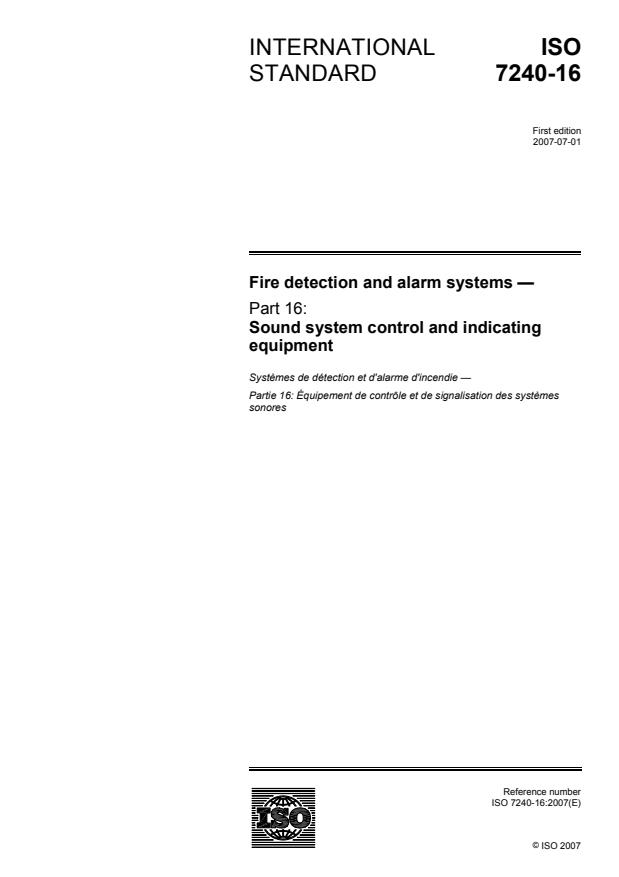
INTERNATIONAL ISO
STANDARD 7240-16
First edition
2007-07-01
Fire detection and alarm systems —
Part 16:
Sound system control and indicating
equipment
Systèmes de détection et d'alarme d'incendie —
Partie 16: Équipement de contrôle et de signalisation des systèmes
sonores
Reference number
©
ISO 2007
PDF disclaimer
This PDF file may contain embedded typefaces. In accordance with Adobe's licensing policy, this file may be printed or viewed but
shall not be edited unless the typefaces which are embedded are licensed to and installed on the computer performing the editing. In
downloading this file, parties accept therein the responsibility of not infringing Adobe's licensing policy. The ISO Central Secretariat
accepts no liability in this area.
Adobe is a trademark of Adobe Systems Incorporated.
Details of the software products used to create this PDF file can be found in the General Info relative to the file; the PDF-creation
parameters were optimized for printing. Every care has been taken to ensure that the file is suitable for use by ISO member bodies. In
the unlikely event that a problem relating to it is found, please inform the Central Secretariat at the address given below.
© ISO 2007
All rights reserved. Unless otherwise specified, no part of this publication may be reproduced or utilized in any form or by any means,
electronic or mechanical, including photocopying and microfilm, without permission in writing from either ISO at the address below or
ISO's member body in the country of the requester.
ISO copyright office
Case postale 56 • CH-1211 Geneva 20
Tel. + 41 22 749 01 11
Fax + 41 22 749 09 47
E-mail copyright@iso.org
Web www.iso.org
Published in Switzerland
ii © ISO 2007 – All rights reserved
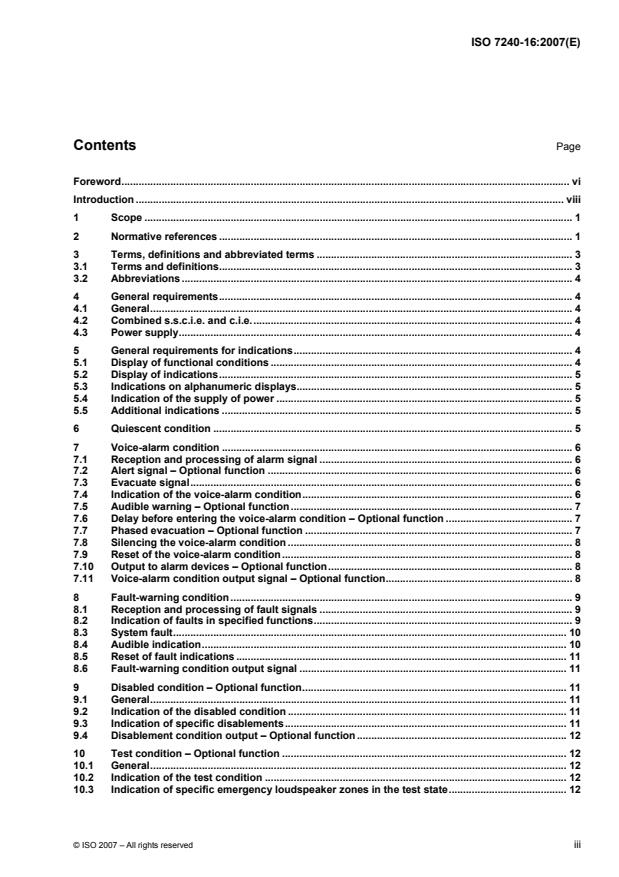
Contents Page
Foreword. vi
Introduction . viii
1 Scope . 1
2 Normative references . 1
3 Terms, definitions and abbreviated terms . 3
3.1 Terms and definitions. 3
3.2 Abbreviations . 4
4 General requirements. 4
4.1 General. 4
4.2 Combined s.s.c.i.e. and c.i.e. 4
4.3 Power supply. 4
5 General requirements for indications. 4
5.1 Display of functional conditions . 4
5.2 Display of indications. 5
5.3 Indications on alphanumeric displays. 5
5.4 Indication of the supply of power . 5
5.5 Additional indications . 5
6 Quiescent condition . 5
7 Voice-alarm condition . 6
7.1 Reception and processing of alarm signal .6
7.2 Alert signal – Optional function . 6
7.3 Evacuate signal. 6
7.4 Indication of the voice-alarm condition. 6
7.5 Audible warning – Optional function. 7
7.6 Delay before entering the voice-alarm condition – Optional function . 7
7.7 Phased evacuation – Optional function . 7
7.8 Silencing the voice-alarm condition . 8
7.9 Reset of the voice-alarm condition. 8
7.10 Output to alarm devices – Optional function.8
7.11 Voice-alarm condition output signal – Optional function. 8
8 Fault-warning condition . 9
8.1 Reception and processing of fault signals . 9
8.2 Indication of faults in specified functions. 9
8.3 System fault. 10
8.4 Audible indication. 10
8.5 Reset of fault indications . 11
8.6 Fault-warning condition output signal . 11
9 Disabled condition – Optional function. 11
9.1 General. 11
9.2 Indication of the disabled condition . 11
9.3 Indication of specific disablements. 11
9.4 Disablement condition output – Optional function. 12
10 Test condition – Optional function . 12
10.1 General. 12
10.2 Indication of the test condition . 12
10.3 Indication of specific emergency loudspeaker zones in the test state. 12
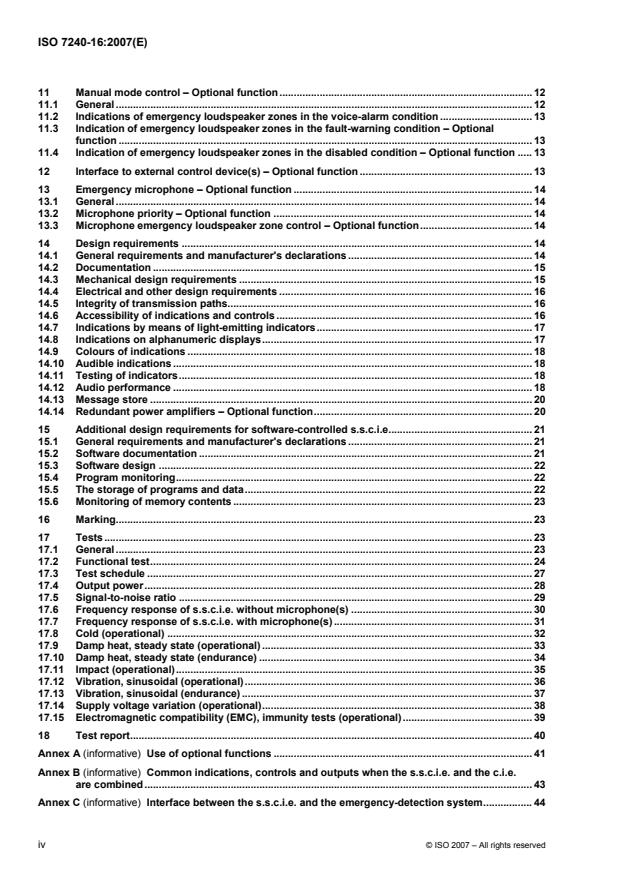
11 Manual mode control – Optional function. 12
11.1 General . 12
11.2 Indications of emergency loudspeaker zones in the voice-alarm condition . 13
11.3 Indication of emergency loudspeaker zones in the fault-warning condition – Optional
function . 13
11.4 Indication of emergency loudspeaker zones in the disabled condition – Optional function . 13
12 Interface to external control device(s) – Optional function . 13
13 Emergency microphone – Optional function . 14
13.1 General . 14
13.2 Microphone priority – Optional function . 14
13.3 Microphone emergency loudspeaker zone control – Optional function. 14
14 Design requirements . 14
14.1 General requirements and manufacturer's declarations . 14
14.2 Documentation . 15
14.3 Mechanical design requirements . 15
14.4 Electrical and other design requirements .16
14.5 Integrity of transmission paths. 16
14.6 Accessibility of indications and controls . 16
14.7 Indications by means of light-emitting indicators. 17
14.8 Indications on alphanumeric displays. 17
14.9 Colours of indications . 18
14.10 Audible indications . 18
14.11 Testing of indicators. 18
14.12 Audio performance . 18
14.13 Message store . 20
14.14 Redundant power amplifiers – Optional function. 20
15 Additional design requirements for software-controlled s.s.c.i.e. 21
15.1 General requirements and manufacturer's declarations . 21
15.2 Software documentation . 21
15.3 Software design . 22
15.4 Program monitoring. 22
15.5 The storage of programs and data. 22
15.6 Monitoring of memory contents . 23
16 Marking. 23
17 Tests. 23
17.1 General . 23
17.2 Functional test. 24
17.3 Test schedule . 27
17.4 Output power. 28
17.5 Signal-to-noise ratio . 29
17.6 Frequency response of s.s.c.i.e. without microphone(s) . 30
17.7 Frequency response of s.s.c.i.e. with microphone(s) . 31
17.8 Cold (operational) . 32
17.9 Damp heat, steady state (operational) . 33
17.10 Damp heat, steady state (endurance) . 34
17.11 Impact (operational). 35
17.12 Vibration, sinusoidal (operational). 36
17.13 Vibration, sinusoidal (endurance) . 37
17.14 Supply voltage variation (operational). 38
17.15 Electromagnetic compatibility (EMC), immunity tests (operational). 39
18 Test report. 40
Annex A (informative) Use of optional functions . 41
Annex B (informative) Common indications, controls and outputs when the s.s.c.i.e. and the c.i.e.
are combined. 43
Annex C (informative) Interface between the s.s.c.i.e. and the emergency-detection system. 44
iv © ISO 2007 – All rights reserved
Annex D (informative) Explanation of access levels . 45
Annex E (informative) Design requirements for software-controlled s.s.c.i.e. 47
Foreword
ISO (the International Organization for Standardization) is a worldwide federation of national standards bodies
(ISO member bodies). The work of preparing International Standards is normally carried out through ISO
technical committees. Each member body interested in a subject for which a technical committee has been
established has the right to be represented on that committee. International organizations, governmental and
non-governmental, in liaison with ISO, also take part in the work. ISO collaborates closely with the
International Electrotechnical Commission (IEC) on all matters of electrotechnical standardization.
International Standards are drafted in accordance with the rules given in the ISO/IEC Directives, Part 2.
The main task of technical committees is to prepare International Standards. Draft International Standards
adopted by the technical committees are circulated to the member bodies for voting. Publication as an
International Standard requires approval by at least 75 % of the member bodies casting a vote.
Attention is drawn to the possibility that some of the elements of this document may be the subject of patent
rights. ISO shall not be held responsible for identifying any or all such patent rights.
ISO 7240-16 was prepared by Technical Committee ISO/TC 21, Equipment for fire protection and fire fighting,
Subcommittee SC 3, Fire detection and alarm systems.
This first edition of ISO 7240-16 together with ISO 7240-19 cancels and replaces IEC 60849:1998, which has
been technically revised.
ISO 7240 consists of the following parts, under the general title Fire detection and alarm systems:
⎯ Part 1: General and definitions
⎯ Part 2: Control and indicating equipment
⎯ Part 4: Power supply equipment
⎯ Part 5: Point-type heat detectors
⎯ Part 6: Carbon monoxide fire detectors using electro-chemical cells
⎯ Part 7: Point-type smoke detectors using scattered light, transmitted light or ionization
⎯ Part 8: Carbon monoxide fire detectors using an electro-chemical cell in combination with a heat sensor
⎯ Part 9: Test fires for fire detectors (Technical Specification)
⎯ Part 10: Point-type flame detectors
⎯ Part 11: Manual call points
⎯ Part 12: Line type smoke detectors using a transmitted optical beam
⎯ Part 13: Compatibility assessment of system components
⎯ Part 14: Guidelines for drafting codes of practice for design, installation and use of fire detection and fire
alarm systems in and around buildings (Technical Report)
vi © ISO 2007 – All rights reserved
⎯ Part 15: Point type fire detectors using scattered light, transmitted light or ionization sensors in
combination with a heat sensor
⎯ Part 16: Sound system control and indicating equipment
⎯ Part 19: Design, installation, commissioning and service of sound systems for emergency purposes
⎯ Part 21: Routing equipment
⎯ Part 22: Smoke-detection equipment for ducts
⎯ Part 27: Point-type fire detectors using a scattered-light, transmitted-light or ionization smoke sensor, an
electrochemical-cell carbon-monoxide sensor and a heat sensor
A part 26 dealing with oil mist detectors and a part 28 dealing with fire protection control equipment are under
development.
Introduction
Sound system control and indicating equipment (s.s.c.i.e.) forms part of a sound system for emergency
purposes (s.s.e.p.). An s.s.e.p. operates automatically or manually in a building or structure to alert occupants
to a hazard which may require their evacuation in a safe and orderly manner. Equipment to warn occupants is
therefore required to function after the hazard has been detected. Fire in a building is a common hazard which
is often detected by an automatic fire detection and alarm system. An s.s.e.p. may operate as part of a fire
detection and alarm system or may function in conjunction with other emergency detection systems, such as
those for storms, earthquakes and bomb threats. The s.s.c.i.e. may be a separate unit or may be physically
combined with the fire detection control and indicating equipment (see ISO 7240-2).
This part of ISO 7240 has been prepared by Subcommittee ISO/TC 21/SC 3 and is based on IEC 60849:1998,
Sound systems for emergency purposes, prepared by the International Electrotechnical Commission
IEC/TC 100, Audio, video and multimedia systems and equipment.
This part of ISO 7240 follows the format of, and has similar requirements to, ISO 7240-2 and is drafted on the
basis of mandatory functions which are to be provided on all s.s.c.i.e. and optional functions (with
requirements) which may be provided. Each optional function is included as a separate entity, with its own set
of associated requirements, in order for s.s.c.i.e. with different combinations of functions to comply with this
part of ISO 7240. It is intended that the options be used for specific applications, as recommended in
ISO 7240-19 and the emergency management plan. Other functions associated with an s.s.e.p. may also be
provided, even if they are not specified in this part of ISO 7240.
This part of ISO 7240 contains specific tests that subject the equipment to conditions likely to be met in
practice, such as corrosion, vibration, direct impact, indirect shock and electromagnetic interference. Some
tests specified are intended to assess the performance of the s.s.c.i.e. under such conditions. The
performance of the s.s.c.i.e. is assessed from the results obtained in specific tests. This part of ISO 7240 is
not intended to place any other restrictions on the design and construction of such equipment.
viii © ISO 2007 – All rights reserved
INTERNATIONAL STANDARD ISO 7240-16:2007(E)
Fire detection and alarm systems —
Part 16:
Sound system control and indicating equipment
1 Scope
This part of ISO 7240 specifies the requirements, test methods and performance criteria for sound system
control and indicating equipment (s.s.c.i.e.) for use in buildings and structures as part of a sound system for
emergency purposes (s.s.e.p.) (item C of Figure 2 in ISO 7240-1:2005). The s.s.c.i.e. is primarily intended to
broadcast information for the protection of lives within one or more specified areas in an emergency, to effect
a rapid and orderly mobilization of occupants in an indoor or outdoor area. This includes systems using
loudspeakers to broadcast voice announcements for emergency purposes, alert signals complying with
ISO 7731, and evacuate signals complying with ISO 8201.
The overall requirements of an s.s.e.p., especially concerning audibility and intelligibility, are contained within
ISO 7240-19. In addition to ensuring compliance with this part of ISO 7240, the manufacturer should also
consider the requirements of ISO 7240-19, national regulations, codes and standards that affect the s.s.c.i.e.
design and usability. For example, some regulations require certain optional functions to be available on all
s.s.c.i.e. installed within the jurisdiction.
The use of the equipment for normal sound reinforcement and distribution systems purposes under non-
hazardous circumstances is not excluded.
This part of ISO 7240 can also be used for the assessment of similar control and indicating equipment for use
in systems where the warning-signal broadcast does not include a voice message.
This part of ISO 7240 does not apply to systems using only sounders or bells.
2 Normative references
The following referenced documents are indispensable for the application of this document. For dated
references, only the edition cited applies. For undated references, the latest edition of the referenced
document (including any amendments) applies.
ISO 7240-1:2005, Fire detection and alarm systems — Part 1: General and definitions
ISO 7240-2:2003, Fire detection and alarm systems — Part 2: Control and indicating equipment
ISO 7240-4:2003, Fire detection and alarm systems — Part 4: Power supply equipment
ISO 7240-5, Fire detection and alarm systems — Part 5: Point-type heat detectors
ISO 7240-6, Fire detection and alarm systems — Part 6: Carbon monoxide fire detectors using electro-
chemical cells
ISO 7240-7, Fire detection and alarm systems — Part 7: Point-type smoke detectors using scattered light,
transmitted light or ionization
ISO 7240-8, Fire detection and alarm systems — Part 8: Carbon monoxide fire detectors using an electro-
chemical cell in combination with a heat sensor
ISO/TS 7240-9, Fire detection and alarm systems — Part 9: Test fires for fire detectors
ISO 7240-10, Fire detection and alarm systems — Part 10: Point-type flame detectors
ISO 7240-11, Fire detection and alarm systems — Part 11: Manual call points
ISO 7240-12, Fire detection and alarm systems — Part 12: Line type smoke detectors using a transmitted
optical beam
ISO 7240-13, Fire detection and alarm systems — Part 13: Compatibility assessment of system components
ISO/TR 7240-14, Fire detection and alarm systems — Part 14: Guidelines for drafting codes of practice for
design, installation and use of fire detection and fire alarm systems in and around buildings
ISO 7240-15, Fire detection and alarm systems — Part 15: Point type fire detectors using scattered light,
transmitted light or ionization sensors in combination with a heat sensor
ISO 7240-19, Fire detection and alarm systems — Part 19: Design, installation, commissioning and service of
sound systems for emergency purposes
ISO 7240-21, Fire detection and alarm systems — Part 21: Routing equipment
ISO 7240-22, Fire detection and alarm systems — Part 22: Smoke detection equipment for ducts
ISO 7731, Ergonomics — Danger signals for public and work areas — Auditory danger signals
ISO 8201, Acoustics — Audible emergency evacuation signal
IEC 60068-1, Environmental testing — Part 1: General and guidance
IEC 60068-2-1, Environmental testing — Part 2: Tests. Tests A: Cold
IEC 60068-2-6, Environmental testing — Part 2: Tests. Test Fc: Vibration (sinusoidal)
IEC 60068-2-47, Environmental testing — Part 2-47: Test — Mounting of specimens for vibration, impact and
similar dynamic tests
IEC 60068-2-75, Environmental testing — Part 2-75: Tests — Test Eh: Hammer tests
IEC 60068-2-78, Environmental testing — Part 2-78: Tests — Test Cab: Damp heat, steady state
IEC 60268-1, Sound system equipment — Part 1: General
IEC 60268-4:2004, Sound system equipment — Part 4: Microphones
IEC 60529:2001, Degrees of protection provided by enclosures (IP Code)
IEC 60721-3-3:2002, Classification of environmental conditions — Part 3-3: Classification of groups of
environmental parameters and their severities — Stationary use at weather protected locations
EN 50130-4, Alarm systems — Part 4: Electromagnetic compatibility — Product family standard: Immunity
requirements for components of fire, intruder and social alarm systems
2 © ISO 2007 – All rights reserved
3 Terms, definitions and abbreviated terms
For the purposes of this document, the terms and definitions given in ISO 7240-1 and the following apply. See
also ISO 7240-1:2005, Figure 2.
3.1 Terms and definitions
3.1.1
automatic mode
mode of operation of a sound system which is linked to an emergency detection system, or other means of
triggering the sound system, to broadcast emergency messages without human intervention in a manner
which is pre-set according to an agreed emergency-response procedure unique to that building
3.1.2
cabinet
housing which affords a degree of protection and robustness to its constituent parts and subassemblies
3.1.3
emergency microphone
microphone dedicated for use by competent personnel during the voice-alarm condition
3.1.4
emergency microphone control
manual control which activates an emergency microphone (also called a “push-to-talk” control)
3.1.5
emergency loudspeaker zone
subdivision of the premises such that the occurrence of an emergency within it will be indicated separately
from any other subdivision at the s.s.c.i.e. and broadcast separately within the subdivision
3.1.6
functional condition
condition of the s.s.c.i.e. characterized by its indication at the s.s.c.i.e
NOTE The functional conditions recognized in this part of ISO 7240 are
⎯ the quiescent condition,
⎯ the voice-alarm condition,
⎯ the fault-warning condition,
⎯ the disabled condition, and
⎯ the test condition.
3.1.7
manual mode
mode of operation where an operator is directly in control of the broadcast of live or pre-recorded sounds,
especially those of an emergency nature
3.1.8
quiescent condition
functional condition characterised by the absence of the voice-alarm, fault-warning, disabled and test
conditions
3.1.9
transmission path
physical connection between s.s.e.p. components (external to the cabinet of the component) used for the
transmission of information, including audio and/or power
3.1.10
voice-alarm condition
alert signal, evacuate signal, recorded or live emergency signal broadcast in at least one emergency
loudspeaker zone
3.2 Abbreviations
⎯ c.i.e. control and indicating equipment
⎯ r.m.s. root mean squared
⎯ S/N signal-to-noise ratio
⎯ s.s.c.i.e. sound system control and indicating equipment
⎯ s.s.e.p. sound system for emergency purposes
⎯ THD total harmonic distortion
4 General requirements
4.1 General
4.1.1 If an optional function is included in the s.s.c.i.e., then all the corresponding requirements shall be met
(see also Annex A).
4.1.2 If functions other than those specified in this part of ISO 7240 are provided, they shall not jeopardize
compliance with any requirements of this part of ISO 7240.
4.2 Combined s.s.c.i.e. and c.i.e.
When the s.s.c.i.e. and c.i.e. are in the same cabinet, they may share common indications, manual controls
and outputs (see Annex B). In this case, the following shall apply.
a) A single fault in the c.i.e. shall not adversely affect the mandatory functions of the s.s.c.i.e.
b) Indication(s) and manual control(s) associated with the s.s.c.i.e which are dedicated to the fault-warning
function shall be clearly identifiable.
4.3 Power supply
Power-supply equipment shall comply with the requirements of ISO 7240-4 and may be internal or external to
the s.s.c.i.e. cabinet.
The power supply may be shared with that of the emergency detection system.
5 General requirements for indications
5.1 Display of functional conditions
5.1.1 The s.s.c.i.e. shall be capable of unambiguously indicating the following functional conditions, as
described in Clauses 6 to 10:
⎯ quiescent condition;
4 © ISO 2007 – All rights reserved
⎯ voice-alarm condition;
⎯ fault-warning condition;
⎯ disabled condition (optional function);
⎯ test condition (optional function).
5.1.2 The s.s.c.i.e. shall be capable of being simultaneously, in any combination of the following functional
conditions:
⎯ one or more voice-alarm conditions;
⎯ fault-warning condition;
⎯ disablement condition;
⎯ test condition.
5.2 Display of indications
All mandatory indications shall be clearly identifiable, except where otherwise specified in this part of
ISO 7240.
5.3 Indications on alphanumeric displays
Where an alphanumeric display is used to display indications relating to different functional conditions, these
may be displayed at the same time. However, for each functional condition, there shall be only one window in
which all of the fields relating to that functional condition are grouped.
5.4 Indication of the supply of power
5.4.1 A visible indication shall be given by means of a separate light-emitting indicator while the s.s.c.i.e. is
supplied with power.
5.4.2 Where the s.s.c.i.e. is distributed in more than one cabinet, an indication of supply of power shall be
given at each distributed cabinet.
5.5 Additional indications
Where indications are used in addition to mandatory indications, these shall not result in contradiction or
confusion.
6 Quiescent condition
Any kind of system information may be displayed during the quiescent condition. However, no indications shall
be given that can be confused with indications used in
⎯ the voice-alarm condition,
⎯ the fault-warning condition,
⎯ the disabled condition, or
⎯ the test condition.
7 Voice-alarm condition
7.1 Reception and processing of alarm signal
7.1.1 The s.s.c.i.e. shall be capable of receiving and processing voice-alarm condition signals from an
emergency detection system (see Annex C) and/or manual controls, and causing the appropriate alarm and
warning-signal outputs to be activated within 3 s, or after the expiry of any delay period (see 7.6).
7.1.2 The mandatory indications and/or outputs shall not be falsified by multiple signals received from the
same or different emergency detection systems and/or manual controls.
7.1.3 Where the s.s.c.i.e. and the c.i.e. are in separate cabinets, failure of the transmission path between
the emergency detection system and the s.s.c.i.e. shall not affect the operation of the s.s.c.i.e. or any change
of state of the voice-alarm condition.
7.1.4 Where the s.s.c.i.e. is used for non-emergency purposes (e.g. paging, music or general pre-recorded
announcements), the voice-alarm condition shall disable or override any functions not connected with the
emergency functions.
7.2 Alert signal – Optional function
7.2.1 The s.s.c.i.e. may produce one or more alert signals complying with ISO 7731.
NOTE The alert signal can be used together with an emergency management plan (see ISO 7240-19) to alert
occupants to a hazard and to prompt evacuation supervisors to attend control points and prepare for further instructions.
Different alert signals may be used to alert trained personnel to different hazards.
7.2.2 Where a voice signal is used as part of the alert signal, the alert signal shall precede the first
pre-recorded voice message for 3 s to 10 s. Successive alert signals and messages shall then continue until
either automatically or manually changed or silenced. The interval between successive messages shall not
exceed 30 s and alert signals shall be broadcast whenever periods of silence might otherwise exceed 10 s.
7.2.3 Where more than one alert signal is provided, each signal shall be clearly distinguishable.
Where an alert signal is used as part of an automatic evacuation plan, it should precede the evacuate signal
and may include voice messages.
7.3 Evacuate signal
7.3.1 The evacuate signal may be preceded by an alert signal (see 7.2).
The use of an alert signal, together with an evacuate signal, should be assessed as part of an emergency
management plan (see ISO 7240-19). For buildings and structures where the plan requires the unassisted
evacuation of occupants, the s.s.e.p. may be configured to generate a warning signal that does not
incorporate an alert signal.
7.3.2 The evacuate signal shall include the tone signal and pre-recorded voice messages, as specified in
ISO 8201.
Manufacturers may implement other signal templates to satisfy specific mandated national requirements.
7.4 Indication of the voice-alarm condition
The presence of a voice-alarm condition shall be indicated on the s.s.c.i.e., without prior manual intervention,
by
a) a visible indication by means of a separate discrete light-emitting indicator (the general voice-alarm-
activated indicator);
6 © ISO 2007 – All rights reserved
b) a visible indication for each activated emergency loudspeaker zone where manual controls are provided;
this may be by means of separate discrete indicators or an alphanumeric display, as specified in 14.8;
c) an optional audible indication, as specified in 7.5.
7.5 Audible warning – Optional function
7.5.1 An audible warning, at the s.s.c.i.e., of the voice-alarm condition may be the same as that for the fault-
warning condition. If they are different, the voice-alarm condition warning shall have priority.
7.5.2 The audible warning shall be capable of being silenced at access level 1 or 2 (see Annex D for more
information on access levels).
7.5.3 The audible warning shall be silenced automatically when the s.s.c.i.e. is reset from the voice-alarm
condition.
7.6 Delay before entering the voice-alarm condition – Optional function
The s.s.c.i.e. may be provided with a facility to introduce a delay before entering the voice-alarm condition. In
this case, the following shall apply.
a) The configuration of delays shall be selectable at access level 3 (see Annex D for more information on
access levels).
b) The operation of the delay shall be in increments not exceeding 1 min, up to a maximum of 10 min.
c) The delay to one output signal shall not affect the delay to other outputs.
d) It shall be possible to override the delay by a manual operation at access level 1 and/or by a signal from a
manual call point.
e) There shall be a provision to switch on and switch off delays by means of a manual operation at access
level 2.
f) There may be a provision to automatically switch on and/or switch off delays by means of a
programmable timer, which shall be configurable at access level 3.
g) A separate light-emitting indicator and/or a field on the alphanumeric display shall be visible when an
alarm signal is received and the delay is activated. This indication shall be suppressed after the s.s.c.i.e.
enters the voice-alarm condition.
7.7 Phased evacuation – Optional function
The s.s.c.i.e. may be provided with a facility to delay the warning signals to the emergency loudspeaker zones
(see 7.6). The following shall apply.
a) The facility shall be configurable at access level 3 (see Annex D for more information on access levels).
b) There may be a provision to switch between manual mode and a phased evacuation sequence by means
of a manual operation at access level 2.
c) When switching from phased evacuation to manual mode, the phased evacuation sequence shall halt.
d) When switching from manual mode to phased evacuation, the phased evacuation sequence shall resume
from the point at which it was halted.
7.8 Silencing the voice-alarm condition
7.8.1 Silencing the voice-alarm condition from the emergency detection system
7.8.1.1 Where the voice-alarm condition has been initiated from the emergency detection system, the
s.s.c.i.e. shall respond appropriately to a silence instruction from the emergency detection system.
7.8.1.2 The silencing procedure may allow for the completion of messages in the process of being
broadcast.
7.8.2 Silencing of the voice-alarm condition with a manual control – Optional function
7.8.2.1 The voice-alarm condition may be manually silenced at the s.s.c.i.e. at access level 2.
7.8.2.2 Following silencing, it shall be possible to reactivate the voice-alarm condition at access level 2.
7.9 Reset of the voice-alarm condition
7.9.1 Reset of the voice-alarm condition from the emergency detection system
Where the voice-alarm condition has been initiated from the emergency detection system, the s.s.c.i.e. shall
implement a reset instruction from the emergency detection system.
7.9.2 Reset of the voice-alarm condition with a manual control – Optional function
7.9.2.1 A separate manual control at the s.s.c.i.e. may be provided to reset the voice-alarm condition.
This control shall be accessible at access level 2, used only for reset, and may be the same as that used for
reset from the fault-warning condition.
7.9.2.2 Following a reset operation, the indication of the correct functional condition corresponding to any
received signals shall either remain or be re-established within 20 s.
7.10 Output to alarm devices – Optional function
The s.s.c.i.e. may have a provision for the automatic transmission of alarm signals to alarm devices, such as
beacons and vibrating devices. In this case, the following shall apply.
a) It shall be possible to deactivate the alarm devices at access level 2.
b) Following deactivation, it shall be possible to reactivate the alarm devices at access level 2.
c) The alarm devices shall not be deactivated automatically.
d) It shall be possible to configure the s.s.c.i.e. at access level 3, to automatically reactivate the alarm
devices if an alarm is reported in another emergency loudspeaker zone.
7.11 Voice-alarm condition output signal – Optional function
The s.s.c.i.e. may have a provision for transmitting the voice-alarm condition. In this case, it shall activate the
output only in the voice-alarm condition.
8 © ISO 2007 – All rights reserved
8 Fault-warning condition
8.1 Reception and processing of fault signals
8.1.1 The s.s.c.i.e. shall enter the fault-warning condition when signals are received that, after any
necessary processing, are interpreted as a fault.
8.1.2 The s.s.c.i.e. shall be capable of simultaneously recognizing all of the faults specified in 8.2, and in
8.3 if provided, unless this is prevented by
⎯ the presence of voice-alarm signals in the same emergency loudspeaker zone, and/or
⎯ the disablement of the corresponding emergency loudspeaker zone or function, and/or
⎯ the testing of a corresponding zone or function.
8.1.3 The s.s.c.i.e. shall enter the fault-warning condition within 100 s of the occurrence of the fault or the
reception of a fault signal, or as otherwise specified in this part of ISO 7240, or within another time period, as
specified in other parts of ISO 7240.
8.2 Indication of faults in specified functions
8.2.1 The presence of faults in specified functions shall be indicated without prior manual intervention. The
fault-warning condition is established when the following are present:
a) a visible indication by means of a separate light-emitting indicator (the general fault-warning indicator);
b) a visible indication for each recognized fault, as specified in 8.2.4, 8.2.5 and 8.3 (if provided);
c) an audible indication, as specified in 8.4.
8.2.2 If the indication is by means of separate light-emitting indicators, these may be the same as those
used to indicate disablement and/or testing of the corresponding emergency loudspeaker zones or functions.
8.2.3 If the indication is on an alphanumeric display that cannot simultaneously indicate all of the faults, the
following shall apply.
a) The presence of fault indications that have been suppressed shall be indicated.
b) Suppressed fault indications shall be capable of being displayed by means of a manual operation at
access level 1 or 2, which interrogates only fault indications.
8.2.4 The following faults shall be indicated by means of separate light-emitting indicators and/or an
alphanumeric display. The following indications may be suppressed during the voice-alarm condition:
a) an indication at least common to any power-supply fault resulting from
⎯ a short-circuit or an interruption in a
...