

ISO 24083:2021
(Main)Information and documentation — International archives statistics
General Information
- Abstract
This document specifies guidelines for the archives community on the collection and reporting of statistics for the following purposes: — strategic planning and internal management of archives; — aggregating and comparing operational and performance statistics at regional, national, and international levels; — reporting to stakeholders such as funding institutions, politicians, researchers, and the general public; — promoting the role and value of archives for advancing learning and research, education and culture, and social and economic life; — improving the management of processes, reinforcing transparency and supporting good governance. This document does not apply to records centres responsible for records that are still in the legal custody of the organization that created or received them, although it is recognized that some archives also have responsibilities for appraising, acquiring, and managing the current records of organizations that can or not be transferred to the archives for permanent retention. When applying this document to archives that also perform records management functions, the archives can exclude statistics that pertain to its records management functions, including measures pertaining to holdings and their usage and preservation, funding and expenditures, space and facilities, staffing and management.
- Status
- Published
- Publication Date
- 03-May-2021
- Technical Committee
- ISO/TC 46/SC 8 - Quality - Statistics and performance evaluation
- Drafting Committee
- ISO/TC 46/SC 8/WG 12 - International archive statistics
- Current Stage
- 9060 - Close of review
- Completion Date
- 02-Dec-2031
Buy Documents




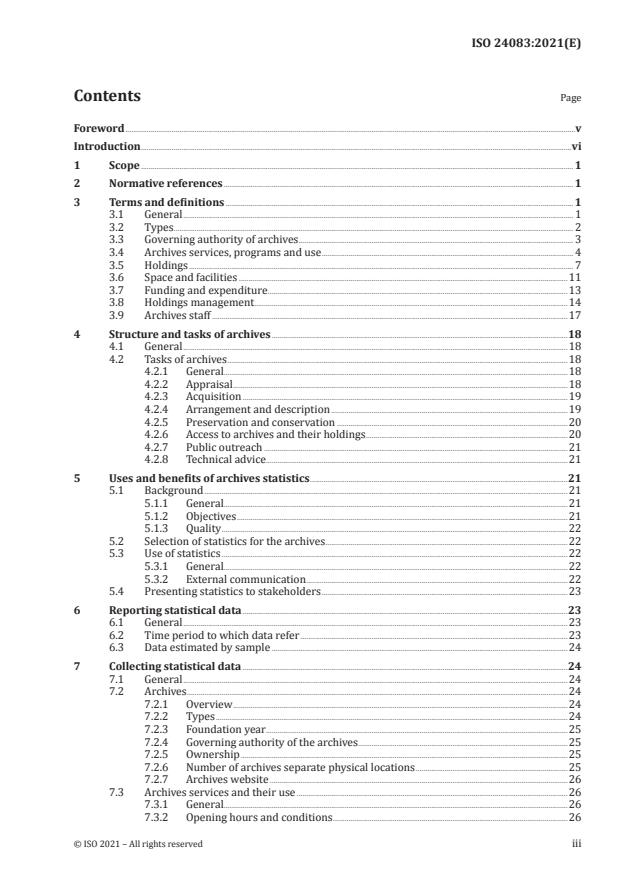
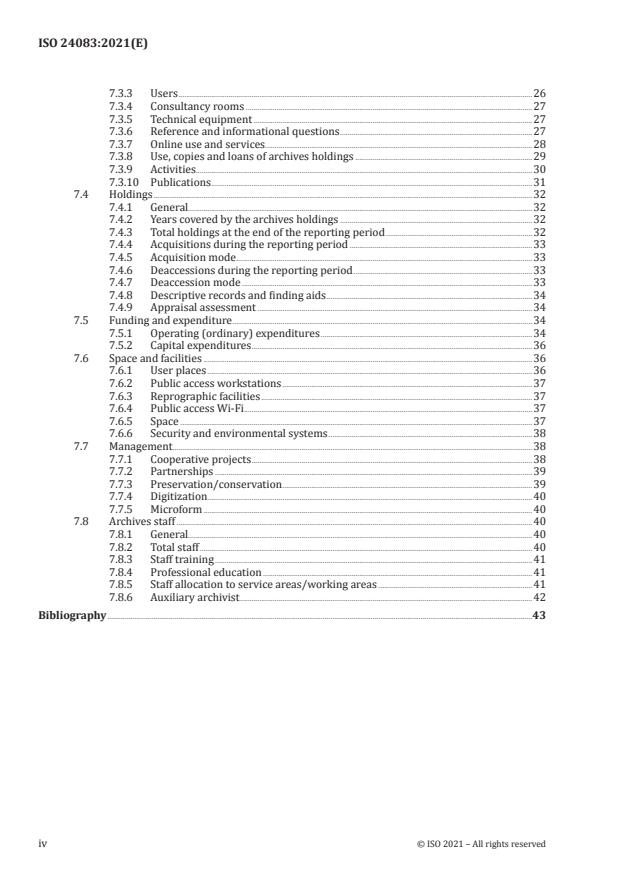
ISO 24083:2021 - Information and documentation -- International archives statistics

ISO 24083:2021 - Information and documentation — International archives statistics/4/2021
Overview - ISO 24083:2021 (International archives statistics)
ISO 24083:2021 provides internationally agreed guidelines for the collection and reporting of archives statistics. It is designed for the archives community to support strategic planning, internal management, benchmarking and external reporting. The standard helps archives aggregate and compare operational and performance statistics at regional, national and international levels, and to communicate value to stakeholders - funders, policymakers, researchers and the public.
Key purposes described in the standard:
- Strategic planning and archives management
- Aggregation and comparison of operational and performance statistics
- Reporting to stakeholders and promoting the value of archives
- Improving process management, transparency and good governance
Note: the standard does not apply to records centres that hold records still in the legal custody of their creating organizations; archives that also perform records management can exclude records-management-specific statistics.
Key topics and technical requirements
ISO 24083:2021 defines the structure for consistent archives statistics and covers terminology, data items and reporting practices. Major technical topics include:
- Terms and definitions for archives types, services, holdings, staff, space and funding
- Structure and tasks of archives (appraisal, acquisition, arrangement, preservation, access, outreach)
- Selection and quality of statistics, including guidance on sampling and time periods for reporting
- Detailed data categories: holdings (years covered, total holdings, acquisitions, deaccessions), services and usage (users, enquiries, online use, copies and loans), funding and expenditure (operating and capital), space and facilities (user places, reprographic facilities, security/environmental systems), holdings management (digitization, preservation) and archives staffing (total staff, training, allocation)
- Reporting and presentation of statistical data to internal and external stakeholders, with emphasis on comparability and transparency
Practical applications and who uses ISO 24083
ISO 24083 is used by:
- National, regional and local archives and archival institutions
- Archivists and records professionals involved in reporting and performance measurement
- Cultural heritage managers, funders and policymakers who rely on standardized statistics for decision-making
- Researchers and consultants conducting comparative studies or benchmarking archives services
Typical applications:
- Preparing annual statistical reports and funding proposals
- Benchmarking operational performance across institutions or countries
- Informing preservation and digitization strategies based on usage and holdings data
- Communicating archives’ social, educational and economic value to stakeholders
Related standards
For comprehensive information management, ISO 24083 complements other ISO information and documentation standards on records management, metadata, description and digital preservation (see ISO catalogue for specific references).
Buy Documents
ISO 24083:2021 - Information and documentation -- International archives statistics
ISO 24083:2021 - Information and documentation — International archives statistics/4/2021
Frequently Asked Questions
ISO 24083:2021 is a standard published by the International Organization for Standardization (ISO). Its full title is "Information and documentation — International archives statistics". This standard covers: This document specifies guidelines for the archives community on the collection and reporting of statistics for the following purposes: — strategic planning and internal management of archives; — aggregating and comparing operational and performance statistics at regional, national, and international levels; — reporting to stakeholders such as funding institutions, politicians, researchers, and the general public; — promoting the role and value of archives for advancing learning and research, education and culture, and social and economic life; — improving the management of processes, reinforcing transparency and supporting good governance. This document does not apply to records centres responsible for records that are still in the legal custody of the organization that created or received them, although it is recognized that some archives also have responsibilities for appraising, acquiring, and managing the current records of organizations that can or not be transferred to the archives for permanent retention. When applying this document to archives that also perform records management functions, the archives can exclude statistics that pertain to its records management functions, including measures pertaining to holdings and their usage and preservation, funding and expenditures, space and facilities, staffing and management.
This document specifies guidelines for the archives community on the collection and reporting of statistics for the following purposes: — strategic planning and internal management of archives; — aggregating and comparing operational and performance statistics at regional, national, and international levels; — reporting to stakeholders such as funding institutions, politicians, researchers, and the general public; — promoting the role and value of archives for advancing learning and research, education and culture, and social and economic life; — improving the management of processes, reinforcing transparency and supporting good governance. This document does not apply to records centres responsible for records that are still in the legal custody of the organization that created or received them, although it is recognized that some archives also have responsibilities for appraising, acquiring, and managing the current records of organizations that can or not be transferred to the archives for permanent retention. When applying this document to archives that also perform records management functions, the archives can exclude statistics that pertain to its records management functions, including measures pertaining to holdings and their usage and preservation, funding and expenditures, space and facilities, staffing and management.
ISO 24083:2021 is classified under the following ICS (International Classification for Standards) categories: 01.140.20 - Information sciences. The ICS classification helps identify the subject area and facilitates finding related standards.
ISO 24083:2021 is available in PDF format for immediate download after purchase. The document can be added to your cart and obtained through the secure checkout process. Digital delivery ensures instant access to the complete standard document.
Standards Content (Sample)
SLOVENSKI STANDARD
01-julij-2021
Informatika in dokumentacija - Statistika mednarodnih arhivov
Information and documentation -- International archives statistics
Information et documentation -- Statistiques internationales des archives
Ta slovenski standard je istoveten z: ISO 24083:2021
ICS:
01.140.20 Informacijske vede Information sciences
2003-01.Slovenski inštitut za standardizacijo. Razmnoževanje celote ali delov tega standarda ni dovoljeno.
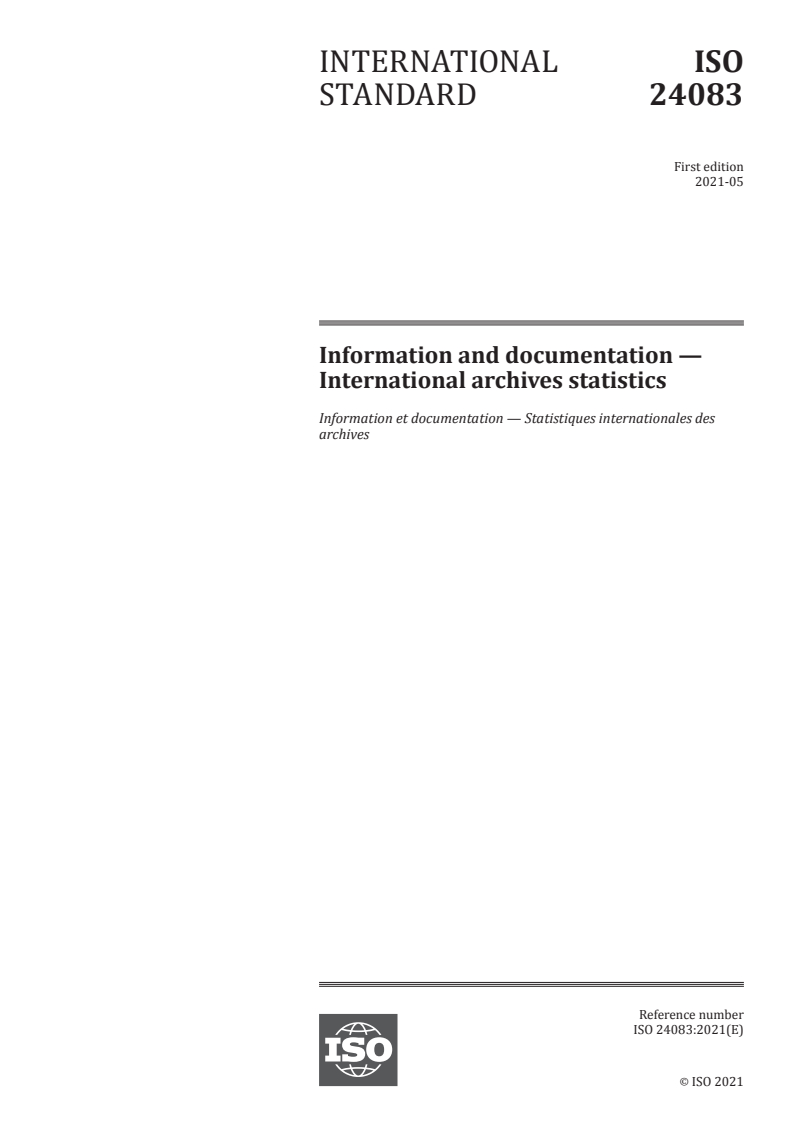
INTERNATIONAL ISO
STANDARD 24083
First edition
2021-05
Information and documentation —
International archives statistics
Information et documentation — Statistiques internationales des
archives
Reference number
©
ISO 2021
© ISO 2021
All rights reserved. Unless otherwise specified, or required in the context of its implementation, no part of this publication may
be reproduced or utilized otherwise in any form or by any means, electronic or mechanical, including photocopying, or posting
on the internet or an intranet, without prior written permission. Permission can be requested from either ISO at the address
below or ISO’s member body in the country of the requester.
ISO copyright office
CP 401 • Ch. de Blandonnet 8
CH-1214 Vernier, Geneva
Phone: +41 22 749 01 11
Email: copyright@iso.org
Website: www.iso.org
Published in Switzerland
ii © ISO 2021 – All rights reserved
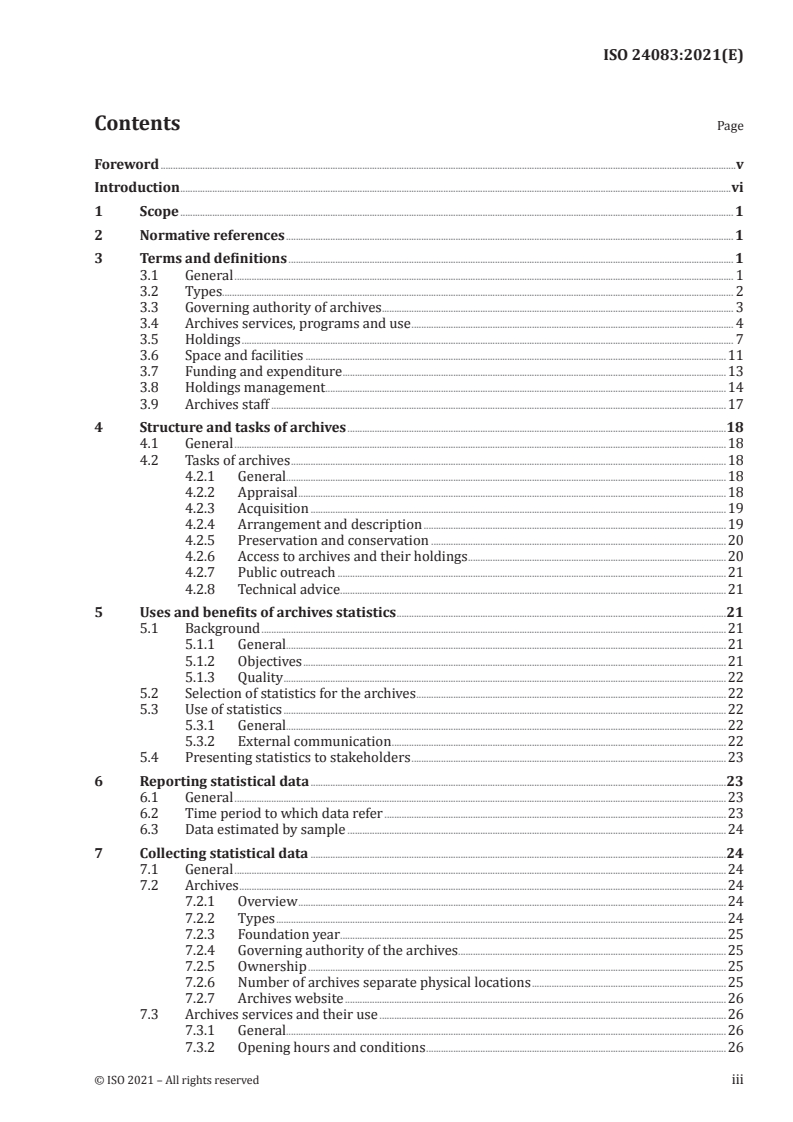
Contents Page
Foreword .v
Introduction .vi
1 Scope . 1
2 Normative references . 1
3 Terms and definitions . 1
3.1 General . 1
3.2 Types. 2
3.3 Governing authority of archives . 3
3.4 Archives services, programs and use . 4
3.5 Holdings . 7
3.6 Space and facilities .11
3.7 Funding and expenditure .13
3.8 Holdings management.14
3.9 Archives staff .17
4 Structure and tasks of archives .18
4.1 General .18
4.2 Tasks of archives .18
4.2.1 General.18
4.2.2 Appraisal .18
4.2.3 Acquisition .19
4.2.4 Arrangement and description .19
4.2.5 Preservation and conservation .20
4.2.6 Access to archives and their holdings .20
4.2.7 Public outreach .21
4.2.8 Technical advice . .21
5 Uses and benefits of archives statistics .21
5.1 Background .21
5.1.1 General.21
5.1.2 Objectives .21
5.1.3 Quality .22
5.2 Selection of statistics for the archives .22
5.3 Use of statistics .22
5.3.1 General.22
5.3.2 External communication .22
5.4 Presenting statistics to stakeholders .23
6 Reporting statistical data .23
6.1 General .23
6.2 Time period to which data refer .23
6.3 Data estimated by sample .24
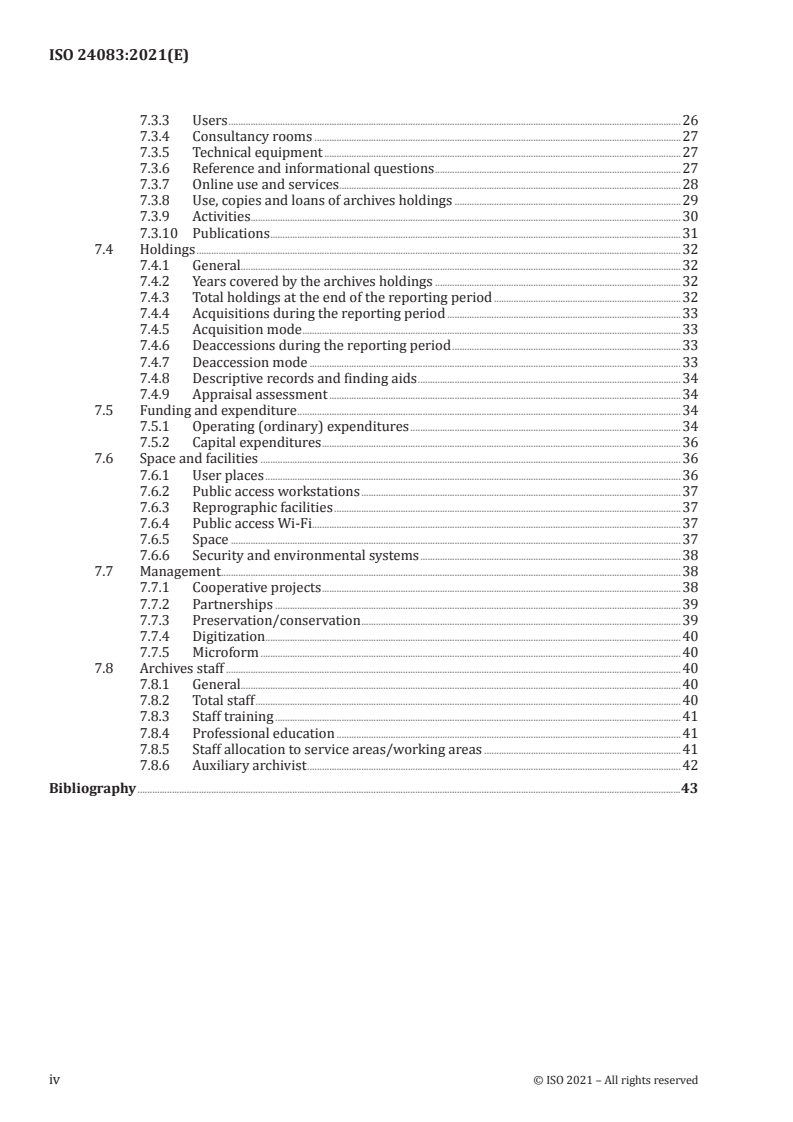
7 Collecting statistical data .24
7.1 General .24
7.2 Archives .24
7.2.1 Overview .24
7.2.2 Types .24
7.2.3 Foundation year . .25
7.2.4 Governing authority of the archives .25
7.2.5 Ownership .25
7.2.6 Number of archives separate physical locations .25
7.2.7 Archives website .26
7.3 Archives services and their use .26
7.3.1 General.26
7.3.2 Opening hours and conditions .26
7.3.3 Users .26
7.3.4 Consultancy rooms .27
7.3.5 Technical equipment .27
7.3.6 Reference and informational questions .27
7.3.7 Online use and services.28
7.3.8 Use, copies and loans of archives holdings .29
7.3.9 Activities.30
7.3.10 Publications .31
7.4 Holdings .32
7.4.1 General.32
7.4.2 Years covered by the archives holdings .32
7.4.3 Total holdings at the end of the reporting period .32
7.4.4 Acquisitions during the reporting period .33
7.4.5 Acquisition mode .33
7.4.6 Deaccessions during the reporting period .33
7.4.7 Deaccession mode .33
7.4.8 Descriptive records and finding aids .34
7.4.9 Appraisal assessment .34
7.5 Funding and expenditure .34
7.5.1 Operating (ordinary) expenditures .34
7.5.2 Capital expenditures .36
7.6 Space and facilities .36
7.6.1 User places .36
7.6.2 Public access workstations .37
7.6.3 Reprographic facilities .37
7.6.4 Public access Wi-Fi . . .37
7.6.5 Space .37
7.6.6 Security and environmental systems .38
7.7 Management .38
7.7.1 Cooperative projects .38
7.7.2 Partnerships .39
7.7.3 Preservation/conservation .39
7.7.4 Digitization.40
7.7.5 Microform .40
7.8 Archives staff .40
7.8.1 General.40
7.8.2 Total staff .40
7.8.3 Staff training .41
7.8.4 Professional education .41
7.8.5 Staff allocation to service areas/working areas .41
7.8.6 Auxiliary archivist .42
Bibliography .43
iv © ISO 2021 – All rights reserved
Foreword
ISO (the International Organization for Standardization) is a worldwide federation of national standards
bodies (ISO member bodies). The work of preparing International Standards is normally carried out
through ISO technical committees. Each member body interested in a subject for which a technical
committee has been established has the right to be represented on that committee. International
organizations, governmental and non-governmental, in liaison with ISO, also take part in the work.
ISO collaborates closely with the International Electrotechnical Commission (IEC) on all matters of
electrotechnical standardization.
The procedures used to develop this document and those intended for its further maintenance are
described in the ISO/IEC Directives, Part 1. In particular, the different approval criteria needed for the
different types of ISO documents should be noted. This document was drafted in accordance with the
editorial rules of the ISO/IEC Directives, Part 2 (see www .iso .org/ directives).
Attention is drawn to the possibility that some of the elements of this document may be the subject of
patent rights. ISO shall not be held responsible for identifying any or all such patent rights. Details of
any patent rights identified during the development of the document will be in the Introduction and/or
on the ISO list of patent declarations received (see www .iso .org/ patents).
Any trade name used in this document is information given for the convenience of users and does not
constitute an endorsement.
For an explanation of the voluntary nature of standards, the meaning of ISO specific terms and
expressions related to conformity assessment, as well as information about ISO's adherence to the
World Trade Organization (WTO) principles in the Technical Barriers to Trade (TBT), see www .iso .org/
iso/ foreword .html.
This document was prepared by Technical Committee ISO/TC 46, Information and documentation,
Subcommittee SC 8, Quality — Statistics and performance evaluation.
Any feedback or questions on this document should be directed to the user's national standards body. A
complete listing of these bodies can be found at www .iso .org/ members .html.
Introduction
This document collects statistics for measuring the archives performance of their tasks, services and use.
Clauses 3 and 7 form the core of this document. Clause 3 provides definitions for most of the elements
which constitute archives and archives services; these are for statistical purposes only. Clause 7
recommends how each of these elements should be counted. Users need to consult both clauses for the
complete picture.
It is recognized that not all measures specified in this document can be collected by archives of different
types, sizes, and functions.
vi © ISO 2021 – All rights reserved
INTERNATIONAL STANDARD ISO 24083:2021(E)
Information and documentation — International archives
statistics
1 Scope
This document specifies guidelines for the archives community on the collection and reporting of
statistics for the following purposes:
— strategic planning and internal management of archives;
— aggregating and comparing operational and performance statistics at regional, national, and
international levels;
— reporting to stakeholders such as funding institutions, politicians, researchers, and the general public;
— promoting the role and value of archives for advancing learning and research, education and culture,
and social and economic life;
— improving the management of processes, reinforcing transparency and supporting good governance.
This document does not apply to records centres responsible for records that are still in the legal
custody of the organization that created or received them, although it is recognized that some archives
also have responsibilities for appraising, acquiring, and managing the current records of organizations
that can or not be transferred to the archives for permanent retention. When applying this document
to archives that also perform records management functions, the archives can exclude statistics that
pertain to its records management functions, including measures pertaining to holdings and their
usage and preservation, funding and expenditures, space and facilities, staffing and management.
2 Normative references
There are no normative references in this document.
3 Terms and definitions
For the purposes of this document, the following terms and definitions apply.
ISO and IEC maintain terminological databases for use in standardization at the following addresses:
— ISO Online browsing platform: available at http:// www .iso .org/ obphttp:// www .iso .org/ obp
— IEC Electropedia: available at http:// www .electropedia .org/
3.1 General
3.1.1
archives
organization or part of an organization responsible for selection, acquisition,
preservation, and availability of one or more archives (3.1.2)
[SOURCE: ISO 5127:2017, 3.2.3.01, modified — Note 1 to entry until Note 4 to entry has been omitted]
3.1.2
archives
materials, items, records or documents created or received by a person, family or
organization, public or private, in the conduct of their affairs and preserved because of the enduring
value contained in them or as evidence of the functions and responsibilities of their creator, especially
those materials maintained using the principles of provenance, original order and collective control
[SOURCE: ISO 5127:2017, 3.6.1.03, modified — Items, records or documents have been included to
define archives. Note 1 to entry has been omitted.]
3.2 Types
3.2.1
national archives
central archives (3.1.1) consisting of and responsible for the archives (3.1.2) mainly emanating from the
central government of a state
[SOURCE: ISO 5127:2017, 3.6.4.2.03]
3.2.2
regional archives
archives (3.1.1) consisting of and responsible for the archives (3.1.2) mainly emanating from the
intermediate levels of government
[SOURCE: ISO 5127:2017, 3.6.4.2.04]
3.2.3
local archives
archives (3.1.1) consisting of and responsible for the archives (3.1.2) mainly emanating from
municipalities or other local governmental authorities
[SOURCE: ISO 5127:2017, 3.6.4.2.05]
3.2.4
departmental archives
archives (3.1.1) of a government department or administrative agency, institution or organization
[SOURCE: ISO 5127:2017, 3.6.4.2.06, modified — Note 1 to entry has been omitted.]
3.2.5
university archives
archives (3.1.1) of or relating to a university
Note 1 to entry: For academic institutions other than universities, such as independent research institutes, select
"other type not listed above" in 7.2.1.
[SOURCE: ISO 5127:2017, 3.6.4.2.07]
3.2.6
corporate archives
documents and other materials created or received by a group of people (a company, an organization)
in the course of operations and preserved for their enduring value
Note 1 to entry: Includes business archives (3.1.1).
Note 2 to entry: Includes foundation archives (3.1.1).
[SOURCE: SAA Glossary https:// dictionary .archivists .org]
2 © ISO 2021 – All rights reserved
3.2.7
audiovisual archives
archives (3.1.1) and archives (3.1.2) of documents in which sound and/or pictures are prominent, and
which requires the use of special equipment to be seen and/or heard
[SOURCE: ISO 5127:2017, 3.3.3.07, modified — Archives of documents have been added to the definition.
Notes 1 and 2 to entry have been omitted.]
3.2.8
family archives
archives (3.2.2) of or relating to a family or similar genealogical entity
[SOURCE: ISO 5127:2017, 3.6.4.2.01]
3.2.9
religious archives
archives (3.1.1) of religious bodies and communities
3.3 Governing authority of archives
3.3.1
governing authority
body with legal and fiduciary responsibility for the archives (3.1.1) and for approving archives policy
[SOURCE: ISO 18461:2016, 2.3.1, modified — "Archives" is used to replace "museum". Note 1 to entry
has been omitted.]
3.3.2
state-governed archives
archives (3.1.1) governed by governmental authorities at the national level
Note 1 to entry: Lower-levels of government are accommodated by locally-governed archives (3.3.3)/regionally-
governed archives (3.1.1).
[SOURCE: ISO18461: 2016, 2.3.6, modified — The term and definition for "state-governed museum"
have been adapted to define "stage-governed archives". Note 1 to entry has been added.]
3.3.3
locally-governed archives
archives (3.1.1) governed by city or municipal authorities
[SOURCE: ISO 18461:2016, 2.3.2, modified — The term and definition for "locally-governed museum"
have been adapted to define "locally-governed archives".]
3.3.4
regionally governed archives
archives (3.1.1) governed by regional authorities (federal units, province or county authorities
[SOURCE: ISO 18461:2016, 2.3.2, modified — The term and definition for "regionally-governed museum"
have been adapted to define "regionally-governed archives".]
3.3.5
other public-governed archives
archives (3.1.1) governed by other public authorities
[SOURCE: ISO 18461:2016, 2.3.3, modified — The term and definition for "other public-governed
museum" have been adapted to define "other public-governed archives". Notes to entry have been
omitted.]
3.3.6
internationally-governed archives
archives (3.1.1) governed by an international organization (such as non-profit or non-governmental
agencies that operate internationally)
3.3.7
privately-governed archives
archives (3.1.1) governed by private entities (such as non-profit or for-profit organizations registered
under private law), families or individuals
[SOURCE: ISO 18461:2016, 2.3.4, modified — The term and definition for "private-governed museum"
have been adapted to define "private-governed archives". Note 1 to entry has been omitted.]
3.3.8
public/private partnership archives
archives (3.1.1) governed jointly, in partnership of a public and private entity
[SOURCE: ISO 18461:2016, 2.3.5, modified — The term and definition for "public/private partnership
museum" have been adapted to define "public/private partnership archives". Notes to entry have been
omitted.]
3.4 Archives services, programs and use
3.4.1
access
right, opportunity, means of finding, using or retrieving information, documents and records
[SOURCE: ISO 5127:2017, 3.11.1.01, modified — Documents and records have been added to definition.
Note 1 to entry has been omitted.]
3.4.2
download
successful request of a content unit from an archives-provided online service or other internet service
[SOURCE: ISO 2789:2013, 2.2.6, modified — In the definition, a library has been replaced by an archive.]
3.4.4
event
pre-arranged activity, in some cases ongoing or repeatable, with cultural, educational, social, political,
scholarly, or other intent involving a group of people
EXAMPLE Exhibitions, author visits, literary discussions, workshops, etc.
Note 1 to entry: Only events arranged by the archives (3.1.1) on its own or in partnership with other institutions
are included, whether inside or outside the archives (3.1.1.) premises. Events inside the archives (3.1.1) premises
organized by institutions outside the archives (3.2.1) without the archives' (3.2.1) cooperation are excluded.
Note 2 to entry: User education lessons and pre-arranged archives (3.1.1) visits are excluded.
Note 3 to entry: Ongoing programs are excluded (i.e. education program, exhibition program) but each session of
a program is counted as one event.
Note 4 to entry: Virtual events are included.
[SOURCE: ISO 2789:2013, 2.2.9, modified — The definition has been modified to include frequency of
the term. Note 1 to entry has been omitted and subsequent notes have been renumbered. In Note 2
to entry, "education" has been used to replace "training" and "archives visits" replaces "library tours".
Note 3 to entry has been modified to exclude ongoing programs.]
4 © ISO 2021 – All rights reserved
3.4.5
exhibition
curated display of objects on a clear concept and communicating a message
Note 1 to entry: See also ISO 25639-1:2008, 3.1 and ISO 2789:2013, 2.2.10.
[SOURCE: ISO 5127:2017, 3.11.1.09]
3.4.6
informational question
directional and/or administrative inquiry delivered to archives (3.1.1) staff
Note 1 to entry: This includes e.g. questions for locating staff or facilities, questions regarding opening times and
registering procedures, and questions about handling equipment such as printers and computer terminals.
Note 2 to entry: It is essential that archives do not include reference questions (3.4.11) in this category.
[SOURCE: ISO 2789:2013, 2.2.13, modified — "Archives" replaces "library". Note 2 to entry has been
replaced. Note 3 to entry has been omitted.]
3.4.7
loan
lending of items in the archives' holdings to, or borrowing an item from, other collecting organizations,
private collectors, or agencies
[SOURCE: ISO 18461:2016, 2.4.7, modified — "Items in the archives' holdings" replaces "object in the
museum's collection". Note 1 to entry has been omitted.]
3.4.8
physical visit
act of entering into one or all of the parts of the archive's premises to access the services and programs
of the archives
[SOURCE: ISO 18461:2016, 2.4.14, modified — "To access the services and programs of the archives"
has been added to the definition.]
3.4.9
program
pre-arranged ongoing and repeatable activity having an intent within the mission of the archives (3.1.1)
Note 1 to entry: The activity would usually be of a cultural, educational, social, political, or scholarly nature, etc.
Note 2 to entry: Programs can be organized inside or outside the archives (3.1.1) premises.
Note 3 to entry: Programs inside the archives (3.1.1) premises organized by institutions outside the archives
without the archives participation should be counted separately.
Note 4 to entry: Ongoing programs are included under events (i.e. education program, exhibition program) but
each session of a program is counted as one event.
Note 5 to entry: Virtual programs are included, but should be counted separately.
[SOURCE: ISO 18461:2016, 2.4.15, modified — Archives replaces museum. In Note 1 to entry, the second
line has been deleted. In Notes 2 and 3 to entry, archives replaces museums. Note 4 to entry has been
replaced.]
3.4.10
publishing
publishing activities by archives (3.1.1), issuing documents for sale or licensing to the public in analogue
or digital format
[SOURCE: ISO 2789:2013, 2.5.8, modified — Archives replaces libraries. Notes 1 and 2 to entry have
been omitted.]
3.4.11
reference question
information contact that involves the knowledge or use of one or more information sources (such as
printed and non-printed materials, machine-readable databases, the archives' (3.1.1) own and other
institutions catalogues and finding aids) by archives (3.1.1) staff
Note 1 to entry: It is essential that archives (3.1.1) do not include informational questions (3.4.6) in this category.
[SOURCE: ISO 2789:2013, 2.2.26, modified — Archives replaces library´s, and finding aids has been
added to the definition. Notes 1 to 4 to entry have been omitted. and subsequent Note 5 to entry has
been renumbered and (directional and administrative) questions, e.g. for locating staff or facilities,
regarding opening times or about handling equipment such as printers or computer terminals has been
omitted.]
3.4.12
registered user
person or organization registered with archives (3.1.1) in order to use its holdings and/or services
onsite or elsewhere
[SOURCE: ISO 2789:2013, 2.2.28, modified — Archives replaces library, holdings replaces collection,
services onsite or elsewhere replace within or away from the library. Notes 1 and 2 to entry have been
omitted.]
3.4.13
reproduction services
services provided by the archives (3.1.1) to create copies replacing original documents produced for
their users
3.4.14
social network service
electronic service designed to allow users to establish a personal or organizational profile and contact
other individuals for the purposes of communicating, collaborating, and/or sharing content with them
[SOURCE: ISO 2789:2013, 2.2.33]
3.4.15
user
recipient of services provided by the archives (3.1.1)
[SOURCE: ISO 2789:2013, 2.2.36, modified — services provided by archives replaces library services.
Notes 1 and 2 to entry have been omitted.]
3.4.16
user education
instruction program designed to teach users how to utilize effectively the sources and the information
services available in an archives (3.1.1)
[SOURCE: ISO 5127:2017, 3.11.5.05, modified — The definition has been amended to apply to archives.]
3.4.17
virtual event
event in digital format, specifically designed for use via the Internet
[SOURCE: ISO 2789:2013, 2.2.38, modified — Digital replaces electronic.]
6 © ISO 2021 – All rights reserved
3.4.18
virtual visit
session
one continuous cycle of user activities on the archives (3.1.1) website, regardless of the number of pages
or elements viewed
[SOURCE: ISO 2789:2013, 2.2.39, modified — Archives replaces library, by users from outside the
library's IP address space (usually from outside the library premises) has been omitted. Notes to entry
have been omitted.]
3.4.19
visitor
person (individual) entering the archives (3.1.1) premises to access the services and programs of the
archives
[SOURCE: ISO 2789:2013, 2.2.40, modified — Visitor replaces visit, archives replaces library, to access
the services and programs of the archives has been added to the definition.]
3.4.20
website
collection of logically connected web pages managed as a single entity and accessed through the same
base URL
[SOURCE: ISO 5127:2017 3.3.3.24]
3.5 Holdings
3.5.1
analogue document
object usable without digital equipment
[SOURCE: ISO 5127:2017, 3.3.3.01, modified — object replaces document]
3.5.2
architectural document
items and materials that are created or assembled as part of the design, construction, and documentation
of buildings and similar large structures, and that are preserved for their administrative, legal, fiscal,
or archival value
[SOURCE: SAA Glossary https:// dictionary .archivists .org, modified — architectural document replaces
architectural record, items replaces documents.]
3.5.3
archival unit
single document or set of documents in an archives (3.1.1), treated as an entity
[SOURCE: ISO 5127:2017, 3.4.4.07]
3.5.4
archive group
record group
primary division in archival arrangement at the level of the independent originating unit or agency
Note 1 to entry: See also fonds
[SOURCE: ISO 5127:2017, 4.6.3.27]
3.5.5
artefact
object made or shaped by a human, such as a tool or a work of art
[SOURCE: ISO 18461:2016, 2.5.4]
3.5.6
audiovisual document
document in which sound and/or pictures are prominent, and which requires the use of special
equipment to be seen and/or heard
Note 1 to entry: This includes audio documents such as phonographic records, tapes, cassettes, audio compact
discs, DVDs, files of digital audio recordings; visual documents such as slides, filmstrips, transparencies; and
combined audiovisual documents, such as motion pictures, video recordings, etc.
Note 2 to entry: Microforms are excluded.
[SOURCE: ISO 5127:2017, 3.3.3.07, modified — Film strips has been added, computer games have been
omitted in Note 1 to entry. In Note 2 to entry, for library and museum statistics purposes has been
omitted.]
3.5.7
born-digital document
document that has been created originally in digital form
[SOURCE: ISO 2789:2013, 2.3.5]
3.5.8
cartographic document
conventional representation, on a reduced scale, of concrete or abstract phenomena which can be
localized in space and time
Note 1 to entry: This includes documents such as two- and three-dimensional maps, globes, plans, topographic
models, tactile maps and aerial representations, but excludes atlases and any other cartographic documents in
codex, micro, audio-visual and digital form.
[SOURCE: ISO 2789:2013, 2.3.6 – modified — Note 1 to entry has been omitted.]
3.5.9
collection
gathering of documents accumulated on the basis of some common characteristic without regard to the
provenance of those documents
[SOURCE: ISO 5127:2017, 3.6.1.05, modified — documents accumulated replaces items assembled,
without regard to the provenance of those documents has replaced for some purpose, or as the result of
some process. Note 1 to entry has been omitted.]
3.5.10
container
receptacle, box, package or housing used to hold materials
[SOURCE: SAA Glossary https:// dictionary .archivists .org/ entry/ container .html, modified — a box has
been added to definition.]
3.5.11
digital collection
all objects in digital form in the archives (3.1.1) holdings, whether born-digital or digitized
8 © ISO 2021 – All rights reserved
3.5.12
digital document
information unit with a defined content, born-digital or digitized, that has been created or digitized by
the archives (3.1.1) or acquired in digital form
[SOURCE: ISO 2789:2013, 2.3.13, modified — Archives replaces library, as part of the library collection
is omitted in the definition. Notes to entry have been omitted.]
3.5.13
digitized document
document that has been digitized from the analogue holdings of the archives (3.1.1)
[SOURCE: ISO 2789:2013, 2.3.16, modified — Part of the electronic collection containing those has been
omitted, documents replaces items, holdings of the archives replaces collection of the library.]
3.5.14
document
information which can be treated as a unit in a documentation process
Note 1 to entry: The information may be recorded using analogue or digital means.
[SOURCE: ISO 5127:2017, 3.1.1.38, modified — recorded information or material object has been
replaced. Notes to entry have been omitted and a new Note 1 to entry has been added.]
3.5.15
file
set of related records either analogue o electronic kept together either for current use by the creator or
in the process of archival arrangement, because they relate to the same subject, activity or transaction
[SOURCE: ISO 5127:2017, 3.4.4.01, modified — Set of related records either analogue or electronic kept
replaces organized unit of documents grouped. Note 1 to entry has been omitted.]
3.5.16
folder
sheet of cardboard, file cover or heavy paper stock that is used as a loose cover to keep documents and
other flat materials together, especially for purposes of filing
[SOURCE: SAA Glossary https:// dictionary .archivists .org]
3.5.17
fonds
whole of the records, regardless of form or medium, organically created and/or accumulated and used
by a particular person, family, or corporate body in the course of that creator's activities and functions
[SOURCE: ISAD (G):1999 Glossary of terms associated with the general rules, modified — Note 1 to
entry is omitted.]
3.5.18
graphic document
manuscript or printed document in which pictorial representation is the most prominent feature
Note 1 to entry: This is pictorial rather than linguistic, musical or cartographic in form. Includes art prints, art
originals, art reproductions, photographs, posters, study prints, technical drawings, etc., but excludes graphic
items in codex form or in microform, audiovisual or digital form.
[SOURCE: ISO 2789:2013, 2.3.25, modified — manuscript has been included.]
3.5.19
archival medium
material that serves as the carrier of the content of a record and that, because of the manner in which it
was made, has a very long life expectancy when properly stored and handled
[SOURCE: SAA Dictionary of Archival Terminology https:// dictionary .archivists .org]
3.5.20
microform
photographic document requiring magnification when used
Note 1 to entry: Adapted from ISO 5127.
Note 2 to entry: Microfiche and microfilm are included.
Note 3 to entry: Slides and similar documents are counted as audiovisual documents.
[SOURCE: ISO 2789:2013, 2.3.30]
3.5.21
photograph
picture obtained by a process which fixes a direct and durable image on a sensitized surface by the
action of electromagnetic radiation
[SOURCE: ISO 5127:2017, 3.4.5.1.01]
3.5.22
poster
large single-faced print for display on a flat surface
[SOURCE: ISO 5127:2017 3.4.7.55]
3.5.23
record
information created, received, and maintained as evidence and as an asset by an organization or perso
...
INTERNATIONAL ISO
STANDARD 24083
First edition
2021-05
Information and documentation —
International archives statistics
Information et documentation — Statistiques internationales des
archives
Reference number
©
ISO 2021
© ISO 2021
All rights reserved. Unless otherwise specified, or required in the context of its implementation, no part of this publication may
be reproduced or utilized otherwise in any form or by any means, electronic or mechanical, including photocopying, or posting
on the internet or an intranet, without prior written permission. Permission can be requested from either ISO at the address
below or ISO’s member body in the country of the requester.
ISO copyright office
CP 401 • Ch. de Blandonnet 8
CH-1214 Vernier, Geneva
Phone: +41 22 749 01 11
Email: copyright@iso.org
Website: www.iso.org
Published in Switzerland
ii © ISO 2021 – All rights reserved
Contents Page
Foreword .v
Introduction .vi
1 Scope . 1
2 Normative references . 1
3 Terms and definitions . 1
3.1 General . 1
3.2 Types. 2
3.3 Governing authority of archives . 3
3.4 Archives services, programs and use . 4
3.5 Holdings . 7
3.6 Space and facilities .11
3.7 Funding and expenditure .13
3.8 Holdings management.14
3.9 Archives staff .17
4 Structure and tasks of archives .18
4.1 General .18
4.2 Tasks of archives .18
4.2.1 General.18
4.2.2 Appraisal .18
4.2.3 Acquisition .19
4.2.4 Arrangement and description .19
4.2.5 Preservation and conservation .20
4.2.6 Access to archives and their holdings .20
4.2.7 Public outreach .21
4.2.8 Technical advice . .21
5 Uses and benefits of archives statistics .21
5.1 Background .21
5.1.1 General.21
5.1.2 Objectives .21
5.1.3 Quality .22
5.2 Selection of statistics for the archives .22
5.3 Use of statistics .22
5.3.1 General.22
5.3.2 External communication .22
5.4 Presenting statistics to stakeholders .23
6 Reporting statistical data .23
6.1 General .23
6.2 Time period to which data refer .23
6.3 Data estimated by sample .24
7 Collecting statistical data .24
7.1 General .24
7.2 Archives .24
7.2.1 Overview .24
7.2.2 Types .24
7.2.3 Foundation year . .25
7.2.4 Governing authority of the archives .25
7.2.5 Ownership .25
7.2.6 Number of archives separate physical locations .25
7.2.7 Archives website .26
7.3 Archives services and their use .26
7.3.1 General.26
7.3.2 Opening hours and conditions .26
7.3.3 Users .26
7.3.4 Consultancy rooms .27
7.3.5 Technical equipment .27
7.3.6 Reference and informational questions .27
7.3.7 Online use and services.28
7.3.8 Use, copies and loans of archives holdings .29
7.3.9 Activities.30
7.3.10 Publications .31
7.4 Holdings .32
7.4.1 General.32
7.4.2 Years covered by the archives holdings .32
7.4.3 Total holdings at the end of the reporting period .32
7.4.4 Acquisitions during the reporting period .33
7.4.5 Acquisition mode .33
7.4.6 Deaccessions during the reporting period .33
7.4.7 Deaccession mode .33
7.4.8 Descriptive records and finding aids .34
7.4.9 Appraisal assessment .34
7.5 Funding and expenditure .34
7.5.1 Operating (ordinary) expenditures .34
7.5.2 Capital expenditures .36
7.6 Space and facilities .36
7.6.1 User places .36
7.6.2 Public access workstations .37
7.6.3 Reprographic facilities .37
7.6.4 Public access Wi-Fi . . .37
7.6.5 Space .37
7.6.6 Security and environmental systems .38
7.7 Management .38
7.7.1 Cooperative projects .38
7.7.2 Partnerships .39
7.7.3 Preservation/conservation .39
7.7.4 Digitization.40
7.7.5 Microform .40
7.8 Archives staff .40
7.8.1 General.40
7.8.2 Total staff .40
7.8.3 Staff training .41
7.8.4 Professional education .41
7.8.5 Staff allocation to service areas/working areas .41
7.8.6 Auxiliary archivist .42
Bibliography .43
iv © ISO 2021 – All rights reserved
Foreword
ISO (the International Organization for Standardization) is a worldwide federation of national standards
bodies (ISO member bodies). The work of preparing International Standards is normally carried out
through ISO technical committees. Each member body interested in a subject for which a technical
committee has been established has the right to be represented on that committee. International
organizations, governmental and non-governmental, in liaison with ISO, also take part in the work.
ISO collaborates closely with the International Electrotechnical Commission (IEC) on all matters of
electrotechnical standardization.
The procedures used to develop this document and those intended for its further maintenance are
described in the ISO/IEC Directives, Part 1. In particular, the different approval criteria needed for the
different types of ISO documents should be noted. This document was drafted in accordance with the
editorial rules of the ISO/IEC Directives, Part 2 (see www .iso .org/ directives).
Attention is drawn to the possibility that some of the elements of this document may be the subject of
patent rights. ISO shall not be held responsible for identifying any or all such patent rights. Details of
any patent rights identified during the development of the document will be in the Introduction and/or
on the ISO list of patent declarations received (see www .iso .org/ patents).
Any trade name used in this document is information given for the convenience of users and does not
constitute an endorsement.
For an explanation of the voluntary nature of standards, the meaning of ISO specific terms and
expressions related to conformity assessment, as well as information about ISO's adherence to the
World Trade Organization (WTO) principles in the Technical Barriers to Trade (TBT), see www .iso .org/
iso/ foreword .html.
This document was prepared by Technical Committee ISO/TC 46, Information and documentation,
Subcommittee SC 8, Quality — Statistics and performance evaluation.
Any feedback or questions on this document should be directed to the user's national standards body. A
complete listing of these bodies can be found at www .iso .org/ members .html.
Introduction
This document collects statistics for measuring the archives performance of their tasks, services and use.
Clauses 3 and 7 form the core of this document. Clause 3 provides definitions for most of the elements
which constitute archives and archives services; these are for statistical purposes only. Clause 7
recommends how each of these elements should be counted. Users need to consult both clauses for the
complete picture.
It is recognized that not all measures specified in this document can be collected by archives of different
types, sizes, and functions.
vi © ISO 2021 – All rights reserved
INTERNATIONAL STANDARD ISO 24083:2021(E)
Information and documentation — International archives
statistics
1 Scope
This document specifies guidelines for the archives community on the collection and reporting of
statistics for the following purposes:
— strategic planning and internal management of archives;
— aggregating and comparing operational and performance statistics at regional, national, and
international levels;
— reporting to stakeholders such as funding institutions, politicians, researchers, and the general public;
— promoting the role and value of archives for advancing learning and research, education and culture,
and social and economic life;
— improving the management of processes, reinforcing transparency and supporting good governance.
This document does not apply to records centres responsible for records that are still in the legal
custody of the organization that created or received them, although it is recognized that some archives
also have responsibilities for appraising, acquiring, and managing the current records of organizations
that can or not be transferred to the archives for permanent retention. When applying this document
to archives that also perform records management functions, the archives can exclude statistics that
pertain to its records management functions, including measures pertaining to holdings and their
usage and preservation, funding and expenditures, space and facilities, staffing and management.
2 Normative references
There are no normative references in this document.
3 Terms and definitions
For the purposes of this document, the following terms and definitions apply.
ISO and IEC maintain terminological databases for use in standardization at the following addresses:
— ISO Online browsing platform: available at http:// www .iso .org/ obphttp:// www .iso .org/ obp
— IEC Electropedia: available at http:// www .electropedia .org/
3.1 General
3.1.1
archives
organization or part of an organization responsible for selection, acquisition,
preservation, and availability of one or more archives (3.1.2)
[SOURCE: ISO 5127:2017, 3.2.3.01, modified — Note 1 to entry until Note 4 to entry has been omitted]
3.1.2
archives
materials, items, records or documents created or received by a person, family or
organization, public or private, in the conduct of their affairs and preserved because of the enduring
value contained in them or as evidence of the functions and responsibilities of their creator, especially
those materials maintained using the principles of provenance, original order and collective control
[SOURCE: ISO 5127:2017, 3.6.1.03, modified — Items, records or documents have been included to
define archives. Note 1 to entry has been omitted.]
3.2 Types
3.2.1
national archives
central archives (3.1.1) consisting of and responsible for the archives (3.1.2) mainly emanating from the
central government of a state
[SOURCE: ISO 5127:2017, 3.6.4.2.03]
3.2.2
regional archives
archives (3.1.1) consisting of and responsible for the archives (3.1.2) mainly emanating from the
intermediate levels of government
[SOURCE: ISO 5127:2017, 3.6.4.2.04]
3.2.3
local archives
archives (3.1.1) consisting of and responsible for the archives (3.1.2) mainly emanating from
municipalities or other local governmental authorities
[SOURCE: ISO 5127:2017, 3.6.4.2.05]
3.2.4
departmental archives
archives (3.1.1) of a government department or administrative agency, institution or organization
[SOURCE: ISO 5127:2017, 3.6.4.2.06, modified — Note 1 to entry has been omitted.]
3.2.5
university archives
archives (3.1.1) of or relating to a university
Note 1 to entry: For academic institutions other than universities, such as independent research institutes, select
"other type not listed above" in 7.2.1.
[SOURCE: ISO 5127:2017, 3.6.4.2.07]
3.2.6
corporate archives
documents and other materials created or received by a group of people (a company, an organization)
in the course of operations and preserved for their enduring value
Note 1 to entry: Includes business archives (3.1.1).
Note 2 to entry: Includes foundation archives (3.1.1).
[SOURCE: SAA Glossary https:// dictionary .archivists .org]
2 © ISO 2021 – All rights reserved
3.2.7
audiovisual archives
archives (3.1.1) and archives (3.1.2) of documents in which sound and/or pictures are prominent, and
which requires the use of special equipment to be seen and/or heard
[SOURCE: ISO 5127:2017, 3.3.3.07, modified — Archives of documents have been added to the definition.
Notes 1 and 2 to entry have been omitted.]
3.2.8
family archives
archives (3.2.2) of or relating to a family or similar genealogical entity
[SOURCE: ISO 5127:2017, 3.6.4.2.01]
3.2.9
religious archives
archives (3.1.1) of religious bodies and communities
3.3 Governing authority of archives
3.3.1
governing authority
body with legal and fiduciary responsibility for the archives (3.1.1) and for approving archives policy
[SOURCE: ISO 18461:2016, 2.3.1, modified — "Archives" is used to replace "museum". Note 1 to entry
has been omitted.]
3.3.2
state-governed archives
archives (3.1.1) governed by governmental authorities at the national level
Note 1 to entry: Lower-levels of government are accommodated by locally-governed archives (3.3.3)/regionally-
governed archives (3.1.1).
[SOURCE: ISO18461: 2016, 2.3.6, modified — The term and definition for "state-governed museum"
have been adapted to define "stage-governed archives". Note 1 to entry has been added.]
3.3.3
locally-governed archives
archives (3.1.1) governed by city or municipal authorities
[SOURCE: ISO 18461:2016, 2.3.2, modified — The term and definition for "locally-governed museum"
have been adapted to define "locally-governed archives".]
3.3.4
regionally governed archives
archives (3.1.1) governed by regional authorities (federal units, province or county authorities
[SOURCE: ISO 18461:2016, 2.3.2, modified — The term and definition for "regionally-governed museum"
have been adapted to define "regionally-governed archives".]
3.3.5
other public-governed archives
archives (3.1.1) governed by other public authorities
[SOURCE: ISO 18461:2016, 2.3.3, modified — The term and definition for "other public-governed
museum" have been adapted to define "other public-governed archives". Notes to entry have been
omitted.]
3.3.6
internationally-governed archives
archives (3.1.1) governed by an international organization (such as non-profit or non-governmental
agencies that operate internationally)
3.3.7
privately-governed archives
archives (3.1.1) governed by private entities (such as non-profit or for-profit organizations registered
under private law), families or individuals
[SOURCE: ISO 18461:2016, 2.3.4, modified — The term and definition for "private-governed museum"
have been adapted to define "private-governed archives". Note 1 to entry has been omitted.]
3.3.8
public/private partnership archives
archives (3.1.1) governed jointly, in partnership of a public and private entity
[SOURCE: ISO 18461:2016, 2.3.5, modified — The term and definition for "public/private partnership
museum" have been adapted to define "public/private partnership archives". Notes to entry have been
omitted.]
3.4 Archives services, programs and use
3.4.1
access
right, opportunity, means of finding, using or retrieving information, documents and records
[SOURCE: ISO 5127:2017, 3.11.1.01, modified — Documents and records have been added to definition.
Note 1 to entry has been omitted.]
3.4.2
download
successful request of a content unit from an archives-provided online service or other internet service
[SOURCE: ISO 2789:2013, 2.2.6, modified — In the definition, a library has been replaced by an archive.]
3.4.4
event
pre-arranged activity, in some cases ongoing or repeatable, with cultural, educational, social, political,
scholarly, or other intent involving a group of people
EXAMPLE Exhibitions, author visits, literary discussions, workshops, etc.
Note 1 to entry: Only events arranged by the archives (3.1.1) on its own or in partnership with other institutions
are included, whether inside or outside the archives (3.1.1.) premises. Events inside the archives (3.1.1) premises
organized by institutions outside the archives (3.2.1) without the archives' (3.2.1) cooperation are excluded.
Note 2 to entry: User education lessons and pre-arranged archives (3.1.1) visits are excluded.
Note 3 to entry: Ongoing programs are excluded (i.e. education program, exhibition program) but each session of
a program is counted as one event.
Note 4 to entry: Virtual events are included.
[SOURCE: ISO 2789:2013, 2.2.9, modified — The definition has been modified to include frequency of
the term. Note 1 to entry has been omitted and subsequent notes have been renumbered. In Note 2
to entry, "education" has been used to replace "training" and "archives visits" replaces "library tours".
Note 3 to entry has been modified to exclude ongoing programs.]
4 © ISO 2021 – All rights reserved
3.4.5
exhibition
curated display of objects on a clear concept and communicating a message
Note 1 to entry: See also ISO 25639-1:2008, 3.1 and ISO 2789:2013, 2.2.10.
[SOURCE: ISO 5127:2017, 3.11.1.09]
3.4.6
informational question
directional and/or administrative inquiry delivered to archives (3.1.1) staff
Note 1 to entry: This includes e.g. questions for locating staff or facilities, questions regarding opening times and
registering procedures, and questions about handling equipment such as printers and computer terminals.
Note 2 to entry: It is essential that archives do not include reference questions (3.4.11) in this category.
[SOURCE: ISO 2789:2013, 2.2.13, modified — "Archives" replaces "library". Note 2 to entry has been
replaced. Note 3 to entry has been omitted.]
3.4.7
loan
lending of items in the archives' holdings to, or borrowing an item from, other collecting organizations,
private collectors, or agencies
[SOURCE: ISO 18461:2016, 2.4.7, modified — "Items in the archives' holdings" replaces "object in the
museum's collection". Note 1 to entry has been omitted.]
3.4.8
physical visit
act of entering into one or all of the parts of the archive's premises to access the services and programs
of the archives
[SOURCE: ISO 18461:2016, 2.4.14, modified — "To access the services and programs of the archives"
has been added to the definition.]
3.4.9
program
pre-arranged ongoing and repeatable activity having an intent within the mission of the archives (3.1.1)
Note 1 to entry: The activity would usually be of a cultural, educational, social, political, or scholarly nature, etc.
Note 2 to entry: Programs can be organized inside or outside the archives (3.1.1) premises.
Note 3 to entry: Programs inside the archives (3.1.1) premises organized by institutions outside the archives
without the archives participation should be counted separately.
Note 4 to entry: Ongoing programs are included under events (i.e. education program, exhibition program) but
each session of a program is counted as one event.
Note 5 to entry: Virtual programs are included, but should be counted separately.
[SOURCE: ISO 18461:2016, 2.4.15, modified — Archives replaces museum. In Note 1 to entry, the second
line has been deleted. In Notes 2 and 3 to entry, archives replaces museums. Note 4 to entry has been
replaced.]
3.4.10
publishing
publishing activities by archives (3.1.1), issuing documents for sale or licensing to the public in analogue
or digital format
[SOURCE: ISO 2789:2013, 2.5.8, modified — Archives replaces libraries. Notes 1 and 2 to entry have
been omitted.]
3.4.11
reference question
information contact that involves the knowledge or use of one or more information sources (such as
printed and non-printed materials, machine-readable databases, the archives' (3.1.1) own and other
institutions catalogues and finding aids) by archives (3.1.1) staff
Note 1 to entry: It is essential that archives (3.1.1) do not include informational questions (3.4.6) in this category.
[SOURCE: ISO 2789:2013, 2.2.26, modified — Archives replaces library´s, and finding aids has been
added to the definition. Notes 1 to 4 to entry have been omitted. and subsequent Note 5 to entry has
been renumbered and (directional and administrative) questions, e.g. for locating staff or facilities,
regarding opening times or about handling equipment such as printers or computer terminals has been
omitted.]
3.4.12
registered user
person or organization registered with archives (3.1.1) in order to use its holdings and/or services
onsite or elsewhere
[SOURCE: ISO 2789:2013, 2.2.28, modified — Archives replaces library, holdings replaces collection,
services onsite or elsewhere replace within or away from the library. Notes 1 and 2 to entry have been
omitted.]
3.4.13
reproduction services
services provided by the archives (3.1.1) to create copies replacing original documents produced for
their users
3.4.14
social network service
electronic service designed to allow users to establish a personal or organizational profile and contact
other individuals for the purposes of communicating, collaborating, and/or sharing content with them
[SOURCE: ISO 2789:2013, 2.2.33]
3.4.15
user
recipient of services provided by the archives (3.1.1)
[SOURCE: ISO 2789:2013, 2.2.36, modified — services provided by archives replaces library services.
Notes 1 and 2 to entry have been omitted.]
3.4.16
user education
instruction program designed to teach users how to utilize effectively the sources and the information
services available in an archives (3.1.1)
[SOURCE: ISO 5127:2017, 3.11.5.05, modified — The definition has been amended to apply to archives.]
3.4.17
virtual event
event in digital format, specifically designed for use via the Internet
[SOURCE: ISO 2789:2013, 2.2.38, modified — Digital replaces electronic.]
6 © ISO 2021 – All rights reserved
3.4.18
virtual visit
session
one continuous cycle of user activities on the archives (3.1.1) website, regardless of the number of pages
or elements viewed
[SOURCE: ISO 2789:2013, 2.2.39, modified — Archives replaces library, by users from outside the
library's IP address space (usually from outside the library premises) has been omitted. Notes to entry
have been omitted.]
3.4.19
visitor
person (individual) entering the archives (3.1.1) premises to access the services and programs of the
archives
[SOURCE: ISO 2789:2013, 2.2.40, modified — Visitor replaces visit, archives replaces library, to access
the services and programs of the archives has been added to the definition.]
3.4.20
website
collection of logically connected web pages managed as a single entity and accessed through the same
base URL
[SOURCE: ISO 5127:2017 3.3.3.24]
3.5 Holdings
3.5.1
analogue document
object usable without digital equipment
[SOURCE: ISO 5127:2017, 3.3.3.01, modified — object replaces document]
3.5.2
architectural document
items and materials that are created or assembled as part of the design, construction, and documentation
of buildings and similar large structures, and that are preserved for their administrative, legal, fiscal,
or archival value
[SOURCE: SAA Glossary https:// dictionary .archivists .org, modified — architectural document replaces
architectural record, items replaces documents.]
3.5.3
archival unit
single document or set of documents in an archives (3.1.1), treated as an entity
[SOURCE: ISO 5127:2017, 3.4.4.07]
3.5.4
archive group
record group
primary division in archival arrangement at the level of the independent originating unit or agency
Note 1 to entry: See also fonds
[SOURCE: ISO 5127:2017, 4.6.3.27]
3.5.5
artefact
object made or shaped by a human, such as a tool or a work of art
[SOURCE: ISO 18461:2016, 2.5.4]
3.5.6
audiovisual document
document in which sound and/or pictures are prominent, and which requires the use of special
equipment to be seen and/or heard
Note 1 to entry: This includes audio documents such as phonographic records, tapes, cassettes, audio compact
discs, DVDs, files of digital audio recordings; visual documents such as slides, filmstrips, transparencies; and
combined audiovisual documents, such as motion pictures, video recordings, etc.
Note 2 to entry: Microforms are excluded.
[SOURCE: ISO 5127:2017, 3.3.3.07, modified — Film strips has been added, computer games have been
omitted in Note 1 to entry. In Note 2 to entry, for library and museum statistics purposes has been
omitted.]
3.5.7
born-digital document
document that has been created originally in digital form
[SOURCE: ISO 2789:2013, 2.3.5]
3.5.8
cartographic document
conventional representation, on a reduced scale, of concrete or abstract phenomena which can be
localized in space and time
Note 1 to entry: This includes documents such as two- and three-dimensional maps, globes, plans, topographic
models, tactile maps and aerial representations, but excludes atlases and any other cartographic documents in
codex, micro, audio-visual and digital form.
[SOURCE: ISO 2789:2013, 2.3.6 – modified — Note 1 to entry has been omitted.]
3.5.9
collection
gathering of documents accumulated on the basis of some common characteristic without regard to the
provenance of those documents
[SOURCE: ISO 5127:2017, 3.6.1.05, modified — documents accumulated replaces items assembled,
without regard to the provenance of those documents has replaced for some purpose, or as the result of
some process. Note 1 to entry has been omitted.]
3.5.10
container
receptacle, box, package or housing used to hold materials
[SOURCE: SAA Glossary https:// dictionary .archivists .org/ entry/ container .html, modified — a box has
been added to definition.]
3.5.11
digital collection
all objects in digital form in the archives (3.1.1) holdings, whether born-digital or digitized
8 © ISO 2021 – All rights reserved
3.5.12
digital document
information unit with a defined content, born-digital or digitized, that has been created or digitized by
the archives (3.1.1) or acquired in digital form
[SOURCE: ISO 2789:2013, 2.3.13, modified — Archives replaces library, as part of the library collection
is omitted in the definition. Notes to entry have been omitted.]
3.5.13
digitized document
document that has been digitized from the analogue holdings of the archives (3.1.1)
[SOURCE: ISO 2789:2013, 2.3.16, modified — Part of the electronic collection containing those has been
omitted, documents replaces items, holdings of the archives replaces collection of the library.]
3.5.14
document
information which can be treated as a unit in a documentation process
Note 1 to entry: The information may be recorded using analogue or digital means.
[SOURCE: ISO 5127:2017, 3.1.1.38, modified — recorded information or material object has been
replaced. Notes to entry have been omitted and a new Note 1 to entry has been added.]
3.5.15
file
set of related records either analogue o electronic kept together either for current use by the creator or
in the process of archival arrangement, because they relate to the same subject, activity or transaction
[SOURCE: ISO 5127:2017, 3.4.4.01, modified — Set of related records either analogue or electronic kept
replaces organized unit of documents grouped. Note 1 to entry has been omitted.]
3.5.16
folder
sheet of cardboard, file cover or heavy paper stock that is used as a loose cover to keep documents and
other flat materials together, especially for purposes of filing
[SOURCE: SAA Glossary https:// dictionary .archivists .org]
3.5.17
fonds
whole of the records, regardless of form or medium, organically created and/or accumulated and used
by a particular person, family, or corporate body in the course of that creator's activities and functions
[SOURCE: ISAD (G):1999 Glossary of terms associated with the general rules, modified — Note 1 to
entry is omitted.]
3.5.18
graphic document
manuscript or printed document in which pictorial representation is the most prominent feature
Note 1 to entry: This is pictorial rather than linguistic, musical or cartographic in form. Includes art prints, art
originals, art reproductions, photographs, posters, study prints, technical drawings, etc., but excludes graphic
items in codex form or in microform, audiovisual or digital form.
[SOURCE: ISO 2789:2013, 2.3.25, modified — manuscript has been included.]
3.5.19
archival medium
material that serves as the carrier of the content of a record and that, because of the manner in which it
was made, has a very long life expectancy when properly stored and handled
[SOURCE: SAA Dictionary of Archival Terminology https:// dictionary .archivists .org]
3.5.20
microform
photographic document requiring magnification when used
Note 1 to entry: Adapted from ISO 5127.
Note 2 to entry: Microfiche and microfilm are included.
Note 3 to entry: Slides and similar documents are counted as audiovisual documents.
[SOURCE: ISO 2789:2013, 2.3.30]
3.5.21
photograph
picture obtained by a process which fixes a direct and durable image on a sensitized surface by the
action of electromagnetic radiation
[SOURCE: ISO 5127:2017, 3.4.5.1.01]
3.5.22
poster
large single-faced print for display on a flat surface
[SOURCE: ISO 5127:2017 3.4.7.55]
3.5.23
record
information created, received, and maintained as evidence and as an asset by an organization or person,
in pursuit of legal obligations or in the course of conducting business
Note 1 to entry: Records are normally used in plural.
[SOURCE: ISO 30300:2020, 3.2.10]
3.5.24
series
group of similar records that are arranged according to a filing system and that are related as the result
of being created, received, or used in the same activity
Note 1 to entry: It is also defined as a file group or a record series.
[SOURCE: SAA Dictionary of Archival Terminology https:// dictionary .archivists .org]
3.5.25
reproduction
document copied from and resembling another document which is recognized as being the original
document
[SOURCE: ISO 5127:2017 4.4.7.17]
10 © ISO 2021 – All rights reserved
3.5.26
sub-fonds
subdivision of a fonds containing a body of related records corresponding to administrative,
chronological, functional or similar groupings of the material itself
...
INTERNATIONAL ISO
STANDARD 24083
First edition
2021-05
Information and documentation —
International archives statistics
Information et documentation — Statistiques internationales des
archives
Reference number
©
ISO 2021
© ISO 2021
All rights reserved. Unless otherwise specified, or required in the context of its implementation, no part of this publication may
be reproduced or utilized otherwise in any form or by any means, electronic or mechanical, including photocopying, or posting
on the internet or an intranet, without prior written permission. Permission can be requested from either ISO at the address
below or ISO’s member body in the country of the requester.
ISO copyright office
CP 401 • Ch. de Blandonnet 8
CH-1214 Vernier, Geneva
Phone: +41 22 749 01 11
Email: copyright@iso.org
Website: www.iso.org
Published in Switzerland
ii © ISO 2021 – All rights reserved
Contents Page
Foreword .v
Introduction .vi
1 Scope . 1
2 Normative references . 1
3 Terms and definitions . 1
3.1 General . 1
3.2 Types. 2
3.3 Governing authority of archives . 3
3.4 Archives services, programs and use . 4
3.5 Holdings . 7
3.6 Space and facilities .11
3.7 Funding and expenditure .13
3.8 Holdings management.14
3.9 Archives staff .17
4 Structure and tasks of archives .18
4.1 General .18
4.2 Tasks of archives .18
4.2.1 General.18
4.2.2 Appraisal .18
4.2.3 Acquisition .19
4.2.4 Arrangement and description .19
4.2.5 Preservation and conservation .20
4.2.6 Access to archives and their holdings .20
4.2.7 Public outreach .21
4.2.8 Technical advice . .21
5 Uses and benefits of archives statistics .21
5.1 Background .21
5.1.1 General.21
5.1.2 Objectives .21
5.1.3 Quality .22
5.2 Selection of statistics for the archives .22
5.3 Use of statistics .22
5.3.1 General.22
5.3.2 External communication .22
5.4 Presenting statistics to stakeholders .23
6 Reporting statistical data .23
6.1 General .23
6.2 Time period to which data refer .23
6.3 Data estimated by sample .24
7 Collecting statistical data .24
7.1 General .24
7.2 Archives .24
7.2.1 Overview .24
7.2.2 Types .24
7.2.3 Foundation year . .25
7.2.4 Governing authority of the archives .25
7.2.5 Ownership .25
7.2.6 Number of archives separate physical locations .25
7.2.7 Archives website .26
7.3 Archives services and their use .26
7.3.1 General.26
7.3.2 Opening hours and conditions .26
7.3.3 Users .26
7.3.4 Consultancy rooms .27
7.3.5 Technical equipment .27
7.3.6 Reference and informational questions .27
7.3.7 Online use and services.28
7.3.8 Use, copies and loans of archives holdings .29
7.3.9 Activities.30
7.3.10 Publications .31
7.4 Holdings .32
7.4.1 General.32
7.4.2 Years covered by the archives holdings .32
7.4.3 Total holdings at the end of the reporting period .32
7.4.4 Acquisitions during the reporting period .33
7.4.5 Acquisition mode .33
7.4.6 Deaccessions during the reporting period .33
7.4.7 Deaccession mode .33
7.4.8 Descriptive records and finding aids .34
7.4.9 Appraisal assessment .34
7.5 Funding and expenditure .34
7.5.1 Operating (ordinary) expenditures .34
7.5.2 Capital expenditures .36
7.6 Space and facilities .36
7.6.1 User places .36
7.6.2 Public access workstations .37
7.6.3 Reprographic facilities .37
7.6.4 Public access Wi-Fi . . .37
7.6.5 Space .37
7.6.6 Security and environmental systems .38
7.7 Management .38
7.7.1 Cooperative projects .38
7.7.2 Partnerships .39
7.7.3 Preservation/conservation .39
7.7.4 Digitization.40
7.7.5 Microform .40
7.8 Archives staff .40
7.8.1 General.40
7.8.2 Total staff .40
7.8.3 Staff training .41
7.8.4 Professional education .41
7.8.5 Staff allocation to service areas/working areas .41
7.8.6 Auxiliary archivist .42
Bibliography .43
iv © ISO 2021 – All rights reserved
Foreword
ISO (the International Organization for Standardization) is a worldwide federation of national standards
bodies (ISO member bodies). The work of preparing International Standards is normally carried out
through ISO technical committees. Each member body interested in a subject for which a technical
committee has been established has the right to be represented on that committee. International
organizations, governmental and non-governmental, in liaison with ISO, also take part in the work.
ISO collaborates closely with the International Electrotechnical Commission (IEC) on all matters of
electrotechnical standardization.
The procedures used to develop this document and those intended for its further maintenance are
described in the ISO/IEC Directives, Part 1. In particular, the different approval criteria needed for the
different types of ISO documents should be noted. This document was drafted in accordance with the
editorial rules of the ISO/IEC Directives, Part 2 (see www .iso .org/ directives).
Attention is drawn to the possibility that some of the elements of this document may be the subject of
patent rights. ISO shall not be held responsible for identifying any or all such patent rights. Details of
any patent rights identified during the development of the document will be in the Introduction and/or
on the ISO list of patent declarations received (see www .iso .org/ patents).
Any trade name used in this document is information given for the convenience of users and does not
constitute an endorsement.
For an explanation of the voluntary nature of standards, the meaning of ISO specific terms and
expressions related to conformity assessment, as well as information about ISO's adherence to the
World Trade Organization (WTO) principles in the Technical Barriers to Trade (TBT), see www .iso .org/
iso/ foreword .html.
This document was prepared by Technical Committee ISO/TC 46, Information and documentation,
Subcommittee SC 8, Quality — Statistics and performance evaluation.
Any feedback or questions on this document should be directed to the user's national standards body. A
complete listing of these bodies can be found at www .iso .org/ members .html.
Introduction
This document collects statistics for measuring the archives performance of their tasks, services and use.
Clauses 3 and 7 form the core of this document. Clause 3 provides definitions for most of the elements
which constitute archives and archives services; these are for statistical purposes only. Clause 7
recommends how each of these elements should be counted. Users need to consult both clauses for the
complete picture.
It is recognized that not all measures specified in this document can be collected by archives of different
types, sizes, and functions.
vi © ISO 2021 – All rights reserved
INTERNATIONAL STANDARD ISO 24083:2021(E)
Information and documentation — International archives
statistics
1 Scope
This document specifies guidelines for the archives community on the collection and reporting of
statistics for the following purposes:
— strategic planning and internal management of archives;
— aggregating and comparing operational and performance statistics at regional, national, and
international levels;
— reporting to stakeholders such as funding institutions, politicians, researchers, and the general public;
— promoting the role and value of archives for advancing learning and research, education and culture,
and social and economic life;
— improving the management of processes, reinforcing transparency and supporting good governance.
This document does not apply to records centres responsible for records that are still in the legal
custody of the organization that created or received them, although it is recognized that some archives
also have responsibilities for appraising, acquiring, and managing the current records of organizations
that can or not be transferred to the archives for permanent retention. When applying this document
to archives that also perform records management functions, the archives can exclude statistics that
pertain to its records management functions, including measures pertaining to holdings and their
usage and preservation, funding and expenditures, space and facilities, staffing and management.
2 Normative references
There are no normative references in this document.
3 Terms and definitions
For the purposes of this document, the following terms and definitions apply.
ISO and IEC maintain terminological databases for use in standardization at the following addresses:
— ISO Online browsing platform: available at http:// www .iso .org/ obphttp:// www .iso .org/ obp
— IEC Electropedia: available at http:// www .electropedia .org/
3.1 General
3.1.1
archives
organization or part of an organization responsible for selection, acquisition,
preservation, and availability of one or more archives (3.1.2)
[SOURCE: ISO 5127:2017, 3.2.3.01, modified — Note 1 to entry until Note 4 to entry has been omitted]
3.1.2
archives
materials, items, records or documents created or received by a person, family or
organization, public or private, in the conduct of their affairs and preserved because of the enduring
value contained in them or as evidence of the functions and responsibilities of their creator, especially
those materials maintained using the principles of provenance, original order and collective control
[SOURCE: ISO 5127:2017, 3.6.1.03, modified — Items, records or documents have been included to
define archives. Note 1 to entry has been omitted.]
3.2 Types
3.2.1
national archives
central archives (3.1.1) consisting of and responsible for the archives (3.1.2) mainly emanating from the
central government of a state
[SOURCE: ISO 5127:2017, 3.6.4.2.03]
3.2.2
regional archives
archives (3.1.1) consisting of and responsible for the archives (3.1.2) mainly emanating from the
intermediate levels of government
[SOURCE: ISO 5127:2017, 3.6.4.2.04]
3.2.3
local archives
archives (3.1.1) consisting of and responsible for the archives (3.1.2) mainly emanating from
municipalities or other local governmental authorities
[SOURCE: ISO 5127:2017, 3.6.4.2.05]
3.2.4
departmental archives
archives (3.1.1) of a government department or administrative agency, institution or organization
[SOURCE: ISO 5127:2017, 3.6.4.2.06, modified — Note 1 to entry has been omitted.]
3.2.5
university archives
archives (3.1.1) of or relating to a university
Note 1 to entry: For academic institutions other than universities, such as independent research institutes, select
"other type not listed above" in 7.2.1.
[SOURCE: ISO 5127:2017, 3.6.4.2.07]
3.2.6
corporate archives
documents and other materials created or received by a group of people (a company, an organization)
in the course of operations and preserved for their enduring value
Note 1 to entry: Includes business archives (3.1.1).
Note 2 to entry: Includes foundation archives (3.1.1).
[SOURCE: SAA Glossary https:// dictionary .archivists .org]
2 © ISO 2021 – All rights reserved
3.2.7
audiovisual archives
archives (3.1.1) and archives (3.1.2) of documents in which sound and/or pictures are prominent, and
which requires the use of special equipment to be seen and/or heard
[SOURCE: ISO 5127:2017, 3.3.3.07, modified — Archives of documents have been added to the definition.
Notes 1 and 2 to entry have been omitted.]
3.2.8
family archives
archives (3.2.2) of or relating to a family or similar genealogical entity
[SOURCE: ISO 5127:2017, 3.6.4.2.01]
3.2.9
religious archives
archives (3.1.1) of religious bodies and communities
3.3 Governing authority of archives
3.3.1
governing authority
body with legal and fiduciary responsibility for the archives (3.1.1) and for approving archives policy
[SOURCE: ISO 18461:2016, 2.3.1, modified — "Archives" is used to replace "museum". Note 1 to entry
has been omitted.]
3.3.2
state-governed archives
archives (3.1.1) governed by governmental authorities at the national level
Note 1 to entry: Lower-levels of government are accommodated by locally-governed archives (3.3.3)/regionally-
governed archives (3.1.1).
[SOURCE: ISO18461: 2016, 2.3.6, modified — The term and definition for "state-governed museum"
have been adapted to define "stage-governed archives". Note 1 to entry has been added.]
3.3.3
locally-governed archives
archives (3.1.1) governed by city or municipal authorities
[SOURCE: ISO 18461:2016, 2.3.2, modified — The term and definition for "locally-governed museum"
have been adapted to define "locally-governed archives".]
3.3.4
regionally governed archives
archives (3.1.1) governed by regional authorities (federal units, province or county authorities
[SOURCE: ISO 18461:2016, 2.3.2, modified — The term and definition for "regionally-governed museum"
have been adapted to define "regionally-governed archives".]
3.3.5
other public-governed archives
archives (3.1.1) governed by other public authorities
[SOURCE: ISO 18461:2016, 2.3.3, modified — The term and definition for "other public-governed
museum" have been adapted to define "other public-governed archives". Notes to entry have been
omitted.]
3.3.6
internationally-governed archives
archives (3.1.1) governed by an international organization (such as non-profit or non-governmental
agencies that operate internationally)
3.3.7
privately-governed archives
archives (3.1.1) governed by private entities (such as non-profit or for-profit organizations registered
under private law), families or individuals
[SOURCE: ISO 18461:2016, 2.3.4, modified — The term and definition for "private-governed museum"
have been adapted to define "private-governed archives". Note 1 to entry has been omitted.]
3.3.8
public/private partnership archives
archives (3.1.1) governed jointly, in partnership of a public and private entity
[SOURCE: ISO 18461:2016, 2.3.5, modified — The term and definition for "public/private partnership
museum" have been adapted to define "public/private partnership archives". Notes to entry have been
omitted.]
3.4 Archives services, programs and use
3.4.1
access
right, opportunity, means of finding, using or retrieving information, documents and records
[SOURCE: ISO 5127:2017, 3.11.1.01, modified — Documents and records have been added to definition.
Note 1 to entry has been omitted.]
3.4.2
download
successful request of a content unit from an archives-provided online service or other internet service
[SOURCE: ISO 2789:2013, 2.2.6, modified — In the definition, a library has been replaced by an archive.]
3.4.4
event
pre-arranged activity, in some cases ongoing or repeatable, with cultural, educational, social, political,
scholarly, or other intent involving a group of people
EXAMPLE Exhibitions, author visits, literary discussions, workshops, etc.
Note 1 to entry: Only events arranged by the archives (3.1.1) on its own or in partnership with other institutions
are included, whether inside or outside the archives (3.1.1.) premises. Events inside the archives (3.1.1) premises
organized by institutions outside the archives (3.2.1) without the archives' (3.2.1) cooperation are excluded.
Note 2 to entry: User education lessons and pre-arranged archives (3.1.1) visits are excluded.
Note 3 to entry: Ongoing programs are excluded (i.e. education program, exhibition program) but each session of
a program is counted as one event.
Note 4 to entry: Virtual events are included.
[SOURCE: ISO 2789:2013, 2.2.9, modified — The definition has been modified to include frequency of
the term. Note 1 to entry has been omitted and subsequent notes have been renumbered. In Note 2
to entry, "education" has been used to replace "training" and "archives visits" replaces "library tours".
Note 3 to entry has been modified to exclude ongoing programs.]
4 © ISO 2021 – All rights reserved
3.4.5
exhibition
curated display of objects on a clear concept and communicating a message
Note 1 to entry: See also ISO 25639-1:2008, 3.1 and ISO 2789:2013, 2.2.10.
[SOURCE: ISO 5127:2017, 3.11.1.09]
3.4.6
informational question
directional and/or administrative inquiry delivered to archives (3.1.1) staff
Note 1 to entry: This includes e.g. questions for locating staff or facilities, questions regarding opening times and
registering procedures, and questions about handling equipment such as printers and computer terminals.
Note 2 to entry: It is essential that archives do not include reference questions (3.4.11) in this category.
[SOURCE: ISO 2789:2013, 2.2.13, modified — "Archives" replaces "library". Note 2 to entry has been
replaced. Note 3 to entry has been omitted.]
3.4.7
loan
lending of items in the archives' holdings to, or borrowing an item from, other collecting organizations,
private collectors, or agencies
[SOURCE: ISO 18461:2016, 2.4.7, modified — "Items in the archives' holdings" replaces "object in the
museum's collection". Note 1 to entry has been omitted.]
3.4.8
physical visit
act of entering into one or all of the parts of the archive's premises to access the services and programs
of the archives
[SOURCE: ISO 18461:2016, 2.4.14, modified — "To access the services and programs of the archives"
has been added to the definition.]
3.4.9
program
pre-arranged ongoing and repeatable activity having an intent within the mission of the archives (3.1.1)
Note 1 to entry: The activity would usually be of a cultural, educational, social, political, or scholarly nature, etc.
Note 2 to entry: Programs can be organized inside or outside the archives (3.1.1) premises.
Note 3 to entry: Programs inside the archives (3.1.1) premises organized by institutions outside the archives
without the archives participation should be counted separately.
Note 4 to entry: Ongoing programs are included under events (i.e. education program, exhibition program) but
each session of a program is counted as one event.
Note 5 to entry: Virtual programs are included, but should be counted separately.
[SOURCE: ISO 18461:2016, 2.4.15, modified — Archives replaces museum. In Note 1 to entry, the second
line has been deleted. In Notes 2 and 3 to entry, archives replaces museums. Note 4 to entry has been
replaced.]
3.4.10
publishing
publishing activities by archives (3.1.1), issuing documents for sale or licensing to the public in analogue
or digital format
[SOURCE: ISO 2789:2013, 2.5.8, modified — Archives replaces libraries. Notes 1 and 2 to entry have
been omitted.]
3.4.11
reference question
information contact that involves the knowledge or use of one or more information sources (such as
printed and non-printed materials, machine-readable databases, the archives' (3.1.1) own and other
institutions catalogues and finding aids) by archives (3.1.1) staff
Note 1 to entry: It is essential that archives (3.1.1) do not include informational questions (3.4.6) in this category.
[SOURCE: ISO 2789:2013, 2.2.26, modified — Archives replaces library´s, and finding aids has been
added to the definition. Notes 1 to 4 to entry have been omitted. and subsequent Note 5 to entry has
been renumbered and (directional and administrative) questions, e.g. for locating staff or facilities,
regarding opening times or about handling equipment such as printers or computer terminals has been
omitted.]
3.4.12
registered user
person or organization registered with archives (3.1.1) in order to use its holdings and/or services
onsite or elsewhere
[SOURCE: ISO 2789:2013, 2.2.28, modified — Archives replaces library, holdings replaces collection,
services onsite or elsewhere replace within or away from the library. Notes 1 and 2 to entry have been
omitted.]
3.4.13
reproduction services
services provided by the archives (3.1.1) to create copies replacing original documents produced for
their users
3.4.14
social network service
electronic service designed to allow users to establish a personal or organizational profile and contact
other individuals for the purposes of communicating, collaborating, and/or sharing content with them
[SOURCE: ISO 2789:2013, 2.2.33]
3.4.15
user
recipient of services provided by the archives (3.1.1)
[SOURCE: ISO 2789:2013, 2.2.36, modified — services provided by archives replaces library services.
Notes 1 and 2 to entry have been omitted.]
3.4.16
user education
instruction program designed to teach users how to utilize effectively the sources and the information
services available in an archives (3.1.1)
[SOURCE: ISO 5127:2017, 3.11.5.05, modified — The definition has been amended to apply to archives.]
3.4.17
virtual event
event in digital format, specifically designed for use via the Internet
[SOURCE: ISO 2789:2013, 2.2.38, modified — Digital replaces electronic.]
6 © ISO 2021 – All rights reserved
3.4.18
virtual visit
session
one continuous cycle of user activities on the archives (3.1.1) website, regardless of the number of pages
or elements viewed
[SOURCE: ISO 2789:2013, 2.2.39, modified — Archives replaces library, by users from outside the
library's IP address space (usually from outside the library premises) has been omitted. Notes to entry
have been omitted.]
3.4.19
visitor
person (individual) entering the archives (3.1.1) premises to access the services and programs of the
archives
[SOURCE: ISO 2789:2013, 2.2.40, modified — Visitor replaces visit, archives replaces library, to access
the services and programs of the archives has been added to the definition.]
3.4.20
website
collection of logically connected web pages managed as a single entity and accessed through the same
base URL
[SOURCE: ISO 5127:2017 3.3.3.24]
3.5 Holdings
3.5.1
analogue document
object usable without digital equipment
[SOURCE: ISO 5127:2017, 3.3.3.01, modified — object replaces document]
3.5.2
architectural document
items and materials that are created or assembled as part of the design, construction, and documentation
of buildings and similar large structures, and that are preserved for their administrative, legal, fiscal,
or archival value
[SOURCE: SAA Glossary https:// dictionary .archivists .org, modified — architectural document replaces
architectural record, items replaces documents.]
3.5.3
archival unit
single document or set of documents in an archives (3.1.1), treated as an entity
[SOURCE: ISO 5127:2017, 3.4.4.07]
3.5.4
archive group
record group
primary division in archival arrangement at the level of the independent originating unit or agency
Note 1 to entry: See also fonds
[SOURCE: ISO 5127:2017, 4.6.3.27]
3.5.5
artefact
object made or shaped by a human, such as a tool or a work of art
[SOURCE: ISO 18461:2016, 2.5.4]
3.5.6
audiovisual document
document in which sound and/or pictures are prominent, and which requires the use of special
equipment to be seen and/or heard
Note 1 to entry: This includes audio documents such as phonographic records, tapes, cassettes, audio compact
discs, DVDs, files of digital audio recordings; visual documents such as slides, filmstrips, transparencies; and
combined audiovisual documents, such as motion pictures, video recordings, etc.
Note 2 to entry: Microforms are excluded.
[SOURCE: ISO 5127:2017, 3.3.3.07, modified — Film strips has been added, computer games have been
omitted in Note 1 to entry. In Note 2 to entry, for library and museum statistics purposes has been
omitted.]
3.5.7
born-digital document
document that has been created originally in digital form
[SOURCE: ISO 2789:2013, 2.3.5]
3.5.8
cartographic document
conventional representation, on a reduced scale, of concrete or abstract phenomena which can be
localized in space and time
Note 1 to entry: This includes documents such as two- and three-dimensional maps, globes, plans, topographic
models, tactile maps and aerial representations, but excludes atlases and any other cartographic documents in
codex, micro, audio-visual and digital form.
[SOURCE: ISO 2789:2013, 2.3.6 – modified — Note 1 to entry has been omitted.]
3.5.9
collection
gathering of documents accumulated on the basis of some common characteristic without regard to the
provenance of those documents
[SOURCE: ISO 5127:2017, 3.6.1.05, modified — documents accumulated replaces items assembled,
without regard to the provenance of those documents has replaced for some purpose, or as the result of
some process. Note 1 to entry has been omitted.]
3.5.10
container
receptacle, box, package or housing used to hold materials
[SOURCE: SAA Glossary https:// dictionary .archivists .org/ entry/ container .html, modified — a box has
been added to definition.]
3.5.11
digital collection
all objects in digital form in the archives (3.1.1) holdings, whether born-digital or digitized
8 © ISO 2021 – All rights reserved
3.5.12
digital document
information unit with a defined content, born-digital or digitized, that has been created or digitized by
the archives (3.1.1) or acquired in digital form
[SOURCE: ISO 2789:2013, 2.3.13, modified — Archives replaces library, as part of the library collection
is omitted in the definition. Notes to entry have been omitted.]
3.5.13
digitized document
document that has been digitized from the analogue holdings of the archives (3.1.1)
[SOURCE: ISO 2789:2013, 2.3.16, modified — Part of the electronic collection containing those has been
omitted, documents replaces items, holdings of the archives replaces collection of the library.]
3.5.14
document
information which can be treated as a unit in a documentation process
Note 1 to entry: The information may be recorded using analogue or digital means.
[SOURCE: ISO 5127:2017, 3.1.1.38, modified — recorded information or material object has been
replaced. Notes to entry have been omitted and a new Note 1 to entry has been added.]
3.5.15
file
set of related records either analogue o electronic kept together either for current use by the creator or
in the process of archival arrangement, because they relate to the same subject, activity or transaction
[SOURCE: ISO 5127:2017, 3.4.4.01, modified — Set of related records either analogue or electronic kept
replaces organized unit of documents grouped. Note 1 to entry has been omitted.]
3.5.16
folder
sheet of cardboard, file cover or heavy paper stock that is used as a loose cover to keep documents and
other flat materials together, especially for purposes of filing
[SOURCE: SAA Glossary https:// dictionary .archivists .org]
3.5.17
fonds
whole of the records, regardless of form or medium, organically created and/or accumulated and used
by a particular person, family, or corporate body in the course of that creator's activities and functions
[SOURCE: ISAD (G):1999 Glossary of terms associated with the general rules, modified — Note 1 to
entry is omitted.]
3.5.18
graphic document
manuscript or printed document in which pictorial representation is the most prominent feature
Note 1 to entry: This is pictorial rather than linguistic, musical or cartographic in form. Includes art prints, art
originals, art reproductions, photographs, posters, study prints, technical drawings, etc., but excludes graphic
items in codex form or in microform, audiovisual or digital form.
[SOURCE: ISO 2789:2013, 2.3.25, modified — manuscript has been included.]
3.5.19
archival medium
material that serves as the carrier of the content of a record and that, because of the manner in which it
was made, has a very long life expectancy when properly stored and handled
[SOURCE: SAA Dictionary of Archival Terminology https:// dictionary .archivists .org]
3.5.20
microform
photographic document requiring magnification when used
Note 1 to entry: Adapted from ISO 5127.
Note 2 to entry: Microfiche and microfilm are included.
Note 3 to entry: Slides and similar documents are counted as audiovisual documents.
[SOURCE: ISO 2789:2013, 2.3.30]
3.5.21
photograph
picture obtained by a process which fixes a direct and durable image on a sensitized surface by the
action of electromagnetic radiation
[SOURCE: ISO 5127:2017, 3.4.5.1.01]
3.5.22
poster
large single-faced print for display on a flat surface
[SOURCE: ISO 5127:2017 3.4.7.55]
3.5.23
record
information created, received, and maintained as evidence and as an asset by an organization or person,
in pursuit of legal obligations or in the course of conducting business
Note 1 to entry: Records are normally used in plural.
[SOURCE: ISO 30300:2020, 3.2.10]
3.5.24
series
group of similar records that are arranged according to a filing system and that are related as the result
of being created, received, or used in the same activity
Note 1 to entry: It is also defined as a file group or a record series.
[SOURCE: SAA Dictionary of Archival Terminology https:// dictionary .archivists .org]
3.5.25
reproduction
document copied from and resembling another document which is recognized as being the original
document
[SOURCE: ISO 5127:2017 4.4.7.17]
10 © ISO 2021 – All rights reserved
3.5.26
sub-fonds
subdivision of a fonds containing a body of related records corresponding to administrative,
chronological, functional or similar groupings of the material itself
...