


ISO 6362-7:2012
(Main)Wrought aluminium and aluminium alloys — Extruded rods/bars, tubes and profiles — Part 7: Chemical composition
Wrought aluminium and aluminium alloys — Extruded rods/bars, tubes and profiles — Part 7: Chemical composition
Aluminium et alliages d'aluminium corroyés — Barres, tubes et profilés filés — Partie 7: Composition chimique
General Information
- Status
- Withdrawn
- Publication Date
- 21-Jun-2012
- Withdrawal Date
- 21-Jun-2012
- Technical Committee
- ISO/TC 79/SC 6 - Wrought aluminium and aluminium alloys
- Drafting Committee
- ISO/TC 79/SC 6 - Wrought aluminium and aluminium alloys
- Current Stage
- 9599 - Withdrawal of International Standard
- Start Date
- 17-Sep-2014
- Completion Date
- 14-Feb-2026
Relations
- Effective Date
- 19-Oct-2013
Get Certified
Connect with accredited certification bodies for this standard

Element Materials Technology
Materials testing and product certification.

Inštitut za kovinske materiale in tehnologije
Institute of Metals and Technology. Materials testing, metallurgical analysis, NDT.
Sponsored listings
Frequently Asked Questions
ISO 6362-7:2012 is a standard published by the International Organization for Standardization (ISO). Its full title is "Wrought aluminium and aluminium alloys — Extruded rods/bars, tubes and profiles — Part 7: Chemical composition". This standard covers: Wrought aluminium and aluminium alloys — Extruded rods/bars, tubes and profiles — Part 7: Chemical composition
Wrought aluminium and aluminium alloys — Extruded rods/bars, tubes and profiles — Part 7: Chemical composition
ISO 6362-7:2012 is classified under the following ICS (International Classification for Standards) categories: 77.150.10 - Aluminium products. The ICS classification helps identify the subject area and facilitates finding related standards.
ISO 6362-7:2012 has the following relationships with other standards: It is inter standard links to ISO 6362-7:2014. Understanding these relationships helps ensure you are using the most current and applicable version of the standard.
ISO 6362-7:2012 is available in PDF format for immediate download after purchase. The document can be added to your cart and obtained through the secure checkout process. Digital delivery ensures instant access to the complete standard document.
Standards Content (Sample)
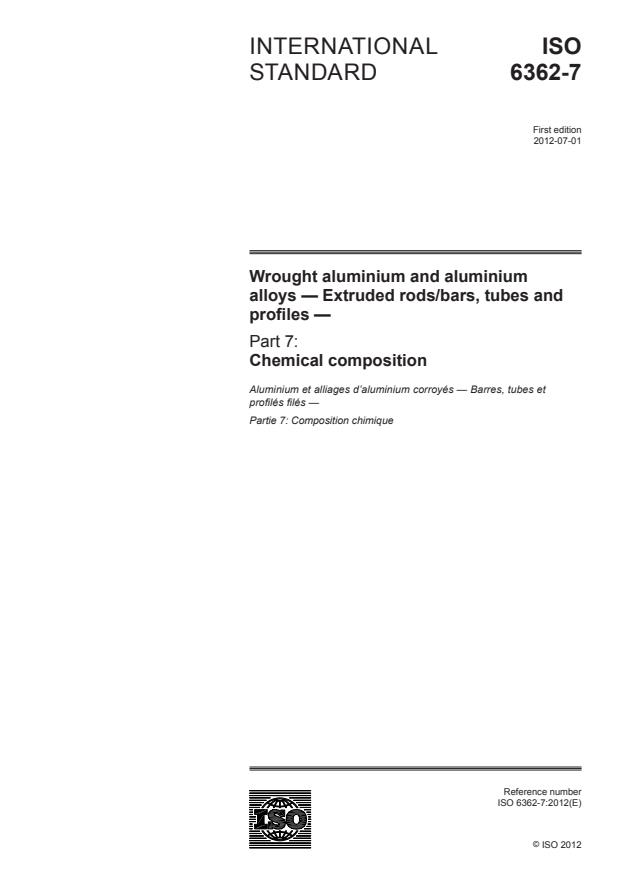
INTERNATIONAL ISO
STANDARD 6362-7
First edition
2012-07-01
Wrought aluminium and aluminium
alloys — Extruded rods/bars, tubes and
profiles —
Part 7:
Chemical composition
Aluminium et alliages d’aluminium corroyés — Barres, tubes et
profilés filés —
Partie 7: Composition chimique
Reference number
©
ISO 2012
All rights reserved. Unless otherwise specified, no part of this publication may be reproduced or utilized in any form or by any means,
electronic or mechanical, including photocopying and microfilm, without permission in writing from either ISO at the address below or ISO’s
member body in the country of the requester.
ISO copyright office
Case postale 56 • CH-1211 Geneva 20
Tel. + 41 22 749 01 11
Fax + 41 22 749 09 47
E-mail copyright@iso.org
Web www.iso.org
Published in Switzerland
ii © ISO 2012 – All rights reserved
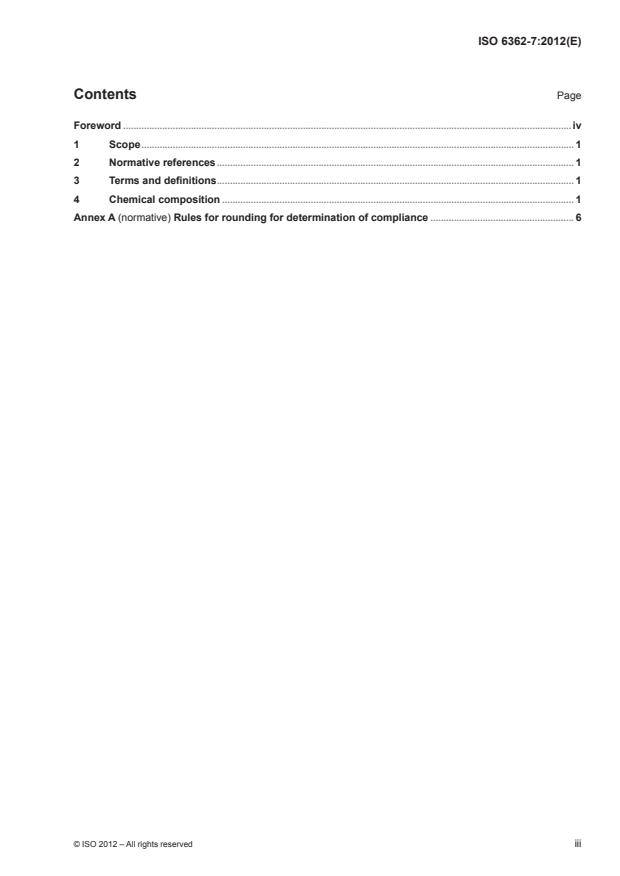
Contents Page
Foreword .iv
1 Scope . 1
2 Normative references . 1
3 Terms and definitions . 1
4 Chemical composition . 1
Annex A (normative) Rules for rounding for determination of compliance . 6
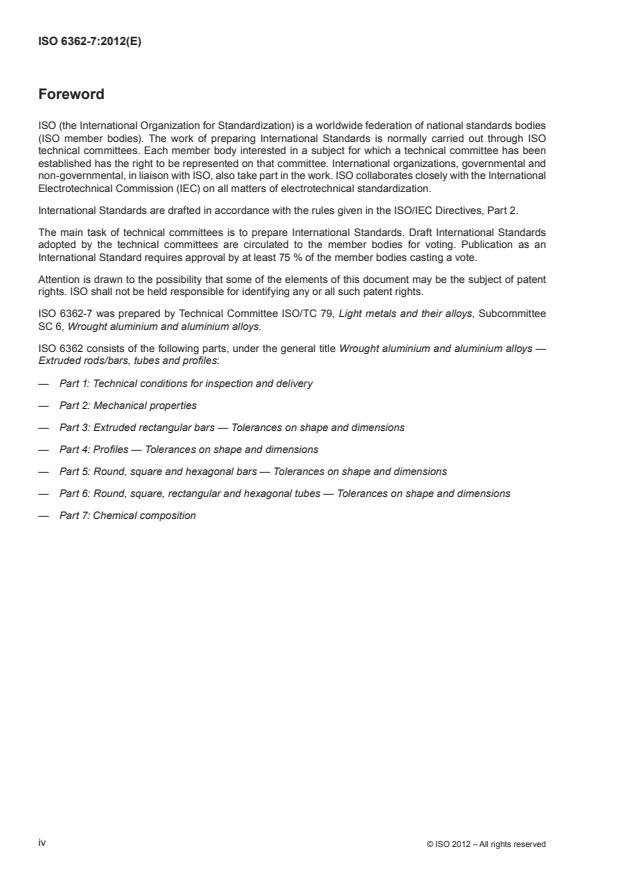
Foreword
ISO (the International Organization for Standardization) is a worldwide federation of national standards bodies
(ISO member bodies). The work of preparing International Standards is normally carried out through ISO
technical committees. Each member body interested in a subject for which a technical committee has been
established has the right to be represented on that committee. International organizations, governmental and
non-governmental, in liaison with ISO, also take part in the work. ISO collaborates closely with the International
Electrotechnical Commission (IEC) on all matters of electrotechnical standardization.
International Standards are drafted in accordance with the rules given in the ISO/IEC Directives, Part 2.
The main task of technical committees is to prepare International Standards. Draft International Standards
adopted by the technical committees are circulated to the member bodies for voting. Publication as an
International Standard requires approval by at least 75 % of the member bodies casting a vote.
Attention is drawn to the possibility that some of the elements of this document may be the subject of patent
rights. ISO shall not be held responsible for identifying any or all such patent rights.
ISO 6362-7 was prepared by Technical Committee ISO/TC 79, Light metals and their alloys, Subcommittee
SC 6, Wrought aluminium and aluminium alloys.
ISO 6362 consists of the following parts, under the general title Wrought aluminium and aluminium alloys —
Extruded rods/bars, tubes and profiles:
— Part 1: Technical conditions for inspection and delivery
— Part 2: Mechanical properties
— Part 3: Extruded rectangular bars — Tolerances on shape and dimensions
— Part 4: Profiles — Tolerances on shape and dimensions
— Part 5: Round, square and hexagonal bars — Tolerances on shape and dimensions
— Part 6: Round, square, rectangular and hexagonal tubes — Tolerances on shape and dimensions
— Part 7: Chemical composition
iv © ISO 2012 – All rights reserved
INTERNATIONAL STANDARD ISO 6362-7:2012(E)
Wrought aluminium and aluminium alloys — Extruded rods/
bars, tubes and profiles —
Part 7:
Chemical composition
1 Scope
This part of ISO 6362 specifies the chemical composition of wrought aluminium and aluminium alloys.
The chemical composition limits of aluminium and aluminium alloys specified herein are completely identical
with those registered with the Aluminum Association, 1525 Wilson Boulevard, Suite 600, Arlington, VA 22209,
USA (known as the “Teal Sheets”), for the corresponding alloys.
NOTE In the case of a discrepancy in the values listed in Table 1 with those listed in the “Registration Record
Series Teal Sheets, International Alloy Destinations and Chemical Composition Limits for Wrought Aluminum and Wrought
Aluminum Alloys”, the composition limits registered with the Aluminum Association and published in the “Teal Sheets” can
be considered for controlling the composition.
2 Normative references
The following referenced documents are indispensable for the application of this document. For dated
references, only the edition cited applies. For undated references, the latest edition of the referenced document
(including any amendments) applies.
ISO 209,Aluminium and aluminium alloys — Chemical composition
ISO 6362-1, Wrought aluminium and aluminium alloys — Extruded rods/bars, tubes and profiles — Part 1:
Technical conditions for inspection and delivery
3 Terms and definitions
For the purposes of this document, the terms and definitions given in ISO 6362-1 apply.
4 Chemical composition
The chemical designations are specified in ISO 209.
The chemical composition of the aluminium and aluminium alloys is given in percentage by mass in Table 1
For the purpose of determining conformance to these limits, an observed value or a calculated value obtained
from analysis is rounded off, in accordance with the rules for rounding given in Annex A.
The conformance does not preclude the possible presence of other elements that are not specified. If the
purchaser’s requirements necessitate limits for any other element not specified, these shall be agreed upon
between the supplier and purchaser. “The remainder” is the difference between 100 % and the sum of all other
metallic elements present in amounts of 0,010 % or more each, expressed to the second decimal place before
determining the sum.
Table 1 — Chemical composition (% by mass)
Others
Alloy Limit Si Fe Cu Mn Mg Cr Zn Ti Remarks Aluminium
Each Total
min. - - - - - - - - - - 99,70
1070 V 0,05 max.
max. 0,20 0,25 0,04 0,03 0,03 - 0,04 0,03 0,03 - -
min. - - - - - - - - - - 99,70
1070A -
max. 0,20 0,25 0,03 0,03 0,03 - 0,07 0,03 0,03 - -
min. - - - - - - - - - - 99,60
1060 -
max. 0,25 0,35 0,05 0,03 0,03 - 0,05 0,03 0,03 - -
min. - - - - - - - - - - 99,50
1050 V 0,05 max.
max. 0,25 0,40 0,05 0,05 0,05 - 0,05 0,03 0,03 - -
min. - - - - - - - - - - 99,50
1050A -
max. 0,25 0,40 0,05 0,05 0,05 - 0,07 0,05 0,03 - -
B 0,05 max.
min. - - - - - - - - - - 99,50
1350 Ga 0,03 max.
max. 0,10 0,40 0,05 0,01 - 0,01 0,05 - 0,03 0,10 -
V+Ti 0,02 max.
min. - 0,05 - - - - - - - 99,00
a
max. Si+Fe:0,95 0,20 0,05 - - 0,10 - 0,05 0,15 -
min. - - - - - - - - - 99.00
1200 -
max. Si+Fe:1,00 0,05 0,05 - - 0,10 0,05 0,05 0,15 -
Ni 0,20 max.
min. - - 3,3 0,50 0,40 - - - Bi 0,20 max. - -
2007 Remainder
max. 0,8 0,8 4,6 1,0 1,8 0,10 0,8 0,20 Pb 0,8-1,5 0,10 0,30
Sn 0,20 max.
min. - - 5,0 - - - - - Bi 0,20-0,6 - -
2011 Remainder
max. 0,40 0,7 6,0 - - - 0,30 - Pb 0,20-0,6 0,05 0,15
min. - - 4,5 - - - - - Bi 0,20-0,6 - -
2011A Remainder
max. 0,40 0,50 6,0 - - - 0,30 - Pb 0,20-0,6 0,05 0,15
- -
min. 0,50 - 3,9 0,40 0,20 - - -
b
2014 Remainder
max. 1,2 0,7 5,0 1,2 0,8 0,10 0,25 0,15 0,05 0,15
min. 0,50 - 3,9 0,40 0,20 - - - Zr+Ti 0,25 max. - -
2014A Remainder
max. 0,9 0,50 5,0 1,2 0,8 0,10 0,25 0,15 Ni 0,10 max. 0,05 0,15
min. 0,20 - 3,5 0,40 0,40 - - - - -
b
2017 Remainder
max. 0,8 0,7 4,5 1,0 0,8 0,10 0,25 0,15 0,05 0,15
min. 0,20
...
Questions, Comments and Discussion
Ask us and Technical Secretary will try to provide an answer. You can facilitate discussion about the standard in here.
Loading comments...