


ISO 19135
(Main)Geographic information - Registration and register governance
Geographic information - Registration and register governance
ISO 19135-1:2015 specifies procedures to be followed in establishing, maintaining, and publishing registers of unique, unambiguous, and permanent identifiers and meanings that are assigned to items of geographic information. In order to accomplish this purpose, ISO 19135-1:2015 specifies elements that are necessary to manage the registration of these items.
Information géographique — Enregistrement et gouvernance de registre
L'ISO 19135-1:2015 spécifie les procédures à suivre pour établir, mettre à jour et publier les registres d'identifiants uniques, non ambigus et permanents, ainsi que les significations qui sont attribuées aux éléments de l'information géographique. Afin d'atteindre cet objectif, l'ISO 19135-1:2015 spécifie les éléments qui sont nécessaires à leur enregistrement.
General Information
- Status
- Not Published
- Technical Committee
- ISO/TC 211 - Geographic information/Geomatics
- Drafting Committee
- ISO/TC 211/WG 9 - Information management
- Current Stage
- 6000 - International Standard under publication
- Start Date
- 27-Nov-2025
- Completion Date
- 13-Dec-2025
Relations
- Effective Date
- 23-Sep-2023
- Effective Date
- 16-Sep-2023
- Revises
ISO 19135-1:2015 - Geographic information - Procedures for item registration - Part 1: Fundamentals - Effective Date
- 16-Sep-2023
Overview
ISO 19135: Geographic information - Registration and register governance is an international standard developed by ISO/TC 211 to define procedures for establishing, maintaining, and publishing registers of unique, unambiguous, and permanent identifiers for geographic information items. The standard ensures consistent registration and management practices that support persistent identification, transparent governance, and traceability of geographic data elements. Applicable across diverse geospatial domains, ISO 19135 promotes data interoperability and reliability critical for geographic information systems (GIS), spatial data infrastructures, and metadata registries.
Key Topics
ISO 19135 covers a comprehensive framework to manage geographic information registers, focusing on:
- Registration Procedures: Outlines steps for adding, updating, and decommissioning geographic data entries with permanent identifiers.
- Register Governance: Defines roles and responsibilities such as register owners, managers, control bodies, and users, ensuring accountable and effective register oversight.
- Identifier Management: Establishes conventions for creating persistent, unique, and unambiguous identifiers crucial for long-term data integrity and referencing.
- Data and Concept Planes: Addresses the management of both concrete data (content plane) and abstract definitions or concepts (concept plane) related to geographic information items.
- Change History and Versioning: Specifies mechanisms to track evolution of entries over time, including change status, version control, and archival practices.
- Compliance and Integrity: Emphasizes technological neutrality, documentation requirements, and integrity protection commitments to enable consistent standards compliance.
- Action Capabilities and Processes: Details actions like concept composition, inheritance, and incorporation, ensuring flexible and scalable register operations.
Applications
ISO 19135 serves an essential role in geospatial data management and has direct practical benefits in:
- Spatial Data Infrastructure (SDI): Facilitating reliable management of geographic vocabularies and registers that underpin SDIs worldwide.
- Geographic Information Systems (GIS): Ensuring GIS datasets use standardized identifiers and register governance to improve data exchange and interoperability.
- Metadata Registries: Enhancing the consistency and accessibility of metadata references through persistent identifiers and governance policies.
- Public and Private Sector Geodata Management: Supporting authoritative data sources, cadastral systems, environmental monitoring, urban planning, and transport networks.
- International and Inter-organizational Data Sharing: Enabling transparent governance and harmonized identification to foster collaboration across borders and organizations.
Related Standards
To complement ISO 19135’s registration and governance framework, users should consider:
- ISO 19115: Geographic information - Metadata, for managing information about geographic datasets.
- ISO 19103: Conceptual schema language, which relates to the conceptual modeling of geographic information definitions.
- ISO 19136: Geographic information - Geography Markup Language (GML), for encoding spatial data.
- ISO 19101: Reference model for geographic information, establishing foundational concepts for geospatial standards.
- ISO/TS 19103: Further guidance related to conceptual schema definitions and register implementations.
By conforming to ISO 19135, organizations ensure robust governance and durable identification practices that enhance geographic information accessibility, traceability, and interoperability across global standards frameworks. This standard is essential for geospatial professionals, data managers, and system developers involved in constructing and managing authoritative geographic information registers.

ISO/FDIS 19135 - Geographic information — Registration and register governance Released:17. 09. 2025
REDLINE ISO/FDIS 19135 - Geographic information — Registration and register governance Released:17. 09. 2025

ISO 19135 - Information géographique — Enregistrement et gouvernance de registre Released:11/26/2025
Frequently Asked Questions
ISO 19135 is a draft published by the International Organization for Standardization (ISO). Its full title is "Geographic information - Registration and register governance". This standard covers: ISO 19135-1:2015 specifies procedures to be followed in establishing, maintaining, and publishing registers of unique, unambiguous, and permanent identifiers and meanings that are assigned to items of geographic information. In order to accomplish this purpose, ISO 19135-1:2015 specifies elements that are necessary to manage the registration of these items.
ISO 19135-1:2015 specifies procedures to be followed in establishing, maintaining, and publishing registers of unique, unambiguous, and permanent identifiers and meanings that are assigned to items of geographic information. In order to accomplish this purpose, ISO 19135-1:2015 specifies elements that are necessary to manage the registration of these items.
ISO 19135 is classified under the following ICS (International Classification for Standards) categories: 35.240.70 - IT applications in science. The ICS classification helps identify the subject area and facilitates finding related standards.
ISO 19135 has the following relationships with other standards: It is inter standard links to ISO 24224:2022, ISO 19135-1:2015/Amd 1:2021, ISO 19135-1:2015. Understanding these relationships helps ensure you are using the most current and applicable version of the standard.
ISO 19135 is available in PDF format for immediate download after purchase. The document can be added to your cart and obtained through the secure checkout process. Digital delivery ensures instant access to the complete standard document.
Standards Content (Sample)
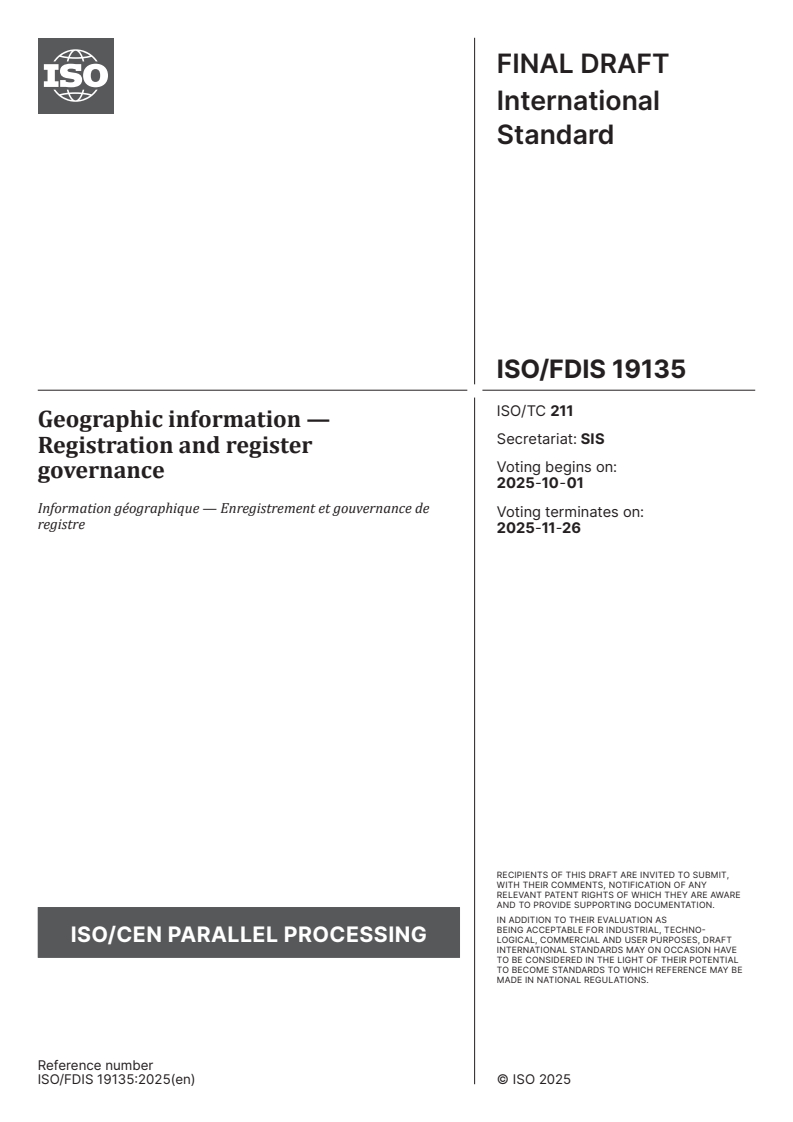
FINAL DRAFT
International
Standard
ISO/FDIS 19135
ISO/TC 211
Geographic information —
Secretariat: SIS
Registration and register
Voting begins on:
governance
2025-10-01
Information géographique — Enregistrement et gouvernance de
Voting terminates on:
registre
2025-11-26
RECIPIENTS OF THIS DRAFT ARE INVITED TO SUBMIT,
WITH THEIR COMMENTS, NOTIFICATION OF ANY
RELEVANT PATENT RIGHTS OF WHICH THEY ARE AWARE
AND TO PROVIDE SUPPOR TING DOCUMENTATION.
IN ADDITION TO THEIR EVALUATION AS
BEING ACCEPTABLE FOR INDUSTRIAL, TECHNO
ISO/CEN PARALLEL PROCESSING LOGICAL, COMMERCIAL AND USER PURPOSES, DRAFT
INTERNATIONAL STANDARDS MAY ON OCCASION HAVE
TO BE CONSIDERED IN THE LIGHT OF THEIR POTENTIAL
TO BECOME STAN DARDS TO WHICH REFERENCE MAY BE
MADE IN NATIONAL REGULATIONS.
Reference number
ISO/FDIS 19135:2025(en) © ISO 2025
FINAL DRAFT
ISO/FDIS 19135:2025(en)
International
Standard
ISO/FDIS 19135
ISO/TC 211
Geographic information —
Secretariat: SIS
Registration and register
Voting begins on:
governance
Information géographique — Enregistrement et gouvernance de
Voting terminates on:
registre
RECIPIENTS OF THIS DRAFT ARE INVITED TO SUBMIT,
WITH THEIR COMMENTS, NOTIFICATION OF ANY
RELEVANT PATENT RIGHTS OF WHICH THEY ARE AWARE
AND TO PROVIDE SUPPOR TING DOCUMENTATION.
© ISO 2025
IN ADDITION TO THEIR EVALUATION AS
All rights reserved. Unless otherwise specified, or required in the context of its implementation, no part of this publication may
BEING ACCEPTABLE FOR INDUSTRIAL, TECHNO
ISO/CEN PARALLEL PROCESSING
LOGICAL, COMMERCIAL AND USER PURPOSES, DRAFT
be reproduced or utilized otherwise in any form or by any means, electronic or mechanical, including photocopying, or posting on
INTERNATIONAL STANDARDS MAY ON OCCASION HAVE
the internet or an intranet, without prior written permission. Permission can be requested from either ISO at the address below
TO BE CONSIDERED IN THE LIGHT OF THEIR POTENTIAL
or ISO’s member body in the country of the requester.
TO BECOME STAN DARDS TO WHICH REFERENCE MAY BE
MADE IN NATIONAL REGULATIONS.
ISO copyright office
CP 401 • Ch. de Blandonnet 8
CH-1214 Vernier, Geneva
Phone: +41 22 749 01 11
Email: copyright@iso.org
Website: www.iso.org
Published in Switzerland Reference number
ISO/FDIS 19135:2025(en) © ISO 2025
ii
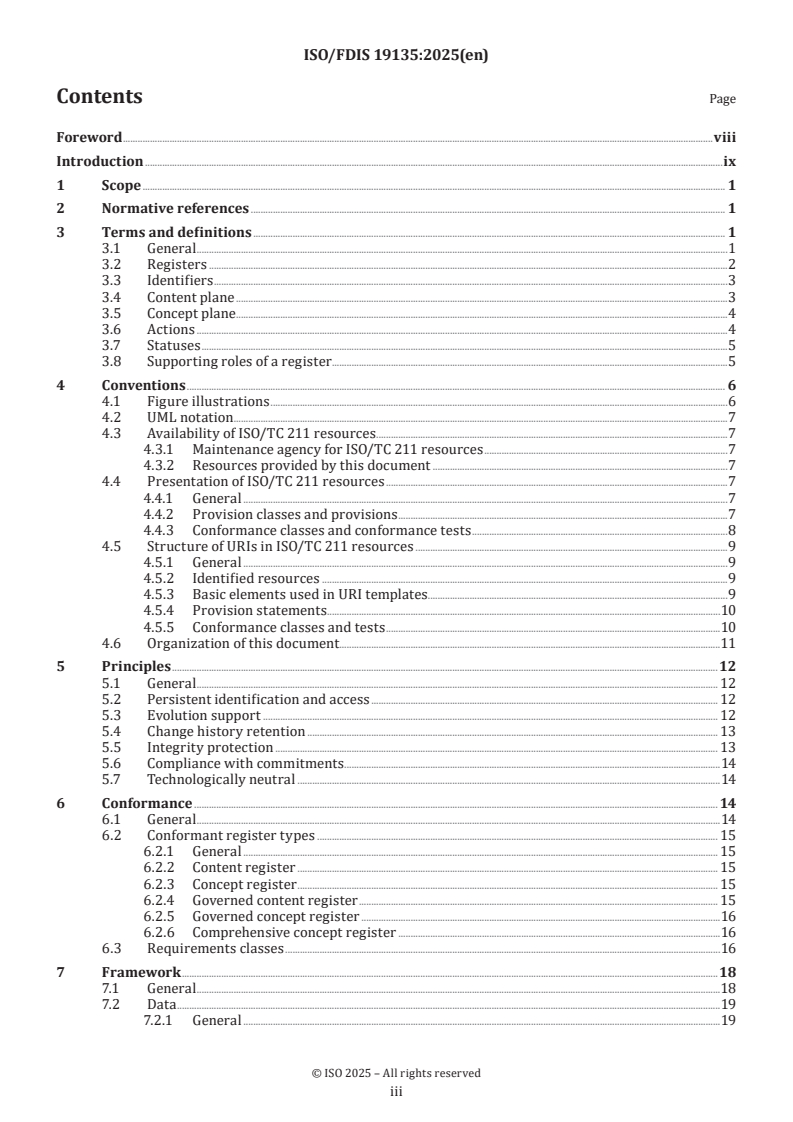
ISO/FDIS 19135:2025(en)
Contents Page
Foreword .viii
Introduction .ix
1 Scope . 1
2 Normative references . 1
3 Terms and definitions . 1
3.1 General .1
3.2 Registers .2
3.3 Identifiers .3
3.4 Content plane .3
3.5 Concept plane . .4
3.6 Actions .4
3.7 Statuses .5
3.8 Supporting roles of a register .5
4 Conventions . 6
4.1 Figure illustrations .6
4.2 UML notation.7
4.3 Availability of ISO/TC 211 resources .7
4.3.1 Maintenance agency for ISO/TC 211 resources .7
4.3.2 Resources provided by this document .7
4.4 Presentation of ISO/TC 211 resources .7
4.4.1 General .7
4.4.2 Provision classes and provisions .7
4.4.3 Conformance classes and conformance tests .8
4.5 Structure of URIs in ISO/TC 211 resources .9
4.5.1 General .9
4.5.2 Identified resources .9
4.5.3 Basic elements used in URI templates.9
4.5.4 Provision statements.10
4.5.5 Conformance classes and tests .10
4.6 Organization of this document .11
5 Principles .12
5.1 General . 12
5.2 Persistent identification and access . 12
5.3 Evolution support . 12
5.4 Change history retention . 13
5.5 Integrity protection . 13
5.6 Compliance with commitments .14
5.7 Technologically neutral .14
6 Conformance . 14
6.1 General .14
6.2 Conformant register types . 15
6.2.1 General . 15
6.2.2 Content register . 15
6.2.3 Concept register . 15
6.2.4 Governed content register . 15
6.2.5 Governed concept register .16
6.2.6 Comprehensive concept register .16
6.3 Requirements classes .16
7 Framework .18
7.1 General .18
7.2 Data .19
7.2.1 General .19
iii
ISO/FDIS 19135:2025(en)
7.2.2 Components .19
7.2.3 Actions . 20
7.2.4 Metadata . 20
7.2.5 Identifiers . 20
7.2.6 Versions .21
7.2.7 Concept plane .21
7.2.8 Content plane .21
7.2.9 Statuses.21
7.2.10 Relations .21
7.3 Governance . 22
7.3.1 General . 22
7.3.2 Documented information . 22
7.3.3 Register specification . 22
7.3.4 Roles and responsibilities . 22
7.3.5 Governance processes . 23
7.4 Commitments . 23
8 Data capabilities .23
8.1 General . 23
8.2 Metadata .24
8.3 Identifiers .24
8.3.1 General .24
8.3.2 Identifier types .24
8.3.3 Identifier schemes . 25
8.3.4 Object identifier scheme . 25
8.3.5 Functional identifier scheme . 26
8.3.6 Requirements . 26
8.4 Versions . . 28
8.4.1 General . 28
8.4.2 Scheme . 29
8.4.3 Requirements . 29
8.5 Information planes.32
8.5.1 Concept plane .32
8.5.2 Content plane .32
8.5.3 Interconnections between planes .32
8.5.4 Management of the planes . 33
8.6 Concept plane . . 33
8.6.1 Concept system . 33
8.6.2 Concept . . 34
8.6.3 Concept version . 35
8.6.4 Concept definitions . 35
8.6.5 Concept version status . 36
8.6.6 Relations . 39
8.7 Content plane . 46
8.7.1 General . 46
8.7.2 Register item class .47
8.7.3 Register item . 48
8.7.4 Relations . 49
8.7.5 Change .51
8.8 Requirements .51
9 Action capabilities .72
9.1 General . 72
9.2 Addition to the register . 73
9.2.1 Add a concept . 73
9.2.2 Add a concept version .74
9.3 Change of concept version statuses . 75
9.3.1 Invalidate a concept version . 75
9.3.2 Unpublish a concept version .76
9.4 Changes to the register . 77
iv
ISO/FDIS 19135:2025(en)
9.4.1 General . 77
9.4.2 Concept supersession . 78
9.4.3 Concept version supersession . 80
9.4.4 Substantive change . 81
9.4.5 Clarification change . 83
9.4.6 Correctional change . 86
9.5 Destructive changes . 88
9.5.1 Redaction . 88
9.5.2 Delete a concept . 89
9.5.3 Delete a concept version . 90
9.6 Concept definition .91
9.6.1 General .91
9.6.2 Add a concept definition .91
9.6.3 Add a concept definition version . . 92
9.6.4 Migrating a concept realization to an evolved concept definition with unchanged
semantics . 93
9.6.5 Migrate a concept realization to an evolved concept definition with changed
semantics . 94
9.6.6 Add a concept realization through new semantics provided in an evolved
concept definition . 97
9.7 Concept domains . 98
9.8 Concept incorporation . 99
9.8.1 General . 99
9.8.2 Unversioned and versioned incorporated concepts . 99
9.8.3 Creating an incorporating concept . 103
9.8.4 Updating an incorporating concept . 103
9.8.5 Modify an incorporated concept . 104
9.8.6 Modify both an incorporated concept and an incorporating concept . 106
9.9 Concept composition . 108
9.9.1 General . 108
9.9.2 Add a composed concept . 109
9.9.3 Add a realized composed concept .110
9.9.4 Modify composed concept parts . 111
9.9.5 Modify composed concept part definitions . 112
9.10 Concept inheritance . 113
9.10.1 General . 113
9.10.2 Add an inherited concept . 113
9.10.3 Add a realized inherited concept .114
9.10.4 Modify inherited concept definitions .116
9.10.5 Usage within incorporated or composed concepts . 118
9.11 Requirements .119
10 Governance processes .131
10.1 General . 131
10.2 Establishing a register . 132
10.2.1 General . 132
10.2.2 Requirements . 132
10.3 Operating a register .134
10.3.1 Proposal process .134
10.3.2 Approval process . 136
10.3.3 Appeal process .138
10.3.4 Content management process . 140
10.4 Decommissioning a register .141
10.4.1 General .141
10.4.2 Requirements .141
11 Roles and responsibilities .143
11.1 General .143
11.2 Register owner . 144
11.3 Register manager . 146
v
ISO/FDIS 19135:2025(en)
11.4 Control body .147
11.5 Register system manager . 148
11.6 Proposer . 148
11.7 Register user . 149
12 Documented information .149
12.1 Register specification . 149
12.1.1 General . 149
12.1.2 Requirements . 150
12.2 Proposal instructions . 156
13 Conceptual model .156
13.1 Overview . 156
13.2 Components package . 157
13.2.1 Components overview . 157
13.2.2 Defining tables . 158
13.3 Identifiers package . 162
13.3.1 Identifiers overview . 162
13.3.2 Defining tables . 162
13.4 Statuses package . 164
13.4.1 Statuses overview . 164
13.4.2 Defining tables . 165
13.5 Relations package .167
13.5.1 Relations overview .167
13.5.2 Defining tables . 168
13.6 Proposal and appeal package .171
13.6.1 Proposal and appeal overview .171
13.6.2 Defining tables . 172
13.7 Requirements . 173
14 Commitments .173
14.1 General . 173
14.2 Access commitments . .174
14.2.1 General .174
14.2.2 Metadata access .174
14.2.3 Content access.174
14.2.4 Historic access .174
14.3 Persistence, integrity and traceability commitments .174
14.3.1 General .174
14.3.2 Identifier persistence . 175
14.3.3 Metadata persistence and retention . 175
14.3.4 Content persistence and retention . 175
14.3.5 Historic persistence with full traceability .176
14.4 Transparency commitments . 177
14.4.1 General . 177
14.4.2 Metadata transparency . 177
14.4.3 Content transparency .
...
Date: 2025-07-01
Reference number of project: ISO/FDIS 19135
Committee identification: ISO/TC 211/WG 1
Secretariat: SIS
Date:
Geographic information — Registration and register governance
Information géographique — Enregistrement et gouvernance de registre
FDIS stage
ISO/FDIS 19135:2025(en)
All rights reserved. Unless otherwise specified, or required in the context of its implementation, no part of this publication
may be reproduced or utilized otherwise in any form or by any means, electronic or mechanical, including photocopying,
or posting on the internet or an intranet, without prior written permission. Permission can be requested from either ISO
at the address below or ISO’s member body in the country of the requester.
ISO copyright office
CP 401 • Ch. de Blandonnet 8
CH-1214 Vernier, Geneva
Phone: + 41 22 749 01 11
Email: E-mail: copyright@iso.org
Website: www.iso.org
Published in Switzerland
ii
ISO/FDIS 19135:2025(en)
Contents
Foreword . vi
Introduction . viii
1 Scope . 1
2 Normative references . 1
3 Terms and definitions . 1
3.1 General . 1
3.2 Registers . 2
3.3 Identifiers . 3
3.4 Content plane . 3
3.5 Concept plane . 4
3.6 Actions . 5
3.7 Statuses . 5
3.8 Supporting roles of a register . 6
4 Conventions . 7
4.1 Figure illustrations . 7
4.2 UML notation . 7
4.3 Availability of ISO/TC 211 resources . 8
4.4 Presentation of ISO/TC 211 resources . 8
4.5 Structure of URIs in ISO/TC 211 resources . 10
4.6 Organization of this document . 12
5 Principles . 13
5.1 General . 13
5.2 Persistent identification and access . 13
5.3 Evolution support . 14
5.4 Change history retention . 14
5.5 Integrity protection . 15
5.6 Compliance with commitments . 15
5.7 Technologically neutral . 16
6 Conformance . 16
6.1 General . 16
6.2 Conformant register types . 16
6.3 Requirements classes . 18
7 Framework . 20
7.1 General . 20
7.2 Data . 21
7.3 Governance . 24
7.4 Commitments . 25
8 Data capabilities . 26
8.1 General . 26
8.2 Metadata . 26
8.3 Identifiers . 26
8.4 Versions . 31
8.5 Information planes . 34
8.6 Concept plane . 36
8.7 Content plane . 50
8.8 Requirements . 55
9 Action capabilities . 77
iii
ISO/FDIS 19135:2025(en)
9.1 General . 77
9.2 Addition to the register . 78
9.3 Change of concept version statuses . 80
9.4 Changes to the register . 82
9.5 Destructive changes . 94
9.6 Concept definition . 97
9.7 Concept domains . 104
9.8 Concept incorporation . 105
9.9 Concept composition . 114
9.10 Concept inheritance . 118
9.11 Requirements . 124
10 Governance processes . 138
10.1 General . 138
10.2 Establishing a register . 138
10.3 Operating a register . 140
10.4 Decommissioning a register . 147
11 Roles and responsibilities . 149
11.1 General . 149
11.2 Register owner . 150
11.3 Register manager . 153
11.4 Control body . 154
11.5 Register system manager . 154
11.6 Proposer . 155
11.7 Register user . 155
12 Documented information . 156
12.1 Register specification . 156
12.2 Proposal instructions . 163
13 Conceptual model . 164
13.1 Overview . 164
13.2 Components package . 165
13.3 Identifiers package . 171
13.4 Statuses package . 174
13.5 Relations package . 178
13.6 Proposal and appeal package . 182
13.7 Requirements . 184
14 Commitments . 185
14.1 General . 185
14.2 Access commitments . 185
14.3 Persistence, integrity and traceability commitments . 186
14.4 Transparency commitments . 188
14.5 Compliance . 189
14.6 Documentation . 189
14.7 Requirements . 190
Annex A (normative) Conformance test suite . 196
Annex B (informative) Differences with ISO 19135-1:2015 . 278
Annex C (informative) Register specification template . 280
Annex D (informative) Register specification sample: Register of Units of Measure (“RUM”)
Register Specification. 282
Annex E (informative) Composite registers. 292
iv
ISO/FDIS 19135:2025(en)
Bibliography . 301
v
ISO/FDIS 19135:2025(en)
Foreword
ISO (the International Organization for Standardization) is a worldwide federation of national standards
bodies (ISO member bodies). The work of preparing International Standards is normally carried out through
ISO technical committees. Each member body interested in a subject for which a technical committee has been
established has the right to be represented on that committee. International organizations, governmental and
non-governmental, in liaison with ISO, also take part in the work. ISO collaborates closely with the
International Electrotechnical Commission (IEC) on all matters of electrotechnical standardization.
The procedures used to develop this document and those intended for its further maintenance are described
in the ISO/IEC Directives, Part 1. In particular, the different approval criteria needed for the different types of
ISO documentsdocument should be noted. This document was drafted in accordance with the editorial rules
of the ISO/IEC Directives, Part 2 (see www.iso.org/directives).
Attention is drawnISO draws attention to the possibility that some of the elementsimplementation of this
document may beinvolve the subjectuse of (a) patent(s). ISO takes no position concerning the evidence,
validity or applicability of any claimed patent rights in respect thereof. As of the date of publication of this
document, ISO had not received notice of (a) patent(s) which may be required to implement this document.
However, implementers are cautioned that this may not represent the latest information, which may be
obtained from the patent database available at www.iso.org/patents. ISO shall not be held responsible for
identifying any or all such patent rights. Details of any patent rights identified during the development of the
document will be in the Introduction and/or on the ISO list of patent declarations received (see ).
Any trade name used in this document is information given for the convenience of users and does not
constitute an endorsement.
For an explanation of the voluntary nature of standards, the meaning of ISO specific terms and expressions
related to conformity assessment, as well as information about ISO's adherence to the World Trade
Organization (WTO) principles in the Technical Barriers to Trade (TBT), see www.iso.org/iso/foreword.html.
The committee responsible for thisThis document is was prepared by Technical Committee ISO/TC 211,
Geographic information/Geomatics, in collaboration with the European Committee for Standardization (CEN)
Technical Committee CEN/TC 287, Geographic Information, in accordance with the Agreement on technical
cooperation between ISO and CEN (Vienna Agreement).
This second edition cancels and replaces the first edition, , as well as the amendment to the first edition,
.second edition (ISO 19135-1:2015), which has been technically revised. It also incorporates the Amendment
The main changes are as follows:
— requirements described in this document now generally apply to all domains of usage, following common
practice of setting up registers in user communities;
— application of the document has been generalized and no longer dictates implementation-level concerns,
such as data schemes;
1 1)
NOTE The XML schema in ISO/TS 19135-2:2012 was an implementation of ISO 19135:2005 . ISO/TS 19135-
2:2012 was withdrawn in 2019. ISO 19135-1:2015/Amd 1:2021, Annex F, incorporates the provisions of the
withdrawn ISO/TS 19135-2:2012 in its Annex F, which provides a link to an externally held schema. This document
does not provide any XML schema.
1)
Cancelled and replaced by ISO 19135-1:2015.
vi
ISO/FDIS 19135:2025(en)
— this document does not define an encoding or technical procedures on how to implement a register; and
— information on compatibility information with and ISO 19135-1:2015 and ISO 19135-
1:2015/Amd 1:2021 is given in Annex B.
Any feedback or questions on this document should be directed to the user’s national standards body. A
complete listing of these bodies can be found at www.iso.org/members.html.
vii
ISO/FDIS 19135:2025(en)
Introduction
0.1 Purpose
The challenge of managing and organizing information is an inevitable, continual goal in the retainment and
passing on of knowledge for humanity.
This task has been traditionally carried out by humans, who have an innate ability to recognize meaning and
bridge concepts across information domains. This has allowed for the creation of a rich tapestry of knowledge
that is accessible and meaningful.
The prospect of productivity increases brought about by the advent of information systems and automation
has led to the minimization or the obsolescence of the intermediary human role, in favour of direct usage of
managed information understood by machines. In contrast with humans, information systems have a lower
tolerance to semantic ambiguity and a higher need for information persistence.
To facilitate the use of managed information by both humans and information systems, it is necessary to
establish a mechanism that allows for the management of information in a way that is both meaningful and
persistent.
This document introduces the Framework for Extensible Registration of Information (FERIN), a
comprehensive approach to the management of information designed to meet the needs of both humans and
information systems.
The framework defines a set of principles, primitives and processes that enable the management and
evolution of information. It provides a structured and systematic way to manage information that remains
flexible, adaptable and accommodates structural and governance needs.
Structurally, the framework is based on the idea of a “register”, a generalisedgeneralized term for information
register, a managed collection of information that is organized and maintained according to a defined set of
rules and processes.
The register is designed to provide persistent access to the information it contains and to allow for the
evolution of that information over time. Within the register, information is organized into concepts and
content, where concepts represent the meaning of the information, and content represents the data that
describes the concepts. Internally, they are linked together through statuses and relations forming a nexus
that allows for complex expressions and the evolution of information.
The framework defines the register as evolving and extensible through the dynamic definition of concepts,
content, statuses and relations, enabling its continuous suitability to serve its audience.
NOTE 1 Various communities in the information management domain contribute to the definitions of concept
[23]
relations that a register can adopt, including ISO, IEC and the Enosema Foundation.
NOTE 2 The term “register” in this document refers to a “managed collection of recorded information”, instead of just
a “collection of recorded information”, as understood in common parlance.
NOTE 3 The meaning of “registration” in this document refers to the assignment of linguistically independent
identifiers to information units, in contrast to the meaning of that term in documents on information technology
developed by ISO/IEC JTC 1 standards, where it refers to the assignment of names to information units.
0.2 Common use cases
Any entity may choose to establish registers that conform to this document.
viii
ISO/FDIS 19135:2025(en)
While the framework is originally developed to satisfy the needs of the geographic information community, it
is intended to be generically applicable to any domain that requires information management.
The register framework supports the following common use cases:
a) manage information that requires persistent identification and access;
b) manage information and its requirements that evolves over time, including the ability to track such
changes;
c) manage information organized according to one or more concept systems;
d) manage information that is required to satisfy certain commitments, such as integrity, transparency,
persistence, and accessibility;
e) provide access to disparate information concerning related information specified across different
information collections, such as the ability to link information across registers;
f) a) support of cultural and linguistic adaptability by providing a means to record, for each item,
equivalent terms used in different languages, cultures, application areas and professions together with a
means to make such information accessible;
g) b) registration and dissemination of information produced through International Standardization
processes, making them available to users in a rapid and persistent manner.
NOTE 1 Items specified in a standard maycan change over time either due to changes in technology or for other
reasons. Published standards do not always clearly document what changes may have occurred, and do not include
information about earlier versions of specified items. Such information can be maintained in a register.
NOTE 2 This document supports the implementation of registers that satisfy the role of an ISO Registration
Authority (RA) and of an ISO Registration Agency, both of which are required to conform to defined rules in the
ISO/IEC Directives. Specific ISO/TCs provide guidance for the usage of this document in this regard, such as the
[20 ]
ISO/TC 211 Good Practices . .
“The name and contact information of the maintenance agency for this document can be found at
www.iso.org/maintenance_agencies” .
ix
ISO/FDIS 19135:2025(en)
Geographic information — Registration and register governance
1 Scope
This document defines a framework for the extensible registration of information — an approach used to
manage an information register.
This framework specifies the following requirements of an information register:
— capability requirements that an information register uses to manage register content;
— governance requirements that define a set of processes and rules used in the establishment, management,
operation, content publication and use of an information register.
The following considerations are out of scope of this document:
— implementation details for the realization of an information register;
— content and related definitions that are managed within an information register.
2 Normative references
There are no normative references in this document.
The following documents are referred to in the text in such a way that some or all of their content constitutes
requirements of this document. For dated references, only the edition cited applies. For undated references,
the latest edition of the referenced document (including any amendments) applies.
IETF RFC 3986, Uniform Resource Identifier (URI): Generic Syntax
3 Terms and definitions
For the purposes of this document, the following terms and definitions apply.
ISO and IEC maintain terminology databases for use in standardization at the following addresses:
— ISO Online browsing platform: available at https://www.iso.org/obp
— IEC Electropedia: available at https://www.electropedia.org
3.1 General
3.1.1
non-substantive change
clarifying change
change with a minor impact on the use of a unit of information
Note 1 to entry: The definition of minor impact depends on the intended use of the unit of information. It may be defined
as an editorial alteration of text that does not cause a system compatibility issue.
3.1.2
relation
association declared between units of information
ISO/FDIS 19135:2025(en)
3.1.3
substantive change
change with a major impact on the use of a unit of information
Note 1 to entry: The definition of major impact depends on the intended use of the unit of information. It may be defined
as the alteration of semantics or technical meaning.
3.1.4
uniform resource identifier
URI
sequence of characters that identifies an abstract or physical resource with a syntax
Note 1 to entry: The sequence of characters shall be in accordance with .IETF RFC 3986.
[SOURCE: ]ISO/IEC 2382-36:2019, 3.11.7]
3.1.5
uniform resource locator
URL
member of the subset of uniform resource identifiers (URIs) (3.1.4)) that provide a means of locating a resource
by describing its primary access mechanism
Note 1 to entry: See .IETF RFC 3986.
[SOURCE: ]ISO/IEC 2382-36:2019, 3.11.8]
3.1.6
uniform resource name
URN
persistent, location-independent, resource identifier used for recognition of, and access to, characteristics of
the resource or the resource itself
[SOURCE: ]ISO 5127:2017, 3.1.9.22]
3.2 Registers
3.2.1
composite register
register (3.2.2) composed of one or more internal registers that collectively fulfils a shared purpose
Note 1 to entry: A hierarchical register is a type of composite register.
3.2.2
register, noun
managed collection of information
Note 1 to entry: The use of the verb form “register” is discouraged to prevent confusion with this use as a noun.
Note 2 to entry: A register differs from a dataset in that is governed through defined processes.
Note 3 to entry: This concept is based on the English language use of this term and is not related to publishing or indexing
of books, which are common uses of this term in other languages.
3.2.3
register specification
documented information describing governance and requirements of the register (3.2.2) and its contents
ISO/FDIS 19135:2025(en)
3.2.4
register system
information system on which a register (3.2.2) is maintained
Note 1 to entry: In the previous editions, only the term “registry” is used.
Note 2 to entry: A register system can be implemented using a database system governed by a set of processes that are
well-defined and rigorously maintained.
3.2.5
registration
process of assigning an unambiguous identifier (3.3.1) to an approved item
3.3 Identifiers
3.3.1
identifier
linguistically independent sequence of characters capable of uniquely and permanently identifying that with
which it is associated
3.3.2
functional identifier
identifier (3.3.1) that always retains its original intent by enabling its association to be redirectable
and change over time
Note 1 to entry: A functional identifier is unique in that there is a single representation of the identifier at any time. A
functional identifier is persistent as what it is associated with always reflects the original intent of the identifier.
3.3.3
object identifier
identifier (3.3.1) that identifies an object
Note 1 to entry: In an object identifier, the characteristics of uniqueness and persistence of its association are not
redirectable and do not change over time.
3.4 Content plane
3.4.1
managed content
information contained in a register item (3.4.2)
Note 1 to entry: Managed content is information that is directly managed and governed under the scope of the register
(3.2.2). Other associated information maycan be necessary for register operations, but it falls outside the realm of
governance and is therefore not considered managed content.
3.4.2
register item
unit of information in a register (3.2.2) with an identifier (3.3.1)
3.4.3
register item class
defined abstraction of a set of register items (3.4.2) that share common characteristics
Note 1 to entry: A register item class typically includes the data requirements of the essential characteristics of a register
item class.
ISO/FDIS 19135:2025(en)
3.4.4
unmanaged content
information associated with a register item (3.4.2) that is not governed by the register (3.2.2)
Note 1 to entry: Unmanaged content may include information that is not directly related to the register item, such as
metadata or administrative information that is useful for the operation of the register but does not require governance
procedures.
Note 2 to entry: Unmanaged content may be stored together with managed content (3.4.1), but is not considered part of
the register item, and therefore not subject to the same governance procedures as managed content.
3.5 Concept plane
3.5.1
concept
unit of knowledge created by a unique combination of characteristics
Note 1 to entry: A unit of knowledge is also a unit of information.
[SOURCE: ,ISO 1087:2019, 3.2.7, modified — Notes 1 and 2 to entry have been removed. A newdeleted. New
Note 1 to entry has been added.]
3.5.2
concept definition
concept (3.5.1) that describes the information requirements and properties of another concept
3.5.3
concept system
system of concepts
set of concepts (3.5.1) organisedorganized according to the concept relations among its concepts
Note 1 to entry: Adapted from .ISO 1087:2019, 3.2.28.
3.5.4
concept version
representation of concept (3.5.1) at a particular point in time
3.5.5
general concept
concept (3.5.1) that corresponds to a potentially unlimited number of objects which form a group by reason
of shared properties
EXAMPLE 1 ‘planet’, ‘tower’, ‘“planet”, “tower”, “Nobel Prize in Physics’, ‘moon’.Physics”, “moon”.
EXAMPLE 2 ‘Spaceship’“Spaceship” has been a general concept before such a material object existed, at the time when
there existed only 1 such object, and later, when there existed several such objects.
Note 1 to entry: For a general concept it is essential that a number of corresponding objects greater than 1 can be
perceived or conceived of.
[SOURCE: ISO 1087:2019, 3.2.9, modified — Last sentence of Note 1 to entry moved to Example 2.]
3.5.6
realised
ISO/FDIS 19135:2025(en)
3.5.6
realized concept
instance of concept (3.5.1) that is realisedrealized into concrete information
3.6 Actions
3.6.1
addition
insertion of a new concept (3.5.1) or concept version (3.5.4) into a register (3.2.2)
3.6.2
deletion
declaration that a concept version (3.5.4) is deleted (3.7.1)
3.6.3
invalidation
declaration that a concept version (3.5.4) is invalid (3.7.2)
3.6.4
publish
make a concept version (3.5.4) visible
3.6.5
redaction
erasure of specific content from a concept version (3.5.4)
3.6.6
supersession
declaration that a concept (3.5.1) or concept version (3.5.4) is superseded (3.7.6)
3.6.7
unpublish
make a concept version (3.5.4) not visible
3.7 Statuses
3.7.1
deleted
status that indicates the concept version (3.5.4) has been removed
3.7.2
invalid
status that indicates the concept version (3.5.4) is unsuitable for use
Note 1 to entry: When a concept version contains at least one error that requires a substantive change (3.1.3) to correct,
it is invalid.
3.7.3
published
status that indicates the concept version (3.5.4) is visible
3.7.4
redacted
status that indicates the concept version (3.5.4) content has been erased
ISO/FDIS 19135:2025(en)
3.7.5
retired
status that indicates the concept version (3.5.4) is no longer recommended for use
3.7.6
superseded
status that indicates the concept (3.5.1) or concept version (3.5.4) has been replaced by one or more
replacements of the same type
3.7.7
unpublished
status that indicates the concept (3.5.1) is not visible
3.7.8
valid
status that indicates the concept (3.5.1) is suitable for use
3.8 Supporting roles of a register
3.8.1
control body
register control body
party (3.8.2) consisting of a group of subject matter experts (3.8.9) that makes decisions regarding
the content of a register (3.2.2)
Note 1 to entry: The control body supports the register manager (3.8.4) for the review, authentication and approval of
the register content.
3.8.2
party
independent person, group, body, or organization
3.8.3
proposer
register change proposer
submitting organization
party (3.8.2) authorized by the register owner (3.8.5) to propose changes to the content of a register
(3.2.2)
3.8.4
register manager
party (3.8.2) delegated by the register owner (3.8.5) to manage a register (3.2.2)
Note 1 to entry: In the case of an ISO register, the register manager performs the functions of the Registration Authority
specified in the ISO/IEC Directives, Part 1, Annex H.
3.8.5
register owner
party (3.8.2) that has ultimate responsibility of a register (3.2.2)
3.8.6
register system manager
registry manager
party (3.8.2) delegated by the register owner (3.8.5) to manage a register system (3.2.4)
Note 1 to entry: In the case of an ISO register (3.2.2), the register system manager performs the functions of the
Registration Authority specified in the ISO/IEC Directives, Part 1.
ISO/FDIS 19135:2025(en)
Note 2 to entry: The register system manager is responsible for the management of the information system.
3.8.7
register user
party (3.8.2) that accesses content from a register (3.2.2) through a register system (3.2.4)
Note 1 to entry: Register users may have different levels of access to the register according to the rules and procedures
of the register.
3.8.8
role
set of specified responsibilities assigned to one or more parties (3.8.2)
3.8.9
subject matter expert
party (3.8.2) with substantial knowledge, experience and competency in a specific domain
4 Conventions
4.1 Figure illustrations
In this document, figures are used to illustrate interaction and connections between components of the
register.
In figures that illustrate register content, some of the following conventions are adopted for consistency
reasons:
— boxes in general represent information objects; if there are boxes in the same figure with rounded and
non-rounded corners, the non-rounded corner boxes denote data while the rounded-corner boxes denote
processes;
— arrows indicate the direction of a relation;
— for figures that represent actions, “new” content is represented as bold text, “modified” content is
represented as italic text with underline, “deleted” content is represented as strikethrough text; new
relations are represented as doubled-lines;
— for relations, a dashed line generally indicates a relation that is not necessarily direct, such as it couldcan
be achieved using indirect means such as redirectable identifier references, while a solid line indicates a
direct relation;
— some figures are split horizontally into left and right parts, where the left shows objects in the concept
plane and the right shows objects in the content plane;
— some figures are split vertically, where the top part shows the information schemas (the requirements)
and the bottom part shows the information instances;
— some figures are split horizontally and vertically at the same time for the above-mentioned reasons.
4.2 UML notation
In this document, conceptual schemas are presented in the Unified Modeling Language (UML).
ISO 19103:2024 presents the specific profile of UML used in this document.
ISO/FDIS 19135:2025(en)
4.3 Availability of ISO/TC 211 resources
4.3.1 Maintenance agency for ISO/TC 211 resources
ISO/TC 211 harmonized resources are resources published by ISO/TC 211 meant to assist developers,
implementers and users of ISO/TC 211 standards, including UML models, XML schemas and ontologies.
Such resources, including those provided by this document, are managed by the ISO/TC 211 Harmonized
Resources Maintenance Agency (HRMA) located at https://www.isotc211.org.
The contact information of the ISO/TC 211 Harmonized Resources Maintenance Agency can be found at
www.iso.org/maintenance_agencies.
4.3.2 Resources provided by this document
This document provides the following types of ISO/TC 211 harmonized resources:
— provision classes and provision statements;
— conformance class and tests.
4.4 Presentation of ISO/TC 211 resources
4.4.1 General
Conformance to ISO/TC 211 document depends on the satisfaction of all mandatory provision classes and
conformance classes provided in the standard.
[20 ]
NOTE Specific rules for ISO/TC 211 “Good practices” are documented in ISO/TC 211 Good Practices . .
This clause describes how these information resources are presented in this document.
4.4.2 Provision classes and provisions
Provision classes are collections of provisions grouped together according to a common theme or a coherent
need, such as for the implementation of a particular feature.
Provision classes may be mandatory or optional if explicitly specified.
A provision class is rendered as shown in Table 1.
Table 1 — Parts of a provision class
Identifier The ISO/TC 211 URI of the provision class.
Implements Any provision class that this provision is an implementation of.
Target type Type of subject to which the provision class applies.
Prerequisites List of provision classes that this provision class depends on.
Included in List of provision classes that this provision class is included in.
Provisions List of provisions contained in this provision class.
Description The description of the provision class.
Guidance Informative information provided as guidance for implementation.
Provisions are statements that describe conformance conditions for this document.
ISO/FDIS 19135:2025(en)
The following types of provisions are specified in ISO/TC 211 standards:
— Requirement: conformance to the statement is mandatory;
— Recommendation: conformance to the statement is recommended;
— Permission: conformance to the statement is permitted.
A provision is rendered as shown in Table 2.
Table 2 — Parts of a provision
Identifier The ISO/TC 211 URI of the provision.
Target type Type of subject to which the provision applies.
Implements Any provision that this provision is an implementation of.
Prerequisites List of provisions that this provision depends on.
Included in List of provision classes that this provision is included in.
Statement The statement to be satisfied.
Guidance Informative information provided as guidance for implementation.
Multiple provision classes can be grouped by specifying them as prerequisites in a separate provision class.
4.4.3 Conformance classes and conformance tests
Satisfaction of ISO/TC 211 provision classes and provisions is determined by the validation of corresponding
conformance classes and conformance tests.
A conformance class contains at least one conformance test that validates a target meeting all provisions
described in a provision class.
A conformance class is rendered as shown in Table 3.
Table 3 — Parts of a conformance class
Identifier The ISO/TC 211 URI of the conformance class.
Target type Type of subject to which the conformance class applies.
Satisfies List of requirements classes that this conformance class satisfies.
Prerequisites List of conformance classes that this conformance class depends on.
Included in List of conformance
...
PROJET FINAL
Norme
internationale
ISO/FDIS 19135
ISO/TC 211
Information géographique —
Secrétariat: SIS
Enregistrement et gouvernance de
Début de vote:
registre
2025-10-01
Geographic information — Registration and register governance
Vote clos le:
2025-11-26
LES DESTINATAIRES DU PRÉSENT PROJET SONT
INVITÉS À PRÉSENTER, AVEC LEURS OBSERVATIONS,
NOTIFICATION DES DROITS DE PROPRIÉTÉ DONT ILS
AURAIENT ÉVENTUELLEMENT CONNAISSANCE ET À
FOURNIR UNE DOCUMENTATION EXPLICATIVE.
OUTRE LE FAIT D’ÊTRE EXAMINÉS POUR
ÉTABLIR S’ILS SONT ACCEPTABLES À DES FINS
INDUSTRIELLES, TECHNOLOGIQUES ET COM-MERCIALES,
AINSI QUE DU POINT DE VUE DES UTILISATEURS, LES
PROJETS DE NORMES
TRAITEMENT PARALLÈLE ISO/CEN
INTERNATIONALES DOIVENT PARFOIS ÊTRE CONSIDÉRÉS
DU POINT DE VUE DE LEUR POSSI BILITÉ DE DEVENIR DES
NORMES POUVANT
SERVIR DE RÉFÉRENCE DANS LA RÉGLEMENTATION
NATIONALE.
Numéro de référence
ISO/FDIS 19135:2025(fr) © ISO 2025
PROJET FINAL
ISO/FDIS 19135:2025(fr)
Norme
internationale
ISO/FDIS 19135
ISO/TC 211
Information géographique —
Secrétariat: SIS
Enregistrement et gouvernance de
Début de vote:
registre
2025-10-01
Geographic information — Registration and register governance
Vote clos le:
2025-11-26
LES DESTINATAIRES DU PRÉSENT PROJET SONT
INVITÉS À PRÉSENTER, AVEC LEURS OBSERVATIONS,
NOTIFICATION DES DROITS DE PROPRIÉTÉ DONT ILS
AURAIENT ÉVENTUELLEMENT CONNAISSANCE ET À
FOURNIR UNE DOCUMENTATION EXPLICATIVE.
DOCUMENT PROTÉGÉ PAR COPYRIGHT
OUTRE LE FAIT D’ÊTRE EXAMINÉS POUR
ÉTABLIR S’ILS SONT ACCEPTABLES À DES FINS
© ISO 2025 INDUSTRIELLES, TECHNOLOGIQUES ET COM-MERCIALES,
AINSI QUE DU POINT DE VUE DES UTILISATEURS, LES
Tous droits réservés. Sauf prescription différente ou nécessité dans le contexte de sa mise en œuvre, aucune partie de cette
PROJETS DE NORMES
TRAITEMENT PARALLÈLE ISO/CEN
INTERNATIONALES DOIVENT PARFOIS ÊTRE CONSIDÉRÉS
publication ne peut être reproduite ni utilisée sous quelque forme que ce soit et par aucun procédé, électronique ou mécanique,
DU POINT DE VUE DE LEUR POSSI BILITÉ DE DEVENIR DES
y compris la photocopie, ou la diffusion sur l’internet ou sur un intranet, sans autorisation écrite préalable. Une autorisation peut
NORMES POUVANT
être demandée à l’ISO à l’adresse ci-après ou au comité membre de l’ISO dans le pays du demandeur.
SERVIR DE RÉFÉRENCE DANS LA RÉGLEMENTATION
NATIONALE.
ISO copyright office
Case postale 401 • Ch. de Blandonnet 8
CH-1214 Vernier, Genève
Tél.: +41 22 749 01 11
E-mail: copyright@iso.org
Web: www.iso.org
Publié en Suisse Numéro de référence
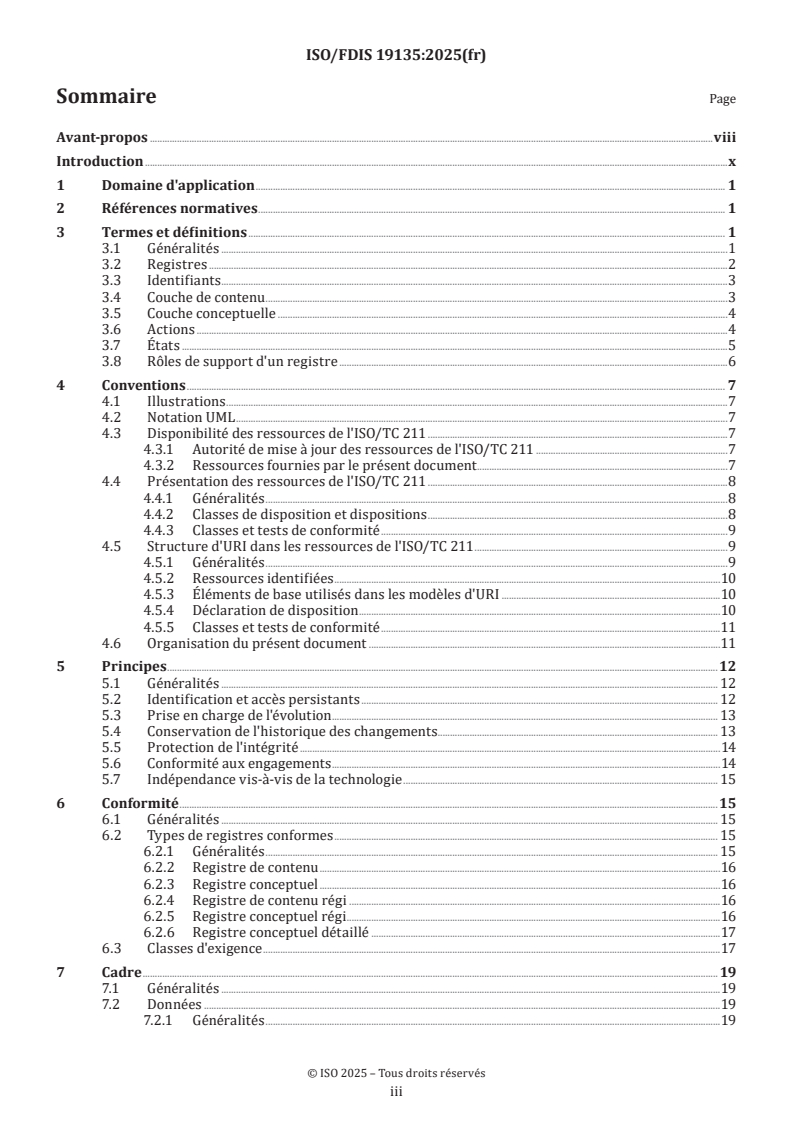
ISO/FDIS 19135:2025(fr) © ISO 2025
ii
ISO/FDIS 19135:2025(fr)
Sommaire Page
Avant-propos .viii
Introduction .x
1 Domaine d'application . 1
2 Références normatives . 1
3 Termes et définitions . 1
3.1 Généralités .1
3.2 Registres .2
3.3 Identifiants .3
3.4 Couche de contenu .3
3.5 Couche conceptuelle .4
3.6 Actions .4
3.7 États .5
3.8 Rôles de support d'un registre .6
4 Conventions . 7
4.1 Illustrations .7
4.2 Notation UML .7
4.3 Disponibilité des ressources de l'ISO/TC 211 .7
4.3.1 Autorité de mise à jour des ressources de l'ISO/TC 211 .7
4.3.2 Ressources fournies par le présent document .7
4.4 Présentation des ressources de l'ISO/TC 211 .8
4.4.1 Généralités .8
4.4.2 Classes de disposition et dispositions .8
4.4.3 Classes et tests de conformité .9
4.5 Structure d'URI dans les ressources de l'ISO/TC 211 .9
4.5.1 Généralités .9
4.5.2 Ressources identifiées .10
4.5.3 Éléments de base utilisés dans les modèles d'URI .10
4.5.4 Déclaration de disposition .10
4.5.5 Classes et tests de conformité .11
4.6 Organisation du présent document .11
5 Principes .12
5.1 Généralités . 12
5.2 Identification et accès persistants . 12
5.3 Prise en charge de l'évolution . . 13
5.4 Conservation de l'historique des changements. 13
5.5 Protection de l'intégrité .14
5.6 Conformité aux engagements .14
5.7 Indépendance vis-à-vis de la technologie . 15
6 Conformité .15
6.1 Généralités . 15
6.2 Types de registres conformes . 15
6.2.1 Généralités . 15
6.2.2 Registre de contenu .16
6.2.3 Registre conceptuel .16
6.2.4 Registre de contenu régi .16
6.2.5 Registre conceptuel régi .16
6.2.6 Registre conceptuel détaillé .17
6.3 Classes d'exigence .17
7 Cadre . 19
7.1 Généralités .19
7.2 Données .19
7.2.1 Généralités .19
iii
ISO/FDIS 19135:2025(fr)
7.2.2 Composants . 20
7.2.3 Actions .21
7.2.4 Métadonnées .21
7.2.5 Identifiants .21
7.2.6 Versions . 22
7.2.7 Couche conceptuelle . 22
7.2.8 Couche de contenu . 22
7.2.9 États . 23
7.2.10 Relations . 23
7.3 Gouvernance . 23
7.3.1 Généralités . 23
7.3.2 Informations documentées . 23
7.3.3 Spécification de registre. 23
7.3.4 Rôles et responsabilités .24
7.3.5 Processus de gouvernance .24
7.4 Engagements .24
8 Capacités en matière de données .25
8.1 Généralités . 25
8.2 Métadonnées . 25
8.3 Identifiants . . 25
8.3.1 Généralités . 25
8.3.2 Types d'identifiants . 26
8.3.3 Schémas d'identifiant . 26
8.3.4 Schéma d'identifiant d'objet . 26
8.3.5 Schéma d'identifiant fonctionnel .27
8.3.6 Exigences .27
8.4 Versions . . 30
8.4.1 Généralités . 30
8.4.2 Plan . 30
8.4.3 Exigences .31
8.5 Plans d'information . 33
8.5.1 Couches conceptuelles . 33
8.5.2 Couche de contenu . 34
8.5.3 Interconnexions entre les plans . . 34
8.5.4 Gestion des plans . 35
8.6 Couche conceptuelle . 35
8.6.1 Système conceptuel . . 35
8.6.2 Concept . . 36
8.6.3 Version du concept .37
8.6.4 Définitions conceptuelles . 38
8.6.5 État de version du concept . 38
8.6.6 Relations .41
8.7 Couche de contenu . 48
8.7.1 Généralités . 48
8.7.2 Classe d'éléments de registre . 49
8.7.3 Élément de registre . 50
8.7.4 Relations .52
8.7.5 Modification . . . 54
8.8 Exigences . 54
9 Capacités d'action . 76
9.1 Généralités .76
9.2 Ajout au registre. 77
9.2.1 Ajouter un concept . 77
9.2.2 Ajouter une version du concept . 78
9.3 Changement des états de version du concept . 79
9.3.1 Invalider une version du concept . 79
9.3.2 Dépublier une version du concept . 80
9.4 Changements apportés à un registre . 81
iv
ISO/FDIS 19135:2025(fr)
9.4.1 Généralités . 81
9.4.2 Remplacement de concept . . 82
9.4.3 Remplacement d'une version du concept . 84
9.4.4 Changement substantiel . 85
9.4.5 Changement de clarification . 87
9.4.6 Changement de correction .91
9.5 Changements destructifs . 93
9.5.1 Expurgation . 93
9.5.2 Supprimer un concept . 94
9.5.3 Supprimer une version du concept . 95
9.6 Définition conceptuelle . 96
9.6.1 Généralités . 96
9.6.2 Ajouter une définition conceptuelle . 97
9.6.3 Ajouter une version de définition conceptuelle . 97
9.6.4 Migration d'une réalisation de concept vers une définition conceptuelle évoluée
avec une sémantique inchangée . 98
9.6.5 Faire migrer une réalisation de concept vers une définition conceptuelle
évoluée avec une sémantique modifiée . 100
9.6.6 Ajouter une réalisation de concept par l'intermédiaire d'une nouvelle
sémantique fournie dans une définition conceptuelle évoluée . 103
9.7 Domaines de concept . 104
9.8 Intégration de concept . 105
9.8.1 Généralités . 105
9.8.2 Concepts incorporés non-versionnés et versionnés . 106
9.8.3 Création d'un concept incorporant . 109
9.8.4 Mise à jour d'un concept incorporant . 109
9.8.5 Modifier un concept incorporé .110
9.8.6 Modifier à la fois un concept incorporé et un concept incorporant . 112
9.9 Composition de concept.114
9.9.1 Généralités .114
9.9.2 Ajouter un concept composé . 115
9.9.3 Ajouter un concept composé réalisé .116
9.9.4 Modifier des parties de concept composé .117
9.9.5 Modifier des définitions de parties de concept composé . 118
9.10 Héritage de concept .119
9.10.1 Généralités .119
9.10.2 Ajouter un concept hérité . 120
9.10.3 Ajouter un concept hérité réalisé . 120
9.10.4 Modifier des définitions conceptuelles héritées . 122
9.10.5 Utilisation au sein de concepts incorporés ou composés . 124
9.11 Exigences . 125
10 Processus de gouvernance .139
10.1 Généralités . 139
10.2 Établissement d'un registre . 139
10.2.1 Généralités . 139
10.2.2 Exigences . 140
10.3 Fonctionnement d'un registre .141
10.3.1 Processus de proposition.141
10.3.2 Processus d'approbation .143
10.3.3 Processus d'appel.145
10.3.4 Processus de gestion du contenu . 148
10.4 Déclassement d'un registre . 149
10.4.1 Généralités . 149
10.4.2 Exigences . 149
11 Rôles et responsabilités .151
11.1 Généralités . 151
11.2 Propriétaire de registre . 152
11.3 Gestionnaire de registre . 155
v
ISO/FDIS 19135:2025(fr)
11.4 Organisme de contrôle . 155
11.5 Gestionnaire de système de registre . 156
11.6 Soumissionnaire. 156
11.7 Utilisateur de registre . . 157
12 Informations documentées .157
12.1 Spécification de registre . 157
12.1.1 Généralités . 157
12.1.2 Exigences .158
12.2 Instructions relatives à la proposition . 165
13 Modèle conceptuel . .166
13.1 Vue d'ensemble . 166
13.2 Paquetage de composants . 166
13.2.1 Vue d'ensemble des composants . 166
13.2.2 Tableaux de définition .167
13.3 Paquetage d'identifiants . 172
13.3.1 Vue d'ensemble des identifiants . 172
13.3.2 Tableaux de définition . 172
13.4 Paquetage d'états .174
13.4.1 Vue d'ensemble des états .174
13.4.2 Tableaux de définition . 175
13.5 Paquetage des relations . . 177
13.5.1 Vue d'ensemble des relations . 177
13.5.2 Tableaux de définition . 178
13.6 Paquetage de proposition et d'appel . 181
13.6.1 Vue d'ensemble de proposition et appel . 181
13.6.2 Tableaux de définition . 181
13.7 Exigences . 182
14 Engagements .183
14.1 Généralités . 183
14.2 Engagements d'accès . 183
14.2.1 Généralités . 183
14.2.2 Accès aux métadonnées .184
14.2.3 Accès au contenu .184
14.2.4 Accès à l'historique . 184
14.3 Engagements de persistance, d'intégrité et de traçabilité .184
14.3.1 Généralités .184
14.3.2 Persistance des identifiants .184
14.3.3 Persistance et conservation des métadonnées . 185
14.3.4 Persistance et conservation du contenu . 185
14.3.5 Persistance de l'historique avec traçabilité complète . 185
14.4 Engagements de transparence . 187
14.4.1 Généralités . 187
14.4.2 Transparence des métadonnées . 187
14.4.3 Transparence du contenu . 187
14.4.4 Transparence de l'historique . 187
14.5 Conformité. 187
14.6 Documentation . 188
14.7 Exigences . 188
Annexe A (normative) Suite de tests de conformité .
...
Questions, Comments and Discussion
Ask us and Technical Secretary will try to provide an answer. You can facilitate discussion about the standard in here.
Loading comments...