

ISO 14289-2:2024
(Main)Document management applications — Electronic document file format enhancement for accessibility — Part 2: Use of ISO 32000-2 (PDF/UA-2)
General Information
- Abstract
This document specifies how to use the Portable Document Format (PDF) specified in ISO 32000-2 to construct accessible digital documents using PDF technology. This document does not specify: — processes for converting paper or electronic documents to the PDF/UA format; — technical design, user interface, implementation, or operational details of presentation; — physical methods of storing these documents such as media and storage conditions; — required computer hardware and/or operating systems; — requirements specific to content (beyond facilitating programmatic access and textual representation); — requirements applying to specific classes (e.g. invoices, reports, etc.) of documents.
- Status
- Published
- Publication Date
- 12-Mar-2024
- Current Stage
- 6060 - International Standard published
- Start Date
- 13-Mar-2024
- Due Date
- 08-Mar-2024
- Completion Date
- 13-Mar-2024
Overview
ISO 14289-2:2024, developed by the International Organization for Standardization (ISO), provides comprehensive guidance for creating accessible digital documents using the Portable Document Format (PDF) as specified in ISO 32000-2 (PDF 2.0). As part of the PDF/UA (PDF for Universal Accessibility) series, this standard addresses file-format-level requirements to ensure that electronic documents are accessible to users, including those who rely on assistive technologies.
This document specifies requirements for constructing accessible digital files but does not prescribe conversion processes, user interface design, storage methods, hardware, or content-specific requirements beyond ensuring programmatic access and textual representation.
Key Topics
Accessible PDF Structure
ISO 14289-2 emphasizes the correct use of semantically appropriate structure elements-such as headings, paragraphs, lists, and tables-ensuring logical reading order and machine-readable content.Conformance with PDF/UA
To conform, a file must meet all requirements of ISO 32000-2 and ISO/TS 32005, avoid deprecated features, and follow guidelines for accessible embedded files. The specification supports the declaration of conformity to additional accessibility standards, such as WCAG 2.2.Semantic Markup and Metadata
The use of proper tagging and role mapping for document structure elements is required. The document outlines best practices for metadata inclusion, ensuring identification of PDF/UA conformance and facilitating compatibility with various processors.Artifacts and Real Content
The standard distinguishes between real content, which is vital for understanding and must be accessible, and artifacts, which are non-essential decorative elements.Inclusion of Alternate Texts and Annotations
Images and non-text elements require appropriate alternate descriptions. Annotation structures must be adequately tagged to support assistive technologies.Support for Assistive Technology
The standard ensures that content is accessible for screen readers and other assistive technology platforms by specifying requirements for logical structure, text representation, and navigation aids.
Applications
Enterprise Document Workflows
Organizations and government bodies applying ISO 14289-2 ensure that reports, contracts, manuals, and official forms in PDF format are accessible to people with disabilities, meeting global accessibility regulations.Software Development and Integration
PDF creation, authoring, validation, and remediation tools can integrate ISO 14289-2 requirements to support automated checks for accessibility features and deliver PDF/UA-2 conformant output.Archiving and Digital Libraries
Libraries and archives adopt this standard to ensure long-term accessibility of digitized and born-digital documents, supporting inclusive access for all users.Compliance and Quality Assurance
Meeting ISO 14289-2 helps organizations demonstrate compliance with digital accessibility laws and standards, reducing legal risks and enhancing corporate social responsibility.
Related Standards
ISO 32000-2:2020
The foundational specification for PDF 2.0, which defines the technical features and file structure requirements leveraged by ISO 14289-2.ISO/TS 32005
Specifies structure namespace inclusion and containment rules for both PDF 1.7 and PDF 2.0, supporting comprehensive tagging and interoperability.ISO 14289-1
Companion document providing guidance for accessible PDF based on PDF 1.7 (ISO 32000-1).ISO 19005-4 (PDF/A-4)
Governs long-term archiving of electronic documents in PDF/A format, which can be harmonized with accessibility requirements.WCAG 2.2
The W3C Web Content Accessibility Guidelines, which inform content-level accessibility practices complementing structural compliance.
ISO 14289-2:2024 enables the creation and management of accessible PDF documents, helping organizations deliver inclusive digital experiences and meet international accessibility standards for electronic documents.
Get Certified
Connect with accredited certification bodies for this standard

BSI Group
BSI (British Standards Institution) is the business standards company that helps organizations make excellence a habit.

NYCE
Mexican standards and certification body.
Sponsored listings
Frequently Asked Questions
ISO 14289-2:2024 is a standard published by the International Organization for Standardization (ISO). Its full title is "Document management applications — Electronic document file format enhancement for accessibility — Part 2: Use of ISO 32000-2 (PDF/UA-2)". This standard covers: This document specifies how to use the Portable Document Format (PDF) specified in ISO 32000-2 to construct accessible digital documents using PDF technology. This document does not specify: — processes for converting paper or electronic documents to the PDF/UA format; — technical design, user interface, implementation, or operational details of presentation; — physical methods of storing these documents such as media and storage conditions; — required computer hardware and/or operating systems; — requirements specific to content (beyond facilitating programmatic access and textual representation); — requirements applying to specific classes (e.g. invoices, reports, etc.) of documents.
This document specifies how to use the Portable Document Format (PDF) specified in ISO 32000-2 to construct accessible digital documents using PDF technology. This document does not specify: — processes for converting paper or electronic documents to the PDF/UA format; — technical design, user interface, implementation, or operational details of presentation; — physical methods of storing these documents such as media and storage conditions; — required computer hardware and/or operating systems; — requirements specific to content (beyond facilitating programmatic access and textual representation); — requirements applying to specific classes (e.g. invoices, reports, etc.) of documents.
ISO 14289-2:2024 is classified under the following ICS (International Classification for Standards) categories: 35.240.30 - IT applications in information, documentation and publishing; 37.100.99 - Other standards related to graphic technology. The ICS classification helps identify the subject area and facilitates finding related standards.
ISO 14289-2:2024 is available in PDF format for immediate download after purchase. The document can be added to your cart and obtained through the secure checkout process. Digital delivery ensures instant access to the complete standard document.
Standards Content (Sample)
International
Standard
ISO 14289-2
First edition
Document management
2024-03
applications — Electronic document
file format enhancement for
accessibility —
Part 2:
Use of ISO 32000-2 (PDF/UA-2)
Applications de la gestion de documents — Amélioration de
format du fichier du document électronique pour l'accessibilité —
Partie 2: Utilisation de l'ISO 32000-2 (PDF/UA-2)
Reference number
© ISO 2024
All rights reserved. Unless otherwise specified, or required in the context of its implementation, no part of this publication may
be reproduced or utilized otherwise in any form or by any means, electronic or mechanical, including photocopying, or posting on
the internet or an intranet, without prior written permission. Permission can be requested from either ISO at the address below
or ISO’s member body in the country of the requester.
ISO copyright office
CP 401 • Ch. de Blandonnet 8
CH-1214 Vernier, Geneva
Phone: +41 22 749 01 11
Email: copyright@iso.org
Website: www.iso.org
Published in Switzerland
ii
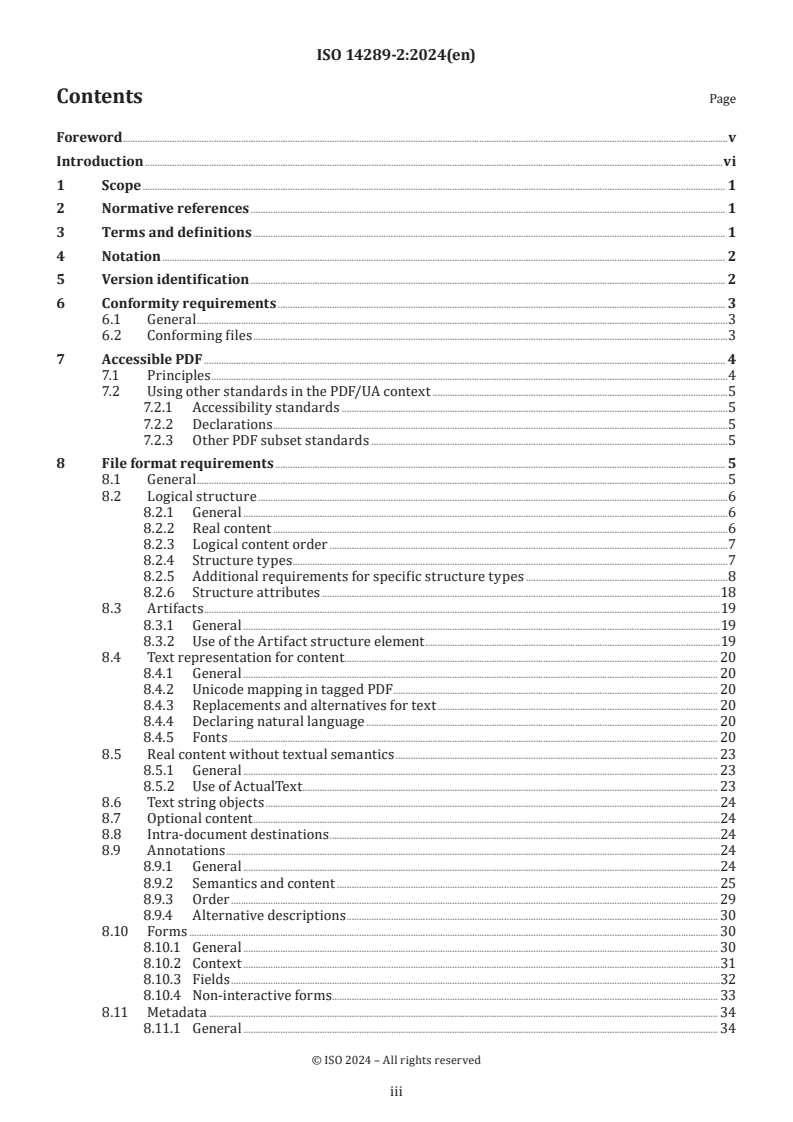
Contents Page
Foreword .v
Introduction .vi
1 Scope . 1
2 Normative references . 1
3 Terms and definitions . 1
4 Notation . 2
5 Version identification . 2
6 Conformity requirements . 3
6.1 General .3
6.2 Conforming files .3
7 Accessible PDF . 4
7.1 Principles .4
7.2 Using other standards in the PDF/UA context .5
7.2.1 Accessibility standards .5
7.2.2 Declarations .5
7.2.3 Other PDF subset standards .5
8 File format requirements . 5
8.1 General .5
8.2 Logical structure .6
8.2.1 General .6
8.2.2 Real content .6
8.2.3 Logical content order .7
8.2.4 Structure types .7
8.2.5 Additional requirements for specific structure types .8
8.2.6 Structure attributes .18
8.3 Artifacts .19
8.3.1 General .19
8.3.2 Use of the Artifact structure element .19
8.4 Text representation for content. 20
8.4.1 General . 20
8.4.2 Unicode mapping in tagged PDF . 20
8.4.3 Replacements and alternatives for text . 20
8.4.4 Declaring natural language . 20
8.4.5 Fonts . 20
8.5 Real content without textual semantics . 23
8.5.1 General . 23
8.5.2 Use of ActualText . . 23
8.6 Text string objects .24
8.7 Optional content .24
8.8 Intra-document destinations .24
8.9 Annotations .24
8.9.1 General .24
8.9.2 Semantics and content . 25
8.9.3 Order . 29
8.9.4 Alternative descriptions . 30
8.10 Forms . 30
8.10.1 General . 30
8.10.2 Context .31
8.10.3 Fields .32
8.10.4 Non-interactive forms. 33
8.11 Metadata . 34
8.11.1 General . 34
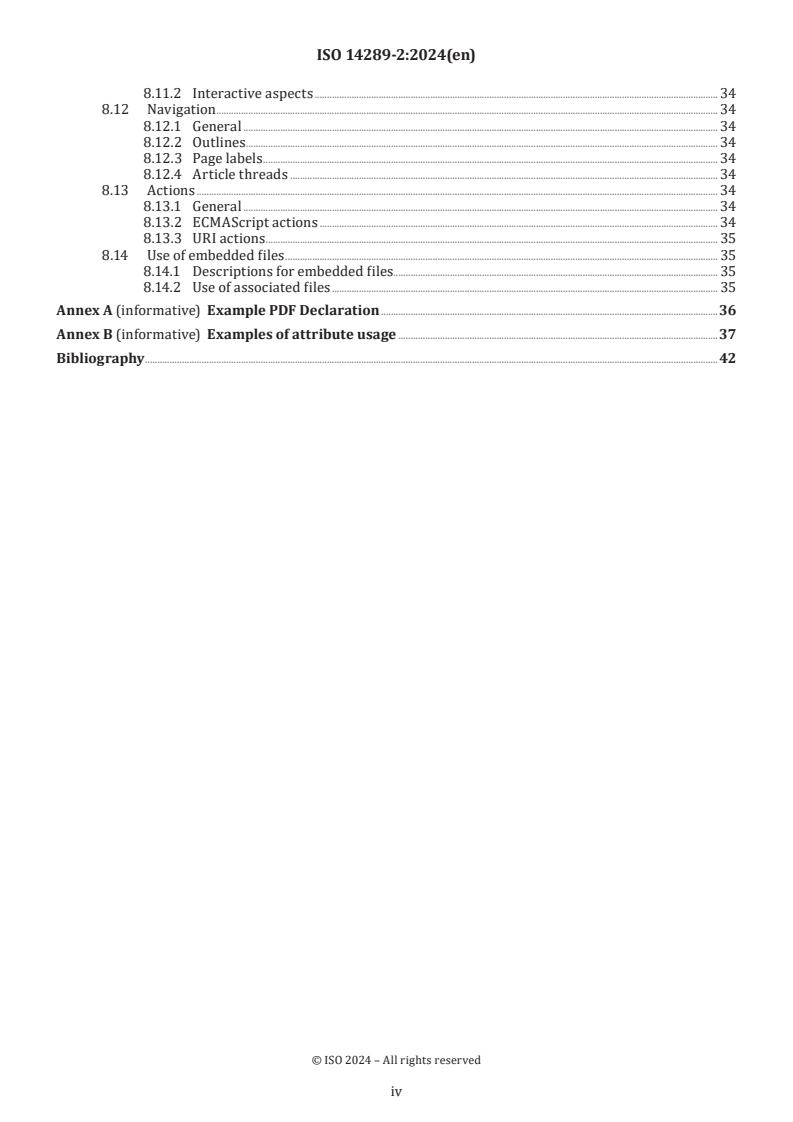
iii
8.11.2 Interactive aspects . 34
8.12 Navigation . 34
8.12.1 General . 34
8.12.2 Outlines . 34
8.12.3 Page labels . 34
8.12.4 Article threads . 34
8.13 Actions . 34
8.13.1 General . 34
8.13.2 ECMAScript actions . 34
8.13.3 URI actions . . 35
8.14 Use of embedded files . 35
8.14.1 Descriptions for embedded files. 35
8.14.2 Use of associated files . 35
Annex A (informative) Example PDF Declaration .36
Annex B (informative) Examples of attribute usage .37
Bibliography .42
iv
Foreword
ISO (the International Organization for Standardization) is a worldwide federation of national standards
bodies (ISO member bodies). The work of preparing International Standards is normally carried out through
ISO technical committees. Each member body interested in a subject for which a technical committee
has been established has the right to be represented on that committee. International organizations,
governmental and non-governmental, in liaison with ISO, also take part in the work. ISO collaborates closely
with the International Electrotechnical Commission (IEC) on all matters of electrotechnical standardization.
The procedures used to develop this document and those intended for its further maintenance are described
in the ISO/IEC Directives, Part 1. In particular, the different approval criteria needed for the different types
of ISO document should be noted. This document was drafted in accordance with the editorial rules of the
ISO/IEC Directives, Part 2 (see www.iso.org/directives).
ISO draws attention to the possibility that the implementation of this document may involve the use of (a)
patent(s). ISO takes no position concerning the evidence, validity or applicability of any claimed patent
rights in respect thereof. As of the date of publication of this document, ISO had not received notice of (a)
patent(s) which may be required to implement this document. However, implementers are cautioned that
this may not represent the latest information, which may be obtained from the patent database available at
www.iso.org/patents. ISO shall not be held responsible for identifying any or all such patent rights.
Any trade name used in this document is information given for the convenience of users and does not
constitute an endorsement.
For an explanation of the voluntary nature of standards, the meaning of ISO specific terms and expressions
related to conformity assessment, as well as information about ISO's adherence to the World Trade
Organization (WTO) principles in the Technical Barriers to Trade (TBT), see www.iso.org/iso/foreword.html.
This document was prepared by Technical Committee ISO/TC 171, Document management applications,
Subcommittee SC 2, Document file formats, EDMS systems and authenticity of information.
A list of all parts in the ISO 14289 series can be found on the ISO website.
Any feedback or questions on this document should be directed to the user’s national standards body. A
complete listing of these bodies can be found at www.iso.org/members.html.
v
Introduction
The Portable Document Format (PDF) is a digital format for representing documents. PDF files can be
created natively in PDF form, converted from other electronic formats, or digitized from paper. Businesses,
governments, libraries, archives, and other institutions and individuals around the world use PDF to
represent considerable bodies of important information. These PDF files should be made accessible to users
with disabilities.
The primary purpose of the ISO 14289 series, known as PDF/UA, is to define how electronic files in the
PDF format can be represented in a manner that allows them to be accessible. The accessibility of a PDF
document depends on the inclusion of a variety of semantic information such as (but not limited to):
— machine-readable text presented in a declared language;
— appropriate semantic structures for elements such as paragraphs, lists, tables and headings;
— the organization of semantic structures in logical reading order;
— descriptive metadata, such as alternate descriptions for images.
This document is intended as a companion standard to be used in conjunction with ISO 32000-2 (PDF 2.0).
Other standards can also be relevant for the purpose of achieving accessibility.
This document does not replace ISO 14289-1. ISO 14289-1 provides normative guidance based on
ISO 32000-1; this document provides normative guidance based on ISO 32000-2.
vi
International Standard ISO 14289-2:2024(en)
Document management applications — Electronic document
file format enhancement for accessibility —
Part 2:
Use of ISO 32000-2 (PDF/UA-2)
1 Scope
This document specifies how to use the Portable Document Format (PDF) specified in ISO 32000-2 to
construct accessible digital documents using PDF technology.
This document does not specify:
— processes for converting paper or electronic documents to the PDF/UA format;
— technical design, user interface, implementation, or operational details of presentation;
— physical methods of storing these documents such as media and storage conditions;
— required computer hardware and/or operating systems;
— requirements specific to content (beyond facilitating programmatic access and textual representation);
— requirements applying to specific classes (e.g. invoices, reports, etc.) of documents.
2 Normative references
The following documents are referred to in the text in such a way that some or all of their content constitutes
requirements of this document. For dated references, only the edition cited applies. For undated references,
the latest edition of the referenced document (including any amendments) applies.
ISO 14289-1, Document management applications — Electronic document file format enhancement for
accessibility — Part 1: Use of ISO 32000-1 (PDF/UA-1)
ISO 32000-2:2020, Document management — Portable document format — Part 2: PDF 2.0
ISO/TS 32005, Document management — Portable Document Format — PDF 1.7 and 2.0 structure namespace
inclusion in ISO 32000-2
W3C Digital Publishing WAI-ARIA Module 1.0 (DPUB-ARIA), W3C Recommendation, 14 December 2017, https://
www .w3 .org/ TR/ dpub -aria -1 .0/
PDF Association, PDF Declarations, September 5, 2019, https:// www .pdfa .org/ resource/ pdf -declarations/
3 Terms and definitions
For the purposes of this document, the following terms and definitions apply.
ISO and IEC maintain terminology databases for use in standardization at the following addresses:
— ISO Online browsing platform: available at https:// www .iso .org/ obp
— IEC Electropedia: available at https:// www .electropedia .org/
3.1
assistive technology
AT
hardware or software added to, or incorporated within, a system that increases accessibility for an individual
[SOURCE: ISO 9241-171:2008, 3.5, modified — the example has been removed.]
3.2
PDF 1.7 namespace
standard structure namespace for PDF 1.7
[SOURCE: ISO/TS 32005:2023, 3.1]
3.3
PDF 2.0 namespace
standard structure namespace for PDF 2.0
[SOURCE: ISO/TS 32005:2023, 3.2]
3.4
real content
graphics objects, annotations and form fields representing material intentionally introduced by a document's
author and necessary for an assistive technology (3.1) user to understand that document's content
Note 1 to entry: Text, images and paths are all examples of “graphics objects” in PDF files.
Note 2 to entry: The purpose of distinguishing between real and other content is to identify specific objects that the
author intended for consumption by a human.
3.5
structure attribute
entry containing additional information contained within an attribute object
Note 1 to entry: This term is introduced in ISO 32000-2:2020, 14.7.6.
3.6
unique PDF 1.7 element
standard structure element whose type is defined solely in the PDF 1.7 namespace (3.2)
[SOURCE: ISO/TS 32005:2023, 3.5]
3.7
artifact marked content sequence
artifact defined solely by a marked content sequence, and not defined by a structure element
4 Notation
Token characters, text string characters, PDF operators, operands, PDF keywords, the names of keys in PDF
dictionaries, and other predefined names are written according to the same convention in ISO 32000-2:2020,
Clause 4, and as defined in ISO 32000-2:2020, 7.2 and 7.9.2 (token characters and text string characters,
respectively).
5 Version identification
The PDF/UA version of a file shall be specified in the value of the Metadata entry in the document catalog
dictionary using the PDF/UA identification schema defined in this clause.
Table 1 defines the PDF/UA identifier using the namespace URI “ht tp:// www .aiim .org/ pdfua/ ns/id / ”. The
required schema namespace prefix is pdfuaid.
NOTE Namespace URIs are intended to be unique strings, and not expected to be resolved as URLs. This URI is
retained for compatibility reasons.
Table 1 — PDF/UA identification schema
Property Value type Category Description
pdfuaid: part Open choice of integer Internal (Required) PDF/UA part identifier
pdfuaid: rev Open choice of integer Internal (Required) Four-digit year of the date of
publication or revision
The value of pdfuaid: part shall be 2 for PDF files conforming with this document.
The value of pdfuaid: rev shall be the four digits of the year of publication or revision.
The values of the pdfuaid: part and pdfuaid: rev properties do not determine conformity with this document
by themselves; these criteria are specified in Clause 6.
6 C onformity requirements
6.1 General
The ISO 14289 series define a file format for representing electronic documents commonly known as “PDF/
UA”. This document addresses the accessibility of PDF files conforming to ISO 32000-2 (PDF 2.0).
NOTE 1 The proper mechanism by which a file can presumptively identify itself as being a PDF/UA file of a given
conformity level is described in Clause 5.
NOTE 2 Regardless of the version number present in the conforming file, conformity requirements specified in this
document are based on ISO 32000-2 (PDF 2.0).
6.2 C onforming files
Beyond the requirements in Clause 8 and PDF/UA version identification as defined in Clause 5, conformity
with this document requires that:
— a file shall adhere to all requirements of ISO 32000-2;
— a file shall adhere to all requirements of ISO/TS 32005;
— a file should not contain any feature that is deprecated in ISO 32000-2;
— a file may include any valid ISO 32000-2 feature that is not explicitly forbidden by this document;
— a file should not contain features described in specifications prior to ISO 32000-2 which are not explicitly
defined or identified in ISO 32000-2 or this document;
— an embedded file, if necessary to the understanding of the document, shall be accessible according to
[5]
If such an embedded file is a PDF file, it shall conform
objectively verifiable standards, e.g. WCAG 2.2.
to the ISO 14289 series.
NOTE 1 Embedded files referenced from the containing file, for use by a human reader, can be necessary to the
understanding of the document. See 8.14.
NOTE 2 Discouraging deprecated features aligns this document with ISO 19005-4.
NOTE 3 Conformance with ISO/TS 32005 is required because, while ISO 32000-2 did not deprecate any structure
types defined in PDF 1.7, ISO 32000-2:2020, Annex L provided containment rules only for structure types defined in
the PDF 2.0 namespace. ISO/TS 32005 expands these containment rules to cover both the PDF 2.0 namespace and
those elements unique to the PDF 1.7 namespace. By adhering to the requirements of ISO/TS 32005, it is possible to
include both PDF 2.0 and PDF 1.7 structure types in files that conform to this document.
A file may declare its support for and conformity with PDF extensions to ISO 32000-2:2020 by use of an
Extensions dictionary as specified in ISO 32000-2:2020, 7.12.
NOTE 4 Use of extensions can potentially negatively impact accessibility, compatibility and consistency of files
when consumed by different processors.
Although other accessibility standards provide guidance on accessible content, this document deliberately
avoids requirements related to content. Conformity to PDF/UA alone does not ensure that the content of a
document is accessible. Cases not covered by PDF/UA include:
— where authors have used colour or contrast in an inaccessible manner;
— where ECMAScript present in the file can generate inaccessible results;
— where text content is potentially inaccessible to those with certain cognitive impairments;
— whether a particular content item is real content or artifact content.
NOTE 5 Requirements governing author's creative choices, (e.g. requirements for plain language), or the use of
specific degrees of colour-contrast, are out of scope for this document. For such requirements, authors can refer to
[5]
WCAG 2.2 and other applicable standards such as ISO 24495-1.
7 Accessible PDF
7.1 Principles
The degree to which document content can be described as accessible depends on the extent to which the
semantic significance and context of each element of content is readily available to as many people and PDF
processors as possible.
Accessible PDF files adhere to the RISE principles:
— Reliable: Files comply to the greatest possible extent with applicable specifications to facilitate robustness
in processing across a wide range of use cases and software.
— Interoperable: Elements of content can be readily exchanged between computing systems without loss
of semantics.
— Suitable: Suitability for the widest range of PDF processing applications and use-cases within the
intended user population, taking account of special abilities, variations in capabilities, diversity in tasks,
and differing environmental, economic and social circumstances.
— Equitable: Equitable solutions provide the same means of use for all users: identical whenever possible;
equivalent when not.
NOTE These principles have been adapted from ISO 9241-171:2008 and are consistent with WCAG's POUR
[5]
principles.
In PDF, access to content is provided by the structures of the file, the software reading the file, and by the
assistive technology consuming the software's output. The content of a document is considered accessible
if real content as specified in ISO 32000-2:2020, 14.8.2.2 is represented with text or has a text-based
equivalent presented in logical reading order with appropriate semantics. This document establishes how to
apply these principles to a PDF file; it addresses the way content is encoded within a conforming PDF/UA file
but does not regulate the document’s content itself, as seen in the following examples.
EXAMPLE 1 The maximum number of characters in a line of text is unregulated.
EXAMPLE 2 Specific colours, colour-combinations, or contrast ratios are unregulated.
EXAMPLE 3 The choice to use plain language or other language is unregulated.
EXAMPLE 4 The size of fonts is unregulated.
7.2 Using other standards in the PDF/UA context
7.2.1 Accessibility standards
Diverse content requirements (e.g. the examples provided in 7.1) can be addressed with other specifications.
7.2.2 describes a means of claiming conformity with one or more such specifications.
7.2.2 Declarations
Many standards and regulations related to accessibility go beyond the requirements of PDF/UA. To facilitate
claims of conformity with such standards, a PDF/UA conforming document may, in addition to the PDF/
UA identification schema specified in Clause 5, include PDF Declarations. An example PDF Declaration is
provided in Annex A.
EXAMPLE 1 A PDF Declaration can serve as the author’s statement attesting that:
[5]
— all of a given file’s content conforms to a specific accessibility standard (such as WCAG 2.2, Level AA);
— all images and figures have been checked for appropriate alternate descriptions;
— the file has been certified to be accessible when using a specific PDF/UA processor.
Files in conformity with this document may leverage the PDF Declarations mechanism to include conformity
claims for the entire file, for portions of the file (even specific objects), or both.
EXAMPLE 2 A PDF Declaration can serve as the author’s statement attesting that an individual movie embedded in
[5]
a PDF/UA file conforms to WCAG 2.2 Level AA.
NOTE 1 It is expected that the file, portion, or object to which a PDF Declaration applies fully conforms to the
standards to which they are declaring conformity.
NOTE 2 The PDF Association’s list of PDF Declarations is fully extensible. Other PDF Declarations can be defined
there and elsewhere.
An embedded file that is not PDF, if necessary to the understanding of the document, shall have an associated
PDF Declaration in accordance with PDF Declarations, indicating its conformance to an appropriate
accessibility standard. The PDF Declaration, as specified in PDF Declarations, shall be included through the
Metadata entry in its file specification dictionary. Any embedded files may have PDF Declarations associated
with them.
7.2.3 Other PDF subset standards
A file in conformity with this document may also conform to other ISO subset standards based on ISO 32000-2
(PDF 2.0) including ISO 19005-4 (PDF/A-4) and ISO 15930-9 (PDF/X-6).
8 File format requirements
8.1 General
Conformity with this document imposes requirements and restrictions beyond those specified in
ISO 32000-2 and ISO/TS 32005. Clause 8 specifies these additional requirements and restrictions.
Beyond requirements for aspects of logical structure, consistent and accurate rendering is also important
to meet the objectives of this document. Accordingly, 8.4.5 includes requirements matching those of the
corresponding clause in ISO 19005-4 (PDF/A-4) and ISO 15930-9 (PDF/X-6).
8.2 Logical structure
8.2.1 General
Conformity with this document depends on the correct use of semantically appropriate structure elements
enclosing the document’s content, along with the structure elements' properties and structure attributes
(additional information attached to the structure element).
8.2.2 Real content
All real content, as specified in ISO 32000-2:2020, 14.8.2.2, shall be enclosed within semantically appropriate
structure elements using appropriate attributes according to the definitions for each structure type
(name objects that identify the nature of the structure element), as defined in ISO 32000-2:2020, 14.8 and
ISO/TS 32005.
NOTE 1 The concept of real content is defined in ISO 32000-2:2020, 14.8.2.2.1.
NOTE 2 ISO/TS 32005 defines the permitted PDF 1.7 structure elements and their inclusion rules in relation to the
PDF 2.0 structure elements as defined in ISO 32000-2.
NOTE 3 Some structure elements with types such as Div and Span have no intrinsic semantics. Div is used to apply
attributes to groups of structure elements and their descendants (including their respective contents), while Span is
used to apply attributes to content.
NOTE 4 Whether attributes are appropriate depends on context and content properties (see 8.2.6).
EXAMPLE 1 The Placement attribute is appropriate on a Figure structure element whose content is inline in a
paragraph.
EXAMPLE 2 The Placement attribute is optional when a Figure is placed in a block flow between two paragraphs.
EXAMPLE 3 The Placement attribute with a value of Block is appropriate for an FENote structure element placed
in the block flow, whereas the Placement attribute with a value of Inline is appropriate for an FENote occurring inline
contained within a P structure element.
EXAMPLE 4 The TextDecorationType attribute with a value of LineThrough is appropriate for a structure element
enclosing struck text.
EXAMPLE 5 The TextPosition attribute with a value of Sup is appropriate for superscript characters.
Tagging shall reflect the semantics of the document's real content regardless of how the real content was
laid out, paginated, or encoded by an authoring tool. Real content that is typically represented by a single
semantic structure element with intrinsic semantics shall not be represented by several such structure
elements of the same structure type.
EXAMPLE 6 A single table spanning two or more pages is correctly enclosed in a single Table structure element.
NOTE 5 It is incorrect to have a single table spanning two or more pages enclosed in multiple Table structure
elements.
EXAMPLE 7 A single paragraph that spans two or more pages or columns is correctly enclosed within a single P
structure element.
NOTE 6 It is incorrect to have multiple lines of a single paragraph enclosed within two or more P structure elements.
NOTE 7 How content is encoded within a content stream does not indicate the semantically appropriate structure
element(s). Unlike ISO 14289-1, this document clearly specifies that the use of images or vector-based drawings does
not always require a Figure structure element.
EXAMPLE 8 An image solely used to represent text with no illustrative purpose can be enclosed in a Span structure
element with appropriate ActualText, as opposed to a Figure structure element.
Content that is not considered real content shall be an artifact in accordance with 8.3.
8.2.3 Logical content order
The logical content order of structure elements and their contents according to ISO 32000-2:2020, 14.8.2.5
shall be semantically correct.
[5]
NOTE 1 This requirement is equivalent to WCAG 2.2, Success Criterion 1.3.2.
NOTE 2 This document does not impose any understanding of what “semantically correct” logical content order
means to any given author. Two common example approaches to ordering real content are to follow the order of the
geographical page layout appropriate to the language or script (e.g. top-down, left-right in some languages), or to
order the most important real content first. The author chooses the approach and thus establishes the intended logical
content order for the document.
EXAMPLE 1 The correct logical content order, in a trifold brochure in English, with its title on the right-hand panel
of a landscape page, would typically locate the title content before the rest of the brochure in the structure tree.
Artifact content intended to be consumed in a single unit shall be enclosed within a single Artifact structure
element or artifact marked content sequence.
NOTE 3 Artifact structure elements and artifact marked content sequences are specified in ISO 32000-2:2020,
14.8.2.2.2.
EXAMPLE 2 Textual content in a page footer would usually be identified as a single artifact.
EXAMPLE 3 Page numbers.
If artifact content has a semantic order, the ordering of that content within the artifact shall match the
semantic order.
In some artifacts, some of the content has semantic order and some does not. Some artifact content,
particularly drawing content, does not have a semantic order.
EXAMPLE 4 Paths comprising table borders have no semantic order.
EXAMPLE 5 Page numbers with a background have a partial semantic order in that the order of the digits of the
page number is semantic, but the relative order of the background to the page number is not.
8.2.4 Structure types
All structure elements shall belong to, or be role mapped to, at least one of the following namespaces
specified in ISO 32000-2:2020, 14.8.6:
— the PDF 1.7 namespace;
— the PDF 2.0 namespace;
— the MathML namespace.
Other namespaces may be used by files in conformity with this document, but all structure elements in such
namespaces shall have their structure types role mapped as described in this subclause. Such role mapping
may be transitive through other namespaces.
A structure element with no explicit namespace may be present. Such a structure element shall have, after
any role mapping, a structure type matching one of the unique PDF 1.7 element types and as restricted by
this document.
NOTE 1 The default standard structure namespace in ISO 32000-2 is defined as the PDF 1.7 namespace.
NOTE 2 8.2.5.14 restricts the use of the Note structure type from the default standard structure namespace, and it
is therefore not permitted despite being a unique PDF 1.7 element.
Within a given explicitly provided namespace, structure types shall not be role mapped to other structure
types in the same namespace.
If custom structure types are role mapped, either directly or transitively, to standard structure types, they
shall conform to the requirements for the standard structure types to which they are role mapped, including
the containment rules specified in ISO/TS 32005:2023, Clause 7.
EXAMPLE A custom structure type mapped to a Caption standard structure type would incur all requirements
for the Caption structure type, including its permitted location in the structure tree with respect to the structure
element enclosing the captioned content and the element’s permitted descendants.
8.2.5 Additional requirements for specific structure types
8.2.5.1 General
ISO 32000-2:2020, 14.8.4 and ISO/TS 32005:2023, 5.5 describe the full list of standard structure types for
the PDF 2.0 namespace and PDF 1.7 namespace, respectively, and provide both requirements and examples
of their use.
Usage of the standard structure types shall be in accordance with the requirements specified in both
ISO 32000-2:2020, 14.7.4.2 and ISO/TS 32005 for the PDF 2.0 namespace and PDF 1.7 namespace.
8.2.5.2 to 8.2.5.33 provide additional requirements for specific structure types.
NOTE 8.2.5.2 to 8.2.5.33 appear in the order in which the structure types occur in ISO 32000-2. If a structure type
does not appear in 8.2.5.2 to 8.2.5.33, then no additional requirements apply beyond those specified in ISO 32000-2
and ISO/TS 32005.
Requirements specific to structure attributes are addressed in 8.2.6.
8.2.5.2 Document and DocumentFragment
The structure tree root (defined in ISO 32000-2:2020, 14.7.2) shall contain a single Document structure
element as its only child, as specified in ISO 32000-2:2020, Annex L and ISO/TS 32005. The namespace for
that element shall be specified as the PDF 2.0 namespace, in accordance with ISO 32000-2:2020, 14.8.6.
NOTE 1 PDF/UA-2-conforming files cannot solely conform to PDF 1.7 because this subclause requires that the
Document structure element is in the PDF 2.0 namespace.
When a document encloses content from another document that is either a logical document or logical
document fragment as specified in ISO 32000-2:2020, 14.8.4.3, that content should be enclosed in either a
Document structure element or a DocumentFragment structure element, respectively.
The DocumentFragment structure type shall only be used when the author’s intent is to identify real
content as originating in another document.
EXAMPLE Excerpts from documents included inside another document.
NOTE 2 DocumentFragment is inappropriate for content (e.g. some quotations) whose semantic intent does not
rely on identification as an extract from another document.
NOTE 3 Because the content is a fragment of another document, it is possible that heading levels do not align with
the overall document and would not be expected to impact subsequent heading levels. However, headings in that
fragment would be self-consistent and not multiple subsets of another document, as described in ISO 32000-2:2020,
14.8.4.3.
8.2.5.3 Part
When a grouping of content has semantic purpose unrelated to the document's headings hierarchy, it should
be enclosed within a Part structure element. ISO 32000-2:2020, Table 365 provides examples distinguishing
the use of Part from the use of the Sect structure type.
8.2.5.4 Article (Art)
Where content is semantically representative of a self-contained article in a larger document that contains
multiple such articles, that content shall be enclosed in an Art structure element.
NOTE As such, articles often include titles, their own heading levels, and sub-structure.
Where a title applies to an entire article, the Title structure element shall be included inside the Art
structure element, either directly or indirectly.
8.2.5.5 Section (Sect)
When a document is divided into sections, Sect structure element(s) should be used to contain the structure
elements and real content that comprise such sections. When a heading applies to an entire section, then
that heading structure element shall be contained within that Sect structure element.
NOTE 1 A section is a thematic grouping of content and structure elements, typically with a heading structure
element at its start.
NOTE 2 The presence of the Sect structure element enables efficiently skipping sections of a document.
8.2.5.6 Division (Div)
Where attributes or properties are common to a set of elements, a Div structure element may be used to
apply those common attributes or properties to that group of elements.
EXAMPLE A set of paragraphs in a common language that differs from that
...