

ISO 20720:2018
(Main)Microbeam analysis — Methods of specimen preparation for analysis of general powders using WDS and EDS
General Information
- Abstract
This document specifies specimen preparation methods for the analysis of particles in powders using energy-dispersive spectrometers (EDS) or wavelength-dispersive spectrometers (WDS) installed on an EPMA or SEM. The preparation methods for powder particle analysis are classified by the analytical purpose and the particle size. This document applies to inorganic particles larger than 100 nm and smaller than 100 µm in diameter. It applies only to analysis of "general" powders, which means that it excludes procedures for special applications such as forensic or trace analysis.
- Status
- Published
- Publication Date
- 17-Oct-2018
- Technical Committee
- ISO/TC 202 - Microbeam analysis
- Drafting Committee
- ISO/TC 202 - Microbeam analysis
- Current Stage
- 9093 - International Standard confirmed
- Start Date
- 30-Apr-2024
- Completion Date
- 29-Aug-2026
Buy Documents


ISO 20720:2018 - Microbeam analysis -- Methods of specimen preparation for analysis of general powders using WDS and EDS
ISO 20720:2018 - Microbeam analysis — Methods of specimen preparation for analysis of general powders using WDS and EDS/18/2018
Overview
ISO 20720:2018 - Microbeam analysis: Methods of specimen preparation for analysis of general powders using WDS and EDS - defines standardized specimen preparation methods for particle analysis by energy-dispersive (EDS) and wavelength-dispersive (WDS) X‑ray spectrometry on EPMA or SEM platforms. It covers inorganic powder particles between 100 nm and 100 µm diameter and classifies preparation procedures by analytical purpose and particle size. Special-application procedures (forensic or trace analysis) are excluded.
Key topics and technical requirements
- Scope and classification
- Applies to general inorganic powders (100 nm–100 µm), with methods chosen according to particle size and analysis goal (surface, whole-particle, cross‑section, statistical).
- Specimen preparation methods
- Surface/whole-particle: sprinkling onto conductive tape/substrate, drying drops of suspension, suction filtration, tablet pressing.
- Cross‑section: embedding in resin and polishing, microtomy, focused ion beam (FIB) or broad argon ion sectioning.
- Sample handling details
- Guidance on avoiding particle agglomeration (ultrasonication, centrifugation), fixation of small quantities, and removal of poorly adhered material (air duster, tapping).
- Use of silver or tin flakes in tablet pressing for individual particles (note: sulfides can react with silver; tin is recommended in such cases).
- Charge mitigation and conductivity
- Electrical conductivity processing via vacuum deposition or ion plating; choice depends on analysis purpose (see ISO 22489:2016).
- Protective conductive/thermal layers (Au, Pt) and electron‑beam induced deposition for beam-sensitive particles.
- Analytical considerations
- Effects of press pressure, particle packing and size on X‑ray intensity are illustrated in Annexes A and B. Examples show X‑ray strength dependence on tablet‑forming pressure and particle size (recommendations include grinding to 0.1–1 µm to improve filling density and noting typical tablet pressures used in examples).
- Cautions when X‑ray generation volume exceeds particle dimensions - impacts quantitative interpretation.
Applications and practical value
- Standardizes sample‑preparation workflows for:
- Materials characterization and failure analysis (ceramics, oxides, minerals, catalysts).
- Quality control in powder manufacturing and processing.
- Research labs performing EPMA/SEM elemental mapping and point analysis of powders.
- Practical benefits:
- Improves reproducibility and comparability of WDS/EDS results.
- Reduces artefacts from charging, agglomeration, or insufficient packing.
- Guides choice of method for whole‑particle vs cross‑sectional analysis and for statistical studies of particle size/distribution.
Who should use this standard
- Microbeam analysts, SEM/EPMA operators, materials scientists, laboratory managers, and sample‑preparation technicians involved in powder analysis.
Related standards
- ISO 14594:2014 - EPMA experimental parameters (WDS)
- ISO 22489:2016 - Conductivity processing and quantitative point analysis guidance
Keywords: ISO 20720:2018, microbeam analysis, specimen preparation, powder analysis, EDS, WDS, EPMA, SEM, particle analysis, sample prep.
Buy Documents
ISO 20720:2018 - Microbeam analysis -- Methods of specimen preparation for analysis of general powders using WDS and EDS
ISO 20720:2018 - Microbeam analysis — Methods of specimen preparation for analysis of general powders using WDS and EDS/18/2018
Get Certified
Connect with accredited certification bodies for this standard

ECOCERT
Organic and sustainability certification.

Eurofins Food Testing Global
Global leader in food, environment, and pharmaceutical product testing.

Intertek Bangladesh
Intertek certification and testing services in Bangladesh.
Sponsored listings
Frequently Asked Questions
ISO 20720:2018 is a standard published by the International Organization for Standardization (ISO). Its full title is "Microbeam analysis — Methods of specimen preparation for analysis of general powders using WDS and EDS". This standard covers: This document specifies specimen preparation methods for the analysis of particles in powders using energy-dispersive spectrometers (EDS) or wavelength-dispersive spectrometers (WDS) installed on an EPMA or SEM. The preparation methods for powder particle analysis are classified by the analytical purpose and the particle size. This document applies to inorganic particles larger than 100 nm and smaller than 100 µm in diameter. It applies only to analysis of "general" powders, which means that it excludes procedures for special applications such as forensic or trace analysis.
This document specifies specimen preparation methods for the analysis of particles in powders using energy-dispersive spectrometers (EDS) or wavelength-dispersive spectrometers (WDS) installed on an EPMA or SEM. The preparation methods for powder particle analysis are classified by the analytical purpose and the particle size. This document applies to inorganic particles larger than 100 nm and smaller than 100 µm in diameter. It applies only to analysis of "general" powders, which means that it excludes procedures for special applications such as forensic or trace analysis.
ISO 20720:2018 is classified under the following ICS (International Classification for Standards) categories: 71.040.99 - Other standards related to analytical chemistry. The ICS classification helps identify the subject area and facilitates finding related standards.
ISO 20720:2018 is available in PDF format for immediate download after purchase. The document can be added to your cart and obtained through the secure checkout process. Digital delivery ensures instant access to the complete standard document.
Standards Content (Sample)
INTERNATIONAL ISO
STANDARD 20720
First edition
2018-10
Microbeam analysis — Methods of
specimen preparation for analysis of
general powders using WDS and EDS
Analyse par microfaisceaux — Méthodes de préparation des
échantillons pour l’analyse des particules
Reference number
©
ISO 2018
© ISO 2018
All rights reserved. Unless otherwise specified, or required in the context of its implementation, no part of this publication may
be reproduced or utilized otherwise in any form or by any means, electronic or mechanical, including photocopying, or posting
on the internet or an intranet, without prior written permission. Permission can be requested from either ISO at the address
below or ISO’s member body in the country of the requester.
ISO copyright office
CP 401 • Ch. de Blandonnet 8
CH-1214 Vernier, Geneva
Phone: +41 22 749 01 11
Fax: +41 22 749 09 47
Email: copyright@iso.org
Website: www.iso.org
Published in Switzerland
ii © ISO 2018 – All rights reserved
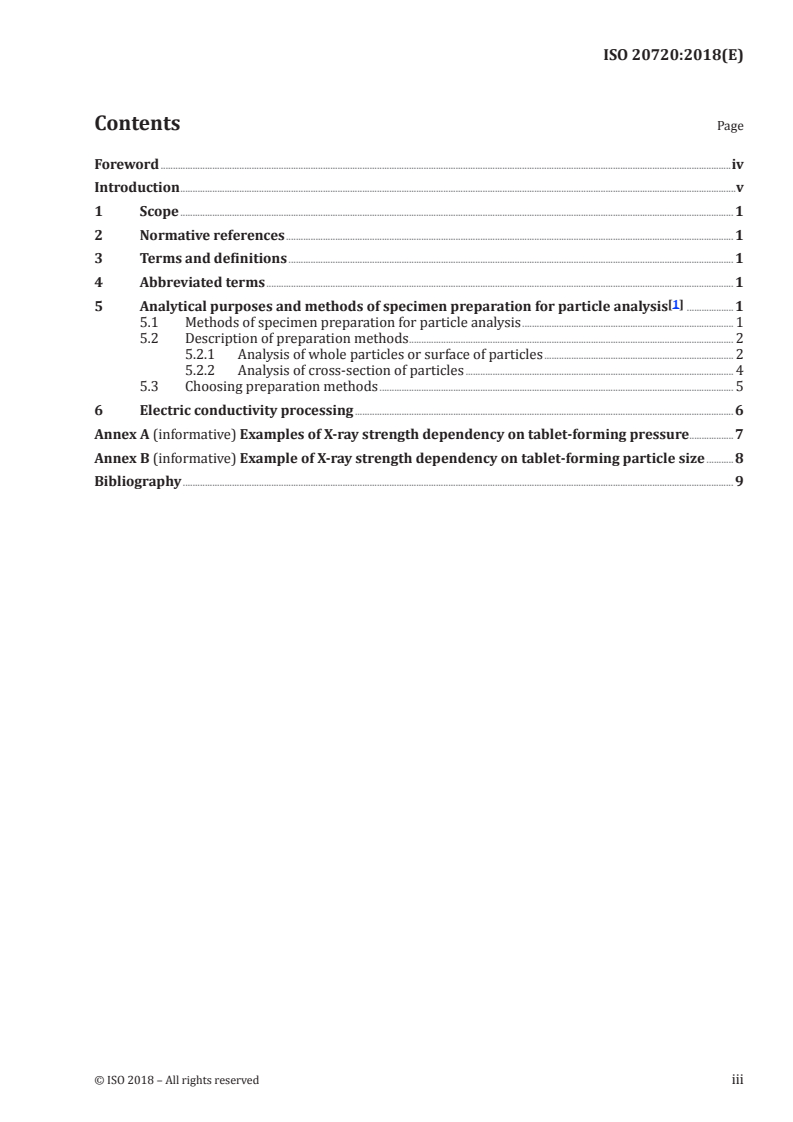
Contents Page
Foreword .iv
Introduction .v
1 Scope . 1
2 Normative references . 1
3 Terms and definitions . 1
4 Abbreviated terms . 1
[1]
5 Analytical purposes and methods of specimen preparation for particle analysis .1
5.1 Methods of specimen preparation for particle analysis . 1
5.2 Description of preparation methods . 2
5.2.1 Analysis of whole particles or surface of particles . 2
5.2.2 Analysis of cross-section of particles . 4
5.3 Choosing preparation methods . 5
6 Electric conductivity processing . 6
Annex A (informative) Examples of X-ray strength dependency on tablet-forming pressure .7
Annex B (informative) Example of X-ray strength dependency on tablet-forming particle size .8
Bibliography . 9
Foreword
ISO (the International Organization for Standardization) is a worldwide federation of national standards
bodies (ISO member bodies). The work of preparing International Standards is normally carried out
through ISO technical committees. Each member body interested in a subject for which a technical
committee has been established has the right to be represented on that committee. International
organizations, governmental and non-governmental, in liaison with ISO, also take part in the work.
ISO collaborates closely with the International Electrotechnical Commission (IEC) on all matters of
electrotechnical standardization.
The procedures used to develop this document and those intended for its further maintenance are
described in the ISO/IEC Directives, Part 1. In particular the different approval criteria needed for the
different types of ISO documents should be noted. This document was drafted in accordance with the
editorial rules of the ISO/IEC Directives, Part 2 (see www .iso .org/directives).
Attention is drawn to the possibility that some of the elements of this document may be the subject of
patent rights. ISO shall not be held responsible for identifying any or all such patent rights. Details of
any patent rights identified during the development of the document will be in the Introduction and/or
on the ISO list of patent declarations received (see www .iso .org/patents).
Any trade name used in this document is information given for the convenience of users and does not
constitute an endorsement.
For an explanation of the voluntary nature of standards, the meaning of ISO specific terms and
expressions related to conformity assessment, as well as information about ISO's adherence to the
World Trade Organization (WTO) principles in the Technical Barriers to Trade (TBT) see the following
URL: www .iso .org/iso/foreword .html.
This document was prepared by Technical Committee ISO/TC 202, Microbeam analysis.
Any feedback or questions on this document should be directed to the user’s national standards body. A
complete listing of these bodies can be found at www .iso .org/members .html.
iv © ISO 2018 – All rights reserved
Introduction
Although there are many applications of electron probe microanalysis (EPMA) and scanning electron
microscopy (SEM) for powder analysis, there are some difficulties, especially in the case of individual
particle analysis, as follows:
(a) the prevention of agglomeration of particles during preparation of the specimen;
(b) the fixation of specimens, especially when there is a small amount of tiny particles, either for
surface analysis or cross-section analysis;
(c) the cross-section preparation in the case of small particles with core-shell structures;
(d) the protection of particle surfaces from damage by electron beam irradiation in cases where the
surfaces of particles are sensitive;
(e) the counteraction of charging of the specimen under electron radiation to prevent the powder from
scattering or dispersing due to electrical repulsion;
(f) the interpretation of qualitative and/or quantitative analysis results when the X-ray generation
volume is larger than that of the particles.
Even in the case of elemental compositional analysis of a powder, the specimen preparation can
affect the results of analysis, because the roughness and/or void space within a particle aggregate or
agglomerate can impact X-ray intensity.
To cope with these difficulties, the standardization of specimen preparation for particle analysis is very
important.
INTERNATIONAL STANDARD ISO 20720:2018(E)
Microbeam analysis — Methods of specimen preparation
for analysis of general powders using WDS and EDS
1 Scope
This document specifies specimen preparation methods for the analysis of particles in powders using
energy-dispersive spectrometers (EDS) or wavelength-dispersive spectrometers (WDS) installed on
an EPMA or SEM. The preparation methods for powder particle analysis are classified by the analytical
purpose and the particle size.
This document applies to inorganic particles larger than 100 nm and smaller than 100 µm in diameter.
It applies only to analysis of “general” powders, which means that it excludes procedures for special
applications such as forensic or trace analysis.
2 Normative references
There are no normative references in this document.
3 Terms and definitions
No terms and definitions are listed in this document.
ISO and IEC maintain terminological databases for use in standardization at the following addresses:
— ISO Online browsing platform: available at https: //www .iso .org/obp
— IEC Electropedia: available at http: //www .electropedia .org/
4 Abbreviated terms
EDS energy-dispersive X-ray spectroscopy/spectrometry
EPMA electron probe microanalysis/electron probe microanalyzer
SEM scanning electron microscopy/scanning electron microscope
WDS wavelength-dispersive X-ray spectroscopy/spectrometry/spectrometer
5 Analytical purposes and methods of specimen preparation for particle
[1]
analysis
5.1 Methods of specimen preparation for particle analysis
The following methods of specimen preparation are widely used for particle analysis (see Figure 1).
The specific procedure is indicated in 5.2.
This list is not comprehensive and does not preclude the use of other specimen preparation methods for
particle analysis that can be more appropriate in some cases.
Figure 1 — Methods of specimen preparation for particle analysis
5.2 Description of preparation methods
5.2.1 Analysis of whole
...
INTERNATIONAL ISO
STANDARD 20720
First edition
2018-10
Microbeam analysis — Methods of
specimen preparation for analysis of
general powders using WDS and EDS
Analyse par microfaisceaux — Méthodes de préparation des
échantillons pour l’analyse des particules
Reference number
©
ISO 2018
© ISO 2018
All rights reserved. Unless otherwise specified, or required in the context of its implementation, no part of this publication may
be reproduced or utilized otherwise in any form or by any means, electronic or mechanical, including photocopying, or posting
on the internet or an intranet, without prior written permission. Permission can be requested from either ISO at the address
below or ISO’s member body in the country of the requester.
ISO copyright office
CP 401 • Ch. de Blandonnet 8
CH-1214 Vernier, Geneva
Phone: +41 22 749 01 11
Fax: +41 22 749 09 47
Email: copyright@iso.org
Website: www.iso.org
Published in Switzerland
ii © ISO 2018 – All rights reserved
Contents Page
Foreword .iv
Introduction .v
1 Scope . 1
2 Normative references . 1
3 Terms and definitions . 1
4 Abbreviated terms . 1
[1]
5 Analytical purposes and methods of specimen preparation for particle analysis .1
5.1 Methods of specimen preparation for particle analysis . 1
5.2 Description of preparation methods . 2
5.2.1 Analysis of whole particles or surface of particles . 2
5.2.2 Analysis of cross-section of particles . 4
5.3 Choosing preparation methods . 5
6 Electric conductivity processing . 6
Annex A (informative) Examples of X-ray strength dependency on tablet-forming pressure .7
Annex B (informative) Example of X-ray strength dependency on tablet-forming particle size .8
Bibliography . 9
Foreword
ISO (the International Organization for Standardization) is a worldwide federation of national standards
bodies (ISO member bodies). The work of preparing International Standards is normally carried out
through ISO technical committees. Each member body interested in a subject for which a technical
committee has been established has the right to be represented on that committee. International
organizations, governmental and non-governmental, in liaison with ISO, also take part in the work.
ISO collaborates closely with the International Electrotechnical Commission (IEC) on all matters of
electrotechnical standardization.
The procedures used to develop this document and those intended for its further maintenance are
described in the ISO/IEC Directives, Part 1. In particular the different approval criteria needed for the
different types of ISO documents should be noted. This document was drafted in accordance with the
editorial rules of the ISO/IEC Directives, Part 2 (see www .iso .org/directives).
Attention is drawn to the possibility that some of the elements of this document may be the subject of
patent rights. ISO shall not be held responsible for identifying any or all such patent rights. Details of
any patent rights identified during the development of the document will be in the Introduction and/or
on the ISO list of patent declarations received (see www .iso .org/patents).
Any trade name used in this document is information given for the convenience of users and does not
constitute an endorsement.
For an explanation of the voluntary nature of standards, the meaning of ISO specific terms and
expressions related to conformity assessment, as well as information about ISO's adherence to the
World Trade Organization (WTO) principles in the Technical Barriers to Trade (TBT) see the following
URL: www .iso .org/iso/foreword .html.
This document was prepared by Technical Committee ISO/TC 202, Microbeam analysis.
Any feedback or questions on this document should be directed to the user’s national standards body. A
complete listing of these bodies can be found at www .iso .org/members .html.
iv © ISO 2018 – All rights reserved
Introduction
Although there are many applications of electron probe microanalysis (EPMA) and scanning electron
microscopy (SEM) for powder analysis, there are some difficulties, especially in the case of individual
particle analysis, as follows:
(a) the prevention of agglomeration of particles during preparation of the specimen;
(b) the fixation of specimens, especially when there is a small amount of tiny particles, either for
surface analysis or cross-section analysis;
(c) the cross-section preparation in the case of small particles with core-shell structures;
(d) the protection of particle surfaces from damage by electron beam irradiation in cases where the
surfaces of particles are sensitive;
(e) the counteraction of charging of the specimen under electron radiation to prevent the powder from
scattering or dispersing due to electrical repulsion;
(f) the interpretation of qualitative and/or quantitative analysis results when the X-ray generation
volume is larger than that of the particles.
Even in the case of elemental compositional analysis of a powder, the specimen preparation can
affect the results of analysis, because the roughness and/or void space within a particle aggregate or
agglomerate can impact X-ray intensity.
To cope with these difficulties, the standardization of specimen preparation for particle analysis is very
important.
INTERNATIONAL STANDARD ISO 20720:2018(E)
Microbeam analysis — Methods of specimen preparation
for analysis of general powders using WDS and EDS
1 Scope
This document specifies specimen preparation methods for the analysis of particles in powders using
energy-dispersive spectrometers (EDS) or wavelength-dispersive spectrometers (WDS) installed on
an EPMA or SEM. The preparation methods for powder particle analysis are classified by the analytical
purpose and the particle size.
This document applies to inorganic particles larger than 100 nm and smaller than 100 µm in diameter.
It applies only to analysis of “general” powders, which means that it excludes procedures for special
applications such as forensic or trace analysis.
2 Normative references
There are no normative references in this document.
3 Terms and definitions
No terms and definitions are listed in this document.
ISO and IEC maintain terminological databases for use in standardization at the following addresses:
— ISO Online browsing platform: available at https: //www .iso .org/obp
— IEC Electropedia: available at http: //www .electropedia .org/
4 Abbreviated terms
EDS energy-dispersive X-ray spectroscopy/spectrometry
EPMA electron probe microanalysis/electron probe microanalyzer
SEM scanning electron microscopy/scanning electron microscope
WDS wavelength-dispersive X-ray spectroscopy/spectrometry/spectrometer
5 Analytical purposes and methods of specimen preparation for particle
[1]
analysis
5.1 Methods of specimen preparation for particle analysis
The following methods of specimen preparation are widely used for particle analysis (see Figure 1).
The specific procedure is indicated in 5.2.
This list is not comprehensive and does not preclude the use of other specimen preparation methods for
particle analysis that can be more appropriate in some cases.
Figure 1 — Methods of specimen preparation for particle analysis
5.2 Description of preparation methods
5.2.1 Analysis of whole
...