

IWA 49:2025
(Main)Child-friendly multidisciplinary and interagency response services for children who are victims of violence — Requirements and recommendations
General Information
- Abstract
This document provides requirements and recommendations for child-friendly multidisciplinary and interagency (MDIA) response services for children who are victims of violence. It provides a holistic framework for MDIA collaboration to ensure that children are provided with a child-friendly, professional and effective response in a safe environment.
- Status
- Published
- Publication Date
- 11-Mar-2025
- Technical Committee
- ISO/TMBG - Technical Management Board - groups
- Drafting Committee
- ISO/TMBG - Technical Management Board - groups
- Current Stage
- 6060 - International Standard published
- Start Date
- 12-Mar-2025
- Completion Date
- 12-Mar-2025
Buy Documents
IWA 49:2025 - Child-friendly multidisciplinary and interagency response services for children who are victims of violence — Requirements and recommendations Released:3/12/2025

IWA 49:2025 - Child-friendly multidisciplinary and interagency response services for children who are victims of violence — Requirements and recommendations Released:3/12/2025
IWA 49:2025 - Child-friendly multidisciplinary and interagency response services for children who are victims of violence — Requirements and recommendations Released:12/22/2025
Overview
IWA 49:2025 - published by ISO - provides requirements and recommendations for child‑friendly multidisciplinary and interagency (MDIA) response services for children who are victims of violence. The document establishes a holistic framework to coordinate child welfare, criminal justice, medical, therapeutic and legal actors so that children receive a professional, timely and safe response in a child‑centred environment.
Key topics and technical requirements
The standard organizes practical requirements across operational, clinical and governance topics, including:
- Best interests of the child - prioritizing child welfare in all decisions.
- Child participation & survivor engagement - enabling age‑appropriate involvement and informed choices.
- Child protection & preventing undue delay - safeguarding and timely action to reduce re‑traumatization.
- Coordinating, operating and sustaining services
- Integration into legal and policy frameworks
- Interagency coordination and multidisciplinary collaboration
- Budgeting and sustainability considerations
- Non‑discrimination and accessibility requirements for a child‑friendly environment (location, interior, preventing contact with alleged offenders).
- Interagency planning and case management - procedures, coordinator role, and support person provisions.
- Forensic investigative interviews - guidance on location, recording, staff roles, adaptation to the child, and interview protocols.
- Healthcare assessment and forensic medical examinations - clinical assessment, examination settings and professional competence.
- Mental health and recovery - assessment, therapy, and responsibilities for psychosocial support.
- Training, supervision and recruitment - staff training, guidance, supervision and safeguarding checks.
- Data sharing and external competence building - data collection, awareness raising and knowledge exchange.
- Performance evaluation and improvement - monitoring, evaluation and continuous quality improvement.
Applications and who uses it
IWA 49:2025 is intended for organizations designing, operating or regulating MDIA response services, such as:
- Child protection agencies and social services
- Health services and forensic medical teams
- Law enforcement and prosecutors engaged in child‑sensitive investigations
- Mental health and therapeutic providers
- Non‑governmental organizations, funders and policy makers
- Service designers implementing child‑friendly facilities (e.g., Barnahus/Children’s House, Children’s Advocacy Centers)
Use of this standard helps reduce repeated interviews, prevent re‑traumatization, and align local services with international child‑rights obligations and Sustainable Development Goal 16 targets.
Related standards and guidance
IWA 49:2025 references and aligns with international child‑rights instruments and best practices such as the United Nations Convention on the Rights of the Child (UNCRC) and the Lanzarote Convention, and complements national policies and sectoral guidance. For implementation, consult the full ISO text or your national standards body for authoritative requirements.
Buy Documents
IWA 49:2025 - Child-friendly multidisciplinary and interagency response services for children who are victims of violence — Requirements and recommendations Released:3/12/2025
IWA 49:2025 - Child-friendly multidisciplinary and interagency response services for children who are victims of violence — Requirements and recommendations Released:3/12/2025
IWA 49:2025 - Child-friendly multidisciplinary and interagency response services for children who are victims of violence — Requirements and recommendations Released:12/22/2025
Get Certified
Connect with accredited certification bodies for this standard

Great Wall Tianjin Quality Assurance Center
Established 1993, first batch to receive national accreditation with IAF recognition.
Hong Kong Quality Assurance Agency (HKQAA)
Hong Kong's leading certification body.

Innovative Quality Certifications Pvt. Ltd. (IQCPL)
Known for integrity, providing ethical & impartial Assessment & Certification. CMMI Institute Partner.
Sponsored listings
Frequently Asked Questions
IWA 49:2025 is a standardization document published by the International Organization for Standardization (ISO). Its full title is "Child-friendly multidisciplinary and interagency response services for children who are victims of violence — Requirements and recommendations". This standard covers: This document provides requirements and recommendations for child-friendly multidisciplinary and interagency (MDIA) response services for children who are victims of violence. It provides a holistic framework for MDIA collaboration to ensure that children are provided with a child-friendly, professional and effective response in a safe environment.
This document provides requirements and recommendations for child-friendly multidisciplinary and interagency (MDIA) response services for children who are victims of violence. It provides a holistic framework for MDIA collaboration to ensure that children are provided with a child-friendly, professional and effective response in a safe environment.
IWA 49:2025 is classified under the following ICS (International Classification for Standards) categories: 03.080.99 - Other services. The ICS classification helps identify the subject area and facilitates finding related standards.
IWA 49:2025 is available in PDF format for immediate download after purchase. The document can be added to your cart and obtained through the secure checkout process. Digital delivery ensures instant access to the complete standard document.
Standards Content (Sample)
International
Workshop
Agreement
IWA 49
First edition
Child-friendly multidisciplinary
2025-03
and interagency response services
for children who are victims of
violence — Requirements and
recommendations
Reference number
© ISO 2025
All rights reserved. Unless otherwise specified, or required in the context of its implementation, no part of this publication may
be reproduced or utilized otherwise in any form or by any means, electronic or mechanical, including photocopying, or posting on
the internet or an intranet, without prior written permission. Permission can be requested from either ISO at the address below
or ISO’s member body in the country of the requester.
ISO copyright office
CP 401 • Ch. de Blandonnet 8
CH-1214 Vernier, Geneva
Phone: +41 22 749 01 11
Email: copyright@iso.org
Website: www.iso.org
Published in Switzerland
ii
Contents Page
Foreword .iv
Introduction .v
1 Scope . 1
2 Normative references . 1
3 Terms and definitions . 1
4 Requirements and recommendations . 2
4.1 General .2
4.2 Best interests of the child .3
4.3 Child participation .3
4.4 Survivor engagement .4
4.5 Child protection .4
4.6 Preventing undue delay .4
4.7 Coordinating, operating and sustaining services .4
4.7.1 Integration into the legal and policy framework.4
4.7.2 Interagency coordination and collaboration .5
4.7.3 Multidisciplinary coordination and collaboration .5
4.7.4 Budgeting and sustainability .5
4.8 Non-discrimination .5
4.9 Child-friendly environment .5
4.9.1 Place and accessibility .5
4.9.2 Interior environment .6
4.9.3 Preventing contact with the alleged offender .6
4.10 Interagency planning and case management .6
4.10.1 Procedures and routines .6
4.10.2 Coordinator .6
4.10.3 Support person . .6
4.11 Forensic investigative interviews .6
4.11.1 General .6
4.11.2 Location and recording .7
4.11.3 Role of response service staff .7
4.11.4 Adaptation to the child .7
4.11.5 Interview protocols .7
4.12 Healthcare assessment, treatment and forensic examination.8
4.12.1 Assessment and treatment .8
4.12.2 Forensic medical examinations . .8
4.12.3 Place and organization .8
4.12.4 Competence and responsibilities .8
4.13 Mental health and recovery .8
4.13.1 Assessment, therapy and interventions .8
4.13.2 Competence and responsibilities .9
4.14 Training, supervision and guidance .9
4.14.1 Training of professionals .9
4.14.2 Guidance, supervision and counselling .9
4.14.3 Recruitment and safeguarding .9
4.14.4 Selection, assessment to work with children .9
4.15 Data sharing and external competence building .9
4.15.1 Data collection and awareness raising .9
4.15.2 Knowledge sharing .10
4.16 Performance evaluation and improvement .10
Annex A (informative) Example of multidisciplinary and interagency (MDIA) response service.11
Annex B (informative) Workshop contributors.12
Bibliography .13
iii
Foreword
ISO (the International Organization for Standardization) is a worldwide federation of national standards
bodies (ISO member bodies). The work of preparing International Standards is normally carried out through
ISO technical committees. Each member body interested in a subject for which a technical committee
has been established has the right to be represented on that committee. International organizations,
governmental and non-governmental, in liaison with ISO, also take part in the work. ISO collaborates closely
with the International Electrotechnical Commission (IEC) on all matters of electrotechnical standardization.
The procedures used to develop this document and those intended for its further maintenance are described
in the ISO/IEC Directives, Part 1. In particular, the different approval criteria needed for the different types
of ISO documents should be noted. This document was drafted in accordance with the editorial rules of the
ISO/IEC Directives, Part 2 (see www.iso.org/directives).
ISO draws attention to the possibility that the implementation of this document may involve the use of (a)
patent(s). ISO takes no position concerning the evidence, validity or applicability of any claimed patent
rights in respect thereof. As of the date of publication of this document, ISO had not received notice of (a)
patent(s) which may be required to implement this document. However, implementers are cautioned that
this may not represent the latest information, which may be obtained from the patent database available at
www.iso.org/patents. ISO shall not be held responsible for identifying any or all such patent rights.
Any trade name used in this document is information given for the convenience of users and does not
constitute an endorsement.
For an explanation of the voluntary nature of standards, the meaning of ISO specific terms and expressions
related to conformity assessment, as well as information about ISO’s adherence to the World Trade
Organization (WTO) principles in the Technical Barriers to Trade (TBT), see www.iso.org/iso/foreword.html.
International Workshop Agreement IWA 49 was approved at a workshop hosted by Icelandic Standards
(IST), in association with Swedish Institute for Standards (SIS), held in Reykjavik, Iceland, in October 2024.
Any feedback or questions on this document should be directed to the user’s national standards body. A
complete listing of these bodies can be found at www.iso.org/members.html.
iv
Introduction
0.1 Background
It is estimated that, worldwide, up to 1 billion children aged between 2 years to 17 years have been affected
[1]
by physical, sexual, or emotional violence or neglect. This includes being subjected to physical punishment
by caregivers, bullying in school, and physical, emotional, and sexual violence. Every four minutes, a child
dies due to violence somewhere in the world. On average, violence claims the lives of approximately 130
000 children and adolescents under the age of 20 every year, with boys facing a higher risk of dying from
[2]
violence compared to girls.
The United Nations Children’s Fund (UNICEF) has estimated that over 1 billion women and men alive in 2024
were subject to sexual violence when they were children. 650 million (1 in 5) girls and women alive today
have been subjected to sexual violence as children. Among them, over 370 million (1 in 8) have experienced
rape or sexual assault. For boys, between 410 million and 530 million (1 in 7) have been subjected to sexual
violence in childhood. This includes 240 million to 310 million (1 in 11) who experienced rape or sexual
[3]
assault.
Furthermore, technology has a significant impact on children’s well-being, offering both opportunities and
risks. While the internet facilitates learning, social interaction and creativity, it also exposes children to
dangers such as cyberbullying, grooming, and sexual exploitation since perpetrators often exploit social
media and online gaming platforms, live-streaming services, and encrypted messaging apps to distribute
[4]
child sexual abuse material, solicitate minors, or engage in sexual extortion.
Globally, 1,6 billion children (2 in 3) experience violent punishment by caregivers at home. Among them,
over two-thirds are subjected to both physical punishment and psychological aggression, such as screaming
and name-calling. Nearly 550 million children (1 in 4 globally) live with mothers who are victims of intimate
[2]
partner violence, exposing them to additional risks and trauma.
“The impact of violence is devastating, immediate and lifelong. Violence against children impairs their brain
development, their physical and mental health and their ability to learn”, according to Reference [5]. While
the criminal justice process is a priority for most states, child victims and witnesses of violence have the
right to a holistic response that supports their full recovery.
[6]
The United Nations Convention on the Rights of the Child (UNCRC) and its Optional Protocol to the
[7]
Convention on the Rights of the Child on the Sale of children, child prostitution and child pornography and the
Council of Europe Convention on the Protection of Children against Sexual Exploitation and Sexual Abuse (the
[8]
Lanzarote Convention) underscore the obligation of state parties to create systems that safeguard children
from all forms of violence and abuse and adopt measures to promote their physical and psychological
recovery. The United Nations Committee on the Rights of the Child systematically recommends that state
parties establish child-friendly, multidisciplinary and interagency services to address violence against
[9]
children and ensure that children receive timely, effective support.
Multidisciplinary and interagency (MDIA) response services are a cornerstone of effective child protection
systems. MDIA response services provide holistic, child-centred and child-friendly responses to violence and
abuse. They bring together child welfare, criminal justice, and medical, therapeutic and legal professionals
under one roof to deliver a coordinated and child-centred response.
In many contexts, the lack of integration between these services results in fragmented and inconsistent
support for child victims. This often forces children to navigate complex systems alone, reliving their
trauma by recounting their experiences multiple times to different professionals. The absence of a child-
centred approach exacerbates the difficulty of disclosure, particularly in cases of sexual violence, where
feelings of fear, shame, and stigma already act as significant barriers. MDIA response services help reduce
re-traumatization for children subjected to sexual exploitation or abuse and child victims and survivors of
[10]
violence by preventing the repetition of their experiences. These services are part of a broader continuum
of child protection mechanisms that address the needs of children and their families throughout the entire
process of healing and protection.
MDIA principles can be adapted to a range of resource environments and governance frameworks while
maintaining a child-centred approach. The Barnahus (Children’s House) model, developed in Iceland, for
v
instance, integrates child welfare, criminal investigation, and medical and therapeutic services under
one roof, minimizing the risk of re-traumatization while ensuring a coordinated response. In 2015, the
Committee of the Parties to the Convention for the Protection of Children against Sexual Exploitation and
Sexual Abuse (the Lanzarote Committee) recognized the Barnahus (Children’s House) model as a promising
[11]
practice.
Children’s Advocacy Centers in the United States emphasize multidisciplinary collaboration, providing
child-friendly environments for interviews, medical examinations, and therapy. In countries with fewer
resources, community-based MDIA initiatives demonstrate the flexibility of the model, relying on community
[9]
involvement to deliver services, ensuring accessibility and cultural relevance.
The promotion and implementation of MDIA response services align closely with the Sustainable Development
Goals (SDGs), particularly Goal 16, which aims to promote peaceful and inclusive societies, provide access to
justice for all, and build effective, accountable institutions. Specifically, MDIA response services contribute
to Target 16.2, which seeks to end abuse, exploitation, trafficking, and all forms of violence against children,
as well as Target 16.3, which focuses on promoting the rule of law and ensuring equal access to justice. By
fostering coordinated, child-centred responses, MDIA response services also intersect with SDG 5, which
aims to achieve gender equality and empower all women and girls, by addressing the gendered dimensions
of violence and supporting survivors, as well as with other SDG targets related to violence against children.
Efforts to establish and expand MDIA response services have been supported by a range of international
and regional organizations.
The United Nations Committee on the Rights of the Child recommends that state parties establish MDIA
response services.
As part of its core commitment to strengthening comprehensive child protection systems, UNICEF has
consistently promoted child-friendly, integrated, and multidisciplinary services for child victims and
witnesses of violence worldwide. These efforts are designed to foster coordinated, child-centred approaches
that address the complex needs of children in a holistic manner.
[12]
The European Union in its Strategy for the Rights of the Child has also emphasized the urgency to present
an initiative aimed at supporting the development and strengthening of integrated child protection systems,
which will encourage all relevant authorities and services to better work together, in a system that puts the
child at the centre.
The Council of Europe has promoted the Barnahus (Children’s House) model since 2015 and has been
assisting its member states in establishing and expanding the existing services with a view to providing
[13]
children with access to child-friendly justice.
The Council of the Baltic Sea States has advanced the Barnahus (Children’s House) model since 2015, focusing
on capacity building, standard development, and international cooperation to enhance child-friendly,
multidisciplinary approaches to child abuse cases. These efforts led to the creation of the Barnahus Quality
[14] [15]
Standards and formalized the Barnahus Network, a member-led platform connecting professionals
and policymakers across Europe. The network supports the establishment and operation of the Barnahus
(Children’s House) model, promotes best practices, facilitates training, and fosters cross-border collaboration
to strengthen MDIA response services globally.
This document recognizes the contributions of all these organizations and others that have supported and
promoted MDIA response services globally, while underscoring the need for continued collaboration to
expand MDIA response services globally.
0.2 Use of this document
This document is intended to establish a consistent global baseline in the establishment and provision of
MDIA response services, based on a consensus of key experts and organizations involved in their drafting
and good practices worldwide. It can be used alongside relevant United Nations standards in addition to
local, regional or global standards.
This document is designed to ensure equality and fairness in the provision of MDIA response services
worldwide. While they form a universally applicable foundation, this document also recognizes the need
vi
for adaptability, allowing governments and stakeholders to contextualize the model to suit specific legal,
cultural, and social environments. Beyond this baseline, states and other actors are encouraged to innovate
and expand upon these requirements and recommendations to achieve the highest levels of service quality
and effectiveness.
The aim of this document is global application, ensuring that the requirements and recommendations
outlined are relevant and applicable to diverse geographical contexts, from high-resource settings to those
with more limited capacities.
This document serves as a resource for collaborative efforts, whether led solely by governmental
organizations or in partnership with non-governmental organizations. It is also intended for use by
international organizations, monitoring bodies, stakeholders and agencies or service providers for child
victims of violence.
See Annex B for information regarding workshop contributors for this document.
vii
International Workshop Agreement IWA 49:2025(en)
Child-friendly multidisciplinary and interagency response
services for children who are victims of violence —
Requirements and recommendations
1 Scope
This document provides requirements and recommendations for child-friendly multidisciplinary and
interagency (MDIA) response services for children who are victims of violence. It provides a holistic
framework for MDIA collaboration to ensure that children are provided with a child-friendly, professional
and effective response in a safe environment.
2 Normative references
There are no normative references in this document.
3 Terms and definitions
For the purposes of this document, the following terms and definitions apply.
ISO and IEC maintain terminology databases for use in standardization at the following addresses:
— ISO Online browsing platform: available at https:// www .iso .org/ obp
— IEC Electropedia: available at https:// www .electropedia .org/
3.1
child
person below the age of 18 years
Note 1 to entry: Adapted from Reference [16].
3.2
parent
person(s) with parental responsibility, according to national law
Note 1 to entry: In case the parent(s) is/are absent or no longer holding parental responsibility, this can be a guardian
or an appointed legal representative.
Note 2 to entry: Adapted from Reference [16].
3.3
violence
all forms of physical or mental violence, injury or abuse, neglect or negligent treatment, maltreatment or
exploitation, including sexual abuse
Note 1 to entry: This includes all kinds of non-intentional forms of harm, including making a child witness violence.
Note 2 to entry: Adapted from Reference [17].
3.4
victim
child affected by violence, including a child who has witnessed violence, irrespective of their legal status and
their recognition as a victim of a crime by a legal system
3.5
survivor
person who has been affected by violence as a child, irrespective of their legal status and their recognition
as a victim of a crime by a legal system
Note 1 to entry: Survivors can identify with the term “victim” or “survivor” or another term. Therefore, it is important
to use the term that an individual prefers when engaging with them. See Reference [18].
3.6
child-friendly
any behaviour, conduct, practice, process, attitude, environment or treatment which is humane, considerate,
adapted to the level of maturity and understanding of the child, and in the best interests of the child, for the
child to feel safe, protected, understood and actively involved
3.7
multidisciplinary and interagency response service
MDIA response service
established and coordinated mechanism to deliver interventions and assist, protect and respond to the
needs of children affected by violence, which is coordinated between different agencies through a formal
setup, and consists of a combination of, or involvement by, several professional disciplines or specializations
Note 1 to entry: A multidisciplinary response can be regulated by, for example, joint standard operating procedures
(SOP) or practical guidelines.
Note 2 to entry: The formal setup for interagency coordination and cooperation can be done by, inter alia, a law, policy,
memorandum of understanding or other agreed cooperation framework.
Note 3 to entry: The agencies involved can include line ministries, public institutions and relevant private and non-
governmental entities.
Note 4 to entry: The MDIA response service mechanism is active during child protection, welfare, and criminal justice
investigations and proceedings.
3.8
trauma-informed manner
practice grounded in and directed by a complete understanding of how trauma exposure affects people’s
neurological, biological, psychological and social development
4 Requirements and recommendations
4.1 General
[6]
MDIA response services shall be based on the four general principles of the UNCRC. These are:
— non-discrimination (UNCRC Article 2);
— the best interests of the child (UNCRC Article 3);
— the right to survival and development (UNCRC Article 6);
— the right to participation (UNCRC Article 12).
MDIA response services should also uphold the right to recovery and reintegration (Article 39), ensuring
that children subjected to violence are supported to recover their health, self-respect, and dignity, and are
reintegrated into their communities.
MDIA response services shall protect the best interests of the child during investigation and handling of
cases involving violence against children.
MDIA response services shall provide comprehensive and coordinated support for children before, during
and after criminal and child protection and welfare investigations. The case management and individual
assessments of each child shall be coordinated by child protection professionals and involve thorough
assessments of the best interests of the child (see 4.2). Children and, where appropriate, their parents and
family members should receive regular information and updates about their case in a manner that they can
fully understand (see 4.3).
MDIA response services shall use an evidence-based, forensic investigative interview protocol. Interviews
should be undertaken in MDI
...
Requirements for
child-friendly services
for victims of violence
iso.org
International
Workshop
Agreement
IWA 49
First edition
Child-friendly multidisciplinary
2025-03
and interagency response services
for children who are victims of
violence — Requirements and
recommendations
Reference number
© ISO 2025
All rights reserved. Unless otherwise specified, or required in the context of its implementation, no part of this publication may
be reproduced or utilized otherwise in any form or by any means, electronic or mechanical, including photocopying, or posting on
the internet or an intranet, without prior written permission. Permission can be requested from either ISO at the address below
or ISO’s member body in the country of the requester.
ISO copyright office
CP 401 • Ch. de Blandonnet 8
CH-1214 Vernier, Geneva
Phone: +41 22 749 01 11
Email: copyright@iso.org
Website: www.iso.org
Published in Switzerland
ii
Contents Page
Foreword .iv
Introduction .v
1 Scope . 1
2 Normative references . 1
3 Terms and definitions . 1
4 Requirements and recommendations . 2
4.1 General .2
4.2 Best interests of the child .3
4.3 Child participation .3
4.4 Survivor engagement .4
4.5 Child protection .4
4.6 Preventing undue delay .4
4.7 Coordinating, operating and sustaining services .4
4.7.1 Integration into the legal and policy framework.4
4.7.2 Interagency coordination and collaboration .5
4.7.3 Multidisciplinary coordination and collaboration .5
4.7.4 Budgeting and sustainability .5
4.8 Non-discrimination .5
4.9 Child-friendly environment .5
4.9.1 Place and accessibility .5
4.9.2 Interior environment .6
4.9.3 Preventing contact with the alleged offender .6
4.10 Interagency planning and case management .6
4.10.1 Procedures and routines .6
4.10.2 Coordinator .6
4.10.3 Support person . .6
4.11 Forensic investigative interviews .6
4.11.1 General .6
4.11.2 Location and recording .7
4.11.3 Role of response service staff .7
4.11.4 Adaptation to the child .7
4.11.5 Interview protocols .7
4.12 Healthcare assessment, treatment and forensic examination.8
4.12.1 Assessment and treatment .8
4.12.2 Forensic medical examinations . .8
4.12.3 Place and organization .8
4.12.4 Competence and responsibilities .8
4.13 Mental health and recovery .8
4.13.1 Assessment, therapy and interventions .8
4.13.2 Competence and responsibilities .9
4.14 Training, supervision and guidance .9
4.14.1 Training of professionals .9
4.14.2 Guidance, supervision and counselling .9
4.14.3 Recruitment and safeguarding .9
4.14.4 Selection, assessment to work with children .9
4.15 Data sharing and external competence building .9
4.15.1 Data collection and awareness raising .9
4.15.2 Knowledge sharing .10
4.16 Performance evaluation and improvement .10
Annex A (informative) Example of multidisciplinary and interagency (MDIA) response service.11
Annex B (informative) Workshop contributors.12
Bibliography .13
iii
Foreword
ISO (the International Organization for Standardization) is a worldwide federation of national standards
bodies (ISO member bodies). The work of preparing International Standards is normally carried out through
ISO technical committees. Each member body interested in a subject for which a technical committee
has been established has the right to be represented on that committee. International organizations,
governmental and non-governmental, in liaison with ISO, also take part in the work. ISO collaborates closely
with the International Electrotechnical Commission (IEC) on all matters of electrotechnical standardization.
The procedures used to develop this document and those intended for its further maintenance are described
in the ISO/IEC Directives, Part 1. In particular, the different approval criteria needed for the different types
of ISO documents should be noted. This document was drafted in accordance with the editorial rules of the
ISO/IEC Directives, Part 2 (see www.iso.org/directives).
ISO draws attention to the possibility that the implementation of this document may involve the use of (a)
patent(s). ISO takes no position concerning the evidence, validity or applicability of any claimed patent
rights in respect thereof. As of the date of publication of this document, ISO had not received notice of (a)
patent(s) which may be required to implement this document. However, implementers are cautioned that
this may not represent the latest information, which may be obtained from the patent database available at
www.iso.org/patents. ISO shall not be held responsible for identifying any or all such patent rights.
Any trade name used in this document is information given for the convenience of users and does not
constitute an endorsement.
For an explanation of the voluntary nature of standards, the meaning of ISO specific terms and expressions
related to conformity assessment, as well as information about ISO’s adherence to the World Trade
Organization (WTO) principles in the Technical Barriers to Trade (TBT), see www.iso.org/iso/foreword.html.
International Workshop Agreement IWA 49 was approved at a workshop hosted by Icelandic Standards
(IST), in association with Swedish Institute for Standards (SIS), held in Reykjavik, Iceland, in October 2024.
Any feedback or questions on this document should be directed to the user’s national standards body. A
complete listing of these bodies can be found at www.iso.org/members.html.
iv
Introduction
0.1 Background
It is estimated that, worldwide, up to 1 billion children aged between 2 years to 17 years have been affected
[1]
by physical, sexual, or emotional violence or neglect. This includes being subjected to physical punishment
by caregivers, bullying in school, and physical, emotional, and sexual violence. Every four minutes, a child
dies due to violence somewhere in the world. On average, violence claims the lives of approximately 130
000 children and adolescents under the age of 20 every year, with boys facing a higher risk of dying from
[2]
violence compared to girls.
The United Nations Children’s Fund (UNICEF) has estimated that over 1 billion women and men alive in 2024
were subject to sexual violence when they were children. 650 million (1 in 5) girls and women alive today
have been subjected to sexual violence as children. Among them, over 370 million (1 in 8) have experienced
rape or sexual assault. For boys, between 410 million and 530 million (1 in 7) have been subjected to sexual
violence in childhood. This includes 240 million to 310 million (1 in 11) who experienced rape or sexual
[3]
assault.
Furthermore, technology has a significant impact on children’s well-being, offering both opportunities and
risks. While the internet facilitates learning, social interaction and creativity, it also exposes children to
dangers such as cyberbullying, grooming, and sexual exploitation since perpetrators often exploit social
media and online gaming platforms, live-streaming services, and encrypted messaging apps to distribute
[4]
child sexual abuse material, solicitate minors, or engage in sexual extortion.
Globally, 1,6 billion children (2 in 3) experience violent punishment by caregivers at home. Among them,
over two-thirds are subjected to both physical punishment and psychological aggression, such as screaming
and name-calling. Nearly 550 million children (1 in 4 globally) live with mothers who are victims of intimate
[2]
partner violence, exposing them to additional risks and trauma.
“The impact of violence is devastating, immediate and lifelong. Violence against children impairs their brain
development, their physical and mental health and their ability to learn”, according to Reference [5]. While
the criminal justice process is a priority for most states, child victims and witnesses of violence have the
right to a holistic response that supports their full recovery.
[6]
The United Nations Convention on the Rights of the Child (UNCRC) and its Optional Protocol to the
[7]
Convention on the Rights of the Child on the Sale of children, child prostitution and child pornography and the
Council of Europe Convention on the Protection of Children against Sexual Exploitation and Sexual Abuse (the
[8]
Lanzarote Convention) underscore the obligation of state parties to create systems that safeguard children
from all forms of violence and abuse and adopt measures to promote their physical and psychological
recovery. The United Nations Committee on the Rights of the Child systematically recommends that state
parties establish child-friendly, multidisciplinary and interagency services to address violence against
[9]
children and ensure that children receive timely, effective support.
Multidisciplinary and interagency (MDIA) response services are a cornerstone of effective child protection
systems. MDIA response services provide holistic, child-centred and child-friendly responses to violence and
abuse. They bring together child welfare, criminal justice, and medical, therapeutic and legal professionals
under one roof to deliver a coordinated and child-centred response.
In many contexts, the lack of integration between these services results in fragmented and inconsistent
support for child victims. This often forces children to navigate complex systems alone, reliving their
trauma by recounting their experiences multiple times to different professionals. The absence of a child-
centred approach exacerbates the difficulty of disclosure, particularly in cases of sexual violence, where
feelings of fear, shame, and stigma already act as significant barriers. MDIA response services help reduce
re-traumatization for children subjected to sexual exploitation or abuse and child victims and survivors of
[10]
violence by preventing the repetition of their experiences. These services are part of a broader continuum
of child protection mechanisms that address the needs of children and their families throughout the entire
process of healing and protection.
MDIA principles can be adapted to a range of resource environments and governance frameworks while
maintaining a child-centred approach. The Barnahus (Children’s House) model, developed in Iceland, for
v
instance, integrates child welfare, criminal investigation, and medical and therapeutic services under
one roof, minimizing the risk of re-traumatization while ensuring a coordinated response. In 2015, the
Committee of the Parties to the Convention for the Protection of Children against Sexual Exploitation and
Sexual Abuse (the Lanzarote Committee) recognized the Barnahus (Children’s House) model as a promising
[11]
practice.
Children’s Advocacy Centers in the United States emphasize multidisciplinary collaboration, providing
child-friendly environments for interviews, medical examinations, and therapy. In countries with fewer
resources, community-based MDIA initiatives demonstrate the flexibility of the model, relying on community
[9]
involvement to deliver services, ensuring accessibility and cultural relevance.
The promotion and implementation of MDIA response services align closely with the Sustainable Development
Goals (SDGs), particularly Goal 16, which aims to promote peaceful and inclusive societies, provide access to
justice for all, and build effective, accountable institutions. Specifically, MDIA response services contribute
to Target 16.2, which seeks to end abuse, exploitation, trafficking, and all forms of violence against children,
as well as Target 16.3, which focuses on promoting the rule of law and ensuring equal access to justice. By
fostering coordinated, child-centred responses, MDIA response services also intersect with SDG 5, which
aims to achieve gender equality and empower all women and girls, by addressing the gendered dimensions
of violence and supporting survivors, as well as with other SDG targets related to violence against children.
Efforts to establish and expand MDIA response services have been supported by a range of international
and regional organizations.
The United Nations Committee on the Rights of the Child recommends that state parties establish MDIA
response services.
As part of its core commitment to strengthening comprehensive child protection systems, UNICEF has
consistently promoted child-friendly, integrated, and multidisciplinary services for child victims and
witnesses of violence worldwide. These efforts are designed to foster coordinated, child-centred approaches
that address the complex needs of children in a holistic manner.
[12]
The European Union in its Strategy for the Rights of the Child has also emphasized the urgency to present
an initiative aimed at supporting the development and strengthening of integrated child protection systems,
which will encourage all relevant authorities and services to better work together, in a system that puts the
child at the centre.
The Council of Europe has promoted the Barnahus (Children’s House) model since 2015 and has been
assisting its member states in establishing and expanding the existing services with a view to providing
[13]
children with access to child-friendly justice.
The Council of the Baltic Sea States has advanced the Barnahus (Children’s House) model since 2015, focusing
on capacity building, standard development, and international cooperation to enhance child-friendly,
multidisciplinary approaches to child abuse cases. These efforts led to the creation of the Barnahus Quality
[14] [15]
Standards and formalized the Barnahus Network, a member-led platform connecting professionals
and policymakers across Europe. The network supports the establishment and operation of the Barnahus
(Children’s House) model, promotes best practices, facilitates training, and fosters cross-border collaboration
to strengthen MDIA response services globally.
This document recognizes the contributions of all these organizations and others that have supported and
promoted MDIA response services globally, while underscoring the need for continued collaboration to
expand MDIA response services globally.
0.2 Use of this document
This document is intended to establish a consistent global baseline in the establishment and provision of
MDIA response services, based on a consensus of key experts and organizations involved in their drafting
and good practices worldwide. It can be used alongside relevant United Nations standards in addition to
local, regional or global standards.
This document is designed to ensure equality and fairness in the provision of MDIA response services
worldwide. While they form a universally applicable foundation, this document also recognizes the need
vi
for adaptability, allowing governments and stakeholders to contextualize the model to suit specific legal,
cultural, and social environments. Beyond this baseline, states and other actors are encouraged to innovate
and expand upon these requirements and recommendations to achieve the highest levels of service quality
and effectiveness.
The aim of this document is global application, ensuring that the requirements and recommendations
outlined are relevant and applicable to diverse geographical contexts, from high-resource settings to those
with more limited capacities.
This document serves as a resource for collaborative efforts, whether led solely by governmental
organizations or in partnership with non-governmental organizations. It is also intended for use by
international organizations, monitoring bodies, stakeholders and agencies or service providers for child
victims of violence.
See Annex B for information regarding workshop contributors for this document.
vii
International Workshop Agreement IWA 49:2025(en)
Child-friendly multidisciplinary and interagency response
services for children who are victims of violence —
Requirements and recommendations
1 Scope
This document provides requirements and recommendations for child-friendly multidisciplinary and
interagency (MDIA) response services for children who are victims of violence. It provides a holistic
framework for MDIA collaboration to ensure that children are provided with a child-friendly, professional
and effective response in a safe environment.
2 Normative references
There are no normative references in this document.
3 Terms and definitions
For the purposes of this document, the following terms and definitions apply.
ISO and IEC maintain terminology databases for use in standardization at the following addresses:
— ISO Online browsing platform: available at https:// www .iso .org/ obp
— IEC Electropedia: available at https:// www .electropedia .org/
3.1
child
person below the age of 18 years
Note 1 to entry: Adapted from Reference [16].
3.2
parent
person(s) with parental responsibility, according to national law
Note 1 to entry: In case the parent(s) is/are absent or no longer holding parental responsibility, this can be a guardian
or an appointed legal representative.
Note 2 to entry: Adapted from Reference [16].
3.3
violence
all forms of physical or mental violence, injury or abuse, neglect or negligent treatment, maltreatment or
exploitation, including sexual abuse
Note 1 to entry: This includes all kinds of non-intentional forms of harm, including making a child witness violence.
Note 2 to entry: Adapted from Reference [17].
3.4
victim
child affected by violence, including a child who has witnessed violence, irrespective of their legal status and
their recognition as a victim of a crime by a legal system
3.5
survivor
person who has been affected by violence as a child, irrespective of their legal status and their recognition
as a victim of a crime by a legal system
Note 1 to entry: Survivors can identify with the term “victim” or “survivor” or another term. Therefore, it is important
to use the term that an individual prefers when engaging with them. See Reference [18].
3.6
child-friendly
any behaviour, conduct, practice, process, attitude, environment or treatment which is humane, considerate,
adapted to the level of maturity and understanding of the child, and in the best interests of the child, for the
child to feel safe, protected, understood and actively involved
3.7
multidisciplinary and interagency response service
MDIA response service
established and coordinated mechanism to deliver interventions and assist, protect and respond to the
needs of children affected by violence, which is coordinated between different agencies through a formal
setup, and consists of a combination of, or involvement by, several professional disciplines or specializations
Note 1 to entry: A multidisciplinary response can be regulated by, for example, joint standard operating procedures
(SOP) or practical guidelines.
Note 2 to entry: The formal setup for interagency coordination and cooperation can be done by, inter alia, a law, policy,
memorandum of understanding or other agreed cooperation framework.
Note 3 to entry: The agencies involved can include line ministries, public institutions and relevant private and non-
governmental entities.
Note 4 to entry: The MDIA response service mechanism is active during child protection, welfare, and criminal justice
investigations and proceedings.
3.8
trauma-informed manner
practice grounded in and directed by a complete understanding of how trauma exposure affects people’s
neurological, biological, psychological and social development
4 Requirements and recommendations
4.1 General
[6]
MDIA response services shall be based on the four general principles of the UNCRC. These are:
— non-discrimination (UNCRC Article 2);
— the best interests of the child (UNCRC Article 3);
— the right to survival and development (UNCRC Article 6);
— the right to participation (UNCRC Article 12).
MDIA response services should also uphold the right to recovery and reintegration (Article 39), ensuring
that children subjected to violence are supported to recover their health, self-respect, and dignity, and are
reintegrated into their communities.
MDIA response services shall protect the best interests of the child during investigation and handling of
cases involving violence against children.
MDIA response services shall provide comprehensive and coordinated support for children before, during
and after criminal and child protection and welfare investigations. The case management and individual
assessments of each child shall be coordinated by child protection professionals and involve thorough
assessments of the best interests of the child (see 4.2). Children and, where appropriate, their parents and
family members should receive regular information and updates about their case in a manner that they can
fully understand (see 4.3).
MDIA response services shall use an evidence-based, forensic investigative interview protocol. Interviews
should be undertaken in MDIA response service settings. Testimonies gathered th
...
Acuerdo De Taller
Internacional
IWA 49
Primera edición
Servicios de respuesta
2025-03
multidisciplinar e interinstitucional
adaptados a niños, niñas y
adolescentes (NNA) víctimas
de violencia — Requisitos y
recomendaciones
Child-friendly multidisciplinary and interagency response
services for children who are victims of violence — Requirements
and recommendations
Publicado por la Secretaría Central de ISO en Ginebra, Suiza,
como traducción oficial en español avalada por el Translation
Management Group, que ha certificado la conformidad en
relación con las versiones inglesa y francesa.
Número de referencia
DOCUMENTO PROTEGIDO POR COPYRIGHT
© ISO 2025
Todos los derechos reservados. Salvo que se especifique de otra manera o se requiera en el contexto de su implementación, no
puede reproducirse ni utilizarse ninguna parte de esta publicación bajo ninguna forma y por ningún medio, electrónico o mecánico,
incluidos el fotocopiado, o la publicación en Internet o una Intranet, sin la autorización previa por escrito. La autorización puede
solicitarse a ISO en la siguiente dirección o al organismo miembro de ISO en el país del solicitante.
ISO copyright office
CP 401 • Ch. de Blandonnet 8
CH-1214 Vernier, Geneva
Phone: +41 22 749 01 11
Email: copyright@iso.org
Website: www.iso.org
Publicado en Suiza
Versión en español publicada en 2025
Traducción oficial
ii
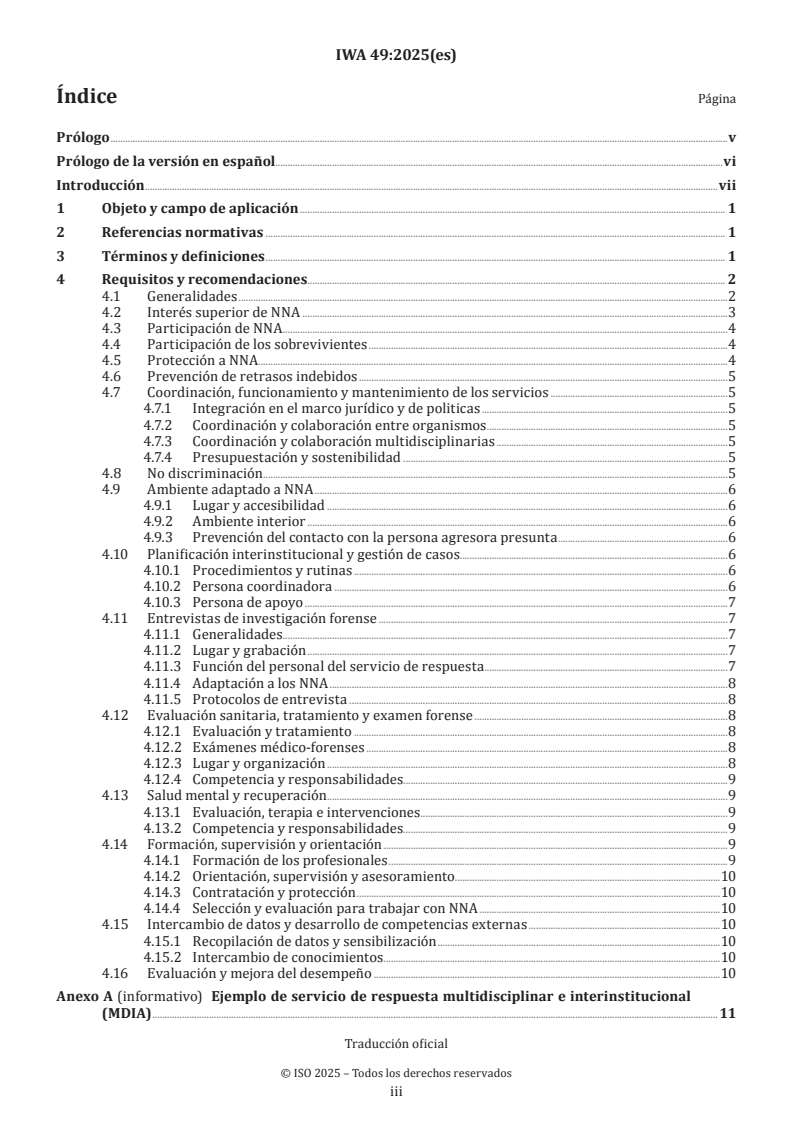
Índice Página
Prólogo .v
Prólogo de la versión en español.vi
Introducción .vii
1 Objeto y campo de aplicación . 1
2 Referencias normativas . 1
3 Términos y definiciones . 1
4 Requisitos y recomendaciones. 2
4.1 Generalidades .2
4.2 Interés superior de NNA .3
4.3 Participación de NNA .4
4.4 Participación de los sobrevivientes .4
4.5 Protección a NNA.4
4.6 Prevención de retrasos indebidos .5
4.7 Coordinación, funcionamiento y mantenimiento de los servicios .5
4.7.1 Integración en el marco jurídico y de politicas .5
4.7.2 Coordinación y colaboración entre organismos .5
4.7.3 Coordinación y colaboración multidisciplinarias .5
4.7.4 Presupuestación y sostenibilidad .5
4.8 No discriminación .5
4.9 Ambiente adaptado a NNA .6
4.9.1 Lugar y accesibilidad .6
4.9.2 Ambiente interior .6
4.9.3 Prevención del contacto con la persona agresora presunta .6
4.10 Planificación interinstitucional y gestión de casos.6
4.10.1 Procedimientos y rutinas .6
4.10.2 Persona coordinadora .6
4.10.3 Persona de apoyo .7
4.11 Entrevistas de investigación forense .7
4.11.1 Generalidades .7
4.11.2 Lugar y grabación .7
4.11.3 Función del personal del servicio de respuesta .7
4.11.4 Adaptación a los NNA .8
4.11.5 Protocolos de entrevista .8
4.12 Evaluación sanitaria, tratamiento y examen forense .8
4.12.1 Evaluación y tratamiento .8
4.12.2 Exámenes médico-forenses .8
4.12.3 Lugar y organización .8
4.12.4 Competencia y responsabilidades.9
4.13 Salud mental y recuperación .9
4.13.1 Evaluación, terapia e intervenciones .9
4.13.2 Competencia y responsabilidades.9
4.14 Formación, supervisión y orientación .9
4.14.1 Formación de los profesionales .9
4.14.2 Orientación, supervisión y asesoramiento.10
4.14.3 Contratación y protección .10
4.14.4 Selección y evaluación para trabajar con NNA .10
4.15 Intercambio de datos y desarrollo de competencias externas .10
4.15.1 Recopilación de datos y sensibilización .10
4.15.2 Intercambio de conocimientos .10
4.16 Evaluación y mejora del desempeño .10
Anexo A (informativo) Ejemplo de servicio de respuesta multidisciplinar e interinstitucional
(MDIA) .11
Traducción oficial
iii
Anexo B (informativo) Participantes del taller.12
Bibliografía.13
Traducción oficial
iv
Prólogo
ISO (Organización Internacional de Normalización) es una federación mundial de organismos nacionales
de normalización (organismos miembros de ISO). El trabajo de elaboración de las Normas Internacionales
se lleva a cabo normalmente a través de los comités técnicos de ISO. Cada organismo miembro interesado
en una materia para la cual se haya establecido un comité técnico, tiene el derecho de estar representado
en dicho comité. Las organizaciones internacionales, gubernamentales y no gubernamentales, vinculadas
con ISO, también participan en el trabajo. ISO colabora estrechamente con la Comisión Electrotécnica
Internacional (IEC) en todos los temas de normalización electrotécnica.
En la Parte 1 de las Directivas ISO/IEC se describen los procedimientos utilizados para desarrollar este
documento y aquellos previstos para su mantenimiento posterior. En particular debería tomarse nota de los
diferentes criterios de aprobación necesarios para los distintos tipos de documentos ISO. Este documento
ha sido redactado de acuerdo con las reglas editoriales de la Parte 2 de las Directivas ISO/IEC (véase
www.iso.org/directives).
ISO llama la atención sobre la posibilidad de que la implementación de este documento pueda conllevar el uso
de una o varias patentes. ISO no se posiciona respecto a la evidencia, validez o aplicabilidad de los derechos
de patente reivindicados. A la fecha de publicación de este documento, ISO no había recibido notificación
de que una o varias patentes pudieran ser necesarias para su implementación. No obstante, se advierte a
los usuarios que esta puede no ser la información más reciente, la cual puede obtenerse de la base de datos
de patentes disponible en www.iso.org/patents. ISO no será responsable de la identificación de parte o la
totalidad de dichos derechos de patente.
Cualquier nombre comercial utilizado en este documento es información que se proporciona para comodidad
del usuario y no constituye una recomendación.
Para una explicación de la naturaleza voluntaria de las normas, el significado de los términos específicos de
ISO y las expresiones relacionadas con la evaluación de la conformidad, así como la información acerca de la
adhesión de ISO a los principios de la Organización Mundial del Comercio (OMC) respecto a los Obstáculos
Técnicos al Comercio (OTC), véase www.iso.org/iso/foreword.html.
El Acuerdo de Taller Internacional IWA 49 fue aprobado en un taller organizado por Icelandic Standards
(IST), en asociación con Swedish Institute for Standards (SIS), celebrado en Reykjavik, Islandia, en octubre de
2024.
Cualquier comentario o pregunta sobre este documento deberían dirigirse al organismo nacional de
normalización del usuario. En www.iso.org/members.html se puede encontrar un listado completo de estos
organismos.
Traducción oficial
v
Prólogo de la versión en español
Este documento ha sido traducido por un Grupo de Trabajo Ad Hoc de traducción, en el que participan
representantes de los organismos nacionales de normalización y otras partes interesadas, para lograr la
unificación de la terminología en lengua española en el ámbito de los servicios de respuesta a niños, niñas y
adolescentes víctimas de violencia.
Este documento ha sido validado por el ISO/TMBG/Spanish Translation Management Group (STMG)
conformado por los siguientes países: Argentina, Bolivia, Chile, Colombia, Costa Rica, Cuba, Ecuador, El
Salvador, España, Guatemala, Honduras, República Dominicana, México, Panamá, Paraguay, Perú y Uruguay.
Traducción oficial
vi
Introducción
0.1 Antecedentes
Se estima que, en todo el mundo, hasta 1 000 millones de niños, niñas y adolescentes (en adelante NNA) de
[1]
entre 2 y 17 años han sido víctimas de violencia física, sexual o emocional, o de negligencia . Esto incluye
el castigo físico por parte de los cuidadores, el acoso escolar y la violencia física, emocional y sexual. Cada
cuatro minutos muere un niño, niña o adolescente a causa de la violencia en algún lugar del mundo. En
promedio, la violencia se cobra la vida de aproximadamente 130 000 NNA menores de 20 años cada año, y los
[2]
niños corren un mayor riesgo de morir por causas violentas que las niñas .
El Fondo de las Naciones Unidas para la Infancia (UNICEF) ha estimado que más de 1 000 millones de mujeres
y hombres vivos en 2024 fueron víctimas de violencia sexual cuando eran NNA. 650 millones (1 de cada 5)
de las niñas y mujeres vivas hoy en día han sido víctimas de violencia sexual durante su infancia. Entre ellas,
más de 370 millones (1 de cada 8) han sufrido violaciones o agresiones sexuales. En cuanto a los niños, entre
410 y 530 millones (1 de cada 7) han sido víctimas de violencia sexual durante la infancia. Esto incluye entre
[3]
240 y 310 millones (1 de cada 11) que han sufrido violaciones o agresiones sexuales .
Además, la tecnología tiene un impacto significativo en el bienestar de NNA, ya que ofrece tanto
oportunidades como riesgos. Si bien Internet facilita el aprendizaje, la interacción social y la creatividad,
también expone a NNA a peligros como el ciberacoso, la captación de menores de edad y la explotación
sexual, ya que los autores suelen utilizar las redes sociales y las plataformas de juegos en línea, los servicios
de transmisión en directo y las aplicaciones de mensajería cifrada para distribuir material de abuso sexual
[ )
de NNA 4 , solicitación y/o captación de menores de edad o participar en extorsión sexual.
A nivel mundial, 1 600 millones de NNA (2 de cada 3) sufren castigos violentos por parte de sus cuidadores en
el hogar. Entre ellos, más de dos tercios son objeto tanto de castigos físicos como de agresiones psicológicas,
como gritos e insultos. Casi 550 millones de NNA (1 de cada 4 en todo el mundo) viven con madres que son
[2]
víctimas de violencia doméstica, lo que los expone a riesgos y traumas adicionales .
«El impacto de la violencia es devastador, inmediato y dura toda la vida. La violencia contra NNA perjudica
[5]
su desarrollo cerebral, su salud física y mental y su capacidad de aprendizaje», según la referencia . Si bien
el proceso de justicia penal es una prioridad para la mayoría de los Estados, los NNA víctimas y testigos de
violencia tienen derecho a una respuesta integral que apoye su plena recuperación.
[6]
La Convención sobre los Derechos del Niño (CDN) de las Naciones Unidas y su Protocolo Facultativo sobre
[7]
la venta de niños, la prostitución infantil y la utilización de niños en la pornografía y el Convenio del Consejo
de Europa sobre la protección de los niños contra la explotación y el abuso sexual (Convenio de Lanzarote)
[8]
subrayan la obligación de los Estados partes de crear sistemas que protejan a NNA de todas las formas
de violencia y abuso y de adoptar medidas para promover su recuperación física y psicológica. El Comité
de los Derechos del Niño de las Naciones Unidas recomienda sistemáticamente a los Estados partes que
establezcan servicios adaptados a los NNA, multidisciplinarios e interinstitucionales para hacer frente a la
[9]
violencia contra NNA y asegurar que estos reciban un apoyo oportuno y eficaz .
Los servicios de respuesta multidisciplinar e interinstitucional (MDIA, por sus siglas en inglés) son una
piedra angular de los sistemas eficaces de protección de NNA. Los servicios de respuesta MDIA proporcionan
respuestas holísticas, centradas en NNA y adaptadas a sus necesidades ante la violencia y el abuso. Reúnen
bajo un mismo techo a profesionales del bienestar de NNA, la justicia penal y los ámbitos médico, terapéutico
y jurídico para ofrecer una respuesta coordinada y centrada en NNA.
En muchos contextos, la falta de integración entre estos servicios da lugar a un apoyo fragmentado e
incoherente a los NNA víctimas. Esto obliga a menudo a los NNA a navegar solos por sistemas complejos,
reviviendo su trauma al relatar sus experiencias varias veces a diferentes profesionales. La ausencia de un
enfoque centrado en NNA agrava la dificultad de revelar los hechos, especialmente en los casos de violencia
sexual, en los que los sentimientos de miedo, vergüenza y estigma ya constituyen obstáculos importantes.
Los servicios de respuesta MDIA contribuyen a reducir la revictimización de los NNA sometidos a explotación
[10]
o abuso sexual y de los NNA víctimas y sobrevivientes de violencia, evitando que repitan sus experiencias .
Estos servicios forman parte de un conjunto más amplio de mecanismos de protección de NNA que abordan
las necesidades de los NNA y sus familias a lo largo de todo el proceso de recuperación y protección.
Traducción oficial
vii
Los principios MDIA pueden adaptarse a una amplia gama de entornos de recursos y marcos de gobernanza,
manteniendo al mismo tiempo un enfoque centrado en NNA. El modelo Barnahus (Casa de NNA), desarrollado
en Islandia, por ejemplo, integra los servicios de bienestar de NNA, investigación criminal y médicos y
terapéuticos bajo un mismo techo, minimizando el riesgo de revictimización y asegurando una respuesta
coordinada. En 2015, el Comité de las Partes en la Convención para la Protección de los Niños contra la
Explotación Sexual y el Abuso Sexual (el Comité de Lanzarote) reconoció el modelo Barnahus (Casa de NNA)
[11]
como una práctica prometedora .
Los Centros de Defensa de los NNA de los Estados Unidos hacen hincapié en la colaboración multidisciplinar
y ofrecen ambientes amigables para las entrevistas, los exámenes médicos y la terapia. En los países con
menos recursos, las iniciativas comunitarias de respuesta a las denuncias de delitos contra NNA demuestran
la flexibilidad del modelo, que se basa en la participación de la comunidad para prestar los servicios,
[9]
asegurando la accesibilidad y la pertinencia cultural .
La promoción y la aplicación de los servicios de respuesta MDIA están en estrecha consonancia con los
Objetivos de Desarrollo Sostenible (ODS), en particular el Objetivo 16, que tiene por objetivo promover
sociedades pacíficas e inclusivas, proporcionar acceso a la justicia para todos y crear instituciones eficaces
y responsables. En concreto, los servicios de respuesta MDIA contribuyen a la meta 16.2, que busca poner
fin al abuso, la explotación, la trata y todas las formas de violencia contra NNA, así como a la meta 16.3,
que se centra en promover el estado de derecho y asegurar la igualdad de acceso a la justicia. Al fomentar
respuestas coordinadas y centradas en los NNA, los servicios de respuesta MDIA también se cruzan con
el ODS 5, que tiene como objetivo lograr la igualdad de género y empoderar a todas las mujeres y niñas,
abordando las dimensiones de género de la violencia y apoyando a las sobrevivientes, así como con otros
objetivos de los ODS relacionados con la violencia contra NNA.
Los esfuerzos para establecer y ampliar los servicios de respuesta MDIA han sido apoyados por diversas
organizaciones internacionales y regionales.
El Comité de los Derechos del Niño de las Naciones Unidas recomienda que los Estados partes establezcan
servicios de respuesta MDIA.
Como parte de su compromiso fundamental de fortalecer los sistemas integrales de protección de NNA,
UNICEF ha promovido sistemáticamente servicios amigables, integrados y multidisciplinarios para NNA
víctimas y testigos de la violencia en todo el mundo. Estos esfuerzos están diseñados para fomentar enfoques
coordinados y centrados en los NNA que aborden las complejas necesidades de NNA de manera integral.
[ )
La Unión Europea, en su Estrategia sobre los Derechos del Niño 12 , también ha destacado la urgencia de
presentar una iniciativa destinada a apoyar el desarrollo y el fortalecimiento de sistemas integrados de
protección de NNA, que fomente una mejor colaboración entre todas las autoridades y servicios pertinentes,
en un sistema que sitúe a NNA en el centro.
El Consejo de Europa promueve el modelo Barnahus (Casa de NNA) desde 2015 y ha estado ayudando a sus
Estados miembros a establecer y ampliar los servicios existentes con miras a proporcionar a NNA acceso a
[13]
una justicia adaptada a sus necesidades .
El Consejo de los Estados del Mar Báltico ha promovido el modelo Barnahus (Casa de NNA) desde 2015,
centrándose en el desarrollo de capacidades, la elaboración de normas y la cooperación internacional para
mejorar los enfoques amigables y multidisciplinarios en los casos de abuso de NNA. Estos esfuerzos dieron
[14] [15]
lugar a la creación de las Normas de Calidad Barnahus y formalizaron la Red Barnahus , una plataforma
dirigida por sus miembros que conecta a profesionales y responsables políticos de toda Europa. La red apoya
el establecimiento y el funcionamiento del modelo Barnahus (Casa de NNA), promueve las mejores prácticas,
facilita la formación y fomenta la colaboración transfronteriza para reforzar los servicios de respuesta MDIA
a nivel mundial.
El presente documento reconoce las contribuciones de todas estas organizaciones y otras que han apoyado
y promovido los servicios de respuesta MDIA a nivel mundial, al tiempo que subraya la necesidad de seguir
colaborando para ampliar dichos servicios a nivel mundial.
Traducción oficial
viii
0.2 Uso de este documento
Este documento tiene por objeto establecer una base de referencia mundial coherente para la creación
y la prestación de servicios de respuesta MDIA, basada en el consenso de los principales expertos y
organizaciones que han participado en su redacción y en las buenas prácticas aplicadas en todo el mundo.
Puede utilizarse junto con las normas pertinentes de las Naciones Unidas, además de las normas locales,
regionales o mundiales.
Este documento está diseñado para asegurar la igualdad y la equidad en la prestación de servicios de
respuesta MDIA en todo el mundo. Si bien constituyen una base de aplicación universal, este documento
también reconoce su adaptabilidad como condición necesaria que permite a los gobiernos y a las partes
interesadas contextualizar el modelo para adaptarlo a entornos jurídicos, culturales y sociales específicos.
Más allá de esta base, se alienta a los Estados y a otros actores a innovar y ampliar estos requisitos y
recomendaciones para alcanzar los más altos niveles de calidad y eficacia de los servicios.
El objetivo de este documento es su aplicación a nivel mundial, asegurando que los requisitos y
recomendaciones descritos sean pertinentes y aplicables a diversos contextos geográficos, desde entornos
con abundantes recursos hasta aquellos con capacidades más limitadas.
Este documento sirve de recurso para los esfuerzos de colaboración, ya sean liderados únicamente por
organizaciones gubernamentales o en asociación con organizaciones no gubernamentales. También está
destinado a organizaciones internacionales, organismos de supervisión, partes interesadas y organismos o
proveedores de servicios para NNA víctimas de violencia.
Véase el Anexo B para obtener información sobre entidades participantes en el taller para la elaboración de
este documento.
Traducción oficial
ix
Acuerdo De Taller Internacional IWA 49:2025(es)
Servicios de respuesta multidisciplinar e interinstitucional
adaptados a niños, niñas y adolescentes (NNA) víctimas de
violencia — Requisitos y recomendaciones
1 Objeto y campo de aplicación
Este documento establece requisitos y recomendaciones para los servicios de respuesta multidisciplinar
e interinstitucional (MDIA) adaptados a niños, niñas y adolescentes (NNA) que son víctimas de violencia.
Proporciona un marco holístico para la colaboración MDIA con el fin de asegurar que NNA reciban una
respuesta adaptada a sus necesidades, profesional y eficaz en un ambiente seguro.
2 Referencias normativas
No hay referencias normativas en este documento.
3 Términos y definiciones
Para los fines de este documento, se aplican los siguientes términos y definiciones.
ISO e IEC mantienen bases de datos terminológicas para su utilización en la normalización en las siguientes
direcciones:
— Plataformas de búsqueda en línea de ISO: disponible en http:// ww .iso .org/ obp
— Electropedia de IEC: disponible en https:// www .electropedia .org/
3.1
niño, niña y adolescente
NNA
persona menor de 18 años
Nota 1 a la entrada: Adaptado de la referencia [16].
3.2
madre, padre o persona cuidadora
persona o personas con responsabilidad parental, de conformidad con la legislación nacional
Nota 1 a la entrada: En caso de que las madres, padres o personas cuidadoras estén ausentes o hayan perdido la
responsabilidad parental, puede tratarse de un tutor o un representante legal designado.
Nota 2 a la entrada: Adaptado de la referencia [16].
3.3
violencia
todas las formas de violencia física o mental, lesión o abuso, abandono o trato negligente, maltrato o
explotación, incluido el abuso sexual
Nota 1 a la entrada: Esto incluye todo tipo de daños no intencionados, incluido el hecho de que NNA sean testigo de
actos violentos.
Nota 2 a la entrada: Adaptado de la referencia [17].
Traducción oficial
3.4
víctima
niño, niña o adolescente afectado por la violencia, incluidos NNA que han sido testigo de actos violentos,
independientemente de su situación jurídica y de que hayan sido reconocidos como víctima de un delito por
un sistema jurídico
3.5
sobreviviente
persona que ha sido afectada por la violencia durante su etapa como NNA, independientemente de su
situación jurídica y de su reconocimiento como víctima de un delito por un sistema jurídico
Nota 1 a la entrada: Los sobrevivientes pueden identificarse con el término «víctima» o «superviviente» u otro término.
Por lo tanto, es importante utilizar el término que prefiera la persona con la que se interactúa. Véase la referencia [18].
3.6
adaptado a NNA
cualquier comportamiento, conducta, práctica, proceso, actitud, ambiente o trato que sea humano,
considerado, adaptado al nivel de madurez y comprensión de NNA y que redunde en su interés superior, de
modo que el niño, niña o adolescente se sienta seguro, protegido, comprendido y activamente involucrado
3.7
servicio de respuesta multidisciplinar e interinstitucional
servicio de respuesta MDIA
mecanismo establecido y coordinado para intervenir, ayudar, proteger y responder a las necesidades de NNA
afectados por la violencia, que se coordina entre diferentes organismos a través de una estructura formal y
consiste en una combinación de varias disciplinas o especializaciones profesionales o en la participación de
estas
Nota 1 a la entrada: Una respuesta multidisciplinar puede estar regulada, por ejemplo, por procedimientos operativos
estándar (SOP, por sus siglas en inglés) conjuntos o directrices prácticas.
Nota 2 a la entrada: La estructura formal para la coordinación y la cooperación interinstitucional puede establecerse,
entre otras cosas, mediante una ley, una política, un acuerdo de colaboración u otro marco de cooperación acordado.
Nota 3 a la entrada: Los organismos implicados pueden incluir ministerios competentes, instituciones públicas y
entidades privadas y no gubernamentales pertinentes.
Nota 4 a la entrada: El mecanismo de respuesta MDIA está activo durante las investigaciones y procedimientos
relacionados con la protección de NNA, el bienestar y la justicia penal.
3.8
perspectiva informada sobre el trauma
práctica basada en y dirigida por una comprensión completa de cómo la exposición al trauma afecta el
desarrollo neurológico, biológico, psicológico y social de las personas
4 Requisitos y recomendaciones
4.1 Generalidades
Los servicios de respuesta MDIA se deben basar en los cuatro principios generales de la CDN de Naciones
[6]
Unidas . Estos son:
— no discriminación (artículo 2 de la CDN);
— el interés superior de NNA (artículo 3 de la CDN);
— el derecho a la supervivencia y al desarrollo (artículo 6 de la CDN);
— el derecho a la participación (artículo 12 de la CDN).
Traducción oficial
Los servicios de respuesta MDIA también deberían defender el derecho a la recuperación y la reintegración
(artículo 39), asegurando que NNA víctimas de violencia reciban apoyo para recuperar su salud, su
autoestima y su dignidad, y se reintegren en sus comunidades.
Los servicios de respuesta MDIA deben proteger el interés superior de NNA durante la investigación y la
tramitación de los casos de violencia contra NNA.
Los servicios de respuesta MDIA deben proporcionar un apoyo integral y coordinado a NNA antes, durante
y después de las investigaciones penales y de protección y bienestar de NNA. La gestión de los casos y
las evaluaciones individuales de cada niño, niña o adolescente deben coordinarse por profesionales de
la protección de NNA e incluir evaluaciones exhaustivas del interés superior del niño, niña o adolescente
(véase 4.2). Los NNA y, cuando proceda, sus madres, padres, personas cuidadoras y los miembros de su
familia deberían recibir información y actualizaciones periódicas sobre su caso
...