

ISO 24212:2024
(Main)Remediation techniques applied at contaminated sites
General Information
- Abstract
This document provides requirements and guidance on key aspects of remediation techniques. It describes the principles, main characteristics, advantages and limitations to be considered in the selection within an option appraisal of individual or combinations of in situ and on-site remediation techniques, including: — the type of contaminants to be dealt with; — current and/or intended site use; — local legal, policy, socio-economic and environmental contexts. This document is applicable to the remediation of contaminated sites, i.e. where soil, or soil gas, ambient air or groundwater are contaminated. It identifies which phase/matrix can be targeted by a technique, e.g. fluid (groundwater, gas, non-aqueous phase liquid) or solid, and which contaminant it can applied to. This document also provides information on hazards that can be associated with the implementation of remediation. This document does not provide: — an exhaustive list of remediation techniques; — guidance on sites contaminated with radioactive substances, pathogenic or infectious agents, or “pyrotechnic devices” (e.g. unexploded ordnances); — guidance on ex situ techniques that are set up off-site; — a framework that covers all individual situations, or prescribes which technique(s) to use in a specific context.
- Status
- Published
- Publication Date
- 19-Sep-2024
- Technical Committee
- ISO/TC 190/SC 7 - Impact assessment
- Drafting Committee
- ISO/TC 190/SC 7/WG 10 - Contaminated site assessment
- Current Stage
- 6060 - International Standard published
- Start Date
- 20-Sep-2024
- Due Date
- 13-Sep-2024
- Completion Date
- 20-Sep-2024
Buy Documents

ISO 24212:2024 - Remediation techniques applied at contaminated sites Released:20. 09. 2024

ISO 24212:2024 - Techniques de dépollution appliquées aux sites pollués Released:20. 09. 2024
Overview
ISO 24212:2024 - Remediation techniques applied at contaminated sites provides requirements and guidance for selecting and implementing in situ and on-site remediation techniques. The standard covers principles, main characteristics, advantages and limitations of remediation options for contaminated soil, soil gas, ambient air and groundwater, and identifies which phase or matrix (fluid or solid; e.g. groundwater, gas, NAPL) and which contaminants each technique can target. It also addresses hazards and risk management during remediation and good practice for strategy appraisal, testing and monitoring.
Key technical topics and requirements
- Remediation strategy appraisal: Good-practice steps for identifying feasible strategies, evaluating options and selecting a final remediation strategy based on site objectives and constraints.
- Selection criteria: Consideration of contaminant type, current/intended site use, and local legal, policy, socio‑economic and environmental contexts.
- Technique descriptions: Structured summaries of common approaches (examples included in the standard):
- In situ chemical oxidation (ISCO)
- In situ chemical reduction (ISCR)
- Enhanced in situ bioremediation (EISB)
- Monitored natural attenuation (MNA)
- Incineration
- In situ thermal remediation (ISTR)
Each technique entry covers principle, scope/applicability, technology description, design considerations, key monitoring parameters, advantages/limitations, EHS aspects and compatible combinations.
- Hazard and risk management: Identification and controls for hazards related to contaminated media, asbestos, dust, odours, contaminated waste, equipment, unexpected finds (including UXO), ground stability, confined spaces, chemicals, manual tasks, noise and long‑term monitoring.
- Testing and validation: Emphasis on laboratory testing and pilot tests to verify effectiveness and refine design before full-scale implementation.
- Limitations and exclusions: Not exhaustive; excludes guidance for radioactive, pathogenic/infectious agents, and pyrotechnic devices (e.g. unexploded ordnance) remediation; and does not cover off‑site (ex situ) techniques established off-site.
Practical applications
ISO 24212 is designed to support:
- Option appraisal and technique selection during site investigation and remediation planning
- Design consideration and monitoring program development for on-site and in situ remediation projects
- EHS planning and risk assessment during remediation implementation Use cases include brownfield redevelopment, groundwater clean‑ups, industrial site remediation and long‑term management of contaminated land.
Who should use this standard
- Environmental consultants and remediation engineers
- Site owners and developers
- Regulatory agencies and permitting authorities
- Environmental health & safety (EHS) professionals
- Project managers overseeing contaminated site remediation
Related standards
ISO 24212 complements national guidance and other ISO standards on environmental management, site investigation and contaminated-land frameworks. It should be used alongside local regulatory requirements and technical guidance for detailed design, permitting and health‑and‑safety compliance.
Relations
- Consolidates
EN ISO 24212:2024 - Remediation techniques applied at contaminated sites (ISO 24212:2024) - Effective Date
- 12-Feb-2026
- Effective Date
- 06-Jun-2022
Buy Documents
ISO 24212:2024 - Remediation techniques applied at contaminated sites Released:20. 09. 2024
ISO 24212:2024 - Techniques de dépollution appliquées aux sites pollués Released:20. 09. 2024
Get Certified
Connect with accredited certification bodies for this standard

CIS Institut d.o.o.
Personal Protective Equipment (PPE) certification body. Notified Body NB-2890 for EU Regulation 2016/425 PPE.

Kiwa BDA Testing
Building and construction product certification.
Kmetijski inštitut Slovenije
Agricultural Institute of Slovenia. Soil testing, plant health, agricultural product analysis.
Sponsored listings
Frequently Asked Questions
ISO 24212:2024 is a standard published by the International Organization for Standardization (ISO). Its full title is "Remediation techniques applied at contaminated sites". This standard covers: This document provides requirements and guidance on key aspects of remediation techniques. It describes the principles, main characteristics, advantages and limitations to be considered in the selection within an option appraisal of individual or combinations of in situ and on-site remediation techniques, including: — the type of contaminants to be dealt with; — current and/or intended site use; — local legal, policy, socio-economic and environmental contexts. This document is applicable to the remediation of contaminated sites, i.e. where soil, or soil gas, ambient air or groundwater are contaminated. It identifies which phase/matrix can be targeted by a technique, e.g. fluid (groundwater, gas, non-aqueous phase liquid) or solid, and which contaminant it can applied to. This document also provides information on hazards that can be associated with the implementation of remediation. This document does not provide: — an exhaustive list of remediation techniques; — guidance on sites contaminated with radioactive substances, pathogenic or infectious agents, or “pyrotechnic devices” (e.g. unexploded ordnances); — guidance on ex situ techniques that are set up off-site; — a framework that covers all individual situations, or prescribes which technique(s) to use in a specific context.
This document provides requirements and guidance on key aspects of remediation techniques. It describes the principles, main characteristics, advantages and limitations to be considered in the selection within an option appraisal of individual or combinations of in situ and on-site remediation techniques, including: — the type of contaminants to be dealt with; — current and/or intended site use; — local legal, policy, socio-economic and environmental contexts. This document is applicable to the remediation of contaminated sites, i.e. where soil, or soil gas, ambient air or groundwater are contaminated. It identifies which phase/matrix can be targeted by a technique, e.g. fluid (groundwater, gas, non-aqueous phase liquid) or solid, and which contaminant it can applied to. This document also provides information on hazards that can be associated with the implementation of remediation. This document does not provide: — an exhaustive list of remediation techniques; — guidance on sites contaminated with radioactive substances, pathogenic or infectious agents, or “pyrotechnic devices” (e.g. unexploded ordnances); — guidance on ex situ techniques that are set up off-site; — a framework that covers all individual situations, or prescribes which technique(s) to use in a specific context.
ISO 24212:2024 is classified under the following ICS (International Classification for Standards) categories: 13.080.01 - Soil quality and pedology in general. The ICS classification helps identify the subject area and facilitates finding related standards.
ISO 24212:2024 has the following relationships with other standards: It is inter standard links to EN ISO 24212:2024, ISO 4378-2:2017. Understanding these relationships helps ensure you are using the most current and applicable version of the standard.
ISO 24212:2024 is available in PDF format for immediate download after purchase. The document can be added to your cart and obtained through the secure checkout process. Digital delivery ensures instant access to the complete standard document.
Standards Content (Sample)
International
Standard
ISO 24212
First edition
Remediation techniques applied at
2024-09
contaminated sites
Techniques de dépollution appliquées aux sites pollués
Reference number
© ISO 2024
All rights reserved. Unless otherwise specified, or required in the context of its implementation, no part of this publication may
be reproduced or utilized otherwise in any form or by any means, electronic or mechanical, including photocopying, or posting on
the internet or an intranet, without prior written permission. Permission can be requested from either ISO at the address below
or ISO’s member body in the country of the requester.
ISO copyright office
CP 401 • Ch. de Blandonnet 8
CH-1214 Vernier, Geneva
Phone: +41 22 749 01 11
Email: copyright@iso.org
Website: www.iso.org
Published in Switzerland
ii
Contents Page
Foreword .viii
Introduction .ix
1 Scope . 1
2 Normative references . 1
3 Terms and definitions . 1
4 Abbreviated terms . 3
5 Overview . 5
5.1 Structure of this document .5
5.2 Generic concepts associated with remediation .6
6 Good practice for carrying out a strategies appraisal prior to implementing remediation
strategy . 8
6.1 General .8
6.2 Identifying feasible remediation strategies .9
6.3 Detailed evaluation of strategies appraisal .9
6.4 Selecting the final remediation strategy .11
7 Generic recommendations for the selection of remediation techniques .11
7.1 General .11
7.2 Considering the site’s context . 12
7.3 Remediation set up on-site . 13
7.4 Techniques prerequistes . 13
7.5 Techniques collateral effects .14
7.6 Laboratory testing and pilot tests.14
8 Generic recommendations for managing hazards and risks during remediation . 14
8.1 General .14
8.2 Risk management process . 15
8.2.1 General . 15
8.2.2 Hazards and controls associated with contaminated soil and groundwater . 15
8.2.3 Asbestos .16
8.2.4 Dust .16
8.2.5 Offensive or noxious odours .16
8.2.6 Contaminated waste .16
8.2.7 Remediation equipment .16
8.2.8 Unexpected finds .17
8.2.9 Long-term monitoring .17
8.2.10 Outdoor work .17
8.2.11 Remote or isolated working .17
8.2.12 Underground services and pipelines .17
8.2.13 Ground stability .18
8.2.14 Excavations .18
8.2.15 Unexploded ordnance (UXO) .18
8.2.16 Confined space .18
8.2.17 Hazardous chemicals and dangerous goods .18
8.2.18 Hazardous manual tasks .19
8.2.19 Slips, trips and falls .19
8.2.20 Plant and equipment .19
8.2.21 Noise .19
9 Remediation techniques description .20
9.1 In situ chemical oxidation (ISCO) . . 20
9.1.1 Technique principle . 20
9.1.2 Scope and applicability of the technique (operating window) . 20
9.1.3 Technology description . 20
iii
9.1.4 Design considerations and dimensioning . 20
9.1.5 Key monitoring parameters .21
9.1.6 Advantages and limitations .21
9.1.7 Specific EHS aspects . .21
9.1.8 Other techniques or containment approaches that can be combined with the
technique . 22
9.2 In situ chemical reduction (ISCR) . 22
9.2.1 Technique principle . 22
9.2.2 Scope and applicability of the technique . 22
9.2.3 Technology description . 22
9.2.4 Design considerations and dimensioning . 22
9.2.5 Key monitoring parameters . 22
9.2.6 Advantages and limitations . 23
9.2.7 Specific EHS aspects . . 23
9.2.8 Other techniques that can be combined with the technique . 23
9.3 Enhanced in situ bioremediation (EISB) . 23
9.3.1 Technique principle . 23
9.3.2 Scope and applicability of the technique (operating window) . 23
9.3.3 Description of technology .24
9.3.4 Design considerations and dimensioning .24
9.3.5 Key monitoring parameters .24
9.3.6 Advantages and limitations .24
9.3.7 Specific EHS aspects . . 25
9.3.8 Other techniques or containment approaches that can be combined with the
technique . 25
9.4 Monitored natural attenuation (MNA) . 25
9.4.1 Technique principle . 25
9.4.2 Scope and applicability of the technique (operating window) . 25
9.4.3 Description of technology . 25
9.4.4 Design considerations and dimensioning . 25
9.4.5 Key monitoring parameters . 25
9.4.6 Advantages and limitations . 26
9.4.7 Specific EHS aspects . . 26
9.4.8 Other techniques or containment approaches that can be combined with the
technique . 26
9.5 Incineration . 26
9.5.1 Technique principle . 26
9.5.2 Scope and applicability of the technique . 26
9.5.3 Technology description . 26
9.5.4 Design considerations and dimensioning .27
9.5.5 Key monitoring parameters .27
9.5.6 Advantages and limitations .27
9.5.7 Specific EHS aspects . . 28
9.5.8 Other techniques or containment approaches that can be combined with the
technique . 28
9.6 In situ thermal remediation (ISTR) . 28
9.6.1 Technique principle . 28
9.6.2 Scope and applicability of the technique (operating window) . 28
9.6.3 Description of technology . 28
9.6.4 Design consideration and dimensioning . 29
9.6.5 Key monitoring parameters . 29
9.6.6 Advantages and limits . 29
9.6.7 Specific EHS aspects . . 30
9.6.8 Other techniques or containment approaches that can be combined with the
technique . 30
9.7 On-site thermal desorption . 30
9.7.1 Technique principle . 30
9.7.2 Scope and applicability of the technique (operating window) . 30
9.7.3 Technology description . 30
iv
9.7.4 Design considerations and dimensioning . 30
9.7.5 Key monitoring parameters .31
9.7.6 Advantages and limits .31
9.7.7 Specific EHS aspects . .31
9.7.8 Other techniques or containment approaches that can be combined with the
technique .31
9.8 Soil vapour extraction (SVE) .31
9.8.1 Technique principle .31
9.8.2 Scope and applicability of the technique (operating window) .32
9.8.3 Technology description .32
9.8.4 Design and dimensioning considerations .32
9.8.5 Key monitoring parameters .32
9.8.6 Advantages and limits . 33
9.8.7 Specific EHS aspects . . 33
9.8.8 Other techniques or containment approaches that can be combined with the
technique . 33
9.9 Air-sparging . 33
9.9.1 Technique principle . 33
9.9.2 Scope and applicability of the technique (operating window) . 33
9.9.3 Technology description . 34
9.9.4 Design considerations and dimensioning . 34
9.9.5 Key monitoring parameters . 34
9.9.6 Advantages and limits . 34
9.9.7 Specific EHS aspects . . 34
9.9.8 Other techniques or containment approaches that can be combined with the
technique . 34
9.10 Multi-phase extraction (MPE) . 35
9.10.1 Technique principle . 35
9.10.2 Scope and applicability of the technique (operating window) . 35
9.10.3 Technology description . 35
9.10.4 Design considerations and dimensioning . 35
9.10.5 Key monitoring parameters . 35
9.10.6 Advantages and limitations . 36
9.10.7 Specific EHS aspects . . 36
9.10.8 Other techniques or containment approaches that can be combined with the
technique . 36
9.11 Dual pump liquid extraction (DPLE) . 36
9.11.1 Technique principle . 36
9.11.2 Scope and applicability of the technique (operating window) . 36
9.11.3 Technology description .37
9.11.4 Design considerations and dimensioning .37
9.11.5 Key monitoring parameters .37
9.11.6 Advantages and limitations .37
9.11.7 Specific EHS aspects . .37
9.11.8 Other techniques or containment approaches that can be combined with the
technique .37
9.12 Hydraulic techniques for groundwater remediation . 38
9.12.1 Technique principle . 38
9.12.2 Scope and applicability of the technique (operating window) . 38
9.12.3 Technology description . 38
9.12.4 Design considerations and dimensioning . 38
9.12.5 Key monitoring parameters . 39
9.12.6 Advantages and limitations . 39
9.12.7 Specific EHS aspects . . 39
9.12.8 Other techniques or containment approaches that can be combined with the
technique . 39
9.13 Soil washing . 39
9.13.1 Technique principle . 39
9.13.2 Scope and applicability of the technique (operating window) . 39
v
9.13.3 Technology description . 40
9.13.4 Design and dimensioning considerations . 40
9.13.5 Key monitoring parameters . 40
9.13.6 Advantages and limitations . 40
9.13.7 Specific EHS aspects . . 40
9.13.8 Other techniques or containment approaches that can be combined with the
technique .41
9.14 Biopiling .41
9.14.1 Technique principle .41
9.14.2 Scope and applicability of the technique (operating window) .41
9.14.3 Technology description .41
9.14.4 Design considerations and dimensioning .41
9.14.5 Advantages and limitations .42
9.14.6 Key monitoring parameters .42
9.14.7 Specific EHS aspect .42
9.14.8 Other techniques or containment approaches that can be combined with the
technique .42
9.15 Landfarming .43
9.15.1 Technique principle .43
9.15.2 Scope and applicability of the technique (operating window) .43
9.15.3 Technology description .43
9.15.4 Design considerations and dimensioning .43
9.15.5 Key monitoring parameters . 44
9.15.6 Advantages and limitations . 44
9.15.7 Specific EHS aspects . . 44
9.15.8 Other techniques or containment approaches that can be combined with the
technique . 44
9.16 Vertical barrier technologies (VBT) . 44
9.16.1 Technique principle . 44
9.16.2 Scope and applicability of the technique .45
9.16.3 Technology description .45
9.16.4 Design considerations and dimensioning .45
9.16.5 Key monitoring parameters .45
9.16.6 Advantages and limitations .45
9.16.7 Specific EHS aspects . . 46
9.16.8 Other techniques or containment approaches that can be combined with the
technique . 46
9.17 Cover systems . . 46
9.17.1 Technique principle . 46
9.17.2 Scope and applicability of the technique . 46
9.17.3 Technology description .47
9.17.4 Design considerations and dimensioning .47
9.17.5 Key monitoring parameters . 48
9.17.6 Avantages and limitations . 48
9.17.7 Specific EHS aspects . . 48
9.18 Permeable reactive barrier (PRB) systems . 49
9.18.1 Technique principle . 49
9.18.2 Scope and applicability of the technique (operating window) . 49
9.18.3 Technology description . 49
9.18.4 Design considerations and dimensioning . 49
9.18.5 Key monitoring parameters . 49
9.18.6 Advantages and limits . 50
9.18.7 Specific EHS aspects . . 50
9.18.8 Possible combination with other techniques and technique variations . 50
9.19 Immobilisation techniques for soil and solid materials . 50
9.19.1 Technique principle . 50
9.19.2 Scope and applicability of the technique (operating window) . 50
9.19.3 Technology description .51
9.19.4 Design and dimensioning considerations .51
vi
9.19.5 Key monitoring parameters .52
9.19.6 Advantages and limitations .52
9.19.7 Specific EHS aspects . . 53
9.19.8 Other techniques or containment approaches that can be combined with the
technique . 53
9.20 Excavation . 53
9.20.1 Technique principle . 53
9.20.2 Scope and applicability of the technique (operating window) . 53
9.20.3 Description of technology . 53
9.20.4 Design considerations and dimensioning . 53
9.20.5 Key monitoring parameters . 54
9.20.6 Advantages and limitations . 54
9.20.7 Specific EHS aspects . . 54
9.20.8 Other techniques or containment approaches that can be combined with the
technique . 54
9.21 Off-gas treatment technologies and wastewater treatment technologies . 54
9.21.1 General . 54
9.21.2 Carbon adsorption . 55
9.21.3 Off-gas treatment technologies . 55
9.21.4 Wastewater treatment technologies .
...
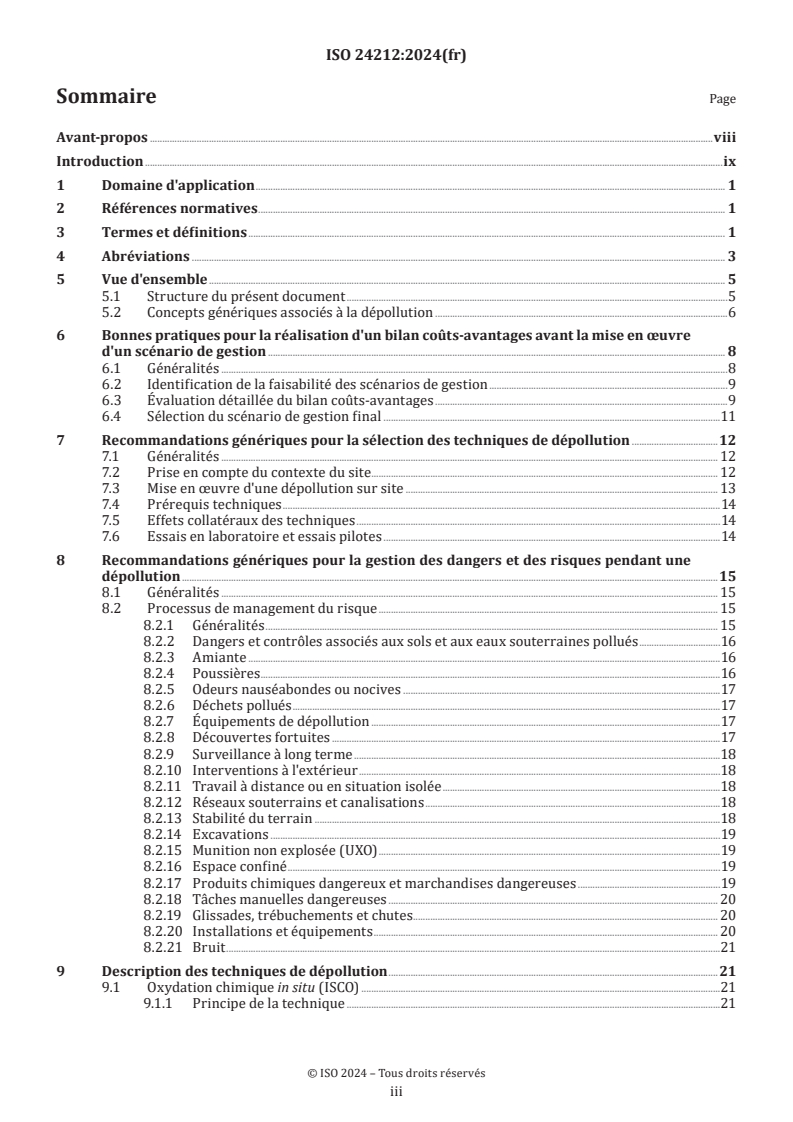
Norme
internationale
ISO 24212
Première édition
Techniques de dépollution
2024-09
appliquées aux sites pollués
Remediation techniques applied at contaminated sites
Numéro de référence
DOCUMENT PROTÉGÉ PAR COPYRIGHT
© ISO 2024
Tous droits réservés. Sauf prescription différente ou nécessité dans le contexte de sa mise en œuvre, aucune partie de cette
publication ne peut être reproduite ni utilisée sous quelque forme que ce soit et par aucun procédé, électronique ou mécanique,
y compris la photocopie, ou la diffusion sur l’internet ou sur un intranet, sans autorisation écrite préalable. Une autorisation peut
être demandée à l’ISO à l’adresse ci-après ou au comité membre de l’ISO dans le pays du demandeur.
ISO copyright office
Case postale 401 • Ch. de Blandonnet 8
CH-1214 Vernier, Genève
Tél.: +41 22 749 01 11
E-mail: copyright@iso.org
Web: www.iso.org
Publié en Suisse
ii
Sommaire Page
Avant-propos .viii
Introduction .ix
1 Domaine d'application . 1
2 Références normatives . 1
3 Termes et définitions . 1
4 Abréviations . 3
5 Vue d'ensemble . 5
5.1 Structure du présent document .5
5.2 Concepts génériques associés à la dépollution .6
6 Bonnes pratiques pour la réalisation d'un bilan coûts-avantages avant la mise en œuvre
d'un scénario de gestion . 8
6.1 Généralités .8
6.2 Identification de la faisabilité des scénarios de gestion .9
6.3 Évaluation détaillée du bilan coûts-avantages .9
6.4 Sélection du scénario de gestion final .11
7 Recommandations génériques pour la sélection des techniques de dépollution .12
7.1 Généralités . 12
7.2 Prise en compte du contexte du site . 12
7.3 Mise en œuvre d'une dépollution sur site . 13
7.4 Prérequis techniques .14
7.5 Effets collatéraux des techniques .14
7.6 Essais en laboratoire et essais pilotes .14
8 Recommandations génériques pour la gestion des dangers et des risques pendant une
dépollution .15
8.1 Généralités . 15
8.2 Processus de management du risque . 15
8.2.1 Généralités . 15
8.2.2 Dangers et contrôles associés aux sols et aux eaux souterraines pollués .16
8.2.3 Amiante .16
8.2.4 Poussières .16
8.2.5 Odeurs nauséabondes ou nocives .17
8.2.6 Déchets pollués .17
8.2.7 Équipements de dépollution .17
8.2.8 Découvertes fortuites .17
8.2.9 Surveillance à long terme .18
8.2.10 Interventions à l'extérieur .18
8.2.11 Travail à distance ou en situation isolée .18
8.2.12 Réseaux souterrains et canalisations .18
8.2.13 Stabilité du terrain .18
8.2.14 Excavations .19
8.2.15 Munition non explosée (UXO) .19
8.2.16 Espace confiné .19
8.2.17 Produits chimiques dangereux et marchandises dangereuses .19
8.2.18 Tâches manuelles dangereuses . 20
8.2.19 Glissades, trébuchements et chutes . 20
8.2.20 Installations et équipements . 20
8.2.21 Bruit .21
9 Description des techniques de dépollution .21
9.1 Oxydation chimique in situ (ISCO) .21
9.1.1 Principe de la technique .21
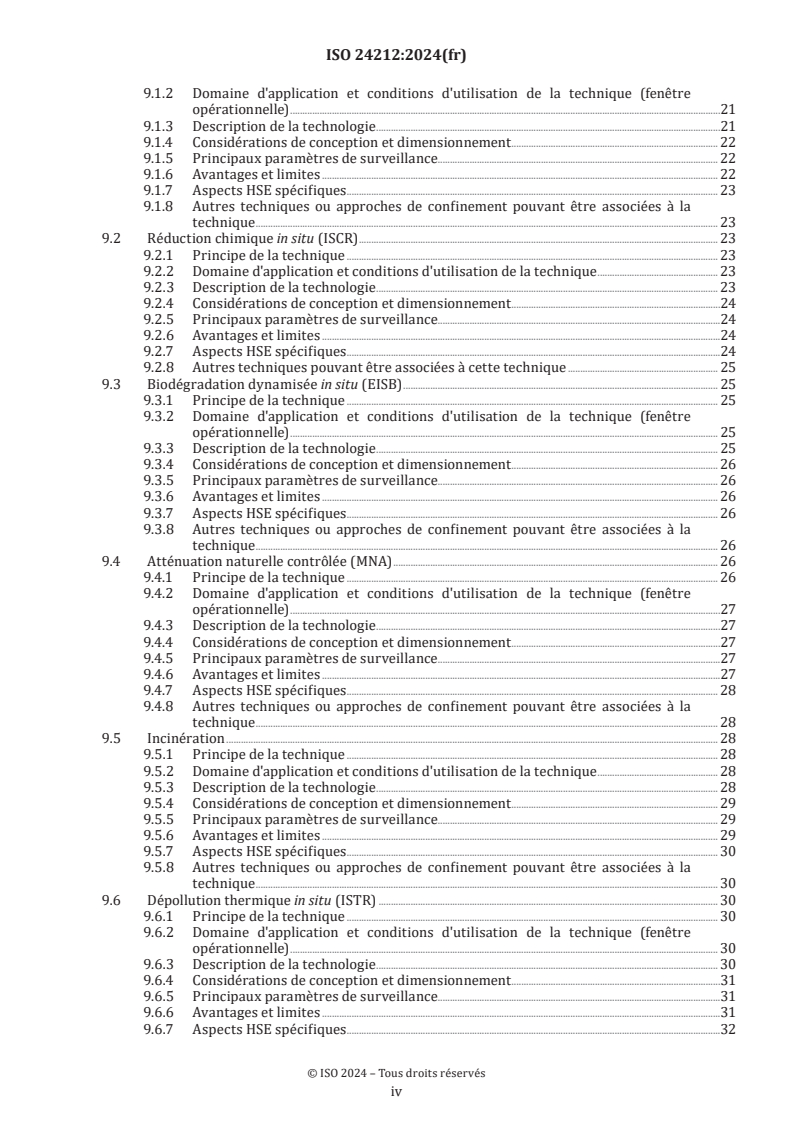
iii
9.1.2 Domaine d'application et conditions d'utilisation de la technique (fenêtre
opérationnelle) .21
9.1.3 Description de la technologie .21
9.1.4 Considérations de conception et dimensionnement . 22
9.1.5 Principaux paramètres de surveillance. 22
9.1.6 Avantages et limites . 22
9.1.7 Aspects HSE spécifiques . 23
9.1.8 Autres techniques ou approches de confinement pouvant être associées à la
technique . 23
9.2 Réduction chimique in situ (ISCR) . 23
9.2.1 Principe de la technique . 23
9.2.2 Domaine d'application et conditions d'utilisation de la technique . 23
9.2.3 Description de la technologie . 23
9.2.4 Considérations de conception et dimensionnement .24
9.2.5 Principaux paramètres de surveillance.24
9.2.6 Avantages et limites .24
9.2.7 Aspects HSE spécifiques .24
9.2.8 Autres techniques pouvant être associées à cette technique . 25
9.3 Biodégradation dynamisée in situ (EISB) . 25
9.3.1 Principe de la technique . 25
9.3.2 Domaine d'application et conditions d'utilisation de la technique (fenêtre
opérationnelle) . 25
9.3.3 Description de la technologie . 25
9.3.4 Considérations de conception et dimensionnement . 26
9.3.5 Principaux paramètres de surveillance. 26
9.3.6 Avantages et limites . 26
9.3.7 Aspects HSE spécifiques . 26
9.3.8 Autres techniques ou approches de confinement pouvant être associées à la
technique . 26
9.4 Atténuation naturelle contrôlée (MNA) . 26
9.4.1 Principe de la technique . 26
9.4.2 Domaine d'application et conditions d'utilisation de la technique (fenêtre
opérationnelle) .27
9.4.3 Description de la technologie .27
9.4.4 Considérations de conception et dimensionnement .27
9.4.5 Principaux paramètres de surveillance.27
9.4.6 Avantages et limites .27
9.4.7 Aspects HSE spécifiques . . 28
9.4.8 Autres techniques ou approches de confinement pouvant être associées à la
technique . 28
9.5 Incinération . 28
9.5.1 Principe de la technique . 28
9.5.2 Domaine d'application et conditions d'utilisation de la technique . 28
9.5.3 Description de la technologie . 28
9.5.4 Considérations de conception et dimensionnement . 29
9.5.5 Principaux paramètres de surveillance. 29
9.5.6 Avantages et limites . 29
9.5.7 Aspects HSE spécifiques . 30
9.5.8 Autres techniques ou approches de confinement pouvant être associées à la
technique . 30
9.6 Dépollution thermique in situ (ISTR) . 30
9.6.1 Principe de la technique . 30
9.6.2 Domaine d'application et conditions d'utilisation de la technique (fenêtre
opérationnelle) . 30
9.6.3 Description de la technologie . 30
9.6.4 Considérations de conception et dimensionnement .31
9.6.5 Principaux paramètres de surveillance.31
9.6.6 Avantages et limites .31
9.6.7 Aspects HSE spécifiques .32
iv
9.6.8 Autres techniques ou approches de confinement pouvant être associées à la
technique .32
9.7 Désorption thermique sur site .32
9.7.1 Principe de la technique .32
9.7.2 Domaine d'application et conditions d'utilisation de la technique (fenêtre
opérationnelle) .32
9.7.3 Description de la technologie .32
9.7.4 Considérations de conception et dimensionnement .32
9.7.5 Principaux paramètres de surveillance. 33
9.7.6 Avantages et limites . 33
9.7.7 Aspects HSE spécifiques . 33
9.7.8 Autres techniques ou approches de confinement pouvant être associées à la
technique . 34
9.8 Ventilation de la zone non saturée (SVE) . 34
9.8.1 Principe de la technique . 34
9.8.2 Domaine d'application et conditions d'utilisation de la technique (fenêtre
opérationnelle) . 34
9.8.3 Description de la technologie . 34
9.8.4 Considérations de conception et dimensionnement . 34
9.8.5 Principaux paramètres de surveillance. 35
9.8.6 Avantages et limites . 35
9.8.7 Aspects HSE spécifiques . 35
9.8.8 Autres techniques ou approches de confinement pouvant être associées à la
technique . 36
9.9 Barbotage in situ (sparging) . 36
9.9.1 Principe de la technique . 36
9.9.2 Domaine d'application et conditions d'utilisation de la technique (fenêtre
opérationnelle) . 36
9.9.3 Description de la technologie . 36
9.9.4 Considérations de conception et dimensionnement . 36
9.9.5 Principaux paramètres de surveillance.37
9.9.6 Avantages et limites .37
9.9.7 Aspects HSE spécifiques .37
9.9.8 Autres techniques ou approches de confinement pouvant être associées à la
technique .37
9.10 Extraction multi-phases (MPE) .37
9.10.1 Principe de la technique .37
9.10.2 Domaine d'application et conditions d'utilisation de la technique (fenêtre
opérationnelle) . 38
9.10.3 Description de la technologie . 38
9.10.4 Considérations de conception et dimensionnement . 38
9.10.5 Principaux paramètres de surveillance. 38
9.10.6 Avantages et limites . 39
9.10.7 Aspects HSE spécifiques . 39
9.10.8 Autres techniques ou approches de confinement pouvant être associées à la
technique . 39
9.11 Pompage-écrémage (DPLE) . 39
9.11.1 Principe de la technique . 39
9.11.2 Domaine d'application et conditions d'utilisation de la technique (fenêtre
opérationnelle) . 39
9.11.3 Description de la technologie . 39
9.11.4 Considérations de conception et dimensionnement . 40
9.11.5 Principaux paramètres de surveillance. 40
9.11.6 Avantages et limites . 40
9.11.7 Aspects HSE spécifiques . . 40
9.11.8 Autres techniques ou approches de confinement pouvant être associées à la
technique . 40
9.12 Techniques hydrauliques pour la dépollution des eaux souterraines .41
9.12.1 Principe de la technique .41
v
9.12.2 Domaine d'application et conditions d'utilisation de la technique (fenêtre
opérationnelle) .41
9.12.3 Description de la technologie .41
9.12.4 Considérations de conception et dimensionnement .41
9.12.5 Principaux paramètres de surveillance.42
9.12.6 Avantages et limites .42
9.12.7 Aspects HSE spécifiques .42
9.12.8 Autres techniques ou approches de confinement pouvant être associées à la
technique .42
9.13 Lavage de sol .42
9.13.1 Principe de la technique .42
9.13.2 Domaine d'application et conditions d'utilisation de la technique (fenêtre
opérationnelle) .43
9.13.3 Description de la technologie .43
9.13.4 Considérations de conception et dimensionnement .43
9.13.5 Principaux paramètres de surveillance.43
9.13.6 Avantages et limites . 44
9.13.7 Aspects HSE spécifiques . 44
9.13.8 Autres techniques ou approches de confinement pouvant être associées à la
technique . 44
9.14 Biotertre . 44
9.14.1 Principe de la technique . 44
9.14.2 Domaine d'application et conditions d'utilisation de la technique (fenêtre
opérationnelle) . 44
9.14.3 Description de la technologie . 44
9.14.4 Considérations de conception et dimensionnement .45
9.14.5 Avantages et limites .45
9.14.6 Principaux paramètres de surveillance. 46
9.14.7 Aspects HSE spécifiques . 46
9.14.8 Autres techniques ou approches de confinement pouvant être associées à la
technique . 46
9.15 Landfarming . 46
9.15.1 Principe de la technique . 46
9.15.2 Domaine d'application et conditions d'utilisation de la technique (fenêtre
opérationnelle) . 46
9.15.3 Description de la technologie . 46
9.15.4 Considérations de conception et dimensionnement .47
9.15.5 Principaux paramètres de surveillance.47
9.15.6 Avantages et limites .47
9.15.7 Aspects HSE spécifiques . 48
9.15.8 Autres techniques ou approches de confinement pouvant être associées à la
technique . 48
9.16 Technologies à barrière verticale (VBT) . 48
9.16.1 Principe de la technique . 48
9.16.2 Domaine d'application et conditions d'utilisation de la technique . 48
9.16.3 Description de la technologie . 48
9.16.4 Considérations de conception et dimensionnement . 49
9.16.5 Principaux paramètres de surveillance. 49
9.16.6 Avantages et limites . 49
9.16.7 Aspects HSE spécifiques . 50
9.16.8 Autres techniques ou approches de confinement pouvant être associées à la
technique . 50
9.17 Systèmes de confinement par couverture du sol . 50
9.17.1 Principe de la technique . 50
9.17.2 Domaine d'application et conditions d'utilisation de la technique . 50
9.17.3 Description de la technologie .51
9.17.4 Considérations de conception et dimensionnement .51
9.17.5 Principaux paramètres de surveillance.52
9.17.6 Avantages et limites .52
vi
9.17.7 Aspects HSE spécifiques . 53
9.18 Systèmes de barrière perméable réactive (BPR) . 53
9.18.1 Principe de la technique . 53
9.18.2 Domaine d'application et conditions d'utilisation de la technique (fenêtre
opérationnelle) . 53
9.18.3 Description de la technologie . 53
9.18.4 Considérations de conception et dimensionnement . 53
9.18.5 Principaux paramètres de surveillance. 54
9.18.6 Avantages et limites . 54
9.18.7 Aspects HSE spécifiques . . 54
9.18.8 Combinaison possible avec d'autres techniques et variantes de techniques . 54
9.19 Techniques de stabilisation/solidification du sol et des matériaux solides . 54
9.19.1 Principe de la technique . 54
9.19.2 Domaine d'application et conditions d'utilisation de la technique (fenêtre
opérationnelle) . 55
9.19.3 Description de la technologie . 55
9.19.4 Considérations de conception et dimensionnement . 56
9.19.5 Principaux paramètres de surveillance. 56
9.19.6 Avantages et limites .57
9.19.7 Aspects HSE spécifiques .57
9.19.8 Autres techniques ou approches de confinement pouvant être associées à la
technique .57
9.20 Excavation . 58
9.20.1 Principe de la technique . 58
9.20.2 Domaine d'application et conditions d'utilisation de la technique (fenêtre
opérationnelle) . 58
9.20.3 Description de la technologie . 58
9.20.4 Considérations de conception et dimensionnement . 58
9.20.5 Principaux paramètres de surveillance.59
9.20.6 Avantages et limites .59
9.20.7 Aspects HSE spécifiques .
...