

ISO 4179:2024
(Main)Ductile iron pipes and fittings for pressure and non-pressure pipelines — Cement mortar lining
General Information
- Abstract
This document specifies the nature, the method of application, the surface condition, performance requirements and the minimum thickness of internal linings of cement mortar for ductile iron pipes and fittings for pressure and non-pressure pipelines as defined in ISO 2531, ISO 7186 and ISO 16631. It covers cement mortar linings which are used to improve the hydraulic properties of pipes and fittings compared to un-lined pipes and fittings and/or to prevent corrosion damage and includes special requirements for linings of gravity sewers operating partially filled. It also covers linings used for the conveyance of particularly aggressive fluids, where the following solutions can be used either separately or in combination: a) an increase in the thickness of the lining; b) a change of the type of cement; c) a coating over the lining.
- Status
- Published
- Publication Date
- 04-Feb-2024
- Technical Committee
- ISO/TC 5/SC 2 - Cast iron pipes, fittings and their joints
- Drafting Committee
- ISO/TC 5/SC 2 - Cast iron pipes, fittings and their joints
- Current Stage
- 6060 - International Standard published
- Start Date
- 05-Feb-2024
- Due Date
- 16-Nov-2023
- Completion Date
- 05-Feb-2024
Overview - ISO 4179:2024, Cement mortar lining for ductile iron pipes
ISO 4179:2024 specifies requirements for cement mortar linings applied to ductile iron pipes and fittings for both pressure and non‑pressure pipelines. The standard defines the nature and method of application, surface preparation, performance tests, curing, and minimum lining thickness. It addresses linings used to improve hydraulic properties, protect against corrosion, and includes special provisions for gravity sewers and for conveying particularly aggressive fluids (through thicker linings, cement type changes, or additional coatings).
Key topics and technical requirements
- Scope and applicability: Covers ductile iron pipes/fittings as defined in ISO 2531, ISO 7186 and ISO 16631.
- Materials: Requirements for cement, aggregates, and mixing water; hygienic certificates required for drinking‑water applications.
- Mortar composition and additives: Definitions and declaration requirements for admixtures and additives; manufacturer control of aggregate/cement and water/cement ratios.
- Surface preparation: Removal of foreign bodies, loose scale and metal projections before lining to ensure adhesion and correct thickness.
- Application methods: Centrifugal and projection methods for pipes and projection, hand or moulding for fittings; control of consistency and application parameters to avoid cavities/air bubbles.
- Curing and seal coats: Controlled curing to achieve performance; seal coat optional but must comply with ISO 16132 and not contaminate transported water.
- Thickness and geometry: Minimum lining thickness, internal diameter measurement and methods for determining lining thickness are specified.
- Performance and testing: New/updated tests include checks for organic impurities, silt/clay in aggregates, compressive strength, ring bending test for disbonding, and visual appearance; additional requirements for sewer applications.
- Quality assurance: Manufacturer QA documentation and routine/performance tests described (Annex A).
Practical applications and users
ISO 4179:2024 is essential for:
- Manufacturers of ductile iron pipes and fittings implementing cement mortar linings.
- Design and pipeline engineers specifying linings for potable water, sewerage, and industrial pipelines.
- Water utilities, sewer operators and contractors selecting linings to improve flow and corrosion resistance.
- Coating suppliers, testing laboratories and quality assurance teams responsible for compliance testing (compressive strength, disbonding checks, impurity tests).
- Regulators and procurement teams writing technical specifications and acceptance criteria.
Using ISO 4179 helps ensure consistent lining quality, predictable hydraulic performance, and long‑term corrosion protection for ductile iron pipeline systems.
Related standards
- ISO 2531, ISO 7186, ISO 16631 (ductile iron pipe definitions)
- ISO 16132 (seal coats)
- ISO 679 (cement test methods)
- ISO 21051 (construction and installation)
Relations
- Effective Date
- 06-Jun-2022
Get Certified
Connect with accredited certification bodies for this standard

Element Materials Technology
Materials testing and product certification.

Inštitut za kovinske materiale in tehnologije
Institute of Metals and Technology. Materials testing, metallurgical analysis, NDT.
Institut za varilstvo d.o.o. (Welding Institute)
Slovenia's leading welding institute since 1952. ISO 3834, EN 1090, pressure equipment certification, NDT personnel, welder qualification. Only IIW Au
Sponsored listings
Frequently Asked Questions
ISO 4179:2024 is a standard published by the International Organization for Standardization (ISO). Its full title is "Ductile iron pipes and fittings for pressure and non-pressure pipelines — Cement mortar lining". This standard covers: This document specifies the nature, the method of application, the surface condition, performance requirements and the minimum thickness of internal linings of cement mortar for ductile iron pipes and fittings for pressure and non-pressure pipelines as defined in ISO 2531, ISO 7186 and ISO 16631. It covers cement mortar linings which are used to improve the hydraulic properties of pipes and fittings compared to un-lined pipes and fittings and/or to prevent corrosion damage and includes special requirements for linings of gravity sewers operating partially filled. It also covers linings used for the conveyance of particularly aggressive fluids, where the following solutions can be used either separately or in combination: a) an increase in the thickness of the lining; b) a change of the type of cement; c) a coating over the lining.
This document specifies the nature, the method of application, the surface condition, performance requirements and the minimum thickness of internal linings of cement mortar for ductile iron pipes and fittings for pressure and non-pressure pipelines as defined in ISO 2531, ISO 7186 and ISO 16631. It covers cement mortar linings which are used to improve the hydraulic properties of pipes and fittings compared to un-lined pipes and fittings and/or to prevent corrosion damage and includes special requirements for linings of gravity sewers operating partially filled. It also covers linings used for the conveyance of particularly aggressive fluids, where the following solutions can be used either separately or in combination: a) an increase in the thickness of the lining; b) a change of the type of cement; c) a coating over the lining.
ISO 4179:2024 is classified under the following ICS (International Classification for Standards) categories: 23.040.10 - Iron and steel pipes; 77.140.75 - Steel pipes and tubes for specific use. The ICS classification helps identify the subject area and facilitates finding related standards.
ISO 4179:2024 has the following relationships with other standards: It is inter standard links to ISO 4179:2005. Understanding these relationships helps ensure you are using the most current and applicable version of the standard.
ISO 4179:2024 is available in PDF format for immediate download after purchase. The document can be added to your cart and obtained through the secure checkout process. Digital delivery ensures instant access to the complete standard document.
Standards Content (Sample)
International
Standard
ISO 4179
Fourth edition
Ductile iron pipes and fittings
2024-02
for pressure and non-pressure
pipelines — Cement mortar lining
Tuyaux et raccords en fonte ductile pour canalisations avec et
sans pression — Revêtement interne de mortier de ciment
Reference number
© ISO 2024
All rights reserved. Unless otherwise specified, or required in the context of its implementation, no part of this publication may
be reproduced or utilized otherwise in any form or by any means, electronic or mechanical, including photocopying, or posting on
the internet or an intranet, without prior written permission. Permission can be requested from either ISO at the address below
or ISO’s member body in the country of the requester.
ISO copyright office
CP 401 • Ch. de Blandonnet 8
CH-1214 Vernier, Geneva
Phone: +41 22 749 01 11
Email: copyright@iso.org
Website: www.iso.org
Published in Switzerland
ii
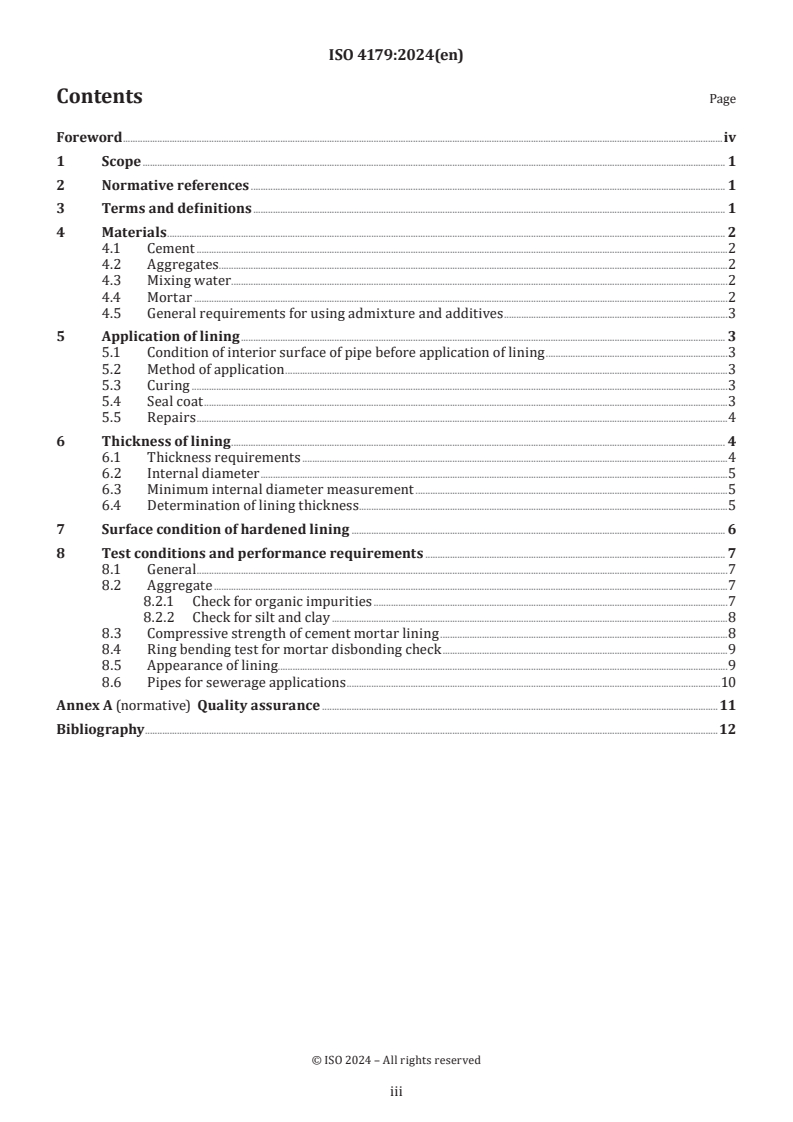
Contents Page
Foreword .iv
1 Scope . 1
2 Normative references . 1
3 Terms and definitions . 1
4 Materials . 2
4.1 Cement .2
4.2 Aggregates . . .2
4.3 Mixing water.2
4.4 Mortar .2
4.5 General requirements for using admixture and additives .3
5 Application of lining . 3
5.1 Condition of interior surface of pipe before application of lining .3
5.2 Method of application .3
5.3 Curing .3
5.4 Seal coat .3
5.5 Repairs .4
6 Thickness of lining . 4
6.1 Thickness requirements .4
6.2 Internal diameter .5
6.3 Minimum internal diameter measurement .5
6.4 Determination of lining thickness .5
7 Surface condition of hardened lining . 6
8 Test conditions and performance requirements . 7
8.1 General .7
8.2 Aggregate .7
8.2.1 Check for organic impurities .7
8.2.2 Check for silt and clay .8
8.3 Compressive strength of cement mortar lining .8
8.4 Ring bending test for mortar disbonding check .9
8.5 Appearance of lining.9
8.6 Pipes for sewerage applications .10
Annex A (normative) Quality assurance .11
Bibliography .12
iii
Foreword
ISO (the International Organization for Standardization) is a worldwide federation of national standards
bodies (ISO member bodies). The work of preparing International Standards is normally carried out through
ISO technical committees. Each member body interested in a subject for which a technical committee
has been established has the right to be represented on that committee. International organizations,
governmental and non-governmental, in liaison with ISO, also take part in the work. ISO collaborates closely
with the International Electrotechnical Commission (IEC) on all matters of electrotechnical standardization.
The procedures used to develop this document and those intended for its further maintenance are described
in the ISO/IEC Directives, Part 1. In particular, the different approval criteria needed for the different types
of ISO document should be noted. This document was drafted in accordance with the editorial rules of the
ISO/IEC Directives, Part 2 (see www.iso.org/directives).
ISO draws attention to the possibility that the implementation of this document may involve the use of (a)
patent(s). ISO takes no position concerning the evidence, validity or applicability of any claimed patent
rights in respect thereof. As of the date of publication of this document, ISO had not received notice of (a)
patent(s) which may be required to implement this document. However, implementers are cautioned that
this may not represent the latest information, which may be obtained from the patent database available at
www.iso.org/patents. ISO shall not be held responsible for identifying any or all such patent rights.
Any trade name used in this document is information given for the convenience of users and does not
constitute an endorsement.
For an explanation of the voluntary nature of standards, the meaning of ISO specific terms and expressions
related to conformity assessment, as well as information about ISO's adherence to the World Trade
Organization (WTO) principles in the Technical Barriers to Trade (TBT), see www.iso.org/iso/foreword.html.
This document was prepared by Technical Committee ISO/TC 5, Ferrous metal pipes and metallic fittings,
Subcommittee SC 2, Cast iron pipes, fittings and their joints.
This fourth edition cancels and replaces the third edition (ISO 4179:2005), which has been technically
revised.
The main changes are as follows:
— definitions of additives and admixtures have been added;
— the following tests and performance requirements have been introduced:
a) check for organic impurities;
b) check for silt and clay;
c) compressive strength of cement mortar lining;
d) ring bending test for mortar disbanding;
— the requirement of internal diameter of pipe has been added;
— the list of performance test and routine tests has been added.
Any feedback or questions on this document should be directed to the user’s national standards body. A
complete listing of these bodies can be found at www.iso.org/members.html.
iv
International Standard ISO 4179:2024(en)
Ductile iron pipes and fittings for pressure and non-pressure
pipelines — Cement mortar lining
1 Scope
This document specifies the nature, the method of application, the surface condition, performance
requirements and the minimum thickness of internal linings of cement mortar for ductile iron pipes and
fittings for pressure and non-pressure pipelines as defined in ISO 2531, ISO 7186 and ISO 16631.
It covers cement mortar linings which are used to improve the hydraulic properties of pipes and fittings
compared to un-lined pipes and fittings and/or to prevent corrosion damage and includes special
requirements for linings of gravity sewers operating partially filled.
It also covers linings used for the conveyance of particularly aggressive fluids, where the following solutions
can be used either separately or in combination:
a) an increase in the thickness of the lining;
b) a change of the type of cement;
c) a coating over the lining.
2 Normative references
The following documents are referred to in the text in such a way that some or all of their content constitutes
requirements of this document. For dated references, only the edition cited applies. For undated references,
the latest edition of the referenced document (including any amendments) applies.
ISO 679, Cement — Test methods — Determination of strength
ISO 2531:2009, Ductile iron pipes, fittings, accessories and their joints for water applications
ISO 7186:2011, Ductile iron products for sewerage applications
ISO 10803:2011, Design method for ductile iron pipes
ISO 16132, Ductile iron pipes and fittings — Seal coats for cement mortar linings
ISO 16631:2016, Ductile iron pipes, fittings, accessories and their joints compatible with plastic (PVC or PE)
piping systems, for water applications and for plastic pipeline connections, repair and replacement
ISO 21051:2020, Construction and installation of ductile iron pipeline system
ISO 20290-5, Aggregates for concrete — Test methods for mechanical and physical properties — Part 5:
Determination of particle size distribution by sieving method
EN 545:2010, Ductile iron pipes, fittings, accessories and their joints for water pipelines – Requirements and test
methods
3 Terms and definitions
For the purposes of this document, the following terms and definitions apply.
ISO and IEC maintain terminology databases for use in standardization at the following addresses:
— ISO Online browsing platform: available at https:// www .iso .org/ obp
— IEC Electropedia: available at https:// www .electropedia .org/
3.1
additives
finely divided mineral material (e.g. ground granulated blast furnace slag, coal fly ash, ground limestone,
silica fume, mineral fillers and metakaolin, mineral pigments) or polymeric material used in order to
improve certain properties of fresh mortar or hardened lining or that can be added to cement mortar in
order to achieve specific properties
3.2
admixtures
organic or inorganic material added during the mixing process of mortar in a quantity not more than 5 % of
dry matter by mass of the cement content of the mortar to modify the properties of the mix in the fresh and/
or hardened state
Note 1 to entry: Admixtures in cement mortar is used to enhance properties of the mortar in terms of plasticizing, set
accelerating, workability etc. meeting the requirements of this document.
4 Materials
4.1 Cement
The cement used for the lining shall comply with the cement standard(s) in application in the country of pipe
manufacture or equivalent ISO standard.
Unless otherwise specified, the type of cement shall be selected by the manufacturer in order to be suitable
for the nature of the fluid to be transported in accordance with ISO 2531:2009, Annex B, ISO 7186:2011,
Annex B and ISO 16631:2016, Annex B.
4.2 Aggregates
The aggregate is a granular mineral constituent suitable for use in cementitious mortar. Aggregate can be
natural, artificial or recycled from material previously used in construction. The aggregate shall have a
controlled granulometric distribution from fine particles (sand) to coarser elements (gravel).
The aggregate shall meet requirements for materials in contact with drinking water when lining used for
drinking water applications.
4.3 Mixing water
The water used for the preparation of the mortar shall be either potable water or water free from substances
deleterious either to the mortar or to the water to be transported in the pipeline. The presence of solid
mineral particles is, however, admissible provided that the above-mentioned requirements are still fulfilled.
Existing national hygienic requirements shall be complied with.
4.4 Mortar
The fresh mortar of the lining shall be composed of cement, aggregates and water complying with 4.1, 4.2
and 4.3 respectively.
The respective proportions of aggregates and water to cement shall be selected and controlled by the
manufacturer in order to achieve compliance with this document. The methods of determination of the
ratios aggregates/cement and water/cement shall be specified by the manufacturer.
Manufacturers shall submit the hygienic certificate of mortar meeting the requirement of ISO 2531:2009,
4.1.4 for the material in contact with water intended for human consumption, in case the pipes are to be
used for water application.
4.5 General requirements for using admixture and additives
In case the admixture(s) and additives have been used by the manufacturer, the same shall be declared
along with the quality assurance plan and applicable hygienic certificate meeting the requirement of
ISO 2531:2009, 4.1.4 for materials in contact with water intended for human consumption, in case the pipes
are to be used for water application.
5 Application of lining
5.1 Condition of interior surface of pipe before application of lining
All foreign bodies, Ioose scale or any other material which can be detrimental to good adhesion between the
metal and the lining shall be removed from the surface to which the lining shall be applied.
The inner surface of the pipe and fitting shall also be free of any metal projections, which can affect the
thickness of the lining.
5.2 Method of application
The mortar shall be thoroughly mixed in order to achieve the appropriate consistency and homogeneity.
For pipes, the mortar is applied inside the pipes by depositing or spraying the mortar on the inner surface
of the pipes, which are rotated at the required rpm to ensure the desirable centrifugal force for adhesion of
the mortar onto the pipe surface (centrifugal method). Manufacturers may also use projection method or
a combination of the two to achieve the desired properties meeting the requirement of this document. For
fittings, the mortar is projected onto the wall by means of a rotating projection head or may be placed by
hand or moulding using appropriate trowels.
Apart from the inner surface of the socket, the parts of the pipe or fitting coming in contact with the
transported water shall be entirely covere
...