

ISO 3856-3:1984
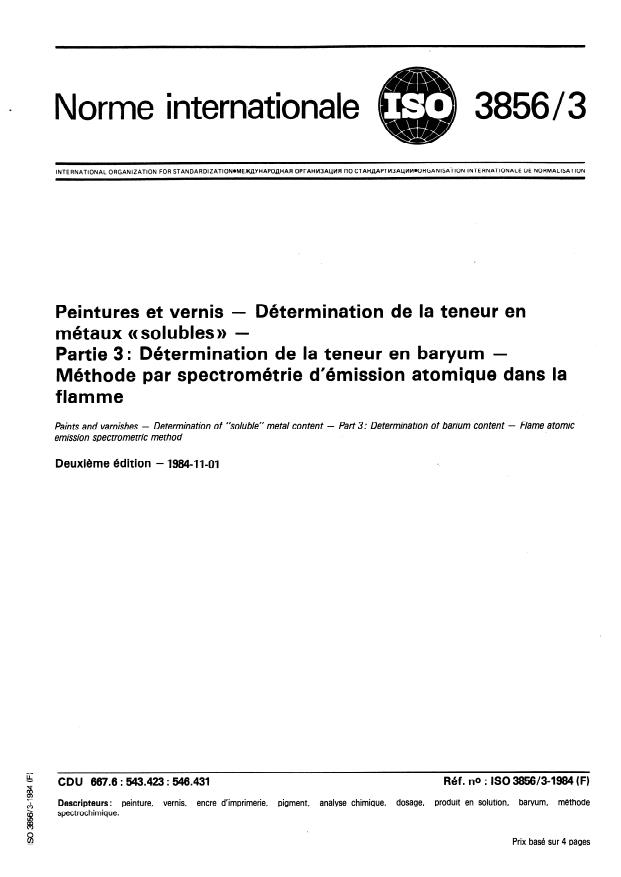
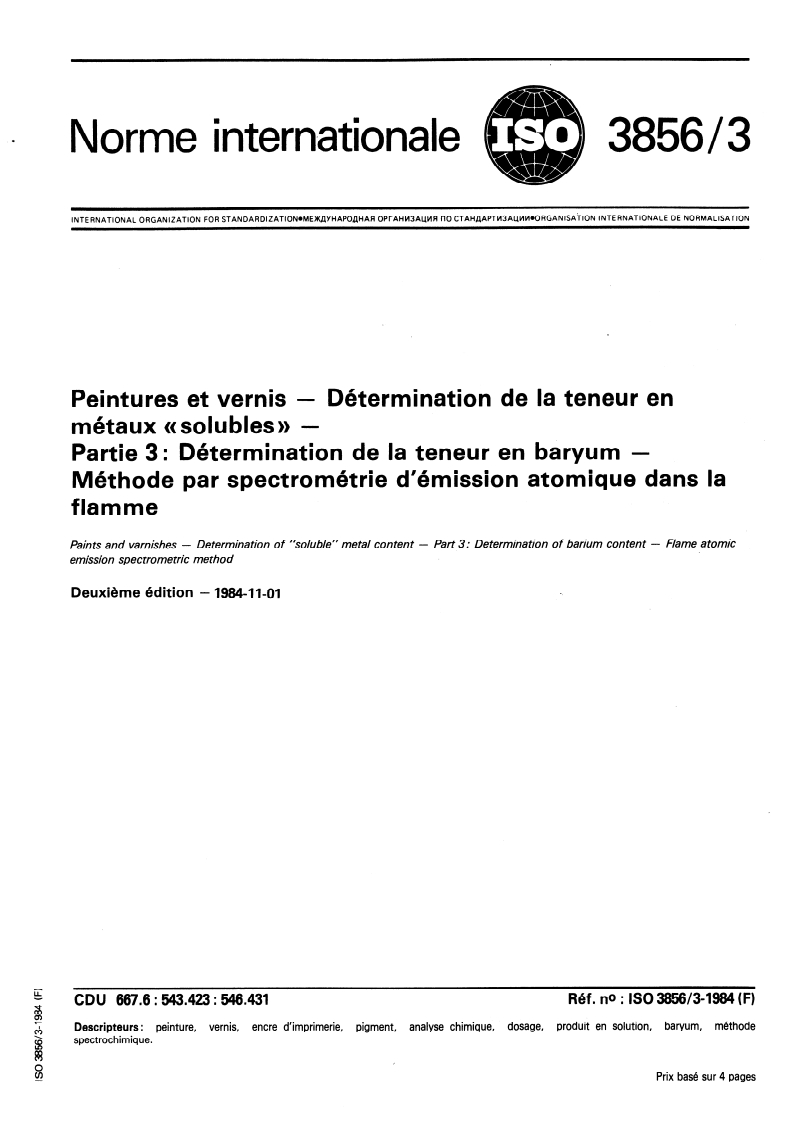
(Main)Paints and varnishes — Determination of "soluble" metal content — Part 3: Determination of barium content — Flame atomic emission spectrometric method
General Information
- Abstract
The principle consists in the aspiration of the test solution into a dinitrogen monoxide/acetylene flame. Measurement of the radiation emitted by barium at a wavelength of 553,5 nm. The ionization of barium atoms in the flame is suppressed by addition of potassium chloride. The method is applicable to coating materials having "soluble" barium contents in the range of about 0,05 % (m/m) to 5 % (m/m). This method is the referee method in cases of dispute. This second edition cancels and replaces ISO 3856/3-1980, of which it constitutes a thorough revision.
- Status
- Published
- Publication Date
- 30-Sep-1984
- Technical Committee
- ISO/TC 256 - Pigments, dyestuffs and extenders
- Drafting Committee
- ISO/TC 256 - Pigments, dyestuffs and extenders
- Current Stage
- 9093 - International Standard confirmed
- Start Date
- 06-Mar-2023
- Completion Date
- 29-Aug-2026
Buy Documents
ISO 3856-3:1984 - Paints and varnishes -- Determination of "soluble" metal content
ISO 3856-3:1984 - Paints and varnishes — Determination of "soluble" metal content — Part 3: Determination of barium content — Flame atomic emission spectrometric method/1/1984
ISO 3856-3:1984 - Peintures et vernis -- Détermination de la teneur en métaux "solubles"
ISO 3856-3:1984 - Peintures et vernis -- Détermination de la teneur en métaux "solubles"
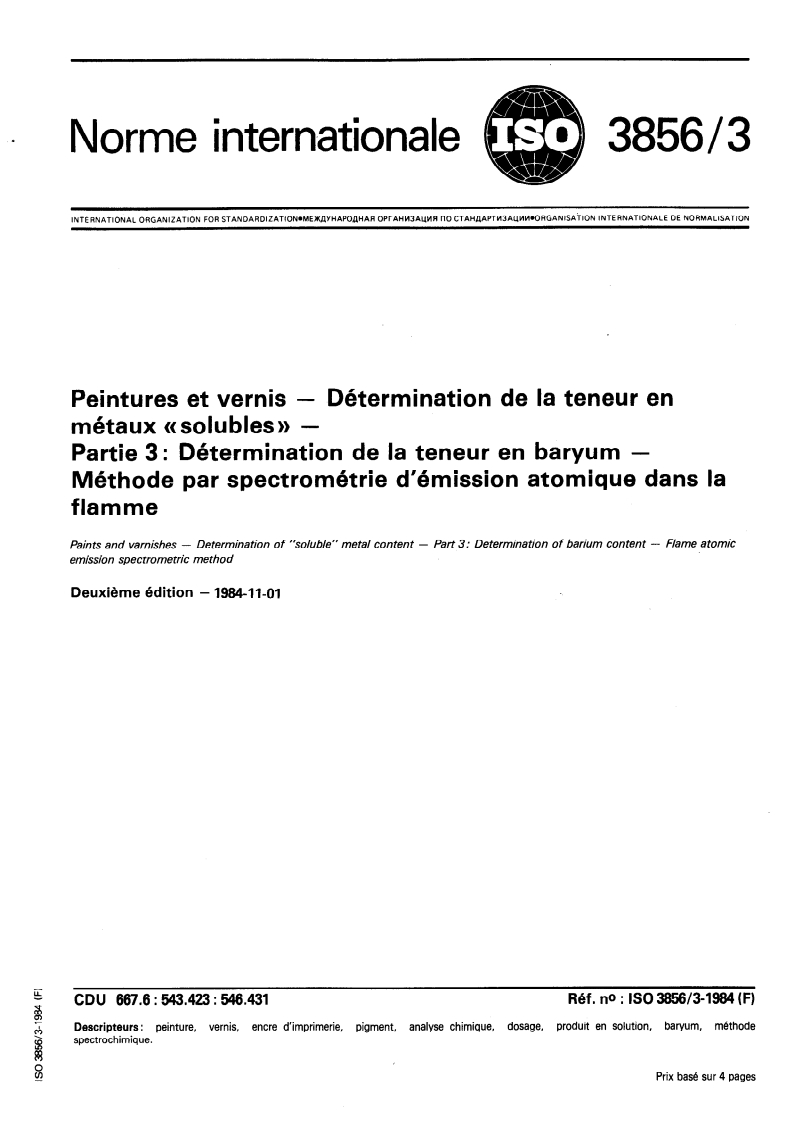
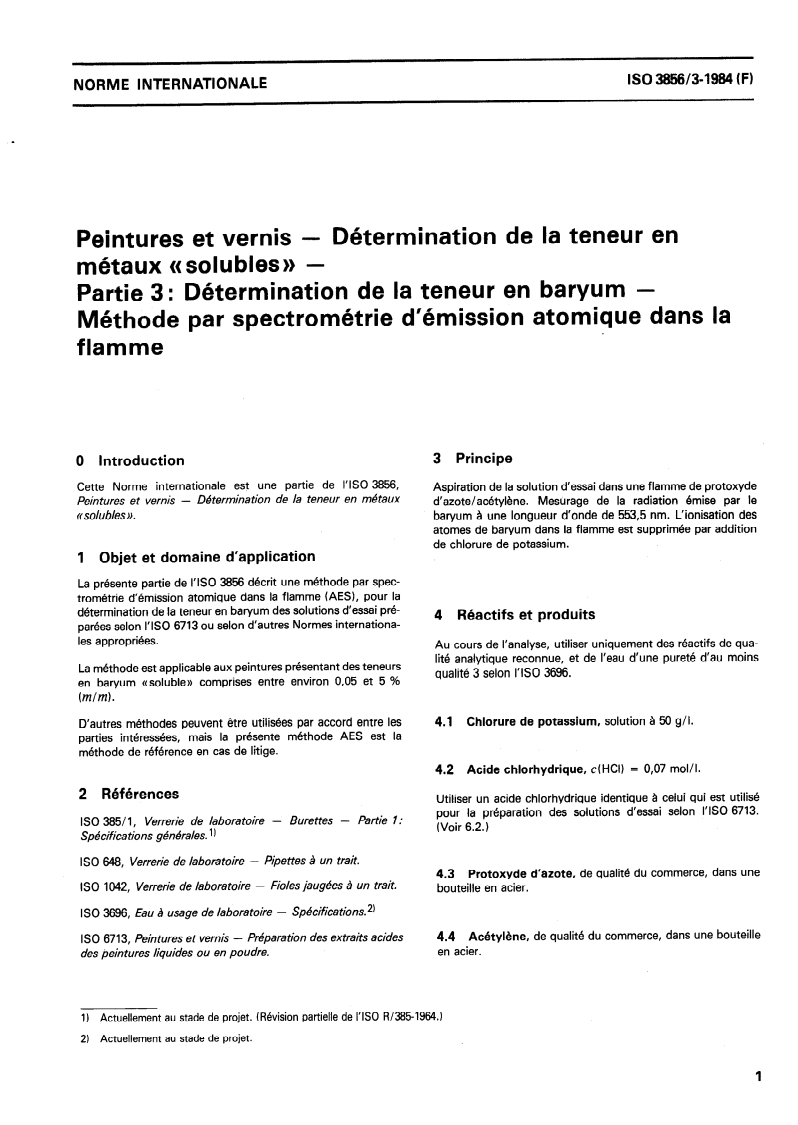
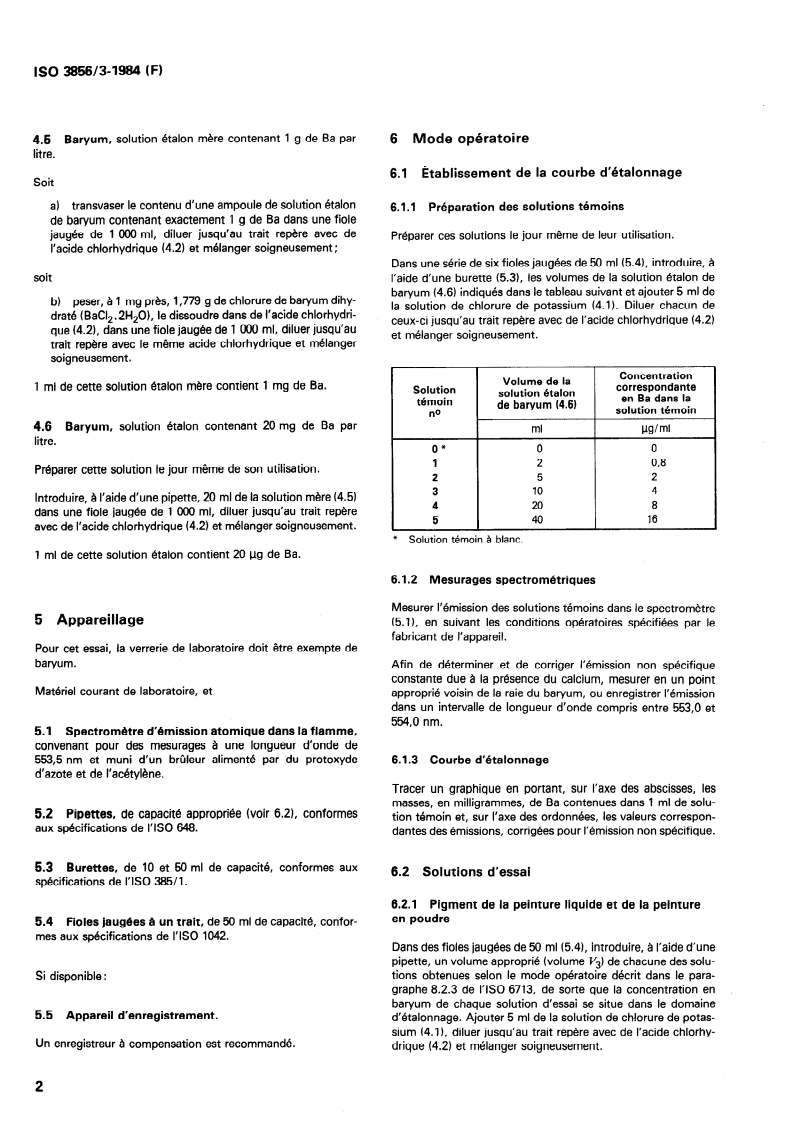
ISO 3856-3:1984 - Peintures et vernis — Détermination de la teneur en métaux "solubles" — Partie 3: Détermination de la teneur en baryum — Méthode par spectrométrie d'émission atomique dans la flamme/1/1984
ISO 3856-3:1984 - Peintures et vernis — Détermination de la teneur en métaux "solubles" — Partie 3: Détermination de la teneur en baryum — Méthode par spectrométrie d'émission atomique dans la flamme/1/1984
Overview
ISO 3856-3:1984 sets out the reference method for determining "soluble" barium content in paints and varnishes using flame atomic emission spectrometry (AES). This international standard is part of the ISO 3856 series, which addresses the quantification of soluble metals in coatings. The procedure is essential for assessing safety, compliance, and quality in coatings by specifically measuring barium, a metal of regulatory and environmental concern.
The method involves aspirating a test solution into a dinitrogen monoxide/acetylene flame and measuring the characteristic emission of barium at 553.5 nm. Ionization interference is controlled with potassium chloride. The standard applies to coatings, including paints and varnishes, with soluble barium content ranging from 0.05% to 5% by mass, providing a critical tool for laboratories and manufacturers to ensure product conformity and resolve disputes.
Key Topics
- Soluble Barium Determination: Focuses on the identification and quantification of barium that is extractable from paints and varnishes.
- Flame Atomic Emission Spectrometry (AES): Utilizes AES as an analytical technique to detect and measure barium concentrations with high specificity.
- Reference and Dispute Solution: ISO 3856-3:1984 is designated as the referee method, to be employed in cases of disagreement over test results.
- Applicable Sample Types: Covers both liquid and powder forms of paints and varnishes, as well as their pigment and liquid fractions.
- Sample Preparation and Calibration: Relies on ISO 6713 for the acid extraction of samples and emphasizes the use of calibration graphs for accurate quantification.
- Quality and Safety Compliance: Supports laboratories in meeting regulatory guidelines for barium content in coating materials.
Applications
- Quality Control in Paints and Varnishes: Used by quality assurance laboratories to verify that products meet specified limits for soluble barium, ensuring safety for end users and regulatory compliance.
- Regulatory Compliance: Essential for manufacturers and suppliers of coatings who must adhere to international, regional, or national safety standards regarding the presence of heavy metals.
- Product Development and Research: Applied during product formulation and innovation phases to monitor and minimize barium content in new or reformulated coatings.
- Dispute Resolution: Acts as the standard method in resolving disagreements between parties regarding the barium content results in disputed batches.
- Environmental and Safety Assessments: Utilized to assess the environmental impact and workplace safety concerning barium release from paints and varnishes.
Related Standards
- ISO 3856 Series: A broader set of standards specifying methods for determining various soluble metals in paints and varnishes.
- ISO 6713: Specifies the preparation of acid extracts from paints for subsequent metal determination methods, ensuring standardized sample preparation.
- ISO 648 and ISO 1042: Deal with laboratory glassware such as pipettes and volumetric flasks, facilitating accurate measurement and solution preparation.
- ISO 3696: Describes requirements for water purity used in laboratory tests, a critical factor in avoiding contamination and ensuring reliable results.
By following ISO 3856-3:1984, organizations involved in the manufacturing, testing, or regulation of paints and varnishes can reliably determine the soluble barium content and ensure product compliance with international safety standards. This enhances product trustworthiness, facilitates global trade, and supports ongoing public health and environmental protection efforts.
Relations
- Effective Date
- 15-Apr-2008
Buy Documents
ISO 3856-3:1984 - Paints and varnishes -- Determination of "soluble" metal content
ISO 3856-3:1984 - Paints and varnishes — Determination of "soluble" metal content — Part 3: Determination of barium content — Flame atomic emission spectrometric method/1/1984
ISO 3856-3:1984 - Peintures et vernis -- Détermination de la teneur en métaux "solubles"
ISO 3856-3:1984 - Peintures et vernis -- Détermination de la teneur en métaux "solubles"
ISO 3856-3:1984 - Peintures et vernis — Détermination de la teneur en métaux "solubles" — Partie 3: Détermination de la teneur en baryum — Méthode par spectrométrie d'émission atomique dans la flamme/1/1984
ISO 3856-3:1984 - Peintures et vernis — Détermination de la teneur en métaux "solubles" — Partie 3: Détermination de la teneur en baryum — Méthode par spectrométrie d'émission atomique dans la flamme/1/1984
Frequently Asked Questions
ISO 3856-3:1984 is a standard published by the International Organization for Standardization (ISO). Its full title is "Paints and varnishes — Determination of "soluble" metal content — Part 3: Determination of barium content — Flame atomic emission spectrometric method". This standard covers: The principle consists in the aspiration of the test solution into a dinitrogen monoxide/acetylene flame. Measurement of the radiation emitted by barium at a wavelength of 553,5 nm. The ionization of barium atoms in the flame is suppressed by addition of potassium chloride. The method is applicable to coating materials having "soluble" barium contents in the range of about 0,05 % (m/m) to 5 % (m/m). This method is the referee method in cases of dispute. This second edition cancels and replaces ISO 3856/3-1980, of which it constitutes a thorough revision.
The principle consists in the aspiration of the test solution into a dinitrogen monoxide/acetylene flame. Measurement of the radiation emitted by barium at a wavelength of 553,5 nm. The ionization of barium atoms in the flame is suppressed by addition of potassium chloride. The method is applicable to coating materials having "soluble" barium contents in the range of about 0,05 % (m/m) to 5 % (m/m). This method is the referee method in cases of dispute. This second edition cancels and replaces ISO 3856/3-1980, of which it constitutes a thorough revision.
ISO 3856-3:1984 is classified under the following ICS (International Classification for Standards) categories: 87.040 - Paints and varnishes. The ICS classification helps identify the subject area and facilitates finding related standards.
ISO 3856-3:1984 has the following relationships with other standards: It is inter standard links to ISO 3856-3:1980. Understanding these relationships helps ensure you are using the most current and applicable version of the standard.
ISO 3856-3:1984 is available in PDF format for immediate download after purchase. The document can be added to your cart and obtained through the secure checkout process. Digital delivery ensures instant access to the complete standard document.
Standards Content (Sample)
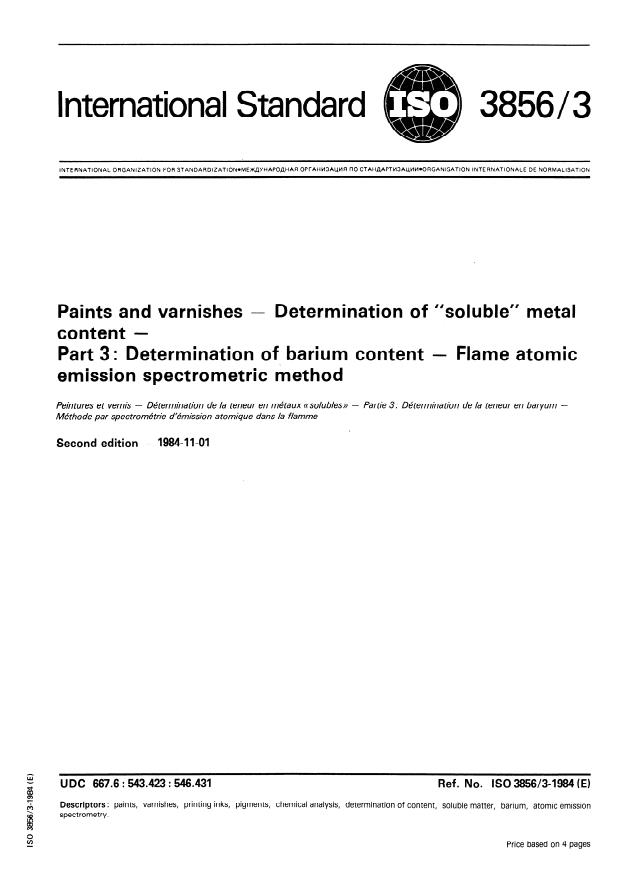
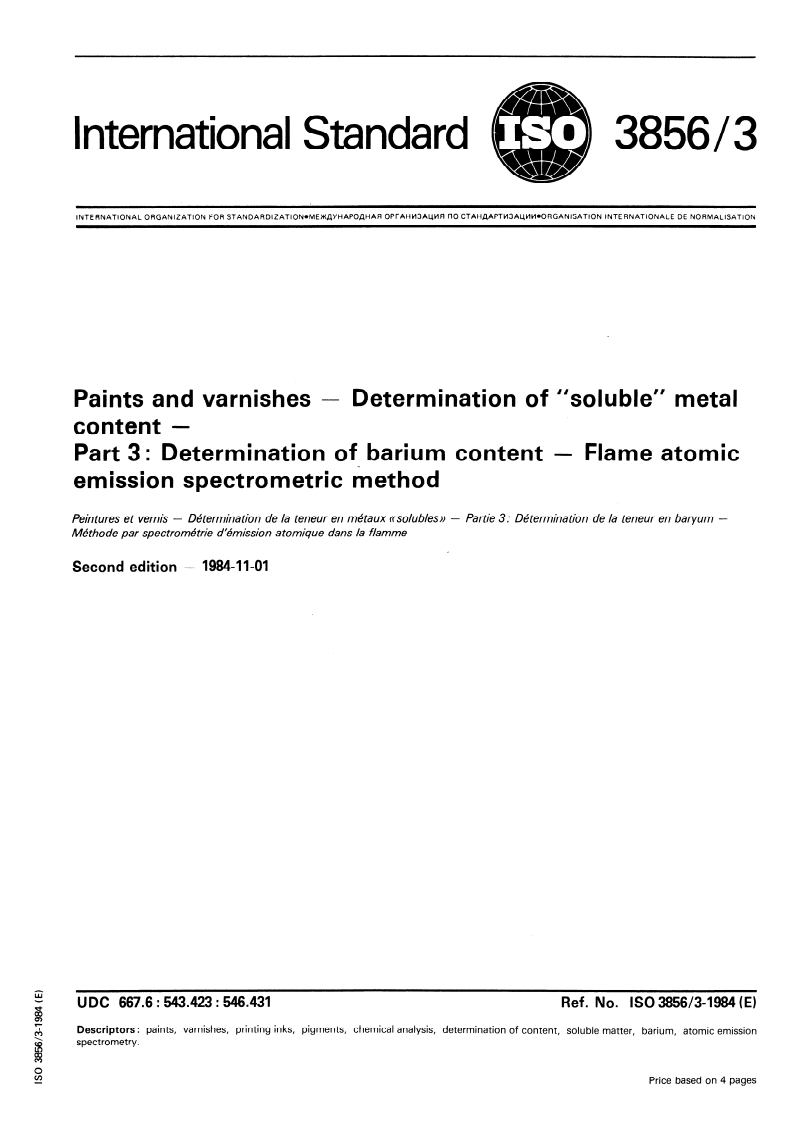
International Standard 385613
INTERNATIONAL ORGANIZATION FOR STANDARDIZATIONWvlEX~YHAPO~l-lAR OPrAHi43ALAMR fl0 CTAHAAPTM3ALWl~ORGANlSATlON INTERNATIONALE DE NORMALISATION
Paints and varnishes - Determination of “soluble” metal
content -
Part 3: Determination of barium content - Flame atomic
emission spectrometric method
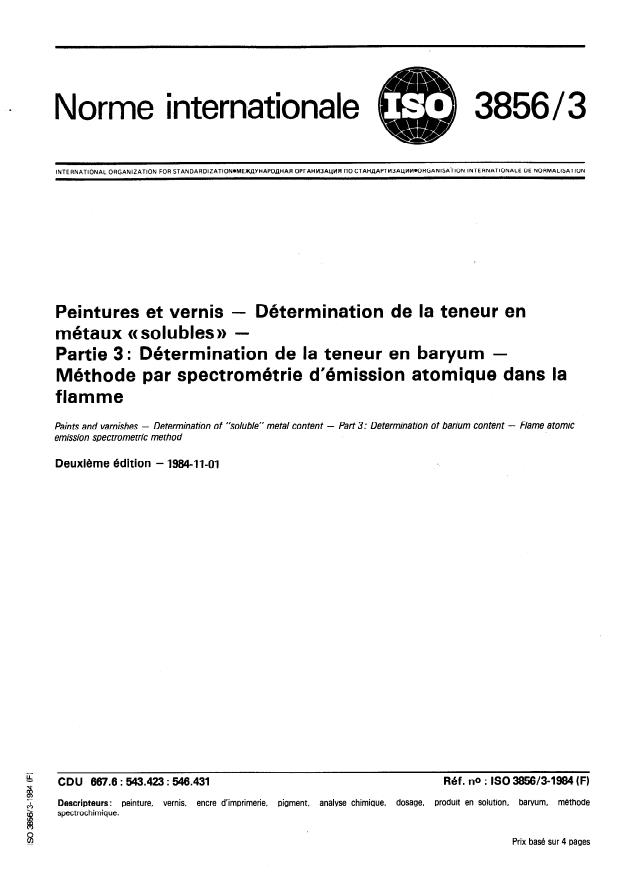
Peintures et vernis - D&ermination de la teneur en mhtaux ~~solubles~> - Partie 3: D&termination de la teneur en baryum -
Mthode par spectromhtrie d ’kmission atomique dans la ffamme
Second edition - 1984-11-01
UDC 667.6 : 643.423 : 546.431 Ref. No. IS0 38!56/3-1984 (E)
Descriptors : paints, varnishes, printing inks, pigments, chemical analysis, determination of content, soluble matter, barium, atomic emission
spectrometry.
Price based on 4 pages
Foreword
IS0 (the International Organization for Standardization) is a worldwide federation of
national standards bodies (IS0 member bodies). The work of preparing International
Standards is normally carried out through IS0 technical committees. Each member
body interested in a subject for which a technical committee has been established has
the right to be represented on that committee. International organizations, govern-
mental and non-governmental, in liaison with ISO, also take part in the work.
Draft International Standards adopted by the technical committees are circulated to
the member bodies for approval before their acceptance as International Standards by
the IS0 Council. They are approved in accordance with IS0 procedures requiring at
least 75 % approval by the member bodies voting.
International Standard IS0 3856/3 was prepared by Technical Committee ISO/TC 35,
Paints and varnishes.
IS0 3856/3 was first published in 1980. This second edition cancels and replaces the
first edition, of which it constitutes a thorough revision.
0 International Organization for Standardization, 1984
Printed in Switzerland
~-
IS0 3856/3-1984 (E)
INTERNATIONAL STANDARD
Determination of “soluble” metal
Paints and varnishes -
content -
Part 3: Determination of barium content - Flame atomic
emission spectrometric method
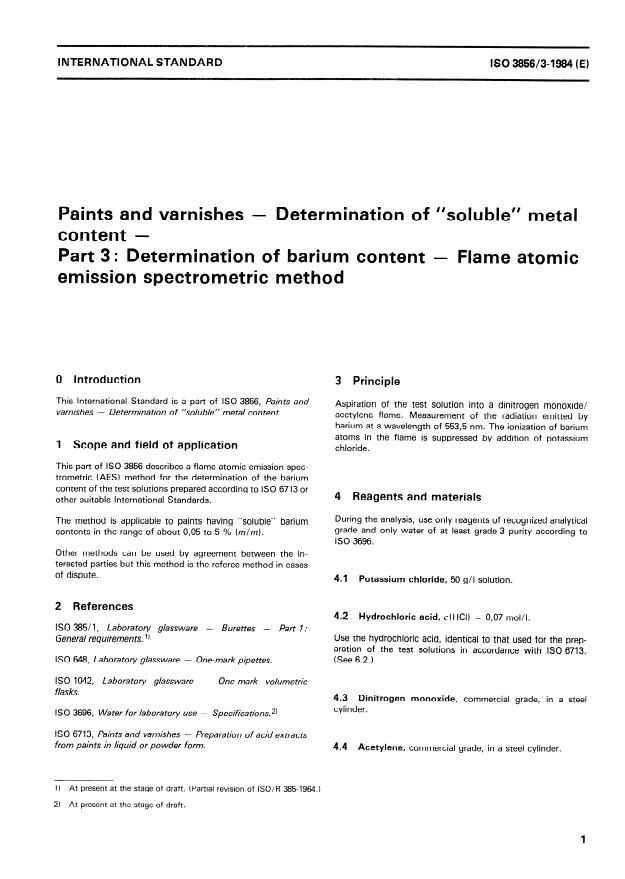
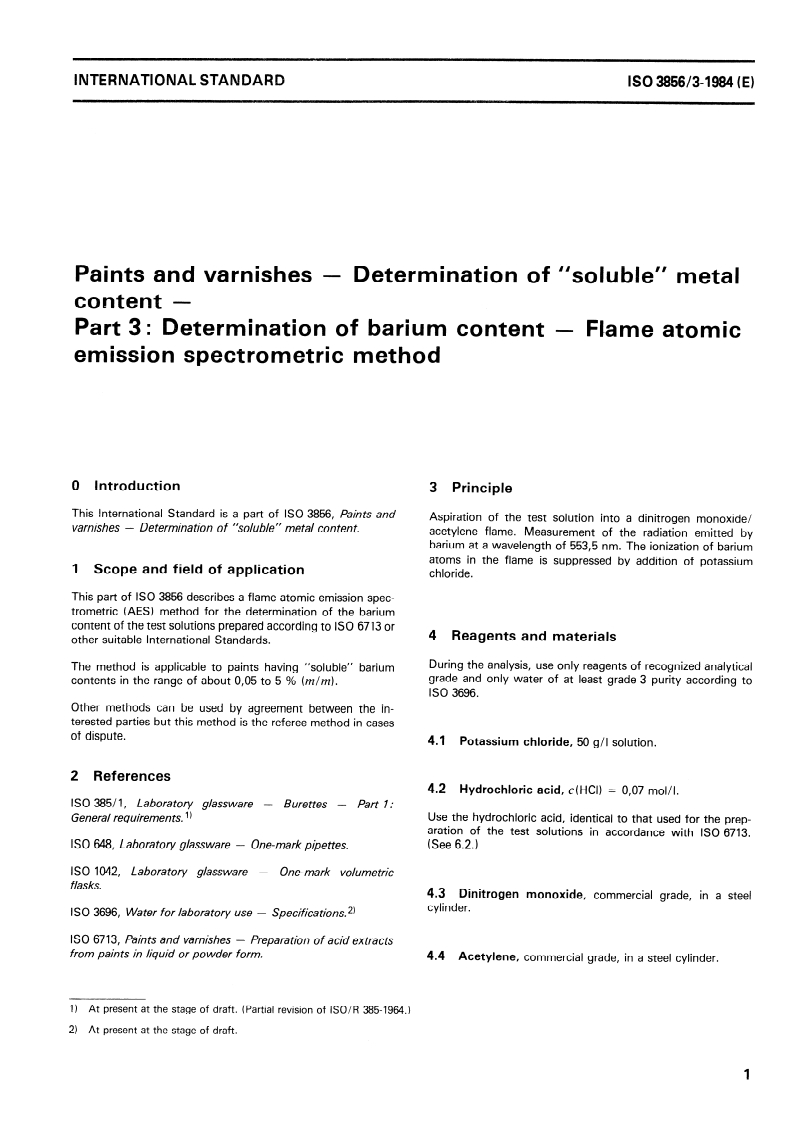
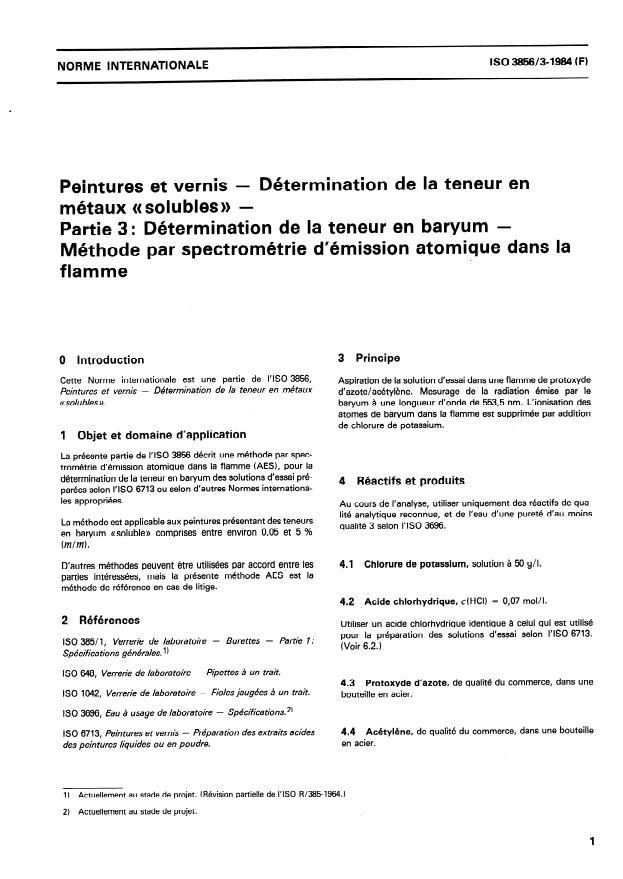
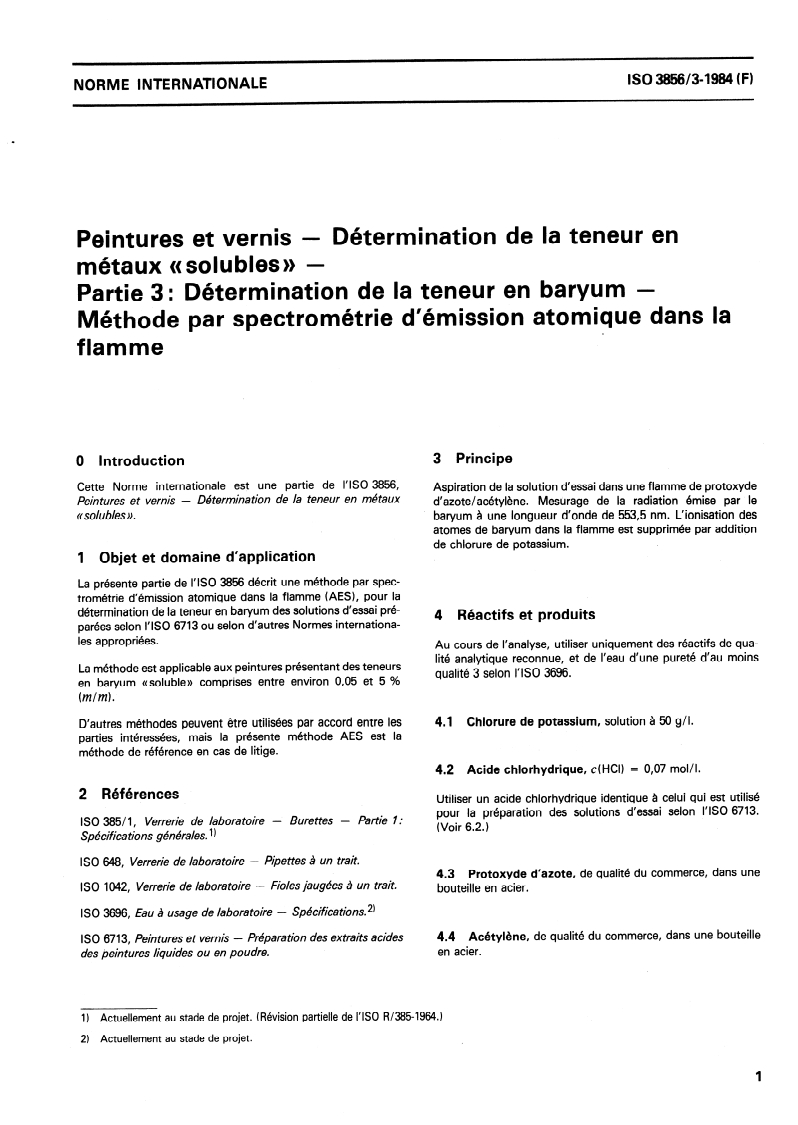
3 Principle
0 introduction
This International Standard is a part of IS0 3856, Paints and
Aspiration of the test solution into a dinitrogen monoxide/
varnishes - Determination of “soluble” metal content.
acetylene flame. Measurement of the radiation emitted by
barium at a wavelength of 553,5 nm. The ionization of barium
atoms in the flame is suppressed by addition of potassium
1 Scope and field of application
chloride.
This part of IS0 3856 describes a flame atomic emission spec-
trometric (AES) method for the determination of the barium
content of the test solutions prepared according to IS0 6713 or
4 Reagents and materials
other suitable International Standards.
During the analysis, use only reagents of recognized analytical
The method is applicable to paints having “soluble” barium
grade and only water of at least grade 3 purity according to
contents in the range of about 0,05 to 5 % (m/m).
IS0 3696.
Other methods can be used by agreement between the in-
terested parties but this method is the referee method in cases
of dispute.
4.1 Potassium chloride, 50 g/l solution.
2 References
4.2 Hydrochloric acid, c(HCI) = 0,07 mol/l.
IS0 38511, Laboratory glassware - Burettes - Part 7:
Use the hydrochloric acid, identical to that used for the prep-
General requirements. 1 )
aration of the test solutions in accordance with IS0 6713.
(See 6.2.)
IS0 648, Laboratory glassware - One-mark pipettes.
IS0 1042, Laboratory glassware - One-mark volumetric
flasks.
4.3 Dinitrogen monoxide, commercial grade, in a steel
cylinder.
I SO 3696, Water for laboratory use - Specifications. 2,
IS0 6713, Paints and varnishes - Preparation of acid extracts
from paints in liquid or powder form.
4.4 Acetylene, commercial grade, in a steel cylinder.
1) At present at the stage of draft. (Partial revision of ISO/R 385-1964.)
2) At present at the stage of draft.
IS0 3856/3-1984 (E)
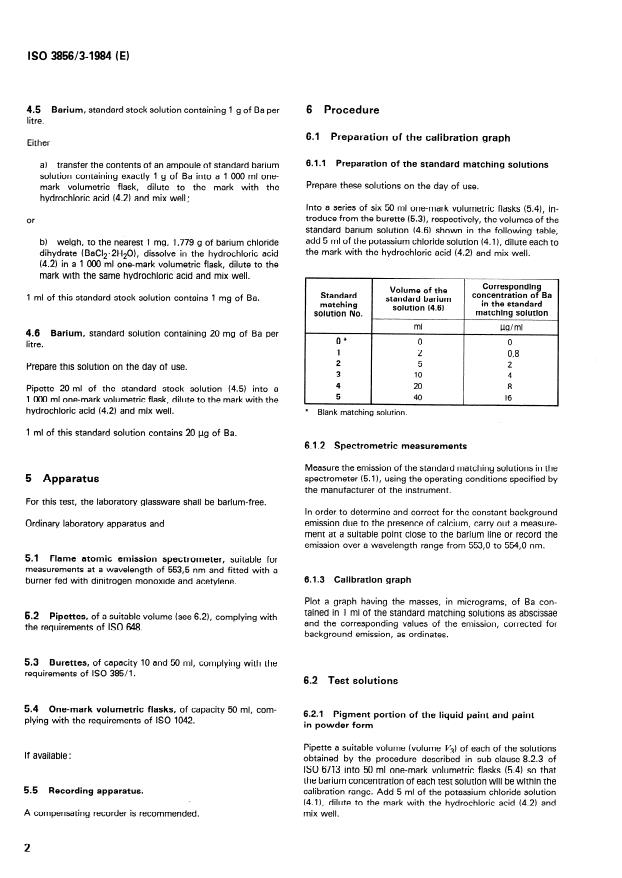
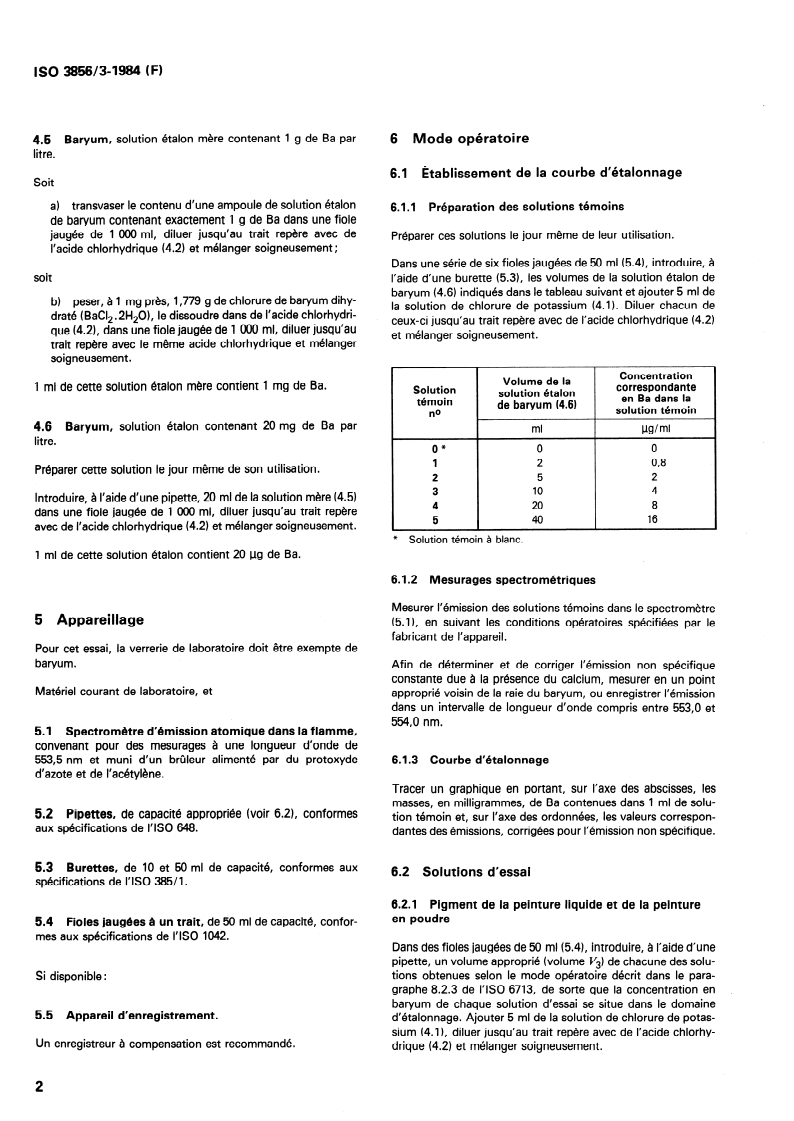
4.5 Barium, standard stock solution containing 1 g of Ba per 6 Procedure
Iitre.
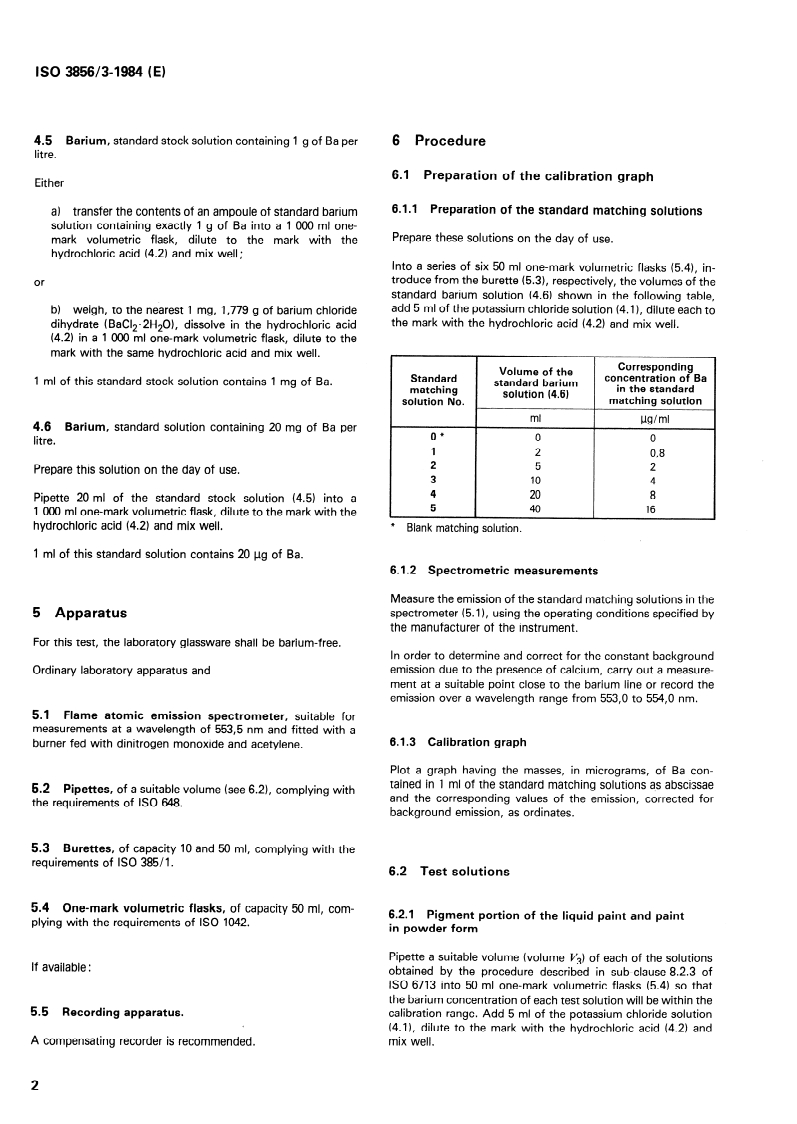
6.1 Preparation of the calibration graph
Either
6.1.1 Preparation of the standard matching solutions
a) transfer the contents of an ampoule of standard barium
solution containing exactly 1 g of Ba into a 1 000 ml one-
Prepare these solutions on the day of use.
mark volumetric flask, dilute to the mark with the
hydrochloric acid (4.2) and mix well;
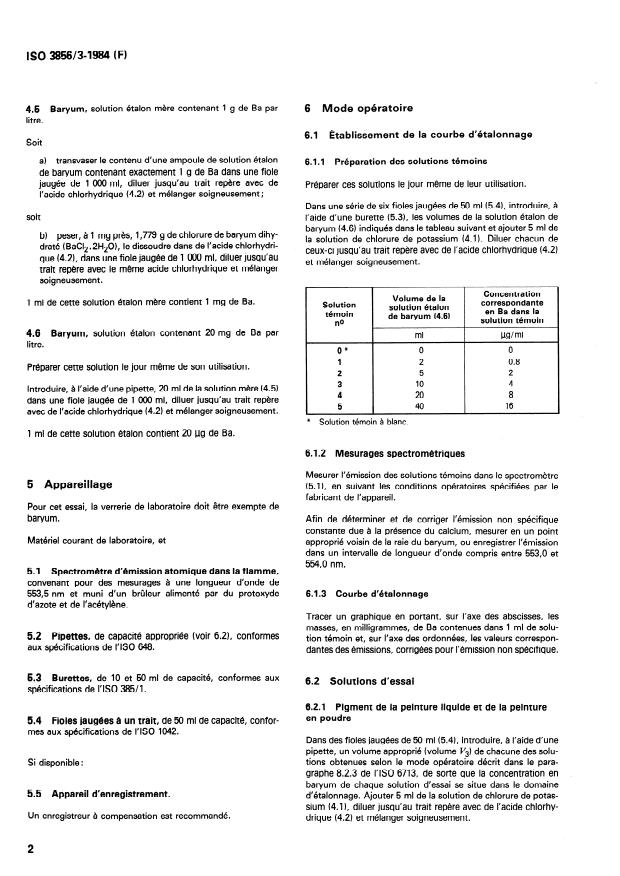
Into a series of six 50 ml one-mark volumetric flasks (5.4), in-
troduce from the burette (5.3), respectively, the volumes of the
or
standard barium solution (4.6) shown in the following table,
add 5 ml of the potassium chloride solution (4.1), dilute each to
b) weigh, to the nearest 1 mg, 1,779 g of barium chloride
the mark with the hydrochloric acid (4.2) and mix well.
dihydrate ( BaC12 m ZH,O), dissolve in the hydrochloric acid
(4.2) in a 1 000 ml one-mark volumetric flask, dilute to the
mark with the same hydrochloric acid and mix well.
1 ml of this standard stock solution contains 1 mg of Ba.
4.6 Barium, standard solution containing 20 mg of Ba per
litre.
Prepare this solution on the day of use.
Pipette 20 ml of the standard stock solution (4.5) into a
1 000 ml one-mark volumetric flask, dilute to the mark with the
hydrochloric acid (4.2) and mix well.
1 ml of this standard solution contains 20 pg of Ba.
6.1.2 Spectrometric measurements
Measure the emission of the standard matching solutions in the
spectrometer (5.1), using the operating conditions specified by
5 Apparatus
the manufacturer of the instrument.
For this test, the laboratory glassware shall be barium-free.
In order to determine and correct for the constant background
emission due to the presence of calcium, carry out a measure-
Ordinary laboratory apparatus and
ment at a suitable point close to the barium line or record the
emission over a wavelength range from 553,0 to 554,O nm.
5.1 Flame atomic emission spectrometer, suitable for
measurements at a wavelength of 553,5 nm and fitted with a
6.1.3 Calibration graph
burner fed with dinitrogen monoxide and acetylene.
Plot a graph having the masses, in micrograms, of Ba con-
tained in 1 ml of the standard matching solutions a,s abscissae
5.2 Pipettes, of a suitable volume (see 6.2), complying with
and the corresponding values of the emission, corrected for
the requirements of IS0 648.
background emission, as ordinates.
5.3 Burettes, of capacity 10 and 50 ml, complying with the
requirements of IS0 385/l.
6.2 Test solutions
5.4 One-mark volumetric flasks, of capacity 50 ml, com-
6.2.1 Pigment porti
on of the liquid paint and paint
plying with the requiremen
...
International Standard 385613
INTERNATIONAL ORGANIZATION FOR STANDARDIZATIONWvlEX~YHAPO~l-lAR OPrAHi43ALAMR fl0 CTAHAAPTM3ALWl~ORGANlSATlON INTERNATIONALE DE NORMALISATION
Paints and varnishes - Determination of “soluble” metal
content -
Part 3: Determination of barium content - Flame atomic
emission spectrometric method
Peintures et vernis - D&ermination de la teneur en mhtaux ~~solubles~> - Partie 3: D&termination de la teneur en baryum -
Mthode par spectromhtrie d ’kmission atomique dans la ffamme
Second edition - 1984-11-01
UDC 667.6 : 643.423 : 546.431 Ref. No. IS0 38!56/3-1984 (E)
Descriptors : paints, varnishes, printing inks, pigments, chemical analysis, determination of content, soluble matter, barium, atomic emission
spectrometry.
Price based on 4 pages
Foreword
IS0 (the International Organization for Standardization) is a worldwide federation of
national standards bodies (IS0 member bodies). The work of preparing International
Standards is normally carried out through IS0 technical committees. Each member
body interested in a subject for which a technical committee has been established has
the right to be represented on that committee. International organizations, govern-
mental and non-governmental, in liaison with ISO, also take part in the work.
Draft International Standards adopted by the technical committees are circulated to
the member bodies for approval before their acceptance as International Standards by
the IS0 Council. They are approved in accordance with IS0 procedures requiring at
least 75 % approval by the member bodies voting.
International Standard IS0 3856/3 was prepared by Technical Committee ISO/TC 35,
Paints and varnishes.
IS0 3856/3 was first published in 1980. This second edition cancels and replaces the
first edition, of which it constitutes a thorough revision.
0 International Organization for Standardization, 1984
Printed in Switzerland
~-
IS0 3856/3-1984 (E)
INTERNATIONAL STANDARD
Determination of “soluble” metal
Paints and varnishes -
content -
Part 3: Determination of barium content - Flame atomic
emission spectrometric method
3 Principle
0 introduction
This International Standard is a part of IS0 3856, Paints and
Aspiration of the test solution into a dinitrogen monoxide/
varnishes - Determination of “soluble” metal content.
acetylene flame. Measurement of the radiation emitted by
barium at a wavelength of 553,5 nm. The ionization of barium
atoms in the flame is suppressed by addition of potassium
1 Scope and field of application
chloride.
This part of IS0 3856 describes a flame atomic emission spec-
trometric (AES) method for the determination of the barium
content of the test solutions prepared according to IS0 6713 or
4 Reagents and materials
other suitable International Standards.
During the analysis, use only reagents of recognized analytical
The method is applicable to paints having “soluble” barium
grade and only water of at least grade 3 purity according to
contents in the range of about 0,05 to 5 % (m/m).
IS0 3696.
Other methods can be used by agreement between the in-
terested parties but this method is the referee method in cases
of dispute.
4.1 Potassium chloride, 50 g/l solution.
2 References
4.2 Hydrochloric acid, c(HCI) = 0,07 mol/l.
IS0 38511, Laboratory glassware - Burettes - Part 7:
Use the hydrochloric acid, identical to that used for the prep-
General requirements. 1 )
aration of the test solutions in accordance with IS0 6713.
(See 6.2.)
IS0 648, Laboratory glassware - One-mark pipettes.
IS0 1042, Laboratory glassware - One-mark volumetric
flasks.
4.3 Dinitrogen monoxide, commercial grade, in a steel
cylinder.
I SO 3696, Water for laboratory use - Specifications. 2,
IS0 6713, Paints and varnishes - Preparation of acid extracts
from paints in liquid or powder form.
4.4 Acetylene, commercial grade, in a steel cylinder.
1) At present at the stage of draft. (Partial revision of ISO/R 385-1964.)
2) At present at the stage of draft.
IS0 3856/3-1984 (E)
4.5 Barium, standard stock solution containing 1 g of Ba per 6 Procedure
Iitre.
6.1 Preparation of the calibration graph
Either
6.1.1 Preparation of the standard matching solutions
a) transfer the contents of an ampoule of standard barium
solution containing exactly 1 g of Ba into a 1 000 ml one-
Prepare these solutions on the day of use.
mark volumetric flask, dilute to the mark with the
hydrochloric acid (4.2) and mix well;
Into a series of six 50 ml one-mark volumetric flasks (5.4), in-
troduce from the burette (5.3), respectively, the volumes of the
or
standard barium solution (4.6) shown in the following table,
add 5 ml of the potassium chloride solution (4.1), dilute each to
b) weigh, to the nearest 1 mg, 1,779 g of barium chloride
the mark with the hydrochloric acid (4.2) and mix well.
dihydrate ( BaC12 m ZH,O), dissolve in the hydrochloric acid
(4.2) in a 1 000 ml one-mark volumetric flask, dilute to the
mark with the same hydrochloric acid and mix well.
1 ml of this standard stock solution contains 1 mg of Ba.
4.6 Barium, standard solution containing 20 mg of Ba per
litre.
Prepare this solution on the day of use.
Pipette 20 ml of the standard stock solution (4.5) into a
1 000 ml one-mark volumetric flask, dilute to the mark with the
hydrochloric acid (4.2) and mix well.
1 ml of this standard solution contains 20 pg of Ba.
6.1.2 Spectrometric measurements
Measure the emission of the standard matching solutions in the
spectrometer (5.1), using the operating conditions specified by
5 Apparatus
the manufacturer of the instrument.
For this test, the laboratory glassware shall be barium-free.
In order to determine and correct for the constant background
emission due to the presence of calcium, carry out a measure-
Ordinary laboratory apparatus and
ment at a suitable point close to the barium line or record the
emission over a wavelength range from 553,0 to 554,O nm.
5.1 Flame atomic emission spectrometer, suitable for
measurements at a wavelength of 553,5 nm and fitted with a
6.1.3 Calibration graph
burner fed with dinitrogen monoxide and acetylene.
Plot a graph having the masses, in micrograms, of Ba con-
tained in 1 ml of the standard matching solutions a,s abscissae
5.2 Pipettes, of a suitable volume (see 6.2), complying with
and the corresponding values of the emission, corrected for
the requirements of IS0 648.
background emission, as ordinates.
5.3 Burettes, of capacity 10 and 50 ml, complying with the
requirements of IS0 385/l.
6.2 Test solutions
5.4 One-mark volumetric flasks, of capacity 50 ml, com-
6.2.1 Pigment porti
on of the liquid paint and paint
plying with the requiremen
...
a
Norme internationale
INTERNATIONAL ORGANIZATION FOR STANDARDIZATIONWVlEIKAYHAPO~HAR OPTAHM3Al@lR Il0 CTAH~APTbl3A~blI4.ORGANISAilON INTERNATIONALE DE NORMALISATION
Peintures et vernis - Détermination de la teneur en
métaux «solubles» -
Partie 3: Détermination de la teneur en baryum -
Méthode par spectrométrie d’émission atomique dans la
flamme
Part 3: Determination of barium content - Flame atomic
Paints and varnishes - Determination of “fsoluble” metal content -
emission spectrometric method
Deuxième édition - 1984-11-01
CDU 667.6 : 543.423 : 546.431 Réf. no : ISO 3856/3-1984 (F)
Descripteurs : peinture, vernis, encre d’imprimerie, pigment, analyse chimique, dosage, produit en solution, baryum, méthode
spectrochimique.
Prix basé sur 4 pages
Avant-propos
L’ISO (Organisation internationale de normalisation) est une fédération mondiale
d’organismes nationaux de normalisation (comités membres de I’ISO). L’élaboration
des Normes internationales est confiée aux comités techniques de I’ISO. Chaque
comité membre intéressé par une étude a le droit de faire partie du comité technique
créé à cet effet. Les organisations internationales, gouvernementales et non gouverne-
mentales, en liaison avec I’ISO, participent également aux travaux.
Les projets de Normes internationales adoptés par les comités techniques sont soumis
aux comités membres pour approbation, avant leur acceptation comme Normes inter-
nationales par le Conseil de I’ISO. Les Normes internationales sont approuvées confor-
mément aux procédures de I’ISO qui requièrent l’approbation de 75 % au moins des
comités membres votants.
La Norme internationale ISO 3856/3 a été élaborée par le comité technique ISO/TC 35,
Peintures et vernis.
La Norme internationale ISO 3856/3 a été pour la première fois publiée en 1980. Cette
deuxième édition annule et remplace la première édition, dont elle constitue une révi-
sion complète.
0 Organisation internationale de normalisation, 1984 0
Imprimé en Suisse
ISO 3866/3-1984 (FI
NORME INTERNATIONALE
Détermination de la teneur en
Peintures et vernis -
métaux «solubles» -
Partie 3: Détermination de la teneur en baryum -
Méthode par spectrométrie d’émission atomique dans la
flamme
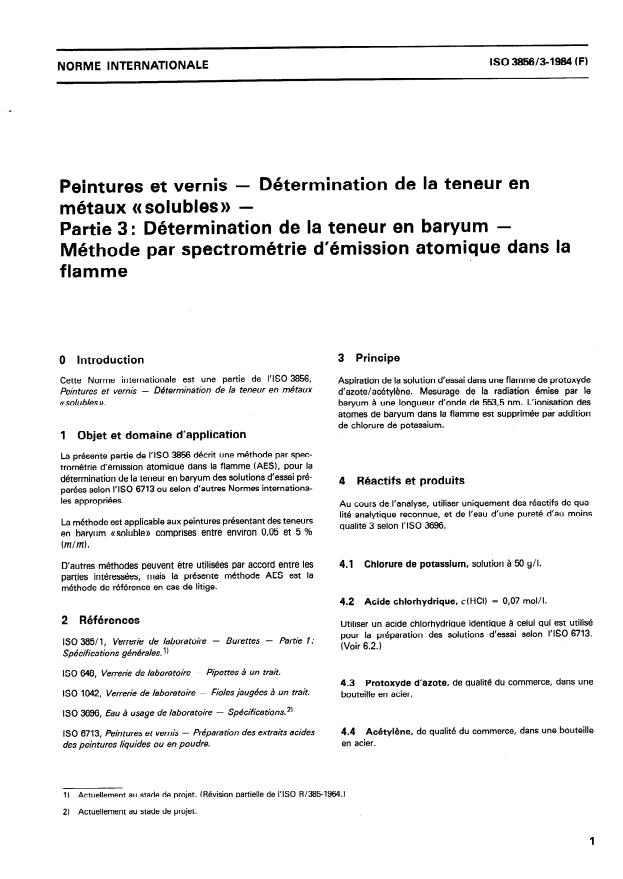
3 Principe
0 Introduction
Cette Norme internationale est une partie de I’ISO 3356,
Aspiration de la solution d’essai dans une flamme de protoxyde
Détermination de la teneur en métaux
Peintures et vernis -
d’azote/acétyléne. Mesurage de la radiation émise par le
N solubles >>.
baryum à une longueur d’onde de 553,5 nm. L’ionisation des
atomes de baryum dans la flamme est supprimée par addition
de chlorure de potassium.
1 Objet et domaine d’application
La présente partie de I’ISO 3856 décrit une méthode par spec-
trométrie d’émission atomique dans la flamme (AES), pour la
détermination de la teneur en baryum des solutions d’essai pré-
4 Réactifs et produits
parées selon I’ISO 6713 ou selon d’autres Normes internationa-
les appropriées.
Au cours de l’analyse, utiliser uniquement des réactifs de qua-
lité analytique reconnue, et de l’eau d’une pureté d’au moins
La méthode est applicable aux peintures présentant des teneurs
qualité 3 selon I’ISO 3696.
en baryum «soluble)) comprises entre environ 0,05 et 5 %
bnlm).
D’autres méthodes peuvent être utilisées par accord entre les 4.1 Chlorure de potassium, solution à 50 g/l.
mais la présente méthode AES est la
parties intéressées,
méthode de référence en cas de litige.
4.2 Acide chlorhydrique, c(HCI) = 0,07 mol/l.
2 Références
Utiliser un acide chlorhydrique identique à celui qui est utilisé
pour la préparation des solutions d’essai selon I’ISO 6713.
ISO 38511, Verrerie de laboratoire - Burettes - Partie 7:
(Voir 6.2.)
Spécifications générales. l)
I SO 648, Verrerie de laboratoire - Pipettes à un trait.
4.3 Protoxyde d’azote, de qualité du commerce, dans une
ISO 1042, Verrerie de laboratoire - Fioles jaugées à un trait.
bouteille en acier.
ISO 3696, Eau à usage de laboratoire - Spécifications.*)
ISO 6713, Peintures et vernis - Préparation des extraits acides 4.4 Acétylène, de qualité du commerce, dans une bouteille
des peintures liquides ou en poudre. en acier.
1) Actuellement au stade de projet. (Révision partielle de I’ISO R/385-1964.)
2) Actuellement au stade de projet.
lso 3856/3-1984 (FI
4.5 Baryum, solution étalon mère contenant 1 g de Ba par 6 Mode opératoire
litre.
6.1 Établissement de la courbe d’étalonnage
Soit
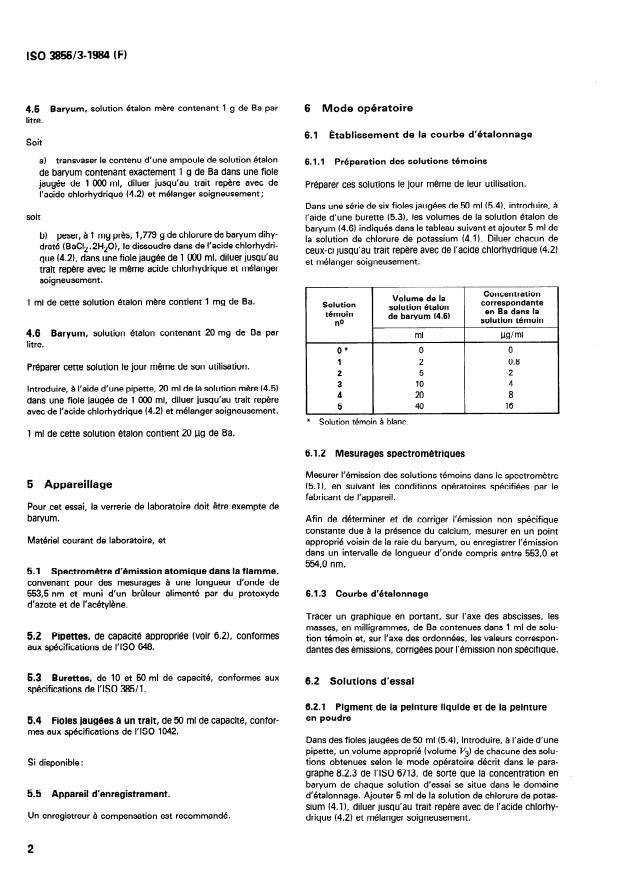
a) transvaser le contenu d’une ampoule de solution étalon Préparation des solutions témoins
6.1 .l
de baryum contenant exactement 1 g de Ba dans une fiole
jaugée de 1 000 ml, diluer jusqu’au trait repére avec de
Préparer ces solutions le jour même de leur utilisation.
l’acide chlorhydrique (4.2) et mélanger soigneusement;
Dans une série de six fioles jaugées de 50 ml (5.41, introduire, à
soit l’aide d’une burette (5.31, les volumes de la solution étalon de
baryum (4.6) indiqués dans le tableau suivant et ajouter 5 ml de
b) peser, à 1 mg prés, 1,779 g de chlorure de baryum dihy-
la solution de chlorure de potassium (4.1). Diluer chacun de
draté ( BaCIZ .2H,O), le dissoudre dans de l’acide chlorhydri-
ceux-ci jusqu’au trait repère avec de l’acide chlorhydrique (4.2)
que (4.21, dans une fiole jaugée de 1 000 ml, diluer jusqu’au
et mélanger soigneusement.
trait repére avec le même acide chlorhydrique et mélanger
soigneusement.
Concentration
Volume de la
correspondante
1 ml de cette solution étalon mère contient 1 mg de Ba.
Solution
solution étalon
en Ba dans la
témoin
de baryum (4.6)
solution témoin
no
4.6 Baryum, solution étalon contenant 20 mg de Ba par ml
Km
I
litre.
0 0
0*
1 2 03
Préparer cette solution le jour même de son utilisation.
5 2
3 10
Introduire, à l’aide d’une pipette, 20 ml de la solution mére (4.5)
20 8
dans une fiole jaugée de 1 000 ml, diluer jusqu’au trait repére
40 16
avec de l’acide chlorhydrique (4.2) et mélanger soigneusement.
* Solution témoin à blanc.
1 ml de cette solution étalon contient 20 pg de Ba.
6.1.2 Mesurages spectrométriques
Mesurer l’émission des solutions témoins dans le spectromètre
5 Appareillage
(5.11, en suivant les conditions opératoires spécifiées par le
fabricant de l’appareil.
Pour cet essai, la verrerie de laboratoire doit être exempte de
baryum. Afin de déterminer et de corriger l’émission non spécifique
constante due à la présence du calcium, mesurer en un point
Matériel courant de laboratoire, et
approprié voisin de la raie du baryum, ou enregistrer l’émission
dans un intervalle de longueur d’onde compris entre 553,0 et
554,0 nm.
5.1 Spectromètre d’émission atomique dans la flamme,
convenant pour des mesurages à une longueur d’onde de
5535 nm et muni d’un brûleur alimenté par du protoxyde 6.1.3 Courbe d’étalonnage
d’azote et de I’acétyléne.
Tracer un graphique en portant, sur l’axe des abscisses, les
masses, en milligrammes, de Ba contenues dans 1 ml de solu-
5.2 Pipettes, de capacité appropriée (voir 6.21, conformes
tion témoin et, sur l’axe des ordonnées, les valeurs correspon-
aux spécifications de I’ISO 648.
dantes des émissions, corrigées pour l’émission non spécifique.
5.3 Burettes, de 10 et 50 ml de capacité, conformes aux
6.2 Solutions d’essai
spécifications de I’ISO 385/1.
6.2.1 Pigment de la peinture liquide et de la peinture
en poudre
5.4
...
a
Norme internationale
INTERNATIONAL ORGANIZATION FOR STANDARDIZATIONWVlE~YHAPO~HAR OPTAHM3Al@lR Il0 CTAH~APTbl3A~blI4.ORGANISAilON INTERNATIONALE DE NORMALISATION
Peintures et vernis - Détermination de la teneur en
métaux «solubles» -
Partie 3: Détermination de la teneur en baryum -
Méthode par spectrométrie d’émission atomique dans la
flamme
Part 3: Determination of barium content - Flame atomic
Paints and varnishes - Determination of “fsoluble” metal content -
emission spectrometric method
Deuxième édition - 1984-11-01
CDU 667.6 : 543.423 : 546.431 Réf. no : ISO 3856/3-1984 (F)
Descripteurs : peinture, vernis, encre d’imprimerie, pigment, analyse chimique, dosage, produit en solution, baryum, méthode
spectrochimique.
Prix basé sur 4 pages
Avant-propos
L’ISO (Organisation internationale de normalisation) est une fédération mondiale
d’organismes nationaux de normalisation (comités membres de I’ISO). L’élaboration
des Normes internationales est confiée aux comités techniques de I’ISO. Chaque
comité membre intéressé par une étude a le droit de faire partie du comité technique
créé à cet effet. Les organisations internationales, gouvernementales et non gouverne-
mentales, en liaison avec I’ISO, participent également aux travaux.
Les projets de Normes internationales adoptés par les comités techniques sont soumis
aux comités membres pour approbation, avant leur acceptation comme Normes inter-
nationales par le Conseil de I’ISO. Les Normes internationales sont approuvées confor-
mément aux procédures de I’ISO qui requièrent l’approbation de 75 % au moins des
comités membres votants.
La Norme internationale ISO 3856/3 a été élaborée par le comité technique ISO/TC 35,
Peintures et vernis.
La Norme internationale ISO 3856/3 a été pour la première fois publiée en 1980. Cette
deuxième édition annule et remplace la première édition, dont elle constitue une révi-
sion complète.
0 Organisation internationale de normalisation, 1984
Imprimé en Suisse
ISO 3856/3-1984 (FI
NORME INTERNATIONALE
Peintures et vernis - Détermination de la teneur en
métaux «solubles» -
Partie 3: Détermination de la teneur en baryum -
Méthode par spectrométrie d’émission atomique dans la
flamme
3 Principe
0 Introduction
Cette Norme internationale est une partie de I’ISO 3356,
Aspiration de la solution d’essai dans une flamme de protoxyde
Détermination de la teneur en métaux
Peintures et vernis -
d’azote/acétyléne. Mesurage de la radiation émise par le
N solubles >>.
baryum à une longueur d’onde de 553,5 nm. L’ionisation des
atomes de baryum dans la flamme est supprimée par addition
de chlorure de potassium.
1 Objet et domaine d’application
La présente partie de I’ISO 3856 décrit une méthode par spec-
trométrie d’émission atomique dans la flamme (AES), pour la
détermination de la teneur en baryum des solutions d’essai pré-
4 Réactifs et produits
parées selon I’ISO 6713 ou selon d’autres Normes internationa-
les appropriées.
Au cours de l’analyse, utiliser uniquement des réactifs de qua-
lité analytique reconnue, et de l’eau d’une pureté d’au moins
La méthode est applicable aux peintures présentant des teneurs
qualité 3 selon I’ISO 3696.
en baryum «soluble)) comprises entre environ 0,05 et 5 %
bnlm).
D’autres méthodes peuvent être utilisées par accord entre les 4.1 Chlorure de potassium, solution à 50 g/l.
mais la présente méthode AES est la
parties intéressées,
méthode de référence en cas de litige.
4.2 Acide chlorhydrique, c(HCI) = 0,07 mol/l.
2 Références
Utiliser un acide chlorhydrique identique à celui qui est utilisé
pour la préparation des solutions d’essai selon I’ISO 6713.
ISO 38511, Verrerie de laboratoire - Burettes - Partie 7:
(Voir 6.2.)
Spécifications générales. l)
I SO 648, Verrerie de laboratoire - Pipettes à un trait.
4.3 Protoxyde d’azote, de qualité du commerce, dans une
ISO 1042, Verrerie de laboratoire - Fioles jaugées à un trait.
bouteille en acier.
ISO 3696, Eau à usage de laboratoire - Spécifications.*)
ISO 6713, Peintures et vernis - Préparation des extraits acides 4.4 Acétylène, de qualité du commerce, dans une bouteille
des peintures liquides ou en poudre. en acier.
1) Actuellement au stade de projet. (Révision partielle de I’ISO R/385-1964.)
2) Actuellement au stade de projet.
lso 3856/3-1984 (FI
4.5 Baryum, solution étalon mère contenant 1 g de Ba par 6 Mode opératoire
litre.
6.1 Établissement de la courbe d’étalonnage
Soit
a) transvaser le contenu d’une ampoule de solution étalon 6.1 .l Préparation des solutions témoins
de baryum contenant exactement 1 g de Ba dans une fiole
jaugée de 1 000 ml, diluer jusqu’au trait repére avec de
Préparer ces solutions le jour même de leur utilisation.
l’acide chlorhydrique (4.2) et mélanger soigneusement;
Dans une série de six fioles jaugées de 50 ml (5.41, introduire, à
soit l’aide d’une burette (5.31, les volumes de la solution étalon de
baryum (4.6) indiqués dans le tableau suivant et ajouter 5 ml de
b) peser, à 1 mg prés, 1,779 g de chlorure de baryum dihy-
la solution de chlorure de potassium (4.1). Diluer chacun de
draté ( BaC12. 2H20), le dissoudre dans de l’acide chlorhydri-
ceux-ci jusqu’au trait repère avec de l’acide chlorhydrique (4.2)
que (4.21, dans une fiole jaugée de 1 000 ml, diluer jusqu’au
et mélanger soigneusement.
trait repére avec le même acide chlorhydrique et mélanger
soigneusement.
Concentration
Volume de la
correspondante
1 ml de cette solution étalon mère contient 1 mg de Ba.
Solution
solution étalon
en Ba dans la
témoin
de baryum (4.6)
solution témoin
no
4.6 Baryum, solution étalon contenant 20 mg de Ba par ml
Km
r I I
litre.
0 0
0*
1 2 03
Préparer cette solution le jour même de son utilisation.
5 2
3 10
Introduire, à l’aide d’une pipette, 20 ml de la solution mére (4.5)
20 8
dans une fiole jaugée de 1 000 ml, diluer jusqu’au trait repére
40 16
avec de l’acide chlorhydrique (4.2) et mélanger soigneusement.
*
Solution témoin à blanc.
1 ml de cette solution étalon contient 20 pg de Ba.
6.1.2 Mesurages spectrométriques
Mesurer l’émission des solutions témoins dans le spectromètre
5 Appareillage
(5.11, en suivant les conditions opératoires spécifiées par le
fabricant de l’appareil.
Pour cet essai, la verrerie de laboratoire doit être exempte
baryum. Afin de déterminer et de corriger l’émission non spécifique
constante due à la présence du calcium, mesurer en un point
Matériel courant de laboratoire, et
approprié voisin de la raie du baryum, ou enregistrer l’émission
dans un intervalle de longueur d’onde compris entre 553,O et
554,O nm.
5.1 Spectromètre d’émission atomique dans la flamme,
convenant pour des mesurages à une longueur d’onde de
553,5 nm et muni d’un brûleur alimenté par du protoxyde 6.1.3 Courbe d’étalonnage
d’azote et de I’acétyléne.
Tracer un graphique en portant, sur l’axe des abscisses, les
masses, en milligrammes, de Ba contenues dans 1 ml de solu-
5.2 Pipettes, de capacité appropriée (voir 6.21, conformes
tion témoin et, sur l’axe des ordonnées, les valeurs correspon-
aux spécifications de I’ISO 648.
dantes des émissions, corrigées pour l’émission non spécifique.
5.3 Burettes, de 10 et 50 ml de capacité, conformes aux
6.2 Solutions d’essai
spécifications de I’ISO 385/1.
6.2.1 Pigment de la peinture liquide et de la pei
...
a
Norme internationale
INTERNATIONAL ORGANIZATION FOR STANDARDIZATIONWVlE~YHAPO~HAR OPTAHM3Al@lR Il0 CTAH~APTbl3A~blI4.ORGANISAilON INTERNATIONALE DE NORMALISATION
Peintures et vernis - Détermination de la teneur en
métaux «solubles» -
Partie 3: Détermination de la teneur en baryum -
Méthode par spectrométrie d’émission atomique dans la
flamme
Part 3: Determination of barium content - Flame atomic
Paints and varnishes - Determination of “fsoluble” metal content -
emission spectrometric method
Deuxième édition - 1984-11-01
CDU 667.6 : 543.423 : 546.431 Réf. no : ISO 3856/3-1984 (F)
Descripteurs : peinture, vernis, encre d’imprimerie, pigment, analyse chimique, dosage, produit en solution, baryum, méthode
spectrochimique.
Prix basé sur 4 pages
Avant-propos
L’ISO (Organisation internationale de normalisation) est une fédération mondiale
d’organismes nationaux de normalisation (comités membres de I’ISO). L’élaboration
des Normes internationales est confiée aux comités techniques de I’ISO. Chaque
comité membre intéressé par une étude a le droit de faire partie du comité technique
créé à cet effet. Les organisations internationales, gouvernementales et non gouverne-
mentales, en liaison avec I’ISO, participent également aux travaux.
Les projets de Normes internationales adoptés par les comités techniques sont soumis
aux comités membres pour approbation, avant leur acceptation comme Normes inter-
nationales par le Conseil de I’ISO. Les Normes internationales sont approuvées confor-
mément aux procédures de I’ISO qui requièrent l’approbation de 75 % au moins des
comités membres votants.
La Norme internationale ISO 3856/3 a été élaborée par le comité technique ISO/TC 35,
Peintures et vernis.
La Norme internationale ISO 3856/3 a été pour la première fois publiée en 1980. Cette
deuxième édition annule et remplace la première édition, dont elle constitue une révi-
sion complète.
0 Organisation internationale de normalisation, 1984
Imprimé en Suisse
ISO 3856/3-1984 (FI
NORME INTERNATIONALE
Peintures et vernis - Détermination de la teneur en
métaux «solubles» -
Partie 3: Détermination de la teneur en baryum -
Méthode par spectrométrie d’émission atomique dans la
flamme
3 Principe
0 Introduction
Cette Norme internationale est une partie de I’ISO 3356,
Aspiration de la solution d’essai dans une flamme de protoxyde
Détermination de la teneur en métaux
Peintures et vernis -
d’azote/acétyléne. Mesurage de la radiation émise par le
N solubles >>.
baryum à une longueur d’onde de 553,5 nm. L’ionisation des
atomes de baryum dans la flamme est supprimée par addition
de chlorure de potassium.
1 Objet et domaine d’application
La présente partie de I’ISO 3856 décrit une méthode par spec-
trométrie d’émission atomique dans la flamme (AES), pour la
détermination de la teneur en baryum des solutions d’essai pré-
4 Réactifs et produits
parées selon I’ISO 6713 ou selon d’autres Normes internationa-
les appropriées.
Au cours de l’analyse, utiliser uniquement des réactifs de qua-
lité analytique reconnue, et de l’eau d’une pureté d’au moins
La méthode est applicable aux peintures présentant des teneurs
qualité 3 selon I’ISO 3696.
en baryum «soluble)) comprises entre environ 0,05 et 5 %
bnlm).
D’autres méthodes peuvent être utilisées par accord entre les 4.1 Chlorure de potassium, solution à 50 g/l.
mais la présente méthode AES est la
parties intéressées,
méthode de référence en cas de litige.
4.2 Acide chlorhydrique, c(HCI) = 0,07 mol/l.
2 Références
Utiliser un acide chlorhydrique identique à celui qui est utilisé
pour la préparation des solutions d’essai selon I’ISO 6713.
ISO 38511, Verrerie de laboratoire - Burettes - Partie 7:
(Voir 6.2.)
Spécifications générales. l)
I SO 648, Verrerie de laboratoire - Pipettes à un trait.
4.3 Protoxyde d’azote, de qualité du commerce, dans une
ISO 1042, Verrerie de laboratoire - Fioles jaugées à un trait.
bouteille en acier.
ISO 3696, Eau à usage de laboratoire - Spécifications.*)
ISO 6713, Peintures et vernis - Préparation des extraits acides 4.4 Acétylène, de qualité du commerce, dans une bouteille
des peintures liquides ou en poudre. en acier.
1) Actuellement au stade de projet. (Révision partielle de I’ISO R/385-1964.)
2) Actuellement au stade de projet.
lso 3856/3-1984 (FI
4.5 Baryum, solution étalon mère contenant 1 g de Ba par 6 Mode opératoire
litre.
6.1 Établissement de la courbe d’étalonnage
Soit
a) transvaser le contenu d’une ampoule de solution étalon 6.1 .l Préparation des solutions témoins
de baryum contenant exactement 1 g de Ba dans une fiole
jaugée de 1 000 ml, diluer jusqu’au trait repére avec de
Préparer ces solutions le jour même de leur utilisation.
l’acide chlorhydrique (4.2) et mélanger soigneusement;
Dans une série de six fioles jaugées de 50 ml (5.41, introduire, à
soit l’aide d’une burette (5.31, les volumes de la solution étalon de
baryum (4.6) indiqués dans le tableau suivant et ajouter 5 ml de
b) peser, à 1 mg prés, 1,779 g de chlorure de baryum dihy-
la solution de chlorure de potassium (4.1). Diluer chacun de
draté ( BaC12. 2H20), le dissoudre dans de l’acide chlorhydri-
ceux-ci jusqu’au trait repère avec de l’acide chlorhydrique (4.2)
que (4.21, dans une fiole jaugée de 1 000 ml, diluer jusqu’au
et mélanger soigneusement.
trait repére avec le même acide chlorhydrique et mélanger
soigneusement.
Concentration
Volume de la
correspondante
1 ml de cette solution étalon mère contient 1 mg de Ba.
Solution
solution étalon
en Ba dans la
témoin
de baryum (4.6)
solution témoin
no
4.6 Baryum, solution étalon contenant 20 mg de Ba par ml
Km
r I I
litre.
0 0
0*
1 2 03
Préparer cette solution le jour même de son utilisation.
5 2
3 10
Introduire, à l’aide d’une pipette, 20 ml de la solution mére (4.5)
20 8
dans une fiole jaugée de 1 000 ml, diluer jusqu’au trait repére
40 16
avec de l’acide chlorhydrique (4.2) et mélanger soigneusement.
*
Solution témoin à blanc.
1 ml de cette solution étalon contient 20 pg de Ba.
6.1.2 Mesurages spectrométriques
Mesurer l’émission des solutions témoins dans le spectromètre
5 Appareillage
(5.11, en suivant les conditions opératoires spécifiées par le
fabricant de l’appareil.
Pour cet essai, la verrerie de laboratoire doit être exempte
baryum. Afin de déterminer et de corriger l’émission non spécifique
constante due à la présence du calcium, mesurer en un point
Matériel courant de laboratoire, et
approprié voisin de la raie du baryum, ou enregistrer l’émission
dans un intervalle de longueur d’onde compris entre 553,O et
554,O nm.
5.1 Spectromètre d’émission atomique dans la flamme,
convenant pour des mesurages à une longueur d’onde de
553,5 nm et muni d’un brûleur alimenté par du protoxyde 6.1.3 Courbe d’étalonnage
d’azote et de I’acétyléne.
Tracer un graphique en portant, sur l’axe des abscisses, les
masses, en milligrammes, de Ba contenues dans 1 ml de solu-
5.2 Pipettes, de capacité appropriée (voir 6.21, conformes
tion témoin et, sur l’axe des ordonnées, les valeurs correspon-
aux spécifications de I’ISO 648.
dantes des émissions, corrigées pour l’émission non spécifique.
5.3 Burettes, de 10 et 50 ml de capacité, conformes aux
6.2 Solutions d’essai
spécifications de I’ISO 385/1.
6.2.1 Pigment de la peinture liquide et de la pei
...
a
Norme internationale
INTERNATIONAL ORGANIZATION FOR STANDARDIZATIONWVlEIKAYHAPO~HAR OPTAHM3Al@lR Il0 CTAH~APTbl3A~blI4.ORGANISAilON INTERNATIONALE DE NORMALISATION
Peintures et vernis - Détermination de la teneur en
métaux «solubles» -
Partie 3: Détermination de la teneur en baryum -
Méthode par spectrométrie d’émission atomique dans la
flamme
Part 3: Determination of barium content - Flame atomic
Paints and varnishes - Determination of “fsoluble” metal content -
emission spectrometric method
Deuxième édition - 1984-11-01
CDU 667.6 : 543.423 : 546.431 Réf. no : ISO 3856/3-1984 (F)
Descripteurs : peinture, vernis, encre d’imprimerie, pigment, analyse chimique, dosage, produit en solution, baryum, méthode
spectrochimique.
Prix basé sur 4 pages
Avant-propos
L’ISO (Organisation internationale de normalisation) est une fédération mondiale
d’organismes nationaux de normalisation (comités membres de I’ISO). L’élaboration
des Normes internationales est confiée aux comités techniques de I’ISO. Chaque
comité membre intéressé par une étude a le droit de faire partie du comité technique
créé à cet effet. Les organisations internationales, gouvernementales et non gouverne-
mentales, en liaison avec I’ISO, participent également aux travaux.
Les projets de Normes internationales adoptés par les comités techniques sont soumis
aux comités membres pour approbation, avant leur acceptation comme Normes inter-
nationales par le Conseil de I’ISO. Les Normes internationales sont approuvées confor-
mément aux procédures de I’ISO qui requièrent l’approbation de 75 % au moins des
comités membres votants.
La Norme internationale ISO 3856/3 a été élaborée par le comité technique ISO/TC 35,
Peintures et vernis.
La Norme internationale ISO 3856/3 a été pour la première fois publiée en 1980. Cette
deuxième édition annule et remplace la première édition, dont elle constitue une révi-
sion complète.
0 Organisation internationale de normalisation, 1984 0
Imprimé en Suisse
ISO 3866/3-1984 (FI
NORME INTERNATIONALE
Détermination de la teneur en
Peintures et vernis -
métaux «solubles» -
Partie 3: Détermination de la teneur en baryum -
Méthode par spectrométrie d’émission atomique dans la
flamme
3 Principe
0 Introduction
Cette Norme internationale est une partie de I’ISO 3356,
Aspiration de la solution d’essai dans une flamme de protoxyde
Détermination de la teneur en métaux
Peintures et vernis -
d’azote/acétyléne. Mesurage de la radiation émise par le
N solubles >>.
baryum à une longueur d’onde de 553,5 nm. L’ionisation des
atomes de baryum dans la flamme est supprimée par addition
de chlorure de potassium.
1 Objet et domaine d’application
La présente partie de I’ISO 3856 décrit une méthode par spec-
trométrie d’émission atomique dans la flamme (AES), pour la
détermination de la teneur en baryum des solutions d’essai pré-
4 Réactifs et produits
parées selon I’ISO 6713 ou selon d’autres Normes internationa-
les appropriées.
Au cours de l’analyse, utiliser uniquement des réactifs de qua-
lité analytique reconnue, et de l’eau d’une pureté d’au moins
La méthode est applicable aux peintures présentant des teneurs
qualité 3 selon I’ISO 3696.
en baryum «soluble)) comprises entre environ 0,05 et 5 %
bnlm).
D’autres méthodes peuvent être utilisées par accord entre les 4.1 Chlorure de potassium, solution à 50 g/l.
mais la présente méthode AES est la
parties intéressées,
méthode de référence en cas de litige.
4.2 Acide chlorhydrique, c(HCI) = 0,07 mol/l.
2 Références
Utiliser un acide chlorhydrique identique à celui qui est utilisé
pour la préparation des solutions d’essai selon I’ISO 6713.
ISO 38511, Verrerie de laboratoire - Burettes - Partie 7:
(Voir 6.2.)
Spécifications générales. l)
I SO 648, Verrerie de laboratoire - Pipettes à un trait.
4.3 Protoxyde d’azote, de qualité du commerce, dans une
ISO 1042, Verrerie de laboratoire - Fioles jaugées à un trait.
bouteille en acier.
ISO 3696, Eau à usage de laboratoire - Spécifications.*)
ISO 6713, Peintures et vernis - Préparation des extraits acides 4.4 Acétylène, de qualité du commerce, dans une bouteille
des peintures liquides ou en poudre. en acier.
1) Actuellement au stade de projet. (Révision partielle de I’ISO R/385-1964.)
2) Actuellement au stade de projet.
lso 3856/3-1984 (FI
4.5 Baryum, solution étalon mère contenant 1 g de Ba par 6 Mode opératoire
litre.
6.1 Établissement de la courbe d’étalonnage
Soit
a) transvaser le contenu d’une ampoule de solution étalon Préparation des solutions témoins
6.1 .l
de baryum contenant exactement 1 g de Ba dans une fiole
jaugée de 1 000 ml, diluer jusqu’au trait repére avec de
Préparer ces solutions le jour même de leur utilisation.
l’acide chlorhydrique (4.2) et mélanger soigneusement;
Dans une série de six fioles jaugées de 50 ml (5.41, introduire, à
soit l’aide d’une burette (5.31, les volumes de la solution étalon de
baryum (4.6) indiqués dans le tableau suivant et ajouter 5 ml de
b) peser, à 1 mg prés, 1,779 g de chlorure de baryum dihy-
la solution de chlorure de potassium (4.1). Diluer chacun de
draté ( BaCIZ .2H,O), le dissoudre dans de l’acide chlorhydri-
ceux-ci jusqu’au trait repère avec de l’acide chlorhydrique (4.2)
que (4.21, dans une fiole jaugée de 1 000 ml, diluer jusqu’au
et mélanger soigneusement.
trait repére avec le même acide chlorhydrique et mélanger
soigneusement.
Concentration
Volume de la
correspondante
1 ml de cette solution étalon mère contient 1 mg de Ba.
Solution
solution étalon
en Ba dans la
témoin
de baryum (4.6)
solution témoin
no
4.6 Baryum, solution étalon contenant 20 mg de Ba par ml
Km
I
litre.
0 0
0*
1 2 03
Préparer cette solution le jour même de son utilisation.
5 2
3 10
Introduire, à l’aide d’une pipette, 20 ml de la solution mére (4.5)
20 8
dans une fiole jaugée de 1 000 ml, diluer jusqu’au trait repére
40 16
avec de l’acide chlorhydrique (4.2) et mélanger soigneusement.
* Solution témoin à blanc.
1 ml de cette solution étalon contient 20 pg de Ba.
6.1.2 Mesurages spectrométriques
Mesurer l’émission des solutions témoins dans le spectromètre
5 Appareillage
(5.11, en suivant les conditions opératoires spécifiées par le
fabricant de l’appareil.
Pour cet essai, la verrerie de laboratoire doit être exempte de
baryum. Afin de déterminer et de corriger l’émission non spécifique
constante due à la présence du calcium, mesurer en un point
Matériel courant de laboratoire, et
approprié voisin de la raie du baryum, ou enregistrer l’émission
dans un intervalle de longueur d’onde compris entre 553,0 et
554,0 nm.
5.1 Spectromètre d’émission atomique dans la flamme,
convenant pour des mesurages à une longueur d’onde de
5535 nm et muni d’un brûleur alimenté par du protoxyde 6.1.3 Courbe d’étalonnage
d’azote et de I’acétyléne.
Tracer un graphique en portant, sur l’axe des abscisses, les
masses, en milligrammes, de Ba contenues dans 1 ml de solu-
5.2 Pipettes, de capacité appropriée (voir 6.21, conformes
tion témoin et, sur l’axe des ordonnées, les valeurs correspon-
aux spécifications de I’ISO 648.
dantes des émissions, corrigées pour l’émission non spécifique.
5.3 Burettes, de 10 et 50 ml de capacité, conformes aux
6.2 Solutions d’essai
spécifications de I’ISO 385/1.
6.2.1 Pigment de la peinture liquide et de la peinture
en poudre
5.4
...