

ISO 2107:2023
(Main)Aluminium and aluminium alloys — Wrought products — Temper designations
General Information
- Abstract
This document establishes temper designations as required for identification for all product forms of wrought aluminium and aluminium alloys.
- Status
- Published
- Publication Date
- 28-Sep-2023
- Technical Committee
- ISO/TC 79/SC 9 - Symbolization
- Drafting Committee
- ISO/TC 79/SC 9 - Symbolization
- Current Stage
- 6060 - International Standard published
- Start Date
- 29-Sep-2023
- Due Date
- 02-Nov-2023
- Completion Date
- 29-Sep-2023


Overview - ISO 2107:2023 (Aluminium temper designations)
ISO 2107:2023 specifies the temper designations used to identify the condition of wrought aluminium and aluminium alloys. The fourth edition (2023) defines the system of letters and digits (for example F, O, H, W, T and their numeric subdivisions) that follow an alloy designation (separated by a hyphen) to indicate the metallurgical and mechanical condition produced by mechanical and/or thermal processing. The document applies to all product forms of wrought aluminium and aluminium alloys and provides rules for consistent product identification and communication across the supply chain.
Key topics and technical requirements
- Scope and terminology: Clear definitions of temper, annealing, strain-hardening, solution heat-treatment, ageing and stress-relieving are included to ensure consistent interpretation.
- Basic temper designations:
- F - as fabricated (no special thermal/strain control).
- O - annealed (lowest strength, with numeric subdivisions for special anneals such as O1 and O3).
- H - strain-hardened (always followed by at least two digits indicating operation sequence and degree of hardening).
- W - solution heat-treated (unstable temper; natural ageing periods may be specified).
- T - precipitation hardened (stable tempers, with numeric sequences describing treatments).
- Numeric subdivisions: Digits after H and T denote specific sequences (e.g., H21–H29 series, T351 types), degree of strain hardening, partial or full anneals, stabilization treatments, and variations that affect mechanical or physical properties.
- Identification practice: Temper designation follows the alloy name, and additional digits are used when variations produce different characteristics. Annex A documents common regional temper designations.
- Editorial updates: This edition adds Clause 2, updates terms in Clause 3, revises Clause 4, and adds Annex A for regional usage.
Practical applications and users
ISO 2107:2023 is used by:
- Manufacturers and mill producers for labeling and declaring temper on product certificates.
- Design and mechanical engineers specifying material conditions for component performance (strength, ductility, machinability).
- Quality and inspection teams verifying that delivered product tempers match purchase specifications.
- Purchasing and procurement to unambiguously request required tempers in contracts and drawings.
- Standards writers and regulatory bodies aligning product identification across national and regional specifications.
Related guidance
- Prepared by ISO/TC 79 (Light metals and their alloys, Subcommittee SC 9 - Symbolization).
- Annex A - provides common, regionally applied temper designations and descriptions.
- For property limits and alloy-specific requirements, consult the relevant product or alloy standards that specify mechanical and physical limits for alloy–temper–product combinations.
Keywords: ISO 2107:2023, aluminium temper designations, wrought aluminium, H temper, T temper, O temper, F temper, W temper, strain-hardening, solution heat-treated, precipitation hardened, temper identification.
Relations
- Effective Date
- 09-Feb-2026
- Effective Date
- 06-Jun-2022
Get Certified
Connect with accredited certification bodies for this standard

DVS-ZERT GmbH
German welding certification society.

Element Materials Technology
Materials testing and product certification.
Inštitut za kovinske materiale in tehnologije
Institute of Metals and Technology. Materials testing, metallurgical analysis, NDT.
Sponsored listings
Frequently Asked Questions
ISO 2107:2023 is a standard published by the International Organization for Standardization (ISO). Its full title is "Aluminium and aluminium alloys — Wrought products — Temper designations". This standard covers: This document establishes temper designations as required for identification for all product forms of wrought aluminium and aluminium alloys.
This document establishes temper designations as required for identification for all product forms of wrought aluminium and aluminium alloys.
ISO 2107:2023 is classified under the following ICS (International Classification for Standards) categories: 25.200 - Heat treatment; 77.120.10 - Aluminium and aluminium alloys. The ICS classification helps identify the subject area and facilitates finding related standards.
ISO 2107:2023 has the following relationships with other standards: It is inter standard links to EN ISO 15614-2:2025, ISO 2107:2007. Understanding these relationships helps ensure you are using the most current and applicable version of the standard.
ISO 2107:2023 is available in PDF format for immediate download after purchase. The document can be added to your cart and obtained through the secure checkout process. Digital delivery ensures instant access to the complete standard document.
Standards Content (Sample)
INTERNATIONAL ISO
STANDARD 2107
Fourth edition
2023-09
Aluminium and aluminium alloys —
Wrought products — Temper
designations
Aluminium et alliages d'aluminium — Produits corroyés —
Désignation des états métallurgiques
Reference number
© ISO 2023
All rights reserved. Unless otherwise specified, or required in the context of its implementation, no part of this publication may
be reproduced or utilized otherwise in any form or by any means, electronic or mechanical, including photocopying, or posting on
the internet or an intranet, without prior written permission. Permission can be requested from either ISO at the address below
or ISO’s member body in the country of the requester.
ISO copyright office
CP 401 • Ch. de Blandonnet 8
CH-1214 Vernier, Geneva
Phone: +41 22 749 01 11
Email: copyright@iso.org
Website: www.iso.org
Published in Switzerland
ii
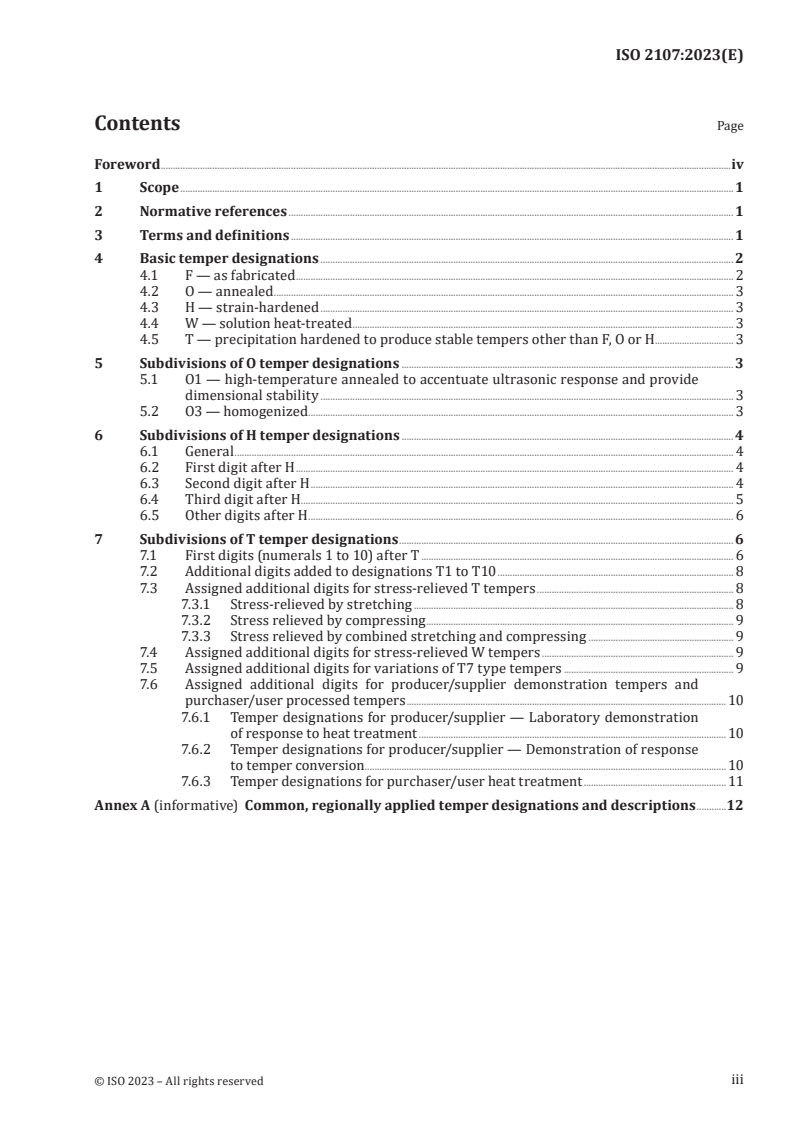
Contents Page
Foreword .iv
1 Scope . 1
2 Normative references . 1
3 Terms and definitions . 1
4 Basic temper designations . 2
4.1 F — as fabricated . 2
4.2 O — annealed . . 3
4.3 H — strain-hardened . 3
4.4 W — solution heat-treated . 3
4.5 T — precipitation hardened to produce stable tempers other than F, O or H . 3
5 Subdivisions of O temper designations . 3
5.1 O1 — high-temperature annealed to accentuate ultrasonic response and provide
dimensional stability . 3
5.2 O3 — homogenized . . 3
6 Subdivisions of H temper designations . 4
6.1 General . 4
6.2 First digit after H . 4
6.3 Second digit after H . 4
6.4 Third digit after H . 5
6.5 Other digits after H . 6
7 Subdivisions of T temper designations . 6
7.1 First digits (numerals 1 to 10) after T . 6
7.2 Additional digits added to designations T1 to T10 . 8
7.3 Assigned additional digits for stress-relieved T tempers . 8
7.3.1 Stress-relieved by stretching . 8
7.3.2 Stress relieved by compressing . 9
7.3.3 Stress relieved by combined stretching and compressing . 9
7.4 Assigned additional digits for stress-relieved W tempers . 9
7.5 Assigned additional digits for variations of T7 type tempers . 9
7.6 Assigned additional digits for producer/supplier demonstration tempers and
purchaser/user processed tempers . 10
7.6.1 Temper designations for producer/supplier — Laboratory demonstration
of response to heat treatment . 10
7.6.2 Temper designations for producer/supplier — Demonstration of response
to temper conversion . 10
7.6.3 Temper designations for purchaser/user heat treatment . 11
Annex A (informative) Common, regionally applied temper designations and descriptions .12
iii
Foreword
ISO (the International Organization for Standardization) is a worldwide federation of national standards
bodies (ISO member bodies). The work of preparing International Standards is normally carried out
through ISO technical committees. Each member body interested in a subject for which a technical
committee has been established has the right to be represented on that committee. International
organizations, governmental and non-governmental, in liaison with ISO, also take part in the work.
ISO collaborates closely with the International Electrotechnical Commission (IEC) on all matters of
electrotechnical standardization.
The procedures used to develop this document and those intended for its further maintenance are
described in the ISO/IEC Directives, Part 1. In particular, the different approval criteria needed for the
different types of ISO document should be noted. This document was drafted in accordance with the
editorial rules of the ISO/IEC Directives, Part 2 (see www.iso.org/directives).
ISO draws attention to the possibility that the implementation of this document may involve the use
of (a) patent(s). ISO takes no position concerning the evidence, validity or applicability of any claimed
patent rights in respect thereof. As of the date of publication of this document, ISO had not received
notice of (a) patent(s) which may be required to implement this document. However, implementers are
cautioned that this may not represent the latest information, which may be obtained from the patent
database available at www.iso.org/patents. ISO shall not be held responsible for identifying any or all
such patent rights.
Any trade name used in this document is information given for the convenience of users and does not
constitute an endorsement.
For an explanation of the voluntary nature of standards, the meaning of ISO specific terms and
expressions related to conformity assessment, as well as information about ISO's adherence to
the World Trade Organization (WTO) principles in the Technical Barriers to Trade (TBT), see
www.iso.org/iso/foreword.html.
This document was prepared by Technical Committee ISO/TC 79, Light metals and their alloys,
Subcommittee SC 9, Symbolization.
This fourth edition cancels and replaces the third edition (ISO 2107:2007), of which it constitutes a
minor revision. The changes are as follows:
— Clause 2 has been added;
— some terms and definitions have been updated and some new terms have been added in Clause 3;
— Clause 4 has been modified to "Basic temper" with some definitions updated and subdivisions
added;
— Annex A has been added.
Any feedback or questions on this document should be directed to the user’s national standards body. A
complete listing of these bodies can be found at www.iso.org/members.html.
iv
INTERNATIONAL STANDARD ISO 2107:2023(E)
Aluminium and aluminium alloys — Wrought products —
Temper designations
1 Scope
This document establishes temper designations as required for identification for all product forms of
wrought aluminium and aluminium alloys.
2 Normative references
There are no normative references in this document.
3 Terms and definitions
For the purposes of this document, the following terms and definitions apply.
ISO and IEC maintain terminology databases for use in standardization at the following addresses:
— ISO Online browsing platform: available at https:// www .iso .org/ obp
— IEC Electropedia: available at https:// www .electropedia .org/
3.1
temper
condition of the metal produced by mechanical and/or thermal processing, or both, typically
characterized by a certain structure and specified properties
3.2
working
forming of solid metal
3.3
hot working
forming of solid metal after pre-heating
Note 1 to entry: Strain hardening will or will not occur during hot working.
3.4
cold working
forming of solid metal without preheating
Note 1 to entry: Plastic deformation of metal at such temperature and strain-rate that strain hardening occurs.
3.5
strain-hardening
modification of a metal structure, by cold working, resulting in an increase in strength and hardness,
generally with loss of ductility
3.6
solution heat-treating
heating of an alloy at a suitable temperature for a sufficient time to allow one or more soluble
constituents to enter into solid solution, where they are retained in a supersaturated state after
quenching (rapid cooling)
3.7
ageing
treatment of a metal aiming at a change in its properties by precipitation of intermetallic phases from
supersaturated solid solution
Note 1 to entry: Ageing can be a treatment at room temperature (natural ageing) or a thermal treatment (artificial
ageing).
3.8
annealing
thermal treatment to soften metal by reduction or removal of strain hardening resulting from cold
working and/or by coalescing precipitates from solid solution
3.9
heat treatable alloy
alloy which can be strengthened by a suitable thermal treatment
3.10
non-heat-treatable alloy
alloy which is strengthened by working and not by thermal treatment
3.11
stress-relieving
reduction of internal residual stresses by thermal or mechanical means
4 Basic temper designations
The temper designations are based on the sequences of basic treatments used to produce the
various tempers. Property limits (mechanical or physical) apply to individual alloy-temper-product
combinations.
Regional temper designations are provided in Annex A.
The temper designation follows the alloy designation; these are separated by a hyphen.
Basic temper designations consist of letters. If subdivisions of the basic tempers are required, these are
indicated by one or more digits following the letter of the basic temper. These digits relate to a specific
sequence of basic treatments, but only those treatments or operations recognized as significantly
influencing the product characteristics are indicated.
Should some other variation of the same sequence of basic operations be applied to the same alloy,
resulting in different characteristics, then additional digits are added to the designation.
Throughout this document, generalized examples of tempers are shown, as follows:
— “X” denotes an unspecified digit (e.g. H2X is generalized to indicate appropriate temper designations
in the series H21 to H29);
— “XX” denotes two unspecified digits (e.g. HXX4 is generalized to indicate appropriate temper
designations in the H114 to H194 series, the H224 to H294 series, and the H324 to H394 series);
— “_” denotes one or multiple unspecified digits (e.g. T_51 is generalized to indicate appropriate temper
designations such as T351, T651, T6151, T7351, T7651, etc.).
4.1 F — as fabricated
This designation applies to the products of shaping processes in which no special control over thermal
conditions or strain-hardening is employed. For wrought products, there are no mechanical property
limits specified.
4.2 O — annealed
This designation applies to wrought products that are annealed to obtain the lowest strength temper,
and to cast products that are annealed to improve ductility and dimensional stability. The O may be
followed by a digit other than zero to indicate a product in the annealed condition having special
characteristics.
NOTE Products achieving the required annealed properties after hot forming processes can be designated
as O temper.
4.3 H — strain-hardened
This designation applies to products that have their strength increased by strain-hardening with or
without supplementary thermal treatments to produce some reduction in strength. The letter H is
always followed by at least two digits, the first indicating the specific combination of basic operations
and the second indicating the degree of strain hardening. A third digit indicates a variation of a two-
digit temper and is used when the mechanical properties, or other characteristics, differ from those of
the two-digit H temper to which it is added.
4.4 W — solution heat-treated
This designation describes an unstable temper applicable only to alloys that spontaneously age at room
temperature after solution heat-treatment. This designation is specific only when the period of natural
ageing is indicated, e.g. W 1/2 hr.
4.5 T — precipitation hardened to produce stable tempers other than F, O or H
This designation applies to products that are precipitation hardened, with or without supplementary
strain hardening, to produce stable tempers. The T is always followed by one or more digits indicating
the specific sequence of treatments.
5 Subdivisions of O temper designations
A digit following the O, when used, indicates a product in the annealed condition having special
characteristics. As the O temper is not part of the strain-hardened (H) series, variations of O temper
shall not apply to products that are strain-hardened after annealing and in which the effect of strain-
hardening is recognized in the mechanical properties or other characteristics.
5.1 O1 — high-temperature annealed to accentuate ultrasonic response and provide
dimensional stability
This designation applies to wrought products that are thermally treated at approximately the same
time and temperature required for solution heat-treatment and slow cooled to room temperature in
order to accentuate ultrasonic response and/or to provide dimensional stability. It is applicable to
products that are to be machined prior to solution heat-treatment by the user. Mechanical property
limits are not specified.
5.2 O3 — homogenized
This designation applies to continuously cast drawing stock or strip, which are subjected to a high
temperature soaking treatment to eliminate or reduce segregations, thus improving subsequent
formability and/or response to solution heat-treatment.
6 Subdivisions of H temper designations
6.1 General
Subdivisions are made according to the basic operations described in Clause 4 and the final degree of
strain hardening as described in 6.2 to 6.5.
6.2 First digit after H
The first digit following the letter H indicates the specific combination of basic operations as follows:
a) H1X Strain-hardened only.
These designations apply to products that are strain-hardened to obtain the desired strength
without supplementary thermal treatment.
b) H2X Strain-hardened and partially annealed.
These designations apply to products that are strain-hardened more than the desired final amount,
and then reduced in strength to the desired level by partial annealing. For alloys that age-soften
at room temperature, the H2X tempers have the same minimum ultimate tensile strength as the
corresponding H3X tempers. For other alloys, the H2X tempers have the same minimum ultimate
tensile strength as the corresponding H1X tempers and slightly higher elongation.
c) H3X Strain-hardened and stabilized.
These designations apply to products that are strain-hardened and whose mechanical properties
are stabilized either by a low-temperature thermal treatment or as a result of heat introduced
during fabrication. Stabilization usually improves ductility. This designation is applicable only to
those alloys which, unless stabilized, gradually age-soften at room temperature.
d) H4X Strain-hardened and lacquered or painted.
These designations apply to products that are strain-hardened and which are subjected to some
thermal operation during the subsequent painting or lacquering operation. The corresponding H2X
or H3X mechanical property limits apply.
6.3 Second digit after H
The second digit following the designation H1, H2, H3, and H4 indicates the degree of strain hardening,
as identified by the minimum valu
...