


ISO 15848-1:2006
(Main)Industrial valves — Measurement, test and qualification procedures for fugitive emissions — Part 1: Classification system and qualification procedures for type testing of valves
Industrial valves — Measurement, test and qualification procedures for fugitive emissions — Part 1: Classification system and qualification procedures for type testing of valves
ISO 15848-1:2005 specifies testing procedures, for evaluation of external leakage of valve stem seals (or shaft) and body joints of isolating valves and control valves intended for application in volatile air pollutants and hazardous fluids. End connection joints, vacuum application, effects of corrosion and radiation are excluded from ISO 15848-1:2005. ISO 15848-1:2005 concerns classification system and qualification procedures for type testing of valves.
Robinetterie industrielle — Mesurage, essais et modes opératoires de qualification pour émissions fugitives — Partie 1: Système de classification et modes opératoires de qualification pour les essais de type des appareils de robinetterie
L'ISO 15848-1:2006 spécifie des modes opératoires d'essai pour l'évaluation des fuites externes des dispositifs d'étanchéité de la tige (ou de l'arbre) des appareils de robinetterie, et des jonctions du corps des robinets de sectionnement et des robinets de régulation destinés à être utilisés au contact de polluants atmosphériques volatils et de fluides dangereux. Les jonctions des raccords d'extrémité, les applications sous vide, les effets de la corrosion et des rayonnements sont exclus de l'ISO 15848-1:2006. L'ISO 15848-1:2006 concerne le système de classification et les modes opératoires de qualification pour les essais de type des appareils de robinetterie.
General Information
- Status
- Withdrawn
- Publication Date
- 11-Jan-2006
- Withdrawal Date
- 11-Jan-2006
- Technical Committee
- ISO/TC 153 - Valves
- Drafting Committee
- ISO/TC 153 - Valves
- Current Stage
- 9599 - Withdrawal of International Standard
- Start Date
- 01-Jun-2015
- Completion Date
- 14-Feb-2026
Relations
- Effective Date
- 12-Feb-2026
- Effective Date
- 06-Jun-2022
- Effective Date
- 06-Jun-2022
- Effective Date
- 28-Jan-2012
Buy Documents
ISO 15848-1:2006 - Industrial valves -- Measurement, test and qualification procedures for fugitive emissions
ISO 15848-1:2006 - Robinetterie industrielle -- Mesurage, essais et modes opératoires de qualification pour émissions fugitives

Get Certified
Connect with accredited certification bodies for this standard

Institut za varilstvo d.o.o. (Welding Institute)
Slovenia's leading welding institute since 1952. ISO 3834, EN 1090, pressure equipment certification, NDT personnel, welder qualification. Only IIW Au
Sponsored listings
Frequently Asked Questions
ISO 15848-1:2006 is a standard published by the International Organization for Standardization (ISO). Its full title is "Industrial valves — Measurement, test and qualification procedures for fugitive emissions — Part 1: Classification system and qualification procedures for type testing of valves". This standard covers: ISO 15848-1:2005 specifies testing procedures, for evaluation of external leakage of valve stem seals (or shaft) and body joints of isolating valves and control valves intended for application in volatile air pollutants and hazardous fluids. End connection joints, vacuum application, effects of corrosion and radiation are excluded from ISO 15848-1:2005. ISO 15848-1:2005 concerns classification system and qualification procedures for type testing of valves.
ISO 15848-1:2005 specifies testing procedures, for evaluation of external leakage of valve stem seals (or shaft) and body joints of isolating valves and control valves intended for application in volatile air pollutants and hazardous fluids. End connection joints, vacuum application, effects of corrosion and radiation are excluded from ISO 15848-1:2005. ISO 15848-1:2005 concerns classification system and qualification procedures for type testing of valves.
ISO 15848-1:2006 is classified under the following ICS (International Classification for Standards) categories: 23.060.01 - Valves in general. The ICS classification helps identify the subject area and facilitates finding related standards.
ISO 15848-1:2006 has the following relationships with other standards: It is inter standard links to EN ISO 15848-1:2006, ISO 5775-1:1994, ISO 12217-2:2013, ISO 15848-1:2015. Understanding these relationships helps ensure you are using the most current and applicable version of the standard.
ISO 15848-1:2006 is available in PDF format for immediate download after purchase. The document can be added to your cart and obtained through the secure checkout process. Digital delivery ensures instant access to the complete standard document.
Standards Content (Sample)
INTERNATIONAL ISO
STANDARD 15848-1
First edition
2006-01-15
Industrial valves — Measurement, test
and qualification procedures for fugitive
emissions —
Part 1:
Classification system and qualification
procedures for type testing of valves
Robinetterie industrielle — Mesurage, essais et procédures de
qualification pour émissions fugitives —
Partie 1: Système de classification et procédures de qualification pour
essais de type des appareils de robinetterie
Reference number
©
ISO 2006
PDF disclaimer
This PDF file may contain embedded typefaces. In accordance with Adobe's licensing policy, this file may be printed or viewed but
shall not be edited unless the typefaces which are embedded are licensed to and installed on the computer performing the editing. In
downloading this file, parties accept therein the responsibility of not infringing Adobe's licensing policy. The ISO Central Secretariat
accepts no liability in this area.
Adobe is a trademark of Adobe Systems Incorporated.
Details of the software products used to create this PDF file can be found in the General Info relative to the file; the PDF-creation
parameters were optimized for printing. Every care has been taken to ensure that the file is suitable for use by ISO member bodies. In
the unlikely event that a problem relating to it is found, please inform the Central Secretariat at the address given below.
© ISO 2006
All rights reserved. Unless otherwise specified, no part of this publication may be reproduced or utilized in any form or by any means,
electronic or mechanical, including photocopying and microfilm, without permission in writing from either ISO at the address below or
ISO's member body in the country of the requester.
ISO copyright office
Case postale 56 • CH-1211 Geneva 20
Tel. + 41 22 749 01 11
Fax + 41 22 749 09 47
E-mail copyright@iso.org
Web www.iso.org
Published in Switzerland
ii © ISO 2006 – All rights reserved
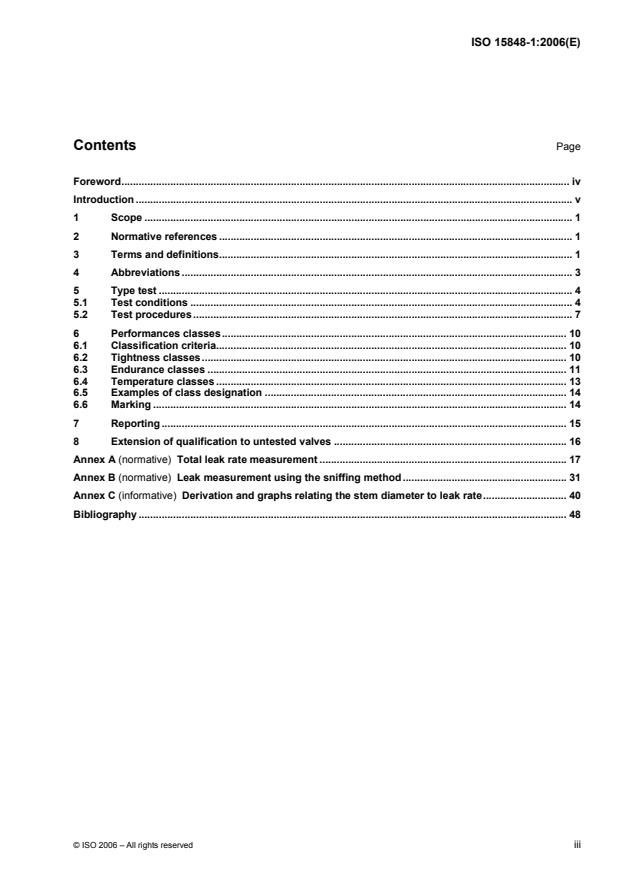
Contents Page
Foreword. iv
Introduction . v
1 Scope . 1
2 Normative references . 1
3 Terms and definitions. 1
4 Abbreviations . 3
5 Type test . 4
5.1 Test conditions . 4
5.2 Test procedures . 7
6 Performances classes. 10
6.1 Classification criteria. 10
6.2 Tightness classes. 10
6.3 Endurance classes . 11
6.4 Temperature classes . 13
6.5 Examples of class designation . 14
6.6 Marking . 14
7 Reporting . 15
8 Extension of qualification to untested valves . 16
Annex A (normative) Total leak rate measurement . 17
Annex B (normative) Leak measurement using the sniffing method . 31
Annex C (informative) Derivation and graphs relating the stem diameter to leak rate. 40
Bibliography . 48
Foreword
ISO (the International Organization for Standardization) is a worldwide federation of national standards bodies
(ISO member bodies). The work of preparing International Standards is normally carried out through ISO
technical committees. Each member body interested in a subject for which a technical committee has been
established has the right to be represented on that committee. International organizations, governmental and
non-governmental, in liaison with ISO, also take part in the work. ISO collaborates closely with the
International Electrotechnical Commission (IEC) on all matters of electrotechnical standardization.
International Standards are drafted in accordance with the rules given in the ISO/IEC Directives, Part 2.
The main task of technical committees is to prepare International Standards. Draft International Standards
adopted by the technical committees are circulated to the member bodies for voting. Publication as an
International Standard requires approval by at least 75 % of the member bodies casting a vote.
Attention is drawn to the possibility that some of the elements of this document may be the subject of patent
rights. ISO shall not be held responsible for identifying any or all such patent rights.
ISO 15848-1 was prepared by Technical Committee ISO/TC 153, Valves, Subcommittee SC 1, Design,
manufacture, marking and testing.
ISO 15848 consists of the following parts, under the general title Industrial valves — Measurement, test and
qualification procedures for fugitive emissions:
— Part 1: Classification system and qualification procedures for type testing of valves
— Part 2: Production acceptance test of valves
iv © ISO 2006 – All rights reserved
Introduction
The objective of this part of ISO 15848 is to enable classification of performance of different designs and
constructions of valves to reduce fugitive emissions.
This part of ISO 15848 defines type test for evaluation and qualification of valves where fugitive emissions
standards are specified.
The procedures of this part of ISO 15848 can only be used with the application of necessary precautions for
testing with flammable or inert gas at temperature and under pressure.
INTERNATIONAL STANDARD ISO 15848-1:2006(E)
Industrial valves — Measurement, test and qualification
procedures for fugitive emissions —
Part 1:
Classification system and qualification procedures for type
testing of valves
1 Scope
This part of ISO 15848 specifies testing procedures, for evaluation of external leakage of valve stem seals (or
shaft) and body joints of isolating valves and control valves intended for application in volatile air pollutants
and hazardous fluids. End connection joints, vacuum application, effects of corrosion and radiation are
excluded from this part of ISO 15848.
This part of ISO 15848 concerns classification system and qualification procedures for type testing of valves.
2 Normative references
The following referenced documents are indispensable for the application of this document. For dated
references, only the edition cited applies. For undated references, the latest edition of the referenced
document (including any amendments) applies.
ISO 5208, Industrial valves — Pressure testing of valves
3 Terms and definitions
For the purposes of this document, the following terms and definitions apply.
3.1
body seals
any seal in pressure containing part except stem (or shaft) seals
3.2
Class
a convenient round number used to designate pressure-temperature ratings
NOTE It is designated by the word “Class” followed by the appropriate reference number from the following series:
Class 125, Class 150, Class 250, Class 300, Class 600, Class 900, Class 1 500, Class 2 500.
3.3
concentration
ratio of test fluid volume to the gas mixture volume measured at the leak source(s) of the test valve
NOTE The concentration is expressed in ppmv (parts per million volume), which is a unit deprecated by ISO
3 3 3
(1 ppmv = 1 ml/m = 1 cm /m ).
3.4
control valve
power operated device which changes the fluid flow rate in a process control system and which consists of a
valve connected to an actuator that is capable of changing the position of a closure member in the valve in
response to a signal from the controlling system
3.5
fugitive emission
any chemical or mixture of chemicals, in any physical form, which represents an unanticipated or spurious
leak from equipment on an industrial site
3.6
leakage
loss of the test fluid through the stem (or shaft) seal or body seal(s) of a test valve under the specified test
conditions and which is expressed as a concentration or a leak rate
3.7
leak rate
−1
mass flow rate of the test fluid, expressed in mg·s per meter of the perimeter of the stem
3.8
local leakage
measurement of the test fluid leakage using a probe at the leak source point
3.9
mechanical cycle of control valves
for linear/rotary control valves, test cycles performed at 50 % of stroke/angle with an amplitude of ± 10 % of
full stroke/angle
3.10
mechanical cycle of isolating valves
motion of a valve obturator moving from the fully closed position to the fully open position, and returning to the
fully closed position
3.11
nominal size
DN
alphanumeric designation of size for components of a pipework system, which is used for reference purposes
and which comprises the letters DN followed by a dimensionless whole number which is directly related to
physical size, in millimetres, of the bore or outside diameter of the end connections
NOTE 1 The nominal diameter is designated by the letters DN followed by a number from the following series: 10, 15,
20, 25, 32, 40, 50, 65, 80, 100, 125, 150, 200, 250, 300, 350, 400, etc.
NOTE 2 The number following the letters DN does not represent a measurable value and should not be used for
calculation purposes except where specified in the relevant standard.
3.12
nominal pressure
PN
numerical designation which is a convenient rounded number for reference purposes
NOTE 1 All equipment of the same nominal size (DN) designated by the same PN number has the compatible mating
dimensions.
NOTE 2 The maximum allowable working pressure depends upon materials, design and working temperatures and
should be selected from the pressure/temperature rating tables in the appropriate standards.
NOTE 3 The nominal pressure is designated by the letters PN followed by the appropriate reference number from the
following series: 2,5, 6, 10, 16, 20, 25, 40, 50, etc.
2 © ISO 2006 – All rights reserved
3.13
isolating valve
valve intended for use principally in the closed or open position which may be power actuated or manually
operated
3.14
performance class
level of the performance of a test valve defined by the criteria specified in Clause 6
3.15
room temperature
temperature in the range of − 29 °C to + 40 °C
3.16
stem
shaft
valve component extending into the valve shell to transmit the linear/rotary motion from the actuating device to
the valve obturator
3.17
stem seal
shaft seal
component(s) installed around the valve stem (or shaft) to avoid leakage of internal fluids to atmosphere
3.18
test pressure
pressure used for testing the valve which, unless otherwise specified, shall be the rated pressure specified at
the test temperature and the shell material of a test valve in the relevant standards
3.19
test temperature
fluid temperature selected for the test from Table 3 as measured inside the test valve
3.20
thermal cycle
change of the temperature from the room temperature to the specified test temperature and return to the room
temperature
3.21
total leakage
collection of leakage of the test fluid at the leak source using an encapsulation method
3.22
type test
a test conducted to establish the performance class of a valve
4 Symbols and abbreviations
M predicted maximum leakage
alr
SSA stem (or shaft) seal adjustment
NOTE The abbreviation SSA corresponds to the abbreviation of “Stem Seal Adjustement”.
OD external diameter of the stem
stem
RT ambient temperature
5 Type test
5.1 Test conditions
5.1.1 Preparation of a valve to be tested
Only a fully assembled valve shall be used for the test.
A valve shall be selected from standard production at random. The valve shall have been tested and accepted
in accordance with ISO 5208 or any other applicable standard and no subsequent protective coating shall
have been applied.
Additional seal arrangements to allow the stem sealing system leakage measurement is permitted and shall
not affect the sealing performance of the valve.
The test valve interior shall be dried and lubricants (if any) shall be removed. The valve and test equipment
shall be clean and free of water, oil and dust and the packing may be changed prior to the test. If the valve
packing is changed prior to the test, it should be done under the supervision of the valve manufacturer.
If a test valve is equipped with a manually adjustable stem (or shaft) seal(s), it shall be initially adjusted
according to the manufacturer instructions, and recorded in the test report as provided in Clause 7.
The valve manufacturer shall select the appropriate actuating device.
5.1.2 Test fluid
The test fluid shall be helium gas of 97 % minimum purity or methane of 97 % minimum purity. The same test
fluid shall be used throughout the test.
5.1.3 Test temperature
Valve mechanical cycling is carried out at the room temperature or in the steps of the room temperature and
the selected test temperature other than the room temperature (see 5.2.4.1).
The test temperature shall be recorded for each leakage measurement.
5.1.4 Measurement of test valve temperature
The temperature of the test valve shall be measured at three locations (X, Y, Z), as shown in Figure 1, and
recorded in a test report.
a) Measurement at location “X” shall be used to determine the test temperature.
b) Measurement at location “Z “is used to determine the external valve temperature adjacent to the stem (or
shaft) seal(s) for information.
c) Measurement at location “Y” is also made for information. Any use of insulation shall be detailed in the
test report.
All temperatures at location X, Y and Z shall be stabilized before leakage is measured (see Figure 2).
Temperature at location “Z” shall be stabilized for minimum 10 min prior to leakage measurement.
Check if the temperature variation is within ± 5 %.
4 © ISO 2006 – All rights reserved
Key
1 location X: flow path (temperature T )
2 location Y: valve body (temperature T )
3 location Z: stuffing box (temperature T )
Figure 1 — Measurements of temperature at three locations
(when the valve is internally heated or cooled)
Key
T test temperature, °C
test
T stabilization temperature at location X (flow path)
T stabilization temperature at location Y (valve body)
T stabilization temperature at location Z (stuffing box)
t time
a
Stabilization of temperature at location Z (stuffing box).
b
Start of mechanical cycles.
Figure 2 — Stabilization of temperatures
5.1.5 Leakage measurement
5.1.5.1 Stem (or shaft) leakage measurement
Leakage shall be measured from a test valve at rest in the partly open position.
The leakage measurement shall be performed by the global method (flushing or vacuum) according to the
procedures described in Annex A.
5.1.5.2 Body seal leakage measurement
The leakage shall be measured by the sniffing method according to the procedure described in Annex B and
3 3 3
expressed in parts per million volume (1 ppmv = 1 ml/m = 1 cm /m ).
Evaluation of the end connections should be done to insure that they do not affect the results of the evaluation
of the body seals.
6 © ISO 2006 – All rights reserved
5.1.5.3 Leakage-measurement records
All results of leakage measurements shall be recorded in a test report as specified in Clause 7.
5.2 Test procedures
5.2.1 Safety rules
Testing with high pressure gas is potentially hazardous and thus all applicable local safety rules and adequate
safety measures shall be followed. If methane (CH ) is used, the combination of the test pressure and
temperature shall be reviewed for possible combustion concerns.
5.2.2 Test equipment
The test equipment shall be appropriately selected to
a) apply and maintain the test pressure within a range of ± 5 % of the nominal value;
b) apply valve mechanical cycles;
c) heat or cool the test valve to the selected test temperature, and maintain it within a range of ± 5 % but not
exceeding 15°C; no mechanical cycling is permitted during temperature change;
d) measure and record time, pressure, temperature, leakage and duration of a valve mechanical cycle;
e) measure and record actuation forces or torques to operate a test valve;
f) measure and record the stem sealing system loading, if applicable.
5.2.3 Stem (or shaft) seal adjustment (SSA)
5.2.3.1 Number of stem seal adjustment
Mechanical adjustments of stem (or shaft) sealing system during the type test shall be permitted only once, as
shown below, for each of qualification stage done according to Figures 3 and 4, if stem (or shaft) leakage has
been measured in excess of the target tightness class selected from Tables 1 or 2.
The maximum re-tightening force (or torque) to apply shall be determined prior to the type test.
EXAMPLE — A maximum of one adjustment is accepted for CC1 or CO1;
— A maximum of two adjustments is accepted for CC2 or CO2.
5.2.3.2 Test failure after stem seal adjustment
If a stem (or shaft) sealing arrangement fails to achieve the target tightness class, or it is not possible to
continue mechanical cycling, the test shall be considered terminated, and the test valve shall be evaluated for
qualification of lower tightness and endurance classes, if applicable.
5.2.3.3 Reporting the number of SSA
The total number of stem (or shaft) seal adjustment shall be recorded in the test report and indicated in the
designation of the valve classification as “SSA-1”, “SSA-2” and so forth.
5.2.4 Test description
5.2.4.1 General
The test description is the following.
a) The test valve shall be mounted on a test rig, according to the instructions given by the manufacturer.
b) The valve mounting shall be principally made with a stem (or shaft) positioned vertical. A valve intended
for use in other positions shall be mounted with the stem (or shaft) positioned horizontally.
c) All sealing systems shall have been properly adjusted beforehand, according to the manufacturer's
instructions. For valves using packings as a stem seal, the tightening torque of the gland boltings shall be
measured and recorded at the beginning of the test and after any stem seal adjustment.
d) The target number and combination of mechanical and thermal cycles shall be selected from the
endurance classes specified in Figures 3 and 4.
e) Leakage from the stem (or shaft) seal and from the body seals shall be separately measured. If the valve
does not allow such a separate measurement the total leakage of both stem (or shaft) and body seals
shall be measured at the same time according to Annex A.
f) Actual methods of mechanical cycles other than those specified in 5.2.4.2 and 5.2.4.3 shall be in
accordance with the manufacturer's instructions, and opening, closing and dwelling time shall be
recorded in the test report. Basically, they shall represent the intended operating conditions of a test valve.
g) Valve opening and closing force (or torque) shall be measured and recorded at the start and at the end of
the test, following subsequent stem seal adjustments if applicable.
5.2.4.2 Mechanical cycles of isolating valves
Unless otherwise specified by the valve manufacturer, the valve seating force (or torque) required for
tightness under a differential pressure of 0,6 MPa (6 bar), air or inert gas shall be used as the minimum force
(or torque) for mechanical cycle of a test valve.
Fully back seating a test valve is not required.
5.2.4.3 Mechanical cycles of control valves
The stem motion of linear action valves shall be between 1 mm/s and 5 mm/s. The shaft motion of rotary
control valves shall be between 1°/s and 5°/s.
The actuator to operate a test valve shall withstand only the pressure and friction force (or torque) acting on
the valve stem, and these values shall be recorded.
NOTE Measurement of friction force (or torque) is principally intended to check the packing friction usually expressed
as the dead band.
5.2.4.4 Preliminary tests at the room temperature (test 1)
The tests are carried out as shown below.
a) Pressurize a test valve with the test fluid to the test pressure as specified in a relevant standard.
b) After the test pressure has been stabilized, measure leakages both from the stem (or shaft) seal and from
the body seals, in accordance with Annexes A and B, respectively.
c) Record the test result in a test report.
8 © ISO 2006 – All rights reserved
5.2.4.5 Mechanical cycle test at the room temperature (test 2)
The tests are carried out as shown below.
a) Perform mechanical cycles at room temperature while the test valve is kept pressurized.
b) Measure the leakage from the stem (or shaft) seal only, in accordance with Annex A.
c) Record the test result in the test report.
d) Repeat the test in case of Class CO1 and CC1, as indicated in Figures 3 and 4.
5.2.4.6 Static test at the selected test temperature (test 3)
The tests are carried out as shown below.
a) Pressurize a test valve with the test fluid to the test pressure as specified in a relevant standard for the
selected test temperature selected from Table 3.
b) After the test pressure has been stabilized, adjust the valve temperature to the selected test temperature,
ensuring that the test pressure does not exceed the level specified in the relevant standard.
c) After the valve temperature has been stabilized with an allowance of ± 5 % with a maximum of 15 °C,
measure the leakage from the stem (or shaft) seal only in accordance with Annex A.
d) Record the test result in the test report.
e) Repeat the test in case of Class C01 and CC1, as indicated in Figures 3 and 4.
5.2.4.7 Mechanical cycle test at the selected test temperature (test 4)
The tests are carried out as shown below.
a) Perform mechanical cycles at the selected test temperature while the test valve is kept pressurized.
b) Measure the leakage from the stem (or shaft) seal only in accordance with Annex A.
c) Record the test result in a test report.
d) Repeat the test in case of Class C01 and CC1, as indicated in Figures 3 and 4.
5.2.4.8 Intermediate static test at the room temperature (test 5)
The tests are carried out as shown below.
a) Allow a test valve to return to the room temperature, without artificial cooling (or heating).
b) After the valve temperature has been stabilized, measure the leakage from the stem (or shaft) seal only in
accordance with Annex A.
c) Record the test result in a test report.
5.2.4.9 Final test at the room temperature (test 6)
The tests are carried out as shown below.
a) Allow a test valve to return to the room temperature, without artificial measures.
b) After the valve temperature has been stabilized, measure the leakage from the stem (or shaft) seal in
accordance with Annex A and from body seals in accordance with Annex B.
c) Record the test results in the test report.
5.2.4.10 Post test examination
After all the tests have been successfully completed, the test valve shall be disassembled and all sealing
components shall be visually examined to record notable wear and any other significant observations for
information.
5.2.4.11 Qualification
Tested valves shall be qualified when
⎯ all steps of test procedures have been satisfactorily performed for the target performance class;
⎯ all leakage measurements are verified equal or lower than the values specified for the target performance
class.
6 Performances classes
6.1 Classification criteria
Valve operating conditions and hazards of the line fluid being handled can result in different levels of valve
emission performance.
The purpose of Clause 6 is to define classification criteria resulting from the type test.
A performance class is defined by the combination of the following criteria:
a) “tightness class”: see Tables 1 and 2;
b) “endurance class”: see Figures 3 and 4;
c) “temperature class”: see Table 3.
6.2 Tightness classes
6.2.1 Definition
Tightness classes are defined only for stem (or shaft) sealing systems.
Leakage from body seals shall be u 50 ppmv in every case.
Table 1 — Tightness classes for stem (or shaft) seals
a
Measured leak rate
Class Remarks
−1 −1
mg⋅s ⋅m
Typically achieved with bellow seals or equivalent stem (shaft) sealing system for
−6
b
u 10
A
quarter turn valves
−4
u 10
B Typically achieved with PTFE based packings or elastomeric seals
−2
u 10
C Typically achieved with flexible graphite based packings
a −1 −1
Expressed in mg·s ·m measured with total leakage method as defined in Annex A.
b
Class A can be measured only with helium using the vacuum method.
10 © ISO 2006 – All rights reserved
Table 2 — Leakage from body seals
Measured concentration
ppmv
u 50
NOTE Expressed in ppmv measured with the sniffing method
3 3 3
as defined in Annex B (1 ppmv = 1 ml/m = 1 cm /m ).
6.2.2 Helium as test fluid
When the test fluid is helium, the tightness classes are identified as Class AH, Class BH and Class CH.
6.2.3 Methane as test fluid
When the test fluid is methane, the tightness classes are identified as Class BM and Class CM.
6.2.4 Correlations
There is no correlation intended between measurements of total leak rate as described in Annex A and local
sniffed concentration as described in Annex B.
There is no correlation intended between the tightness classes when the test fluid is helium (Class AH,
Class BH and Class CH) and when the test fluid is methane (Class BM and Class CM).
6.3 Endurance classes
6.3.1 Mechanical-cycle classes for isolating valves
The required minimum number of mechanical cycles for isolating valves shall be 500 cycles (full stroke) with
two thermal cycles, except for RT. This classification stage shall be identified as CO1. An extension to
classification CO2 shall be accomplished by addition of 1 000 mechanical cycles with one thermal cycle.
Further extension to CO3 etc shall be achieved by repetition of the requirement for CO2 (see Figure 3).
Key
T test temperature, °C
test
N number of mechanical cycles
P test fluid pressure
L measurement of leakage of stem seal
L measurement of leakage of body seal
NOTE The numbers 1 to 6 refer to the test sequences test 1 to test 6 as defined in 5.2.4.4 to 5.2.4.9.
Figure 3 — Mechanical-cycle classes for isolating valves
6.3.2 Mechanical-cycle classes for control valves
The required minimum number of mechanical cycles for control valves shall be 20 000 cycles with two thermal
cycles, except for RT. This classification stage shall be identified as CC1. An extension to classification CC2
shall be accomplished by addition of 40 000 mechanical cycles with one thermal cycle. Further extension to
CC3 etc shall be achieved by repetition of the requirement for CC2 (see Figure 4).
12 © ISO 2006 – All rights reserved
Key
T test temperature, °C
test
N number of mechanical cycles
P test fluid pressure
L measurement of leakage of stem seal
L measurement of leakage of body seal
NOTE The numbers 1 to 6 refer to the test sequences test 1 to test 6 as defined in 5.2.4.4 to 5.2.4.9.
Figure 4 — Mechanical-cycles classes for control valves
6.4 Temperature classes
The target temperature class shall be selected from Table 3. If the test is carried out at any temperature other
than those specified in the Table, the next lower class shall apply in case of the test temperature being above
zero, or the next higher class shall apply in case of the test temperature being below zero.
EXAMPLE If the test temperature is 405 °C, the value shall be classified as (t400 °C).
All test temperatures shall be recorded in the test report.
Table 3 — Temperature classes
(t-196 °C) (t-46 °C) (tRT) (t200 °C) (t400 °C)
− 196 °C − 46 °C Room temperature, °C 200 °C 400 °C
⎯ Test at − 196 °C qualifies the valve in the range − 196 °C up to RT.
⎯ Test at − 46 °C qualifies the valve in the range − 46 °C up to RT.
⎯ Test at RT qualifies the valve in the range − 29 °C to + 40 °C.
⎯ Test at 200 °C qualifies the valve in the range RT up to 200 °C.
⎯ Test at 400 °C qualifies the valve in the range RT up to 400 °C.
To qualify a valve in the range − 46 °C up to 200 °C, two tests are necessary:
⎯ The test at − 46 °C qualifies the valve in the range − 46 °C up to RT;
⎯ The test at 200 °C qualifies the valve in the range RT up to 200 °C.
Alternative temperature classes shall be subject to the agreement between the manufacturer and the
purchaser.
6.5 Examples of class designation
⎯ Tightness class: B (reference in Table 1).
⎯ Endurance class:
⎯ isolating valve CO1 ( reference in Figure 3);
⎯ control valve CC1 (reference in Figure 4).
⎯ Temperature class: a test at t200 °C and a test at t−46 °C.
⎯ Test pressure : according to PN or ANSI class rating depending on a relevant valve standard or in bar at
room temperature and at test temperature for specific tests; the standard reference is ISO 15848-1.
⎯ Number of stem seal adjustments (SSA): 1.
6.6 Marking
In addition to the marking required by relevant standards, production valves qualified by type testing in
accordance with this part of ISO 15848 may be marked with “ISO FE” - which stands for ISO fugitive
emission - and the information as indicated in 6.5.
EXAMPLE 1 Performance class: ISO FE BH (or BM) — CO1 — SSA 1 — t(− 46°C, 200 °C) — PN16 — ISO 15848-1.
EXAMPLE 2 Performance class: ISO FE BH (or BM) — CO1 — SSA 1 — t(− 46°C, 200 °C) — CL150 — ISO 15848-1.
In case of specific tests in bars:
EXAMPLE 3 Performance class: ISO FE BH (or BM) — CO1 — SSA 1 — t200 °C — (40/30) — ISO 15848-1.
14 © ISO 2006 – All rights reserved
7 Reporting
The test report shall include the following information:
a) the name and address of the valve manufacturer;
b) valve sizes and pressure class;
c) valve model number and style;
d) method of sample selection;
e) diagram of the test rig and the data of the test equipment including the detector make and model or the
probe flow rate where any sniffing measurement is quoted;
f) the date of test;
g) reference standards with applicable revision numbers;
h) the test fluid;
i) valve performance classes achieved;
j) valve mounting instructions;
k) valve repacking before type test to be reported if applicable;
l) insulation of test valve to be reported if applicable;
m) valve operation data:
⎯ valve operating torque or force,
⎯ gland bolt tightening torque,
⎯ stroke/angle;
n) description of the actuator if applicable;
o) copy of the test profile;
p) detailed results of the test;
q) qualification certificate.
The specific product data file including the following information shall be the responsibility of the manufacturer
and shall be included as an annex:
a) cross sectional valve assembly drawing;
b) bill of valve materials;
c) stem or shaft seal description, dimensions and specifications;
d) body seal(s) description, dimensions and specifications;
e) material specifications of stem (or shaft) seal components;
f) hydrostatic test certificate.
8 Extension of qualification to untested valves
Upon the successful completion of the test program as defined in this part of ISO 15848, this qualification may
be extended to untested sizes and classes of valves of the same type if the following criteria are met:
a) the stem (or shaft) seals and body seals are of the same material, design (shape) and construction,
independent of the size;
b) loading arrangement applies a similar sealing stress to the seal element as that applied in the test valve;
c) the type of motion of the stem (or shaft) is identical;
d) tolerances classes and surface finishes specifications of all valve components which affect sealing
performance are identical;
NOTE The tolerances classes are in accordance with ISO 286.
e) stem diameters are within the range of 50 % lower and 200 % higher of those of the test valve;
f) the valve Class or PN designation is equal or lower;
g) the required temperature class falls between the room temperature and the test temperature of the
qualified valve;
h) the tightness class required is equal to, or less severe than that of the qualified valve.
The use of gearbox or other actuator does not require separated qualification, provided above criteria are met.
16 © ISO 2006 – All rights reserved
Annex A
(normative)
Total leak rate measurement
A.1 Vacuum method (helium only)
A.1.1 Scope
This annex specifies the vacuum method used to measure the total leak rate of the stem sealing system of an
industrial valve in using an helium mass spectrometer.
The test fluid is helium (97 % purity).
A.1.2 Principle
The principle of the vacuum method is illustrated in Figure A.1. The leakage source is enclosed in a tight
chamber, which is evacuated and then connected to an helium mass spectrometer.
The tight chamber may be fulfilled by the design of the stem sealing system.
Key
1 vacuum chamber
2 pressurized helium
3 vacuum helium detector
Figure A.1 — Principle of the vacuum method
A.1.3 Equipment and definitions
A.1.3.1 Helium mass spectrometer
The helium mass spectrometer type and main characteristics shall be specified.
The sensitivity of the helium mass spectrometer shall be in accordance with the range of the leak rate to be
measured.
The helium mass spectrometer measurement corresponds to the rate at which a volume of helium at specified
3 −1
pressure passes a given cross section of the test system (SI unit: Pa·m ·s ).
Then, the leak rate is calculated in milligrams per second (see A.1.7) and reported to the outer stem diameter.
−1 −10 −1
As regards the helium systems, sensitivities ranging from 5 mg·s to 5·10 mg·s are allowable.
The response time of the helium mass spectrometer is evaluated (or verified) in using the standard calibrated
leak. The time is recorded when the standard calibrated leak is opened to the helium mass spectrometer and
when the increase in helium mass spectrometer output signal becomes stable.
The elapse time between the helium application and the moment where the reading represents 90 % of the
equilibrium signal is the response time of the helium mass spectrometer.
A.1.3.2 Auxiliary pump system
The size of the tested valve can necessitate the use of an auxiliary vacuum pump system. Then the ultimate
absolute pressure and pump speed capability shall be sufficient to attain required test sensitivity and response
time.
A.1.3.3 Helium pressurisation
It shall be possible to apply helium pressure up to the nominal test pressure of the valve.
A.1.3.4 Standard calibrated leak
In order to evaluate the response time of the whole measuring system, the standard calibrated leak
connection should be placed on the vacuum enclosure as near as possible to the stem sealing system.
The standard calibrated leak may be either of a permeation or a capillary type. The standard calibrated leak
shall be selected depending on to the tightness class of the tested valve. Depending of the helium mass
spectrometer manufacturer, different standard calibrated leaks exist for one item of equipment
A.1.4 Calibration
A.1.4.1 Helium mass spectrometer
A.1.4.1.1 Warm up
The instrument shall be turned on and allowed to warm up for the minimum time specified by the instrument
manufacturer prior to calibrating with the calibrated leak standard.
A.1.4.1.2 Calibration
The instrument shall be calibrated as specified by the instrument manufacturer using permeation or a capillary
type standard.
18 © ISO 2006 – All rights reserved
The helium mass spectrometer shall be calibrated:
⎯ at the beginning of each test and routinely if the test takes a long time (e.g. calibration once a week);
⎯ over the tightness class range required.
A.1.4.2 System calibration
A standard calibrated leak with 100 % helium shall be attached, where possible, to the component as far as
possible from the instrument connection to the component (Figure A.2).
The instrument shall be turned on and allowed to warm up for the minimum time specified by the instrument
manufacturer prior to calibrating with the standard calibrated leak. The standard calibrated leak shall remain
open during system calibration until the response time has been determined.
a) Evacuation: with the component evacuated to an absolute pressure sufficient for connection of the helium
mass spectrometer to the system, the standard calibrated leak shall remain open during system
calibration until the response time has been determined.
b) Response time of the full system: the time is recorded when the standard calibrated leak is opened to the
system and when the increase in helium mass spectrometer output signal becomes stable. The elapse
time between the helium application and the moment where the reading represents 90 % of the
equilibrium signal is the response time of the system.
c) Background reading: background is established after determining response time. The standard calibrated
leak is closed to the system and the instrument reading shall be recorded when it becomes stable.
A.1.5 Requirements for the test
A.1.5.1 Tight chamber
The tight chamber shall be tight enough to enhance the establishment of a vacuum warranting the
measurement accuracy.
The tight chamber shall be so sized as to allow the valve actuator to be moved. During heating, the inside of
the tight chamber should be ventilated, or the tight chamber can be removed, to stabilize the temperature and
avoid any overheating of the valve body that is not representative of real operating conditions.
A.1.5.2 Instrumented stem sealing system
It shall meet the same tightness requirements as the tight chamber.
In addition, the operator shall check that
⎯ the vacuum tap is correctly positioned for leak rate measurement,
⎯ the vacuum tap remains unclogged throughout the test.
In addition, the sealing of instrumented stem sealing system shall withstand the temperature and mechanical
cycling conditions required during testing (durability conditions).
While the stem sealing system is being instrumented, the modifications made on the gland shall maintain
operating conditions representative of the real valve stem operation.
A.1.5.3 Pollution and packing degradation
Provision shall be made for a filter to protect the helium mass spectrometer against any pollution, which might
result from packing degradation products, and make the leak measurement erroneous.
It is also recommended to properly establish a vacuum within the spectrometer prior to any measurement, so
as to make sure of the absence of any pollution and to possibly eliminate them.
A.1.5.4 Safety
All accessories used to contain pressure in the valve body (flanges, bolting, all fittings etc.) shall be suitable
for test pressure and temperature.
The valve to be tested shall be carefully fastened before pressurisation and cycling.
The pressure inside the valve body shall be increased slowly.
A.1.5.5 Personnel qualification
This method shall be applied by qualified and suitably trained operators.
A.1.6 Testing procedure
A.1.6.1 Test set-up
The test set-up is shown schematically in Figure A.2.
Key
1 helium at 97 % purity 6 standard calibrated leak
2 pressure control 7 vacuum safety
3 actuator 8 tested stem sealing
4 vacuum 9 helium mass spectrometer
5 helium 10 data acquisition
Figure A.2 — Equipment
20 © ISO 2006 – All rights reserved
A.1.6.2 Preparation of the tested valve
Before each test
⎯ the valve is cleaned and dried;
⎯ the packing tightening checked.
The hydrostatic test shall be performed before testing the valve in high pressure and high temperature
conditions.
It is required to change packing before any sealing test (when using packing in the stem sealing system).
If the tight chamber encloses the entire valve, connection flanges shall be welded to avoid any leaks that
come from them. In this case, the measurements correspond to the leaks from stem sealing system and body
seals.
A.1.6.3 Calibration
See A.1.4.
A.1.6.4 Measurement
The measurement is carried out as follows:
a) establishment of a vacuum inside the tight chamber and connection of the helium mass spectrometer to
the tight chamber;
b) determination of the system response time (e.g. by use of a calibrated leak as shown in Figure A.2);
c) helium background levels recording;
d) valve pressurization;
e) test temperature stabilization;
f) leak recording;
g) leak stabilization (see Figure A.3);
h) leak measurement.
Key
L leak rate, in milligrams per second per metre
...
NORME ISO
INTERNATIONALE 15848-1
Première édition
2006-01-15
Robinetterie industrielle — Mesurage,
essais et modes opératoires de
qualification pour émissions fugitives —
Partie 1:
Système de classification et modes
opératoires de qualification pour les
essais de type des appareils de
robinetterie
Industrial valves — Measurement, test and qualification procedures for
fugitive emissions —
Part 1: Classification system and qualification procedures for type
testing of valves
Numéro de référence
©
ISO 2006
PDF – Exonération de responsabilité
Le présent fichier PDF peut contenir des polices de caractères intégrées. Conformément aux conditions de licence d'Adobe, ce fichier
peut être imprimé ou visualisé, mais ne doit pas être modifié à moins que l'ordinateur employé à cet effet ne bénéficie d'une licence
autorisant l'utilisation de ces polices et que celles-ci y soient installées. Lors du téléchargement de ce fichier, les parties concernées
acceptent de fait la responsabilité de ne pas enfreindre les conditions de licence d'Adobe. Le Secrétariat central de l'ISO décline toute
responsabilité en la matière.
Adobe est une marque déposée d'Adobe Systems Incorporated.
Les détails relatifs aux produits logiciels utilisés pour la création du présent fichier PDF sont disponibles dans la rubrique General Info
du fichier; les paramètres de création PDF ont été optimisés pour l'impression. Toutes les mesures ont été prises pour garantir
l'exploitation de ce fichier par les comités membres de l'ISO. Dans le cas peu probable où surviendrait un problème d'utilisation,
veuillez en informer le Secrétariat central à l'adresse donnée ci-dessous.
© ISO 2006
Droits de reproduction réservés. Sauf prescription différente, aucune partie de cette publication ne peut être reproduite ni utilisée sous
quelque forme que ce soit et par aucun procédé, électronique ou mécanique, y compris la photocopie et les microfilms, sans l'accord écrit
de l'ISO à l'adresse ci-après ou du comité membre de l'ISO dans le pays du demandeur.
ISO copyright office
Case postale 56 • CH-1211 Geneva 20
Tel. + 41 22 749 01 11
Fax. + 41 22 749 09 47
E-mail copyright@iso.org
Web www.iso.org
Publié en Suisse
ii © ISO 2006 – Tous droits réservés
Sommaire Page
Avant-propos. iv
Introduction . v
1 Domaine d'application. 1
2 Références normatives . 1
3 Termes et définitions. 1
4 Abréviations . 4
5 Essai de type . 4
5.1 Conditions d'essai . 4
5.2 Modes opératoires d'essai. 7
6 Classes de performance . 10
6.1 Critères de classification . 10
6.2 Classes d'étanchéité . 11
6.3 Classes d'endurance . 12
6.4 Classes de température . 13
6.5 Exemples de désignation de classe . 14
6.6 Marquage . 14
7 Rapport d'essai . 15
8 Extension de qualification aux appareils de robinetterie non soumis à essai . 16
Annexe A (normative) Mesurage du débit de fuite total. 17
Annexe B (normative) Mesurage des fuites au moyen de la méthode de reniflage. 32
Annexe C (informative) Calcul et graphiques établissant le rapport entre le diamètre de la tige et
le débit de fuite. 42
Bibliographie . 50
Avant-propos
L'ISO (Organisation internationale de normalisation) est une fédération mondiale d'organismes nationaux de
normalisation (comités membres de l'ISO). L'élaboration des Normes internationales est en général confiée
aux comités techniques de l'ISO. Chaque comité membre intéressé par une étude a le droit de faire partie du
comité technique créé à cet effet. Les organisations internationales, gouvernementales et non
gouvernementales, en liaison avec l'ISO participent également aux travaux. L'ISO collabore étroitement avec
la Commission électrotechnique internationale (CEI) en ce qui concerne la normalisation électrotechnique.
Les Normes internationales sont rédigées conformément aux règles données dans les Directives ISO/CEI,
Partie 2.
La tâche principale des comités techniques est d'élaborer les Normes internationales. Les projets de Normes
internationales adoptés par les comités techniques sont soumis aux comités membres pour vote. Leur
publication comme Normes internationales requiert l'approbation de 75 % au moins des comités membres
votants.
L'attention est appelée sur le fait que certains des éléments du présent document peuvent faire l'objet de
droits de propriété intellectuelle ou de droits analogues. L'ISO ne saurait être tenue pour responsable de ne
pas avoir identifié de tels droits de propriété et averti de leur existence.
L'ISO 15848-1 a été élaborée par le comité technique ISO/TC 153, Robinetterie, sous-comité SC 1,
Conception, construction, marquage et essais.
L'ISO 15848 comprend les parties suivantes, présentées sous le titre général Robinetterie industrielle —
Mesurage, essais et modes opératoires de qualification pour émissions fugitives:
— Partie 1: Système de classification et modes opératoires de qualification pour les essais de type des
appareils de robinetterie
— Partie 2: Essais de réception en production des appareils de robinetterie
iv © ISO 2006 – Tous droits réservés
Introduction
La présente partie de l'ISO 15848 établit la classification des performances de différentes conceptions et
constructions d'appareils de robinetterie afin de réduire les émissions fugitives.
La présente partie de l'ISO 15848 définit un essai de type pour l'évaluation et la qualification d'appareils de
robinetterie pour lesquels des normes sur les émissions fugitives sont spécifiées.
Les modes opératoires de la présente partie de l'ISO 15848 ne peuvent être appliqués qu'en prenant les
précautions nécessaires pour les essais avec des gaz inflammables ou inertes à diverses températures et
sous pression.
NORME INTERNATIONALE ISO 15848-1:2006(F)
Robinetterie industrielle — Mesurage, essais et modes
opératoires de qualification pour émissions fugitives —
Partie 1:
Système de classification et modes opératoires de qualification
pour les essais de type des appareils de robinetterie
1 Domaine d'application
La présente partie de l'ISO 15848 spécifie des modes opératoires d'essai pour l'évaluation des fuites externes
des dispositifs d'étanchéité de la tige (ou de l'arbre) des appareils de robinetterie, et des jonctions du corps
des robinets de sectionnement et des robinets de régulation destinés à être utilisés au contact de polluants
atmosphériques volatils et de fluides dangereux. Les jonctions des raccords d'extrémité, les applications sous
vide, les effets de la corrosion et des rayonnements sont exclus de la présente partie de l'ISO 15848.
La présente partie de l'ISO 15848 concerne le système de classification et les modes opératoires de
qualification pour les essais de type des appareils de robinetterie.
2 Références normatives
Les documents de référence suivants sont indispensables pour l'application du présent document. Pour les
références datées, seule l'édition citée s'applique. Pour les références non datées, la dernière édition du
document de référence s'applique (y compris les éventuels amendements).
ISO 5208, Robinetterie industrielle — Essais sous pression pour les appareils de robinetterie
3 Termes et définitions
Pour les besoins du présent document, les termes et définitions suivants s'appliquent.
3.1
dispositifs d'étanchéité du corps
tout dispositif d'étanchéité dans une partie sous pression à l'exception des dispositifs d'étanchéité de la tige
(ou de l'arbre)
3.2
Class
chiffre entier approprié utilisé pour désigner la relation pression/température
NOTE Celui-ci est désigné par le terme «Class» suivi du numéro de référence approprié à partir de la série suivante:
Class 125, Class 150, Class 250, Class 300, Class 600, Class 900, Class 1 500, Class 2 500.
3.3
concentration
rapport du volume du fluide d'essai au volume du mélange de gaz mesuré à la (ou aux) source(s) de fuite de
l'appareil de robinetterie soumis à essai
NOTE La concentration est exprimée en ppmv (parties par million en volume qui est une unité déconseillée par l’ISO)
3 3 3
(1 ppmv = 1 ml/m = 1 cm /m ).
3.4
robinet de régulation
appareil motorisé qui modifie le débit de fluide dans un système de régulation de processus et qui se
compose d'un appareil de robinetterie relié à un actionneur pouvant modifier la position d'un élément de
fermeture dans l'appareil de robinetterie en réponse à un signal du système de régulation
3.5
émission fugitive
tout produit chimique ou mélange de produits chimiques, sous toute forme physique, qui représente une fuite
imprévue ou un parasite provenant d'équipements d'un site industriel
3.6
fuite
perte de fluide d'essai par le dispositif d'étanchéité de la tige (ou de l'arbre) ou par le ou les dispositifs
d'étanchéité du corps d'un appareil de robinetterie soumis à l'essai dans les conditions d'essai spécifiées,
exprimée en tant que concentration ou débit de fuite
3.7
débit de fuite
−1
débit-masse du fluide d'essai, exprimé en mg⋅s par mètre de périmètre de la tige
3.8
fuite locale
fuite du fluide d'essai mesurée à la source de la fuite, au moyen d'une sonde
3.9
cycle mécanique des robinets de régulation
pour les robinets de régulation linéaires/rotatifs, cycles d'essai effectués à 50 % de la course/de l'angle avec
une amplitude de ± 10 % de la course complète/de l'angle complet
3.10
cycle mécanique des robinets de sectionnement
mouvement de l'obturateur de l'appareil de robinetterie se déplaçant de la position complètement fermée vers
la position complètement ouverte et retournant à la position complètement fermée
3.11
diamètre nominal
DN
désignation alphanumérique du diamètre des composants d'un système de robinetterie utilisé pour des
besoins de référence et qui se compose des lettres DN suivies d'un chiffre entier sans dimension directement
lié aux dimensions physiques, en millimètres, du diamètre de passage ou du diamètre extérieur des
raccordements d'extrémité
NOTE 1 Le diamètre nominal est désigné par les lettres DN suivies du numéro de la série suivante: 10; 15; 20; 25; 32;
40; 50; 65; 80; 100; 125; 150; 200; 250; 300; 350; 400; etc.
NOTE 2 Le numéro qui suit les lettres DN ne représente pas une valeur mesurable, et il ne convient pas de l'utiliser
dans des calculs, sauf spécification contraire dans la norme correspondante.
2 © ISO 2006 – Tous droits réservés
3.12
pression nominale
PN
désignation numérique correspondant à un chiffre arrondi approprié pour des besoins de référence
NOTE 1 Tous les équipements de même diamètre nominal (DN) désignés par le même numéro de PN ont des
dimensions correspondantes compatibles.
NOTE 2 La pression maximale admissible dépend des matériaux et des températures de calcul et de service. Il
convient de la choisir en fonction des tableaux des relations pression/température présentés dans les normes pertinentes.
NOTE 3 La pression nominale est désignée par les lettres PN suivies du numéro de référence approprié, à partir de la
série suivante: 2,5; 6; 10; 16; 20; 25; 40; 50; etc.
3.13
robinets de sectionnement
appareil de robinetterie destiné à être utilisé essentiellement dans la position fermée ou ouverte et qui peut
être motorisé ou manuel
3.14
classe de performance
niveau de performance d'un appareil de robinetterie soumis à l'essai défini par les critères spécifiés dans
l'Article 6
3.15
température ambiante
température comprise entre − 29 °C et + 40 °C
3.16
tige
arbre
composant de l'appareil de robinetterie se prolongeant jusque dans l'enveloppe de celui-ci afin de transmettre
le mouvement linéaire/rotatif depuis l'actionneur jusqu'à l'obturateur de l'appareil de robinetterie
3.17
dispositif d'étanchéité de la tige
dispositif d'étanchéité de l'arbre
composant(s) placé(s) autour de la tige (ou de l'arbre) de l'appareil de robinetterie pour éviter la fuite des
fluides internes dans l'atmosphère
3.18
pression d'essai
pression utilisée pour les essais de l'appareil de robinetterie qui, sauf spécification contraire, doit être la
pression nominale spécifiée à la température d'essai et pour le matériau de l'enveloppe de l'appareil de
robinetterie soumis à l'essai dans les normes pertinentes
3.19
température d'essai
température de fluide choisie pour l'essai à partir du Tableau 3 telle que mesurée à l'intérieur de l'appareil de
robinetterie soumis à l'essai
3.20
cycle thermique
changement de température de la température ambiante à la température d'essai, et retour à la température
ambiante
3.21
fuite totale
recueil du fluide d'essai à la source de la fuite au moyen d'une méthode d'encapsulation
3.22
essai de type
essai effectué pour établir la classe de performance d'un appareil de robinetterie
4 Symboles et abréviations
M débit de fuite maximal prévu
alr
SSA ajustement des dispositifs d'étanchéité de la tige (ou de l'arbre)
NOTE L’abréviation SSA maintenue dans les langues anglaise et française correspond à l’abréviation de «Stem Seal
Adjustment».
OD diamètre extérieur de la tige
stem
RT température ambiante
5 Essai de type
5.1 Conditions d'essai
5.1.1 Préparation de l'appareil de robinetterie soumis à l'essai
Seul un appareil de robinetterie entièrement assemblé doit être utilisé pour l'essai.
L'appareil de robinetterie doit être choisi au hasard dans la production de série. Il doit avoir été soumis à essai
conformément à l'ISO 5208 ou à toute autre norme applicable et aucun revêtement de protection
supplémentaire ne doit avoir été appliqué.
Un dispositif d'étanchéité complémentaire pour permettre la mesure de fuite du système d'étanchéité de la
tige est admis et ne doit pas affecter le niveau d'étanchéité de l'appareil de robinetterie.
L'intérieur de l'appareil de robinetterie d'essai doit être séché et les lubrifiants (s'il y en a) doivent être retirés.
L'appareil de robinetterie et les équipements d'essai doivent être nettoyés et vidés de toute eau, huile et
poussière, et la garniture d'étanchéité peut être changée avant l'essai. Si la garniture de l'appareil est
changée avant l'essai, il convient d'effectuer ce changement sous la supervision du fabricant de l'appareil.
Si l'appareil de robinetterie est équipé d'un ou de plusieurs dispositifs d'étanchéité de la tige (ou de l'arbre)
réglables manuellement, ils doivent être préalablement ajustés selon les instructions du fabricant et
l'ajustement doit être enregistré dans le rapport d'essai comme indiqué dans l'Article 7.
Le fabricant de l'appareil de robinetterie doit choisir l'actionneur approprié.
5.1.2 Fluide d'essai
Le fluide d'essai doit être de l'hélium d'une pureté minimale de 97 % ou du méthane d'une pureté minimale de
97 %. Le même fluide d'essai doit être utilisé pendant tout l'essai.
5.1.3 Température d'essai
Les cycles mécaniques de l'appareil de robinetterie sont effectués à température ambiante ou aux environs
de la température ambiante et à la température d'essai autre que la température ambiante (voir 5.2.4.1).
La température d'essai doit être enregistrée pour chaque mesure de fuite.
4 © ISO 2006 – Tous droits réservés
5.1.4 Mesure de la température d'essai de l'appareil de robinetterie
La température de l'appareil de robinetterie doit être mesurée en trois points (X, Y, Z), comme illustré à la
Figure 1, et enregistrée dans le rapport d'essai.
a) La mesure au point «X» doit être utilisée pour déterminer la température d'essai.
b) La mesure au point «Z» est utilisée pour déterminer la température de l'appareil de robinetterie adjacente
aux dispositifs d'étanchéité de la tige (ou de l'arbre), pour information.
c) La mesure au point «Y» est également relevée pour information. Toute utilisation de dispositif isolant doit
être décrite dans le rapport d'essai.
Toutes les températures aux points X, Y et Z doivent être stabilisées avant de mesurer la fuite (voir Figure 2).
La température au point «Z» doit être stabilisée pendant au moins 10 min avant de mesurer la fuite.
Vérifier si la variation de température est à l'intérieur d'une tolérance de ± 5 %.
Légende
1 point X: passage de l'écoulement (température T )
2 point Y: corps de l'appareil de robinetterie (température T )
3 point Z: boîte à garniture (température T )
Figure 1 — Mesure de la température en trois points
(lorsque l'appareil de robinetterie est chauffé ou refroidi intérieurement)
Légende
T température d'essai, °C
test
T température de stabilisation au point X (passage de l'écoulement)
T température de stabilisation au point Y (corps de l'appareil de robinetterie)
T température de stabilisation au point Z (boîte à garniture)
t temps
a
Stabilisation de la température au point Z (boîte à garniture).
b
Début des cycles mécaniques.
Figure 2 — Stabilisation des températures
5.1.5 Mesurage de la fuite
5.1.5.1 Mesurage de la fuite au niveau de la tige (ou de l'arbre)
La fuite doit être mesurée sur un appareil de robinetterie au repos dans la position partiellement ouverte.
Le mesurage de la fuite doit être effectué au moyen de la méthode globale (balayage par gaz porteur ou par
le vide) conformément aux modes opératoires décrits dans l'Annexe A.
5.1.5.2 Mesurage de la fuite au niveau des dispositifs d'étanchéité du corps
La fuite doit être mesurée au moyen de la méthode de reniflage conformément au mode opératoire décrit
3 3 3
dans l'Annexe B et exprimée en parties par million en volume (1 ppmv = 1 ml/m = 1 cm /m ).
Il convient d'effectuer l'évaluation des raccordements d'extrémité afin de s'assurer qu'ils n'affectent pas les
résultats de l'évaluation des dispositifs d'étanchéité du corps.
6 © ISO 2006 – Tous droits réservés
5.1.5.3 Enregistrement des mesures de fuite
Tous les résultats des mesurages de fuite doivent être enregistrés dans un rapport d'essai comme spécifié
dans l'Article 7.
5.2 Modes opératoires d'essai
5.2.1 Règles de sécurité
Les essais utilisant des gaz à haute pression sont potentiellement dangereux, et toutes les règles locales de
sécurité et les mesures de sécurité adéquates doivent être suivies. Si du méthane (CH ) est utilisé, la
combinaison de la pression d'essai et de la température d'essai doit être révisée au regard de problèmes de
combustion éventuels.
5.2.2 Appareillage d'essai
L'appareillage d'essai doit être correctement choisi pour
a) appliquer et maintenir la pression d'essai à ± 5 % de sa valeur nominale;
b) appliquer les cycles mécaniques à l'appareil de robinetterie;
c) chauffer ou refroidir l'appareil de robinetterie à la température d'essai choisie, et la maintenir à ± 5 %,
sans toutefois dépasser 15 °C; aucun cycle mécanique n'est autorisé pendant le changement de
température;
d) mesurer et enregistrer l'heure, la pression, la température, la fuite et la durée d'un cycle mécanique de
l'appareil de robinetterie;
e) mesurer et enregistrer les forces ou les couples de manœuvre permettant de faire fonctionner l'appareil
de robinetterie;
f) mesurer et enregistrer la charge du système d'étanchéité de la tige, le cas échéant.
5.2.3 Ajustement des dispositifs d'étanchéité de la tige (ou de l'arbre) (SSA)
5.2.3.1 Nombre d'ajustements des dispositifs d'étanchéité de la tige
Les ajustements mécaniques du système d'étanchéité de la tige (ou de l'arbre) pendant l'essai de type ne
sont admis qu'une seule fois, comme indiqué ci-dessous, pour chaque étape de qualification effectuée
conformément à la Figure 3 et à la Figure 4, si la fuite de la tige (ou de l'arbre) a été mesurée en excès par
rapport à la classe d'étanchéité cible sélectionnée à partir du Tableau 1 ou du Tableau 2.
La force (ou le couple) de resserrage maximal(e) à appliquer doit être déterminé(e) avant l'essai de type.
EXEMPLE — Un seul ajustement est accepté pour CC1 ou CO1;
— deux ajustements au maximum sont acceptés pour CC2 ou CO2.
5.2.3.2 Échec de l'essai après ajustement des dispositifs d'étanchéité de la tige
Si le système d'étanchéité de la tige (ou de l'arbre) ne permet pas d'atteindre la classe d'étanchéité cible, ou
s'il est impossible de poursuivre les cycles mécaniques, l'essai doit être considéré comme terminé et l'appareil
de robinetterie doit être évalué pour une qualification selon des classes d'étanchéité et d'endurance
inférieures, le cas échéant.
5.2.3.3 Enregistrement du nombre de SSA
Le nombre total d'ajustements des dispositifs d'étanchéité de la tige (ou de l'arbre) doit être enregistré dans le
rapport d'essai et indiqué dans la désignation de la classification des appareils de robinetterie comme
«SSA-1», «SSA-2», etc.
5.2.4 Description de l'essai
5.2.4.1 Généralités
La description de l'essai est la suivante.
a) L'appareil de robinetterie soumis à l'essai doit être monté sur un banc d'essai conformément aux
instructions du fabricant.
b) Le montage de l'appareil de robinetterie doit se composer principalement d'une tige (ou d'un arbre)
positionnée à la verticale. Les appareils de robinetterie devant être utilisés dans d'autres positions
doivent être montés avec la tige (ou l'arbre) positionnée à l'horizontale.
c) Tous les systèmes d'étanchéité doivent avoir été correctement ajustés avant l'essai, conformément aux
instructions du fabricant. Pour les appareils de robinetterie utilisant des garnitures comme dispositif
d'étanchéité de la tige, le couple de serrage de la boulonnerie du fouloir doit être mesuré et enregistré au
début de l'essai et après tout ajustement du dispositif d'étanchéité.
d) Le nombre et la combinaison des cycles mécaniques et thermiques doivent être choisis en fonction des
classes d'endurance spécifiées à la Figure 3 et à la Figure 4.
e) Les fuites des dispositifs d'étanchéité de la tige (ou de l'arbre) et du corps doivent être mesurées
séparément. Si les dimensions de l'appareil de robinetterie soumis à l'essai ne le permettent pas, la fuite
totale des dispositifs d'étanchéité de la tige (ou de l'arbre) et du corps doit être mesurée en une seule fois
conformément à l'Annexe A.
f) Des méthodes d'application de cycles mécaniques autres que celles spécifiées en 5.2.4.2 et 5.2.4.3
doivent être conformes aux instructions du fabricant, et les durées d'ouverture, de fermeture et de
stabilisation doivent être enregistrées dans le rapport d'essai. Elles doivent globalement représenter les
conditions de fonctionnement prévues de l'appareil de robinetterie soumis à l'essai.
g) Les forces (ou les couples) de fermeture et d'ouverture de l'appareil de robinetterie doivent être
mesuré(e)s et enregistré(e)s au début et à la fin de l'essai, après les ajustements ultérieurs des
dispositifs d'étanchéité, si applicable.
5.2.4.2 Cycles mécaniques des robinets de sectionnement
Sauf spécification contraire du fabricant, la force (ou le couple) de serrage de l'appareil de robinetterie
requis(e) pour l'étanchéité, sous une pression différentielle de 0,6 MPa (6 bar) d'air ou d'un gaz inerte, doit
être utilisé(e) en tant que force (ou couple) minimal(e) pour les cycles mécaniques de l'appareil de robinetterie
soumis à l'essai.
Une portée d'étanchéité arrière complète n'est pas nécessaire pour l'appareil de robinetterie soumis à l'essai.
5.2.4.3 Cycles mécaniques des robinets de régulation
Les mouvements de la tige des robinets de régulation à déplacement linéaire doivent être compris entre
1 mm/s et 5 mm/s. Les mouvements de l'arbre des robinets de régulation rotatifs doivent être compris entre
1°/s et 5°/s.
L'actionneur devant faire fonctionner l'appareil de robinetterie soumis à l'essai ne doit supporter que la
pression et la force (ou le couple) de frottement agissant sur la tige, et ces valeurs doivent être enregistrées.
8 © ISO 2006 – Tous droits réservés
NOTE Le mesurage de la force (ou du couple) de frottement sert principalement à vérifier le frottement de la
garniture, généralement appelée zone morte.
5.2.4.4 Essais préliminaires à température ambiante (essai 1)
Les essais sont effectués comme indiqué ci-dessous:
a) mettre l'appareil de robinetterie soumis à l'essai avec le fluide d'essai à la pression d'essai comme
spécifié dans la norme pertinente;
b) après stabilisation de la pression d'essai, mesurer les fuites provenant des dispositifs d'étanchéité de la
tige (ou de l'arbre) et du corps, conformément à l'Annexe A et à l'Annexe B respectivement;
c) enregistrer le résultat d'essai dans le rapport d'essai.
5.2.4.5 Essai des cycles mécaniques à température ambiante (essai 2)
Les essais sont effectués comme indiqué ci-dessous:
a) appliquer les cycles mécaniques à température ambiante alors que l'appareil de robinetterie soumis à
l'essai est maintenu sous pression;
b) mesurer la fuite provenant uniquement du dispositif d'étanchéité de la tige (ou de l'arbre), conformément
à l'Annexe A;
c) enregistrer le résultat d'essai dans le rapport d'essai;
d) répéter l'essai pour les classes CO1 et CC1, comme indiqué à la Figure 3 et à la Figure 4.
5.2.4.6 Essai statique à la température d'essai choisie (essai 3)
Les essais sont effectués comme indiqué ci-dessous:
a) mettre l'appareil de robinetterie soumis à l'essai avec le fluide d'essai à la pression d'essai comme
spécifié dans la norme pertinente pour la température d'essai choisie à partir du Tableau 3;
b) après stabilisation de la pression d'essai, ajuster la température de l'appareil de robinetterie à la
température d'essai choisie, en s'assurant que la pression d'essai ne dépasse pas le niveau spécifié
dans la norme pertinente;
c) après stabilisation de la température de l'appareil de robinetterie avec une tolérance de ± 5 % et un
maximum de 15 °C, mesurer la fuite provenant uniquement du dispositif d'étanchéité de la tige (ou de
l'arbre), conformément à l'Annexe A;
d) enregistrer le résultat d'essai dans le rapport d'essai;
e) répéter l'essai pour les classes CO1 et CC1, comme indiqué à la Figure 3 et à la Figure 4.
5.2.4.7 Essai des cycles mécaniques à la température d'essai choisie (essai 4)
Les essais sont effectués comme indiqué ci-dessous:
a) appliquer les cycles mécaniques à la température d'essai choisie alors que l'appareil de robinetterie
soumis à l'essai est maintenu sous pression;
b) mesurer la fuite provenant uniquement du dispositif d'étanchéité de la tige (ou de l'arbre), conformément
à l'Annexe A;
c) enregistrer le résultat d'essai dans le rapport d'essai;
d) répéter l'essai pour les classes CO1 et CC1, comme indiqué à la Figure 3 et à la Figure 4.
5.2.4.8 Essai statique intermédiaire à température ambiante (essai 5)
Les essais sont effectués comme indiqué ci-dessous:
a) laisser l'appareil de robinetterie soumis à l'essai revenir à température ambiante sans système de
refroidissement (ou de chauffage) artificiel;
b) après stabilisation de la température de l'appareil de robinetterie, mesurer la fuite provenant uniquement
du dispositif d'étanchéité de la tige (ou de l'arbre), conformément à l'Annexe A;
c) enregistrer le résultat d'essai dans le rapport d'essai.
5.2.4.9 Essai final à température ambiante (essai 6)
Les essais sont effectués comme indiqué ci-dessous:
a) laisser l'appareil de robinetterie soumis à l'essai revenir à température ambiante sans système artificiel;
b) après stabilisation de la température de l'appareil de robinetterie, mesurer la fuite provenant du dispositif
d'étanchéité de la tige (ou de l'arbre) conformément à l'Annexe A, et la fuite provenant du dispositif
d'étanchéité du corps conformément à l'Annexe B;
c) enregistrer les résultats d'essai dans le rapport d'essai.
5.2.4.10 Examen après les essais
Après avoir effectué tous les essais avec succès, l'appareil de robinetterie soumis à l'essai doit être
désassemblé, et tous les composants d'étanchéité doivent être soumis à un examen visuel afin d'enregistrer
les signes d'usure notables et toute autre observation significative pour information.
5.2.4.11 Qualification
Les appareils de robinetterie sont qualifiés lorsque
⎯ toutes les étapes des modes opératoires d'essai ont été appliquées de manière satisfaisante pour la
classe de performance cible;
⎯ toutes les mesures des fuites sont inférieures ou égales aux valeurs spécifiées pour la classe de
performance cible.
6 Classes de performance
6.1 Critères de classification
Les conditions de fonctionnement des appareils de robinetterie et les dangers liés au fluide manipulé peuvent
déterminer différents niveaux de performance pour les émissions des appareils.
L'objet de l’Article 6 est de définir les critères de classification résultant de l'essai de type.
Une classe de performance est définie par la combinaison des critères suivants:
a) «classe d'étanchéité»: voir Tableau 1 et Tableau 2;
b) «classe d'endurance»: voir Figure 3 et Figure 4;
c) «classe de température»: voir Tableau 3.
10 © ISO 2006 – Tous droits réservés
6.2 Classes d'étanchéité
6.2.1 Définition
Les classes d'étanchéité sont définies uniquement pour les systèmes d'étanchéité de la tige (ou de l'arbre).
Les fuites provenant des dispositifs d'étanchéité du corps doivent être u 50 ppmv dans tous les cas.
Tableau 1 — Classes d'étanchéité pour les dispositifs d'étanchéité de la tige (ou de l'arbre)
a
Débit de fuite mesuré
Classe Remarques
−1 −1
mg⋅s ⋅m
Généralement atteint avec des soufflets d'étanchéité ou des systèmes
−6
b
u 10
A d'étanchéité équivalents de la tige (ou de l'arbre) pour des appareils de
robinetterie quart de tour
Généralement atteint avec des garnitures à base de PTFE ou des
−4
u 10
B
dispositifs d'étanchéité en élastomère
−2
C u 10 Généralement atteint avec des garnitures à base de graphite flexible
a −1 −1
Exprimé en mg⋅s ⋅m et mesuré avec la méthode de fuite totale définie dans l'Annexe A.
b
La classe A peut être mesurée uniquement avec de l'hélium au moyen de la méthode sous vide.
Tableau 2 — Fuite provenant des dispositifs d'étanchéité du corps
Concentration mesurée
ppmv
u 50
NOTE Exprimée en ppmv et mesurée avec la méthode de reniflage définie
3 3 3
dans l'Annexe B (1 ppmv = 1 ml/m = 1 cm /m ).
6.2.2 Hélium comme fluide d'essai
Lorsque le fluide d'essai est l'hélium, les classes d'étanchéité sont identifiées comme classe AH, classe BH et
classe CH.
6.2.3 Méthane comme fluide d'essai
Lorsque le fluide d'essai est le méthane, les classes d'étanchéité sont identifiées comme classe BM et classe
CM.
6.2.4 Corrélations
Il n'y a pas de corrélation attendue entre les mesures du débit de fuite total, telles que décrites dans
l'Annexe A, et la concentration locale mesurée par la méthode de reniflage, telle que décrite dans l'Annexe B.
Il n'y a pas de corrélation attendue entre les classes d'étanchéité lorsque le fluide d'essai est l'hélium (classe
AH, classe BH et classe CH) et lorsque le fluide d'essai est le méthane (classe BM et classe CM).
6.3 Classes d'endurance
6.3.1 Classes des cycles mécaniques pour les robinets de sectionnement
Le nombre minimal requis de cycles mécaniques pour les robinets de sectionnement doit être de 500 cycles
(course complète) avec deux cycles thermiques, excepté pour RT. Cette étape de classification doit être
identifiée comme CO1. Une extension jusqu'à la classification CO2 doit être effectuée en ajoutant
1 000 cycles mécaniques et un cycle thermique. Une extension supplémentaire jusqu'à CO3, etc., doit être
effectuée en répétant l'exigence définie pour CO2 (voir Figure 3).
Légende
T température d'essai, °C
test
N nombres de cycles mécaniques
P pression du fluide d'essai
L mesurage de la fuite du dispositif d'étanchéité de la tige
L mesurage de la fuite du dispositif d'étanchéité du corps
NOTE Les chiffres 1 à 6 renvoient aux séquences d'essai 1 à 6 définies en 5.2.4.4 à 5.2.4.9.
Figure 3 — Classes des cycles mécaniques pour les robinets de sectionnement
6.3.2 Classes des cycles mécaniques pour les robinets de régulation
Le nombre minimal requis de cycles mécaniques pour les robinets de régulation doit être de 20 000 cycles et
deux cycles thermiques, excepté pour RT. Cette étape de classification doit être identifiée comme CC1. Une
extension jusqu'à la classification CC2 doit être effectuée en ajoutant 40 000 cycles mécaniques et un cycle
thermique. Une extension supplémentaire jusqu'à CC3, etc., doit être effectuée en répétant l'exigence définie
pour CC2 (voir Figure 4).
12 © ISO 2006 – Tous droits réservés
Légende
T température d'essai, °C
test
N nombres de cycles mécaniques
P pression du fluide d'essai
L mesurage de la fuite du dispositif d'étanchéité de la tige
L mesurage de la fuite du dispositif d'étanchéité du corps
NOTE Les chiffres 1 à 6 renvoient aux séquences d'essai 1 à 6 définies en 5.2.4.4 à 5.2.4.9.
Figure 4 — Classes des cycles mécaniques pour les robinets de régulation
6.4 Classes de température
La classe de température cible doit être choisie à partir du Tableau 3. Si l'essai est effectué à toute autre
température que celles spécifiées dans ce tableau, soit la classe immédiatement inférieure doit s'appliquer
lorsque la température d'essai est supérieure à zéro, soit la classe immédiatement supérieure doit s'appliquer
lorsque la température d'essai est inférieure à zéro.
EXEMPLE Si la température d'essai est de 405 °C, la valeur doit être classée comme (t400 °C).
Toutes les températures d'essai doivent être enregistrées dans le rapport d'essai.
Tableau 3 — Classes de température
(t−196 °C) (t−46 °C) (tRT) (t200 °C) (t400 °C)
− 196 °C − 46 °C Température ambiante, °C 200 °C 400 °C
⎯ L'essai à − 196 °C qualifie l'appareil de robinetterie dans la gamme − 196 °C à RT.
⎯ L'essai à − 46 °C qualifie l'appareil de robinetterie dans la gamme − 46 °C à RT.
⎯ L'essai à RT qualifie l'appareil de robinetterie dans la gamme − 29 °C à + 40 °C.
⎯ L'essai à 200 °C qualifie l'appareil de robinetterie dans la gamme RT à 200 °C.
⎯ L'essai à 400 °C qualifie l'appareil de robinetterie dans la gamme RT à 400 °C.
Pour qualifier un appareil de robinetterie dans la gamme − 46 °C à 200 °C, deux essais sont nécessaires:
⎯ L'essai à − 46 °C qualifie l'appareil de robinetterie dans la gamme − 46 °C à RT.
⎯ L'essai à 200 °C qualifie l'appareil de robinetterie dans la gamme RT à 200 °C.
D'autres classes de température doivent faire l'objet d'un accord entre le fabricant et l'acheteur.
6.5 Exemples de désignation de classe
⎯ Classe d'étanchéité: B (référence au Tableau 1).
⎯ Classe d'endurance:
⎯ robinets de sectionnement CO1 (référence à la Figure 3);
⎯ robinet de régulation CC1 (référence à la Figure 4).
⎯ Classe de température: un essai à t200 °C et un essai à t−46 °C;
⎯ Pression d'essai: selon le PN ou la qualification de classe ANSI en fonction de la norme pertinente ou en
bars à température ambiante et à la température d'essai pour les essais spécifiques; la norme de
référence est l'ISO 15848-1.
⎯ Nombre d'ajustements des dispositifs d'étanchéité de la tige (SSA): 1.
6.6 Marquage
Outre le marquage requis par les normes pertinentes, les appareils de robinetterie de série qualifiés par des
essais de type conformément à la présente partie de l'ISO 15848 peuvent comporter le marquage «ISO FE»,
qui correspond à «ISO émissions fugitives», ainsi que les informations indiquées en 6.5.
EXEMPLE 1 Classe de performance: ISO FE BH (ou BM) — CO1 — SSA 1 — t(−46 °C, 200 °C) — PN16 —
ISO 15848-1.
EXEMPLE 2 Classe de performance: ISO FE BH (ou BM) — CO1 — SSA 1 — t(−46 °C, 200 °C) — CL150 —
ISO 15848-1.
Pour les essais spécifiques en bars:
EXEMPLE 3 Classe de performance: ISO FE BH (ou BM) — CO1 — SSA 1 — t200 °C — (40/30) — ISO 15848-1.
14 © ISO 2006 – Tous droits réservés
7 Rapport d'essai
Le rapport d'essai doit comprendre les informations suivantes:
a) le nom et l'adresse du fabricant de l'appareil de robinetterie;
b) les dimensions et la classe de pression de l'appareil de robinetterie;
c) le numéro de modèle de l'appareil de robinetterie et le style;
d) la méthode de sélection de l'échantillon;
e) le diagramme du banc d'essai et les données concernant l'équipement d'essai, y compris la marque et le
modèle du détecteur ou la vitesse de la sonde, diagramme sur lequel toutes les mesures effectuées par
la méthode de reniflage sont notées;
f) la date de l'essai;
g) les normes de référence avec les numéros de révision applicables;
h) le fluide d'essai;
i) les classes de performance atteintes par l'appareil de robinetterie;
j) les instructions de montage de l'appareil de robinetterie;
k) le renouvellement de garniture de l'appareil de robinetterie à noter avant l'essai de type, le cas échéant;
l) l'isolation thermique de l'appareil de robinetterie soumis à l'essai à noter, le cas échéant;
m) les données de fonctionnement de l'appareil de robinetterie:
⎯ couple ou force de manœuvre de l'appareil de robinetterie,
⎯ couple de serrage de la boulonnerie du fouloir,
⎯ course/angle;
n) la description de l'actionneur, le cas échéant;
o) une copie du profil d'essai;
p) les résultats détaillés de l'essai;
q) le certificat de qualification.
Le dossier contenant les données spécifiques du produit, y compris les informations suivantes, est de la
responsabilité du fabricant et doit être ajouté en annexe:
a) vue en coupe de l'assemblage de l'appareil de robinetterie;
b) liste des matériaux de l'appareil de robinetterie;
c) description, dimensions et spécifications du système d'étanchéité de la tige ou de l'arbre;
d) description, dimensions et spécifications du ou des dispositifs d'étanchéité du corps;
e) spécifications des matériaux des composants du système d'étanchéité de la tige (ou de l'arbre);
f) certificat d'essai hydrostatique.
8 Extension de qualification aux appareils de robinetterie non soumis à essai
Après avoir appliqué de manière concluante le programme d'essai défini dans la présente partie de
l'ISO 15848, la qualification peut être étendue aux dimensions et classes non soumises à essai d'appareils de
robinetterie du même type si les critères suivants sont respectés:
a) les dispositifs d'étanchéité de la tige (ou de l'arbre) et du corps sont composés du même matériau, sont
de même conception (forme) et de même construction, indépendamment des dimensions;
b) le dispositif de charge applique une contrainte d'étanchéité similaire sur l'élément d'étanchéité que celle
appliquée sur l'appareil de robinetterie;
c) le type de mouvement de la tige (ou de l'arbre) est identique;
d) les classes de tolérance et les spécifications sur les revêtements de surface de tous les composants de
l'appareil de robinetterie qui affectent le niveau d'étanchéité sont identiques;
NOTE Les classes de tolérance sont conformes à l'ISO 286.
e) le diamètre de la tige est dans une plage de 50 % inférieur à 200 % supérieur à celui de l'appareil de
robinetterie soumis à l'essai;
f) la désignation Class ou PN de l'appareil de robinetterie est inférieure ou égale;
g) la classe de température requise est comprise entre la température ambiante et la température d'essai de
l'appareil de robinetterie qualifié;
h) la classe d'étanchéité requise est inférieure ou égale à celle de l'appareil de robinetterie qualifié.
L'utilisation d'un démultiplicateur ou autre actionneur ne nécessite pas une qualification indépendante, sous
réserve que les critères ci-dessus soient satisfaits.
16 © ISO 2006 – Tous droits réservés
Annexe A
(normative)
Mesurage du débit de fuite total
A.1 Méthode sous vide (hélium uniquement)
A.1.1 Domaine d'application
La présente annexe spécifie la méthode sous vide utilisée pour mesurer le débit de fuite total du système
d'étanchéité de la tige d'un appareil de robinetterie industriel au moyen d'un spectromètre de masse à l'hélium.
Le fluide d'essai est l'hélium (pur à 97 %).
A.1.2 Principe
Le principe de la méthode sous vide est illustré à la Figure A.1. La source de la fuite est enfermée dans une
chambre d'étanchéité qui est évacuée puis reliée à un spectromètre de masse à l'hélium.
Les exigences relatives à la chambre d'étanchéité peuvent être satisfaites par la conception du système
d'étanchéité de la tige.
Légende
1 chambre à vide
2 hélium sous pression
3 détecteur d'hélium à vide
Figure A.1 — Principe de la méthode sous vide
A.1.3 Appareillage et définitions
A.1.3.1 Spectromètre de masse à l'hélium
Le type et les principales
...
МЕЖДУНАРОДНЫЙ ISO
СТАНДАРТ 15848-1
Первое издание
2006-01-15
Арматура трубопроводная. Измерение,
испытание и методы оценки
герметичности по отношению к
внешней среде (атмосфере).
Часть 1.
Система классификации и методы
оценки при испытаниях различных
типов и видов арматуры
Industrial valves – Measurement, test and qualification procedures for
fugitive emissions –
Part 1: Classification system and qualification procedures for type
testing of valves
Ответственность за подготовку русской версии несёт GOST R
(Российская Федерация) в соответствии со статьёй 18.1 Устава ISO
Ссылочный номер
©
ISO 2006
Отказ от ответственности при работе в PDF
Настоящий файл PDF может содержать интегрированные шрифты. В соответствии с условиями лицензирования, принятыми
фирмой Adobe, этот файл можно распечатать или смотреть на экране, но его нельзя изменить, пока не будет получена
лицензия на установку интегрированных шрифтов в компьютере, на котором ведется редактирование. В случае загрузки
настоящего файла заинтересованные стороны принимают на себя ответственность за соблюдение лицензионных условий
фирмы Adobe. Центральный секретариат ISO не несет никакой ответственности в этом отношении.
Adobe — торговый знак Adobe Systems Incorporated.
Подробности, относящиеся к программным продуктам, использованным для создания настоящего файла PDF, можно найти в
рубрике General Info файла; параметры создания PDF оптимизированы для печати. Были приняты во внимание все меры
предосторожности с тем, чтобы обеспечить пригодность настоящего файла для использования комитетами – членами ISO. В
редких случаях возникновения проблемы, связанной со сказанным выше, просим информировать Центральный секретариат
по адресу, приведенному ниже.
ДОКУМЕНТ ЗАЩИЩЕН АВТОРСКИМ ПРАВОМ
© ISO 2006
Все права сохраняются. Если не указано иное, никакую часть настоящей публикации нельзя копировать или использовать в
какой-либо форме или каким-либо электронным или механическим способом, включая фотокопии и микрофильмы, без
предварительного письменного согласия ISO по адресу ниже или представительства ISO в соответствующей стране.
ISO copyright office
Case postale 56 • CH-1211 Geneva 20
Tel. + 41 22 749 01 11
Fax + 41 22 749 09 47
E-mail copyright@iso.org
Web www.iso.org
Опубликовано в Швейцарии
©
ii ISO 2006 – Все права сохраняются
Содержание Страница
Предисловие .iv
Введение .v
1 Область применения .1
2 Нормативные ссылки .1
3 Термины и определения .1
4 Обозначения и аббревиатуры .4
5 Типовое испытание.4
5.1 Условия испытания.4
5.2 Проведение испытания.7
6 Классы исполнения арматуры .11
6.1 Критерии классификации .11
6.2 Классы герметичности арматуры .11
6.3 Классы прочности .12
6.4 Классификация по температуре.13
6.5 Примеры условного обозначения классов.14
6.6 Маркировка .14
7 Протокол испытания.15
8 Распространение результатов на неиспытанную арматуру .16
Приложение A (нормативное) Измерение скорости (объема) общей утечки.17
Приложение B (нормативное) Измерение утечки методом щупа .31
Приложение C (информативное) Производные и графики зависимости скорости утечки от
диаметра штока.40
Библиография.48
©
ISO 2006 – Все права сохраняются iii
Предисловие
Международная организация по стандартизации (ISO) является всемирной федерацией национальных
организаций по стандартизации (комитетов-членов ISO). Разработка международных стандартов
обычно осуществляется техническими комитетами ISO. Каждый комитет-член ISO, заинтересованный
в деятельности, для которой был создан технический комитет, имеет право быть представленным в
этом комитете. Международные организации, правительственные и неправительственные, имеющие
связи с ISO, также принимают участие в работах. ISO непосредственно сотрудничает с
Международной электротехнической комиссией (IEC) по всем вопросам электротехнической
стандартизации.
Международные стандарты разрабатываются в соответствии с правилами, приведенными в
Директивах ISO/IEC, Часть 2.
Основная задача технических комитетов состоит в подготовке международных стандартов. Проекты
международных стандартов, одобренные техническими комитетами, рассылаются комитетам-членам
на голосование. Их опубликование в качестве международных стандартов требует одобрения, по
меньшей мере, 75 % комитетов-членов, принимающих участие в голосовании.
Следует иметь в виду, что некоторые элементы настоящего документа могут быть объектом патентных
прав. ISO не должен нести ответственность за идентификацию какого-либо одного или всех патентных
прав.
ISO 15848-1 был подготовлен Техническим комитетом ISO/TC 153, Арматура, Подкомитетом SC 1,
Конструкция, производство, изготовление и испытания.
ISO 15848 состоит из следующих частей под общим названием Арматура трубопроводная.
Измерение, испытание и методы оценки герметичности по отношению к внешней среде
(атмосфере):
— Часть 1. Система классификации и методы оценки при испытаниях различных типов и видов
арматуры
— Часть 2. Приемо-сдаточные испытания арматуры на производстве
©
iv ISO 2006 – Все права сохраняются
Введение
Целью данной части ISO 15848 является создание системы классификации различных типов и видов
арматуры по уровню допустимых утечек в атмосферу.
Данная часть ISO 15848 определяет типовые испытания для оценки и определения соответствия
пригодности арматуры стандартам на допустимые утечки во внешнюю среду.
Методы, описанные в данной части ISO 15848, можно использовать только при соблюдении
необходимой техники безопасности при испытаниях с огнеопасными и инертными газами под
давлением и при повышенной температуре.
©
ISO 2006 – Все права сохраняются v
МЕЖДУНАРОДНЫЙ СТАНДАРТ ISO 15848-1:2006(R)
Арматура трубопроводная. Измерение, испытание и
методы оценки герметичности по отношению к внешней
среде (атмосфере).
Часть 1.
Система классификации и методы оценки при испытаниях
различных типов и видов арматуры
1 Область применения
Настоящая часть ISO 15848 устанавливает методы испытания для оценки внешней утечки через
уплотнения соединений штока арматуры (или шпинделя) и корпуса запорной арматуры и
регулирующей арматуры, предназначенных для применения с газообразными загрязнителями воздуха
и опасными средами. Уплотнения присоединительных концов арматуры, применение вакуума, влияние
коррозии и облучения из данной части ISO 15848 исключены.
Настоящая часть ISO 15848 касается системы классификации и методов оценки для типовых
испытаний трубопроводной арматуры на герметичность относительно внешней среды.
2 Нормативные ссылки
Нижеследующие документы являются обязательными для применения настоящего стандарта. В
отношении датированных ссылок действительно только приведенное издание. В отношении
недатированных ссылок применимо последнее издание ссылаемого документа, включая любые к нему
изменения
ISO 5208, Арматура промышленная. Испытание арматуры под давлением
3 Термины и определения
Применительно к данному документу используются следующие термины и определения.
3.1
уплотнение корпуса
body seals
любое уплотнение в соединениях корпусных деталей арматуры (корпус-крышка, корпус-сильфонная
сборка, корпус-пробка), работающих под давлением, за исключением уплотнений штока (шпинделя) и
присоединительных концов арматуры
3.2
Класс
Class
подходящее круглое число, используемое для обозначения номинальных значений давления-
температуры
ПРИМЕЧАНИЕ Обозначается словом “Класс” с последующим соответствующим справочным номером из
следующего ряда: Класс 125, Класс 150, Класс 250, Класс 300, Класс 600, Класс 900, Класс 1 500, Класс 2 500.
©
ISO 2006 – Все права сохраняются 1
3.3
концентрация
concentration
отношение объема утечек испытательной среды к объему окружающей среды, измеренному у
источника(ов) утечки из испытуемой арматуры
ПРИМЕЧАНИЕ ISO не рекомендует применять величину концентрации, выраженную в частях на миллион
3 3 3
объема (ppmv). Рекомендована величина 1мл/ м = 1 см /м = 1 ppmv
3.4
регулирующая арматура
control valve
устройство, работающее с исполнительным механизмом, которое изменяет скорость потока (расход)
среды в системе управления процессом и которое включает арматуру, соединенную с исполнительным
механизмом, обеспечивающим изменение положения регулирующего элемента арматуры в ответ на
сигнал от управляющей системы
3.5
загрязняющие вещества, поступающие в окружающую среду
fugitive emission
любое химическое вещество или смесь химических веществ, в любой физической форме, которые
представляют собой непредвиденную или непредусмотренную утечку из арматуры в окружающую
среду
3.6
утечка
leakage
потери испытательной среды через уплотнение(я) штока (или шпинделя) или корпуса испытуемой
арматуры в установленных условиях испытания, выражаемые как концентрация или скорость (объем)
утечки
3.7
скорость утечки
leak rate
−1
скорость потока массы испытательной среды, выраженная в мг·с на метр периметра штока
3.8
местная утечка
local leakage
измерение испытательной среды с помощью щупа в местах течи (источника утечки)
3.9
механический цикл регулирующей арматуры
mechanical cycle of control valves
для линейной/поворотной регулирующей арматуры, пробные циклы, выполняемые на 50 % хода/угла
поворота с амплитудой ± 10 % от полного хода/угла поворота
3.10
механический цикл запорной (отсечной) арматуры
mechanical cycle of isolating valves
движение запирающего элемента арматуры, перемещающегося от положения “полностью закрыто” в
положение “полностью открыто” и возвращающегося обратно
3.11
номинальный размер
nominal size
DN
буквенно-числовое обозначение размера для компонентов трубопроводной системы, которое
используется для справочных целей и которое включает буквы DN с последующим безразмерным
©
2 ISO 2006 – Все права сохраняются
целым числом, которое непосредственно относится к физическому размеру, в миллиметрах, отверстия
или наружного диаметра концевых соединений
ПРИМЕЧАНИЕ 1 Номинальный диаметр обозначается буквами DN с последующим числом из следующего ряда:
10, 15, 20, 25, 32, 40, 50, 65, 80, 100, 125, 150, 200, 250, 300, 350, 400, и т.д.
ПРИМЕЧАНИЕ 2 Число, следующее за буквами DN, не представляет измеримое значение и не должно
использоваться в расчетах, за исключением случаев, специально оговоренных в соответствующем стандарте.
3.12
номинальное давление
nominal pressure
PN
числовое обозначение, которое представляет собой округленное число для справочных целей
ПРИМЕЧАНИЕ 1 Все оборудование одного и того же номинального размера (DN) с обозначением одного и того
же числа PN имеет совместимые сопряженные размеры.
ПРИМЕЧАНИЕ 2 Максимально допустимое рабочее давление зависит от материалов, конструкции и рабочих
температур и должно выбираться по таблицам номинальных значений давление/температура в соответствующих
стандартах.
ПРИМЕЧАНИЕ 3 Номинальное давление обозначают буквами PN с последующим соответственным справочным
числом из следующего ряда: 2,5; 6, 10, 16, 20, 25, 40, 50, и т.д.
3.13
запорная (отсечная) арматура
isolating valve
арматура, предназначенная для использования принципиально в закрытом или открытом положении,
которая может приводиться в действие автоматически или вручную
3.14
класс исполнения (арматуры)
performance class
Характеристики исполнения испытуемой арматуры, оцениваемые по критериям, приведенным в
Разделе 6
3.15
комнатная температура
room temperature
температура в диапазоне от − 29 °C до + 40 °C
3.16
шток
шпиндель
stem
shaft
кинематический элемент арматуры, входящий в корпус арматуры и осуществляющий передачу
поступательного движения/крутящего момента от привода или исполнительного механизма
запирающему или регулирующему элементу арматуры
3.17
уплотнение штока
уплотнение шпинделя
stem seal
shaft seal
компонент(ы), установленный вокруг штока (или шпинделя) арматуры, чтобы избежать утечки
внутренней среды в атмосферу
©
ISO 2006 – Все права сохраняются 3
3.18
пробное давление
test pressure
давление, используемое для испытания арматуры, которое, если нет иных указаний, должно
представлять собой номинальное давление, установленное при температуре испытания и в
соответствии с материалом корпуса испытуемой арматуры в соответствующих стандартах
3.19
температура испытания
test temperature
температура среды, выбранная для испытания из Таблицы 3, измеренная внутри испытуемой
арматуры
3.20
термодинамический цикл
thermal cycle
изменение температуры от комнатной до установленного значения температуры испытания и
возвращение к комнатной температуре
3.21
общая утечка
total leakage
величина утечки испытательной среды от разных источников утечки арматуры, определенная с
использованием метода заключения в камеру
3.22
испытание различных типов и видов арматуры на герметичность
type test
испытание, выполняемое с целью установления класса исполнения арматуры
4 Обозначения и аббревиатуры
M прогнозируемая максимальная утечка
alr
SSA поджатие уплотнения штока (или шпинделя)
ПРИМЕЧАНИЕ Аббревиатура SSA соответствует сокращению от “Stem Seal Adjustement” = “Поджатие
уплотнения штока”.
OD наружный диаметр штока (НД )
штока
stem
RT окружающая (комнатная) температура
5 Типовое испытание
5.1 Условия испытания
5.1.1 Подготовка арматуры, подлежащей испытанию
В испытание должна использоваться только полностью собранная арматура.
Арматура должна отбираться из производственной партии случайным образом. Арматура должна
проходить испытания и приемку в соответствии с ISO 5208 или другим применяемым стандартом,
после чего не допускается нанесения на нее никаких защитных покрытий.
Перед измерением герметичности по уплотнению штока допускается дополнительное поджатие
уплотнения, которое не влияет на конструкцию арматуры.
©
4 ISO 2006 – Все права сохраняются
Внутренняя часть испытуемой арматуры должна быть высушена, смазочные материалы (если
применялись) должны быть удалены. Сама арматура и испытательное оборудование должны
находиться в чистом состоянии, не содержать следов воды, масла и пыли, а уплотнение можно
заменить непосредственно перед испытанием. Если уплотнение арматуры заменяют перед
испытанием, необходимо делать это под наблюдением изготовителя арматуры.
Если испытуемая арматура оснащена уплотнением штока (или шпинделя), требующим поджатия, его
необходимо сначала поджать в соответствии с инструкциями изготовителя, и отметить это в
протоколе испытания в соответствии с Разделом 7.
Изготовитель арматуры должен выбрать подходящий привод или исполнительный механизм.
5.1.2 Испытательная среда (пробное вещество или газ)
Испытательной средой должен быть гелий (газ) минимальной чистоты 97 % или метан минимальной
чистоты 97 %. Одну и ту же испытательную среду можно использовать в течение всего испытания.
5.1.3 Температура испытания
Механический цикл арматуры осуществляют при комнатной температуре или поэтапно, при комнатной
температуре и при выбранной температуре испытания, отличной от комнатной (см. 5.2.4.1).
Температура испытания должна быть зарегистрирована для каждого измерения утечки.
5.1.4 Измерение температуры испытуемой арматуры
Температура испытуемой арматуры должна быть измерена в трех местах (X, Y, Z), как показано на
Рисунке 1, и записана в протоколе испытания.
a) Измерение в точке “X” должно использоваться для определения температуры испытания.
b) Измерение в точке “Z “используется для определения температуры снаружи арматуры вблизи
уплотнения(ий) штока (или шпинделя) и необходимо для информации.
c) Измерение в точке “Y” также выполняется для информации. Использование изоляции должно быть
подробно отражено в протоколе испытания.
Все температуры в точках X, Y и Z должны быть стабилизированы перед измерением утечки (см.
Рисунок 2). Температура в точке “Z” должна стабилизироваться в течение минимум 10 мин перед
измерением утечки.
Погрешность измерений должна составлять ± 5 %.
©
ISO 2006 – Все права сохраняются 5
Обозначение
1 точка X: проточная часть (температура T )
2 точка Y: корпус арматуры (температура T )
3 точка Z: коробка сальника (температура T )
Рисунок 1 — Схема измерения температуры в трех точках
(когда арматура нагревается или охлаждается изнутри)
Обозначение
T температура испытания, °C
test
T температура стабилизации в точке X (проточная часть)
T температура стабилизации в точке Y (корпус арматуры)
T температура стабилизации в точке Z (коробка сальника)
t время
a
Стабилизация температуры в точке Z (коробка сальника).
b
начало механических циклов.
Рисунок 2 — График стабилизации температуры
©
6 ISO 2006 – Все права сохраняются
5.1.5 Измерение утечки
5.1.5.1 Измерение утечки через уплотнение штока (или шпинделя)
Утечка должна измеряться из испытуемой арматуры в состоянии покоя в частично открытом
положении.
Измерение утечки должно производиться методом определения полной утечки (обдува или вакуумной
камеры) в соответствии с методиками, описанными в Приложении A.
5.1.5.2 Измерение утечки через уплотнение корпуса
Утечка должна измеряться методом обдува в соответствии с процедурами, описанными в приложении
B и выражаться в частях на миллион по объему (ppmv) (1 часть на миллион по
3 3 3
объему = 1 мл/м = 1 см /м ).
Рекомендуется проверить герметичность присоединительных концевых соединений для уверенности,
что они не влияют на герметичность уплотнения корпуса.
5.1.5.3 Запись измерения утечки
Все результаты измерений утечки должны отражаться в протоколе испытания в соответствии с
Разделом 7.
5.2 Проведение испытания
5.2.1 Техника безопасности
Испытания с применением газа под высоким давлением потенциально опасно и, следовательно,
необходимо соблюдать все местные применяемые правила по безопасности и адекватные меры. Если
используется метан (CH ), то комбинацию, применяемых в испытании температуры и давления,
необходимо рассмотреть с учетом возможного возгорания.
5.2.2 Испытательное оборудование
Испытательное оборудование необходимо выбрать соответствующим образом, чтобы обеспечить
возможность
a) подавать и поддерживать пробное давление в пределах ± 5 % от номинального значения;
b) нарабатывать механические циклы арматуры;
c) нагревать или охлаждать испытуемую арматуру до выбранной температуры испытания и
поддерживать температуру в пределах ± 5 %, но не превышая 15 °C; в процессе изменения
температуры не допускается механическая циклическая работа арматуры;
d) измерять и регистрировать время, давление, температуру, утечку и продолжительность
механического цикла арматуры;
e) измерять и регистрировать усилия и крутящие моменты срабатывания испытуемой арматуры;
f) измерять и регистрировать поджатие уплотнения штока, если применяется.
5.2.3 Поджатие уплотнения штока (или шпинделя) (SSA)
5.2.3.1 Количество поджатий уплотнения штока
Поджатие уплотнения штока (или шпинделя) в процессе типового испытания должно допускаться
©
ISO 2006 – Все права сохраняются 7
только один раз, как показано ниже, для каждого этапа измерений, выполняемого в соответствии с
Рисунками 3 и 4, если утечка через шток (или шпиндель) превышает уровень, соответствующий классу
герметичности, выбранному из Таблицы 1 или 2.
Максимальное усилие (или крутящий момент) для поджатия уплотнений, которое необходимо
применять для восстановления герметичности, определяется до типового испытания.
ПРИМЕР — Не более одного поджатия применяется для CC1 или CO1;
— Не более двух поджатий применяется для CC2 или CO2.
5.2.3.2 Отрицательные результаты после поджатия уплотнения штока
Если поджатие уплотнения штока (или шпинделя) не позволяет достичь требуемого класса
герметичности, или если невозможно далее продолжать механическую наработку циклов, испытание
должно считаться прерванным, а испытуемая арматура должна быть отнесена к более низкому классу
герметичности и прочности, если такая классификация применяется.
5.2.3.3 Отчет о количестве SSA
Общее число поджатий уплотнения штока (или шпинделя) должно быть отражено в протоколе
испытания и указано в обозначении классификации арматуры как “SSA-1”, “SSA-2” и т.д.
5.2.4 Требования к испытаниям
5.2.4.1 Общие положения
Требования к испытаниям следующие.
a) Испытуемая арматура должна быть установлена на испытательном стенде в соответствии с
инструкциями, предоставленными изготовителем.
b) Установка на стенде арматуры, в основном, производится при вертикальном положении штока
(или шпинделя). Арматура, предназначенная для эксплуатации в других положениях, должна
устанавливаться так, чтобы шток (или шпиндель) располагались горизонтально.
c) Все системы уплотнения должны быть заранее подогнаны надлежащим образом в соответствии с
инструкциями изготовителя. Для арматуры, в которой используется в качестве уплотнения набивка,
необходимо измерить крутящий момент затяжки нажимных болтов сальника и записать его в
самом начале испытания, а также после поджатия уплотнения штока.
d) Требуемое число и комбинация механических и термодинамических циклов должны выбираться по
классу прочности, установленному по Рисункам 3 и 4.
e) Утечка через уплотнение штока (или шпинделя) и уплотнения корпуса должна измеряться по
отдельности. Если конструкция арматуры не позволяет выполнить такие отдельные измерения, то
должна быть измерена общая утечка через уплотнение как штока (или шпинделя), так и корпуса
одновременно в соответствии с Приложением A.
f) Фактические способы наработки механических циклов, отличающиеся от установленных в 5.2.4.2 и
5.2.4.3, должны соответствовать инструкциям изготовителя, а время открытия, закрытия и
промежутка между ними должно отражаться в протоколе испытания. Эти параметры должны
соответствовать требуемым условиям эксплуатации испытуемой арматуры.
g) Усилие (или крутящий момент), требуемое для открытия и закрытия арматуры должно измеряться
и регистрироваться в начале и конце испытания, а также после поджатия уплотнения штока, если
оно производилось.
©
8 ISO 2006 – Все права сохраняются
5.2.4.2 Механические циклы запорной (отсечной) арматуры
Если нет иных указаний от изготовителя арматуры, усилие (или крутящий момент) закрытия арматуры,
требуемое для герметичности затворов при дифференциальном давлении 0,6 MПa (6 бар), воздуха
или инертного газа, должно быть минимально необходимым для совершения механического цикла
испытуемой арматуры.
Полная обратная посадка запорного органа испытуемой арматуры не требуется.
5.2.4.3 Механические циклы регулирующей арматуры
Скорость перемещения штока арматуры с поступательным движением регулирующего элемента
должно составлять от 1 мм/с до 5 мм/с. Скорость перемещения шпинделя регулирующей арматуры с
вращательным движением регулирующего элемента должно составлять от 1°/с до 5°/с.
Исполнительный механизм, приводящий в движение регулирующий элемент испытуемой арматуры,
должен выдерживать только давление и силу трения (или момент трения), действующие на шток
арматуры, и эти значения должны регистрироваться.
ПРИМЕЧАНИЕ Измерение силы трения (или момента трения) предназначено, главным образом, для проверки
трения в набивке, обычно выражается как зона нечувствительности.
5.2.4.4 Предварительные испытания при комнатной температуре (испытание 1)
Испытания выполняются следующим образом.
a) Создают давление в испытуемой арматуре с помощью испытательной среды, давлению
испытания как указано в соответствующем стандарте.
b) После стабилизации давления испытания, измеряют утечку через уплотнение штока (или
шпинделя) и через уплотнения корпуса арматуры в соответствии с Приложениями A и B,
соответственно.
c) Вносят результаты испытания в протокол.
5.2.4.5 Испытание с наработкой механических циклов при комнатной температуре
(испытание 2)
Испытания проводятся следующим образом.
a) Механические циклы нарабатываются при комнатной температуре, с подачей давления в
испытуемую арматуру.
b) Измеряют утечку только через уплотнение штока (или шпинделя), в соответствии с
Приложением A.
c) Записывают результат испытания в протоколе.
d) В случае Класса CO1 и CC1 повторяют испытание, как показано на Рисунках 3 и 4.
5.2.4.6 Испытания в статическом режиме при выбранной температуре (испытание 3)
Испытания проводятся следующим образом.
a) Создают давление в испытуемой арматуре с помощью испытательной среды, равное давлению
испытания, указанному в соответствующем стандарте для температуры испытания, выбранной по
Таблице 3.
b) После стабилизации давления испытания доводят температуру арматуры до выбранного значения,
следя за тем, чтобы давление испытаний не превышало уровень, установленный в
©
ISO 2006 – Все права сохраняются 9
соответствующем стандарте.
c) После стабилизации температуры арматуры с допуском ± 5 % и максимумом 15 °C, измеряют
утечку только через уплотнение штока (или шпинделя), в соответствии с Приложением A.
d) Вносят результаты испытания в протокол.
e) В случае Класса CO1 и CC1 повторяют испытание, как показано на Рисунках 3 и 4.
5.2.4.7 Испытание с наработкой механических циклов при выбранной температуре
испытания (испытание 4)
Испытания проводятся в соответствии с приведенным ниже описанием.
a) Механические циклы выполняют при выбранной температуре, держа испытуемую арматуру под
давлением.
b) Измеряют утечку только через уплотнение штока (или шпинделя), в соответствии с
Приложением A.
c) Вносят результаты испытания в протокол.
d) В случае Класса CO1 и CC1 повторяют испытание, как показано на Рисунках 3 и 4.
5.2.4.8 Промежуточное испытание в статическом режиме при комнатной температуре
(испытание 5)
Испытания проводятся в следующем порядке.
a) Доводят температуру испытуемой арматуры до комнатной, без принудительного охлаждения (или
нагревания).
b) После стабилизации температуры испытуемой арматуры, измеряют утечку только через
уплотнение штока (или шпинделя), в соответствии с Приложением A.
c) Вносят результаты испытания в протокол.
5.2.4.9 Итоговое испытание при комнатной температуре (испытание 6)
Испытания проводятся в следующем порядке.
a) Доводят температуру испытуемой арматуры до комнатной, без принудительных мер.
b) После стабилизации температуры испытуемой арматуры, измеряют утечку через уплотнение
штока (или шпинделя) и через уплотнения корпуса арматуры в соответствии с Приложениями A и
B, соответственно.
c) Вносят результаты испытания в протокол.
5.2.4.10 Обследование после испытания
После того, как все испытания успешно завершены, испытуемую арматуру необходимо разобрать и
все герметизирующие элементы обследовать визуально, чтобы зафиксировать видимый износ и все
другие имеющие значение дефекты.
5.2.4.11 Оценка
Испытанная арматура признана прошедшей испытания, если
©
10 ISO 2006 – Все права сохраняются
⎯ все этапы испытаний выполнены удовлетворительно для требуемого (выбранного) класса
исполнения арматуры;
⎯ подтверждено, что все измеренные утечки равны или ниже значений, установленных для
требуемого класса исполнения арматуры.
6 Классы исполнения арматуры
6.1 Критерии классификации
Условия эксплуатации арматуры и уровень опасности рабочих сред, связанные с используемой в
линии средой, требуют различных классов арматуры в зависимости от герметичности.
Целью Раздела 6 является определение критериев классификации, по результатам типовых испытаний.
Класс исполнения определяется путем сочетания следующих критериев:
a) “класс герметичности”: см. Таблицы 1 и 2;
b) “класс прочности”: см. Рисунки 3 и 4;
c) “класс температуры”: см. Таблицу 3.
6.2 Классы герметичности арматуры
6.2.1 Определение
Классы герметичности (арматуры) определяют только для узлов уплотнения штока (или шпинделя).
Утечка через уплотнения корпуса должна составлять в каждом случае u 50 ppmv.
Таблица 1 — Классы герметичности для уплотнения штока (или шпинделя)
Измеренная скорость
a
Класс утечки Замечания
−1 −1
мг⋅с ⋅м
Обычно достигается посредством применения сильфонных уплотнений или
−6
b
u 10
A эквивалентных узлов уплотнения штока (шпинделя) для арматуры на четверть
оборота
Обычно достигается посредством применения уплотнений на базе ПТФЭ или
−4
B u 10
уплотнений из эластомеров
Обычно достигается посредством применения эластичных уплотнений на
−2
C u 10
основе графита
a −1 −1
Выражается в мг·с ·м при измерении методом определения общей утечки в соответствии с Приложением A.
b
В Классе A можно производить измерения только с помощью гелия вакуумным методом.
Таблица 2 — Утечка через уплотнения корпуса
Измеренная концентрация
ppmv
u 50
ПРИМЕЧАНИЕ Выраженная в ppmv, измеренная методом щупа в
3 3 3
соответствии с Приложением B (1 ppmv = 1 мл/м = 1 см /м ).
©
ISO 2006 – Все права сохраняются 11
6.2.2 Гелий в качестве испытательной среды (пробного газа)
Если в качестве испытательной среды используется гелий, то классы герметичности определяют как
Класс AH, Класс BH и Класс CH.
6.2.3 Метан в качестве испытательной среды (пробного газа)
Если в качестве испытательной среды используется метан, то классы герметичности определяют как
Класс BM и Класс CM.
6.2.4 Корреляции
Не существует корреляции, подразумеваемой между измерениями скорости общей утечки, как описано
в Приложении A, и местной концентрации, определенной методом щупа, как описано в Приложении B.
Не существует корреляции, подразумеваемой между классами герметичности при использовании в
качестве испытательной среды гелия (Класс AH, Класс BH и Класс CH) и при использовании в качестве
испытательной среды метана (Класс BM и Класс CM).
6.3 Классы прочности
6.3.1 Классификация по ресурсу в механических циклах для запорной (отсечной) арматуры
Требуемое минимальное количество механических циклов для запорной арматуры должно составлять 500 циклов
(полный ход) с двумя термодинамическими циклами, за исключением RT (комнатная температура). Этот этап
классификации должен определяться как CO1. Распространение на класс CO2 должно сопровождаться
добавлением 1 000 механических циклов и одного термодинамического цикла. Дальнейшее продолжение до CO3
и т.д. должно достигаться повторением требований для CO2 (см. Рисунок 3).
Обозначение
T температура испытания, °C
test
N число механических циклов
P давление испытательной среды
L измерение утечки через уплотнение штока
L измерение утечки через уплотнение корпуса
ПРИМЕЧАНИЕ Номера от 1 до 6 относятся к проведению испытания от испытания 1 до испытания 6 в соответствии с 5.2.4.4 - 5.2.4.9.
Рисунок 3 — Классификация запорной (отсечной) арматуры по ресурсу в механических циклах
©
12 ISO 2006 – Все права сохраняются
6.3.2 Классификация по механическому циклу для регулирующей арматуры
Требуемое минимальное количество механических циклов для регулирующей арматуры должно
составлять 20 000 циклов с двумя термодинамическими циклами, за исключением RT. Этот этап
классификации должен определяться как CC1. Распространение на класс CC2 должно сопровождаться
добавлением 40 000 механических циклов и одного термодинамического цикла. Дальнейшее
продолжение до CС3 и т.д. должно достигаться повторением требований для CС2 (см. Рисунок 4).
Обозначение
T температура испытания, °C
test
N число механических циклов
P давление испытательной среды
L измерение утечки через уплотнение штока
L измерение утечки через уплотнение корпуса
ПРИМЕЧАНИЕ Номера от 1 до 6 относятся к проведению испытаний от испытания 1 до испытания 6 в
соответствии с 5.2.4.4 - 5.2.4.9.
Рисунок 4 — Классификация регулирующей арматуры по ресурсу в механических циклах
6.4 Классификация по температуре
Требуемый класс по температуре должен выбираться из Таблицы 3. Если испытание выполняется при
температуре, отличающейся от температур, установленных в Таблице, то в случае температуры
испытания выше нуля должен применяться следующий более низкий класс, или, в случае температуры
испытания ниже нуля, должен применяться следующий более высокий класс.
ПРИМЕР Если температура испытания составляет 405 °C, это значение должно быть классифицировано как
(t400 °C).
©
ISO 2006 – Все права сохраняются 13
Все температуры испытания должны регистрироваться в протоколе испытания.
Таблица 3 — Классы температуры
(t-196 °C) (t-46 °C) (tRT) (t200 °C) (t400 °C)
− 196 °C − 46 °C Комнатная температура, °C 200 °C 400 °C
⎯ Испытание при температуре − 196 °C оценивает арматуру в диапазоне от − 196 °C до RT.
⎯ Испытание при температуре − 46 °C оценивает арматуру в диапазоне от − 46 °C до RT.
⎯ Испытание при температуре RT оценивает арматуру в диапазоне от − 29 °C до + 40 °C.
⎯ Испытание при температуре 200 °C оценивает арматуру в диапазоне от RT до 200 °C.
⎯ Испытание при температуре 400 °C оценивает арматуру в диапазоне от RT до 400 °C.
Чтобы оценить арматуру в диапазоне от − 46 °C до 200 °C, необходимо выполнить два испытания:
⎯ Испытание при температуре − 46 °C оценивает арматуру в диапазоне от − 46 °C до RT;
⎯ Испытание при температуре 200 °C оценивает арматуру в диапазоне от RT до 200 °C.
Альтернативные классы температуры должны быть предметом соглашения между изготовителем и
покупателем.
6.5 Примеры условного обозначения классов
⎯ Класс герметичности: B (ссылка в Таблице 1).
⎯ Класс прочности:
⎯ запорная (отсечная) арматура CO1 ( ссылка на Рисунке 3);
⎯ регулирующая арматура CC1 (ссылка на Рисунке 4).
⎯ Класс температуры: испытание при температуре t200 °C и испытание при температуре t−46 °C.
⎯ Пробное давление: согласно PN или классификации по ANSI в зависимости от стандарта на
соответствующую арматуру или в барах при комнатной температуре и при температуре
конкретных испытаний; ссылка на международный стандарт ISO 15848-1.
⎯ Количество поджатий уплотнения штока (SSA): 1.
6.6 Маркировка
В дополнение к маркировке, требуемой соответствующими стандартами, промышленную арматуру,
классифицированную по типовым испытаниям в соответствии с данной частью ISO 15848, можно
маркировать обозначением “ISO FE”,– которое предназначено для выделения загрязняющих веществ в
атмосферу вне системы дымовых труб по ISO – и информацией, представленной в 6.5.
ПРИМЕР 1 Класс исполнения: ISO FE BH (или BM)—CO1—SSA 1— t(− 46°C, 200 °C) — PN16 — ISO 15848-1.
ПРИМЕР 2 Класс исполнения: ISO FE BH (или BM) — CO1 — SSA 1 — t(− 46°C, 200 °C) — CL150 — ISO 15848-1.
В случае конкретных измерений в барах:
©
14 ISO 2006 – Все права сохраняются
ПРИМЕР 3 Класс исполнения: ISO FE BH (или BM) — CO1 — SSA 1 — t200 °C — (40/30) — ISO 15848-1.
7 Протокол испытания
Протокол испытания должен включать следующие сведения:
a) наименование и адрес изготовителя арматуры;
b) размеры арматуры и класс давления;
c) номер модели и тип арматуры;
d) метод отбора образца;
e) схему испытательного стенда и данные по испытательному оборудованию, включая конструкцию и
модель течеискателя или щупа для определения скорости утечки, там где приводятся данные
измерений , полученные методом щупа;
f) дату проведения испытания;
g) ссылочные стандарты с обозначением в соответствии с применяем изданием;
h) используемую испытательную среду;
i) полученные классы исполнения арматуры;
j) инструкции по установке арматуры;
k) отметку о замене уплотнения арматуры перед типовым испытанием, если замена была
произведена;
l) отметку об изоляции испытуемой арматуры, если применялась;
m) рабочие параметры арматуры:
⎯ усилие или крутящий момент, приводящий в действие арматуру,
⎯ момент затяжки нажимных болтов сальника,
⎯ ход/угол поворота;
n) описание привода или исполнительного механизма, если применялся;
o) копия последовательности процедур испытания;
p) подробные результаты испытания;
q) квалификационный сертификат.
Данные по конкретному изделию, включая следующую информацию, лежат на ответственности
изготовителя и должны быть включены в качестве приложения:
a) чертеж поперечного сечения арматуры в сборе;
b) перечень материалов для изготовления арматуры;
c) описание уплотнения штока или шпинделя, размеры и технические требования;
©
ISO 2006 – Все права сохраняются 15
d) описание уплотнения(ий) корпуса, размеры и технические требования;
e) спецификации материалов компонентов уплотнения штока (или шпинделя);
f) свидетельство о проведении гидравлического испытания под давлением (опрессовки).
8 Распространение результатов на неиспытанную арматуру
По успешном завершении программы испытаний в соответствии с данной частью ISO 15848,
результаты можно распространить на неиспытанные размеры и классы арматуры такого же типа, если
выполняются следующие критерии:
a) уплотнение штока (или шпинделя) и уплотнение корпуса изготовлены из того же самого материала
и имеют такую же конструкцию и форму, независимо от размера;
b) при нагружении применяется аналогичное напряжение на герметизирующий элемент, как и в
испытанной арматуре;
c) тип перемещения штока (или шпинделя) идентичен;
d) классы допусков и технические требования к шероховатости поверхности всех компонентов
арматуры, которые действуют на исполнение уплотнения, идентичны;
ПРИМЕЧАНИЕ Классы допусков соответствуют международному стандарту ISO 286.
e) диаметры штока находятся в диапазоне на 50 % ниже и на 200 % выше диаметров испытанной
арматуры;
f) класс арматуры или обозначение PN одинаково или ниже, чем класс и PN испытанной арматуры;
g) требуемый класс температуры попадает в интервал между комнатной температурой и
температурой испытания оцененной арматуры;
h) требуемый класс герметичности аналогичен или предъявляет менее строгие требования, чем
класс оцененной арматуры.
Применение редуктора или другого привода или исполнительного механизма не требует отдельной
оценки, при условии выполнения приведенных выше критериев.
©
16 ISO 2006 – Все права сохраняются
Приложение A
(нормативное)
Измерение скорости (объема) общей утечки
A.1 Вакуумный метод (только гелий)
A.1.1 Область применения
Данное приложение устанавливает вакуумный метод, используемый для измерения объема общей
утечки через уплотнительную систему штока трубопроводной арматуры с помощью гелиевого масс-
спектрометра.
В качестве испытательной среды (пробного газа) используют гелий (чистота 97 %).
A.1.2 Сущность метода
Сущность вакуумного метода проиллюстрирована на Рисунке A.1. Источник утечки (течь) закрывают в
герметичной камере, из которой откачивают воздух и затем соединяют с гелиевым масс-
спектрометром.
Герметичная камера может быть выполнена по конфигурации конструкции узла уплотнения штока.
Обозначение
1 вакуумная камера
2 гелий под давлением
3 вакуумный гелиевый течеискатель
Рисунок A.1 —Принципиальная схема вакуумного метода
©
ISO 2006 – Все права сохраняются 17
A.1.3 Оборудование и определения
A.1.3.1 Гелиевый масс-спектрометр
Необходимо установить тип и характеристики гелиевого масс-спектрометра.
Чувствительность гелиевого масс-спектрометра должна соответствовать диапазону интенсивности
измеряемой утечки.
Измерение с помощью гелиевого масс-спектрометра соответствует скорости, с которой объем гелия
при заданном давлении проходит через данное сечение испытательной системы (единица СИ:
3 −1
Пa·м ·с ).
Затем, скорость утечки рассчитывают в миллиграммах в секунду (см. A.1.7) и соотносят к наружному
диаметру штока.
−1 −10 −1
Что касается гелиевых систем, допускается диапазон чувствительности от 5 мг·с до 5·10 мг·с .
Длительность измерения (время выдержки) гелиевого масс-спектрометрического течеискателя
оценивают (или подтверждают) с помощью стандартной калиброванной течи. Регистрируется время
открытия стандартной калиброванной течи и время стабилизации выходного сигнала гелиевого масс-
спектрометрического течеискателя.
Промежуток времени между подачей гелия из калибровочной течи и моментом стабилизации, когда
показание составляет 90 % равновесного сигнала, составляет время выдержки гелиевого масс-
спектрометрического течеискателя.
A.1.3.2 Вспомогательная насосная система
Объем испытуемой арматуры может потребовать применение вспомогательной системы вакуумного
насоса. При этом конечное абсолютное давление и мощность насоса должны быть достаточными,
чтобы обеспечить требуемую чувствительность испытания и время срабатывания (длительность
измерения).
A.1.3.3 Давление гелия
Должна иметься возможность приложения давления гелия равного номинальному давлению арматуры.
A.1.3.4 Стандартная калиброванная течь
Чтобы определить длительность измерения измерительной системы в целом, необходимо
стандартную калиброванную течь расположить на вакуумированной камере как можно ближе к узлу
уплотнения штока.
Стандартная калиброванная течь может представлять собой либо диффузионный материал, либо
капилляр. Стандартная калиброванная течь должна выбираться в зависимости от класса
герметичности испытуемой арматуры. В зависимости от изготовителя гелиевого масс-спектрометра,
для одной позиции оборудования существуют разные стандартные калиброванные течи.
A.1.4 Настройка
A.1.4.1 Гелиевый масс-спектрометр
A.1.4.1.1 Прогрев
Прибор необходимо включить и дать прогреться в течение минимального установленного
изготовителем прибора времени перед настр
...
Questions, Comments and Discussion
Ask us and Technical Secretary will try to provide an answer. You can facilitate discussion about the standard in here.
Loading comments...