


ISO/FDIS 28017
(Main)Rubber hoses and hose assemblies, wire or textile reinforced, for dredging applications — Specification
Rubber hoses and hose assemblies, wire or textile reinforced, for dredging applications — Specification
This document specifies requirements for two types, seven classes and three grades of wire- or textile-reinforced dredging hoses with nominal sizes ranging from 100 to 1 300. Within each class, all grades and sizes have the same maximum working pressure. Such hoses are suitable for the delivery or suction of seawater or freshwater mixed with silt, sand, coral and small stones with a specific gravity in the range from 1,0 to 2,3 at ambient temperature ranging from -10 °C to +40 °C or for low-temperature hoses (designated -LT) ranging from -20 °C to +40 °C. This document covers two types of hose, as follows: — type 1: floating type, for delivery only, which includes flotation material to give the hose buoyancy; — type 2: submarine type for delivery and suction. This document does not specify requirements concerning the service life of hoses or hose assemblies. Specifying such requirements is the responsibility of the customer, in consultation with the hose manufacturer.
Tuyaux et assemblages flexibles en caoutchouc, à armature textile ou métallique, pour des applications de dragage — Spécifications
ISO 28017:2018 spécifie les exigences pour deux types, sept classes et trois qualités de tuyaux de dragage à armature métallique ou textile, de dimensions nominales allant de 100 à 1 200. Dans chaque classe, toutes les qualités et dimensions ont la même pression maximale de service. Ces tuyaux sont adaptés pour le refoulement ou l'aspiration d'eau de mer ou d'eau douce mélangée à du limon, du sable, des coraux et de petites pierres ayant une densité relative de 1,0 à 2,3 à des températures ambiantes comprises entre −10 °C et +40 °C. ISO 28017:2018 traite les deux types de tuyaux suivants: - type 1: type flottant, pour le refoulement uniquement, incluant un matériau de flottaison permettant au tuyau de flotter; - type 2: type sous-marin, pour le refoulement ou l'aspiration. ISO 28017:2018 ne spécifie pas d'exigences concernant la durée de vie des tuyaux ou des flexibles. La spécification de ce type d'exigences relève de la responsabilité du client, en concertation avec le fabricant de tuyaux.
General Information
- Status
- Not Published
- Technical Committee
- ISO/TC 45/SC 1 - Rubber and plastics hoses and hose assemblies
- Drafting Committee
- ISO/TC 45/SC 1/WG 1 - Industrial, chemical and oil hoses
- Current Stage
- 5020 - FDIS ballot initiated: 2 months. Proof sent to secretariat
- Start Date
- 03-Dec-2025
- Completion Date
- 03-Dec-2025
Relations
- Effective Date
- 27-Apr-2024
Overview
ISO/FDIS 28017 is an international standard that specifies the requirements for rubber hoses and hose assemblies reinforced with wire or textile, designed specifically for dredging applications. This standard covers hoses with nominal sizes ranging from 100 mm to 1,300 mm and defines the classification of hoses into two main types, seven classes, and three grades. These hoses are engineered to handle the delivery or suction of seawater or freshwater containing silt, sand, coral, and small stones with specific gravity between 1.0 to 2.3, within ambient temperature ranges from -10 °C to +40 °C, or for designated low-temperature hoses (-LT) from -20 °C to +40 °C.
Key Topics
Hose Types and Applications
- Type 1 (Floating Type): Designed for delivery only, these hoses incorporate flotation materials ensuring buoyancy in water.
- Type 2 (Submarine Type): Suitable for both delivery and suction operations underwater.
Classification
- Classes: Seven classes categorized by maximum working pressure ranging from 0.5 to 4.0 MPa, accommodating different nominal hose sizes.
- Grades: Type 2 hoses are divided into Grades A, B, and C based on the number of reinforcing helical wires, influencing their suitability for different dredging conditions.
Materials and Construction
- The hoses consist of abrasion-resistant rubber linings, steel or textile reinforcement layers, textile-reinforced rubber undercovers, and weather-resistant outer covers.
- Type 1 hoses include flexible closed-cell flotation material to maintain buoyancy.
- End fittings must be mechanically and chemically bonded to the hose body; flanged end connections with steel stiffening rings are also permitted.
Dimensions and Tolerances
- Inside diameters must conform to specified nominal sizes with specific tolerance ranges.
- Hose assembly length tolerance is ±2% unless otherwise agreed.
- Thickness requirements for linings and covers vary by nominal size to ensure durability under dredging conditions.
Physical and Performance Properties
- Tested according to ISO methods for abrasion resistance, tear strength, ozone resistance, and low-temperature brittleness.
- Hydrostatic pressure tests define proof and minimum burst pressures, guaranteeing hose reliability under operational working pressures.
Applications
ISO/FDIS 28017 standardized hoses are essential components in dredging operations for the marine and construction industries. Their robust design ensures reliable handling of abrasive slurries containing sand, silt, and small stones. Applications include:
- Seawater and freshwater dredging: Efficiently transporting slurry mixtures without hose damage.
- Floating dredging lines: Using Type 1 hoses for surface delivery, providing buoyancy and easy maneuverability.
- Submarine suction and delivery: Employing Type 2 hoses that withstand high pressures and the rigors of underwater use.
- Harbor and coastal maintenance: Enabling effective sediment removal and waterway management.
- Mining and excavation: Transporting abrasive slurries in industrial dredging operations.
Related Standards
ISO/FDIS 28017 integrates requirements and test methods referenced from several established ISO standards to ensure comprehensive quality and performance:
- ISO 34-2:2022 – Tear strength determination of vulcanized rubber.
- ISO 812:2017 – Testing for low-temperature brittleness of rubber.
- ISO 1402 – Hydrostatic testing of hoses and hose assemblies.
- ISO 1431-1 – Resistance to ozone cracking test for rubber.
- ISO 4649:2024 – Abrasion resistance testing using a rotating drum.
- ISO 4662 – Determination of rubber rebound resilience.
- ISO 4671 – Methods for measuring hose dimensions and lengths.
- ISO 7233:2021 – Resistance to vacuum testing.
- ISO 8033:2016 – Adhesion measurement between hose components.
- ISO 8330 – Vocabulary related to rubber and plastics hoses and assemblies.
- ISO 10619-1 – Flexibility and stiffness measurement through bending tests.
By adhering to ISO/FDIS 28017, manufacturers and end-users ensure that rubber hoses used in dredging meet stringent international criteria for safety, durability, and performance, supporting efficient and reliable operations in harsh marine environments. This standard is vital for procurement specifications, quality assurance, and operational planning in dredging and related industries.


ISO/FDIS 28017 - Rubber hoses and hose assemblies, wire or textile reinforced, for dredging applications — Specification Released:19. 11. 2025
REDLINE ISO/FDIS 28017 - Rubber hoses and hose assemblies, wire or textile reinforced, for dredging applications — Specification Released:19. 11. 2025

ISO/FDIS 28017 - Tuyaux et flexibles en caoutchouc, à armature textile ou métallique, pour des applications de dragage — Spécifications Released:12/4/2025
Frequently Asked Questions
ISO/FDIS 28017 is a draft published by the International Organization for Standardization (ISO). Its full title is "Rubber hoses and hose assemblies, wire or textile reinforced, for dredging applications — Specification". This standard covers: This document specifies requirements for two types, seven classes and three grades of wire- or textile-reinforced dredging hoses with nominal sizes ranging from 100 to 1 300. Within each class, all grades and sizes have the same maximum working pressure. Such hoses are suitable for the delivery or suction of seawater or freshwater mixed with silt, sand, coral and small stones with a specific gravity in the range from 1,0 to 2,3 at ambient temperature ranging from -10 °C to +40 °C or for low-temperature hoses (designated -LT) ranging from -20 °C to +40 °C. This document covers two types of hose, as follows: — type 1: floating type, for delivery only, which includes flotation material to give the hose buoyancy; — type 2: submarine type for delivery and suction. This document does not specify requirements concerning the service life of hoses or hose assemblies. Specifying such requirements is the responsibility of the customer, in consultation with the hose manufacturer.
This document specifies requirements for two types, seven classes and three grades of wire- or textile-reinforced dredging hoses with nominal sizes ranging from 100 to 1 300. Within each class, all grades and sizes have the same maximum working pressure. Such hoses are suitable for the delivery or suction of seawater or freshwater mixed with silt, sand, coral and small stones with a specific gravity in the range from 1,0 to 2,3 at ambient temperature ranging from -10 °C to +40 °C or for low-temperature hoses (designated -LT) ranging from -20 °C to +40 °C. This document covers two types of hose, as follows: — type 1: floating type, for delivery only, which includes flotation material to give the hose buoyancy; — type 2: submarine type for delivery and suction. This document does not specify requirements concerning the service life of hoses or hose assemblies. Specifying such requirements is the responsibility of the customer, in consultation with the hose manufacturer.
ISO/FDIS 28017 is classified under the following ICS (International Classification for Standards) categories: 23.040.70 - Hoses and hose assemblies. The ICS classification helps identify the subject area and facilitates finding related standards.
ISO/FDIS 28017 has the following relationships with other standards: It is inter standard links to ISO 28017:2018. Understanding these relationships helps ensure you are using the most current and applicable version of the standard.
ISO/FDIS 28017 is available in PDF format for immediate download after purchase. The document can be added to your cart and obtained through the secure checkout process. Digital delivery ensures instant access to the complete standard document.
Standards Content (Sample)
FINAL DRAFT
International
Standard
ISO/TC 45/SC 1
Rubber hoses and hose assemblies,
Secretariat: DIN
wire or textile reinforced,
Voting begins on:
for dredging applications —
2025-12-03
Specification
Voting terminates on:
2026-01-28
Tuyaux et flexibles en caoutchouc, à armature textile ou
métallique, pour des applications de dragage — Spécifications
RECIPIENTS OF THIS DRAFT ARE INVITED TO SUBMIT,
WITH THEIR COMMENTS, NOTIFICATION OF ANY
RELEVANT PATENT RIGHTS OF WHICH THEY ARE AWARE
AND TO PROVIDE SUPPOR TING DOCUMENTATION.
IN ADDITION TO THEIR EVALUATION AS
BEING ACCEPTABLE FOR INDUSTRIAL, TECHNO
ISO/CEN PARALLEL PROCESSING LOGICAL, COMMERCIAL AND USER PURPOSES, DRAFT
INTERNATIONAL STANDARDS MAY ON OCCASION HAVE
TO BE CONSIDERED IN THE LIGHT OF THEIR POTENTIAL
TO BECOME STAN DARDS TO WHICH REFERENCE MAY BE
MADE IN NATIONAL REGULATIONS.
Reference number
FINAL DRAFT
International
Standard
ISO/TC 45/SC 1
Rubber hoses and hose assemblies,
Secretariat: DIN
wire or textile reinforced,
Voting begins on:
for dredging applications —
Specification
Voting terminates on:
Tuyaux et flexibles en caoutchouc, à armature textile ou
métallique, pour des applications de dragage — Spécifications
RECIPIENTS OF THIS DRAFT ARE INVITED TO SUBMIT,
WITH THEIR COMMENTS, NOTIFICATION OF ANY
RELEVANT PATENT RIGHTS OF WHICH THEY ARE AWARE
AND TO PROVIDE SUPPOR TING DOCUMENTATION.
© ISO 2025
IN ADDITION TO THEIR EVALUATION AS
All rights reserved. Unless otherwise specified, or required in the context of its implementation, no part of this publication may
BEING ACCEPTABLE FOR INDUSTRIAL, TECHNO
ISO/CEN PARALLEL PROCESSING
LOGICAL, COMMERCIAL AND USER PURPOSES, DRAFT
be reproduced or utilized otherwise in any form or by any means, electronic or mechanical, including photocopying, or posting on
INTERNATIONAL STANDARDS MAY ON OCCASION HAVE
the internet or an intranet, without prior written permission. Permission can be requested from either ISO at the address below
TO BE CONSIDERED IN THE LIGHT OF THEIR POTENTIAL
or ISO’s member body in the country of the requester.
TO BECOME STAN DARDS TO WHICH REFERENCE MAY BE
MADE IN NATIONAL REGULATIONS.
ISO copyright office
CP 401 • Ch. de Blandonnet 8
CH-1214 Vernier, Geneva
Phone: +41 22 749 01 11
Email: copyright@iso.org
Website: www.iso.org
Published in Switzerland Reference number
ii
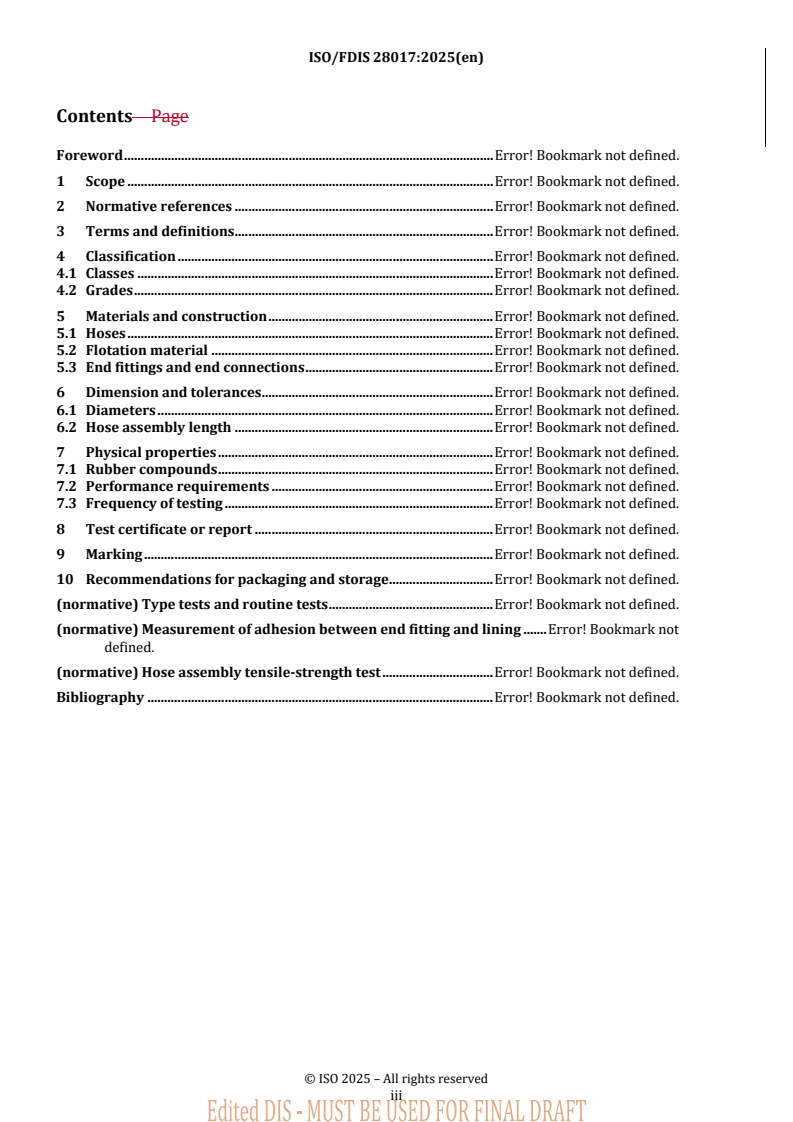
Contents Page
Foreword .iv
1 Scope . 1
2 Normative references . 1
3 Terms and definitions . 1
4 Classification . 2
4.1 Classes .2
4.2 Grades .2
5 Materials and construction . 3
5.1 Hoses .3
5.2 Flotation material .4
5.3 End fittings and end connections .4
6 Dimension and tolerances . 5
6.1 Diameters .5
6.2 Hose assembly length .5
7 Physical properties . 5
7.1 Rubber compounds .5
7.2 Performance requirements .6
7.2.1 Hydrostatic requirements .6
7.2.2 Change in length .7
7.2.3 Bending test .7
7.2.4 Leakage of hose assemblies (proof pressure test) .8
7.2.5 Minimum reserve buoyancy .8
7.2.6 Flotation material recovery .8
7.2.7 Adhesion between components .9
7.2.8 Adhesion between end fitting and lining .9
7.2.9 Minimum tensile strength of empty hose assemblies . .9
7.2.10 Vacuum resistance .9
7.2.11 Dimensions of flange and other connections .9
7.2.12 Visual examination .9
7.3 Frequency of testing .9
8 Test certificate or report . 10
9 Marking . .10
10 Recommendations for packaging and storage . 10
Annex A (normative) Type tests and routine tests .11
Annex B (normative) Measurement of adhesion between end fitting and lining.13
Annex C (normative) Hose assembly tensile-strength test .16
Bibliography .18
iii
Foreword
ISO (the International Organization for Standardization) is a worldwide federation of national standards
bodies (ISO member bodies). The work of preparing International Standards is normally carried out through
ISO technical committees. Each member body interested in a subject for which a technical committee
has been established has the right to be represented on that committee. International organizations,
governmental and non-governmental, in liaison with ISO, also take part in the work. ISO collaborates closely
with the International Electrotechnical Commission (IEC) on all matters of electrotechnical standardization.
The procedures used to develop this document and those intended for its further maintenance are described
in the ISO/IEC Directives, Part 1. In particular, the different approval criteria needed for the different types
of ISO document should be noted. This document was drafted in accordance with the editorial rules of the
ISO/IEC Directives, Part 2 (see www.iso.org/directives).
ISO draws attention to the possibility that the implementation of this document may involve the use of (a)
patent(s). ISO takes no position concerning the evidence, validity or applicability of any claimed patent
rights in respect thereof. As of the date of publication of this document, ISO had not received notice of (a)
patent(s) which may be required to implement this document. However, implementers are cautioned that
this may not represent the latest information, which may be obtained from the patent database available at
www.iso.org/patents. ISO shall not be held responsible for identifying any or all such patent rights.
Any trade name used in this document is information given for the convenience of users and does not
constitute an endorsement.
For an explanation of the voluntary nature of standards, the meaning of ISO specific terms and expressions
related to conformity assessment, as well as information about ISO's adherence to the World Trade
Organization (WTO) principles in the Technical Barriers to Trade (TBT), see www.iso.org/iso/foreword.html.
This document was prepared by Technical Committee ISO/TC 45, Rubber and rubber products, Subcommittee
SC 1, Rubber and plastics hoses and hose assemblies, in collaboration with the European Committee for
Standardization (CEN) Technical Committee CEN/TC 218, Rubber and plastics hoses and hose assemblies, in
accordance with the Agreement on technical cooperation between ISO and CEN (Vienna Agreement).
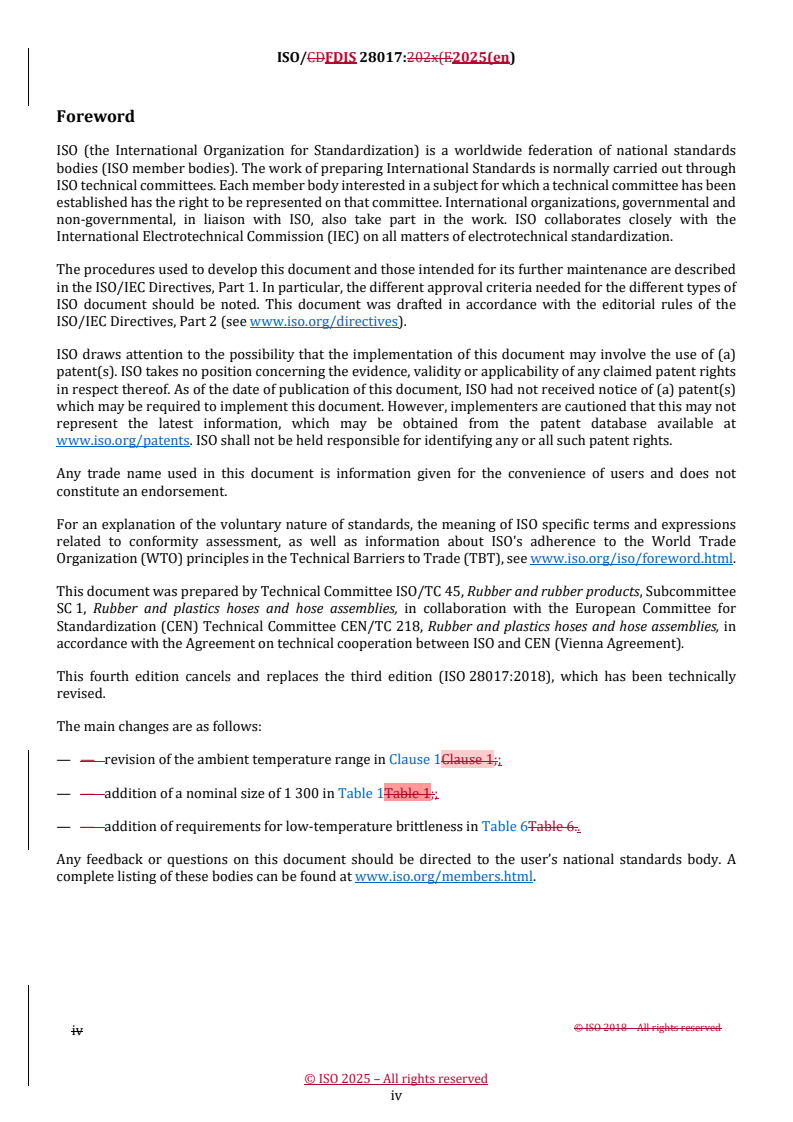
This fourth edition cancels and replaces the third edition (ISO 28017:2018), which has been technically
revised.
The main changes are as follows:
— revision of the ambient temperature range in Clause 1;
— addition of a nominal size of 1 300 in Table 1;
— addition of requirements for low-temperature brittleness in Table 6.
Any feedback or questions on this document should be directed to the user’s national standards body. A
complete listing of these bodies can be found at www.iso.org/members.html.
iv
FINAL DRAFT International Standard ISO/FDIS 28017:2025(en)
Rubber hoses and hose assemblies, wire or textile reinforced,
for dredging applications — Specification
1 Scope
This document specifies requirements for two types, seven classes and three grades of wire- or textile-
reinforced dredging hoses with nominal sizes ranging from 100 to 1 300. Such hoses are suitable for the
delivery or suction of seawater or freshwater mixed with silt, sand, coral and small stones with a specific
gravity in the range from 1,0 to 2,3 at ambient temperature ranging from -10 °C to +40 °C or for low-
temperature hoses (designated -LT) ranging from -20 °C to +40 °C.
This document covers two types of hose, as follows:
— type 1: floating type, for delivery only, which includes flotation material to give the hose buoyancy;
— type 2: submarine type for delivery and suction.
2 Normative references
The following documents are referred to in the text in such a way that some or all of their content constitutes
requirements of this document. For dated references, only the edition cited applies. For undated references,
the latest edition of the referenced document (including any amendments) applies.
ISO 34-2:2022, Rubber, vulcanized or thermoplastic — Determination of tear strength — Part 2: Small (Delft)
test pieces
ISO 812:2017, Rubber, vulcanized or thermoplastic — Determination of low-temperature brittleness
ISO 1402, Rubber and plastics hoses and hose assemblies — Hydrostatic testing
ISO 1431-1, Rubber, vulcanized or thermoplastic — Resistance to ozone cracking — Part 1: Static and dynamic
strain testing
ISO 4649:2024, Rubber, vulcanized or thermoplastic — Determination of abrasion resistance using a rotating
cylindrical drum device
ISO 4662, Rubber, vulcanized or thermoplastic — Determination of rebound resilience
ISO 4671, Rubber and plastics hoses and hose assemblies — Methods of measurement of the dimensions of hoses
and the lengths of hose assemblies
ISO 7233:2021, Rubber and plastics hoses and hose assemblies — Determination of resistance to vacuum
ISO 8033:2016, Rubber and plastics hoses — Determination of adhesion between components
ISO 8330, Rubber and plastics hoses and hose assemblies — Vocabulary
ISO 10619-1, Rubber and plastics hoses and tubing — Measurement of flexibility and stiffness — Part 1: Bending
tests at ambient temperature
3 Terms and definitions
For the purposes of this document, the terms and definitions given in ISO 8330 apply.
ISO and IEC maintain terminology databases for use in standardization at the following addresses:
— ISO Online browsing platform: available at https:// www .iso .org/ obp
— IEC Electropedia: available at https:// www .electropedia .org/
4 Classification
4.1 Classes
Seven classes of hose are specified, distinguished by their maximum working pressure, of nominal sizes
from 100 to 1 300, as shown in Table 1.
Table 1 — Classes and corresponding maximum working pressures and nominal sizes
Class
5 10 15 20 25 30 40
Maximum working pressure, MWP
Nominal size bar
5 10 15 20 25 30 40
MPa
0,5 1,0 1,5 2,0 2,5 3,0 4,0
100 X X X X X X X
150 X X X X X X X
200 X X X X X X X
250 X X X X X X N/A
300 X X X X X X N/A
350 X X X X X X N/A
400 X X X X X X N/A
450 X X X X X X N/A
500 X X X X X X N/A
550 X X X X X X N/A
600 X X X X X X N/A
650 X X X X X X N/A
700 X X X X X X N/A
750 X X X X X X N/A
800 X X X X X X N/A
850 X X X X X X N/A
900 X X X X X X N/A
1 000 X X X X X X N/A
1 100 X X X X X X N/A
1 200 X X X X X N/A N/A
1 300 X X X X N/A N/A N/A
X: Applicable
N/A: Not applicable
4.2 Grades
Type 2 hoses are classified into three grades, A, B and C, according to their construction (number of
reinforcing helical wires), as shown in Table 2.
Type 1 hoses are not divided into grades.
Table 2 — Grades
Construction and purpose
Type Grade
Number of reinforcing
Purpose
wires
1 — 0 Delivery only
A 2 Delivery or suction
2 B 1 Delivery or suction
C 0 Delivery only
The types and grades available in each class (i.e. for each maximum working pressure) are as shown in
Table 3.
Table 3 — Types and grades available in each class
Class
5 10 15 20 25 30 40
Maximum working pressure, MWP
Type Grade bar
5 10 15 20 25 30 40
MPa
0,5 1,0 1,5 2,0 2,5 3,0 4,0
1 — X X X X X X X
A X X X N/A N/A N/A N/A
2 B X X X N/A N/A N/A N/A
C X X X X X X X
X: Applicable
N/A: Not applicable
5 Materials and construction
5.1 Hoses
Type 1 hose assemblies shall consist of the following:
a) an abrasion-resistant rubber lining;
b) one or more layers of steel or textile reinforcement;
c) a textile-reinforced rubber undercover;
d) a flexible closed-cell flotation material integrally fitted round the hose body as specified in 5.2;
e) an abrasion- and weather-resistant rubber or thermoplastic outer cover (which, in the case of a rubber
cover, can include one or two textile breaker layers);
f) end fittings as specified in 5.3 on both ends.
Type 2 hose assemblies shall consist of the following:
1) an abrasion-resistant rubber lining;
2) one or more layers of steel or textile reinforcement;
3) a textile-reinforced rubber;
4) a rubber or thermoplastic cover;
5) end fittings as specified in 5.3 on both ends.
The thickness of the lining or cover shall be measured in accordance with the most appropriate method in
ISO 4671. The thickness of both shall be not less than the values given in Table 4.
Table 4 — Minimum thickness of the lining and cover
Lining thickness Cover thickness
Nominal Size
mm mm
150 8
12 10
1 000
1 100 12
1 200
1 300
5.2 Flotation material
The closed-cell flotation material used in type 1 hose assemblies shall adhere firmly both to the hose body
and to the outer cover so that it cannot move or tend to become detached in service. At the ends of the hose, a
space shall be provided to facilitate the insertion of connection bolts and to allow the use of mechanical tools
for tightening nuts on the bolts. The flotation material shall be distributed over the whole length of the hose
assembly in such a manner that the hose assembly floats evenly when connected to other assemblies in a string.
This does not apply to hose assemblies for special applications (e.g. the end of a string, tapered hose, etc.).
5.3 End fittings and end connections
End fittings shall be mechanically and chemically bonded to the hose body. With hoses intended for delivery
use only, clamped-on and swaged-on nipples are not acceptable, but such nipples may be utilized with hoses
intended for suction use. Alternatively, flanged end connections built up of hose reinforcement, lining and
cover material are acceptable provided they are additionally reinforced by steel stiffening rings to avoid
distortion when the connection bolts are tightened. All hose assemblies shall be fitted with either end
fittings or flanged end connections unless otherwise required by the end user.
6 Dimension and tolerances
6.1 Diameters
The inside and outside diameter shall be measured in accordance with the most appropriate method in
ISO 4671.
The inside diameter of hoses shall conform to the values given in Table 5.
The outside diameter of hoses shall conform to the values specified by the customer.
NOTE For hoses manufactured on mandrels with diameters in inches, the tolerances on the inside diameter are
the same as the closest inside diameter in metric units in Table 5.
Table 5 — Inside diameter and tolerance
Inside diameter Tolerance
Nominal size
mm
mm
100 100,0
150 150,0 ±3
200 200,0
250 250,0
±4
300 300,0
350 350,0
400 400,0
450 450,0
500 500,0
550 550,0 ±5
600 600,0
650 650,0
700 700,0
750 750,0
800 800,0
850 850,0
±6
900 900,0
1 000 1 000,0
1 100 1 100,0
1 200 1 200,0 ±7
1 300 1 300,0
6.2 Hose assembly length
The hose assembly length shall be determined according to the conditions of use. Unless otherwise agreed
between the customer and the manufacturer, the tolerances on the measured length hose assembly shall
be ±2 %.
7 Physical properties
7.1 Rubber compounds
7.1.1 When determined by the methods listed in Table 6, the physical properties of the compounds used
for the lining and cover shall conform to the values specified in Table 6.
7.1.2 For certain slurries containing a large quantity of sharp gravel, broken rocks or coral, the hose user
can require a lining with high rebound resilience properties. In this case, the lining compound shall be tested
for rebound resilience in accordance with ISO 4662, the pendulum method. A recommended minimum
rebound resilience value is 35 %.
Table 6 — Physical properties of rubber compounds
Requirement
Property Test method
Lining Cover
a 3
Abrasion resistance (max.) 200 mm N/A ISO 4649:2024, method A
Tear strength (min.) 35 N N/A ISO 34-2:2022, 7.2.2.3, method 2
No cracking or
b
Ozone resistance
other deteriora-
N/A ISO 1431-1
(72 h at 40 °C and 20 % strain in
tion under × 2
50 pphm ozone)
magnification
For ambient tem-
perature hoses with
-20 °C -20 °C
temperature ranging
from -10 °C to +40 °C
Temperature
ISO 812:2017, method A
brittleness
For low-tempera-
ture hoses (LT) with
-30 °C -30 °C
temperature ranging
from -20 °C to +40 °C
NOTE: The tear strength of the lining may be determined in accordance with ISO 34-1:2022, method B, procedure (b), in which
case the minimum required value is 35 kN/m.
N/A: Test not applicable.
a
Test pieces shall be prepared from sheets of lining compound (of cure state equivalent to that of the hose) of thickness at
least 6 mm.
b
Test pieces shall be prepared from sheets of cover compound (of cure state equivalent to that of the hose) of thickness at least
2 mm. For type 1 hoses, it is the compound from which the outer cover (that surrounds the flotation material) is made which is
tested.
7.2 Performance requirements
7.2.1 Hydrostatic requirements
The test shall be carried out in accordance with ISO 1402. The proof pressure and the minimum burst
pressure of hoses and hose assemblies shall conform to the values given in Table 7.
The theoretical minimum bu
...
ISO TC 45/SC 1
ISO/TC 45/SC 1
Secretariat: DIN
Date: 2025-03-2711-19
Rubber hoses and hose assemblies, wire or textile reinforced, for
dredging applications — Specification
Tuyaux et flexibles en caoutchouc, à armature textile ou métallique, pour des applications de dragage —
Spécifications
FDIS stage
ISOISO/C/CEEN PARN PARALLALLEEL PRL PROOCECESSINGSSING
ISO/CDFDIS 28017:202x(E2025(en)
All rights reserved. Unless otherwise specified, or required in the context of its implementation, no part of this publication
may be reproduced or utilized otherwise in any form or by any means, electronic or mechanical, including photocopying,
or posting on the internet or an intranet, without prior written permission. Permission can be requested from either ISO
at the address below or ISO’s member body in the country of the requester.
ISO copyright office
CP 401 • Ch. de Blandonnet 8 • CP 401
CH-1214 Vernier, Geneva, Switzerland
Tel.Phone: + 41 22 749 01 11
Fax + 41 22 749 09 47
E-mail: copyright@iso.org
Website: www.iso.org
Published in Switzerland
ii
ii
Contents Page
Foreword . Error! Bookmark not defined.
1 Scope . Error! Bookmark not defined.
2 Normative references . Error! Bookmark not defined.
3 Terms and definitions . Error! Bookmark not defined.
4 Classification . Error! Bookmark not defined.
4.1 Classes . Error! Bookmark not defined.
4.2 Grades . Error! Bookmark not defined.
5 Materials and construction . Error! Bookmark not defined.
5.1 Hoses . Error! Bookmark not defined.
5.2 Flotation material . Error! Bookmark not defined.
5.3 End fittings and end connections . Error! Bookmark not defined.
6 Dimension and tolerances . Error! Bookmark not defined.
6.1 Diameters . Error! Bookmark not defined.
6.2 Hose assembly length . Error! Bookmark not defined.
7 Physical properties . Error! Bookmark not defined.
7.1 Rubber compounds . Error! Bookmark not defined.
7.2 Performance requirements . Error! Bookmark not defined.
7.3 Frequency of testing . Error! Bookmark not defined.
8 Test certificate or report . Error! Bookmark not defined.
9 Marking . Error! Bookmark not defined.
10 Recommendations for packaging and storage . Error! Bookmark not defined.
(normative) Type tests and routine tests . Error! Bookmark not defined.
(normative) Measurement of adhesion between end fitting and lining . Error! Bookmark not
defined.
(normative) Hose assembly tensile-strength test . Error! Bookmark not defined.
Bibliography . Error! Bookmark not defined.
iii
ISO/CDFDIS 28017:202x(E2025(en)
Foreword
ISO (the International Organization for Standardization) is a worldwide federation of national standards
bodies (ISO member bodies). The work of preparing International Standards is normally carried out through
ISO technical committees. Each member body interested in a subject for which a technical committee has been
established has the right to be represented on that committee. International organizations, governmental and
non-governmental, in liaison with ISO, also take part in the work. ISO collaborates closely with the
International Electrotechnical Commission (IEC) on all matters of electrotechnical standardization.
The procedures used to develop this document and those intended for its further maintenance are described
in the ISO/IEC Directives, Part 1. In particular, the different approval criteria needed for the different types of
ISO document should be noted. This document was drafted in accordance with the editorial rules of the
ISO/IEC Directives, Part 2 (see www.iso.org/directives).
ISO draws attention to the possibility that the implementation of this document may involve the use of (a)
patent(s). ISO takes no position concerning the evidence, validity or applicability of any claimed patent rights
in respect thereof. As of the date of publication of this document, ISO had not received notice of (a) patent(s)
which may be required to implement this document. However, implementers are cautioned that this may not
represent the latest information, which may be obtained from the patent database available at
www.iso.org/patents. ISO shall not be held responsible for identifying any or all such patent rights.
Any trade name used in this document is information given for the convenience of users and does not
constitute an endorsement.
For an explanation of the voluntary nature of standards, the meaning of ISO specific terms and expressions
related to conformity assessment, as well as information about ISO's adherence to the World Trade
Organization (WTO) principles in the Technical Barriers to Trade (TBT), see www.iso.org/iso/foreword.html.
This document was prepared by Technical Committee ISO/TC 45, Rubber and rubber products, Subcommittee
SC 1, Rubber and plastics hoses and hose assemblies, in collaboration with the European Committee for
Standardization (CEN) Technical Committee CEN/TC 218, Rubber and plastics hoses and hose assemblies, in
accordance with the Agreement on technical cooperation between ISO and CEN (Vienna Agreement).
This fourth edition cancels and replaces the third edition (ISO 28017:2018), which has been technically
revised.
The main changes are as follows:
— — revision of the ambient temperature range in Clause 1Clause 1;;
— — addition of a nominal size of 1 300 in Table 1Table 1;;
— — addition of requirements for low-temperature brittleness in Table 6Table 6.
Any feedback or questions on this document should be directed to the user’s national standards body. A
complete listing of these bodies can be found at www.iso.org/members.html.
iv
iv
DRAFT International Standard ISO/FDIS 28017:2025(en)
Rubber hoses and hose assemblies, wire or textile reinforced, for
dredging applications — Specification
1 Scope
This document specifies requirements for two types, seven classes and three grades of wire- or textile-
reinforced dredging hoses with nominal sizes ranging from 100 to 1 300. Such hoses are suitable for the
delivery or suction of seawater or freshwater mixed with silt, sand, coral and small stones with a specific
gravity in the range from 1,0 to 2,3 at ambient temperature ranging from -10 °C to +40 °C or for low-
temperature hoses (designated -LT) ranging from -20 °C to +40 °C. This document covers two types of hose,
as follows:
This document covers two types of hose, as follows:
— — type 1: floating type, for delivery only, which includes flotation material to give the hose buoyancy;
— — type 2: submarine type for delivery and suction.
2 Normative references
The following documents are referred to in the text in such a way that some or all of their content constitutes
requirements of this document. For dated references, only the edition cited applies. For undated references,
the latest edition of the referenced document (including any amendments) applies.
ISO 34--2:2022, Rubber, vulcanized or thermoplastic — Determination of tear strength — Part 2: Small (Delft)
test pieces
ISO 812:2017, Rubber, vulcanized or thermoplastic — Determination of low-temperature brittleness
ISO 1402, Rubber and plastics hoses and hose assemblies — Hydrostatic testing
ISO 1431--1, Rubber, vulcanized or thermoplastic — Resistance to ozone cracking — Part 1: Static and dynamic
strain testing
ISO 4649:2024, Rubber, vulcanized or thermoplastic — Determination of abrasion resistance using a rotating
cylindrical drum device
ISO 4662, Rubber, vulcanized or thermoplastic — Determination of rebound resilience
ISO 4671, Rubber and plastics hoses and hose assemblies — Methods of measurement of the dimensions of hoses
and the lengths of hose assemblies
ISO 7233:2021, Rubber and plastics hoses and hose assemblies — Determination of resistance to vacuum
ISO 8033:2016, Rubber and plastics hoses — Determination of adhesion between components
ISO 8330, Rubber and plastics hoses and hose assemblies — Vocabulary
ISO 10619--1, Rubber and plastics hoses and tubing — Measurement of flexibility and stiffness — Part 1: Bending
tests at ambient temperature
ISO/CDFDIS 28017:202x(E2025(en)
3 Terms and definitions
For the purposes of this document, the terms and definitions given in ISO 8330 apply.
ISO and IEC maintain terminology databases for use in standardization at the following addresses:
— — ISO Online browsing platform: available at https://www.iso.org/obp
— — IEC Electropedia: available at https://www.electropedia.org/
4 Classification
4.1 Classes
Seven classes of hose are specified, distinguished by their maximum working pressure, of nominal sizes from
100 to 1 300, as shown in Table 1Table 1.
Table 1 — Classes and corresponding maximum working pressures and nominal sizes
Class
5 10 15 20 25 30 40
Maximum working pressure, MWP
Nominal size bar
5 10 15 20 25 30 40
MPa
0,5 1,0 1,5 2,0 2,5 3,0 4,0
100 X X X X X X X
150 X X X X X X X
200 X X X X X X X
250 X X X X X X N/A
300 X X X X X X N/A
350 X X X X X X N/A
400 X X X X X X N/A
450 X X X X X X N/A
500 X X X X X X N/A
550 X X X X X X N/A
600 X X X X X X N/A
650 X X X X X X N/A
700 X X X X X X N/A
750 X X X X X X N/A
800 X X X X X X N/A
850 X X X X X X N/A
Class
5 10 15 20 25 30 40
Maximum working pressure, MWP
Nominal size bar
5 10 15 20 25 30 40
MPa
0,5 1,0 1,5 2,0 2,5 3,0 4,0
900 X X X X X X N/A
1 000 X X X X X X N/A
1 100 X X X X X X N/A
1 200 X X X X X N/A N/A
1 300 X X X X N/A N/A N/A
X: Applicable
N/A: Not applicable
4.2 Grades
Type 2 hoses are classified into three grades, A, B and C, according to their construction (number of reinforcing
helical wires), as shown in Table 2Table 2.
Type 1 hoses are not divided into grades.
Table 2 — Grades
Construction and purpose
Type Grade
Number of reinforcing
Purpose
wires
1 — 0 Delivery only
A 2 Delivery or suction
2 B 1 Delivery or suction
C 0 Delivery only
The types and grades available in each class (i.e. for each maximum working pressure) are as shown in
Table 3Table 3.
ISO/CDFDIS 28017:202x(E2025(en)
Table 3 — Types and grades available in each class
Class
5 10 15 20 25 30 40
Maximum working pressure, MWP
Type Grade bar
5 10 15 20 25 30 40
MPa
0,5 1,0 1,5 2,0 2,5 3,0 4,0
1 — X X X X X X X
A X X X N/A N/A N/A N/A
2 B X X X N/A N/A N/A N/A
C X X X X X X X
X: Applicable
N/A: Not applicable
5 Materials and construction
5.1 Hoses
Type 1 hose assemblies shall consist of the following:
a) an abrasion-resistant rubber lining;
b) one or more layers of steel or textile reinforcement;
c) a textile-reinforced rubber undercover;
d) a flexible closed-cell flotation material integrally fitted round the hose body as specified in 5.25.2;;
e) an abrasion- and weather-resistant rubber or thermoplastic outer cover (which, in the case of a rubber
cover, can include one or two textile breaker layers);
f) end fittings as specified in 5.35.3 on both ends.
Type 2 hose assemblies shall consist of the following:
1) an abrasion-resistant rubber lining;
2) one or more layers of steel or textile reinforcement;
3) a textile-reinforced rubber;
4) a rubber or thermoplastic cover;
5) end fittings as specified in 5.35.3 on both ends.
The thickness of the lining or cover shall be measured in accordance with the most appropriate method in ISO
4671. The thickness of both shall be not less than the values given in Table 4Table 4.
Table 4 — Minimum thickness of the lining and cover
Lining Cover
thickness thickness
Nominal Size
mm mm
150 8
12 10
10001 000
11001 100 12
12001 200
13001 300
5.2 Flotation material
The closed-cell flotation material used in type 1 hose assemblies shall adhere firmly both to the hose body and
to the outer cover so that it cannot move or tend to become detached in service. At the ends of the hose, a
space shall be provided to facilitate the insertion of connection bolts and to allow the use of mechanical tools
for tightening nuts on the bolts. The flotation material shall be distributed over the whole length of the hose
assembly in such a manner that the hose assembly floats evenly when connected to other assemblies in a
string. This does not apply to hose assemblies for special applications (e.g. the end of a string, tapered hose,
etc.).
5.3 End fittings and end connections
End fittings shall be mechanically and chemically bonded to the hose body. With hoses intended for delivery
use only, clamped-on and swaged-on nipples are not acceptable, but such nipples may be utilized with hoses
intended for suction use. Alternatively, flanged end connections built up of hose reinforcement, lining and
cover material are acceptable provided they are additionally reinforced by steel stiffening rings to avoid
ISO/CDFDIS 28017:202x(E2025(en)
distortion when the connection bolts are tightened. All hose assemblies shall be fitted with either end fittings
or flanged end connections unless otherwise required by the end user.
6 Dimension and tolerances
6.1 Diameters
The inside and outside diameter shall be measured in accordance with the most appropriate method in ISO
4671.
The inside diameter of hoses shall be conform to the values given in Table 5Table 5.
The outside diameter of hoses shall conform to the values specified by the customer.
NOTE For hoses manufactured on mandrels with diameters in inches, the tolerances on the inside diameter are the
same as the closest inside diameter in metric units in Table 5Table 5.
Table 5 — Inside diameter and tolerance
Inside
Tolerance
Nominal size diameter
mm
mm
100 100,0
150 150,0 ±3
200 200,0
250 250,0
±4
300 300,0
350 350,0
400 400,0
450 450,0
500 500,0
550 550,0 ±5
600 600,0
650 650,0
700 700,0
750 750,0
800 800,0
850 850,0
±6
900 900,0
1 000 1 000,0
1 100 1 100,0
1 200 1 200,0 ±7
1 300 1 300,0
6.2 Hose assembly length
The hose assembly length shall be determined according to the conditions of use. Unless otherwise agreed
between the customer and the manufacturer, the tolerances on the measured length hose assembly shall be
±2 %.
7 Physical properties
7.1 Rubber compounds
7.1.1 7.1.1 When determined by the methods listed in Table 6Table 6,, the physical properties of the
compounds used for the lining and cover shall conform to the values specified in Table 6Table 6.
7.1.2 7.1.2 For certain slurries containing a large quantity of sharp gravel, broken rocks or coral, the hose
user can require a lining with high rebound resilience properties. In this case, the lining compound shall be
tested for rebound resilience in accordance with ISO 4662, the pendulum method. A recommended minimum
rebound resilience value is 35 %.
Table 6 — Physical properties of rubber compounds
Requirement
Property Test method
Lining Cover
a 3
Abrasion resistance (max.) 200 mm N/A ISO 4649:2024, method A
Tear strength (min.) 35 N N/A ISO 34-2:2022, 7.2.2.3, method 2
No cracking or
b
Ozone resistance
other
N/A deterioration ISO 1431-1
(72 h at 40 °C and 20 % strain in
under × 2
50 pphm ozone)
magnification
For ambient
temperature hoses
with temperature -20 °C -20 °C
ranging from -10 °C
to +40 °C
Temperature
ISO 812:2017, method A
brittleness
For low-temperature
hoses (LT) with
temperature ranging -30 °C -30 °C
from -20 °C to
+40 °C
NOTE —: The tear strength of the lining may be determined in accordance with ISO 34-1:2022, method B, procedure (b), in which
case the minimum required value is 35 kN/m.
N/A: Test not applicable.
a Test pieces shall be prepared from sheets of lining compound (of cure state equivalent to that of the hose) of thickness at least
6 mm.
b Test pieces shall be prepared from sheets of cover compound (of cure state equivalent to that of the hose) of thickness at least
2 mm. For type 1 hoses, it is the compound from which the outer cover (that surrounds the flotation material) is made which is
tested.
7.2 Performance requirements
7.2.1 Hydrostatic requirements
The test shall be carried out in accordance with ISO 1402. The proof pressure and the minimum burst pressure
of hoses and hose assemblies shall conform to the values given in Table 7Table 7.
ISO/CDFDIS 28017:202x(E2025(en)
The theoretical minimum burst pressure for each hose assembly of each design in a manufacturer’s range shall
be calculated and included in the manufacturer’s sales documentation for the information of potential users.
Burst testing shall be carried out on a mid-range or larger nominal size of each design in the manufacturer’s
range. The minimum burst pressure of other sizes of the same design, construction (with a reinforcement type
identical to that of the hose assembly tested but not necessarily the same number of plies), materials and
method of manufacture shall be determined by calculation. However, this is an acceptable method only if
calculation, before testing, of the burst pressure of the hose assembly tested gives a result which is not more
than 5 % higher than the actual measured burst pressure. If the calculated burst pressure is more than 5 %
higher, the minimum burst pressure of all other sizes in the range shall be determined by testing.
For type 1 hoses, the burst test shall be carried out on a hose assembly without its flotation material.
Table 7 — Maximum working pressure, proof pressure and minimum burst pressure
Maximum Proof pressure Minimum burst pressure
working
Class Type 1 Type 2 Type 1 Type 2
pressure
MPa (bar) MPa (bar) MPa (bar) MPa (bar) MPa (bar)
5 0,5 (5) 0,5 (5) 0,5 (5) 1,5 (15) 1,5 (15)
10 1,0 (10) 1,0 (10) 1,0 (10) 3,0 (30) 3,0 (30)
15 1,5 (15) 1,5 (15) 1,5 (15) 4,5 (45) 4,5 (45)
20 2,0 (20) 2,0 (20) 2,0 (20) 6,0 (60) 6,0 (60)
25 2,5 (25) 2,5 (25) 2,5 (25) 7,5 (75) 7,5 (75)
30 3,0 (30) 3,0 (30) 3,0 (30) 9,0 (90) 9,0 (90)
40 4,0 (40) 4,0 (40) 4,0 (40) 12,0 (120) 12,0 (120)
7.2.2 Change in length
The test shall be carried out in accordance with ISO 1402, the change in length of the hose at the maximum
working pressure shall not exceed +11 % or −2 %.
7.2.3 Bending test
The test shall be carried out in accordance with the methods specified in ISO 10619-1 (the method chosen to
be the most appropriate one for the size of hose) The hose shall be subjected to the minimum bend radius
given in Table 8Table 8 and show no kinking, breaking or peeling under visual examination.
In addition, the coefficient of deformation, T/D, shall not be lower than 0,95.
The difference in minimum bend radii for identical nominal sizes between the various grades depends on the
number of helical reinforcing wires in the construction.
Table 8 — Minimum bend radius
Minimum bend radius
mm
Nominal size
Type 1 Type 2
— Grade A Grade B Grade C
100 600 500 800 1 200
150 900 750 1 200 1 800
200 1 200 1 000 1 600 2 400
250 1 500 1 250 2 000 3 000
300 1 800 1 500 2 400 3 600
350 2 100 1 750 2 800 4 200
400 2 400 2 000 3 200 4 800
450 2 700 2 250 3 600 5 400
500 3 000 2 5
...
PROJET FINAL
Norme
internationale
ISO/TC 45/SC 1
Tuyaux et flexibles en caoutchouc,
Secrétariat: DIN
à armature textile ou métallique,
Début de vote:
pour des applications de dragage —
2025-12-03
Spécifications
Vote clos le:
2026-01-28
Rubber hoses and hose assemblies, wire or textile reinforced, for
dredging applications — Specification
LES DESTINATAIRES DU PRÉSENT PROJET SONT
INVITÉS À PRÉSENTER, AVEC LEURS OBSERVATIONS,
NOTIFICATION DES DROITS DE PROPRIÉTÉ DONT ILS
AURAIENT ÉVENTUELLEMENT CONNAISSANCE ET À
FOURNIR UNE DOCUMENTATION EXPLICATIVE.
OUTRE LE FAIT D’ÊTRE EXAMINÉS POUR
ÉTABLIR S’ILS SONT ACCEPTABLES À DES FINS
INDUSTRIELLES, TECHNOLOGIQUES ET COM-MERCIALES,
AINSI QUE DU POINT DE VUE DES UTILISATEURS, LES
PROJETS DE NORMES
TRAITEMENT PARALLÈLE ISO/CEN
INTERNATIONALES DOIVENT PARFOIS ÊTRE CONSIDÉRÉS
DU POINT DE VUE DE LEUR POSSI BILITÉ DE DEVENIR DES
NORMES POUVANT
SERVIR DE RÉFÉRENCE DANS LA RÉGLEMENTATION
NATIONALE.
Numéro de référence
PROJET FINAL
Norme
internationale
ISO/TC 45/SC 1
Tuyaux et flexibles en caoutchouc,
Secrétariat: DIN
à armature textile ou métallique,
Début de vote:
pour des applications de dragage —
2025-12-03
Spécifications
Vote clos le:
2026-01-28
Rubber hoses and hose assemblies, wire or textile reinforced, for
dredging applications — Specification
LES DESTINATAIRES DU PRÉSENT PROJET SONT
INVITÉS À PRÉSENTER, AVEC LEURS OBSERVATIONS,
NOTIFICATION DES DROITS DE PROPRIÉTÉ DONT ILS
AURAIENT ÉVENTUELLEMENT CONNAISSANCE ET À
FOURNIR UNE DOCUMENTATION EXPLICATIVE.
DOCUMENT PROTÉGÉ PAR COPYRIGHT
OUTRE LE FAIT D’ÊTRE EXAMINÉS POUR
ÉTABLIR S’ILS SONT ACCEPTABLES À DES FINS
© ISO 2025 INDUSTRIELLES, TECHNOLOGIQUES ET COM-MERCIALES,
AINSI QUE DU POINT DE VUE DES UTILISATEURS, LES
Tous droits réservés. Sauf prescription différente ou nécessité dans le contexte de sa mise en œuvre, aucune partie de cette
PROJETS DE NORMES
TRAITEMENT PARALLÈLE ISO/CEN
INTERNATIONALES DOIVENT PARFOIS ÊTRE CONSIDÉRÉS
publication ne peut être reproduite ni utilisée sous quelque forme que ce soit et par aucun procédé, électronique ou mécanique,
DU POINT DE VUE DE LEUR POSSI BILITÉ DE DEVENIR DES
y compris la photocopie, ou la diffusion sur l’internet ou sur un intranet, sans autorisation écrite préalable. Une autorisation peut
NORMES POUVANT
être demandée à l’ISO à l’adresse ci-après ou au comité membre de l’ISO dans le pays du demandeur.
SERVIR DE RÉFÉRENCE DANS LA RÉGLEMENTATION
NATIONALE.
ISO copyright office
Case postale 401 • Ch. de Blandonnet 8
CH-1214 Vernier, Genève
Tél.: +41 22 749 01 11
E-mail: copyright@iso.org
Web: www.iso.org
Publié en Suisse Numéro de référence
ii
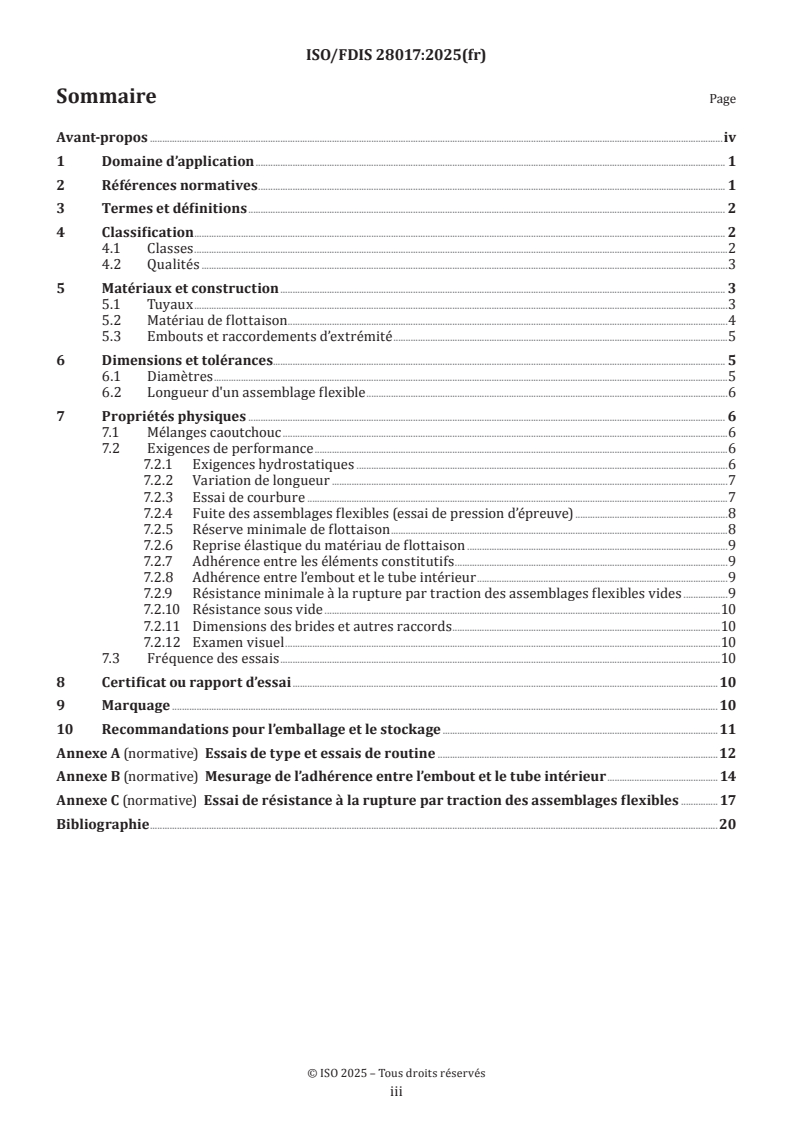
Sommaire Page
Avant-propos .iv
1 Domaine d’application . 1
2 Références normatives . 1
3 Termes et définitions . 2
4 Classification . 2
4.1 Classes .2
4.2 Qualités .3
5 Matériaux et construction . 3
5.1 Tuyaux .3
5.2 Matériau de flottaison.4
5.3 Embouts et raccordements d’extrémité .5
6 Dimensions et tolérances. 5
6.1 Diamètres .5
6.2 Longueur d'un assemblage flexible .6
7 Propriétés physiques . 6
7.1 Mélanges caoutchouc .6
7.2 Exigences de performance .6
7.2.1 Exigences hydrostatiques .6
7.2.2 Variation de longueur .7
7.2.3 Essai de courbure .7
7.2.4 Fuite des assemblages flexibles (essai de pression d’épreuve) .8
7.2.5 Réserve minimale de flottaison .8
7.2.6 Reprise élastique du matériau de flottaison .9
7.2.7 Adhérence entre les éléments constitutifs .9
7.2.8 Adhérence entre l’embout et le tube intérieur .9
7.2.9 Résistance minimale à la rupture par traction des assemblages flexibles vides .9
7.2.10 Résistance sous vide .10
7.2.11 Dimensions des brides et autres raccords .10
7.2.12 Examen visuel .10
7.3 Fréquence des essais .10
8 Certificat ou rapport d’essai .10
9 Marquage . 10
10 Recommandations pour l’emballage et le stockage .11
Annexe A (normative) Essais de type et essais de routine .12
Annexe B (normative) Mesurage de l’adhérence entre l’embout et le tube intérieur . 14
Annexe C (normative) Essai de résistance à la rupture par traction des assemblages flexibles . 17
Bibliographie .20
iii
Avant-propos
L'ISO (Organisation internationale de normalisation) est une fédération mondiale d'organismes nationaux
de normalisation (comités membres de l'ISO). L'élaboration des Normes internationales est en général
confiée aux comités techniques de l'ISO. Chaque comité membre intéressé par une étude a le droit de faire
partie du comité technique créé à cet effet. Les organisations internationales, gouvernementales et non
gouvernementales, en liaison avec l'ISO participent également aux travaux. L'ISO collabore étroitement avec
la Commission électrotechnique internationale (IEC) en ce qui concerne la normalisation électrotechnique.
Les procédures utilisées pour élaborer le présent document et celles destinées à sa mise à jour sont
décrites dans les Directives ISO/IEC, Partie 1. Il convient, en particulier, de prendre note des différents
critères d'approbation requis pour les différents types de documents ISO. Le présent document a
été rédigé conformément aux règles de rédaction données dans les Directives ISO/IEC, Partie 2 (voir
www.iso.org/directives).
L’ISO attire l’attention sur le fait que la mise en application du présent document peut entraîner l’utilisation
d’un ou de plusieurs brevets. L’ISO ne prend pas position quant à la preuve, à la validité et à l’applicabilité de
tout droit de brevet revendiqué à cet égard. À la date de publication du présent document, l’ISO n'avait pas
reçu notification qu’un ou plusieurs brevets pouvaient être nécessaires à sa mise en application. Toutefois,
il y a lieu d’avertir les responsables de la mise en application du présent document que des informations
plus récentes sont susceptibles de figurer dans la base de données de brevets, disponible à l'adresse
www.iso.org/brevets. L’ISO ne saurait être tenue pour responsable de ne pas avoir identifié tout ou partie de
tels droits de propriété.
Les appellations commerciales éventuellement mentionnées dans le présent document sont données pour
information, par souci de commodité, à l’intention des utilisateurs et ne sauraient constituer un engagement.
Pour une explication de la nature volontaire des normes, la signification des termes et expressions
spécifiques de l'ISO liés à l'évaluation de la conformité, ou pour toute information au sujet de l'adhésion de
l'ISO aux principes de l’Organisation mondiale du commerce (OMC) concernant les obstacles techniques au
commerce (OTC), voir www.iso.org/avant-propos.
Le présent document a été élaboré par le comité technique ISO/TC 45, Élastomères et produits à base
d'élastomères, sous-comité SC 1, Tuyaux et flexibles en caoutchouc et en matière plastique en collaboration
avec le comité technique CEN/TC 218, Tuyaux et flexibles en caoutchouc et en plastique, du Comité européen
de normalisation (CEN) conformément à l’Accord de coopération technique entre l’ISO et le CEN (Accord de
Vienne).
Cette quatrième édition annule et remplace la troisième édition (ISO 28017:2018), qui a fait l’objet d’une
révision technique.
Les principales modifications sont les suivantes:
— révision de la température ambiante à l’Article 1;
— ajout de la dimension nominale 1 300 dans le Tableau 1;
— ajout d'exigences relatives à la fragilité à basse température dans le Tableau 6.
Il convient que l’utilisateur adresse tout retour d’information ou toute question concernant le présent
document à l’organisme national de normalisation de son pays. Une liste exhaustive desdits organismes se
trouve à l’adresse www.iso.org/fr/members.html.
iv
PROJET FINAL Norme internationale ISO/FDIS 28017:2025(fr)
Tuyaux et flexibles en caoutchouc, à armature textile ou
métallique, pour des applications de dragage — Spécifications
1 Domaine d’application
Le présent document spécifie les exigences pour deux types, sept classes et trois qualités de tuyaux de
dragage à armature métallique ou textile, de dimensions nominales allant de 100 à 1 300. Dans chaque
classe, toutes les qualités et dimensions ont la même pression maximale de service. Ces tuyaux sont adaptés
pour le refoulement ou l’aspiration d’eau de mer ou d’eau douce mélangée à du limon, du sable, des coraux
et de petites pierres ayant une densité relative de 1,0 à 2,3 à des températures ambiantes comprises entre
−10 °C et +40 °C ou pour les tuyaux basse température (désigné -LT) à des températures comprises entre
−20 °C et +40 °C. Le présent document traite deux types de tuyaux, comme suit:
— type 1: type flottant, pour le refoulement uniquement, incluant un matériau de flottaison permettant au
tuyau de flotter;
— type 2: type sous-marin, pour le refoulement ou l’aspiration.
2 Références normatives
Les documents suivants sont cités dans le texte de sorte qu’ils constituent, pour tout ou partie de leur
contenu, des exigences du présent document. Pour les références datées, seule l’édition citée s’applique. Pour
les références non datées, la dernière édition du document de référence s'applique (y compris les éventuels
amendements).
ISO 34-2:2022, Caoutchouc vulcanisé ou thermoplastique — Détermination de la résistance au déchirement —
Partie 2: Petites éprouvettes (éprouvettes de Delft)
ISO 812:2017, Caoutchouc vulcanisé ou thermoplastique — Détermination de la fragilité à basse température
ISO 1402, Tuyaux et flexibles en caoutchouc et en plastique — Essais hydrostatiques
ISO 1431-1, Caoutchouc vulcanisé ou thermoplastique — Résistance au craquelage par l’ozone — Partie 1: Essais
sous allongement statique et dynamique
ISO 4649:2024, Caoutchouc vulcanisé ou thermoplastique — Détermination de la résistance à l’abrasion à l’aide
d’un dispositif à tambour tournant
ISO 4662, Caoutchouc vulcanisé ou thermoplastique — Détermination de la résilience de rebondissement
ISO 4671, Tuyaux et flexibles en caoutchouc et en plastique — Méthodes de mesurage des dimensions des tuyaux
et de la longueur des flexibles
ISO 7233:2021, Tuyaux et flexibles en caoutchouc et en plastique — Détermination de la résistance à l’aspiration
ISO 8033:2016, Tuyaux en caoutchouc et en plastique — Détermination de l’adhérence entre éléments
ISO 8330, Tuyaux et flexibles en caoutchouc et en plastique — Vocabulaire
ISO 10619-1, Tuyaux et tubes en caoutchouc et en plastique — Mesurage de la flexibilité et de la rigidité —
Partie 1: Essais de courbure à température ambiante
3 Termes et définitions
Pour les besoins du présent document, les termes et définitions de l’ISO 8330 s’appliquent.
L’ISO et l’IEC tiennent à jour des bases de données terminologiques destinées à être utilisées en normalisation,
consultables aux adresses suivantes:
— ISO Online browsing platform: disponible à l’adresse https://www.iso.org/obp
— IEC Electropedia: disponible à l’adresse https://www.electropedia.org/
4 Classification
4.1 Classes
Sept classes de tuyaux sont spécifiées, selon leur pression maximale de service, de dimensions nominales de
100 à 1 300, comme indiqué dans le Tableau 1.
Tableau 1 — Classes et pressions maximales de service et dimensions nominales correspondantes
Classe
5 10 15 20 25 30 40
Pression maximale de service, PMS
Dimension nomi-
bar
nale
5 10 15 20 25 30 40
MPa
0,5 1,0 1,5 2,0 2,5 3,0 4,0
100 X X X X X X X
150 X X X X X X X
200 X X X X X X X
250 X X X X X X N/A
300 X X X X X X N/A
350 X X X X X X N/A
400 X X X X X X N/A
450 X X X X X X N/A
500 X X X X X X N/A
550 X X X X X X N/A
600 X X X X X X N/A
650 X X X X X X N/A
700 X X X X X X N/A
750 X X X X X X N/A
800 X X X X X X N/A
850 X X X X X X N/A
900 X X X X X X N/A
1 000 X X X X X X N/A
1 100 X X X X X X N/A
1 200 X X X X X N/A N/A
1 300 X X X X N/A N/A N/A
X: Applicable
N/A: Non applicable
4.2 Qualités
Les tuyaux de type 2 sont classés selon trois qualités, A, B et C, en fonction de leur construction (nombre de
fils de renfort hélicoïdaux), comme indiqué dans le Tableau 2.
Les tuyaux de type 1 ne sont pas classés par qualité.
Tableau 2 — Qualités
Construction et application
Type Qualité
Nombre de fils d’arma-
Application
ture
1 — 0 Refoulement uniquement
A 2 Refoulement ou aspiration
2 B 1 Refoulement ou aspiration
C 0 Refoulement uniquement
Les types et qualités disponibles dans chaque classe (c’est-à-dire pour chaque pression maximale de service)
sont indiqués dans le Tableau 3.
Tableau 3 — Types et qualités disponibles dans chaque classe
Classe
5 10 15 20 25 30 40
Pression maximale de service, PMS
Type Qualité bar
5 10 15 20 25 30 40
MPa
0,5 1,0 1,5 2,0 2,5 3,0 4,0
1 — X X X X X X X
A X X X N/A N/A N/A N/A
2 B X X X N/A N/A N/A N/A
C X X X X X X X
X: Applicable
N/A: Non applicable
5 Matériaux et construction
5.1 Tuyaux
Les assemblages flexibles de type 1 doivent être constitués des éléments suivants:
a) un tube intérieur en caoutchouc résistant à l’abrasion;
b) une ou plusieurs couches de renfort acier ou textile;
c) un sous-revêtement en caoutchouc à armature textile;
d) un matériau de flottaison souple à cellules fermées enveloppant intégralement le corps du tuyau comme
spécifié en 5.2;
e) un revêtement extérieur en caoutchouc ou thermoplastique résistant à l’abrasion et aux intempéries
(qui, dans le cas d’un revêtement caoutchouc, peut inclure une ou deux grilles textiles);
f) d'embouts tels que spécifiés en 5.3 aux deux extrémités.
Les assemblages flexibles de type 2 doivent être constitués des éléments suivants:
a) un tube intérieur en caoutchouc résistant à l’abrasion;
b) une ou plusieurs couches de renfort acier ou textile;
c) un renfort en caoutchouc à armature textile;
d) d'embouts tels que spécifiés en 5.3 aux deux extrémités.
L’épaisseur du tube intérieur ou du revêtement doit être mesurée conformément à la méthode la plus
appropriée de l'ISO 4671. L'épaisseur des deux ne doit pas être inférieure aux valeurs données dans le
Tableau 4.
Tableau 4 — Épaisseur minimale du tube intérieur et du revêtement
Épaisseur du Épaisseur du
tube intérieur revêtement
Dimension nominale
mm mm
150 8
12 10
1 000
1 100 12
1 200
1 300
5.2 Matériau de flottaison
Le matériau de flottaison à cellules fermées utilisé pour les assemblages flexibles de type 1 doit adhérer
fermement à la fois au corps du tuyau et au revêtement extérieur de sorte qu’il ne puisse pas se déplacer ou
avoir tendance à se détacher en service. Aux extrémités du tuyau, un espace doit être prévu pour faciliter
l’insertion des boulons de raccordement et permettre l’utilisation d’outils mécaniques pour serrer les écrous
sur les boulons. Le matériau de flottaison doit être réparti sur toute la longueur de l'assemblage flexible de
manière que l'assemblage flexible flotte uniformément une fois raccordé à d’autres assemblages flexibles
pour former une chaîne. Cela ne s’applique pas aux assemblages flexibles destinés à des applications spéciales
(par exemple, extrémité d’une chaîne, tuyaux coniques, etc.).
5.3 Embouts et raccordements d’extrémité
Les embouts doivent être reliés mécaniquement et chimiquement au corps du tuyau. Pour les tuyaux destinés
au refoulement uniquement, l’utilisation d’embout fixés et sertis n’est pas admise, mais ces embouts peuvent
être utilisés sur les tuyaux destinés à des applications d’aspiration. En alternative, des raccordements
d’extrémité à brides, constitués du même matériau que l’armature du tuyau, le tube intérieur et le revêtement
sont acceptables à condition qu’ils soient en outre armés d’anneaux de renfort en acier afin d’éviter toute
déformation lors du serrage des boulons de raccordement. Tous les assemblages flexibles doivent être munis
d’embouts ou de raccordements d’extrémité à brides, sauf spécification contraire de l’utilisateur final.
6 Dimensions et tolérances
6.1 Diamètres
Les diamètres intérieur et extérieur doivent être mesurés conformément à la méthode la plus appropriée de
l’ISO 4671.
Le diamètre intérieur des tuyaux doit être conforme aux valeurs données dans le Tableau 5.
Le diamètre extérieur des tuyaux doit être conforme aux valeurs spécifiées par le client.
NOTE Pour les tuyaux fabriqués sur mandrins avec des diamètres en inches, les tolérances sur le diamètre
intérieur sont les mêmes que celles données pour le diamètre intérieur le plus proche en unités métriques dans le
Tableau 5.
Tableau 5 — Diamètre intérieur et tolérance
Diamètre inté-
Tolérance
Dimension nomi-
rieur
nale
mm
mm
100 100,0
150 150,0 ±3
200 200,0
250 250,0
±4
300 300,0
350 350,0
400 400,0
450 450,0
500 500,0
550 550,0 ±5
600 600,0
650 650,0
700 700,0
750 750,0
800 800,0
850 850,0
±6
900 900,0
1 000 1 000,0
1 100 1 100,0
1 200 1 200,0 ±7
1 300 1 300,0
6.2 Longueur d'un assemblage flexible
La longueur d’un assemblage flexible doit être déterminée en fonction des conditions d’utilisation. Sauf
accord contraire entre le client et le fabricant, les tolérances sur la longueur mesurée de l'assemblage flexible
doivent être de ±2 %.
7 Propriétés physiques
7.1 Mélanges caoutchouc
7.1.1 Lorsqu'elles sont déterminées selon les méthodes indiquées dans le Tableau 6, les propriétés
physiques des mélanges utilisés pour le tube intérieur et le revêtement doivent être conformes aux valeurs
spécifiées dans le Tableau 6.
7.1.2 Pour certaines boues contenant une grande quantité de gravier coupant, de roches ou de coraux
cassés, l’utilisateur du tuyau peut exiger un tube intérieur présentant une forte résilience de rebondissement.
Dans ce cas, le mélange pour tube intérieur doit être soumis à un essai de résilience de rebondissement
conformément à l’ISO 4662, la méthode du pendule. Une valeur minimale résilience de rebondissement
recommandée est de 35 %.
Tableau 6 — Propriétés physiques des mélanges caoutchouc
Exigence
Propriété Méthode d'essai
Tube intérieur Revêtement
Résistance à l'abrasion (max.) 200 mm N/A ISO 4649:2024, méthode A
Résistance au déchirement (min.) 35 N N/A ISO 34-2:2022, 7.2.2.3, méthode 2
Aucun craquelage
b
Résistance à l'ozone
ou autre détério-
N/A ISO 1431-1
(72 h à 40 °C et une contrainte de 20 %
ration sous un
sous 50 ppcm d'ozone)
grossissement × 2
Pour les tuyaux tem-
pérature ambiante
avec une température −20 °C −20 °C
comprise entre −10 °C
et +40 °C
Température
ISO 812:2017, méthode A
de fragilité
Pour les tuyaux basse
température (LT)
avec une température −30 °C −30 °C
comprise entre −20 °C
et +40 °C
NOTE: La résistance au déchirement du tube intérieur peut être déterminée conformément à l'ISO 34-1:2022, méthode B, mode
opératoire (b), dans ce cas la valeur minimale requise est de 35 kN/m.
N/A: Essai non applicable.
a
Les éprouvettes doivent être préparées à partir de feuilles de mélange pour tube intérieur (d’un degré de vulcanisation
équivalent à celui du tuyau) d’au moins 6 mm d’épaisseur.
b
Des éprouvettes doivent être préparées à partir de feuilles de mélange pour revêtement (d'un degré de vulcanisation
équivalent à celui du tuyau) d’au moins 2 mm d’épaisseur. Pour les tuyaux de type 1, c’est le mélange à partir duquel le revêtement
extérieur est fabriqué (qui entoure le matériau de flottaison) qui est soumis à essai.
7.2 Exigences de performance
7.2.1 Exigences hydrostatiques
L’essai doit être réalisé conformément à l’ISO 1402. La pression d’épreuve et la pression minimale de rupture
des tuyaux et des assemblages flexibles doivent être conformes aux valeurs données dans le Tableau 7.
La pression minimale de rupture théorique de chaque assemblage flexible pour chacun des modèles de la
gamme du fabricant doit être calculée et incluse dans la documentation commerciale du fabricant pour
informer les utilisateurs potentiels.
L’essai de rupture doit être réalisé sur une dimension nominale de milieu de gamme ou supérieure pour
chaque modèle de la gamme du fabricant. La pression minimale de rupture des autres dimensions du même
modèle, de même construction (avec un type de renfort identique à celui de l'assemblage fl
...
Questions, Comments and Discussion
Ask us and Technical Secretary will try to provide an answer. You can facilitate discussion about the standard in here.
Loading comments...