

ISO 18796-2:2025
(Main)Oil and gas industries including lower carbon energy — Internal coating of carbon steel process vessels — Part 2: Requirements and guidance for the selection of coating systems
General Information
- Abstract
This document specifies the criteria and minimum requirements for selecting internal coatings (often referred to as linings) for pressurized service within process vessels. The document provides the following: — key factors influencing coating selection; — generic composition of test liquids which can be used as references when evaluating supporting testing evidence for coatings; — principal test methods to be used as evidence of performance when selecting suitable coatings; — supporting evidence to be used in evaluating coatings that is relevant to the potential end use. This document covers types of coatings that are generally available, with properties that are known and documented. It also covers other materials to be evaluated and qualified for use. This document is applicable to process vessels coated at the new construction phase. It can be applied only where the coating is applied directly to the substrate. This document does not cover requirements related to metallic coatings nor weld overlay materials.
- Status
- Published
- Publication Date
- 24-Jul-2025
- Technical Committee
- ISO/TC 67 - Materials, equipment and offshore structures for petroleum, petrochemical and natural gas industries
- Drafting Committee
- ISO/TC 67/WG 11 - Coating and lining of structures and equipment
- Current Stage
- 6060 - International Standard published
- Start Date
- 25-Jul-2025
- Due Date
- 04-Oct-2025
- Completion Date
- 25-Jul-2025
Buy Documents

ISO 18796-2:2025 - Oil and gas industries including lower carbon energy — Internal coating of carbon steel process vessels — Part 2: Requirements and guidance for the selection of coating systems Released:25. 07. 2025

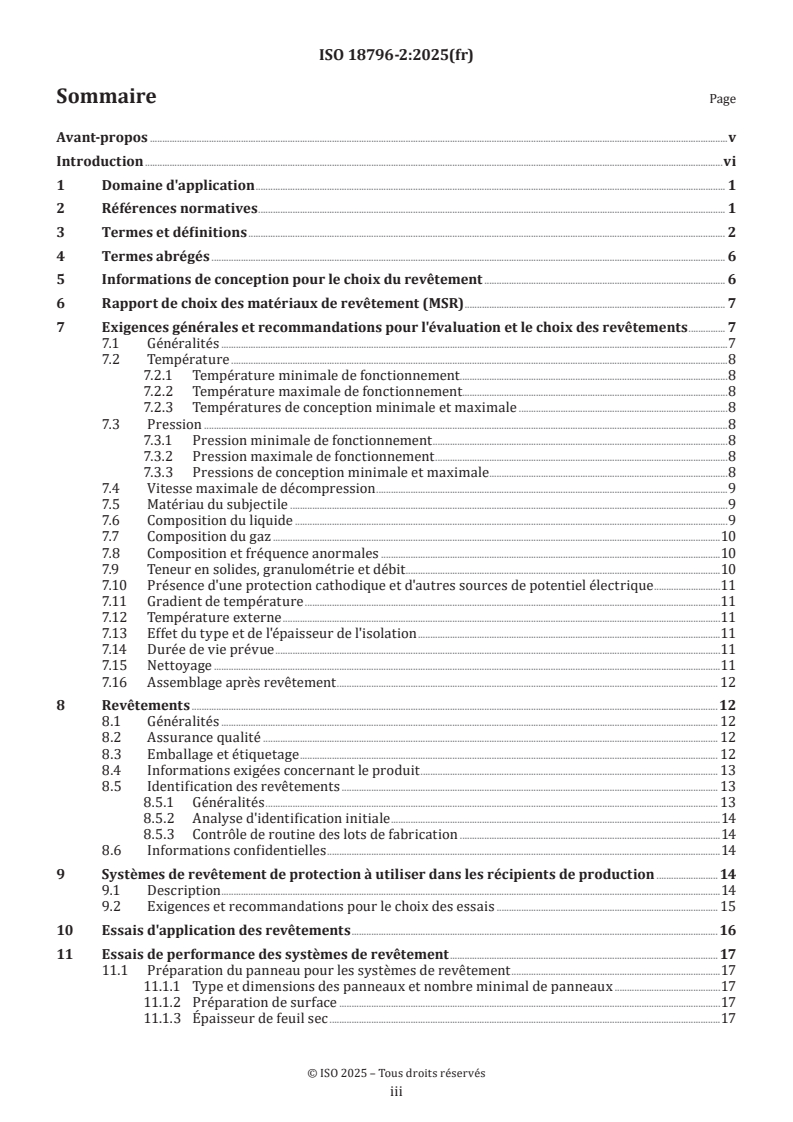
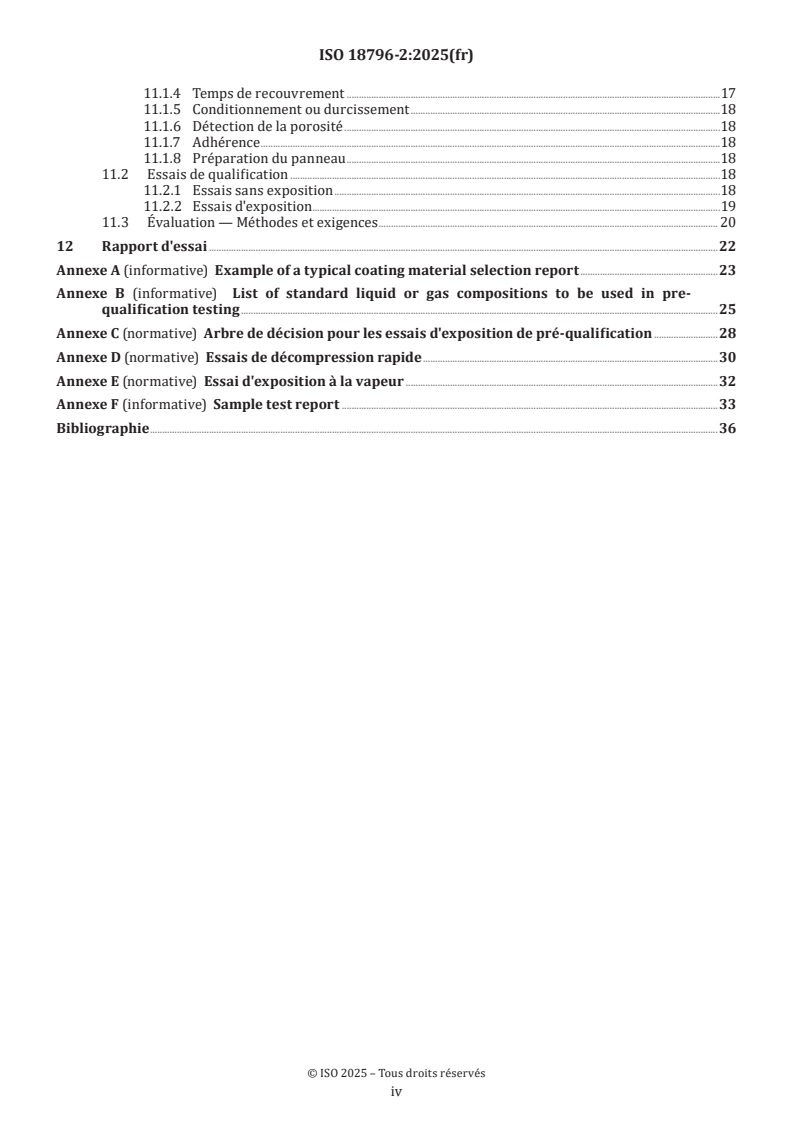
ISO 18796-2:2025 - Industries du pétrole et du gaz, y compris les énergies a faible teneur en carbone — Revetement de protection interne des récipients de production en acier au carbone — Partie 2: Exigences et recommandations pour le choix des systemes de revetement Released:25. 07. 2025
Overview
ISO 18796-2:2025 - Internal coating of carbon steel process vessels, Part 2: Requirements and guidance for the selection of coating systems - provides criteria and minimum requirements for selecting internal coatings (linings) for pressurized service within process vessels in the oil and gas (including lower carbon energy) sectors. The standard covers coatings applied directly to carbon steel during new construction, defines the design information needed for selection, and identifies the types of supporting testing and evidence required to demonstrate coating suitability. It explicitly excludes metallic coatings and weld overlay materials.
Key topics and technical requirements
The standard emphasizes a structured, risk-based approach to coating selection and includes guidance on:
- Design inputs for coating selection: required operating conditions and service data that influence selection decisions.
- Environmental and process factors: operating temperature and pressure, decompression rates, gas and liquid composition, solids content and flow, temperature gradients, external temperatures and insulation effects.
- Substrate and post-assembly considerations: substrate material, post-coating assembly and expected service life.
- Coating product information and QA: required product data, packaging, labelling, quality assurance and handling of confidential information.
- Coating identification and verification: fingerprint checks and routine batch checks to confirm product conformity.
- Testing strategy: recommended application testing (to validate coating application) and performance testing (qualification and exposure testing), including panel preparation, surface preparation, dry film thickness, adhesion, porosity detection, conditioning/curing, and assessment methods.
- Supporting documentation: preparation of a coating material selection report (MSR) and standardized test reports.
- Normative and informative annexes: pre‑qualification decision tree, standard liquid/gas compositions for testing, rapid decompression and steam exposure test procedures, and sample reports.
Practical applications and users
ISO 18796-2:2025 is intended for practical use where internal coatings are required to protect carbon steel process vessels in pressurized service. Typical users include:
- Oil and gas companies and asset owners specifying coatings for new vessels
- Engineering, procurement and construction (EPC) contractors and plant designers
- Materials and corrosion engineers specifying lining systems
- Coating manufacturers developing products and preparing qualification data
- Inspection, testing and quality assurance teams evaluating coating conformity
Use cases include selecting coatings for receivers, separators, scrubbers and other pressurized process vessels handling hydrocarbons, CO2-rich streams, water and chemical service streams in conventional and lower-carbon energy projects.
Related standards
- ISO 18796 series (other parts)
- Standards and test methods referenced within ISO 18796-2 for qualification, exposure and performance testing (see Clause 2 and annexes for referenced documents).
Keywords: internal coating, carbon steel process vessels, oil and gas, coating selection, linings, pre-qualification testing, performance testing, coating material selection report (MSR).
Buy Documents
ISO 18796-2:2025 - Oil and gas industries including lower carbon energy — Internal coating of carbon steel process vessels — Part 2: Requirements and guidance for the selection of coating systems Released:25. 07. 2025
ISO 18796-2:2025 - Industries du pétrole et du gaz, y compris les énergies a faible teneur en carbone — Revetement de protection interne des récipients de production en acier au carbone — Partie 2: Exigences et recommandations pour le choix des systemes de revetement Released:25. 07. 2025
Get Certified
Connect with accredited certification bodies for this standard

Element Materials Technology
Materials testing and product certification.

ABS Group Brazil
ABS Group certification services in Brazil.

ABS Quality Evaluations Inc.
American Bureau of Shipping quality certification.
Sponsored listings
Frequently Asked Questions
ISO 18796-2:2025 is a standard published by the International Organization for Standardization (ISO). Its full title is "Oil and gas industries including lower carbon energy — Internal coating of carbon steel process vessels — Part 2: Requirements and guidance for the selection of coating systems". This standard covers: This document specifies the criteria and minimum requirements for selecting internal coatings (often referred to as linings) for pressurized service within process vessels. The document provides the following: — key factors influencing coating selection; — generic composition of test liquids which can be used as references when evaluating supporting testing evidence for coatings; — principal test methods to be used as evidence of performance when selecting suitable coatings; — supporting evidence to be used in evaluating coatings that is relevant to the potential end use. This document covers types of coatings that are generally available, with properties that are known and documented. It also covers other materials to be evaluated and qualified for use. This document is applicable to process vessels coated at the new construction phase. It can be applied only where the coating is applied directly to the substrate. This document does not cover requirements related to metallic coatings nor weld overlay materials.
This document specifies the criteria and minimum requirements for selecting internal coatings (often referred to as linings) for pressurized service within process vessels. The document provides the following: — key factors influencing coating selection; — generic composition of test liquids which can be used as references when evaluating supporting testing evidence for coatings; — principal test methods to be used as evidence of performance when selecting suitable coatings; — supporting evidence to be used in evaluating coatings that is relevant to the potential end use. This document covers types of coatings that are generally available, with properties that are known and documented. It also covers other materials to be evaluated and qualified for use. This document is applicable to process vessels coated at the new construction phase. It can be applied only where the coating is applied directly to the substrate. This document does not cover requirements related to metallic coatings nor weld overlay materials.
ISO 18796-2:2025 is classified under the following ICS (International Classification for Standards) categories: 75.180.20 - Processing equipment. The ICS classification helps identify the subject area and facilitates finding related standards.
ISO 18796-2:2025 is available in PDF format for immediate download after purchase. The document can be added to your cart and obtained through the secure checkout process. Digital delivery ensures instant access to the complete standard document.
Standards Content (Sample)
International
Standard
ISO 18796-2
First edition
Oil and gas industries including
2025-07
lower carbon energy — Internal
coating of carbon steel process
vessels —
Part 2:
Requirements and guidance for the
selection of coating systems
Industries du pétrole et du gaz, y compris les énergies à faible
teneur en carbone — Revêtement de protection interne des
récipients de production en acier au carbone —
Partie 2: Exigences et recommandations pour le choix des
systèmes de revêtement
Reference number
© ISO 2025
All rights reserved. Unless otherwise specified, or required in the context of its implementation, no part of this publication may
be reproduced or utilized otherwise in any form or by any means, electronic or mechanical, including photocopying, or posting on
the internet or an intranet, without prior written permission. Permission can be requested from either ISO at the address below
or ISO’s member body in the country of the requester.
ISO copyright office
CP 401 • Ch. de Blandonnet 8
CH-1214 Vernier, Geneva
Phone: +41 22 749 01 11
Email: copyright@iso.org
Website: www.iso.org
Published in Switzerland
ii
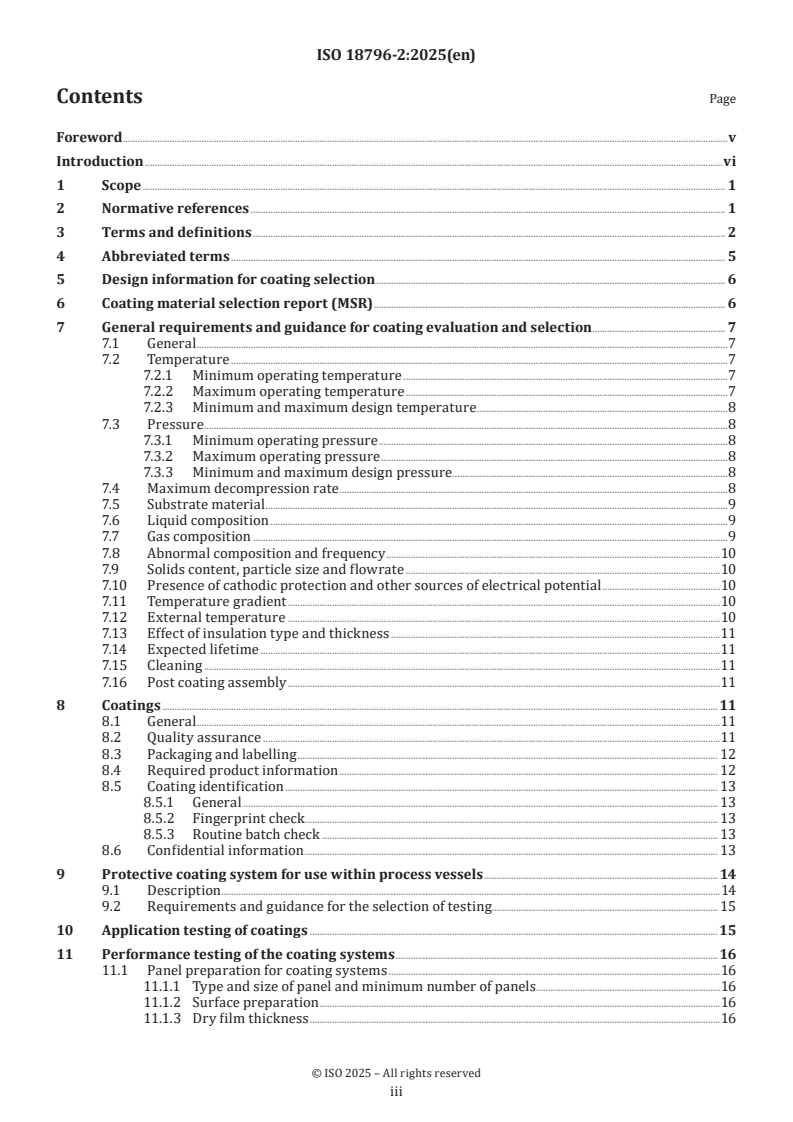
Contents Page
Foreword .v
Introduction .vi
1 Scope . 1
2 Normative references . 1
3 Terms and definitions . 2
4 Abbreviated terms . 5
5 Design information for coating selection . 6
6 Coating material selection report (MSR) . 6
7 General requirements and guidance for coating evaluation and selection . 7
7.1 General .7
7.2 Temperature .7
7.2.1 Minimum operating temperature .7
7.2.2 Maximum operating temperature .7
7.2.3 Minimum and maximum design temperature .8
7.3 Pressure .8
7.3.1 Minimum operating pressure .8
7.3.2 Maximum operating pressure .8
7.3.3 Minimum and maximum design pressure .8
7.4 Maximum decompression rate .8
7.5 Substrate material .9
7.6 Liquid composition .9
7.7 Gas composition .9
7.8 Abnormal composition and frequency .10
7.9 Solids content, particle size and flowrate .10
7.10 Presence of cathodic protection and other sources of electrical potential .10
7.11 Temperature gradient .10
7.12 External temperature .10
7.13 Effect of insulation type and thickness .11
7.14 Expected lifetime .11
7.15 Cleaning .11
7.16 Post coating assembly .11
8 Coatings .11
8.1 General .11
8.2 Quality assurance .11
8.3 Packaging and labelling . 12
8.4 Required product information . 12
8.5 Coating identification . 13
8.5.1 General . 13
8.5.2 Fingerprint check . 13
8.5.3 Routine batch check . 13
8.6 Confidential information . 13
9 Protective coating system for use within process vessels . 14
9.1 Description .14
9.2 Requirements and guidance for the selection of testing. 15
10 Application testing of coatings .15
11 Performance testing of the coating systems .16
11.1 Panel preparation for coating systems .16
11.1.1 Type and size of panel and minimum number of panels . .16
11.1.2 Surface preparation .16
11.1.3 Dry film thickness .16
iii
11.1.4 Overcoating time .16
11.1.5 Conditioning or curing .16
11.1.6 Porosity detection .17
11.1.7 Adhesion .17
11.1.8 Panel preparation .17
11.2 Qualification tests.17
11.2.1 Non-exposure tests .17
11.2.2 Exposure tests .17
11.3 Assessment — Methods and requirements .18
12 Test report .20
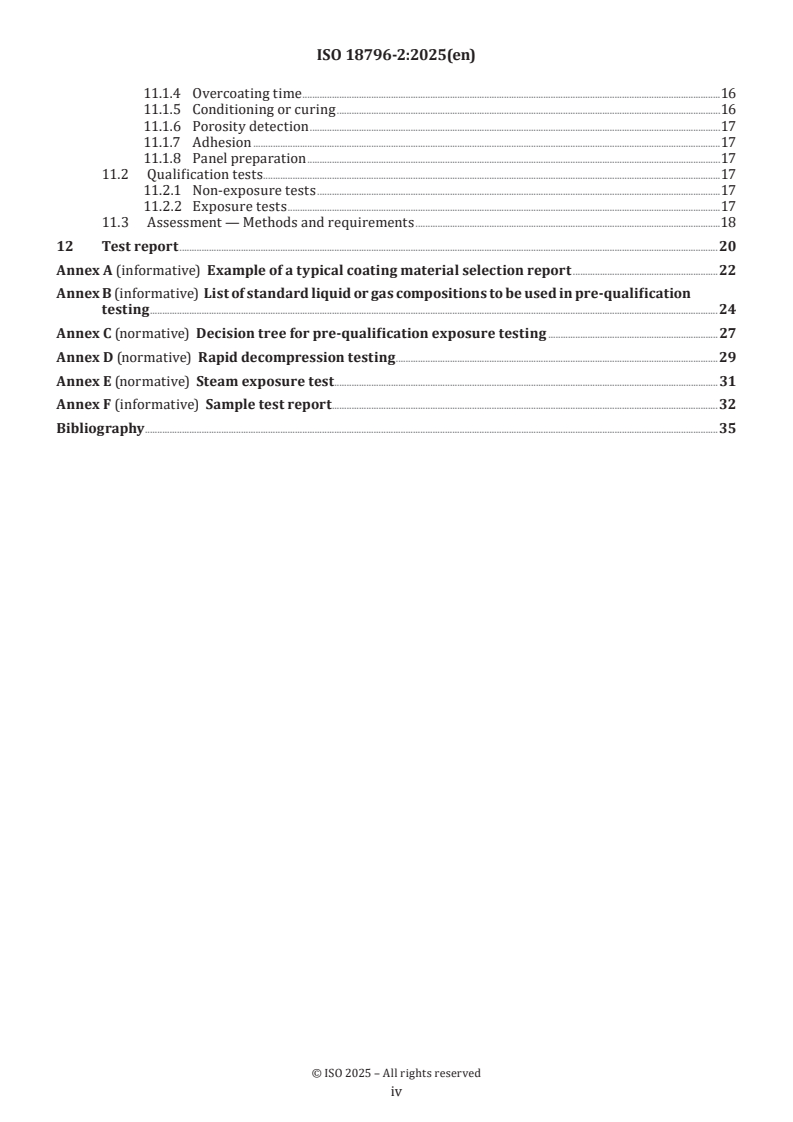
Annex A (informative) Example of a typical coating material selection report .22
Annex B (informative) List of standard liquid or gas compositions to be used in pre-qualification
testing .24
Annex C (normative) Decision tree for pre-qualification exposure testing .27
Annex D (normative) Rapid decompression testing .29
Annex E (normative) Steam exposure test . .31
Annex F (informative) Sample test report .32
Bibliography .35
iv
Foreword
ISO (the International Organization for Standardization) is a worldwide federation of national standards
bodies (ISO member bodies). The work of preparing International Standards is normally carried out through
ISO technical committees. Each member body interested in a subject for which a technical committee
has been established has the right to be represented on that committee. International organizations,
governmental and non-governmental, in liaison with ISO, also take part in the work. ISO collaborates closely
with the International Electrotechnical Commission (IEC) on all matters of electrotechnical standardization.
The procedures used to develop this document and those intended for its further maintenance are described
in the ISO/IEC Directives, Part 1. In particular, the different approval criteria needed for the different types
of ISO document should be noted. This document was drafted in accordance with the editorial rules of the
ISO/IEC Directives, Part 2 (see www.iso.org/directives).
ISO draws attention to the possibility that the implementation of this document may involve the use of (a)
patent(s). ISO takes no position concerning the evidence, validity or applicability of any claimed patent
rights in respect thereof. As of the date of publication of this document, ISO had not received notice of (a)
patent(s) which may be required to implement this document. However, implementers are cautioned that
this may not represent the latest information, which may be obtained from the patent database available at
www.iso.org/patents. ISO shall not be held responsible for identifying any or all such patent rights.
Any trade name used in this document is information given for the convenience of users and does not
constitute an endorsement.
For an explanation of the voluntary nature of standards, the meaning of ISO specific terms and expressions
related to conformity assessment, as well as information about ISO's adherence to the World Trade
Organization (WTO) principles in the Technical Barriers to Trade (TBT), see www.iso.org/iso/foreword.html.
This document was prepared by Technical Committee ISO/TC 67, Oil and gas industries including lower
carbon energy.
A list of all parts in the ISO 18796 series can be found on the ISO website.
Any feedback or questions on this document should be directed to the user’s national standards body. A
complete listing of these bodies can be found at www.iso.org/members.html.
v
Introduction
By providing requirements and guidance for the selection of coating materials, this document:
— ensures the long-term performance of coating materials.
— ensures that coating materials selected meet the needs of a broad range of end users in the oil and gas
industries.
— enables coating manufactures to develop and provide coatings that meet the requirements of this
document.
Oil and gas production projects benefit from a structured evaluation of coatings performance for the
different process liquids and gases being handled within process vessels.
The main objective of this document is to provide general requirements with guidance for the selection
of coatings for the internal surfaces of process vessels, with due consideration to the liquids and gases
contained within the vessel and the impact of the external environment. Particular attention is paid to key
parameters such as operating temperature, pressure, and presence of abrasion, amongst others. It is the end
user's responsibility to provide a project document with respect to the implementation of the requirements
and guidance of this document, and to specify the design conditions for coating selection. In addition to the
end user, the organization responsible for the facility or for the process equipment design, or for both, is
regarded as responsible for coating selection.
This document is developed to provide responsible parties with a structured process to carry out evaluation
of proposed coatings in a consistent manner as a part of the engineering work, with a design basis for a
particular installation or equipment item. Further this document is intended for use by oil companies and
engineering contractors. Further or differing requirements can be needed for individual applications.
vi
International Standard ISO 18796-2:2025(en)
Oil and gas industries including lower carbon energy —
Internal coating of carbon steel process vessels —
Part 2:
Requirements and guidance for the selection of coating systems
1 Scope
This document specifies the criteria and minimum requirements for selecting internal coatings (often
referred to as linings) for pressurized service within process vessels. The document provides the following:
— key factors influencing coating selection;
— generic composition of test liquids which can be used as references when evaluating supporting testing
evidence for coatings;
— principal test methods to be used as evidence of performance when selecting suitable coatings;
— supporting evidence to be used in evaluating coatings that is relevant to the potential end use.
This document covers types of coatings that are generally available, with properties that are known and
documented. It also covers other materials to be evaluated and qualified for use.
This document is applicable to process vessels coated at the new construction phase. It can be applied only
where the coating is applied directly to the substrate.
This document does not cover requirements related to metallic coatings nor weld overlay materials.
2 Normative references
The following documents are referred to in the text in such a way that some or all their content constitutes
requirements of this document. For dated references, only the edition cited applies. For undated references,
the latest edition of the referenced document (including any amendments) applies.
ISO 1514, Paints and varnishes — Standard panels for testing
ISO 1519, Paints and varnishes — Bend test (cylindrical mandrel)
ISO 2811-3, Paints and varnishes — Determination of density — Part 3: Oscillation method
ISO 3270, Paints and varnishes and their raw materials — Temperatures and humidities for conditioning and testing
ISO 4624, Paints and varnishes — Pull-off test for adhesion
ISO 4628-2, Paints and varnishes — Evaluation of degradation of coatings — Designation of quantity and size of
defects, and of intensity of uniform changes in appearance — Part 2: Assessment of degree of blistering
ISO 4628-3, Paints and varnishes — Evaluation of quantity and size of defects, and of intensity of uniform
changes in appearance — Part 3: Assessment of degree of rusting
ISO 4628-4, Paints and varnishes — Evaluation of degradation of coatings — Designation of quantity and size of
defects, and of intensity of uniform changes in appearance — Part 4: Assessment of degree of cracking
ISO 4628-5, Paints and varnishes — Evaluation of quantity and size of defects, and of intensity of uniform
changes in appearance — Part 5: Assessment of degree of flaking
ISO 4628-6, Paints and varnishes — Evaluation of quantity and size of defects, and of intensity of uniform
changes in appearance — Part 6: Assessment of degree of chalking by tape method
ISO 7783, Paints and varnishes — Determination of water-vapour transmission properties — Cup method
ISO 7784-2, Paints and varnishes — Determination of resistance to abrasion — Part 2: Method with abrasive
rubber wheels and rotating test specimen
ISO 6272-1, Paints and varnishes — Rapid-deformation (impact resistance) tests — Part 1: Falling-weight test,
large-area indenter
ISO 8503-1, Preparation of steel substrates before application of paints and related products — Surface
roughness characteristics of blast-cleaned steel substrates — Part 1: Specifications and definitions for ISO
surface profile comparators for the assessment of abrasive blast-cleaned surfaces
ISO 11357, Plastics — Differential scanning calorimetry (DSC)
ISO 12944-9:2018, Paints and varnishes — Corrosion protection of steel structures by protective paint systems
— Part 9: Protective paint systems and laboratory performance test methods for offshore and related structures
ISO 15184, Paints and varnishes — Determination of film hardness by pencil test
ISO/IEC 17025, General requirements for the competence of testing and calibration laboratories
ISO 19840, Paints and varnishes — Corrosion protection of steel structures by protective paint systems —
Measurement of, and acceptance criteria for, the thickness of dry films on rough surfaces
ISO 29601, Paints and varnishes — Corrosion protection by protective paint systems — Assessment of porosity
in a dry film
NACE TM0174-22, Laboratory methods for the evaluation of protective coatings and lining materials on metallic
substrates in immersion service
NACE TM0185-24, Evaluation of Internal Plastic Coatings for Corrosion Control of Tubular Goods by
Autoclave Testing
ASTM D2485, Standard test methods for evaluating coatings for high temperature service
3 Terms and definitions
For the purposes of this document, the following terms and definitions apply.
ISO and IEC maintain terminology databases for use in standardization at the following addresses:
— ISO Online browsing platform: available at https:// www .iso .org/ obp
— IEC Electropedia: available at https:// www .electropedia .org/
3.1
abrasion resistance
coating (3.5) wear resistance property
3.2
ambient temperature
external temperature range in degrees Celsius in which a process vessel (3.27) operates and maintains
characteristics within recommended limits
3.3
cathodic protection
electrochemical protection by decreasing the electrode potential to a level at which the corrosion rate of the
metal is significantly reduced
3.4
coat
layer of a protective coating (3.5) applied to the surface in a single application to form an evenly distributed
film when dry
3.5
coating
lining
layer of material applied to a metal surface to provide protection
Note 1 to entry: The terms "coating" and "lining" are used interchangeably to refer to an internal coating. Internal
coatings can be applied to the internal surfaces of a process vessel (3.27) to serve as a barrier to either corrosion or
product contamination, or both, for example.
3.6
corrosion allowance
extra wall thickness (3.35) added during design to compensate for any reduction in wall thickness by
corrosion (internal or external) during the design operational life
3.7
curing
chemical process of developing the intended properties of a polymerised product in the coating (3.5),
generally due to a reaction of two or more chemicals (e.g. resin and curative)
3.8
rapid decompression
explosive decompression
rapid pressure-drop in a high-pressure gas-containing system which disrupts the equilibrium between
external gas pressure and the concentration of gas dissolved inside any polymer, with the result that excess
gas tries to escape from the solution at points throughout the material, causing expansion
3.9
flowrate
actual volume of flow per unit of time
3.10
gas composition
fractions or concentrations of all the components determined from natural gas analysis
3.11
holiday
discontinuity in a coating (3.5) or contamination in the coating film that materially lowers the performance
of the coating
Note 1 to entry: Examples of discontinuity in coatings are pinholes, craters, voids, cracks, thin spots and inclusion of
foreign material.
3.12
immersion test
test in which the liquid covers the entire sample for the duration of the test (or partially covers the sample
where a gaseous phase is also present)
3.13
lifetime
period during which a coated or lined item of equipment exists and functions
3.14
liquid composition
identity and content of each component that constitutes a liquid mixture
3.15
maximum dry film thickness
MDFT
maximum permissible dry film thickness of a layer of coating (3.5) or coating system in its fully cured
condition
3.16
maximum design pressure
maximum pressure, inclusive of operating pressure, surge pressure including shut-in pressure, vacuum
conditions, and static pressure head
3.17
maximum design temperature
maximum temperature value applied to the design of pressure-containing components
3.18
maximum operating pressure
maximum pressure to which the coating (3.5) will be subjected during normal operation of the process vessel
(3.27), including start-up or shutdown
3.19
maximum operating temperature
maximum temperature to which the coating (3.5) will be subjected during normal operation of the process
vessel (3.27), including start-up and shutdown
3.20
minimum design pressure
minimum pressure, inclusive of operating pressure, surge pressure including shut-in pressure, vacuum
conditions, and static pressure head
3.21
minimum design temperature
minimum temperature value applied to the design of pressure-containing components
3.22
minimum operating pressure
minimum pressure to which the coating (3.5) will be subjected during normal operation of the process vessel
(3.27), including start-up, shutdown, or emergency decompression
3.23
minimum operating temperature
minimum temperature to which the coating (3.5) will be subjected during normal operation of the process
vessel (3.27)
3.24
nominal dry film thickness
NDFT
specified thickness of a layer of coating (3.5) or coating system in its fully cured condition
3.25
normal operating pressure
stabilised pressure normally reached during continuous operation
3.26
normal operating temperature
stabilised temperature normally reached during continuous operation
3.27
process vessel
housing and its direct attachments up to the coupling point connecting it to other equipment, design and
built to contain either liquids or gases, or both, usually under pressure
3.28
purchaser
legal entity which is purchasing the installed coating (3.5) system
3.29
solids content
proportion of solids contained in the liquid either as a contaminant or as a deliberate useful burden or
suspension
Note 1 to entry: Solids content is expressed as a mass fraction or as the fraction of solids volume to total volume, i.e.
the volume fraction.
3.30
steam cleaning
removal of surface contaminants by the action of steam or steam jets
3.31
substrate
surface to which the coating (3.5) material is applied or is to be applied
3.32
surface profile
micro-roughness of a surface generally expressed as the average height of the major peaks relative to the
major valleys
3.33
thermo-osmosis
passage of a liquid through a membrane against the hydrostatic pressure, due to a temperature gradient
3.34
vendor
supplier of coatings (3.5)
3.35
wall thickness
measured thickness around the circumference of the process vessel (3.27) rounded up to the nearest 0,1 mm
4 Abbreviated terms
ASTM American Society for Testing and Materials
CADS Coating application data sheet
IMO International Maritime Organisation
MSDS material safety data sheet
MSR material selection report
NACE National Association of Corrosion Engineers
VOC volatile organic compound
5 Design information for coating selection
To enable either the contractor or coating vendors, or both, to perform the correct material selection, the
end user should provide as a minimum the information provided in Table 1 at the time of either the enquiry
or subsequent contract, or both. Additionally, where multiple values are provided, such as in the event of
temperature, the basis for the coating selection shall be clearly stated.
If, at the time of selection of the coating, the design data are only available because of theoretical calculations,
then the person carrying out the evaluation should consider the accuracy of the information and its potential
to change, as well as the impact this can have on coating selection.
Table 1 — Design information for coating selection
Information to be provided Subclause
Minimum operating temperature, °C 7.2.1
Normal operating temperature, °C 7.2.1
Maximum operating temperature, °C 7.2.2
Minimum design temperature, °C 7.2.3
Maximum design temperature, °C 7.2.3
Minimum operating pressure, MPa 7.3.1
Normal operating pressure, MPa 7.3.1
Maximum operating pressure, MPa 7.3.2
Minimum design pressure, MPa 7.3.3
Maximum design pressure, MPa 7.3.3
Maximum decompression rate, MPa/s 7.4
Substrate material (list all) 7.5
Liquid composition 7.6
Gas composition 7.7
Abnormal liquid or gas composition and frequency (excursion events, presence 7.8
of corrosion inhibitors, de-scalers, etc.)
Solids content and maximum and minimum expected flowrate (including de- 7.9
tails of excursion such as during sand removal)
Presence of cathodic protection other sources of electrical potential 7.10
Minimum and maximum external ambient temperature, °C 7.12
External insulation type and thickness, mm 7.13
Expected lifetime, years 7.14
Corrosion allowance, mm 7.14
Cleaning method and frequency (if steam cleaning see below) 7.15
Steam cleaning temperature, pressure, duration, and frequency 7.15
Details of post coating internal equipment assembly 7.16
6 Coating material selection report (MSR)
The selection of the coating for each process vessel shall be documented in a report for future use by the
purchaser. The following elements shall be included:
— description of the process vessel, its unique identification (tag) number and the intended service duty;
details of upstream and downstream equipment should also be provided for clarity on its intended use;
— design input data (as a minimum that listed in Table 1) for the operating conditions (unless otherwise
stated) during the design life of the facility;
— details of the evaluation carried out and the coating selected, including vendors details;
— details of any ancillary materials required to support the correct installation of the coating, and which
can subsequently be exposed to the same conditions as the process vessel itself;
— identification of any uncertainties from a coating perspective;
— limitations to the scope of operation, inspection or maintenance caused by the coating selection;
— requirements for any coating pre-qualification testing prior to approval.
An example of a basic coating material selection report (MSR) is shown in Annex A.
7 General requirements and guidance for coating evaluation and selection
7.1 General
All statutory and regulatory requirements relevant to the coating process shall be identified and documented.
The project design criteria, such as design life, process vessel inspection and maintenance philosophy, safety
and environmental profiles, operational reliability and specific project requirements, should be considered.
In general, robust coating selection shall be undertaken to ensure operational reliability throughout the
design life. For certain process vessel types and configuration, the access for repair and maintenance can be
limited and costly and should be carefully considered in the selection of suitable coatings.
Coating selection should normally be based upon evaluation of the criteria within 7.2 to 7.16. This should
also include the stages of final assembly, inspection, storage, installation, and commissioning.
Mechanical properties and usage limitations for different coating types shall be compatible with the design
information criteria provided in Table 1. Inherent in this evaluation shall be that the coating material, and
any ancillary materials used in its installation, are in accordance with the vendors' instructions.
Cost and coating availability can have a significant influence on material selection and proper evaluations
should be made to support the final selection.
NOTE If life cycle cost evaluations are used in the selection of the coating, the methodology in ISO 15663 can be
followed.
7.2 Temperature
7.2.1 Minimum operating temperature
The coating shall be suitable to withstand the liquid and gas composition when operating at the minimum
operating temperature and above. Where the minimum operating temperature coincides with excursion
conditions, such as when temperature drops during rapid decompression, the combination of conditions
should be taken into consideration. Details of any cyclic service shall also be provided in terms of any
minimum temperature fluctuations, duration, and frequency. The normal operating temperature occurs
between the minimum operating temperature and the maximum operating temperature.
7.2.2 Maximum operating temperature
Unless otherwise agreed between the purchaser and the coating vendor, the coating shall be suitable to
withstand the liquid and gas composition when operating at the maximum operating temperature for the
design life of the process vessel. This is one of the key parameters for coating selection. Details of any cyclic
service shall also be provided in terms of any maximum temperature fluctuations, duration, and frequency.
The operation of any internal heating equipment which may also cause a higher localised temperature
should also be considered.
7.2.3 Minimum and maximum design temperature
Design parameters shall be used in the initial coating selection process and typically represent the most
conservative option. The purchaser may consider to instead use the minimum, normal or maximum
operating temperature, or all three. This shall be considered as part of the evaluation.
7.3 Pressure
7.3.1 Minimum operating pressure
The coating shall be suitable to withstand the liquid and gas composition when operating at the minimum
operating pressure and above. Where pressure vessels operate in the presence of a vacuum for part or all
the time, this shall be clearly stated. The normal operating pressure occurs between the minimum operating
temperature and the maximum operating temperature.
7.3.2 Maximum operating pressure
Unless otherwise agreed between the purchaser and the coating vendor, the coating shall be suitable to
withstand the liquid and gas composition when operating at the maximum operating pressure for the design
life of the process vessel. This is one of the key parameters for coating selection. Details of any cyclic service
shall also be provided in terms of any maximum pressure fluctuations, duration, and frequency.
7.3.3 Minimum and maximum design pressure
Design parameters shall be used in the initial coating selection process and typically represent the most
conservative option. Purchaser may consider to instead use the minimum, normal or maximum operating
pressure. This shall be considered as part of the evaluation.
7.4 Maximum decompression rate
Rapid decompression of a process vessel can have significant negative effects on the performance of coating
materials. The presence of gas at interstices, voids and other inhomogeneous areas within the coating can
suddenly be subjected to a rapid drop in pressure resulting in expansion of the gas and internal stresses
within the coating. This can be particularly evident where coating blistering or degradation has already
commenced.
This may be further exhibited as:
— an increase in blistering;
— delamination from the substrate;
— delamination between coats.
The coating shall be evaluated for its suitability when subjected to the maximum decompression rate. This
may be expressed in terms of:
a) change in pressure (MPa) per unit of time (s); or
b) the time (s) taken to decompress from the maximum to minimum operating temperature.
When evaluating test results the type of gas used can have an impact upon the result, but safety limitations
may exist when carrying out rapid decompression testing using hydrocarbon gases and suitable substitute
gases may need to be agreed.
7.5 Substrate material
When evaluating the suitability of coating materials, consideration shall be given to the choice of substrate
material from the following perspectives:
— adhesion of the coating material to the substrate due either to the material’s inherent chemical adhesion,
or the effectiveness of surface preparation which can in turn impact the mechanical adhesion between
the coating and the substrate;
— whether the nature of the substrate places specific restrictions on the surface preparation method of the
coating that have possibly not been considered during general testing of the coating’s suitability;
— whether the substrate is the same throughout the internal surfaces of the process vessel, e.g. presence of
weld overlays, use of corrosion resistant alloys for internal vessel furniture and nozzles.
7.6 Liquid composition
The liquid composition is one of the key factors which can influence the selection of a suitable coating.
Additional complexity arises from the fact that not all coating materials resist the effects of the liquid
composition in the same way due to their different chemistry types.
Liquid compositions can be described in a manner of different ways, but consideration should be given to:
— diffusion type, liquids which use a diffusion type mechanism to penetrate the coating, and which can
subsequently result in deterioration of the coatings’ adhesion to the substrate which in turn can lead to
corrosion of the substrate;
— solvent type, liquids which can be absorbed into a macromolecular network, such as an organic coating,
causing it to swell but without dissolving; the amount of swelling the liquid causes is controlled in the
large part by the cross-link density of the coating binder;
— acid type, liquids which can degrade the coating binder system by full or partial depolymerisation to
oligomers and other chemical substances.
The coating shall be evaluated for its resistance to one or more of the degradation mechanisms listed in this
subclause.
To create relevant testing protocols and to effectively cover the large number of liquid compositions
which may exist within a process vessel, a series of typical liquids may be used which, whilst not wholly
representative of all liquid compositions, are sufficiently indicative to allow for pre-qualification of the
coating for its intended use.
7.7 Gas composition
The composition of any gaseous components present with a process vessel is also a key factor to consider
when evaluating the suitability of any coating. Whilst total pressure is relevant to physical effects, the ability
of gas to diffuse through a coating system is a function of other parameters including:
a) the morphology of the coating;
b) the molecular size of the gas;
c) the compatibility, solubility, and volatility of the gas within the coatings’ polymer matrix.
As each of these parameters vary with different gas compositions, the gas composition should be considered
when selecting test protocols.
The corrosive impact of the gas composition when reaching the substrate should also be taken into
consideration.
7.8 Abnormal composition and frequency
Liquid and gas compositions should be considered during normal and abnormal (upset) conditions. The
presence of liquid or gas components which are not normally encountered during normal operations should
be considered, particularly if those components affect the coating in different ways to the normal liquid or
gas composition.
An example of this is the presence of chemicals such as alcohols, amines and acids used in downhole
operations in a test separator or drains vessel.
Whilst the composition of individual components can be easily defined, along with the frequency in which
they are added, the concentration in which they are ultimately present within the process vessel can be
harder to define and dependent upon whether they are introduced as part of a continuous or batch treatment.
7.9 Solids content, particle size and flowrate
The presence of solids within a laminar or turbulent liquid or gaseous flow can result in either abrasion
or erosion, or both, of the coating material which, if left unchecked, can result in exposure of the substrate
and subsequent corrosion. Basic information about the abrasion/erosion resistance of any coating should be
considered when evaluating its suitability.
Particular attention should be given to the amount of solid present, its particle size, shape, the physical
properties of the solid particles and the flowrate.
In some case coating materials are available with enhanced abrasion resistance or erosion resistance due to
the nature of the filler particles within them.
Consideration should be given to abnormal conditions, for example, operation of sand removal systems, as
well as equipment design to ensure the effect of solid particles on the coating is minimised. Where different
coating systems are used to mitigate abrasion or erosion in localised areas, these shall also be evaluated
along with their compatibility with the primary coating system.
7.10 Presence of cathodic protection and other sources of electrical poten
...
Norme
internationale
ISO 18796-2
Première édition
Industries du pétrole et du gaz, y
2025-07
compris les énergies à faible teneur
en carbone — Revêtement de
protection interne des récipients de
production en acier au carbone —
Partie 2:
Exigences et recommandations
pour le choix des systèmes de
revêtement
Oil and gas industries including lower carbon energy — Internal
coating of carbon steel process vessels —
Part 2: Requirements and guidance for the selection of coating
systems
Numéro de référence
DOCUMENT PROTÉGÉ PAR COPYRIGHT
© ISO 2025
Tous droits réservés. Sauf prescription différente ou nécessité dans le contexte de sa mise en œuvre, aucune partie de cette
publication ne peut être reproduite ni utilisée sous quelque forme que ce soit et par aucun procédé, électronique ou mécanique,
y compris la photocopie, ou la diffusion sur l’internet ou sur un intranet, sans autorisation écrite préalable. Une autorisation peut
être demandée à l’ISO à l’adresse ci-après ou au comité membre de l’ISO dans le pays du demandeur.
ISO copyright office
Case postale 401 • Ch. de Blandonnet 8
CH-1214 Vernier, Genève
Tél.: +41 22 749 01 11
E-mail: copyright@iso.org
Web: www.iso.org
Publié en Suisse
ii
Sommaire Page
Avant-propos .v
Introduction .vi
1 Domaine d'application . 1
2 Références normatives . 1
3 Termes et définitions . 2
4 Termes abrégés . 6
5 Informations de conception pour le choix du revêtement . 6
6 Rapport de choix des matériaux de revêtement (MSR) . 7
7 Exigences générales et recommandations pour l'évaluation et le choix des revêtements . 7
7.1 Généralités .7
7.2 Température .8
7.2.1 Température minimale de fonctionnement.8
7.2.2 Température maximale de fonctionnement.8
7.2.3 Températures de conception minimale et maximale .8
7.3 Pression .8
7.3.1 Pression minimale de fonctionnement .8
7.3.2 Pression maximale de fonctionnement .8
7.3.3 Pressions de conception minimale et maximale .8
7.4 Vitesse maximale de décompression .9
7.5 Matériau du subjectile .9
7.6 Composition du liquide .9
7.7 Composition du gaz .10
7.8 Composition et fréquence anormales .10
7.9 Teneur en solides, granulométrie et débit .10
7.10 Présence d'une protection cathodique et d'autres sources de potentiel électrique .11
7.11 Gradient de température .11
7.12 Température externe .11
7.13 Effet du type et de l'épaisseur de l'isolation .11
7.14 Durée de vie prévue .11
7.15 Nettoyage .11
7.16 Assemblage après revêtement . 12
8 Revêtements .12
8.1 Généralités . 12
8.2 Assurance qualité . 12
8.3 Emballage et étiquetage . 12
8.4 Informations exigées concernant le produit . 13
8.5 Identification des revêtements . 13
8.5.1 Généralités . 13
8.5.2 Analyse d'identification initiale .14
8.5.3 Contrôle de routine des lots de fabrication .14
8.6 Informations confidentielles .14
9 Systèmes de revêtement de protection à utiliser dans les récipients de production . 14
9.1 Description .14
9.2 Exigences et recommandations pour le choix des essais . 15
10 Essais d'application des revêtements .16
11 Essais de performance des systèmes de revêtement . 17
11.1 Préparation du panneau pour les systèmes de revêtement .17
11.1.1 Type et dimensions des panneaux et nombre minimal de panneaux .17
11.1.2 Préparation de surface .17
11.1.3 Épaisseur de feuil sec .17
iii
11.1.4 Temps de recouvrement .17
11.1.5 Conditionnement ou durcissement .18
11.1.6 Détection de la porosité .18
11.1.7 Adhérence .18
11.1.8 Préparation du panneau .18
11.2 Essais de qualification .18
11.2.1 Essais sans exposition .18
11.2.2 Essais d'exposition.19
11.3 Évaluation — Méthodes et exigences . 20
12 Rapport d'essai .22
Annexe A (informative) Example of a typical coating material selection report .23
Annexe B (informative) List of standard liquid or gas compositions to be used in pre-
qualification testing .25
Annexe C (normative) Arbre de décision pour les essais d'exposition de pré-qualification .28
Annexe D (normative) Essais de décompression rapide .30
Annexe E (normative) Essai d'exposition à la vapeur .32
Annexe F (informative) Sample test report .33
Bibliographie .36
iv
Avant-propos
L'ISO (Organisation internationale de normalisation) est une fédération mondiale d'organismes nationaux
de normalisation (comités membres de l'ISO). L'élaboration des Normes internationales est en général
confiée aux comités techniques de l'ISO. Chaque comité membre intéressé par une étude a le droit de faire
partie du comité technique créé à cet effet. Les organisations internationales, gouvernementales et non
gouvernementales, en liaison avec l'ISO participent également aux travaux. L'ISO collabore étroitement avec
la Commission électrotechnique internationale (IEC) en ce qui concerne la normalisation électrotechnique.
Les procédures utilisées pour élaborer le présent document et celles destinées à sa mise à jour sont
décrites dans les Directives ISO/IEC, Partie 1. Il convient, en particulier, de prendre note des différents
critères d'approbation requis pour les différents types de documents ISO. Le présent document
a été rédigé conformément aux règles de rédaction données dans les Directives ISO/IEC, Partie 2
(voir www.iso.org/directives).
L'ISO attire l'attention sur le fait que la mise en application du présent document peut entraîner l'utilisation
d'un ou de plusieurs brevets. L'ISO ne prend pas position quant à la preuve, à la validité et à l'applicabilité
de tout droit de propriété revendiqué à cet égard. À la date de publication du présent document, l'ISO
n'avait pas reçu notification qu'un ou plusieurs brevets pouvaient être nécessaires à sa mise en application.
Toutefois, il y a lieu d'avertir les responsables de la mise en application du présent document que des
informations plus récentes sont susceptibles de figurer dans la base de données de brevets, disponible à
l'adresse www.iso.org/brevets. L'ISO ne saurait être tenue pour responsable de ne pas avoir identifié tout ou
partie de tels droits de brevet.
Les appellations commerciales éventuellement mentionnées dans le présent document sont données pour
information, par souci de commodité, à l'intention des utilisateurs et ne sauraient constituer un engagement.
Pour une explication de la nature volontaire des normes, la signification des termes et expressions
spécifiques de l'ISO liés à l'évaluation de la conformité, ou pour toute information au sujet de l'adhésion de
l'ISO aux principes de l'Organisation mondiale du commerce (OMC) concernant les obstacles techniques au
commerce (OTC), voir www.iso.org/avant-propos.
Le présent document a été élaboré par le comité technique ISO/TC 67, Industries du pétrole et du gaz, y
compris les énergies à faible teneur en carbone.
Une liste de toutes les parties de la série ISO 18796 se trouve sur le site Web de l'ISO.
Il convient que l'utilisateur adresse tout retour d'information ou toute question concernant le présent
document à l'organisme national de normalisation de son pays. Une liste exhaustive desdits organismes se
trouve à l'adresse www.iso.org/fr/members.html.
v
Introduction
En fournissant des exigences et des recommandations pour le choix des matériaux de revêtement, le présent
document:
— assure les performances à long terme des matériaux de revêtement;
— assure que les matériaux de revêtement choisis répondent aux besoins d'une large gamme d'utilisateurs
finaux dans les industries du pétrole et du gaz;
— permet aux fabricants de revêtements de développer et de fournir des revêtements qui répondent aux
exigences du présent document.
Les projets de production de pétrole et de gaz bénéficient d'une évaluation structurée des performances
des revêtements pour les différents liquides et gaz d'exploitation traités à l'intérieur des récipients de
production.
Le principal objectif du présent document est de fournir des exigences générales accompagnées de
recommandations pour le choix des revêtements destinés aux surfaces internes des récipients de production,
en tenant compte des liquides et gaz contenus à l'intérieur du récipient et de l'impact de l'environnement
extérieur. Une attention particulière est accordée aux paramètres clés tels que la température de
fonctionnement, la pression et la présence d'abrasion, entre autres. Il appartient à l'utilisateur final de
fournir un document de projet concernant la mise en œuvre des exigences et recommandations du présent
document, et de spécifier les conditions de conception pour le choix du revêtement. Outre l'utilisateur final,
l'organisme responsable de la conception de l'installation ou de l'équipement de procédé, ou des deux, est
considéré comme responsable du choix du revêtement.
Le présent document a été élaboré pour fournir aux parties responsables un procédé structuré permettant
d'effectuer l'évaluation des revêtements proposés d'une manière cohérente dans le cadre de travaux
d'ingénierie, avec une base de conception pour une installation ou un élément d'équipement particulier. Le
présent document est en outre destiné à être utilisé par les compagnies pétrolières et les entreprises de
construction. Des exigences complémentaires ou différentes peuvent être nécessaires pour des applications
particulières.
vi
Norme internationale ISO 18796-2:2025(fr)
Industries du pétrole et du gaz, y compris les énergies à faible
teneur en carbone — Revêtement de protection interne des
récipients de production en acier au carbone —
Partie 2:
Exigences et recommandations pour le choix des systèmes de
revêtement
1 Domaine d'application
Le présent document spécifie les critères et les exigences minimales de choix des revêtements internes
(souvent désignés en tant que doublures) pour le service sous pression à l'intérieur des récipients de
production. Le document fournit les éléments suivants:
— facteurs clés influençant le choix du revêtement;
— composition générique des liquides d'essai qui peut être utilisée comme référence lors de l'évaluation des
preuves d'essai à l'appui des revêtements;
— principales méthodes d'essai à utiliser comme preuve de performance lors du choix des revêtements
appropriés;
— preuves à l'appui à utiliser dans l'évaluation des revêtements qui sont pertinentes pour l'utilisation finale
potentielle.
Le présent document couvre des types de matériaux qui sont généralement disponibles et qui ont des
propriétés connues et documentées. Il couvre également d'autres matériaux à évaluer et qualifier pour
utilisation.
Le présent document s'applique aux récipients de production revêtus lors de la phase de construction des
équipements neufs. Il peut être appliqué uniquement lorsque le revêtement est appliqué directement sur le
subjectile.
Le présent document ne couvre pas les exigences relatives aux revêtements métalliques ni aux matériaux de
recouvrement des soudures.
2 Références normatives
Les documents suivants sont cités dans le texte de sorte qu'ils constituent, pour tout ou partie de leur
contenu, des exigences du présent document. Pour les références datées, seule l'édition citée s'applique. Pour
les références non datées, la dernière édition du document de référence s'applique (y compris les éventuels
amendements).
ISO 1514, Peintures et vernis — Panneaux normalisés pour essai
ISO 1519, Peintures et vernis — Essai de pliage sur mandrin cylindrique
ISO 2811-3, Peintures et vernis — Détermination de la masse volumique — Partie 3: Méthode par oscillation
ISO 3270, Peintures et vernis et leurs matières premières — Températures et humidités pour le conditionnement
et l'essai
ISO 4624, Peintures et vernis — Essai de traction
ISO 4628-2, Peintures et vernis — Évaluation de la dégradation des revêtements — Désignation de la quantité
et de la dimension des défauts, et de l'intensité des changements uniformes d'aspect — Partie 2: Évaluation du
degré de cloquage
ISO 4628-3, Peintures et vernis — Évaluation de la quantité et de la dimension des défauts, et de l’intensité des
changements uniformes d’aspect — Partie 3: Évaluation du degré d’enrouillement
ISO 4628-4, Peintures et vernis — Évaluation de la dégradation des revêtements — Désignation de la quantité
et de la dimension des défauts, et de l'intensité des changements uniformes d'aspect — Partie 4: Évaluation du
degré de craquelage
ISO 4628-5, Peintures et vernis — Évaluation de la quantité et de la dimension des défauts, et de l’intensité des
changements uniformes d’aspect — Partie 5: Évaluation du degré d’écaillage
ISO 4628-6, Peintures et vernis — Évaluation de la quantité et de la dimension des défauts, et de l'intensité des
changements uniformes d'aspect — Partie 6: Évaluation du degré de farinage par la méthode du ruban adhésif
ISO 7783, Peintures et vernis — Détermination des propriétés de transmission de la vapeur d'eau — Méthode de
la coupelle
ISO 7784-2, Peintures et vernis — Détermination de la résistance à l'abrasion — Partie 2: Méthode utilisant des
roues abrasives en caoutchouc et une éprouvette rotative
ISO 6272-1, Peintures et vernis — Essais de déformation rapide (résistance au choc) — Partie 1: Essai de chute
d'une masse avec pénétrateur de surface importante
ISO 8503-1, Préparation des subjectiles d'acier avant application de peintures et de produits assimilés —
Caractéristiques de rugosité des subjectiles d'acier décapés — Partie 1: Spécifications et définitions des
comparateurs viso-tactiles ISO pour caractériser les surfaces décapées par projection d'abrasif
ISO 11357, Plastiques — Analyse calorimétrique différentielle (DSC)
ISO 12944-9:2018, Peintures et vernis — Anticorrosion des structures en acier par systèmes de peinture —
Partie 9: Systèmes de peinture protectrice et méthodes d'essai de performance en laboratoire pour la protection
des structures offshore et structures associées
ISO 15184, Peintures et vernis — Détermination de la dureté du feuil par l'essai de dureté crayon
ISO/IEC 17025, Exigences générales concernant la compétence des laboratoires d'étalonnages et d'essais
ISO 19840, Peintures et vernis — Anticorrosion des structures en acier par systèmes de peinture — Mesure et
critères d'acceptation de l'épaisseur d'un feuil sec sur des surfaces rugueuses
ISO 29601, Peintures et vernis — Anticorrosion par systèmes de peinture — Évaluation de la porosité d’un feuil sec
NACE TM0174-22, Laboratory methods for the evaluation of protective coatings and lining materials on metallic
substrates in immersion service
NACE TM0185-24, Evaluation of Internal Plastic Coatings for Corrosion Control of Tubular Goods by
Autoclave Testing
ASTM D2485, Standard test methods for evaluating coatings for high temperature service
3 Termes et définitions
Pour les besoins du présent document, les termes et définitions suivants s'appliquent.
L'ISO et l'IEC tiennent à jour des bases de données terminologiques destinées à être utilisées en normalisation,
consultables aux adresses suivantes:
— ISO Online browsing platform: disponible à l'adresse https:// www .iso .org/ obp
— IEC Electropedia: disponible à l'adresse https:// www .electropedia .org/
3.1
résistance à l'abrasion
propriété de résistance à l'usure du revêtement (3.5)
3.2
température ambiante
plage de température externe en degrés Celsius dans laquelle un récipient de production (3.27) fonctionne et
maintient ses caractéristiques dans les limites recommandées
3.3
protection cathodique
protection électrochimique par diminution du potentiel d'électrode à un niveau auquel la vitesse de corrosion
du métal est réduite de façon significative
3.4
couche
couche de revêtement (3.5) de protection appliquée sur la surface en une seule application et qui, une fois
sèche, forme un feuil uniformément réparti
3.5
revêtement
doublure
couche de matériau appliquée sur la surface d'un métal pour assurer une protection
Note 1 à l'article: Les termes «revêtement» et «doublure» sont utilisés de manière interchangeable pour désigner
un revêtement interne. Les revêtements de protection interne peuvent être appliqués sur les surfaces internes d'un
récipient de production (3.27) pour servir de barrière de protection contre la corrosion ou la contamination des
produits, ou les deux, par exemple.
3.6
surépaisseur de corrosion
épaisseur de paroi (3.35) supplémentaire ajoutée lors de la conception pour compenser toute diminution
d'épaisseur de paroi due à la corrosion (interne ou externe) au cours de la durée de vie définie à la conception
3.7
durcissement
processus chimique permettant d'obtenir les propriétés prévues d'un produit polymérisé dans le revêtement
(3.5), en général suite à une réaction entre deux produits chimiques ou plus (par exemple: résine et
durcisseur)
3.8
décompression rapide
décompression explosive
chute de pression rapide dans un système contenant du gaz sous haute pression, qui rompt l'équilibre entre la
pression de gaz externe et la concentration du gaz dissous à l'intérieur d'un polymère, avec pour conséquence
que le gaz en excès cherche des points de sortie dans tout le matériau en entraînant une dilatation
3.9
débit
débit-volume réel par unité de temps
3.10
composition du gaz
fractions ou concentrations de tous les composants déterminées à partir de l'analyse du gaz naturel
3.11
porosité dans le revêtement
discontinuité dans un revêtement (3.5) ou contamination dans le feuil de revêtement qui entraîne une
réduction matérielle des performances du revêtement
Note 1 à l'article: Exemples de discontinuités dans un revêtement: piqûres, cratères, cavités, craquelages, sous-
épaisseurs locales et inclusions d'impuretés.
3.12
essai d'immersion
essai au cours duquel le liquide recouvre la totalité de l'échantillon pendant la durée de l'essai (ou recouvre
partiellement l'échantillon si une phase gazeuse est également présente)
3.13
durée de vie
période pendant laquelle un élément d'équipement revêtu ou doublé existe et fonctionne
3.14
composition du liquide
identité et teneur de chaque composant qui constitue un mélange de liquides
3.15
épaisseur maximale de feuil sec
MDFT
épaisseur maximale admissible du feuil sec d'une couche de revêtement (3.5) ou d'un système de revêtement
totalement durci
3.16
pression maximale de conception
pression maximale, y compris la pression de service, les à-coups de pression comprenant le cas échéant la
pression de fermeture, les conditions de dépression et la pression statique
3.17
température maximale de conception
valeur maximale de température appliquée à la conception des composants contenant une pression
3.18
pression maximale de fonctionnement
pression maximale à laquelle le revêtement (3.5) est soumis pendant le fonctionnement normal du récipient
de production (3.27), y compris lors du démarrage ou de l'arrêt
3.19
température maximale de fonctionnement
température maximale à laquelle le revêtement (3.5) est soumis pendant le fonctionnement normal du
récipient de production (3.27), y compris lors du démarrage et de l'arrêt
3.20
pression minimale de conception
pression minimale, y compris la pression de service, les à-coups de pression comprenant le cas échéant la
pression de fermeture, les conditions de dépression et la pression statique
3.21
température minimale de conception
valeur minimale de température appliquée à la conception des composants contenant une pression
3.22
pression minimale de fonctionnement
pression minimale à laquelle le revêtement (3.5) est soumis pendant le fonctionnement normal du récipient
de production (3.27), y compris lors du démarrage, de l'arrêt, ou d'une décompression d'urgence
3.23
température minimale de fonctionnement
température minimale à laquelle le revêtement (3.5) est soumis pendant le fonctionnement normal du
récipient de production (3.27)
3.24
épaisseur nominale de feuil sec
NDFT
épaisseur spécifiée d'une couche de revêtement (3.5) ou d'un système de revêtement totalement durci
3.25
pression normale de fonctionnement
pression stabilisée normalement atteinte pendant un fonctionnement continu
3.26
température normale de fonctionnement
température stabilisée normalement atteinte pendant un fonctionnement continu
3.27
récipient de production
enveloppe et ses fixations directes jusqu'au point d'accouplement qui la relie à d'autres équipements, conçue
et fabriquée pour contenir des liquides ou des gaz, ou les deux, généralement sous pression
3.28
acheteur
entité juridique qui achète le système de revêtement (3.5) appliqué
3.29
teneur en solides
proportion de solides dans le liquide qui peut être soit un contaminant, soit une charge ou suspension utile
introduite délibérément
Note 1 à l'article: La teneur en solides est exprimée en fraction de la masse ou comme la fraction du volume de solides
par rapport au volume total, c'est-à-dire la fraction volumique.
3.30
nettoyage à la vapeur
action d'enlever les contaminants de surface au moyen de vapeur ou de jets de vapeur
3.31
subjectile
surface à laquelle le matériau de revêtement (3.5) est appliqué ou doit être appliqué
3.32
profil de surface
micro-rugosité d'une surface, généralement exprimée par la hauteur moyenne des principales crêtes par
rapport aux principaux creux
3.33
thermo-osmose
passage d'un liquide à travers une membrane malgré la pression hydrostatique, en raison d'un gradient de
température
3.34
vendeur
fournisseur de revêtements (3.5)
3.35
épaisseur de paroi
épaisseur mesurée sur la circonférence du récipient de production (3.27) arrondie à 0,1 mm près
4 Termes abrégés
ASTM American Society for Testing and Materials
CADS Coating application data sheet (fiche technique pour l'application du revêtement)
COV Composé organique volatil
MSDS Material safety data sheet (fiche de données de sécurité d'un matériau)
MSR Material selection report (rapport de sélection sur les matériaux)
NACE National Association of Corrosion Engineers (association nationale des ingénieurs en corrosion)
OMI Organisation Maritime Internationale
5 Informations de conception pour le choix du revêtement
Pour permettre soit à l'entrepreneur, soit aux vendeurs de revêtements, soit aux deux, de choisir correctement
les matériaux, il convient que l'utilisateur final fournisse au minimum les informations figurant dans
le Tableau 1 au moment soit de la demande de renseignements, soit du contrat ultérieur, soit des deux. En
outre, lorsque des valeurs multiples sont fournies, par exemple dans le cas de la température, la base de
choix du revêtement doit être clairement indiquée.
Si, au moment du choix du revêtement, les données de conception ne sont disponibles que sur la base de
calculs théoriques, il convient que la personne réalisant l'évaluation prenne en considération l'exactitude des
informations et leur variation potentielle, ainsi que l'impact que cela peut avoir sur le choix du revêtement.
Tableau 1 — Informations de conception pour le choix du revêtement
Informations à fournir Paragraphe
Température minimale de fonctionnement, °C 7.2.1
Température normale de fonctionnement, °C 7.2.1
Température maximale de fonctionnement, °C 7.2.2
Température minimale de conception, °C 7.2.3
Température maximale de conception, °C 7.2.3
Pression minimale de fonctionnement, MPa 7.3.1
Pression normale de fonctionnement, MPa 7.3.1
Pression maximale de fonctionnement, MPa 7.3.2
Pression minimale de conception, MPa 7.3.3
Pression maximale de conception, MPa 7.3.3
Vitesse maximale de décompression, MPa/s 7.4
Matériau du subjectile (liste complète) 7.5
Composition du liquide 7.6
Composition du gaz 7.7
Composition et fréquence anormales du liquide ou du gaz (événements d'excur- 7.8
sion, présence d'inhibiteurs de corrosion, de détartrants, etc.)
Teneur en solides et débit maximal et minimal prévu (y compris les détails de 7.9
l'excursion, par exemple lors du dessablage)
Présence d'une protection cathodique et d'autres sources de potentiel élec- 7.10
trique
Température ambiante externe minimale et maximale, °C 7.12
Type et épaisseur de l'isolation externe, mm 7.13
Durée de vie prévue, en années 7.14
TTabableleaauu 1 1 ((ssuuiitte)e)
Informations à fournir Paragraphe
Surépaisseur de corrosion, mm 7.14
Méthode et fréquence de nettoyage (pour le nettoyage à la vapeur, voir ci-des- 7.15
sous)
Température, pression, durée et fréquence du nettoyage à la vapeur 7.15
Détails de l'assemblage d'équipements internes après le revêtement 7.16
6 Rapport de choix des matériaux de revêtement (MSR)
Le choix du revêtement pour chaque récipient de production doit être documenté dans un rapport destiné à
un usage ultérieur par l'acheteur. Les éléments suivants doivent être inclus:
— description du récipient de production, de son numéro d'identification unique (étiquette) et de l'utilisation
prévue; il convient également de fournir des détails concernant les équipements en amont et en aval afin
de clarifier l'utilisation prévue;
— données d'entrée de conception (au minimum celles énumérées dans le Tableau 1) pour les conditions de
fonctionnement (sauf indication contraire) pendant la durée de vie de l'installation;
— détails de l'évaluation effectuée et du revêtement choisi, y compris les détails concernant les vendeurs;
— détails de tous les matériaux auxiliaires nécessaires à l'application correcte du revêtement et qui peuvent
être ultérieurement exposés aux mêmes conditions que le récipient de production lui-même;
— identification de toute incertitude du point de vue du revêtement;
— limitations du domaine d'application de l'exploitation, de l'inspection ou de la maintenance résultant du
choix du revêtement;
— exigences relatives à tout essai de qualification préalable du revêtement avant l'approbation.
Un exemple de rapport de choix des matériaux de revêtement (MSR) de base est présenté à l'Annexe A.
7 Exigences générales et recommandations pour l'évaluation et le choix des
revêtements
7.1 Généralités
Toutes les exigences légales et réglementaires relatives au processus de revêtement doivent être identifiées
et documentées. Il convient de tenir compte des critères de conception du projet, notamment la durée de vie
théorique, le concept de contrôle et de maintenance des récipients de production, les profils de sécurité et
d'environnement, la fiabilité opérationnelle ainsi que les exigences spécifiques du projet.
En général, un choix rigoureux du revêtement doit être effectué pour garantir la fiabilité opérationnelle
tout au long de la durée de vie théorique. Pour certains types de récipients de production et certaines
configurations, l'accès pour réparation et maintenance peut être limité et coûteux et il convient d'en tenir
compte lors du choix des revêtements appropriés.
Il convient normalement que le choix du revêtement soit fondé sur l'évaluation des critères décrits en 7.2
à 7.16. Il convient également d'inclure les étapes d'assemblage final, de contrôle, de stockage, d'installation
et de mise en service.
Les propriétés mécaniques et les limites d'utilisation des différents types de revêtements doivent être
compatibles avec les critères d'information de conception indiqués dans le Tableau 1. Cette évaluation doit
garantir que le matériau de revêtement et tous les matériaux auxiliaires utilisés pour son application sont
conformes aux instructions du vendeur.
Le coût et la disponibilité du revêtement peuvent avoir une influence significative sur le choix du matériau et
il convient de réaliser des évaluations appropriées pour appuyer le choix final.
NOTE Si des évaluations du coût du cycle de vie sont utilisées lors du choix du revêtement, la méthodologie de
l'ISO 15663 peut être suivie.
7.2 Température
7.2.1 Température minimale de fonctionnement
Le revêtement doit être capable de résister à la composition du liquide et du gaz lors du fonctionnement à la
température minimale de fonctionnement et au-dessus. Lorsque la température minimale de fonctionnement
coïncide avec des conditions d'excursion, telles que lorsque la température chute lors d'une décompression
rapide, il convient de prendre en considération la combinaison des conditions. Les détails de tout service
cyclique doivent également être fournis en termes de fluctuations de température minimale, de durée et
de fréquence. La température normale de fonctionnement se situe entre la température minimale de
fonctionnement et la température maximale de fonctionnement.
7.2.2 Température maximale de fonctionnement
Sauf accord contraire convenu entre l'acheteur et le vendeur de revêtement, le revêtement doit pouvoir
résister à la composition du liquide et du gaz lors d'un fonctionnement à la température maximale
d'exploitation pendant la durée de vie théorique du récipient de production. Il s'agit de l'un des paramètres
clés pour le choix du revêtement. Les détails de tout service cyclique doivent également être fournis en
termes de fluctuations de température maximale, de durée et de fréquence. Il convient que le fonctionnement
de tout équipement de chauffage interne qui est susceptible de provoquer une température localisée plus
élevée soit également pris en compte.
7.2.3 Températures de conception minimale et maximale
Les paramètres de conception doivent être utilisés dans le processus initial de choix du revêtement et
représentent en général l'option la plus prudente. L'acheteur peut envisager d'utiliser plutôt la température
minimale, normale et/ou maximale de fonctionnement, ou toutes les trois. Ce point doit être pris en compte
dans le cadre de l'évaluation.
7.3 Pression
7.3.1 Pression minimale de fonctionnement
Le revêtement doit être capable de résister à la composition du liquide et du gaz lors du fonctionnement à
la pression minimale de fonctionnement et au-dessus. Il doit être clairement indiqué si des récipients sous
pression fonctionnent en présence de vide pendant une partie ou la totalité du temps. La pression normale
de fonctionnement se situe entre la température minimale de fonctionnement et la température maximale
de fonctionnement.
7.3.2 Pression maximale de fonctionnement
Sauf accord contraire convenu entre l'acheteur et le vendeur de revêtement, le revêtement doit pouvoir
résister à la composition du liquide et du gaz lors d'un fonctionnement à la pression maximale d'exploitation
pendant la durée de vie théorique du récipient de production. Il s'agit de l'un des paramètres clés pour
le choix du revêtement. Les détails de tout service cyclique doivent également être fournis en termes de
fluctuations de pression maximale, de durée et de fréquence.
7.3.3 Pressions de conception minimale et maximale
Les paramètres de conception doivent être utilisés dans le processus initial de choix du revêtement et
représentent en général l'option la plus prudente. L'acheteur peut envisager d'utiliser plutôt la pression
minimale, normale et/ou maximale de fonctionnement. Ce point doit être pris en compte dans le cadre de
l'évaluation.
7.4 Vitesse maximale de décompression
La décompression rapide d'un récipient de production peut avoir des effets négatifs importants sur les
performances des matériaux de revêtement. La présence de gaz au niveau des interstices, des vides et
d'autres zones non homogènes du revêtement peut soudainement faire l'objet d'une chute de pression rapide
entraînant une expansion du gaz et des contraintes internes au sein du revêtement. Ce phénomène peut être
particulièrement évident lorsque le cloquage ou la dégradation du revêtement a déjà commencé.
Il peut également se manifester par:
— une augmentation du cloquage;
— un décollement du subjectile;
— un décollement entre les couches.
L'adéquation du revêtement doit être évaluée lorsque celui-ci est soumis à la vitesse de décompression
maximale. Cela peut être exprimé en termes de:
a) changement de pression (MPa) par unité de temps (s); ou
b) le temps (s) nécessaire à la décompression entre les températures maximale et minimale de
fonctionnement.
Lors de l'évaluation des résultats d'essai, le type de gaz utilisé peut avoir une incidence sur les résultats,
mais des limites de sécurité peuvent s'appliquer aux essais de décompression rapide utilisant des gaz
d'hydrocarbures et il peut être nécessaire de convenir de gaz de substitution appropriés.
7.5 Matériau du subjectile
Lors de l'évaluation de l'adéquation des matériaux de revêtement, le choix du matériau du subjectile doit
être pris en considération au regard des aspects suivants:
— l'adhérence du matériau de revêtement au subjectile, soit du fait de l'adhérence chimique inhérente au
matériau, soit du fait de l'efficacité de la préparation de la surface, qui peut à son tour avoir un impact sur
l'adhérence mécanique entre le revêtement et le subjectile;
— si la nature du subjectile impose des restrictions spécifiques à la méthode de préparation de la surface
du revêtement, qui n'ont éventuellement pas été prises en compte lors des essais généraux d'adéquation
du revêtement;
— si le subjectile reste identique sur l'ensemble des surfaces internes du récipient de production, par
exemple présence de recouvrements de soudures, utilisation d'alliages résistants à la corrosion pour les
éléments internes du récipient et les buses.
7.6 Composition du liquide
La composition du liquide est l'un des facteurs clés qui peuvent influencer le choix d'un revêtement
approprié. Le fait que tous les matériaux de revêtement ne résistent pas de la même manière aux effets de la
composition du liquide, en raison de leurs différents types de composition chimique, constitue un facteur de
complexité supplémentaire.
Les compositions du liquide peuvent être décrites de différentes manières, mais il convient de prendre en
considération:
— le type de diffusion, les liquides qui util
...