


ISO 7176-19:2008
(Main)Wheelchairs — Part 19: Wheeled mobility devices for use as seats in motor vehicles
Wheelchairs — Part 19: Wheeled mobility devices for use as seats in motor vehicles
ISO 7176-19:2008 applies to all manual and powered wheelchairs, including scooters, which, in addition to their primary function as wheeled mobility devices, are also likely to be used as forward-facing seats in motor vehicles by children and adults with a body mass equal to or greater than 22 kg. ISO 7176-19:2008 specifies wheelchair design requirements, performance requirements and associated test methods, and requirements for wheelchair labelling, presale literature, user instructions and user warnings. It applies to complete wheelchairs, including a base frame and seating system, as well as to wheelchairs equipped with add-on adaptive components designed to facilitate compliance with one or more of the requirements.
Fauteuils roulants — Partie 19: Dispositifs de mobilité montés sur roues et destinés à être utilisés comme sièges dans des véhicules à moteur
L'ISO 7176-19:2008 s'applique à tous les fauteuils roulants, manuels et électriques, notamment les scooters qui, en plus de leur fonction principale de dispositifs de mobilité montés sur roues, peuvent également être utilisés comme sièges face à la route dans les véhicules à moteur par les enfants et adultes ayant une masse corporelle supérieure ou égale à 22 kg. L'ISO 7176-19:2008 définit les exigences de conception et de performance des fauteuils roulants et les méthodes d'essai associées, ainsi que les exigences relatives à l'étiquetage du fauteuil roulant, la documentation publicitaire, les instructions d'utilisation et les avertissements destinés aux utilisateurs. Elle s'applique aux fauteuils roulants complets, avec un cadre de base et un système d'assise, ainsi qu'aux fauteuils roulants avec des composants adaptatifs additionnels conçus pour faciliter le respect d'une ou plusieurs exigences.
General Information
- Status
- Withdrawn
- Publication Date
- 06-Jul-2008
- Technical Committee
- ISO/TC 173/SC 1 - Wheelchairs
- Drafting Committee
- ISO/TC 173/SC 1/WG 6 - Wheelchair restraint systems
- Current Stage
- 9599 - Withdrawal of International Standard
- Start Date
- 05-Apr-2022
- Completion Date
- 14-Feb-2026
Relations
- Effective Date
- 25-Apr-2020
- Effective Date
- 16-Jul-2016
- Effective Date
- 15-Apr-2008
Get Certified
Connect with accredited certification bodies for this standard

BSI Group
BSI (British Standards Institution) is the business standards company that helps organizations make excellence a habit.

TÜV Rheinland
TÜV Rheinland is a leading international provider of technical services.

TÜV SÜD
TÜV SÜD is a trusted partner of choice for safety, security and sustainability solutions.
Sponsored listings
Frequently Asked Questions
ISO 7176-19:2008 is a standard published by the International Organization for Standardization (ISO). Its full title is "Wheelchairs — Part 19: Wheeled mobility devices for use as seats in motor vehicles". This standard covers: ISO 7176-19:2008 applies to all manual and powered wheelchairs, including scooters, which, in addition to their primary function as wheeled mobility devices, are also likely to be used as forward-facing seats in motor vehicles by children and adults with a body mass equal to or greater than 22 kg. ISO 7176-19:2008 specifies wheelchair design requirements, performance requirements and associated test methods, and requirements for wheelchair labelling, presale literature, user instructions and user warnings. It applies to complete wheelchairs, including a base frame and seating system, as well as to wheelchairs equipped with add-on adaptive components designed to facilitate compliance with one or more of the requirements.
ISO 7176-19:2008 applies to all manual and powered wheelchairs, including scooters, which, in addition to their primary function as wheeled mobility devices, are also likely to be used as forward-facing seats in motor vehicles by children and adults with a body mass equal to or greater than 22 kg. ISO 7176-19:2008 specifies wheelchair design requirements, performance requirements and associated test methods, and requirements for wheelchair labelling, presale literature, user instructions and user warnings. It applies to complete wheelchairs, including a base frame and seating system, as well as to wheelchairs equipped with add-on adaptive components designed to facilitate compliance with one or more of the requirements.
ISO 7176-19:2008 is classified under the following ICS (International Classification for Standards) categories: 11.180.10 - Aids and adaptation for moving. The ICS classification helps identify the subject area and facilitates finding related standards.
ISO 7176-19:2008 has the following relationships with other standards: It is inter standard links to ISO 7176-19:2008/Amd 1:2015, ISO 7176-19:2022, ISO 7176-19:2001. Understanding these relationships helps ensure you are using the most current and applicable version of the standard.
ISO 7176-19:2008 is available in PDF format for immediate download after purchase. The document can be added to your cart and obtained through the secure checkout process. Digital delivery ensures instant access to the complete standard document.
Standards Content (Sample)
INTERNATIONAL ISO
STANDARD 7176-19
Second edition
2008-07-15
Wheelchairs —
Part 19:
Wheeled mobility devices for use as
seats in motor vehicles
Fauteuils roulants —
Partie 19: Dispositifs de mobilité montés sur roues et destinés à être
utilisés comme sièges dans des véhicules à moteur
Reference number
©
ISO 2008
PDF disclaimer
This PDF file may contain embedded typefaces. In accordance with Adobe's licensing policy, this file may be printed or viewed but
shall not be edited unless the typefaces which are embedded are licensed to and installed on the computer performing the editing. In
downloading this file, parties accept therein the responsibility of not infringing Adobe's licensing policy. The ISO Central Secretariat
accepts no liability in this area.
Adobe is a trademark of Adobe Systems Incorporated.
Details of the software products used to create this PDF file can be found in the General Info relative to the file; the PDF-creation
parameters were optimized for printing. Every care has been taken to ensure that the file is suitable for use by ISO member bodies. In
the unlikely event that a problem relating to it is found, please inform the Central Secretariat at the address given below.
© ISO 2008
All rights reserved. Unless otherwise specified, no part of this publication may be reproduced or utilized in any form or by any means,
electronic or mechanical, including photocopying and microfilm, without permission in writing from either ISO at the address below or
ISO's member body in the country of the requester.
ISO copyright office
Case postale 56 • CH-1211 Geneva 20
Tel. + 41 22 749 01 11
Fax + 41 22 749 09 47
E-mail copyright@iso.org
Web www.iso.org
Published in Switzerland
ii © ISO 2008 – All rights reserved
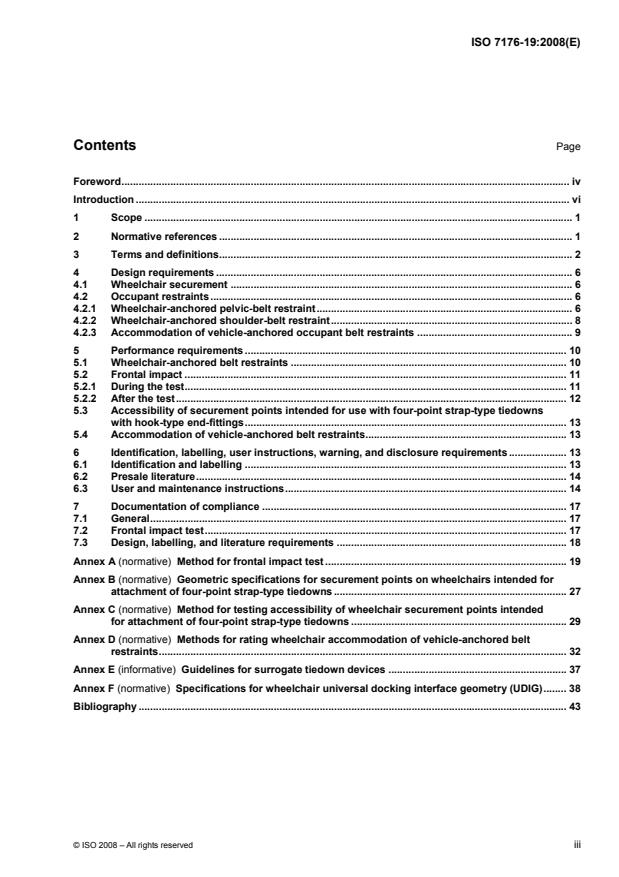
Contents Page
Foreword. iv
Introduction . vi
1 Scope . 1
2 Normative references . 1
3 Terms and definitions. 2
4 Design requirements . 6
4.1 Wheelchair securement . 6
4.2 Occupant restraints. 6
4.2.1 Wheelchair-anchored pelvic-belt restraint. 6
4.2.2 Wheelchair-anchored shoulder-belt restraint. 8
4.2.3 Accommodation of vehicle-anchored occupant belt restraints . 9
5 Performance requirements . 10
5.1 Wheelchair-anchored belt restraints . 10
5.2 Frontal impact . 11
5.2.1 During the test. 11
5.2.2 After the test. 12
5.3 Accessibility of securement points intended for use with four-point strap-type tiedowns
with hook-type end-fittings. 13
5.4 Accommodation of vehicle-anchored belt restraints. 13
6 Identification, labelling, user instructions, warning, and disclosure requirements . 13
6.1 Identification and labelling . 13
6.2 Presale literature. 14
6.3 User and maintenance instructions. 14
7 Documentation of compliance . 17
7.1 General. 17
7.2 Frontal impact test. 17
7.3 Design, labelling, and literature requirements . 18
Annex A (normative) Method for frontal impact test . 19
Annex B (normative) Geometric specifications for securement points on wheelchairs intended for
attachment of four-point strap-type tiedowns . 27
Annex C (normative) Method for testing accessibility of wheelchair securement points intended
for attachment of four-point strap-type tiedowns . 29
Annex D (normative) Methods for rating wheelchair accommodation of vehicle-anchored belt
restraints. 32
Annex E (informative) Guidelines for surrogate tiedown devices . 37
Annex F (normative) Specifications for wheelchair universal docking interface geometry (UDIG). 38
Bibliography . 43
Foreword
ISO (the International Organization for Standardization) is a worldwide federation of national standards bodies
(ISO member bodies). The work of preparing International Standards is normally carried out through ISO
technical committees. Each member body interested in a subject for which a technical committee has been
established has the right to be represented on that committee. International organizations, governmental and
non-governmental, in liaison with ISO, also take part in the work. ISO collaborates closely with the
International Electrotechnical Commission (IEC) on all matters of electrotechnical standardization.
International Standards are drafted in accordance with the rules given in the ISO/IEC Directives, Part 2.
The main task of technical committees is to prepare International Standards. Draft International Standards
adopted by the technical committees are circulated to the member bodies for voting. Publication as an
International Standard requires approval by at least 75 % of the member bodies casting a vote.
Attention is drawn to the possibility that some of the elements of this document may be the subject of patent
rights. ISO shall not be held responsible for identifying any or all such patent rights.
ISO 7176-19 was prepared by Technical Committee ISO/TC 173, Assistive products for persons with disability,
Subcommittee SC 1, Wheelchairs.
This second edition cancels and replaces the first edition (ISO 7176-19:2001), most clauses of which have
been technically revised.
ISO 7176 consists of the following parts, under the general title Wheelchairs:
⎯ Part 1: Determination of static stability
⎯ Part 2: Determination of dynamic stability of electric wheelchairs
⎯ Part 3: Determination of effectiveness of brakes
⎯ Part 4: Energy consumption of electric wheelchairs and scooters for determination of theoretical distance
range
⎯ Part 5: Determination of dimensions, mass and manoeuvring space
⎯ Part 6: Determination of maximum speed, acceleration and deceleration of electric wheelchairs
⎯ Part 7: Measurement of seating and wheel dimensions
⎯ Part 8: Requirements and test methods for static, impact and fatigue strengths
⎯ Part 9: Climatic tests for electric wheelchairs
⎯ Part 10: Determination of obstacle-climbing ability of electrically powered wheelchairs
⎯ Part 11: Test dummies
⎯ Part 13: Determination of coefficient of friction of test surfaces
⎯ Part 14: Power and control systems for electrically powered wheelchairs and scooters — Requirements
and test methods
iv © ISO 2008 – All rights reserved
⎯ Part 15: Requirements for information disclosure, documentation and labelling
⎯ Part 16: Resistance to ignition of upholstered parts — Requirements and test methods
⎯ Part 19: Wheeled mobility devices for use as seats in motor vehicles
⎯ Part 21: Requirements and test methods for electromagnetic compatibility of electrically powered
wheelchairs and scooters, and battery chargers
⎯ Part 22: Set-up procedures
⎯ Part 23: Requirements and test methods for attendant-operated stair-climbing devices
⎯ Part 24: Requirements and test methods for user-operated stair-climbing devices
⎯ Part 25: Requirements and test methods for batteries and their chargers for electrically powered
wheelchairs and motorized scooters
⎯ Part 26: Vocabulary
A technical report, ISO/TR 13570-1, is also available, giving a simplified explanation of these parts of
ISO 7176.
Introduction
Transportation safety research has shown that the vehicle seat is an important part of the occupant-restraint
system and therefore plays a key role in reducing the risk of serious injuries to vehicle occupants in many
types of vehicle crashes. In particular, the seat needs to allow and facilitate the proper positioning of belt
restraints on the skeletal regions of the occupant, not add to occupant loads during impact loading, and
provide effective support for the occupant so that the belt restraint will remain in place over skeletal regions
throughout a crash. People with physical disabilities must often remain in their wheelchairs whilst travelling in
motor vehicles as drivers or passengers. Since many wheelchairs were not designed for this purpose,
wheelchair-seated occupants are often at higher risk of injury in crashes than are people seated in seats
provided by the vehicle manufacturer.
ISO 10542-1 provides design, performance, labelling, and the manufacturer’s literature requirements, and
specifies associated test methods, for wheelchair tiedown and occupant-restraint systems (WTORS). This part
of ISO 7176 addresses the seating part of wheelchair-user occupant-protection systems by establishing
design, performance, labelling, and the manufacturer’s literature requirements, as well as associated test
methods, for wheelchairs that may be used as seats in motor vehicles.
Whilst wheelchairs may be secured by various types of tiedown and securement systems that were available
throughout the world at the time this part of ISO 7176 was developed, effective wheelchair securement in the
real world requires compatibility of the wheelchair tiedown system available in the vehicle and the method of
securement provided on the wheelchair. At the time that this part of ISO 7176 was developed, the four-point
strap-type tiedown was considered to be the most effective, common, and universally adaptable system for
securing a wide range of wheelchair types and sizes. For these reasons, this part of ISO 7176 requires that
wheelchairs intended for use as seats in motor vehicles provide for securement using a four-point strap-type
tiedown system by providing at least four designated securement points, with two in front and two in the back.
However, this part of ISO 7176 also provides for evaluating wheelchairs that are also designed for securement
by other methods, such as docking-type securement systems.
To evaluate the crashworthiness performance of a wheelchair, Annex A specifies procedures for dynamically
testing a wheelchair loaded with an appropriate-size crash-test dummy using a 48 km/h crash pulse with the
wheelchair secured facing forward on the impact sled. This test is based on well-documented motor vehicle
crash and injury statistics, which show that more than 50 % of all serious injuries to occupants of motor
vehicles occur in frontal crashes, and that more than 95 % of frontal crashes result in a longitudinal change in
vehicle speed of less than 48 km/h. Dynamic performance for forward-facing wheelchairs in rear and side
impacts might be addressed in future International Standards.
This part of ISO 7176 has also been developed with the recognition that the use of a pelvic-belt restraint alone
does not provide the wheelchair occupant with the same level of crash protection in a frontal impact as the
use of both pelvic-belt and shoulder-belt restraints. Therefore, the provisions and test methods of this part of
ISO 7176 are based on the use of both pelvic- and shoulder-belt-type restraints.
Although the four-point strap-type tiedown system was considered to be the most common and universal
method for effectively securing a wide range of wheelchairs at the time this part of ISO 7176 was developed, it
is a method of wheelchair securement that requires the involvement of a second person and cannot be
implemented by the wheelchair occupant. Accordingly, it is desirable to progress toward a securement method
that can be implemented independently by the wheelchair-seated passenger who may travel in different public
transportation and private vehicles. As a step toward this goal, this part of ISO 7176 includes a normative
annex (Annex F) that establishes universal docking interface geometry (UDIG) for securement points on
wheelchairs when it is intended for the wheelchair to be secured by docking-type securement devices in public
transportation and/or multiple private vehicles.
Finally, this part of ISO 7176 can be viewed in the totality of daily wheelchair use and the range of standards
to which all wheelchairs are expected to comply. Wheelchairs are designed primarily to serve as effective
mobility devices and, in that respect, they must first conform to the applicable requirements set forth in other
vi © ISO 2008 – All rights reserved
parts of the ISO 7176 series. Transportation is only one of many daily activities that introduce unique
circumstances and requirements that wheelchairs and wheelchair occupants may experience. Wheelchair
products that comply with this part of ISO 7176 will have additional features that provide increased levels of
occupant security and safety whilst their occupants are riding in motor vehicles. However, a wheelchair’s
failure to comply with this part of ISO 7176 cannot be used to limit access to, and availability of, motor vehicle
transportation for wheelchair users.
INTERNATIONAL STANDARD ISO 7176-19:2008(E)
Wheelchairs —
Part 19:
Wheeled mobility devices for use as seats in motor vehicles
1 Scope
This part of ISO 7176 applies to all manual and powered wheelchairs, including scooters, which, in addition to
their primary function as wheeled mobility devices, are also likely to be used as forward-facing seats in motor
vehicles by children and adults with a body mass equal to or greater than 22 kg. This part of ISO 7176
specifies wheelchair design requirements, performance requirements and associated test methods, and
requirements for wheelchair labelling, presale literature, user instructions and user warnings. It applies to
complete wheelchairs, including a base frame and seating system, as well as to wheelchairs equipped with
add-on adaptive components designed to facilitate compliance with one or more of the requirements.
2 Normative references
The following referenced documents are indispensable for the application of this document. For dated
references, only the edition cited applies. For undated references, the latest edition of the referenced
document (including any amendments) applies.
ISO 3795, Road vehicles, and tractors and machinery for agriculture and forestry — Determination of burning
behaviour of interior materials
ISO 6487, Road vehicles — Measurement techniques in impact tests — Instrumentation
ISO 7176-5, Wheelchairs — Part 5: Determination of dimensions, mass and manoeuvring space
ISO 7176-15:1996, Wheelchairs — Part 15: Requirements for information disclosure, documentation and
labelling
ISO 7176-22:2000, Wheelchairs — Part 22: Set-up procedures
ISO 7176-26:2007, Wheelchairs — Part 26: Vocabulary
ISO 10542-1, Technical systems and aids for disabled or handicapped persons — Wheelchair tiedown and
occupant-restraint systems — Part 1: Requirements and test methods for all systems
ISO 10542-2, Technical systems and aids for disabled or handicapped persons — Wheelchair tiedown and
occupant-restraint systems — Part 2: Four-point strap-type tiedown systems
FMVSS 209:2004, Standard No. 209, Seat belt assemblies. Federal Motor Vehicle Safety Standards, 49 CFR
571.209, 1 October, 2004
ECE Regulation 16, Uniform provisions concerning the approval of safety belts and restraint systems for adult
occupants of power-driven vehicles, Revision 3, Amendment 2, 16 August 1993
3 Terms and definitions
For the purposes of this document, the following terms and definitions apply.
3.1
add-on components
hardware that is attached to the wheelchair frame subsequent to sale by the wheelchair manufacturer, in a
manner that requires the use of tools for removal, in order to enhance design and/or performance of the
wheelchair
3.2
adult
person having a mass equal to or greater than 43 kg
3.3
anchor point
location on a vehicle interior component, floor, wall, wheelchair, or wheelchair tiedown, to which an anchorage
is attached
3.4
anchorage
assembly of components and fittings by which loads are transferred directly from the wheelchair tiedown to
the vehicle, or from the occupant restraint to the vehicle, wheelchair, wheelchair tiedown, or vehicle interior
component
3.5
anthropomorphic test device
ATD
articulated physical analogue of the human body used to represent a wheelchair occupant in a test
3.6
belt
length of webbing material used as part of an occupant restraint or postural support device
3.7
child
person having a mass equal to or greater than 22 kg and less than 43 kg
3.8
clamp-type tiedown
method of wheelchair tiedown or securement that uses only mechanical linkages and/or grips requiring
manual positioning and tensioning of the end fittings to the wheelchair
3.9
docking-type tiedown
docking-type securement
method of wheelchair tiedown by which portions of the wheelchair structure, or add-on components fastened
to the wheelchair, align, mate and engage with a docking tiedown device fastened to the vehicle, upon
manoeuvring the wheelchair into position in the vehicle
NOTE Securement of the wheelchair may occur automatically during wheelchair engagement, or could require
manual intervention through operation of a mechanical lever or electrical switch. Release of the wheelchair will usually
require operation of a mechanical lever or electrical switch.
3.10
docking tiedown device
docking securement device
assembly of fixtures and components designed for installation in motor vehicles for the purpose of securing a
wheelchair by engaging with, and locking onto, securement points on the wheelchair frame or on wheelchair
securement adaptors attached to the wheelchair frame
2 © ISO 2008 – All rights reserved
3.11
excursion
horizontal movement of an ATD or wheelchair during a test relative to its initial position on an impact sled
3.12
forward-facing
orientation in which the wheelchair-seated occupant faces the front of the vehicle with the wheelchair
reference plane within 10° of the longitudinal axis of the vehicle
3.13
four-point tiedown
wheelchair tiedown that attaches to the wheelchair frame at four separate securement points and also
attaches to the vehicle at four separate anchor points
3.14
four-point strap-type tiedown
four-point tiedown that uses four strap assemblies to secure the wheelchair in the vehicle
3.15
H-point
one of a pair of points located on the left and right sides of the pelvic region of an anthropomorphic test device
(ATD) that represent the approximate locations of the human hip joint centre in the side views, as specified by
the ATD manufacturer
3.16
head restraint
device intended to limit rearward excursion of the wheelchair occupant’s head in a vehicle impact
3.17
impact simulator
device for accelerating, decelerating, or a combination of decelerating and accelerating, a section of a vehicle
or simulated vehicle structures, including instrumentation for measuring data required by this standard
3.18
impact sled
part of an impact simulator on which components can be mounted for impact testing
3.19
occupant restraint
system or device intended to restrain a motor-vehicle occupant during an impact in order to prevent ejection,
and prevent or minimise contact with the vehicle interior components and other occupants
3.20
pelvic-belt restraint
lap-belt restraint
assembly of webbing and hardware intended to maintain an occupant in a seat during a crash
NOTE See Figure 1.
Key
1 shoulder-belt restraint
2 pelvic-belt restraint
NOTE The use of a pelvic-belt restraint only is not recommended.
Figure 1 — Three-point-belt restraint comprising a pelvic-belt restraint and a shoulder-belt restraint
that connect together near the hip of the occupant
3.21
point P
side-view projection of a point that lies at the cross-sectional centre of a 100 mm diameter, 200 mm long,
lightweight (max. 0,5 kg) cylinder positioned with the longitudinal axis perpendicular to the wheelchair
reference plane, such that the curved surface of the cylinder contacts the back support and the upper surface
of the seat
NOTE See Figure 2.
Dimensions in millimetres
Key
1 cylinder, diameter 100 mm
P point P
a
Wheelchair reference plane.
b
Wheelchair ground plane.
Figure 2 — Wheelchair reference point P and wheelchair reference and ground planes
4 © ISO 2008 – All rights reserved
3.22
postural support device
component and/or belt used to support a person in a desired seated position during normal wheelchair use
NOTE Postural support devices are not designed or intended to provide occupant restraint in a vehicle impact
3.23
power(ed)
systems which are operated by means of an energy source other than manual effort
3.24
securement points
points on the wheelchair to which wheelchair tiedowns are connected
3.25
shoulder-belt restraint
upper torso restraint
portion of the occupant restraint intended to limit movement of the head and chest by application of restraint
forces to either or both clavicles
NOTE See Figure 1.
3.26
strap
length of webbing material used in a wheelchair tiedown
3.27
surrogate tiedown
wheelchair securement system used during wheelchair testing to simulate commercial tiedown systems
NOTE Guidelines for designing surrogate tiedowns are provided in Annex E.
3.28
three-point belt restraint
three-point restraint (deprecated)
occupant-restraint assembly with three anchorages comprised of both a pelvic-belt restraint and a diagonal
shoulder-belt restraint that connect together near the hip of the occupant
NOTE See Figure 1.
3.29
tilt seating
type of wheelchair seat design that allows the complete seat structure to rotate in the wheelchair reference
plane relative to and about an axis located on the wheelchair base
3.30
universal docking interface geometry
UDIG
specifications for the size, shape, and location of wheelchair securement points, including surrounding clear
zones, intended for use with a variety of docking tiedown devices installed in a wide range of vehicles
3.31
UDIG adaptor
wheelchair tiedown adaptor that conforms to the UDIG specification in Annex F
3.32
wheelchair footprint
space outlined on the horizontal wheelchair ground plane by projecting vertically down from the outermost
edges of the structural members that comprise the mobile base and seat of the wheelchair
3.33
wheelchair ground plane
plane representing the surface on which the wheelchair rests
NOTE See Figure 2.
3.34
wheelchair reference plane
vertical plane in the longitudinal centreline of the wheelchair
NOTE See Figure 2.
3.35
wheelchair tiedown
wheelchair securement
device or system designed to secure a forward-facing wheelchair in place in a motor vehicle
NOTE The vehicle-anchored tiedown component may be installed using either permanent fasteners or by using a
mechanical coupling that allows for position adjustment for different wheelchairs.
3.36
wheelchair tiedown adaptor
wheelchair securement adaptor
hardware that is attached temporarily or permanently to the wheelchair frame to accommodate wheelchair
securement by a wheelchair tiedown device
3.37
wheelchair tiedown and occupant-restraint system
WTORS
complete restraint system for wheelchair-seated occupants comprised of equipment for wheelchair tiedown
and a belt-type occupant restraint
4 Design requirements
4.1 Wheelchair securement
4.1.1 The wheelchair shall be designed to provide for forward-facing securement in a motor vehicle using a
four-point strap-type tiedown system that complies with ISO 10542-2 using a minimum of four securement
points, two at the front and two at the rear, that conform to the geometric specifications set forth in Annex B
and the performance requirements in Clause 5.
NOTE In addition to complying with this subclause, the wheelchair can be designed for forward-facing securement
using other methods of wheelchair securement, including docking-type securement devices.
4.1.2 If a wheelchair is intended by the manufacturer to also be secured by a docking securement device in
public transportation and/or different private vehicles, the securement points on the wheelchair and/or of the
wheelchair tiedown adaptors shall conform to the specifications set forth in Annex F and the performance
requirements in Clause 5.
4.2 Occupant restraints
4.2.1 Wheelchair-anchored pelvic-belt restraint
If a wheelchair-anchored pelvic-belt intended for use as an occupant restraint in a vehicle is provided as part
of the wheelchair, when placed on the ATD in accordance with the set-up procedures for the frontal-impact
test of Annex A, it shall
a) have its anchor points located so that the projected side-view angle of the belt is between 30° and 75° to
the horizontal, as indicated in Figure 3, and
6 © ISO 2008 – All rights reserved
b) provide for adjustment of the pelvic-belt restraint that allows for increasing the length and decreasing the
length as specified in Table 1.
NOTE 1 A steeper (larger) pelvic-belt restraint angle within the preferred zone shown in Figure 3 is desirable.
NOTE 2 At least 25 mm of webbing must extend through any fitting where adjustment takes place at all times during
testing.
Table 1 — Requirements for pelvic-belt-restraint shortening and lengthening
Dimensions in millimetres
Required belt Required belt
a
ATD size
b b
shortening lengthening
6-year-old child 100 100
10-year-old child 100 100
small adult female 100 100
midsize adult male 200 200
large adult male 200 200
a
See Table A.1.
b
At least 25 mm of webbing must extend through any fitting where adjustment takes place at
all times during testing.
NOTE The angles indicated are obtained by projecting the angle of the pelvic-belt restraint onto a vertical plane that
is parallel to the wheelchair reference plane.
Figure 3 — Range of required angles of wheelchair-anchored pelvic-belt restraint when installed on
the appropriate-size ATD used in the test of Annex A
4.2.2 Wheelchair-anchored shoulder-belt restraint
If a wheelchair-anchored shoulder-belt restraint intended for use as an occupant restraint is provided as part
of the wheelchair, when installed on the ATD in accordance with the set-up procedures for the frontal-impact
test in Annex A, it shall be designed to
a) fit over the shoulder and across the chest, passing through the 100-mm-wide shaded zone of the ATD
used in the test of Annex A, as illustrated in Figure 4,
b) have an upper anchor point or upper guide point at, or above, the shoulder of the ATD used in the test of
Annex A,
c) locate the shoulder-belt restraint/pelvic-belt restraint junction at least as far from the ATD centreline as
shown in Table 3,
d) provide adjustment in the shoulder-belt restraint that allows for increasing and decreasing the length as
specified in Table 4,
NOTE At least 25 mm of webbing must extend through any fitting where adjustment takes place at all times during
testing.
Dimensions in millimetres
Key
1 ATD centreline
2 centre of sternum (measured from seating surface with ATD in upright seated posture)
NOTE The shoulder-belt restraint angle of 55° is relative to the horizontal and is measured in the frontal plane.
Values for the centre of the sternum dimension for each ATD size are given in Table 2.
Figure 4 — Location of shoulder-belt restraint on occupant's torso
8 © ISO 2008 – All rights reserved
Table 2 — Height of centre of sternum from seat surface for each ATD size
Dimensions in millimetres
a
Centre of sternum
ATD size
6-year-old child 275
10-year-old child 325
small adult female 353
midsize adult male 406
large adult male 432
a
See Table A.1.
Table 3 — Minimum distance of the shoulder-/pelvic- belt restraint junction
from the ATD centreline
Dimensions in millimetres
ATD centreline to
a
ATD size
belt junction
6-year-old child 150
10-year-old child 150
small adult female 150
midsize adult male 200
large adult male 200
a
See Table A.1.
Table 4 — Requirements for shoulder-belt-restraint shortening and lengthening
Dimensions in millimetres
Required belt Required belt
a
ATD size
b b
shortening lengthening
6-year-old child 250 150
10-year-old child 250 150
small adult female 250 150
midsize adult male 300 200
large adult male 300 200
a
See Table A.1.
b
At least 25 mm of webbing must extend through any fitting where adjustment takes place at
all times during testing.
4.2.3 Accommodation of vehicle-anchored occupant belt restraints
The test methods and performance criteria of Annex D shall be used to score and rate the wheelchair with
regard to accommodating the proper use and placement of vehicle or tiedown-anchored belt restraints. The
results shall be disclosed in the manufacturer’s presale literature in accordance with 6.2.
Whether or not a wheelchair caters for the use of a vehicle-anchored lap-belt or lap-plus-shoulder-belt
restraint, it is important to design the wheelchair frame and seating system to facilitate the proper use and
placement of vehicle-anchored lap- and shoulder-belt restraints on the wheelchair user. Proper placement of
the lap-belt restraint is low down near the thigh-abdominal junction, and proper placement of the shoulder-belt
restraint is over the near middle of the shoulder and diagonally across the middle of one shoulder, with a
connection to the lap-belt restraint near the hip of the user opposite the shoulder where the belt restraint
crossed over. All belt restraints should make good contact with the occupant’s body and not be held away by
wheelchair components.
Use of a head restraint that is part of the wheelchair is recommended to reduce the risk of neck injuries in rear
impacts. To be effective, the head restraint should be padded and be positioned within 50 mm of the back of
the occupant’s head, with the centre of the head restraint at least as high as the most rearward point on the
back of the head (i.e. the occiput) during normal travel.
5 Performance requirements
5.1 Wheelchair-anchored belt restraints
All webbing, metal parts, buckles, release mechanisms and adjustment mechanisms of wheelchair–anchored
belt restraints shall conform to applicable subsections of either ECE Regulation No. 16, and/or FMVSS 209,
as indicated in Tables 5 and 6, respectively, or as specified in equivalent mutually recognised regulations.
All webbing of wheelchair-anchored belt restraints and postural belts shall have a burning rate not exceeding
100 mm/min when tested as specified in ISO 3795.
Table 5 — Applicable subclauses of ECE Regulation No.16
ECE No. 16 tests
Subclause Component Subject
referenced
6.2.1.1 rigid parts sharp edges —
6.2.1.2 rigid parts corrosion 7.2
6.2.1.4 rigid parts cold impact test 7.5.4
6.2.2.1 buckles correct use and size —
6.2.2.2 buckles closing/releasing 7.8.2
6.2.2.3 buckles cold mating 7.5.3
6.2.2.4 buckles repeated testing 7.7
6.2.3.2 adjustment devicesmicro-slip —
belt-restraint force
6.2.3.4 7.5.6
adjusting device
various belt- performance
6.2.5 7.2, 7.6.1 thru 7.6.4
restraint retractors
6.2.6 preloading devices performance 7.2, 7.9.2
6.3.1 belt restraints general specifications —
6.3.2 belt restraints strength 7.4.1.1, 7.4.2
6.3.3 belt restraints strength 7.4.1, 7.4.2
6.4.2 belt restraints strength 7.4.1.6, 7.4.2, 7.5
10 © ISO 2008 – All rights reserved
Table 6 — Applicable subclauses of FMVSS 209
FMVSS 209 tests
Subclause Component Subject
referenced
S4.1 (d) hardware burrs and sharp edges —
S4.1 (e) release mechanism design —
S4.1 (h) webbing unravelling —
S4.2 (a) webbing belt width S5.1(a)
S4.2 (b) webbing breaking strength S5.1(b)
S4.2 (c) webbing elongation S5.1(c)
S4.2 (d) webbing abrasion resistance S5.1(d), S5.3(c)
S4.2 (d) webbing abrasion resistance S5.1(d)
S4.2 (e) webbing light resistance S5.1(e)
S4.2 (h) webbing stain resistance S5.1(h)
S4.3 (a) hardware corrosion resistance S5.2(a)
S4.3 (b) hardware temperature resistance S5.2(b)
S4.3 (d) buckle release release force S5.2(d)
S4.3 (e) adjustment device adjustment force S5.2(e)
S4.3 (f) tilt-lock devices locking angles S5.2(f)
S4.3 (g) buckle latch separation force S5.2(g)
S4.3 (i) belt restraint retractor performance S5.2(i)
S4.3 (j) belt-restraint retractor performance S5.2(j)
S4.3 (k) belt-restraint retractor performance S5.2(k), S4.4
S4.4 (a) pelvic-belt restraint performance S5.3(a)
S4.4 (b) three-point-belt restraint performance S5.3(b)
5.2 Frontal impact
All wheelchairs shall comply with a); compliance with b) is optional.
a) When tested in accordance with Annex A using a four-point strap-type tiedown that complies with
ISO 10542-2, the requirements of 5.2.1 and 5.2.2 shall be met during and after the test.
b) If a wheelchair is tested in accordance with Annex A using other methods of securement, such as a
docking-type securement device, the requirements of 5.2.1 and 5.2.2 shall be met during and after the
test.
5.2.1 During the test
a) The horizontal excursions of the ATD and the wheelchair with respect to the impact sled shall not exceed
the limits in Table 7 at any time during the test.
b) If the wheelchair is tested with a vehicle-anchored pelvic-belt restraint intended for restraint in a motor
vehicle, then the knee excursion shall exceed the wheelchair point P excursion as follows (see Table 7):
X / X W 1,1
knee wc
NOTE Compliance with this requirement reduces the potential for the wheelchair to apply large horizontal loads to
the wheelchair occupant.
c) Batteries of powered wheelchairs, or their surrogate replacement parts shall
1) not move completely outside the wheelchair footprint, and
2) not move into the wheelchair user's space (e.g., shall not contact the back of the ATD's legs).
Table 7 — Horizontal excursion limits
Dimensions in millimetres
Measurement Excursion 6-year-old child 10-year-old child Small adult Midsize and large
point variable ATD ATD female ATD adult ATD
Wheelchair point P X 150 175 200 200
wc
ATD knee centre X 300 325 375 375
knee
ATD front of head X 450 500 550 650
headF
ATD back of head X −350 −400 −400 −450
headR
X is the horizontal distance relative to the sled platform between the point P target on the wheelchair at time t , to the point P
wc 0
target at the time of peak wheelchair excursion.
X is the horizontal distance relative to the sled platform between the ATD knee-joint target at time t , to the knee-joint target at
knee 0
the time of peak knee excursion.
X is the horizontal distance relative to the sled platform between the most forward point on the ATD's head above the nose at
headF
time t , to the most forward point on the ATD's head at the time of peak head excursion.
X is the horizontal distance relative to the sled platform between the most rearward point on the ATD's head at time t , to the
headR 0
most rearward point on the ATD's head at the time of peak head excursion.
NOTE See the last paragraph of A.4.11 which describes how to estimate the point P excursion when it is not possible to place a
contrast marker at point P.
5.2.2 After the test
a) The wheelchair shall remain in an upright position on the test platform, and the ATD shall be retained in
the wheelchair in a seated posture, as determined by the ATD torso being oriented at not more than 45°
to the vertical when viewed from any direction.
b) The wheelchair securement points shall not show visible signs of material failure.
c) Rigid components, fragments or accessories of the wheelchair with a mass in excess of 100 g shall not
be completely separated from the wheelchair.
d) Wheelchair components that may contact the occupant shall not fragment or separate in a manner that
produces sharp edges, defined by as having a radius of less than 2 mm.
e) Primary load-carrying components of the wheelchair shall not show visible signs of failure, unless there is
a backup system to provide support.
NOTE If half or more of the layers in a plywood seating system do not crack or fail, the seating system is considered
to have adequate backup support.
f) Locking mechanisms of tilting seating adjusters shall not show signs of failure.
g) Removal of the ATD from the wheelchair shall not require the use of tools, other than a hoist to lift the
ATD.
h) Release of the wheelchair from the tiedown system shall not require the use of tools.
i) The post-test height of the average of left and right ATD H-points relative to the wheelchair ground plane
shall not have decreased by more than 20 % from the pretest height.
j) The wheelchair and its components shall not cause partial or complete failure of the webbing of any of the
WTORS assemblies during the test.
12 © ISO 2008 – All rights reserved
5.3 Accessibility of securement points intended for use with four-point strap-type tiedowns
with hook-type end-fittings
When tested in accordance with Annex C, each wheelchair securement point intended for use with a four-
point strap-type tiedown shall
a) allow one-handed attachment and engagement of the hook gauge specified in Figure C.2 within a time
period of 10 s, and
b) allow one-handed disengagement and removal of the same hook gauge within a time period of 10 s.
Securement points on wheelchairs should also be provided with sufficient clear space to allow webbing and
associated end-fittings of tiedown assemblies without hook end-fittings to be easily inserted and attached or
detached.
5.4 Accommodation of vehicle-anchored belt restraints
The wheelchair shall be tested for accommodation of vehicle-anchored occupant-restraint systems in
accordance with Annex D and the resulting rating shall be reported in the product presale literature.
6 Identification, labelling, user instructions, warning, and disclosure requirements
ISO 7176-15 applies with the addition of the information given in 6.1 to 6.3.
6.1 Identification and labelling
a) The wheelchair and/or its components shall be provided with permanent labels or markings that indicate
the location of securement points for four-point strap-type tiedowns, using the symbol in Figure 5, where
⎯ each symbol has an overall height of at least 12 mm,
⎯ the line width used to make the symbol is between 10 % and 20 % of the overall symbol height, and
⎯ the symbol is of sufficient contrast to the background to be visible in normal room lighting from a
distance of 1 m.
b) For wheelchairs intended to provide attachment points for tiedowns in addition to the four-point strap-type,
affix appropriate markings or labels to indicate the locations of any additional securement points and the
method of securement to be used.
c) Indicate that the wheelchair complies with the requirements specified in ISO 7176-19:2008.
d) Affix a label to any belt restraints anchored to the wheelchair that are intended for use as an occupant
restraint in a vehicle to indicate that they conform to ISO 7176-19:2008.
e) Affix a label to any postural support belt supplied by the wheelchair manufacturer that is not intended to
be used as an occupant restraint in a moving vehicle to indicate that it should not be relied upon for
occupant restraint in a moving vehicle.
Dimensions in millimetres
Figure 5 — Symbol required at each four-point strap-type securement point
6.2 Presale literature
In addition to the requirements in ISO 7176-15, the wheelchair manufacturer's presale literature shall include:
a) a statement that the wheelchair is designed to be secured facing forward when used as a seat in a motor
vehicle and that it complies with the requirements of ISO 7176-19:2008;
b) a description of the types of tiedowns that are suitable for use with the wheelchair (i.e., four-point strap-
type, clamp systems, specific type of docking system, etc.);
c) a statement that ease of access to, and manoeuvrability in, motor vehicles can be significantly affected by
wheelchair size and turning radius, and that smaller wheelchairs and/or wheelchairs with a shorter turning
radius will generally provide greater ease of vehicle acc
...
NORME ISO
INTERNATIONALE 7176-19
Deuxième édition
2008-07-15
Fauteuils roulants —
Partie 19:
Dispositifs de mobilité montés sur
roues et destinés à être utilisés
comme sièges dans des véhicules à
moteur
Wheelchairs —
Part 19: Wheeled mobility devices for use as seats in motor vehicles
Numéro de référence
©
ISO 2008
DOCUMENT PROTÉGÉ PAR COPYRIGHT
© ISO 2008
Droits de reproduction réservés. Sauf indication contraire, aucune partie de cette publication ne peut être reproduite ni utilisée
sous quelque forme que ce soit et par aucun procédé, électronique ou mécanique, y compris la photocopie, l’affichage sur
l’internet ou sur un Intranet, sans autorisation écrite préalable. Les demandes d’autorisation peuvent être adressées à l’ISO à
l’adresse ci-après ou au comité membre de l’ISO dans le pays du demandeur.
ISO copyright office
Case postale 56 • CH-1211 Geneva 20
Tel. + 41 22 749 01 11
Fax + 41 22 749 09 47
E-mail copyright@iso.org
Web www.iso.org
Version française parue en 2014
Publié en Suisse
ii © ISO 2008 – Tous droits réservés
Sommaire Page
Avant-propos .iv
Introduction .vi
1 Domaine d’application . 1
2 Références normatives . 1
3 Termes et définitions . 2
4 Exigences de conception. 6
4.1 Fixation de fauteuil roulant . 6
4.2 Systèmes de retenue des occupants . 7
5 Exigences de performance .11
5.1 Dispositifs de retenue par ceinture fixés au fauteuil roulant .11
5.2 Choc frontal .12
5.3 Accessibilité des points de fixation destinés à être utilisés avec des systèmes de sangle
d’attache à quatre points avec pièces d’extrémité à crochet .14
5.4 Capacité d’accueil des dispositifs de retenue par ceinture fixés au véhicule .14
6 Exigences en matière d’identification, d’étiquetage, d’instructions d’utilisation,
d’avertissement et de communication.14
6.1 Identification et étiquetage .14
6.2 Documentation publicitaire .15
6.3 Instructions d’utilisation et de maintenance .16
7 Documents de conformité .19
7.1 Généralités .19
7.2 Essai de choc frontal.19
7.3 Exigences en matière de conception, d’étiquetage et de documentation .20
Annexe A (normative) Méthode relative à l’essai de choc frontal .21
Annexe B (normative) Spécifications géométriques relatives aux points de fixation sur les
fauteuils roulants destinés à être fixés à l’aide de systèmes de sangles d’attache à
quatre points .30
Annexe C (normative) Méthode pour soumettre à essai l’accessibilité des points de fixation
de fauteuil roulant prévus pour la fixation des systèmes de sangles d’attache à
quatre points .33
Annexe D (normative) Méthodes d’évaluation des fauteuils roulants en termes de capacité
d’accueildes dispositifs de retenue par ceinture fixés au véhicule .36
Annexe E (informative) Lignes directrices relatives aux systèmes d’attache de substitution .41
Annexe F (normative) Spécifications relatives à la géométrie de l’interface d’arrimage universelle
du fauteuil roulant (UDIG) .43
Bibliographie .48
Avant-propos
L’ISO (Organisation internationale de normalisation) est une fédération mondiale d’organismes
nationaux de normalisation (comités membres de l’ISO). L’élaboration des Normes internationales est
en général confiée aux comités techniques de l’ISO. Chaque comité membre intéressé par une étude
a le droit de faire partie du comité technique créé à cet effet. Les organisations internationales,
gouvernementales et non gouvernementales, en liaison avec l’ISO participent également aux travaux.
L’ISO collabore étroitement avec la Commission électrotechnique internationale (IEC) en ce qui concerne
la normalisation électrotechnique.
Les procédures utilisées pour élaborer le présent document et celles destinées à sa mise à jour sont
décrites dans les Directives ISO/IEC, Partie 1. Il convient, en particulier de prendre note des différents
critères d’approbation requis pour les différents types de documents ISO. Le présent document a été
rédigé conformément aux règles de rédaction données dans les Directives ISO/IEC, Partie 2 (voir www.
iso.org/directives).
L’attention est appelée sur le fait que certains des éléments du présent document peuvent faire l’objet de
droits de propriété intellectuelle ou de droits analogues. L’ISO ne saurait être tenue pour responsable
de ne pas avoir identifié de tels droits de propriété et averti de leur existence. Les détails concernant les
références aux droits de propriété intellectuelle ou autres droits analogues identifiés lors de l’élaboration
du document sont indiqués dans l’Introduction et/ou dans la liste des déclarations de brevets reçues par
l’ISO (voir www.iso.org/brevets).
Les appellations commerciales éventuellement mentionnées dans le présent document sont données
pour information, par souci de commodité, à l’intention des utilisateurs et ne sauraient constituer un
engagement.
Pour une explication de la signification des termes et expressions spécifiques de l’ISO liés à l’évaluation de
la conformité, ou pour toute information au sujet de l’adhésion de l’ISO aux principes de l’OMC concernant
les obstacles techniques au commerce (OTC), voir le lien suivant: Avant-propos — Informations
supplémentaires.
L’ISO 7176-19 a été élaborée par le comité technique ISO/TC 173, Appareils et accessoires fonctionnels
pour les personnes handicapées, sous-comité SC 1, Fauteuils roulants.
Cette deuxième édition annule et remplace la première édition (ISO 7176-19:2001), dont les articles ont
fait l’objet d’une révision technique.
L’ISO 7176 comprend les parties suivantes, présentées sous le titre général Fauteuils roulants:
— Partie 1: Détermination de la stabilité statique
— Partie 2: Détermination de la stabilité dynamique des fauteuils roulants électriques
— Partie 3: Détermination de l’efficacité des freins
— Partie 4: Consommation d’énergie des fauteuils roulants et scooters électriques pour la détermination
de la distance théorique
— Partie 5: Détermination des dimensions, de la masse et de l’espace de manœuvre
— Partie 6: Détermination de la vitesse, de l’accélération et du ralentissement maximaux des fauteuils
roulants électriques
— Partie 7: Mesurage des dimensions d’assise et des roues
— Partie 8: Exigences et méthodes d’essai pour la résistance statique, la résistance aux chocs et la résistance
à la fatigue
— Partie 9: Essais climatiques pour fauteuils roulants électriques
iv © ISO 2008 – Tous droits réservés
— Partie 10: Détermination de l’aptitude des fauteuils roulants électriques à gravir les obstacles
— Partie 11: Mannequins d’essai
— Partie 13: Détermination du coefficient de frottement des surfaces d’essai
— Partie 14: Systèmes d’alimentation et de commande des fauteuils roulants et des scooters électriques —
Exigences et méthodes d’essai
— Partie 15: Exigences relatives à la diffusion des informations, à la documentation et à l’étiquetage
— Partie 16: Résistance à l’inflammation des parties rembourrées – Exigences et méthodes d’essai
— Partie 19: Dispositifs de mobilité montés sur roues et destinés à être utilisés comme sièges dans des
véhicules à moteur
— Partie 21: Exigences et méthodes d’essai pour la compatibilité électromagnétique des fauteuils roulants
et scooters électriques, et des chargeurs de batterie
— Partie 22: Modes opératoires de réglage
— Partie 23: Exigences et méthodes d’essai pour les monte-escalier manipulés par une tierce personne
— Partie 24: Exigences et méthodes d’essai pour les monte-escalier manipulés par l’utilisateur
— Partie 25: Exigences et méthodes d’essai pour les batteries et chargeurs pour fauteuils roulants
électriques et scooters motorisés
— Partie 26: Vocabulaire
Un rapport technique, ISO/TR 13570-1, donnant une explication simplifiée de ces parties est également
disponible.
Introduction
La recherche en matière de sécurité de transport a montré que le siège de véhicule est un élément
important du système de retenue des occupants et joue ainsi un rôle clé dans la réduction des blessures
graves pour les occupants du véhicule dans de nombreux types de collisions de véhicule. Le siège doit
notamment permettre et faciliter le bon fonctionnement des dispositifs de retenue par ceinture au
niveau des régions squelettiques de l’occupant, ne pas ajouter de charges pour l’occupant dues à la force
du choc et fournir un support efficace pour l’occupant de manière à ce que le dispositif de retenue par
ceinture reste en place sur les régions squelettiques pendant une collision. Les personnes handicapées
doivent souvent rester dans leur fauteuil roulant lorsqu’elles se déplacent dans des véhicules à moteur
en qualité de conducteur ou de passager. Comme de nombreux fauteuils roulants n’ont pas été conçus
à cet effet, les occupants assis dans un fauteuil roulant sont souvent exposés à un plus grand risque de
blessures en cas de collisions que les personnes assises dans les sièges fournis par le constructeur du
véhicule.
L’ISO 10542-1 définit les exigences relatives à la conception, à la performance, à l’étiquetage et à la
documentation du fabricant, et spécifie les méthodes d’essai associées, pour les systèmes d’attache du
fauteuil roulant et de retenue de l’occupant (WTORS). Cette partie de l’ISO 7176 couvre la partie assise
des systèmes de protection des occupants pour les utilisateurs de fauteuil roulant en définissant les
exigences relatives à la conception, à la performance, à l’étiquetage et à la documentation du fabricant,
ainsi que les méthodes d’essai associées, pour les fauteuils roulants qui peuvent être utilisés comme
sièges dans les véhicules à moteur.
Même si les fauteuils roulants peuvent être sécurisés au moyen de divers types de systèmes d’attache et
de fixation qui étaient disponibles dans le monde entier lors de l’élaboration de cette partie de l’ISO 7176,
une fixation de fauteuil roulant efficace dans le monde réel nécessite la compatibilité entre le système
d’attache du fauteuil roulant disponible dans le véhicule et la méthode de fixation fournie sur le fauteuil
roulant. Au moment de l’élaboration de cette partie de l’ISO 7176, le système de sangle d’attache à quatre
points était considéré comme le système le plus efficace, courant et universellement adaptable pour
fixer une grande variété de types et tailles de fauteuils roulants. C’est pourquoi cette partie de l’ISO 7176
nécessite que les fauteuils roulants destinés à être utilisés comme sièges dans les véhicules à moteur
permettent une fixation à l’aide d’un système de sangle d’attache à quatre points en fournissant au
moins quatre points de fixation désignés, dont deux à l’avant et deux à l’arrière. Cependant, cette partie
de l’ISO 7176 permet également d’évaluer les fauteuils roulants qui sont aussi conçus pour être fixés au
moyen d’autres méthodes, comme les systèmes de fixation par arrimage.
Pour évaluer la capacité d’absorption d’énergie de collision d’un fauteuil roulant, l’Annexe A définit les
procédures relatives aux essais dynamiques d’un fauteuil roulant chargé avec un mannequin d’essai de
taille appropriée à l’aide d’une impulsion de 48 km/h avec le fauteuil roulant fixé face à la route sur le
traîneau. Cet essai est basé sur des statistiques correctement documentées de collisions de véhicules à
moteur et de blessures, qui montrent que plus de 50 % de l’ensemble des blessures graves des occupants
de véhicules à moteur ont lieu lors de collisions frontales, et que plus de 95 % des collisions frontales
entraînent un changement longitudinal de la vitesse de véhicule de moins de 48 km/h. La performance
dynamique des fauteuils roulants face à la route lors des chocs arrière et avant peut être abordée dans
les futures normes internationales.
Cette partie de l’ISO 7176 a également été élaborée en tenant compte du fait que l’utilisation d’un
dispositif de retenue par ceinture pelvienne seul ne fournit pas à l’occupant du fauteuil roulant le même
niveau de protection lors d’un choc frontal que l’utilisation des deux dispositifs de retenue par ceinture
pelvienne et par ceinture épaulière. Par conséquent, les dispositions et méthodes d’essai de cette partie
de l’ISO 7176 sont basées sur l’utilisation des deux dispositifs de retenue par ceinture pelvienne et par
ceinture épaulière.
Bien que le système de sangle d’attache à quatre points était considéré comme la méthode la plus
courante et universelle pour fixer efficacement une grande variété de fauteuils roulants lors de
l’élaboration de cette partie de l’ISO 7176, il s’agit d’une méthode de fixation de fauteuil roulant qui
nécessite l’intervention d’une deuxième personne et qui ne peut pas être utilisée par l’occupant du
fauteuil roulant. Par conséquent, il est recommandé d’opter pour une méthode de fixation qui peut être
vi © ISO 2008 – Tous droits réservés
utilisée de manière indépendante par le passager assis dans le fauteuil roulant, celui-ci pouvant alors
utiliser différents transports publics et véhicules privés. Pour se rapprocher de cet objectif, cette partie
de l’ISO 7176 inclut une annexe normative (Annexe F) qui définit la géométrie d’interface d’arrimage
universelle (UDIG) pour les points de fixation sur les fauteuils roulants lorsque le fauteuil roulant doit
être sécurisé au moyen de systèmes de fixation par arrimage dans les transports publics et/ou véhicules
privés multiples.
Finalement, cette partie de l’ISO 7176 peut être considérée dans la totalité des utilisations quotidiennes
de fauteuils roulants et l’ensemble de normes auxquelles tous les fauteuils roulants doivent satisfaire.
Les fauteuils roulants sont principalement conçus pour servir de dispositifs de mobilité efficaces et,
à cet égard, ils doivent d’abord se conformer aux exigences applicables définies dans d’autres parties
de la série ISO 7176. Le transport est une seule des nombreuses activités quotidiennes qui impliquent
des circonstances uniques et exigences auxquelles peuvent être confrontés les fauteuils roulants et
leurs occupants. Les accessoires de fauteuils roulants qui sont conformes à cette partie de l’ISO 7176
présentent des caractéristiques supplémentaires qui fournissent des niveaux accrus de sécurité des
occupants lorsque leurs occupants sont dans des véhicules à moteur. Mais, si un fauteuil roulant n’est
pas conforme à cette partie de l’ISO 7176, cela ne peut pas être utilisé pour limiter l’accès au, et la
disponibilité du transport par véhicule à moteur pour les utilisateurs de fauteuils roulants.
NORME INTERNATIONALE ISO 7176-19:2008(F)
Fauteuils roulants —
Partie 19:
Dispositifs de mobilité montés sur roues et destinés à être
utilisés comme sièges dans des véhicules à moteur
1 Domaine d’application
Cette partie de l’ISO 7176 s’applique à tous les fauteuils roulants, manuels et électriques, notamment
les scooters qui, en plus de leur fonction principale de dispositifs de mobilité montés sur roues, peuvent
également être utilisés comme sièges face à la route dans les véhicules à moteur par les enfants et
adultes ayant une masse corporelle supérieure ou égale à 22 kg. Cette partie de l’ISO 7176 définit les
exigences de conception et de performance des fauteuils roulants et les méthodes d’essai associées,
ainsi que les exigences relatives à l’étiquetage du fauteuil roulant, la documentation publicitaire, les
instructions d’utilisation et les avertissements destinés aux utilisateurs. Elle s’applique aux fauteuils
roulants complets, avec un cadre de base et un système d’assise, ainsi qu’aux fauteuils roulants avec des
composants adaptatifs additionnels conçus pour faciliter le respect d’une ou plusieurs exigences.
2 Références normatives
Les documents de référence suivants sont indispensables pour l’application du présent document. Pour
les références datées, seule l’édition citée s’applique. Pour les références non datées, la dernière édition
du document de référence s’applique (y compris les éventuels amendements).
ISO 3795, Véhicules routiers et tracteurs et matériels agricoles et forestiers — Détermination des
caractéristiques de combustion des matériaux intérieurs
ISO 6487, Véhicules routiers — Techniques de mesurage lors des essais de chocs — Instrumentation
ISO 7176-5, Fauteuils roulants — Partie 5: Détermination des dimensions, de la masse et de l’espace de
manoeuvre
ISO 7176-15:1996, Fauteuils roulants — Partie 15: Exigences relatives à la diffusion des informations, à la
documentation et à l’étiquetage
ISO 7176-22:2000, Fauteuils roulants — Partie 22: Modes opératoires de réglage
ISO 7176-26:2007, Fauteuils roulants — Partie 26: Vocabulaire
ISO 10542-1, Assistances et aides techniques pour les personnes invalides ou handicapées — Systèmes
d’attache du fauteuil roulant et de retenue de l’occupant — Partie 1: Exigences générales et méthodes d’essai
pour tous les systèmes
ISO 10542-2, Assistances et aides techniques pour les personnes invalides ou handicapées — Systèmes
d’attache du fauteuil roulant et de retenue de l’occupant — Partie 2: Systèmes de sangles d’attache à quatre
points
FMVSS 209:2004, Standard No. 209, Seat belt assemblies. Federal Motor Vehicle Safety Standards, 49 CFR
571.209, 1 October, 2004
ECE Regulation 16, Uniform provisions concerning the approval of safety belts and restraint systems for
adult occupants of power-driven vehicles, Revision 3, Amendment 2, 16 August 1993
3 Termes et définitions
Pour les besoins du présent document, les termes et définitions suivants s’appliquent.
3.1
composants additionnels
matériel qui est fixé au cadre du fauteuil roulant suite à la vente par le fabricant de fauteuil roulant, de
telle manière qu’il nécessite l’utilisation d’outils pour le retrait, afin d’améliorer la conception et/ou la
performance du fauteuil roulant
3.2
adulte
personne ayant un poids supérieur ou égal à 43 kg
3.3
point d’ancrage
endroit sur un composant intérieur du véhicule, sol, mur, fauteuil roulant ou système d’attache de fauteuil
roulant, où est fixé un système d’ancrage
3.4
système d’ancrage
ensemble de composants et accessoires par lesquels les charges sont transférées directement du système
d’attache de fauteuil roulant au véhicule, ou du système de retenue des occupants au véhicule, fauteuil
roulant, système d’attache de fauteuil roulant ou composant intérieur du véhicule
3.5
mannequin d’essai anthropomorphique
ATD
mannequin articulé semblable au corps humain utilisé pour représenter un occupant de fauteuil roulant
lors d’un essai
3.6
ceinture
longueur de sangle utilisée comme partie d’un système de retenue d’occupant ou d’un système de
maintien postural
3.7
enfant
personne ayant un poids supérieur ou égal à 22 kg mais inférieur à 43 kg
3.8
système d’attache par bridage
méthode d’attache ou de fixation de fauteuil roulant qui utilise uniquement des liaisons mécaniques
et/ou poignées nécessitant le positionnement et serrage manuel des pièces d’extrémité sur le fauteuil
roulant
3.9
attache par arrimage
fixation par arrimage
méthode d’attache de fauteuil roulant par laquelle des parties de la structure du fauteuil roulant ou des
composants additionnels fixés sur le fauteuil roulant, sont alignés, accouplés et engagés avec un système
d’attache par arrimage fixé sur le véhicule, lors du positionnement du fauteuil roulant dans le véhicule
Note 1 à l’article: La fixation du fauteuil roulant peut avoir lieu automatiquement pendant l’engagement du fauteuil
roulant, ou peut nécessiter une intervention manuelle via la commande d’un levier mécanique ou commutateur
électrique. La libération du fauteuil roulant nécessite généralement la commande d’un levier mécanique ou
commutateur électrique.
2 © ISO 2008 – Tous droits réservés
3.10
système d’attache par arrimage
système de fixation par arrimage
ensemble des accessoires et composants conçus pour être installés dans des véhicules à moteur afin de
fixer un fauteuil roulant en l’engageant avec et en le bloquant sur les points de fixation situés sur le cadre
du fauteuil roulant ou sur les adaptateurs de fixation du fauteuil roulant fixés sur le cadre du fauteuil
roulant
3.11
déplacement
mouvement horizontal d’un ATD ou fauteuil roulant pendant un essai par rapport à sa position initiale
sur un traîneau
3.12
face à la route
orientation selon laquelle l’occupant assis dans le fauteuil roulant est face à l’avant du véhicule avec le
plan de référence du fauteuil orienté à 10° de l’axe longitudinal du véhicule
3.13
attache quatre points
attache du fauteuil roulant qui se fixe sur le cadre du fauteuil roulant en quatre points de fixation séparés
et qui se fixe également sur le véhicule en quatre points d’ancrage séparés
3.14
système de sangle d’attache à quatre points
attache à quatre points qui utilise quatre sangles pour sécuriser le fauteuil roulant dans le véhicule
3.15
point H
point d’une paire de points situés à gauche et à droite de la région pelvienne d’un mannequin d’essai
anthropomorphique (ATD) qui représente les emplacements approximatifs du centre de l’articulation
de la hanche dans les vues de côté, comme spécifié par le fabricant de l’ATD
3.16
système de maintien de la tête
système destiné à limiter le déplacement arrière de la tête de l’occupant du fauteuil roulant lors d’une
collision du véhicule
3.17
simulateur de choc
système d’accélération, de ralentissement ou combinaison de ralentissement et d’accélération, d’une
section d’un véhicule ou de structures de véhicule simulées, notamment les instruments de mesure des
données requis par cette norme
3.18
traîneau
partie d’un simulateur de choc sur laquelle les composants peuvent être montés pour les essais de choc
3.19
système de retenue des occupants
système ou dispositif destiné à retenir l’occupant d’un véhicule à moteur pendant un choc afin d’empêcher
son éjection et d’empêcher ou de minimiser tout contact avec les composants intérieurs du véhicule et
les autres occupants
3.20
système de retenue par ceinture pelvienne
système de retenue par ceinture sous-abdominale
ensemble de sangles et équipements destinés à maintenir un occupant dans un siège lors d’une collision
Note 1 à l’article: Voir Figure 1.
Légende
1 Système de retenue par ceinture épaulière
2 Système de retenue par ceinture pelvienne
NOTE L’utilisation d’un système de retenue par ceinture pelvienne seul n’est pas recommandée.
Figure 1 — Système de retenue par ceinture trois points composé d’un système de retenue
par ceinture pelvienne et d’un système de retenue par ceinture épaulière qui se connectent
ensemble à proximité de la hanche de l’occupant
3.21
point P
projection latérale d’un point qui est situé au centre d’un cylindre léger (max. 0,5 kg) de 100 mm de
diamètre et de 200 mm de long, positionné avec l’axe longitudinal perpendiculaire au plan de référence
du fauteuil roulant, de manière à ce que la surface incurvée du cylindre entre en contact avec le dossier
et la surface supérieure du siège
Note 1 à l’article: Voir Figure 2.
Dimensions en millimètres
Légende
1 cylindre, diamètre 100 mm
P point P
a
plan de référence du fauteuil roulant
b
plan au sol du fauteuil roulant
Figure 2 — Point de référence P du fauteuil roulant et plans de référence et de masse du fauteuil
roulant
4 © ISO 2008 – Tous droits réservés
3.22
système de maintien postural
composant et/ou ceinture utilisé pour supporter une personne dans une position assise souhaitée
pendant l’utilisation normale du fauteuil roulant
Note 1 à l’article: Les systèmes de maintien postural ne sont pas conçus pour ou destinés à fournir une retenue de
l’occupant en cas de choc du véhicule
3.23
électrique
systèmes qui sont commandés au moyen d’une source d’énergie autre qu’un effort manuel
3.24
points de fixation
points sur le fauteuil roulant auxquels sont connectées les attaches de fauteuil roulant
3.25
retenue par ceinture épaulière
retenue par baudrier
partie du système de retenue de l’occupant destinée à limiter le mouvement de la tête et le thorax par
application de forces de retenue sur une des clavicules ou les deux
Note 1 à l’article: Voir Figure 1.
3.26
sangle
longueur de sangle utilisée dans un système d’attache de fauteuil roulant
3.27
attache de substitution
système de fixation de fauteuil roulant utilisé pendant les essais de fauteuil roulant pour simuler les
systèmes d’attache commerciaux
Note 1 à l’article: Des instructions relatives à la conception d’attaches de substitution sont fournies en Annexe E.
3.28
dispositif de retenue par ceinture trois points
dispositif de retenue trois points (obsolète)
ensemble de retenue de l’occupant avec trois fixations composé d’un dispositif de retenue par ceinture
pelvienne et d’un dispositif de retenue par ceinture épaulière diagonale qui se connectent ensemble à
proximité de la hanche de l’occupant
Note 1 à l’article: Voir Figure 1.
3.29
siège inclinable
type de modèle de siège de fauteuil roulant qui permet à la structure de siège complète de tourner dans
le plan de référence du fauteuil roulant par rapport à un axe situé sur la base du fauteuil roulant
3.30
géométrie d’interface d’arrimage universelle
UDIG
spécifications relatives à la taille, à la forme et à l’emplacement des points de fixation de fauteuil roulant,
y compris les zones de dégagement environnantes, destinés à être utilisés avec une grande variété de
systèmes d’attache par arrimage installés dans une grande variété de véhicules
3.31
adaptateur UDIG
adaptateur d’attache de fauteuil roulant qui est conforme à la spécification de l’UDIG en Annexe F
3.32
encombrement du fauteuil roulant
espace délimité sur le plan au sol de fauteuil roulant horizontal par projection verticale à partir des
bords extérieurs des éléments structurels qui comprennent la base mobile et l’assise du fauteuil roulant
3.33
plan au sol du fauteuil roulant
plan représentant la surface sur laquelle repose le fauteuil roulant
Note 1 à l’article: Voir Figure 2.
3.34
plan de référence du fauteuil roulant
plan vertical dans l’axe longitudinal du fauteuil roulant
Note 1 à l’article: Voir Figure 2.
3.35
attache de fauteuil roulant
fixation de fauteuil roulant
dispositif ou système conçu pour positionner un fauteuil roulant face à la route dans un véhicule à moteur
Note 1 à l’article: Le composant d’attache fixé au véhicule peut être installé à l’aide de fixations permanentes ou
d’un accouplement mécanique qui permet un bon positionnement pour différents fauteuils roulants.
3.36
adaptateur d’attache de fauteuil roulant
adaptateur de fixation de fauteuil roulant
équipement qui est fixé de manière temporaire ou permanente au cadre du fauteuil roulant pour recevoir
la fixation du fauteuil roulant par un système d’attache de fauteuil roulant
3.37
système d’attache du fauteuil roulant et de retenue de l’occupant
WTORS
système de retenue complet pour les occupants assis dans un fauteuil roulant, composé d’équipements
pour l’attache du fauteuil roulant et un système de retenue de l’occupant par ceinture
4 Exigences de conception
4.1 Fixation de fauteuil roulant
4.1.1 Le fauteuil roulant doit être conçu de manière à garantir une fixation face à la route dans un
véhicule à moteur à l’aide d’un système de sangle d’attache à quatre points qui est conforme à l’ISO 10542-
2 avec quatre points de fixation minimum, deux à l’avant et deux à l’arrière, qui sont conformes aux
spécifications géométriques définies en Annexe B et aux exigences de performance dans l’Article 5.
NOTE Outre le respect de ce paragraphe, le fauteuil roulant peut être conçu pour une fixation face à la route
à l’aide d’autres méthodes de fixation de fauteuil roulant, y compris les systèmes de fixation par arrimage.
4.1.2 Si un fabricant prévoit qu’un fauteuil roulant soit également sécurisé par un dispositif d’arrimage
dans les transports publics et/ou les véhicules privés, les points de fixation sur le fauteuil roulant et/ou
les adaptateurs d’attache du fauteuil roulant doivent se conformer aux spécifications définies en Annexe
F et aux exigences de performance de l’Article 5.
6 © ISO 2008 – Tous droits réservés
4.2 Systèmes de retenue des occupants
4.2.1 Dispositif de retenue par ceinture pelvienne fixé au véhicule
Si une ceinture pelvienne fixée au fauteuil roulant destinée à être utilisée comme système de retenue
de l’occupant dans un véhicule est fournie avec le fauteuil roulant, lors de son placement sur l’ATD
conformément aux procédures de réglage pour l’essai de choc frontal de l’Annexe A, elle doit
a) avoir des points d’ancrage situés de manière à ce que l’angle latéral projeté de la ceinture soit entre
30° et 75° à l’horizontale, comme indiqué dans la Figure 3, et
b) garantir l’ajustement du dispositif de retenue par ceinture pelvienne qui permet d’augmenter et de
réduire la longueur comme spécifié dans le Tableau 1.
NOTE 1 Un angle de retenue par ceinture pelvienne plus raide (plus grand) dans la zone préférée illustrée dans
la Figure 3 est recommandé.
NOTE 2 Au moins 25 mm de sangle doivent s’étendre sur n’importe quel accessoire où a lieu l’ajustement à tous
moments de l’essai.
Tableau 1 — Exigences relatives au raccourcissement et à l’allongement du dispositif de retenue
par ceinture pelvienne
Dimensions en millimètres
Raccourcisse-
Allongement de
a
Taille de l’ATD ment de ceinture
b
ceinture requis
b
requis
Enfant âgé de 6 ans 100 100
Enfant âgé de 10 ans 100 100
Adulte de sexe féminin de petite taille 100 100
Adulte de sexe masculin de taille
200 200
moyenne
Adulte de sexe masculin de grande taille 200 200
a
Voir Tableau A.1.
b
Au moins 25 mm de sangle doivent s’étendre sur n’importe quel accessoire où a lieu
l’ajustement à tous moments de l’essai.
NOTE Les angles indiqués sont obtenus en projetant l’angle du dispositif de retenue par ceinture pelvienne
sur un plan vertical qui est parallèle au plan de référence du fauteuil roulant.
Figure 3 — Plage d’angles requis du dispositif de retenue par ceinture pelvienne fixé au fauteuil
roulant lorsqu’il est installé sur l’ATD de taille appropriée utilisé dans l’essai de l’Annexe A
4.2.2 Dispositif de retenue par ceinture épaulière fixé au fauteuil roulant
Si une ceinture épaulière fixée au fauteuil roulant destinée à être utilisée comme système de retenue
de l’occupant est fournie avec le fauteuil roulant, lors de son placement sur l’ATD conformément aux
procédures de réglage pour l’essai de choc frontal de l’Annexe A, elle doit être conçue pour
a) être placée sur l’épaule et en travers du thorax, en passant par la zone ombrée de 100 mm de l’ATD
utilisé dans l’essai de l’Annexe A, comme illustré dans la Figure 4,
b) avoir un point d’ancrage supérieur ou un point de guidage supérieur au niveau de l’épaule ou au-
dessus de l’épaule de l’ATD utilisé dans l’essai de l’Annexe A,
c) placer la jonction du dispositif de retenue par ceinture épaulière/du dispositif de retenue par
ceinture pelvienne au moins le plus loin possible du centre de l’ATD comme illustré dans le Tableau 3,
d) garantir l’ajustement du dispositif de retenue par ceinture épaulière qui permet d’augmenter et de
réduire la longueur comme spécifié dans le Tableau 4,
NOTE Au moins 25 mm de sangle doivent s’étendre sur n’importe quel accessoire où a lieu l’ajustement à tous
moments de l’essai.
8 © ISO 2008 – Tous droits réservés
Dimensions en millimètres
Légende
1 centre de l’ATD
2 centre du sternum (mesuré à partir de la surface d’assise avec l’ATD en position assise droite)
NOTE L’angle du dispositif de retenue par ceinture épaulière de 55° est relatif à l’horizontale et est mesuré
dans le plan frontal. Les valeurs pour le centre de la dimension du sternum pour chaque taille d’ATD figurent dans
le Tableau 2.
Figure 4 — Emplacement du dispositif de retenue par ceinture épaulière sur le torse de
l’occupant
Tableau 2 — Hauteur du centre de sternum à partir de la surface d’assise pour chaque taille
d’ATD
Dimensions en millimètres
Taille de l’ATD a Centre de sternum
Enfant âgé de 6 ans 275
Enfant âgé de 10 ans 325
Adulte de sexe féminin de petite taille 353
Adulte de sexe masculin de taille moyenne 406
Adulte de sexe masculin de grande taille 432
a
Voir Tableau A.1.
Tableau 3 — Distance minimale de la jonction du dispositif de retenue par ceinture
épaulière/pelvienne à partir de l’axe de l’ATD
Dimensions en millimètres
Jonction axe de l’ATD par rapport à
Taille de l’ATD a
la ceinture
Enfant âgé de 6 ans 150
Enfant âgé de 10 ans 150
Adulte de sexe féminin de petite taille 150
Adulte de sexe masculin de taille moyenne 200
Adulte de sexe masculin de grande taille 200
a
Voir Tableau A.1.
Tableau 4 — Exigences relatives au raccourcissement et à l’allongement du dispositif de retenue
par ceinture épaulière
Dimensions en millimètres
Raccourcisse-
Allongement de
a
Taille de l’ATD ment de ceinture
b
ceinture requis
b
requis
Enfant âgé de 6 ans 250 150
Enfant âgé de 10 ans 250 150
Adulte de sexe féminin de petite taille 250 150
Adulte de sexe masculin de taille
300 200
moyenne
Adulte de sexe masculin de grande taille 300 200
a
Voir Tableau A.1.
b
Au moins 25 mm de sangle doivent s’étendre sur n’importe quel accessoire où a lieu
l’ajustement à tous moments de l’essai.
4.2.3 Capacité d’accueil des dispositifs de retenue par ceinture de sécurité fixés au véhicule
Les méthodes d’essai et critères de performance de l’Annexe D doivent être utilisés pour noter et évaluer
le fauteuil roulant eu égard à l’utilisation correcte et au positionnement des dispositifs de retenue
par ceinture fixés au véhicule ou au système d’attache. Les résultats doivent être présentés dans la
documentation publicitaire du fabricant conformément à 6.2.
Qu’un fauteuil roulant permette ou non l’utilisation d’un dispositif de retenue par ceinture sous-
abdominale ou par ceinture sous-abdominale plus épaulière fixé au véhicule, il est important de concevoir
le châssis du fauteuil roulant et le système d’assise pour faciliter l’utilisation et le positionnement corrects
des dispositifs de retenue par ceinture sous-abdominale et par ceinture épaulière fixés au véhicule sur
l’utilisateur du fauteuil roulant. Le positionnement correct du dispositif de retenue par ceinture sous-
abdominale est en bas à côté de la jonction cuisse-abdomen et le positionnement correct du dispositif
de retenue par ceinture épaulière est au-dessus du milieu de l’épaule et diagonalement à travers le
milieu d’une épaule, avec une connexion au dispositif de retenue par ceinture sous-abdominale à côté
de la hanche de l’utilisateur à l’opposé de l’épaule traversée par le dispositif de retenue par ceinture.
Il convient que tous les dispositifs de retenue par ceinture établissent un bon contact avec le corps de
l’occupant et qu’ils ne soient pas maintenus à distance par les composants du fauteuil roulant.
L’utilisation d’un système de maintien de la tête qui fait partie du fauteuil roulant est recommandée
pour réduire le risque de blessures du cou dans les chocs arrière. Pour être efficace, il convient que le
système de maintien de la tête soit rembourré et positionné à 50 mm de l’arrière de la tête de l’occupant,
avec le centre du système de maintien de la tête au minimum à la même hauteur que le point le plus en
arrière sur l’arrière de la tête (à savoir l’occiput) pendant le déplacement normal.
10 © ISO 2008 – Tous droits réservés
5 Exigences de performance
5.1 Dispositifs de retenue par ceinture fixés au fauteuil roulant
L’ensemble des sangles, pièces métalliques, boucles, mécanismes de libération et mécanismes d’ajustement
des dispositifs de retenue par ceinture fixés au fauteuil roulant doivent être conformes aux sous-sections
applicables du Règlement n°16 de l’ECE, et/ou FMVSS 209, comme indiqué dans les Tableaux 5 et 6,
respectivement, ou comme spécifié dans les règlements équivalents reconnus mutuellement.
L’ensemble des sangles des dispositifs de retenue par ceinture fixés au fauteuil roulant et des ceintures
posturales doivent avoir une vitesse de combustion inférieure à 100 mm/min lorsqu’elles sont soumises
à essai comme spécifié dans l’ISO 3795.
Tableau 5 — Paragraphes applicables du Règlement n°16 de l’ECE
ECE 16 essais
n°
Paragraphe Composant Sujet
référencés
6.2.1.1 pièces rigides bords coupants —
6.2.1.2 pièces rigides corrosion 7.2
6.2.1.4 pièces rigides essai de choc à froid 7.5.4
utilisation correcte et
6.2.2.1 boucles —
taille
6.2.2.2 boucles fermeture/libération 7.8.2
6.2.2.3 boucles contact à froid 7.5.3
6.2.2.4 boucles essais répétés 7.7
systèmes d’ajuste-
6.2.3.2 micro-glissement —
ment
système d’ajuste-
ment de dispositif
6.2.3.4 force 7.5.6
de retenue par
ceinture
divers rétracteurs
de dispositif de
6.2.5 performance 7.2, 7.6.1 à 7.6.4
retenue par cein-
ture
systèmes de pré-
6.2.6 performance 7.2, 7.9.2
charge
dispositifs de
6.3.1 retenue par cein- spécifications générales —
ture
dispositifs de
6.3.2 retenue par cein- résistance 7.4.1,1, 7.4.2
ture
dispositifs de
6.3.3 retenue par cein- résistance 7.4.1, 7.4.2
ture
dispositifs de
6.4.2 retenue par cein- résistance 7.4.1.6, 7.4.2, 7.5
ture
Tableau 6 — Paragraphes applicables de FMVSS 209
FMVSS 209
Paragraphe Composant Sujet essais référen-
cés
bavures et bords cou-
S4.1 (d) matériel —
pants
mécanisme de libé-
S4.1 (e) conception —
ration
S4.1 (h) sangle effilochage —
S4.2 (a) sangle largeur de ceinture S5.1(a)
S4.2 (b) sangle résistance à la rupture S5.1(b)
S4.2 (c) sangle allongement S5.1(c)
S4.2 (d) sangle résistance à l’abrasion S5.1(d), S5.3(c)
S4.2 (d) sangle résistance à l’abrasion S5.1(d)
S4.2 (e) sangle résistance légère S5.1(e)
S4.2 (h) sangle résistance aux taches S5.1(h)
résistance à la corro-
S4.3 (a) matériel S5.2(a)
sion
résistance à la tempé-
S4.3 (b) matériel S5.2(b)
rature
libération de la
S4.3 (d) force de libération S5.2(d)
boucle
système d’ajuste-
S4.3 (e) force d’ajustement S5.2(e)
ment
systèmes de blocage
S4.3 (f) angles de blocage S5.2(f)
d’inclinaison
S4.3 (g) languette force de séparation S5.2(g)
rétracteur de dispo-
S4.3 (i) sitif de retenue par performance S5.2(i)
ceinture
rétracteur de dispo-
S4.3 (j) sitif de retenue par performance S5.2(j)
ceinture
rétracteur de dispo-
S4.3 (k) sitif de retenue par performance S5.2(k), S4.4
ceinture
dispositif de retenue
S4.4 (a) par ceinture pel- performance S5.3(a)
vienne
dispositif de retenue
S4.4 (b) par ceinture trois performance S5.3(b)
points
5.2 Choc frontal
Tous les fauteuils roulants doivent être conformes à a); la conformité avec b) est facultative.
a) Lorsqu’ils sont soumis à essai conformément à l’Annexe A à l’aide d’un système de sangle d’attache à
quatre points qui est conforme à l’ISO 10542-2, les exigences de 5.2.1 et 5.2.2 doivent être satisfaites
pendant et après l’essai.
12 © ISO 2008 – Tous droits réservés
b) Si un fauteuil roulant est soumis à essai conformément à l’Annexe A à l’aide d’autres méthodes de
fixation, comme un système de fixation par arrimage, les exigences de 5.2.1 et 5.2.2 doivent être
satisfaites pendant et après l’essai.
5.2.1 Pendant l’essai
a) Les déplacements horizontaux de l’ATD et du fauteuil roulant eu égard au traîneau ne doivent pas
excéder les limites spécifiées dans le Tableau 7 à tout moment lors de l’essai.
b) Si le fauteuil roulant est soumis à essai
...
МЕЖДУНАРОДНЫЙ ISO
СТАНДАРТ 7176-19
Второе издание
2008-07-15
Кресла-коляски.
Часть 19.
Колесные передвижные устройства,
используемые в качестве сидения в
автомобилях
Wheelchairs —
Part 19:
Wheeled mobility devices for use as seats in motor vehicles
Ответственность за подготовку русской версии несѐт GOST R (Рос-
сийская Федерация) в соответствии со статьѐй 18.1 Устава ISO
Ссылочный номер
ISO 7176-5:2008(R)
©
ISO 2008
Отказ от ответственности при работе в PDF
Настоящий файл PDF может содержать интегрированные шрифты. В соответствии с условиями лицензирования, принятыми
фирмой Adobe, этот файл можно распечатать или смотреть на экране, но его нельзя изменить, пока не будет получена ли-
цензия на интегрированные шрифты и они не будут установлены на компьютере, на котором ведется редактирование. В слу-
чае загрузки настоящего файла заинтересованные стороны принимают на себя ответственность за соблюдение лицензион-
ных условий фирмы Adobe. Центральный секретариат ISO не несет никакой ответственности в этом отношении.
Adobe - торговый знак фирмы Adobe Systems Incorporated.
Подробности, относящиеся к программным продуктам, использованные для создания настоящего файла PDF, можно найти в
рубрике General Info файла; параметры создания PDF были оптимизированы для печати. Были приняты во внимание все ме-
ры предосторожности с тем, чтобы обеспечить пригодность настоящего файла для использования комитетами-членами ISO.
В редких случаях возникновения проблемы, связанной со сказанным выше, просьба проинформировать Центральный секре-
тариат по адресу, приведенному ниже.
ДОКУМЕНТ ЗАЩИЩЕН АВТОРСКИМ ПРАВОМ
© ISO 2008
Все права сохраняются. Если не указано иное, никакую часть настоящей публикации нельзя копировать или использовать в ка-
кой-либо форме или каким-либо электронным или механическим способом, включая фотокопии и микрофильмы, без предвари-
тельного письменного согласия ISO, которое должно быть получено после запроса о разрешении, направленного по адресу,
приведенному ниже, или в комитет-член ISO в стране запрашивающей стороны.
ISO copyright office
Case postale 56 CH-1211 Geneva 20
Tel. + 41 22 749 01 11
Fax + 41 22 749 09 47
E-mail copyright@iso.org
Web www.iso.org
Опубликовано в Швейцарии
ii © ISO 2008 – Все права сохраняются
Содержание Страница
Предисловие. iv
Введение . vi
1 Область применения . 1
2 Нормативные ссылки . 1
3 Термины и определения . 2
4 Конструктивные требования . 7
4.1 Соединение кресла-коляски . 7
4.2 Способы пристегивания пользователя . 8
4.2.1 Набедренный ремень безопасности, зафиксированный на кресле-коляске . 8
4.2.2 Плечевой ремень безопасности, зафиксированный на кресле-коляске . 9
4.2.3 Подгонка ремней безопасности пользователя, зафиксированных на транспортном средстве . 10
5 Технические требования . 11
5.1 Ремни безопасности, закрепленные на кресле-коляске . 11
5.2 Лобовое столкновение . 12
5.2.1 Во время испытания . 12
5.2.2 После испытания . 13
5.3 Доступность точек соединения, предназначенных для использования четырех
точечного крепления ременного типа с соединительной муфтой в виде крюка . 14
5.4 Подгонка ремней безопасности пользователя, зафиксированных на транспортном
средстве . 14
6 Идентификация, маркировка, инструкции пользователя, предостережения и
заявленные требования . 14
6.1 Идентификация и маркировка . 14
6.2 Предпродажная литература . 15
6.3 Инструкция пользователя и руководство по техническому обслуживанию . 16
7 Документация о соответствии . 19
7.1 Общие положения . 19
7.2 Испытание на лобовое столкновение . 19
7.3 Требования к дизайну, надписям и литературе . 20
Приложение А (нормативное) Метод испытания при лобовом столкновении . 21
Приложение B (нормативное) Определение геометрических характеристик точек
соединения на кресле-коляске, предназначенных для подсоединения четырех
точечного крепления ременного типа . 29
Приложение C (нормативное) Метод испытания доступности точек соединения кресла-
коляски, предназначенных для подсоединения четырех точечного крепления
ременного типа . 31
Приложение D (нормативное) Методы для оценки приспособляемости кресла-коляски для
использования ремней безопасности зафиксированных на транспортном средстве . 34
Приложение Е (информативное) Нормативы на имитаторы крепления . 39
Приложение F (нормативное) Технические условия для универсальной конфигурации
подсоединения кресла-коляски (UDIG) . 40
Библиография . 45
Предисловие
Международная организация по стандартизации (ISO) является всемирной федерацией национальных
организаций по стандартизации (комитетов-членов ISO). Разработка международных стандартов
обычно осуществляется техническими комитетами ISO. Каждый комитет-член, заинтересованный в
деятельности, для которой был создан технический комитет, имеет право быть представленным в этом
комитете. Международные правительственные и неправительственные организации, имеющие связи с
ISO, также принимают участие в работах. ISO работает в тесном сотрудничестве с Международной
электротехнической комиссией (IEC) по всем вопросам стандартизации в области электротехники.
Международные стандарты разрабатываются в соответствии с правилами, установленными в
Директивах ISO/IEC, Часть 2.
Главной задачей технических комитетов является подготовка международных стандартов. Проект
международных стандартов, принятый техническими комитетами распространяется среди членов
организации для утверждения. Публикация в качестве международного стандарта требует одобрения,
по крайней мере, 75 % голосов участвующих в голосовании.
Следует обратить внимание на тот факт, что некоторые элементы международного стандарта могут
являться объектом авторских прав. ISO не берет на себя ответственность за идентификацию любых
авторских прав.
ISO 7176-19 подготовлен Техническим Комитетом ISO/TC 173, Вспомогательные устройства для
инвалидов, Подкомитетом SC 1, Кресла-коляски.
Данное второе издание аннулирует и заменяет первое издание (ISO 7176-19:2001), которое было
подвергнуто корректуре.
ISO 7176 состоит из следующих частей под общим названием Кресла-коляски:
Часть 1. Определение статической устойчивости
Часть 2. Определение динамической устойчивости кресел-колясок с электроприводом
Часть 3. Определение эффективности тормозов
Часть 4. Расход энергии кресел-колясок с электроприводом и скутеров для определения
теоретической длины пробега
Часть 5. Определение размеров, массы и площади маневрирования
Часть 6. Определение максимальной скорости, ускорения и торможения кресел-колясок с
электроприводом
Часть 7. Измерение размеров сидения и колес
Часть 8. Требования и методы испытаний статической импульсной и усталостной прочности
Часть 9. Климатические испытания кресел-колясок с электроприводом
Часть 10. Определение способности преодоления препятствий креслами-колясками с
электроприводом
iv
Часть 11. Испытательные манекены
Часть 13. Определения коэффициента трения испытательных поверхностей
Часть 14. Системы питания и управления для кресел-колясок с электроприводом и скутеров.
Требования и методы испытания
Часть 15. Требования к информационному обеспечению, документации и маркировке
Часть 16. Огнестойкость обитых материей частей. Требования и методы испытания
Часть 19. Колесные передвижные устройства, используемые в качестве сидения в
автомобилях
Часть 21. Требования и методы испытаний кресел-колясок с электроприводом и
моторизованных скутеров на электромагнитную совместимость
Часть 22. Процедуры установки
Часть 23. Требования и методы испытаний устройств, для преодоления лестничных
ступеней с сопровождающим
Часть 24. Требования и методы испытаний устройств, для преодоления лестничных ступеней,
управляемых пользователем
Part 25. Требования и методы испытаний аккумуляторов и зарядных устройств к ним для
кресел-колясок с электроприводом и скутеров
Часть 26. Словарь
Упрощенное объяснение частей ISO 7176 приведено в действующем техническом отчете
ISO/TR 13570-1.
Введение
Изучение вопросов безопасности при транспортировке, показало, что сиденья, используемые в
транспортных средствах, являются важной частью системы безопасности пассажиров и,
следовательно, играют ключевую роль в уменьшении риска серьезных повреждений пассажиров
транспортного средства во многих видах дорожно-транспортных происшествий. В частности, сиденье
позволяет и облегчает удобное расположение ремня безопасности на теле пассажира, не создавая
дополнительной нагрузки на пассажира во время возникновения ударной нагрузки, а обеспечивает
эффективную поддержку пассажира, так как ремень безопасности остается на теле на протяжении
всего времени аварии. Лица с ограничениями жизнедеятельности должны часто оставаться в своих
креслах-колясках при передвижении в автомобилях в качестве водителей или пассажиров. Так как
многие кресла-коляски не были предназначены для этих целей, сидящие в кресле-коляске пассажиры
часто подвергаются большему риску при аварии, чем лица, сидящие в креслах, которыми
укомплектовано транспортное средство его изготовителем.
ISO 10542-1 рассматривает особенности конструкции, эксплуатационные качества, маркировку и
требования к документации изготовителя, а так же определенные, связанные с этими понятиями,
методы испытаний крепления кресел-колясок и систем безопасности пассажиров (WTORS). Эта часть
ISO 7176 акцентирует внимание на сиденье как части систем безопасности пассажиров пользователей
кресел-колясок с точки зрения конструирования, эксплуатационных качеств, маркировки и требований
к документации изготовителя, также как на связанные с этими вопросами методы испытаний кресел-
колясок, которые могут быть использованы как сиденья в автомобиле.
Хотя к моменту введения этой части ISO 7176 кресла-коляски уже снабжались различными широко
доступными типами фиксаторов и систем крепления, эффективное их использование требовало
совместимости системы фиксации кресел-колясок в автомобилях и способа крепления самих кресел-
колясок. На момент принятия этой части ISO 7176, считается, что наиболее эффективной,
общепринятой и универсальной системой применимой к широкому набору типов и размеров кресел-
колясок, является система фиксации ременного типа в четырех точках. Поэтому эта часть ISO 7176
требует, чтобы для кресел-колясок, предназначенных для использования в качестве сиденья в
автомобиле, была предусмотрена возможность использования системы крепления ременного типа в
четырех точках, обеспечивающей, по крайней мере, четыре заданные точки крепежа, две из которых
расположены спереди и две сзади. Однако, в этой части ISO 7176 также существует возможность
оценки кресел-колясок, которые предусматривают возможность крепления другими способами, такими
как системы крепления стыковочного типа.
Для того чтобы оценить противоударные характеристики кресла-коляски, Приложение A определяет
процедуры динамических испытаний кресла-коляски с манекеном, размер которого соответствует
испытанию на столкновение при скорости соударения 48 км/час и который развернут в сторону
соударения. Это испытание базируется на надежно зарегистрированных данных о столкновении
автомобилей и статистике повреждений, которая показывает, что более чем 50 % всех серьезных
повреждений пассажиров автомобилей происходит при лобовых столкновениях, и что более чем 95 %
лобовых столкновений вызывает продольное изменение скорости меньше чем на 48 км/час. Изучение
динамических характеристик кресел-колясок, развернутых своей задней или боковой стороной
относительно направления столкновения может быть адресовано к будущим международным
стандартам.
В этой части ISO 7176 также изучается вопрос признания того, что использование только набедренного
ремня безопасности не обеспечивает пользователю кресла-коляски такой же уровень безопасности
при лобовом столкновении как при одновременном использовании набедренного и плечевого ремня
безопасности. Поэтому техническое обеспечение и методы испытаний этой части ISO 7176 основаны
на использовании как набедренного, так и плечевого ремня безопасности.
Хотя, как считается, четырех точечная система крепления ременного типа является наиболее
распространенным и эффективным способом обеспечения безопасности для обширного набора
vi
кресел-колясок, на момент разработки данной части ISO 7176, этот способ обеспечения безопасности
требует привлечение второго лица и не может быть осуществлен пользователем креслом-коляской.
Соответственно, желательно развивать методы обеспечения безопасности, которые могут быть
использованы независимо пользователем креслом-коляской в качестве сиденья, который может
передвигаться на общественном транспорте или личном автомобиле. Как шаг для достижения этой
цели, в эту часть ISO 7176 включено нормативное приложение (Приложение F), которое устанавливает
универсальную конфигурацию подсоединения [(universal docking interface geometry)(UDIG)] для точек
крепления на креслах-колясках, в случае если для кресла-коляски предусмотрены устройства
крепления стыковочного типа в общественном транспорте и/или разных личных автомобилях.
Наконец, эта часть ISO 7176 может быть рассмотрена с общей позиции повседневного использования
кресла-коляски и набора стандартов, которым, как ожидается, они соответствуют. Кресла-коляски,
прежде всего, разработаны как эффективные средства передвижения и, исходя из этого, они должны,
прежде всего, удовлетворять требованиям, сформулированным в других частях серии ISO 7176.
Вопрос транспортировки является одним из многих повседневных проблем, которые создают особые
обстоятельства и требования к креслам-коляскам и их пользователям. Оборудование кресла-коляски,
которое соответствует этой части ISO 7176, будет обладать дополнительными качествами,
обеспечивающими повышенный уровень безопасности пользователя кресла-коляски, и безопасность
при езде в транспортном средстве. Однако несоответствие кресла-коляски требованиям этой части
ISO 7176 не может быть поводом для ограничения возможности транспортировки пользователя
кресла-коляски в транспортном средстве.
МЕЖДУНАРОДНЫЙ СТАНДАРТ ISO 7176-19:2008(R)
Кресла-коляски.
Часть19.
Колесные передвижные устройства, используемые в
качестве сидения в автомобилях
1 Область применения
Эта часть ISO 7176 применима ко всем креслам-коляскам с ручным и силовым приводом, включая
скутеры, которые, в дополнение к своим первоначальным функциям колесных передвижных средств,
также, вероятней всего, будут использованы ребенком и взрослыми пассажирами с массой равной или
большей чем 22 кг в качестве сиденья расположенного по направлению движения транспортного
средства. Эта часть ISO 7176 определяет требования к конструкции, техническим характеристикам и
связанными с ними методами испытаний, а также требования к маркировке кресла-коляски,
предпродажной литературе, инструкциям пользователя и предостережениям пользователя. Она
применима целиком ко всей креслу-коляске, включая раму и систему размещения, так же как к
креслам-коляскам, оборудованным дополнительными элементами, приспособленными для лучшего
соответствия одному или большему числу предъявляемых требований.
2 Нормативные ссылки
Следующие нормативные ссылки являются обязательными при применении данного документа. Для
датированных ссылок, применимы только цитируемые издания. Для недатированных ссылок
применимы самые последние издания нормативного документа (включая любые изменения).
ISO 3795, Транспорт дорожный, тракторы и машины для сельского и лесного хозяйства -
Определение характеристик горения материалов обивки салон
ISO 6487, Транспорт дорожный. Методы измерений при испытаниях ударной нагрузкой.
Контрольно-измерительные приборы
ISO 7176-5, Кресла-коляски. Часть 5. Определение размеров, массы и площади маневрирования
ISO 7176-15:1996, Кресла-коляски. Часть 15. Требования к информационному обеспечению,
документации и маркировке
ISO 7176-22:2000, Кресла-коляски. Часть 22. Процедуры установки
ISO 7176-26:2007, Кресла-коляски. Часть 26 Словарь
ISO 10542-1, Технические системы и приспособления для лиц с ограничениями жизнедеятельности.
Крепление кресла-коляски и системы пристегивания пользователя. Часть 1. Требования и методы
испытания для всех систем
ISO 10542-2, Технические системы и приспособления для лиц с ограничениями жизнедеятельности.
Крепление кресла-коляски и системы пристегивания пользователя. Часть 2. Четырех точечные
система крепления ременного типа
FMVSS 209:2004, Стандарт № 209, Комплекты ремней безопасности. Федеральные стандарты по
безопасности транспортных средств, 49 CFR 571.209, 1 Октябрь, 2004
ECE Директива 16, Унифицированные условия, касающиеся одобрения ремней безопасности и
систем крепления для взрослого пользователя транспортных средств с силовым приводом.
Пересмотр 3, Поправка 2, 16 Август 1993
3 Термины и определения
В данном документе используются следующие термины и определения.
3.1
встроенные компоненты
add-on components
оборудование, которое подсоединено к раме кресла-коляски, для последующей продажи
изготовителем кресла-коляски, и которое требует использования инструмента для его удаления, с
целью изменения конструкции и/или рабочих характеристик кресла-коляски
3.2
взрослый
adult
лицо, имеющее массу равную или большую чем 43 кг
3.3
точка фиксации
anchor point
местоположение на внутренней части транспортного средства, на полу, на стене, на кресле-коляске,
или в месте крепления кресла-коляски, к которому осуществляется ее фиксация
3.4
фиксатор
anchorage
набор устройств и приспособлений, посредством которых нагрузка непосредственно
перераспределяется от места подсоединения кресла-коляски к транспортному средству, или от
устройства удерживающего пользователя, к транспортному средству, креслу-коляске, крепежу кресла-
коляски или внутренним частям транспортного средства
3.5
антропоморфическое испытательное устройство
anthropomorphic test device
ATD
составной физический аналог человеческого тела, используемый для представления пользователя
кресла-коляски в испытаниях
3.6
ремень
belt
отрезок тканого материала, используемого как часть устройства для удержания пользователя или
сохранения его осанки
3.7
ребенок
child
лицо, имеющее массу равную или большую чем 22 кг и меньшую чем 43 кг
3.8
крепление зажимного типа
clamp-type tiedown
механические соединения и/или зажимы, требующие ручного подсоединения и затяжки при
окончательной подгонке к креслу-коляске
3.9
крепление стыковочного типа
соединение стыковочного типа
docking-type tiedown
docking-type securement
способ крепления кресла-коляски, при котором положение основных и добавочных компонентов,
скрепленных с креслом-коляской, выравнивают, подгоняют и сцепляют с устройством стыковочного
крепления, прикрепленного к транспортному средству, после того, как кресло-коляска помещено в нем
ПРИМЕЧАНИЕ Крепление кресла-коляски может осуществляться автоматически во время сцепления кресла-
коляски, или может требовать ручного вмешательства посредством манипулирования рычагом или электрическим
тумблером. Расцепление кресла-коляски обычно требует манипулирования рычагом или электрическим
тумблером.
3.10
устройство стыковочного крепления
устройство стыковочного соединения
docking tiedown device
docking securement device
набор крепежных и других деталей, предназначенных для установки в транспортном средстве, для
соединения кресла-коляски путем зацепления и надежной фиксации точек соединения на раме кресла-
коляски или на соединительном устройстве кресла-коляски, прикрепленном к ее раме
3.11
возвратно-поступательное движение
excursion
горизонтальное перемещение ATD или кресла-коляски во время испытания относительно их
первоначального положения на салазках ударного воздействия
3.12
развернутый лицом вперед
forward-facing
ориентация, при которой пользователь кресла-коляски, используемой в качестве сиденья развернут
лицом к передней части транспортного средства и контрольная плоскость кресла-коляски находится в
пределах 10° отклонения от продольной оси транспортного средства
3.13
четырех точечное крепление
four-point tiedown
крепление кресла-коляски, которое осуществляется подсоединением к раме кресла-коляски в четырех
разных точках соединения также как и в четырех разных точках фиксации транспортного средства
3.14
четырех точечное крепление ременного
типа four-point strap-type tiedown
четырех точечное крепление, которое использует набор ремней для соединения кресла-коляски с
транспортным средством
3.15
H-точка
H-point
одна из двух точек, расположенных с правой и с левой стороны в области таза антропоморфического
испытательного устройства (ATD), которая приблизительно соответствует положению центра
тазобедренного сустава для вида сбоку, как это определено изготовителем ATD
3.16
подголовник
head restraint
устройство, предназначенное для ограничения возвратно-поступательного движения головы
пользователя кресла-коляски при столкновении транспортного средства
3.17
имитатор столкновения
impact simulator
устройство для ускорения, торможения или сочетания торможения и ускорения части транспортного
средства или имитатора части транспортного средства, включающее приборы для измерения
параметров требуемых этим стандартом
3.18
ударные салазки
impact sled
часть имитатора столкновения, на котором могут быть смонтированы элементы, используемые при
испытаниях на столкновение
3.19
система безопасности пользователя
occupant restraint
система или устройство, предназначенное для закрепления пользователя транспортного средства при
столкновении, чтобы предотвратить его выброс и предотвратить или минимизировать взаимодействие
с внутренними компонентами транспортного средства и другими пассажирами
3.20
набедренный ремень безопасности
поясной ремень безопасности
pelvic-belt restraint
lap-belt restraint
сочетание тесьмы и оборудования предназначенного для удержания пользователя в сиденье при
столкновении
ПРИМЕЧАНИЕ См. Рисунок 1.
Обозначение
1 плечевой ремень безопасности
2 набедренный ремень безопасности
ПРИМЕЧАНИЕ Использование только набедренного ремня безопасности не рекомендуется.
Рисунок 1 — Трех точечный ремень безопасности, включающий в себя набедренный и
плечевой ремень безопасности, которые соединены вместе вблизи бедра пользователя
3.21
точка P
point P
точка на проекции вида сбоку, которая лежит в центре поперечного сечения легкого цилиндра
(максимум 0.5 кг) 100 мм диаметра, 200 мм длины, расположенного так, чтобы его продольная ось
располагалась перпендикулярно контрольной плоскости кресла-коляски и боковая поверхность
соприкасалась со спинкой и верхней поверхностью сиденья
ПРИМЕЧАНИЕ См. Рисунок 2.
Размеры в миллиметрах
Обозначение
1 цилиндр диаметром 100 мм
P точка P
a
Контрольная плоскость кресла-коляски.
b
Плоскость основания кресла-коляски.
Рисунок 2 — Контрольная точка P кресла-коляски и контрольная плоскость и плоскость
основания кресла-коляски
3.22
устройство поддержания осанки
postural support device
узел и/или ремень, который используется для удержания человека в сидячем положении,
предусмотренном при нормальном использовании кресла-коляски
ПРИМЕЧАНИЕ Устройства поддержки осадки не предназначены для обеспечения безопасности пользователя
при столкновении транспортного средства.
3.23
сила (мощность)
power(ed)
системы, которые приводятся в действие посредством источника энергии не связанного с ручным
усилием
3.24
точки соединения
securement points
точки на кресле-коляске, к которым подсоединяются элементы крепежа
3.25
плечевой ремень безопасности
ремень безопасности для туловища
shoulder-belt restraint
upper torso restraint
часть средств обеспечения безопасности пользователя, предназначенная для ограничения
перемещения головы и груди за счет приложения сдерживающих сил к одной или двум ключицам
ПРИМЕЧАНИЕ См. Рисунок 1.
3.26
ремень
strap
полоска из тканого материала, используемого для закрепления кресла-коляски
3.27
имитатор крепления
surrogate tiedown
устройство для соединения кресла-коляски, используемое во время испытания кресла-коляски с целью
имитации поставляемых систем крепления
ПРИМЕЧАНИЕ Руководство по созданию заменителей крепления приведено в Приложении E.
3.28
трех точечный ремень безопасности
трех точечных ограничитель (не рекомендовано)
three-point belt restraint
three-point restraint (deprecated)
сочетание ограничителей пользователя с тремя точками закрепления, состоящее как из
набедренного ремня безопасности, так и из диагонального плечевого ремня безопасности, которые
соединены вместе вблизи бедра пользователя
ПРИМЕЧАНИЕ См. Рисунок 1.
3.29
откидывающееся сиденье
tilt seating
вид сиденья кресла-коляски, которое позволяет вращать сиденье целиком относительно оси
расположенной в контрольной плоскости кресла-коляски и расположенной на корпусе кресла-коляски.
3.30
универсальная конфигурация подсоединения
universal docking interface geometry
UDIG
задание размера, формы и положения точек соединения, включая окружающие свободные зоны,
предназначенные для использования различных стыковочных устройств крепления, установленных на
разных транспортных средствах
3.31
UDIG переходник
UDIG adaptor
переходник крепления кресла-коляски, который соответствует требованиям к UDIG в Приложении F
3.32
площадь основания кресла-коляски
wheelchair footprint
площадь образованная вертикальной проекцией на горизонтальную плоскость основания кресла-
коляски максимально выступающих частей, включая корпус и сиденье кресла-коляски
3.33
плоскость основания кресла-коляски
wheelchair ground plane
плоскость, представляющая поверхность на которой находится кресло-коляска
ПРИМЕЧАНИЕ См. Рисунок 2.
3.34
контрольная плоскость кресла-коляски
wheelchair reference plane
плоскость перпендикулярная центральной линии кресла-коляски
ПРИМЕЧАНИЕ См. Рисунок 2.
3.35
крепление кресла-коляски
соединение кресла-коляски
wheelchair tiedown
wheelchair securement
устройство или система, предназначенная для закрепления развернутым лицом вперед креслом-
коляской в транспортном средстве
ПРИМЕЧАНИЕ Устройство крепления с фиксацией к транспортному средству может быть установлено либо с
использованием постоянных застежек, либо с использованием механической соединительной муфты, которая
позволяет учитывать изменение положения для разных кресел-колясок.
3.36
переходник крепления кресла-коляски
переходник соединения кресла-коляски
wheelchair tiedown adaptor
wheelchair securement adaptor
оборудование, которое временно или постоянно подсоединено к раме кресла-коляски, для того чтобы
осуществлять соединение посредством устройства крепления кресла-коляски
3.37
крепления кресла-коляски и система безопасности пользователя
wheelchair tiedown and occupant-restraint system
WTORS
комплексная система безопасности пользователей, использующих кресло-коляску в качестве сиденья,
и состоящая из оборудования для крепления кресла-коляски и ремня безопасности
4 Конструктивные требования
4.1 Соединение кресла-коляски
4.1.1 Кресло-коляска должна быть сконструирована таким образом, чтобы обеспечивать, при
развернутом лицом вперед соединении в автомобиле, использование четырех точечной системы
крепления ременного типа. Эта система крепления в соответствии с ISO 10542-2, осуществляет
соединение минимум в четырех точках, две из которых спереди и две сзади, что соответствует данным
по конфигурации, сформулированным в Приложении B и техническим требованиям в Разделе 5.
ПРИМЕЧАНИЕ В дополнение к тому, что кресло-коляска удовлетворят требованиям этого подпункта, она
должна быть приспособлена для развернутого лицом вперед соединения, использующего другие способы
соединения, включая устройства соединения стыковочного типа.
4.1.2 Если изготовителем кресла-коляски предусмотрено ее обеспечение устройством соединения
стыковочного типа в общественном транспорте и/или различных личных автомобилях, точки
соединения на кресле-коляске и/или переходниках крепления кресла-коляски должны соответствовать
определениям, сформулированных в Приложении F и техническим требованиям в Разделе 5.
4.2 Способы пристегивания пользователя
4.2.1 Набедренный ремень безопасности, зафиксированный на кресле-коляске
Если кресло-коляска оборудовано набедренный ремнем, который предназначен для пристегивания
пользователя к зафиксированному в транспортном средстве креслу-коляске, то когда его размещают
на ATD в соответствии с процедурами установки для испытаний на лобовое столкновение Приложения A,
он должен
a) иметь точки фиксации расположенные так, чтобы угол между ремнем и горизонталью на боковой
проекции был между 30° и 75°, как изображено на Рисунке 3, и
b) обеспечивать регулировку набедренного ремня безопасности, что позволит увеличивать и
уменьшать его длину, как определено в Таблице 1.
ПРИМЕЧАНИЕ 1 Более крутой (больший) угол набедренного ремня безопасности, чем в указанной на Рисунке 3
области нежелателен.
ПРИМЕЧАНИЕ 2 Ремень должен иметь возможность удлинения, по крайней мере, на 25 мм во время всего
проведения испытаний, везде, где предусмотрена возможность регулировки его длины.
Таблица 1 — Требования для укорачивания и удлинения набедренного ремня безопасности
Размеры в миллиметрах
Необходимое
Необходимое
a
Размер ATD укорачивание
b
удлинение ремня
b
ремня
6-летний ребенок 100 100
10-летний ребенок 100 100
маленькая взрослая женщина 100 100
средний взрослый мужчина 200 200
большой взрослый мужчина 200 200
a
См. Таблица A.1.
b
Ремень должен иметь возможность удлинения по крайней мере на 25 мм во время всего
проведения испытаний, везде где предусмотрена возможность регулировки его длины.
ПРИМЕЧАНИЕ Указанные углы получены проектированием угла набедренного ремня безопасности на
вертикальную плоскость, параллельную контрольной плоскости кресла-коляски.
Рисунок 3 – Область допустимых углов набедренного ремня безопасности зафиксированной
кресла-коляски при установке ATD соответствующего размера, которые использовались в
испытаниях Приложениях A
4.2.2 Плечевой ремень безопасности, зафиксированный на кресле-коляске
Если кресло-коляска оборудовано плечевым ремнем безопасности, который предназначен для
пристегивания пользователя к зафиксированному в транспортном средстве креслу-коляске, то когда
его размещают на ATD в соответствии с процедурами установки для испытаний на лобовое
столкновение Приложения A, он должен
a) быть пропущен через плечо поперек груди, проходя через заштрихованную зону ATD 100 мм
ширины, используемого в испытаниях Приложения A, как показано на Рисунке 4,
b) иметь верхнюю точку фиксации или верхнюю направляющую точку на уровне или выше плеча ATD,
используемого в испытаниях Приложения А,
c) иметь место соединения плечевого ремня безопасности/набедренного ремня безопасности, по
крайней мере, на таком же расстоянии от центральной линии ATD как приведено в Таблице 3,
d) обеспечивать регулировку плечевого ремня безопасности, что позволит увеличивать и уменьшать
его длину, как определено в Таблице 4.
ПРИМЕЧАНИЕ Ремень должен иметь возможность удлинения, по крайней мере, на 25 мм во время всего
проведения испытаний, везде, где предусмотрена возможность регулировки его длины
Размеры в миллиметрах
Обозначение
1 центральная линия ATD
2 центр грудины (отмеренный от поверхности сиденья с ATD в вертикально сидящем положении)
ПРИМЕЧАНИЕ Угол плечевого ремня безопасности в 55° измерен относительно горизонтальной плоскости во
фронтальной плоскости. Значения положения центра грудины для каждого ATD приведены в Таблице 2.
Рисунок 4 – Положение плечевого ремня безопасности на туловище пользователя
Таблица 2 – Высота центра грудины от поверхности сиденья для каждого размера ATD
Размеры в миллиметрах
a
Размер ATD Центр грудины
6-летний ребенок 275
10-летний ребенок 325
маленькая взрослая женщина 353
средний взрослый мужчина 406
большой взрослый мужчина 432
a
См. Таблицу A.1
Таблица 3 – Минимальное расстояние места соединения плечевого-набедренного
ремня безопасности от центральной линии ATD
Размеры в миллиметрах
Расстояние от центральной линии
a
Размер ATD
ATD к месту соединения ремня
6-летний ребенок 150
10- летний ребенок 150
маленькая взрослая женщина 150
средний взрослый мужчина 200
большой взрослый мужчина 200
a
См. Таблицу A.1
Таблица 4 – Требования к укорачиванию и удлинению плечевого ремня безопасности
Размеры в миллиметрах
Необходимое
Необходимое
a
Размер ATD
b
b
укорачивание ремня
удлинение ремня
6-летний ребенок 250 150
10-летний ребенок 250 150
маленькая взрослая женщина 250 150
средний взрослый мужчина 300 200
большой взрослый мужчина 300 200
a
См. Таблицу A.1.
b
Ремень должен иметь возможность удлинения, по крайней мере, на 25 мм во время всего проведения
испытаний, везде, где предусмотрена возможность регулировки его длины
4.2.3 Подгонка ремней безопасности пользователя, зафиксированных на транспортном средстве
Должны быть использованы методы испытаний и оценки технических характеристик Приложения D для
сравнения и оценки кресла-коляски относительно выбора подходящего использования и размещения
ремней безопасности, зафиксированных в месте закрепления или на транспортном средстве. Эти
результаты должны быть отображены в предпродажной литературе изготовителя в соответствии с 6.2.
Поставляется ли кресло-коляска или нет для использования с наколенными ремнями безопасности,
зафиксированными на транспортном средстве или с наколенными плюс плечевыми ремнями, важно
чтобы конструкция рамы кресла-коляски и сиденья облегчало надлежащее использование и
размещение на пользователе кресла-коляски наколенных и плечевых ремней безопасности,
зафиксированных на транспортном средстве. Надлежащее размещение наколенного ремня
безопасности - ниже сочленения бедро-таз, и надлежащее размещение плечевого ремня безопасности
-вблизи середины плеча, с диагональным пересечением середины плеча, с подсоединением
наколенного ремня безопасности вблизи бедра пользователя противоположного плечу, которое
ремень безопасности пересекает. Все ремни безопасности должны плотно прилегать к телу
пользователя и не должны удерживаться элементами кресла-коляски.
Рекомендуется использование подголовника, который является частью кресла-коляски, для того,
чтобы уменьшить риск повреждения шеи при ударе сзади. Для увеличения эффективности,
подголовник должен быть иметь мягкую обивку и располагаться в 50 мм за головой пользователя, так
чтобы центральная точка подголовника была, по крайней мере, на такой же высоте, как и самая
выступающая сзади точка головы (т.е. затылок) во время обычного движения.
5 Технические требования
5.1 Ремни безопасности, закрепленные на кресле-коляске
Все тканые материалы, металлические части, застежки, устройства разъединения и устройства
регулировки ремней безопасности, закрепленные на кресле-коляске должны соответствовать
применимым подпунктам либо ECE Директиве № 16, либо/или FMVSS 209, как указано в Таблице 5 и 6,
соответственно, или как определено в эквивалентных взаимно согласованных технических условиях.
Все тканые материалы ремней безопасности закрепленных на кресле-коляске, и ремней для
поддержания осанки должны иметь скорость горения не превышающую 100 мм/мин, при проведении
испытания определенных в ISO 3795.
Таблица 5 – Применимые подпункты ECE Regulation No.16
Контрольные испытания ECE
Подраздел Элемент Предмет испытания
No. 16
6.2.1.1 жесткие части острые края —
6.2.1.2 жесткие части коррозия 7.2
жесткие части испытание на удар при
6.2.1.4 7.5.4
пониженной температуре
застежки правильное использование и
6.2.2.1 —
размер
6.2.2.2 застежки застегивание/расстегивание 7.8.2
застежки соединение при пониженной
6.2.2.3 7.5.3
температуре
6.2.2.4 застежки повторные испытания 7.7
6.2.3.2 устройства регулировки микро-отклонения —
регулировочное усилие
6.2.3.4 устройство ремня 7.5.6
безопасности
различные натяжители рабочие характеристики
6.2.5 7.2, 7.6.1 thru 7.6.4
ремня безопасности
устройства рабочие характеристики
6.2.6 7.2, 7.9.2
предварительной нагрузки
6.3.1 ремни безопасности общие определения —
6.3.2 ремни безопасности прочность 7.4.1.1, 7.4.2
6.3.3 ремни безопасности прочность 7.4.1, 7.4.2
6.4.2 ремни безопасности прочность 7.4.1.6, 7.4.2, 7.5
Таблица 6 – Применимые подразделы FMVSS 209
Контрольные испытания
Подпункт Элемент Предмет испытания
FMVSS 209
S4.1 (d) оборудование заусенции и острые края —
S4.1 (e) устройство разъединения конструкция —
S4.1 (h) тканый материал разматывание —
S4.2 (a) тканый материал ширина ремня S5.1(a)
S4.2 (b) тканый материал прочность на разрыв S5.1(b)
S4.2 (c) тканый материал удлинение S5.1(c)
S4.2 (d) тканый материал изностойкость S5.1(d), S5.3(c)
S4.2 (d) тканый материал изностойкость S5.1(d)
S4.2 (e) тканый материал светостойкость S5.1(e)
S4.2 (h) тканый материал цветостойкость S5.1(h)
S4.3 (a) оборудование коррозионная стойкость S5.2(a)
S4.3 (b) оборудование термостойкость S5.2(b)
S4.3 (d) расстегивание застежки усилие расстегивания S5.2(d)
S4.3 (e) устройство регулировки усилие регулировки S5.2(e)
устройства, фиксирующие углы фиксации
S4.3 (f) S5.2(f)
наклон
S4.3 (g) фиксатор застежки усилие расстегивания S5.2(g)
натяжитель ремня рабочие характеристики
S4.3 (i) S5.2(i)
безопасности
натяжитель ремня рабочие характеристики
S4.3 (j) S5.2(j)
безопасности
натяжитель ремня рабочие характеристики
S4.3 (k) S5.2(k), S4.4
безопасности
набедренный ремень рабочие характеристики
S4.4 (a) S5.3(a)
безопасности
трех точечный ремень рабочие характеристики
S4.4 (b) S5.3(b)
безопасности
5.2 Лобовое столкновение
Все кресла-коляски должны соответствовать a); соответствие b) не обязательно.
a) При проведении испытания в соответствии с Приложением A с использованием четырех точечного
крепления ременного типа, которое соответствует ISO 10542-2, требования 5.2.1 и 5.2.2 должны
выполняться во время и после проведения испытания.
b) Если кресло-коляска испытывается согласно Приложению A с использованием других методов
подсоединения, таких как использование устройства соединения стыковочного типа, должны
выполняться требования 5.2.1 и 5.2.2 во время и после проведения испытания.
5.2.1 Во время испытания
a) Горизонтальные возвратно-поступательные перемещения ATD и кресла-коляски по отношению к
ударным салазкам не должны превышать ограничения Таблицы 7 в любой момент проведения
испытания.
b) Если испытывается кресло-коляска с набедренным ремнем безопасности, зафиксированным на
транспортном средстве, который предназначен для крепления в автомобиле, возвратно
поступательные перемещения колена должны превышать возвратно-поступательные
перемещения точки P на следующую величину (см. Таблица 7):
X / X W 1,1
knee wc
ПРИМЕЧАНИЕ Соответствие этим требованиям уменьшает возможность приложения больших
горизонтальных нагрузок к пользователю кресла-коляски.
c) Аккумуляторные батареи кресел-колясок с электроприводом, или части их сменных имитаторов
должны
1) не смещаться полностью за пределы площади основания кресла-коляски, и
2) не смещаться на местоположение пользователя кресла-коляски (т.е. не должны
соприкасаться с задней стороной ног ATD)
Таблица 7 – Ограничения горизонтального возвратно-поступательного перемещения
Размеры в миллиметрах
ATD 10- ATD маленькой ATD среднего и
Значение ATD 6-летнего
Точка измерения летнего взрослой большого
смещения ребенка
ребенка женщины взрослого
Точка P кресла-коляски X 150 175 200 200
wc
Центр колена ATD X 300 325 375 375
knee
Передняя часть головы ATD X 450 500 550 650
headF
Задняя часть головы ATD X 350 400 400 450
headR
X горизонтальное расстояние относительно платформы салазок между положением точки P кресла-коляски в момент
wc
времени t , и положением точки P в момент макс
...
Questions, Comments and Discussion
Ask us and Technical Secretary will try to provide an answer. You can facilitate discussion about the standard in here.
Loading comments...