

ISO 6427:2013
(Main)Plastics — Determination of matter extractable by organic solvents (conventional methods)
General Information
- Abstract
ISO 6427:2013 specifies methods for the determination of components in plastics that can be extracted by hot organic liquids near their boiling points. For one special case, a so-called cold-extraction method is given. The extractable components can be monomers, oligomers, polymers, plasticizers, stabilizers, etc. The kind and percentage of extractable matter influence the properties of plastics. The recommended extraction liquid depends on the type of plastic and on the purpose of the determination. The extracted amounts of special constituents are often not quantitative in the sense of analytical chemistry.
- Status
- Withdrawn
- Publication Date
- 21-Jan-2013
- Technical Committee
- ISO/TC 61/SC 5 - Physical-chemical properties
- Drafting Committee
- ISO/TC 61/SC 5/WG 11 - Analytical methods
- Current Stage
- 9599 - Withdrawal of International Standard
- Start Date
- 07-Jul-2025
- Completion Date
- 29-Aug-2026
Buy Documents
ISO 6427:2013 - Plastics — Determination of matter extractable by organic solvents (conventional methods)/22/2013

ISO 6427:2013 - Plastics -- Determination of matter extractable by organic solvents (conventional methods)
ISO 6427:2013 - Plastiques — Détermination des matières extractibles par des solvants organiques (Méthodes conventionnelles)/6/2013
ISO 6427:2013 - Plastiques -- Détermination des matieres extractibles par des solvants organiques (Méthodes conventionnelles)
ISO 6427:2013 - Overview
ISO 6427:2013, "Plastics - Determination of matter extractable by organic solvents (conventional methods)," specifies laboratory procedures for determining the fraction of components in plastics that can be extracted by hot organic solvents near their boiling points. The extractable fraction can include monomers, oligomers, polymers, plasticizers, stabilizers and other additives. The standard describes conventional extraction apparatus and sample preparation, and provides specific solvent and operating-condition recommendations for many common plastics. A single cold‑extraction procedure is included as a special case (Annex B).
Keywords: ISO 6427, extractable matter, plastics testing, organic solvents, Soxhlet extraction, plasticizers, monomers, polymer additives.
Key technical topics and requirements
- Scope & exclusions
- Applies to conventional solvent extraction of plastics; does not apply to food- or drinking‑water contact plastics and is not intended for migration testing.
- Sample preparation
- Remove dust/contaminants; reduce sample size by grinding or cutting without overheating (solid CO2 may be used to control heat); retain specified particle sizes (see Table 1).
- Extraction methods
- Primary methods: Soxhlet extractor (preferred) or equivalent (e.g., Twisselmann-type). Selection of extraction liquid depends on polymer type and purpose (Table 1).
- Annex B provides a cold‑extraction variant for a special case.
- Apparatus & reagents
- Standard laboratory glassware (boiling flasks, reflux condensers), thimbles, wire baskets or glass‑filter crucibles, anti‑bumping granules, rotary evaporator or distillation setup, and vacuum oven for drying.
- Result expression & repeatability
- Results reported as percentage by mass of extractable matter (volatile and/or non‑volatile as applicable). Two determinations minimum; repeat if individual values differ by >5% relative. Method precision not fully established; an approximate ±5% can be expected.
- Test reporting
- Report must reference ISO 6427 and include plastic identification, sample prep details, extraction liquid and time, drying conditions, individual values and mean, and any deviations.
Practical applications - who uses ISO 6427
- Quality-control and R&D laboratories in plastics manufacturing to assess additive content and residual monomers/oligomers.
- Raw-material and compound suppliers for batch verification and specification compliance.
- Independent testing laboratories performing comparative extractability testing.
- Materials engineers evaluating effects of extractable matter on mechanical, electrical or chemical properties. Note: For food-contact compliance or regulatory migration testing, use the specific methods required by relevant regulations (different from ISO 6427).
Related standards
- ISO 308 (acetone‑soluble matter for phenolic moulding materials)
- ISO 1875 (plasticized cellulose acetate - extractable matter)
- ISO 1773, ISO 383, ISO 565 (laboratory glassware and sieves referenced for apparatus and sample sizing)
ISO 6427 is a practical reference for conventional solvent extraction of plastics when assessing extractable constituents and their likely influence on product performance.
Relations
- Effective Date
- 28-Oct-2023
- Effective Date
- 10-May-2012
Buy Documents
ISO 6427:2013 - Plastics — Determination of matter extractable by organic solvents (conventional methods)/22/2013
ISO 6427:2013 - Plastics -- Determination of matter extractable by organic solvents (conventional methods)
ISO 6427:2013 - Plastiques — Détermination des matières extractibles par des solvants organiques (Méthodes conventionnelles)/6/2013
ISO 6427:2013 - Plastiques -- Détermination des matieres extractibles par des solvants organiques (Méthodes conventionnelles)
Get Certified
Connect with accredited certification bodies for this standard

DIN CERTCO
DIN Group product certification.

Smithers Quality Assessments
US management systems and product certification.
Sponsored listings
Frequently Asked Questions
ISO 6427:2013 is a standard published by the International Organization for Standardization (ISO). Its full title is "Plastics — Determination of matter extractable by organic solvents (conventional methods)". This standard covers: ISO 6427:2013 specifies methods for the determination of components in plastics that can be extracted by hot organic liquids near their boiling points. For one special case, a so-called cold-extraction method is given. The extractable components can be monomers, oligomers, polymers, plasticizers, stabilizers, etc. The kind and percentage of extractable matter influence the properties of plastics. The recommended extraction liquid depends on the type of plastic and on the purpose of the determination. The extracted amounts of special constituents are often not quantitative in the sense of analytical chemistry.
ISO 6427:2013 specifies methods for the determination of components in plastics that can be extracted by hot organic liquids near their boiling points. For one special case, a so-called cold-extraction method is given. The extractable components can be monomers, oligomers, polymers, plasticizers, stabilizers, etc. The kind and percentage of extractable matter influence the properties of plastics. The recommended extraction liquid depends on the type of plastic and on the purpose of the determination. The extracted amounts of special constituents are often not quantitative in the sense of analytical chemistry.
ISO 6427:2013 is classified under the following ICS (International Classification for Standards) categories: 83.080.01 - Plastics in general. The ICS classification helps identify the subject area and facilitates finding related standards.
ISO 6427:2013 has the following relationships with other standards: It is inter standard links to ISO 6427:2025, ISO 6427:1992. Understanding these relationships helps ensure you are using the most current and applicable version of the standard.
ISO 6427:2013 is available in PDF format for immediate download after purchase. The document can be added to your cart and obtained through the secure checkout process. Digital delivery ensures instant access to the complete standard document.
Standards Content (Sample)
INTERNATIONAL ISO
STANDARD 6427
Third edition
2013-02-01
Plastics — Determination of matter
extractable by organic solvents
(conventional methods)
Plastiques — Détermination des matières extractibles par des
solvants organiques (Méthodes conventionnelles)
Reference number
©
ISO 2013
© ISO 2013
All rights reserved. Unless otherwise specified, no part of this publication may be reproduced or utilized in any form or by any
means, electronic or mechanical, including photocopying and microfilm, without permission in writing from either ISO at the
address below or ISO’s member body in the country of the requester.
ISO copyright office
Case postale 56 • CH-1211 Geneva 20
Tel. + 41 22 749 01 11
Fax + 41 22 749 09 47
E-mail copyright@iso.org
Web www.iso.org
Published in Switzerland
ii © ISO 2013 – All rights reserved
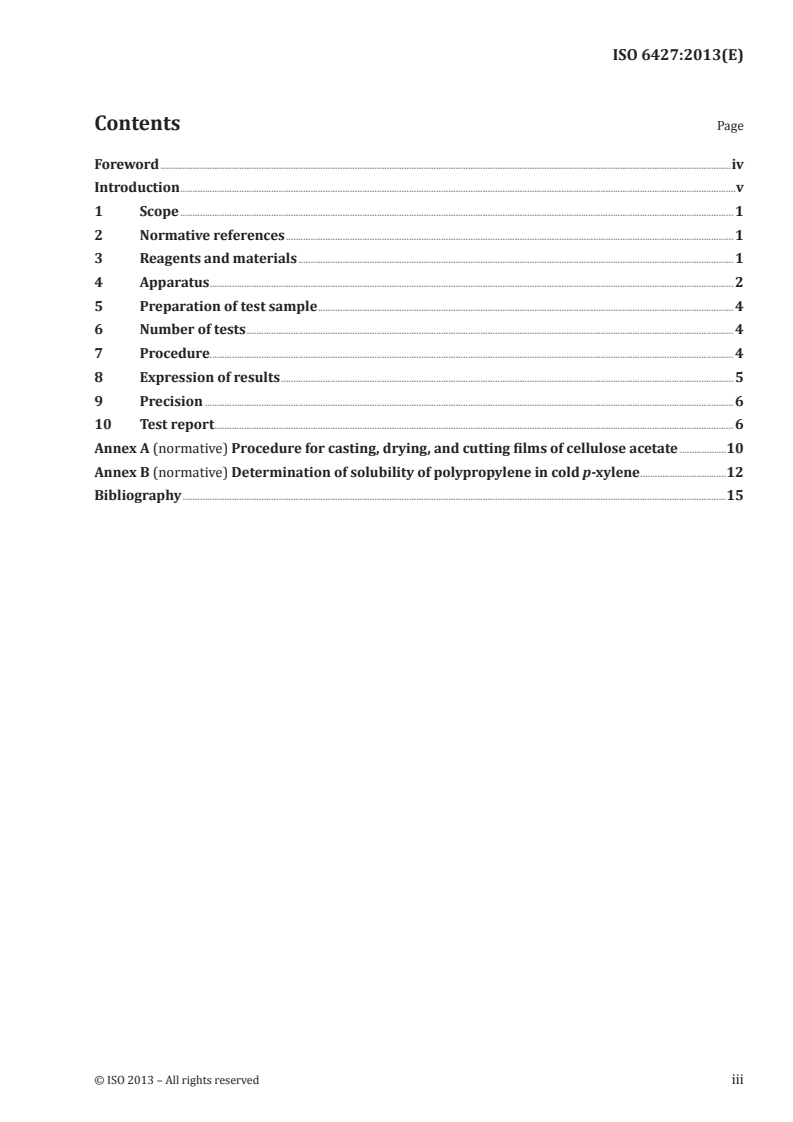
Contents Page
Foreword .iv
Introduction .v
1 Scope . 1
2 Normative references . 1
3 Reagents and materials . 1
4 Apparatus . 2
5 Preparation of test sample . 4
6 Number of tests . 4
7 Procedure. 4
8 Expression of results . 5
9 Precision . 6
10 Test report . 6
Annex A (normative) Procedure for casting, drying, and cutting films of cellulose acetate .10
Annex B (normative) Determination of solubility of polypropylene in cold p‑xylene .12
Bibliography .15
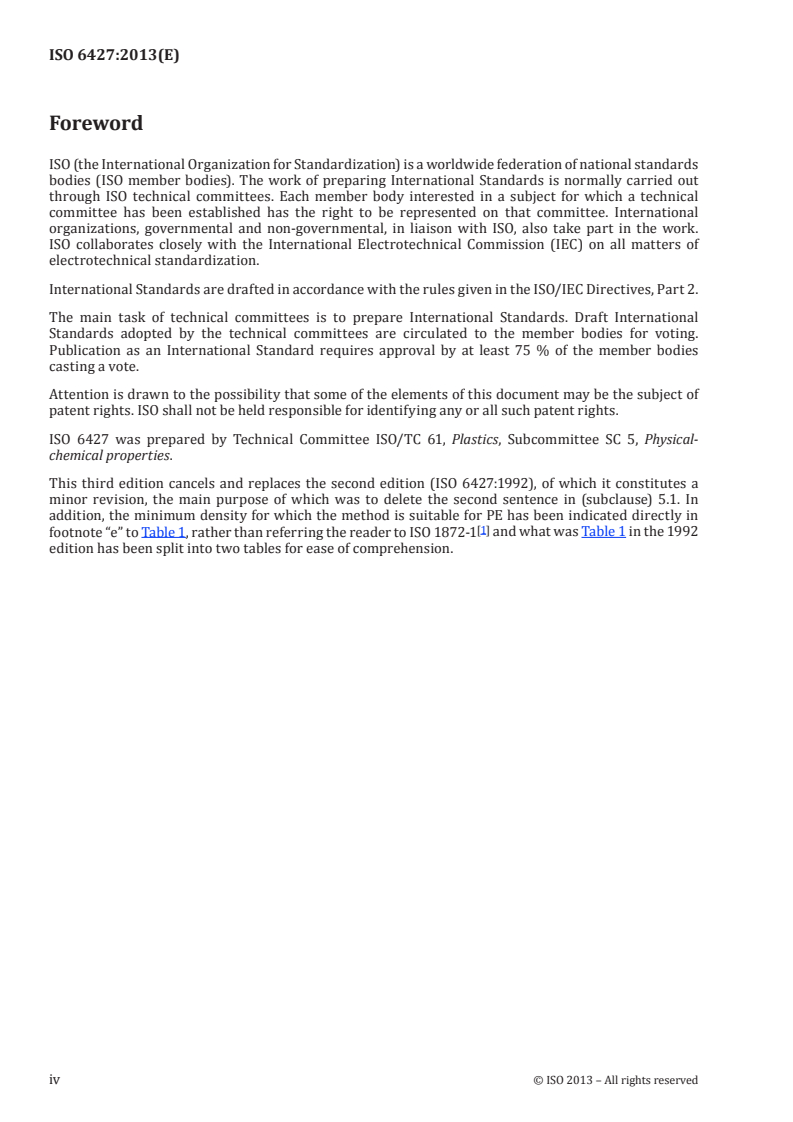
Foreword
ISO (the International Organization for Standardization) is a worldwide federation of national standards
bodies (ISO member bodies). The work of preparing International Standards is normally carried out
through ISO technical committees. Each member body interested in a subject for which a technical
committee has been established has the right to be represented on that committee. International
organizations, governmental and non-governmental, in liaison with ISO, also take part in the work.
ISO collaborates closely with the International Electrotechnical Commission (IEC) on all matters of
electrotechnical standardization.
International Standards are drafted in accordance with the rules given in the ISO/IEC Directives, Part 2.
The main task of technical committees is to prepare International Standards. Draft International
Standards adopted by the technical committees are circulated to the member bodies for voting.
Publication as an International Standard requires approval by at least 75 % of the member bodies
casting a vote.
Attention is drawn to the possibility that some of the elements of this document may be the subject of
patent rights. ISO shall not be held responsible for identifying any or all such patent rights.
ISO 6427 was prepared by Technical Committee ISO/TC 61, Plastics, Subcommittee SC 5, Physical-
chemical properties.
This third edition cancels and replaces the second edition (ISO 6427:1992), of which it constitutes a
minor revision, the main purpose of which was to delete the second sentence in (subclause) 5.1. In
addition, the minimum density for which the method is suitable for PE has been indicated directly in
[1]
footnote “e” to Table 1, rather than referring the reader to ISO 1872-1 and what was Table 1 in the 1992
edition has been split into two tables for ease of comprehension.
iv © ISO 2013 – All rights reserved
Introduction
There are several very similar national and international standards for determination of the percentage
of extractable matter, with only slight differences in the procedures. To facilitate the work of the
laboratory staff which has to carry out these determinations on various plastics products, the generally
applicable methods are described in this International Standard.
INTERNATIONAL STANDARD ISO 6427:2013(E)
Plastics — Determination of matter extractable by organic
solvents (conventional methods)
1 Scope
This International Standard specifies methods for the determination of components in plastics that
can be extracted by hot organic liquids near their boiling points. For one special case, a so-called cold-
extraction method is given in Annex B.
The extractable components can be monomers, oligomers, polymers, plasticizers, stabilizers, etc. The
kind and percentage of extractable matter influence the properties of plastics.
The recommended extraction liquid depends on the type of plastic and on the purpose of the
determination (see Table 1). The extracted amounts of special constituents are often not quantitative in
the sense of analytical chemistry.
This International Standard does not apply to plastics that come into contact with food or drinking
water. Special regulations for those plastics are established in many countries. In order to test plastics
for compliance with these regulations, methods other than those given in this International Standard
are used in most cases. The methods of this International Standard are not intended to be used for
migration tests.
If this International Standard is used to test plastics other than those mentioned in Table 1, the operating
conditions is intended to be agreed upon by the interested parties.
2 Normative references
The following documents, in whole or in part, are normatively referenced in this document and are
indispensable for its application. For dated references, only the edition cited applies. For undated
references, the latest edition of the referenced document (including any amendments) applies.
ISO 308, Plastics — Phenolic moulding materials — Determination of acetone-soluble matter (apparent
resin content of material in the unmoulded state)
ISO 383, Laboratory glassware — Interchangeable conical ground joints
ISO 565, Test sieves — Metal wire cloth, perforated metal plate and electroformed sheet — Nominal
sizes of openings
ISO 1773, Laboratory glassware — Narrow-necked boiling flasks
ISO 1875, Plastics — Plasticized cellulose acetate — Determination of matter extractable by diethyl ether
3 Reagents and materials
3.1 Extraction liquid, of recognized analytical grade, to be selected according to the requirements of
the plastic material being tested (see Table 1).
3.2 Anti‑bumping granules.
3.3 Glass wool, pre-extracted.
4 Apparatus
4.1 Mill, for reducing the sample to the required grain size.
A mill in which the sample is cut between rotating and stationary blades is preferred. Large pieces can
be reduced in size with a pair of shears before they are fed into the mill.
4.2 Set of sieves, complying with the requirements of ISO 565.
4.3 Flat-bottomed flask, of suitable capacity, for example 250 ml, complying with the requirements of
ISO 1773, with ground-glass neck complying with the requirements of ISO 383.
4.4 Extraction apparatus, of such a design that the crucible or thimble is heated by the rising vapour
of the extraction liquid.
4.4.1 Soxhlet extractor, as shown in Figure 1.
4.4.2 Other extractors, for example that designed by Twisselmann (see Figure 2), may be used, if they
give the same results as the Soxhlet extractor.
4.5 Container, for the test portion to be extracted: chosen from one of the following:
4.5.1 Cellulose paper thimble, of suitable size, for example diameter 33 mm and length 94 mm.
4.5.2 Metal wire basket, of the same dimensions as the thimble (4.5.1).
4.5.3 Glass-filter crucible, pore size 40 μm to 100 μm.
NOTE The choice of a suitable container for the extraction is very important. The mass of the cellulose
thimble (4.5.1) depends on its moisture content, and this can lead to variable results when weighing. The metal
wire basket (4.5.2) cannot be used with a powder sample or if a chemical reaction is possible between the metal
and any of the components of the plastic. Difficulties can be caused by penetration of components of the plastic
into the pores of the glass-filter crucible (4.5.3) and subsequent swelling.
4.6 Reflux condenser, fitted with a ground-glass cone to fit the extraction apparatus (4.4), for example
a Dimroth condenser.
4.7 Heating device, which does not use a naked flame and is explosion-proof, suitable for use with the
flask (4.3).
4.8 Balance, accurate to 0,1 mg.
4.9 Desiccator, containing calcium chloride or silica gel.
2 © ISO 2013 – All rights reserved
Dimensions in millimetres
Key
1 extractor trap
2 thimble
3 solvent
4 heater
Figure 1 — Extraction apparatus capable of receiving the thimble (4.5.1) or other sample containers
4.10 Distillation equipment.
One of the following devices shall be used:
4.10.1 Rotary evaporator.
4.10.2 Distillation apparatus, fitted with a Vigreux or equivalent distillation column of length at
least 400 mm.
4.11 Vacuum oven or oven with fresh air circulation, explosion-proof, capable of maintaining a
temperature of 105 °C.
4.12 Evaporating dish, of suitable capacity, for example 200 ml.
Dimensions in millimetres
Key
1 45/40 ground-glass socket
2 vacuum jacket
3 29/32 ground-glass cone
Figure 2 — Extractor of Twisselmann type with vacuum jacket
5 Preparation of test sample
5.1 The plastics material or plastics product shall be free of dust and foreign matter.
5.2 The sample of plastic shall be reduced to small pieces, for example by grinding in a suitable mill
(4.1), but shall not be heated more than necessary. In some cases, it may be necessary to add solid carbon
dioxide to prevent heat build-up during grinding. The reduction in size may also be done by the use of
a razor blade or a pair of scissors, or a file for hard materials. The portion of the sample of specified
granular size (see Table 1) shall be kept in a closed bottle until tested. Films with a thickness of less than
0,5 mm may be cut into small fragments for insertion into the thimble.
6 Number of tests
At least two determinations shall be made.
7 Procedure
7.1 The specific details of the procedure to be used depend on the material to be tested and are given
in Tables 1 and 2. The general procedure is as described hereafter.
4 © ISO 2013 – All rights reserved
7.2 Dry the paper thimble (4.5.1), wire basket (4.5.2) or filter crucible (4.5.3) for 1 h in the oven (4.11) at
the same temperature as used later for the drying of the plastic tested; allow to cool to room temperature
in the desiccator (4.9) and weigh in a closed weighing bottle.
NOTE In special cases, it might be necessary to pre-extract the thimble with the extraction liquid (3.1).
Weigh a test portion of the mass given in Table 1 to the nearest 1 mg in the thimble, basket or crucible,
cover it with a piece of glass wool (3.3), and put it into the extraction apparatus (4.4). If the expected
content of extractable material is below 0,5 % (by mass), increase the mass of the test portion to obtain
a residue of at least 25 mg. Pour the appropriate volume of extraction liquid (3.1) into the flask (4.3). One
or two anti-bumping granules (3.2) may be added. Mount the extractor (4.4) and the reflux condenser
(4.6) on the flask and adjust the heating device (4.7) so that, when a Soxhlet-type extractor (4.4.1) is used,
the extraction liquid syphons several times per hour. For the number of syphonings and the extraction
time, see Table 1.
7.3 Carry out the extraction. Depending on the type of plastic extracted (see Table 2), further process
the residue in accordance with 7.4 and/or the extract in accordance with 7.5.
7.4 When the extraction is finished, take the thimble, basket or crucible out of the extractor, allow it
to drain and air-dry, and then dry it under the conditions given in Table 2 (depending on the kind of
extraction liquid). Allow it to cool to room temperature in the desiccator (4.9) and weigh the thimble,
basket or crucible to the nearest 1 mg. When a thimble is used, weigh the thimble and its contents in a
closed weighing bottle.
7.5 The extraction liquid in the flask may be either distilled to about 20 ml, using the rotary evaporator
(4.10.1) or distillation apparatus (4.10.2), or the liquid may be placed directly in a pre-dried and weighed
evaporating dish (4.12). In the case of distillation of the main amount of the liquid, transfer the remaining
contents of the flask into a dried and weighed evaporating dish. If there are anti-bumping granules in the
flask, remove these by filtration. Wash the flask three times with 5 ml of the extraction liquid, collecting
the washings in the evaporating dish.
Dry the extract under the conditions given in Table 2. If no conditions are specified for the material
being tested, place the dish on a water bath and evaporate the extraction liquid
...
INTERNATIONAL ISO
STANDARD 6427
Third edition
2013-02-01
Plastics — Determination of matter
extractable by organic solvents
(conventional methods)
Plastiques — Détermination des matières extractibles par des
solvants organiques (Méthodes conventionnelles)
Reference number
©
ISO 2013
© ISO 2013
All rights reserved. Unless otherwise specified, no part of this publication may be reproduced or utilized in any form or by any
means, electronic or mechanical, including photocopying and microfilm, without permission in writing from either ISO at the
address below or ISO’s member body in the country of the requester.
ISO copyright office
Case postale 56 • CH-1211 Geneva 20
Tel. + 41 22 749 01 11
Fax + 41 22 749 09 47
E-mail copyright@iso.org
Web www.iso.org
Published in Switzerland
ii © ISO 2013 – All rights reserved
Contents Page
Foreword .iv
Introduction .v
1 Scope . 1
2 Normative references . 1
3 Reagents and materials . 1
4 Apparatus . 2
5 Preparation of test sample . 4
6 Number of tests . 4
7 Procedure. 4
8 Expression of results . 5
9 Precision . 6
10 Test report . 6
Annex A (normative) Procedure for casting, drying, and cutting films of cellulose acetate .10
Annex B (normative) Determination of solubility of polypropylene in cold p‑xylene .12
Bibliography .15
Foreword
ISO (the International Organization for Standardization) is a worldwide federation of national standards
bodies (ISO member bodies). The work of preparing International Standards is normally carried out
through ISO technical committees. Each member body interested in a subject for which a technical
committee has been established has the right to be represented on that committee. International
organizations, governmental and non-governmental, in liaison with ISO, also take part in the work.
ISO collaborates closely with the International Electrotechnical Commission (IEC) on all matters of
electrotechnical standardization.
International Standards are drafted in accordance with the rules given in the ISO/IEC Directives, Part 2.
The main task of technical committees is to prepare International Standards. Draft International
Standards adopted by the technical committees are circulated to the member bodies for voting.
Publication as an International Standard requires approval by at least 75 % of the member bodies
casting a vote.
Attention is drawn to the possibility that some of the elements of this document may be the subject of
patent rights. ISO shall not be held responsible for identifying any or all such patent rights.
ISO 6427 was prepared by Technical Committee ISO/TC 61, Plastics, Subcommittee SC 5, Physical-
chemical properties.
This third edition cancels and replaces the second edition (ISO 6427:1992), of which it constitutes a
minor revision, the main purpose of which was to delete the second sentence in (subclause) 5.1. In
addition, the minimum density for which the method is suitable for PE has been indicated directly in
[1]
footnote “e” to Table 1, rather than referring the reader to ISO 1872-1 and what was Table 1 in the 1992
edition has been split into two tables for ease of comprehension.
iv © ISO 2013 – All rights reserved
Introduction
There are several very similar national and international standards for determination of the percentage
of extractable matter, with only slight differences in the procedures. To facilitate the work of the
laboratory staff which has to carry out these determinations on various plastics products, the generally
applicable methods are described in this International Standard.
INTERNATIONAL STANDARD ISO 6427:2013(E)
Plastics — Determination of matter extractable by organic
solvents (conventional methods)
1 Scope
This International Standard specifies methods for the determination of components in plastics that
can be extracted by hot organic liquids near their boiling points. For one special case, a so-called cold-
extraction method is given in Annex B.
The extractable components can be monomers, oligomers, polymers, plasticizers, stabilizers, etc. The
kind and percentage of extractable matter influence the properties of plastics.
The recommended extraction liquid depends on the type of plastic and on the purpose of the
determination (see Table 1). The extracted amounts of special constituents are often not quantitative in
the sense of analytical chemistry.
This International Standard does not apply to plastics that come into contact with food or drinking
water. Special regulations for those plastics are established in many countries. In order to test plastics
for compliance with these regulations, methods other than those given in this International Standard
are used in most cases. The methods of this International Standard are not intended to be used for
migration tests.
If this International Standard is used to test plastics other than those mentioned in Table 1, the operating
conditions is intended to be agreed upon by the interested parties.
2 Normative references
The following documents, in whole or in part, are normatively referenced in this document and are
indispensable for its application. For dated references, only the edition cited applies. For undated
references, the latest edition of the referenced document (including any amendments) applies.
ISO 308, Plastics — Phenolic moulding materials — Determination of acetone-soluble matter (apparent
resin content of material in the unmoulded state)
ISO 383, Laboratory glassware — Interchangeable conical ground joints
ISO 565, Test sieves — Metal wire cloth, perforated metal plate and electroformed sheet — Nominal
sizes of openings
ISO 1773, Laboratory glassware — Narrow-necked boiling flasks
ISO 1875, Plastics — Plasticized cellulose acetate — Determination of matter extractable by diethyl ether
3 Reagents and materials
3.1 Extraction liquid, of recognized analytical grade, to be selected according to the requirements of
the plastic material being tested (see Table 1).
3.2 Anti‑bumping granules.
3.3 Glass wool, pre-extracted.
4 Apparatus
4.1 Mill, for reducing the sample to the required grain size.
A mill in which the sample is cut between rotating and stationary blades is preferred. Large pieces can
be reduced in size with a pair of shears before they are fed into the mill.
4.2 Set of sieves, complying with the requirements of ISO 565.
4.3 Flat-bottomed flask, of suitable capacity, for example 250 ml, complying with the requirements of
ISO 1773, with ground-glass neck complying with the requirements of ISO 383.
4.4 Extraction apparatus, of such a design that the crucible or thimble is heated by the rising vapour
of the extraction liquid.
4.4.1 Soxhlet extractor, as shown in Figure 1.
4.4.2 Other extractors, for example that designed by Twisselmann (see Figure 2), may be used, if they
give the same results as the Soxhlet extractor.
4.5 Container, for the test portion to be extracted: chosen from one of the following:
4.5.1 Cellulose paper thimble, of suitable size, for example diameter 33 mm and length 94 mm.
4.5.2 Metal wire basket, of the same dimensions as the thimble (4.5.1).
4.5.3 Glass-filter crucible, pore size 40 μm to 100 μm.
NOTE The choice of a suitable container for the extraction is very important. The mass of the cellulose
thimble (4.5.1) depends on its moisture content, and this can lead to variable results when weighing. The metal
wire basket (4.5.2) cannot be used with a powder sample or if a chemical reaction is possible between the metal
and any of the components of the plastic. Difficulties can be caused by penetration of components of the plastic
into the pores of the glass-filter crucible (4.5.3) and subsequent swelling.
4.6 Reflux condenser, fitted with a ground-glass cone to fit the extraction apparatus (4.4), for example
a Dimroth condenser.
4.7 Heating device, which does not use a naked flame and is explosion-proof, suitable for use with the
flask (4.3).
4.8 Balance, accurate to 0,1 mg.
4.9 Desiccator, containing calcium chloride or silica gel.
2 © ISO 2013 – All rights reserved
Dimensions in millimetres
Key
1 extractor trap
2 thimble
3 solvent
4 heater
Figure 1 — Extraction apparatus capable of receiving the thimble (4.5.1) or other sample containers
4.10 Distillation equipment.
One of the following devices shall be used:
4.10.1 Rotary evaporator.
4.10.2 Distillation apparatus, fitted with a Vigreux or equivalent distillation column of length at
least 400 mm.
4.11 Vacuum oven or oven with fresh air circulation, explosion-proof, capable of maintaining a
temperature of 105 °C.
4.12 Evaporating dish, of suitable capacity, for example 200 ml.
Dimensions in millimetres
Key
1 45/40 ground-glass socket
2 vacuum jacket
3 29/32 ground-glass cone
Figure 2 — Extractor of Twisselmann type with vacuum jacket
5 Preparation of test sample
5.1 The plastics material or plastics product shall be free of dust and foreign matter.
5.2 The sample of plastic shall be reduced to small pieces, for example by grinding in a suitable mill
(4.1), but shall not be heated more than necessary. In some cases, it may be necessary to add solid carbon
dioxide to prevent heat build-up during grinding. The reduction in size may also be done by the use of
a razor blade or a pair of scissors, or a file for hard materials. The portion of the sample of specified
granular size (see Table 1) shall be kept in a closed bottle until tested. Films with a thickness of less than
0,5 mm may be cut into small fragments for insertion into the thimble.
6 Number of tests
At least two determinations shall be made.
7 Procedure
7.1 The specific details of the procedure to be used depend on the material to be tested and are given
in Tables 1 and 2. The general procedure is as described hereafter.
4 © ISO 2013 – All rights reserved
7.2 Dry the paper thimble (4.5.1), wire basket (4.5.2) or filter crucible (4.5.3) for 1 h in the oven (4.11) at
the same temperature as used later for the drying of the plastic tested; allow to cool to room temperature
in the desiccator (4.9) and weigh in a closed weighing bottle.
NOTE In special cases, it might be necessary to pre-extract the thimble with the extraction liquid (3.1).
Weigh a test portion of the mass given in Table 1 to the nearest 1 mg in the thimble, basket or crucible,
cover it with a piece of glass wool (3.3), and put it into the extraction apparatus (4.4). If the expected
content of extractable material is below 0,5 % (by mass), increase the mass of the test portion to obtain
a residue of at least 25 mg. Pour the appropriate volume of extraction liquid (3.1) into the flask (4.3). One
or two anti-bumping granules (3.2) may be added. Mount the extractor (4.4) and the reflux condenser
(4.6) on the flask and adjust the heating device (4.7) so that, when a Soxhlet-type extractor (4.4.1) is used,
the extraction liquid syphons several times per hour. For the number of syphonings and the extraction
time, see Table 1.
7.3 Carry out the extraction. Depending on the type of plastic extracted (see Table 2), further process
the residue in accordance with 7.4 and/or the extract in accordance with 7.5.
7.4 When the extraction is finished, take the thimble, basket or crucible out of the extractor, allow it
to drain and air-dry, and then dry it under the conditions given in Table 2 (depending on the kind of
extraction liquid). Allow it to cool to room temperature in the desiccator (4.9) and weigh the thimble,
basket or crucible to the nearest 1 mg. When a thimble is used, weigh the thimble and its contents in a
closed weighing bottle.
7.5 The extraction liquid in the flask may be either distilled to about 20 ml, using the rotary evaporator
(4.10.1) or distillation apparatus (4.10.2), or the liquid may be placed directly in a pre-dried and weighed
evaporating dish (4.12). In the case of distillation of the main amount of the liquid, transfer the remaining
contents of the flask into a dried and weighed evaporating dish. If there are anti-bumping granules in the
flask, remove these by filtration. Wash the flask three times with 5 ml of the extraction liquid, collecting
the washings in the evaporating dish.
Dry the extract under the conditions given in Table 2. If no conditions are specified for the material
being tested, place the dish on a water bath and evaporate the extraction liquid
...
NORME ISO
INTERNATIONALE 6427
Troisième édition
2013-02-01
Plastiques — Détermination des
matières extractibles par des
solvants organiques (Méthodes
conventionnelles)
Plastics — Determination of matter extractable by organic solvents
(conventional methods)
Numéro de référence
©
ISO 2013
DOCUMENT PROTÉGÉ PAR COPYRIGHT
© ISO 2013
Droits de reproduction réservés. Sauf indication contraire, aucune partie de cette publication ne peut être reproduite ni utilisée
sous quelque forme que ce soit et par aucun procédé, électronique ou mécanique, y compris la photocopie, l’affichage sur
l’internet ou sur un Intranet, sans autorisation écrite préalable. Les demandes d’autorisation peuvent être adressées à l’ISO à
l’adresse ci-après ou au comité membre de l’ISO dans le pays du demandeur.
ISO copyright office
Case postale 56 • CH-1211 Geneva 20
Tel. + 41 22 749 01 11
Fax + 41 22 749 09 47
E-mail copyright@iso.org
Web www.iso.org
Publié en Suisse
ii © ISO 2013 – Tous droits réservés
Sommaire Page
Avant-propos .iv
Introduction .v
1 Domaine d’application . 1
2 Références normatives . 1
3 Réactifs et matériaux . 1
4 Appareillage . 2
5 Préparation de l’échantillon pour essai . 4
6 Nombre d’essais . 4
7 Mode opératoire. 4
8 Expression des résultats. 5
9 Fidélité . 6
10 Rapport d’essai . 6
Annexe A (normative) Mode opératoire pour le déroulement, le séchage et le découpage de films
d’acétate de cellulose .10
Annexe B (normative) Détermination de la solubilité du polypropylène dans le p-xylène froid .12
Bibliographie .15
Avant-propos
L’ISO (Organisation internationale de normalisation) est une fédération mondiale d’organismes
nationaux de normalisation (comités membres de l’ISO). L’élaboration des Normes internationales est
en général confiée aux comités techniques de l’ISO. Chaque comité membre intéressé par une étude
a le droit de faire partie du comité technique créé à cet effet. Les organisations internationales,
gouvernementales et non gouvernementales, en liaison avec l’ISO participent également aux travaux.
L’ISO collabore étroitement avec la Commission électrotechnique internationale (CEI) en ce qui concerne
la normalisation électrotechnique.
Les Normes internationales sont rédigées conformément aux règles données dans les Directives
ISO/CEI, Partie 2.
La tâche principale des comités techniques est d’élaborer les Normes internationales. Les projets de
Normes internationales adoptés par les comités techniques sont soumis aux comités membres pour vote.
Leur publication comme Normes internationales requiert l’approbation de 75 % au moins des comités
membres votants.
L’attention est appelée sur le fait que certains des éléments du présent document peuvent faire l’objet de
droits de propriété intellectuelle ou de droits analogues. L’ISO ne saurait être tenue pour responsable de
ne pas avoir identifié de tels droits de propriété et averti de leur existence.
L’ISO 6427 a été élaborée par le comité technique ISO/TC 61, Plastiques, sous-comité SC 5, Propriétés
physicochimiques.
Cette troisième édition annule et remplace la deuxième édition (ISO 6427:1992), dont elle constitue
une révision mineure, l’objet principal étant de supprimer la seconde phrase du paragraphe 5.1. En
complément, la masse volumique minimale pour laquelle la méthode est appropriée pour le PE a été
indiquée directement dans la note de bas de tableau «c» du Tableau 1, plutôt que de renvoyer le lecteur
[1]
à l’ISO 1872-1 et le Tableau 1 de l’édition de 1992 a été scindé en deux pour faciliter la compréhension.
iv © ISO 2013 – Tous droits réservés
Introduction
II existe plusieurs normes nationales et internationales relatives à la détermination du pourcentage de
matière extractible, spécifiant des méthodes d’extraction peu divergentes. Pour faciliter le travail du
personnel de laboratoire chargé d’exécuter ces déterminations sur différentes matières plastiques, la
présente Norme internationale décrit les méthodes qui sont généralement appliquées.
NORME INTERNATIONALE ISO 6427:2013(F)
Plastiques — Détermination des matières extractibles par
des solvants organiques (Méthodes conventionnelles)
1 Domaine d’application
La présente Norme internationale spécifie des méthodes pour la détermination des composants dans
les plastiques pouvant être extraits au moyen de liquides organiques chauds près de leurs points
d’ébullition. Pour une utilisation spéciale, une méthode d’extraction froide est spécifiée dans l’Annexe B.
Les composants extractibles peuvent être des monomères, des oligomères, des polymères, des
plastifiants, des stabilisants, etc. La nature et le pourcentage de la matière extractible ont une influence
sur les propriétés des plastiques.
Le liquide d’extraction recommandé dépend du type de plastique mis en présence ainsi que du but de
la détermination (voir Tableau 1). Les quantités de composants spéciaux extraites sont souvent non
quantitatives dans le sens de la chimie analytique.
La présente Norme internationale n’est pas applicable aux plastiques qui viennent en contact avec des
aliments ou avec de l’eau potable. Des règlements spéciaux ont été établis pour de tels plastiques dans de
nombreux pays. Pour examiner la conformité des plastiques avec ces règlements, des méthodes d’essai
autres que celles indiquées dans la présente Norme internationale sont utilisées dans la plupart des cas.
Les méthodes de la présente Norme internationale ne sont pas prévues pour une utilisation dans des
essais de migration.
Si la présente Norme internationale est appliquée à des plastiques autres que ceux mentionnés dans le
Tableau 1, les conditions opératoires doivent faire l’objet d’un accord entre les parties intéressées.
2 Références normatives
Les documents suivants, en tout ou partie, sont référencés de manière normative dans le présent
document et sont indispensables pour son application. Pour les références datées, seule l’édition citée
s’applique. Pour les références non datées, la dernière édition du document de référence s’applique (y
compris les éventuels amendements).
ISO 308, Plastiques — Matières à mouler à base de phénoplastes — Détermination des matières solubles
dans l’acétone (teneur apparente en résine des matières à l’état non moulé)
ISO 383, Verrerie de laboratoire — Assemblages coniques rodés interchangeables
ISO 565, Tamis de contrôle — Tissus métalliques, tôles métalliques perforées et feuilles électroformées —
Dimensions nominales des ouvertures
ISO 1773, Verrerie de laboratoire — Fioles coniques et ballons à col étroit
ISO 1875, Plastiques — Acétate de cellulose plastifié — Détermination des matières extractibles par
l’oxyde diéthylique
3 Réactifs et matériaux
3.1 Liquide d’extraction, de qualité analytique reconnue, à choisir en fonction des spécifications du
plastique à examiner (voir Tableau 1).
3.2 Grains de porcelaine poreuse.
3.3 Laine de verre, préalablement extraite.
4 Appareillage
4.1 Machine à broyer (broyeur ou dispositif similaire), pour réduire l’échantillon à la granulométrie
requise.
L’utilisation d’un broyeur qui coupe l’échantillon au moyen de lames rotatives et fixes est préférable. Le
cas échéant, on peut utiliser une paire de ciseaux afin de réduire les dimensions de l’échantillon.
4.2 Jeu de tamis, conformes aux exigences de l’ISO 565.
4.3 Ballon à fond plat, de capacité appropriée, par exemple 250 ml, conforme aux exigences de
l’ISO 1773, avec col rodé conforme aux exigences de l’ISO 383.
4.4 Appareil d’extraction, conçu pour que le creuset ou la cartouche soit chauffé(e) de tous côtés par
la vapeur du liquide d’extraction.
4.4.1 Extracteur de Soxhlet, tel que représenté à la Figure 1.
4.4.2 Autres extracteurs, par exemple du type Twisselmann (voir Figure 2), à condition qu’ils donnent
les mêmes résultats que ceux obtenus avec l’extracteur de Soxhlet.
4.5 Récipient, pour la prise d’essai à extraire, choisi parmi ce qui suit.
4.5.1 Cartouche en papier cellulosique, de taille appropriée, par exemple 33 mm de diamètre
et 94 mm de longueur.
4.5.2 Panier en fil métallique, ayant les mêmes dimensions que celles de la cartouche (4.5.1).
4.5.3 Creuset filtrant en verre, de porosité 40 μm à 100 μm.
NOTE Le choix du récipient approprié à l’extraction est très important. La masse de la cartouche
cellulosique (4.5.1) dépend de l’humidité, ce qui peut conduire à des résultats variables lors des pesées. Le panier
en fil métallique (4.5.2) ne peut pas être utilisé dans le cas d’un échantillon en poudre ou dans le cas où une
réaction chimique est possible entre le métal et l’un des composants du plastique. D’autre part, des difficultés
peuvent se présenter à cause de la pénétration de composants du plastique dans les pores du creuset filtrant en
verre (4.5.3) et du gonflement qui s’ensuit.
4.6 Réfrigérant à reflux, muni d’un joint rodé adaptable à l’appareil d’extraction (4.4), par exemple
réfrigérant à reflux du type Dimroth.
4.7 Dispositif de chauffage, sans flamme ouverte, approprié au chauffage du ballon (4.3) sans
risque d’explosion.
4.8 Balance, précise à 0,1 mg.
4.9 Dessiccateur, garni de chlorure de calcium ou de gel de silice.
2 © ISO 2013 – Tous droits réservés
Dimensions en millimètres
Légende
1 siphon de l’extracteur
2 cartouche
3 solvant
4 dispositif de chauffage
Figure 1 — Appareil d’extraction capable de recevoir la cartouche (4.5.1) ou d’autres récipients
pour échantillon
4.10 Appareil de distillation.
Il est nécessaire d’utiliser l’un des appareils suivants.
4.10.1 Évaporateur rotatif.
4.10.2 Appareil de distillation, muni d’une colonne à distiller de Vigreux, ou colonne à distiller
équivalente, de 400 mm de hauteur.
4.11 Étuve à vide ou étuve à circulation d’air, antidéflagrante, pouvant être maintenue à une
température de 105 °C.
4.12 Coupelle d’évaporation, de capacité appropriée, par exemple 200 ml.
Dimensions en millimètres
Légende
1 joint rodé 45/40
2 chemise à vide
3 joint rodé 29/32
Figure 2 — Extracteur du type Twisselmann avec chemise à vide
5 Préparation de l’échantillon pour essai
5.1 Le matériau plastique ou le produit plastique doit être exempt de poussière et de matières étrangères.
5.2 L’échantillon de plastique doit être réduit en petits morceaux, par exemple en le broyant dans un
broyeur approprié (4.1) sans que le matériau soit chauffé plus que nécessaire. Dans certains cas, il peut
être nécessaire d’ajouter du dioxyde de carbone solide, en vue d’éviter la production de chaleur pendant
le broyage. La réduction dimensionnelle peut également être réalisée à l’aide d’une lame de rasoir, une
paire de ciseaux ou une lime pour les matériaux durs. La partie de l’échantillon ayant une granulométrie
spécifiée (voir Tableau 1) doit être conservée jusqu’au moment de l’essai dans un flacon fermé. Des films
de moins de 0,5 mm d’épaisseur peuvent être découpés en petits fragments pour qu’il soit possible de les
placer dans la cartouche.
6 Nombre d’essais
Il faut effectuer au moins deux déterminations.
7 Mode opératoire
7.1 Les détails spécifiques du mode opératoire dépendent du matériau à soumettre à essai et sont
indiqués dans les Tableaux 1 et 2. Le mode opératoire général est décrit ci-après.
4 © ISO 2013 – Tous droits réservés
7.2 Sécher la cartouche en papier (4.5.1), le panier en fil métallique (4.5.2) ou le creuset filtrant en
verre (4.5.3) dans l’étuve (4.11) durant 1 h, à la même température que celle utilisée pour le séchage du
plastique soumis à essai. Laisser refroidir jusqu’à température ambiante dans le dessiccateur (4.9) et
peser dans un vase à peser fermé.
NOTE Dans des cas spéciaux, il peut être nécessaire d’extraire préalablement la cartouche en utilisant le
liquide d’extraction (3.1).
Peser, à 1 mg près, dans la cartouche, le panier ou le creuset, une prise d’essai ayant la masse indiquée
dans le Tableau 1, la recouvrir de laine de verre (3.3) et placer le tout dans l’appareil d’extraction (4.4).
Si la teneur présumée en matières extractibles est inférieure à 0,5 % (fraction massique), augmenter la
masse de la prise d’essai de manière à obtenir un résidu d’au moins 25 mg. Verser le volume approprié du
liquide d’extraction (3.1) dans le ballon (4.3); on peut y ajouter un ou deux grains de porcelaine poreuse
(3.2). Monter l’extracteur et le réfrigérant à reflux (4.6) sur le ballon, et régler le dispositif de chauffage
(4.7) de manière que le liquide d’extraction siphonne plusieurs fois par heure si l’on utilise l’extracteur de
Soxhlet (4.4.1). En ce qui concerne le nombre de siphonnements et le temps d’extraction, voir Tableau 1.
7.3 Effectuer l’extraction. Selon le type de plastique extrait (voir Tableau 2), traiter ultérieurement le
résidu conformément à 7.4 et/ou l’extrait conformément à 7.5.
7.4 À la fin de l’extraction, enlever la cartouche, le panier ou le creuset de l’extracteur, le (la) laisser
s’égoutter et sécher à l’air, et ensuite le (la) sécher dans les conditions indiquées dans le Tableau 2
(dépendant du type de liquide d’extraction). Laisser refroidir jusqu’à température ambiante dans le
dessiccateur (4.9) et peser, à 1 mg près, la cartouche, le panier ou le creuset. Si l’on utilise une cartouche,
peser la cartouche et son contenu dans un vase à peser fermé.
7.5 Le liquide d’extraction se trouvant dans le ballon peut être soit distillé jusqu’à environ 20 ml, en
utilisant l’évaporateur rotatif (4.10.1) ou l’appareil de distillation (4.10.2), soit transvasé directement
dans la coupelle d’évaporation (4.12) préalablement séchée et pesée. Dans le cas d’une distillation de
la majeure partie du liquide, transvaser le reste du contenu du ballon dans la coupelle d’évaporation
préalablement séchée et pesée. S’il y a des grains de porcelaine poreuse dans le ballon, les enlever par
filtration. Laver le ballon à trois reprises avec chaque fois 5 ml du liquide d’extraction, en recueillant le
liquide de lavage dans la coupelle d’évaporation.
Sécher l’extrait dans les conditions indiquées dans le Tableau 2. Si aucune condition n’est spécifi
...
NORME ISO
INTERNATIONALE 6427
Troisième édition
2013-02-01
Plastiques — Détermination des
matières extractibles par des
solvants organiques (Méthodes
conventionnelles)
Plastics — Determination of matter extractable by organic solvents
(conventional methods)
Numéro de référence
©
ISO 2013
DOCUMENT PROTÉGÉ PAR COPYRIGHT
© ISO 2013
Droits de reproduction réservés. Sauf indication contraire, aucune partie de cette publication ne peut être reproduite ni utilisée
sous quelque forme que ce soit et par aucun procédé, électronique ou mécanique, y compris la photocopie, l’affichage sur
l’internet ou sur un Intranet, sans autorisation écrite préalable. Les demandes d’autorisation peuvent être adressées à l’ISO à
l’adresse ci-après ou au comité membre de l’ISO dans le pays du demandeur.
ISO copyright office
Case postale 56 • CH-1211 Geneva 20
Tel. + 41 22 749 01 11
Fax + 41 22 749 09 47
E-mail copyright@iso.org
Web www.iso.org
Publié en Suisse
ii © ISO 2013 – Tous droits réservés
Sommaire Page
Avant-propos .iv
Introduction .v
1 Domaine d’application . 1
2 Références normatives . 1
3 Réactifs et matériaux . 1
4 Appareillage . 2
5 Préparation de l’échantillon pour essai . 4
6 Nombre d’essais . 4
7 Mode opératoire. 4
8 Expression des résultats. 5
9 Fidélité . 6
10 Rapport d’essai . 6
Annexe A (normative) Mode opératoire pour le déroulement, le séchage et le découpage de films
d’acétate de cellulose .10
Annexe B (normative) Détermination de la solubilité du polypropylène dans le p-xylène froid .12
Bibliographie .15
Avant-propos
L’ISO (Organisation internationale de normalisation) est une fédération mondiale d’organismes
nationaux de normalisation (comités membres de l’ISO). L’élaboration des Normes internationales est
en général confiée aux comités techniques de l’ISO. Chaque comité membre intéressé par une étude
a le droit de faire partie du comité technique créé à cet effet. Les organisations internationales,
gouvernementales et non gouvernementales, en liaison avec l’ISO participent également aux travaux.
L’ISO collabore étroitement avec la Commission électrotechnique internationale (CEI) en ce qui concerne
la normalisation électrotechnique.
Les Normes internationales sont rédigées conformément aux règles données dans les Directives
ISO/CEI, Partie 2.
La tâche principale des comités techniques est d’élaborer les Normes internationales. Les projets de
Normes internationales adoptés par les comités techniques sont soumis aux comités membres pour vote.
Leur publication comme Normes internationales requiert l’approbation de 75 % au moins des comités
membres votants.
L’attention est appelée sur le fait que certains des éléments du présent document peuvent faire l’objet de
droits de propriété intellectuelle ou de droits analogues. L’ISO ne saurait être tenue pour responsable de
ne pas avoir identifié de tels droits de propriété et averti de leur existence.
L’ISO 6427 a été élaborée par le comité technique ISO/TC 61, Plastiques, sous-comité SC 5, Propriétés
physicochimiques.
Cette troisième édition annule et remplace la deuxième édition (ISO 6427:1992), dont elle constitue
une révision mineure, l’objet principal étant de supprimer la seconde phrase du paragraphe 5.1. En
complément, la masse volumique minimale pour laquelle la méthode est appropriée pour le PE a été
indiquée directement dans la note de bas de tableau «c» du Tableau 1, plutôt que de renvoyer le lecteur
[1]
à l’ISO 1872-1 et le Tableau 1 de l’édition de 1992 a été scindé en deux pour faciliter la compréhension.
iv © ISO 2013 – Tous droits réservés
Introduction
II existe plusieurs normes nationales et internationales relatives à la détermination du pourcentage de
matière extractible, spécifiant des méthodes d’extraction peu divergentes. Pour faciliter le travail du
personnel de laboratoire chargé d’exécuter ces déterminations sur différentes matières plastiques, la
présente Norme internationale décrit les méthodes qui sont généralement appliquées.
NORME INTERNATIONALE ISO 6427:2013(F)
Plastiques — Détermination des matières extractibles par
des solvants organiques (Méthodes conventionnelles)
1 Domaine d’application
La présente Norme internationale spécifie des méthodes pour la détermination des composants dans
les plastiques pouvant être extraits au moyen de liquides organiques chauds près de leurs points
d’ébullition. Pour une utilisation spéciale, une méthode d’extraction froide est spécifiée dans l’Annexe B.
Les composants extractibles peuvent être des monomères, des oligomères, des polymères, des
plastifiants, des stabilisants, etc. La nature et le pourcentage de la matière extractible ont une influence
sur les propriétés des plastiques.
Le liquide d’extraction recommandé dépend du type de plastique mis en présence ainsi que du but de
la détermination (voir Tableau 1). Les quantités de composants spéciaux extraites sont souvent non
quantitatives dans le sens de la chimie analytique.
La présente Norme internationale n’est pas applicable aux plastiques qui viennent en contact avec des
aliments ou avec de l’eau potable. Des règlements spéciaux ont été établis pour de tels plastiques dans de
nombreux pays. Pour examiner la conformité des plastiques avec ces règlements, des méthodes d’essai
autres que celles indiquées dans la présente Norme internationale sont utilisées dans la plupart des cas.
Les méthodes de la présente Norme internationale ne sont pas prévues pour une utilisation dans des
essais de migration.
Si la présente Norme internationale est appliquée à des plastiques autres que ceux mentionnés dans le
Tableau 1, les conditions opératoires doivent faire l’objet d’un accord entre les parties intéressées.
2 Références normatives
Les documents suivants, en tout ou partie, sont référencés de manière normative dans le présent
document et sont indispensables pour son application. Pour les références datées, seule l’édition citée
s’applique. Pour les références non datées, la dernière édition du document de référence s’applique (y
compris les éventuels amendements).
ISO 308, Plastiques — Matières à mouler à base de phénoplastes — Détermination des matières solubles
dans l’acétone (teneur apparente en résine des matières à l’état non moulé)
ISO 383, Verrerie de laboratoire — Assemblages coniques rodés interchangeables
ISO 565, Tamis de contrôle — Tissus métalliques, tôles métalliques perforées et feuilles électroformées —
Dimensions nominales des ouvertures
ISO 1773, Verrerie de laboratoire — Fioles coniques et ballons à col étroit
ISO 1875, Plastiques — Acétate de cellulose plastifié — Détermination des matières extractibles par
l’oxyde diéthylique
3 Réactifs et matériaux
3.1 Liquide d’extraction, de qualité analytique reconnue, à choisir en fonction des spécifications du
plastique à examiner (voir Tableau 1).
3.2 Grains de porcelaine poreuse.
3.3 Laine de verre, préalablement extraite.
4 Appareillage
4.1 Machine à broyer (broyeur ou dispositif similaire), pour réduire l’échantillon à la granulométrie
requise.
L’utilisation d’un broyeur qui coupe l’échantillon au moyen de lames rotatives et fixes est préférable. Le
cas échéant, on peut utiliser une paire de ciseaux afin de réduire les dimensions de l’échantillon.
4.2 Jeu de tamis, conformes aux exigences de l’ISO 565.
4.3 Ballon à fond plat, de capacité appropriée, par exemple 250 ml, conforme aux exigences de
l’ISO 1773, avec col rodé conforme aux exigences de l’ISO 383.
4.4 Appareil d’extraction, conçu pour que le creuset ou la cartouche soit chauffé(e) de tous côtés par
la vapeur du liquide d’extraction.
4.4.1 Extracteur de Soxhlet, tel que représenté à la Figure 1.
4.4.2 Autres extracteurs, par exemple du type Twisselmann (voir Figure 2), à condition qu’ils donnent
les mêmes résultats que ceux obtenus avec l’extracteur de Soxhlet.
4.5 Récipient, pour la prise d’essai à extraire, choisi parmi ce qui suit.
4.5.1 Cartouche en papier cellulosique, de taille appropriée, par exemple 33 mm de diamètre
et 94 mm de longueur.
4.5.2 Panier en fil métallique, ayant les mêmes dimensions que celles de la cartouche (4.5.1).
4.5.3 Creuset filtrant en verre, de porosité 40 μm à 100 μm.
NOTE Le choix du récipient approprié à l’extraction est très important. La masse de la cartouche
cellulosique (4.5.1) dépend de l’humidité, ce qui peut conduire à des résultats variables lors des pesées. Le panier
en fil métallique (4.5.2) ne peut pas être utilisé dans le cas d’un échantillon en poudre ou dans le cas où une
réaction chimique est possible entre le métal et l’un des composants du plastique. D’autre part, des difficultés
peuvent se présenter à cause de la pénétration de composants du plastique dans les pores du creuset filtrant en
verre (4.5.3) et du gonflement qui s’ensuit.
4.6 Réfrigérant à reflux, muni d’un joint rodé adaptable à l’appareil d’extraction (4.4), par exemple
réfrigérant à reflux du type Dimroth.
4.7 Dispositif de chauffage, sans flamme ouverte, approprié au chauffage du ballon (4.3) sans
risque d’explosion.
4.8 Balance, précise à 0,1 mg.
4.9 Dessiccateur, garni de chlorure de calcium ou de gel de silice.
2 © ISO 2013 – Tous droits réservés
Dimensions en millimètres
Légende
1 siphon de l’extracteur
2 cartouche
3 solvant
4 dispositif de chauffage
Figure 1 — Appareil d’extraction capable de recevoir la cartouche (4.5.1) ou d’autres récipients
pour échantillon
4.10 Appareil de distillation.
Il est nécessaire d’utiliser l’un des appareils suivants.
4.10.1 Évaporateur rotatif.
4.10.2 Appareil de distillation, muni d’une colonne à distiller de Vigreux, ou colonne à distiller
équivalente, de 400 mm de hauteur.
4.11 Étuve à vide ou étuve à circulation d’air, antidéflagrante, pouvant être maintenue à une
température de 105 °C.
4.12 Coupelle d’évaporation, de capacité appropriée, par exemple 200 ml.
Dimensions en millimètres
Légende
1 joint rodé 45/40
2 chemise à vide
3 joint rodé 29/32
Figure 2 — Extracteur du type Twisselmann avec chemise à vide
5 Préparation de l’échantillon pour essai
5.1 Le matériau plastique ou le produit plastique doit être exempt de poussière et de matières étrangères.
5.2 L’échantillon de plastique doit être réduit en petits morceaux, par exemple en le broyant dans un
broyeur approprié (4.1) sans que le matériau soit chauffé plus que nécessaire. Dans certains cas, il peut
être nécessaire d’ajouter du dioxyde de carbone solide, en vue d’éviter la production de chaleur pendant
le broyage. La réduction dimensionnelle peut également être réalisée à l’aide d’une lame de rasoir, une
paire de ciseaux ou une lime pour les matériaux durs. La partie de l’échantillon ayant une granulométrie
spécifiée (voir Tableau 1) doit être conservée jusqu’au moment de l’essai dans un flacon fermé. Des films
de moins de 0,5 mm d’épaisseur peuvent être découpés en petits fragments pour qu’il soit possible de les
placer dans la cartouche.
6 Nombre d’essais
Il faut effectuer au moins deux déterminations.
7 Mode opératoire
7.1 Les détails spécifiques du mode opératoire dépendent du matériau à soumettre à essai et sont
indiqués dans les Tableaux 1 et 2. Le mode opératoire général est décrit ci-après.
4 © ISO 2013 – Tous droits réservés
7.2 Sécher la cartouche en papier (4.5.1), le panier en fil métallique (4.5.2) ou le creuset filtrant en
verre (4.5.3) dans l’étuve (4.11) durant 1 h, à la même température que celle utilisée pour le séchage du
plastique soumis à essai. Laisser refroidir jusqu’à température ambiante dans le dessiccateur (4.9) et
peser dans un vase à peser fermé.
NOTE Dans des cas spéciaux, il peut être nécessaire d’extraire préalablement la cartouche en utilisant le
liquide d’extraction (3.1).
Peser, à 1 mg près, dans la cartouche, le panier ou le creuset, une prise d’essai ayant la masse indiquée
dans le Tableau 1, la recouvrir de laine de verre (3.3) et placer le tout dans l’appareil d’extraction (4.4).
Si la teneur présumée en matières extractibles est inférieure à 0,5 % (fraction massique), augmenter la
masse de la prise d’essai de manière à obtenir un résidu d’au moins 25 mg. Verser le volume approprié du
liquide d’extraction (3.1) dans le ballon (4.3); on peut y ajouter un ou deux grains de porcelaine poreuse
(3.2). Monter l’extracteur et le réfrigérant à reflux (4.6) sur le ballon, et régler le dispositif de chauffage
(4.7) de manière que le liquide d’extraction siphonne plusieurs fois par heure si l’on utilise l’extracteur de
Soxhlet (4.4.1). En ce qui concerne le nombre de siphonnements et le temps d’extraction, voir Tableau 1.
7.3 Effectuer l’extraction. Selon le type de plastique extrait (voir Tableau 2), traiter ultérieurement le
résidu conformément à 7.4 et/ou l’extrait conformément à 7.5.
7.4 À la fin de l’extraction, enlever la cartouche, le panier ou le creuset de l’extracteur, le (la) laisser
s’égoutter et sécher à l’air, et ensuite le (la) sécher dans les conditions indiquées dans le Tableau 2
(dépendant du type de liquide d’extraction). Laisser refroidir jusqu’à température ambiante dans le
dessiccateur (4.9) et peser, à 1 mg près, la cartouche, le panier ou le creuset. Si l’on utilise une cartouche,
peser la cartouche et son contenu dans un vase à peser fermé.
7.5 Le liquide d’extraction se trouvant dans le ballon peut être soit distillé jusqu’à environ 20 ml, en
utilisant l’évaporateur rotatif (4.10.1) ou l’appareil de distillation (4.10.2), soit transvasé directement
dans la coupelle d’évaporation (4.12) préalablement séchée et pesée. Dans le cas d’une distillation de
la majeure partie du liquide, transvaser le reste du contenu du ballon dans la coupelle d’évaporation
préalablement séchée et pesée. S’il y a des grains de porcelaine poreuse dans le ballon, les enlever par
filtration. Laver le ballon à trois reprises avec chaque fois 5 ml du liquide d’extraction, en recueillant le
liquide de lavage dans la coupelle d’évaporation.
Sécher l’extrait dans les conditions indiquées dans le Tableau 2. Si aucune condition n’est spécifi
...