

ISO 15387:2005
(Main)Space systems — Single-junction solar cells — Measurements and calibration procedures
General Information
- Abstract
ISO 15387:2005 specifies the requirements for measurement and calibration procedures of single-junction space solar cells only. The main body of ISO 15387:2004 specifies the requirements for Air Mass Zero (AM0) standard calibration. The relative measurement procedures are provided as annexes.
- Status
- Withdrawn
- Publication Date
- 16-May-2005
- Technical Committee
- ISO/TC 20/SC 14 - Space systems and operations
- Drafting Committee
- ISO/TC 20/SC 14/WG 1 - Design engineering and production
- Current Stage
- 9599 - Withdrawal of International Standard
- Start Date
- 10-Aug-2026
- Completion Date
- 29-Aug-2026
Buy Documents
ISO 15387:2005 - Space systems -- Single-junction solar cells -- Measurements and calibration procedures
ISO 15387:2005 - Space systems — Single-junction solar cells — Measurements and calibration procedures/17/2005
ISO 15387:2005 - Systemes spatiaux -- Cellules solaires simple jonction -- Méthodes de mesure et d'étalonnage
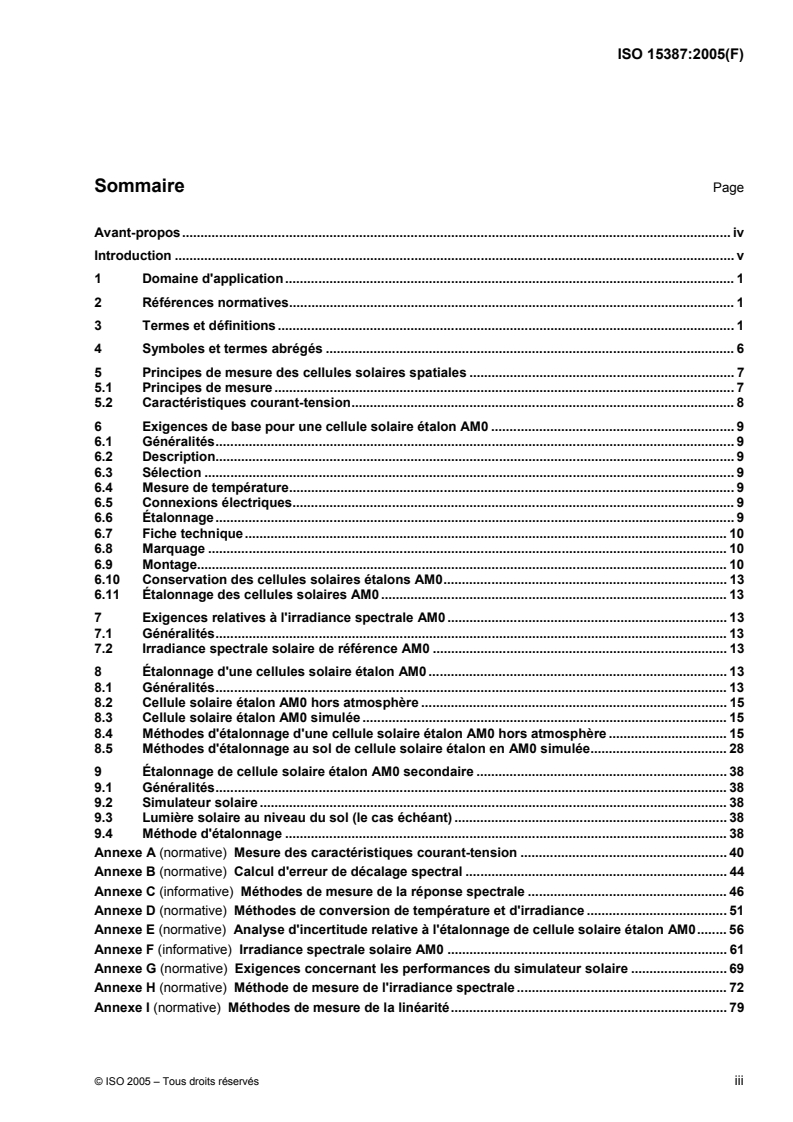
ISO 15387:2005 - Systèmes spatiaux — Cellules solaires simple jonction — Méthodes de mesure et d'étalonnage/17/2005
Overview
ISO 15387:2005 - Space systems: Single‑junction solar cells - Measurement and calibration procedures defines measurement and calibration requirements for single‑junction space solar cells using the Air Mass Zero (AM0) reference. The standard establishes principles for AM0 standard calibration, measurement of current‑voltage (I‑V) characteristics, spectral irradiance requirements and both primary (extraterrestrial/synthetic) and secondary calibration procedures. It is focused on enabling traceable, repeatable AM0 calibration for space photovoltaic devices.
Key topics and requirements
- Scope: Applies only to single‑junction solar cells intended for space (AM0) conditions.
- Measurement principles: Defines I‑V characteristic measurement methods and parameters (short‑circuit current ISC, open‑circuit voltage VOC, maximum power Pmax, fill factor).
- AM0 standard solar cell requirements: Classification, selection, temperature measurement, electrical connections, calibration, data sheet content, marking, packaging and care.
- AM0 spectral irradiance: Requirements for the reference extraterrestrial spectral irradiance distribution used to define the AM0 standard.
- Calibration methods: Procedures for calibrating AM0 standard cells using extraterrestrial and synthetic techniques, plus calibration of secondary AM0 standard cells (including solar simulator and ground‑sunlight methods).
- Correction and uncertainty: Annexes provide procedures for temperature and irradiance corrections, computation of spectral mismatch error, measurement of spectral response, and uncertainty analysis of AM0 calibration.
- Test equipment performance: Normative annexes specify solar simulator performance, spectral irradiance measurement methods and linearity measurement methods.
- Standard test conditions (STC): Defines AM0 STC (e.g., AM0 irradiance ~1 367 W·m‑2 and cell temperature reference at 25 °C ±1 °C).
Applications and users
ISO 15387:2005 is intended for:
- Space system engineers and satellite power‑subsystem designers needing reliable photovoltaic performance data under AM0 conditions.
- Solar cell manufacturers producing single‑junction cells for space applications who require standard calibration and traceable test methods.
- Calibration laboratories and test houses that perform primary and secondary AM0 calibrations or certify reference cells.
- Research institutions studying space solar cell behavior, spectral response, and degradation in orbital environments.
Practical uses include setting and verifying solar simulator irradiance, producing AM0 reference cells, performing traceable I‑V measurements, implementing spectral mismatch corrections and compiling uncertainty budgets for space photovoltaic qualification.
Related standards
ISO 15387 references and aligns with IEC photovoltaic standards, including:
- IEC 60904 series (I‑V measurement, reference cells, spectral response, spectral mismatch, solar simulator requirements)
- IEC 60891 (temperature and irradiance corrections)
- IEC 61798 (linearity measurement methods)
Keywords: ISO 15387:2005, AM0 calibration, space solar cells, single‑junction solar cells, measurement procedures, I‑V characteristics, spectral irradiance, solar simulator, calibration laboratory.
Relations
- Referred By
EN 16603-20-08:2014 - Space engineering - Part 20-08: Photovoltaic assemblies and components - Effective Date
- 25-Aug-2026
- Effective Date
- 25-Aug-2026
Buy Documents
ISO 15387:2005 - Space systems -- Single-junction solar cells -- Measurements and calibration procedures
ISO 15387:2005 - Space systems — Single-junction solar cells — Measurements and calibration procedures/17/2005
ISO 15387:2005 - Systemes spatiaux -- Cellules solaires simple jonction -- Méthodes de mesure et d'étalonnage
ISO 15387:2005 - Systèmes spatiaux — Cellules solaires simple jonction — Méthodes de mesure et d'étalonnage/17/2005
Get Certified
Connect with accredited certification bodies for this standard

DNV
DNV is an independent assurance and risk management provider.

Lloyd's Register
Lloyd's Register is a global professional services organisation specialising in engineering and technology.

BUREAU VERITAS Certification Germany
Bureau Veritas certification in Germany.
Sponsored listings
Frequently Asked Questions
ISO 15387:2005 is a standard published by the International Organization for Standardization (ISO). Its full title is "Space systems — Single-junction solar cells — Measurements and calibration procedures". This standard covers: ISO 15387:2005 specifies the requirements for measurement and calibration procedures of single-junction space solar cells only. The main body of ISO 15387:2004 specifies the requirements for Air Mass Zero (AM0) standard calibration. The relative measurement procedures are provided as annexes.
ISO 15387:2005 specifies the requirements for measurement and calibration procedures of single-junction space solar cells only. The main body of ISO 15387:2004 specifies the requirements for Air Mass Zero (AM0) standard calibration. The relative measurement procedures are provided as annexes.
ISO 15387:2005 is classified under the following ICS (International Classification for Standards) categories: 27.160 - Solar energy engineering; 49.140 - Space systems and operations. The ICS classification helps identify the subject area and facilitates finding related standards.
ISO 15387:2005 has the following relationships with other standards: It is inter standard links to EN 16603-20-08:2014, EN 16603-20-08:2023. Understanding these relationships helps ensure you are using the most current and applicable version of the standard.
ISO 15387:2005 is available in PDF format for immediate download after purchase. The document can be added to your cart and obtained through the secure checkout process. Digital delivery ensures instant access to the complete standard document.
Standards Content (Sample)
INTERNATIONAL ISO
STANDARD 15387
First edition
2005-06-01
Space systems — Single-junction solar
cells — Measurement and calibration
procedures
Systèmes spatiaux — Cellules solaires simple jonction — Méthodes de
mesure et d'étalonnage
Reference number
©
ISO 2005
PDF disclaimer
This PDF file may contain embedded typefaces. In accordance with Adobe's licensing policy, this file may be printed or viewed but
shall not be edited unless the typefaces which are embedded are licensed to and installed on the computer performing the editing. In
downloading this file, parties accept therein the responsibility of not infringing Adobe's licensing policy. The ISO Central Secretariat
accepts no liability in this area.
Adobe is a trademark of Adobe Systems Incorporated.
Details of the software products used to create this PDF file can be found in the General Info relative to the file; the PDF-creation
parameters were optimized for printing. Every care has been taken to ensure that the file is suitable for use by ISO member bodies. In
the unlikely event that a problem relating to it is found, please inform the Central Secretariat at the address given below.
© ISO 2005
All rights reserved. Unless otherwise specified, no part of this publication may be reproduced or utilized in any form or by any means,
electronic or mechanical, including photocopying and microfilm, without permission in writing from either ISO at the address below or
ISO's member body in the country of the requester.
ISO copyright office
Case postale 56 • CH-1211 Geneva 20
Tel. + 41 22 749 01 11
Fax + 41 22 749 09 47
E-mail copyright@iso.org
Web www.iso.org
Published in Switzerland
ii © ISO 2005 – All rights reserved
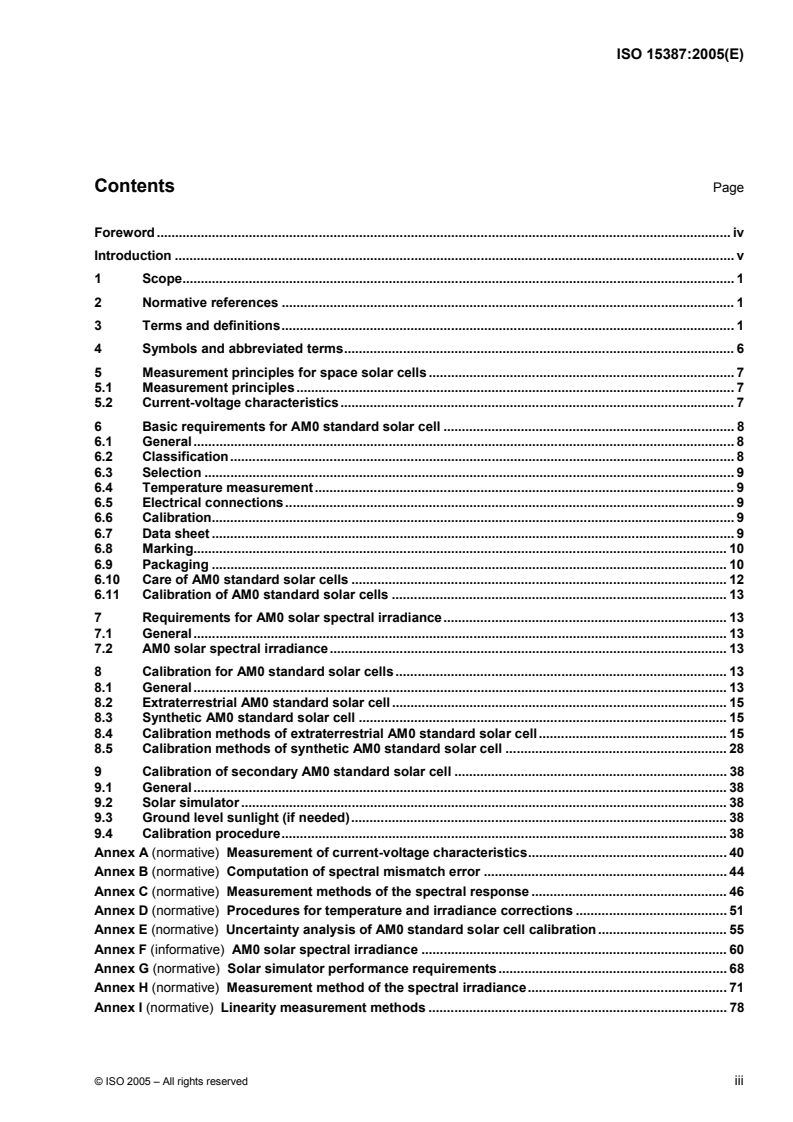
Contents Page
Foreword. iv
Introduction . v
1 Scope. 1
2 Normative references . 1
3 Terms and definitions. 1
4 Symbols and abbreviated terms. 6
5 Measurement principles for space solar cells . 7
5.1 Measurement principles. 7
5.2 Current-voltage characteristics. 7
6 Basic requirements for AM0 standard solar cell . 8
6.1 General. 8
6.2 Classification. 8
6.3 Selection . 9
6.4 Temperature measurement. 9
6.5 Electrical connections. 9
6.6 Calibration. 9
6.7 Data sheet . 9
6.8 Marking. 10
6.9 Packaging . 10
6.10 Care of AM0 standard solar cells . 12
6.11 Calibration of AM0 standard solar cells . 13
7 Requirements for AM0 solar spectral irradiance. 13
7.1 General. 13
7.2 AM0 solar spectral irradiance. 13
8 Calibration for AM0 standard solar cells. 13
8.1 General. 13
8.2 Extraterrestrial AM0 standard solar cell . 15
8.3 Synthetic AM0 standard solar cell . 15
8.4 Calibration methods of extraterrestrial AM0 standard solar cell. 15
8.5 Calibration methods of synthetic AM0 standard solar cell . 28
9 Calibration of secondary AM0 standard solar cell . 38
9.1 General. 38
9.2 Solar simulator . 38
9.3 Ground level sunlight (if needed). 38
9.4 Calibration procedure. 38
Annex A (normative) Measurement of current-voltage characteristics. 40
Annex B (normative) Computation of spectral mismatch error . 44
Annex C (normative) Measurement methods of the spectral response . 46
Annex D (normative) Procedures for temperature and irradiance corrections . 51
Annex E (normative) Uncertainty analysis of AM0 standard solar cell calibration. 55
Annex F (informative) AM0 solar spectral irradiance . 60
Annex G (normative) Solar simulator performance requirements. 68
Annex H (normative) Measurement method of the spectral irradiance. 71
Annex I (normative) Linearity measurement methods . 78
Foreword
ISO (the International Organization for Standardization) is a worldwide federation of national standards bodies
(ISO member bodies). The work of preparing International Standards is normally carried out through ISO
technical committees. Each member body interested in a subject for which a technical committee has been
established has the right to be represented on that committee. International organizations, governmental and
non-governmental, in liaison with ISO, also take part in the work. ISO collaborates closely with the
International Electrotechnical Commission (IEC) on all matters of electrotechnical standardization.
International Standards are drafted in accordance with the rules given in the ISO/IEC Directives, Part 2.
The main task of technical committees is to prepare International Standards. Draft International Standards
adopted by the technical committees are circulated to the member bodies for voting. Publication as an
International Standard requires approval by at least 75 % of the member bodies casting a vote.
Attention is drawn to the possibility that some of the elements of this document may be the subject of patent
rights. ISO shall not be held responsible for identifying any or all such patent rights.
ISO 15387 was prepared by Technical Committee ISO/TC 20, Aircraft and space vehicles, Subcommittee
SC 14, Space systems and operations.
iv © ISO 2005 – All rights reserved
Introduction
This International Standard is consistent with the principles associated with photovoltaic solar cells
established by IEC/TC 82, Solar photovoltaic energy systems. It provides specific requirements and
procedures that apply to the use of solar photovoltaic cells in outer space. It introduces the principle of the air
mass zero cell, which serves as a standard reference for primary calibration purposes. All further calibration is
then compared to the results obtained with these cells.
The calibration procedures for primary solar cells are established, as well as the corresponding measuring
methods for secondary cells. Calibration methods using extra-terrestrial and synthetic techniques are given.
Comparative tests are in preparation.
INTERNATIONAL STANDARD ISO 15387:2005(E)
Space systems — Single-junction solar cells — Measurement
and calibration procedures
1 Scope
This International Standard specifies measurement and calibration procedures of single-junction space solar
cells only. The main body of this international standard specifies the requirements for Air Mass Zero (AM0)
standard calibration and the relative measurement procedures are provided as annexes.
2 Normative references
The following referenced documents are indispensable for the application of this document. For dated
references, only the edition cited applies. For undated references, the latest edition of the referenced
document (including any amendments) applies.
IEC 60891, Procedures for temperature and irradiance corrections to measured current-voltage (I-V)
characteristics of crystalline silicon photovoltaic (PV) devices
IEC 60904-1, Measurement of photovoltaic current-voltage (I-V) characteristics
IEC 60904-2, Requirements for reference solar cells
IEC 60904-3, Measurement principles for terrestrial photovoltaic (PV) solar devices with reference spectral
irradiance data
IEC 60904-7, Computation of spectral mismatch error introduced in the testing of a photovoltaic (PV) device
IEC 60904-8, Guidance for the measurement of spectral response of a photovoltaic (PV) device
IEC 60904-9, Solar simulator performance requirements
IEC 61798, Linearity measurement methods
3 Terms and definitions
For the purposes of this document, the following terms and definitions apply.
3.1
air mass (AM)
length of path through the earth's atmosphere traversed by the direct solar beam, expressed as a multiple of
the path traversed to a point at sea level with the sun directly overhead
NOTE The value of air mass is 1 at sea level with a cloudless sky when the sun is directly overhead and the air
pressure P = 1,013 × 10 Pa.
At any point on the earth surface, the value of the air mass is given by:
AM = (P/P ) × (1/sinθ)
where
P = local air pressure in pascals;
P = 1,013 × 10 , in pascals;
θ = solar elevation angle (degrees).
3.2
air mass zero
AM0
absence of atmospheric attenuation of the solar irradiance at one astronomical unit from the sun
3.3
AM0 standard solar cell
calibrated solar cell used to measure irradiance or to set simulator irradiance levels in terms of an air mass
zero (AM0) reference solar spectral irradiance distribution
3.4
ambient temperature
T
amb
temperature of the air surrounding the solar cell as measured in a vented enclosure and shielded from solar,
sky and ground radiation
3.5
angle of incidence
angle between the direct irradiant beam and the normal to the active surface
3.6
astronomical unit
AU
unit of length defined as the semi major axis of earth orbit
NOTE 1 AU = 149 597 890 km ± 500 km.
3.7
cell temperature
T
j
cell temperature as one of ambient air in absence of cell illumination or under short duration light pulse (flash)
NOTE T is not very different from the temperature of the cell exposed face.
j
3.8
current temperature coefficient
α
change of the short-circuit current of a solar cell as a function of the change of cell temperature
−1
NOTE α is expressed in amperes per degree Celsius (A⋅°C ).
3.9
conversion efficiency
ratio of “maximum electrical power output” to the product of generator area and incident irradiance measured
under defined test conditions and expressed as a percentage
3.10
current-voltage characteristics
output current of a solar cell as a function of output voltage, at a particular temperature and irradiance
NOTE I = f(V).
2 © ISO 2005 – All rights reserved
3.11
fill factor
FF
ratio of maximum power to the product of open circuit voltage and short-circuit current
NOTE FF = P /(V × I ).
max oc sc
3.12
irradiance
radiant power incident upon unit area of surface
−2
NOTE It is expressed in watts per square metre (W⋅m ).
3.13
irradiation
integration of irradiance over a specified period of time
−2
NOTE It is expressed in megajoules per square metre (MJ⋅m ) per hour, day, week, month or year.
3.14
linearity
performance of a solar cell with respect to:
the variation of the slope of short-circuit current to irradiance;
the variation of the slope of open circuit voltage to the logarithm of irradiance;
the variation of the slope of short-circuit current and open-circuit voltage to cell temperature; and
the variation of relative spectral response at a specified voltage
3.15
load current
I
L
current supplied by the solar cell at a particular temperature and irradiance, into a load connected across its
terminals
3.16
load voltage
V
L
voltage appearing across the terminals of a load connected to the terminals of the solar cell at a particular
temperature and irradiance
3.17
load power
P
L
power supplied to a load connected to the terminals of the solar cell at a particular temperature and irradiance;
NOTE P = V × L .
L L L
3.18
maximum power
P
max
power at the point on the current-voltage characteristics where the product of current and voltage is a
maximum at a particular temperature and irradiance
NOTE P = V × I
max max max
3.19
maximum power voltage
V
Pmax
voltage corresponding to maximum power at a particular temperature and irradiance
3.20
maximum power current
I
Pmax
current corresponding to maximum power at a particular temperature and irradiance
3.21
module
assembly of interconnected solar cells
3.22
open circuit voltage
V
oc
voltage across a solar cell with no load at a particular temperature and irradiance
3.23
ozone content
volume of ozone at standard temperature and pressure in a vertical column of the atmosphere
NOTE Ozone content is measured with a Dobson spectrophotometer.
3.24
pyranometer
radiometer normally used to measure global sunlight irradiance on a horizontal plane
NOTE A pyranometer can also be used at an angle to measure the total sunlight irradiance on an inclined plane,
which in this case includes an element caused by radiation reflected from the foreground.
3.25
pyrheliometer
radiometer, complete with a collimator, used to measure direct sunlight irradiance
NOTE This instrument is sometimes called normal incidence pyrheliometer, or NIP.
3.26
rated current
assigned value of current of a solar cell at the rated voltage under specified operating conditions
3.27
rated power
assigned value of power output of a solar cell at rated voltage under specified operating conditions
3.28
rated voltage
assigned value of voltage under specified operating conditions
3.29
relative spectral response
S(λ)
rel
spectral response normalized to unity at wavelength of maximum response
NOTE S(λ) = S(λ)/S(λ)
rel max
4 © ISO 2005 – All rights reserved
3.30
short circuit current
I
SC
output current of a solar cell in the short-circuit condition at a particular temperature and irradiance
3.31
solar cell
basic photovoltaic device that generates electricity when exposed to sunlight
3.32
solar constant
rate of total solar energy at all wavelengths incident on a unit area exposed normally to rays of the sun at one
astronomical unit in AM0 conditions
−2 −2
NOTE The average of values is 1 367 W⋅m ± 7 W⋅m .
3.33
solar elevation angle
θ
angle between the direct solar beam and the horizontal plane
NOTE This angle is measured in radians.
3.34
spectral irradiance
E
λ
irradiance per unit bandwidth at a particular wavelength
−2 −6
NOTE The units are expressed as W⋅m ⋅m .
3.35
spectral photon irradiance
E
pλ
photon flux density at a particular wavelength
NOTE E = 5,035 × 10 λ ⋅ E , where λ is expressed in micrometers.
pλ λ
3.36
spectral irradiance distribution
spectral irradiance plotted as a function of wavelength
−2 −6
NOTE The units are expressed as W⋅m ⋅m .
3.37
spectral response
S(λ)
short-circuit current density generated by unit irradiance at a particular wavelength as a function of wavelength
−1
NOTE The units is A⋅W .
3.38
standard test conditions
STC
−2
at cell temperature of 25 °C ± 1 °C and at one solar constant AM0 irradiance of 1 367 W⋅m as measured
with an AM0 standard solar cell using the AM0 reference extraterrestrial solar spectral irradiance
NOTE Cell temperature of 28 °C only applies to 8.4.1.
3.39
voltage temperature coefficient
β
change of the open circuit voltage of a solar cell as a function of the change of cell temperature
−1
NOTE β is expressed in volts per degree Celsius (V⋅°C ).
4 Symbols and abbreviated terms
AM air mass
AM0 air mass zero
AU astronomical unit
α coefficient of current temperature
β coefficient of voltage temperature
CAST China Academy of Space Technology
CNES French National Space Research Center
ESA European Space Agency
E spectral irradiance
λ
E photonic spectral irradiance
pλ
FF fill factor
GMT Greenwich mean time
GPS global positioning system
I load current
L
I maximum power current
Pmax
I short circuit current
sc
INTA-Spasolab Instituto Nacional de Tecnica Aerospacial - Spasolab
I-V current-voltage
JPL Jet Propulsion Laboratory
NASA-GRC National Aeronautics and Space Administration – Glenn Research Center
NASDA National Space Development Agency of Japan
NIP normal incidence pyrheliometer
NSBF National Scientific Balloon Facility in Palestine, Texas
P load power
L
P maximum power
max
PTB Physikalisch-Technische Bundesanstalt
PV photovoltaic
RTD platinum resistance thermometers
S(λ) spectral response
S(λ) relative spectral response
rel
STC standard test conditions
T ambiant temperature
amb
T cell temperature
j
6 © ISO 2005 – All rights reserved
TC telecommand
TM telemetry
θ solar elevation angle
V load voltage
L
V open circuit voltage
oc
V maximum power voltage
Pmax
WRC World Radiation Centre
WRR World Radiometric Reference
5 Measurement principles for space solar cells
5.1 Measurement principles
In current practice, the photovoltaic performance of a solar cell is determined by exposing it at a known
temperature to stable sunlight or simulated light and tracing its current-voltage characteristic while measuring
the magnitude of the incident irradiance.
The measured performance is then corrected to STC or other desired conditions of irradiance and
temperature. The corrected power output at the rated voltage and STC is commonly referred to as the rated
power.
Since a solar cell has a wavelength-dependent response, its performance is significantly affected by the
spectral distribution of the incident radiation, which in extraterrestrial sunlight varies with the location of the
sun and earth, season, time of year and time of day, and with a simulator varies with its type and conditions. If
the irradiance is measured with a thermopile-type radiometer that is not spectrally selective, the measured
conversion efficiencies can vary by several percent because of spectral distribution changes.
The principles given in this International Standard are designed to reduce such discrepancies by relating the
performance rating to a reference extraterrestrial solar spectral irradiance distribution. This is done by
measuring the irradiance with an AM0 standard solar cell that has essentially the same relative spectral
response as the test specimen and has been calibrated in terms of short-circuit current per unit of irradiance
−1 −2
(AW m ) with the reference spectral distribution.
If the performance of a solar cell is related to a known spectral irradiance distribution, it is possible for a user
or array designer, using the spectral response of the cells, to compute within a reasonable tolerance its
performance when exposed to the light of any other known spectral irradiance distribution.
5.2 Current-voltage characteristics
See Annex A. One example of an I-V curve measured at a fixed irradiance and temperature is shown in
Figure 1. The current is plotted along the ordinate, the voltage along the abscissa. The electrical
characteristics, which may be derived from the I-V curve are:
a) short-circuit current (I ): Point A – the current value where the I-V curve crosses the current axis at V = 0;
sc
b) open-circuit voltage (V ): Point B – the voltage value where the I-V curve crosses the voltage axis at
oc
I = 0;
c) maximum power (P ): Point C – the power at the point on the I-V curve where the product of current
max
and voltage is maximum;
d) load current (I ): Point D – the measured current at a specified load voltage V .
L L
X Voltage
Y Current
−2
Irradiance = E (W⋅m )
Temperature = T (°C)
Figure 1 — Example of a current-voltage curve
6 Basic requirements for AM0 standard solar cell
6.1 General
Clause 6 gives requirements for the classification, selection, packaging, marking, calibration and care of AM0
standard solar cells.
6.2 Classification
6.2.1 Extraterrestrial AM0 standard solar cell
This is a solar cell whose calibration is based on extraterrestrial AM0 conditions using high altitude balloon or
aircraft.
8 © ISO 2005 – All rights reserved
6.2.2 Synthetic AM0 standard solar cell
This is a solar cell whose calibration is based on synthetic AM0 conditions using the solar simulator, global
sunlight, or direct normal sunlight.
6.3 Selection
−2
Solar cells shall be irradiated with one solar constant (1 367 W⋅m and AM0 spectrum) for 48 h. The cells
shall be kept at 25 °C ± 5 °C during the test.
At least two solar cells shall be selected for calibration as AM0 standard solar cells. The spectral response of
the selected cells shall be such that errors in performance measurement of the intended test (under
extraterrestrial sunlight or specific simulator) caused by spectral response mismatch are less than ± 1 %. The
spectral mismatch error shall be calculated by the method described in Annex B.
AM0 standard solar cells shall be stable devices, that is their photovoltaic characteristics shall not change
from the initial calibration to reevaluation by more than 1 %.
6.4 Temperature measurement
Means shall be provided for measuring the AM0 standard solar cell junction temperature to an accuracy of
± 1 °C.
6.5 Electrical connections
Any measurement resistor incorporated into the AM0 standard module shall be a high-precision, high-
temperature stability resistor with a low value in order to allow the cell to operate at a level close to its short-
circuit current. On the other hand, the electrical connections to the AM0 standard solar cell without resistance
shall consist of a four-wire contact system (Kelvin probe).
6.6 Calibration
Each AM0 standard solar cell shall be calibrated in terms of its short-circuit current at 25 °C ± 1 °C per unit of
−1 −2
irradiance with the AM0 reference spectral irradiance (A⋅W ⋅m ).
The standard methods of calibrating both AM0 standard and secondary standard solar cells are described in
Clauses 8 and 9. The relative spectral response and the temperature coefficient of each AM0 standard solar
cell shall be measured in accordance with Annexes C and D.
6.7 Data sheet
Each time an AM0 standard solar cell is calibrated, the following information shall be recorded on a data
sheet:
a) identification number
b) type (extraterrestrial AM0 standard or synthetic AM0 standard)
c) cell manufacturer
d) manufacturer complete reference of the cell
e) material type
f) type of package
g) calibration organization
h) site and date of calibration
i) method of calibration (refer to standard)
j) radiometer or standard lamp characteristics (where applicable)
k) AM0 standard solar cell identification (where applicable)
l) simulator characteristics (where applicable)
m) type of temperature sensor (where applicable)
n) relative spectral response (where applicable)
o) temperature coefficient of short-circuit current
p) calibration value
q) claimed accuracy
6.8 Marking
Each AM0 standard solar cell shall carry a clear, indelible identification number for cross-reference to the
relevant data sheet.
6.9 Packaging
6.9.1 Measurement in extraterrestrial sunlight
The AM0 standard solar cells used for measurements in extraterrestrial sunlight shall respond to variations in
the distribution of the incident radiation in the same way as the test solar cells. Figures 2 and 3 show
examples of suitable AM0 standard single cell packages for high altitude balloon flight calibration.
6.9.2 Measurement under simulators
In some simulators, which allow multiple reflections of light to and from the test specimen, the irradiance in the
test plane may change depending on whether or not the test specimen is present.
Therefore, in order to measure accurately the irradiance that will be present when the test specimen is in
place, the AM0 standard solar cells used in such simulators shall be packaged in the same way as the test
specimens, such that the change in irradiance caused by the multiple reflections is the same for both the AM0
standard solar cell and the specimen. AM0 standard solar cells used for measurement in a simulator are
designed to render insignificant any error from multi-reflected light may be in the unpackaged state on a
temperature controlled block. Alternatively, the requirements given for AM0 standard solar cells designed for
use in extraterrestrial sunlight may be followed.
10 © ISO 2005 – All rights reserved
Dimensions in millimetres
Item List
Item number Description
1 Current terminal (negative)
2 Potential terminal (negative)
3 Potential terminal (positive)
4 Jumper wire
5 Current terminal (positive) (0,1 A rating)
Figure 2 — JPL balloon flight module
Item List
Item number Description
1 Solar cell
2 Printed circuit
3 Resistor
4 Connectors
5 Si solar cell
6 GaAs solar cell
Figure 3 — CNES balloon flight module
6.9.3 Single cell package
If a single cell package is used, the following recommendations apply.
a) The field of view should be at least 160°.
b) All surfaces in the package within the cell's field of view should be non-reflective, with an absorption of at
least 0,95 in the cell's wavelength response band.
c) The material used for bonding the cell to the holder should not be degraded electrically and optically. Its
physical characteristics should remain stable over the entire period of intended use.
d) A protective window should be used. If the cell is to be calibrated or used in total sunlight, the space
between the window and the cell should be filled with a stable, transparent encapsulant. The reflectance
of the encapsulant shall be similar (within 10 %) to that of the window to minimize errors caused by the
internal reflection of light at high angles of incidence. The transparency, continuity and adhesion of the
encapsulant should not be adversely affected by ultraviolet light and operation temperature.
6.10 Care of AM0 standard solar cells
All standard solar cells shall be kept at temperatures below 50 °C during operation and storage. The standard
cells should be kept in the dark during extended storage periods.
12 © ISO 2005 – All rights reserved
The window of a packaged AM0 standard solar cell shall be kept clean and scratch free. Unpackaged AM0
standard solar cells shall be preserved from damage, contamination and degradation. The calibration of AM0
standard solar cells in frequent use shall be cross-checked at intervals of no more than one month by
comparing their short-circuit currents under the same irradiance. If there is any change in the current ratios
beyond ± 1 %, the cells should be recalibrated. All AM0 standard solar cells shall be reevaluated periodically
to check for degradation.
6.11 Calibration of AM0 standard solar cells
The calibration methods of AM0 standard solar cells should be in accordance with Clause 8. The calibration
methods and their execution shall have an uncertainty within ± 1 %. The method for determining the
uncertainty is given in Annex E.
7 Requirements for AM0 solar spectral irradiance
7.1 General
This International Standard specifies the AM0 reference extraterrestrial solar spectral irradiance.
7.2 AM0 solar spectral irradiance
The AM0 reference solar spectral irradiance for the purpose of this International Standard is illustrated in
Figure 4. The data from which this curve is drawn are presented in Annex F. This is total sunlight,
−2
corresponding to an irradiance of 1 367 W⋅m (solar constant) at AM0, on a plane surface under zero
incidence.
8 Calibration for AM0 standard solar cells
8.1 General
This document describes the calibration methods of AM0 standard solar cells. The existing procedures on
which these methods are based are claimed by the originators to give results repeatable to within a standard
deviation of ± 1 %, if carried out by a competent agency, with no change of equipment.
The calibration methods for AM0 standard solar cell are as follows (see Figure 5).
X Wavelength
−2 −1
Y Solar spectral irradiance (W⋅m ⋅m )
1 WRC Spectrum
Figure 4 — AM0 solar spectral irradiance (a part of distribution)
14 © ISO 2005 – All rights reserved
Figure 5 — Calibration methods for (primary) AM0 standard cell
8.2 Extraterrestrial AM0 standard solar cell
a) High altitude balloon flight calibration method
b) High altitude aircraft calibration method
8.3 Synthetic AM0 standard solar cell
a) Global sunlight calibration method
b) Direct normal sunlight calibration method
c) Solar simulator calibration method
d) Differential spectral response calibration method (if applicable)
8.4 Calibration methods of extraterrestrial AM0 standard solar cell
8.4.1 High altitude balloon flight calibration method (JPL)
8.4.1.1 Description
The purpose of the high altitude solar cell calibration program is to produce an extraterrestrial AM0 standard
solar cell that can be used for accurately setting solar simulator intensities. The concept is to fly solar cells on
a high altitude balloon, to measure their output at altitudes at or above 36 km, to recover the cells and to use
them as reference standards. The calibrated standard solar cell is placed in the solar simulator beam, and the
beam intensity is adjusted until the standard solar cell reads the same as it read on the balloon. As long as the
reference cell has the same spectral response as the cells or panels to be measured, this is a very accurate
method of setting the intensity, even though the irradiance of the solar simulator is not an exact match to that
of the sun. But as solar cell technology changes, the spectral response of the solar cells changes also, and
reference standards that use the new technology must be built and calibrated.
JPL has been flying calibration standards on high altitude balloons since 1963 and continues to organize a
calibration balloon flight at least once a year. Up to 39 solar cells can be accommodated on each flight. Full
current-voltage curves may be measured on 19 cells, and 30 cells with fixed loads may be measured. The
data is corrected to 28 °C and 1 AU (1,496 × 10 km). The calibrated cells are returned to the participants for
use as reference standards.
NOTE Cell temperature of 28 °C only applies to 8.4.1.
8.4.1.2 Principle
The basic principle of the calibration is to measure the short-circuit current (I ) of each flight cell since I is
sc sc
directly proportional to the incident light intensity. In practice, each calibration solar cell is shunted with a load
resistor which establishes an operating point near I . In addition, the load resistors are chosen so that their
sc
output voltage will be less than 100 mV during the flight. The resistors used for loading the cells are highly
−5 −1
stable wire wound precision resistors with temperature coefficients of 2⋅10 ⋅°C . The cells connected for full
current-voltage curve measurement do not have load resistors. The cells are exposed to direct extraterrestrial
sunlight while they are carried on the high altitude balloon. A solar tracker is used to constantly align the solar
cells normal to the sun. The tracker assembly is mounted on the apex of the balloon in order to avoid
reflections and/or shadowing from the balloon or from any part of the structure hanging below the balloon. If
the sun pointing is precise, there are only two corrections that must be made to convert the on-board voltage
measurements to the standard condition. One correction is for the earth-sun distance at the time of the flight,
and the other is a temperature correction to the standard temperature of 28 °C.
8.4.1.3 Apparatus
See Figure 6.The main components of the balloon flight system are the following.
a) The apex-mounted hoop assembly that contains the experimental package, the data encoder, the
recovery system and the camera.
b) The balloon.
c) The lower payload that contains the telemetry, command receiver, and power systems.
The following apparatus is required:
a) Main balloon. This balloon is made of polyethylene film 20 µm thick, has a volume of 98 000 m and
weighs 319 kg.
b) Small balloon. This balloon has a volume of 82 m and weighs 4,3 kg.
c) Top payload. The following top payload is mounted to the aluminum hoop assembly.
1) Solar tracker
2) Sun angle sensor
3) Voltage reference (calibration) box
4) Data acquisition system
5) Single-frame movie camera
6) Clock
7) Descent parachute
8) Battery power supply for the tracker and data acquisition system
9) Tracking beacon
16 © ISO 2005 – All rights reserved
d) Bottom payload. The bottom payload is furnished by the National Scientific Balloon Facility (NSBF) and
consists of the following.
1) Battery power supply
2) Ballast module for balloon altitude control
3) An electronics module known as the Consolidated Instrument Package (CIP)
4) GPS receivers
5) Transponder
6) Descent parachute
e) Solar cell modules mounted on the tracker solar panel.
f) Ground support equipment is furnished by the NSBF and consists of the following.
1) Telemetry receiving and recording system
2) GPS receiver
3) Computer systems for monitoring balloon position, altitude and status
4) Launch vehicles
5) Chase and recovery vehicles
6) Airplane for tracking, chase and recovery
Item List
Item number Description
1 Solar panel
2 Solar tracker
3 Hoop assembly and parachute
4 Balloons
5 Bottom parachute
6 Instrument package
Figure 6 — JPL high altitude balloon flight calibration
18 © ISO 2005 – All rights reserved
8.4.1.4 Environmental conditions
The National Scientific Balloon Facility (NSBF) was established in 1963 at Palestine, Texas. The Physical
Science Laboratory (PSL) of New Mexico State University operates this facility under the sponsorship of the
National Aeronautics and Space Administration (NASA). This location was chosen because it has favourable
weather conditions for balloon launching and a large number of clear days with light surface winds. The high
altitude winds in this part of the country take the balloons over sparsely populated areas so the descending
payloads are unlikely to cause damage to people or property.
The JPL calibration flights have been flown from the Palestine facility since 1973. The flights are scheduled to
fly in the June-to-September time period since the sun is high in the sky at that time of year and the sunlight
passes through a minimum depth of atmosphere before reaching the solar cell modules. In order to maintain a
minimum amount of atmosphere between the sun and the solar cells, the calibrations are carried out at
altitude higher than 35 km.
8.4.1.5 Test procedure
Before the flight, the data acquisition system is calibrated by placing a sequence of input voltages into the
appropriate input terminals of the DAQ and measuring the corresponding output (in both voltage and data
word). A least-squares fit to the measurements is calculated to establish the gain and offset of the DAQ
amplifier. This procedure is performed separately for (1) the fixed-load cell amplifier, (2) the voltage amplifier
used in measuring current-voltage characteristics and (3) the current amplifier used in measuring the current-
voltage characteristics.
The cell temperatures during the flight are measured by reading the resistance of several platinum resistance
thermometers (RTDs) embedded in several of the light cell modules. A calibration of the amplifiers used to
measure these RTDs is also performed before the flight.
The calibrations described above are performed at room temperature. The temperature stability of the DAQs
is measured before flight by placing the DAQs in a temperature controlled oven.
An environmental test of the entire solar cell tracking and data acquisition system is performed before each
flight. In this test, the solar panel is fully populated with modules for the flight. The system is placed in a
thermal vacuum chamber and powered on. The chamber is evacuated to a pressure corresponding to the
expected float altitude of the flight (at 36,6 km the air pressure is 500 Pa). The operation of the DAQs is
monitored at temperatures between − 50 °C and + 50 °C. During this time, the operation of the tracker is
monitored to assure that it is not adversely affected by temperature.
During the flight, the data is telemetered to the ground station at the NSBF. The solar cell calibration data is
sent to a computer dedicated to the real-time display and storage of the solar cell data. Data is accumulated
for at least 30 m within 1 h of local solar noon.
At the end of the flight, the solar tracker assembly is separated from the balloon system and allowed to
descend by parachute.
Computer analysis of the stored data is performed after the flight. The analysis program corrects the fixed-
load cell data for temperature and sun-earth distance according to the following formula:
V = V (R ) − A⋅T(T − 28)
28,1 T,R
where
V is the measured module output voltage at temperature T and distance R;
T,R
R is the sun-earth distance (AU);
A is the module output temperature coefficient; and
T is the module temperature (°C).
A slightly different procedure is used for the cells producing current-voltage curves. The correction shown
above is made for all measured cell current values, using temperature coefficients (A) appropriate for I . The
sc
voltages are corrected, utilizing temperature coefficients appropriate for V . This correction used the above
oc
formula also, but the factor for sun-earth distance is not used. The voltage correction is applied to all
measured cell voltage values.
8.4.2 High altitude balloon flight calibration method (CNES method)
8.4.2.1 Description
Since 1975, CNES (French National Space Research Centre) has been involved in the calibration of space
solar cells by producing AM0 standard solar cells. Calibrations are performed on board stratospheric balloons
flying at high altitudes (36 ± 2 km) where the solar spectral irradiance is very close to AM0. The cells
calibrated in this way can subsequently be used as standard solar cell in various laboratory tasks for solar cell
characterization by sun simulators. A standard solar cell must be used to adjust and measure the simulated
illumination energy. The spectral response of this cell shall be as close as possible to that of the specimen to
be measured using the simulator. CNES is the only laboratory in Europe carrying out calibration of this type
above the atmosphere, with a flight planned every year.
Size increases, changes in solar cell technology (GaAs/Ge, tandem, tri-junction, etc.) and the impossibility of
carrying out tests on the ground led to modification of the electronics of the 1996 flight, thus preparing
tomorrow's technologies. This now allows measurement with high accuracy the I = f(V) curves for 28 modules,
at temperatures between −20 °C and 30 °C and with a programmed temperature step (1 °C to 10 °C).
8.4.2.2 Principle
An electronics payload is carried on-board the balloon's gondola, allowing the characteristic current-voltage
relationship I = f(V) to be recorded as a function of temperature, under real illumination AM0, with corrections
made for the following:
K Residual atmosphere at the balloon's altitude (see 8.4.2.8),
n
K Variation of illumination caused by the varying earth-sun distance over the year (see 8.4.2.8).
s
Two supply voltages are c
...
INTERNATIONAL ISO
STANDARD 15387
First edition
2005-06-01
Space systems — Single-junction solar
cells — Measurement and calibration
procedures
Systèmes spatiaux — Cellules solaires simple jonction — Méthodes de
mesure et d'étalonnage
Reference number
©
ISO 2005
PDF disclaimer
This PDF file may contain embedded typefaces. In accordance with Adobe's licensing policy, this file may be printed or viewed but
shall not be edited unless the typefaces which are embedded are licensed to and installed on the computer performing the editing. In
downloading this file, parties accept therein the responsibility of not infringing Adobe's licensing policy. The ISO Central Secretariat
accepts no liability in this area.
Adobe is a trademark of Adobe Systems Incorporated.
Details of the software products used to create this PDF file can be found in the General Info relative to the file; the PDF-creation
parameters were optimized for printing. Every care has been taken to ensure that the file is suitable for use by ISO member bodies. In
the unlikely event that a problem relating to it is found, please inform the Central Secretariat at the address given below.
© ISO 2005
All rights reserved. Unless otherwise specified, no part of this publication may be reproduced or utilized in any form or by any means,
electronic or mechanical, including photocopying and microfilm, without permission in writing from either ISO at the address below or
ISO's member body in the country of the requester.
ISO copyright office
Case postale 56 • CH-1211 Geneva 20
Tel. + 41 22 749 01 11
Fax + 41 22 749 09 47
E-mail copyright@iso.org
Web www.iso.org
Published in Switzerland
ii © ISO 2005 – All rights reserved
Contents Page
Foreword. iv
Introduction . v
1 Scope. 1
2 Normative references . 1
3 Terms and definitions. 1
4 Symbols and abbreviated terms. 6
5 Measurement principles for space solar cells . 7
5.1 Measurement principles. 7
5.2 Current-voltage characteristics. 7
6 Basic requirements for AM0 standard solar cell . 8
6.1 General. 8
6.2 Classification. 8
6.3 Selection . 9
6.4 Temperature measurement. 9
6.5 Electrical connections. 9
6.6 Calibration. 9
6.7 Data sheet . 9
6.8 Marking. 10
6.9 Packaging . 10
6.10 Care of AM0 standard solar cells . 12
6.11 Calibration of AM0 standard solar cells . 13
7 Requirements for AM0 solar spectral irradiance. 13
7.1 General. 13
7.2 AM0 solar spectral irradiance. 13
8 Calibration for AM0 standard solar cells. 13
8.1 General. 13
8.2 Extraterrestrial AM0 standard solar cell . 15
8.3 Synthetic AM0 standard solar cell . 15
8.4 Calibration methods of extraterrestrial AM0 standard solar cell. 15
8.5 Calibration methods of synthetic AM0 standard solar cell . 28
9 Calibration of secondary AM0 standard solar cell . 38
9.1 General. 38
9.2 Solar simulator . 38
9.3 Ground level sunlight (if needed). 38
9.4 Calibration procedure. 38
Annex A (normative) Measurement of current-voltage characteristics. 40
Annex B (normative) Computation of spectral mismatch error . 44
Annex C (normative) Measurement methods of the spectral response . 46
Annex D (normative) Procedures for temperature and irradiance corrections . 51
Annex E (normative) Uncertainty analysis of AM0 standard solar cell calibration. 55
Annex F (informative) AM0 solar spectral irradiance . 60
Annex G (normative) Solar simulator performance requirements. 68
Annex H (normative) Measurement method of the spectral irradiance. 71
Annex I (normative) Linearity measurement methods . 78
Foreword
ISO (the International Organization for Standardization) is a worldwide federation of national standards bodies
(ISO member bodies). The work of preparing International Standards is normally carried out through ISO
technical committees. Each member body interested in a subject for which a technical committee has been
established has the right to be represented on that committee. International organizations, governmental and
non-governmental, in liaison with ISO, also take part in the work. ISO collaborates closely with the
International Electrotechnical Commission (IEC) on all matters of electrotechnical standardization.
International Standards are drafted in accordance with the rules given in the ISO/IEC Directives, Part 2.
The main task of technical committees is to prepare International Standards. Draft International Standards
adopted by the technical committees are circulated to the member bodies for voting. Publication as an
International Standard requires approval by at least 75 % of the member bodies casting a vote.
Attention is drawn to the possibility that some of the elements of this document may be the subject of patent
rights. ISO shall not be held responsible for identifying any or all such patent rights.
ISO 15387 was prepared by Technical Committee ISO/TC 20, Aircraft and space vehicles, Subcommittee
SC 14, Space systems and operations.
iv © ISO 2005 – All rights reserved
Introduction
This International Standard is consistent with the principles associated with photovoltaic solar cells
established by IEC/TC 82, Solar photovoltaic energy systems. It provides specific requirements and
procedures that apply to the use of solar photovoltaic cells in outer space. It introduces the principle of the air
mass zero cell, which serves as a standard reference for primary calibration purposes. All further calibration is
then compared to the results obtained with these cells.
The calibration procedures for primary solar cells are established, as well as the corresponding measuring
methods for secondary cells. Calibration methods using extra-terrestrial and synthetic techniques are given.
Comparative tests are in preparation.
INTERNATIONAL STANDARD ISO 15387:2005(E)
Space systems — Single-junction solar cells — Measurement
and calibration procedures
1 Scope
This International Standard specifies measurement and calibration procedures of single-junction space solar
cells only. The main body of this international standard specifies the requirements for Air Mass Zero (AM0)
standard calibration and the relative measurement procedures are provided as annexes.
2 Normative references
The following referenced documents are indispensable for the application of this document. For dated
references, only the edition cited applies. For undated references, the latest edition of the referenced
document (including any amendments) applies.
IEC 60891, Procedures for temperature and irradiance corrections to measured current-voltage (I-V)
characteristics of crystalline silicon photovoltaic (PV) devices
IEC 60904-1, Measurement of photovoltaic current-voltage (I-V) characteristics
IEC 60904-2, Requirements for reference solar cells
IEC 60904-3, Measurement principles for terrestrial photovoltaic (PV) solar devices with reference spectral
irradiance data
IEC 60904-7, Computation of spectral mismatch error introduced in the testing of a photovoltaic (PV) device
IEC 60904-8, Guidance for the measurement of spectral response of a photovoltaic (PV) device
IEC 60904-9, Solar simulator performance requirements
IEC 61798, Linearity measurement methods
3 Terms and definitions
For the purposes of this document, the following terms and definitions apply.
3.1
air mass (AM)
length of path through the earth's atmosphere traversed by the direct solar beam, expressed as a multiple of
the path traversed to a point at sea level with the sun directly overhead
NOTE The value of air mass is 1 at sea level with a cloudless sky when the sun is directly overhead and the air
pressure P = 1,013 × 10 Pa.
At any point on the earth surface, the value of the air mass is given by:
AM = (P/P ) × (1/sinθ)
where
P = local air pressure in pascals;
P = 1,013 × 10 , in pascals;
θ = solar elevation angle (degrees).
3.2
air mass zero
AM0
absence of atmospheric attenuation of the solar irradiance at one astronomical unit from the sun
3.3
AM0 standard solar cell
calibrated solar cell used to measure irradiance or to set simulator irradiance levels in terms of an air mass
zero (AM0) reference solar spectral irradiance distribution
3.4
ambient temperature
T
amb
temperature of the air surrounding the solar cell as measured in a vented enclosure and shielded from solar,
sky and ground radiation
3.5
angle of incidence
angle between the direct irradiant beam and the normal to the active surface
3.6
astronomical unit
AU
unit of length defined as the semi major axis of earth orbit
NOTE 1 AU = 149 597 890 km ± 500 km.
3.7
cell temperature
T
j
cell temperature as one of ambient air in absence of cell illumination or under short duration light pulse (flash)
NOTE T is not very different from the temperature of the cell exposed face.
j
3.8
current temperature coefficient
α
change of the short-circuit current of a solar cell as a function of the change of cell temperature
−1
NOTE α is expressed in amperes per degree Celsius (A⋅°C ).
3.9
conversion efficiency
ratio of “maximum electrical power output” to the product of generator area and incident irradiance measured
under defined test conditions and expressed as a percentage
3.10
current-voltage characteristics
output current of a solar cell as a function of output voltage, at a particular temperature and irradiance
NOTE I = f(V).
2 © ISO 2005 – All rights reserved
3.11
fill factor
FF
ratio of maximum power to the product of open circuit voltage and short-circuit current
NOTE FF = P /(V × I ).
max oc sc
3.12
irradiance
radiant power incident upon unit area of surface
−2
NOTE It is expressed in watts per square metre (W⋅m ).
3.13
irradiation
integration of irradiance over a specified period of time
−2
NOTE It is expressed in megajoules per square metre (MJ⋅m ) per hour, day, week, month or year.
3.14
linearity
performance of a solar cell with respect to:
the variation of the slope of short-circuit current to irradiance;
the variation of the slope of open circuit voltage to the logarithm of irradiance;
the variation of the slope of short-circuit current and open-circuit voltage to cell temperature; and
the variation of relative spectral response at a specified voltage
3.15
load current
I
L
current supplied by the solar cell at a particular temperature and irradiance, into a load connected across its
terminals
3.16
load voltage
V
L
voltage appearing across the terminals of a load connected to the terminals of the solar cell at a particular
temperature and irradiance
3.17
load power
P
L
power supplied to a load connected to the terminals of the solar cell at a particular temperature and irradiance;
NOTE P = V × L .
L L L
3.18
maximum power
P
max
power at the point on the current-voltage characteristics where the product of current and voltage is a
maximum at a particular temperature and irradiance
NOTE P = V × I
max max max
3.19
maximum power voltage
V
Pmax
voltage corresponding to maximum power at a particular temperature and irradiance
3.20
maximum power current
I
Pmax
current corresponding to maximum power at a particular temperature and irradiance
3.21
module
assembly of interconnected solar cells
3.22
open circuit voltage
V
oc
voltage across a solar cell with no load at a particular temperature and irradiance
3.23
ozone content
volume of ozone at standard temperature and pressure in a vertical column of the atmosphere
NOTE Ozone content is measured with a Dobson spectrophotometer.
3.24
pyranometer
radiometer normally used to measure global sunlight irradiance on a horizontal plane
NOTE A pyranometer can also be used at an angle to measure the total sunlight irradiance on an inclined plane,
which in this case includes an element caused by radiation reflected from the foreground.
3.25
pyrheliometer
radiometer, complete with a collimator, used to measure direct sunlight irradiance
NOTE This instrument is sometimes called normal incidence pyrheliometer, or NIP.
3.26
rated current
assigned value of current of a solar cell at the rated voltage under specified operating conditions
3.27
rated power
assigned value of power output of a solar cell at rated voltage under specified operating conditions
3.28
rated voltage
assigned value of voltage under specified operating conditions
3.29
relative spectral response
S(λ)
rel
spectral response normalized to unity at wavelength of maximum response
NOTE S(λ) = S(λ)/S(λ)
rel max
4 © ISO 2005 – All rights reserved
3.30
short circuit current
I
SC
output current of a solar cell in the short-circuit condition at a particular temperature and irradiance
3.31
solar cell
basic photovoltaic device that generates electricity when exposed to sunlight
3.32
solar constant
rate of total solar energy at all wavelengths incident on a unit area exposed normally to rays of the sun at one
astronomical unit in AM0 conditions
−2 −2
NOTE The average of values is 1 367 W⋅m ± 7 W⋅m .
3.33
solar elevation angle
θ
angle between the direct solar beam and the horizontal plane
NOTE This angle is measured in radians.
3.34
spectral irradiance
E
λ
irradiance per unit bandwidth at a particular wavelength
−2 −6
NOTE The units are expressed as W⋅m ⋅m .
3.35
spectral photon irradiance
E
pλ
photon flux density at a particular wavelength
NOTE E = 5,035 × 10 λ ⋅ E , where λ is expressed in micrometers.
pλ λ
3.36
spectral irradiance distribution
spectral irradiance plotted as a function of wavelength
−2 −6
NOTE The units are expressed as W⋅m ⋅m .
3.37
spectral response
S(λ)
short-circuit current density generated by unit irradiance at a particular wavelength as a function of wavelength
−1
NOTE The units is A⋅W .
3.38
standard test conditions
STC
−2
at cell temperature of 25 °C ± 1 °C and at one solar constant AM0 irradiance of 1 367 W⋅m as measured
with an AM0 standard solar cell using the AM0 reference extraterrestrial solar spectral irradiance
NOTE Cell temperature of 28 °C only applies to 8.4.1.
3.39
voltage temperature coefficient
β
change of the open circuit voltage of a solar cell as a function of the change of cell temperature
−1
NOTE β is expressed in volts per degree Celsius (V⋅°C ).
4 Symbols and abbreviated terms
AM air mass
AM0 air mass zero
AU astronomical unit
α coefficient of current temperature
β coefficient of voltage temperature
CAST China Academy of Space Technology
CNES French National Space Research Center
ESA European Space Agency
E spectral irradiance
λ
E photonic spectral irradiance
pλ
FF fill factor
GMT Greenwich mean time
GPS global positioning system
I load current
L
I maximum power current
Pmax
I short circuit current
sc
INTA-Spasolab Instituto Nacional de Tecnica Aerospacial - Spasolab
I-V current-voltage
JPL Jet Propulsion Laboratory
NASA-GRC National Aeronautics and Space Administration – Glenn Research Center
NASDA National Space Development Agency of Japan
NIP normal incidence pyrheliometer
NSBF National Scientific Balloon Facility in Palestine, Texas
P load power
L
P maximum power
max
PTB Physikalisch-Technische Bundesanstalt
PV photovoltaic
RTD platinum resistance thermometers
S(λ) spectral response
S(λ) relative spectral response
rel
STC standard test conditions
T ambiant temperature
amb
T cell temperature
j
6 © ISO 2005 – All rights reserved
TC telecommand
TM telemetry
θ solar elevation angle
V load voltage
L
V open circuit voltage
oc
V maximum power voltage
Pmax
WRC World Radiation Centre
WRR World Radiometric Reference
5 Measurement principles for space solar cells
5.1 Measurement principles
In current practice, the photovoltaic performance of a solar cell is determined by exposing it at a known
temperature to stable sunlight or simulated light and tracing its current-voltage characteristic while measuring
the magnitude of the incident irradiance.
The measured performance is then corrected to STC or other desired conditions of irradiance and
temperature. The corrected power output at the rated voltage and STC is commonly referred to as the rated
power.
Since a solar cell has a wavelength-dependent response, its performance is significantly affected by the
spectral distribution of the incident radiation, which in extraterrestrial sunlight varies with the location of the
sun and earth, season, time of year and time of day, and with a simulator varies with its type and conditions. If
the irradiance is measured with a thermopile-type radiometer that is not spectrally selective, the measured
conversion efficiencies can vary by several percent because of spectral distribution changes.
The principles given in this International Standard are designed to reduce such discrepancies by relating the
performance rating to a reference extraterrestrial solar spectral irradiance distribution. This is done by
measuring the irradiance with an AM0 standard solar cell that has essentially the same relative spectral
response as the test specimen and has been calibrated in terms of short-circuit current per unit of irradiance
−1 −2
(AW m ) with the reference spectral distribution.
If the performance of a solar cell is related to a known spectral irradiance distribution, it is possible for a user
or array designer, using the spectral response of the cells, to compute within a reasonable tolerance its
performance when exposed to the light of any other known spectral irradiance distribution.
5.2 Current-voltage characteristics
See Annex A. One example of an I-V curve measured at a fixed irradiance and temperature is shown in
Figure 1. The current is plotted along the ordinate, the voltage along the abscissa. The electrical
characteristics, which may be derived from the I-V curve are:
a) short-circuit current (I ): Point A – the current value where the I-V curve crosses the current axis at V = 0;
sc
b) open-circuit voltage (V ): Point B – the voltage value where the I-V curve crosses the voltage axis at
oc
I = 0;
c) maximum power (P ): Point C – the power at the point on the I-V curve where the product of current
max
and voltage is maximum;
d) load current (I ): Point D – the measured current at a specified load voltage V .
L L
X Voltage
Y Current
−2
Irradiance = E (W⋅m )
Temperature = T (°C)
Figure 1 — Example of a current-voltage curve
6 Basic requirements for AM0 standard solar cell
6.1 General
Clause 6 gives requirements for the classification, selection, packaging, marking, calibration and care of AM0
standard solar cells.
6.2 Classification
6.2.1 Extraterrestrial AM0 standard solar cell
This is a solar cell whose calibration is based on extraterrestrial AM0 conditions using high altitude balloon or
aircraft.
8 © ISO 2005 – All rights reserved
6.2.2 Synthetic AM0 standard solar cell
This is a solar cell whose calibration is based on synthetic AM0 conditions using the solar simulator, global
sunlight, or direct normal sunlight.
6.3 Selection
−2
Solar cells shall be irradiated with one solar constant (1 367 W⋅m and AM0 spectrum) for 48 h. The cells
shall be kept at 25 °C ± 5 °C during the test.
At least two solar cells shall be selected for calibration as AM0 standard solar cells. The spectral response of
the selected cells shall be such that errors in performance measurement of the intended test (under
extraterrestrial sunlight or specific simulator) caused by spectral response mismatch are less than ± 1 %. The
spectral mismatch error shall be calculated by the method described in Annex B.
AM0 standard solar cells shall be stable devices, that is their photovoltaic characteristics shall not change
from the initial calibration to reevaluation by more than 1 %.
6.4 Temperature measurement
Means shall be provided for measuring the AM0 standard solar cell junction temperature to an accuracy of
± 1 °C.
6.5 Electrical connections
Any measurement resistor incorporated into the AM0 standard module shall be a high-precision, high-
temperature stability resistor with a low value in order to allow the cell to operate at a level close to its short-
circuit current. On the other hand, the electrical connections to the AM0 standard solar cell without resistance
shall consist of a four-wire contact system (Kelvin probe).
6.6 Calibration
Each AM0 standard solar cell shall be calibrated in terms of its short-circuit current at 25 °C ± 1 °C per unit of
−1 −2
irradiance with the AM0 reference spectral irradiance (A⋅W ⋅m ).
The standard methods of calibrating both AM0 standard and secondary standard solar cells are described in
Clauses 8 and 9. The relative spectral response and the temperature coefficient of each AM0 standard solar
cell shall be measured in accordance with Annexes C and D.
6.7 Data sheet
Each time an AM0 standard solar cell is calibrated, the following information shall be recorded on a data
sheet:
a) identification number
b) type (extraterrestrial AM0 standard or synthetic AM0 standard)
c) cell manufacturer
d) manufacturer complete reference of the cell
e) material type
f) type of package
g) calibration organization
h) site and date of calibration
i) method of calibration (refer to standard)
j) radiometer or standard lamp characteristics (where applicable)
k) AM0 standard solar cell identification (where applicable)
l) simulator characteristics (where applicable)
m) type of temperature sensor (where applicable)
n) relative spectral response (where applicable)
o) temperature coefficient of short-circuit current
p) calibration value
q) claimed accuracy
6.8 Marking
Each AM0 standard solar cell shall carry a clear, indelible identification number for cross-reference to the
relevant data sheet.
6.9 Packaging
6.9.1 Measurement in extraterrestrial sunlight
The AM0 standard solar cells used for measurements in extraterrestrial sunlight shall respond to variations in
the distribution of the incident radiation in the same way as the test solar cells. Figures 2 and 3 show
examples of suitable AM0 standard single cell packages for high altitude balloon flight calibration.
6.9.2 Measurement under simulators
In some simulators, which allow multiple reflections of light to and from the test specimen, the irradiance in the
test plane may change depending on whether or not the test specimen is present.
Therefore, in order to measure accurately the irradiance that will be present when the test specimen is in
place, the AM0 standard solar cells used in such simulators shall be packaged in the same way as the test
specimens, such that the change in irradiance caused by the multiple reflections is the same for both the AM0
standard solar cell and the specimen. AM0 standard solar cells used for measurement in a simulator are
designed to render insignificant any error from multi-reflected light may be in the unpackaged state on a
temperature controlled block. Alternatively, the requirements given for AM0 standard solar cells designed for
use in extraterrestrial sunlight may be followed.
10 © ISO 2005 – All rights reserved
Dimensions in millimetres
Item List
Item number Description
1 Current terminal (negative)
2 Potential terminal (negative)
3 Potential terminal (positive)
4 Jumper wire
5 Current terminal (positive) (0,1 A rating)
Figure 2 — JPL balloon flight module
Item List
Item number Description
1 Solar cell
2 Printed circuit
3 Resistor
4 Connectors
5 Si solar cell
6 GaAs solar cell
Figure 3 — CNES balloon flight module
6.9.3 Single cell package
If a single cell package is used, the following recommendations apply.
a) The field of view should be at least 160°.
b) All surfaces in the package within the cell's field of view should be non-reflective, with an absorption of at
least 0,95 in the cell's wavelength response band.
c) The material used for bonding the cell to the holder should not be degraded electrically and optically. Its
physical characteristics should remain stable over the entire period of intended use.
d) A protective window should be used. If the cell is to be calibrated or used in total sunlight, the space
between the window and the cell should be filled with a stable, transparent encapsulant. The reflectance
of the encapsulant shall be similar (within 10 %) to that of the window to minimize errors caused by the
internal reflection of light at high angles of incidence. The transparency, continuity and adhesion of the
encapsulant should not be adversely affected by ultraviolet light and operation temperature.
6.10 Care of AM0 standard solar cells
All standard solar cells shall be kept at temperatures below 50 °C during operation and storage. The standard
cells should be kept in the dark during extended storage periods.
12 © ISO 2005 – All rights reserved
The window of a packaged AM0 standard solar cell shall be kept clean and scratch free. Unpackaged AM0
standard solar cells shall be preserved from damage, contamination and degradation. The calibration of AM0
standard solar cells in frequent use shall be cross-checked at intervals of no more than one month by
comparing their short-circuit currents under the same irradiance. If there is any change in the current ratios
beyond ± 1 %, the cells should be recalibrated. All AM0 standard solar cells shall be reevaluated periodically
to check for degradation.
6.11 Calibration of AM0 standard solar cells
The calibration methods of AM0 standard solar cells should be in accordance with Clause 8. The calibration
methods and their execution shall have an uncertainty within ± 1 %. The method for determining the
uncertainty is given in Annex E.
7 Requirements for AM0 solar spectral irradiance
7.1 General
This International Standard specifies the AM0 reference extraterrestrial solar spectral irradiance.
7.2 AM0 solar spectral irradiance
The AM0 reference solar spectral irradiance for the purpose of this International Standard is illustrated in
Figure 4. The data from which this curve is drawn are presented in Annex F. This is total sunlight,
−2
corresponding to an irradiance of 1 367 W⋅m (solar constant) at AM0, on a plane surface under zero
incidence.
8 Calibration for AM0 standard solar cells
8.1 General
This document describes the calibration methods of AM0 standard solar cells. The existing procedures on
which these methods are based are claimed by the originators to give results repeatable to within a standard
deviation of ± 1 %, if carried out by a competent agency, with no change of equipment.
The calibration methods for AM0 standard solar cell are as follows (see Figure 5).
X Wavelength
−2 −1
Y Solar spectral irradiance (W⋅m ⋅m )
1 WRC Spectrum
Figure 4 — AM0 solar spectral irradiance (a part of distribution)
14 © ISO 2005 – All rights reserved
Figure 5 — Calibration methods for (primary) AM0 standard cell
8.2 Extraterrestrial AM0 standard solar cell
a) High altitude balloon flight calibration method
b) High altitude aircraft calibration method
8.3 Synthetic AM0 standard solar cell
a) Global sunlight calibration method
b) Direct normal sunlight calibration method
c) Solar simulator calibration method
d) Differential spectral response calibration method (if applicable)
8.4 Calibration methods of extraterrestrial AM0 standard solar cell
8.4.1 High altitude balloon flight calibration method (JPL)
8.4.1.1 Description
The purpose of the high altitude solar cell calibration program is to produce an extraterrestrial AM0 standard
solar cell that can be used for accurately setting solar simulator intensities. The concept is to fly solar cells on
a high altitude balloon, to measure their output at altitudes at or above 36 km, to recover the cells and to use
them as reference standards. The calibrated standard solar cell is placed in the solar simulator beam, and the
beam intensity is adjusted until the standard solar cell reads the same as it read on the balloon. As long as the
reference cell has the same spectral response as the cells or panels to be measured, this is a very accurate
method of setting the intensity, even though the irradiance of the solar simulator is not an exact match to that
of the sun. But as solar cell technology changes, the spectral response of the solar cells changes also, and
reference standards that use the new technology must be built and calibrated.
JPL has been flying calibration standards on high altitude balloons since 1963 and continues to organize a
calibration balloon flight at least once a year. Up to 39 solar cells can be accommodated on each flight. Full
current-voltage curves may be measured on 19 cells, and 30 cells with fixed loads may be measured. The
data is corrected to 28 °C and 1 AU (1,496 × 10 km). The calibrated cells are returned to the participants for
use as reference standards.
NOTE Cell temperature of 28 °C only applies to 8.4.1.
8.4.1.2 Principle
The basic principle of the calibration is to measure the short-circuit current (I ) of each flight cell since I is
sc sc
directly proportional to the incident light intensity. In practice, each calibration solar cell is shunted with a load
resistor which establishes an operating point near I . In addition, the load resistors are chosen so that their
sc
output voltage will be less than 100 mV during the flight. The resistors used for loading the cells are highly
−5 −1
stable wire wound precision resistors with temperature coefficients of 2⋅10 ⋅°C . The cells connected for full
current-voltage curve measurement do not have load resistors. The cells are exposed to direct extraterrestrial
sunlight while they are carried on the high altitude balloon. A solar tracker is used to constantly align the solar
cells normal to the sun. The tracker assembly is mounted on the apex of the balloon in order to avoid
reflections and/or shadowing from the balloon or from any part of the structure hanging below the balloon. If
the sun pointing is precise, there are only two corrections that must be made to convert the on-board voltage
measurements to the standard condition. One correction is for the earth-sun distance at the time of the flight,
and the other is a temperature correction to the standard temperature of 28 °C.
8.4.1.3 Apparatus
See Figure 6.The main components of the balloon flight system are the following.
a) The apex-mounted hoop assembly that contains the experimental package, the data encoder, the
recovery system and the camera.
b) The balloon.
c) The lower payload that contains the telemetry, command receiver, and power systems.
The following apparatus is required:
a) Main balloon. This balloon is made of polyethylene film 20 µm thick, has a volume of 98 000 m and
weighs 319 kg.
b) Small balloon. This balloon has a volume of 82 m and weighs 4,3 kg.
c) Top payload. The following top payload is mounted to the aluminum hoop assembly.
1) Solar tracker
2) Sun angle sensor
3) Voltage reference (calibration) box
4) Data acquisition system
5) Single-frame movie camera
6) Clock
7) Descent parachute
8) Battery power supply for the tracker and data acquisition system
9) Tracking beacon
16 © ISO 2005 – All rights reserved
d) Bottom payload. The bottom payload is furnished by the National Scientific Balloon Facility (NSBF) and
consists of the following.
1) Battery power supply
2) Ballast module for balloon altitude control
3) An electronics module known as the Consolidated Instrument Package (CIP)
4) GPS receivers
5) Transponder
6) Descent parachute
e) Solar cell modules mounted on the tracker solar panel.
f) Ground support equipment is furnished by the NSBF and consists of the following.
1) Telemetry receiving and recording system
2) GPS receiver
3) Computer systems for monitoring balloon position, altitude and status
4) Launch vehicles
5) Chase and recovery vehicles
6) Airplane for tracking, chase and recovery
Item List
Item number Description
1 Solar panel
2 Solar tracker
3 Hoop assembly and parachute
4 Balloons
5 Bottom parachute
6 Instrument package
Figure 6 — JPL high altitude balloon flight calibration
18 © ISO 2005 – All rights reserved
8.4.1.4 Environmental conditions
The National Scientific Balloon Facility (NSBF) was established in 1963 at Palestine, Texas. The Physical
Science Laboratory (PSL) of New Mexico State University operates this facility under the sponsorship of the
National Aeronautics and Space Administration (NASA). This location was chosen because it has favourable
weather conditions for balloon launching and a large number of clear days with light surface winds. The high
altitude winds in this part of the country take the balloons over sparsely populated areas so the descending
payloads are unlikely to cause damage to people or property.
The JPL calibration flights have been flown from the Palestine facility since 1973. The flights are scheduled to
fly in the June-to-September time period since the sun is high in the sky at that time of year and the sunlight
passes through a minimum depth of atmosphere before reaching the solar cell modules. In order to maintain a
minimum amount of atmosphere between the sun and the solar cells, the calibrations are carried out at
altitude higher than 35 km.
8.4.1.5 Test procedure
Before the flight, the data acquisition system is calibrated by placing a sequence of input voltages into the
appropriate input terminals of the DAQ and measuring the corresponding output (in both voltage and data
word). A least-squares fit to the measurements is calculated to establish the gain and offset of the DAQ
amplifier. This procedure is performed separately for (1) the fixed-load cell amplifier, (2) the voltage amplifier
used in measuring current-voltage characteristics and (3) the current amplifier used in measuring the current-
voltage characteristics.
The cell temperatures during the flight are measured by reading the resistance of several platinum resistance
thermometers (RTDs) embedded in several of the light cell modules. A calibration of the amplifiers used to
measure these RTDs is also performed before the flight.
The calibrations described above are performed at room temperature. The temperature stability of the DAQs
is measured before flight by placing the DAQs in a temperature controlled oven.
An environmental test of the entire solar cell tracking and data acquisition system is performed before each
flight. In this test, the solar panel is fully populated with modules for the flight. The system is placed in a
thermal vacuum chamber and powered on. The chamber is evacuated to a pressure corresponding to the
expected float altitude of the flight (at 36,6 km the air pressure is 500 Pa). The operation of the DAQs is
monitored at temperatures between − 50 °C and + 50 °C. During this time, the operation of the tracker is
monitored to assure that it is not adversely affected by temperature.
During the flight, the data is telemetered to the ground station at the NSBF. The solar cell calibration data is
sent to a computer dedicated to the real-time display and storage of the solar cell data. Data is accumulated
for at least 30 m within 1 h of local solar noon.
At the end of the flight, the solar tracker assembly is separated from the balloon system and allowed to
descend by parachute.
Computer analysis of the stored data is performed after the flight. The analysis program corrects the fixed-
load cell data for temperature and sun-earth distance according to the following formula:
V = V (R ) − A⋅T(T − 28)
28,1 T,R
where
V is the measured module output voltage at temperature T and distance R;
T,R
R is the sun-earth distance (AU);
A is the module output temperature coefficient; and
T is the module temperature (°C).
A slightly different procedure is used for the cells producing current-voltage curves. The correction shown
above is made for all measured cell current values, using temperature coefficients (A) appropriate for I . The
sc
voltages are corrected, utilizing temperature coefficients appropriate for V . This correction used the above
oc
formula also, but the factor for sun-earth distance is not used. The voltage correction is applied to all
measured cell voltage values.
8.4.2 High altitude balloon flight calibration method (CNES method)
8.4.2.1 Description
Since 1975, CNES (French National Space Research Centre) has been involved in the calibration of space
solar cells by producing AM0 standard solar cells. Calibrations are performed on board stratospheric balloons
flying at high altitudes (36 ± 2 km) where the solar spectral irradiance is very close to AM0. The cells
calibrated in this way can subsequently be used as standard solar cell in various laboratory tasks for solar cell
characterization by sun simulators. A standard solar cell must be used to adjust and measure the simulated
illumination energy. The spectral response of this cell shall be as close as possible to that of the specimen to
be measured using the simulator. CNES is the only laboratory in Europe carrying out calibration of this type
above the atmosphere, with a flight planned every year.
Size increases, changes in solar cell technology (GaAs/Ge, tandem, tri-junction, etc.) and the impossibility of
carrying out tests on the ground led to modification of the electronics of the 1996 flight, thus preparing
tomorrow's technologies. This now allows measurement with high accuracy the I = f(V) curves for 28 modules,
at temperatures between −20 °C and 30 °C and with a programmed temperature step (1 °C to 10 °C).
8.4.2.2 Principle
An electronics payload is carried on-board the balloon's gondola, allowing the characteristic current-voltage
relationship I = f(V) to be recorded as a function of temperature, under real illumination AM0, with corrections
made for the following:
K Residual atmosphere at the balloon's altitude (see 8.4.2.8),
n
K Variation of illumination caused by the varying earth-sun distance over the year (see 8.4.2.8).
s
Two supply voltages are c
...
NORME ISO
INTERNATIONALE 15387
Première édition
2005-06-01
Systèmes spatiaux — Cellules solaires
simple jonction — Méthodes de mesure
et d'étalonnage
Space systems — Single-junction solar cells — Measurements and
calibration procedures
Numéro de référence
©
ISO 2005
PDF – Exonération de responsabilité
Le présent fichier PDF peut contenir des polices de caractères intégrées. Conformément aux conditions de licence d'Adobe, ce fichier
peut être imprimé ou visualisé, mais ne doit pas être modifié à moins que l'ordinateur employé à cet effet ne bénéficie d'une licence
autorisant l'utilisation de ces polices et que celles-ci y soient installées. Lors du téléchargement de ce fichier, les parties concernées
acceptent de fait la responsabilité de ne pas enfreindre les conditions de licence d'Adobe. Le Secrétariat central de l'ISO décline toute
responsabilité en la matière.
Adobe est une marque déposée d'Adobe Systems Incorporated.
Les détails relatifs aux produits logiciels utilisés pour la création du présent fichier PDF sont disponibles dans la rubrique General Info
du fichier; les paramètres de création PDF ont été optimisés pour l'impression. Toutes les mesures ont été prises pour garantir
l'exploitation de ce fichier par les comités membres de l'ISO. Dans le cas peu probable où surviendrait un problème d'utilisation,
veuillez en informer le Secrétariat central à l'adresse donnée ci-dessous.
© ISO 2005
Droits de reproduction réservés. Sauf prescription différente, aucune partie de cette publication ne peut être reproduite ni utilisée sous
quelque forme que ce soit et par aucun procédé, électronique ou mécanique, y compris la photocopie et les microfilms, sans l'accord écrit
de l'ISO à l'adresse ci-après ou du comité membre de l'ISO dans le pays du demandeur.
ISO copyright office
Case postale 56 • CH-1211 Geneva 20
Tel. + 41 22 749 01 11
Fax. + 41 22 749 09 47
E-mail copyright@iso.org
Web www.iso.org
Publié en Suisse
ii © ISO 2005 – Tous droits réservés
Sommaire Page
Avant-propos. iv
Introduction . v
1 Domaine d'application. 1
2 Références normatives. 1
3 Termes et définitions . 1
4 Symboles et termes abrégés . 6
5 Principes de mesure des cellules solaires spatiales . 7
5.1 Principes de mesure . 7
5.2 Caractéristiques courant-tension. 8
6 Exigences de base pour une cellule solaire étalon AM0 . 9
6.1 Généralités. 9
6.2 Description. 9
6.3 Sélection . 9
6.4 Mesure de température. 9
6.5 Connexions électriques. 9
6.6 Étalonnage. 9
6.7 Fiche technique. 10
6.8 Marquage . 10
6.9 Montage. 10
6.10 Conservation des cellules solaires étalons AM0. 13
6.11 Étalonnage des cellules solaires AM0 . 13
7 Exigences relatives à l'irradiance spectrale AM0 . 13
7.1 Généralités. 13
7.2 Irradiance spectrale solaire de référence AM0 . 13
8 Étalonnage d'une cellules solaire étalon AM0 . 13
8.1 Généralités. 13
8.2 Cellule solaire étalon AM0 hors atmosphère . 15
8.3 Cellule solaire étalon AM0 simulée . 15
8.4 Méthodes d'étalonnage d'une cellule solaire étalon AM0 hors atmosphère . 15
8.5 Méthodes d'étalonnage au sol de cellule solaire étalon en AM0 simulée. 28
9 Étalonnage de cellule solaire étalon AM0 secondaire . 38
9.1 Généralités. 38
9.2 Simulateur solaire . 38
9.3 Lumière solaire au niveau du sol (le cas échéant) . 38
9.4 Méthode d'étalonnage . 38
Annexe A (normative) Mesure des caractéristiques courant-tension . 40
Annexe B (normative) Calcul d'erreur de décalage spectral . 44
Annexe C (informative) Méthodes de mesure de la réponse spectrale . 46
Annexe D (normative) Méthodes de conversion de température et d'irradiance . 51
Annexe E (normative) Analyse d'incertitude relative à l'étalonnage de cellule solaire étalon AM0. 56
Annexe F (informative) Irradiance spectrale solaire AM0 . 61
Annexe G (normative) Exigences concernant les performances du simulateur solaire . 69
Annexe H (normative) Méthode de mesure de l'irradiance spectrale . 72
Annexe I (normative) Méthodes de mesure de la linéarité. 79
Avant-propos
L'ISO (Organisation internationale de normalisation) est une fédération mondiale d'organismes nationaux de
normalisation (comités membres de l'ISO). L'élaboration des Normes internationales est en général confiée
aux comités techniques de l'ISO. Chaque comité membre intéressé par une étude a le droit de faire partie du
comité technique créé à cet effet. Les organisations internationales, gouvernementales et non
gouvernementales, en liaison avec l'ISO participent également aux travaux. L'ISO collabore étroitement avec
la Commission électrotechnique internationale (CEI) en ce qui concerne la normalisation électrotechnique.
Les Normes internationales sont rédigées conformément aux règles données dans les Directives ISO/CEI,
Partie 2.
La tâche principale des comités techniques est d'élaborer les Normes internationales. Les projets de Normes
internationales adoptés par les comités techniques sont soumis aux comités membres pour vote. Leur
publication comme Normes internationales requiert l'approbation de 75 % au moins des comités membres
votants.
L'attention est appelée sur le fait que certains des éléments du présent document peuvent faire l'objet de
droits de propriété intellectuelle ou de droits analogues. L'ISO ne saurait être tenue pour responsable de ne
pas avoir identifié de tels droits de propriété et averti de leur existence.
L'ISO 15387 a été élaborée par le comité technique ISO/TC 20, Aéronautique et espace, sous-comité SC 14,
Systèmes spatiaux, développement et mise en œuvre.
iv © ISO 2005 – Tous droits réservés
Introduction
La présente Norme internationale obéit aux principes relatifs aux cellules solaires photovoltaïques, établis par
la CEI/TC 82, Systèmes à énergie solaire photovoltaïque. Elle fournit des exigences et des méthodes
spécifiques qui s'appliquent à l'utilisation des cellules solaires photovoltaïques hors atmosphère. Elle introduit
le principe de la cellule air masse zéro qui sert d'étalon de référence en matière d'étalonnage primaire. Tout
l'étalonnage ultérieur est ensuite comparé aux résultats obtenus avec ces cellules air masse zéro.
Les méthodes d'étalonnage des cellules solaires primaires sont décrites, ainsi que les méthodes de mesure
correspondantes des cellules secondaires. Des méthodes d'étalonnage utilisant des techniques solaires hors
atmosphère et des techniques solaires simulées sont données. Des essais comparatifs sont en préparation.
NORME INTERNATIONALE ISO 15387:2005(F)
Systèmes spatiaux — Cellules solaires simple jonction —
Méthodes de mesure et d'étalonnage
1 Domaine d'application
La présente Norme internationale spécifie les méthodes de mesure et d'étalonnage des cellules solaires
spatiales simple jonction. Le contenu essentiel de la présente Norme internationale spécifie l'étalonnage des
cellules solaires étalons air masse zéro (AM0), et les méthodes de mesure des cellules secondaires font
l'objet des annexes.
2 Références normatives
Les documents de référence suivants sont indispensables pour l'application du présent document. Pour les
références datées, seule l'édition citée s'applique. Pour les références non datées, la dernière édition du
document de référence s'applique (y compris les éventuels amendements).
CEI 60891, Procédures de correction de l'irradiance et de la température pour les mesures des
caractéristiques courant-tension (I-V) des dispositifs photovoltaïques (PV) en silicium monocristallin
CEI 60904-1, Mesure des caractéristiques courant-tension (I-V) des dispositifs photovoltaïques
CEI 60904-2, Exigences pour les cellules solaires de référence
CEI 60904-3, Principes de mesure des dispositifs photovoltaïques (PV) terrestres et données d'irradiance
spectrale de référence
CEI 60904-7, Erreur due à la distribution spectrale dans les tests d'un dispositif photovoltaïque (PV)
CEI 60904-8, Guide pour la mesure de la réponse spectrale d'un dispositif photovoltaïque (PV)
CEI 60904-9, Exigences concernant les performances d'un simulateur solaire
CEI 61798, Méthodes de mesure de la linéarité
3 Termes et définitions
Pour les besoins du présent document, les termes et définitions suivants s'appliquent.
3.1
air masse
AM
longueur du trajet, dans l'atmosphère terrestre, du rayonnement solaire direct, exprimée en multiples du trajet
du rayonnement solaire traversant perpendiculairement l'atmosphère jusqu'au niveau de la mer
NOTE La valeur air masse est 1 au niveau de la mer, par ciel clair sans nuage quand le soleil est à la verticale et que
la pression de l'air P = 1,013 × 10 Pa.
En tout point de la surface de la terre, la valeur air masse est donnée par
AM = (P/P ) × (1/sinθ)
où
P = pression locale de l'air, en pascals;
P = 1,013 × 10 , en pascals;
θ = angle d'élévation solaire, en degrés.
3.2
air masse zéro
AM0
irradiance solaire sans atténuation atmosphérique à une distance terre-soleil d'une unité astronomique
3.3
cellule solaire étalon AM0
cellule solaire utilisée pour mesurer l'irradiance ou pour régler l'irradiance d'un simulateur solaire aux valeurs
de la distribution de l'irradiance spectrale solaire de référence air masse zéro (AM0)
3.4
température ambiante
T
amb
température de l'air autour de la cellule solaire, mesurée dans un lieu aéré et protégé des rayonnements
provenant du soleil, du ciel et du sol
3.5
angle d'incidence
angle entre la direction du soleil et la perpendiculaire à la surface irradiée
3.6
unité astronomique
AU
unité de longueur égale au demi grand axe de l'orbite terrestre
NOTE 1 AU = 149 597 890 km ± 500 km
3.7
température cellule
T
j
température de la cellule correspondant à la température de l'air ambiant en l'absence d'éclairage de la cellule
ou sous une impulsion lumineuse de courte durée (flash)
NOTE T n'est pas très différent de la température de la face de la cellule exposée.
j
3.8
coefficient de température du courant
α
variation du courant de court-circuit d'une cellule solaire en fonction du changement de la température cellule
−1
NOTE α est exprimé en ampères par degré Celsius (A⋅°C ).
3.9
rendement de conversion
«puissance électrique maximale de sortie d'un générateur photovoltaïque» divisée par «surface du générateur
× irradiance incidente» mesurées dans des conditions d'essai définies, le rapport étant exprimé en
pourcentage
2 © ISO 2005 – Tous droits réservés
3.10
caractéristiques courant-tension
courant de sortie d'une cellule solaire en fonction de sa tension de sortie, à une température et une irradiance
données
NOTE I = f(V)
3.11
facteur de forme
FF
«puissance maximale» divisée par «tension en circuit ouvert × courant de court-circuit»
NOTE FF = P /(V × I )
max oc sc
3.12
irradiance
éclairement énergétique
puissance radiante incidente par unité de surface
−2
NOTE L'irradiance est exprimée en watts par mètre carré (W⋅m ).
3.13
irradiation
intégration de l'irradiance sur une période de temps spécifiée
−2
NOTE Elle est exprimée en mégajoules par mètre carré (MJ⋅m ) par heure, jour, semaine, mois, ou année.
3.14
linéarité
performance d'une cellule solaire par rapport
à la variation de la pente de courant de court-circuit en fonction de l'irradiance,
à la variation de la pente de tension de court-circuit en fonction du logarithme de l'irradiance,
à la variation de la pente du courant de court-circuit et de la tension de court-circuit en fonction de la
température de la cellule, et
à la variation de la réponse spectrale relative pour une tension spécifiée
3.15
courant de charge
I
L
courant délivré par la cellule solaire, à une température et une irradiance données, sur un circuit de charge
connecté à ses bornes
3.16
tension de charge
V
L
tension aux bornes d'un circuit de charge connecté aux bornes d'une cellule solaire à une température et une
irradiance données
3.17
puissance de charge
P
L
puissance délivrée sur un circuit de charge connecté aux bornes de la cellule solaire dans des conditions de
température et d'irradiance données
NOTE P = V × L
L L L
3.18
puissance maximale
P
max
puissance délivrée au point de la caractéristique courant-tension correspondant au produit «courant ×
tension» maximal à une température et une irradiance données
NOTE P = V × I
max max max
3.19
tension de puissance maximale
V
Pmax
tension correspondant à la puissance maximale à une température et une irradiance données
3.20
courant de puissance maximale
I
Pmax
courant correspondant à la puissance maximale à une température et une irradiance données
3.21
module
assemblage de cellules solaires interconnectées
3.22
tension de circuit ouvert
V
oc
tension aux bornes d'une cellule solaire sans charge à une température et une irradiance données
3.23
teneur en ozone
volume d'ozone à température et pression normales dans une colonne verticale d'atmosphère
NOTE La teneur en ozone est mesurée à l'aide d'un spectrophotomètre Dobson.
3.24
pyranomètre
radiomètre normalement utilisé pour mesurer l'irradiance solaire globale sur un plan horizontal
NOTE Un pyranomètre peut également être utilisé pour mesurer l'irradiance solaire globale sur un plan incliné et,
dans ce cas, la mesure comprend la contribution du rayonnement réfléchi.
3.25
pyrhéliomètre
radiomètre complété par un collimateur, utilisé pour mesurer l'irradiance solaire directe
NOTE Un pyrhéliomètre est parfois appelé NIP, correspondant à pyrhéliomètre à incidence normale («normal
incidence pyrheliometer»).
3.26
courant nominal
valeur de courant définie d'une cellule solaire à une tension nominale dans des conditions de fonctionnement
spécifiées
3.27
puissance nominale
valeur de tension de sortie définie d'une cellule solaire à une tension nominale dans des conditions de
fonctionnement spécifiées
3.28
tension nominale
valeur de tension définie dans des conditions de fonctionnement spécifiées
4 © ISO 2005 – Tous droits réservés
3.29
réponse spectrale relative
S(λ)
rel
réponse spectrale normalisée à l'unité, à la longueur d'onde de la réponse spectrale maximale
NOTE S(λ) = S(λ) / S(λ)
rel max
3.30
courant de court-circuit
I
SC
courant de sortie d'une cellule solaire en état de court-circuit à une température et une irradiance données
3.31
cellule solaire
dispositif photovoltaïque de base qui génère de l'électricité quand il est exposé à la lumière solaire
3.32
constante solaire
puissance solaire totale à toutes les longueurs d'onde, reçue sur une surface unitaire perpendiculaire au
rayonnement solaire et située à une unité astronomique en conditions AM0
−2 −2
NOTE La moyenne des valeurs est de 1 367 W⋅m ± 7 W⋅m .
3.33
angle d'élévation solaire
θ
angle entre le rayon solaire direct et le plan horizontal
NOTE θ est exprimé en radians (rad).
3.34
irradiance spectrale
E
λ
irradiance par bande passante unitaire à une longueur d'onde donnée
−2 −6
NOTE E est exprimé en watts mètres à la puissance moins deux mètres à la puissance moins six (W⋅m ⋅m ).
λ
3.35
irradiance photonique spectrale
E
pλ
densité du flux photonique à une longueur d'onde donnée
NOTE E = 5,035 × 10 λ ⋅ E , où λ est exprimé en micromètres.
pλ λ
3.36
distribution d'irradiance spectrale
irradiance spectrale enregistrée en fonction de la longueur d'onde
−2 −6
NOTE La distribution d'irradiance spectrale est exprimée en W⋅m ⋅m .
3.37
réponse spectrale
S(λ)
densité de courant de court-circuit généré par irradiance unitaire à une longueur d'onde donnée en fonction
de la longueur d'onde
−1
NOTE S(λ) est exprimé en ampères par watt (A⋅W ).
3.38
conditions d'essai normales
STC
−2
à une température de cellule de 25 °C ± 1 °C et à une constante solaire AM0, irradiance de 1 367 W⋅m
mesurée avec une cellule solaire étalon AM0 en utilisant l'irradiance spectrale solaire hors atmosphère de
référence AM0
NOTE Une température de cellule de 28 °C ne s'applique qu'à 8.4.1.
3.39
coefficient de température de la tension
β
variation de la tension de circuit ouvert d'une cellule solaire en fonction de la température
−1
NOTE β est exprimé en volts par degré Celsius (V⋅°C ).
4 Symboles et termes abrégés
AM air-masse
AM0 air-masse zéro
AU unité astronomique
α coefficient de température du courant
β coefficient de température de la tension
CAST China Academy of Space Technology
CNES Centre national d'études spatiales
DAQ data acquisition system
ESA Agence spatiale européenne
E irradiance spectrale
λ
E irradiance photonique spectrale
pλ
FF facteur de forme
GMT temps moyen de Greenwich
GPS système de navigation par satellite
I-V courant-tension
I courant de charge
L
I courant de puissance maximale
Pmax
I courant de court-circuit
sc
INTA-Spasolab Instituto National de Tecnica Aerospacial-Spasolab
JPL Jet Propulsion Laboratory
NASA-GRC National Aeronautics and Space Administration-Glen Research Center
NASDA National Space Development Agency of Japan
NIP pyrhéliomètre d'incidence normale
NSBF National Scientific Balloon Facility in Palestine, Texas
P puissance de charge
L
P puissance maximale
max
PTB Physikalisch-Technische Bundesanstalt
6 © ISO 2005 – Tous droits réservés
PV photovoltaïque
RTD sonde à résistance de platine
S(λ) réponse spectrale
S(λ) réponse spectrale relative
rel
STC conditions d'essai normales
T température ambiante
amb
T température-cellule
j
TC télécommande
TM télémesure
θ angle d'élévation solaire
V tension de charge
L
V tension de circuit ouvert
oc
V tension de puissance maximale
Pmax
WRC World Radiation Centre
WRR référence radiométrique mondiale
5 Principes de mesure des cellules solaires spatiales
5.1 Principes de mesure
Dans la pratique courante, la performance photovoltaïque d'une cellule solaire est déterminée par son
exposition, à une température donnée, à un rayonnement lumineux stable, solaire ou simulé, et par le tracé
de sa caractéristique courant-tension durant la mesure de l'amplitude de l'irradiance incidente.
La performance mesurée est ensuite corrigée dans les STC ou autres conditions souhaitées d'irradiance et de
température. Il est d'ordinaire fait référence à la puissance de sortie corrigée à la tension nominale et dans les
STC en tant que puissance nominale.
Comme la réponse d'une cellule solaire dépend de la longueur d'onde, sa performance est affectée de façon
significative par la distribution spectrale du rayonnement incident qui, pour le rayonnement solaire hors
atmosphère, varie selon les positions relatives du soleil et de la terre, selon la saison, l'époque de l'année et
l'heure de la journée, et qui, pour le rayonnement d'un simulateur, varie selon son type et ses conditions
d'utilisation.
Si l'irradiance est mesurée à l'aide d'un radiomètre de type thermopile qui n'est pas spectralement sélectif, les
rendements de conversion mesurés peuvent varier de plusieurs pour cent en raison des variations de
distribution spectrale.
Les principes décrits dans la présente norme sont destinés à réduire ces écarts en reliant la performance
nominale à une distribution d'irradiance spectrale solaire hors atmosphère de référence. Ceci est obtenu en
mesurant l'irradiance avec une cellule solaire étalon AM0 qui a essentiellement la même réponse spectrale
relative que la cellule à mesurer et qui a été étalonnée en termes de courant de court-circuit par unité
−1 −2
d'irradiance (A⋅W ⋅m ) avec la distribution spectrale de référence.
Si la performance d'une cellule solaire est liée à une distribution d'irradiance spectrale connue, il sera possible
à un utilisateur ou à un concepteur de panneaux solaires de calculer, à l'aide de la réponse spectrale des
cellules et dans des limites de tolérance raisonnables, la performance de ce même panneau exposé au
rayonnement lumineux d'une source ayant une toute autre distribution d'irradiance spectrale connue.
5.2 Caractéristiques courant-tension
Voir Annexe A. Un exemple de courbe I-V mesurée à une température et une irradiance fixées est donné à la
Figure 1. Le courant est en ordonnée, la tension en abscisse. Les caractéristiques électriques obtenues à
partir de la courbe I-V sont les suivantes:
a) courant de court-circuit (I ): le point A correspond à la valeur du courant où la courbe I-V traverse l'axe
sc
du courant quand V = 0;
b) tension de circuit ouvert (V ): le point B correspond à la valeur de la tension où la courbe I-V traverse
oc
l'axe de tension quand I = 0;
c) puissance maximale (P ): le point C correspond à la valeur de la puissance au point de la courbe I-V
max
où le produit «courant multiplié par tension» est maximal;
d) courant de charge (I ): le point D correspond à la valeur du courant mesuré à une tension de charge
L
spécifiée V .
L
X Tension
Y Courant
−2
Irradiance = E (W⋅m )
Température = T (°C)
Figure 1 — Exemple de courbe courant-tension
8 © ISO 2005 – Tous droits réservés
6 Exigences de base pour une cellule solaire étalon AM0
6.1 Généralités
L'Article 6 donne les exigences de classification, sélection, emballage, marquage, étalonnage et conservation
des cellules solaires étalons AM0.
6.2 Description
6.2.1 Cellule solaire étalon AM0 hors atmosphère
Cellule solaire dont l'étalonnage est réalisé dans les conditions AM0 hors atmosphère à l'aide d'un ballon ou
d'un aéronef stratosphérique.
6.2.2 Cellule solaire étalon AM0 simulée
Cellule solaire dont l'étalonnage est réalisé dans des conditions AM0 simulées à l'aide d'un simulateur solaire,
ou de la lumière solaire globale ou directe.
6.3 Sélection
−2
Les cellules solaires doivent être irradiées avec une constante solaire (1 367 W⋅m et spectre AM0) pendant
48 h. Les cellules doivent être conservées à 25 °C ± 5 °C pendant l'essai.
Deux cellules solaires au moins doivent être sélectionnées pour étalonnage comme cellules solaires étalons
AM0. La réponse spectrale des cellules sélectionnées doit être telle que les erreurs de mesure de
performance de l'essai concerné (réalisé à la lumière solaire hors atmosphère ou par simulateur spécifique)
causées par un écart de réponse spectrale, soient inférieures à ± 1 %. L'erreur de dispersion spectrale doit
être calculée selon la méthode décrite dans l'Annexe B.
Les cellules solaires étalons AM0 doivent être des dispositifs stables, c'est-à-dire que leurs caractéristiques
photovoltaïques ne doivent pas varier de plus de 1 % entre l'étalonnage initial et le suivant.
6.4 Mesure de température
Les moyens utilisés pour mesurer la température de jonction des cellules solaires étalons AM0 doivent avoir
une précision de ± 1 °C.
6.5 Connexions électriques
Toute résistance de mesure intégrée dans le support de la cellule solaire étalon AM0 doit être une résistance
de faible valeur, de haute précision et de haute stabilité en température, afin de permettre le fonctionnement
de la cellule à un niveau proche de son courant de court-circuit. En outre, les connexions électriques à la
cellule solaire étalon AM0 non reliées à la résistance doivent être réalisées en quatre fils (effet Kelvin).
6.6 Étalonnage
Chaque cellule solaire étalon AM0 doit être étalonnée en termes de courant de court-circuit à 25 °C ± 1 °C par
−1 −2
unité d'irradiance (A⋅W ⋅m ) sous une irradiance spectrale de référence AM0.
Les méthodes normales d'étalonnage des cellules solaires étalons AM0 et des cellules solaires étalons
secondaires sont décrites dans les Articles 8 et 9. La réponse spectrale relative et le coefficient de
température de chaque cellule solaire étalon AM0 doivent être mesurés conformément aux Annexes C et D.
6.7 Fiche technique
Chaque fois qu'une cellule solaire AM0 est étalonnée, les informations suivantes doivent être enregistrées sur
une fiche technique.
a) numéro d'identification
b) type (étalon AM0 hors atmosphère ou étalon AM0 simulée)
c) fabricant de la cellule
d) référence complète du fabricant de la cellule
e) type de matériau
f) type d'emballage
g) organisme d'étalonnage
h) site et date de l'étalonnage
i) méthode d'étalonnage (se référer à la norme)
j) caractéristiques lampe standard ou radiomètre (le cas échéant)
k) identification de la cellule solaire étalon AM0 (le cas échéant)
l) caractéristiques du simulateur (le cas échéant)
m) type de sonde de température (le cas échéant)
n) réponse spectrale relative (le cas échéant)
o) coefficient de température du courant de court-circuit
p) valeur d'étalonnage
q) précision exigée
6.8 Marquage
Chaque cellule solaire étalon AM0 doit porter un numéro d'identification clair et indélébile qui fait référence à
la fiche technique concernée.
6.9 Montage
6.9.1 Mesure à la lumière solaire hors atmosphère
Les cellules solaires étalons AM0 utilisées pour les mesures à la lumière solaire hors atmosphère doivent
répondre aux variations de la distribution du rayonnement incident de la même manière que les cellules
solaires d'essai. Les Figures 2 et 3 montrent des exemples de montage de cellules solaires étalons AM0
simple jonction pour l’étalonnage par vols ballons stratosphériques.
6.9.2 Mesures par simulateurs
Sur certains simulateurs qui présentent des réflexions multiples de la lumière vers et depuis la cellule d’essai,
l’irradiance sur le plan d’essai peut varier suivant la présence ou non de cellule d’essai.
10 © ISO 2005 – Tous droits réservés
C’est pourquoi, pour mesurer avec précision l’irradiance que verra la cellule d’essai lorsqu’elle sera en place,
les cellules solaires étalons AM0 utilisés sur ces simulateurs doivent être montées de la même manière que
les cellules d’essai, de sorte que les changements d’irradiance causés par les réflexions multiples soient
identiques pour la cellule solaire étalon et pour la cellule d’essai. Les cellules solaires étalons AM0 utilisées
pour les mesures sur simulateurs et destinées à minimiser toute erreur provenant de réflexions multiples de
lumière peuvent être utilisées sans leur couvercle de protection sur un support à température contrôlée. Une
autre alternative est de suivre les spécifications de montage des cellules solaires étalons AM0 utilisées pour
les mesures à la lumière solaire hors atmosphère.
Dimensions en millimètres
Nomenclature de définitions
Numéro Description
1 Borne de courant (négative)
2 Borne de tension (négative)
3 Borne de tension (positive)
4 Fil de connexion
5 Borne de courant (positive) (classe 0,1 A)
Figure 2 — Montage utilisé par le JPL sur vol ballon
Nomenclature de définitions
Numéro Description
1 Cellule solaire
2 Circuit imprimé
3 Résistance
4 Connecteurs
5 Cellule solaire Si
6 Cellule solaire GaAs
Figure 3 — Montage utilisé par le CNES sur vol ballon
6.9.3 Support de montage individuel
En cas d'utilisation de supports individuels pour les étalons, les recommandations suivantes s'appliquent:
a) Le champ visuel doit être d'au moins 160°.
b) Il convient que toutes les surfaces à l'intérieur du champ visuel de la cellule soient non réfléchissantes,
avec une absorption d'au moins 0,95 dans la bande de réponse de longueur d'onde de la cellule.
c) Il convient que le matériau utilisé pour coller la cellule sur le support n'ait pas subi de dégradation
électrique ni optique. Il convient que ses caractéristiques physiques restent stables sur toute la période
d'utilisation souhaitée.
d) Il convient de prévoir une fenêtre de protection. Si la cellule doit être étalonnée ou utilisée en pleine
lumière solaire, il convient d'obturer, à l'aide d'un enrobage transparent stable, l'espace entre la fenêtre et
la cellule. La réflectance de l'enrobage doit être identique (dans la limite de 10 %) à celle de la fenêtre,
afin de réduire les erreurs causées par la réflexion interne de la lumière aux angles d'incidence élevés. Il
convient que la transparence, la continuité et l'adhérence de l'enrobage ne subissent pas de dégradation
due aux ultraviolets à la température d'utilisation.
12 © ISO 2005 – Tous droits réservés
6.10 Conservation des cellules solaires étalons AM0
Toutes les cellules solaires étalons doivent être conservées à des températures inférieures à 50 °C pendant
leur utilisation et leur stockage. Il convient de garder dans l'obscurité les cellules étalons en cas de périodes
de stockage prolongées.
La fenêtre d'un support de cellule solaire étalon AM0 doit être conservée propre et sans éraflures. Les cellules
solaires étalons AM0 non intégrées dans un boîtier support doivent être protégées contre tout risque
d'endommagement, de pollution et de dégradation. La valeur d'étalonnage des cellules solaires étalons AM0
fréquemment utilisées doit être vérifiée au moins tous les mois en comparant leurs courants de court-circuit
dans les mêmes conditions d'irradiance. En cas de variations des courants supérieures à ± 1 %, il convient de
réétalonner les cellules. Toutes les cellules solaires étalons AM0 doivent être réévaluées périodiquement pour
vérifier l'absence de dégradation.
6.11 Étalonnage des cellules solaires AM0
Il convient que les méthodes d'étalonnage des cellules solaires étalons AM0 soient conformes à celles
décrites à l'Article 8. L'incertitude entre les différentes méthodes d'étalonnage doit se situer dans les limites de
± 1 %. La méthode pour déterminer l'incertitude est donnée dans l'Annexe E.
7 Exigences relatives à l'irradiance spectrale AM0
7.1 Généralités
La présente Norme internationale spécifie l'irradiance spectrale solaire hors atmosphère de référence AM0.
7.2 Irradiance spectrale solaire de référence AM0
L'irradiance spectrale solaire de référence AM0 utilisée dans le cadre de la présente Norme internationale est
représentée à la Figure 4. Les données qui ont permis de réaliser cette courbe sont décrites dans l'Annexe F.
−2
Il s'agit de la lumière solaire totale correspondant à une irradiance de 1 367 W⋅m (constante solaire) à AM0,
arrivant sur une surface plane sous incidence nulle.
8 Étalonnage d'une cellules solaire étalon AM0
8.1 Généralités
Le présent document décrit les méthodes d'étalonnage des cellules solaires étalons AM0. Les procédures
existantes sur lesquelles sont basées ces méthodes sont réclamées par les utilisateurs des cellules afin
d'obtenir des résultats reproductibles avec un écart-type de ± 1 % de la part d'un organisme compétent sans
modification des équipements.
Les méthodes d'étalonnage d'une cellule solaire étalon AM0 sont les suivantes (voir Figure 5).
X longueur d’onde
−2 −1
Y irradiance spectrale solaire (W⋅m ⋅m )
1 Spectre WRC
Figure 4 — Irradiance spectrale solaire AM0 (distribution partielle)
14 © ISO 2005 – Tous droits réservés
Figure 5 — Méthodes d'étalonnage pour cellule étalon AM0 (primaire)
8.2 Cellule solaire étalon AM0 hors atmosphère
a) Méthode d'étalonnage en ballon à haute altitude
b) Méthode d'étalonnage en avion à haute altitude
8.3 Cellule solaire étalon AM0 simulée
a) Méthode d'étalonnage à la lumière solaire globale
b) Méthode d'étalonnage à la lumière solaire directe normale
c) Méthode d'étalonnage sous simulateur solaire
d) Méthode d'étalonnage par réponse spectrale différentielle (le cas échéant)
8.4 Méthodes d'étalonnage d'une cellule solaire étalon AM0 hors atmosphère
8.4.1 Méthode d'étalonnage en ballon à haute altitude (JPL)
8.4.1.1 Description
Le but du programme d'étalonnage de cellules solaires à haute altitude est de produire une cellule solaire
étalon AM0 hors atmosphère qui pourra être utilisée pour le réglage précis d'un simulateur solaire. L'objectif
est de faire voler des cellules solaires à bord d'un ballon à haute altitude, afin de mesurer leurs
caractéristiques de sortie en vol à une altitude supérieure à 36,6 km, de récupérer les cellules et de les utiliser
comme étalons de référence. La cellule solaire étalon est placée dans le faisceau d'un simulateur solaire, et
l'intensité du faisceau est réglée jusqu'à ce que la cellule solaire étalon atteigne la valeur qu'elle avait fournie
en vol ballon. Comme la cellule étalon a la même réponse spectrale que les cellules ou les panneaux à
mesurer, le réglage de l'intensité est très précis même si l'irradiance du simulateur solaire ne correspond pas
exactement à celle du soleil. Mais la technologie des cellules solaires évoluant, leur réponse spectrale évolue
également et de nouveaux étalons de référence qui font appel aux nouvelles technologies doivent être
construits et étalonnés régulièrement.
Le laboratoire JPL fait voler des étalons sur des ballons à haute altitude depuis 1963 et continue d'organiser
un vol d'étalonnage en ballon au moins une fois par an. Un maximum de 39 cellules solaires peut être
emporté par vol. Les courbes courant-tension peuvent être mesurées pour 19 cellules, et 30 autres cellules
peuvent être mesurées à une charge fixe. Les données sont corrigées à 28 °C et 1 AU (1,496 × 10 km). Les
cellules étalonnées sont retournées aux clients participants pour utilisation comme étalons de référence.
NOTE Une température de cellule de 28°C ne s'applique qu'à 8.4.1.
8.4.1.2 Principe
Le principe de base de l'étalonnage consiste à mesurer le courant de court-circuit (I ) de chaque cellule en
sc
vol, I étant directement proportionnel à l'intensité de la lumière incidente. Dans la pratique, chaque cellule
sc
solaire d'étalonnage est reliée à une résistance de charge qui établit un point de fonctionnement proche de I .
sc
De plus, les résistances de charge sont choisies de manière que leur tension de sortie soit inférieure à
100 mV pendant le vol. Les résistances utilisées pour charger les cellules sont des résistances de précision
−5 −1
bobinées, très stables, avec des coefficients de température de 2⋅10 ⋅°C . Les cellules destinées aux
mesures des courbes courant-tension ne comportent pas de résistances de charge. Les cellules sont
exposées à la lumière solaire directe hors atmosphère lorsqu'elles sont à haute altitude. Un senseur solaire
est utilisé pour pointer constamment les cellules solaires sur le soleil. L'ensemble du senseur est monté au
sommet du ballon afin d'éviter les réflexions et/ou les ombres causées par le ballon ou toute autre pièce de la
structure située sous le ballon. Si le pointage du soleil est précis, il n'y a que deux corrections à effectuer pour
convertir les mesures de tension en vol aux conditions normales. L'une pour la distance terre-soleil à la date
du vol, l'autre pour la température normale de 28 °C.
8.4.1.3 Équipement
Voir Figure 6. Les principaux composants du système de vol ballon sont les suivants.
a) L'ensemble monté au sommet, comprenant l'ensemble expérimental, le codeur de signaux, le système de
récupération et la caméra.
b) Le ballon.
c) La charge utile inférieure, qui comprend les systèmes de télémesure, le récepteur de commande et les
systèmes d'alimentation.
L'équipement indiqué ci-après est nécessaire.
a) Le ballon principal. Ce ballon est constitué d'un film de polyéthylène de 20 µm d'épaisseur, il a un volume
de 98 000 m et pèse 319 kg.
b) Un petit ballon. Ce ballon a un volume de 82 m et pèse 4,3 kg.
c) La charge utile supérieure montée sur un cerceau en aluminium comprenant les éléments suivants.
1) un pointeur solaire
2) un senseur d'angle solaire
3) un boîtier de tension de référence (étalonnage)
4) un système d'acquisition des données
5) une caméra
16 © ISO 2005 – Tous droits réservés
6) une horloge
7) un parachute de descente
8) une batterie d'alimentation pour le pointeur et le système d'acquisition de données
9) une balise de poursuite
d) La charge utile inférieure. La charge utile inférieure est fournie par le NSBF et comprend les éléments
suivants.
1) les batterie d'alimentation
2) un module de ballast pour contrôle d'altitude du ballon
3) un module électronique appelé Consolidated Instrument Package (CIP)
4) des récepteurs GPS
5) un émetteur-répondeur de bord
6) un parachute de descente
e) Le modules de cellules solaires montées sur le panneau solaire orientable.
f) L'équipement de servitude au sol est fourni par le NSBF et comprend les éléments suivants.
1) le système d'enregistrement et de réception de télémesure
2) le récepteur GPS
3) les calculateurs de surveillance de l'état, de l'altitude et de la position du ballon
4) les véhicules de lancement
5) les véhicules de poursuite et de récupération
6) un avion pour le suivi, la poursuite et la récupération
Nomenclature de définitions
Numéro Description
1 Panneau solaire
2 Suiveur solaire
3 Ensemble cerceau et parachute
4 Ballon
5 Parachute inférieur
6 Ensemble d'instruments
Figure 6 — Étalonnage JPL en ballon à haute altitude
18 © ISO 2005 – Tous droits réservés
8.4.1.4 Conditions d'environnement
Le National Scientific Balloon Facility (NSBF) a été crée en 1963 à Palestine, Texas. Ces installations sont
exploitées par le Physical Science Laboratory (PSL) de l'Université de l'État du Nouveau Mexique sous le
parrainage du National Aeronautics and Space Administration (NASA). Ce site a été choisi en raison des
conditions météorologiques favorables pour le lancement de ballons et le nombre élevé de journées claires
avec des vents en surface faibles. Les vents en haute altitude dans cette partie du pays amènent les ballons
au-dessus de zones faiblement peuplées de sorte que les descentes de charges utiles ne sont pas
susceptibles de causer des dommages aux personnes ou aux propriétés.
Les vols d'étalonnage JPL sont réalisés à partir des installations de Palestine depuis 1973. Les vols sont
planifiés pour la période de juin à septembre alors que le soleil est haut dans le ciel à cette période de l'année
et que la lumière solaire traverse une épaisseur minimale de l'atmosphère avant d'atteindre les modules des
cellules solaires. Les étalonnages sont réalisés à une altitude supérieure à 35 km pour avoir une atmosphère
minimale entre le soleil et les cellules solaires.
8.4.1.5 Mode opératoire
Avant le vol, le système d'acquisition des données est étalonné en appliquant une séquence de tensions
d'entrée sur les bornes d'entrée appropriées du DAQ et en mesurant la sortie correspondante (à la fois
tension et octet d'information). La méthode des moindres carrés adaptée aux mesures est calculée pour
établir le gain et le décalage de l'amplificateur DAQ. Cette procédure est réalisée séparément pour
(1) l'amplificateur de cellules à charge fixe, (2) l'amplificateur de tension utilisé pour mesurer les
caractéristiques courant-tension, et (3) l'amplificateur de courant utilisé pour
...
NORME ISO
INTERNATIONALE 15387
Première édition
2005-06-01
Systèmes spatiaux — Cellules solaires
simple jonction — Méthodes de mesure
et d'étalonnage
Space systems — Single-junction solar cells — Measurements and
calibration procedures
Numéro de référence
©
ISO 2005
PDF – Exonération de responsabilité
Le présent fichier PDF peut contenir des polices de caractères intégrées. Conformément aux conditions de licence d'Adobe, ce fichier
peut être imprimé ou visualisé, mais ne doit pas être modifié à moins que l'ordinateur employé à cet effet ne bénéficie d'une licence
autorisant l'utilisation de ces polices et que celles-ci y soient installées. Lors du téléchargement de ce fichier, les parties concernées
acceptent de fait la responsabilité de ne pas enfreindre les conditions de licence d'Adobe. Le Secrétariat central de l'ISO décline toute
responsabilité en la matière.
Adobe est une marque déposée d'Adobe Systems Incorporated.
Les détails relatifs aux produits logiciels utilisés pour la création du présent fichier PDF sont disponibles dans la rubrique General Info
du fichier; les paramètres de création PDF ont été optimisés pour l'impression. Toutes les mesures ont été prises pour garantir
l'exploitation de ce fichier par les comités membres de l'ISO. Dans le cas peu probable où surviendrait un problème d'utilisation,
veuillez en informer le Secrétariat central à l'adresse donnée ci-dessous.
© ISO 2005
Droits de reproduction réservés. Sauf prescription différente, aucune partie de cette publication ne peut être reproduite ni utilisée sous
quelque forme que ce soit et par aucun procédé, électronique ou mécanique, y compris la photocopie et les microfilms, sans l'accord écrit
de l'ISO à l'adresse ci-après ou du comité membre de l'ISO dans le pays du demandeur.
ISO copyright office
Case postale 56 • CH-1211 Geneva 20
Tel. + 41 22 749 01 11
Fax. + 41 22 749 09 47
E-mail copyright@iso.org
Web www.iso.org
Publié en Suisse
ii © ISO 2005 – Tous droits réservés
Sommaire Page
Avant-propos. iv
Introduction . v
1 Domaine d'application. 1
2 Références normatives. 1
3 Termes et définitions . 1
4 Symboles et termes abrégés . 6
5 Principes de mesure des cellules solaires spatiales . 7
5.1 Principes de mesure . 7
5.2 Caractéristiques courant-tension. 8
6 Exigences de base pour une cellule solaire étalon AM0 . 9
6.1 Généralités. 9
6.2 Description. 9
6.3 Sélection . 9
6.4 Mesure de température. 9
6.5 Connexions électriques. 9
6.6 Étalonnage. 9
6.7 Fiche technique. 10
6.8 Marquage . 10
6.9 Montage. 10
6.10 Conservation des cellules solaires étalons AM0. 13
6.11 Étalonnage des cellules solaires AM0 . 13
7 Exigences relatives à l'irradiance spectrale AM0 . 13
7.1 Généralités. 13
7.2 Irradiance spectrale solaire de référence AM0 . 13
8 Étalonnage d'une cellules solaire étalon AM0 . 13
8.1 Généralités. 13
8.2 Cellule solaire étalon AM0 hors atmosphère . 15
8.3 Cellule solaire étalon AM0 simulée . 15
8.4 Méthodes d'étalonnage d'une cellule solaire étalon AM0 hors atmosphère . 15
8.5 Méthodes d'étalonnage au sol de cellule solaire étalon en AM0 simulée. 28
9 Étalonnage de cellule solaire étalon AM0 secondaire . 38
9.1 Généralités. 38
9.2 Simulateur solaire . 38
9.3 Lumière solaire au niveau du sol (le cas échéant) . 38
9.4 Méthode d'étalonnage . 38
Annexe A (normative) Mesure des caractéristiques courant-tension . 40
Annexe B (normative) Calcul d'erreur de décalage spectral . 44
Annexe C (informative) Méthodes de mesure de la réponse spectrale . 46
Annexe D (normative) Méthodes de conversion de température et d'irradiance . 51
Annexe E (normative) Analyse d'incertitude relative à l'étalonnage de cellule solaire étalon AM0. 56
Annexe F (informative) Irradiance spectrale solaire AM0 . 61
Annexe G (normative) Exigences concernant les performances du simulateur solaire . 69
Annexe H (normative) Méthode de mesure de l'irradiance spectrale . 72
Annexe I (normative) Méthodes de mesure de la linéarité. 79
Avant-propos
L'ISO (Organisation internationale de normalisation) est une fédération mondiale d'organismes nationaux de
normalisation (comités membres de l'ISO). L'élaboration des Normes internationales est en général confiée
aux comités techniques de l'ISO. Chaque comité membre intéressé par une étude a le droit de faire partie du
comité technique créé à cet effet. Les organisations internationales, gouvernementales et non
gouvernementales, en liaison avec l'ISO participent également aux travaux. L'ISO collabore étroitement avec
la Commission électrotechnique internationale (CEI) en ce qui concerne la normalisation électrotechnique.
Les Normes internationales sont rédigées conformément aux règles données dans les Directives ISO/CEI,
Partie 2.
La tâche principale des comités techniques est d'élaborer les Normes internationales. Les projets de Normes
internationales adoptés par les comités techniques sont soumis aux comités membres pour vote. Leur
publication comme Normes internationales requiert l'approbation de 75 % au moins des comités membres
votants.
L'attention est appelée sur le fait que certains des éléments du présent document peuvent faire l'objet de
droits de propriété intellectuelle ou de droits analogues. L'ISO ne saurait être tenue pour responsable de ne
pas avoir identifié de tels droits de propriété et averti de leur existence.
L'ISO 15387 a été élaborée par le comité technique ISO/TC 20, Aéronautique et espace, sous-comité SC 14,
Systèmes spatiaux, développement et mise en œuvre.
iv © ISO 2005 – Tous droits réservés
Introduction
La présente Norme internationale obéit aux principes relatifs aux cellules solaires photovoltaïques, établis par
la CEI/TC 82, Systèmes à énergie solaire photovoltaïque. Elle fournit des exigences et des méthodes
spécifiques qui s'appliquent à l'utilisation des cellules solaires photovoltaïques hors atmosphère. Elle introduit
le principe de la cellule air masse zéro qui sert d'étalon de référence en matière d'étalonnage primaire. Tout
l'étalonnage ultérieur est ensuite comparé aux résultats obtenus avec ces cellules air masse zéro.
Les méthodes d'étalonnage des cellules solaires primaires sont décrites, ainsi que les méthodes de mesure
correspondantes des cellules secondaires. Des méthodes d'étalonnage utilisant des techniques solaires hors
atmosphère et des techniques solaires simulées sont données. Des essais comparatifs sont en préparation.
NORME INTERNATIONALE ISO 15387:2005(F)
Systèmes spatiaux — Cellules solaires simple jonction —
Méthodes de mesure et d'étalonnage
1 Domaine d'application
La présente Norme internationale spécifie les méthodes de mesure et d'étalonnage des cellules solaires
spatiales simple jonction. Le contenu essentiel de la présente Norme internationale spécifie l'étalonnage des
cellules solaires étalons air masse zéro (AM0), et les méthodes de mesure des cellules secondaires font
l'objet des annexes.
2 Références normatives
Les documents de référence suivants sont indispensables pour l'application du présent document. Pour les
références datées, seule l'édition citée s'applique. Pour les références non datées, la dernière édition du
document de référence s'applique (y compris les éventuels amendements).
CEI 60891, Procédures de correction de l'irradiance et de la température pour les mesures des
caractéristiques courant-tension (I-V) des dispositifs photovoltaïques (PV) en silicium monocristallin
CEI 60904-1, Mesure des caractéristiques courant-tension (I-V) des dispositifs photovoltaïques
CEI 60904-2, Exigences pour les cellules solaires de référence
CEI 60904-3, Principes de mesure des dispositifs photovoltaïques (PV) terrestres et données d'irradiance
spectrale de référence
CEI 60904-7, Erreur due à la distribution spectrale dans les tests d'un dispositif photovoltaïque (PV)
CEI 60904-8, Guide pour la mesure de la réponse spectrale d'un dispositif photovoltaïque (PV)
CEI 60904-9, Exigences concernant les performances d'un simulateur solaire
CEI 61798, Méthodes de mesure de la linéarité
3 Termes et définitions
Pour les besoins du présent document, les termes et définitions suivants s'appliquent.
3.1
air masse
AM
longueur du trajet, dans l'atmosphère terrestre, du rayonnement solaire direct, exprimée en multiples du trajet
du rayonnement solaire traversant perpendiculairement l'atmosphère jusqu'au niveau de la mer
NOTE La valeur air masse est 1 au niveau de la mer, par ciel clair sans nuage quand le soleil est à la verticale et que
la pression de l'air P = 1,013 × 10 Pa.
En tout point de la surface de la terre, la valeur air masse est donnée par
AM = (P/P ) × (1/sinθ)
où
P = pression locale de l'air, en pascals;
P = 1,013 × 10 , en pascals;
θ = angle d'élévation solaire, en degrés.
3.2
air masse zéro
AM0
irradiance solaire sans atténuation atmosphérique à une distance terre-soleil d'une unité astronomique
3.3
cellule solaire étalon AM0
cellule solaire utilisée pour mesurer l'irradiance ou pour régler l'irradiance d'un simulateur solaire aux valeurs
de la distribution de l'irradiance spectrale solaire de référence air masse zéro (AM0)
3.4
température ambiante
T
amb
température de l'air autour de la cellule solaire, mesurée dans un lieu aéré et protégé des rayonnements
provenant du soleil, du ciel et du sol
3.5
angle d'incidence
angle entre la direction du soleil et la perpendiculaire à la surface irradiée
3.6
unité astronomique
AU
unité de longueur égale au demi grand axe de l'orbite terrestre
NOTE 1 AU = 149 597 890 km ± 500 km
3.7
température cellule
T
j
température de la cellule correspondant à la température de l'air ambiant en l'absence d'éclairage de la cellule
ou sous une impulsion lumineuse de courte durée (flash)
NOTE T n'est pas très différent de la température de la face de la cellule exposée.
j
3.8
coefficient de température du courant
α
variation du courant de court-circuit d'une cellule solaire en fonction du changement de la température cellule
−1
NOTE α est exprimé en ampères par degré Celsius (A⋅°C ).
3.9
rendement de conversion
«puissance électrique maximale de sortie d'un générateur photovoltaïque» divisée par «surface du générateur
× irradiance incidente» mesurées dans des conditions d'essai définies, le rapport étant exprimé en
pourcentage
2 © ISO 2005 – Tous droits réservés
3.10
caractéristiques courant-tension
courant de sortie d'une cellule solaire en fonction de sa tension de sortie, à une température et une irradiance
données
NOTE I = f(V)
3.11
facteur de forme
FF
«puissance maximale» divisée par «tension en circuit ouvert × courant de court-circuit»
NOTE FF = P /(V × I )
max oc sc
3.12
irradiance
éclairement énergétique
puissance radiante incidente par unité de surface
−2
NOTE L'irradiance est exprimée en watts par mètre carré (W⋅m ).
3.13
irradiation
intégration de l'irradiance sur une période de temps spécifiée
−2
NOTE Elle est exprimée en mégajoules par mètre carré (MJ⋅m ) par heure, jour, semaine, mois, ou année.
3.14
linéarité
performance d'une cellule solaire par rapport
à la variation de la pente de courant de court-circuit en fonction de l'irradiance,
à la variation de la pente de tension de court-circuit en fonction du logarithme de l'irradiance,
à la variation de la pente du courant de court-circuit et de la tension de court-circuit en fonction de la
température de la cellule, et
à la variation de la réponse spectrale relative pour une tension spécifiée
3.15
courant de charge
I
L
courant délivré par la cellule solaire, à une température et une irradiance données, sur un circuit de charge
connecté à ses bornes
3.16
tension de charge
V
L
tension aux bornes d'un circuit de charge connecté aux bornes d'une cellule solaire à une température et une
irradiance données
3.17
puissance de charge
P
L
puissance délivrée sur un circuit de charge connecté aux bornes de la cellule solaire dans des conditions de
température et d'irradiance données
NOTE P = V × L
L L L
3.18
puissance maximale
P
max
puissance délivrée au point de la caractéristique courant-tension correspondant au produit «courant ×
tension» maximal à une température et une irradiance données
NOTE P = V × I
max max max
3.19
tension de puissance maximale
V
Pmax
tension correspondant à la puissance maximale à une température et une irradiance données
3.20
courant de puissance maximale
I
Pmax
courant correspondant à la puissance maximale à une température et une irradiance données
3.21
module
assemblage de cellules solaires interconnectées
3.22
tension de circuit ouvert
V
oc
tension aux bornes d'une cellule solaire sans charge à une température et une irradiance données
3.23
teneur en ozone
volume d'ozone à température et pression normales dans une colonne verticale d'atmosphère
NOTE La teneur en ozone est mesurée à l'aide d'un spectrophotomètre Dobson.
3.24
pyranomètre
radiomètre normalement utilisé pour mesurer l'irradiance solaire globale sur un plan horizontal
NOTE Un pyranomètre peut également être utilisé pour mesurer l'irradiance solaire globale sur un plan incliné et,
dans ce cas, la mesure comprend la contribution du rayonnement réfléchi.
3.25
pyrhéliomètre
radiomètre complété par un collimateur, utilisé pour mesurer l'irradiance solaire directe
NOTE Un pyrhéliomètre est parfois appelé NIP, correspondant à pyrhéliomètre à incidence normale («normal
incidence pyrheliometer»).
3.26
courant nominal
valeur de courant définie d'une cellule solaire à une tension nominale dans des conditions de fonctionnement
spécifiées
3.27
puissance nominale
valeur de tension de sortie définie d'une cellule solaire à une tension nominale dans des conditions de
fonctionnement spécifiées
3.28
tension nominale
valeur de tension définie dans des conditions de fonctionnement spécifiées
4 © ISO 2005 – Tous droits réservés
3.29
réponse spectrale relative
S(λ)
rel
réponse spectrale normalisée à l'unité, à la longueur d'onde de la réponse spectrale maximale
NOTE S(λ) = S(λ) / S(λ)
rel max
3.30
courant de court-circuit
I
SC
courant de sortie d'une cellule solaire en état de court-circuit à une température et une irradiance données
3.31
cellule solaire
dispositif photovoltaïque de base qui génère de l'électricité quand il est exposé à la lumière solaire
3.32
constante solaire
puissance solaire totale à toutes les longueurs d'onde, reçue sur une surface unitaire perpendiculaire au
rayonnement solaire et située à une unité astronomique en conditions AM0
−2 −2
NOTE La moyenne des valeurs est de 1 367 W⋅m ± 7 W⋅m .
3.33
angle d'élévation solaire
θ
angle entre le rayon solaire direct et le plan horizontal
NOTE θ est exprimé en radians (rad).
3.34
irradiance spectrale
E
λ
irradiance par bande passante unitaire à une longueur d'onde donnée
−2 −6
NOTE E est exprimé en watts mètres à la puissance moins deux mètres à la puissance moins six (W⋅m ⋅m ).
λ
3.35
irradiance photonique spectrale
E
pλ
densité du flux photonique à une longueur d'onde donnée
NOTE E = 5,035 × 10 λ ⋅ E , où λ est exprimé en micromètres.
pλ λ
3.36
distribution d'irradiance spectrale
irradiance spectrale enregistrée en fonction de la longueur d'onde
−2 −6
NOTE La distribution d'irradiance spectrale est exprimée en W⋅m ⋅m .
3.37
réponse spectrale
S(λ)
densité de courant de court-circuit généré par irradiance unitaire à une longueur d'onde donnée en fonction
de la longueur d'onde
−1
NOTE S(λ) est exprimé en ampères par watt (A⋅W ).
3.38
conditions d'essai normales
STC
−2
à une température de cellule de 25 °C ± 1 °C et à une constante solaire AM0, irradiance de 1 367 W⋅m
mesurée avec une cellule solaire étalon AM0 en utilisant l'irradiance spectrale solaire hors atmosphère de
référence AM0
NOTE Une température de cellule de 28 °C ne s'applique qu'à 8.4.1.
3.39
coefficient de température de la tension
β
variation de la tension de circuit ouvert d'une cellule solaire en fonction de la température
−1
NOTE β est exprimé en volts par degré Celsius (V⋅°C ).
4 Symboles et termes abrégés
AM air-masse
AM0 air-masse zéro
AU unité astronomique
α coefficient de température du courant
β coefficient de température de la tension
CAST China Academy of Space Technology
CNES Centre national d'études spatiales
DAQ data acquisition system
ESA Agence spatiale européenne
E irradiance spectrale
λ
E irradiance photonique spectrale
pλ
FF facteur de forme
GMT temps moyen de Greenwich
GPS système de navigation par satellite
I-V courant-tension
I courant de charge
L
I courant de puissance maximale
Pmax
I courant de court-circuit
sc
INTA-Spasolab Instituto National de Tecnica Aerospacial-Spasolab
JPL Jet Propulsion Laboratory
NASA-GRC National Aeronautics and Space Administration-Glen Research Center
NASDA National Space Development Agency of Japan
NIP pyrhéliomètre d'incidence normale
NSBF National Scientific Balloon Facility in Palestine, Texas
P puissance de charge
L
P puissance maximale
max
PTB Physikalisch-Technische Bundesanstalt
6 © ISO 2005 – Tous droits réservés
PV photovoltaïque
RTD sonde à résistance de platine
S(λ) réponse spectrale
S(λ) réponse spectrale relative
rel
STC conditions d'essai normales
T température ambiante
amb
T température-cellule
j
TC télécommande
TM télémesure
θ angle d'élévation solaire
V tension de charge
L
V tension de circuit ouvert
oc
V tension de puissance maximale
Pmax
WRC World Radiation Centre
WRR référence radiométrique mondiale
5 Principes de mesure des cellules solaires spatiales
5.1 Principes de mesure
Dans la pratique courante, la performance photovoltaïque d'une cellule solaire est déterminée par son
exposition, à une température donnée, à un rayonnement lumineux stable, solaire ou simulé, et par le tracé
de sa caractéristique courant-tension durant la mesure de l'amplitude de l'irradiance incidente.
La performance mesurée est ensuite corrigée dans les STC ou autres conditions souhaitées d'irradiance et de
température. Il est d'ordinaire fait référence à la puissance de sortie corrigée à la tension nominale et dans les
STC en tant que puissance nominale.
Comme la réponse d'une cellule solaire dépend de la longueur d'onde, sa performance est affectée de façon
significative par la distribution spectrale du rayonnement incident qui, pour le rayonnement solaire hors
atmosphère, varie selon les positions relatives du soleil et de la terre, selon la saison, l'époque de l'année et
l'heure de la journée, et qui, pour le rayonnement d'un simulateur, varie selon son type et ses conditions
d'utilisation.
Si l'irradiance est mesurée à l'aide d'un radiomètre de type thermopile qui n'est pas spectralement sélectif, les
rendements de conversion mesurés peuvent varier de plusieurs pour cent en raison des variations de
distribution spectrale.
Les principes décrits dans la présente norme sont destinés à réduire ces écarts en reliant la performance
nominale à une distribution d'irradiance spectrale solaire hors atmosphère de référence. Ceci est obtenu en
mesurant l'irradiance avec une cellule solaire étalon AM0 qui a essentiellement la même réponse spectrale
relative que la cellule à mesurer et qui a été étalonnée en termes de courant de court-circuit par unité
−1 −2
d'irradiance (A⋅W ⋅m ) avec la distribution spectrale de référence.
Si la performance d'une cellule solaire est liée à une distribution d'irradiance spectrale connue, il sera possible
à un utilisateur ou à un concepteur de panneaux solaires de calculer, à l'aide de la réponse spectrale des
cellules et dans des limites de tolérance raisonnables, la performance de ce même panneau exposé au
rayonnement lumineux d'une source ayant une toute autre distribution d'irradiance spectrale connue.
5.2 Caractéristiques courant-tension
Voir Annexe A. Un exemple de courbe I-V mesurée à une température et une irradiance fixées est donné à la
Figure 1. Le courant est en ordonnée, la tension en abscisse. Les caractéristiques électriques obtenues à
partir de la courbe I-V sont les suivantes:
a) courant de court-circuit (I ): le point A correspond à la valeur du courant où la courbe I-V traverse l'axe
sc
du courant quand V = 0;
b) tension de circuit ouvert (V ): le point B correspond à la valeur de la tension où la courbe I-V traverse
oc
l'axe de tension quand I = 0;
c) puissance maximale (P ): le point C correspond à la valeur de la puissance au point de la courbe I-V
max
où le produit «courant multiplié par tension» est maximal;
d) courant de charge (I ): le point D correspond à la valeur du courant mesuré à une tension de charge
L
spécifiée V .
L
X Tension
Y Courant
−2
Irradiance = E (W⋅m )
Température = T (°C)
Figure 1 — Exemple de courbe courant-tension
8 © ISO 2005 – Tous droits réservés
6 Exigences de base pour une cellule solaire étalon AM0
6.1 Généralités
L'Article 6 donne les exigences de classification, sélection, emballage, marquage, étalonnage et conservation
des cellules solaires étalons AM0.
6.2 Description
6.2.1 Cellule solaire étalon AM0 hors atmosphère
Cellule solaire dont l'étalonnage est réalisé dans les conditions AM0 hors atmosphère à l'aide d'un ballon ou
d'un aéronef stratosphérique.
6.2.2 Cellule solaire étalon AM0 simulée
Cellule solaire dont l'étalonnage est réalisé dans des conditions AM0 simulées à l'aide d'un simulateur solaire,
ou de la lumière solaire globale ou directe.
6.3 Sélection
−2
Les cellules solaires doivent être irradiées avec une constante solaire (1 367 W⋅m et spectre AM0) pendant
48 h. Les cellules doivent être conservées à 25 °C ± 5 °C pendant l'essai.
Deux cellules solaires au moins doivent être sélectionnées pour étalonnage comme cellules solaires étalons
AM0. La réponse spectrale des cellules sélectionnées doit être telle que les erreurs de mesure de
performance de l'essai concerné (réalisé à la lumière solaire hors atmosphère ou par simulateur spécifique)
causées par un écart de réponse spectrale, soient inférieures à ± 1 %. L'erreur de dispersion spectrale doit
être calculée selon la méthode décrite dans l'Annexe B.
Les cellules solaires étalons AM0 doivent être des dispositifs stables, c'est-à-dire que leurs caractéristiques
photovoltaïques ne doivent pas varier de plus de 1 % entre l'étalonnage initial et le suivant.
6.4 Mesure de température
Les moyens utilisés pour mesurer la température de jonction des cellules solaires étalons AM0 doivent avoir
une précision de ± 1 °C.
6.5 Connexions électriques
Toute résistance de mesure intégrée dans le support de la cellule solaire étalon AM0 doit être une résistance
de faible valeur, de haute précision et de haute stabilité en température, afin de permettre le fonctionnement
de la cellule à un niveau proche de son courant de court-circuit. En outre, les connexions électriques à la
cellule solaire étalon AM0 non reliées à la résistance doivent être réalisées en quatre fils (effet Kelvin).
6.6 Étalonnage
Chaque cellule solaire étalon AM0 doit être étalonnée en termes de courant de court-circuit à 25 °C ± 1 °C par
−1 −2
unité d'irradiance (A⋅W ⋅m ) sous une irradiance spectrale de référence AM0.
Les méthodes normales d'étalonnage des cellules solaires étalons AM0 et des cellules solaires étalons
secondaires sont décrites dans les Articles 8 et 9. La réponse spectrale relative et le coefficient de
température de chaque cellule solaire étalon AM0 doivent être mesurés conformément aux Annexes C et D.
6.7 Fiche technique
Chaque fois qu'une cellule solaire AM0 est étalonnée, les informations suivantes doivent être enregistrées sur
une fiche technique.
a) numéro d'identification
b) type (étalon AM0 hors atmosphère ou étalon AM0 simulée)
c) fabricant de la cellule
d) référence complète du fabricant de la cellule
e) type de matériau
f) type d'emballage
g) organisme d'étalonnage
h) site et date de l'étalonnage
i) méthode d'étalonnage (se référer à la norme)
j) caractéristiques lampe standard ou radiomètre (le cas échéant)
k) identification de la cellule solaire étalon AM0 (le cas échéant)
l) caractéristiques du simulateur (le cas échéant)
m) type de sonde de température (le cas échéant)
n) réponse spectrale relative (le cas échéant)
o) coefficient de température du courant de court-circuit
p) valeur d'étalonnage
q) précision exigée
6.8 Marquage
Chaque cellule solaire étalon AM0 doit porter un numéro d'identification clair et indélébile qui fait référence à
la fiche technique concernée.
6.9 Montage
6.9.1 Mesure à la lumière solaire hors atmosphère
Les cellules solaires étalons AM0 utilisées pour les mesures à la lumière solaire hors atmosphère doivent
répondre aux variations de la distribution du rayonnement incident de la même manière que les cellules
solaires d'essai. Les Figures 2 et 3 montrent des exemples de montage de cellules solaires étalons AM0
simple jonction pour l’étalonnage par vols ballons stratosphériques.
6.9.2 Mesures par simulateurs
Sur certains simulateurs qui présentent des réflexions multiples de la lumière vers et depuis la cellule d’essai,
l’irradiance sur le plan d’essai peut varier suivant la présence ou non de cellule d’essai.
10 © ISO 2005 – Tous droits réservés
C’est pourquoi, pour mesurer avec précision l’irradiance que verra la cellule d’essai lorsqu’elle sera en place,
les cellules solaires étalons AM0 utilisés sur ces simulateurs doivent être montées de la même manière que
les cellules d’essai, de sorte que les changements d’irradiance causés par les réflexions multiples soient
identiques pour la cellule solaire étalon et pour la cellule d’essai. Les cellules solaires étalons AM0 utilisées
pour les mesures sur simulateurs et destinées à minimiser toute erreur provenant de réflexions multiples de
lumière peuvent être utilisées sans leur couvercle de protection sur un support à température contrôlée. Une
autre alternative est de suivre les spécifications de montage des cellules solaires étalons AM0 utilisées pour
les mesures à la lumière solaire hors atmosphère.
Dimensions en millimètres
Nomenclature de définitions
Numéro Description
1 Borne de courant (négative)
2 Borne de tension (négative)
3 Borne de tension (positive)
4 Fil de connexion
5 Borne de courant (positive) (classe 0,1 A)
Figure 2 — Montage utilisé par le JPL sur vol ballon
Nomenclature de définitions
Numéro Description
1 Cellule solaire
2 Circuit imprimé
3 Résistance
4 Connecteurs
5 Cellule solaire Si
6 Cellule solaire GaAs
Figure 3 — Montage utilisé par le CNES sur vol ballon
6.9.3 Support de montage individuel
En cas d'utilisation de supports individuels pour les étalons, les recommandations suivantes s'appliquent:
a) Le champ visuel doit être d'au moins 160°.
b) Il convient que toutes les surfaces à l'intérieur du champ visuel de la cellule soient non réfléchissantes,
avec une absorption d'au moins 0,95 dans la bande de réponse de longueur d'onde de la cellule.
c) Il convient que le matériau utilisé pour coller la cellule sur le support n'ait pas subi de dégradation
électrique ni optique. Il convient que ses caractéristiques physiques restent stables sur toute la période
d'utilisation souhaitée.
d) Il convient de prévoir une fenêtre de protection. Si la cellule doit être étalonnée ou utilisée en pleine
lumière solaire, il convient d'obturer, à l'aide d'un enrobage transparent stable, l'espace entre la fenêtre et
la cellule. La réflectance de l'enrobage doit être identique (dans la limite de 10 %) à celle de la fenêtre,
afin de réduire les erreurs causées par la réflexion interne de la lumière aux angles d'incidence élevés. Il
convient que la transparence, la continuité et l'adhérence de l'enrobage ne subissent pas de dégradation
due aux ultraviolets à la température d'utilisation.
12 © ISO 2005 – Tous droits réservés
6.10 Conservation des cellules solaires étalons AM0
Toutes les cellules solaires étalons doivent être conservées à des températures inférieures à 50 °C pendant
leur utilisation et leur stockage. Il convient de garder dans l'obscurité les cellules étalons en cas de périodes
de stockage prolongées.
La fenêtre d'un support de cellule solaire étalon AM0 doit être conservée propre et sans éraflures. Les cellules
solaires étalons AM0 non intégrées dans un boîtier support doivent être protégées contre tout risque
d'endommagement, de pollution et de dégradation. La valeur d'étalonnage des cellules solaires étalons AM0
fréquemment utilisées doit être vérifiée au moins tous les mois en comparant leurs courants de court-circuit
dans les mêmes conditions d'irradiance. En cas de variations des courants supérieures à ± 1 %, il convient de
réétalonner les cellules. Toutes les cellules solaires étalons AM0 doivent être réévaluées périodiquement pour
vérifier l'absence de dégradation.
6.11 Étalonnage des cellules solaires AM0
Il convient que les méthodes d'étalonnage des cellules solaires étalons AM0 soient conformes à celles
décrites à l'Article 8. L'incertitude entre les différentes méthodes d'étalonnage doit se situer dans les limites de
± 1 %. La méthode pour déterminer l'incertitude est donnée dans l'Annexe E.
7 Exigences relatives à l'irradiance spectrale AM0
7.1 Généralités
La présente Norme internationale spécifie l'irradiance spectrale solaire hors atmosphère de référence AM0.
7.2 Irradiance spectrale solaire de référence AM0
L'irradiance spectrale solaire de référence AM0 utilisée dans le cadre de la présente Norme internationale est
représentée à la Figure 4. Les données qui ont permis de réaliser cette courbe sont décrites dans l'Annexe F.
−2
Il s'agit de la lumière solaire totale correspondant à une irradiance de 1 367 W⋅m (constante solaire) à AM0,
arrivant sur une surface plane sous incidence nulle.
8 Étalonnage d'une cellules solaire étalon AM0
8.1 Généralités
Le présent document décrit les méthodes d'étalonnage des cellules solaires étalons AM0. Les procédures
existantes sur lesquelles sont basées ces méthodes sont réclamées par les utilisateurs des cellules afin
d'obtenir des résultats reproductibles avec un écart-type de ± 1 % de la part d'un organisme compétent sans
modification des équipements.
Les méthodes d'étalonnage d'une cellule solaire étalon AM0 sont les suivantes (voir Figure 5).
X longueur d’onde
−2 −1
Y irradiance spectrale solaire (W⋅m ⋅m )
1 Spectre WRC
Figure 4 — Irradiance spectrale solaire AM0 (distribution partielle)
14 © ISO 2005 – Tous droits réservés
Figure 5 — Méthodes d'étalonnage pour cellule étalon AM0 (primaire)
8.2 Cellule solaire étalon AM0 hors atmosphère
a) Méthode d'étalonnage en ballon à haute altitude
b) Méthode d'étalonnage en avion à haute altitude
8.3 Cellule solaire étalon AM0 simulée
a) Méthode d'étalonnage à la lumière solaire globale
b) Méthode d'étalonnage à la lumière solaire directe normale
c) Méthode d'étalonnage sous simulateur solaire
d) Méthode d'étalonnage par réponse spectrale différentielle (le cas échéant)
8.4 Méthodes d'étalonnage d'une cellule solaire étalon AM0 hors atmosphère
8.4.1 Méthode d'étalonnage en ballon à haute altitude (JPL)
8.4.1.1 Description
Le but du programme d'étalonnage de cellules solaires à haute altitude est de produire une cellule solaire
étalon AM0 hors atmosphère qui pourra être utilisée pour le réglage précis d'un simulateur solaire. L'objectif
est de faire voler des cellules solaires à bord d'un ballon à haute altitude, afin de mesurer leurs
caractéristiques de sortie en vol à une altitude supérieure à 36,6 km, de récupérer les cellules et de les utiliser
comme étalons de référence. La cellule solaire étalon est placée dans le faisceau d'un simulateur solaire, et
l'intensité du faisceau est réglée jusqu'à ce que la cellule solaire étalon atteigne la valeur qu'elle avait fournie
en vol ballon. Comme la cellule étalon a la même réponse spectrale que les cellules ou les panneaux à
mesurer, le réglage de l'intensité est très précis même si l'irradiance du simulateur solaire ne correspond pas
exactement à celle du soleil. Mais la technologie des cellules solaires évoluant, leur réponse spectrale évolue
également et de nouveaux étalons de référence qui font appel aux nouvelles technologies doivent être
construits et étalonnés régulièrement.
Le laboratoire JPL fait voler des étalons sur des ballons à haute altitude depuis 1963 et continue d'organiser
un vol d'étalonnage en ballon au moins une fois par an. Un maximum de 39 cellules solaires peut être
emporté par vol. Les courbes courant-tension peuvent être mesurées pour 19 cellules, et 30 autres cellules
peuvent être mesurées à une charge fixe. Les données sont corrigées à 28 °C et 1 AU (1,496 × 10 km). Les
cellules étalonnées sont retournées aux clients participants pour utilisation comme étalons de référence.
NOTE Une température de cellule de 28°C ne s'applique qu'à 8.4.1.
8.4.1.2 Principe
Le principe de base de l'étalonnage consiste à mesurer le courant de court-circuit (I ) de chaque cellule en
sc
vol, I étant directement proportionnel à l'intensité de la lumière incidente. Dans la pratique, chaque cellule
sc
solaire d'étalonnage est reliée à une résistance de charge qui établit un point de fonctionnement proche de I .
sc
De plus, les résistances de charge sont choisies de manière que leur tension de sortie soit inférieure à
100 mV pendant le vol. Les résistances utilisées pour charger les cellules sont des résistances de précision
−5 −1
bobinées, très stables, avec des coefficients de température de 2⋅10 ⋅°C . Les cellules destinées aux
mesures des courbes courant-tension ne comportent pas de résistances de charge. Les cellules sont
exposées à la lumière solaire directe hors atmosphère lorsqu'elles sont à haute altitude. Un senseur solaire
est utilisé pour pointer constamment les cellules solaires sur le soleil. L'ensemble du senseur est monté au
sommet du ballon afin d'éviter les réflexions et/ou les ombres causées par le ballon ou toute autre pièce de la
structure située sous le ballon. Si le pointage du soleil est précis, il n'y a que deux corrections à effectuer pour
convertir les mesures de tension en vol aux conditions normales. L'une pour la distance terre-soleil à la date
du vol, l'autre pour la température normale de 28 °C.
8.4.1.3 Équipement
Voir Figure 6. Les principaux composants du système de vol ballon sont les suivants.
a) L'ensemble monté au sommet, comprenant l'ensemble expérimental, le codeur de signaux, le système de
récupération et la caméra.
b) Le ballon.
c) La charge utile inférieure, qui comprend les systèmes de télémesure, le récepteur de commande et les
systèmes d'alimentation.
L'équipement indiqué ci-après est nécessaire.
a) Le ballon principal. Ce ballon est constitué d'un film de polyéthylène de 20 µm d'épaisseur, il a un volume
de 98 000 m et pèse 319 kg.
b) Un petit ballon. Ce ballon a un volume de 82 m et pèse 4,3 kg.
c) La charge utile supérieure montée sur un cerceau en aluminium comprenant les éléments suivants.
1) un pointeur solaire
2) un senseur d'angle solaire
3) un boîtier de tension de référence (étalonnage)
4) un système d'acquisition des données
5) une caméra
16 © ISO 2005 – Tous droits réservés
6) une horloge
7) un parachute de descente
8) une batterie d'alimentation pour le pointeur et le système d'acquisition de données
9) une balise de poursuite
d) La charge utile inférieure. La charge utile inférieure est fournie par le NSBF et comprend les éléments
suivants.
1) les batterie d'alimentation
2) un module de ballast pour contrôle d'altitude du ballon
3) un module électronique appelé Consolidated Instrument Package (CIP)
4) des récepteurs GPS
5) un émetteur-répondeur de bord
6) un parachute de descente
e) Le modules de cellules solaires montées sur le panneau solaire orientable.
f) L'équipement de servitude au sol est fourni par le NSBF et comprend les éléments suivants.
1) le système d'enregistrement et de réception de télémesure
2) le récepteur GPS
3) les calculateurs de surveillance de l'état, de l'altitude et de la position du ballon
4) les véhicules de lancement
5) les véhicules de poursuite et de récupération
6) un avion pour le suivi, la poursuite et la récupération
Nomenclature de définitions
Numéro Description
1 Panneau solaire
2 Suiveur solaire
3 Ensemble cerceau et parachute
4 Ballon
5 Parachute inférieur
6 Ensemble d'instruments
Figure 6 — Étalonnage JPL en ballon à haute altitude
18 © ISO 2005 – Tous droits réservés
8.4.1.4 Conditions d'environnement
Le National Scientific Balloon Facility (NSBF) a été crée en 1963 à Palestine, Texas. Ces installations sont
exploitées par le Physical Science Laboratory (PSL) de l'Université de l'État du Nouveau Mexique sous le
parrainage du National Aeronautics and Space Administration (NASA). Ce site a été choisi en raison des
conditions météorologiques favorables pour le lancement de ballons et le nombre élevé de journées claires
avec des vents en surface faibles. Les vents en haute altitude dans cette partie du pays amènent les ballons
au-dessus de zones faiblement peuplées de sorte que les descentes de charges utiles ne sont pas
susceptibles de causer des dommages aux personnes ou aux propriétés.
Les vols d'étalonnage JPL sont réalisés à partir des installations de Palestine depuis 1973. Les vols sont
planifiés pour la période de juin à septembre alors que le soleil est haut dans le ciel à cette période de l'année
et que la lumière solaire traverse une épaisseur minimale de l'atmosphère avant d'atteindre les modules des
cellules solaires. Les étalonnages sont réalisés à une altitude supérieure à 35 km pour avoir une atmosphère
minimale entre le soleil et les cellules solaires.
8.4.1.5 Mode opératoire
Avant le vol, le système d'acquisition des données est étalonné en appliquant une séquence de tensions
d'entrée sur les bornes d'entrée appropriées du DAQ et en mesurant la sortie correspondante (à la fois
tension et octet d'information). La méthode des moindres carrés adaptée aux mesures est calculée pour
établir le gain et le décalage de l'amplificateur DAQ. Cette procédure est réalisée séparément pour
(1) l'amplificateur de cellules à charge fixe, (2) l'amplificateur de tension utilisé pour mesurer les
caractéristiques courant-tension, et (3) l'amplificateur de courant utilisé pour
...