


ISO 10423:2001
(Main)Petroleum and natural gas industries — Drilling and production equipment — Wellhead and christmas tree equipment
Petroleum and natural gas industries — Drilling and production equipment — Wellhead and christmas tree equipment
Industries du pétrole et du gaz naturel — Équipement de forage et de production — Équipement pour têtes de puits et arbre de Noël
General Information
- Status
- Withdrawn
- Publication Date
- 15-Aug-2001
- Withdrawal Date
- 15-Aug-2001
- Technical Committee
- ISO/TC 67/SC 4 - Drilling and production equipment
- Drafting Committee
- ISO/TC 67/SC 4/WG 3 - Wellhead and Christmas tree equipment
- Current Stage
- 9599 - Withdrawal of International Standard
- Start Date
- 10-Dec-2003
- Completion Date
- 14-Feb-2026
Relations
- Effective Date
- 12-Feb-2026
- Effective Date
- 15-Apr-2008
- Effective Date
- 15-Apr-2008
- Effective Date
- 15-Apr-2008
- Effective Date
- 15-Apr-2008
Get Certified
Connect with accredited certification bodies for this standard

ABS Quality Evaluations Inc.
American Bureau of Shipping quality certification.

Element Materials Technology
Materials testing and product certification.

ABS Group Brazil
ABS Group certification services in Brazil.
Sponsored listings
Frequently Asked Questions
ISO 10423:2001 is a standard published by the International Organization for Standardization (ISO). Its full title is "Petroleum and natural gas industries — Drilling and production equipment — Wellhead and christmas tree equipment". This standard covers: Petroleum and natural gas industries — Drilling and production equipment — Wellhead and christmas tree equipment
Petroleum and natural gas industries — Drilling and production equipment — Wellhead and christmas tree equipment
ISO 10423:2001 is classified under the following ICS (International Classification for Standards) categories: 75.180.10 - Exploratory, drilling and extraction equipment. The ICS classification helps identify the subject area and facilitates finding related standards.
ISO 10423:2001 has the following relationships with other standards: It is inter standard links to EN ISO 10423:2001, ISO 10423:2003, ISO 10419:1993, ISO 10433:1994, ISO 10423:1994. Understanding these relationships helps ensure you are using the most current and applicable version of the standard.
ISO 10423:2001 is available in PDF format for immediate download after purchase. The document can be added to your cart and obtained through the secure checkout process. Digital delivery ensures instant access to the complete standard document.
Standards Content (Sample)
INTERNATIONAL ISO
STANDARD 10423
Second edition
2001-08-01
Petroleum and natural gas industries —
Drilling and production equipment —
Wellhead and christmas tree equipment
Industries du pétrole et du gaz naturel — Équipement de forage et de
production — Équipement pour têtes de puits et arbre de Noël
Reference number
©
ISO 2001
PDF disclaimer
This PDF file may contain embedded typefaces. In accordance with Adobe's licensing policy, this file may be printed or viewed but shall not
be edited unless the typefaces which are embedded are licensed to and installed on the computer performing the editing. In downloading this
file, parties accept therein the responsibility of not infringing Adobe's licensing policy. The ISO Central Secretariat accepts no liability in this
area.
Adobe is a trademark of Adobe Systems Incorporated.
Details of the software products used to create this PDF file can be found in the General Info relative to the file; the PDF-creation parameters
were optimized for printing. Every care has been taken to ensure that the file is suitable for use by ISO member bodies. In the unlikely event
that a problem relating to it is found, please inform the Central Secretariat at the address given below.
All rights reserved. Unless otherwise specified, no part of this publication may be reproduced or utilized in any form or by any means, electronic
or mechanical, including photocopying and microfilm, without permission in writing from either ISO at the address below or ISO's member body
in the country of the requester.
ISO copyright office
Case postale 56 � CH-1211 Geneva 20
Tel. + 41 22 749 01 11
Fax + 41 22 749 09 47
E-mail copyright@iso.ch
Web www.iso.ch
Printed in Switzerland
ii © ISO 2001 – All rights reserved
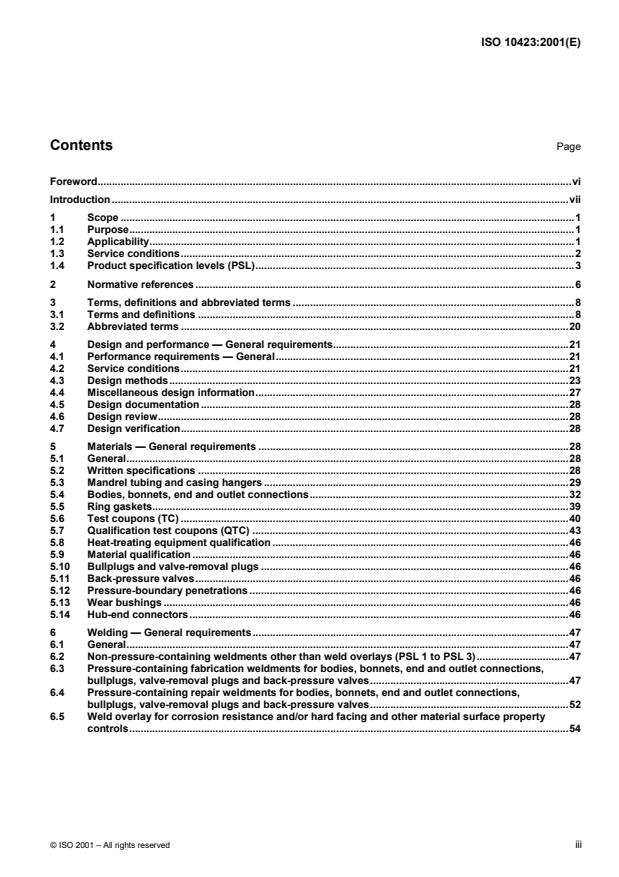
Contents Page
Foreword.vi
Introduction.vii
1 Scope .1
1.1 Purpose.1
1.2 Applicability.1
1.3 Service conditions.2
1.4 Product specification levels (PSL).3
2 Normative references .6
3 Terms, definitions and abbreviated terms .8
3.1 Terms and definitions .8
3.2 Abbreviated terms .20
4 Design and performance — General requirements.21
4.1 Performance requirements — General.21
4.2 Service conditions.21
4.3 Design methods.23
4.4 Miscellaneous design information.27
4.5 Design documentation .28
4.6 Design review.28
4.7 Design verification.28
5 Materials — General requirements .28
5.1 General.28
5.2 Written specifications .28
5.3 Mandrel tubing and casing hangers .29
5.4 Bodies, bonnets, end and outlet connections.32
5.5 Ring gaskets.39
5.6 Test coupons (TC) .40
5.7 Qualification test coupons (QTC) .43
5.8 Heat-treating equipment qualification .46
5.9 Material qualification .46
5.10 Bullplugs and valve-removal plugs .46
5.11 Back-pressure valves.46
5.12 Pressure-boundary penetrations .46
5.13 Wear bushings .46
5.14 Hub-end connectors.46
6 Welding — General requirements.47
6.1 General.47
6.2 Non-pressure-containing weldments other than weld overlays (PSL 1 to PSL 3).47
6.3 Pressure-containing fabrication weldments for bodies, bonnets, end and outlet connections,
bullplugs, valve-removal plugs and back-pressure valves.47
6.4 Pressure-containing repair weldments for bodies, bonnets, end and outlet connections,
bullplugs, valve-removal plugs and back-pressure valves.52
6.5 Weld overlay for corrosion resistance and/or hard facing and other material surface property
controls.54
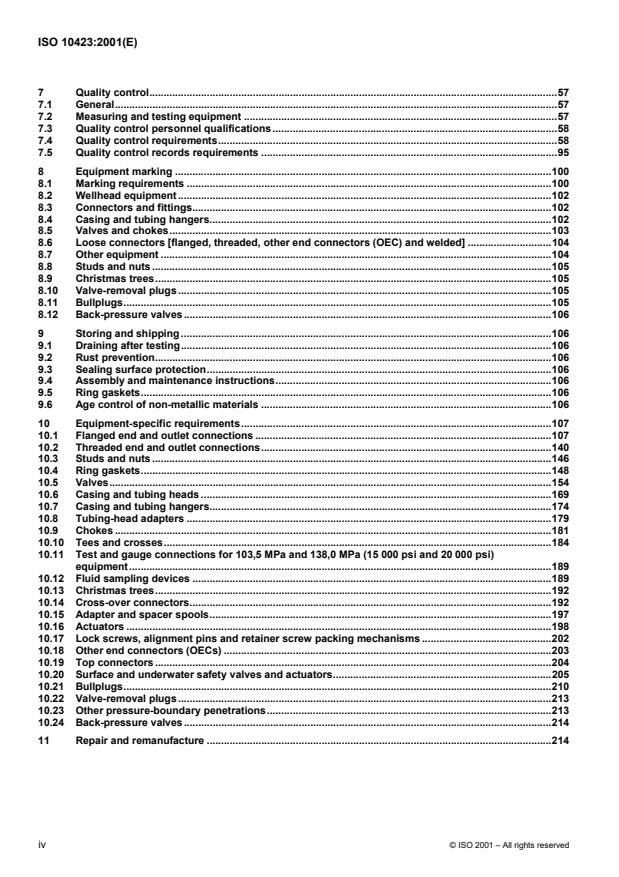
7 Quality control.57
7.1 General.57
7.2 Measuring and testing equipment .57
7.3 QuaIity control personnel qualifications.58
7.4 Quality control requirements.58
7.5 Quality control records requirements .95
8 Equipment marking .100
8.1 Marking requirements .100
8.2 Wellhead equipment.102
8.3 Connectors and fittings.102
8.4 Casing and tubing hangers.102
8.5 Valves and chokes.103
8.6 Loose connectors [flanged, threaded, other end connectors (OEC) and welded] .104
8.7 Other equipment .104
8.8 Studs and nuts .105
8.9 Christmas trees.105
8.10 Valve-removal plugs.105
8.11 Bullplugs.105
8.12 Back-pressure valves.106
9 Storing and shipping.106
9.1 Draining after testing.106
9.2 Rust prevention.106
9.3 Sealing surface protection.106
9.4 Assembly and maintenance instructions.106
9.5 Ring gaskets.106
9.6 Age control of non-metallic materials .106
10 Equipment-specific requirements.107
10.1 Flanged end and outlet connections .107
10.2 Threaded end and outlet connections.140
10.3 Studs and nuts .146
10.4 Ring gaskets.148
10.5 Valves.154
10.6 Casing and tubing heads .169
10.7 Casing and tubing hangers.174
10.8 Tubing-head adapters .179
10.9 Chokes .181
10.10 Tees and crosses.184
10.11 Test and gauge connections for 103,5 MPa and 138,0 MPa (15 000 psi and 20 000 psi)
equipment.189
10.12 Fluid sampling devices .189
10.13 Christmas trees.192
10.14 Cross-over connectors.192
10.15 Adapter and spacer spools.197
10.16 Actuators .198
10.17 Lock screws, alignment pins and retainer screw packing mechanisms .202
10.18 Other end connectors (OECs) .203
10.19 Top connectors .204
10.20 Surface and underwater safety valves and actuators.205
10.21 Bullplugs.210
10.22 Valve-removal plugs.213
10.23 Other pressure-boundary penetrations.213
10.24 Back-pressure valves.214
11 Repair and remanufacture .214
iv © ISO 2001 – All rights reserved
Annex A (informative) Purchasing guidelines.215
Annex B (informative) US customary unit tables and data for this International Standard .234
Annex C (informative) Method of calculating stud bolt lengths for type 6B and 6BX flanges.289
Annex D (informative) Recommended flange bolt torque.291
Annex E (informative) Recommended weld groove design dimensions.295
Annex F (informative) Performance verification procedures .299
Annex G (informative) Design and rating of equipment for use at elevated temperatures.333
Annex H (normative) Design and manufacture of surface wellhead running, retrieving and testing
tools, clean-out tools and wear bushings.336
Annex I (normative) Performance verification procedures for surface safety valves and underwater
safety valves.340
Annex J (normative) Repair and remanufacture requirements.348
Annex K (informative) Recommended specifications for top connectors for christmas trees.361
Annex L (normative) Specifications for valve-removal preparations and valve-removal plugs.376
Annex M (informative) List of tables and figures .391
Bibliography.401
Foreword
ISO (the International Organization for Standardization) is a worldwide federation of national standards bodies (ISO
member bodies). The work of preparing International Standards is normally carried out through ISO technical
committees. Each member body interested in a subject for which a technical committee has been established has
the right to be represented on that committee. International organizations, governmental and non-governmental, in
liaison with ISO, also take part in the work. ISO collaborates closely with the International Electrotechnical
Commission (IEC) on all matters of electrotechnical standardization.
International Standards are drafted in accordance with the rules given in the ISO/IEC Directives, Part 3.
Draft International Standards adopted by the technical committees are circulated to the member bodies for voting.
Publication as an International Standard requires approval by at least 75 % of the member bodies casting a vote.
Attention is drawn to the possibility that some of the elements of this International Standard may be the subject of
patent rights. ISO shall not be held responsible for identifying any or all such patent rights.
International Standard ISO 10423 was prepared by Technical Committee ISO/TC 67, Materials, equipment and
offshore structures for petroleum and natural gas industries, Subcommittee SC 4, Drilling and production
equipment.
This second edition cancels and replaces ISO 10419, ISO 10433 and the first edition of ISO 10423
(ISO 10423:1994).
Annexes H, I, J and L form a normative part of this International Standard. Annexes A, B, C, D, E, F, G, K and M
are for information only.
vi © ISO 2001 – All rights reserved
Introduction
This International Standard is based on API Spec 6A, seventeenth edition, February 1996, its errata and
supplement, and API Spec 6AV1, first edition, February 1996.
The contents of API Spec 14D (upon which ISO 10433 was based) and API Recommended Practice 14H (upon
which ISO 10419 was based) have been incorporated in API Spec 6A, seventeenth edition.
The International System of units (SI) is used in this International Standard. However, nominal sizes are shown as
fractions in the inch system.
The fractions and their decimal equivalents are equal and interchangeable. Metric conversions and inch
dimensions in this International Standard are based on the original fractional inch designs. Functional dimensions
have been converted into the metric system to ensure interchangeability of products manufactured in metric or inch
systems (see also annex B).
Tables referenced in the main body of this International Standard which are marked with an asterisk are repeated
in annex B in US customary units with the same table number as in the main body but with the prefix B. See also
annex M for listings of tables and figures.
Users of this International Standard should be aware that further or differing requirements may be needed for
individual applications. This International Standard is not intended to inhibit a vendor from offering, or the purchaser
from accepting, alternative equipment or engineering solutions for the individual application. This may be
particularly applicable where there is innovative or developing technology. Where an alternative is offered, the
vendor should identify any variations from this International Standard and provide details.
INTERNATIONAL STANDARD ISO 10423:2001(E)
Petroleum and natural gas industries — Drilling and production
equipment — Wellhead and christmas tree equipment
1 Scope
1.1 Purpose
This International Standard specifies requirements and gives recommendations for the performance, dimensional
and functional interchangeability, design, materials, testing, inspection, welding, marking, handling, storing,
shipment, purchasing, repair and remanufacture of wellhead and christmas tree equipment for use in the petroleum
and natural gas industries.
This International Standard does not apply to field use, field testing or field repair of wellhead and christmas tree
equipment.
1.2 Applicability
This International Standard is applicable to the following specific equipment.
a) Wellhead equipment:
� casing head housings;
� casing head spools;
� tubing head spools;
� cross-over spools;
� multi-stage head housings and spools.
b) Connectors and fittings:
� cross-over connectors;
� tubing head adapters;
� top connectors;
� tees and crosses;
� fluid-sampling devices;
� adapter and spacer spools.
c) Casing and tubing hangers:
� mandrel hangers;
� slip hangers.
d) Valves and chokes:
� single valves;
� multiple valves;
� actuated valves;
� valves prepared for actuators;
� check valves;
� chokes;
� surface and underwater safety valves and actuators;
� back-pressure valves.
e) Loose connectors [flanged, threaded, other end connectors (OEC), and welded]:
� weld neck connectors;
� blind connectors;
� threaded connectors;
� adapter and spacer connectors;
� bullplugs;
� valve-removal plugs.
f) Other equipment:
� actuators;
� hubs;
� pressure boundary penetrations;
� ring gaskets;
� running and testing tools (in annex H);
� wear bushings (in annex H).
The nomenclature used in this International Standard for typical equipment is shown in Figure 1 and Figure 2. All
parts whose physical dimensions conform to the metric tables incorporated into the body of this International
Standard or to the US customary units tables in annex B are acceptable (see Introduction).
1.3 Service conditions
This International Standard defines service conditions, in terms of pressure, temperature and material class for the
well-bore constituents, and operating conditions.
2 © ISO 2001 – All rights reserved
1.4 Product specification levels (PSL)
This International Standard establishes requirements for five product specification levels. These five PSL
designations define different levels of technical quality requirements. Annex A provides guidelines (not
requirements) for selecting an acceptable PSL.
Key
1 Back-pressure valve preparation 12 Double studded adapter
2 Subsurface safety valve control line 13 Annular casing pack-off
3 Subsurface safety valve control line outlet 14 Casing hanger (slip style)
4 Tubing head adapter 15 Threaded outlet connection
5 Lock screw 16 Bullplug
6 Tubing hanger pack-off 17 Casing head housing
7 Extended neck tubing hanger with downhole safety valve control line 18 Surface casing
8 Studded side outlet 19 Wellhead support plate
9 Valve removal preparation 20 Tubing pack-off retainer
10 Bottom casing pack-off 21 Tubing hanger (slip style)
11 Tubing head spool 22 Tubing
Figure 1 — Typical wellhead assembly nomenclature
Key
23 Studded side outlet connection 29 Casing head spool
24 Extended neck tubing hanger seal 30 Inner casing
25 Annular tubing hanger seal 31 Intermediate casing
26 Tubing hanger mandrel 32 Flanged end connection
27 Flanged outlet connection 33 Tubing hanger mandrel seals
28 Casing hanger mandrel 34 Wrap-around hanger pack-off
Figure 1 — Typical wellhead assembly nomenclature (continued)
4 © ISO 2001 – All rights reserved
Key
1 Gauge valve 7 Tee
2 Bonnet nut 8 Wing valve
3 Blanking plug 9 Choke
4 Body 10 Master valve
5 Top connector 11 Tubing head adapter
6 Swab or crown valve
Figure 2 — Typical christmas tree nomenclature
2 Normative references
The following normative documents contain provisions which, through reference in this text, constitute provisions of
this International Standard. For dated references, subsequent amendments to, or revisions of, any of these
publications do not apply. However, parties to agreements based on this International Standard are encouraged to
investigate the possibility of applying the most recent editions of the normative documents indicated below. For
undated references, the latest edition of the normative document referred to applies. Members of ISO and IEC
maintain registers of currently valid International Standards.
ISO 2859-1:1999, Sampling procedures for inspection by attributes � Part 1: Sampling schemes indexed by
acceptance quality limit (AQL) for lot-by-lot inspection.
ISO 10414-1, Petroleum and natural gas industries � Field testing of drilling and completion fluids and well
cement� Part 1: Water-based fluids.
ISO 10422, Petroleum and natural gas industries� Threading, gauging, and thread inspection of casing, tubing
and line pipe threads� Specification.
ISO 11960, Petroleum and natural gas industries� Steel pipes for use as casing or tubing for wells.
ISO 13533, Petroleum and natural gas industries� Drilling and production equipment� Specification for drill-
through equipment.
ISO 13628-4, Petroleum and natural gas industries� Design and operation of subsea production systems�
Part 4: Subsea wellhead and tree equipment.
ISO 13678, Petroleum and natural gas industries� Evaluation and testing of thread compounds for use with
casing, tubing and line pipe.
1)
API Spec 7:1997, Specification for rotary drill stem elements.
API RP 14F, Recommended practice for design and installation of electrical systems for offshore fixed and floating
production facilities for unclassified and class 1, division 1 and division 2 locations.
2)
ASME B1.1, Unified inch screw threads.
ASME B1.2, Gages and gaging for unified inch screw threads.
ASME B1.20.1, Pipe threads, general purpose (inch).
ASME Boiler and Pressure Vessel Code:1998, Section V, Non destructive examination.
ASME Boiler and Pressure Vessel Code:1998, Section VIII, Division 1, Rules for construction of pressure vessels.
ASME Boiler and Pressure Vessel Code:1998, Section VIII, Division 2, Alternative rules for construction of pressure
vessels.
ASME Boiler and Pressure Vessel Code:1998, Section IX, Welding and brazing qualifications.
3)
ASNT SNT-TC-1A, Personnel qualifications and certification in non destructive testing.
1) American Petroleum Institute, 1220 L Street North West, Washington, D.C. 20005, USA.
th
2) ASME International, 345 East 47 Street New York, NY 10017-2392, USA.
3) American Society for Non destructive Testing, 4153 Arlingate Plaza, Columbus, OH 43228-0518, USA.
6 © ISO 2001 – All rights reserved
4)
ASTM A 193/A 193 M, Standard Specification for Alloy-Steel and Stainless Steel Bolting Materials for High-
Temperature Service.
ASTM A 194/A 194M, Standard Specification for Carbon and Alloy Steel Nuts for Bolts for High-Pressure or High-
Temperature Service, or Both.
ASTM A 320/A 320M, Standard Specification for Alloy/Steel Bolting Materials for Low-Temperature Service.
ASTM A 370, Standard Test Methods and Definitions for Mechanical Testing of Steel Products.
ASTM A 388/A 388M, Standard Practice for Ultrasonic Examination of Heavy Steel Forgings.
ASTM A 453/A 453 M, Standard Specification for High-Temperature Bolting Materials, With Expansion Coefficients
Comparable to Austenitic Stainless Steels.
ASTM A 703/A 703M:1999, Standard Specification for Steel Castings, General Requirements, for Pressure-
Containing Parts.
ASTM D 395, Standard Test Methods for Rubber Property� Compression Set.
ASTM D 412, Standard Test Methods for Vulcanized Rubber and Thermoplastic Rubbers and Thermoplastic
Elastomers� Tension.
ASTM D 471, Standard Test Method for Rubber Property� Effect of Liquids.
ASTM D 1414, Standard Test Methods for Rubber O-Rings.
ASTM D 1415, Standard Test Method for Rubber Property — International Hardness.
ASTM D 1418, Standard Practice for Rubber and Rubber Latices — Nomenclature.
ASTM D 2240, Standard Test Method for Rubber Property — Durometer Hardness.
ASTM E 10, Standard Test Method for Brinell Hardness of Metallic Materials.
ASTM E 18, Standard Test Methods for Rockwell Hardness and Rockwell Superficial Hardness of Metallic
Materials.
ASTM E 92, Standard Test Method for Vickers Hardness of Metallic Materials.
ASTM E 94, Standard Guide for Radiographic Examination.
ASTM E 140, Standard Hardness Conversion Tables for Metals, (Relationship Among Brinell Hardness, Vickers
Hardness, Rockwell Hardness, Rockwell Superficial Hardness, Knoop Hardness and Scleroscope Hardness).
ASTM E 165, Standard Test Method for Liquid Penetrant Examination.
ASTM E 428, Standard Practice for Fabrication and Control of Steel Reference Blocks Used in Ultrasonic
Inspection.
ASTM E 709, Standard Guide for Magnetic Particle Examination.
ASTM E 747, Standard Practice for Design, Manufacture and Material Grouping Classification of Wire Image
Quality Indicators (IQI) Used for Radiology.
4) American Society for Testing and Materials, 1916 Race Street, Philadelphia, PA 19103-11887, USA.
5)
EN 473, Qualification and certification of NDT personnel� General principles.
6)
MSS SP-55, Quality standard for steel castings for valves, flanges and fittings and other piping components,
visual method for evaluation of surface irregularities.
7)
NACE MR 0175:1999, Standard material requirements� Sulfide stress cracking resistant metallic materials for
oilfield equipment.
8)
SAE AS 568A:1974, Aerospace size standard for O-rings.
3 Terms, definitions and abbreviated terms
3.1 Terms and definitions
For the purposes of this International Standard, the following terms and definitions apply.
3.1.1
acceptance criteria
defined limits placed on characteristics of materials, products or services
3.1.2
accessible wetted surface
wetted surface which can be viewed, for purposes of non-destructive examination, by direct line of sight
NOTE This excludes test ports, control line ports, lockdown screw holes and other penetrations of these types.
3.1.3
actuator
mechanism for the remote or automatic operation of a valve or choke
3.1.4
adapter
pressure-containing piece of equipment having end connections of different nominal sizes and/or pressure ratings,
used to connect other pieces of equipment of different nominal sizes and/or pressure ratings
3.1.5
annular packoff
mechanism that seals off annular pressure between the outside diameter of a suspended tubular member or
hanger and the inside diameter of the head or spool through which the tubular member passes or hanger is
suspended
3.1.6
as-shipped condition
condition of the product or equipment when it is ready for shipment
3.1.7
back-pressure valve
unidirectional or bidirectional check valve that is installed through the christmas tree, into the tubing hanger, and
prevents well fluids from flowing out of the well
5) European Committee for Standardization, rue de Stassart 36, Brussels B-1050, Belgium.
6) Manufacturers Standardization Society of the Valve & Fittings Industry, 127 Park Street, N.E., Vienna, VA 22180, USA.
7) NACE, P.O. Box 218340, Houston, TX 77218, USA.
8) SAE International, 400 Commonwealth Drive, Warrendale, PA 15096-0001, USA.
8 © ISO 2001 – All rights reserved
3.1.8
body
any portion of wellhead and christmas tree equipment between end connections, with or without internal parts,
which contains well-bore pressure
3.1.9
bolting closure
threaded fastener used to assemble well-bore pressure-containing parts or join end or outlet connections
EXAMPLES Studs, nuts, bolts and capscrews.
3.1.10
exposed bolting
bolting that is exposed directly to the sour environment or that is buried, insulated, equipped with flange protectors,
or otherwise denied direct atmospheric exposure
3.1.11
non-exposed bolting
bolting that is not directly exposed to sour environments and is not intended to be buried, insulated, equipped with
flange protectors, or otherwise denied direct atmospheric exposure
3.1.12
bonnet
pressure-containing closure for a body, other than an end or outlet connection
3.1.13
bottom casing packoff
mechanism that seals off annular pressure between the outside diameter of a suspended tubular member or
hanger and the inside diameter of the spool or tubing head adapter placed over the suspended tubular or hanger
3.1.14
bullplug
pressure-containing closure for a female threaded end or outlet connection, which may have an internal counter
bore and/or test port
3.1.15
calibration
comparison and adjustment to a standard of known accuracy
3.1.16
carbon steel
alloy of carbon and iron containing a maximum of 2 % carbon (mass fraction), 1,65 % manganese (mass fraction),
and residual quantities of other elements, except those intentionally added in specific quantities for deoxidation
(usually silicon and/or aluminium)
3.1.17
casing
pipe run from the surface and intended to line the walls of a drilled hole
3.1.18
casing hanger mandrel
mechanism used to support a casing string in a casing head by means of a male or female thread attached to the casing
3.1.19
slip-type casing hanger
mechanism used to support a casing string in a casing head by gripping the pipe with wedge-type members
3.1.20
casing head housing
equipment attached to the uppermost end of the surface casing which serves to suspend and seal a casing string
3.1.21
casing head spool
equipment attached to another casing head which serves to suspend and seal a secondary casing string
3.1.22
casting, noun
object at or near finished shape obtained by solidification of a fluid substance in a mould
NOTE HIP components are not considered to be a casting.
3.1.23
chemical analysis
determination of the chemical composition of material
3.1.24
choke
equipment used to restrict and control the flow of fluids
3.1.25
choke bean
flow bean
replaceable orifice part used in positive chokes to control flowrate
3.1.26
choke trim
pressure-controlling choke component, including choke beans, used to control or regulate the flow of fluids
NOTE One-piece stems, and that segment of multi-piece stems that passes through the pressure boundary, are pressure-
containing components.
3.1.27
christmas tree
assembly of equipment, including tubing head adapters, valves, tees, crosses, top connectors and chokes attached
to the uppermost connection of the tubing head, used to control well production
3.1.28
conformance
compliance with specified requirements
3.1.29
loose connector
connector, as-manufactured, not intended to be made integral with another piece of wellhead and christmas tree
equipment
EXAMPLE There are blind, threaded, spacer, welding neck, flanged, studded, or other loose connectors.
3.1.30
corrosion-resistant alloy
CRA
nonferrous-based alloy in which any one or the sum of the specified amount of the elements titanium, nickel, cobalt,
chromium, and molybdenum exceeds 50 % (mass fraction)
3.1.31
corrosion-resistant ring grooves
ring grooves lined with metal resistant to metal-loss corrosion
NOTE This metal is either a CRA or an austenitic stainless steel.
3.1.32
cross
pressure-containing fitting with a minimum of four openings
10 © ISO 2001 – All rights reserved
3.1.33
cross-over connector
adapter with a restricted-area sealing means and with a top-connection pressure rating above that of the lower
connection
3.1.34
cross-over flange
double- or single-studded adapter flange with a restricted-area sealing means and with a top-connection pressure
rating above that of the lower connection
3.1.35
cross-over spool
flanged or other connected equipment with a restricted-area sealing means, at or near the face of its lower flange
NOTE Cross-over spools are also provided with suitable means to suspend and seal around an inner string of casing or
tubing. A cross-over spool has a top connection with a pressure rating above that of the lower connection.
3.1.36
date of manufacture
date of manufacturer’s final acceptance of finished equipment
3.1.37
date of repair/remanufacture
date of repairer’s/remanufacturer’s final acceptance of finished equipment
3.1.38
dynamic seal
seal in which motion exists relative to the sealing surface after installation
3.1.39
end connection
outlet connection
integral male or female thread; hub end connector and flange, studded or through-bolted, or any other means used
to join together equipment that contains or controls pressure
3.1.40
equipment
any item or assembled equipment to which this International Standard is applicable
3.1.41
equivalent round
ER
standard for comparing various shaped sections to round bars, in determining the response to hardening
characteristics when heat-treating low alloy and martensitic corrosion-resistant steel
3.1.42
fit
geometric relationship between parts
NOTE This includes the tolerance criteria used during the design of a part and its mating part.
3.1.43
flange
protruding rim with holes to accept bolts and having a sealing mechanism used to join pressure-containing
equipment, with dimensions specified in this International Standard
3.1.43.1
blind flange
flange with no centre bore, used to close off completely a flanged end or outlet connection
3.1.43.2
loose flange
flange, as-manufactured, not intended to be made integral with equipment compliant to this International Standard
EXAMPLES Types of flanges include blind, threaded, spacer, welding neck, studded or other connected adapter flanges.
3.1.43.3
threaded flange
flange having a sealing face on one side and a female thread on the other for the purpose of joining flanged
connections to threaded connections
3.1.43.4
welding neck flange
flange with a neck on the side opposite the sealing face prepared with a bevel to weld to corresponding pipe or
transition pieces
3.1.44
forging, noun
shaped metal part formed by the forging method
3.1.45
forge,verb
deform metal plastically into desired shapes with compressive force
NOTE Forging is usually a hot process. Use of dies is optional.
3.1.46
form
essential shape of a product including all its component parts
3.1.47
function
operation of a product during service
3.1.48
gauge and test port connection
hole drilled and tapped into wellhead and christmas tree equipment through which internal pressure may be
measured or through which pressure may be applied to test the sealing mechanisms
3.1.49
hanger mandrel
portion of a casing or tubing hanger which is attached by a threaded connection to the tubular string and forms the
upper end of that tubular string
3.1.50
heat-affected zone
HAZ
portion of the base metal which has not been melted, but whose mechanical properties or microstructure has been
altered by the heat of welding or cutting
3.1.51
heat
cast lot
material originating from a final melt
NOTE For remelted alloys, a heat is the raw material originating from a single remelted ingot.
12 © ISO 2001 – All rights reserved
3.1.52
heat-sensitive lock-open device
device installed on a surface safety valve (SSV) actuator to maintain the SSV valve in a full open position until
exposed to sufficient heat to cause the device to release and allow the SSV valve to close
3.1.53
heat treat lot
�batch furnaces� material placed on loading or carry devices and moved as a batch through one heat treat cycle
3.1.54
heat treat lot
�continuous furnaces� group of pieces of material with the same nominal size that is moved sequentially through
the heat treatment process using the same process parameters
3.1.55
heat treatment
heat treating
alternating steps of controlled heating and cooling of materials for the purpose of changing physical or mechanical
properties
3.1.56
hold period
period of time that the product is subjected to pressure and isolated from the pressure source
3.1.57
hot isostatic pressing
HIP
special forming process used to compact and metallurgically bond metal powder
NOTE This process takes place within a flexible, metal container whose contents are formed into the desired shape by
subjecting the container to high temperature and pressure in an autoclave. It produces a fully wrought structure.
3.1.58
hot-work
deform metal plastically at a temperature above the recrystallization temperature
3.1.59
hub
protruding rim with an external angled shoulder and a sealing mechanism used to join pressure-containing
equipment
3.1.60
job lot traceability
ability for parts to be traced as originating from a job lot which identifies the included heat(s)
3.1.61
linear indication
surface NDE indication whose length is equal to or greater than three times its width
3.1.62
lock screw
tie-down screw
threaded pin extending through the wall of a casing head or tubing head connection used to lock down hangers or
energize seals
3.1.63
low-alloy steel
steel containing less than 5 % (mass fraction) total alloying elements, but more than that specified for carbon steel
NOTE Steels with less than 11 % chromium (mass fraction) are included in this category.
3.1.64
make-and-break,verb
connect and disconnect a connection
3.1.65
manufacturing operation
activity involving, but not limited to the machining, welding, heat treating or other processes utilized to produce a
finished product
3.1.66
material performance basis
capabilities which must be demonstrated, as a minimum, for material to satisfy the criteria of t
...
Questions, Comments and Discussion
Ask us and Technical Secretary will try to provide an answer. You can facilitate discussion about the standard in here.
Loading comments...