

ISO/IEC 14888-4:2024
(Main)Information security — Digital signatures with appendix — Part 4: Stateful hash-based mechanisms
General Information
- Abstract
This document specifies stateful digital signature mechanisms with appendix, where the level of security is determined by the security properties of the underlying hash function. This document also provides requirements for implementing basic state management, which is needed for the secure deployment of the stateful schemes described in this document.
- Status
- Published
- Publication Date
- 23-Jun-2024
- Drafting Committee
- ISO/IEC JTC 1/SC 27/WG 2 - Cryptography and security mechanisms
- Current Stage
- 6060 - International Standard published
- Start Date
- 24-Jun-2024
- Due Date
- 15-Mar-2024
- Completion Date
- 24-Jun-2024


Overview - ISO/IEC 14888-4:2024
ISO/IEC 14888-4:2024 specifies stateful hash-based digital signature mechanisms with appendix. First published in 2024 as Part 4 of the ISO/IEC 14888 series, this international standard defines hash-based signature schemes whose security depends solely on the strength of the underlying hash function. Because these schemes are stateful, the standard also provides requirements and guidance for basic state management needed to safely deploy the described algorithms.
Keywords: ISO/IEC 14888-4, stateful hash-based signatures, post-quantum digital signatures, XMSS, LMS, HSS, WOTS+, Merkle tree, state management.
Key technical topics and requirements
- Hash-based signature families covered
- XMSS and XMSS-MT (eXtended Merkle Signature Scheme and multi-tree variant)
- LMS and HSS (Leighton–Micali Signature and Hierarchical Signature Scheme)
- Auxiliary one-time schemes such as WOTS+ and LM-OTS
- Core building blocks and algorithms
- Definitions and algorithms for key generation, signing, verification, and authentication path computation
- Use of Merkle trees, L-tree structures, and Winternitz parameters
- State management
- Mandatory requirements to update and protect signer state (private-key usage counters, indices, etc.) to prevent reuse that would compromise security
- Guidance aimed at robust deployment to avoid forgery due to incorrect state handling
- Supporting material
- Suggested parameter sets, byte order conventions, checksum methods, and ASN.1 object identifiers/module (Annex A)
- Informative annexes with relations to other standards and numerical examples
Note: The standard intentionally ties security to the cryptographic hash function chosen; it does not introduce new hash primitives.
Practical applications and who should use it
- Use cases
- Post-quantum-resilient digital signatures for software and firmware signing, secure boot, software distribution, code-signing, long-term archival integrity, and secure logging
- Signature solutions for constrained or embedded systems where hash-based schemes are attractive
- Primary users
- Security architects, cryptographic engineers, PKI operators, firmware and IoT device vendors, standards bodies, and implementers seeking quantum-resistant signature options
- Benefits
- Predictable security based on hash function properties and standardized algorithms for interoperable implementations
Related standards
- Part of the ISO/IEC 14888 family (see Parts 2 and 3 for algorithm classes based on integer factorization and discrete logarithms). Annex B of 14888-4 discusses relations to other standards and deployment considerations.
Get Certified
Connect with accredited certification bodies for this standard

BSI Group
BSI (British Standards Institution) is the business standards company that helps organizations make excellence a habit.

Bureau Veritas
Bureau Veritas is a world leader in laboratory testing, inspection and certification services.

DNV
DNV is an independent assurance and risk management provider.
Sponsored listings
Frequently Asked Questions
ISO/IEC 14888-4:2024 is a standard published by the International Organization for Standardization (ISO). Its full title is "Information security — Digital signatures with appendix — Part 4: Stateful hash-based mechanisms". This standard covers: This document specifies stateful digital signature mechanisms with appendix, where the level of security is determined by the security properties of the underlying hash function. This document also provides requirements for implementing basic state management, which is needed for the secure deployment of the stateful schemes described in this document.
This document specifies stateful digital signature mechanisms with appendix, where the level of security is determined by the security properties of the underlying hash function. This document also provides requirements for implementing basic state management, which is needed for the secure deployment of the stateful schemes described in this document.
ISO/IEC 14888-4:2024 is classified under the following ICS (International Classification for Standards) categories: 35.030 - IT Security. The ICS classification helps identify the subject area and facilitates finding related standards.
ISO/IEC 14888-4:2024 is available in PDF format for immediate download after purchase. The document can be added to your cart and obtained through the secure checkout process. Digital delivery ensures instant access to the complete standard document.
Standards Content (Sample)
International
Standard
ISO/IEC 14888-4
First edition
Information security — Digital
2024-06
signatures with appendix —
Part 4:
Stateful hash-based mechanisms
Sécurité de l'information — Signatures digitales avec
appendice —
Partie 4: Mécanismes basés sur le hachage dynamique
Reference number
© ISO/IEC 2024
All rights reserved. Unless otherwise specified, or required in the context of its implementation, no part of this publication may
be reproduced or utilized otherwise in any form or by any means, electronic or mechanical, including photocopying, or posting on
the internet or an intranet, without prior written permission. Permission can be requested from either ISO at the address below
or ISO’s member body in the country of the requester.
ISO copyright office
CP 401 • Ch. de Blandonnet 8
CH-1214 Vernier, Geneva
Phone: +41 22 749 01 11
Email: copyright@iso.org
Website: www.iso.org
Published in Switzerland
© ISO/IEC 2024 – All rights reserved
ii
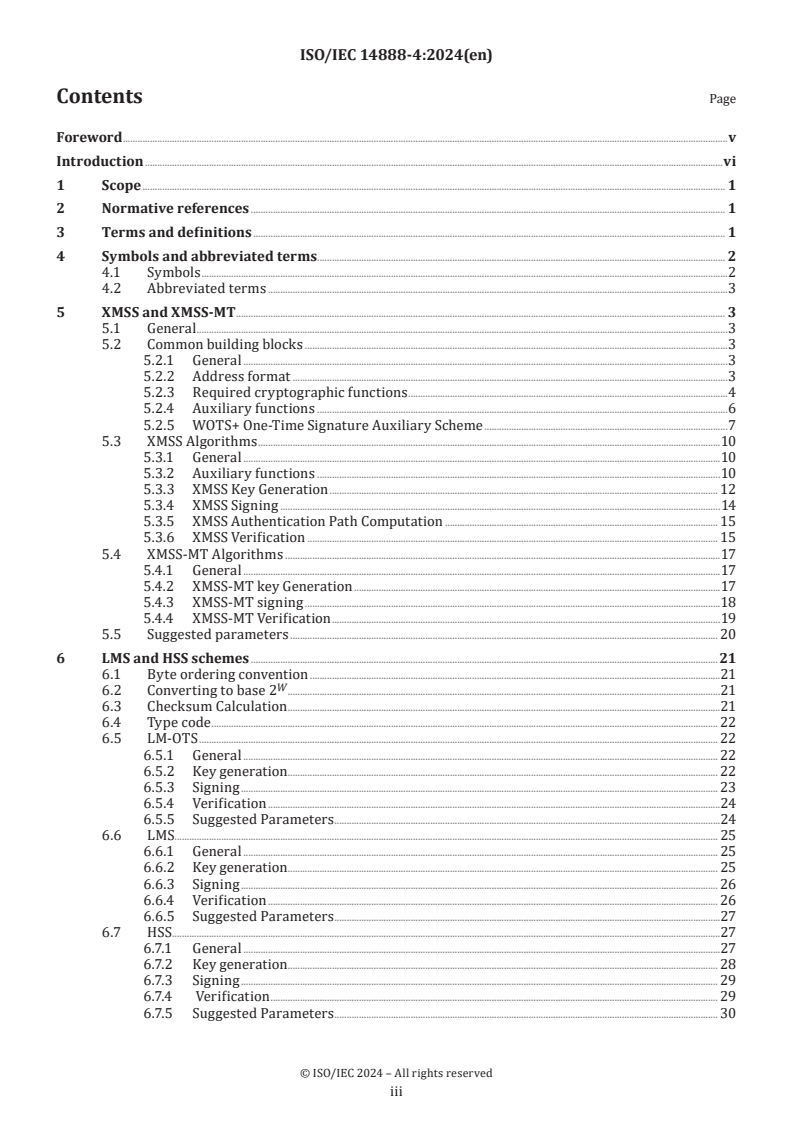
Contents Page
Foreword .v
Introduction .vi
1 Scope . 1
2 Normative references . 1
3 Terms and definitions . 1
4 Symbols and abbreviated terms. 2
4.1 Symbols .2
4.2 Abbreviated terms .3
5 XMSS and XMSS-MT . 3
5.1 General .3
5.2 Common building blocks .3
5.2.1 General .3
5.2.2 Address format .3
5.2.3 Required cryptographic functions .4
5.2.4 Auxiliary functions .6
5.2.5 WOTS+ One-Time Signature Auxiliary Scheme .7
5.3 XMSS Algorithms .10
5.3.1 General .10
5.3.2 Auxiliary functions .10
5.3.3 XMSS Key Generation . 12
5.3.4 XMSS Signing .14
5.3.5 XMSS Authentication Path Computation . 15
5.3.6 XMSS Verification . 15
5.4 XMSS-MT Algorithms .17
5.4.1 General .17
5.4.2 XMSS-MT key Generation .17
5.4.3 XMSS-MT signing .18
5.4.4 XMSS-MT Verification .19
5.5 Suggested parameters . 20
6 LMS and HSS schemes .21
6.1 Byte ordering convention .21
W
6.2 Converting to base 2 .21
6.3 Checksum Calculation .21
6.4 Type code . 22
6.5 LM-OTS . 22
6.5.1 General . 22
6.5.2 Key generation . . 22
6.5.3 Signing . 23
6.5.4 Verification .24
6.5.5 Suggested Parameters .24
6.6 LMS. 25
6.6.1 General . 25
6.6.2 Key generation . . 25
6.6.3 Signing . 26
6.6.4 Verification . 26
6.6.5 Suggested Parameters .27
6.7 HSS . .27
6.7.1 General .27
6.7.2 Key generation . . 28
6.7.3 Signing . 29
6.7.4 Verification . 29
6.7.5 Suggested Parameters . 30
© ISO/IEC 2024 – All rights reserved
iii
7 State management .30
Annex A (normative) Object identifiers and ASN.1 module .31
Annex B (informative) Relation to other standards .33
Annex C (informative) Numerical examples .34
Bibliography .56
© ISO/IEC 2024 – All rights reserved
iv
Foreword
ISO (the International Organization for Standardization) and IEC (the International Electrotechnical
Commission) form the specialized system for worldwide standardization. National bodies that are
members of ISO or IEC participate in the development of International Standards through technical
committees established by the respective organization to deal with particular fields of technical activity.
ISO and IEC technical committees collaborate in fields of mutual interest. Other international organizations,
governmental and non-governmental, in liaison with ISO and IEC, also take part in the work.
The procedures used to develop this document and those intended for its further maintenance are described
in the ISO/IEC Directives, Part 1. In particular, the different approval criteria needed for the different types
of document should be noted. This document was drafted in accordance with the editorial rules of the ISO/
IEC Directives, Part 2 (see www.iso.org/directives or www.iec.ch/members_experts/refdocs).
ISO and IEC draw attention to the possibility that the implementation of this document may involve the
use of (a) patent(s). ISO and IEC take no position concerning the evidence, validity or applicability of any
claimed patent rights in respect thereof. As of the date of publication of this document, ISO and IEC had not
received notice of (a) patent(s) which may be required to implement this document. However, implementers
are cautioned that this may not represent the latest information, which may be obtained from the patent
database available at www.iso.org/patents and https://patents.iec.ch. ISO and IEC shall not be held
responsible for identifying any or all such patent rights.
Any trade name used in this document is information given for the convenience of users and does not
constitute an endorsement.
For an explanation of the voluntary nature of standards, the meaning of ISO specific terms and expressions
related to conformity assessment, as well as information about ISO's adherence to the World Trade
Organization (WTO) principles in the Technical Barriers to Trade (TBT) see www.iso.org/iso/foreword.html.
In the IEC, see www.iec.ch/understanding-standards.
This document was prepared by Joint Technical Committee ISO/IEC JTC 1, Information technology,
Subcommittee SC 27, Information security, cybersecurity and privacy protection.
A list of all parts in the ISO/IEC 14888 series can be found on the ISO and IEC websites.
Any feedback or questions on this document should be directed to the user’s national standards
body. A complete listing of these bodies can be found at www.iso.org/members.html and
www.iec.ch/national-committees.
© ISO/IEC 2024 – All rights reserved
v
Introduction
Digital signatures with appendix are designed to offer integrity, authentication and non-repudiation.
ISO/IEC 14888-2 specifies the class of digital signature mechanisms in which the security is based on the
difficulty of integer factorization. ISO/IEC 14888-3 specifies the class in which the security is based on
computing discrete logarithms. Unfortunately, if and when a large-scale general purpose quantum computer
[1]
becomes available, all of these techniques will no longer be secure for practical key sizes.
This document specifies a class of digital signatures whose security depends only on the security of the
underlying hash function. At the time of publication of this document, standardized hash functions are
believed to be secure even against attacks using large scale quantum computers. Hence, the schemes
specified in this document do not suffer from the same problems as the schemes specified in ISO/IEC 14888-2
and ISO/IEC 14888-3.
The hash-based signature (HBS) schemes specified in this document are stateful schemes, whereby the
private key is part of the state of the scheme. This means that at every signature generation, state information
held by the signer must be updated, as otherwise the security of the scheme is compromised. Therefore,
when deploying any of the schemes specified in this document, it is expected that robust state-management
practices are implemented to ensure that state information is correctly updated.
© ISO/IEC 2024 – All rights reserved
vi
International Standard ISO/IEC 14888-4:2024(en)
Information security — Digital signatures with appendix —
Part 4:
Stateful hash-based mechanisms
1 Scope
This document specifies stateful digital signature mechanisms with appendix, where the level of security is
determined by the security properties of the underlying hash function.
This document also provides requirements for implementing basic state management, which is needed for
the secure deployment of the stateful schemes described in this document.
2 Normative references
There are no normative references in this document.
3 Terms and definitions
For the purposes of this document, the following terms and definitions apply.
ISO and IEC maintain terminology databases for use in standardization at the following addresses:
— ISO Online browsing platform: available at https:// www .iso .org/ obp
— IEC Electropedia: available at https:// www .electropedia .org/
3.1
authentication path
list of hash values that show that a specific node belongs to a Merkle tree (3.5)
3.2
balanced binary tree
ordered tree in which each node has exactly two other nodes that are directly subordinate
3.3
binary tree
ordered tree in which each node has at most two other nodes that are directly subordinate
[SOURCE: ISO/IEC -2382: 2015, 2121636, modified — notes to entry have been removed.]
3.4
L-tree
unbalanced binary tree (3.3) used to compress the Winternitz+ One-Time Signature Scheme (WOTS+) public
keys in the eXtended Merkle Signature Scheme (XMSS)
3.5
Merkle tree
balanced binary tree (3.2), where each node of the tree corresponds to the hash of the labels of the child nodes
3.6
one-time signature
digital signature scheme where the security is limited to signing a single message for a given key pair
© ISO/IEC 2024 – All rights reserved
3.7
state
state information
information regarding key usage stored with an eXtended Merkle Signature Scheme (XMSS) or Leighton-
Micali signature scheme (LMS) private key
3.8
state management
processes by which the state (3.7) is updated with each signature
Note 1 to entry: This is a crucial part of any stateful hash-based signature, as incorrect state information can lead to
signature forgeries.
3.9
Winternitz parameter
parameter in the Winternitz one-time signature (3.6) scheme, which allows a trade-off between signature
size and computation time
4 Symbols and abbreviated terms
4.1 Symbols
0x00
the hexadecimal representation of the 0 byte
a || b concatenation of the bit sequences a and b in the order specified
a * b multiplication of a and b
a & b bitwise logical AND of two bit strings a and b
a XOR b bitwise logical EXCLUSIVE OR of two bit strings a and b
a mod b the remainder when a is divided by b
a << x the result of left-shifting a bit-string a by x positions (e.g. 0x08 << 1 = 0x10)
a >> x the result of right-shifting a bit-string a by x positions (e.g. 0x08 >> 1 = 0x04)
ceil(x) the least integer greater than or equal to x
d the number of layers of sub-trees in XMSS-MT
floor(x) the greatest integer less than or equal to x
h total height of the Merkle tree (or hyper tree for XMSS-MT and HSS)
NOTE 1 h is the parameter which controls the maximum number of signatures, which are
h
given by 2 .
lb(x) the base 2 logarithm of x
n the length in bytes of one element of the private key, public key or signature, and the
length of the message representative
m the arbitrary length message to be signed in XMSS, XMSS-MT, LM-OTS, LMS, and HSS
M’ the message representative signed in XMSS and XMSS-MT
toByte(x,y) computation of the y-byte string containing the binary representation of x in big-endian
byte order
© ISO/IEC 2024 – All rights reserved
w the Winternitz parameter used in the XMSS and XMSS-MT algorithms
NOTE 2 w controls the trade-off between computation time and signature size. Smaller
values of w/W lead to faster computations, while larger values of w lead to smaller signatures.
W the Winternitz parameter used in the LMS and HSS algorithms. W and w are related as
W
follows: w= 2 .
x[i] the ith element of the array x
[X] the result of truncating X to its leftmost y bits, e.g. [0xfe] = 0xf
y 4
4.2 Abbreviated terms
HBS hash-based signature
HSS hierarchical signature scheme
LMS Leighton-Micali signature scheme
OTS one-time signature
RBG random bit generator
WOTS+ Winternitz+ One-Time signature scheme
XMSS eXtended Merkle Signature Scheme
XMSS-MT eXtended Merkle Signature Scheme Multi Tree
5 XMSS and XMSS-MT
5.1 General
The XMSS scheme is a stateful hash-based signature scheme for which only a limited number of signatures
can be created using a particular private key. The security of XMSS is based on the hardness of the Target
Collision Resistance (TCR) problem, and XMSS has been proven to be secure in the standard model (see
Reference [13]).
The XMSS-MT scheme, a variant of the XMSS scheme, is a stateful hash-based signature scheme that supports
[14]
a larger number of signatures than XMSS. XMSS-MT inherits all the security properties of XMSS.
The OIDs for these algorithms shall be in accordance with Annex A. Test vectors can be found in Annex C.
5.2 Common building blocks
5.2.1 General
The XMSS and the XMSS-MT schemes are described in a unified way since they employ common building blocks.
5.2.2 Address format
The ADRS input has three different address formats (see Table 1). Each layout is appropriate for a different
step of the algorithms:
— the OTS address format is for the hash calls in the one-time signature schemes;
— the L-tree address format is for hashes used in the L-trees;
© ISO/IEC 2024 – All rights reserved
— the hash tree address format is for the Merkle-tree construction.
An L-tree is an unbalanced binary hash tree used to compute the leaves of the main XMSS binary hash tree.
Each ADRS address format consists of six 32-bit fields and one 64-bit field. The fields are encoded as unsigned
integers. The layerAddress field refers to the layer in a multi-tree construction (0 if not using multi-trees).
The treeAddress refers to the position (from left to right) of a tree in a multi-tree construction (0 if not using
multi-trees). The field type differentiates the three ADRS layouts: 0 for OTS, 1 for L-tree and 2 for Hash tree.
The field keyAndMask is used to distinguish if the hash call intends to generate a key (0) or a bitmask (1) for
an OTS address. In the case of the L-tree and Hash tree address, keyAndMask is: (0) to generate a key, (1) to
generate the most significant n bytes of the 2n-byte bitmask and (2) to generate the least significant n bytes
of the 2n-byte bitmask.
Table 1 — XMSS address formats
OTS address L-tree address Hash tree address
+---------------------+ +---------------------+ +---------------------+
| layerAddress (32 bits)| | layerAddress (32 bits)| | layerAddress (32 bits)|
+---------------------+ +---------------------+ +---------------------+
| treeAddress (64 bits)| | treeAddress (64 bits)| | treeAddress (64 bits)|
+---------------------+ +---------------------+ +---------------------+
| type = 0 (32 bits)| | type = 1 (32 bits)| | type = 2 (32 bits)|
+---------------------+ +---------------------+ +---------------------+
| OTSAddress (32 bits)| | ltreeAddress (32 bits)| | padding = 0 (32 bits)|
+---------------------+ +---------------------+ +---------------------+
| chainAddress (32 bits)| | treeHeight (32 bits)| | treeHeight (32 bits)|
+---------------------+ +---------------------+ +---------------------+
| hashAddress (32 bits)| | treeIndex (32 bits)| | treeIndex (32 bits)|
+---------------------+ +---------------------+ +---------------------+
| keyAndMask (32 bits)| | keyAndMask (32 bits)| | keyAndMask (32 bits)|
+---------------------+ +---------------------+ +---------------------+
NOTE Each XMSS Address in this table is 32-bytes.
The field OTSAddress encodes the index of the OTS key pair within the tree, the chainAddress encodes the
chain index and finally the hashAddress encodes the hash function call index within the chain.
In the L-tree address layout, the ltreeAddress field encodes the index of the leaf computed with this L-tree.
The treeHeight encodes the height of the node used as input for the next computation inside the L-tree. The
treeIndex encodes the index of the node at that height, inside the L-tree.
In the tree hash address format, the padding field is always 0. The treeHeight encodes the height of the tree
node being used for the next computation, followed by the treeIndex which is the node index at that height.
For the L-tree address layout, the keyAndMask field can be: 0 (key), 1 (first bitmask), and 2 (second bitmask).
5.2.3 Required cryptographic functions
5.2.3.1 General
The XMSS scheme uses the following cryptographic primitives:
— Keyed Hash-Function F(KEY, M), where KEY is an n-byte key, M is an n-byte message and the output is n bytes.
— Keyed Hash-Function H(KEY, M), where KEY is an n-byte key, M is a 2n-byte message and the output is n bytes.
— Keyed Hash-Function H_msg(KEY, M), where KEY is a 3n-byte key, M is an arbitrary length message and
the output is n bytes.
— Pseudo-Random Function PRF(KEY, M), where KEY is an n-byte key, M is a 32-byte message and the
output is n bytes.
© ISO/IEC 2024 – All rights reserved
— Pseudo-Random Function PRF (KEY, M), where KEY is an n-byte key, M is a 32-byte message and the
Keygen
output is n bytes. This function is optional and only used if WOTS+ private keys are generated pseudo-
randomly.
— Pseudo-Random Function PRF (KEY, M), where KEY is an n-byte key, M is a 32-byte message and
Keygen_MT
the output is n bytes. This function is only used in XMSS_keygen if called from XMSS_MT_keygen.
— A non-deterministic random number generator RBG that provides at least a security level of 8n bits.
These functions shall be implemented with SHA2-256 (Dedicated Hash-Function 4 defined in
ISO/IEC 10118-3), SHAKE256 (see ISO/IEC 10118-3:2018, C.2) as described below (see Annex B for further
considerations on these instantiations).
5.2.3.2 Functions Based on SHA2-256
When using SHA2-256 as the underlying hash function and n=32, the following constructions shall be used.
— F(KEY, M): SHA2-256(toByte(0, 32) || KEY || M)
— H(KEY, M): SHA2-256(toByte(1, 32) || KEY || M)
— H_msg(KEY, M): SHA2-256(toByte(2, 32) || KEY || M)
— PRF(KEY, M): SHA2-256(toByte(3, 32) || KEY || M)
— PRF (KEY, M): SHA2-256(toByte(4, 32) || KEY || M)
Keygen
— PRF (KEY, M): SHA2-256(toByte(5, 32) || KEY || M)
Keygen_MT
When using SHA2-256 as the underlying hash function and n=24, the following constructions shall be used.
— F(KEY, M): SHA2-256/192(toByte(0, 4) || KEY || M)
— H(KEY, M): SHA2-256/192(toByte(1, 4) || KEY || M)
— H_msg(KEY, M): SHA2-256/192(toByte(2, 4) || KEY || M)
— PRF(KEY, M): SHA2-256/192(toByte(3, 4) || KEY || M)
— PRF (KEY, M): SHA2-256/192(toByte(4, 4) || KEY || M)
Keygen
— PRF (KEY, M): SHA2-256/192(toByte(5, 4) || KEY || M)
Keygen_MT
5.2.3.3 Functions Based on SHAKE
When using SHAKE256 and n=32, the following constructions shall be used.
— F(KEY, M): SHAKE256(toByte(0, 32) || KEY || M, 256)
— H(KEY, M): SHAKE256(toByte(1, 32) || KEY || M, 256)
— H_msg(KEY, M): SHAKE256(toByte(2, 32) || KEY || M, 256)
— PRF(KEY, M): SHAKE256(toByte(3, 32) || KEY || M, 256)
— PRF (KEY, M): SHAKE256(toByte(4, 32) || KEY || M, 256)
Keygen
— PRF (KEY, M): SHAKE256(toByte(5, 32) || KEY || M, 256)
Keygen_MT
When using SHAKE256 and n=24, the following constructions shall be used.
— F(KEY, M): SHAKE256(toByte(0, 4) || KEY || M, 192)
— H(KEY, M): SHAKE256(toByte(1, 4) || KEY || M, 192)
© ISO/IEC 2024 – All rights reserved
— H_msg(KEY, M): SHAKE256(toByte(2, 4) || KEY || M, 192)
— PRF(KEY, M): SHAKE256(toByte(3, 4) || KEY || M, 192)
— PRF (KEY, M): SHAKE256(toByte(4, 4) || KEY || M, 192)
Keygen
— PRF (KEY, M): SHAKE256(toByte(5, 4) || KEY || M, 192)
Keygen_MT
5.2.4 Auxiliary functions
5.2.4.1 General
Both XMSS and XMSS-MT make use of two auxiliary functions, namely the base_w function and the chain
function. The specifications of these auxiliary functions are given in 5.2.4.2 and 5.2.4.3.
5.2.4.2 base_w auxiliary function
This function is used in the signing and verification process to convert a string of bytes into a sequence of
base w integers (i.e. integers between 0 and w-1).
Algorithm: base_w(X, w, out_len).
Input: A sequence of bytes X = X[0], … , X[len_x - 1] of length len_x, the base w which shall be 4 or 16, and the
output length out_len.
Output: A sequence of integers Q = Q[0],…, Q[out_len-1] of length out_len from the set {0,1,…,w-1}
Steps:
a) Set in = 0, out = 0, total = 0, bits = 0.
b) For i from 0 to out_len - 1:
1) If bits is equal to 0 then
i) Set total = X[in].
ii) Set in = in + 1.
iii) Set bits = 8.
2) Set bits = bits - lb(w).
3) Set Q[out] = (total >> bits) & (w - 1).
4) Set out = out + 1.
c) Return Q.
5.2.4.3 Chain auxiliary function
The chain function is the main building block of the XMSS and XMSS-MT schemes. This is the function used
multiple times to produce the public key and signature from the private key material.
Algorithm: chain(X, i, s, SEED, ADRS).
Input: A string X, starting index i, length s of the hash chain to be computed, n-byte value SEED, 32-byte value
ADRS formatted as an OTS address according to Table 1.
Output: An n-byte value output
© ISO/IEC 2024 – All rights reserved
Steps:
a) If s is equal to 0, then return X.
b) If (i + s) > w - 1, then return NULL.
c) Set tmp = chain(X, i, s - 1, SEED, ADRS).
d) Set ADRS.hashAddress = (i + s - 1).
e) Set ADRS.keyAndMask = 0.
f) Set KEY = PRF(SEED, ADRS).
g) Set ADRS.keyAndMask = 1.
h) Set BM = PRF(SEED, ADRS).
i) Return F(KEY, tmp XOR BM).
5.2.5 WOTS+ One-Time Signature Auxiliary Scheme
5.2.5.1 General
Both XMSS and XMSS-MT make use of an underlying one-time signature scheme called WOTS+. A one-time
signature scheme has limited applicability because a signing key can only be used to sign a single message.
If the same one-time signing key is used twice, the scheme loses its security guarantees (in particular,
signature forgery becomes possible). WOTS+ shall not be used outside the context of XMSS and XMSS-MT.
5.2.5.2 gives the definition of WOTS+ key generation, signing and verification, which are algorithms used by
XMSS/XMSS-MT key generation, signing and verification, respectively.
5.2.5.2 WOTS+ key generation
5.2.5.2.1 General
5.2.5.2.2, 5.2.5.2.3 and 5.2.5.2.4 describe the key generation process for WOTS+. There are two possible
methods to create the private key: 1) generate the private key from a single seed (5.2.5.2.2), and 2) generate
a uniform random private key (5.2.5.2.3). The main difference is that the method described in 5.2.5.2.2 is
more memory-efficient as it uses a pseudo-random function to generate all WOTS+ private key elements
from a single seed, while the one described in 5.2.5.2.3 does not introduce an additional security assumption
regarding the pseudo-random function step.
Throughout the document, various other algorithms are required to generate WOTS+ private keys. For
those, it is always assumed that the pseudo-random method described in 5.2.5.2.2 is used. Trivial changes
(omitted for simplicity) to these algorithms are allowed so that the method described in 5.2.5.2.3 is used
instead, at the cost of storing all WOTS+ private keys. The public key generation given in 5.2.5.2.4 is the
same for both private key generation methods.
5.2.5.2.2 WOTS+ Private Key (pseudo-random)
This algorithm generates a WOTS+ private key. This method is called by the XMSS and XMSS-MT signatures
schemes and makes use of SK_S, which works as a seed for the generation of all WOTS+ private keys. This
method also receives an index idx which specifies what WOTS+ private key is required to be generated
h
(among the 2 possible ones), and the layer L and tree address T to identify the XMSS sub-tree (relevant
when using the XMSS-MT variant).
Algorithm: WOTS+_generate_privkey(SK_S, SEED, idx, L, T).
Input: An n-byte string SK_S, public seed SEED, an integer idx, layer L, tree address T.
Output: A sequence of n-byte values sk of length len.
© ISO/IEC 2024 – All rights reserved
Steps:
a) Set ADRS = toByte(0, 32).
b) Set ADRS.layerAddress = L.
c) Set ADRS.treeAddress = T.
d) Set ADRS.OTSAddress = idx.
e) Set ADRS.hashAddress = 0.
f) For i from 0 to len - 1:
1) Set ADRS.chainAddress = i.
2) Set sk[i] = PRF (SK_S, SEED || ADRS)
Keygen
g) Return sk.
5.2.5.2.3 WOTS+ private key (random)
This algorithm generates a WOTS+ private key.
Algorithm: WOTS+_generate_privkey_random().
Input: None.
Output: A sequence of n-byte values sk of length len.
Steps:
a) For i from 0 to len - 1:
1) Let sk[i] be an n-byte string from the output generation function of an RBG
b) Return sk.
5.2.5.2.4 WOTS+ public key
This algorithm generates a WOTS+ public key from a private key. It should be noted that the SEED used here
is public information that is also made available to the verifier.
Algorithm: WOTS+_generate_pubkey(sk, SEED, ADRS).
Input: Sequence of n-byte strings sk of length len, n-byte SEED, a 32-byte ADRS formatted as an OTS address
according to Table 1.
Output: Sequence of n-byte strings pk of length len.
Steps:
a) For i from 0 to len - 1:
1) Set ADRS.chainAddress = i.
2) Set pk[i] = chain(sk[i], 0, w - 1, SEED, ADRS).
b) Return pk.
© ISO/IEC 2024 – All rights reserved
5.2.5.3 WOTS+ signing
This algorithm generates a signature from a private key and a message. The values len and len used in
1 2
WOTS+_sign are constants derived from the parameters n and w:
— len = ceil(8*n/lb(w))
— len = floor(lb(len * (w - 1)) / lb(w)) + 1
2 1
Algorithm: WOTS+_sign(sk, m, SEED, ADRS).
Input: A private key SK, a message M’ of length n bytes to be signed, n-byte SEED, a 32-byte ADRS formatted
as an OTS address according to Table 1.
Output: Signature sig for the message M’.
Steps:
a) Set csum = 0.
b) Set msg = base_w(M’, w, len ).
c) For i from 0 to len - 1:
1) Set csum = csum + w - 1 - msg[i].
d) Set csum = csum << (8 - ((len * lb(w)) mod 8)).
e) Set len2_bytes = ceil((len * lb(w)) / 8).
f) Set msg = msg || base_w(toByte(csum, len2_bytes), w, len ).
g) For i from 0 to len - 1:
1) Set ADRS.chainAddress = i.
2) Set sig[i] = chain(SK[i], 0, msg[i], SEED, ADRS).
h) Return sig.
5.2.5.4 WOTS+ verification
5.2.5.4.1 Compute the WOTS+ public key
This algorithm verifies if a signature is authentic given a signature, a public key and a message. The WOTS+
verification process is divided into two parts. The first one recomputes the WOTS+ public key from the
WOTS+ signature. The second one checks if the recomputed WOTS+ public key matches the original one.
When used in the context of XMSS or XMSS-MT signature verification, only the first part of the WOTS+
verification process is performed, i.e. the WOTS+ public key recovery step. It is never compared with any other
WOTS+ public key. This verification is implicitly done at the XMSS or XMSS-MT signature verification level.
This algorithm computes a WOTS+ public key from a message and its signature.
Algorithm: WOTS+_pk_from_sig(sig, M’, SEED, ADRS).
Input: A signature sig, a message M’ of length n bytes, n-byte SEED, a 32-byte ADRS formatted as an OTS
address according to Table 1.
Output: A public key candidate tmp_pk.
Steps:
a) Set csum = 0.
© ISO/IEC 2024 – All rights reserved
b) Set msg = base_w(M’, w, len ).
c) For i from 0 to len - 1:
1) Set csum = csum + w - 1 - msg[i].
d) Set csum = csum << (8 - ((len * lb(w)) mod 8)).
e) Set len2_bytes = ceil((len * lb(w)) / 8).
f) Set msg = msg || base_w(toByte(csum, len2_bytes), w, len ).
g) For i from 0 to len - 1:
1) Set ADRS.chainAddress = i.
2) Set tmp_pk[i] = chain(sig[i], msg[i], w - 1 - msg[i], SEED, ADRS).
h) Return tmp_pk.
5.3 XMSS Algorithms
5.3.1 General
The XMSS scheme is a multi-time stateful signature scheme that allows for a large but fixed number of
signatures. It uses the WOTS+ one-time signature scheme as a building block. It also uses a perfectly balanced
binary tree, called a Merkle tree. This binary tree has height h/d (for XMSS, d = 1 and therefore h/d = h, while
for XMSS-MT d > 1). For the sake of simplicity, the height can be considered to be h, since this refers to XMSS
h
specifically. A tree of height h has exactly 2 leaf nodes. Each leaf node represents one WOTS+ key pair that
h
can be used to generate one signature. In practice, such a binary tree represents a set of 2 WOTS+ key pairs,
h
thus an XMSS instantiation with parameter h allows up to 2 signatures.
To prevent reusing the same WOTS+ key pair, each leaf node (which is associated with a WOTS+ key pair)
h
is numbered from 0 to (2 - 1), where the leftmost leaf node has index 0. After producing a new WOTS+
signature, the index shall be increased by 1. This process shall be flawlessly performed since reusing the
same WOTS+ key pair more than once voids its security guarantees. This process makes the XMSS scheme a
stateful scheme, meaning that the signer shall flawlessly update this index after each signature.
An XMSS signature essentially consists of two things: a WOTS+ signature and the authentication path,
which is a set of nodes of the Merkle tree. The WOTS+ signature is used to re-generate the WOTS+ public
key associated with the current leaf node. The WOTS+ public key plus the authentication path are enough
information for a verifier to reconstruct the root of the Merkle tree. If the re-computed root node matches
with the XMSS public key, the verifier then knows that the signature is authentic.
There are several methods to compute authentication paths, and each one offers a different performance
profile, although all of them should compute exactly the same authentication path for a given signature.
The key generation and signing algorithms (for both XMSS and XMSS-MT) assume that the pseudo-random
WOTS+ private key generation method described in 5.2.5.2.2 is used. In this case, the WOTS+ private keys
are generated from a seed SK_S contained in the private key SK. If the random method described in 5.2.5.2.3
is used instead, the XMSS private key will not have a SK_S element, but rather the WOTS+ private keys
instead.
5.3.2 Auxiliary functions
5.3.2.1 RAND_HASH
This algorithm implements the randomized tree hashing.
Algorithm: RAND_HASH(LEFT, RIGHT, SEED, ADRS).
© ISO/IEC 2024 – All rights reserved
Input: An n-byte string LEFT, an n-byte string RIGHT, an n-byte string SEED, a 32-byte string ADRS formatted
according to Table 1 as either an L-tree Address or a Hash tree Address.
Output: An n-byte string.
Steps:
a) Set ADRS.keyAndMask = 0.
b) Set KEY = PRF(SEED, ADRS).
c) Set ADRS.keyAndMask = 1.
d) Set BM =PRF(SEED, ADRS).
e) Set ADRS.keyAndMask = 2.
f) Set BM = PRF(SEED, ADRS).
g) Return H(KEY, (LEFT XOR BM ) || (RIGHT XOR BM )).
0 1
5.3.2.2 L_TREE
This algorithm compresses a WOTS+ public key pk into a single n-byte value pk[0].
Algorithm: L_TREE(pk, SEED, ADRS).
Input: A sequence of n-byte strings pk of length len, public SEED, and 32-byte address ADRS formatted
according to Table 1 as an L-tree Address. It should be noted that this method modifies the input pk.
Output: An n-byte string pk[0].
Steps:
a) Set len′ = len.
b) Set ADRS.treeHeight = 0.
c) While len′ > 1 do:
1) For i from 0 to floor(len′/ 2) - 1:
i) Set ADRS.treeIndex = i.
ii) Set pk[i] = RAND_HASH(pk[2i], pk[2i + 1], SEED, ADRS).
2) If len′ mod 2 is equal to 1:
d) Set pk[floor(len′/ 2)] = pk[len′ - 1].
1) Set len′ = ceil(len′/ 2).
2) Increment ADRS.treeHeight by 1.
e) Return pk[0].
5.3.2.3 treeHash
The treeHash algorithm is an auxiliary function that computes a specific node of the tree. It is used in the
context of generating key pairs and computing authentication paths. It makes use of the conventional stack
data structure which has a push (insert an item at the top of the stack) and a pop (remove an item from the
top of the stack) operation working in a last-in-first-out fashion.
Algorithm: treeHash(SK, s, t, ADRS).
© ISO/IEC 2024 – All rights reserved
Input: XMSS private key SK, an unsigned integer s representing the start index, an unsigned integer t
representing the target node height, and an address ADRS formatted according to Table 1 as a Hash tree
Address.
Output: n-byte root node of a sub-tree.
Steps:
t
a) If (s mod (2 ) is not equal to 0) return -1.
t
b) for i from 0 to 2 - 1:
1) Set SEED = SK.SEED.
2) Set ADRS.type = 0.
3) Set ADRS.OTSAddress = (s + i).
4) Set pk = WOTS+_generate_pubkey(WOTS+_generate_privkey(SK.SK_S, SEED, s + i, ADRS.layerAddress,
ADRS.treeAddress), SEED, ADRS).
5) Set ADRS.type = 1
6) Set ADRS.ltreeAddress = (s + i).
7) Set node = L_TREE(pk, SEED, ADRS).
8) Set ADRS.type = 2.
9) Set ADRS.padding = 0.
10) Set ADRS.treeHeight = 0.
11) Set ADRS.treeIndex = (i + s).
12) While (Stack is not empty and Top node on Stack has same height t' as node):
i) Set ADRS.treeIndex = ((ADRS.treeIndex - 1) / 2).
ii) Set node = RAND_HASH(Stack.pop(), node, SEED, ADRS).
iii) Set ADRS.treeHeight = (ADRS.treeHeight + 1).
13) Stack.push(node).
c) Return Stack.pop().
The description above assumes that the pseudo-random key generation method from 5.2.5.2.2 is used.
Alternatively, if the method from 5.2.5.2.3 is used, then step b)4) would not reconstruct the private key, and
instead it would use the one stored in sk (i.e. the WOTS+ private key).
5.3.3 XMSS Key Generation
5.3.3.1 General
This key generates an XMSS key pair for a given layer and tree. The XMSS private and public key generation
[12]
methods described in 5.3.3.2 follow the definition provided in Section 7.2.1 of NIST SP 800-208. The
XMSS private and public keys consist of the following components:
NOTE SEED and root are public and stored in private and public keys.
— Private key:
— If the pseudo-random method described in 5.2.5.2.2 is used, a seed SK_S (n bytes),
© ISO/IEC 2024 – All rights reserved
h h
— If the random method described in 5.2.5.2.3 is used, 2 WOTS+ private keys (2 * len * n bytes),
— SK_PRF, a key for the PRF (n bytes),
— idx, index of the next WOTS+ private key that has not been used yet (8 bytes),
— root, the root of the tree (n bytes),
— SEED, the public seed (n bytes);
— Public key:
— type, the type code (4 bytes),
— root, the root of the tree (n b
...