

ISO 1464:2018
(Main)Aerospace — Tripod jacks — Clearance dimensions
General Information
- Abstract
ISO 1464:2018 specifies the minimum clear space to be provided beneath the aircraft main jacking points, in order to accommodate tripod jacks and thus ensure adequate clearance between the jacks and the adjacent aircraft structure. ISO 1464:2018 is not intended to define fully all jack clearance dimensions. In situations where clearances are critical, it is used as a design aid only. Final critical clearances are established by using actual jack dimensions.
- Status
- Published
- Publication Date
- 06-Feb-2018
- Technical Committee
- ISO/TC 20/SC 9 - Air cargo and ground equipment
- Drafting Committee
- ISO/TC 20/SC 9 - Air cargo and ground equipment
- Current Stage
- 9093 - International Standard confirmed
- Start Date
- 26-Jun-2023
- Completion Date
- 29-Aug-2026
Buy Documents
ISO 1464:2018 - Aerospace -- Tripod jacks -- Clearance dimensions
ISO 1464:2018 - Aerospace — Tripod jacks — Clearance dimensions/7/2018
Overview
ISO 1464:2018 is an international standard published by the International Organization for Standardization (ISO) that specifies clearance dimensions for tripod jacks used in aerospace applications. It focuses on defining the minimum clear space beneath an aircraft's main jacking points to accommodate tripod jacks safely and efficiently. This ensures proper clearance between the jacks and adjacent aircraft structures during maintenance or lifting operations.
The standard provides design aids for engineers and aircraft manufacturers but does not define all jack clearance dimensions comprehensively. Instead, it is intended as a guideline to be complemented by actual jack dimensions where critical clearances are involved, ensuring safety and functionality at all times.
Key Topics
Minimum Clearance Space: Specifies the shape and dimensions of the safe clearance zone beneath aircraft main jacking points - modeled as a truncated right pyramid with an equilateral triangular base and edges at a 30° angle to the vertical axis.
Clearance Geometry:
- The height of the clearance pyramid must extend to the airplane jacking pad at maximum airplane height before jacking.
- The base leg radius must be at least 0.3 times the maximum extended jack height to guarantee jack stability.
- If the jacking pad is embedded in the aircraft surface, an additional cylindrical clearance space on top of the pyramid is required, referencing ISO 43 for exact pad configurations.
Load Capacity Categories: The standard sets clearance dimensions based on jack load capacity, ranging from light loads (<44.5 kN) to heavy aircraft jacks (up to 1,600 kN). For example:
- For jacks under 44.5 kN, the apex circle diameter is 152.4 mm (6 in).
- For jacks between 1,112 and 1,600 kN, the diameter increases to 381 mm (15 in).
Design Aid Role: ISO 1464:2018 should be used in the initial design and assessment phases for ground equipment and aircraft jacking interfaces but requires validation by using actual tripod jack measurements.
Applications
Aircraft Maintenance Facilities: Helps maintenance engineers design safe ground support equipment setups to prevent accidental contact between tripod jacks and aircraft structures during lifting.
Aircraft Manufacturers: Guides the structural design of jacking points to provide adequate clearance for commonly used tripod jacks, reducing risk during routine servicing.
Ground Equipment Designers: Provides manufacturers of tripod jacks with clear geometric boundaries to optimize jack design for use across various aircraft sizes and capacities.
Safety Compliance: Assists regulatory bodies and operators in ensuring that jacking operations meet internationally recognized clearance standards, minimizing risk of structural damage or injury.
Related Standards
ISO 43 – Aircraft - Jacking Pads: Defines detailed requirements for aircraft jacking pads, which ISO 1464 references for embedded pad configurations.
ISO/IEC Directives: Ensure that ISO 1464 follows international procedures for technical standard development, including patent declarations and conformity assessment terms.
Aerospace Ground Support Equipment Standards: Complement ISO 1464 by addressing other mechanical interfaces and safety requirements in aircraft servicing.
This standard is essential for aerospace engineers, maintenance teams, and equipment manufacturers who seek to ensure optimal clearance and safety in aircraft jacking operations while aligning with international best practices. By adhering to ISO 1464:2018, stakeholders can streamline design processes and reduce operational risks during aircraft lifting tasks.
Relations
- Consolidated By
ISO/ASTM 52902:2023 - Additive manufacturing — Test artefacts — Geometric capability assessment of additive manufacturing systems - Effective Date
- 06-Jun-2022
- Effective Date
- 30-Jan-2016
Buy Documents
ISO 1464:2018 - Aerospace -- Tripod jacks -- Clearance dimensions
ISO 1464:2018 - Aerospace — Tripod jacks — Clearance dimensions/7/2018
Get Certified
Connect with accredited certification bodies for this standard

BUREAU VERITAS Certification Germany
Bureau Veritas certification in Germany.

Element Materials Technology
Materials testing and product certification.

AQMS Ltd.
AQMS provides ISO certification to SMEs across the UK.
Sponsored listings
Frequently Asked Questions
ISO 1464:2018 is a standard published by the International Organization for Standardization (ISO). Its full title is "Aerospace — Tripod jacks — Clearance dimensions". This standard covers: ISO 1464:2018 specifies the minimum clear space to be provided beneath the aircraft main jacking points, in order to accommodate tripod jacks and thus ensure adequate clearance between the jacks and the adjacent aircraft structure. ISO 1464:2018 is not intended to define fully all jack clearance dimensions. In situations where clearances are critical, it is used as a design aid only. Final critical clearances are established by using actual jack dimensions.
ISO 1464:2018 specifies the minimum clear space to be provided beneath the aircraft main jacking points, in order to accommodate tripod jacks and thus ensure adequate clearance between the jacks and the adjacent aircraft structure. ISO 1464:2018 is not intended to define fully all jack clearance dimensions. In situations where clearances are critical, it is used as a design aid only. Final critical clearances are established by using actual jack dimensions.
ISO 1464:2018 is classified under the following ICS (International Classification for Standards) categories: 49.100 - Ground service and maintenance equipment. The ICS classification helps identify the subject area and facilitates finding related standards.
ISO 1464:2018 has the following relationships with other standards: It is inter standard links to ISO/ASTM 52902:2023, ISO 1464:1985. Understanding these relationships helps ensure you are using the most current and applicable version of the standard.
ISO 1464:2018 is available in PDF format for immediate download after purchase. The document can be added to your cart and obtained through the secure checkout process. Digital delivery ensures instant access to the complete standard document.
Standards Content (Sample)
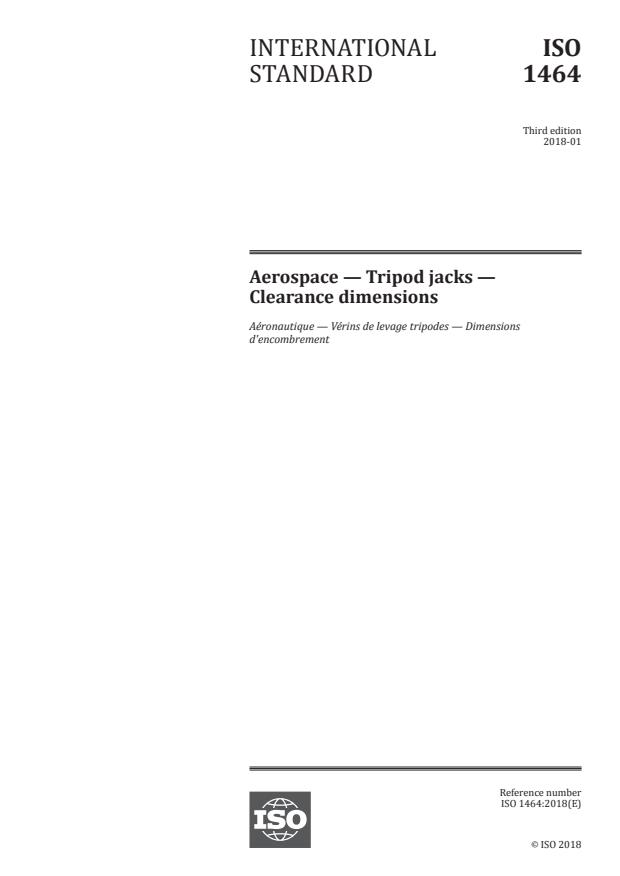
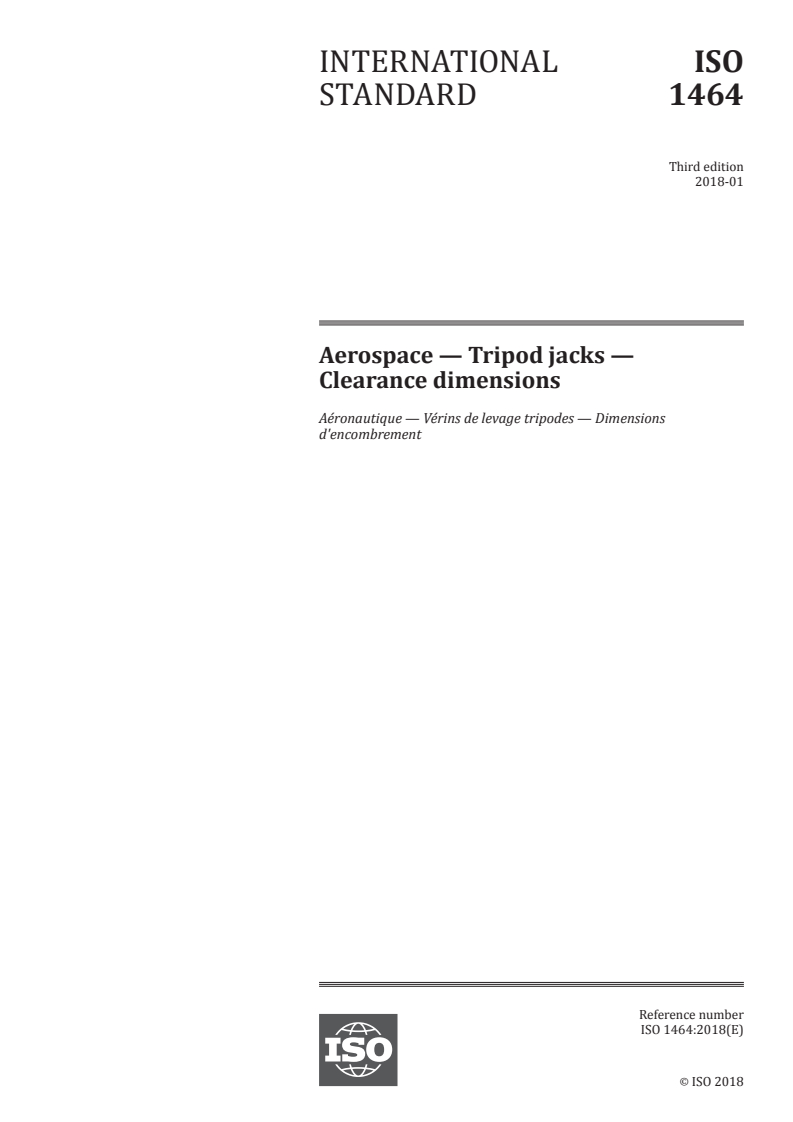
INTERNATIONAL ISO
STANDARD 1464
Third edition
2018-01
Aerospace — Tripod jacks —
Clearance dimensions
Aéronautique — Vérins de levage tripodes — Dimensions
d'encombrement
Reference number
©
ISO 2018
© ISO 2018
All rights reserved. Unless otherwise specified, or required in the context of its implementation, no part of this publication may
be reproduced or utilized otherwise in any form or by any means, electronic or mechanical, including photocopying, or posting
on the internet or an intranet, without prior written permission. Permission can be requested from either ISO at the address
below or ISO’s member body in the country of the requester.
ISO copyright office
CP 401 • Ch. de Blandonnet 8
CH-1214 Vernier, Geneva, Switzerland
Tel. +41 22 749 01 11
Fax +41 22 749 09 47
copyright@iso.org
www.iso.org
Published in Switzerland
ii © ISO 2018 – All rights reserved
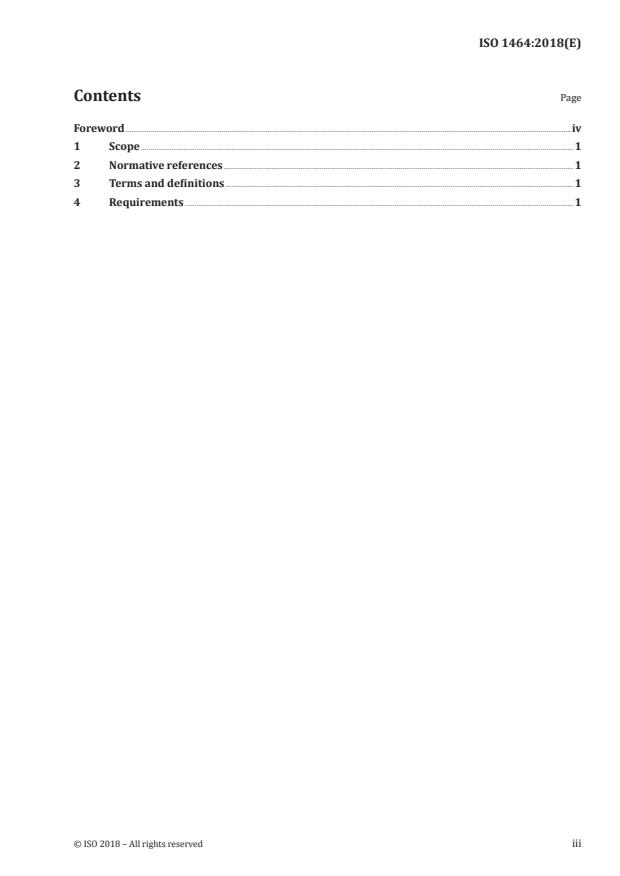
Contents Page
Foreword .iv
1 Scope . 1
2 Normative references . 1
3 Terms and definitions . 1
4 Requirements . 1
Foreword
ISO (the International Organization for Standardization) is a worldwide federation of national standards
bodies (ISO member bodies). The work of preparing International Standards is normally carried out
through ISO technical committees. Each member body interested in a subject for which a technical
committee has been established has the right to be represented on that committee. International
organizations, governmental and non-governmental, in liaison with ISO, also take part in the work.
ISO collaborates closely with the International Electrotechnical Commission (IEC) on all matters of
electrotechnical standardization.
The procedures used to develop this document and those intended for its further maintenance are
described in the ISO/IEC Directives, Part 1. In particular the different approval criteria needed for the
different types of ISO documents should be noted. This document was drafted in accordance with the
editorial rules of the ISO/IEC Directives, Part 2. www .iso .org/ directives
Attention is drawn to the possibility that some of the elements of this document may be the subject of
patent rights. ISO shall not be held responsible for identifying any or all such patent rights. Details of
any patent rights identified during the development of the document will be in the Introduction and/or
on the ISO list of patent declarations received. www .iso .org/ patents
Any trade name used in this document is information given for the convenience of users and does not
constitute an endorsement.
For an explanation on the voluntary nature of standards, the meaning of ISO specific terms and
expressions related to conformity assessment, as well as information about ISO's adherence to the WTO
principles in the Technical Barriers to Trade (TBT), see the following URL: Foreword - Supplementary
information
This document was prepared by Technical Committee ISO/TC 20, Aircraft and space vehicles,
Subcommittee SC 9, Air carg
...
INTERNATIONAL ISO
STANDARD 1464
Third edition
2018-01
Aerospace — Tripod jacks —
Clearance dimensions
Aéronautique — Vérins de levage tripodes — Dimensions
d'encombrement
Reference number
©
ISO 2018
© ISO 2018
All rights reserved. Unless otherwise specified, or required in the context of its implementation, no part of this publication may
be reproduced or utilized otherwise in any form or by any means, electronic or mechanical, including photocopying, or posting
on the internet or an intranet, without prior written permission. Permission can be requested from either ISO at the address
below or ISO’s member body in the country of the requester.
ISO copyright office
CP 401 • Ch. de Blandonnet 8
CH-1214 Vernier, Geneva, Switzerland
Tel. +41 22 749 01 11
Fax +41 22 749 09 47
copyright@iso.org
www.iso.org
Published in Switzerland
ii © ISO 2018 – All rights reserved
Contents Page
Foreword .iv
1 Scope . 1
2 Normative references . 1
3 Terms and definitions . 1
4 Requirements . 1
Foreword
ISO (the International Organization for Standardization) is a worldwide federation of national standards
bodies (ISO member bodies). The work of preparing International Standards is normally carried out
through ISO technical committees. Each member body interested in a subject for which a technical
committee has been established has the right to be represented on that committee. International
organizations, governmental and non-governmental, in liaison with ISO, also take part in the work.
ISO collaborates closely with the International Electrotechnical Commission (IEC) on all matters of
electrotechnical standardization.
The procedures used to develop this document and those intended for its further maintenance are
described in the ISO/IEC Directives, Part 1. In particular the different approval criteria needed for the
different types of ISO documents should be noted. This document was drafted in accordance with the
editorial rules of the ISO/IEC Directives, Part 2. www .iso .org/ directives
Attention is drawn to the possibility that some of the elements of this document may be the subject of
patent rights. ISO shall not be held responsible for identifying any or all such patent rights. Details of
any patent rights identified during the development of the document will be in the Introduction and/or
on the ISO list of patent declarations received. www .iso .org/ patents
Any trade name used in this document is information given for the convenience of users and does not
constitute an endorsement.
For an explanation on the voluntary nature of standards, the meaning of ISO specific terms and
expressions related to conformity assessment, as well as information about ISO's adherence to the WTO
principles in the Technical Barriers to Trade (TBT), see the following URL: Foreword - Supplementary
information
This document was prepared by Technical Committee ISO/TC 20, Aircraft and space vehicles,
Subcommittee SC 9, Air carg
...