


ISO/IEC 10026-2:1996
(Main)Information technology — Open Systems Interconnection — Distributed Transaction Processing — Part 2: OSI TP Service
Information technology — Open Systems Interconnection — Distributed Transaction Processing — Part 2: OSI TP Service
Technologies de l'information — Interconnexion de systèmes ouverts (OSI) — Traitement transactionnel réparti — Partie 2: Service OSI TP
General Information
- Status
- Withdrawn
- Publication Date
- 15-May-1996
- Withdrawal Date
- 15-May-1996
- Technical Committee
- ISO/IEC JTC 1 - Information technology
- Drafting Committee
- ISO/IEC JTC 1 - Information technology
- Current Stage
- 9599 - Withdrawal of International Standard
- Start Date
- 13-Sep-2012
- Completion Date
- 14-Feb-2026
Relations
- Effective Date
- 06-Jun-2022
- Effective Date
- 15-Apr-2008
- Effective Date
- 15-Apr-2008
Get Certified
Connect with accredited certification bodies for this standard

BSI Group
BSI (British Standards Institution) is the business standards company that helps organizations make excellence a habit.

NYCE
Mexican standards and certification body.
Sponsored listings
Frequently Asked Questions
ISO/IEC 10026-2:1996 is a standard published by the International Organization for Standardization (ISO). Its full title is "Information technology — Open Systems Interconnection — Distributed Transaction Processing — Part 2: OSI TP Service". This standard covers: Information technology — Open Systems Interconnection — Distributed Transaction Processing — Part 2: OSI TP Service
Information technology — Open Systems Interconnection — Distributed Transaction Processing — Part 2: OSI TP Service
ISO/IEC 10026-2:1996 is classified under the following ICS (International Classification for Standards) categories: 35.100.70 - Application layer. The ICS classification helps identify the subject area and facilitates finding related standards.
ISO/IEC 10026-2:1996 has the following relationships with other standards: It is inter standard links to ISO 10993-13:2010, ISO/IEC 10026-2:1998, ISO/IEC 10026-2:1992. Understanding these relationships helps ensure you are using the most current and applicable version of the standard.
ISO/IEC 10026-2:1996 is available in PDF format for immediate download after purchase. The document can be added to your cart and obtained through the secure checkout process. Digital delivery ensures instant access to the complete standard document.
Standards Content (Sample)
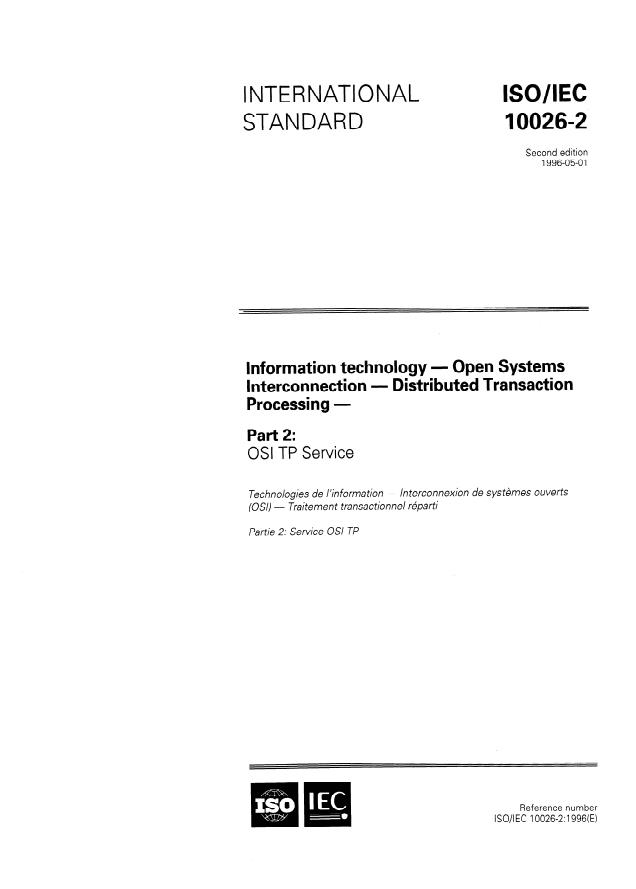
INTERNATIONAL
ISO/IEC
STANDARD
10026-2
Second edition
1996-05-01
Information technology - Open Systems
Distributed Transaction
Interconnection -
Processing -
Part 2:
OSI TP Service
Technologies de /‘information - In terconnexion de sys tt?mes ouverts
(OS/) - Traitement transactionnel kparti
Partie 2: Service OS/ TP
Reference number
ISO/l EC 10026-2: 1996(E)
0 ISOAEC
SO/I EC 10026-2: 1996(E)
Contents
V
Foreword . . . . . . . . . . . . . . . . . . . . . . . . . . . . . . . . . . . . . . . . . . . . . . . . . . . . . . . . . . . . . . . . . . . . . . . . . . . . . . . . . . . . . . . . . . . . . . . . . . . . . . . . . . . . . . . . . . . . . . . . .*.
Vi
Introduction . . . . . . . . . . . . . . . . . . . . . . . . . . . . . . . . . . . . . . . . . . . . . . . . . . . . . . . . . . . . . . . . . . . . . . . . . . . . . . . . . . . . . . . . .“.“.“.““““““““““““.””.”””””““““““.“.
Scope .
................................................................................................................................
Normative references
Definitions .
Abbreviations .
Conventions .
5.1 Service conventions .
.....................................................................................................
5.2 Usage of the term transaction
.......................................................................................................
5.3 Usage of italics for notations
Overview of the OSI TP Service .
........................................................................................................................................
Service facilities
.........................................................................................................
7.1 Functional unit descriptions
units .
7.2 Services contained in functional
..............................................................................................
7.3 Service for modelling data transfer
.................................................................................................
7.4 Structure of service descriptions
....................................................................................................
7.5 Effects of dialogue termination
...................................................................................................
Service primitives and their parameters
Data transfer .
..........................................................................................................
9.1 Overview of data transfer
................................................................................................
9.2 Data transfer service, TP-DATA
..................................................................................................................
10 The Dialogue functional unit
..................................................................................
10.1 Overview of the Dialogue functional unit
.........................................................
10.2 Dialogue Establishment service, TP-BEGIN-DIALOGU E
................................................................
10.3 Dialogue Termination service, TP-END-DIALOGU E
............................................................................
10.4 User Error Reporting service, TP-U-ERROR
. $20
10.5 User Abort service, TP-U-ABORT .
.....................................................................................
10.6 Provider Abort service, TP-P-ABORT
........................................................................................................
11 The Shared Control functional unit
........................................................................
11 .l Overview of the Shared Control functional unit
.....................................................................................................
12 The Polarized Control functional unit
.....................................................................
12.1 Overview of the Polarized Control functional unit
........................................................................
12.2 Grant Control service, TP-GRANT-CONTROL
............................................................... 26
12.3 Request Control service, TP-REQUEST-CONTROL
0 ISO/IEC 1996
All rights reserved. Unless otherwise specified, no part of this publication may be reproduced or utilized in any form or
by any means, electronic or mechanical, including photocopying and microfilm, without permission in writing from the
publisher.
ISO/IEC Copyright Office l Case Postale 56 l CH-1211 Geneve 20 l Switzerland
Printed in Switzerland
ii
ISOllEC 10026-2: 1996(E)
SO/IEC
..............................................................................................................
The Handshake functional unit
..............................................................................
13.1 Overview of the Handshake functional unit
....................................................................................
13.2 Handshake service, TP-HANDSHAKE
..2 9
13.3 Handshake and Grant Control service, TP-HANDSHAKE-AND-GRANT-CONTROL
.............
...............................................................................................
14 The commitment-related functional units
.............................................................................................................................
14.1 Introduction
...................................................................................
14.2 Overview of the Commit functional unit
unit .
14.3 Overview of the Chained Transactions functional
..........................................................
14.4 Overview of the Unchained Transactions functional unit
..........................................................
14.5 Begin Transaction service, TP-BEGIN-TRANSACTION
.........................................
14.6 Deferred End Dialogue service, TP-DEFERRED-END-DIALOGUE
..................................... 36
14.7 Deferred Grant Control service, TP-DEFERRED-GRANT-CONTROL
............................................................................................................
14.8 TP-PREPARE request
. . . . . . . . . . . . . . . . . . . . . . . . . . . . . . . . . . . . . . . . . . . . . . . . . . . . . . . . . . . . . . . . . . . . . . . . . . . . . . . . . . . . . . . . . . . . . . . . . . . . . . . .
14.9 TP-PREPARE indication
........................................................................................................
14.10 TP-READY indication.
........................................................................................................
14.11 TP-COMMIT request.
........................................................................................................
14.12 TP-COMMIT indication.
request . . . . . . . . .
14.13 TP-DONE
. . . . . . . . . . . . . . . . . . . . . . . . . . . . . . . . . . . . . . . . . . . . . . . . . . . . . . . . . . . . .““.““.
T ‘E indication
14.14 TP-COMMIT-COMPLE-
........................................................................................................
14.15 TP-ROLLBACK request
.....................................................................................................
14.16 TP-ROLLBACK indication
.................................................................................
14.17 TP-ROLLBACK-COMPLETE indication
.......................................... 46
14.18 Heuristic Reporting service, TP-HEURISTIC-REPORT indication
Annexes
................................................................................................................................
A Service state table
A. 1 Overview .
A.2 Dialogue States .
.................................................................................................................................
A.3 Variables
....................................................................................................................................
A.4 Actions
.............................................................................................................................
A.5 Node Crash
A.6 Keys .
..................................................................................................................
A.7 Blank Intersections
. . . . . . . . . . . . . . . . . . . . . . . . . . . . . . . . . . . . . . . . . . . . . . . . . . . . . . . . . . . . . . . . . . . . . . . . . . . . . . . . . . . . . . . . . . . . . . . . . . . . . . . . . . . . . . . . .
A.8 Service State Table
...................................................................................................................
B Changes from first edition
...................................................
B-1 Changes from the first edition to produce the second edition
Tables
....................................................................................
Table 1 - Functional units and their services
....................................................................................
Table 2 - Service for modelling data transfer
..................................................................................................
Table 3 - OSI TP service primitives
................................................................................
Table 4 - TP-DATA primitives and parameters
................................................... 12
Table 5 - TP-BEGIN-DIALOGUE primitives and their parameters
....................................................... 16
Table 6 - TP-END-DIALOGUE primitives and their parameters
..................................................................................................
Table 7 - TP-U-ERROR primitives
..................................................................
Table 8 - TP-U-ABORT primitives and their parameters
.....................................................................
Table 9 - TP-P-ABORT indication and its parameters
..................................................................................
Table 10 - TP-GRANT-CONTROL primitives
..............................................................................
Table 11 - TP-REQUEST-CONTROL primitives
............................................................
Table 12 - TP-HANDSHAKE primitives and their parameter
“29
Table 13 - TP-HANDSHAKE-AND-GRANT-CONTROL primitives and their parameter.
.................
............................................................................ 33
primitives
Table 14 - TP-BEGIN-TRANSACTION
..................................................................
Table 15 - TP-DEFERRED-END-DIALOGUE primitives
. . .
III
0 ISOAEC
ISOllEC 10026=2:1996(E)
..............................................................
Table 16 - TP-DEFERRED-GRANT-CONTROL primitives
.......................................................................
Table 17 - TP-PREPARE request and its parameter
....................................................................
Table 18 - TP-PREPARE indication and its parameter
.....................................................................................................
Table 19 - TP-READY indication
.....................................................................................................
Table 20 - TP-COMMIT request
..................................................................................................
Table 21 - TP-COMMIT indication
.............................................................................
Table 22 - TP-DONE request and its parameter
..............................................................................
Table 23 - TP-COMMIT-COMPLETE indication
.................................................................................................
Table 24 - TP-ROLLBACK request
..............................................................................................
Table 25 - TP-ROLLBACK indication
..........................................................................
Table 26 - TP-ROLLBACK-COMPLETE indication
......................................................
Table 27 - TP-HEURISTIC-REPORT indication and parameter
Figures
...........................................
Figure 1 - Unconfirmed TP-BEGIN-DIALOGUE sequence of primitives
.............................................. 14
Figure 2 - Confirmed TP-BEGIN-DIALOGUE sequence of primitives
..............................................
Figure 3 - Unconfirmed TP-END-DIALOGUE sequence of primitives
.......................................................
Figure 4 - Confirmed END-DIALOGUE sequence of primitives
.............................................................................
Figure 5 - TP-U-ERROR sequence of primitives
...............................
Figure 6 - TP-U-ERROR as the negative confirmation to a handshake service
..............................................................................
Figure 7 - TP-U-ABORT sequence of primitives
..............................................................................
Figure 8 - TP-P-ABORT sequence of primitives
...............................................................
Figure 9 - TP-GRANT-CONTROL sequence of primitives
........................................................
Figure 10 - TP-REQUEST-CONTROL sequence of primitives
......................................................................
Figure 11 - TP-HANDSHAKE sequence of primitives
..............................
Figure 12 - TP-HANDSHAKE-AND-GRANT-CONTROL sequence of primitives
......................................................
Figure 13 - TP-BEGIN-TRANSACTION sequence of primitives
............................................. 35
Figure 14 - TP-DEFERRED-END-DIALOGUE sequence of primitives
......................................... 37
Figure 15 - TP-DEFERRED-GRANT-CONTROL sequence of primitives
iv
0 ISOAEC ISOll EC 10026-2: 1996(E)
Foreword
IS0 (the International Organization for Standardization) and IEC (the
International Electrotechnical Commission) for the specialized system for
worldwide standardization. National bodies that are members of IS0 or
IEC participate in the development of International Standards through
technical committees established by the respective organization to deal
with particular fields of technical activity. IS0 and IEC technical
committees collaborate in fields of mutual interest. Other International
organizations, governmental and non-governmental, in liaison with IS0 and
IEC, also take part in the work.
In the field of information technology, IS0 and IEC have established a joint
technical committee, ISO/IEC JTC 1. Draft International Standards
adopted by the joint technical committee are circulated to national bodies
for voting. Publication as an International Standard requires approval by at
least 75 % of the national bodies casting a vote.
International Standard ISOAEC 10026-2 was prepared by Joint Technical
Committee ISOAEC JTC 1, information technology, Subcommittee SC 21,
Open Systems Interconnection, data management and open distributed
processing.
This second edition cancels and replaces the first edition (ISO/IEC
10026-2:1992), which has been technically revised.
ISO/IEC 10026 consists of the following parts, under the general title
Information technology - Open Systems Interconnection - Distributed
Transaction Processing:
-
Part 1: OS/ TP Model
Part 2: OS/ TP Service
-
Pan 3: Protocol specification
Part 4. Protocol Implementation Conformance Statement (PICS)
proforma
Pat? 5. Application context proforma and guidelines when using
OS TP
Part 6: Unstructured Data Transfer
-
Pan 7: Message queuing
Annex A forms an integral part of this part of ISO/IEC 10026. Annex B is
for information only.
0 ISOAEC
ISO/IEC 10026=2:1996(E)
Introduction
ISO/IEC 10026 is one of a set of standards produced to facilitate the
It is related to other International
interconnection of computer systems.
Standards in the set as defined by the Reference Model for Open Systems
Interconnection (lSO/lEC 7498-1). The Reference Model subdivides the
area of standardization for interconnection into a series of layers of
specification, each of manageable size.
The aim of Open Systems Interconnection is to allow, with a minimum of
technical agreement outside the interconnection standards, the
interconnection of computer systems
from different manufacturers;
a)
under different management;
b)
of different levels of complexity; and,
Cl
of different technologies.
d)
ISO/IEC 10026 defines an OSI TP Model, an OSI TP Service and
specifies an OSI TP Protocol available within the Application Layer of the
OSI Reference Model.
The OSI TP Service is an Application Layer service. It is concerned with
information which can be related as transactions, which may involve two or
more open systems.
This part of ISO/IEC 10026 defines a basic OSI TP Service. It provides
sufficient facilities to support transaction processing, and establishes a
framework for coordination across multiple TP resources in separate open
systems.
ISO/IEC 10026 does not specify the interface to local resources or access
facilities that are provided within the local system. However, future
enhancement of the standard may deal with these issues.
Vi
ISO/IEC 10026-2: 1996(E)
INTERNATIONAL STANDARD @ ISO/IEC
Information technology - Open Systems
Distributed Transaction
Interconnection -
Processing -
Part 2:
OSI TP Service
1 Scope
This part of ISO/IEC 10026 defines in an abstract way the Distributed Transaction Processing Service within
the Application Layer in terms of
a) the actions and events of the service primitives;
b) the parameter data associated with each service primitive ’s action and event; and,
c) the relationship between, and the valid sequences of these actions and events.
It does not specify individual implementations or products, nor does it constrain the implementation of
entities or interfaces within a computer system.
2 Normative references
The following standards contain provisions which, through reference in this text, constitute provisions of this
part of ISO/IEC 10026. At the time of publication, the editions indicated were valid. All standards are
subject to revision, and the parties to agreements based on this part of lSO/IEC 10026 are encouraged to
investigate the possibility of applying the most recent editions of the standards indicated below. Members of
IS0 and IEC maintain registers of currently valid International Standards.
Open Systems Interconnection - Basic Reference
IS0 7498-3: 1989, Information processing systems -
Model - Par? 3: Naming and Addressing.
I SO 8649: 1988, Information processing systems - Open Systems Interconnection - Service definition for the
Association Control Service Element.
ISO/l EC 10026-l : 1992, Information technology - Open Systems Interconnection - Distributed Transaction
Processing - Part I: OS/ TP Model.
0 ISOAEC
ISOllEC 10026=2:1996(E)
ISO/I EC 10026-3: 1996, Information technology - Open Systems Interconnection - Distributed Transaction
Processing - Parf 3: Protocol specification.
ISOAEC 10731 :1994, Information technology - Open Systems Interconnection - Basic Reference Model -
Conventions for the definition of 03 services.
3 Definitions
For the purposes of this part of ISO/IEC 10026, the definitions of ISO/IEC 10026-I and the following
definitions apply.
3.1 dialogue establishment indication outstanding: A dialogue state in which a TP-BEGIN-DIALOGUE
indication with the Confirmation parameter set to Vlalways” has been issued but has not yet been responded
to by a TP-BEGIN-DIALOGUE response.
A dialogue state in which a TP-BEGIN-DIALOGUE
3.2 dialogue establishment request outstanding:
request with the Confirmation parameter set to “alwaystl has been issued but has not yet been responded to
by a TP-BEGIN-DIALOGUE confirm.
A dialogue state in which a TP-END-DIALOGUE
3.3 dialogue termination indication outstanding:
indication with the Confirmation parameter set to Yrue” has been issued while there is no user error request
outstanding, but has not yet been responded to by a TP-END-DIALOGUE response, or by a TP-U-ERROR
request.
3.4 dialogue termination request outstanding: A dialogue state in which a TP-END-DIALOGUE request
with the Confirmation parameter set to Yrue” has been issued, but has not yet been responded to by a TP-
END-DIALOGUE confirm, or by a TP-U-ERROR indication-
3.5 handshake indication outstanding: A dialogue state in which one of the following service primitives:
- TP-HANDSHAKE indication;
- TP-HANDSHAKE-AND-GRANT-CONTROL indication;
has been issued while there is no user error request outstanding, but has not yet been responded to by one
of the following service primitives (respectively):
- TP-HANDSHAKE response;
- TP-HANDSHAKE-AND-GRANT-CONTROL response;
or by a TP-U-ERROR request, or, if the coordination level of the dialogue is %ommitmenY, by any rollback-
initiating service primitive.
3.6 handshake request outstanding: A dialogue state in which one of the following service primitives:
- TP-HANDSHAKE request;
- TP-HANDSHAKE-AND-GRANT-CONTROL request;
has been issued, but has not yet been responded to by one of the following service primitives (respectively):
- TP-HANDSHAKE confirm;
- TP-HANDSHAKE-AND-GRANT-CONTROL confirm;
or by a TP-U-ERROR indication, or, if the coordination level of the dialogue is ~~commitment~~, by any
rollback-initiating service primitive.
3.7 rollback-initiating indication: An indication or confirm that triggers a rollback; it is one of the
following service primitives:
- TP-ROLLBACK indication;
- TP-U-ABORT indication with the Rollback parameter set to “true ”;
- TP-P-ABORT indication with the Rollback parameter set to ‘Yruell;
- TP-BEGIN-DIALOGUE confirm with the Rollback parameter set to “true ”.
0 ISOAEC ISOllEC 10026-2:1996(E)
it is one of the following service
3.8 rollback-initiating request: A request that triggers a rollback;
primitives:
- TP-ROLLBACK request;
- TP-U-ABORT request for a dialogue with a coordination level of ttcommitmenttt not issued during the
termination phase of a transaction.
3.9 rollback-initiating service primitive: A service primitive that triggers a rollback; it may be either a
rollback-initiating request or a rollback-initiating indication.
3.10 subordinate dialogue: A dialogue with a subordinate.
3.11 subordinate subtree: A subtree of a subordinate.
3.12 superior dialogue: The dialogue with the superior.
3.13 termination phase of a transaction: The phase of a transaction between initiation of commitment or
rollback and the end of the transaction.
This phase is entered, for a given TPSUI, upon issuance of a TP-COMMIT request or any rollback-initiating
service primitive.
For a TPSUI which does not have a dialogue establishment indication outstanding, this phase is exited upon
issuance of a TP-COMMIT-COMPLETE indication or a TP-ROLLBACK-COMPLETE indication.
For a TPSUI which does have a dialogue establishment indication outstanding when the termination phase is
entered (this can only happen when a TP-ROLLBACK indication is issued), this phase is exited by a TP-
BEGIN-DIALOGUE response with the Result parameter set to Yejected(user)tt or by a TP-P-ABORT
indication for the dialogue; if the dialogue is accepted during the termination phase, the termination phase is
exited by the subsequent TP-ROLLBACK-COMPLETE indication.
3.14 transaction tree constraint: A constraint that cannot be checked at a single node.
3.15 user error indication outstanding: A state of a dialogue with the Polarized Control functional unit
selected. In this state, a TP-U-ERROR indication, issued while the recipient had control of the dialogue and
has neither a handshake request outstanding nor a dialogue termination request outstanding, has not yet
been responded to by a TP-GRANT-CONTROL request, or, if the coordination level of the dialogue is
“commitment ”, by any rollback-initiating service primitive.
3.16 user error request outstanding: A state of a dialogue with the Polarized Control functional unit
selected. In this state, a TP-U-ERROR request, issued without having control of the dialogue and without
having either a handshake indication outstanding or a dialogue termination indication outstanding, has not
yet been responded to by a TP-GRANT-CONTROL indication, a TP-HANDSHAKE indication, a TP-
HANDSHAKE-AND-GRANT-CONTROL indication, a TP-END-DIALOGUE indication with the Confirmation
parameter set to Yruett, or, if the coordination level of the dialogue is “commitmenY, by any rollback-initiating
service primitive.
4 Abbreviations
Abbreviations used in this part of ISO/IEC 10026 are defined in ISO/IEC 10026-I (OS II TP Model), except
for the following which are used in some tables:
confirm service primitive;
cnf
ind indication service primitive;
request service primitive;
w
response service primitive.
f SP
ISOAEC 18026-2: 1996(E) 0 ISOAEC
5 Conventions
5.1 Service conventions
This part of ISO/IEC 10026 defines services for Distributed Transaction Processing guided by the descriptive
conventions defined in ISO/lEC 10731=
However, the terms Vequest” and Yndication” are sometimes used in the following ways:
a) a single request may result in multiple indications (an example is that a single VP-COMMIT request
may result in TP-PREPARE indications to each direct subordinate TPSUI);
b) several requests may result in a single indication (an example is that a single TP-COMMIT-
COMPLETE indication may be issued to a superior TPSUI only after TP-DONE requests have been
issued by this TPSUI and by all subordinate TPSUls in the transaction tree);
c) the convention that a request primitive results in an indication primitive of the same name, is not always
followed (for example, the issuance of a TP-COMMIT request will cause a TP-PREPARE indication to
be issued).
NOTE - In this part of ISOAEC 10026, requests and responses are described as being issued by the TPSUI
whereas indications and confirms are described as being issued by the TPSP.
For a given primitive, the presence of each parameter is described by one of the following values:
blank:
not applicable;
.
M .
presence. is mandatory;
.
U . presence is a user option;
.
0 . presence is a provider option; and,
.
C . presence is conditional.
In addition the notation (=) indicates that a parameter value is semantically equal to the value of the
parameter of the preceding primitive in the table.
5.2 Usage of the term transaction
In this part of ISO/IEC 10026, the term Yransaction” is used to denote a distributed provider-supported
transaction.
5.3 Usage of italics for notations
In this part of ISO/IEC 10026, the following notations, defined in clause 3, appear in italics:
- dialogue establishment indication outstanding;
- dialogue establishment request outstanding;
- dialogue termination indication outstanding;
- dialogue termination request outstanding;
- handshake indication outstanding;
- handshake request outstanding;
- rollback-initiating indication;
- rollback-initiating request;
- rollback-initiating service primitive;
- subordinate dialogue;
- subordinate subtree;
- superior dialogue;
- transaction tree constraint;
ISOllEC 10026-2: 1996(E)
0 ISO/IEC
- termination phase of a transaction;
- user error indication outstanding;
- user error request outstanding.
6 Overview of the OSI TIP Service
The Distributed Transaction Processing Service and its supporting protocol are concerned with creating an
environment in which two or more users may interact to
a) establish dialogues;
b) invoke services of specific user application service elements, subject to the constraints of the TPSP;
c) delimit provider-supported transactions;
d) coordinate work for application-supported transactions or provider-supported transactions;
e) prepare for commitment, and commit or rollback a provider-supported transaction;
f) heuristically place bound data either in the final or initial state;
g) report errors;
located to these dialogues to be freed;
h) terminate dialogues allowing all resources a
i) terminate dialogues abnormally;
j) synchronize processing by handshaking;
k) support chained or unchained sequences of provider-supported transaction branches for a dialogue.
A node crash may result in the TPSP issuing certain TP service primitives more than once (i.e., TP-
COMMIT indication, TP-ROLLBACK indication, and TP-HEURISTIC-REPORT indication). The TPSP and
the TPSUI are both aware of the node crash through local means.
7 Service facilities
7.1 Functional unit descriptions
The following functional units are defined:
Dialogue: the Dialogue functional unit supports the basic services required to establish a dialogue
between two TPSUls within which U-ASE primitives may be invoked, signal user-initiated errors and
terminate the dialogue. The user or the provider may signal abnormal termination;
Shared Control: the Shared Control functional unit supports both TPSUls having control of the
dialogue at the same time and allows them to issue request primitives subject only to the normal
sequencing constraints of the primitives. For example, data may be transferred by both TPSUls at the
same time;
. c) Polarized Control: the Polarized Control functional unit allows only one TPSUI to have control of the
dialogue at any point in time. Many request primitives may be issued only by the TPSUI which has
control of the dialogue. This restriction is in addition to the normal sequencing constraints for the
primitives. For example, a handshake may only be requested by the TPSUI which has control of the
dialogue;
d) Handshake: the Handshake functional unit allows the TPSUls to synchronize their processing with
one another;
e) Commit: the Commit functional unit allows reliable commitment and rollback of transactions;
0 ISOAEC
ISOllEC 10026=2:1996(E)
f) Chained Transactions: the Chained Transactions functional unit supports coordination of both
TPSUls with a chained sequence of transaction branches. The coordination level of the dialogue will
always be llcommitment ’l. The subordinate TPSUI will always be a participant in the same transaction
as the superior TPSUI;
g) Unchained Transactions: the Unchained Transactions functional unit supports coordination of both
The superior determines when the
TPSUls with an unchained sequence of transaction branches.
At a given point in time, the two TPSUIs may be
coordination level of the dialogue is ?ommitment ”.
in different transactions, or one or both TPSUIs may not be
participants in the same transaction,
involved in a transaction.
The Dialogue functional unit shall always be selected.
For a given dialogue, the Shared Control and Polarized Control functional units are mutually exclusive. One
and only one of these two functional units shall be selected.
For a given dialogue, the Chained Transactions and Unchained Transactions functional units are mutually
exclusive. If the Commit functional unit is selected, one and only one of them shall be selected. If the
Commit functional unit is not selected, neither one shall be selected.
7.2 Services contained in functional units
Table 1 lists the functional units and the associated services.
Table 1 - Functional units and their services
Services
Functional Unit
TP-BEGIN-DIALOGUE
Dialogue
TP-END-DIALOGUE *
TP-U-ERROR
TP-U-ABORT
TP-P-ABORT
(no associated services)
Shared Control
TP-GRANT-CONTROL
Polarized Control
TP-REQUEST-CONTROL
TP-HANDSHAKE
Handshake
TP-HANDSHAKE-AND-GRANT-CONTROL **
Commit TP-DEFERRED-END-DIALOGUE
TP-DEFERRED-GRANT-CONTROL **
TP-PREPARE
TP-READY
TP-COMMIT
TP-DONE
TP-COMMIT-COMPLETE
TP-ROLLBACK
TP-ROLLBACK-COMPLETE
TP-HEURISTIC-REPORT
Chained Transactions (no associated services)
TP-BEGIN-TRANSACTION
Unchained Transactions
* This service shall not be used if the Chained Transactions functional unit is
selected.
** This service may be used only if the Polarized Control functional unit is
also selected.
7.3 Service for modelling data transfer
Table 2 shows the service for modelling data transfer.
ISOAEC 10026=2:1996(E)
0 ISOAEC
Table 2 - Service for modelling data transfer
Data Transfer 1 TP-DATA
It represents the capability of a TPSUI to invoke specific U-
TP-DATA is not a service in the normal sense.
ASE services on a dialogue, constrained by the TPSP.
7.4 Structure of service descriptions
7.4.1 “Purpose” subclause
The ffPurposeff subclause describes, in a few words, the purpose of the service.
7.4.2 “Service and parameters” subclause
The Service and parameters” subclause describes the service primitives and their parameters.
The constraints or conditions on the presence or values of these parameters are described in this subclause.
7.4.3 “Sequences of primitives” subclause
The Sequence of primitives” subclause is included for certain services; it shows the relationship in time
between the service request and the resulting indication, and, if applicable, the subsequent response and the
resulting confirm.
7.4.4 “TPSUI conditions” subclause
The ffTPSUI conditions” subclause applies to certain requests and responses only; it specifies prerequisites
for the respective request or response to be issued by the TPSUI. TPSUI conditions cannot be monitored
by the TPSP, nevertheless it is vital for orderly cooperation of the TPSUI and for atomicity that they are
obeyed.
TPSUI conditions include
- the state of bound data;
- the success of synchronization.
7.4.5 “TPSP constraints” subclause
The “TPSP constraints” subclause applies to all service primitives. For request and response service
primitives, it specifies prerequisites for issuance by the TPSUI that are enforced by the TPSP. For indication
and confirm service primitives, it specifies constraints on the issuance of the service primitives by the TPSP.
Constraints on the values of parameters for service primitives are described separately in the Service and
parameters” subclause for each service.
In general, the constraints are based on information associated with the state of the TPSUI at the time the
service primitive is issued. Constraints for service primitives that are associated with a particular dialogue
relate only to that dialogue unless the constraints explicitly reference other dialogues or attributes that are
not related to a particular dialogue.
Information on which constraints are based includes
- functional units selected for a dialogue;
- superior or subordinate status;
- control of the dialogue;
- coordination level;
- state of bound data;
- transaction state;
- sequence of service primitives and associated parameter values.
0 ISOAEC
ISOAEC 10026=2:1996(E)
7.4.6 “Effects of a service primitive” subclause
The “Effects of a service primitive” subclause describes any effects on the characteristics of the dialogue or
the transaction resulting from the issuance of a service primitive.
Effects include
- initiating or terminating the dialogue or the transaction;
- control of the dialogue;
- superior or subordinate status;
- change of the coordination level;
- issuance of resulting service primitives.
NOTE - Effects of a service primitive on certain lower layers facilities (e.g. Session tokens) are described in ISOAEC
10026-3.
7.4.7 “Collisions” subclause
There is a collision of two requests if the requests have been issued:
- on opposite sides of the same dialogue; and
- before the indication resulting from the request issued on the other side is either issued or suppressed.
The ffCollisionsff subclause describes any effects on a service request or response caused by collision with a
service primitive issued by the partner TPSUI.
In general, the effects of a collision involving a particular service are described in the “Collisionsff subclause
for that service.
These effects include
- suppression of an indication;
- generation of a different indication.
7.5 Effects of dialogue termination
Whenever a dialogue is terminated for a particular TPSUI, no further service primitives are issued to the
TPSUI for the dialogue, except TP-HEURISTIC-REPORT indication, which may be issued during the
termination phase of the transaction.
For a particular TPSUI, a dialogue is terminated by one of the following service primitives:
- TP-END-DIALOGUE request with the Confirmation parameter set to fffalseff;
- TP-END-DIALOGUE indication with the Confirmation parameter set to fffalseff;
- TP-END-DIALOGU E response;
- TP-END-DIALOGU E confirm;
- TP-BEGIN-DIALOGUE response with the Result parameter set to ffrejected(user)ff;
- TP-BEGIN-DIALOGUE confirm with the Result parameter set to ffrejected(provider)ff or Vejected(user) “;
- TP-U-ABORT request;
- TP-U-ABORT indication;
- TP-P-ABORT indication;
- TP-COMMIT-COMPLETE indication when a TP-DEFERRED-END-DIALOGUE request or indication has
been issued.
Suppression of subsequent service primitives is not described in the collisions subclauses.
8 Service primitives and their parameters
The OSI TP Service is invoked using a sequence of OSI TP service primitives.
ISOIIEC 10026-2: 1996(E)
0 ISOAEC
Table 3 lists
a) the service primitives of the OS1 TP Service;
b) for each service primitive, whether the service primitive is associated with a particular dialogue or with
the TPSUI as a whole;
c) the subclause in which the service primitive is described; and,
d) the parameters associated with each service.
Blanks in the parameters column indicates that the service primitive has no parameters.
Table 3 - OSI TP service primitives
Services Primitives Scope Subclause Parameters
TP-BEGIN-DIALOGUE req/ind/rsp/cnf Dialogue 10.2 Initiating-AP-Title
Initiating-API-Identifier
Initiating-AE-Qualifier
Initiating-AEI-Identifier
Initiating-TPSU-Title
Recipient-AP-Title
Recipient-API-Identifier
Recipient-AE-Qualifier
Recipient-AEI-Identifier
Recipient-TPSU-Title
Functional-Units
Quality-of-Service
Application-Context-Name
Begin-Transaction
Confirmation
Result
Diagnostic
Rollback
User-Data
I
TP-END-DIALOGUE req/ind/rsp/cnf Dialogue 10.3 1 Confirmation
reqhnd
TP-U-ERROR Dialogue 10.4
TP-U-ABORT req/ind Dialogue 10.5 Rollback
User-Data
ind
TP-P-ABORT Dialogue 10.6 Diagnostic
Rollback
I
req/ind Dialogue 12.2
TP-GRANT-CONTROL
req/ind Dialogue 12.3
TP-REQUEST-CONTROL
req/ind/rsp/cnf Dialogue 13.2 1 Confirmation-Urgency
TP-HANDSHAKE
TP-HANDSHAKE-AND-GRANT-CONTROL req/ind/rsp/cnf Dialogue 13.3 1 Confirmation-Urgency
I
TP-BEGIN-TRANSACTIQN reqhnd Dialogue 14.5
reqlind
TP-DEFERRED-END-DIALOGUE Dialogue 14.6
reqhnd Dialogue
TP-DEFERRED-GRANT-CONTROL 14.7
req Dialogue 14.8
TP-PREPARE 1 Data-Permitted
ind Dialogue 14.9
TP-PREPARE 1 Data-Permitted
ind Dialogue 14.10 I
TP-READY
req TPSUI 14.11 I
TP-COMMIT
TP-COMMIT ind TPSUI 14.12 1
0 ISOAEC
ISOIIEC 10026=2:1996(E)
Table 3 - OSI TP service primitives (concluded)
Parameters
Primitives Scope Subclause
Services
Heuristic-Report
req TPSUI 14.13
TP-DONE
TPSUI 14.14
ind
TP-COMMIT-COMPLETE
req TPSUI 14.15
TP-ROLLBACK
ind TPSUI 14.16
TP-ROLLBACK
ind TPSUI 14.17
TP-ROLLBACK-COMPLETE
ind Dialogue 14.18 Heuristic-Report
TP-HEURISTIC-REPORT
NOTE - The method for identifying the appropriate dialogue for the service primitives which are associated with a
particular dialogue is a local matter.
9 Data transfer
9.1 Overview of data transfer
Data transfer is performed within the framework of 03 TP by issuance of the service primitives offered by
one or more U-ASEs. To specify the coordination between these service primitives and OSI TP service
primitives, these U-ASE service primitives are modelled as TP-DATA.
NOTE - TP-DATA may not only be used to model data transfer but also to model any other U-ASE services that may
be constrained by the TPSP (see ISO/IEC 10026-3 for constraints on such services).
9.2 Data transfer service, TP-DATA
9.2.1 Purpose
From the standpoint of the TPSP, it is
This service represents the capability of a TPSUI to transfer data.
used to specify the coordination between data transfer and other OSI TP services.
This service is never invoked as such, but is used in the OSI TP Service Definition to represent any U-ASE
service primitive within the OSI TP framework.
This service is associated with one particular dialogue.
9.2.2 Primitives and parameters
Table 4 lists the TP-DATA primitives.
Table 4 - TP-DATA primitives and parameters
TP-DATA
ind
parameters defined in the U-ASE 1 req 1
NOTE - TP-DATA is modelled as an unconfirmed service. This is not meant to exclude the possibility of other types of
services (e.g. confirmed services).
9.2.3 TPSP constraints on TP-DATA request
The requestor shall not have a dialogue establishment indication outstanding.
or, if the Polarized Control functional unit is selected, the
The requestor shall have control of the dialogue;
coordination level of the dialogue shall be “commitment” and a TP-PREPARE indication with the Data-
Permitted parameter set to Yrue” shall have been issued during the current transaction.
The requestor shall not have a handshake request outstanding.
The requestor shall not have a user error indication outstanding.
The requestor shall have neither a dialogue termination request outstanding nor a dialogue termination
indication outstanding.
0 ISOAEC ISO/IEC 10026-2: 1996(E)
If the coordination level is Vommitmenttt, a TP-PREPARE request shall not have been issued during the
current transaction.
If the coordination level is YommitmenY, the current transaction shall no
...
Questions, Comments and Discussion
Ask us and Technical Secretary will try to provide an answer. You can facilitate discussion about the standard in here.
Loading comments...