

ISO 4907-4:2025
(Main)Plastics — Ion exchange resin — Part 4: Determination of particle size by laser diffraction method
General Information
- Abstract
This document specifies the test method for determination of particle size of ion exchange resin by laser diffraction, ranging from 0,1 μm to 2,0 mm.
- Status
- Published
- Publication Date
- 25-Mar-2025
- Technical Committee
- ISO/TC 61/SC 5 - Physical-chemical properties
- Drafting Committee
- ISO/TC 61/SC 5 - Physical-chemical properties
- Current Stage
- 6060 - International Standard published
- Start Date
- 26-Mar-2025
- Due Date
- 12-Apr-2026
- Completion Date
- 26-Mar-2025
Overview
ISO 4907-4:2025 – Plastics - Ion exchange resin - Determination of particle size by laser diffraction method is an international standard published by ISO. This standard specifies the method for determining the particle size distribution of ion exchange resins using the laser diffraction technique, covering a broad range from 0.1 micrometres to 2.0 millimetres. Accurate measurement of particle size is essential for the consistent performance and quality control of ion exchange resins, which are widely used in water treatment, chemical processing, and biochemical applications.
Key Topics
- Test Scope: Defines the particle size range from 0.1 μm to 2.0 mm for ion exchange resins.
- Principle: Utilizes laser diffraction, where a dispersed resin sample is exposed to a laser beam. The scattered light pattern is detected and mathematically analyzed, resulting in a volumetric particle size distribution.
- Apparatus and Materials: Requires a laser diffraction particle size analyser compliant with ISO 13320 and water of grade 3 purity (ISO 3696).
- Sample Preparation: Follows ISO 4907-1 sampling recommendations to ensure results are representative.
- Procedure Highlights:
- Preparation and alignment of the analyser.
- Setting key parameters: dispersion medium, analytical model, refractive index, absorptivity, and use of ultrasound for sample dispersion.
- Conducting multiple tests for result consistency.
- Data Analysis: Calculation of percent below/above specific sizes, effective size (D10), median size (D50), uniformity coefficient, area-weighted mean size, and volume-weighted mean size.
- Repeatability: Specifies relative standard deviations for size parameters, ensuring reliable and precise results.
- Reporting: Outlines required details for comprehensive and transparent test documentation.
Applications
Adherence to ISO 4907-4:2025 ensures reliable and reproducible measurement of particle size distribution in ion exchange resins. The standard is crucial for:
- Manufacturers of ion exchange resins seeking to maintain strict quality control and uniformity in product batches.
- Quality assurance laboratories in the plastics and chemical industries to reliably assess material properties.
- End users in water purification, chemical synthesis, and pharmaceuticals where the particle size of resins directly impacts efficiency and performance.
- Regulatory compliance for organizations requiring standardized reporting for safety, quality, and traceability.
Implementing this standard helps minimize variability, optimize resin function in end-use applications, and supports consistent product performance.
Related Standards
For comprehensive and harmonized testing, ISO 4907-4:2025 references and aligns with several related standards, including:
- ISO 3696: Water for analytical laboratory use - Specification and test methods
- ISO 4907-1: Plastics - Ion exchange resin - Part 1: Determination of exchange capacity of acrylic anion exchange resins
- ISO 9276-2: Representation of results of particle size analysis - Calculation of average particle sizes/diameters and moments
- ISO 13320: Particle size analysis - Laser diffraction methods
Together, these standards create an integrated framework for the accurate measurement, calculation, and reporting of physical and chemical properties of ion exchange resins and related plastic materials.
By following ISO 4907-4, organizations demonstrate their commitment to international best practices in material testing, ensuring product reliability and market acceptance globally.
Get Certified
Connect with accredited certification bodies for this standard

DIN CERTCO
DIN Group product certification.

Smithers Quality Assessments
US management systems and product certification.
Sponsored listings
Frequently Asked Questions
ISO 4907-4:2025 is a standard published by the International Organization for Standardization (ISO). Its full title is "Plastics — Ion exchange resin — Part 4: Determination of particle size by laser diffraction method". This standard covers: This document specifies the test method for determination of particle size of ion exchange resin by laser diffraction, ranging from 0,1 μm to 2,0 mm.
This document specifies the test method for determination of particle size of ion exchange resin by laser diffraction, ranging from 0,1 μm to 2,0 mm.
ISO 4907-4:2025 is classified under the following ICS (International Classification for Standards) categories: 83.080.01 - Plastics in general. The ICS classification helps identify the subject area and facilitates finding related standards.
ISO 4907-4:2025 is available in PDF format for immediate download after purchase. The document can be added to your cart and obtained through the secure checkout process. Digital delivery ensures instant access to the complete standard document.
Standards Content (Sample)
International
Standard
ISO 4907-4
First edition
Plastics — Ion exchange resin —
2025-03
Part 4:
Determination of particle size by
laser diffraction method
Plastiques — Résine échangeuse d'ions —
Partie 4: Détermination de la taille des particules par la méthode
de diffraction laser
Reference number
© ISO 2025
All rights reserved. Unless otherwise specified, or required in the context of its implementation, no part of this publication may
be reproduced or utilized otherwise in any form or by any means, electronic or mechanical, including photocopying, or posting on
the internet or an intranet, without prior written permission. Permission can be requested from either ISO at the address below
or ISO’s member body in the country of the requester.
ISO copyright office
CP 401 • Ch. de Blandonnet 8
CH-1214 Vernier, Geneva
Phone: +41 22 749 01 11
Email: copyright@iso.org
Website: www.iso.org
Published in Switzerland
ii
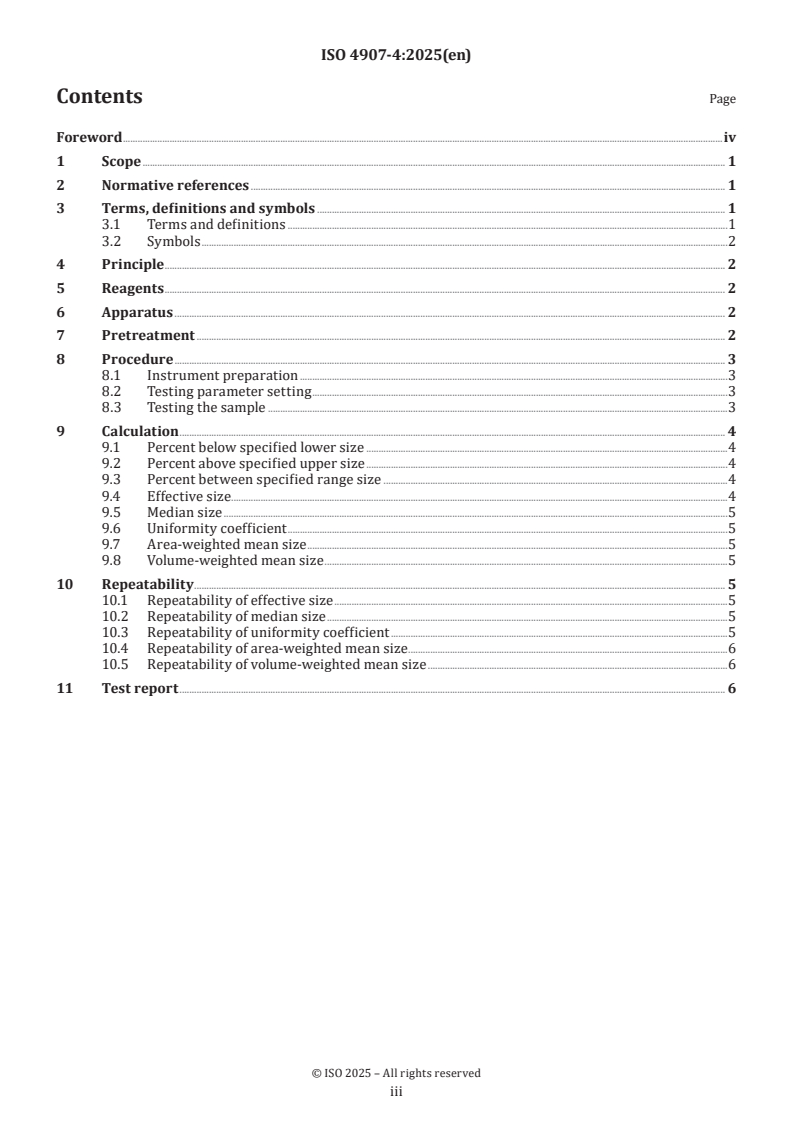
Contents Page
Foreword .iv
1 Scope . 1
2 Normative references . 1
3 Terms, definitions and symbols . 1
3.1 Terms and definitions .1
3.2 Symbols .2
4 Principle . 2
5 Reagents . 2
6 Apparatus . 2
7 Pretreatment . 2
8 Procedure . 3
8.1 Instrument preparation .3
8.2 Testing parameter setting .3
8.3 Testing the sample .3
9 Calculation . 4
9.1 Percent below specified lower size .4
9.2 Percent above specified upper size .4
9.3 Percent between specified range size .4
9.4 Effective size.4
9.5 Median size .5
9.6 Uniformity coefficient .5
9.7 Area-weighted mean size .5
9.8 Volume-weighted mean size .5
10 Repeatability . 5
10.1 Repeatability of effective size .5
10.2 Repeatability of median size .5
10.3 Repeatability of uniformity coefficient .5
10.4 Repeatability of area-weighted mean size .6
10.5 Repeatability of volume-weighted mean size .6
11 Test report . 6
iii
Foreword
ISO (the International Organization for Standardization) is a worldwide federation of national standards
bodies (ISO member bodies). The work of preparing International Standards is normally carried out through
ISO technical committees. Each member body interested in a subject for which a technical committee
has been established has the right to be represented on that committee. International organizations,
governmental and non-governmental, in liaison with ISO, also take part in the work. ISO collaborates closely
with the International Electrotechnical Commission (IEC) on all matters of electrotechnical standardization.
The procedures used to develop this document and those intended for its further maintenance are described
in the ISO/IEC Directives, Part 1. In particular, the different approval criteria needed for the different types
of ISO documents should be noted. This document was drafted in accordance with the editorial rules of the
ISO/IEC Directives, Part 2 (see www.iso.org/directives).
ISO draws attention to the possibility that the implementation of this document may involve the use of (a)
patent(s). ISO takes no position concerning the evidence, validity or applicability of any claimed patent
rights in respect thereof. As of the date of publication of this document, ISO had not received notice of (a)
patent(s) which may be required to implement this document. However, implementers are cautioned that
this may not represent the latest information, which may be obtained from the patent database available at
www.iso.org/patents. ISO shall not be held responsible for identifying any or all such patent rights.
Any trade name used in this document is information given for the convenience of users and does not
constitute an endorsement.
For an explanation of the voluntary nature of standards, the meaning of ISO specific terms and expressions
related to conformity assessment, as well as information about ISO's adherence to the World Trade
Organization (WTO) principles in the Technical Barriers to Trade (TBT), see www.iso.org/iso/foreword.html.
This document was prepared by Technical Committee ISO/TC 61, Plastic, Subcommittee SC 5, Physical-
chemical properties.
A list of all parts in the ISO 4907 series can be found on the ISO website.
Any feedback or questions on this document should be directed to the user’s national standards body. A
complete listing of these bodies can be found at www.iso.org/members.html.
...