

ISO 27928:2025
(Main)Carbon dioxide capture, transportation and storage — Carbon dioxide capture — Performance evaluation methods for CO2 capture connected to a CO2 intensive plant
General Information
- Abstract
1.1 This document specifies methods for measuring and evaluating the performance of CO2 capture connected to a CO2 intensive plant, and which separates CO2 from the CO2 intensive plant exhaust gas in preparation for subsequent transportation and geological storage. In particular, this document provides a common methodology to calculate key performance indicators (KPI) for the CO2 capture plant. To determine the KPIs, the boundaries of the CO2 capture plant need to be defined and the necessary parameters need to be measured. 1.2 This document covers the CO2 capture plant capturing CO2 from CO2 containing exhaust gas connected to CO2 intensive plants. The connection of a CO2 capture plant to a CO2 intensive plant is anticipated to have negligible impact on the product quality or the quantities produced by the CO2 intensive plant. This is in contrast with the integration of CO2 capture plants with power plants which usually results in a reduction of the power plant output. For the CO2 intensive industry, it is important that product quality remains the same after connection of the CO2 capture plant, in order for the industry to continue to meet customer requirements. The CO2 capture technologies covered by this document are able to operate without interfering with the operations of the CO2 intensive plant. Frequently used CO2 capture technologies are chemical absorption (e.g. liquid amine) and solid adsorption [e.g. pressure swing adsorption (PSA), temperature swing adsorption (TSA)]. Other CO2 capture concepts are membranes, cryogenic and other capture technologies. The CO2 capture plant can be installed for treatment of the full volume of exhaust gas from the CO2 intensive plant or a fraction of the total (i.e. a slipstream). Captured CO2 is then conditioned, e.g. dried and compressed or liquefied, as determined by the conditions needed for transportation and storage. The transportation can be either through a pipeline or through an intermediate storage facility waiting for shipment; either by tanker car, train or ship. The system includes interfaces between the CO2 capture plant and the CO2 intensive plant as well as the CO2 transportation and storage system. 1.3 This document is intended to describe the following KPIs: a) CO2 capture rate; b) specific electrical energy consumption (SEC); c) specific thermal energy consumption (STEC); d) specific material consumption (e.g. absorbent or adsorbent) (SMC). The calculations are based on measurements at the boundary of the CO2 capture plant, particularly of energy and other utilities consumption. 1.4 This document includes: a) the CO2 capture plant boundary (see Clause 4), which defines the boundaries of the CO2 capture plant and identifies which streams of energy and mass are crossing these boundaries to identify the key streams that are applicable for their particular case; b) the basic performance of CO2 capture plant (see Clause 5), which defines the parameters that describe the basic performance of the CO2 capture plant; c) the utilities and consumption calculation (see Clause 6), which lists the utility measurements required and provides guidance on how to convert utility measurements into the values required for the KPIs; d) the guiding principles (see Clause 7), the basis for CO2 capture plant performance assessment, which describes all guidelines to prepare, set-up and conduct the tests; e) the instruments and measurement methods (see Clause 8), which lists the standards available for the relevant measurements issues and considerations to take into account when applying measurement methods to CO2 capture plants; f) the evaluation of key performance indicators (see Clause 9), which specifies the set of KPIs to be determined and their calculation methods. 1.5 This document does not provide guidance for benchmarking, comparing or assessing KPIs of different technologies or different CO2 capture projects. Health, safety and environment (HSE) is not included.
- Status
- Published
- Publication Date
- 17-Dec-2025
- Technical Committee
- ISO/TC 265 - Carbon dioxide capture, transportation, and geological storage
- Current Stage
- 6060 - International Standard published
- Start Date
- 18-Dec-2025
- Due Date
- 11-Feb-2026
- Completion Date
- 18-Dec-2025



Overview
ISO 27928:2025 specifies standardized methods to measure and evaluate the performance of CO2 capture systems that are connected to CO2‑intensive industrial plants (steel, cement, refineries, chemicals, etc.). It defines how to set the CO2 capture plant boundary, which streams of mass and energy must be measured, and provides a common methodology to calculate key performance indicators (KPIs) for captured CO2 prepared for subsequent transportation and geological storage.
Key topics and technical requirements
- CO2 capture plant boundary
- Defines what equipment, interfaces and utility streams are inside the capture plant boundary versus the CO2‑intensive plant and wider transport/storage system.
- Performance definitions
- Methods to determine basic performance parameters and product CO2 stream properties (flow, composition, conditioning).
- Key Performance Indicators (KPIs)
- CO2 capture rate (fraction of CO2 separated from the exhaust stream)
- Specific electrical energy consumption (SEC)
- Specific thermal energy consumption (STEC)
- Specific material consumption (SMC) (e.g., solvent, sorbent)
- KPI calculations are based on measurements at the capture‑plant boundary, including energy and utilities.
- Utilities and consumption calculations
- Guidance on measuring and converting thermal energy, electrical energy, cooling and process water, and consumables into KPI inputs.
- Guiding principles and test procedures
- Test planning, preparation, conduct of tests and calculation/reporting of results.
- Instruments and measurement methods
- References and considerations for gas analysis, flow, pressure, temperature, power measurement and data handling.
- Quantification and verification
- Procedures for quantifying captured CO2, addressing leakage considerations and verification practices.
- Technologies covered
- Chemical absorption (e.g., liquid amines), solid adsorption (PSA, TSA), membranes, cryogenic and other capture concepts; applicable to full‑flow or slipstream arrangements.
- Exclusions
- The standard does not provide benchmarking between technologies or address health, safety and environment (HSE).
Applications
- Engineering performance testing and acceptance of CO2 capture plants connected to industrial emitters.
- Establishing consistent KPI reporting for project developers, plant owners and financiers.
- Supporting measurement plans for CO2 conditioning, compression/liquefaction and handover to transport or storage.
- Informing procurement and commissioning activities for capture equipment and measurement systems.
Who should use this standard
- Plant operators and process engineers at CO2‑intensive facilities
- CCS project developers and EPC contractors
- Test engineers, measurement & verification teams, auditors and regulators
- Equipment suppliers and technology licensors
- Researchers comparing capture process performance (non‑benchmarking)
Related standards
- ISO 27919‑1 (post‑combustion CO2 capture KPI methods for power plants) - complementary and independent; both address KPI methodology for different source categories.
- Prepared by ISO/TC 265 (Carbon dioxide capture, transportation and storage).
Keywords: ISO 27928, CO2 capture standard, carbon dioxide capture, CO2 intensive plant, KPIs, SEC, STEC, SMC, performance evaluation.
Get Certified
Connect with accredited certification bodies for this standard

BSI Group
BSI (British Standards Institution) is the business standards company that helps organizations make excellence a habit.

Bureau Veritas
Bureau Veritas is a world leader in laboratory testing, inspection and certification services.

DNV
DNV is an independent assurance and risk management provider.
Sponsored listings
Frequently Asked Questions
ISO 27928:2025 is a standard published by the International Organization for Standardization (ISO). Its full title is "Carbon dioxide capture, transportation and storage — Carbon dioxide capture — Performance evaluation methods for CO2 capture connected to a CO2 intensive plant". This standard covers: 1.1 This document specifies methods for measuring and evaluating the performance of CO2 capture connected to a CO2 intensive plant, and which separates CO2 from the CO2 intensive plant exhaust gas in preparation for subsequent transportation and geological storage. In particular, this document provides a common methodology to calculate key performance indicators (KPI) for the CO2 capture plant. To determine the KPIs, the boundaries of the CO2 capture plant need to be defined and the necessary parameters need to be measured. 1.2 This document covers the CO2 capture plant capturing CO2 from CO2 containing exhaust gas connected to CO2 intensive plants. The connection of a CO2 capture plant to a CO2 intensive plant is anticipated to have negligible impact on the product quality or the quantities produced by the CO2 intensive plant. This is in contrast with the integration of CO2 capture plants with power plants which usually results in a reduction of the power plant output. For the CO2 intensive industry, it is important that product quality remains the same after connection of the CO2 capture plant, in order for the industry to continue to meet customer requirements. The CO2 capture technologies covered by this document are able to operate without interfering with the operations of the CO2 intensive plant. Frequently used CO2 capture technologies are chemical absorption (e.g. liquid amine) and solid adsorption [e.g. pressure swing adsorption (PSA), temperature swing adsorption (TSA)]. Other CO2 capture concepts are membranes, cryogenic and other capture technologies. The CO2 capture plant can be installed for treatment of the full volume of exhaust gas from the CO2 intensive plant or a fraction of the total (i.e. a slipstream). Captured CO2 is then conditioned, e.g. dried and compressed or liquefied, as determined by the conditions needed for transportation and storage. The transportation can be either through a pipeline or through an intermediate storage facility waiting for shipment; either by tanker car, train or ship. The system includes interfaces between the CO2 capture plant and the CO2 intensive plant as well as the CO2 transportation and storage system. 1.3 This document is intended to describe the following KPIs: a) CO2 capture rate; b) specific electrical energy consumption (SEC); c) specific thermal energy consumption (STEC); d) specific material consumption (e.g. absorbent or adsorbent) (SMC). The calculations are based on measurements at the boundary of the CO2 capture plant, particularly of energy and other utilities consumption. 1.4 This document includes: a) the CO2 capture plant boundary (see Clause 4), which defines the boundaries of the CO2 capture plant and identifies which streams of energy and mass are crossing these boundaries to identify the key streams that are applicable for their particular case; b) the basic performance of CO2 capture plant (see Clause 5), which defines the parameters that describe the basic performance of the CO2 capture plant; c) the utilities and consumption calculation (see Clause 6), which lists the utility measurements required and provides guidance on how to convert utility measurements into the values required for the KPIs; d) the guiding principles (see Clause 7), the basis for CO2 capture plant performance assessment, which describes all guidelines to prepare, set-up and conduct the tests; e) the instruments and measurement methods (see Clause 8), which lists the standards available for the relevant measurements issues and considerations to take into account when applying measurement methods to CO2 capture plants; f) the evaluation of key performance indicators (see Clause 9), which specifies the set of KPIs to be determined and their calculation methods. 1.5 This document does not provide guidance for benchmarking, comparing or assessing KPIs of different technologies or different CO2 capture projects. Health, safety and environment (HSE) is not included.
1.1 This document specifies methods for measuring and evaluating the performance of CO2 capture connected to a CO2 intensive plant, and which separates CO2 from the CO2 intensive plant exhaust gas in preparation for subsequent transportation and geological storage. In particular, this document provides a common methodology to calculate key performance indicators (KPI) for the CO2 capture plant. To determine the KPIs, the boundaries of the CO2 capture plant need to be defined and the necessary parameters need to be measured. 1.2 This document covers the CO2 capture plant capturing CO2 from CO2 containing exhaust gas connected to CO2 intensive plants. The connection of a CO2 capture plant to a CO2 intensive plant is anticipated to have negligible impact on the product quality or the quantities produced by the CO2 intensive plant. This is in contrast with the integration of CO2 capture plants with power plants which usually results in a reduction of the power plant output. For the CO2 intensive industry, it is important that product quality remains the same after connection of the CO2 capture plant, in order for the industry to continue to meet customer requirements. The CO2 capture technologies covered by this document are able to operate without interfering with the operations of the CO2 intensive plant. Frequently used CO2 capture technologies are chemical absorption (e.g. liquid amine) and solid adsorption [e.g. pressure swing adsorption (PSA), temperature swing adsorption (TSA)]. Other CO2 capture concepts are membranes, cryogenic and other capture technologies. The CO2 capture plant can be installed for treatment of the full volume of exhaust gas from the CO2 intensive plant or a fraction of the total (i.e. a slipstream). Captured CO2 is then conditioned, e.g. dried and compressed or liquefied, as determined by the conditions needed for transportation and storage. The transportation can be either through a pipeline or through an intermediate storage facility waiting for shipment; either by tanker car, train or ship. The system includes interfaces between the CO2 capture plant and the CO2 intensive plant as well as the CO2 transportation and storage system. 1.3 This document is intended to describe the following KPIs: a) CO2 capture rate; b) specific electrical energy consumption (SEC); c) specific thermal energy consumption (STEC); d) specific material consumption (e.g. absorbent or adsorbent) (SMC). The calculations are based on measurements at the boundary of the CO2 capture plant, particularly of energy and other utilities consumption. 1.4 This document includes: a) the CO2 capture plant boundary (see Clause 4), which defines the boundaries of the CO2 capture plant and identifies which streams of energy and mass are crossing these boundaries to identify the key streams that are applicable for their particular case; b) the basic performance of CO2 capture plant (see Clause 5), which defines the parameters that describe the basic performance of the CO2 capture plant; c) the utilities and consumption calculation (see Clause 6), which lists the utility measurements required and provides guidance on how to convert utility measurements into the values required for the KPIs; d) the guiding principles (see Clause 7), the basis for CO2 capture plant performance assessment, which describes all guidelines to prepare, set-up and conduct the tests; e) the instruments and measurement methods (see Clause 8), which lists the standards available for the relevant measurements issues and considerations to take into account when applying measurement methods to CO2 capture plants; f) the evaluation of key performance indicators (see Clause 9), which specifies the set of KPIs to be determined and their calculation methods. 1.5 This document does not provide guidance for benchmarking, comparing or assessing KPIs of different technologies or different CO2 capture projects. Health, safety and environment (HSE) is not included.
ISO 27928:2025 is classified under the following ICS (International Classification for Standards) categories: 13.020.40 - Pollution, pollution control and conservation. The ICS classification helps identify the subject area and facilitates finding related standards.
ISO 27928:2025 is available in PDF format for immediate download after purchase. The document can be added to your cart and obtained through the secure checkout process. Digital delivery ensures instant access to the complete standard document.
Standards Content (Sample)
International
Standard
ISO 27928
First edition
Carbon dioxide capture,
2025-12
transportation and storage —
Carbon dioxide capture —
Performance evaluation methods
for CO capture connected to a CO
2 2
intensive plant
Capture, transport et stockage du dioxyde de carbone —
Capture du dioxyde de carbone — Méthodes d'évaluation des
performances pour la capture du CO des installations à fortes
émissions de CO
Reference number
© ISO 2025
All rights reserved. Unless otherwise specified, or required in the context of its implementation, no part of this publication may
be reproduced or utilized otherwise in any form or by any means, electronic or mechanical, including photocopying, or posting on
the internet or an intranet, without prior written permission. Permission can be requested from either ISO at the address below
or ISO’s member body in the country of the requester.
ISO copyright office
CP 401 • Ch. de Blandonnet 8
CH-1214 Vernier, Geneva
Phone: +41 22 749 01 11
Email: copyright@iso.org
Website: www.iso.org
Published in Switzerland
ii
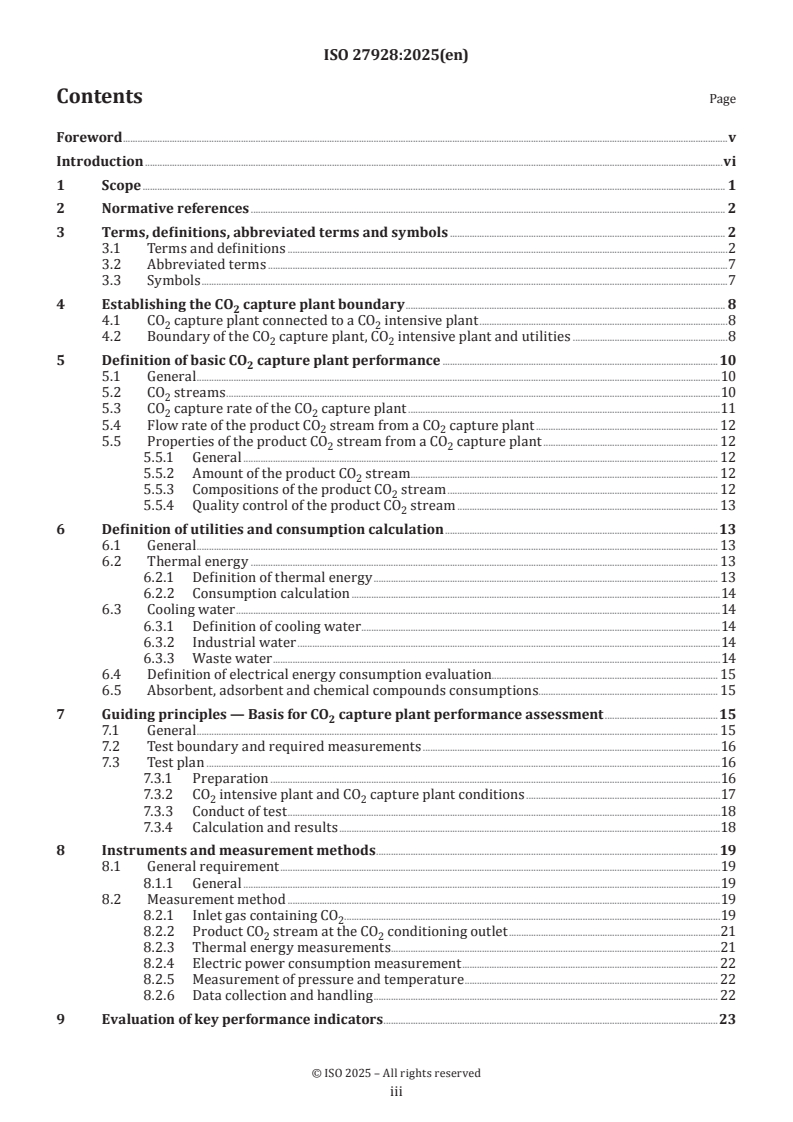
Contents Page
Foreword .v
Introduction .vi
1 Scope . 1
2 Normative references . 2
3 Terms, definitions, abbreviated terms and symbols . 2
3.1 Terms and definitions .2
3.2 Abbreviated terms .7
3.3 Symbols .7
4 Establishing the CO capture plant boundary . 8
4.1 CO capture plant connected to a CO intensive plant .8
2 2
4.2 Boundary of the CO capture plant, CO intensive plant and utilities .8
2 2
5 Definition of basic CO capture plant performance .10
5.1 General .10
5.2 CO streams .10
5.3 CO capture rate of the CO capture plant .11
2 2
5.4 Flow rate of the product CO stream from a CO capture plant . 12
2 2
5.5 Properties of the product CO stream from a CO capture plant . 12
2 2
5.5.1 General . 12
5.5.2 Amount of the product CO stream. 12
5.5.3 Compositions of the product CO stream . 12
5.5.4 Quality control of the product CO stream . 13
6 Definition of utilities and consumption calculation .13
6.1 General . 13
6.2 Thermal energy . 13
6.2.1 Definition of thermal energy . 13
6.2.2 Consumption calculation .14
6.3 Cooling water .14
6.3.1 Definition of cooling water .14
6.3.2 Industrial water .14
6.3.3 Waste water .14
6.4 Definition of electrical energy consumption evaluation. 15
6.5 Absorbent, adsorbent and chemical compounds consumptions. 15
7 Guiding principles — Basis for CO capture plant performance assessment .15
7.1 General . 15
7.2 Test boundary and required measurements .16
7.3 Test plan .16
7.3.1 Preparation .16
7.3.2 CO intensive plant and CO capture plant conditions .17
2 2
7.3.3 Conduct of test .18
7.3.4 Calculation and results .18
8 Instruments and measurement methods . 19
8.1 General requirement .19
8.1.1 General .19
8.2 Measurement method .19
8.2.1 Inlet gas containing CO .19
8.2.2 Product CO stream at the CO conditioning outlet .21
2 2
8.2.3 Thermal energy measurements.21
8.2.4 Electric power consumption measurement . 22
8.2.5 Measurement of pressure and temperature . 22
8.2.6 Data collection and handling . 22
9 Evaluation of key performance indicators .23
iii
9.1 General . 23
9.2 Specific electrical energy consumption . 23
9.3 Specific thermal energy consumption .24
9.4 Specific material consumption.24
10 Quantification and verification of the CO capture .24
10.1 General .24
10.2 Quantification . . .24
10.3 CO leakage . 25
10.4 Verification . . 25
Annex A (informative) General information for the instrument and measurement methods .26
Annex B (informative) KPI evaluation sheet.28
Bibliography .30
iv
Foreword
ISO (the International Organization for Standardization) is a worldwide federation of national standards
bodies (ISO member bodies). The work of preparing International Standards is normally carried out through
ISO technical committees. Each member body interested in a subject for which a technical committee
has been established has the right to be represented on that committee. International organizations,
governmental and non-governmental, in liaison with ISO, also take part in the work. ISO collaborates closely
with the International Electrotechnical Commission (IEC) on all matters of electrotechnical standardization.
The procedures used to develop this document and those intended for its further maintenance are described
in the ISO/IEC Directives, Part 1. In particular, the different approval criteria needed for the different types
of ISO document should be noted. This document was drafted in accordance with the editorial rules of the
ISO/IEC Directives, Part 2 (see www.iso.org/directives).
ISO draws attention to the possibility that the implementation of this document may involve the use of (a)
patent(s). ISO takes no position concerning the evidence, validity or applicability of any claimed patent
rights in respect thereof. As of the date of publication of this document, ISO had not received notice of (a)
patent(s) which may be required to implement this document. However, implementers are cautioned that
this may not represent the latest information, which may be obtained from the patent database available at
www.iso.org/patents. ISO shall not be held responsible for identifying any or all such patent rights.
Any trade name used in this document is information given for the convenience of users and does not
constitute an endorsement.
For an explanation of the voluntary nature of standards, the meaning of ISO specific terms and expressions
related to conformity assessment, as well as information about ISO's adherence to the World Trade
Organization (WTO) principles in the Technical Barriers to Trade (TBT), see www.iso.org/iso/foreword.html.
This document was prepared by Technical Committee ISO/TC 265, Carbon dioxide capture, transportation,
and storage.
Any feedback or questions on this document should be directed to the user’s national standards body. A
complete listing of these bodies can be found at www.iso.org/members.html.
v
Introduction
It is very important to reduce atmospheric carbon dioxide (CO ) emissions in order to meet climate change
mitigation targets. The inclusion of carbon dioxide capture and storage (CCS) among the variety of available
emission reduction approaches enhances the probability of meeting these targets at the lowest cost to the
global economy. CCS captures CO from industrial and energy-related sources and stores it underground in
geological formations. CCS can capture CO emissions from carbonaceous fuel-based combustion processes,
including power generation, and is at present the most effective technology capable of dealing directly with
emissions from several CO intensive industries, such as steel, cement etc.
As a standard for CO capture, ISO 27919-1 presents an evaluation method of key performance indicators
(KPIs) for post-combustion CO capture (PCC) from a power plant. On the other hand, this document covers
an evaluation method of KPIs for CO capture from various CO intensive plants. It is noted that ISO 27919-1
2 2
and this document are mutually independent; similar terms and symbols used in both the standards are
valid only in the respective standards. CO intensive plants suggest industries such as steel, cement, ferro
alloys, aluminium and other metals. It is also intended for CCS enabled hydrogen as well as refineries,
chemical processing industries such as fertilizer. The CO capture plant takes in the exhaust gas from the
CO intensive plant without further integration, i.e. not impacting on the production of the CO intensive
2 2
plant.
CO intensive industries are characterized by the production of significant volumes of CO as a by-product.
2 2
In many cases, the CO amounts are comparable or even larger than the amount of the main product. The
two largest of such industries, steel and cement manufacture, are responsible for 7 % to 8 % each of global
CO production. Typically, the CO intensive industries produce large amounts of CO at each production site,
2 2 2
often in the range from some hundred thousand to million tonnes per annum. CO intensive industries, such
as steel, cement, etc. are using carbon or carbon-containing raw materials, which often cannot readily be
replaced. For example, cement needs limestone and silicon metal needs carbon as the chemical reductant.
In steel production, the dominant CO sources are the iron-making blast furnace and the steel converter,
while other production steps (ore sintering, rolling mills, etc.) are producing smaller amounts. A modern,
integrated steel plant, making finished steel bars, beams or plates from iron ore emits around two tonnes
of CO per tonne of finished product. In contrast, steel produced from scrap in an electric arc furnace
emits about 350 kg CO per tonne of steel. However, scrap availability is seriously limited. The exhaust
gases from the blast furnace have extra high content of CO (typically 25 % by volume) and high pressure
[2 atmospheres (atm) to 4 atm]. The steel converter produces intermittently smaller amounts of flue gas
with some lower CO content and at ambient pressure. Other CO producing steps on the way from iron
2 2
ore to finished products typically produce flue gases with lower CO content (10 % to 15 %), like most fuel
combustion and at ambient pressure.
CO capture on the blast furnace exhaust gas can take advantage of the high CO content, pressure and
2 2
volume of this exhaust gas, typically 75 % of the total CO from the integrated mill. This has been pilot tested
with pressure swing adsorption (PSA) on a semi-industrial blast furnace. The adsorbents were zeolites and
active carbon. The results showed low energy consumption.
In cement production, there are two main steps producing CO :
a) Calcination of limestone by heating the main raw material, limestone to 900 °C, after grinding the rock
limestone to a fine powder. Heating of the materials occurs in counter current flow with hot exhaust
gases from step b). The process equipment can vary from plant to plant.
b) Clinker burning of a mixture of burnt lime from step a) together with silica containing raw materials
occur in a long, rotary kiln. The kiln is normally fired from the material exit end with solid, liquid or
gaseous fuel (e.g. coal, oil, gas, biomass and waste). The clinker mix is heated up to 1 450 °C and the
clinker is semi-fused to round plum size pellets. A part of the exhaust gases is sent to step a); the rest is
sent to the exhaust gas stack. The clinker leaving the rotary kiln passes through a clinker cooler, where
combustion air is pre-heated for the kiln.
In lime production, CO generation includes only step a).
vi
After calcination and clinker burning, the clinker is ground together with other mineral raw materials into
cement powder, used to make concrete; the biggest volume of construction material globally by far.
The limestone calcination generates 60 % of the total CO produced. The exhaust gas from the rotary kiln
combustion carries the remaining 40 %; giving a total of 0,8 to 0,9 tonnes of CO per tonne of clinker. The
exhaust gas contains typically 20 % to 22 % of CO , moisture and dust. The remaining gas compounds
are mostly N , O and NO with smaller amounts of other compounds depending on the fuel used. The CO
2 2 x 2
capture process is located downstream of conventional contaminant controls of the exhaust gas, and is
expected to have minimal, if any, influence on the quality of the cement clinker produced.
Silicon metal (a typical use is in solar panels) is smelted in large bucket shaped furnaces with three large
diameter electrodes in through the top. The top of the furnace is semi-closed for operational reasons. Raw
materials (typically quartz and carbon) are fed through the top. Extreme high temperatures are generated
in the centre of the furnace. This causes the quartz to melt, react with carbon and form a bottom pool of
silicon metal, which then is intermittently tapped out. The furnace reactions also generate large volumes of
exhaust gases; a mixture of carbon monoxide and silicon monoxide (CO and SiO). As the exhaust gas is cooled
down and contacts air at the top of the furnace, these gas components are oxidized into CO and silica dust
(SiO ). The silica particle size typically less than 10 microns in size (particle size as for cigarette smoke) is
filtered off and sold as a by-product. The resulting plant exhaust contains varying and low concentrations of
CO and air. Recycling off gas back to the furnace top before connecting the exhaust gas to the CO capture
2 2
plant can result in higher CO concentrations, facilitating the CO capture.
2 2
Even if the furnace producing silicon metal is fed exclusively with renewable electricity, the production
emits around four tonnes of CO per tonne of silicon metal produced.
Aluminium production is done in long rows of electrolysis cells fed with aluminium oxide (Al O ) powder
2 3
into a melted fluoride bath. The electricity is fed through bottom (cathode) and top (anode) electrodes.
Produced melted aluminium metal gathers in the bottom and is intermittently tapped off. Under the top
carbon electrode, CO gas evolves containing over 95 % CO ; the remainder being fluorides. This cell gas is
2 2
collected from the long row of cells and then mixed with large volumes of air from building above the cell
row (the hall). This gaseous mixture also contains traces of fluorides leaked from the cells. The diluted cell
gas is then sent to water washing, to avoid harming the environment. After mixing with the hall air and after
water wash, the gas contains 1 % to 2 % CO ; rest air and moisture.
Aluminium electrolysis produces around 1,5 tonnes of CO per tonne of aluminium product.
To capture CO the cell gas can be diverted to a CO capture unit before mixing it with the hall gas and then
2 2
sent to washing with water.
CCS enabled hydrogen (commonly referred to as “Blue” hydrogen) is produced by the reforming of short-
chain hydrocarbons (typically methane). The product CO from this reaction is captured and exported for
permanent storage.
Feedstock gas is purified and mixed with steam, before passing through one or multiple reforming reactor(s),
producing a stream consisting primary of hydrogen, CO , carbon monoxide (CO) and water. This stream is
then passed through a water-gas shift reactor, where residual CO is converted to CO and hydrogen, and then
cooled to remove water. The result is a syngas made up almost entirely of CO and hydrogen, at a pressure of
1)
approximately 25 bar to 30 bar.
CO is then captured from this syngas stream and exported for storage. Depending on the plant’s
configuration and reformer design, CO can also be captured from plant’s fired heater and reformer flue
gases. Hydrogen is typically purified using a pressure swing adsorption (PSA) unit, from which the rejected
“tail gas” is combusted to produce process heat or steam.
Modern CCS enabled hydrogen flowsheets are capable of capturing in excess of 95 % of all carbon within the
feedstock hydrocarbon gas.
For other CO intensive industries, beyond steel, cement, silicon, aluminium and CCS enabled hydrogen, see
relevant textbooks. The intended user of this document includes CO intensive plant owners and operators,
5 2
1) 1 bar = 0,1 MPa = 10 Pa; 1 MPa = 1 N/mm .
vii
project developers, technology developers and vendors, regulators, and other stakeholders. This document
provides a common basis for estimating, measuring and evaluating the performance of a CO capture plant
connected to a CO intensive plant.
viii
International Standard ISO 27928:2025(en)
Carbon dioxide capture, transportation and storage — Carbon
dioxide capture — Performance evaluation methods for CO
capture connected to a CO intensive plant
1 Scope
1.1 This document specifies methods for measuring and evaluating the performance of CO capture
connected to a CO intensive plant, and which separates CO from the CO intensive plant exhaust gas in
2 2 2
preparation for subsequent transportation and geological storage. In particular, this document provides a
common methodology to calculate key performance indicators (KPI) for the CO capture plant. To determine
the KPIs, the boundaries of the CO capture plant need to be defined and the necessary parameters need to
be measured.
1.2 This document covers the CO capture plant capturing CO from CO containing exhaust gas connected
2 2 2
to CO intensive plants. The connection of a CO capture plant to a CO intensive plant is anticipated to have
2 2 2
negligible impact on the product quality or the quantities produced by the CO intensive plant. This is in
contrast with the integration of CO capture plants with power plants which usually results in a reduction
of the power plant output. For the CO intensive industry, it is important that product quality remains the
same after connection of the CO capture plant, in order for the industry to continue to meet customer
requirements.
The CO capture technologies covered by this document are able to operate without interfering with the
operations of the CO intensive plant. Frequently used CO capture technologies are chemical absorption
2 2
(e.g. liquid amine) and solid adsorption [e.g. pressure swing adsorption (PSA), temperature swing adsorption
(TSA)]. Other CO capture concepts are membranes, cryogenic and other capture technologies. The CO
2 2
capture plant can be installed for treatment of the full volume of exhaust gas from the CO intensive plant
or a fraction of the total (i.e. a slipstream). Captured CO is then conditioned, e.g. dried and compressed or
liquefied, as determined by the conditions needed for transportation and storage. The transportation can be
either through a pipeline or through an intermediate storage facility waiting for shipment; either by tanker
car, train or ship.
The system includes interfaces between the CO capture plant and the CO intensive plant as well as the CO
2 2 2
transportation and storage system.
1.3 This document is intended to describe the following KPIs:
a) CO capture rate;
b) specific electrical energy consumption (SEC);
c) specific thermal energy consumption (STEC);
d) specific material consumption (e.g. absorbent or adsorbent) (SMC).
The calculations are based on measurements at the boundary of the CO capture plant, particularly of energy
and other utilities consumption.
1.4 This document includes:
a) the CO capture plant boundary (see Clause 4), which defines the boundaries of the CO capture plant
2 2
and identifies which streams of energy and mass are crossing these boundaries to identify the key
streams that are applicable for their particular case;
b) the basic performance of CO capture plant (see Clause 5), which defines the parameters that describe
the basic performance of the CO capture plant;
c) the utilities and consumption calculation (see Clause 6), which lists the utility measurements required
and provides guidance on how to convert utility measurements into the values required for the KPIs;
d) the guiding principles (see Clause 7), the basis for CO capture plant performance assessment, which
describes all guidelines to prepare, set-up and conduct the tests;
e) the instruments and measurement methods (see Clause 8), which lists the standards available for the
relevant measurements issues and considerations to take into account when applying measurement
methods to CO capture plants;
f) the evaluation of key performance indicators (see Clause 9), which specifies the set of KPIs to be
determined and their calculation methods.
1.5 This document does not provide guidance for benchmarking, comparing or assessing KPIs of different
technologies or different CO capture projects. Health, safety and environment (HSE) is not included.
2 Normative references
There are no normative references in this document.
3 Terms, definitions, abbreviated terms and symbols
For the purposes of this document, the following terms and definitions apply.
ISO and IEC maintain terminology databases for use in standardization at the following addresses:
— ISO Online browsing platform: available at https:// www .iso .org/ obp
— IEC Electropedia: available at https:// www .electropedia .org/
3.1 Terms and definitions
3.1.1
absorbent
substance able to selectively absorb liquid or gas components in its bulk phase
3.1.2
accuracy
measurement accuracy
closeness of agreement between a measured quantity value and a true quantity value of a measured entity
[SOURCE: ISO/IEC Guide 99:2007, 2.13, modified — the admitted term "accuracy of measurement" has been
deleted, "measurand" has been replaced with "measured entity" in the definition and Notes 1, 2 and 3 to
entry have been deleted.]
3.1.3
adsorbent
substance able to selectively adsorb liquid or gas components on its surface
3.1.4
auxiliary unit
unit providing electricity or thermal (heating or cooling) or other utilities for the CO capture plant
3.1.5
carbon dioxide capture and storage
CCS
process consisting of the separation of CO from industrial and energy-related sources, transportation and
injection into a geological formation, resulting in long term isolation from the atmosphere
Note 1 to entry: CCS is often referred to as carbon capture and storage. This terminology is not encouraged because it
is inaccurate: the objective is the capture of carbon dioxide and not the capture of carbon. Tree plantation is another
form of carbon capture that does not describe precisely the physical process of removing CO from industrial emission
sources.
Note 2 to entry: The term “sequestration” is also used alternatively to “storage”. The term “storage” is preferred.
Note 3 to entry: Long term means the minimum period necessary for CO geological storage to be considered an
effective and environmentally safe climate change mitigation option.
Note 4 to entry: The term carbon dioxide capture, utilization (or use) and storage (CCUS) includes the concept that
isolation from the atmosphere can be associated with a beneficial outcome. CCUS is embodied within the definition
of CCS to the extent that long term isolation of the CO occurs through storage within geological formations. CCU is
carbon capture and utilization (or use) without storage within geological formations.
Note 5 to entry: CCS should also ensure long term isolation of CO from oceans, lakes, potable water supplies and other
natural resources.
[SOURCE: ISO 27917:2017, 3.1.1, modified — Note 2 to entry has been modified.]
3.1.6
chemical absorption
process in which CO is absorbed by chemical reaction
3.1.7
CO capture
separation of CO in such a manner as to produce a concentrated stream of CO that can readily be
2 2
transported for storage
3.1.8
CO captured
CO in the product CO stream (3.1.31) produced by a CO capture plant that produces a CO stream (3.1.14)
2 2 2 2
from exhaust gases
3.1.9
CO capture plant boundary
boundary
performance evaluation boundary of a CO capture plant
3.1.10
CO capture rate
CO removal efficiency of the CO capture plant calculated as the quotient of the CO volume flow rate in the
2 2 2
product CO stream (3.1.14) divided by the CO volume flow rate in the inlet gas steam
2 2
Note 1 to entry: CO capture rate is expressed as a percentage.
3.1.11
CO conditioning
processes needed before transportation to make the CO stream (3.1.14) leaving the capture plant
meeting downstream specifications, e.g. drying (dehydration) purification, compression, liquefaction and
dehydration
3.1.12
CO intensive industry
industry producing significant volumes of CO as a by-product
3.1.13
CO intensive plant
plant producing significant volumes of CO as a by-product
3.1.14
CO stream
gas stream containing CO , crossing the CO capture plant boundary (3.1.9)
2 2
Note 1 to entry: In ISO 27917, a CO stream is defined instead as a “stream consisting overwhelmingly of carbon
dioxide”.
3.1.15
cooling duty
net enthalpy rejected to a cooling media
3.1.16
cooling energy
enthalpy removed by the cooling method
3.1.17
dehydrator
moisture removal system or equipment
3.1.18
deNO
x
process or equipment used to remove nitrogen oxides (NO ) from the exhaust gas
x
3.1.19
effluent
liquid discharged to the environment or wastewater (3.1.42) treatment facility
3.1.20
heat duty
net enthalpy required from a heat media cycling forth and back with the thermal energy (3.1.39) source
3.1.21
impurity
non-CO substance that is part of the CO stream (3.1.14) that may be derived from the source materials or
2 2
the capture process, or added as a result of co-mingling for transportation, or released or formed as a result
of sub-surface storage or leakage of CO
[SOURCE: ISO 27917:2017, 3.2.12, modified — Notes 1 and 2 to entry have been deleted.]
3.1.22
inlet gas stream
input gas stream to be treated by CO capture plant coming from the CO intensive plant (3.1.13)
2 2
3.1.23
interface
mechanical, thermal, electrical or operational common boundary between two elements of a system
[SOURCE: ISO 10795:2019, 3.132, modified — the term "I/F" has been deleted.]
3.1.24
key performance indicator
KPI
measure of performance relevant to the CO capture plant connected to a CO intensive plant (3.1.13)
2 2
3.1.25
measurement point
point of connection between the CO capture plant and inlet, outlet and product gas stream as well as with
utilities
Note 1 to entry: The measurement point sits at the CO capture plant boundary (3.1.9).
3.1.26
outlet gas stream
outlet CO leaner gas stream of which the CO concentration has been reduced after passing through a CO
2 2 2
capture plant
3.1.27
permanent plant instrument
instrument installed in the CO intensive plant (3.1.13) and capture plant for control and monitoring
3.1.28
plant reference condition
stable operating condition of the CO intensive plant (3.1.13) with the rated or the ordinary production
operation
3.1.29
post-combustion CO capture
PCC
capture of carbon dioxide from exhaust gas stream produced by carbonaceous fuel combustion
[SOURCE: ISO/TR 27912:2016, 3.51, modified — “fuel air combustion” has been modified to “carbonaceous
fuel combustion”.]
3.1.30
pre-treatment
part of the CO capture (3.1.7) which conditions the inlet gas as required for CO to be separated, in respect
2 2
of the temperature, the pressure and impurities concentrations
Note 1 to entry: Treatment can include, if necessary, deNO , exhaust (flue) gas desulfurization (FGD), and particulate
x
matter (PM) reduction.
3.1.31
product CO stream
CO stream (3.1.14) produced by a CO capture plant including any conditioning process
2 2
3.1.32
redundant instrument
duplicate instrument necessary to plant functioning in case of failure of similar instruments for measurement
of the same parameters
3.1.33
reference condition
condition for a reference point where results of performance evaluation can be adjusted for the purpose of
comparability in the reporting of the results and benchmarking
3.1.34
regeneration
process to regenerate an absorbent (3.1.1) or adsorbent (3.1.3) activity after use to its operationally effective
state
3.1.35
renewable energy
energy from a source that is not depleted by extraction, such as solar energy (thermal and photovoltaic),
wind power, hydropower and biomass
3.1.36
specific electrical energy consumption
SEC
C
se
electrical energy consumed to capture and conditioning (e.g. compress, liquify, purify, dehydrate) a mass
unit of CO
3.1.37
specific material consumption
SMC
C
sm
amount of materials (e.g. absorbent (3.1.1), adsorbent (3.1.3) or chemical) consumed to capture and compress
or liquefy a mass unit of CO
3.1.38
specific thermal energy consumption
STEC
C
ste
thermal energy (3.1.39) consumed to capture and compress or liquefy a mass unit of CO
3.1.39
thermal energy
enthalpy transported by the heating media cycling forth and back between the heat supply sources or by the
heat generating media like fuels through the distribution network
3.1.40
uncertainty
measurement uncertainty
non-negative parameter characterizing the dispersion of the quantity values being attributed to a measured
entity, based on the information used
Note 1 to entry: Measurement uncertainty includes components arising from systematic effects, such as components
associated with corrections and the assigned quantity values of physical properties, as well as the definitional
uncertainty. Sometimes estimated systematic effects are not corrected for; associated measurement uncertainty
components are incorporated instead.
Note 2 to entry: The parameter may be, for example, a standard deviation called standard measurement uncertainty
(or a specified multiple of it), or the half-width of an interval, having a stated coverage probability.
Note 3 to entry: Measurement uncertainty comprises, in general, many components. Some of these may be evaluated
by Type A evaluation of measurement uncertainty from the statistical distribution of the quantity values from a series
of measurements and can be characterized by standard deviations. The other components, which may be evaluated
by Type B evaluation of measurement uncertainty, can also be characterized by standard deviations, evaluated from
probability density functions based on experience or other information.
Note 4 to entry: In general, for a given set of information, it is understood that the measurement uncertainty is
associated with a stated quantity value attributed to the measured entity. A modification of this value results in a
modification of the associated uncertainty.
Note 5 to entry: “Type A evaluation of measurement uncertainty” is defined as an evaluation of a component of
measurement uncertainty by a statistical analysis of measured quantity values obtained under defined measurement
conditions. “Type B evaluation of measurement uncertainty” is defined as an evaluation of a component of measurement
uncertainty determined by means other than a Type A evaluation of measurement uncertainty”.
[SOURCE: ISO/IEC Guide 99:2007, 2.26, modified — the term "measurement of uncertainty has been deleted",
“measurement standards” has been changed to “physical properties” in Note 1 to entry, "measurand" has
been replaced with "measured entity" in Note 4 to entry and Note 5 to entry has been added.]
3.1.41
utility
substance or ancillary service needed in the operation of a process, such as steam, electricity, cooling water
(CW), demineralised water, compressed air, nitrogen, refrigeration and effluent (3.1.19) disposal
3.1.42
waste water
excess water allowed to run to waste from the water circuit
3.2 Abbreviated terms
CCS carbon dioxide capture and storage
CCUS carbon dioxide capture, utilization (or use) and storage
CW cooling water
DP differential pressure
FGD exhaust (flue) gas desulfurization
HSE health, safety and environment
KPI key performance indicator
NO nitrogen oxides
x
PCC post-combustion CO2 capture
PM particulate matter
PSA pressure swing adsorption
SEC specific electrical energy consumption kWh/t
SMC specific material (e.g. absorbent or adsorbent) consumption kg/t
SO sulfur oxides
x
STEC specific thermal energy consumption GJ/t
TSA temperature swing adsorption
3.3 Symbols
C specific electrical energy consumption kWh/t
se
C specific material (e.g. absorbent or adsorbent) consumption kg/t
sm
C specific thermal energy consumption GJ/t
ste
P
total electrical power requirement of a CO capture plant MW
CO capture
q
mass flow rate of CO in a product CO stream t/h
mCO
2 2
q
average consumption rate of material at a CO capture plant kg/h
mmaterial
q
volume flow rate of CO in the inlet gas stream on a dry basis at the standard
VrCO in
2 3
m /h
temperature (273,15 K) and pressure (100 kPa) conditions
q
volume flow rate of CO in the outlet gas stream (stream #3) on a dry basis at
VrCO out
2 2 3
m /h
the standard temperature (273,15 K) and pressure (100 kPa) conditions
q
volume flow rate of the inlet gas stream on a dry basis at the standard temper-
Vr inletgasin
m /h
ature (273,15 K) and pressure (100 kPa) conditions
q
volume flow rate of CO in the product CO stream on a dry basis at the standard
VrproductCO
2 2 3
m /h
temperature (273,15 K) and pressure (100 kPa) conditions
q
volume flow rate of the product CO stream on a dry basis at the standard tem-
VrproductCOstream
2 3
m /h
perature (273,15 K) and pressure (100 kPa) conditions
η
CO capture rate %
CO
Φ
thermal energy consumption of a CO capture plant kJ/h
thcapture
ϕ
volume concentration of CO in the inlet gas stream on a dry basis %
CO in_cap
ϕ
volume concentration of CO in the product CO stream on a dry basis
%
CO product
2 2
4 Establishing the CO capture plant boundary
4.1 CO capture plant connected to a CO intensive plant
2 2
A CO capture plant connected to a CO intensive plant is characterized as follows:
2 2
a) It receives exhaust gas from one or more CO intensive plants. Pre-treatment may be conducted within
the CO intensive plant(s), the CO capture plant or a combination of both.
2 2
NOTE Depending on local regulatory demand or technology, this varies. If reported, KPIs needs to be
specified against the specific location of the boundary.
b) It receives utilities and energy supply from other sources than the CO capture plant.
c) The load control of CO capture plant is linked to the operation of the CO intensive plant with the
2 2
agreement of both parties.
4.2 Boundary of the CO capture plant, CO intensive plant and utilities
2 2
Figure 1 presents a typical boundary of a CO capture plant connected to a CO intensive plant. The boundary
2 2
of a CO
...