

ISO 9022-22:2012
(Main)Optics and photonics — Environmental test methods — Part 22: Combined cold, dry heat or temperature change with bump or random vibration
General Information
- Abstract
ISO 9022-22:2012 specifies methods for the testing of optical instruments, including additional assemblies from other fields (e.g. mechanical, chemical and electronic devices) under equivalent conditions, for their ability to resist combined bump or random vibration, in cold, dry heat or temperature change.
- Status
- Published
- Publication Date
- 15-Apr-2012
- Technical Committee
- ISO/TC 172/SC 1 - Fundamental standards
- Drafting Committee
- ISO/TC 172/SC 1/WG 3 - Environmental test methods
- Current Stage
- 9093 - International Standard confirmed
- Start Date
- 08-Nov-2023
- Completion Date
- 29-Aug-2026

Overview
ISO 9022-22:2012 - Optics and photonics - Environmental test methods - Part 22 - specifies laboratory methods to assess the resistance of optical instruments (and assemblies that include mechanical, chemical or electronic parts) to combined thermal stress (cold, dry heat or temperature change) together with mechanical shock (bump) or random vibration. The standard defines conditioning method 22 and gives the procedural framework, environmental test code format and the items that must be specified in a test program and report.
Key topics and technical requirements
- Scope: Combined tests to investigate how optical, thermal, chemical and electrical performance are affected by simultaneous temperature and mechanical stresses.
- Conditioning method 22: Combines ISO 9022‑2 temperature methods (cold, dry heat, temperature change) with ISO 9022‑3 mechanical methods (bump or random vibration).
- Bump (shock): Typical shock pulse is a half‑sine (example severity listed: 10 g, 6 ms). The specimen is commonly subjected to 1 000 shocks in each direction along each axis unless otherwise specified.
- Random vibration: Digitally controlled per IEC 60068‑2‑64. Example acceleration power spectral densities shown in the standard:
- 20 Hz–150 Hz at 0.02 g²/Hz
- 20 Hz–500 Hz at 0.005 g²/Hz
- 20 Hz–2 000 Hz at 0.001 g²/Hz
- Temperature parameters: Values are selected from ISO 9022‑2 (examples include −10 °C, −25 °C, −35 °C, 40 °C, 55 °C, 63 °C) and temperature‑change cycles (methods for cycle duration and ramp rates are given).
- Test sequencing and operation:
- Temperature and vibration sequencing options (cold/dry heat vs temperature change) and allowed specimen repositioning between axes.
- Specimen operating state (powered/operational) during mechanical conditioning must be defined.
- Temperature stabilization and thermal insulation requirements for fixtures; mounting per IEC 60068‑2‑47.
- Environmental test code and specification: The standard provides the coding format (example: ISO 9022‑22‑14‑01/37‑01‑1) and an explicit list of items to include in the test specification and report (temperature dwell times, number of cycles, exposure times, shock axes, state of operation, acceptance criteria, etc.).
Applications and who uses it
- Manufacturers and designers of optical instruments (lenses, imaging systems, photonics modules) who need to validate environmental robustness.
- Test laboratories and QA/validation engineers performing combined thermal-mechanical environmental qualification, burn‑in, run‑in or environmental stress screening (ESS).
- Procurement and acceptance teams who require standardized test evidence for shipping, storage and operational durability.
Related standards
- ISO 9022‑1, ISO 9022‑2, ISO 9022‑3 (other parts of the optics environmental series)
- IEC 60068‑2‑47 (mounting for vibration/impact)
- IEC 60068‑2‑64 (random vibration test control)
ISO 9022‑22:2012 is a practical reference for specifying and executing combined temperature and vibration tests to ensure optical products meet real‑world handling and environmental requirements.
Relations
- Effective Date
- 19-Dec-2009
- Effective Date
- 19-Dec-2009
- Effective Date
- 19-Dec-2009
- Effective Date
- 19-Dec-2009
- Effective Date
- 19-Dec-2009
Frequently Asked Questions
ISO 9022-22:2012 is a standard published by the International Organization for Standardization (ISO). Its full title is "Optics and photonics — Environmental test methods — Part 22: Combined cold, dry heat or temperature change with bump or random vibration". This standard covers: ISO 9022-22:2012 specifies methods for the testing of optical instruments, including additional assemblies from other fields (e.g. mechanical, chemical and electronic devices) under equivalent conditions, for their ability to resist combined bump or random vibration, in cold, dry heat or temperature change.
ISO 9022-22:2012 specifies methods for the testing of optical instruments, including additional assemblies from other fields (e.g. mechanical, chemical and electronic devices) under equivalent conditions, for their ability to resist combined bump or random vibration, in cold, dry heat or temperature change.
ISO 9022-22:2012 is classified under the following ICS (International Classification for Standards) categories: 37.020 - Optical equipment. The ICS classification helps identify the subject area and facilitates finding related standards.
ISO 9022-22:2012 has the following relationships with other standards: It is inter standard links to ISO 9022-16:1998, ISO 9022-13:1998, ISO 9022-10:1998, ISO 9022-19:1994, ISO 9022-15:1998. Understanding these relationships helps ensure you are using the most current and applicable version of the standard.
ISO 9022-22:2012 is available in PDF format for immediate download after purchase. The document can be added to your cart and obtained through the secure checkout process. Digital delivery ensures instant access to the complete standard document.
Standards Content (Sample)
INTERNATIONAL ISO
STANDARD 9022-22
First edition
2012-04-15
Optics and photonics — Environmental
test methods —
Part 22:
Combined cold, dry heat or temperature
change with bump or random vibration
Optique et photonique — Méthodes d’essais d’environnement —
Partie 22: Chaleurs sèche, froid ou changement de température
combinés avec choc ou vibration aléatoire
Reference number
©
ISO 2012
All rights reserved. Unless otherwise specified, no part of this publication may be reproduced or utilized in any form or by any means,
electronic or mechanical, including photocopying and microfilm, without permission in writing from either ISO at the address below or ISO’s
member body in the country of the requester.
ISO copyright office
Case postale 56 • CH-1211 Geneva 20
Tel. + 41 22 749 01 11
Fax + 41 22 749 09 47
E-mail copyright@iso.org
Web www.iso.org
Published in Switzerland
ii © ISO 2012 – All rights reserved
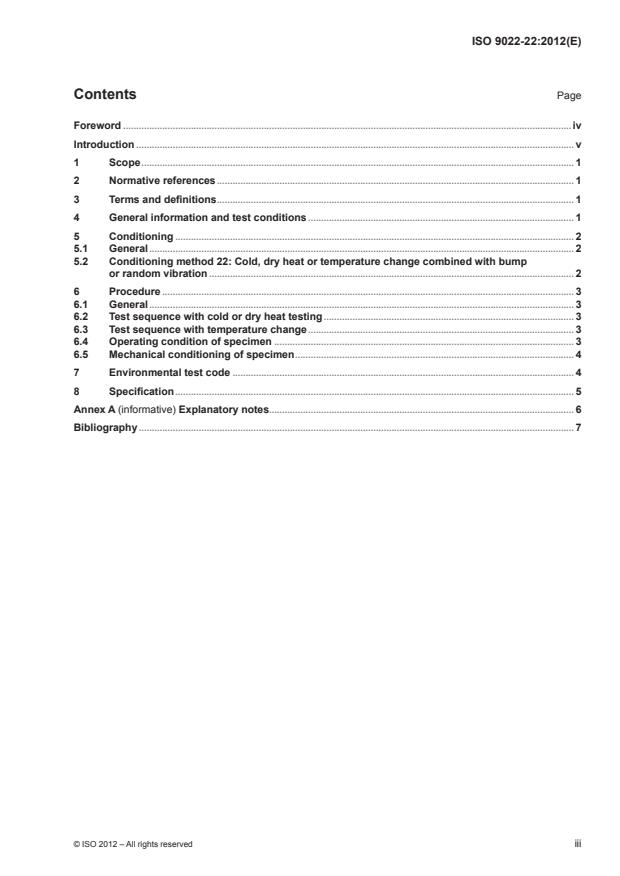
Contents Page
Foreword .iv
Introduction . v
1 Scope . 1
2 Normative references . 1
3 Terms and definitions . 1
4 General information and test conditions . 1
5 Conditioning . 2
5.1 General . 2
5.2 Conditioning method 22: Cold, dry heat or temperature change combined with bump
or random vibration . 2
6 Procedure . 3
6.1 General . 3
6.2 Test sequence with cold or dry heat testing . 3
6.3 Test sequence with temperature change . 3
6.4 Operating condition of specimen . 3
6.5 Mechanical conditioning of specimen . 4
7 Environmental test code . 4
8 Specification . 5
Annex A (informative) Explanatory notes. 6
Bibliography . 7
Foreword
ISO (the International Organization for Standardization) is a worldwide federation of national standards bodies
(ISO member bodies). The work of preparing International Standards is normally carried out through ISO
technical committees. Each member body interested in a subject for which a technical committee has been
established has the right to be represented on that committee. International organizations, governmental and
non-governmental, in liaison with ISO, also take part in the work. ISO collaborates closely with the International
Electrotechnical Commission (IEC) on all matters of electrotechnical standardization.
International Standards are drafted in accordance with the rules given in the ISO/IEC Directives, Part 2.
The main task of technical committees is to prepare International Standards. Draft International Standards
adopted by the technical committees are circulated to the member bodies for voting. Publication as an
International Standard requires approval by at least 75 % of the member bodies casting a vote.
Attention is drawn to the possibility that some of the elements of this document may be the subject of patent
rights. ISO shall not be held responsible for identifying any or all such patent rights.
ISO 9022-22 was prepared by Technical Committee ISO/TC 172, Optics and photonics, Subcommittee SC 1,
Fundamental standards.
This first edition cancels and replaces ISO 9022-10:1998, ISO 9022-13:1998, ISO 9022-15:1998,
ISO 9022-16:1998 and ISO 9022-19:1994 which have been technically revised.
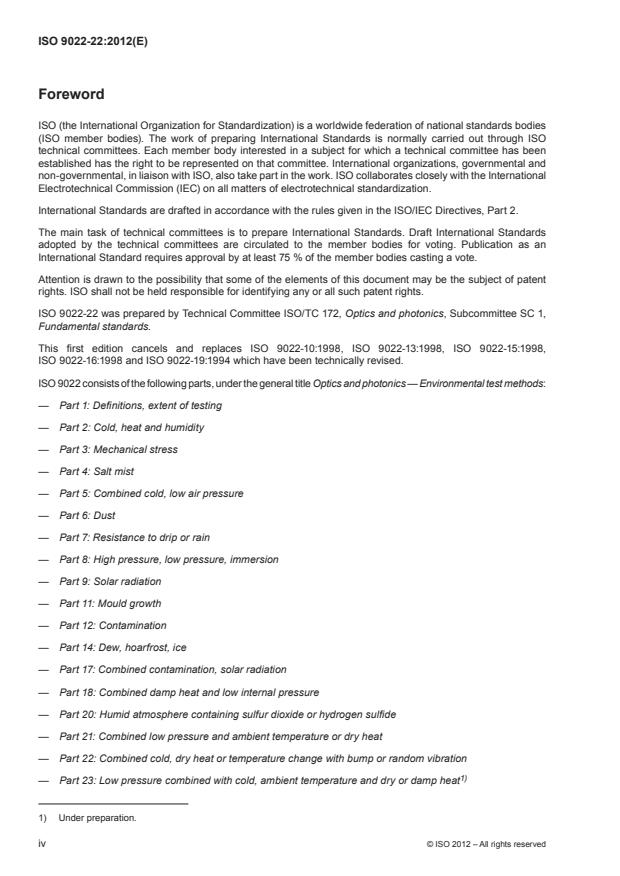
ISO 9022 consists of the following parts, under the general title Optics and photonics — Environmental test methods:
— Part 1: Definitions, extent of testing
— Part 2: Cold, heat and humidity
— Part 3: Mechanical stress
— Part 4: Salt mist
— Part 5: Combined cold, low air pressure
— Part 6: Dust
— Part 7: Resistance to drip or rain
— Part 8: High pressure, low pressure, immersion
— Part 9: Solar radiation
— Part 11: Mould growth
— Part 12: Contamination
— Part 14: Dew, hoarfrost, ice
— Part 17: Combined contamination, solar radiation
— Part 18: Combined damp heat and low internal pressure
— Part 20: Humid atmosphere containing sulfur dioxide or hydrogen sulfide
— Part 21: Combined low pressure and ambient temperature or dry heat
— Part 22: Combined cold, dry heat or temperature change with bump or random vibration
1)
— Part 23: Low pressure combined with cold, ambient temperature and dry or damp heat
1) Under preparation.
iv © ISO 2012 – All rights reserved
Introduction
Optical and photonic instruments, including additional assemblies from other fields (e.g. mechanical, chemical
and electronic devices) are affected during their use by a number of different environmental and handling
parameters which they are required to resist without significant reduction in performance, while still remaining
within defined specifications.
The type and severity of these parameters depend on the conditions of use of the instrument (for example in
the laboratory or workshop) and on its geographical location. The environmental effects on optical instrument
performance in tropical and subtropical climates are totally different from those found when they are used in the
arctic regions. Individual parameters cause a variety of different and overlapping effects on instrument performance.
The manufacturer attempts to ensure, and the user naturally expects, that instruments will resist the likely
rigours of their environment throughout their life. This expectation can be assessed by cumulated exposure
of the instrument to a range of simulated environmental parameters under controlled laboratory conditions.
The cumulative combination, degree of severity and sequence of these conditions can be selected to obtain
meaningful results in a relatively short period of time.
In order to allow assessment and comparison of the response of optical instruments to appropriate environ-
mental conditions, the ISO 9022 series contains details of a number of laboratory tests which reliably simulate
a variety of different environments. The tests are based largely on IEC standards, modified where necessary
to take into account features specific to optical instruments.
lt should be noted that, as a result of continuous progress in all fields, optical instruments are no longer only
precision-engineered optical products, but, depending on their range of application, also contain additional
assemblies from other fields. For this reason, the principal function of the instrument must be assessed
to determine which International Standard should be used for testing. If the optical function is of primary
importance, then the relevant part of ISO 9022 is applicable, but if other functions take precedence, then the
appropriate Inter national Standard in the field concerned should be applied. Cases may arise where application
of both the relevant part of ISO 9022 and other appropriate International Standards is necessary.
INTERNATIONAL STANDARD ISO 9022-22:2012(E)
Optics and photonics — Environmental test methods —
Part 22:
Combined cold, dry heat or temperature change with bump
or random vibration
1 Scope
This part of ISO 9022 specifies methods for the testing of optical instruments, including additional assemblies
from other fields (e.g. mechanical, chemical and electronic devices) under equivalent conditions, for their ability
to resist combined bump or random vibration, in cold, dry heat or temperature change.
The purpose of testing is to investigate to what extent the optical, thermal, chemical and electrical performance
characteristics of the specimen are affected by combined cold, dry heat or temperature change with bump or
random vibration.
2 Normative references
The following referenced documents are indispensable for the application of this document. For dated
references, only the edition cited applies. For undated references, the latest edition of the referenced document
(including any amendments) applies.
ISO 9022-1, Optics and photonics — Environmental test methods — Part 1: Definitions, extent of testing
ISO 9022-2, Optics and optical instruments — Environmental test methods — Part 2: Cold, heat and humidity
ISO 9022-3, Optics and optical instruments — Environmental test methods — Part 3: Mechani
...