

ISO 21100:2020
(Main)Air cargo unit load devices — Performance requirements and test parameters
General Information
- Abstract
This document specifies the minimum requirements for airworthiness approval of air cargo pallets, nets and containers, generally designated as air cargo unit load devices (ULD). This document is intended to provide a uniform technical reference for air cargo unit load devices approval. As a prerequisite, it is presupposed that the applicable general civil aviation requirements and the aircraft manufacturer's approved Weight and Balance Manual are followed. This document defines the minimum performance requirements and test parameters for air cargo unit load devices requiring approval of airworthiness for installation in an approved aircraft cargo compartment and restraint system that complies with the cargo restraint and occupant protection requirements of EASA CS-25 or 14 CFR Part 25, except for the 9,0 g forward ultimate inertia force of § 25.561(b) (3) (ii). This document applies to airworthiness approved air cargo unit load devices intended for carriage on board civil transport category airplanes type certificated under EASA CS-25 or 14 CFR Part 25, or equivalent. This document exclusively applies to unit load devices airworthiness approval and testing parameters. It does not apply to aircraft design or aircraft operating requirements, which are provided by the approved Weight and Balance Manual for each aircraft type. Other aspects that do not directly pertain to air cargo unit load devices airworthiness approval and testing are not covered by this document and are defined in other International Standards (see Bibliography), e.g.: — ULD design specifications, — ULD in service damage limits, — ULD restraint malfunction limitations, — ULD test methods, — ULD load distribution models, — ULD maximum allowable contours, — ULD CG (centre for gravity) location control means, — ULD pressure equalization methods, — ULD utilization guidelines. Air cargo unit load devices qualified prior to publication of this document were approved in accordance with the requirements of ISO 8097:2001. This document is intended as a TSO approval reference for all new models of unit load devices in the sizes and types it covers, in replacement of ISO 8097. For air cargo unit load devices the size or type of which is not covered in this document, see the requirements of ISO 8097:2001, if their size or type is contained therein, or other equivalent criteria, if not. NOTE 1 ISO 8097 is based on USA National Aerospace Standard NAS 3610 revision 10:1990, Specification for Cargo Unit Load Devices. NOTE 2 The requirements for cargo covers are not defined in this document, except insofar as net restraint is incorporated therein.
- Status
- Withdrawn
- Publication Date
- 29-Jun-2020
- Technical Committee
- ISO/TC 20/SC 9 - Air cargo and ground equipment
- Drafting Committee
- ISO/TC 20/SC 9 - Air cargo and ground equipment
- Current Stage
- 9599 - Withdrawal of International Standard
- Start Date
- 13-Aug-2025
- Completion Date
- 29-Aug-2026
Buy Documents
ISO 21100:2020 - Air cargo unit load devices — Performance requirements and test parameters/30/2020

ISO 21100:2020 - Air cargo unit load devices -- Performance requirements and test parameters
Overview - What ISO 21100:2020 covers
ISO 21100:2020, Air cargo unit load devices - Performance requirements and test parameters, defines the minimum airworthiness performance requirements and test parameters for air cargo unit load devices (ULDs) - including containers, pallets and nets - intended for carriage on certified civil transport aircraft. It provides a uniform technical reference and means of compliance for ULD airworthiness approval (TSO-type reference) for airplanes certificated to EASA CS-25 or 14 CFR Part 25 (or equivalent), while explicitly excluding aircraft design and operating requirements (these remain in the aircraft Weight and Balance Manual).
Key facts:
- Applies to certified ULDs for transport-category airplanes.
- Focuses exclusively on ULD airworthiness approval and test parameters.
- Replaces ISO 8097 for new ULD models and updates the 2014 edition.
- Dimensions expressed in mm (inches in brackets); forces in N (lbf shown).
Key technical topics and requirements
ISO 21100 organizes technical requirements and tests into clear sections; major topics include:
- Classification: types, sizes, configurations and form factors of ULDs.
- Materials, fabrication and workmanship: minimum material and construction quality requirements.
- Protection, marking and inspection: identification, inspection provisions and protective features.
- Fire protection and rapid decompression: performance needs related to in-flight conditions.
- Dimensions and tolerances: nominal base dimensions and acceptable variances.
- Strength and restraint criteria: ultimate load criteria, restraint performance, pallet and net specific tests (including pallet track tests for strap compatibility).
- Environmental degradation: durability and ageing considerations.
- Tests and test parameters: defined test methods, parameters and result evaluation.
- ULD configurations and restraint conditions: detailed configuration drawings and recommended restraint condition tests.
Notable updates in the 2020 edition include pallet track tests, added stiffness requirements for container base edges, configuration clarifications (e.g., certain configurations limited to lower-deck use), and adjustments to several restraint-condition procedures.
Practical applications - who uses ISO 21100
ISO 21100 is used by:
- ULD manufacturers and designers for product development and type approval.
- Certification authorities and test laboratories as a means of compliance and as a standardized test reference.
- Airlines, cargo operators and maintenance organizations for procurement, acceptance testing and conformity checks.
- Regulatory bodies and industry auditors for verification of airworthiness documentation.
Benefits include harmonized approval criteria, clearer acceptance testing, and reduced risk of compatibility or restraint failures when ULDs are installed in certified aircraft cargo compartments.
Related standards and references
- ISO 8097:2001 (prior ULD reference; still applicable for sizes/types not covered by ISO 21100)
- EASA CS-25 and 14 CFR Part 25 (aircraft cargo restraint and occupant protection requirements)
- Relevant ISO standards and industry documents on ULD design, load distribution, contours and test methods (see ISO 21100 bibliography).
Relations
- Consolidated By
ISO 16610-45:2025 - Geometrical product specifications (GPS) — Filtration — Part 45: Morphological profile filters: Segmentation - Effective Date
- 06-Jun-2022
- Effective Date
- 10-Jun-2023
- Effective Date
- 30-Jan-2016
Buy Documents
ISO 21100:2020 - Air cargo unit load devices — Performance requirements and test parameters/30/2020
ISO 21100:2020 - Air cargo unit load devices -- Performance requirements and test parameters
Get Certified
Connect with accredited certification bodies for this standard

BUREAU VERITAS Certification Germany
Bureau Veritas certification in Germany.

Element Materials Technology
Materials testing and product certification.

AQMS Ltd.
AQMS provides ISO certification to SMEs across the UK.
Sponsored listings
Frequently Asked Questions
ISO 21100:2020 is a standard published by the International Organization for Standardization (ISO). Its full title is "Air cargo unit load devices — Performance requirements and test parameters". This standard covers: This document specifies the minimum requirements for airworthiness approval of air cargo pallets, nets and containers, generally designated as air cargo unit load devices (ULD). This document is intended to provide a uniform technical reference for air cargo unit load devices approval. As a prerequisite, it is presupposed that the applicable general civil aviation requirements and the aircraft manufacturer's approved Weight and Balance Manual are followed. This document defines the minimum performance requirements and test parameters for air cargo unit load devices requiring approval of airworthiness for installation in an approved aircraft cargo compartment and restraint system that complies with the cargo restraint and occupant protection requirements of EASA CS-25 or 14 CFR Part 25, except for the 9,0 g forward ultimate inertia force of § 25.561(b) (3) (ii). This document applies to airworthiness approved air cargo unit load devices intended for carriage on board civil transport category airplanes type certificated under EASA CS-25 or 14 CFR Part 25, or equivalent. This document exclusively applies to unit load devices airworthiness approval and testing parameters. It does not apply to aircraft design or aircraft operating requirements, which are provided by the approved Weight and Balance Manual for each aircraft type. Other aspects that do not directly pertain to air cargo unit load devices airworthiness approval and testing are not covered by this document and are defined in other International Standards (see Bibliography), e.g.: — ULD design specifications, — ULD in service damage limits, — ULD restraint malfunction limitations, — ULD test methods, — ULD load distribution models, — ULD maximum allowable contours, — ULD CG (centre for gravity) location control means, — ULD pressure equalization methods, — ULD utilization guidelines. Air cargo unit load devices qualified prior to publication of this document were approved in accordance with the requirements of ISO 8097:2001. This document is intended as a TSO approval reference for all new models of unit load devices in the sizes and types it covers, in replacement of ISO 8097. For air cargo unit load devices the size or type of which is not covered in this document, see the requirements of ISO 8097:2001, if their size or type is contained therein, or other equivalent criteria, if not. NOTE 1 ISO 8097 is based on USA National Aerospace Standard NAS 3610 revision 10:1990, Specification for Cargo Unit Load Devices. NOTE 2 The requirements for cargo covers are not defined in this document, except insofar as net restraint is incorporated therein.
This document specifies the minimum requirements for airworthiness approval of air cargo pallets, nets and containers, generally designated as air cargo unit load devices (ULD). This document is intended to provide a uniform technical reference for air cargo unit load devices approval. As a prerequisite, it is presupposed that the applicable general civil aviation requirements and the aircraft manufacturer's approved Weight and Balance Manual are followed. This document defines the minimum performance requirements and test parameters for air cargo unit load devices requiring approval of airworthiness for installation in an approved aircraft cargo compartment and restraint system that complies with the cargo restraint and occupant protection requirements of EASA CS-25 or 14 CFR Part 25, except for the 9,0 g forward ultimate inertia force of § 25.561(b) (3) (ii). This document applies to airworthiness approved air cargo unit load devices intended for carriage on board civil transport category airplanes type certificated under EASA CS-25 or 14 CFR Part 25, or equivalent. This document exclusively applies to unit load devices airworthiness approval and testing parameters. It does not apply to aircraft design or aircraft operating requirements, which are provided by the approved Weight and Balance Manual for each aircraft type. Other aspects that do not directly pertain to air cargo unit load devices airworthiness approval and testing are not covered by this document and are defined in other International Standards (see Bibliography), e.g.: — ULD design specifications, — ULD in service damage limits, — ULD restraint malfunction limitations, — ULD test methods, — ULD load distribution models, — ULD maximum allowable contours, — ULD CG (centre for gravity) location control means, — ULD pressure equalization methods, — ULD utilization guidelines. Air cargo unit load devices qualified prior to publication of this document were approved in accordance with the requirements of ISO 8097:2001. This document is intended as a TSO approval reference for all new models of unit load devices in the sizes and types it covers, in replacement of ISO 8097. For air cargo unit load devices the size or type of which is not covered in this document, see the requirements of ISO 8097:2001, if their size or type is contained therein, or other equivalent criteria, if not. NOTE 1 ISO 8097 is based on USA National Aerospace Standard NAS 3610 revision 10:1990, Specification for Cargo Unit Load Devices. NOTE 2 The requirements for cargo covers are not defined in this document, except insofar as net restraint is incorporated therein.
ISO 21100:2020 is classified under the following ICS (International Classification for Standards) categories: 49.100 - Ground service and maintenance equipment; 49.120 - Cargo equipment. The ICS classification helps identify the subject area and facilitates finding related standards.
ISO 21100:2020 has the following relationships with other standards: It is inter standard links to ISO 16610-45:2025, ISO 21100:2025, ISO 21100:2014. Understanding these relationships helps ensure you are using the most current and applicable version of the standard.
ISO 21100:2020 is available in PDF format for immediate download after purchase. The document can be added to your cart and obtained through the secure checkout process. Digital delivery ensures instant access to the complete standard document.
Standards Content (Sample)
INTERNATIONAL ISO
STANDARD 21100
Second edition
2020-06
Air cargo unit load devices —
Performance requirements and test
parameters
Unités de charge de fret aérien — Exigences de performances et
paramètres d'essai
Reference number
©
ISO 2020
© ISO 2020
All rights reserved. Unless otherwise specified, or required in the context of its implementation, no part of this publication may
be reproduced or utilized otherwise in any form or by any means, electronic or mechanical, including photocopying, or posting
on the internet or an intranet, without prior written permission. Permission can be requested from either ISO at the address
below or ISO’s member body in the country of the requester.
ISO copyright office
CP 401 • Ch. de Blandonnet 8
CH-1214 Vernier, Geneva
Phone: +41 22 749 01 11
Email: copyright@iso.org
Website: www.iso.org
Published in Switzerland
ii © ISO 2020 – All rights reserved
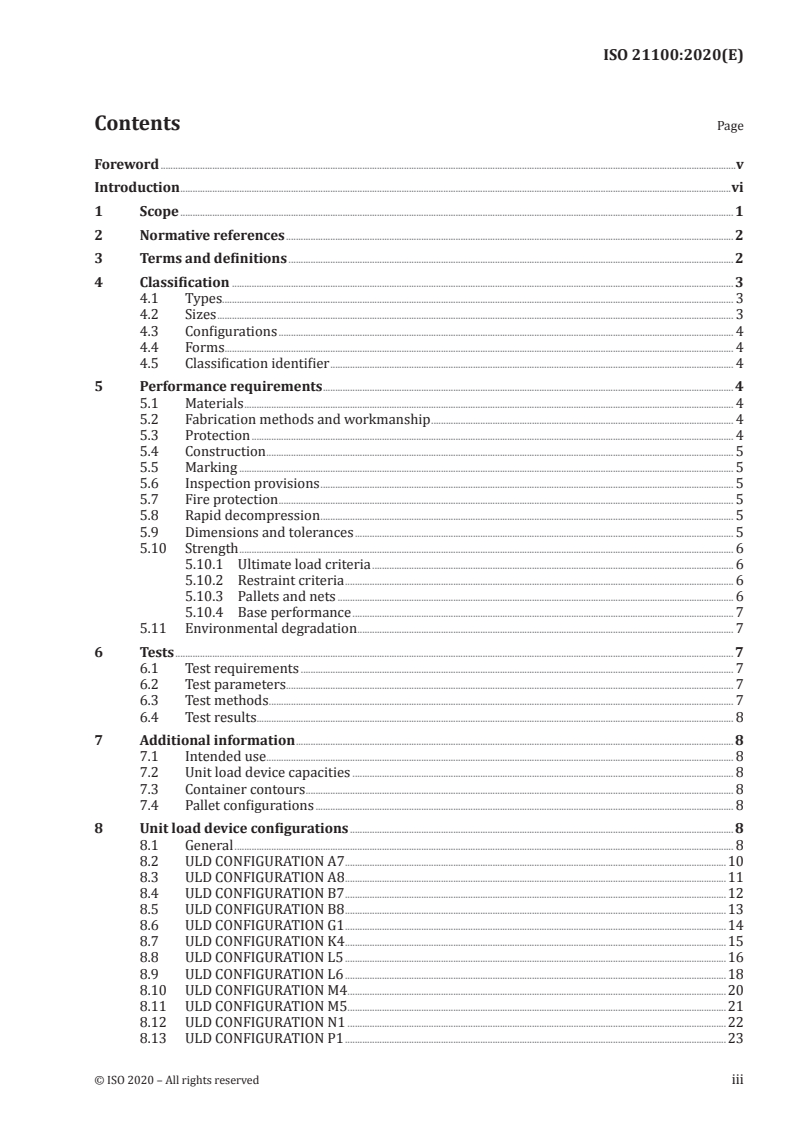
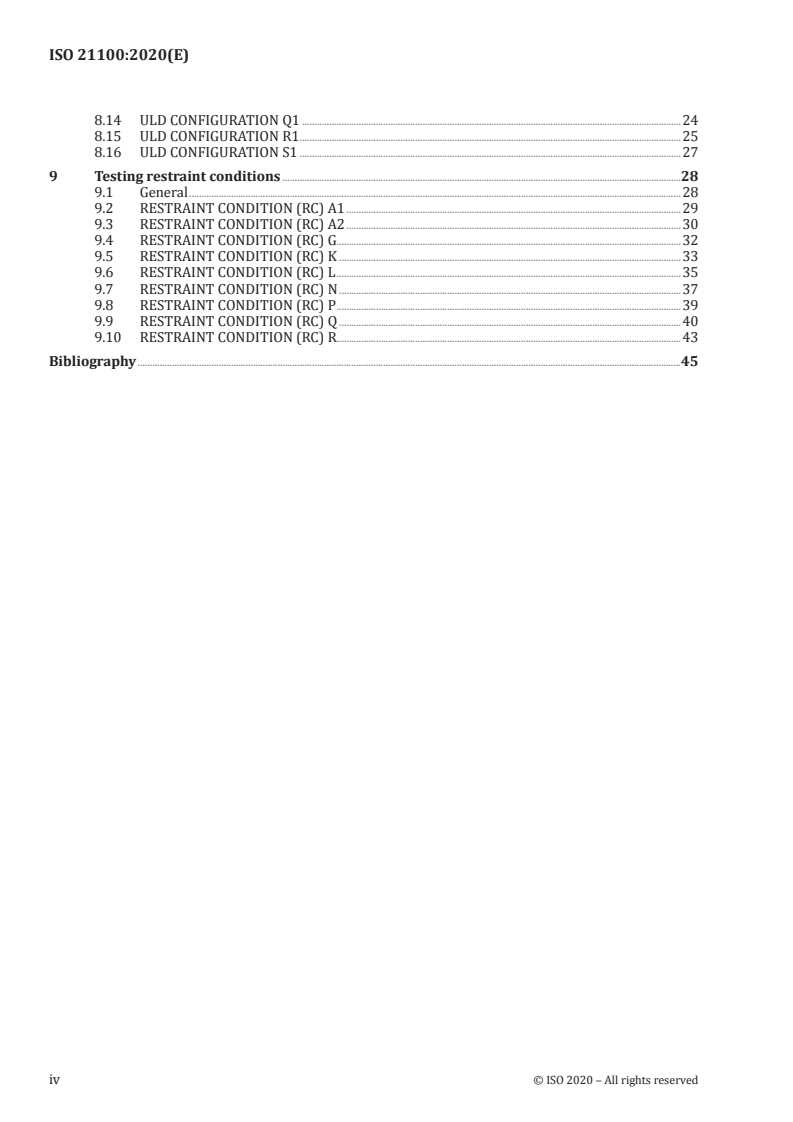
Contents Page
Foreword .v
Introduction .vi
1 Scope . 1
2 Normative references . 2
3 Terms and definitions . 2
4 Classification . 3
4.1 Types. 3
4.2 Sizes . 3
4.3 Configurations . 4
4.4 Forms . 4
4.5 Classification identifier . 4
5 Performance requirements . 4
5.1 Materials . 4
5.2 Fabrication methods and workmanship . 4
5.3 Protection . 4
5.4 Construction . 5
5.5 Marking . 5
5.6 Inspection provisions . 5
5.7 Fire protection . 5
5.8 Rapid decompression . 5
5.9 Dimensions and tolerances . 5
5.10 Strength . 6
5.10.1 Ultimate load criteria . 6
5.10.2 Restraint criteria . 6
5.10.3 Pallets and nets . 6
5.10.4 Base performance . 7
5.11 Environmental degradation . 7
6 Tests . 7
6.1 Test requirements . 7
6.2 Test parameters . 7
6.3 Test methods . 7
6.4 Test results. 8
7 Additional information . 8
7.1 Intended use . 8
7.2 Unit load device capacities . 8
7.3 Container contours . 8
7.4 Pallet configurations . 8
8 Unit load device configurations . 8
8.1 General . 8
8.2 ULD CONFIGURATION A7 .10
8.3 ULD CONFIGURATION A8 .11
8.4 ULD CONFIGURATION B7 .12
8.5 ULD CONFIGURATION B8 .13
8.6 ULD CONFIGURATION G1 .14
8.7 ULD CONFIGURATION K4 .15
8.8 ULD CONFIGURATION L5 .16
8.9 ULD CONFIGURATION L6 .18
8.10 ULD CONFIGURATION M4.20
8.11 ULD CONFIGURATION M5.21
8.12 ULD CONFIGURATION N1 .22
8.13 ULD CONFIGURATION P1 .23
8.14 ULD CONFIGURATION Q1 .24
8.15 ULD CONFIGURATION R1 .25
8.16 ULD CONFIGURATION S1 .27
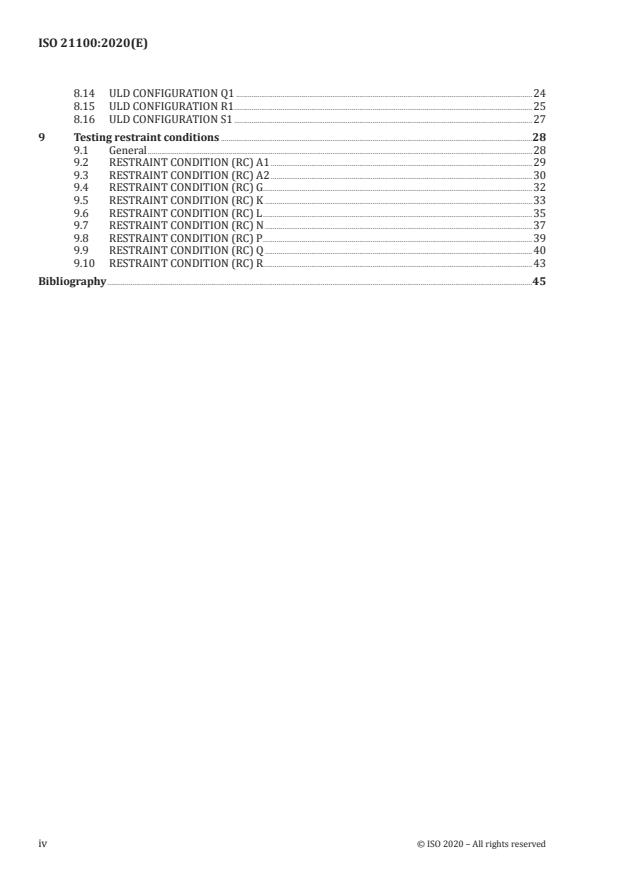
9 Testing restraint conditions .28
9.1 General .28
9.2 RESTRAINT CONDITION (RC) A1 .29
9.3 RESTRAINT CONDITION (RC) A2 .30
9.4 RESTRAINT CONDITION (RC) G .32
9.5 RESTRAINT CONDITION (RC) K .33
9.6 RESTRAINT CONDITION (RC) L .35
9.7 RESTRAINT CONDITION (RC) N .37
9.8 RESTRAINT CONDITION (RC) P .39
9.9 RESTRAINT CONDITION (RC) Q .40
9.10 RESTRAINT CONDITION (RC) R.43
Bibliography .45
iv © ISO 2020 – All rights reserved
Foreword
ISO (the International Organization for Standardization) is a worldwide federation of national standards
bodies (ISO member bodies). The work of preparing International Standards is normally carried out
through ISO technical committees. Each member body interested in a subject for which a technical
committee has been established has the right to be represented on that committee. International
organizations, governmental and non-governmental, in liaison with ISO, also take part in the work.
ISO collaborates closely with the International Electrotechnical Commission (IEC) on all matters of
electrotechnical standardization.
The procedures used to develop this document and those intended for its further maintenance are
described in the ISO/IEC Directives, Part 1. In particular, the different approval criteria needed for the
different types of ISO documents should be noted. This document was drafted in accordance with the
editorial rules of the ISO/IEC Directives, Part 2 (see www .iso .org/ directives).
Attention is drawn to the possibility that some of the elements of this document may be the subject of
patent rights. ISO shall not be held responsible for identifying any or all such patent rights. Details of
any patent rights identified during the development of the document will be in the Introduction and/or
on the ISO list of patent declarations received (see www .iso .org/ patents).
Any trade name used in this document is information given for the convenience of users and does not
constitute an endorsement.
For an explanation of the voluntary nature of standards, the meaning of ISO specific terms and
expressions related to conformity assessment, as well as information about ISO's adherence to the
World Trade Organization (WTO) principles in the Technical Barriers to Trade (TBT) see www .iso .org/
iso/ foreword .html.
This document was prepared by Technical Committee ISO/TC 20, Aircraft and space vehicles,
Subcommittee SC 9, Air cargo and ground equipment.
This second edition cancels and replaces the first edition (ISO 21100:2014), which has been technically
revised.
The main changes compared to the previous edition are as follows:
— 5.10.3.5, addition of pallets track test to ensure compatibility with straps restraint;
— 5.10.4.3, addition of stiffness requirements for containers base edges;
— Clause 8, ULD configurations A8, B8 and M5 use limited to lower deck containers;
— Clause 8, ULD configuration Q1 change to add pallet and net applicability;
— Clause 9, restraint conditions K, L, P and Q change as a result of testing experience.
Any feedback or questions on this document should be directed to the user’s national standards body. A
complete listing of these bodies can be found at www .iso .org/ members .html.
Introduction
This document specifies the performance and testing requirements for approved (certified) cargo
unit load devices (containers, pallets and nets) intended to be used for cargo restraint on board civil
transport aircraft.
The civil aviation requirements referred to in this document are those concerning certification
of transport aircraft and appliances to be installed aboard them, and constitute the set of design
and operation requirements internationally agreed in application of International Civil Aviation
Organization (ICAO) Annex 8, Airworthiness of aircraft, to the Convention on International Civil Aviation.
This document provides one means of compliance for unit load devices.
Dimensions and tolerances are expressed in millimetres, with dimensions in inches shown between
brackets. The nominal values of outer unit load device base dimensions are those expressed in inches.
Forces are expressed in Newton, with forces in pound-force shown between brackets.
vi © ISO 2020 – All rights reserved
INTERNATIONAL STANDARD ISO 21100:2020(E)
Air cargo unit load devices — Performance requirements
and test parameters
1 Scope
This document specifies the minimum requirements for airworthiness approval of air cargo pallets,
nets and containers, generally designated as air cargo unit load devices (ULD).
This document is intended to provide a uniform technical reference for air cargo unit load devices
approval. As a prerequisite, it is presupposed that the applicable general civil aviation requirements
and the aircraft manufacturer’s approved Weight and Balance Manual are followed.
This document defines the minimum performance requirements and test parameters for air cargo
unit load devices requiring approval of airworthiness for installation in an approved aircraft cargo
compartment and restraint system that complies with the cargo restraint and occupant protection
requirements of EASA CS-25 or 14 CFR Part 25, except for the 9,0 g forward ultimate inertia force of
§ 25.561(b) (3) (ii).
This document applies to airworthiness approved air cargo unit load devices intended for carriage
on board civil transport category airplanes type certificated under EASA CS-25 or 14 CFR Part 25, or
equivalent.
This document exclusively applies to unit load devices airworthiness approval and testing parameters.
It does not apply to aircraft design or aircraft operating requirements, which are provided by the
approved Weight and Balance Manual for each aircraft type.
Other aspects that do not directly pertain to air cargo unit load devices airworthiness approval
and testing are not covered by this document and are defined in other International Standards
(see Bibliography), e.g.:
— ULD design specifications,
— ULD in service damage limits,
— ULD restraint malfunction limitations,
— ULD test methods,
— ULD load distribution models,
— ULD maximum allowable contours,
— ULD CG (centre for gravity) location control means,
— ULD pressure equalization methods,
— ULD utilization guidelines.
Air cargo unit load devices qualified prior to publication of this document were approved in accordance
with the requirements of ISO 8097:2001. This document is intended as a TSO approval reference for
all new models of unit load devices in the sizes and types it covers, in replacement of ISO 8097. For air
cargo unit load devices the size or type of which is not covered in this document, see the requirements
of ISO 8097:2001, if their size or type is contained therein, or other equivalent criteria, if not.
NOTE 1 ISO 8097 is based on USA National Aerospace Standard NAS 3610 revision 10:1990, Specification for
Cargo Unit Load Devices.
NOTE 2 The requirements for cargo covers are not defined in this document, except insofar as net restraint is
incorporated therein.
2 Normative references
The following documents are referred to in the text in such a way that some or all of their content
constitutes requirements of this document. For dated references, only the edition cited applies. For
undated references, the latest edition of the referenced document (including any amendments) applies.
ISO 7166, Aircraft — Rail and stud configuration for passenger equipment and cargo restraint
ISO 9788, Air cargo — Double stud tie-down fittings — Design and testing requirements
ISO 10046, Aircraft — Methodology of calculating cargo compartment volumes
3 Terms and definitions
For the purposes of this document, the following terms and definitions apply.
ISO and IEC maintain terminological databases for use in standardization at the following addresses:
— ISO Online browsing platform: available at https:// www .iso .org/ obp
— IEC Electropedia: available at http:// www .electropedia .org/
3.1
base edge
outer perimeter of a unit load device (3.8), interfacing with the aircraft restraint system (3.7), ensuring
the required performance with contribution of adjacent parts of the complete unit load device
3.2
container
rigid structure which interfaces directly with the aircraft cargo handling and restraint
system (3.7) and alone performs all the functions of a unit load device (3.8)
3.3
cover
layer made of flexible material, used to protect cargo on a pallet (3.6)
Note 1 to entry: It may or may not incorporate a pallet net (3.4) or be permanently attached to one. If a net is
incorporated or permanently attached to the cover, the performance and testing requirements applicable to nets
in this document are applicable to the net/cover assembly.
3.4
net
webbing or rope net for restraining load onto an air cargo pallet (3.6)
3.5
numeric simulation
simulation of physical test condition and reaction of unit load device (3.8) employing numerical analysis,
computational geometry and computer graphics to obtain proof support and design verification,
validated by demonstration that parameters, algorithms and analytical methods used provide results
of at least equivalent reliability to the outcome of a specified actual test
3.6
pallet
unit load device (3.8) consisting of a flat platform with a flat undersurface of standard
dimensions, on which goods are assembled and secured by a net (3.4) before being loaded as a unit onto
the aircraft, and which interfaces directly with the aircraft handling and restraint system (3.7)
2 © ISO 2020 – All rights reserved
3.7
restraint system
equipment for supporting and restraining unit load devices (3.8) in an aircraft against the ground/
flight loads
Note 1 to entry: It usually consists of such items as rollers, side guides, and locks for securing unit load devices to
the aircraft structure. It does not include unit load devices, barrier nets (3.4) and tie-down straps.
3.8
unit load device
ULD
device for grouping, transferring and restraining cargo for transit
Note 1 to entry: It may consist of a pallet (3.6) with a net (3.4) or it may be a container (3.2).
4 Classification
4.1 Types
Type 1 (for reference only): Unit load devices (ULDs) designed for use in an approved aircraft restraint
system that conforms to all flight and ground cargo restraint and occupant protection requirements of
EASA CS-25 or 14 CFR Part 25, including the 9,0 g forward ultimate inertia force of § 25.561 (b)(3)(ii).
NOTE Type 1 ULDs are not shown in this document. Refer to ISO 8097:2001 (NAS 3610 revision 10).
Type 2: ULDs designed for use in an approved aircraft cargo compartment and restraint system that
conforms to the flight and ground cargo restraint and occupant protection requirements of CCAR-
25, JAS Part 3, EASA CS-25 or 14 CFR Part 25, except for the 9,0 g forward ultimate inertia force of
§ 25.561(b) (3) (ii), which is complied with either by supplementary installation of a barrier net or
bulkhead, or by specifying an approved placement of the ULD in the aircraft.
4.2 Sizes
This document provides for the sizes of unit load devices listed in Table 1, expressed as nominal
dimensions in the overall plan form of a pallet or a container base, in mm (inches).
NOTE Throughout this document, dimensions are expressed in SI units, with inch/pound system values
additionally shown between brackets in order to conform to international air cargo industry usage.
Table 1 — Sizes
Size Nominal dimension
A 2 235 mm × 3 175 mm (88 in × 125 in)
B 2 235 mm × 2 743 mm (88 in × 108 in)
G 2 438 mm × 6 058 mm (96 in × 238.5 in)
K 1 534 mm × 1 562 mm (60.4 in × 61.5 in)
L 1 534 mm × 3 175 mm (60.4 in × 125 in)
M 2 438 mm × 3 175 mm (96 in × 125 in)
N 1 562 mm × 2 438 mm (61.5 in × 96 in)
P 1 198 mm × 1 534 mm (47 in × 60.4 in)
Q 1 534 mm × 2 438 mm (60.4 in × 96 in)
R 2 438 mm × 4 978 mm (96 in × 196 in)
S 1 562 mm × 2 235 mm (61.5 in × 88 in)
NOTE Size codes C, D, E, F, H, I, J, O have been intentionally omitted in this document in order to
be in agreement with the industry's (IATA ULD Regulations) identification coding system.
4.3 Configurations
4.3.1 This document provides for variations of configuration among pallets, nets and containers of the
same type and size, specified in Clause 8 and listed in Table 2. Variations in pallet/net attachment and
special interface requirements between components of unit load devices when affecting airworthiness
are specified by the configuration drawings. Configurations are denoted by sequence numbers and are
identified in accordance with 4.5.
4.3.2 The applicable restraint conditions to be used for testing each unit load device configuration are
specified in Clause 9 and listed in Table 18, based on testing of worst-case analysis.
4.3.3 The ULD restraint conditions and ultimate loads included herein are intended to represent a
worst-case capability for the ULD. They are not intended to represent aircraft cargo handling system
restraint designs. Actual aircraft implementations may vary from the ULD test parameters stated herein
in such areas as number and spacing of restraints, among others, as long as they stay within the worst-
case ULD capabilities.
4.4 Forms
Form C = Container
Form N = Net
Form P = Pallet
4.5 Classification identifier
The pallets, nets, and containers described in this document shall be identified by the numbers
derived as shown. Types, sizes, configurations, and forms shall be limited to those in configuration
drawings. “ISO 21100-2A7P” = Type 2, Size A (2 235 mm × 3 175 mm, 88 in × 125 in), Configuration
sequence A7, Pallet.
5 Performance requirements
5.1 Materials
The suitability and durability of materials used shall be established on the basis of experience or tests.
Materials shall conform to approved industry specifications that ensure their having the strength and
other properties specified in the design data.
5.2 Fabrication methods and workmanship
The methods of fabrication used shall produce a consistently sound structure. If the fabrication
processes (such as gluing or heat treatment) require close control to reach their objectives, the processes
shall be performed under an approved process specification. Workmanship shall be consistent with
high-grade aircraft manufacturing practices.
5.3 Protection
All components of the unit load devices shall be suitably protected against deterioration or loss of
strength in service due to weathering, corrosion, abrasion or other causes where the type of material
used requires such protection. The unit load device shall have provisions for ventilation or drainage
where necessary for protection.
4 © ISO 2020 – All rights reserved
5.4 Construction
The unit load device shall be constructed to adequately encompass the cargo and shall provide
for proper support and restraint of the cargo. All components shall be designed to withstand rough
handling. The design shall minimize the possibility of improper installation. All pallet/net attachment
devices shall conform to ISO 7166 track and stud configuration, for single stud fittings, or ISO 9788 for
double stud fittings.
5.5 Marking
Each pallet, net, and container shall be legibly and permanently marked in an area clearly visible after
the article is loaded with cargo, with the following information:
a) the name and address of the manufacturer;
b) the weight of the article to the nearest kilogram or pound, with the applicable unit;
c) the serial number and date of manufacture;
d) the part number of the article and its identification in the code system set out in 4.5;
e) if the article is not omni-directional, the words “FORWARD”, “AFT”, and “SIDE” shall be
conspicuously and appropriately placed;
f) the burning rate determined for the article under 5.7;
g) the applicable TSO (Technical Standard Order) approval number;
h) any limitations or restrictions.
5.6 Inspection provisions
There shall be means to allow close examination of each part requiring inspection, adjustment, or
lubrication.
5.7 Fire protection
It is presupposed that the materials used in the construction of pallets, nets, and containers meet the
appropriate provisions set forth in CCAR-25, JAS Part 3, EASA CS-25 or 14 CFR Part 25 Appendix F.
5.8 Rapid decompression
Unit load devices shall be designed to protect the airplane structure and the occupants as result of a
sudden release of pressure. The suitability of the design shall be established by analysis and/or tests or
numeric simulation. ISO 11242 specifies the requirements and possible methods.
5.9 Dimensions and tolerances
Each pallet, net, and container of a given configuration shall conform to the requirements specified by
the drawing for that configuration. General tolerances for all configuration drawings, unless otherwise
noted, are ±0,01 mm for two places decimals, ±0,1 mm for one place decimals, ±1 mm without a decimal
(in inches: ±0.01 in for three place decimals, ±0.03 in for two place decimals, ±0.1 in for one place
decimals).
5.10 Strength
5.10.1 Ultimate load criteria
5.10.1.1 Ultimate loads for each unit load device configuration are specified in the page defining that
configuration. These loads shall be considered as acting separately, except as noted, and shall be applied
in accordance with the specified centre of gravity limits, which shall be taken into account simultaneously.
5.10.1.2 Longitudinal eccentricity is expressed in percentage of the longitudinal dimension of a pallet or
container base, and it is measured from the lateral centreline of the pallet or container base. Longitudinal
dimensions correspond to the forward and aft directions specified by the plan views in applicable figures.
5.10.1.3 Lateral eccentricity is expressed in percentage of the lateral dimension of a pallet or container
base, and it is measured from its longitudinal centreline. Plus and minus signs indicate forward and aft
directions from the lateral centreline, and right and left directions from the longitudinal centreline of the
pallet or container base respectively.
5.10.1.4 Centre of gravity height is expressed in mm (inches) above the bottom surface of pallet or
container base.
5.10.2 Restraint criteria
Restraint system details for each restraint condition are specified by the figure referenced in restraint
drawing. Tolerances for the restraint system are the same as those specified in 5.9 for configuration
drawings.
5.10.3 Pallets and nets
5.10.3.1 If a pallet (or net) is to be substantiated individually, a qualified net (or pallet) of the same
configuration code may be assumed for analysis or used for test. A qualified and compatible net (or pallet)
of different configuration code may be used provided it equals or exceeds the strength requirements
of the pallet (or net) being substantiated. For substantiating a net, any net tensioning devices shall be
engaged: a pallet doesn't need to be used for testing, provided that all net fittings are at the locations
specified in the unit load device configuration.
5.10.3.2 Pallet edge tracks and net fittings shall conform to the geometric and tolerance requirements
of ISO 7166 or, in the case of double stud fittings, ISO 9788, or equivalent with at least equal ultimate
strength.
5.10.3.3 All net fittings incorporating a single tie-down stud for attachment to pallets shall have a
minimum ultimate load capacity of 8 900 N (2 000 lbf) in all directions, horizontal to vertical. Double stud
tie-down fittings shall have a minimum ultimate load capacity of 17 800 N (4 000 lbf) in all directions,
horizontal to vertical. The load application point shall be 21 mm (0.83 in) or less from the head end of
the stud.
5.10.3.4 Except where otherwise stated, all track-type single stud tie down receptacles incorporated in
the pallet construction shall have a minimum ultimate load capacity of 8 900 N (2 000 lbf), or 22 250 N
(5 000 lbf) for a double stud receptacle, in all directions, horizontal to vertical. The load application point
shall be 23 mm (0.90 in) or more from the bottom of the track groove.
5.10.3.5 It is presupposed that pallets edge tracks withstand without rupture an ultimate load of 22 250 N
(5 000 lbf) applied in any direction through a double stud fitting meeting the requirements of ISO 9788, for
a duration of 3 seconds in accordance with CCAR-25, JAS Part 3, EASA CS-25 or 14 CFR Part 25 § 25.305(b).
The load application point shall be 23 mm (0,90 in) or more from the bottom of the track groove.
6 © ISO 2020 – All rights reserved
5.10.4 Base performance
5.10.4.1 Minimum base area loads for each unit load device configuration are specified in the page
defining that configuration. These loads shall be applicable to any area representing at least 10 % of
the total base area, while the unit load device is supported by the aircraft system. All unit load devices
(containers or pallets) bases shall have a minimum area load capacity of 10 kPa (209 lbf/ft ).
7 2 6 2
5.10.4.2 All pallet base edges shall have a minimum vertical EI value of 5 × 10 N·cm (1.75 × 10 lbf·in ).
5.10.4.3 All container base edges shall have a uniform cross section and a minimum vertical EI value
7 2 6 2
of 5 × 10 N·cm (1.75 × 10 lbf·in ). However, the doorway side base edge of 1 562 mm (61.5 in) or
7 2
less wide containers shall have a uniform cross section and a minimum EI value of 2,5 × 10 N·cm
5 2
(8.75 × 10 lbf·in ).
Local deviations in uniformity are allowable at specific locations (e.g., corner fittings, identification
recesses, track tie-down receptacles, forklift tineways, or similar).
5.10.4.4 All ULD base edge profiles shall be rounded or chamfered in order to ensure a smooth interface
with aircraft unit load device conveyance and restraint systems.
5.11 Environmental degradation
The materials used in the construction of pallets, nets, and containers shall take into account the effects
of environment conditions, such as temperature, humidity, and UV (ultra violet) degradation, expected
in service.
6 Tests
6.1 Test requirements
Tests and/or analysis or numeric simulation shall be conducted as necessary to show compliance with
this document.
6.2 Test parameters
Tests for any given ULD configuration shall be conducted using the maximum ultimate loads and centre
of gravity deviations shown in this document for that ULD configuration, with the ULD being restrained
in accordance with the indicated testing restraint condition(s). Analysis or numeric simulation, if used,
shall use the same assumptions.
Pallets shall be tested in combination with an approved net of the same size and configuration. Nets
do not need to be tested in combination with a pallet, but their attachment fittings shall be located in
accordance with the applicable ULD configuration drawing.
6.3 Test methods
The method(s) used for testing any ULD configuration shall ensure conformity with the testing
conditions and ultimate load parameters specified for that configuration in this document. It is
presupposed that the ultimate load is applied in each specified direction for a minimum duration of
3 s, in accordance with CCAR-25, JAS Part 3, EASA CS-25 or 14 CFR Part 25 § 25.305 (b). Analysis or
numeric simulation, if used, shall provide an equivalent assurance of conformity guarantee. A test and/
or analysis report shall be established to record the details of the method(s) used and substantiate the
results obtained.
NOTE When two ULD sides (e.g. opposite ones) and the corresponding restraint conditions are identical,
testing can be performed on one side only.
6.4 Test results
Under ultimate load, the tested ULD or parts thereof may exhibit damage or permanent deformation,
but shall not deform or rupture to the extent of discharging its contents. Analysis or numeric simulation,
if used, shall confirm that the ULD would not deform or rupture to the extent its contents would be
discharged under the test conditions.
7 Additional information
7.1 Intended use
Type 2 nets, pallets, and containers (ULDs) described in this document are intended for use only in an
approved aircraft cargo compartment and restraint system where compliance with the 9,0 g forward
ultimate inertia force of CCAR-25, JAS Part 3, EASA CS-25 or 14 CFR Part 25 § 25.561 (b)(3)(ii) is
achieved either by supplementary installation of a barrier net or bulkhead, or by specified approved
placement of the ULD in the aircraft.
NOTE Type 1 ULDs are not shown in this document. Refer to ISO 8097:2001 (NAS 3610 revision 10).
7.2 Unit load device capacities
Maximum gross weight capacities are not shown for the unit load devices covered by this document.
Actual gross weight limits for devices in a given airplane are determined in compliance with CCAR-25,
JAS Part 3, EASA CS-25 or 14 CFR Part 25 and listed in the approved Weight and Balance Manual for that
airplane.
7.3 Container contours
Performance and testing parameters are independent from container contours, which hence are not
shown in this document. Maximum allowable container contours shall provide clearance from the
relevant aircraft cargo compartment's inner envelope. Contours shall be determined for the intended
aircraft types or compartments in accordance with ISO 10046.
7.4 Pallet configurations
Pallet configuration drawings indicate net attachment points. Continuous edge track is allowable all
around the pallet's periphery, except where differently noted.
8 Unit load device configurations
8.1 General
Unit load devices configurations, characteristics, and ultimate load capacities shall conform to the
relevant ULD configuration subclause. See Table 2.
NOTE 1 The net attachment points shown on ULD configuration drawings do not, or not entirely, apply to
containers.
NOTE 2 Configuration drawings are not on scale.
8 © ISO 2020 – All rights reserved
Table 2 — ULD configurations
ULD configuration Type Applicable to: Nominal base dimensions Minimum base Sub-
area load clause
(UC) C P N mm (inches) kPa (lb/ft )
A7 2 X X X 2 235 × 3 175 (88 × 125) 10 (209) 8.2
A8 2 X X X 2 235 × 3 175 (88 × 125) 10 (209) 8.3
B7 2 X X X 2 235 × 2 743 (88 × 108) 10 (209) 8.4
B8 2 X X X 2 235 × 2 743 (88 × 108) 10 (209) 8.5
G1 2 X X X 2 438 × 6 058 (96 × 238.5) 20 (418) 8.6
K4 2 X X X 1 534 × 1 562 (60.4 × 61.5) 10 (209) 8.7
L5 2 X X X 1 534 × 3 175 (60.4 × 125) 10 (209) 8.8
L6 2 X X 1 534 × 3 175 (60.4 × 125) 10 (209) 8.9
M4 2 X X X 2 438 × 3 175 (96 × 125) 10 (209) 8.10
M5 2 X X X 2 438 × 3 175 (96 × 125) 10 (209) 8.11
N1 2 X X X 1 562 × 2 438 (61.5 × 96) 10 (209) 8.12
P1 2 X 1 198 × 1 534 (47 × 60.4) 10 (209) 8.13
Q1 2 X 1 534 × 2 438 (60.4 × 96) 10 (209) 8.14
R1 2 X X X 2 438 × 4 978 (96 × 196) 20 (418) 8.15
S1 2 X X X 1 562 × 2 235 (61.5 × 88) 10 (209) 8.16
NOTE ULD configuration sequence codes A7, A8, B7, B8, K4, L5, L6, M4, M5 were assigned in order to differentiate from
former ISO 8097 (NAS 3610) ULD configurations, with non-identical maximum CG eccentricities and/or with non-identical
lateral ultimate load criteria.
8.2 ULD CONFIGURATION A7
Unit load device A7 configuration consists of the following characteristics and ultimate load capacities.
See Table 3 and Figure 1.
Nominal base size 2 235 × 3 175 mm (88 × 125 in) — Type 2
Applicable to: Containers, Pallets, Nets Minimum base area load: 10 kPa (209 lbf/ft )
Table 3 — Ultimate load criteria
a
Ultimate loads N (lbf) CG height mm (in) CG eccentricity %
Forward Aft Side Up Down Maximum Longitudinal Lateral
100 000 100 000 100 000 169 000 340 000 1 219 ±10 ±10
(22 500) (22 500) (22 500) (38 000) (76 500) (48)
a
= for containers and nets, 55 % of maximum height, limited to the maximum shown.
Dimensions in millimetres (inches)
Key
1 centre line
2 ISO 7166 track
3 net fitting
a
Typically 4 edges.
b
Typically 18 places (continuous track optional).
c
Typical.
Figure 1 — Configuration drawing — Applicable testing restraint condition —
RC A1 (see Clause 9)
10 © ISO 2020 – All rights reserved
8.3 ULD CONFIGURATION A8
Unit load device A8 configuration consists of the following characteristics and ultimate load capacities.
See Table 4 and Figure 2.
Nominal base size 2 235 mm × 3 175 mm (88 in × 125 in) — Type 2
Applicable to: Containers Minimum base area load: 10 kPa (209 lbf/ft )
Table 4 — Ultimate load criteria
a
Ultimate loads N (lbf) CG height mm (in) CG eccentricity %
Forward Aft Side Up Down Maximum Longitudinal Lateral
55 600 55 600 55 600 100 000 188 600 864 ±10 ±10
(12 500) (12 500) (12 500) (22 500) (42 400) (34)
a
= 55 % of maximum height, limited to the maximum shown.
Dimensions in millimetres (inches)
a
Typically 4 edges.
Figure 2 — Configuration drawing — Applicable testing restraint condition —
RC A2 (see Clause 9)
8.4 ULD CONFIGURATION B7
Unit load device B7 configuration consists of the following characteristics and ultimate load capacities.
See Table 5 and Figure 3.
Nominal base size 2 235 × 2 743 mm (88 × 108 in) — Type 2
Applicable to: Containers, Pallets, Nets Minimum base area load: 10 kPa (209 lbf/ft )
Table 5 — Ultimate load criteria
a
Ultimate loads N (lbf) CG height mm (in) CG eccentricity %
Forward Aft Side Up Down Maximum Longitudinal Lateral
87 000 87 000 87 000 147 000 294 000 1 219 ±10 ±10
(19 500) (19 500) (19 500) (33 000) (66 000) (48)
a
= for containers and nets, 55 % of maximum height, limited to the maximum shown.
Dimensions in millimetres (inches)
Key
1 centre line
2 ISO 7166 track
3 net fitting
a
Typically 4 edges.
b
Typically 18 places (continuous track optional).
c
Typical.
Figure 3 — Configuration drawing — Applicable testing restraint condition — RC A1
(see Clause 9)
12 © ISO 2020 – All rights reserved
...
INTERNATIONAL ISO
STANDARD 21100
Second edition
2020-06
Air cargo unit load devices —
Performance requirements and test
parameters
Unités de charge de fret aérien — Exigences de performances et
paramètres d'essai
Reference number
©
ISO 2020
© ISO 2020
All rights reserved. Unless otherwise specified, or required in the context of its implementation, no part of this publication may
be reproduced or utilized otherwise in any form or by any means, electronic or mechanical, including photocopying, or posting
on the internet or an intranet, without prior written permission. Permission can be requested from either ISO at the address
below or ISO’s member body in the country of the requester.
ISO copyright office
CP 401 • Ch. de Blandonnet 8
CH-1214 Vernier, Geneva
Phone: +41 22 749 01 11
Email: copyright@iso.org
Website: www.iso.org
Published in Switzerland
ii © ISO 2020 – All rights reserved
Contents Page
Foreword .v
Introduction .vi
1 Scope . 1
2 Normative references . 2
3 Terms and definitions . 2
4 Classification . 3
4.1 Types. 3
4.2 Sizes . 3
4.3 Configurations . 4
4.4 Forms . 4
4.5 Classification identifier . 4
5 Performance requirements . 4
5.1 Materials . 4
5.2 Fabrication methods and workmanship . 4
5.3 Protection . 4
5.4 Construction . 5
5.5 Marking . 5
5.6 Inspection provisions . 5
5.7 Fire protection . 5
5.8 Rapid decompression . 5
5.9 Dimensions and tolerances . 5
5.10 Strength . 6
5.10.1 Ultimate load criteria . 6
5.10.2 Restraint criteria . 6
5.10.3 Pallets and nets . 6
5.10.4 Base performance . 7
5.11 Environmental degradation . 7
6 Tests . 7
6.1 Test requirements . 7
6.2 Test parameters . 7
6.3 Test methods . 7
6.4 Test results. 8
7 Additional information . 8
7.1 Intended use . 8
7.2 Unit load device capacities . 8
7.3 Container contours . 8
7.4 Pallet configurations . 8
8 Unit load device configurations . 8
8.1 General . 8
8.2 ULD CONFIGURATION A7 .10
8.3 ULD CONFIGURATION A8 .11
8.4 ULD CONFIGURATION B7 .12
8.5 ULD CONFIGURATION B8 .13
8.6 ULD CONFIGURATION G1 .14
8.7 ULD CONFIGURATION K4 .15
8.8 ULD CONFIGURATION L5 .16
8.9 ULD CONFIGURATION L6 .18
8.10 ULD CONFIGURATION M4.20
8.11 ULD CONFIGURATION M5.21
8.12 ULD CONFIGURATION N1 .22
8.13 ULD CONFIGURATION P1 .23
8.14 ULD CONFIGURATION Q1 .24
8.15 ULD CONFIGURATION R1 .25
8.16 ULD CONFIGURATION S1 .27
9 Testing restraint conditions .28
9.1 General .28
9.2 RESTRAINT CONDITION (RC) A1 .29
9.3 RESTRAINT CONDITION (RC) A2 .30
9.4 RESTRAINT CONDITION (RC) G .32
9.5 RESTRAINT CONDITION (RC) K .33
9.6 RESTRAINT CONDITION (RC) L .35
9.7 RESTRAINT CONDITION (RC) N .37
9.8 RESTRAINT CONDITION (RC) P .39
9.9 RESTRAINT CONDITION (RC) Q .40
9.10 RESTRAINT CONDITION (RC) R.43
Bibliography .45
iv © ISO 2020 – All rights reserved
Foreword
ISO (the International Organization for Standardization) is a worldwide federation of national standards
bodies (ISO member bodies). The work of preparing International Standards is normally carried out
through ISO technical committees. Each member body interested in a subject for which a technical
committee has been established has the right to be represented on that committee. International
organizations, governmental and non-governmental, in liaison with ISO, also take part in the work.
ISO collaborates closely with the International Electrotechnical Commission (IEC) on all matters of
electrotechnical standardization.
The procedures used to develop this document and those intended for its further maintenance are
described in the ISO/IEC Directives, Part 1. In particular, the different approval criteria needed for the
different types of ISO documents should be noted. This document was drafted in accordance with the
editorial rules of the ISO/IEC Directives, Part 2 (see www .iso .org/ directives).
Attention is drawn to the possibility that some of the elements of this document may be the subject of
patent rights. ISO shall not be held responsible for identifying any or all such patent rights. Details of
any patent rights identified during the development of the document will be in the Introduction and/or
on the ISO list of patent declarations received (see www .iso .org/ patents).
Any trade name used in this document is information given for the convenience of users and does not
constitute an endorsement.
For an explanation of the voluntary nature of standards, the meaning of ISO specific terms and
expressions related to conformity assessment, as well as information about ISO's adherence to the
World Trade Organization (WTO) principles in the Technical Barriers to Trade (TBT) see www .iso .org/
iso/ foreword .html.
This document was prepared by Technical Committee ISO/TC 20, Aircraft and space vehicles,
Subcommittee SC 9, Air cargo and ground equipment.
This second edition cancels and replaces the first edition (ISO 21100:2014), which has been technically
revised.
The main changes compared to the previous edition are as follows:
— 5.10.3.5, addition of pallets track test to ensure compatibility with straps restraint;
— 5.10.4.3, addition of stiffness requirements for containers base edges;
— Clause 8, ULD configurations A8, B8 and M5 use limited to lower deck containers;
— Clause 8, ULD configuration Q1 change to add pallet and net applicability;
— Clause 9, restraint conditions K, L, P and Q change as a result of testing experience.
Any feedback or questions on this document should be directed to the user’s national standards body. A
complete listing of these bodies can be found at www .iso .org/ members .html.
Introduction
This document specifies the performance and testing requirements for approved (certified) cargo
unit load devices (containers, pallets and nets) intended to be used for cargo restraint on board civil
transport aircraft.
The civil aviation requirements referred to in this document are those concerning certification
of transport aircraft and appliances to be installed aboard them, and constitute the set of design
and operation requirements internationally agreed in application of International Civil Aviation
Organization (ICAO) Annex 8, Airworthiness of aircraft, to the Convention on International Civil Aviation.
This document provides one means of compliance for unit load devices.
Dimensions and tolerances are expressed in millimetres, with dimensions in inches shown between
brackets. The nominal values of outer unit load device base dimensions are those expressed in inches.
Forces are expressed in Newton, with forces in pound-force shown between brackets.
vi © ISO 2020 – All rights reserved
INTERNATIONAL STANDARD ISO 21100:2020(E)
Air cargo unit load devices — Performance requirements
and test parameters
1 Scope
This document specifies the minimum requirements for airworthiness approval of air cargo pallets,
nets and containers, generally designated as air cargo unit load devices (ULD).
This document is intended to provide a uniform technical reference for air cargo unit load devices
approval. As a prerequisite, it is presupposed that the applicable general civil aviation requirements
and the aircraft manufacturer’s approved Weight and Balance Manual are followed.
This document defines the minimum performance requirements and test parameters for air cargo
unit load devices requiring approval of airworthiness for installation in an approved aircraft cargo
compartment and restraint system that complies with the cargo restraint and occupant protection
requirements of EASA CS-25 or 14 CFR Part 25, except for the 9,0 g forward ultimate inertia force of
§ 25.561(b) (3) (ii).
This document applies to airworthiness approved air cargo unit load devices intended for carriage
on board civil transport category airplanes type certificated under EASA CS-25 or 14 CFR Part 25, or
equivalent.
This document exclusively applies to unit load devices airworthiness approval and testing parameters.
It does not apply to aircraft design or aircraft operating requirements, which are provided by the
approved Weight and Balance Manual for each aircraft type.
Other aspects that do not directly pertain to air cargo unit load devices airworthiness approval
and testing are not covered by this document and are defined in other International Standards
(see Bibliography), e.g.:
— ULD design specifications,
— ULD in service damage limits,
— ULD restraint malfunction limitations,
— ULD test methods,
— ULD load distribution models,
— ULD maximum allowable contours,
— ULD CG (centre for gravity) location control means,
— ULD pressure equalization methods,
— ULD utilization guidelines.
Air cargo unit load devices qualified prior to publication of this document were approved in accordance
with the requirements of ISO 8097:2001. This document is intended as a TSO approval reference for
all new models of unit load devices in the sizes and types it covers, in replacement of ISO 8097. For air
cargo unit load devices the size or type of which is not covered in this document, see the requirements
of ISO 8097:2001, if their size or type is contained therein, or other equivalent criteria, if not.
NOTE 1 ISO 8097 is based on USA National Aerospace Standard NAS 3610 revision 10:1990, Specification for
Cargo Unit Load Devices.
NOTE 2 The requirements for cargo covers are not defined in this document, except insofar as net restraint is
incorporated therein.
2 Normative references
The following documents are referred to in the text in such a way that some or all of their content
constitutes requirements of this document. For dated references, only the edition cited applies. For
undated references, the latest edition of the referenced document (including any amendments) applies.
ISO 7166, Aircraft — Rail and stud configuration for passenger equipment and cargo restraint
ISO 9788, Air cargo — Double stud tie-down fittings — Design and testing requirements
ISO 10046, Aircraft — Methodology of calculating cargo compartment volumes
3 Terms and definitions
For the purposes of this document, the following terms and definitions apply.
ISO and IEC maintain terminological databases for use in standardization at the following addresses:
— ISO Online browsing platform: available at https:// www .iso .org/ obp
— IEC Electropedia: available at http:// www .electropedia .org/
3.1
base edge
outer perimeter of a unit load device (3.8), interfacing with the aircraft restraint system (3.7), ensuring
the required performance with contribution of adjacent parts of the complete unit load device
3.2
container
rigid structure which interfaces directly with the aircraft cargo handling and restraint
system (3.7) and alone performs all the functions of a unit load device (3.8)
3.3
cover
layer made of flexible material, used to protect cargo on a pallet (3.6)
Note 1 to entry: It may or may not incorporate a pallet net (3.4) or be permanently attached to one. If a net is
incorporated or permanently attached to the cover, the performance and testing requirements applicable to nets
in this document are applicable to the net/cover assembly.
3.4
net
webbing or rope net for restraining load onto an air cargo pallet (3.6)
3.5
numeric simulation
simulation of physical test condition and reaction of unit load device (3.8) employing numerical analysis,
computational geometry and computer graphics to obtain proof support and design verification,
validated by demonstration that parameters, algorithms and analytical methods used provide results
of at least equivalent reliability to the outcome of a specified actual test
3.6
pallet
unit load device (3.8) consisting of a flat platform with a flat undersurface of standard
dimensions, on which goods are assembled and secured by a net (3.4) before being loaded as a unit onto
the aircraft, and which interfaces directly with the aircraft handling and restraint system (3.7)
2 © ISO 2020 – All rights reserved
3.7
restraint system
equipment for supporting and restraining unit load devices (3.8) in an aircraft against the ground/
flight loads
Note 1 to entry: It usually consists of such items as rollers, side guides, and locks for securing unit load devices to
the aircraft structure. It does not include unit load devices, barrier nets (3.4) and tie-down straps.
3.8
unit load device
ULD
device for grouping, transferring and restraining cargo for transit
Note 1 to entry: It may consist of a pallet (3.6) with a net (3.4) or it may be a container (3.2).
4 Classification
4.1 Types
Type 1 (for reference only): Unit load devices (ULDs) designed for use in an approved aircraft restraint
system that conforms to all flight and ground cargo restraint and occupant protection requirements of
EASA CS-25 or 14 CFR Part 25, including the 9,0 g forward ultimate inertia force of § 25.561 (b)(3)(ii).
NOTE Type 1 ULDs are not shown in this document. Refer to ISO 8097:2001 (NAS 3610 revision 10).
Type 2: ULDs designed for use in an approved aircraft cargo compartment and restraint system that
conforms to the flight and ground cargo restraint and occupant protection requirements of CCAR-
25, JAS Part 3, EASA CS-25 or 14 CFR Part 25, except for the 9,0 g forward ultimate inertia force of
§ 25.561(b) (3) (ii), which is complied with either by supplementary installation of a barrier net or
bulkhead, or by specifying an approved placement of the ULD in the aircraft.
4.2 Sizes
This document provides for the sizes of unit load devices listed in Table 1, expressed as nominal
dimensions in the overall plan form of a pallet or a container base, in mm (inches).
NOTE Throughout this document, dimensions are expressed in SI units, with inch/pound system values
additionally shown between brackets in order to conform to international air cargo industry usage.
Table 1 — Sizes
Size Nominal dimension
A 2 235 mm × 3 175 mm (88 in × 125 in)
B 2 235 mm × 2 743 mm (88 in × 108 in)
G 2 438 mm × 6 058 mm (96 in × 238.5 in)
K 1 534 mm × 1 562 mm (60.4 in × 61.5 in)
L 1 534 mm × 3 175 mm (60.4 in × 125 in)
M 2 438 mm × 3 175 mm (96 in × 125 in)
N 1 562 mm × 2 438 mm (61.5 in × 96 in)
P 1 198 mm × 1 534 mm (47 in × 60.4 in)
Q 1 534 mm × 2 438 mm (60.4 in × 96 in)
R 2 438 mm × 4 978 mm (96 in × 196 in)
S 1 562 mm × 2 235 mm (61.5 in × 88 in)
NOTE Size codes C, D, E, F, H, I, J, O have been intentionally omitted in this document in order to
be in agreement with the industry's (IATA ULD Regulations) identification coding system.
4.3 Configurations
4.3.1 This document provides for variations of configuration among pallets, nets and containers of the
same type and size, specified in Clause 8 and listed in Table 2. Variations in pallet/net attachment and
special interface requirements between components of unit load devices when affecting airworthiness
are specified by the configuration drawings. Configurations are denoted by sequence numbers and are
identified in accordance with 4.5.
4.3.2 The applicable restraint conditions to be used for testing each unit load device configuration are
specified in Clause 9 and listed in Table 18, based on testing of worst-case analysis.
4.3.3 The ULD restraint conditions and ultimate loads included herein are intended to represent a
worst-case capability for the ULD. They are not intended to represent aircraft cargo handling system
restraint designs. Actual aircraft implementations may vary from the ULD test parameters stated herein
in such areas as number and spacing of restraints, among others, as long as they stay within the worst-
case ULD capabilities.
4.4 Forms
Form C = Container
Form N = Net
Form P = Pallet
4.5 Classification identifier
The pallets, nets, and containers described in this document shall be identified by the numbers
derived as shown. Types, sizes, configurations, and forms shall be limited to those in configuration
drawings. “ISO 21100-2A7P” = Type 2, Size A (2 235 mm × 3 175 mm, 88 in × 125 in), Configuration
sequence A7, Pallet.
5 Performance requirements
5.1 Materials
The suitability and durability of materials used shall be established on the basis of experience or tests.
Materials shall conform to approved industry specifications that ensure their having the strength and
other properties specified in the design data.
5.2 Fabrication methods and workmanship
The methods of fabrication used shall produce a consistently sound structure. If the fabrication
processes (such as gluing or heat treatment) require close control to reach their objectives, the processes
shall be performed under an approved process specification. Workmanship shall be consistent with
high-grade aircraft manufacturing practices.
5.3 Protection
All components of the unit load devices shall be suitably protected against deterioration or loss of
strength in service due to weathering, corrosion, abrasion or other causes where the type of material
used requires such protection. The unit load device shall have provisions for ventilation or drainage
where necessary for protection.
4 © ISO 2020 – All rights reserved
5.4 Construction
The unit load device shall be constructed to adequately encompass the cargo and shall provide
for proper support and restraint of the cargo. All components shall be designed to withstand rough
handling. The design shall minimize the possibility of improper installation. All pallet/net attachment
devices shall conform to ISO 7166 track and stud configuration, for single stud fittings, or ISO 9788 for
double stud fittings.
5.5 Marking
Each pallet, net, and container shall be legibly and permanently marked in an area clearly visible after
the article is loaded with cargo, with the following information:
a) the name and address of the manufacturer;
b) the weight of the article to the nearest kilogram or pound, with the applicable unit;
c) the serial number and date of manufacture;
d) the part number of the article and its identification in the code system set out in 4.5;
e) if the article is not omni-directional, the words “FORWARD”, “AFT”, and “SIDE” shall be
conspicuously and appropriately placed;
f) the burning rate determined for the article under 5.7;
g) the applicable TSO (Technical Standard Order) approval number;
h) any limitations or restrictions.
5.6 Inspection provisions
There shall be means to allow close examination of each part requiring inspection, adjustment, or
lubrication.
5.7 Fire protection
It is presupposed that the materials used in the construction of pallets, nets, and containers meet the
appropriate provisions set forth in CCAR-25, JAS Part 3, EASA CS-25 or 14 CFR Part 25 Appendix F.
5.8 Rapid decompression
Unit load devices shall be designed to protect the airplane structure and the occupants as result of a
sudden release of pressure. The suitability of the design shall be established by analysis and/or tests or
numeric simulation. ISO 11242 specifies the requirements and possible methods.
5.9 Dimensions and tolerances
Each pallet, net, and container of a given configuration shall conform to the requirements specified by
the drawing for that configuration. General tolerances for all configuration drawings, unless otherwise
noted, are ±0,01 mm for two places decimals, ±0,1 mm for one place decimals, ±1 mm without a decimal
(in inches: ±0.01 in for three place decimals, ±0.03 in for two place decimals, ±0.1 in for one place
decimals).
5.10 Strength
5.10.1 Ultimate load criteria
5.10.1.1 Ultimate loads for each unit load device configuration are specified in the page defining that
configuration. These loads shall be considered as acting separately, except as noted, and shall be applied
in accordance with the specified centre of gravity limits, which shall be taken into account simultaneously.
5.10.1.2 Longitudinal eccentricity is expressed in percentage of the longitudinal dimension of a pallet or
container base, and it is measured from the lateral centreline of the pallet or container base. Longitudinal
dimensions correspond to the forward and aft directions specified by the plan views in applicable figures.
5.10.1.3 Lateral eccentricity is expressed in percentage of the lateral dimension of a pallet or container
base, and it is measured from its longitudinal centreline. Plus and minus signs indicate forward and aft
directions from the lateral centreline, and right and left directions from the longitudinal centreline of the
pallet or container base respectively.
5.10.1.4 Centre of gravity height is expressed in mm (inches) above the bottom surface of pallet or
container base.
5.10.2 Restraint criteria
Restraint system details for each restraint condition are specified by the figure referenced in restraint
drawing. Tolerances for the restraint system are the same as those specified in 5.9 for configuration
drawings.
5.10.3 Pallets and nets
5.10.3.1 If a pallet (or net) is to be substantiated individually, a qualified net (or pallet) of the same
configuration code may be assumed for analysis or used for test. A qualified and compatible net (or pallet)
of different configuration code may be used provided it equals or exceeds the strength requirements
of the pallet (or net) being substantiated. For substantiating a net, any net tensioning devices shall be
engaged: a pallet doesn't need to be used for testing, provided that all net fittings are at the locations
specified in the unit load device configuration.
5.10.3.2 Pallet edge tracks and net fittings shall conform to the geometric and tolerance requirements
of ISO 7166 or, in the case of double stud fittings, ISO 9788, or equivalent with at least equal ultimate
strength.
5.10.3.3 All net fittings incorporating a single tie-down stud for attachment to pallets shall have a
minimum ultimate load capacity of 8 900 N (2 000 lbf) in all directions, horizontal to vertical. Double stud
tie-down fittings shall have a minimum ultimate load capacity of 17 800 N (4 000 lbf) in all directions,
horizontal to vertical. The load application point shall be 21 mm (0.83 in) or less from the head end of
the stud.
5.10.3.4 Except where otherwise stated, all track-type single stud tie down receptacles incorporated in
the pallet construction shall have a minimum ultimate load capacity of 8 900 N (2 000 lbf), or 22 250 N
(5 000 lbf) for a double stud receptacle, in all directions, horizontal to vertical. The load application point
shall be 23 mm (0.90 in) or more from the bottom of the track groove.
5.10.3.5 It is presupposed that pallets edge tracks withstand without rupture an ultimate load of 22 250 N
(5 000 lbf) applied in any direction through a double stud fitting meeting the requirements of ISO 9788, for
a duration of 3 seconds in accordance with CCAR-25, JAS Part 3, EASA CS-25 or 14 CFR Part 25 § 25.305(b).
The load application point shall be 23 mm (0,90 in) or more from the bottom of the track groove.
6 © ISO 2020 – All rights reserved
5.10.4 Base performance
5.10.4.1 Minimum base area loads for each unit load device configuration are specified in the page
defining that configuration. These loads shall be applicable to any area representing at least 10 % of
the total base area, while the unit load device is supported by the aircraft system. All unit load devices
(containers or pallets) bases shall have a minimum area load capacity of 10 kPa (209 lbf/ft ).
7 2 6 2
5.10.4.2 All pallet base edges shall have a minimum vertical EI value of 5 × 10 N·cm (1.75 × 10 lbf·in ).
5.10.4.3 All container base edges shall have a uniform cross section and a minimum vertical EI value
7 2 6 2
of 5 × 10 N·cm (1.75 × 10 lbf·in ). However, the doorway side base edge of 1 562 mm (61.5 in) or
7 2
less wide containers shall have a uniform cross section and a minimum EI value of 2,5 × 10 N·cm
5 2
(8.75 × 10 lbf·in ).
Local deviations in uniformity are allowable at specific locations (e.g., corner fittings, identification
recesses, track tie-down receptacles, forklift tineways, or similar).
5.10.4.4 All ULD base edge profiles shall be rounded or chamfered in order to ensure a smooth interface
with aircraft unit load device conveyance and restraint systems.
5.11 Environmental degradation
The materials used in the construction of pallets, nets, and containers shall take into account the effects
of environment conditions, such as temperature, humidity, and UV (ultra violet) degradation, expected
in service.
6 Tests
6.1 Test requirements
Tests and/or analysis or numeric simulation shall be conducted as necessary to show compliance with
this document.
6.2 Test parameters
Tests for any given ULD configuration shall be conducted using the maximum ultimate loads and centre
of gravity deviations shown in this document for that ULD configuration, with the ULD being restrained
in accordance with the indicated testing restraint condition(s). Analysis or numeric simulation, if used,
shall use the same assumptions.
Pallets shall be tested in combination with an approved net of the same size and configuration. Nets
do not need to be tested in combination with a pallet, but their attachment fittings shall be located in
accordance with the applicable ULD configuration drawing.
6.3 Test methods
The method(s) used for testing any ULD configuration shall ensure conformity with the testing
conditions and ultimate load parameters specified for that configuration in this document. It is
presupposed that the ultimate load is applied in each specified direction for a minimum duration of
3 s, in accordance with CCAR-25, JAS Part 3, EASA CS-25 or 14 CFR Part 25 § 25.305 (b). Analysis or
numeric simulation, if used, shall provide an equivalent assurance of conformity guarantee. A test and/
or analysis report shall be established to record the details of the method(s) used and substantiate the
results obtained.
NOTE When two ULD sides (e.g. opposite ones) and the corresponding restraint conditions are identical,
testing can be performed on one side only.
6.4 Test results
Under ultimate load, the tested ULD or parts thereof may exhibit damage or permanent deformation,
but shall not deform or rupture to the extent of discharging its contents. Analysis or numeric simulation,
if used, shall confirm that the ULD would not deform or rupture to the extent its contents would be
discharged under the test conditions.
7 Additional information
7.1 Intended use
Type 2 nets, pallets, and containers (ULDs) described in this document are intended for use only in an
approved aircraft cargo compartment and restraint system where compliance with the 9,0 g forward
ultimate inertia force of CCAR-25, JAS Part 3, EASA CS-25 or 14 CFR Part 25 § 25.561 (b)(3)(ii) is
achieved either by supplementary installation of a barrier net or bulkhead, or by specified approved
placement of the ULD in the aircraft.
NOTE Type 1 ULDs are not shown in this document. Refer to ISO 8097:2001 (NAS 3610 revision 10).
7.2 Unit load device capacities
Maximum gross weight capacities are not shown for the unit load devices covered by this document.
Actual gross weight limits for devices in a given airplane are determined in compliance with CCAR-25,
JAS Part 3, EASA CS-25 or 14 CFR Part 25 and listed in the approved Weight and Balance Manual for that
airplane.
7.3 Container contours
Performance and testing parameters are independent from container contours, which hence are not
shown in this document. Maximum allowable container contours shall provide clearance from the
relevant aircraft cargo compartment's inner envelope. Contours shall be determined for the intended
aircraft types or compartments in accordance with ISO 10046.
7.4 Pallet configurations
Pallet configuration drawings indicate net attachment points. Continuous edge track is allowable all
around the pallet's periphery, except where differently noted.
8 Unit load device configurations
8.1 General
Unit load devices configurations, characteristics, and ultimate load capacities shall conform to the
relevant ULD configuration subclause. See Table 2.
NOTE 1 The net attachment points shown on ULD configuration drawings do not, or not entirely, apply to
containers.
NOTE 2 Configuration drawings are not on scale.
8 © ISO 2020 – All rights reserved
Table 2 — ULD configurations
ULD configuration Type Applicable to: Nominal base dimensions Minimum base Sub-
area load clause
(UC) C P N mm (inches) kPa (lb/ft )
A7 2 X X X 2 235 × 3 175 (88 × 125) 10 (209) 8.2
A8 2 X X X 2 235 × 3 175 (88 × 125) 10 (209) 8.3
B7 2 X X X 2 235 × 2 743 (88 × 108) 10 (209) 8.4
B8 2 X X X 2 235 × 2 743 (88 × 108) 10 (209) 8.5
G1 2 X X X 2 438 × 6 058 (96 × 238.5) 20 (418) 8.6
K4 2 X X X 1 534 × 1 562 (60.4 × 61.5) 10 (209) 8.7
L5 2 X X X 1 534 × 3 175 (60.4 × 125) 10 (209) 8.8
L6 2 X X 1 534 × 3 175 (60.4 × 125) 10 (209) 8.9
M4 2 X X X 2 438 × 3 175 (96 × 125) 10 (209) 8.10
M5 2 X X X 2 438 × 3 175 (96 × 125) 10 (209) 8.11
N1 2 X X X 1 562 × 2 438 (61.5 × 96) 10 (209) 8.12
P1 2 X 1 198 × 1 534 (47 × 60.4) 10 (209) 8.13
Q1 2 X 1 534 × 2 438 (60.4 × 96) 10 (209) 8.14
R1 2 X X X 2 438 × 4 978 (96 × 196) 20 (418) 8.15
S1 2 X X X 1 562 × 2 235 (61.5 × 88) 10 (209) 8.16
NOTE ULD configuration sequence codes A7, A8, B7, B8, K4, L5, L6, M4, M5 were assigned in order to differentiate from
former ISO 8097 (NAS 3610) ULD configurations, with non-identical maximum CG eccentricities and/or with non-identical
lateral ultimate load criteria.
8.2 ULD CONFIGURATION A7
Unit load device A7 configuration consists of the following characteristics and ultimate load capacities.
See Table 3 and Figure 1.
Nominal base size 2 235 × 3 175 mm (88 × 125 in) — Type 2
Applicable to: Containers, Pallets, Nets Minimum base area load: 10 kPa (209 lbf/ft )
Table 3 — Ultimate load criteria
a
Ultimate loads N (lbf) CG height mm (in) CG eccentricity %
Forward Aft Side Up Down Maximum Longitudinal Lateral
100 000 100 000 100 000 169 000 340 000 1 219 ±10 ±10
(22 500) (22 500) (22 500) (38 000) (76 500) (48)
a
= for containers and nets, 55 % of maximum height, limited to the maximum shown.
Dimensions in millimetres (inches)
Key
1 centre line
2 ISO 7166 track
3 net fitting
a
Typically 4 edges.
b
Typically 18 places (continuous track optional).
c
Typical.
Figure 1 — Configuration drawing — Applicable testing restraint condition —
RC A1 (see Clause 9)
10 © ISO 2020 – All rights reserved
8.3 ULD CONFIGURATION A8
Unit load device A8 configuration consists of the following characteristics and ultimate load capacities.
See Table 4 and Figure 2.
Nominal base size 2 235 mm × 3 175 mm (88 in × 125 in) — Type 2
Applicable to: Containers Minimum base area load: 10 kPa (209 lbf/ft )
Table 4 — Ultimate load criteria
a
Ultimate loads N (lbf) CG height mm (in) CG eccentricity %
Forward Aft Side Up Down Maximum Longitudinal Lateral
55 600 55 600 55 600 100 000 188 600 864 ±10 ±10
(12 500) (12 500) (12 500) (22 500) (42 400) (34)
a
= 55 % of maximum height, limited to the maximum shown.
Dimensions in millimetres (inches)
a
Typically 4 edges.
Figure 2 — Configuration drawing — Applicable testing restraint condition —
RC A2 (see Clause 9)
8.4 ULD CONFIGURATION B7
Unit load device B7 configuration consists of the following characteristics and ultimate load capacities.
See Table 5 and Figure 3.
Nominal base size 2 235 × 2 743 mm (88 × 108 in) — Type 2
Applicable to: Containers, Pallets, Nets Minimum base area load: 10 kPa (209 lbf/ft )
Table 5 — Ultimate load criteria
a
Ultimate loads N (lbf) CG height mm (in) CG eccentricity %
Forward Aft Side Up Down Maximum Longitudinal Lateral
87 000 87 000 87 000 147 000 294 000 1 219 ±10 ±10
(19 500) (19 500) (19 500) (33 000) (66 000) (48)
a
= for containers and nets, 55 % of maximum height, limited to the maximum shown.
Dimensions in millimetres (inches)
Key
1 centre line
2 ISO 7166 track
3 net fitting
a
Typically 4 edges.
b
Typically 18 places (continuous track optional).
c
Typical.
Figure 3 — Configuration drawing — Applicable testing restraint condition — RC A1
(see Clause 9)
12 © ISO 2020 – All rights reserved
...