


ISO/IEC 9579-2:1993
(Main)Information technology — Open Systems Interconnection — Remote Database Access — Part 2: SQL specialization
Information technology — Open Systems Interconnection — Remote Database Access — Part 2: SQL specialization
Technologies de l'information — Interconnexion de systèmes ouverts (OSI) — Accès aux bases de données à distance — Partie 2: Spécialisation SQL
General Information
- Status
- Withdrawn
- Publication Date
- 22-Dec-1993
- Withdrawal Date
- 22-Dec-1993
- Technical Committee
- ISO/IEC JTC 1/SC 32 - Data management and interchange
- Drafting Committee
- ISO/IEC JTC 1/SC 32 - Data management and interchange
- Current Stage
- 9599 - Withdrawal of International Standard
- Start Date
- 19-Feb-1998
- Completion Date
- 14-Feb-2026
Relations
- Effective Date
- 06-Jun-2022
- Effective Date
- 15-Apr-2008
- Effective Date
- 15-Apr-2008
Get Certified
Connect with accredited certification bodies for this standard

BSI Group
BSI (British Standards Institution) is the business standards company that helps organizations make excellence a habit.

NYCE
Mexican standards and certification body.
Sponsored listings
Frequently Asked Questions
ISO/IEC 9579-2:1993 is a standard published by the International Organization for Standardization (ISO). Its full title is "Information technology — Open Systems Interconnection — Remote Database Access — Part 2: SQL specialization". This standard covers: Information technology — Open Systems Interconnection — Remote Database Access — Part 2: SQL specialization
Information technology — Open Systems Interconnection — Remote Database Access — Part 2: SQL specialization
ISO/IEC 9579-2:1993 is classified under the following ICS (International Classification for Standards) categories: 35.100.70 - Application layer. The ICS classification helps identify the subject area and facilitates finding related standards.
ISO/IEC 9579-2:1993 has the following relationships with other standards: It is inter standard links to ISO/IEC 9579-2:1993/Cor 1:1995, ISO/IEC 9579-2:1998; is excused to ISO/IEC 9579-2:1993/Cor 1:1995. Understanding these relationships helps ensure you are using the most current and applicable version of the standard.
ISO/IEC 9579-2:1993 is available in PDF format for immediate download after purchase. The document can be added to your cart and obtained through the secure checkout process. Digital delivery ensures instant access to the complete standard document.
Standards Content (Sample)
ISO/IEC
9579-2
STANDARD
First edition
1993-1 2-1 5
Information technology - Open Systems
Interconnection - Remote Database
Access -
Part 2:
SQL specialization
Technologies de l'information - Interconnexion de systèmes ouverts
à distance -
IOSI) -Accès aux bases de données
Partie 2: Spécialisation SQL
Reference number
ISO/IEC 9579-21993(E)
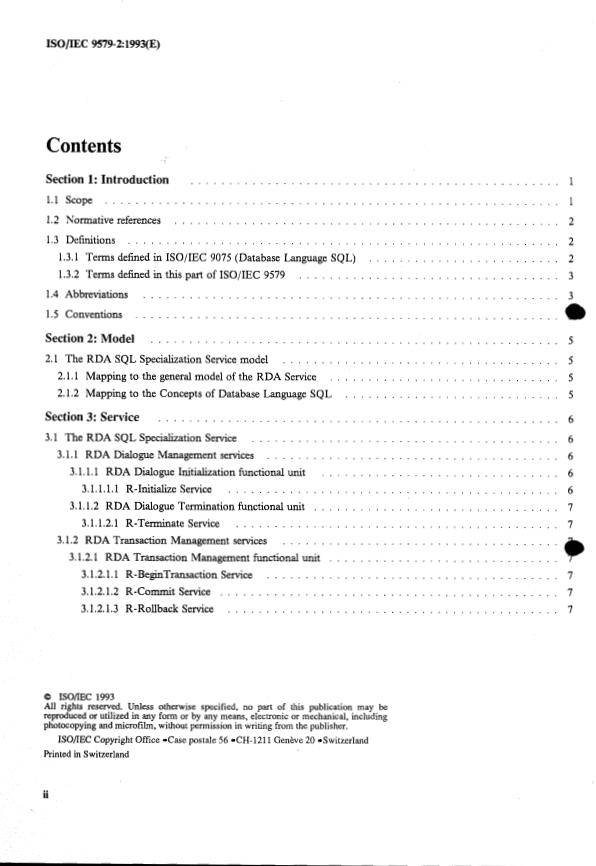
Contents
Section 1: Introduction .
............ .................. 1
1.1 Scope .
............ .................. 1
1.2 Normative references .
1.3 Defuiitions .
.................... 2
1.3.1 Terms defined in ISO/IEC 9075 (Database Language SQL)
.... .................... 2
1.3.2 Terms defmed in this part of ISO/IEC 9579 . . 3
1.4 Abbreviations . . 3
1.5 Conventions .
.................... e
Section 2: Model . . 5
2.1 The RDA SQL Specialization Service model
............... .................... 5
2.1.1 Mapping to the general model of the RDA Service
......... .................... 5
2.1.2 Mapping to the Concepts of Database Language SQL . . 5
Section 3: Service . 6
3.1 The RDA SQL Specialization Service . 6
3.1.1 RDA Dialogue Management services . 6
3.1.1.1 RDA Dialogue Initialization functional unit . 6
3.1.1.1.1 R-Initialize Service . 6
3.1.1.2 RDA Dialogue Termination functional unit . 7
3.1.1.2.1 R-Terminate Service . 7
3.1.2 RDA Transaction Management services .
..............................
3.1.2.1 RDA Transaction Management functional unit
(t
3.1.2.1.1 R-BeginTransaction Service . 7
3.1.2.1.2 R-Commit Service . 7
3.1.2.1.3 R-Rollback Service . 7
@ ISO/IEC 1993
All rights reserved . Unless otherwise specified. no part of this publication may be
reproduced or utilized in any form or by any means. electronic or mechanical. including
photocopying and microfilm. without permission in writing from the publisher .
ISO/IEC Copyright Office Case postale 56 CH-1211 Genève 20 Switzerland
Printed in Switzerland
ii
ISO/IEC 9579-21993(E)
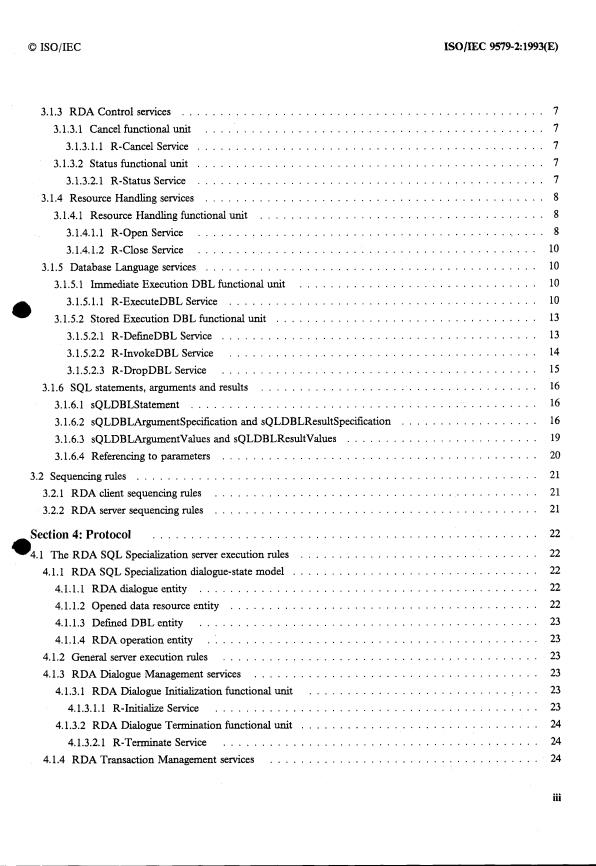
3.1.3.1 Cancel functional unit . 7
3.1.3.1.1 R-Cancel Service . 7
3.1.3.2 Status functional unit . 7
3.1.3.2.1 R-Status Service . 7
3.1.4 Resource Handling services . 8
3.1.4.1 Resource Handling functional unit . 8
3.1.4.1.1 K-Open Service . 8
3.1.4.1.2 R-Close Service . 10
3.1.5 Database Language services . 10
3.1.5.1 Immediate Execution DBL functional unit . 10
3.1.5.1.1 R-ExecuteDBL Service . 10
3.1.5.2 Stored Execution DBL functional unit . 13
3.1.5.2.1 R-DefmeDBL Service . 13
3.1.5.2.2 R-InvokeDBL Service . 14
......................................... 15
3.1.5.2.3 R-DropDBL Service
3.1.6 SQL statements, arguments and results . 16
3.1.6.1 SQLDBLStatement . 16
3.1.6.2 sQLDBLArgumentSpecifcation and sQLDBLResultSpecification . 16
3.1.6.3 SQLDBLArgumentValues and sQLDBLResultValues . 19
3.1.6.4 Referencing to parameters . 20
3.2 Sequencing des . 21
3.2.1 RDA client sequencing rules . 21
3.2.2 RDA server sequencing rules . 21
Section 4: Protocol . 22
'
*4.1 The RDA SQL Specialization server execution rules . 22
4.1.1 RDA SQL Specialization dialogue-state model . 22
4.1.1.1 RDA dialogue entity . 22
4.1.1.2 Opened data resource entity . 22
4.1.1.3 Defined DBL entity . 23
4.1.1.4 RDA operation entity . 23
I
I 4.1.2 General server execution des . 23
4.1.3 RDA Dialogue Management services . 23
I
4.1.3.1 RDA Dialogue Initialization functional unit . 23
..........................................
I 4.1.3.1.1 R-Initialize Service 23
4.1.3.2 RDA Dialogue Termination functional unit . 24
I
I 4.1.3.2.1 R-Terminate Service . 24
4.1.4 RDA Transaction Management services . . . 24
iii
I
ISO/IEX 9579-21993(E)
O ISO/IEC
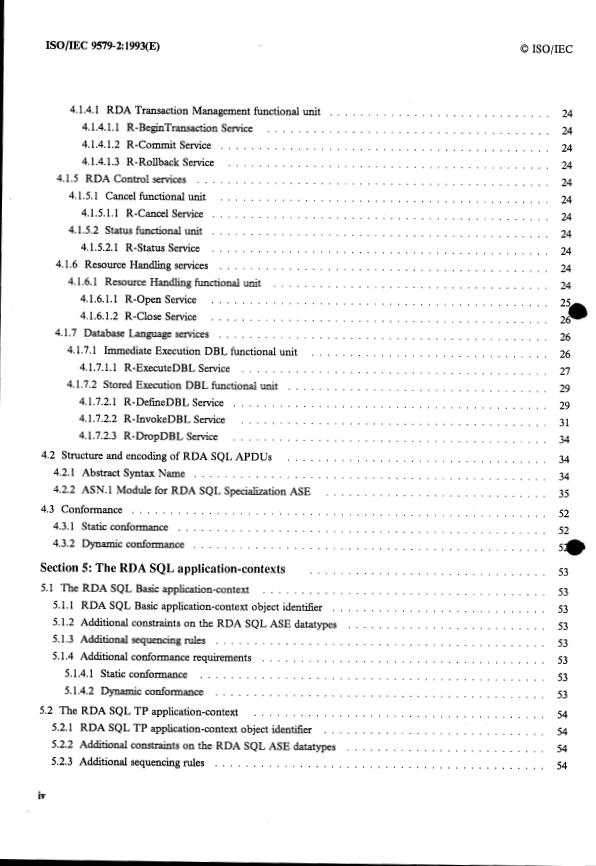
4.1.4.1 RDA Transaction Management functional unit
. . . . . . . . . . . . . . . . . . . . . . . . , . . . .
4.1.4.1.1 R-BeginTransaction Service
. . . . . . . . . . , . . . . . . . . . , . . . . . , . . , . . , . . , .
4.1.4.1.2 R-Commit Service . . . . . . . . . . . . . . . . . . , . . , . . . , . . . . . . . . . . . , , . . , .
4.1.4.1.3 R-Rollback Service . . . , . . . . . . . , . . . . . , . . . . . . . . . . . . . . . . . . . . . . , .
4.1.5 RDA Control services
. . . . . . . . . . . . . . . . , . . , . . . . . . . . . . . . . . . . . . . , . . . . . .
4.1.5.1 Cancel functional unit
. . . . . . . . . . . . . . . . . . . . . . . . . . . . . . . . . . . . , . . , . . .
4.1.5.1.1 R-Cancel Service . . . . . . . , . . . . . , . . . . . . . . . . . . . . , . . . . , . , . . . . . . . .
4.1.5.2 Status functional unit
. . . . . . . . . . . . . . . . . . . . . , . . . . . , . . . . . . . . . , . . . , . ,
4.1.5.2.1 R-Status Service
. . . . . , . . . . . . . . . . . , . . . . . . . . . . . . . . . . . . . , . . . . . .
4.1.6 Resource Handling services
. . . . . . . . . . . . . . . . . . . , . . . . . , . . . . , , . . . . . . . , . . .
4.1.6.1 Resource Handiing functional unit
. . . . . . . . . . . . . . . . . . . . . . . , . . . . , . . , . . . .
4.1.6.1.1 R-Open Service
. . . . . . . . . . . . . . . . . . . . . , . . . . . . . . . . . . . . . . . . . . . .
4.1.6.1.2 R-Close Service 25e
. . . . . . . . . . . . . . . . . . . . . . . . . . . . , . . . . . . . . . . . . . , .
4.1.7 Database Language services . . . . . . . . . . . . . . , . . . . . , . . , . . , . . . . . . . . . . . . . , . .
4.1.7.1
Immediate Execution DBL functional unit
. . . . . . . . . . , . . . . . . . . . . . . . . . . . . . .
4.1.7.1.1 R-ExecuteDBL Service
. . . . . . . . . . . . . . . . . . . . . . . . . . . . . . . . . . . , . . . .
4.1.7.2 Stored Execution DBL functional unit
. . . . . . . . . . . . . . . . . . . . . . . . . . . . . . . , . .
4.1.7.2.1 R-DefrneDBL Service . . . . . . . . . . . . . . . . , . . . . . . . . . . . . . . . . . . . , . . , .
4.1.7.2.2 R-InvokeDBL Service . . . . . . . . . . . . . . . . . . . . . . . . . . . . . , . . . . . . . . . .
4.1.7.2.3 R-DropDBL Service . . . . . . . . . . . . . . . . . . . . . . . . . . . . . . . . . . . . . , . . .
4.2 Structure and encoding of RDA SQL APDUs
. . . . . . . . . . . . . . . . . . . . . . . . . . . . . . . , . .
4.2.1 Abstract Syntax Name . . . . . . . . . . . . . . . . . . . . . . . . . . . . . . . . . . . . . . . . . . . . . .
4.2.2 ASN.l Module for RDA SQL Specialization ASE . . . . . . . . . , . . . . , . . . . . . . . . . . . . .
4.3 Conformance .
4.3.1 Static conformance . . . . . . . . . . . . . . . . . . . . . . , . . . . . . . . . . . , . . . . . . . . . . . . ,
4.3.2 Dynamic conformance . . . . . . . . . . . . . . . . . . . . . . . , . . . , . . . . . . . . . . . ,
......
5*
Section 5: The RDA SQL application-contexts
. . . , . . . , . . , . . . . . . . . . . . . . . . . . . . .
5.1 The RDA SQL Basic application-context
. . . . . . . . . . . . . . . . . . . , . . . . . . . . . . , . . . . . ,
5.1.1 RDA SQL Basic application-context object identifier . . . . . . . . . . . , . . . . . . . . . . . . . . . .
5.1.2 Additional constraints on the RDA SQL ASE datatypes . . . . . . . . . . . . . . . . . . . . . . . . . .
5.1.3 Additional sequencing rules . . . . . . . . . . . . , . . . . . . . . . . . . . . . . . . . . . . . . . . . . . .
5.1.4 Additional conformance requirements . . . . . . . . . . . . . . . . . . . . . . . . . . . . , . . . , . . , .
5.1.4.1 Static conformance
. . . . . . . . . . . . . . . . . . . . . . . . . . . . . . . . . . . . . . . . . . . . .
5.1.4.2 Dynamic conformance
, . . . . . . . . . . . . . . . . . , . . , . . . , . . , . . . . . . . . . , . . , .
5.2 The RDA SQL TP application-context
. . . . . . , . . , . . . . , . . . . , . . . . . , . . . . . . , . . . . .
5.2.1 RDA SQL TP application-context object identifier , . . . . . . . . . . , . . . . . . . . . . . . . . . . .
5.2.2 Additional constraints on the RDA SQL ASE datatypes . . . . . . . . , . . . . . . . . . . . , . . . . .
5.2.3 Additional sequencing rules . . . . . , . . . . . . . . . . . . . . . . . . . , . . . . . . . . . . . , . . . . .
iv
ISO/IEC 9579-21993(E)
O ISO/IEC
I 1
ISO/IEC 9579-2 1993(E) O ISO/IEC
Figures
1 . Usage of Embedded SQL Variables . 20
Tables
1 . R-Initialize SQL Specific Service Parameters . 6
2 . R-Open SQL Specific Service Parameters . 8
3 . R-Close SQL Specific Service Parameters . 10
4 . R-ExecuteDBL SQL Specific Service Parameters . 11
5 . R-DefmeDBL SQL Specific Service Parameters . 13
6 . R-InvokeDBL SQL Specific Service Parameters . 14
7 . sQLDBLStatement .
8 . sQ LDBLArgument Specification and sQ LDB LResult Specification . : 6.
9 . sQLDBLArgumentValues and sQLDBLResultValues . 19
10 . R-ExecuteDBL use of SQL argument and result parameters . 27
11 . R-DefïneDBL use of SQL argument and result parameters . 30
R-InvokeDBL use of SQL argument and result parameters . 32
12 .
vi
Q ISODEC
Foreword
IS0 (the International Organization for Standardization) and IEC (the Interna-
tional Electrotechnical Commission) form the specialized system for worldwide
standardization. National bodies that are members of IS0 or IEC participate in
the development of International Standards through technical committees estab-
lished by the respective organization to deal with particular fields of technical
activity. IS0 and IEC technical committees collaborate in fields of mutual inter-
est. Other international organizations, governmental and non-governmental, in
liaison with IS0 and IEC, also take part in the work.
In the field of information technology, IS0 and IEC have established a joint
technical committee, ISO/IEC JTC 1. Draft International Standards adopted by
the joint technical committee are circulated to national bodies for voting. Publi-
cation as an International Standard requires approval by at least 75 % of the na-
tional bodies casting a vote.
International Standard ISOAEC 9579-2 was prepared by Joint Technical Com-
Information technology, Subcommittee SC 21, Open
mittee ISOAEC JTC 1,
systems interconnection, data management and open distributed processing.
ISO/IEC 9579 consists of the following parts, under the general title Information
technology - Open Systems Interconnection - Remote Database Access:
- Part I: Generic Model, Service and Protocol
- Part 2: SQL specialization
vii
ISO/IEC 9579-2: 1993(E) O ISO/IEC
Introduction
Remote Database Access (RDA) International Standards are members of a set of International Standards produced
to facilitate the interworking of computer systems. The RDA International Standards are positioned in the Applica-
tion Layer of the Reference Model of Open Systems Interconnection (OSI) and are related to other Open Systems
International Standards in the set, as defrned in IS0 7498.
The goal of Remote Database Access is to ailow, with a minimum of technical agreement outside the intercon-
nection standards, the interconnection of applications and database systems:
from different manufacturers;
under different managements;
of different levels of complexity;
exploiting different technologies.
An application may itself be a database system and therefore an RDA Specialization standard can be used to
support multi-database system interworking.
This part of ISO/IEC 9579 is to be used together with ISO/IEC 9579-1 to provide remote data access to a database
management system conforming to ISO/IEC 9075 (Database Language SQL).
viii
INTERNATIONAL STANDARD @ LsOmEC 9579-2: 1993(E)
Information technology - Open Systems Interconnection -
Remote Database Access -
Part 2:
S QL specialization
Section 1: Introduction
1.1 Scope
This part of ISO/IEC 9579 specifies the functionality of a database server within a distributed open systems envi-
ronment and specifies the communication service and protocol for accessing its capabilities. The communications
capabilities are positioned in the Application Layer of the Reference Model of Open Systems Interconnection
(OSI).
This part of ISO/IEC 9579 complements ISO/IEC 9579-1 (RDA Generic) in order that the two parts together:
a) define the capabilities of an RDA SQL database server supporting dialogues with clients.
b) define a model of dialogues between the RDA SQL database server and remote users.
c) define a model of a dialogue between an RDA client and an RDA server.
d) define an abstract service for the RDA SQL ASE, which models the communications facilities supporting inter-
action between the RDA client and RDA server.
e) define the RDA SQL ASE protocol to support the RDA SQL Service.
f) define the characteristics of application-contexts which include the RDA SQL ASE.
g) define application-contexts that support remote database access using SQL:
1) RDA Basic application-context
2) RDA TP application-context
This part of ISO/IEC 9579 does not specify individual implementations or products, nor does it constrain the
implementation of entities and interfaces within a computer system.
This part of ISOIIEC 9579 does not defrne a programmatic interface. The RDA server includes a database capa-
bility as defined in ISO/IEC 9075 (Database Language SQL).
NOTES
1 The RDA client may contain an SQL application program but there is no requirement that the RDA client shali be an
application program written to the ISO/IEC 9075 (Database Language SQL) application program interface.
2 ISO/IEC 9075:1989, the former International Standard for Database Language SQL, has been replaced by ISO/IEC
90751992. Both the current and former standards contain conformance rules, and the RDA SQL Specialization allows an
RDA client to specify the desired level of conformance which it expects the RDA Server to support. Throughout this part
of ISO/IEC 9579, “SQL” refers to the language statements permitted by the appropriate standard at the requested level of
conformance.
ISO/iEC 9579-2: 1993(E) O ISO/IEC
1.2 Normative references
The following standards contain provisions which, through reference in this text, constitute provisions of this part
of ISO/IEC 9579. At the time of publication, the editions indicated were valid. All standards are subject to revision,
and parties to agreements based on this part of ISO/IEC 9579 are encouraged to investigate the possibility of
applying the most recent editions of the standards listed below. Members of IS0 and IEC maintain registers of
currently valid International Standards.
ISO/IEC 8824: 1990, Information technology - Open Systems Interconnection - Specifcation of Abstract Syntax Notation
One (ASN.1).
ISO/IEC 8825: 1990, Information technology - Open Systems Interconnection - Specijîcation of Basic Encoding Rules for
Abstract Syntax Notation One (ASN.1).
ISO/IEC 9075: 1992, Information technology - Database Languages SQL.
ISO/IEC 9579-1: 1993, Information technology - Open Systems Interconnection - Remote Database Access - Part I: Generic.
1.3 Definitions 0
For the purposes of this part of ISO/IEC 9579, the deibitions given in ISO/IEC 9579-1 and the following defi-
nitions apply.
1.3.1 Terms defined in ISO/IEC 9075 (Database Language SQL)
This part of ISO/IEC 9579 uses the following terms defmed in ISO/IEC 90751989 (Database Language SQL) or
ISO/IEC 9075:1992 (Database Language SQL).
a) applicable privileges
b) EmbeddedSQL
c) SQL-data
d) SQLCODE
e) SQLSTATE
In addition, this part of ISO/IEC 9579 references the following non-terminai production symbols from the SQL
syntax, which represent a valid string of characters that can be derived from these production symbols according to
the syntax des in ISO/IEC 9075 (Database Language SQL) at the approriate level of conformance.
e
9 close statement >
g) commit statement >
h)
i) < declare cursor >
j) < delete statement: positioned >
k) < delete statement: searched >
I) embedded variable name >
m) < fetch statement >
n)
O) < host identifier >
p) < indicator variable >
q) < insert statement >
r)
O ISO/IEC ISO/IEC %79-21993(E)
s) < open statement >
t) < rollback statement >
U) < schema definition >
v) < select statement: single row >
w) < SQL conformance >
x) < SQL data statement >
y) < SQL edition >
z) < table definition >
aa) < update statement: positioned >
ab) < update statement: searched >
ac) < variable specification >
ad) < view definition >
oae) < 1987>
af) < 1989>
ag) < 1992 >
1.3.2 Terms defined in this part of ISO/IEC 9579
1.3.2.1 SQL database resource: SQL-data and the schemas describing it, as defined in ISO/IEC 9075 (Database
Language SQL).
1.3.2.2 RDA SQL statement: One of the non-terminals < schema definiion > , C table defuiition > ,
nition > , 6 grant statement > , < SQL data statement > , < cormnit statement > , < rollback statement > and
declare cursor > as defined in ISOIIEC 9075 (Database Language SQL).
1.4 Abbreviations
For the purposes of this part of ISO/IEC 9579, the abbreviations given in ISO/IEC 9075 and ISO/IEC 9579-1
eappiy.
1.5 Conventions
This part of ISO/IEC 9579 adopts the conventions established in ISO/IEC 9579- 1.
The RDA SQL Specialization is formaiiy defined in an ASN.l Module that is derived from the RDA Specialization
module template defmed in ISO/IEC 9579-1. The RDA SQL Specialization module provides definitions for those
types listed in the template as being undefmed by the Generic part of ISO/IEC 9579.
The structure of this part of ISO/IEC 9579 follows the requirements defined in ISO/IEC 9579-1 for defuillg spe-
cializations of the RDA Generic Service and Protocol.
In this part of ISO/IEC 9579, the RDA Generic parameters and data types named specificxxxx . and
SpecificXxxx. . are renamed to sQLXxxx. . and to SQLXxxx. ., respectively.
in 3.1, parameters which are defined by this specialization have values entered in the
In the service parameter tables
Req, Ind, Rsp or Cnf columns. Other service parameters in these tables which are copied from the RDA Generic to
improve readability do not have entries in these columns.
ISO/IFX 9579-2 1993(E) O ISO/IEC
The RDA SQL Specialization defines a means of communicating SQL database language statements and their
parameters from an RDA client to an RDA server, and of returning the results of those statements. Database Lan-
guage SQL is supported at various levels of conformance, determined by an object identifier dehed in ISO/IEC
9075.
In this part of ISO/IEC 9579, the reference “ISO/IEC 9075 (Database Language SQL)” means any International
Standard carrying the designation ISO/IEC 9075 and year of approval. The specific version (or versions) of that
standard that is intended in each instance is determined, for the RDA client, by the SQL Conformance Level
requested either when the RDA dialogue is initialized or when a data resource is opened, and, for the RDA server,
by the SQL Conformance Level (or Levels) claimed in the Protocol Implementation Conformance Statement.
When the SQL Conformance Level specifies a year value of 1987 or 1989, the relevant International Standard is
ISO/IEC 90751989; when the SQL Conformance Level specifies a year value of 1992, the relevant International
Standard is ISO/IEC 9075: 1992.
The term “SQL” is used throughout in a generic sense, intending to cover Database Language SQL at a particular
conformance level as well as valid statements written within that conformance level.
a
o
O ISO/IEC
ISO/IEC 9579-21993(E)
Section 2: Model
2.1 The RDA SQL Specialization Service model
2.1.1 Mapping to the general model of the RDA Service
This subclause relates the relevant concepts defmed in section 2 of ISO/IEC 9579-1 to this RDA SQL Specializa-
tion.
The term data resource, defmed in the ISO/IEC 9579-1, corresponds to SQL-data as defmed in ISO/IEC 9075
(Database Language SQL). In this part of ISO/IEC 9579, this is called the SQL database resource.
a
The RDA client gains access to an SQL database resource at the RDA server by opening it. It is then available for
use in requests for Database Language Services (see 3.1.5, “Database Language services” on page 10). Nested SQL
database resources are not supported.
Closing an SQL database resource causes it to be made inaccessible to the RDA client; that is, unavailable for
subsequent use in requests for Database Language Services.
An implementor shail provide an RDA server at which one or multiple SQL database resources are available.
2.1.2 Mapping to the Concepts of Database Language SQL
This subclause relates the relevant concepts defined in clause 4 of ISO/IEC 9075 (Database Language SQL) to the
database model contained in the RDA server.
RDA SQL statements are executed by the database server exactly as if they were embedded in a host program local
to the SQL database resource. Any exception condition or completion condition raised by the database server is
returned to the RDA client.
NOTE - A < declare cursor RDA SQL statement must have been executed or invoked at the RDA server prior to exe-
cuting or invoking any < open statement > that uses the same cursor name.
a
O ISO/IEC
ISO/IEX 9579-2: 1993(E)
Section 3: Service
3.1 The RDA SQL Specialization Service
This clause contains the expansion of the RDA Generic Service parameters which are specialization defmed. These
specifications are in addition to those specified in ISO/IEC 9579- 1.
NOTE- The subclauses in this clause are elaborations of the corresponding subclauses in ISO/IEC 9579-1 and are num-
bered accordingly.
3.1.1 RDA Dialogue Management services
a
3.1.1.1 RDA Dialogue Initialization functional unit
3.1.1.1.1 R-Initialize Service
Table 1 lists the R-Initialize SQL Specific Service Parameters.
Table 1. R-Initialize SQL Specific Service Parameters
Ind
Re4
Request Parameters
U
sQLInitializeArgument
sQLConformanceLevelDefault U
userData C
Result Parameters
U
sQLInitializeResult
userData C
Request Parameters
sQLIni t ialize Argumen t :
This argument is used to negotiate the level of support desired by the RDA client.
sQLConformanceLevelDefau1 t :
This parameter identifies the characteristics (“SQL level”) of the Database Language SQL requested by the
RDA client. The object identifiers specif~g those characteristics are defined in ISO/IEC 9075:1992. This is
the default SQL Conformance Level requested by the RDA client. If this parameter is omitted, there is no
default established for the RDA client.
userData:
The meaning of this parameter is defmed by the implementor of the RDA server.
Result Parameters
sQLInitiaiiieResult:
This parameter contains information returned by the RDA server whose meaning is specific to this RDA
SQL Specialization.
userData:
The meaning of this parameter is defined by the implementor of the RDA server.
O ISO/IEC ISO/IEC 9579-2 1993(E)
Error Parameters
NOTE - None of the specific error parameters for this service are used in this Speciaiization.
3.1.1.2 RDA Dialogue Termination functional unit
3.1.1.2.1 R-Terminate Service
NOTE - None of the specific request, result or error parameters for this service are used in this Specialization.
3.1.2 RDA Transaction Management services
3.1.2.1 RDA Transaction Management functional unit
0 3.1.2.1.1 R-BeginTransaction Service
NOTE - There are no specific request, result or error parameters.
3.1.2.1.2 R-Commit Service
NOTE - There are no specific request, result or error parameters.
3.1.2.1.3 R-Rollback Service
NOTE - There are no specific request, result or error parameters.
3.1.3 RDA Control services
3.1.3.1 Cancel functional unit
3.1.3.1.1 R-Cancel Service
0 NOTE - None of the specific request, result or error parameters for this service are used in this Specialization.
3.1.3.2 Status functional unit
3.1.3.2.1 R-Status Service
NOTE - None of the specific request, result or error parameters for this service are used in this Specialization.
O ISO/IEC
ISO/IEC 9579-2 1993(E)
3.1.4 Resource Handling services
3.1.4.1 Resource Handling functional unit
3.1.4.1.1 R-Open Service
Table 2 lists the R-Open SQL Specific Service Parameters.
Table 2. R-Open SQL Specific Service Parameters
Ind
RsP
Req
Request Parameters
U
sQLAccessControlData
U
sQLUsageMode
U
sQ LOpenArgument
charset U
B
sQLConformanceLeve1 U
Result Parameters
U
sQLOpenResult
U
charset
U
charset Not Supported
C
sQLConformanceLeve1
Error Parameters
sQLOpenError S
invalids QLConformanceLevel S
S
r DATransactionOpen
sQLAccessControlViolation S
sQLDatabaseResourceAady Open S
Request Parameters
sQLAccessControlDatz
Data supplied by the RDA client to authenticate the right to open the SQL database resource for the required
usage.
sQLUsageMode:
This argument specifies the access mode to the SQL database resource. If “retrieval” mode is chosen then ali
the objects within that SQL database resource can be accessed for read-only purposes and any attempt to
modify any object within that SQL database resource causes an error usageModeviolation. If “update” mode
is chosen then update, insert and delete of the objects within that SQL database resource are permitted. The
applicable privileges as defmed in ISO/IEC 9075:1992 may further restrict the access to any of the objects
witbin that SQL database resource irrespective of the sQLUsageMode. The default value for sQLUsageMode
is “retrieval.”
sQLOpen Argument:
This parameter contains information sent by the RDA client whose meaning is specific to SQL.
charst:
This parameter uniquely identifies the specification of a coded character set. The character repertoire for char-
acter data associated with (described by) this parameter is the character repertoire specified in the identified
coded character set specification. The character set identified by that specification shall be used by the RDA
client as the default in this RDA dialogue for ail RDA SQL Statements and their associated character data
arguments accessing the SQL database resource opened by this RDA service.
NOTE- This default can be overridden by explicit specification, in an sQLDELArgumentSpecification or an
sQLDBLStatement, of a character set for a particular argument value or RDA SQL statement.
If this parameter is omitted, there is no default established for the RDA client.
O ISO/IEC ISO/IEC 9579-2:1993(E)
NOTE- This means that a charset parameter must be specified for every character data argument and
sQLDBLStatement sent by the RDA client.
sQLConformanceLeve1:
This parameter identifies the characteristics (“SQL level”) of the Database Language SQL requested by the
RDA client. The object identifiers specifying those characteristics are defmed in ISO/IEC 90751992. This is
the sQLConformanceLeve1 which the RDA client requests for all RDA SQL statements for this SQL database
resource. This parameter shall be provided if no default was established by the RDA client on R-Initialize.
parentDataResourceHandle:
This parameter is not used in this Specialization.
Result Parameters
sQLOpenResult:
This parameter contains information returned by the RDA server whose meaning is specific to SQL.
charset:
This parameter uniquely identifies the specification of a coded character set. The character repertoire for char-
acter data associated with (described by) this parameter is the character repertoire specified in the identified
0 coded character set specification. The character set identified by that specification shall be used by the RDA
server as the default in this RDA dialogue for ali character data results that are associated with DBL state-
ments accessing the SQL database resource opened by this RDA Service.
If the default character set declared by the RDA client in the charset argument parameter is also supported
for result parameters by the RDA server, then the RDA server declares the same default character set for itself
by responding with the same character set identification.
NOTE- This default can be overridden by explicit specification, in an sQLDBLResu1 tspecification, of a character set
for a particular result value.
If this parameter is omitted, there is no default established for the RDA server.
NOTE- This means that a charset parameter must be specified for every character data result sent by the RDA
server.
charSetNotSupported:
The character set declared by the RDA client is not supported by the RDA server.
NOTE- If the RDA server returns this parameter, the RDA client should close the SQL database resource and
propose another default character set.
sQLConformanceLeve1:
If the RDA server cannot provide the SQL level requested by the RDA client then this parameter identifies
the characteristics (“SQL level”) of the Database Language SQL that the RDA server will provide. The object
0 identifiers specming those characteristics are defined in ISO/IEC 9075:1992. If the RDA server does not
support the sQLConformanceLeve1 requested by the RDA client, the RDA server returns the
sQLConformanceLeve1 which the RDA server does support in this result parameter.
Error Parameters
sQLOpenError :
This parameter is used by the RDA server to report errors.
invalidSQLCon formanceLeve1:
The value of sQLConformanceLeve1 is not allowed. If the sQLConformanceLeve1 request parameter was supplied
on the R-Open request, then the error refers to the value in that parameter. Otherwise it refers to the
sqLConformanceLeve1 Defaul t request parameter value as supplied on the previous R-Initialize request.
rDATransactionOpen
The opening of an SQL database resource is not allowed within a transaction.
sQLAccessControlViolation:
The RDA client does not have the required authority to open the SQL database resource for the requested
sQLUsageMode.
O ISO/IEC
ISO/IEC 9979-2: 1993(E)
sQLDat aûaseResourceAlready Open
There is already an SQL database resource open.
3.1.4.1.2 R-Close Service
Table 3 lists the R-Close SQL Specific Service Parameters.
Table 3. R-Close SQL Specific Service Parameters
Req Ind Rsp Cnf
Ewor Parameters
sQ LCloseError
S S(=)
rDATransactionOpen
S S(=)
Error Parameters
sQLCloseError:
This parameter is used by the RDA semer to report errors.
rDATransactionOpen
The closing of an SQL database resource is not allowed with a transaction.
3.1.5 Database Language services
There are no constraints on intermixing invocation (through R-InvokeDBL operations) and execution (through
R-ExecuteDBL operations) of RDA SQL statements.
3.1.5.1 Immediate Execution DBL functional unit
3.1 51.1 R-ExecuteDBL Service
Table 4 lists the R-ExecuteDBL SQL Specific Service Parameters.
ISO/IEC %79-21993(E)
O ISO/IEC
Table 4. R-ExecuteDBL SQL Specific Service Parameters
Ind Cnf
Req
Request Parameters
sQLDBLStatement M
sQ LDB LArgument Specification U
U
sQLDBLResult Specification
dB LArgument s
single Argument
sQ LD B LAr gumentvalues U
multiple Argument
list OfS QLDB LArgumentValues U
Result Parameters
sQLDBLResult Specification C
list OfResuitValues
sQ LDB LException M
sQ LSTATE C
C
sQLCODE
s Q LErrorText U
sOLDBLResultValues C
EV& Parameters
S
sQ LExecuteDBLError
S
host IdentifierError
r DATransactionNot Open S
sQLDBLArgument Count Mismatch S
sQLDBLArgumentTypeMismatch S
S
sQLDBLNoCharSet
sQLDBLTransactionStatement NotAiiowed S
sQLUsageModeViolation S
NOTE - The specificTerminationCode result parameter is not used in this Specialization.
Request Parameters
sQLDBLStatement:
This parameter contains the RDA SQL statement to be executed and is fkUy defuied in 3.1.6.1,
“sQLDBLStatement” on page 15.
sQLDBLArgumentSpecifcation:
This parameter consists of a list of SQL datatype descriptors and is fully defmed in 3.1.6.2,
“sQLDBLArgumentSpec5cation and sQLDBLResultSpecification” on page 16.
sQLDBLResult Specification:
This parameter consists of a list of SQL datatype descriptors and is fidy defmed in 3.1.6.2,
“sQLDBLArgumentSpecification and sQLDBLResultSpec5cation” on page 16.
sQLDBLArgumen tValues:
This parameter consists of a list of the values of the argument parameters defined in the
sQLDBLArgumentSpecification and is fully defmed in 3.1.6.3, “sQLDBLArgumentValues and
sQLDBLResultValues” on page 18.
list OfSQLDBLArgumentVdues:
This parameter consists of multiple lists of the values of the argument parameters defmed in the
sQLDBLArgumentSpecifcation and is fully defined in 3.1.6.3, “sQLDBLArgumentValues and
sQLDBLResuitValues” on page 18.
ISO/IEC 9579-2 1993(E) O ISO/IEC
Result Parameters
sQLDBLResu1 tspecification:
This parameter consists of a list of SQL datatype descriptors and is fully defmed in 3.1.6.2,
“sQLDBLArgumentSpecification and sQLDBLResultSpecication” on page 16.
SQLDBLException:
This defmes the completion code for the execution of the RDA SQL statement. It is the method used by the
RDA server to return SQL exceptions (exception conditions or completion conditions).
sQLSTATE:
An SQLSTATE value as defined in ISO/IEC 9075:1992 or by the RDA server in conformance with that
specification.
sQLCODE:
An SQLCODE value as defmed in ISO/IEC 9075 (Database Language SQL).
sQLError Text:
Supplemental information describing the error or warning corresponding to the sQLSTATE value or the
sQLCODE value.
a
sQLDBLResultVaiues:
This parameter consists of a list of the values of the result parameters defmed in the
SQLDBLResultSpecification and is fully defined in 3.1.6.3, “sQLDBLArgumentValues and
sQLDBLResultValues” on page 18.
Error Parameters
SQLExecuteDBLError:
This parameter is used by the RDA server to report errors.
hostIdentifierError:
The RDA server detected an error in an SQL variable name in an RDA SQL statement.
rDATransactionNot Open:
No transaction is open and an attempt was made to execute an operation containing an RDA SQL statement
other than a < schema defuiition > , < table definition > , < view definition > or grant statement > .
sQLDBLArgumentCountMismatch:
The number of entries in the sQLDBLArgumentValues parameter is not the same as in its associated
sQLDBLArgumentSpeci fi cati on parameter.
sQLDBLArgumentTy peMismatch:
The type of one or more entries in the sQLDBLArgumentValues parameter is not the same as in its associated
sQLDBLArgumentSpeci fi cati on parameter.
sQLDBLNoC harSet
There is no default character set for the SQL database resource and either the sQLDBLArgumentSpecication
contains a descriptor for character data without the explicit specification of its character set or the
sQLDBLStatement contains character data without the explicit specification of its character set.
SQLDBLTransactionStatemen tNot Allowed:
sQLDBLStatement performs transaction management (e.g. SQL < commit statement > or SQL
The content of
< roiiback statement > ) which is not permitted by the RDA SQL Specialization.
sQLUsageModeViolation:
The access mode of the SQL database resource associated with this request is in conflict with the RDA SQL
O ISO/IEC ISO/IEC 9579-21993(E)
3.1.5.2 Stored Execution DBL functional unit
3.1.5.2.1 R-DefineDBL Service
Table 5 lists the R-DefmeDBL SQL Specific Service Parameters.
Table 5. R-DefineDBL SQL Specific Service Parameters
Cnf
Ind
1 Req RSP
Request Parameters
sQLDBLStatement M
sQ LDB LArgumentSpecifcation U
U
sQLDBLResult SpecZcation
Result Parameters
C
sQ LDB LResult Specification
C
sQLDB LException
C
sQLSTATE
C
sQLCODE
U
sQLErrorText
Error Parameters
S
sQ LDefmeDB LError
S
ho st IdentifïerError
S
sQLDBLNoCharSet
S
sQ LDB LTransactionS tatement NotAilowed
S
sQLUsageModeViolation
Request Parameters
sQLDBLSt atement:
This parameter contains the RDA SQL statement to be defmed and is fully defined in 3.1.6.1,
“sQLDBLStatement” on page 15.
sQLDBLArgument Specification:
This parameter consists of a list of SQL datatype descriptors and is fully defmed in 3.1.6.2,
“sQLDBLArgumentSpeication and sQLDBLResultSpecifcation” on page 16.
sQLDBLResuit Specification:
This parameter consists of a list of SQL datatype descriptors and is fully defined in 3.1.6.2,
“sQLDBLArgumentSpec5cation and sQLDBLResultSpec5cation” on page 16.
Result Parameters
sQLDBLResult Specification:
This parameter consists of a list of SQL datatype descriptors and is fully defmed in 3.1.6.2,
“sQLDBLArgument Specifcation and sQLDBLResultSpecification” on page 16.
sQLDBLExcept ion:
This defines the comdetion code for the execution of the RDA SOL statement. It is the method used by the
RDA server to ret- SQL exceptions (exception conditions or conipietion conditions).
sQLSTATE
An SQLSTATE value as defmed in ISO/IEC 9075:1992 or by the RDA server in conformance with that
specification.
sQLCODE
An SQLCODE value as defmed in ISO/IEC 9075 (Database Language SQL).
sQLErrorTex t :
Supplemental information describing the error or warning corresponding to the sQLSTATE value or the
sQLCODE value.
0 ISO/IEC
ISO/IEC 9579-21993(E)
Error Parameters
sOLDefineDBLError :
.
This parameter is used by lue RDA server to report errors.
hostIdentifierError:
The RDA server detected an error in an SQL variable name in an SQL statement.
sQLDBLNoCharSet:
There is no default character set for the SQL database resource and either the sQLDBLArgumentSpecification
contains a descriptor for character data without the explicit specification of its character set or the
sQLDBLStatement contains character data without the explicit specification of its character set.
sQLDBLTransactionStatementNot Allowed:
The content of sQLDBLStatement performs transaction management (e.g. SQL or SQL
< roiiback statement > ) which is not permitted by the RDA SQL Specialization.
sQLUsageModeViolat ion:
The access mode of the SQL database resource associated with this request is in conflict with the RDA SQL
statement specified.
3.1.5.2.2 R-InvokeDBL Service
Table 6 lists the R-InvokeDBL SQL Specific Service Parameters.
Table 6. R-InvokeDBL SQL Specific Service Parameters
Ind Cnf
Req RSP
Request Parameters
dB LArgument s
SinglekgUment
U
sQ LDB LArgumentValues
multiple Argument
list OfSQLDBLArgumentValues U
Result Parameters
C
sQ LDB LResultSpecification
list OfResultVaiues
sQ LD B LException M
C
sQLSTATE
C
sQLCODE
sQLErrorText U
sQ LD B LResultValues C
Ewor Parameters
S
sQ LInvoke DBLError
S
r DATransaction Not Open
sQ LDBLArgument Count Mismatch S
sQLDBLArgumentTypeMismatch S
S
sQLUsageModeViolation
NOTE - The specificTerminationCode result parameter is not used in this Specialization.
Request Parameters
sQLDBLArgumentValues:
This parameter consists of a list of the values of the argument parameters defmed in the
sQLDBLArgumentSpecification and is fully defmed in 3.1.6.3, “SQLDBLArgumentValues and
sQLDBLResultValues” on page 18.
TI& paramiter consists of multiple lists of the values of the argument parameters defined in the
sQLDBLArguxnentSpecification and is fully defined in 3.1.6.3, “sQLDBLArgwnentValues and
sQLDBLResultValues” on page 18.
Result Parameters
sQLDBLResult Specification:
This parameter consists of a list of SQL datatype descriptors and is fully defined in 3.1.6.2,
“sQLDBLArgumentSpecification and sQLDBLResultSpecification” on page 16.
,
sQLDBLException:
This defmes the completion code for the execution of the RDA SQL statement. It is the method used by the
I
RDA server to return SQL exceptions (exception conditions or completion conditions).
sQLSTATE:
An SQLSTATE value as defined in ISO/IEC 90751992 or by the RDA server in conformance with that
I specification.
1 sQLCODE
An SQLCODE value as defined in ISO/IEC 9075 (Database Language SQL).
I
sQLErrorTex t :
Supplemental information describing the error or warning corresponding to the sQLSTATE value or the
sQLCODE value.
sQLDBLResuitVaiues:
This parameter consists of a list of the values of the result parameters defined in the
sQLDBLResultSpecification and is fdy defined in 3.1.6.3, “sQLDBLArgumentValues and
sQLDBLResultVaiues” on page 18.
Error Parameters
sQLInvokeDBLError:
This parameter is used by the RDA server to report errors.
rDATransactionNot Open:
No transaction is open and an attempt was made to execute an operation containing an RDA SQL statement
other than a < schema definition > , < table defuition > , < view defuition > or < grant statement > .
sQLDBLArgument Coun tMismatch:
The number of entries in the sQLDBLArgumentValues parameter is not the same as in its associated
sQLOBLArgumentSpeci fication parameter.
O
sQLDBLArgumen tTy peMismatch:
The type of entries in the sQLDBLArgumentValues parameter is not the same as in its associated
sQLDBLArgumentSpeci fication parameter.
I I sQLUsageModeViolation:
l The access mode of the SQL database resource associated with this request is in conflict with the RDA SQL
statement specified.
3.1.5.2.3 R-DropDBL Service
NOTE - None of the specific request, result or error parameters for this service are used in this Specialization.
ISO/IEC %79-21993(E) O ISO/IEC
3.1.6 SQL statements, arguments
...
Questions, Comments and Discussion
Ask us and Technical Secretary will try to provide an answer. You can facilitate discussion about the standard in here.
Loading comments...