

ISO 20299-3:2008
(Main)Film for wrapping rubber bales — Part 3: Ethylene-propylene-diene rubber (EPDM), acrylonitrile-butadiene rubber (NBR), hydrogenated nitrile-butadiene rubber (HNBR), acrylic-ethylene rubber (AEM) and acrylic rubber (ACM)
General Information
- Abstract
ISO 20299-3:2008 specifies the material and physical property requirements for non-strippable film for wrapping general purpose synthetic rubber bales and intended to keep the bales separate during storage. It concerns wrapping film for the following types of rubber: ethylene-propylene-diene rubber (EPDM); acrylonitrile-butadiene rubber (NBR); hydrogenated nitrile-butadiene rubber (HNBR); acrylic-ethylene rubber (AEM); acrylic rubber (ACM). Certain applications and processing methods require the removal of the film. This part of ISO 20299 does not deal with strippable films.
- Status
- Published
- Publication Date
- 24-Feb-2008
- Current Stage
- 9093 - International Standard confirmed
- Start Date
- 05-Jun-2026
- Completion Date
- 29-Aug-2026
Buy Documents
ISO 20299-3:2008 - Film for wrapping rubber bales
ISO 20299-3:2008 - Film for wrapping rubber bales — Part 3: Ethylene-propylene-diene rubber (EPDM), acrylonitrile-butadiene rubber (NBR), hydrogenated nitrile-butadiene rubber (HNBR), acrylic-ethylene rubber (AEM) and acrylic rubber (ACM)/25/2008
Overview
ISO 20299-3:2008 specifies requirements for non-strippable film used in wrapping general-purpose synthetic rubber bales. Developed by the International Organization for Standardization (ISO), this standard ensures effective separation of bales, especially for industrial storage and transport. The covered rubber types include:
- Ethylene-propylene-diene rubber (EPDM)
- Acrylonitrile-butadiene rubber (NBR)
- Hydrogenated nitrile-butadiene rubber (HNBR)
- Acrylic-ethylene rubber (AEM)
- Acrylic rubber (ACM)
The primary goal is to avoid rubber-to-rubber adhesion during storage, enabling easy bale handling throughout the manufacturing supply chain.
Key Topics
Material Specifications
The film must be composed of low-density polyethylene (PE-LD), PE-LD blended with ethylene-vinyl acetate copolymer (EVAC), pure EVAC, or certain copolymers of ethylene. The use of suitable antioxidants and agents is permitted to improve film performance.Physical Property Requirements
The wrapping film must meet strict thickness standards, typically ranging between 0.040 mm and 0.085 mm, depending on the material used. Proper thickness is essential for handling stresses during bale processing and storage.Thermal Properties
The standard defines maximum limits for Vicat softening temperature-ensuring that the film will disperse efficiently into rubber compounds during mixing. This reduces manual removal requirements and enhances operational efficiency.Non-strippable Film Focus
Films specified by ISO 20299-3:2008 are intended to remain on the bales during compounding, as they are designed to disperse under typical mixing conditions. The standard does not cover strippable (removable) films.
Applications
Rubber Processing and Manufacturing
The film is widely used in the synthetic rubber industry for wrapping bales prior to distribution and storage. It maintains separation, preserves bale integrity, and prevents contamination.Automated Packing Operations
Given that the film must endure the heat and pressure of automatic bale packing, ISO 20299-3:2008 ensures its suitability for high-throughput environments.Rubber Compound Mixing
Because the film disperses during high-temperature internal mixing, there is greater efficiency in production pipelines using EPDM, NBR, HNBR, AEM, and ACM rubbers.Logistics and Storage
With the risk of rubber-to-rubber adhesion reduced, storage and handling are more manageable, minimizing the creation of large, undividable bales and facilitating seamless downstream usage.
Related Standards
ISO 20299-3:2008 is part of a broader set of ISO standards concerning films for wrapping rubber bales:
- ISO 20299-1 - Film for wrapping butadiene rubber (BR) and styrene-butadiene rubber (SBR) bales
- ISO 20299-2 - Film for wrapping natural rubber bales
Additionally, key referenced standards support compliance:
- ISO 306 - Determination of Vicat softening temperature for plastics
- ISO 4591 - Determination of film thickness by gravimetric techniques
- ISO 11357-3 - Differential scanning calorimetry for plastics
- ISO 1872-1 - Polyethylene material specifications
By following ISO 20299-3:2008, manufacturers and supply chain specialists ensure optimal protection and processing of synthetic rubber bales, aligning handling, safety, and quality with international best practices.
Buy Documents
ISO 20299-3:2008 - Film for wrapping rubber bales
ISO 20299-3:2008 - Film for wrapping rubber bales — Part 3: Ethylene-propylene-diene rubber (EPDM), acrylonitrile-butadiene rubber (NBR), hydrogenated nitrile-butadiene rubber (HNBR), acrylic-ethylene rubber (AEM) and acrylic rubber (ACM)/25/2008
Get Certified
Connect with accredited certification bodies for this standard

DIN CERTCO
DIN Group product certification.

Smithers Quality Assessments
US management systems and product certification.
Sponsored listings
Frequently Asked Questions
ISO 20299-3:2008 is a standard published by the International Organization for Standardization (ISO). Its full title is "Film for wrapping rubber bales — Part 3: Ethylene-propylene-diene rubber (EPDM), acrylonitrile-butadiene rubber (NBR), hydrogenated nitrile-butadiene rubber (HNBR), acrylic-ethylene rubber (AEM) and acrylic rubber (ACM)". This standard covers: ISO 20299-3:2008 specifies the material and physical property requirements for non-strippable film for wrapping general purpose synthetic rubber bales and intended to keep the bales separate during storage. It concerns wrapping film for the following types of rubber: ethylene-propylene-diene rubber (EPDM); acrylonitrile-butadiene rubber (NBR); hydrogenated nitrile-butadiene rubber (HNBR); acrylic-ethylene rubber (AEM); acrylic rubber (ACM). Certain applications and processing methods require the removal of the film. This part of ISO 20299 does not deal with strippable films.
ISO 20299-3:2008 specifies the material and physical property requirements for non-strippable film for wrapping general purpose synthetic rubber bales and intended to keep the bales separate during storage. It concerns wrapping film for the following types of rubber: ethylene-propylene-diene rubber (EPDM); acrylonitrile-butadiene rubber (NBR); hydrogenated nitrile-butadiene rubber (HNBR); acrylic-ethylene rubber (AEM); acrylic rubber (ACM). Certain applications and processing methods require the removal of the film. This part of ISO 20299 does not deal with strippable films.
ISO 20299-3:2008 is classified under the following ICS (International Classification for Standards) categories: 83.040.01 - Raw materials for rubber and plastics in general. The ICS classification helps identify the subject area and facilitates finding related standards.
ISO 20299-3:2008 is available in PDF format for immediate download after purchase. The document can be added to your cart and obtained through the secure checkout process. Digital delivery ensures instant access to the complete standard document.
Standards Content (Sample)
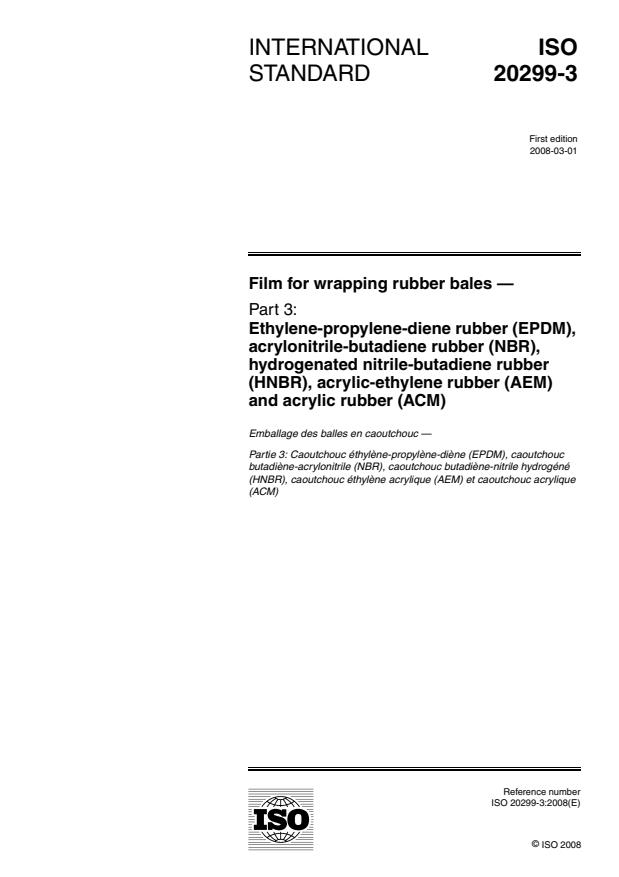
INTERNATIONAL ISO
STANDARD 20299-3
First edition
2008-03-01
Film for wrapping rubber bales —
Part 3:
Ethylene-propylene-diene rubber (EPDM),
acrylonitrile-butadiene rubber (NBR),
hydrogenated nitrile-butadiene rubber
(HNBR), acrylic-ethylene rubber (AEM)
and acrylic rubber (ACM)
Emballage des balles en caoutchouc —
Partie 3: Caoutchouc éthylène-propylène-diène (EPDM), caoutchouc
butadiène-acrylonitrile (NBR), caoutchouc butadiène-nitrile hydrogéné
(HNBR), caoutchouc éthylène acrylique (AEM) et caoutchouc acrylique
(ACM)
Reference number
©
ISO 2008
PDF disclaimer
This PDF file may contain embedded typefaces. In accordance with Adobe's licensing policy, this file may be printed or viewed but shall
not be edited unless the typefaces which are embedded are licensed to and installed on the computer performing the editing. In
downloading this file, parties accept therein the responsibility of not infringing Adobe's licensing policy. The ISO Central Secretariat
accepts no liability in this area.
Adobe is a trademark of Adobe Systems Incorporated.
Details of the software products used to create this PDF file can be found in the General Info relative to the file; the PDF-creation
parameters were optimized for printing. Every care has been taken to ensure that the file is suitable for use by ISO member bodies. In the
unlikely event that a problem relating to it is found, please inform the Central Secretariat at the address given below.
All rights reserved. Unless otherwise specified, no part of this publication may be reproduced or utilized in any form or by any means,
electronic or mechanical, including photocopying and microfilm, without permission in writing from either ISO at the address below or
ISO's member body in the country of the requester.
ISO copyright office
Case postale 56 CH-1211 Geneva 20
Tel. + 41 22 749 01 11
Fax + 41 22 749 09 47
E-mail copyright@iso.org
Web www.iso.org
Published in Switzerland
©
ii ISO 2008 – All rights reserved
Foreword
ISO (the International Organization for Standardization) is a worldwide federation of national standards bodies
(ISO member bodies). The work of preparing International Standards is normally carried out through ISO
technical committees. Each member body interested in a subject for which a technical committee has been
established has the right to be represented on that committee. International organizations, governmental and
non-governmental, in liaison with ISO, also take part in the work. ISO collaborates closely with the International
Electrotechnical Commission (IEC) on all matters of electrotechnical standardization.
International Standards are drafted in accordance with the rules given in the ISO/IEC Directives, Part 2.
The main task of technical committees is to prepare International Standards. Draft International Standards
adopted by the technical committees are circulated to the member bodies for voting. Publication as an
International Standard requires approval by at least 75 % of the member bodies casting a vote.
Attention is drawn to the possibility that some of the elements of this document may be the subject of patent
rights. ISO shall not be held responsible for identifying any or all such patent rights.
ISO 20299-3 was prepared by Technical Committee ISO/TC 45, Rubber and rubber products, Subcommittee
SC 3, Raw materials (including latex) for use in the rubber industry.
ISO 20299 consists of the following parts, under the general title Film for wrapping rubber bales:
— Part 1: Butadiene rubber (BR) and styrene-butadiene rubber (SBR)
— Part 2: Natural rubber
— Part3:Ethylene-propylene-diene rubber (EPDM), acrylonitrile-butadiene rubber (NBR), hydrogenated
nitrile-butadiene rubber (HNBR), acrylic-ethylene rubber (AEM) and acrylic rubber (ACM)
©
ISO 2008 – All rights reserved iii
Introduction
Considerable quantities of synthetic rubber are prepared in crumb form. The crumbs are dried and then pressed
◦
into bales whilst still warm, at approximately 60 C. The bales are then wrapped in a film and packed, often
automatically, into crates.
The wrapping film should be strong enough to withstand the stresses encountered during the wrapping and
packing operations. It should not adhere to the film on the other bales under the combined effects of the heat
from the rubber and the weight of the bales. During storage, the rubber will flow and the film should be able to
withstand the stresses generated. Any failure of the film causes rubber-to-rubber adhesion, which in a 30-bale
crate leads to a “one-tonne bale”.
The prime purpose of the film is to keep the bales separate at all times, so that they may be easily removed from
their pack
...
INTERNATIONAL ISO
STANDARD 20299-3
First edition
2008-03-01
Film for wrapping rubber bales —
Part 3:
Ethylene-propylene-diene rubber (EPDM),
acrylonitrile-butadiene rubber (NBR),
hydrogenated nitrile-butadiene rubber
(HNBR), acrylic-ethylene rubber (AEM)
and acrylic rubber (ACM)
Emballage des balles en caoutchouc —
Partie 3: Caoutchouc éthylène-propylène-diène (EPDM), caoutchouc
butadiène-acrylonitrile (NBR), caoutchouc butadiène-nitrile hydrogéné
(HNBR), caoutchouc éthylène acrylique (AEM) et caoutchouc acrylique
(ACM)
Reference number
©
ISO 2008
PDF disclaimer
This PDF file may contain embedded typefaces. In accordance with Adobe's licensing policy, this file may be printed or viewed but shall
not be edited unless the typefaces which are embedded are licensed to and installed on the computer performing the editing. In
downloading this file, parties accept therein the responsibility of not infringing Adobe's licensing policy. The ISO Central Secretariat
accepts no liability in this area.
Adobe is a trademark of Adobe Systems Incorporated.
Details of the software products used to create this PDF file can be found in the General Info relative to the file; the PDF-creation
parameters were optimized for printing. Every care has been taken to ensure that the file is suitable for use by ISO member bodies. In the
unlikely event that a problem relating to it is found, please inform the Central Secretariat at the address given below.
All rights reserved. Unless otherwise specified, no part of this publication may be reproduced or utilized in any form or by any means,
electronic or mechanical, including photocopying and microfilm, without permission in writing from either ISO at the address below or
ISO's member body in the country of the requester.
ISO copyright office
Case postale 56 CH-1211 Geneva 20
Tel. + 41 22 749 01 11
Fax + 41 22 749 09 47
E-mail copyright@iso.org
Web www.iso.org
Published in Switzerland
©
ii ISO 2008 – All rights reserved
Foreword
ISO (the International Organization for Standardization) is a worldwide federation of national standards bodies
(ISO member bodies). The work of preparing International Standards is normally carried out through ISO
technical committees. Each member body interested in a subject for which a technical committee has been
established has the right to be represented on that committee. International organizations, governmental and
non-governmental, in liaison with ISO, also take part in the work. ISO collaborates closely with the International
Electrotechnical Commission (IEC) on all matters of electrotechnical standardization.
International Standards are drafted in accordance with the rules given in the ISO/IEC Directives, Part 2.
The main task of technical committees is to prepare International Standards. Draft International Standards
adopted by the technical committees are circulated to the member bodies for voting. Publication as an
International Standard requires approval by at least 75 % of the member bodies casting a vote.
Attention is drawn to the possibility that some of the elements of this document may be the subject of patent
rights. ISO shall not be held responsible for identifying any or all such patent rights.
ISO 20299-3 was prepared by Technical Committee ISO/TC 45, Rubber and rubber products, Subcommittee
SC 3, Raw materials (including latex) for use in the rubber industry.
ISO 20299 consists of the following parts, under the general title Film for wrapping rubber bales:
— Part 1: Butadiene rubber (BR) and styrene-butadiene rubber (SBR)
— Part 2: Natural rubber
— Part3:Ethylene-propylene-diene rubber (EPDM), acrylonitrile-butadiene rubber (NBR), hydrogenated
nitrile-butadiene rubber (HNBR), acrylic-ethylene rubber (AEM) and acrylic rubber (ACM)
©
ISO 2008 – All rights reserved iii
Introduction
Considerable quantities of synthetic rubber are prepared in crumb form. The crumbs are dried and then pressed
◦
into bales whilst still warm, at approximately 60 C. The bales are then wrapped in a film and packed, often
automatically, into crates.
The wrapping film should be strong enough to withstand the stresses encountered during the wrapping and
packing operations. It should not adhere to the film on the other bales under the combined effects of the heat
from the rubber and the weight of the bales. During storage, the rubber will flow and the film should be able to
withstand the stresses generated. Any failure of the film causes rubber-to-rubber adhesion, which in a 30-bale
crate leads to a “one-tonne bale”.
The prime purpose of the film is to keep the bales separate at all times, so that they may be easily removed from
their pack
...