

ISO 14997:2017
(Main)Optics and photonics — Test methods for surface imperfections of optical elements
General Information
- Abstract
ISO 14997:2017 specifies the physical principles and practical means for the implementation of methods for evaluating surface imperfections. For imperfections specified using the visibility method, two inspection methods are described. The first is visual evaluation of the surface without any comparison standard (IVV). The second is a visibility assessment of a surface imperfection when compared to an artefact of known brightness (ISV). For imperfections specified using the dimensional method, three methods are described. The first is visual evaluation of the surface without any comparison standard (IVD). The second is a dimensional assessment of a surface imperfection when compared to an artefact of known size (ISD). The third is the dimensional measurement of a surface imperfection using magnification and either a comparison artefact of known size or a reticle or ruler (IMD). Instruments exist that allow objective measurement of brightness (digital scatterometry) or size (digital microscopy). While these instruments can be used for evaluation of surface imperfections, they are beyond the scope of this document. ISO 14997:2017 applies to optical surfaces of components or assemblies such as doublets or triplets. ISO 14997:2017 can be applied to optical plastic components; however, attention is drawn to the fact that impact damage to plastic materials often looks very different from that on harder materials as it does not always result in the removal of material but instead can displace material, causing ripples in the surface. Consequently, visual comparisons of scratch and dig damage to plastic with those on glass or crystalline materials can give very different results.
- Status
- Published
- Publication Date
- 15-Aug-2017
- Technical Committee
- ISO/TC 172/SC 1 - Fundamental standards
- Drafting Committee
- ISO/TC 172/SC 1/WG 1 - General optical test methods
- Current Stage
- 9093 - International Standard confirmed
- Start Date
- 28-Oct-2022
- Completion Date
- 29-Aug-2026
Buy Documents




ISO 14997:2017 - Optics and photonics -- Test methods for surface imperfections of optical elements


ISO 14997:2017 - Optics and photonics — Test methods for surface imperfections of optical elements/16/2017


ISO 14997:2017 - Optique et photonique -- Méthodes d'essai applicables aux imperfections de surface des éléments optiques

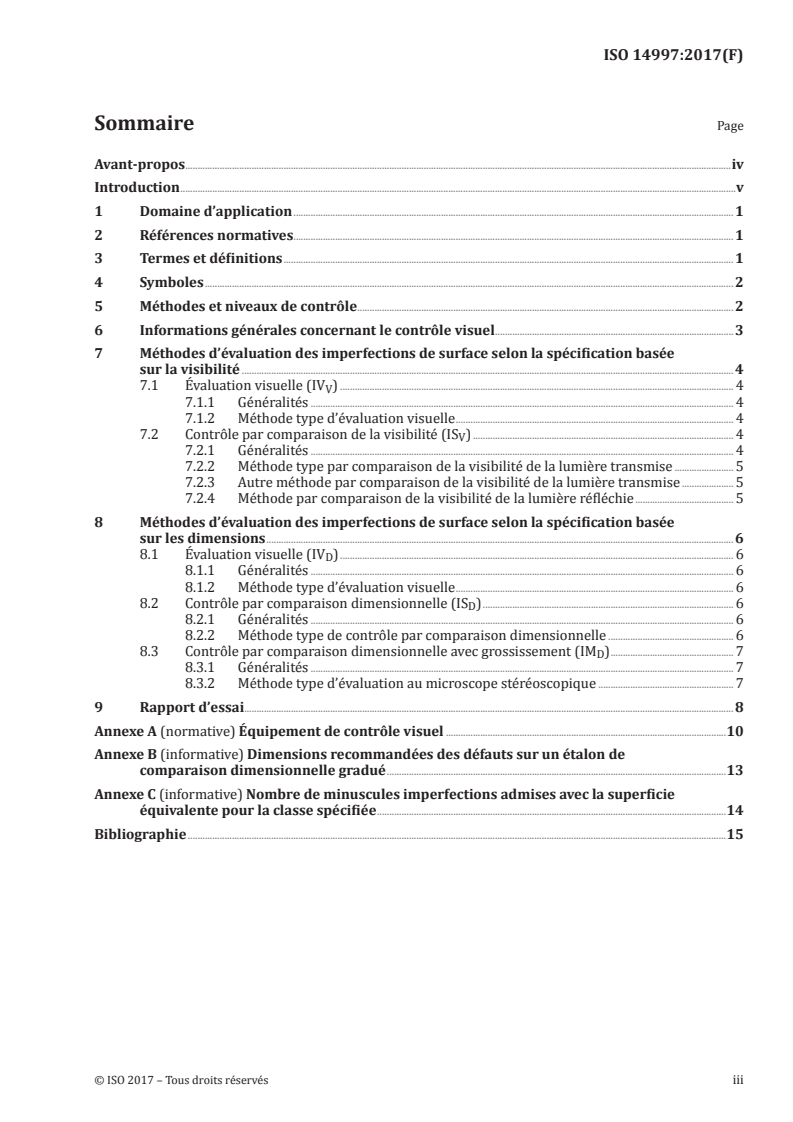
ISO 14997:2017 - Optique et photonique — Méthodes d'essai applicables aux imperfections de surface des éléments optiques/16/2017
Overview
ISO 14997:2017 - Optics and photonics - Test methods for surface imperfections of optical elements - defines standardized, practical methods for evaluating surface imperfections (scratches, digs, impact marks) on optical elements. The standard covers both visibility-based and dimensional-based specifications and describes human inspection procedures, comparison artefacts, and reporting requirements for optical quality control.
Key topics and technical requirements
- Two specification approaches
- Visibility method - assesses how noticeable an imperfection is (brightness/appearance). Two inspection methods:
- Visual evaluation (IV): unaided human inspection without a comparison artefact.
- Visibility comparison inspection (IS): human assessment against a brightness comparison standard (artefact of known brightness).
- Dimensional method - assesses physical size of imperfections. Three inspection methods:
- Visual dimensional evaluation (IV): unaided visual sizing.
- Dimensional comparison inspection (IS): compare against a dimensional comparison standard (artefact of known size).
- Inspection with magnification (IM): magnified measurement (loupe or stereo microscope) using a comparison artefact, reticle, or ruler.
- Visibility method - assesses how noticeable an imperfection is (brightness/appearance). Two inspection methods:
- Inspection arrangements and default levels - The standard maps inspection methods to inspection levels and indicates defaults when drawings do not specify a level.
- Human factors and resolution - Notes angular resolution of the human eye (~1 arcminute) and provides guidance on when magnification is required (magnification and device resolution must correlate with the specified tolerance).
- Scope and limits - Applies to optical components and assemblies (doublets, triplets) and can be used for plastic optics with caution: impact damage on plastics can appear different (material displacement/ripples vs. removal).
- Objective instruments - Digital scatterometry (brightness) and digital microscopy (size) exist but are beyond the scope; manufacturers must demonstrate compatibility with ISO 14997 methods if using objective equipment.
- Supporting annexes - Annex A (visual inspection equipment), Annex B (recommended artefact dimensions), Annex C (rules for accumulating smaller imperfections).
Practical applications and users
ISO 14997:2017 is used by:
- Optical manufacturers and fabricators for incoming/outgoing quality control
- Inspection and metrology laboratories performing visual or magnified assessments
- Optical designers and engineers specifying surface imperfection tolerances on drawings (in conjunction with ISO 10110‑7)
- Procurement and acceptance testing teams for lenses, mirrors, optical assemblies, and plastic optics
- Companies producing comparison artefacts and inspection fixtures
Benefits include consistent pass/fail decisions, reduced disputes between suppliers and customers, and clearer communication of surface quality expectations.
Related standards
- ISO 10110-7 - Preparation of drawings for optical elements - surface imperfection notation (used together with ISO 14997)
- ISO 9211-1, ISO 11145 - Definitions and vocabulary referenced by ISO 14997
Keywords: ISO 14997, surface imperfections, optical elements, test methods, visibility method, dimensional method, visual inspection, dimensional inspection, optical quality control, ISO 10110-7.
Relations
- Effective Date
- 15-Dec-2017
- Revises
ISO 14997:2011 - Optics and photonics — Test methods for surface imperfections of optical elements - Effective Date
- 26-Jan-2013
Buy Documents
ISO 14997:2017 - Optics and photonics -- Test methods for surface imperfections of optical elements
ISO 14997:2017 - Optics and photonics — Test methods for surface imperfections of optical elements/16/2017
ISO 14997:2017 - Optique et photonique -- Méthodes d'essai applicables aux imperfections de surface des éléments optiques
ISO 14997:2017 - Optique et photonique — Méthodes d'essai applicables aux imperfections de surface des éléments optiques/16/2017
Frequently Asked Questions
ISO 14997:2017 is a standard published by the International Organization for Standardization (ISO). Its full title is "Optics and photonics — Test methods for surface imperfections of optical elements". This standard covers: ISO 14997:2017 specifies the physical principles and practical means for the implementation of methods for evaluating surface imperfections. For imperfections specified using the visibility method, two inspection methods are described. The first is visual evaluation of the surface without any comparison standard (IVV). The second is a visibility assessment of a surface imperfection when compared to an artefact of known brightness (ISV). For imperfections specified using the dimensional method, three methods are described. The first is visual evaluation of the surface without any comparison standard (IVD). The second is a dimensional assessment of a surface imperfection when compared to an artefact of known size (ISD). The third is the dimensional measurement of a surface imperfection using magnification and either a comparison artefact of known size or a reticle or ruler (IMD). Instruments exist that allow objective measurement of brightness (digital scatterometry) or size (digital microscopy). While these instruments can be used for evaluation of surface imperfections, they are beyond the scope of this document. ISO 14997:2017 applies to optical surfaces of components or assemblies such as doublets or triplets. ISO 14997:2017 can be applied to optical plastic components; however, attention is drawn to the fact that impact damage to plastic materials often looks very different from that on harder materials as it does not always result in the removal of material but instead can displace material, causing ripples in the surface. Consequently, visual comparisons of scratch and dig damage to plastic with those on glass or crystalline materials can give very different results.
ISO 14997:2017 specifies the physical principles and practical means for the implementation of methods for evaluating surface imperfections. For imperfections specified using the visibility method, two inspection methods are described. The first is visual evaluation of the surface without any comparison standard (IVV). The second is a visibility assessment of a surface imperfection when compared to an artefact of known brightness (ISV). For imperfections specified using the dimensional method, three methods are described. The first is visual evaluation of the surface without any comparison standard (IVD). The second is a dimensional assessment of a surface imperfection when compared to an artefact of known size (ISD). The third is the dimensional measurement of a surface imperfection using magnification and either a comparison artefact of known size or a reticle or ruler (IMD). Instruments exist that allow objective measurement of brightness (digital scatterometry) or size (digital microscopy). While these instruments can be used for evaluation of surface imperfections, they are beyond the scope of this document. ISO 14997:2017 applies to optical surfaces of components or assemblies such as doublets or triplets. ISO 14997:2017 can be applied to optical plastic components; however, attention is drawn to the fact that impact damage to plastic materials often looks very different from that on harder materials as it does not always result in the removal of material but instead can displace material, causing ripples in the surface. Consequently, visual comparisons of scratch and dig damage to plastic with those on glass or crystalline materials can give very different results.
ISO 14997:2017 is classified under the following ICS (International Classification for Standards) categories: 37.020 - Optical equipment. The ICS classification helps identify the subject area and facilitates finding related standards.
ISO 14997:2017 has the following relationships with other standards: It is inter standard links to ISO/TR 14997-2:2022, ISO 14997:2011. Understanding these relationships helps ensure you are using the most current and applicable version of the standard.
ISO 14997:2017 is available in PDF format for immediate download after purchase. The document can be added to your cart and obtained through the secure checkout process. Digital delivery ensures instant access to the complete standard document.
Standards Content (Sample)
INTERNATIONAL ISO
STANDARD 14997
Third edition
2017-08
Optics and photonics — Test methods
for surface imperfections of optical
elements
Optique et photonique — Méthodes d’essai applicables aux
imperfections de surface des éléments optiques
Reference number
©
ISO 2017
© ISO 2017, Published in Switzerland
All rights reserved. Unless otherwise specified, no part of this publication may be reproduced or utilized otherwise in any form
or by any means, electronic or mechanical, including photocopying, or posting on the internet or an intranet, without prior
written permission. Permission can be requested from either ISO at the address below or ISO’s member body in the country of
the requester.
ISO copyright office
Ch. de Blandonnet 8 • CP 401
CH-1214 Vernier, Geneva, Switzerland
Tel. +41 22 749 01 11
Fax +41 22 749 09 47
copyright@iso.org
www.iso.org
ii © ISO 2017 – All rights reserved
Contents Page
Foreword .iv
Introduction .v
1 Scope . 1
2 Normative references . 1
3 Terms and definitions . 1
4 Symbols . 2
5 Inspection methods and levels . 2
6 General information regarding visual inspection . 3
7 Evaluation methods for the visibility based specification of surface imperfections .3
7.1 Visual evaluation (IV ) . 3
V
7.1.1 General. 3
7.1.2 Typical visual evaluation method . 3
7.2 Visibility comparison inspection (IS ) . 4
V
7.2.1 General. 4
7.2.2 Typical transmitted light visibility comparison method . 4
7.2.3 Alternative transmitted light visibility comparison method . 4
7.2.4 Reflective light visibility comparison method . 5
8 Evaluation methods for the dimensional based specification of surface imperfections .5
8.1 Visual evaluation (IV ) . 5
D
8.1.1 General. 5
8.1.2 Typical visual evaluation method . 5
8.2 Dimensional comparison inspection (IS ) . 5
D
8.2.1 General. 5
8.2.2 Typical dimensional comparison inspection method . 6
8.3 Dimensional comparison inspection with magnification (IM ) . 6
D
8.3.1 General. 6
8.3.2 Typical stereo microscope evaluation method . 6
9 Test report . 7
Annex A (normative) Visual inspection equipment. 9
Annex B (informative) Recommended dimensions of artefacts on a dimensional
comparison standard .12
Annex C (informative) Number of allowed smaller imperfections with equivalent area of
the specified grade .13
Bibliography .14
Foreword
ISO (the International Organization for Standardization) is a worldwide federation of national standards
bodies (ISO member bodies). The work of preparing International Standards is normally carried out
through ISO technical committees. Each member body interested in a subject for which a technical
committee has been established has the right to be represented on that committee. International
organizations, governmental and non-governmental, in liaison with ISO, also take part in the work.
ISO collaborates closely with the International Electrotechnical Commission (IEC) on all matters of
electrotechnical standardization.
The procedures used to develop this document and those intended for its further maintenance are
described in the ISO/IEC Directives, Part 1. In particular the different approval criteria needed for the
different types of ISO documents should be noted. This document was drafted in accordance with the
editorial rules of the ISO/IEC Directives, Part 2 (see www .iso .org/ directives).
Attention is drawn to the possibility that some of the elements of this document may be the subject of
patent rights. ISO shall not be held responsible for identifying any or all such patent rights. Details of
any patent rights identified during the development of the document will be in the Introduction and/or
on the ISO list of patent declarations received (see www .iso .org/ patents).
Any trade name used in this document is information given for the convenience of users and does not
constitute an endorsement.
For an explanation on the voluntary nature of standards, the meaning of ISO specific terms and
expressions related to conformity assessment, as well as information about ISO’s adherence to the
World Trade Organization (WTO) principles in the Technical Barriers to Trade (TBT) see the following
URL: w w w . i s o .org/ iso/ foreword .html.
This document was prepared by Technical Committee ISO/TC 172, Optics and photonics, Subcommittee
SC 1, Fundamental standards.
This third edition cancels and replaces the second edition (ISO 14997:2011), which has been technically
revised to adapt ISO 14997 to the new version of ISO 10110-7.
The main change compared to the previous edition is as follows:
— the addition of language required to accommodate visibility inspection.
iv © ISO 2017 – All rights reserved
Introduction
Standard practice in the optics industry since the 1950s has been to visually inspect optical surfaces
for small, localized imperfections and determine if they are acceptable.
This document was developed in response to worldwide demand for the standardization of test
methods for surface imperfections. Surface imperfections, such as digs and scratches, arise from
localized damage during or after manufacture. They can be visible as a result of the light they scatter,
giving rise to a false impression of poor quality. Alternatively, this light can appear as unwanted veiling
glare (stray radiation) in an image plane, or it can lead to degradation in signal quality at an image
sensor. Imperfections can also provide centres of stress, eventually leading to failure of components
exposed to high laser radiation power/energy densities. In most cases, however, surface imperfections
are representative of the quality of workmanship and do not have any impact whatsoever on the
performance of the component in question.
Since modern methods of surface examination are capable of atomic resolution, no surface is likely to be
found totally free of localized imperfections. Most surfaces produced are satisfactory for their intended
purpose, but a small proportion can have suffered obvious damage and will be reworked or regarded
as unacceptable. This can leave some components that, although slightly damaged, can still be found
acceptable, when tested, depending on the level of acceptability of surface imperfections requested by
the customer and specified on drawings in ISO 10110-7. This document describes how these methods
are implemented.
In some cases, it is necessary to measure or estimate the size of the imperfections on an optical surface.
In other cases, however, it is necessary or desirable to assess their brightness or appearance, and not
their size. In these cases, visual inspection is preferred over dimensional measurements.
This document describes the human evaluation of surface imperfections for the dimensional and
visibility methods. New developments open the route to machine vision approaches which are more
objective and exhibit an increased reproducibility, less conflict and an optimized production closer
[10],[11]
to the allowed specification, lowering cost . Some of these machine vision-based approaches
may be able to validate the surface imperfection specifications of ISO 10110-7. It is incumbent upon
the manufacturers and users of objective measurement equipment to demonstrate compatibility with
the methods described herein and to report their results consistent with the notation described in
ISO 10110-7.
It should be noted that other light scattering imperfections, which also need to be measured, can arise
as digs distributed over the surface of an incompletely polished surface, and as bubbles and as striae
within an optical material. The measurement of laser damage thresholds also requires sensitive means
for quantifying the level of radiation scattered by damage in its early stages.
INTERNATIONAL STANDARD ISO 14997:2017(E)
Optics and photonics — Test methods for surface
imperfections of optical elements
1 Scope
This document specifies the physical principles and practical means for the implementation of methods
for evaluating surface imperfections.
For imperfections specified using the visibility method, two inspection methods are described. The first
is visual evaluation of the surface without any comparison standard (IV ). The second is a visibility
V
assessment of a surface imperfection when compared to an artefact of known brightness (IS ).
V
For imperfections specified using the dimensional method, three methods are described. The first is
visual evaluation of the surface without any comparison standard (IV ). The second is a dimensional
D
assessment of a surface imperfection when compared to an artefact of known size (IS ). The third is
D
the dimensional measurement of a surface imperfection using magnification and either a comparison
artefact of known size or a reticle or ruler (IM ).
D
Instruments exist that allow objective measurement of brightness (digital scatterometry) or size
(digital microscopy). While these instruments can be used for evaluation of surface imperfections, they
are beyond the scope of this document.
This document applies to optical surfaces of components or assemblies such as doublets or triplets.
This document can be applied to optical plastic components; however, attention is drawn to the fact
that impact damage to plastic materials often looks very different from that on harder materials as it
does not always result in the removal of material but instead can displace material, causing ripples in
the surface. Consequently, visual comparisons of scratch and dig damage to plastic with those on glass
or crystalline materials can give very different results.
2 Normative references
The following documents are referred to in the text in such a way that some or all of their content
constitutes requirements of this document. For dated references, only the edition cited applies. For
undated references, the latest edition of the referenced document (including any amendments) applies.
ISO 9211-1, Optics and photonics — Optical coatings — Part 1: Definitions
ISO 10110-7, Optics and photonics — Preparation of drawings for optical elements and systems — Part 7:
Surface imperfections
ISO 11145, Optics and photonics — Lasers and laser-related equipment — Vocabulary and symbols
3 Terms and definitions
For the purposes of this document, the terms and definitions given in ISO 10110-7, ISO 9211-1 and
ISO 11145 and the following apply.
ISO and IEC maintain terminological databases for use in standardization at the following addresses:
— IEC Electropedia: available at http:// www .electropedia .org/
— ISO Online browsing platform: available at http:// www .iso .org/ obp
3.1
brightness comparison standard
plate, paddle, or window with one or more artefacts of known brightness grade
3.2
dimensional comparison standard
plate, paddle, or window with one or more patterned artefacts (chrome on glass, ink on film, iron oxide
on glass, etched glass, focused ion beam milling (FIB) on glass substrate, etc.) of a specified size grade
4 Symbols
IV visual inspection of visibility
V
IS subjective comparison inspection of visibility
V
IV visual inspection of dimensions
D
IS subjective comparison inspection of dimensions
D
IM inspection with magnification of dimensions
D
5 Inspection methods and levels
Surface imperfections may be specified and graded using the notations provided in ISO 10110-7 in terms
of visibility or size. Surface imperfections may be evaluated visually with or without magnification, or
objectively using equipment designed for the purpose. Table 1 shows the evaluation arrangements by
inspection level for visibility of surface imperfections. Table 2 shows the evaluation arrangements by
inspection level for dimensional specifications of surface imperfections.
Table 1 — Evaluation methods for the visibility based specification of surface imperfections
Inspection level Evaluation arrangement Comparison standard
Visual evaluation (Level IV ) Any arrangement is allowed per None required
V
7.1
Visibility comparison inspection Any Annex A arrangement per 7.2 Brightness comparison standard
(Level IS ) indicated on the drawing
V
If no inspection level is indicated on the drawing, the default inspection level for visibility based
specifications is IS .
V
Table 2 — Evaluation methods for the dimensional based specification of surface imperfections
Inspection level Evaluation arrangement Comparison standard
Visual evaluation (Level IV ) Any arrangement is allowed per None required
D
8.1
Dimensional comparison inspection Figure A.3 arrangement per 8.2 Dimensional comparison standard
(Level IS ) per Annex B
D
Dimensional comparison inspection Loupe or stereo microscope per Dimensional comparison standard
with magnification (Level IM ) 8.3 per Annex B
D
The number of allowed smaller imperfections with equivalent area of the specified grade can be found
in Annex C.
[9]
The angular resolution of the human eye is about 1 arcminute ; therefore, an unstressed human
inspector can reasonably estimate the size of imperfections larger than 0,1 grade under the arrangement
described in Annex A. Assuming long imperfections can be resolved to approximately one-fourth of this
value, a scratch of width 0,025 mm can be estimated under the same conditions. Since in accordance
2 © ISO 2017 – All rights reserved
with ISO 10110-7, imperfections shall be accumulated down to 0,16× the specification (or 0,25× for
long imperfection), the default inspection method for specifications of 5/1 × 0,63; C1 × 0,63; L1 × 0,1 or
larger shall be IS . For smaller specifications, the default inspection level is IM .
D D
When using the IM method, the magnification and device resolution shall correlate with the required
D
specification.
EXAMPLE 1 For testing 5/1 × 0,04, the smallest imperfection size to test is 0,006 3 mm and therefore the
magnification should be >16×.
Fractioned imperfections with gaps smaller than the resolution required for the measurement shall be
treated as a single imperfection. Imperfections with gaps larger than the resolution required for the
measurement shall be treated as separate imperfections.
EXAMPLE 2 For testing 5/1 × 0,04, the smallest imperfection size to test is 0,006 3 mm. Imperfections with
gaps larger than this shall be treated as separate imperfections.
If two or more optical elements are to be cemented (or optically contacted), the surface imperfection
tolerances and inspection levels given for the individual elements apply also for the surfaces of the
optical subassembly, i.e. after cementing (or optically contacting), unless otherwise specified.
6 General information regarding visual inspection
Optical components shall first be cleaned and inspected, preferably in low angle scattered light by
strong side-illumination under dark field conditions. Most optical components will be either obviously
acceptable or obviously unacceptable. For these components, no further evaluation is necessary.
There is usually a small proportion of doubtful components with imperfections that require careful
evaluation.
7 Evaluation methods for the visibility based specification of surface
imperfections
7.1 Visual evaluation (IV )
V
7.1.1 General
The inspector shall assess the brightness grade of the imperfection. If necessary, the inspector shall
refer to the brightness comparison standard referenced on the drawing.
The length of scratches, when required, and the extent of edge chips from the physical edge of the
surface should be estimated visually.
7.1.2 Typical visual evaluation method
7.1.2.1 Viewing stat
...
INTERNATIONAL ISO
STANDARD 14997
Third edition
2017-08
Optics and photonics — Test methods
for surface imperfections of optical
elements
Optique et photonique — Méthodes d’essai applicables aux
imperfections de surface des éléments optiques
Reference number
©
ISO 2017
© ISO 2017, Published in Switzerland
All rights reserved. Unless otherwise specified, no part of this publication may be reproduced or utilized otherwise in any form
or by any means, electronic or mechanical, including photocopying, or posting on the internet or an intranet, without prior
written permission. Permission can be requested from either ISO at the address below or ISO’s member body in the country of
the requester.
ISO copyright office
Ch. de Blandonnet 8 • CP 401
CH-1214 Vernier, Geneva, Switzerland
Tel. +41 22 749 01 11
Fax +41 22 749 09 47
copyright@iso.org
www.iso.org
ii © ISO 2017 – All rights reserved
Contents Page
Foreword .iv
Introduction .v
1 Scope . 1
2 Normative references . 1
3 Terms and definitions . 1
4 Symbols . 2
5 Inspection methods and levels . 2
6 General information regarding visual inspection . 3
7 Evaluation methods for the visibility based specification of surface imperfections .3
7.1 Visual evaluation (IV ) . 3
V
7.1.1 General. 3
7.1.2 Typical visual evaluation method . 3
7.2 Visibility comparison inspection (IS ) . 4
V
7.2.1 General. 4
7.2.2 Typical transmitted light visibility comparison method . 4
7.2.3 Alternative transmitted light visibility comparison method . 4
7.2.4 Reflective light visibility comparison method . 5
8 Evaluation methods for the dimensional based specification of surface imperfections .5
8.1 Visual evaluation (IV ) . 5
D
8.1.1 General. 5
8.1.2 Typical visual evaluation method . 5
8.2 Dimensional comparison inspection (IS ) . 5
D
8.2.1 General. 5
8.2.2 Typical dimensional comparison inspection method . 6
8.3 Dimensional comparison inspection with magnification (IM ) . 6
D
8.3.1 General. 6
8.3.2 Typical stereo microscope evaluation method . 6
9 Test report . 7
Annex A (normative) Visual inspection equipment. 9
Annex B (informative) Recommended dimensions of artefacts on a dimensional
comparison standard .12
Annex C (informative) Number of allowed smaller imperfections with equivalent area of
the specified grade .13
Bibliography .14
Foreword
ISO (the International Organization for Standardization) is a worldwide federation of national standards
bodies (ISO member bodies). The work of preparing International Standards is normally carried out
through ISO technical committees. Each member body interested in a subject for which a technical
committee has been established has the right to be represented on that committee. International
organizations, governmental and non-governmental, in liaison with ISO, also take part in the work.
ISO collaborates closely with the International Electrotechnical Commission (IEC) on all matters of
electrotechnical standardization.
The procedures used to develop this document and those intended for its further maintenance are
described in the ISO/IEC Directives, Part 1. In particular the different approval criteria needed for the
different types of ISO documents should be noted. This document was drafted in accordance with the
editorial rules of the ISO/IEC Directives, Part 2 (see www .iso .org/ directives).
Attention is drawn to the possibility that some of the elements of this document may be the subject of
patent rights. ISO shall not be held responsible for identifying any or all such patent rights. Details of
any patent rights identified during the development of the document will be in the Introduction and/or
on the ISO list of patent declarations received (see www .iso .org/ patents).
Any trade name used in this document is information given for the convenience of users and does not
constitute an endorsement.
For an explanation on the voluntary nature of standards, the meaning of ISO specific terms and
expressions related to conformity assessment, as well as information about ISO’s adherence to the
World Trade Organization (WTO) principles in the Technical Barriers to Trade (TBT) see the following
URL: w w w . i s o .org/ iso/ foreword .html.
This document was prepared by Technical Committee ISO/TC 172, Optics and photonics, Subcommittee
SC 1, Fundamental standards.
This third edition cancels and replaces the second edition (ISO 14997:2011), which has been technically
revised to adapt ISO 14997 to the new version of ISO 10110-7.
The main change compared to the previous edition is as follows:
— the addition of language required to accommodate visibility inspection.
iv © ISO 2017 – All rights reserved
Introduction
Standard practice in the optics industry since the 1950s has been to visually inspect optical surfaces
for small, localized imperfections and determine if they are acceptable.
This document was developed in response to worldwide demand for the standardization of test
methods for surface imperfections. Surface imperfections, such as digs and scratches, arise from
localized damage during or after manufacture. They can be visible as a result of the light they scatter,
giving rise to a false impression of poor quality. Alternatively, this light can appear as unwanted veiling
glare (stray radiation) in an image plane, or it can lead to degradation in signal quality at an image
sensor. Imperfections can also provide centres of stress, eventually leading to failure of components
exposed to high laser radiation power/energy densities. In most cases, however, surface imperfections
are representative of the quality of workmanship and do not have any impact whatsoever on the
performance of the component in question.
Since modern methods of surface examination are capable of atomic resolution, no surface is likely to be
found totally free of localized imperfections. Most surfaces produced are satisfactory for their intended
purpose, but a small proportion can have suffered obvious damage and will be reworked or regarded
as unacceptable. This can leave some components that, although slightly damaged, can still be found
acceptable, when tested, depending on the level of acceptability of surface imperfections requested by
the customer and specified on drawings in ISO 10110-7. This document describes how these methods
are implemented.
In some cases, it is necessary to measure or estimate the size of the imperfections on an optical surface.
In other cases, however, it is necessary or desirable to assess their brightness or appearance, and not
their size. In these cases, visual inspection is preferred over dimensional measurements.
This document describes the human evaluation of surface imperfections for the dimensional and
visibility methods. New developments open the route to machine vision approaches which are more
objective and exhibit an increased reproducibility, less conflict and an optimized production closer
[10],[11]
to the allowed specification, lowering cost . Some of these machine vision-based approaches
may be able to validate the surface imperfection specifications of ISO 10110-7. It is incumbent upon
the manufacturers and users of objective measurement equipment to demonstrate compatibility with
the methods described herein and to report their results consistent with the notation described in
ISO 10110-7.
It should be noted that other light scattering imperfections, which also need to be measured, can arise
as digs distributed over the surface of an incompletely polished surface, and as bubbles and as striae
within an optical material. The measurement of laser damage thresholds also requires sensitive means
for quantifying the level of radiation scattered by damage in its early stages.
INTERNATIONAL STANDARD ISO 14997:2017(E)
Optics and photonics — Test methods for surface
imperfections of optical elements
1 Scope
This document specifies the physical principles and practical means for the implementation of methods
for evaluating surface imperfections.
For imperfections specified using the visibility method, two inspection methods are described. The first
is visual evaluation of the surface without any comparison standard (IV ). The second is a visibility
V
assessment of a surface imperfection when compared to an artefact of known brightness (IS ).
V
For imperfections specified using the dimensional method, three methods are described. The first is
visual evaluation of the surface without any comparison standard (IV ). The second is a dimensional
D
assessment of a surface imperfection when compared to an artefact of known size (IS ). The third is
D
the dimensional measurement of a surface imperfection using magnification and either a comparison
artefact of known size or a reticle or ruler (IM ).
D
Instruments exist that allow objective measurement of brightness (digital scatterometry) or size
(digital microscopy). While these instruments can be used for evaluation of surface imperfections, they
are beyond the scope of this document.
This document applies to optical surfaces of components or assemblies such as doublets or triplets.
This document can be applied to optical plastic components; however, attention is drawn to the fact
that impact damage to plastic materials often looks very different from that on harder materials as it
does not always result in the removal of material but instead can displace material, causing ripples in
the surface. Consequently, visual comparisons of scratch and dig damage to plastic with those on glass
or crystalline materials can give very different results.
2 Normative references
The following documents are referred to in the text in such a way that some or all of their content
constitutes requirements of this document. For dated references, only the edition cited applies. For
undated references, the latest edition of the referenced document (including any amendments) applies.
ISO 9211-1, Optics and photonics — Optical coatings — Part 1: Definitions
ISO 10110-7, Optics and photonics — Preparation of drawings for optical elements and systems — Part 7:
Surface imperfections
ISO 11145, Optics and photonics — Lasers and laser-related equipment — Vocabulary and symbols
3 Terms and definitions
For the purposes of this document, the terms and definitions given in ISO 10110-7, ISO 9211-1 and
ISO 11145 and the following apply.
ISO and IEC maintain terminological databases for use in standardization at the following addresses:
— IEC Electropedia: available at http:// www .electropedia .org/
— ISO Online browsing platform: available at http:// www .iso .org/ obp
3.1
brightness comparison standard
plate, paddle, or window with one or more artefacts of known brightness grade
3.2
dimensional comparison standard
plate, paddle, or window with one or more patterned artefacts (chrome on glass, ink on film, iron oxide
on glass, etched glass, focused ion beam milling (FIB) on glass substrate, etc.) of a specified size grade
4 Symbols
IV visual inspection of visibility
V
IS subjective comparison inspection of visibility
V
IV visual inspection of dimensions
D
IS subjective comparison inspection of dimensions
D
IM inspection with magnification of dimensions
D
5 Inspection methods and levels
Surface imperfections may be specified and graded using the notations provided in ISO 10110-7 in terms
of visibility or size. Surface imperfections may be evaluated visually with or without magnification, or
objectively using equipment designed for the purpose. Table 1 shows the evaluation arrangements by
inspection level for visibility of surface imperfections. Table 2 shows the evaluation arrangements by
inspection level for dimensional specifications of surface imperfections.
Table 1 — Evaluation methods for the visibility based specification of surface imperfections
Inspection level Evaluation arrangement Comparison standard
Visual evaluation (Level IV ) Any arrangement is allowed per None required
V
7.1
Visibility comparison inspection Any Annex A arrangement per 7.2 Brightness comparison standard
(Level IS ) indicated on the drawing
V
If no inspection level is indicated on the drawing, the default inspection level for visibility based
specifications is IS .
V
Table 2 — Evaluation methods for the dimensional based specification of surface imperfections
Inspection level Evaluation arrangement Comparison standard
Visual evaluation (Level IV ) Any arrangement is allowed per None required
D
8.1
Dimensional comparison inspection Figure A.3 arrangement per 8.2 Dimensional comparison standard
(Level IS ) per Annex B
D
Dimensional comparison inspection Loupe or stereo microscope per Dimensional comparison standard
with magnification (Level IM ) 8.3 per Annex B
D
The number of allowed smaller imperfections with equivalent area of the specified grade can be found
in Annex C.
[9]
The angular resolution of the human eye is about 1 arcminute ; therefore, an unstressed human
inspector can reasonably estimate the size of imperfections larger than 0,1 grade under the arrangement
described in Annex A. Assuming long imperfections can be resolved to approximately one-fourth of this
value, a scratch of width 0,025 mm can be estimated under the same conditions. Since in accordance
2 © ISO 2017 – All rights reserved
with ISO 10110-7, imperfections shall be accumulated down to 0,16× the specification (or 0,25× for
long imperfection), the default inspection method for specifications of 5/1 × 0,63; C1 × 0,63; L1 × 0,1 or
larger shall be IS . For smaller specifications, the default inspection level is IM .
D D
When using the IM method, the magnification and device resolution shall correlate with the required
D
specification.
EXAMPLE 1 For testing 5/1 × 0,04, the smallest imperfection size to test is 0,006 3 mm and therefore the
magnification should be >16×.
Fractioned imperfections with gaps smaller than the resolution required for the measurement shall be
treated as a single imperfection. Imperfections with gaps larger than the resolution required for the
measurement shall be treated as separate imperfections.
EXAMPLE 2 For testing 5/1 × 0,04, the smallest imperfection size to test is 0,006 3 mm. Imperfections with
gaps larger than this shall be treated as separate imperfections.
If two or more optical elements are to be cemented (or optically contacted), the surface imperfection
tolerances and inspection levels given for the individual elements apply also for the surfaces of the
optical subassembly, i.e. after cementing (or optically contacting), unless otherwise specified.
6 General information regarding visual inspection
Optical components shall first be cleaned and inspected, preferably in low angle scattered light by
strong side-illumination under dark field conditions. Most optical components will be either obviously
acceptable or obviously unacceptable. For these components, no further evaluation is necessary.
There is usually a small proportion of doubtful components with imperfections that require careful
evaluation.
7 Evaluation methods for the visibility based specification of surface
imperfections
7.1 Visual evaluation (IV )
V
7.1.1 General
The inspector shall assess the brightness grade of the imperfection. If necessary, the inspector shall
refer to the brightness comparison standard referenced on the drawing.
The length of scratches, when required, and the extent of edge chips from the physical edge of the
surface should be estimated visually.
7.1.2 Typical visual evaluation method
7.1.2.1 Viewing stat
...
NORME ISO
INTERNATIONALE 14997
Troisième édition
2017-08
Optique et photonique — Méthodes
d’essai applicables aux imperfections
de surface des éléments optiques
Optics and photonics — Test methods for surface imperfections of
optical elements
Numéro de référence
©
ISO 2017
DOCUMENT PROTÉGÉ PAR COPYRIGHT
© ISO 2017, Publié en Suisse
Droits de reproduction réservés. Sauf indication contraire, aucune partie de cette publication ne peut être reproduite ni utilisée
sous quelque forme que ce soit et par aucun procédé, électronique ou mécanique, y compris la photocopie, l’affichage sur
l’internet ou sur un Intranet, sans autorisation écrite préalable. Les demandes d’autorisation peuvent être adressées à l’ISO à
l’adresse ci-après ou au comité membre de l’ISO dans le pays du demandeur.
ISO copyright office
Ch. de Blandonnet 8 • CP 401
CH-1214 Vernier, Geneva, Switzerland
Tel. +41 22 749 01 11
Fax +41 22 749 09 47
copyright@iso.org
www.iso.org
ii © ISO 2017 – Tous droits réservés
Sommaire Page
Avant-propos .iv
Introduction .v
1 Domaine d’application . 1
2 Références normatives . 1
3 Termes et définitions . 1
4 Symboles . 2
5 Méthodes et niveaux de contrôle . 2
6 Informations générales concernant le contrôle visuel . 3
7 Méthodes d’évaluation des imperfections de surface selon la spécification basée
sur la visibilité . 4
7.1 Évaluation visuelle (IV ) . 4
V
7.1.1 Généralités . 4
7.1.2 Méthode type d’évaluation visuelle . 4
7.2 Contrôle par comparaison de la visibilité (IS ) . 4
V
7.2.1 Généralités . 4
7.2.2 Méthode type par comparaison de la visibilité de la lumière transmise . 5
7.2.3 Autre méthode par comparaison de la visibilité de la lumière transmise . 5
7.2.4 Méthode par comparaison de la visibilité de la lumière réfléchie . 5
8 Méthodes d’évaluation des imperfections de surface selon la spécification basée
sur les dimensions . 6
8.1 Évaluation visuelle (IV ) . 6
D
8.1.1 Généralités . 6
8.1.2 Méthode type d’évaluation visuelle . 6
8.2 Contrôle par comparaison dimensionnelle (IS ) . 6
D
8.2.1 Généralités . 6
8.2.2 Méthode type de contrôle par comparaison dimensionnelle . 6
8.3 Contrôle par comparaison dimensionnelle avec grossissement (IM ) . 7
D
8.3.1 Généralités . 7
8.3.2 Méthode type d’évaluation au microscope stéréoscopique . 7
9 Rapport d’essai . 8
Annexe A (normative) Équipement de contrôle visuel .10
Annexe B (informative) Dimensions recommandées des défauts sur un étalon de
comparaison dimensionnelle gradué .13
Annexe C (informative) Nombre de minuscules imperfections admises avec la superficie
équivalente pour la classe spécifiée .14
Bibliographie .15
Avant-propos
L’ISO (Organisation internationale de normalisation) est une fédération mondiale d’organismes
nationaux de normalisation (comités membres de l’ISO). L’élaboration des Normes internationales est
en général confiée aux comités techniques de l’ISO. Chaque comité membre intéressé par une étude
a le droit de faire partie du comité technique créé à cet effet. Les organisations internationales,
gouvernementales et non gouvernementales, en liaison avec l’ISO participent également aux travaux.
L’ISO collabore étroitement avec la Commission électrotechnique internationale (IEC) en ce qui
concerne la normalisation électrotechnique.
Les procédures utilisées pour élaborer le présent document et celles destinées à sa mise à jour sont
décrites dans les Directives ISO/IEC, Partie 1. Il convient, en particulier de prendre note des différents
critères d’approbation requis pour les différents types de documents ISO. Le présent document a été
rédigé conformément aux règles de rédaction données dans les Directives ISO/IEC, Partie 2 (voir www
.iso .org/ directives).
L’attention est appelée sur le fait que certains des éléments du présent document peuvent faire l’objet de
droits de propriété intellectuelle ou de droits analogues. L’ISO ne saurait être tenue pour responsable
de ne pas avoir identifié de tels droits de propriété et averti de leur existence. Les détails concernant
les références aux droits de propriété intellectuelle ou autres droits analogues identifiés lors de
l’élaboration du document sont indiqués dans l’Introduction et/ou dans la liste des déclarations de
brevets reçues par l’ISO (voir www .iso .org/ brevets).
Les appellations commerciales éventuellement mentionnées dans le présent document sont données
pour information, par souci de commodité, à l’intention des utilisateurs et ne sauraient constituer un
engagement.
Pour une explication de la nature volontaire des normes, la signification des termes et expressions
spécifiques de l’ISO liés à l’évaluation de la conformité, ou pour toute information au sujet de l’adhésion
de l’ISO aux principes de l’Organisation mondiale du commerce (OMC) concernant les obstacles
techniques au commerce (OTC), voir le lien suivant: w w w . i s o .org/ iso/ fr/ avant -propos .html
Le présent document a été élaboré par le comité technique ISO/TC 172, Optique et photonique, Sous-
comité SC 1, Normes fondamentales.
Cette troisième édition annule et remplace la deuxième édition (ISO 14997:2011), qui a fait l’objet d’une
révision technique pour adapter l’ISO 14997 à la nouvelle version de l’ISO 10110-7.
Le principal changement par rapport à l’édition précédente est le suivant:
— l’ajout du vocabulaire à utiliser pour désigner le contrôle de visibilité.
iv © ISO 2017 – Tous droits réservés
Introduction
Dans l’industrie optique, la pratique courante depuis les années 50 consiste à contrôler visuellement
les surfaces optiques à la recherche de petites imperfections localisées et à déterminer si elles sont
acceptables.
Le présent document a été élaboré en réponse à la demande mondiale de normalisation des méthodes
d’essai concernant les imperfections de surface. Les imperfections de surface, telles que les creux
et les rayures, sont dues à un dommage localisé pendant ou après la fabrication. Elles peuvent se
voir en raison de la dispersion de la lumière qu’elles causent, et cela donne une fausse impression de
mauvaise qualité. Elles peuvent également provoquer un rayonnement parasite dans le plan image ou
engendrer une dégradation de la qualité du signal au niveau d’un capteur d’images. Les imperfections
peuvent également engendrer des centres de contrainte susceptibles de conduire à une défaillance
des composants exposés à des densités intenses de puissance/énergie de rayonnement laser. Dans la
plupart des cas, toutefois, les imperfections de surface sont représentatives de la qualité de la main-
d’œuvre et n’ont aucun impact, quel qu’il soit, sur la performance du composant concerné.
Puisque les méthodes modernes d’examen des surfaces ont un pouvoir de résolution du niveau de
l’atome, il n’est plus possible de trouver de surface absolument exempte d’imperfections localisées. La
plupart des surfaces produites sont satisfaisantes pour leur usage prévu, mais une petite partie d’entre
elles peut avoir subi des dommages évidents et peut être retraitée ou considérée comme inacceptable.
Il n’en reste pas moins que certains composants, bien que légèrement endommagés, peuvent, lorsqu’ils
sont soumis à essai, demeurer acceptables en fonction du niveau d’acceptabilité des imperfections
de surface demandé par le client et spécifié sur les dessins conformément à l’ISO 10110-7. Le présent
document décrit la mise en œuvre de ces méthodes.
Dans certains cas, il est nécessaire de mesurer ou d’estimer la taille des imperfections sur une surface
optique. Dans d’autres cas, toutefois, il est nécessaire ou souhaitable d’évaluer leur luminosité ou leur
aspect, et non leur taille. Dans de tels cas, le contrôle visuel est préféré aux mesurages dimensionnels.
Le présent document décrit l’évaluation humaine des imperfections de surface pour les méthodes
dimensionnelles et de visibilité. De nouveaux développements ouvrent la voie à des approches de
vision mécanique plus objectives et présentant une reproductibilité accrue, moins de conflits et une
[10][11]
production optimisée plus proche des spécifications permises, abaissant les coûts . Certaines
de ces approches basées sur la vision machine peuvent être en mesure de valider les spécifications
d’imperfection superficielle de l’ISO 10110-7. Il incombe aux fabricants et aux utilisateurs d’appareils
de mesure objectifs de démontrer leur compatibilité avec les méthodes décrites ici et de communiquer
leurs résultats conformément à la notation décrite dans l’ISO 10110-7.
Il convient de noter que d’autres imperfections de diffusion de la lumière, qu’il est également nécessaire
de mesurer, peuvent provenir de creux répartis sur une surface incomplètement polie, de bulles et de
stries à l’intérieur d’un matériau optique. Le mesurage des seuils d’endommagement par laser nécessite
également l’utilisation de dispositifs sensibles pour quantifier le niveau de rayonnement diffracté par le
dommage dès son origine.
NORME INTERNATIONALE ISO 14997:2017(F)
Optique et photonique — Méthodes d’essai applicables aux
imperfections de surface des éléments optiques
1 Domaine d’application
Le présent document spécifie les principes physiques et les moyens pratiques de mise en œuvre des
méthodes d’évaluation des imperfections de surface.
Pour les imperfections spécifiées au moyen de la méthode de visibilité, deux méthodes de contrôle sont
décrites. La première est une évaluation visuelle de la surface sans aucun étalon de comparaison (IV ).
V
La seconde est une évaluation de la visibilité d’une imperfection de surface comparée à un défaut dont
la luminosité est connue (IS ).
V
Pour les imperfections spécifiées au moyen de la méthode dimensionnelle, trois méthodes sont décrites.
La première est une évaluation visuelle de la surface sans aucun étalon de comparaison (IV ). La
D
deuxième est une évaluation dimensionnelle d’une imperfection de surface comparée à un défaut dont
la taille est connue (IS ). La troisième est le mesurage dimensionnel d’une imperfection de surface avec
D
un grossissement et en utilisant soit un défaut de comparaison dont la taille est connue, soit un réticule
ou une règle (IM ).
D
Il existe des instruments qui permettent un mesurage objectif de la luminosité (diffusiométrie
numérique) ou de la taille (microscopie numérique). Bien que ces instruments puissent être utilisés pour
l’évaluation des imperfections de surface, ils sont hors du domaine d’application du présent document.
Le présent document s’applique aux surfaces optiques des composants ou ensembles, tels que les
doublets ou les triplets.
Le présent document peut être appliquée à des composants en plastique optiques, toutefois l’attention
est attirée sur le fait que l’endommagement des matières plastiques par des chocs est souvent très
différent de celui observé sur des matériaux plus durs, car il ne conduit pas toujours à un retrait de
matière mais plutôt à un déplacement de matière causant des ondulations à la surface. Par conséquent,
les comparaisons visuelles de rayures et de creux sur des plastiques et sur du verre ou des matériaux
cristallins peuvent donner des résultats très différents.
2 Références normatives
Les documents suivants cités dans le texte constituent, pour tout ou partie de leur contenu, des
exigences du présent document. Pour les références datées, seule l’édition citée s’applique. Pour les
références non datées, la dernière édition du document de référence s’applique (y compris les éventuels
amendements).
ISO 9211-1, Optique et photonique — Traitements optiques — Partie 1: Définitions
ISO 10110-7, Optique et photonique — Indications sur les dessins pour éléments et systèmes optiques —
Partie 7: Tolérances d’imperfection de surface
ISO 11145, Optique et photonique — Lasers et équipements associés aux lasers — Vocabulaire et symboles
3 Termes et définitions
Pour les besoins du présent document, les termes et définitions donnés dans l’ISO 10110-7, l’ISO 9211-1
et l’ISO 11145 ainsi que les suivants, s’appliquent.
L’ISO et l’IEC maintiennent des bases de données terminologiques pour utilisation dans le domaine de la
normalisation aux adresses suivantes:
— IEC Electropedia: disponible à http:// www .electropedia .org/
— ISO Online browsing platform: disponible à http:// www .iso .org/ obp
3.1
étalon de comparaison de luminosité
plateau, palette ou fenêtre avec un ou plusieurs défauts ayant une classe de luminosité connue
3.2
étalon de comparaison dimensionnelle
plateau, palette ou fenêtre avec un ou plusieurs défauts imprimés (chrome sur verre, encre sur film,
oxyde de fer sur verre, verre gravé, sonde ionique focalisée (FIB) sur un substrat en verre, etc.) ayant
une classe de taille spécifiée
4 Symboles
IV inspection visuelle de visibilité
V
IS inspection de comparaison subjective des dimensions
V
IV inspection visuelle des dimensions
D
IS inspection de comparaison subjective des dimensions
D
IM inspection avec agrandissement des dimensions
D
5 Méthodes et niveaux de contrôle
Les imperfections de surface peuvent être spécifiées et classées en utilisant les notations fournies dans
l’ISO 10110-7 en fonction de leur visibilité ou de leur taille. Les imperfections de surface peuvent être
évaluées visuellement avec ou sans grossissement, ou objectivement avec un équipement conçu à cet
effet. Le Tableau 1 illustre les configurations d’évaluation par niveau de contrôle de la visibilité des
imperfections de surface. Le Tableau 2 illustre les configurations d’évaluation par niveau de contrôle
des spécifications dimensionnelles des imperfections de surface.
Tableau 1 — Configurations d’évaluation des imperfections de surface selon la spécification
basée sur la visibilité
Niveau de contrôle Configuration d’évaluation Étalon de comparaison
Toute configuration admise
Évaluation visuelle (Niveau IV ) Pas nécessaire
V
selon 7.1
Contrôle par comparaison de la visibi- Toute configuration de l’Annexe A Étalon de comparaison de lumino-
lité (Niveau IS ) selon 7.2 sité indiqué sur le dessin
V
Si aucun niveau de contrôle n’est indiqué sur le dessin, le niveau de contrôle par défaut pour les
spécifications basées sur la visibilité est IS .
y
2 © ISO 2017 – Tous droits réservés
Tableau 2 — Configurations d’évaluation des imperfections de surface selon la spécification
basée sur les dimensions
Niveau de contrôle Configuration d’évaluation Étalon de comparaison
Évaluation visuelle (Niveau IV ) Toute configuration admise Pas nécessaire
D
selon 8.1
Contrôle par comparaison dimension- Configuration de la Figure A.3 Étalon de comparaison dimension-
nelle (Niveau IS ) selon 8.2 nelle selon l’Annexe B
D
Contrôle par comparaison dimension- Loupe ou microscope stéréosco- Étalon de comparaison dimension-
nelle avec grossissement (Niveau IM ) pique selon 8.3 nelle selon l’Annexe B
D
Le nombre de minuscules imperfections admises avec la superficie équivalente pour la classe spécifiée
est donnée en Annexe C.
[9]
La résolution angulaire de l’œil humain est d’environ 1 arcminute , par conséquent un inspecteur
humain non stressé peut raisonnablement estimer la taille des imperfections de classe supérieure à
0,1 avec la configuration décrite à l’Annexe A. En supposant que les imperfections longues peuvent
être résolues à environ un quart de cette valeur, une rayure de largeur de 0,025 mm peut être estimée
dans les mêmes conditions. Étant donné que conformément à l’ISO 10110-7, les imperfections doivent
être accumulées jusqu’à 0,16× la spécification (ou 0,25× pour une imperfection longue), la méthode
d’inspection par défaut pour les spécifications de 5/1 × 0,63; C1 × 0,63; L1 × 0,1 ou plus doit être IS .
D
Pour des spécifications plus petites, le niveau d’inspection par défaut est IM .
D
Lors de l’utilisation de la méthode IM , le grossissement et la résolution de l’appareil doivent
D
correspondre aux spécifications requises.
EXEMPLE 1 Pour tester 5/1 × 0,04 la plus petite taille d’imperfection à tester est 0,006 3 mm et donc le
grossissement doit être > 16× .
Les imperfections fractionnées avec des intervalles inférieurs à la résolution requise pour la mesure
doivent être traitées comme une seule imperfection. Les imperfections dont les intervalles sont
supérieurs à la résolution requise pour la mesure doivent être traitées comme des imperfections
distinctes.
EXEMPLE 2 Pour tester 5/1 × 0,04, la plus petite taille d’imperfection à tester est de 0,006 3 mm. Les
imperfections avec des intervalles supérieurs à cette valeur doivent être traitées comme des imperfections
distinctes.
Si deux éléments optiques ou plus doivent être collés (ou liés par adhérence moléculaire), les tolérances
d’imperfections de surface et les niveaux de contrôle donnés pour les éléments individuels s’appliquent
également, sauf indication contraire, aux surfaces du sous-ensemble optique, c’est-à-dire après collage
(ou adhérence moléculaire).
6 Informations générales concernant le contrôle visuel
Les composants optiques doivent tout d’abord être nettoyés et contrôlés, de préférence sous un angle
faible de lumière diffractée par un éclairement latéral puissant, et dans des conditions de fond noir.
La plupart des composants optiques seront soit manifestement acceptables, soit manifestement
inacceptables. Pour ces composants, aucune évaluation supplémentaire n’est nécessaire. Il existe
généralement une faible proportion de composants incertains, qui présentent des imperfections
nécessitant une évaluation minutieuse.
7 Méthodes d’évaluation des imperfections de surface selon la spécification
basée sur la visibilité
7.1 Évaluation visuelle (IV )
V
7.1.1 Généralités
Le contrôleur doit évaluer la classe de luminosité de l’imperfection. Si nécessaire, le contrôleur doit se
référer à l’étalon de comparaison de luminosité référencé sur le dessin.
Il convient d’évaluer visuellement la longueur des rayures, si elle est requise, et l’étendue des égrenures
depuis le bord physique de la surface.
7.1.2 Méthode type d’évaluation visuelle
7.1.2.1 Position d’observation
Cette méthode de contrôle est généralement réalisée avec une source lumineuse à fibres optiques en col
de cygne de haute intensité, dans une zone sombre, sur un fond noir mat. Aucune position d’observ
...
NORME ISO
INTERNATIONALE 14997
Troisième édition
2017-08
Optique et photonique — Méthodes
d’essai applicables aux imperfections
de surface des éléments optiques
Optics and photonics — Test methods for surface imperfections of
optical elements
Numéro de référence
©
ISO 2017
DOCUMENT PROTÉGÉ PAR COPYRIGHT
© ISO 2017, Publié en Suisse
Droits de reproduction réservés. Sauf indication contraire, aucune partie de cette publication ne peut être reproduite ni utilisée
sous quelque forme que ce soit et par aucun procédé, électronique ou mécanique, y compris la photocopie, l’affichage sur
l’internet ou sur un Intranet, sans autorisation écrite préalable. Les demandes d’autorisation peuvent être adressées à l’ISO à
l’adresse ci-après ou au comité membre de l’ISO dans le pays du demandeur.
ISO copyright office
Ch. de Blandonnet 8 • CP 401
CH-1214 Vernier, Geneva, Switzerland
Tel. +41 22 749 01 11
Fax +41 22 749 09 47
copyright@iso.org
www.iso.org
ii © ISO 2017 – Tous droits réservés
Sommaire Page
Avant-propos .iv
Introduction .v
1 Domaine d’application . 1
2 Références normatives . 1
3 Termes et définitions . 1
4 Symboles . 2
5 Méthodes et niveaux de contrôle . 2
6 Informations générales concernant le contrôle visuel . 3
7 Méthodes d’évaluation des imperfections de surface selon la spécification basée
sur la visibilité . 4
7.1 Évaluation visuelle (IV ) . 4
V
7.1.1 Généralités . 4
7.1.2 Méthode type d’évaluation visuelle . 4
7.2 Contrôle par comparaison de la visibilité (IS ) . 4
V
7.2.1 Généralités . 4
7.2.2 Méthode type par comparaison de la visibilité de la lumière transmise . 5
7.2.3 Autre méthode par comparaison de la visibilité de la lumière transmise . 5
7.2.4 Méthode par comparaison de la visibilité de la lumière réfléchie . 5
8 Méthodes d’évaluation des imperfections de surface selon la spécification basée
sur les dimensions . 6
8.1 Évaluation visuelle (IV ) . 6
D
8.1.1 Généralités . 6
8.1.2 Méthode type d’évaluation visuelle . 6
8.2 Contrôle par comparaison dimensionnelle (IS ) . 6
D
8.2.1 Généralités . 6
8.2.2 Méthode type de contrôle par comparaison dimensionnelle . 6
8.3 Contrôle par comparaison dimensionnelle avec grossissement (IM ) . 7
D
8.3.1 Généralités . 7
8.3.2 Méthode type d’évaluation au microscope stéréoscopique . 7
9 Rapport d’essai . 8
Annexe A (normative) Équipement de contrôle visuel .10
Annexe B (informative) Dimensions recommandées des défauts sur un étalon de
comparaison dimensionnelle gradué .13
Annexe C (informative) Nombre de minuscules imperfections admises avec la superficie
équivalente pour la classe spécifiée .14
Bibliographie .15
Avant-propos
L’ISO (Organisation internationale de normalisation) est une fédération mondiale d’organismes
nationaux de normalisation (comités membres de l’ISO). L’élaboration des Normes internationales est
en général confiée aux comités techniques de l’ISO. Chaque comité membre intéressé par une étude
a le droit de faire partie du comité technique créé à cet effet. Les organisations internationales,
gouvernementales et non gouvernementales, en liaison avec l’ISO participent également aux travaux.
L’ISO collabore étroitement avec la Commission électrotechnique internationale (IEC) en ce qui
concerne la normalisation électrotechnique.
Les procédures utilisées pour élaborer le présent document et celles destinées à sa mise à jour sont
décrites dans les Directives ISO/IEC, Partie 1. Il convient, en particulier de prendre note des différents
critères d’approbation requis pour les différents types de documents ISO. Le présent document a été
rédigé conformément aux règles de rédaction données dans les Directives ISO/IEC, Partie 2 (voir www
.iso .org/ directives).
L’attention est appelée sur le fait que certains des éléments du présent document peuvent faire l’objet de
droits de propriété intellectuelle ou de droits analogues. L’ISO ne saurait être tenue pour responsable
de ne pas avoir identifié de tels droits de propriété et averti de leur existence. Les détails concernant
les références aux droits de propriété intellectuelle ou autres droits analogues identifiés lors de
l’élaboration du document sont indiqués dans l’Introduction et/ou dans la liste des déclarations de
brevets reçues par l’ISO (voir www .iso .org/ brevets).
Les appellations commerciales éventuellement mentionnées dans le présent document sont données
pour information, par souci de commodité, à l’intention des utilisateurs et ne sauraient constituer un
engagement.
Pour une explication de la nature volontaire des normes, la signification des termes et expressions
spécifiques de l’ISO liés à l’évaluation de la conformité, ou pour toute information au sujet de l’adhésion
de l’ISO aux principes de l’Organisation mondiale du commerce (OMC) concernant les obstacles
techniques au commerce (OTC), voir le lien suivant: w w w . i s o .org/ iso/ fr/ avant -propos .html
Le présent document a été élaboré par le comité technique ISO/TC 172, Optique et photonique, Sous-
comité SC 1, Normes fondamentales.
Cette troisième édition annule et remplace la deuxième édition (ISO 14997:2011), qui a fait l’objet d’une
révision technique pour adapter l’ISO 14997 à la nouvelle version de l’ISO 10110-7.
Le principal changement par rapport à l’édition précédente est le suivant:
— l’ajout du vocabulaire à utiliser pour désigner le contrôle de visibilité.
iv © ISO 2017 – Tous droits réservés
Introduction
Dans l’industrie optique, la pratique courante depuis les années 50 consiste à contrôler visuellement
les surfaces optiques à la recherche de petites imperfections localisées et à déterminer si elles sont
acceptables.
Le présent document a été élaboré en réponse à la demande mondiale de normalisation des méthodes
d’essai concernant les imperfections de surface. Les imperfections de surface, telles que les creux
et les rayures, sont dues à un dommage localisé pendant ou après la fabrication. Elles peuvent se
voir en raison de la dispersion de la lumière qu’elles causent, et cela donne une fausse impression de
mauvaise qualité. Elles peuvent également provoquer un rayonnement parasite dans le plan image ou
engendrer une dégradation de la qualité du signal au niveau d’un capteur d’images. Les imperfections
peuvent également engendrer des centres de contrainte susceptibles de conduire à une défaillance
des composants exposés à des densités intenses de puissance/énergie de rayonnement laser. Dans la
plupart des cas, toutefois, les imperfections de surface sont représentatives de la qualité de la main-
d’œuvre et n’ont aucun impact, quel qu’il soit, sur la performance du composant concerné.
Puisque les méthodes modernes d’examen des surfaces ont un pouvoir de résolution du niveau de
l’atome, il n’est plus possible de trouver de surface absolument exempte d’imperfections localisées. La
plupart des surfaces produites sont satisfaisantes pour leur usage prévu, mais une petite partie d’entre
elles peut avoir subi des dommages évidents et peut être retraitée ou considérée comme inacceptable.
Il n’en reste pas moins que certains composants, bien que légèrement endommagés, peuvent, lorsqu’ils
sont soumis à essai, demeurer acceptables en fonction du niveau d’acceptabilité des imperfections
de surface demandé par le client et spécifié sur les dessins conformément à l’ISO 10110-7. Le présent
document décrit la mise en œuvre de ces méthodes.
Dans certains cas, il est nécessaire de mesurer ou d’estimer la taille des imperfections sur une surface
optique. Dans d’autres cas, toutefois, il est nécessaire ou souhaitable d’évaluer leur luminosité ou leur
aspect, et non leur taille. Dans de tels cas, le contrôle visuel est préféré aux mesurages dimensionnels.
Le présent document décrit l’évaluation humaine des imperfections de surface pour les méthodes
dimensionnelles et de visibilité. De nouveaux développements ouvrent la voie à des approches de
vision mécanique plus objectives et présentant une reproductibilité accrue, moins de conflits et une
[10][11]
production optimisée plus proche des spécifications permises, abaissant les coûts . Certaines
de ces approches basées sur la vision machine peuvent être en mesure de valider les spécifications
d’imperfection superficielle de l’ISO 10110-7. Il incombe aux fabricants et aux utilisateurs d’appareils
de mesure objectifs de démontrer leur compatibilité avec les méthodes décrites ici et de communiquer
leurs résultats conformément à la notation décrite dans l’ISO 10110-7.
Il convient de noter que d’autres imperfections de diffusion de la lumière, qu’il est également nécessaire
de mesurer, peuvent provenir de creux répartis sur une surface incomplètement polie, de bulles et de
stries à l’intérieur d’un matériau optique. Le mesurage des seuils d’endommagement par laser nécessite
également l’utilisation de dispositifs sensibles pour quantifier le niveau de rayonnement diffracté par le
dommage dès son origine.
NORME INTERNATIONALE ISO 14997:2017(F)
Optique et photonique — Méthodes d’essai applicables aux
imperfections de surface des éléments optiques
1 Domaine d’application
Le présent document spécifie les principes physiques et les moyens pratiques de mise en œuvre des
méthodes d’évaluation des imperfections de surface.
Pour les imperfections spécifiées au moyen de la méthode de visibilité, deux méthodes de contrôle sont
décrites. La première est une évaluation visuelle de la surface sans aucun étalon de comparaison (IV ).
V
La seconde est une évaluation de la visibilité d’une imperfection de surface comparée à un défaut dont
la luminosité est connue (IS ).
V
Pour les imperfections spécifiées au moyen de la méthode dimensionnelle, trois méthodes sont décrites.
La première est une évaluation visuelle de la surface sans aucun étalon de comparaison (IV ). La
D
deuxième est une évaluation dimensionnelle d’une imperfection de surface comparée à un défaut dont
la taille est connue (IS ). La troisième est le mesurage dimensionnel d’une imperfection de surface avec
D
un grossissement et en utilisant soit un défaut de comparaison dont la taille est connue, soit un réticule
ou une règle (IM ).
D
Il existe des instruments qui permettent un mesurage objectif de la luminosité (diffusiométrie
numérique) ou de la taille (microscopie numérique). Bien que ces instruments puissent être utilisés pour
l’évaluation des imperfections de surface, ils sont hors du domaine d’application du présent document.
Le présent document s’applique aux surfaces optiques des composants ou ensembles, tels que les
doublets ou les triplets.
Le présent document peut être appliquée à des composants en plastique optiques, toutefois l’attention
est attirée sur le fait que l’endommagement des matières plastiques par des chocs est souvent très
différent de celui observé sur des matériaux plus durs, car il ne conduit pas toujours à un retrait de
matière mais plutôt à un déplacement de matière causant des ondulations à la surface. Par conséquent,
les comparaisons visuelles de rayures et de creux sur des plastiques et sur du verre ou des matériaux
cristallins peuvent donner des résultats très différents.
2 Références normatives
Les documents suivants cités dans le texte constituent, pour tout ou partie de leur contenu, des
exigences du présent document. Pour les références datées, seule l’édition citée s’applique. Pour les
références non datées, la dernière édition du document de référence s’applique (y compris les éventuels
amendements).
ISO 9211-1, Optique et photonique — Traitements optiques — Partie 1: Définitions
ISO 10110-7, Optique et photonique — Indications sur les dessins pour éléments et systèmes optiques —
Partie 7: Tolérances d’imperfection de surface
ISO 11145, Optique et photonique — Lasers et équipements associés aux lasers — Vocabulaire et symboles
3 Termes et définitions
Pour les besoins du présent document, les termes et définitions donnés dans l’ISO 10110-7, l’ISO 9211-1
et l’ISO 11145 ainsi que les suivants, s’appliquent.
L’ISO et l’IEC maintiennent des bases de données terminologiques pour utilisation dans le domaine de la
normalisation aux adresses suivantes:
— IEC Electropedia: disponible à http:// www .electropedia .org/
— ISO Online browsing platform: disponible à http:// www .iso .org/ obp
3.1
étalon de comparaison de luminosité
plateau, palette ou fenêtre avec un ou plusieurs défauts ayant une classe de luminosité connue
3.2
étalon de comparaison dimensionnelle
plateau, palette ou fenêtre avec un ou plusieurs défauts imprimés (chrome sur verre, encre sur film,
oxyde de fer sur verre, verre gravé, sonde ionique focalisée (FIB) sur un substrat en verre, etc.) ayant
une classe de taille spécifiée
4 Symboles
IV inspection visuelle de visibilité
V
IS inspection de comparaison subjective des dimensions
V
IV inspection visuelle des dimensions
D
IS inspection de comparaison subjective des dimensions
D
IM inspection avec agrandissement des dimensions
D
5 Méthodes et niveaux de contrôle
Les imperfections de surface peuvent être spécifiées et classées en utilisant les notations fournies dans
l’ISO 10110-7 en fonction de leur visibilité ou de leur taille. Les imperfections de surface peuvent être
évaluées visuellement avec ou sans grossissement, ou objectivement avec un équipement conçu à cet
effet. Le Tableau 1 illustre les configurations d’évaluation par niveau de contrôle de la visibilité des
imperfections de surface. Le Tableau 2 illustre les configurations d’évaluation par niveau de contrôle
des spécifications dimensionnelles des imperfections de surface.
Tableau 1 — Configurations d’évaluation des imperfections de surface selon la spécification
basée sur la visibilité
Niveau de contrôle Configuration d’évaluation Étalon de comparaison
Toute configuration admise
Évaluation visuelle (Niveau IV ) Pas nécessaire
V
selon 7.1
Contrôle par comparaison de la visibi- Toute configuration de l’Annexe A Étalon de comparaison de lumino-
lité (Niveau IS ) selon 7.2 sité indiqué sur le dessin
V
Si aucun niveau de contrôle n’est indiqué sur le dessin, le niveau de contrôle par défaut pour les
spécifications basées sur la visibilité est IS .
y
2 © ISO 2017 – Tous droits réservés
Tableau 2 — Configurations d’évaluation des imperfections de surface selon la spécification
basée sur les dimensions
Niveau de contrôle Configuration d’évaluation Étalon de comparaison
Évaluation visuelle (Niveau IV ) Toute configuration admise Pas nécessaire
D
selon 8.1
Contrôle par comparaison dimension- Configuration de la Figure A.3 Étalon de comparaison dimension-
nelle (Niveau IS ) selon 8.2 nelle selon l’Annexe B
D
Contrôle par comparaison dimension- Loupe ou microscope stéréosco- Étalon de comparaison dimension-
nelle avec grossissement (Niveau IM ) pique selon 8.3 nelle selon l’Annexe B
D
Le nombre de minuscules imperfections admises avec la superficie équivalente pour la classe spécifiée
est donnée en Annexe C.
[9]
La résolution angulaire de l’œil humain est d’environ 1 arcminute , par conséquent un inspecteur
humain non stressé peut raisonnablement estimer la taille des imperfections de classe supérieure à
0,1 avec la configuration décrite à l’Annexe A. En supposant que les imperfections longues peuvent
être résolues à environ un quart de cette valeur, une rayure de largeur de 0,025 mm peut être estimée
dans les mêmes conditions. Étant donné que conformément à l’ISO 10110-7, les imperfections doivent
être accumulées jusqu’à 0,16× la spécification (ou 0,25× pour une imperfection longue), la méthode
d’inspection par défaut pour les spécifications de 5/1 × 0,63; C1 × 0,63; L1 × 0,1 ou plus doit être IS .
D
Pour des spécifications plus petites, le niveau d’inspection par défaut est IM .
D
Lors de l’utilisation de la méthode IM , le grossissement et la résolution de l’appareil doivent
D
correspondre aux spécifications requises.
EXEMPLE 1 Pour tester 5/1 × 0,04 la plus petite taille d’imperfection à tester est 0,006 3 mm et donc le
grossissement doit être > 16× .
Les imperfections fractionnées avec des intervalles inférieurs à la résolution requise pour la mesure
doivent être traitées comme une seule imperfection. Les imperfections dont les intervalles sont
supérieurs à la résolution requise pour la mesure doivent être traitées comme des imperfections
distinctes.
EXEMPLE 2 Pour tester 5/1 × 0,04, la plus petite taille d’imperfection à tester est de 0,006 3 mm. Les
imperfections avec des intervalles supérieurs à cette valeur doivent être traitées comme des imperfections
distinctes.
Si deux éléments optiques ou plus doivent être collés (ou liés par adhérence moléculaire), les tolérances
d’imperfections de surface et les niveaux de contrôle donnés pour les éléments individuels s’appliquent
également, sauf indication contraire, aux surfaces du sous-ensemble optique, c’est-à-dire après collage
(ou adhérence moléculaire).
6 Informations générales concernant le contrôle visuel
Les composants optiques doivent tout d’abord être nettoyés et contrôlés, de préférence sous un angle
faible de lumière diffractée par un éclairement latéral puissant, et dans des conditions de fond noir.
La plupart des composants optiques seront soit manifestement acceptables, soit manifestement
inacceptables. Pour ces composants, aucune évaluation supplémentaire n’est nécessaire. Il existe
généralement une faible proportion de composants incertains, qui présentent des imperfections
nécessitant une évaluation minutieuse.
7 Méthodes d’évaluation des imperfections de surface selon la spécification
basée sur la visibilité
7.1 Évaluation visuelle (IV )
V
7.1.1 Généralités
Le contrôleur doit évaluer la classe de luminosité de l’imperfection. Si nécessaire, le contrôleur doit se
référer à l’étalon de comparaison de luminosité référencé sur le dessin.
Il convient d’évaluer visuellement la longueur des rayures, si elle est requise, et l’étendue des égrenures
depuis le bord physique de la surface.
7.1.2 Méthode type d’évaluation visuelle
7.1.2.1 Position d’observation
Cette méthode de contrôle est généralement réalisée avec une source lumineuse à fibres optiques en col
de cygne de haute intensité, dans une zone sombre, sur un fond noir mat. Aucune position d’observ
...