

ISO 28927-5:2009
(Main)Hand-held portable power tools — Test methods for evaluation of vibration emission — Part 5: Drills and impact drills
General Information
- Abstract
ISO 28927-5:2009 specifies a laboratory method for measuring hand-transmitted vibration emission at the handles of hand-held, power-driven drills and impact drills. It is a type-test procedure for establishing the magnitude of vibration in the gripping areas of a drill fitted with a drill bit. It is intended that the results be used to compare different models of the same type of machine. ISO 28927-5:2009 is applicable to straight drills, drills with a pistol‑grip and angle drills intended for drilling holes with rotating or impact action in all kinds of materials (see Clause 5), driven pneumatically or by other means. It is not applicable to heavy-duty drills with a screw feed or drills driven by a combustion engine.
- Status
- Published
- Publication Date
- 10-Dec-2009
- Technical Committee
- ISO/TC 118/SC 3 - Pneumatic tools and machines
- Drafting Committee
- ISO/TC 118/SC 3/WG 3 - Vibrations in hand-held tools
- Current Stage
- 9093 - International Standard confirmed
- Start Date
- 19-Mar-2026
- Completion Date
- 29-Aug-2026
Buy Documents
ISO 28927-5:2009 - Hand-held portable power tools — Test methods for evaluation of vibration emission — Part 5: Drills and impact drills Released:12/11/2009
ISO 28927-5:2009 - Machines a moteur portatives — Méthodes d'essai pour l'évaluation de l'émission de vibrations — Partie 5: Perceuses et perceuses a percussion Released:12/11/2009
Overview
ISO 28927-5:2009 - Hand-held portable power tools - Test methods for evaluation of vibration emission - Part 5: Drills and impact drills - specifies a laboratory, type-test method to measure hand‑transmitted vibration at the handles of drills and impact drills. The standard defines how to establish the magnitude of vibration in the gripping areas of a drill fitted with a drill bit so that different models of the same machine type can be compared under reproducible conditions.
Key topics and requirements
- Scope: Applies to straight drills, pistol‑grip drills and angle drills driven pneumatically or by other means; excludes heavy‑duty screw‑feed drills and combustion‑engine driven drills.
- Type-test method: Laboratory procedure to produce comparable vibration emission values intended for model comparison rather than direct workplace exposure assessment.
- Three‑axis measurement: Vibration is measured in three orthogonal axes and at both hand positions; transducers are positioned close to the hand (area between thumb and index finger) to minimize operator disturbance.
- Instrumentation and procedure: Requirements cover transducer mounting, frequency‑weighting filters, integration time, calibration and auxiliary equipment. Detailed test conditions, operator role, attached equipment, workpiece and task are described to ensure reproducibility.
- Reporting and uncertainty: Specifies reported vibration values, declaration and verification rules, a model test report (informative annex) and procedures for determining measurement uncertainty (normative annex).
- Use with exposure standards: Results are type‑test values; for occupational exposure assessment, ISO 5349 procedures are required. The standard notes that emission values below 2.5 m/s² are not recommended for estimating real‑world vibration magnitudes.
Practical applications
- Product design and engineering: compare vibration performance across drill models and validate vibration‑reduction design features.
- Manufacturer type testing: produce standardized vibration data for technical specs, user manuals and declarations.
- Independent test laboratories: perform repeatable laboratory tests for certification or supplier comparison.
- Occupational safety and procurement: use type‑test data to screen tools and inform workplace risk assessments (follow-up field measurements per ISO 5349).
- Regulatory and compliance work: support conformity assessment and labeling related to vibration emission.
Who should use this standard
- Tool manufacturers and R&D teams
- Test and calibration laboratories
- Occupational hygienists and safety engineers
- Certification bodies and regulatory authorities
- Procurement specialists specifying low‑vibration tools
Related standards
- ISO 20643 - Principles for evaluation of vibration emission
- ISO 5349 - Measurement and evaluation of human exposure to hand‑transmitted vibration
- ISO 5391, EN 12096 and other parts of the ISO 28927 series
Keywords: ISO 28927-5:2009, hand-held portable power tools, vibration emission, drills, impact drills, hand-transmitted vibration, test methods, type-test, measurement procedure.
Relations
- Effective Date
- 09-Feb-2026
- Effective Date
- 09-Feb-2026
- Effective Date
- 09-Feb-2026
- Effective Date
- 12-Feb-2026
- Effective Date
- 14-Jul-2018
- Effective Date
- 15-Apr-2008
Buy Documents
ISO 28927-5:2009 - Hand-held portable power tools — Test methods for evaluation of vibration emission — Part 5: Drills and impact drills Released:12/11/2009
ISO 28927-5:2009 - Machines a moteur portatives — Méthodes d'essai pour l'évaluation de l'émission de vibrations — Partie 5: Perceuses et perceuses a percussion Released:12/11/2009
Get Certified
Connect with accredited certification bodies for this standard

DVS-ZERT GmbH
German welding certification society.
CARES (UK Certification Authority for Reinforcing Steels)
UK certification for reinforcing steels and construction.
CIS Institut d.o.o.
Personal Protective Equipment (PPE) certification body. Notified Body NB-2890 for EU Regulation 2016/425 PPE.
Sponsored listings
Frequently Asked Questions
ISO 28927-5:2009 is a standard published by the International Organization for Standardization (ISO). Its full title is "Hand-held portable power tools — Test methods for evaluation of vibration emission — Part 5: Drills and impact drills". This standard covers: ISO 28927-5:2009 specifies a laboratory method for measuring hand-transmitted vibration emission at the handles of hand-held, power-driven drills and impact drills. It is a type-test procedure for establishing the magnitude of vibration in the gripping areas of a drill fitted with a drill bit. It is intended that the results be used to compare different models of the same type of machine. ISO 28927-5:2009 is applicable to straight drills, drills with a pistol‑grip and angle drills intended for drilling holes with rotating or impact action in all kinds of materials (see Clause 5), driven pneumatically or by other means. It is not applicable to heavy-duty drills with a screw feed or drills driven by a combustion engine.
ISO 28927-5:2009 specifies a laboratory method for measuring hand-transmitted vibration emission at the handles of hand-held, power-driven drills and impact drills. It is a type-test procedure for establishing the magnitude of vibration in the gripping areas of a drill fitted with a drill bit. It is intended that the results be used to compare different models of the same type of machine. ISO 28927-5:2009 is applicable to straight drills, drills with a pistol‑grip and angle drills intended for drilling holes with rotating or impact action in all kinds of materials (see Clause 5), driven pneumatically or by other means. It is not applicable to heavy-duty drills with a screw feed or drills driven by a combustion engine.
ISO 28927-5:2009 is classified under the following ICS (International Classification for Standards) categories: 13.160 - Vibration and shock with respect to human beings; 25.140.10 - Pneumatic tools. The ICS classification helps identify the subject area and facilitates finding related standards.
ISO 28927-5:2009 has the following relationships with other standards: It is inter standard links to EN ISO 28927-13:2022, EN ISO 11148-3:2010, EN ISO 11148-3:2012, EN ISO 28927-5:2009, ISO 28927-5:2009/Amd 1:2015, ISO 8662-6:1994. Understanding these relationships helps ensure you are using the most current and applicable version of the standard.
ISO 28927-5:2009 is available in PDF format for immediate download after purchase. The document can be added to your cart and obtained through the secure checkout process. Digital delivery ensures instant access to the complete standard document.
Standards Content (Sample)
INTERNATIONAL ISO
STANDARD 28927-5
First edition
2009-12-15
Hand-held portable power tools — Test
methods for evaluation of vibration
emission —
Part 5:
Drills and impact drills
Machines à moteur portatives — Méthodes d'essai pour l'évaluation de
l'émission de vibrations —
Partie 5: Perceuses et perceuses à percussion
Reference number
©
ISO 2009
PDF disclaimer
This PDF file may contain embedded typefaces. In accordance with Adobe's licensing policy, this file may be printed or viewed but
shall not be edited unless the typefaces which are embedded are licensed to and installed on the computer performing the editing. In
downloading this file, parties accept therein the responsibility of not infringing Adobe's licensing policy. The ISO Central Secretariat
accepts no liability in this area.
Adobe is a trademark of Adobe Systems Incorporated.
Details of the software products used to create this PDF file can be found in the General Info relative to the file; the PDF-creation
parameters were optimized for printing. Every care has been taken to ensure that the file is suitable for use by ISO member bodies. In
the unlikely event that a problem relating to it is found, please inform the Central Secretariat at the address given below.
© ISO 2009
All rights reserved. Unless otherwise specified, no part of this publication may be reproduced or utilized in any form or by any means,
electronic or mechanical, including photocopying and microfilm, without permission in writing from either ISO at the address below or
ISO's member body in the country of the requester.
ISO copyright office
Case postale 56 • CH-1211 Geneva 20
Tel. + 41 22 749 01 11
Fax + 41 22 749 09 47
E-mail copyright@iso.org
Web www.iso.org
Published in Switzerland
ii © ISO 2009 – All rights reserved
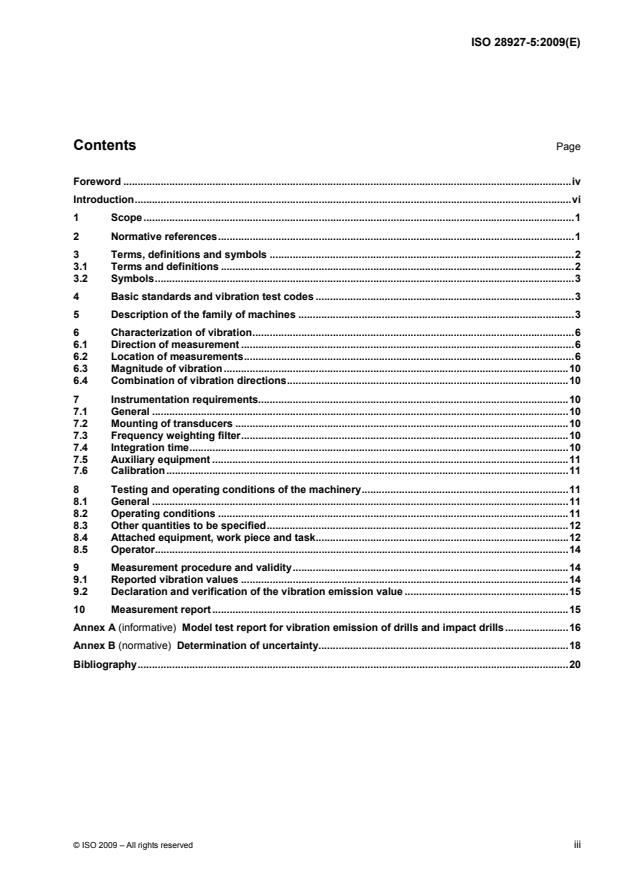
Contents Page
Foreword .iv
Introduction.vi
1 Scope.1
2 Normative references.1
3 Terms, definitions and symbols .2
3.1 Terms and definitions .2
3.2 Symbols.3
4 Basic standards and vibration test codes .3
5 Description of the family of machines .3
6 Characterization of vibration.6
6.1 Direction of measurement .6
6.2 Location of measurements.6
6.3 Magnitude of vibration.10
6.4 Combination of vibration directions.10
7 Instrumentation requirements.10
7.1 General .10
7.2 Mounting of transducers .10
7.3 Frequency weighting filter.10
7.4 Integration time.10
7.5 Auxiliary equipment .11
7.6 Calibration.11
8 Testing and operating conditions of the machinery.11
8.1 General .11
8.2 Operating conditions .11
8.3 Other quantities to be specified.12
8.4 Attached equipment, work piece and task.12
8.5 Operator.14
9 Measurement procedure and validity.14
9.1 Reported vibration values .14
9.2 Declaration and verification of the vibration emission value .15
10 Measurement report .15
Annex A (informative) Model test report for vibration emission of drills and impact drills.16
Annex B (normative) Determination of uncertainty.18
Bibliography.20
Foreword
ISO (the International Organization for Standardization) is a worldwide federation of national standards bodies
(ISO member bodies). The work of preparing International Standards is normally carried out through ISO
technical committees. Each member body interested in a subject for which a technical committee has been
established has the right to be represented on that committee. International organizations, governmental and
non-governmental, in liaison with ISO, also take part in the work. ISO collaborates closely with the
International Electrotechnical Commission (IEC) on all matters of electrotechnical standardization.
International Standards are drafted in accordance with the rules given in the ISO/IEC Directives, Part 2.
The main task of technical committees is to prepare International Standards. Draft International Standards
adopted by the technical committees are circulated to the member bodies for voting. Publication as an
International Standard requires approval by at least 75 % of the member bodies casting a vote.
Attention is drawn to the possibility that some of the elements of this document may be the subject of patent
rights. ISO shall not be held responsible for identifying any or all such patent rights.
ISO 28927-5 was prepared by Technical Committee ISO/TC 118, Compressors and pneumatic tools,
machines and equipment, Subcommittee SC 3, Pneumatic tools and machines.
This first edition of ISO 29827-5 cancels and replaces ISO 8662-6:1994, of which it constitutes a technical
revision. The most important changes are
⎯ vibration measurement in three axes and at both hand positions,
⎯ new transducer positions,
⎯ improved definition of transducer positions and orientation, and
⎯ more types of drills and impact drills covered.
ISO 28927 consists of the following parts, under the general title Hand-held portable power tools — Test
methods for evaluation of vibration emission:
1)
⎯ Part 1: Angle and vertical grinders
2)
⎯ Part 2: Wrenches, nutrunners and screwdrivers
3)
⎯ Part 3: Polishers and rotary, orbital and random orbital sanders
4)
⎯ Part 4: Straight grinders
1) Together with Part 4, replaces ISO 8662-4, Hand-held portable power tools — Measurement of vibrations at the
handle — Part 4: Grinders.
2) Replaces ISO 8662-7, Hand-held portable power tools — Measurement of vibrations at the handle —
Part 7: Wrenches, screwdrivers nut runners with impact, impulse and ratcheting action. All screwdrivers and nutrunners
except for one-shot tools now covered.
3) Replaces ISO 8662-8, Hand-held portable power tools — Measurement of vibrations at the handle —
Part 8: Polishers and rotary, orbital and random orbital sanders.
4) Together with Part 1, replaces ISO 8662-4, Hand-held portable power tools — Measurement of vibrations at the
handle — Part 4: Grinders.
iv © ISO 2009 – All rights reserved
⎯ Part 5: Drills and impact drills
5)
⎯ Part 6: Rammers
6)
⎯ Part 7: Nibblers and shears
⎯ Part 8: Saws, polishing and filing machines with reciprocating action and small saws with oscillating or
7)
rotating action
8)
⎯ Part 9: Scaling hammers and needle scalers
9)
⎯ Part 10: Percussive drills, hammers and breakers
10)
⎯ Part 11: Stone hammers
5) Replaces ISO 8662-9, Hand-held portable power tools — Measurement of vibrations at the handle —Part 9: Rammers.
6) Replaces ISO 8662-10, Hand-held portable power tools — Measurement of vibrations at the handle —
Part 10: Nibblers and shears.
7) Replaces ISO 8662-12, Hand-held portable power tools — Measurement of vibrations at the handle — Part 12: Saws
and files with reciprocating action and saws with oscillating or rotating action.
8) Together with Part 11, replaces ISO 8662-14, Hand-held portable power tools — Measurement of vibrations at the
handle — Part 14: Stone-working tools and needle scalers.
9) Replaces ISO 8662-2, Hand-held portable power tools — Measurement of vibrations at the handle — Part 2: Chipping
hammers and riveting hammers, ISO 8662-3, Hand-held portable power tools — Measurement of vibrations at the
handle — Part 3: Rock drills and rotary hammers, and ISO 8662-5, Hand-held portable power tools — Measurement of
vibrations at the handle — Part 5: Pavement breakers and hammers for construction work. Chipping and riveting hammers,
rock drills and rotary hammers all covered.
10) Together with Part 9, replaces ISO 8662-14, Hand-held portable power tools — Measurement of vibrations at the
handle — Part 14: Stone-working tools and needle scalers.
Introduction
This document is a type-C standard as stated in ISO 12100.
When requirements of this type-C standard are different from those which are stated in type-A or -B standards,
the requirements of this type-C standard take precedence over the requirements of the other standards for
machines that have been designed and built according to the requirements of this type-C standard.
The vibration test codes for portable hand-held machines given in ISO 28927 are based on ISO 20643, which
gives general specifications for the measurement of the vibration emission of hand-held and hand-guided
machinery. ISO 28927 specifies the operation of the machines under type-test conditions and other
requirements for the performance of type tests. The structure/numbering of its clauses follows that of
ISO 20643.
The basic principle for transducer positioning first introduced in the EN 60745 series of European standards is
followed, representing a deviation from ISO 20643 for reasons of consistency. The transducers are primarily
positioned next to the hand in the area between the thumb and the index finger, where they give the least
disturbance to the operator gripping the machine.
It has been found that vibrations generated by drills vary considerably in typical use. For impact drills, the
impacting action is the dominant source of vibration, with variation in the result being affected by the quality of
the drill bit, the work piece and the skill of the operator. For drills without impacting action, the variation is
largely due to variations in the unbalance of the chuck and inserted tool, and the runout of the chuck. In some
drilling operations, the interaction between the drill bit and the work piece can cause vibration.
This part of ISO 28927 uses a real working process for the test. In order to provide a method that gives good
measurement reproducibility, the procedure — chosen to give vibration values as far as possible in
accordance with ISO 20643 — is described in detail and it is essential that it be followed exactly. The
procedures of ISO 5349 are required whenever exposure at the workplace is to be assessed.
The values obtained are type-test values intended to be representative of the average of the upper quartile of
typical vibration magnitudes in real-world use of the machines. However, the actual magnitudes will vary
considerably from time to time and depend on many factors, including the operator, the task and the inserted
tool or consumable. The state of maintenance of the machine itself might also be of importance. Under real
working conditions the influences of the operator and process can be particularly important at low magnitudes.
It is therefore not recommended that emission values below 2,5 m/s be used for estimating the vibration
magnitude under real working conditions. In such cases, 2,5 m/s is the recommended vibration magnitude for
estimating the machine vibration.
If accurate values for a specific work place are required, then measurements (according to ISO 5349) in that
work situation could be necessary. Vibration values measured in real working conditions can be either higher
or lower than the values obtained using this part of ISO 28927.
Higher vibration magnitudes can easily occur in real work situations caused by the use of worn or bent drill
bits, worn or unbalanced chucks, or a poor combination of drilling power, drill-bit size and feed force.
The vibration test codes given in ISO 28927 supersede those given in ISO 8662, whose parts have been
replaced by the corresponding parts of ISO 28927 (see Foreword).
NOTE ISO 8662-11, Hand-held portable power tools — Measurement of vibrations at the handle — Part 11: Fastener
driving tools, and ISO 8662-13, Hand-held portable power tools — Measurement of vibrations at the handle —
Part 13: Die grinders, could be replaced by future parts of ISO 28927.
vi © ISO 2009 – All rights reserved
INTERNATIONAL STANDARD ISO 28927-5:2009(E)
Hand-held portable power tools — Test methods for evaluation
of vibration emission —
Part 5:
Drills and impact drills
1 Scope
This part of ISO 28927 specifies a laboratory method for measuring hand-transmitted vibration emission at the
handles of hand-held, power-driven drills and impact drills. It is a type-test procedure for establishing the
magnitude of vibration in the gripping areas of a drill fitted with a drill bit. It is intended that the results be used
to compare different models of the same type of machine.
This part of ISO 28927 is applicable to straight drills, drills with a pistol-grip and angle drills intended for drilling
holes with rotating or impact action in all kinds of materials (see Clause 5), driven pneumatically or by other
means. It is not applicable to heavy-duty drills with a screw feed or drills driven by a combustion engine.
NOTE To avoid confusion with the terms “power tool” and “inserted tool”, machine is used for the former throughout
this document.
2 Normative references
The following referenced documents are indispensable for the application of this document. For dated
references, only the edition cited applies. For undated references, the latest edition of the referenced
document (including any amendments) applies.
ISO 185:2005, Grey cast irons — Classification
ISO 630:1995, Structural steels — Plates, wide flats, bars, sections and profiles
ISO 679:2009, Cement — Test methods — Determination of strength
ISO 2787:1984, Rotary and percussive pneumatic tools — Performance tests
ISO 5349:2001 (all parts), Mechanical vibration — Measurement and evaluation of human exposure to
hand-transmitted vibration
ISO 5391:2003, Pneumatic tools and machines — Vocabulary
ISO 17066:2007, Hydraulic Tools — Vocabulary
ISO 20643:2005, Mechanical vibration — Hand-held and hand-guided machinery — Principles for evaluation
of vibration emission
EN 12096:1997, Mechanical vibration — Declaration and verification of vibration emission values
3 Terms, definitions and symbols
For the purposes of this document, the terms and definitions given in ISO 5391, ISO 17066 and ISO 20643,
and the following terms, definitions and symbols, apply.
3.1 Terms and definitions
3.1.1
drill
rotary machine driving an output spindle, typically through a gear box
NOTE 1 The output spindle is normally fitted with a chuck or Morse taper or other socket, making the machine suitable
for drilling, reaming and tube expanding, and for boring metal, wood and other materials.
NOTE 2 Adapted from ISO 5391:2003, definition 2.1.1.
3.1.2
straight drill
drill whose output spindle is coaxial with its handle and motor
NOTE Adapted from ISO 5391:2003, definition 2.1.1.1.
3.1.3
angle drill
drill whose output spindle is at an angle to its handle and motor
NOTE Adapted from ISO 5391:2003, definition 2.1.1.3.
3.1.4
drill with pistol grip
pistol-grip drill
drill where the handle of the tool is side-mounted to the motor and output spindle axis
[ISO 5391:2003, definition 2.1.1.2]
3.1.5
impact drill
drill having a built in percussion system that gives an axial percussion movement to a rotating output spindle
3.1.6
loading device
device used to obtain a stable rotational frequency of the output shaft of the machine and to absorb the output
energy of the machine
2 © ISO 2009 – All rights reserved
3.2 Symbols
Symbol Description Unit
a root-mean-square (r.m.s.) single-axis acceleration value of the frequency- m/s
hw
weighted hand-transmitted vibration
a vibration total value of frequency-weighted r.m.s. acceleration; root sum of m/s
hv
squares of a values for the three measured axes of vibration
hw
a arithmetic mean value of a values of runs for single operator using one m/s
hv hv
hand position
a arithmetic mean value of a values for all operators for one hand position m/s
h hv
a arithmetic mean value of a values for one hand position on several m/s
h h
machines
a declared vibration emission value m/s
hd
s standard deviation for a test series (for a sample, s) m/s
n−1
σ standard deviation of reproducibility (for a population, σ) m/s
R
C coefficient of variation for a test series
v
K uncertainty m/s
4 Basic standards and vibration test codes
This part of ISO 28297 is based on the requirements of ISO 20643 and corresponds to its structure in respect
of clause subjects and numbering except for the annexes.
Annex A presents a model test report and Annex B the means for determining the uncertainty, K.
5 Description of the family of machines
This part of ISO 29827 applies to hand-held machines intended for drilling holes by means of a rotating or
impact action in all types of materials.
Figures 1 to 7 show examples of typical drills covered by this part of ISO 29827.
Figure 1 — Straight drill
Figure 2 — Straight drill with support handle
Figure 3 — Drill with pistol grip
Figure 4 — Drill with pistol grip and second handle
4 © ISO 2009 – All rights reserved
Figure 5 — Angle drill
Figure 6 — Impact drill
Figure 7 — Impact drill with second handle
6 Characterization of vibration
6.1 Direction of measurement
The vibration transmitted to the hand shall be measured and reported for three directions of an orthogonal
coordinate system. At each hand position, the vibration shall be measured simultaneously in the three
directions shown in Figures 8 to 14.
6.2 Location of measurements
Measurements shall be made at the gripping zones, where the operator normally holds the machine and
applies the feed force. For machines intended for one-handed operation, it is only necessary to measure at a
single point.
...
NORME ISO
INTERNATIONALE 28927-5
Première édition
2009-12-15
Machines à moteur portatives —
Méthodes d'essai pour l'évaluation de
l'émission de vibrations —
Partie 5:
Perceuses et perceuses à percussion
Hand-held portable power tools — Test methods for evaluation of
vibration emission —
Part 5: Drills and impact drills
Numéro de référence
©
ISO 2009
PDF – Exonération de responsabilité
Le présent fichier PDF peut contenir des polices de caractères intégrées. Conformément aux conditions de licence d'Adobe, ce fichier
peut être imprimé ou visualisé, mais ne doit pas être modifié à moins que l'ordinateur employé à cet effet ne bénéficie d'une licence
autorisant l'utilisation de ces polices et que celles-ci y soient installées. Lors du téléchargement de ce fichier, les parties concernées
acceptent de fait la responsabilité de ne pas enfreindre les conditions de licence d'Adobe. Le Secrétariat central de l'ISO décline toute
responsabilité en la matière.
Adobe est une marque déposée d'Adobe Systems Incorporated.
Les détails relatifs aux produits logiciels utilisés pour la création du présent fichier PDF sont disponibles dans la rubrique General Info
du fichier; les paramètres de création PDF ont été optimisés pour l'impression. Toutes les mesures ont été prises pour garantir
l'exploitation de ce fichier par les comités membres de l'ISO. Dans le cas peu probable où surviendrait un problème d'utilisation,
veuillez en informer le Secrétariat central à l'adresse donnée ci-dessous.
DOCUMENT PROTÉGÉ PAR COPYRIGHT
© ISO 2009
Droits de reproduction réservés. Sauf prescription différente, aucune partie de cette publication ne peut être reproduite ni utilisée sous
quelque forme que ce soit et par aucun procédé, électronique ou mécanique, y compris la photocopie et les microfilms, sans l'accord écrit
de l'ISO à l'adresse ci-après ou du comité membre de l'ISO dans le pays du demandeur.
ISO copyright office
Case postale 56 • CH-1211 Geneva 20
Tel. + 41 22 749 01 11
Fax + 41 22 749 09 47
E-mail copyright@iso.org
Web www.iso.org
Publié en Suisse
ii © ISO 2009 – Tous droits réservés
Sommaire Page
Avant-propos .iv
Introduction.vi
1 Domaine d'application .1
2 Références normatives.1
3 Termes, définitions et symboles.2
3.1 Termes et définitions .2
3.2 Symboles.3
4 Normes de référence et codes d'essai de vibration .3
5 Description de la famille de machines .3
6 Caractérisation des vibrations.6
6.1 Direction du mesurage.6
6.2 Emplacement des mesurages.6
6.3 Amplitude des vibrations.10
6.4 Combinaison des directions de vibrations.10
7 Exigences pour l'appareillage.10
7.1 Généralités .10
7.2 Montage des transducteurs.10
7.3 Filtre de pondération fréquentielle .10
7.4 Durée d'intégration.11
7.5 Équipement auxiliaire .11
7.6 Étalonnage .11
8 Conditions d'essai et de fonctionnement de la machine .11
8.1 Généralités .11
8.2 Conditions de fonctionnement .11
8.3 Autres valeurs à spécifier.12
8.4 Équipement accessoire, pièce et tâche .12
8.5 Opérateur.14
9 Mode opératoire de mesure et validité.14
9.1 Valeurs de vibrations consignées .14
9.2 Déclaration et vérification des valeurs d'émission vibratoire .15
10 Rapport d'essai.15
Annexe A (informative) Modèle de rapport d'essai pour les émissions de vibrations des
perceuses.16
Annexe B (normative) Détermination de l'incertitude.18
Bibliographie.20
Avant-propos
L'ISO (Organisation internationale de normalisation) est une fédération mondiale d'organismes nationaux de
normalisation (comités membres de l'ISO). L'élaboration des Normes internationales est en général confiée
aux comités techniques de l'ISO. Chaque comité membre intéressé par une étude a le droit de faire partie du
comité technique créé à cet effet. Les organisations internationales, gouvernementales et non
gouvernementales, en liaison avec l'ISO participent également aux travaux. L'ISO collabore étroitement avec
la Commission électrotechnique internationale (CEI) en ce qui concerne la normalisation électrotechnique.
Les Normes internationales sont rédigées conformément aux règles données dans les Directives ISO/CEI,
Partie 2.
La tâche principale des comités techniques est d'élaborer les Normes internationales. Les projets de Normes
internationales adoptés par les comités techniques sont soumis aux comités membres pour vote. Leur
publication comme Normes internationales requiert l'approbation de 75 % au moins des comités membres
votants.
L'attention est appelée sur le fait que certains des éléments du présent document peuvent faire l'objet de
droits de propriété intellectuelle ou de droits analogues. L'ISO ne saurait être tenue pour responsable de ne
pas avoir identifié de tels droits de propriété et averti de leur existence.
L'ISO 28927-5 a été élaborée par le comité technique ISO/TC 118, Compresseurs, machines portatives
pneumatiques, machines et équipements pneumatiques, sous-comité SC 3, Machines portatives
pneumatiques et machines pneumatiques.
Cette première édition annule et remplace l'ISO 8662-6:1994, dont elle constitue une révision technique. Les
principales modifications sont
⎯ le mesurage des vibrations sur trois axes et aux deux positions de main,
⎯ l'utilisation de nouvelles positions de transducteur,
⎯ une définition améliorée des positions et de l'orientation du transducteur,
⎯ de nouveaux types de perceuses et de perceuses à percussion traités.
L'ISO 28927 comprend les parties suivantes, présentées sous le titre général Machines à moteur
portatives — Méthodes d'essai pour l'évaluation de l'émission de vibrations:
1)
⎯ Partie 1: Meuleuses verticales et meuleuses d'angles
2)
⎯ Partie 2: Clés, boulonneuses et visseuses
3)
⎯ Partie 3: Polisseuses-lustreuses et ponceuses rotatives, orbitales et orbitales spéciales
1) Conjointement à l'ISO 28927-4, remplace l'ISO 8662-4, Machines à moteur portatives — Mesurage des vibrations au
niveau des poignées — Partie 4: Meuleuses.
2) Remplace l'ISO 8662-7, Machines à moteur portatives — Mesurage des vibrations au niveau des poignées —
Partie 7: Clés, tournevis et serreuses à percussion, à impulsion ou à cliquet. Tous les types de tournevis et de
boulonneuses sont maintenant traités à l'exception des outils monocoup.
3) Remplace l'ISO 8662-8, Machines à moteur portatives — Mesurage des vibrations au niveau des poignées —
Partie 8: Polisseuses-lustreuses et ponceuses rotatives, orbitales et orbitales spéciales.
iv © ISO 2009 – Tous droits réservés
4)
⎯ Partie 4: Meuleuses droites
⎯ Partie 5: Perceuses et perceuses à percussion
5)
⎯ Partie 6: Marteaux fouloirs
6)
⎯ Partie 7: Grignoteuses et cisailles
7)
⎯ Partie 8: Scies, polisseuses et limes alternatives, et petites scies oscillantes ou circulaires
8)
⎯ Partie 9: Marteaux dérouilleurs et marteaux à aiguilles
9)
⎯ Partie 10: Marteaux à percussion, perforateurs et brise-béton
10)
⎯ Partie 11: Casse-pierres
4) Conjointement à l'ISO 28927-1, remplace l'ISO 8662-4, Machines à moteur portatives — Mesurage des vibrations au
niveau des poignées — Partie 4: Meuleuses.
5) Remplace l'ISO 8662-9, Machines à moteur portatives — Mesurage des vibrations au niveau des poignées —
Partie 9: Marteaux fouloirs.
6) Remplace l'ISO 8662-10, Machines à moteur portatives — Mesurage des vibrations au niveau des poignées —
Partie 10: Grignoteuses et cisailles.
7) Remplace l'ISO 8662-12, Machines à moteur portatives — Mesurage des vibrations au niveau des poignées —
Partie 12: Scies et limes alternatives et scies oscillantes ou circulaires.
8) Conjointement à l'ISO 28927-11, remplace l'ISO 8662-14, Machines à moteur portatives — Mesurage des vibrations
au niveau des poignées — Partie 14: Machines portatives pour le travail de la pierre et marteaux à aiguilles.
9) Remplace l'ISO 8662-2, Machines à moteur portatives — Mesurage des vibrations au niveau des poignées —
Partie 2: Marteaux burineurs et marteaux riveurs, l'ISO 8662-3, Machines à moteur portatives — Mesurage des vibrations
au niveau des poignées — Partie 3: Marteaux perforateurs et marteaux rotatifs et l'ISO 8662-5, Machines à moteur
portatives — Mesurage des vibrations au niveau des poignées — Partie 5: Brise-béton, marteaux de démolition et
marteaux piqueurs. Les marteaux burineurs, les marteaux riveurs et les marteaux perforateurs et marteaux rotatifs sont
tous traités.
10) Conjointement à l'ISO 28927-9, remplace l'ISO 8662-14, Machines à moteur portatives — Mesurage des vibrations au
niveau des poignées — Partie 14: Machines portatives pour le travail de la pierre et marteaux à aiguilles.
Introduction
Le présent document est une norme de type C tel que mentionné dans l'ISO 12100.
Lorsque des exigences de la présente norme de type C sont différentes de celles énoncées dans les normes
de type A ou les normes de type B, les exigences de la présente norme de type C prévalent sur celles des
autres normes pour les machines ayant été conçues et fabriquées conformément aux exigences de la
présente norme de type C.
L'ISO 28927, qui spécifie un code d'essai pour le mesurage des émissions de vibrations des machines à
percussion portatives, est rédigée conformément à l'ISO 20643 qui fournit les principes généraux de
mesurage des émissions de vibrations des machines tenues et guidées à la main. L'ISO 28927 spécifie la
façon de manier la machine pendant l'essai de type et donne d'autres indications concernant cet essai. La
structure/la numérotation des ses articles suit celle de l'ISO 20643.
Le principe de base relatif à l'emplacement du transducteur, introduit tout d'abord dans la série de la
CEI 60745, est utilisé, mais il représente un écart par rapport à l'ISO 20643 pour des raisons de cohérence.
Ces transducteurs sont principalement positionnés près de la main dans la zone entre le pouce et l'index, là
où ils gênent le moins l'opérateur saisissant l'outil.
Il a été constaté que les vibrations engendrées par les perceuses présentent des variations importantes dans
des conditions d'utilisation typiques. Dans le cas des perceuses à percussion, l'action de percussion constitue
la source de vibrations dominante et la variation du résultat est affectée par la qualité du foret, la pièce à
usiner et les compétences de l'opérateur. Pour les perceuses sans action de percussion, la variation est due,
pour une large part, aux variations du déséquilibre observé au niveau du mandrin et de l'outil intégré, ainsi
qu'au faux-rond du mandrin. Dans certaines opérations de forage, l'interaction entre le foret et la pièce à
usiner peut produire des vibrations.
Il est essentiel, afin de fournir une méthode qui permet une reproductibilité des mesurages appropriée, que la
présente partie de l'ISO 28927 suive un mode opératoire d'essai réel. Le mode opératoire (choisi pour donner
les valeurs de vibrations qui sont en accord autant que possible avec l'ISO 20643) est décrit en détail et il est
essentiel de la suivre exactement. Si l'on doit estimer l'exposition au poste de travail, les modes opératoires
de l'ISO 5349 s'appliquent.
Les valeurs d'essai de type sont destinées à être représentatives de la moyenne du quartile supérieur des
amplitudes des vibrations typiques de l'utilisation réelle des machines. Cependant, les amplitudes réelles
varieront considérablement au court du temps et dépendront de beaucoup de facteurs comprenant l'opérateur,
la tâche et l'outil ou le consommable inséré. L'état de l'entretien de la machine lui-même peut également avoir
de l'importance. Dans des conditions de travail réelles, l'influence de l'opérateur et du procédé peuvent être
particulièrement importantes pour les amplitudes faibles. C'est pourquoi il n'est pas recommandé d'utiliser des
valeurs d'émission en dessous de 2,5 m/s comme estimation de l'amplitude de vibrations des conditions de
travail réelles. Dans de tels cas, 2,5 m/s est l'amplitude de vibrations recommandée pour estimer les
vibrations de la machine.
Si, pour un travail spécifique, des valeurs exactes sont requises, il peut être nécessaire de réaliser des
mesurages (conformément à l'ISO 5349) dans cette situation de travail. Les valeurs de vibrations mesurées
dans les conditions de travail réelles peuvent être supérieures ou inférieures à celles obtenues en utilisant la
présente partie de l'ISO 28927.
Des amplitudes de vibrations plus élevées peuvent se produire dans des conditions de travail réelles, à cause
d'outils insérés excessivement mal équilibrés, en ponçant avec des plateaux avec une mauvaise charge, en
utilisant des garnitures dont le support est usé ou des axes déformés.
vi © ISO 2009 – Tous droits réservés
Les codes d'essai pour le mesurage des émissions de vibrations donnés dans l'ISO 28927 remplacent ceux
donnés dans l'ISO 8662, dont les parties ont été remplacées par les parties correspondantes de l'ISO 28927
(voir Avant-propos).
NOTE L'ISO 8662-11, Machines à moteur portatives — Mesurage des vibrations au niveau des poignées —
Partie 11: Machines à enfoncer les fixations et l'ISO 8662-13, Machines à moteur portatives — Mesurage des vibrations
au niveau des poignées — Partie 13: Meuleuses d'outillage, pourraient être remplacées par de futures parties de
l'ISO 28927.
NORME INTERNATIONALE ISO 28927-5:2009(F)
Machines à moteur portatives — Méthodes d'essai pour
l'évaluation de l'émission de vibrations —
Partie 5:
Perceuses et perceuses à percussion
1 Domaine d'application
La présente partie de l'ISO 28927 spécifie une méthode de mesure en laboratoire des émissions de vibrations
transmises aux mains s'exerçant au niveau des poignées des perceuses et des perceuses à percussion à
moteur tenues à la main. Il s'agit d'une méthode d'essai de type définissant l'amplitude des vibrations aux
zones de préhension d'une perceuse avec un foret. Il est prévu d'utiliser les résultats pour comparer différents
modèles du même type de machine.
La présente partie de l'ISO 28927 s'applique aux perceuses droites, perceuses à poignée revolver et
perceuses d'angles utilisées pour percer des trous sur tous les types de matériaux par rotation ou par
percussion (voir Article 5), pneumatiques ou entraînées par un autre dispositif. Elle ne s'applique pas aux
perceuses à grand rendement à vis sans fin ou aux perceuses entrainées par un moteur à combustion.
NOTE Pour éviter la confusion entre «outil à moteur portatif» et «outil intégré», le mot machine est utilisé tout au long
du présent document.
2 Références normatives
Les documents de référence suivants sont indispensables pour l'application du présent document. Pour les
références datées, seule l'édition citée s'applique. Pour les références non datées, la dernière édition du
document de référence s'applique (y compris les éventuels amendements).
ISO 185:2005, Fontes à graphite lamellaire — Classification
ISO 630:1995, Aciers de construction métallique — Tôles, larges-plats, barres, poutrelles et profilés
ISO 679:2009, Ciments — Méthodes d'essai — Détermination de la résistance mécanique
ISO 2787:1984, Machines pneumatiques rotatives, percutantes et roto-percutantes — Essais de
fonctionnement
ISO 5349:2001, (toutes les parties), Vibrations mécaniques — Mesurage et évaluation de l'exposition des
individus aux vibrations transmises par la main
ISO 5391:2003, Machines portatives pneumatiques et machines pneumatiques — Vocabulaire
ISO 17066:2007, Outils hydrauliques — Vocabulaire
ISO 20643:2005, Vibration mécanique — Machines tenues et guidées à la main — Principes pour l'évaluation
d'émission de vibration
EN 12096:1997, Vibrations mécaniques — Déclaration et vérification des valeurs d'émission vibratoire
3 Termes, définitions et symboles
Pour les besoins du présent document, les termes et définitions donnés dans l'ISO 5391, l'ISO 17066 et
l'ISO 20643, ainsi que les termes, définitions et symboles suivants s'appliquent.
3.1 Termes et définitions
3.1.1
perceuse
machine rotative entraînant une broche, typiquement par l'intermédiaire d'un réducteur
NOTE 1 Adapté de l'ISO 5391:2003, définition 2.1.1.
NOTE 2 La broche de sortie est normalement munie d'un mandrin, d'un cône morse ou d'un autre emmanchement
rendant l'outil apte aux opérations de perçage, d'alésage, de dudgeonnage et de forage des métaux, bois et autres matériaux.
3.1.2
perceuse droite
perceuse dont la broche de sortie est en ligne avec la poignée et le moteur
NOTE Adapté de l'ISO 5391:2003, définition 2.1.1.1.
3.1.3
perceuse d'angles
perceuse dont la broche de sortie forme un angle avec la poignée et le moteur
NOTE Adapté de l'ISO 5391:2003, définition 2.1.1.3.
3.1.4
perceuse à poignée revolver
perceuse dont la poignée est montée latéralement à l'axe du moteur et de la broche de sortie
[ISO 5391:2003, définition 2.1.1.2]
3.1.5
perceuse à percussion
perceuse équipée d'un système de percussion intégré qui entraîne un mouvement de percussion axial par
rapport à une broche de sortie tournante
3.1.6
dispositif de mise en charge
dispositif de freinage
dispositif permettant d'obtenir une fréquence de rotation stable de l'arbre de sortie de la machine et destiné à
absorber l'énergie de sortie de la machine
2 © ISO 2009 – Tous droits réservés
3.2 Symboles
Symbole Description Unité
a valeur moyenne quadratique de l'accélération unidirectionnelle des m/s
hw
vibrations pondérées en fréquence transmises à la main
a valeur totale des vibrations de la moyenne quadratique de l'accélération m/s
hv
pondérée en fréquence; résultante quadratique des valeurs a pour les
hw
trois axes de vibration mesurés
a moyenne arithmétique des valeurs a entre les essais pour un opérateur m/s
hv hv
pour la position de main 1
a moyenne arithmétique des valeurs a pour tous les opérateurs pour la m/s
hv
h
position de main 1
a moyenne arithmétique des valeurs a pour un la position de main 1 sur m/s
h h
plusieurs machines
a valeur d'émission de vibrations déclarée m/s
hd
s écart-type pour une série d'essais (pour un échantillon, s) m/s
n−1
σ écart-type de reproductibilité (pour une population, σ) m/s
R
C coefficient de variation d'une série d'essais
v
K incertitude m/s
4 Normes de référence et codes d'essai de vibration
La présente partie de l'ISO 28927 est fondée sur les exigences de l'ISO 20643 quant à sa structure, le sujet
des articles et sa numérotation, à l'exception des annexes.
L'Annexe A présente un modèle de rapport d'essai et l'Annexe B la méthode de détermination de l'incertitude, K.
5 Description de la famille de machines
La présente partie de l'ISO 28927 s'applique aux machines destinées au perçage de trous sur tous les types
de matériaux par rotation ou par percussion.
Les Figures 1 à 6 constituent des exemples de perceuses couvertes par la présente partie de l'ISO 28927.
Figure 1 — Perceuse droite
Figure 2 — Perceuse droite avec poignée de support
Figure 3 — Perceuse à poignée revolver
Figure 4 — Perceuse à poignée revolver munie d'une poignée de support
4 © ISO 2009 – Tous droits réservés
Figure 5 — Perceuse d'angle
Figure 6 — Perceuse à percussion
Figure 7 — Perceuse à percussion munie d'une poignée de support
6 Caractérisation des vibrations
6.1 Direction du mesurage
Les vibrations transmises à la main doivent être mesurées et consignées pour trois directions dans un
système de coordonnées orthogonal. À chaque position de main, les vibrations doivent être mesurées
simultanément dans les trois directions indiquées aux Figures 8 à 14.
6.2 Emplacement des mesurages
Les mesurages doivent être effectués dans les zones de préhension, là où l'opérateur tient normalement la
machine et applique la force d'avance. Le mesurage n'est effectué qu'en un seul point pour les machines
destinées à être actionnées à l'aide d'une seule main.
L'emplacement prescrit du transducteur doit être aussi proche
...