

ISO 10256-1:2016
(Main)Protective equipment for use in ice hockey — Part 1: General requirements
General Information
- Abstract
ISO 10256-1:2016 is part of ISO 10256 specifies general requirements for head, face, neck and body protectors (hereafter referred to as protectors) for use in ice hockey. ISO 10256-1:2016 is intended only for protectors used for ice hockey. Requirements are given for the following: a) terms and definitions; b) innocuousness; c) ergonomics; d) test report; e) permanent markings; f) information for users. In the ISO 10256 series, collateral standards specify performance requirements for protectors for use in ice hockey and are intended to be read in conjunction with ISO 10256-1:2016. NOTE 1 The requirements of a clause take precedence over a figure. NOTE 2 The intent is to reduce the risk of injury to an ice hockey player without compromising the form or appeal of the game. These standards presume that the rules of play for ice hockey will be followed by players and enforced by officials.
- Status
- Withdrawn
- Publication Date
- 23-Nov-2016
- Technical Committee
- ISO/TC 83/SC 5 - Ice hockey equipment and facilities
- Drafting Committee
- ISO/TC 83/SC 5 - Ice hockey equipment and facilities
- Current Stage
- 9599 - Withdrawal of International Standard
- Start Date
- 16-Jul-2024
- Completion Date
- 29-Aug-2026
Buy Documents
ISO 10256-1:2016 - Protective equipment for use in ice hockey — Part 1: General requirements Released:11/24/2016
ISO 10256-1:2016 - Équipements de protection destinés a etre utilisés en hockey sur glace — Partie 1: Exigences générales Released:11/24/2016
Overview
ISO 10256-1:2016 outlines the general requirements for protective equipment used in ice hockey. This international standard focuses on head, face, neck, and body protectors specifically designed to enhance player safety during high-speed collisions inherent in the sport. The standard aims to reduce injury risk without compromising the dynamics or appeal of ice hockey. Compliance with ISO 10256-1:2016 ensures that protective gear is safe, ergonomic, and effective under typical game conditions while aligning with recognized international best practices.
Key Topics
- Scope and Definitions: Details the terms and definitions to maintain consistency in protective equipment design and evaluation.
- Innocuousness: Stipulates that all equipment materials must be safe for contact, free from harmful chemicals or sharp edges that could injure players or others.
- Ergonomics: Emphasizes comfort and freedom of movement to minimize discomfort and allow normal playing motions without restriction.
- Test Methods: Specifies procedures for evaluating material safety and ergonomic design, including conditioning tests that simulate ambient, low, and elevated temperatures.
- Permanent Marking: Requires clear, durable labeling on protectors to provide vital information such as manufacturing details, standard compliance, size, and use instructions.
- User Information: Mandates comprehensive guidance accompanying protectors to ensure proper fit, maintenance, and safe use, including warnings about limitations and potential allergens.
Applications
ISO 10256-1:2016 serves manufacturers, testers, and regulatory bodies involved in the production and certification of ice hockey protective equipment. Its practical applications include:
- Design and Manufacturing: Assisting producers in developing safe, ergonomic protective gear that meets internationally recognized criteria.
- Product Testing and Certification: Guiding laboratories and certification bodies in assessing equipment compliance through standardized tests.
- Consumer Safety: Informing users about proper fitting, maintenance, and usage instructions to maximize protection and comfort.
- Regulatory Compliance: Helping manufacturers adhere to safety regulations and directives, such as the European Union PPE Directive, ensuring market access and player protection.
- Injury Prevention: Supporting hockey leagues, teams, and players in selecting protective equipment designed to reduce the frequency and severity of injuries during play.
Related Standards
ISO 10256-1:2016 is part of a series dedicated to ice hockey protective equipment. Complementary standards specify performance requirements for different gear types and should be used together for comprehensive safety assurance:
- ISO 10256-2: Head protection for skaters
- ISO 10256-3: Facial protectors for skaters
- ISO 10256-4: Head and face protection for goalkeepers
- ISO 10256-5: Neck laceration protectors for ice hockey players
- ISO 10256-6 (under development): Lower leg protectors for ice hockey players
These related standards build upon the general requirements set by ISO 10256-1 to address specific protection zones and performance criteria tailored to various player roles.
Keywords: ISO 10256-1, ice hockey protective equipment, head protection, body protectors, ergonomics, injury prevention, safety standards, sports equipment certification, protective gear for ice hockey, PPE Directive compliance.
Relations
- Effective Date
- 09-Feb-2026
- Effective Date
- 09-Feb-2026
- Effective Date
- 09-Feb-2026
- Effective Date
- 12-Feb-2026
- Effective Date
- 06-Jun-2022
- Effective Date
- 26-Nov-2021
- Effective Date
- 28-Feb-2009
Buy Documents
ISO 10256-1:2016 - Protective equipment for use in ice hockey — Part 1: General requirements Released:11/24/2016
ISO 10256-1:2016 - Équipements de protection destinés a etre utilisés en hockey sur glace — Partie 1: Exigences générales Released:11/24/2016
Get Certified
Connect with accredited certification bodies for this standard

CIS Institut d.o.o.
Personal Protective Equipment (PPE) certification body. Notified Body NB-2890 for EU Regulation 2016/425 PPE.

Kiwa BDA Testing
Building and construction product certification.
Kmetijski inštitut Slovenije
Agricultural Institute of Slovenia. Soil testing, plant health, agricultural product analysis.
Sponsored listings
Frequently Asked Questions
ISO 10256-1:2016 is a standard published by the International Organization for Standardization (ISO). Its full title is "Protective equipment for use in ice hockey — Part 1: General requirements". This standard covers: ISO 10256-1:2016 is part of ISO 10256 specifies general requirements for head, face, neck and body protectors (hereafter referred to as protectors) for use in ice hockey. ISO 10256-1:2016 is intended only for protectors used for ice hockey. Requirements are given for the following: a) terms and definitions; b) innocuousness; c) ergonomics; d) test report; e) permanent markings; f) information for users. In the ISO 10256 series, collateral standards specify performance requirements for protectors for use in ice hockey and are intended to be read in conjunction with ISO 10256-1:2016. NOTE 1 The requirements of a clause take precedence over a figure. NOTE 2 The intent is to reduce the risk of injury to an ice hockey player without compromising the form or appeal of the game. These standards presume that the rules of play for ice hockey will be followed by players and enforced by officials.
ISO 10256-1:2016 is part of ISO 10256 specifies general requirements for head, face, neck and body protectors (hereafter referred to as protectors) for use in ice hockey. ISO 10256-1:2016 is intended only for protectors used for ice hockey. Requirements are given for the following: a) terms and definitions; b) innocuousness; c) ergonomics; d) test report; e) permanent markings; f) information for users. In the ISO 10256 series, collateral standards specify performance requirements for protectors for use in ice hockey and are intended to be read in conjunction with ISO 10256-1:2016. NOTE 1 The requirements of a clause take precedence over a figure. NOTE 2 The intent is to reduce the risk of injury to an ice hockey player without compromising the form or appeal of the game. These standards presume that the rules of play for ice hockey will be followed by players and enforced by officials.
ISO 10256-1:2016 is classified under the following ICS (International Classification for Standards) categories: 13.340.20 - Head protective equipment; 97.220.20 - Winter sports equipment. The ICS classification helps identify the subject area and facilitates finding related standards.
ISO 10256-1:2016 has the following relationships with other standards: It is inter standard links to EN ISO 10256-2:2018, EN ISO 10256-4:2018, EN ISO 10256-3:2018, EN ISO 10256-1:2016, ISO/IEC 8824-1:1998, ISO 10256-1:2024, ISO 10256:2003. Understanding these relationships helps ensure you are using the most current and applicable version of the standard.
ISO 10256-1:2016 is available in PDF format for immediate download after purchase. The document can be added to your cart and obtained through the secure checkout process. Digital delivery ensures instant access to the complete standard document.
Standards Content (Sample)
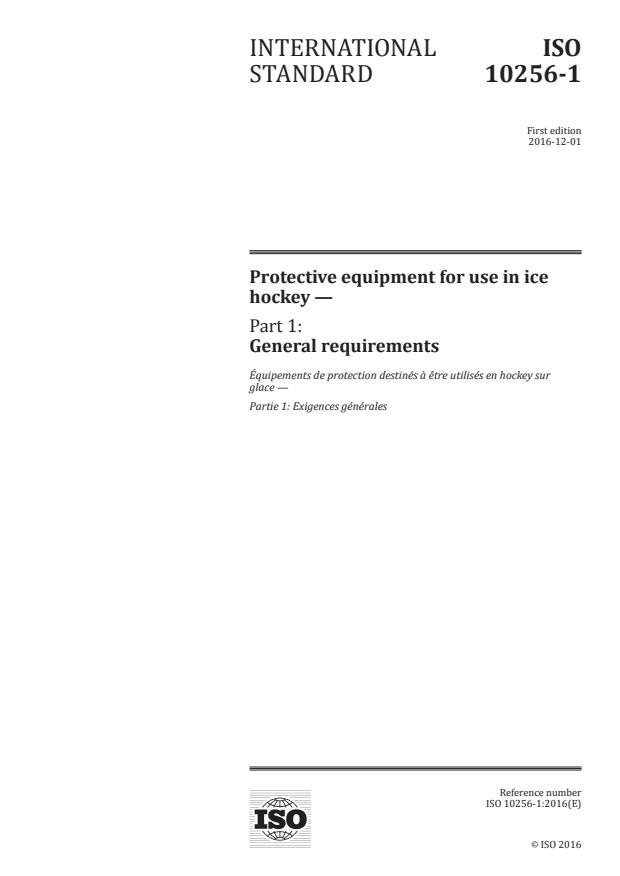
INTERNATIONAL ISO
STANDARD 10256-1
First edition
2016-12-01
Protective equipment for use in ice
hockey —
Part 1:
General requirements
Équipements de protection destinés à être utilisés en hockey sur
glace —
Partie 1: Exigences générales
Reference number
©
ISO 2016
© ISO 2016, Published in Switzerland
All rights reserved. Unless otherwise specified, no part of this publication may be reproduced or utilized otherwise in any form
or by any means, electronic or mechanical, including photocopying, or posting on the internet or an intranet, without prior
written permission. Permission can be requested from either ISO at the address below or ISO’s member body in the country of
the requester.
ISO copyright office
Ch. de Blandonnet 8 • CP 401
CH-1214 Vernier, Geneva, Switzerland
Tel. +41 22 749 01 11
Fax +41 22 749 09 47
copyright@iso.org
www.iso.org
ii © ISO 2016 – All rights reserved
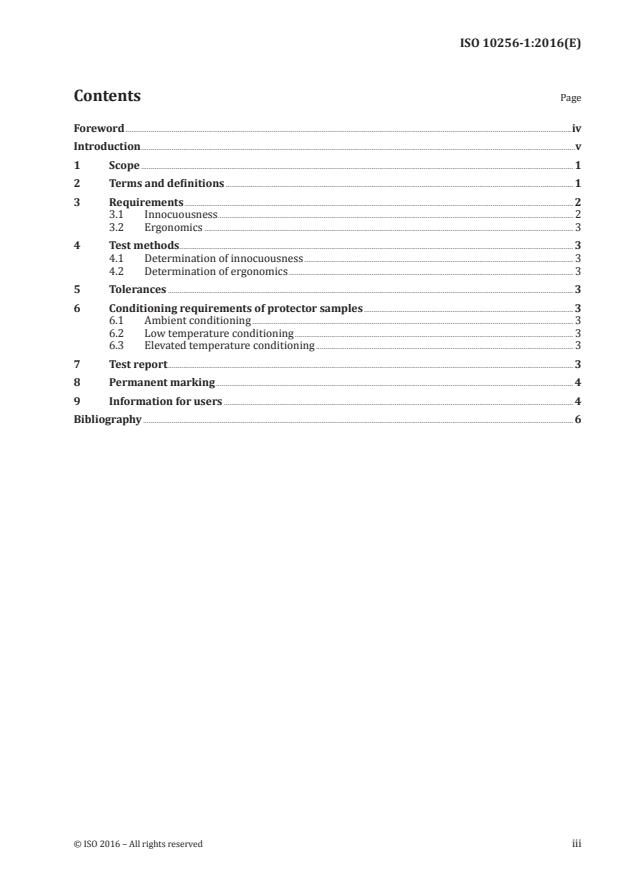
Contents Page
Foreword .iv
Introduction .v
1 Scope . 1
2 Terms and definitions . 1
3 Requirements . 2
3.1 Innocuousness . 2
3.2 Ergonomics . 3
4 Test methods . 3
4.1 Determination of innocuousness . 3
4.2 Determination of ergonomics . 3
5 Tolerances . 3
6 Conditioning requirements of protector samples . 3
6.1 Ambient conditioning . 3
6.2 Low temperature conditioning . 3
6.3 Elevated temperature conditioning . 3
7 Test report . 3
8 Permanent marking . 4
9 Information for users . 4
Bibliography . 6
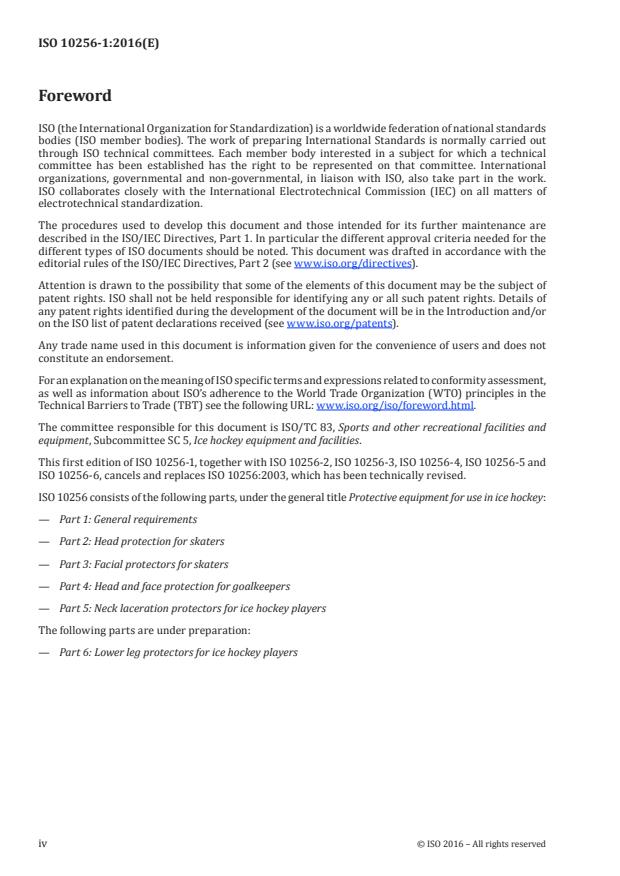
Foreword
ISO (the International Organization for Standardization) is a worldwide federation of national standards
bodies (ISO member bodies). The work of preparing International Standards is normally carried out
through ISO technical committees. Each member body interested in a subject for which a technical
committee has been established has the right to be represented on that committee. International
organizations, governmental and non-governmental, in liaison with ISO, also take part in the work.
ISO collaborates closely with the International Electrotechnical Commission (IEC) on all matters of
electrotechnical standardization.
The procedures used to develop this document and those intended for its further maintenance are
described in the ISO/IEC Directives, Part 1. In particular the different approval criteria needed for the
different types of ISO documents should be noted. This document was drafted in accordance with the
editorial rules of the ISO/IEC Directives, Part 2 (see www.iso.org/directives).
Attention is drawn to the possibility that some of the elements of this document may be the subject of
patent rights. ISO shall not be held responsible for identifying any or all such patent rights. Details of
any patent rights identified during the development of the document will be in the Introduction and/or
on the ISO list of patent declarations received (see www.iso.org/patents).
Any trade name used in this document is information given for the convenience of users and does not
constitute an endorsement.
For an explanation on the meaning of ISO specific terms and expressions related to conformity assessment,
as well as information about ISO’s adherence to the World Trade Organization (WTO) principles in the
Technical Barriers to Trade (TBT) see the following URL: www.iso.org/iso/foreword.html.
The committee responsible for this document is ISO/TC 83, Sports and other recreational facilities and
equipment, Subcommittee SC 5, Ice hockey equipment and facilities.
This first edition of ISO 10256-1, together with ISO 10256-2, ISO 10256-3, ISO 10256-4, ISO 10256-5 and
ISO 10256-6, cancels and replaces ISO 10256:2003, which has been technically revised.
ISO 10256 consists of the following parts, under the general title Protective equipment for use in ice hockey:
— Part 1: General requirements
— Part 2: Head protection for skaters
— Part 3: Facial protectors for skaters
— Part 4: Head and face protection for goalkeepers
— Part 5: Neck laceration protectors for ice hockey players
The following parts are under preparation:
— Part 6: Lower leg protectors for ice hockey players
iv © ISO 2016 – All rights reserved
Introduction
Ice hockey is a high speed, collision sport in which there is a risk of injury. The object of this part of
ISO 10256 is to specify general requirements and to serve as the basis for particular standards for ice
hockey, taking into account the risks inherent in participating in the sport, many of which cannot be
eliminated by protective equipment. By playing this sport, participants accept the risk of serious injury,
paralysis and/or death.
The intention of protective equipment for use in ice hockey is to reduce the frequency and severity of
localized injuries to that part of the body for which the protector is intended. The protective function
is intended to distribute and dampen the force of impact and to counteract the penetration of objects
applied to the protector, and in the case of neck protectors, reduce the risk of lacerations. To achieve the
performance of which it is capable, and to ensure stability while worn, the protective equipment need
to be as closely fitting as possible, consistent with comfort. In use, it is essential that protectors are
securely fastened, properly fitted and adjusted according to manufacturer’s instructions.
SC 5 is aware that specifications for the performance of protective equipment are required in order
to reduce the risk of injury in ice hockey. A goal of the subcommittee is to promote the use of better
materials and/or constructions as they become available to meet the future requirements of the sport
of ice hockey. SC 5 is also aware that in order to provide for comfort, correct fitting and use, and in
accordance with the PPE Directive of the European Union (Council Directive 89/686/EEC), protective
equipment intended for ice hockey need to be as light as practicable while providing appropriate
performance characteristics that meet the demands of the sport. Proper education in the proper use
and fitting of protective equipment is critical to its performance. Proper enforcement of the rules of
play and consistent officiating are also essential for best performance of the protective equipment in
reducing the risk of injury.
This part of ISO 10256 is to be used in conjunction with other collateral standards in the ISO 10256 series.
----
...
NORME ISO
INTERNATIONALE 10256-1
Première édition
2016-12-01
Équipements de protection destinés à
être utilisés en hockey sur glace —
Partie 1:
Exigences générales
Protective equipment for use in ice hockey —
Part 1: General requirements
Numéro de référence
©
ISO 2016
DOCUMENT PROTÉGÉ PAR COPYRIGHT
© ISO 2016, Publié en Suisse
Droits de reproduction réservés. Sauf indication contraire, aucune partie de cette publication ne peut être reproduite ni utilisée
sous quelque forme que ce soit et par aucun procédé, électronique ou mécanique, y compris la photocopie, l’affichage sur
l’internet ou sur un Intranet, sans autorisation écrite préalable. Les demandes d’autorisation peuvent être adressées à l’ISO à
l’adresse ci-après ou au comité membre de l’ISO dans le pays du demandeur.
ISO copyright office
Ch. de Blandonnet 8 • CP 401
CH-1214 Vernier, Geneva, Switzerland
Tel. +41 22 749 01 11
Fax +41 22 749 09 47
copyright@iso.org
www.iso.org
ii © ISO 2016 – Tous droits réservés
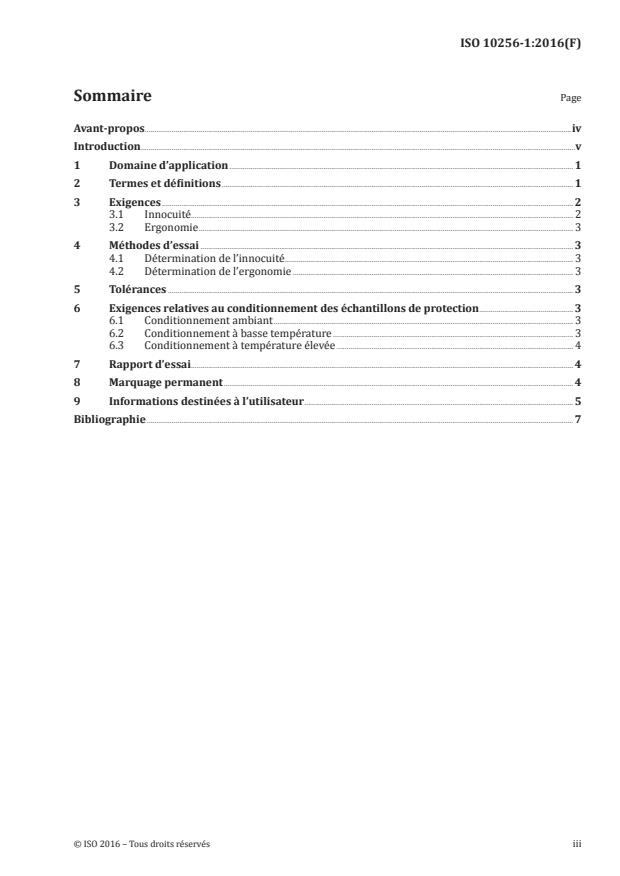
Sommaire Page
Avant-propos .iv
Introduction .v
1 Domaine d’application . 1
2 Termes et définitions . 1
3 Exigences . 2
3.1 Innocuité. 2
3.2 Ergonomie . 3
4 Méthodes d’essai . 3
4.1 Détermination de l’innocuité . 3
4.2 Détermination de l’ergonomie . 3
5 Tolérances . 3
6 Exigences relatives au conditionnement des échantillons de protection .3
6.1 Conditionnement ambiant . 3
6.2 Conditionnement à basse température . 3
6.3 Conditionnement à température élevée . 4
7 Rapport d’essai . 4
8 Marquage permanent . 4
9 Informations destinées à l’utilisateur . 5
Bibliographie . 7
Avant-propos
L’ISO (Organisation internationale de normalisation) est une fédération mondiale d’organismes
nationaux de normalisation (comités membres de l’ISO). L’élaboration des Normes internationales est
en général confiée aux comités techniques de l’ISO. Chaque comité membre intéressé par une étude
a le droit de faire partie du comité technique créé à cet effet. Les organisations internationales,
gouvernementales et non gouvernementales, en liaison avec l’ISO participent également aux travaux.
L’ISO collabore étroitement avec la Commission électrotechnique internationale (IEC) en ce qui
concerne la normalisation électrotechnique.
Les procédures utilisées pour élaborer le présent document et celles destinées à sa mise à jour sont
décrites dans les Directives ISO/IEC, Partie 1. Il convient, en particulier de prendre note des différents
critères d’approbation requis pour les différents types de documents ISO. Le présent document a été
rédigé conformément aux règles de rédaction données dans les Directives ISO/IEC, Partie 2 (voir www.
iso.org/directives).
L’attention est appelée sur le fait que certains des éléments du présent document peuvent faire l’objet de
droits de propriété intellectuelle ou de droits analogues. L’ISO ne saurait être tenue pour responsable
de ne pas avoir identifié de tels droits de propriété et averti de leur existence. Les détails concernant
les références aux droits de propriété intellectuelle ou autres droits analogues identifiés lors de
l’élaboration du document sont indiqués dans l’Introduction et/ou dans la liste des déclarations de
brevets reçues par l’ISO (voir www.iso.org/brevets).
Les appellations commerciales éventuellement mentionnées dans le présent document sont données
pour information, par souci de commodité, à l’intention des utilisateurs et ne sauraient constituer un
engagement.
Pour une explication de la signification des termes et expressions spécifiques de l’ISO liés à
l’évaluation de la conformité, ou pour toute information au sujet de l’adhésion de l’ISO aux principes
de l’OMC concernant les obstacles techniques au commerce (OTC), voir le lien suivant: Avant-propos —
Informations supplémentaires.
Le comité chargé de l’élaboration du présent document est l’ISO/TC 83, Matériel et équipements de sports
et autres activités de loisirs, sous-comité SC 5, Matériel pour hockey sur glace et équipements connexes.
Cette première édition de l’ISO 10256-1, conjointement avec l’ISO 10256-2, l’ISO 10256-3, l’ISO 10256-4,
l’ISO 10256-5 et l’ISO 10256-6, annule et remplace l’ISO 10256:2003, qui a fait l’objet d’une révision
technique.
L’ISO 10256 comprend les parties suivantes, présentées sous le titre général Équipements de protection
destinés à être utilisés en hockey sur glace:
— Partie 1: Exigences générales
— Partie 2: Protections de tête pour les skateurs
— Partie 3: Protections faciales pour les skateurs
— Partie 4: Protections de tête et de visage pour les gardiens de but
— Partie 5: Protège-cous contre les lacérations pour joueurs de hockey sur glace
Les parties suivantes sont en cours d’élaboration:
— Partie 6: Protections de la partie inférieure de la jambe pour joueurs de hockey sur glace
iv © ISO 2016 – Tous droits réservés
Introduction
Le hockey sur glace est un sport de collision et de rapidité où il existe un risque de blessure. La présente
partie de l’ISO 10256 vise à spécifier des exigences générales et à servir de référence pour les normes
spécifiquement applicables au hockey sur glace. Elle tient compte des risques inhérents à ce sport, dont
beaucoup ne peuvent être éradiqués par l’usage d’équipements de protection. En participant, les joueurs
acceptent d’être exposés à un risque de blessure grave, de paralysie et/ou de décès.
Les équipements de protection destinés à être utilisés en hockey sur glace ont pour vocation de réduire
la fréquence et la gravité des blessures localisées sur la partie du corps qu’ils sont supposés protéger.
La fonction de protection vise à répartir et amortir l’impact des chocs contre la protection et à prévenir
toute pénétration d’objets dans la protection ou, dans le cas d’un protège-cou, à réduire le risque de
lacération. Pour atteindre les performances dont ils sont capables et rester stables lorsqu’ils sont
portés, les équipements de protection doivent s’ajuster aussi près que le permet le confort. Lors de leur
utilisation, il est indispensable que les protections soient bien fixées, correctement ajustées et réglées
selon les instructions du fabricant.
Le SC 5 est conscient du fait que des spécifications relatives aux performances des équipements de
protection sont nécessaires pour réduire le risque de blessure en hockey sur glace. L’un des objectifs de
ce sous-comité est d’encourager l’utilisation de matériaux et/ou de fabrications de meilleure qualité, au
fur et à mesure de leur existence, pour satisfaire aux futures exigences du hockey sur glace. Le SC 5 est
également conscient du fait que, pour assurer un bon confort ainsi qu’un ajustement et une utilisation
corrects, dans le respect de la directive de l’Union européenne relative aux équipements de protection
individuelle (Directive 89/686/CEE du Conseil), les équipements de protection destinés au hockey
sur glace doivent être aussi légers que possible tout en offrant les caractéristiques de performance
appropriées satisfaisant aux exigences de ce sport. Pour que ces équipements de protection soient
performants, une formation à leur utilisation et à leur ajustement est indispensable. L’application des
règles du jeu et la cohérence de l’arbitrage contribuent également à optimiser les performances des
équipements de protection et, par conséquent, leur capacité à réduire le risque de blessure.
La présente partie de l’ISO 10256 doit être utilisée conjointement avec les autres normes collatérales de
la série ISO 10256.
NORME INTERNATIONALE ISO 10256-1:2016(F)
Équipements de protection destinés à être utilisés en
hockey sur glace —
Partie 1:
Exigences générales
1 Domaine d’application
La présente partie de l’ISO 10256 spécifie les exigences générales relatives aux protections de la tête,
du visage, du cou et du corps (ci-après dénommées «protections») destinées à être utilisées en hockey
sur glace.
La présente pa
...