

ISO/IEC Guide 41:2018
(Main)Packaging — Recommendations for addressing consumer needs
General Information
- Abstract
This document provides general recommendations to be taken into consideration when determining the most suitable type of packaging for products intended for consumers. The functions that packaging can perform include, but are not limited to, containment, protection, handling, transport, storage, convenience, information and presentation. This document also considers the sustainable use of resources covering optimization, reuse and recovery of packaging. This document provides guidance to: — product designers, manufacturers and others engaged in the process of making decisions concerning packaging; — those drafting standards to meet the packaging needs and requirements of consumers as prospective purchasers of products; — committees preparing standards for consumer products or services; — regulators. This document is not applicable to bulk packaging, which is solely intended to protect products in bulk when being transported between manufacturers and retailers, and it is not intended for industrial packaging.
- Status
- Published
- Publication Date
- 25-Sep-2018
- Technical Committee
- ISO/COPOLCO - Committee on consumer policy
- Drafting Committee
- ISO/COPOLCO - Committee on consumer policy
- Current Stage
- 9093 - International Standard confirmed
- Start Date
- 18-Jan-2024
- Completion Date
- 29-Aug-2026
Buy Documents
ISO/IEC Guide 41:2018 - Packaging — Recommendations for addressing consumer needs Released:9/26/2018
ISO/IEC Guide 41:2018 - Packaging — Recommendations for addressing consumer needs/26/2018
Overview
ISO/IEC Guide 41:2018 - "Packaging - Recommendations for addressing consumer needs" provides practical, non-prescriptive guidance for selecting and designing packaging for consumer products. The guide covers packaging functions such as containment, protection, handling, transport, storage, convenience, information and presentation, and specifically addresses sustainability (optimization, reuse and recovery). It is intended for consumer-focused packaging (primary, secondary, tertiary and sales packaging) and explicitly excludes bulk and industrial packaging.
Key Topics
- Safety and risk management
- Iterative risk assessment and risk reduction following the approach in ISO/IEC Guide 51.
- Consideration of hazards, vulnerable consumers, and child-resistant design where applicable.
- Packaging materials and storage
- Guidance on assessing packaging materials for safety and suitability and on storage conditions that preserve product integrity.
- Suitability for intended purpose
- Design principles to ensure packaging provides required protection, handling and presentation from manufacture to use.
- Sustainable use of resources
- Measures for optimization, reuse, recovery and resource conservation to reduce environmental impact and cost to consumers.
- Information and legibility
- Recommendations on consumer information, durability, recognizability, uniformity, legibility of text (including x-height and typography) and colour for clear communication.
- Scope and applicability
- Targeted at consumer packaging decisions and standards development; not for bulk/industrial packaging.
Applications
ISO/IEC Guide 41:2018 is used to guide decisions and standards across the packaging lifecycle:
- Product designers and manufacturers - to design packaging that balances protection, user safety, cost and sustainability.
- Standards committees and drafters - to incorporate consumer-focused packaging requirements into product standards.
- Regulators - to inform policy and conformity expectations addressing consumer safety, labelling and environmental outcomes.
- Procurement and retail - to evaluate packaging suitability for transport, storage and point-of-sale presentation. Practical benefits include improved consumer safety and accessibility, clearer product information, reduced complaints and more efficient use of materials with lower environmental and cost impacts.
Related Standards (if applicable)
- ISO/IEC Guide 51 - risk assessment and risk reduction methodology
- ISO 18601 series - packaging and the environment (optimization, recovery)
- ISO 8317 - child-resistant packaging
- ISO 21067-1, ISO 18603 - terminology and reuse guidance
Keywords: ISO/IEC Guide 41:2018, packaging recommendations, consumer packaging, packaging safety, sustainable packaging, packaging information, risk assessment, packaging design.
Relations
- Effective Date
- 07-Sep-2013
Buy Documents
ISO/IEC Guide 41:2018 - Packaging — Recommendations for addressing consumer needs Released:9/26/2018
ISO/IEC Guide 41:2018 - Packaging — Recommendations for addressing consumer needs/26/2018
Get Certified
Connect with accredited certification bodies for this standard

BRCGS (Brand Reputation Compliance Global Standards)
Global food safety and quality standards owner.
Sponsored listings
Frequently Asked Questions
ISO/IEC Guide 41:2018 is a guide published by the International Organization for Standardization (ISO). Its full title is "Packaging — Recommendations for addressing consumer needs". This standard covers: This document provides general recommendations to be taken into consideration when determining the most suitable type of packaging for products intended for consumers. The functions that packaging can perform include, but are not limited to, containment, protection, handling, transport, storage, convenience, information and presentation. This document also considers the sustainable use of resources covering optimization, reuse and recovery of packaging. This document provides guidance to: — product designers, manufacturers and others engaged in the process of making decisions concerning packaging; — those drafting standards to meet the packaging needs and requirements of consumers as prospective purchasers of products; — committees preparing standards for consumer products or services; — regulators. This document is not applicable to bulk packaging, which is solely intended to protect products in bulk when being transported between manufacturers and retailers, and it is not intended for industrial packaging.
This document provides general recommendations to be taken into consideration when determining the most suitable type of packaging for products intended for consumers. The functions that packaging can perform include, but are not limited to, containment, protection, handling, transport, storage, convenience, information and presentation. This document also considers the sustainable use of resources covering optimization, reuse and recovery of packaging. This document provides guidance to: — product designers, manufacturers and others engaged in the process of making decisions concerning packaging; — those drafting standards to meet the packaging needs and requirements of consumers as prospective purchasers of products; — committees preparing standards for consumer products or services; — regulators. This document is not applicable to bulk packaging, which is solely intended to protect products in bulk when being transported between manufacturers and retailers, and it is not intended for industrial packaging.
ISO/IEC Guide 41:2018 is classified under the following ICS (International Classification for Standards) categories: 01.120 - Standardization. General rules; 55.020 - Packaging and distribution of goods in general. The ICS classification helps identify the subject area and facilitates finding related standards.
ISO/IEC Guide 41:2018 has the following relationships with other standards: It is inter standard links to ISO/IEC Guide 41:2003. Understanding these relationships helps ensure you are using the most current and applicable version of the standard.
ISO/IEC Guide 41:2018 is available in PDF format for immediate download after purchase. The document can be added to your cart and obtained through the secure checkout process. Digital delivery ensures instant access to the complete standard document.
Standards Content (Sample)
GUIDE 41
Second edition
2018-10
Packaging — Recommendations for
addressing consumer needs
Emballage — Recommandations pour répondre aux besoins des
consommateurs
Reference number
©
ISO/IEC 2018
© ISO/IEC 2018
All rights reserved. Unless otherwise specified, or required in the context of its implementation, no part of this publication may
be reproduced or utilized otherwise in any form or by any means, electronic or mechanical, including photocopying, or posting
on the internet or an intranet, without prior written permission. Permission can be requested from either ISO at the address
below or ISO’s member body in the country of the requester.
ISO copyright office
CP 401 • Ch. de Blandonnet 8
CH-1214 Vernier, Geneva
Phone: +41 22 749 01 11
Fax: +41 22 749 09 47
Email: copyright@iso.org
Website: www.iso.org
Published in Switzerland
ii © ISO/IEC 2018 – All rights reserved
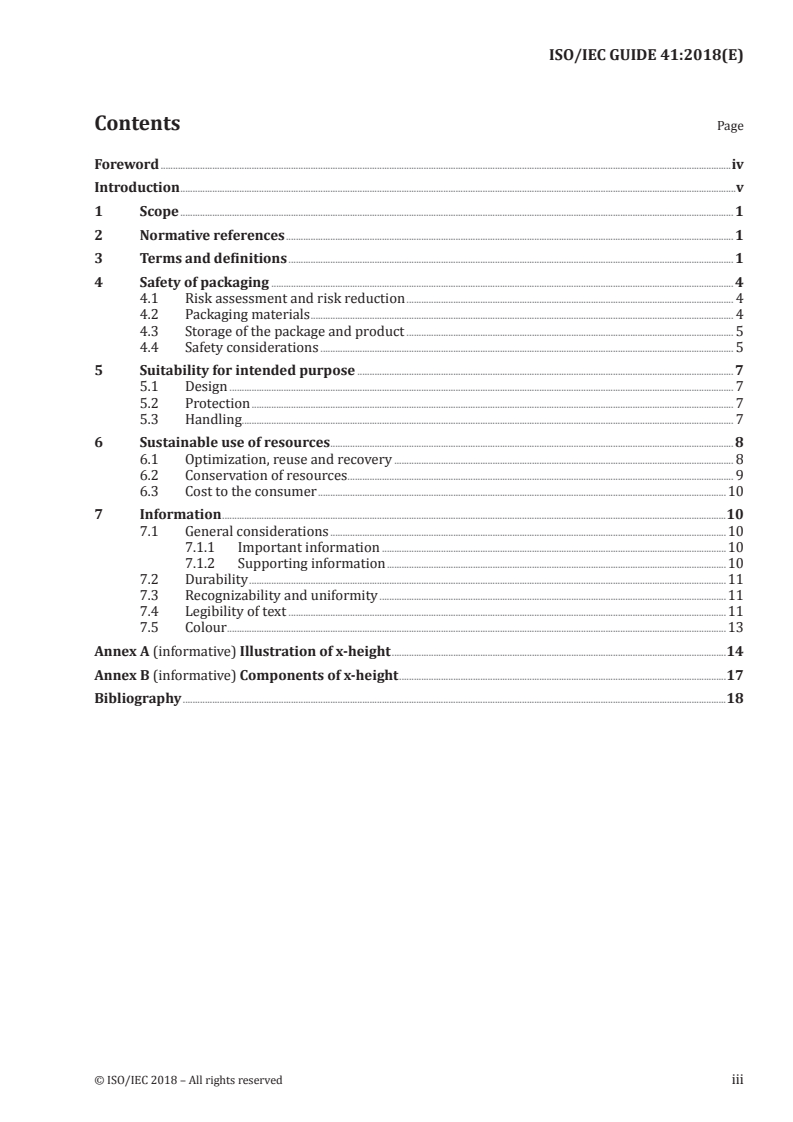
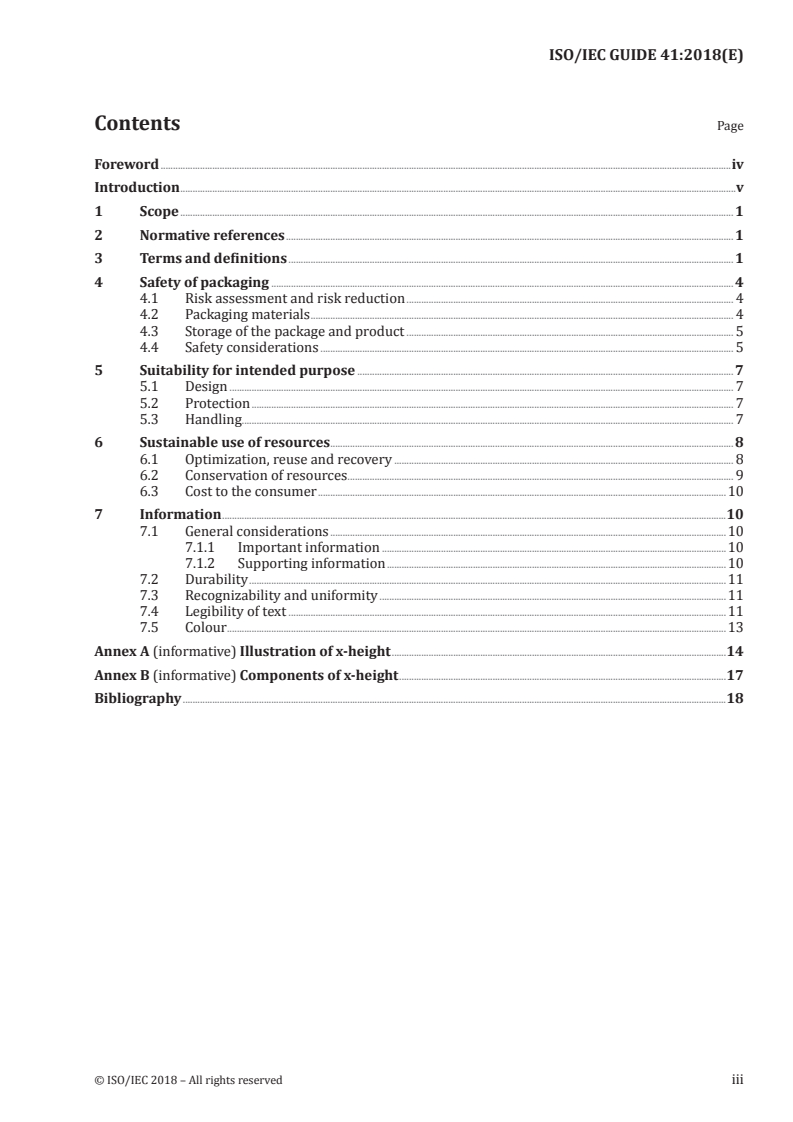
Contents Page
Foreword .iv
Introduction .v
1 Scope . 1
2 Normative references . 1
3 Terms and definitions . 1
4 Safety of packaging . 4
4.1 Risk assessment and risk reduction . 4
4.2 Packaging materials . 4
4.3 Storage of the package and product . 5
4.4 Safety considerations . 5
5 Suitability for intended purpose . 7
5.1 Design . 7
5.2 Protection . 7
5.3 Handling. 7
6 Sustainable use of resources . 8
6.1 Optimization, reuse and recovery . 8
6.2 Conservation of resources . 9
6.3 Cost to the consumer .10
7 Information .10
7.1 General considerations .10
7.1.1 Important information .10
7.1.2 Supporting information .10
7.2 Durability .11
7.3 Recognizability and uniformity .11
7.4 Legibility of text .11
7.5 Colour .13
Annex A (informative) Illustration of x-height .14
Annex B (informative) Components of x-height .17
Bibliography .18
© ISO/IEC 2018 – All rights reserved iii
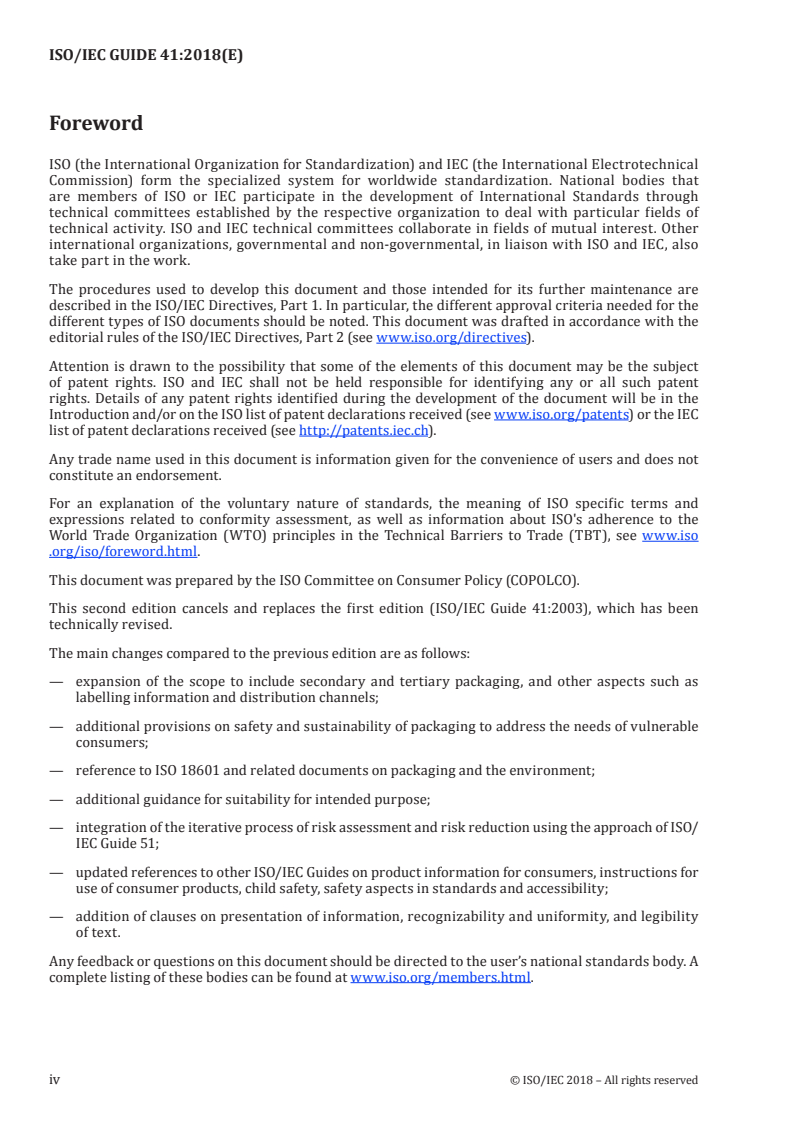
Foreword
ISO (the International Organization for Standardization) and IEC (the International Electrotechnical
Commission) form the specialized system for worldwide standardization. National bodies that
are members of ISO or IEC participate in the development of International Standards through
technical committees established by the respective organization to deal with particular fields of
technical activity. ISO and IEC technical committees collaborate in fields of mutual interest. Other
international organizations, governmental and non-governmental, in liaison with ISO and IEC, also
take part in the work.
The procedures used to develop this document and those intended for its further maintenance are
described in the ISO/IEC Directives, Part 1. In particular, the different approval criteria needed for the
different types of ISO documents should be noted. This document was drafted in accordance with the
editorial rules of the ISO/IEC Directives, Part 2 (see www .iso .org/directives).
Attention is drawn to the possibility that some of the elements of this document may be the subject
of patent rights. ISO and IEC shall not be held responsible for identifying any or all such patent
rights. Details of any patent rights identified during the development of the document will be in the
Introduction and/or on the ISO list of patent declarations received (see www .iso .org/patents) or the IEC
list of patent declarations received (see http: //patents .iec .ch).
Any trade name used in this document is information given for the convenience of users and does not
constitute an endorsement.
For an explanation of the voluntary nature of standards, the meaning of ISO specific terms and
expressions related to conformity assessment, as well as information about ISO's adherence to the
World Trade Organization (WTO) principles in the Technical Barriers to Trade (TBT), see www .iso
.org/iso/foreword .html.
This document was prepared by the ISO Committee on Consumer Policy (COPOLCO).
This second edition cancels and replaces the first edition (ISO/IEC Guide 41:2003), which has been
technically revised.
The main changes compared to the previous edition are as follows:
— expansion of the scope to include secondary and tertiary packaging, and other aspects such as
labelling information and distribution channels;
— additional provisions on safety and sustainability of packaging to address the needs of vulnerable
consumers;
— reference to ISO 18601 and related documents on packaging and the environment;
— additional guidance for suitability for intended purpose;
— integration of the iterative process of risk assessment and risk reduction using the approach of ISO/
IEC Guide 51;
— updated references to other ISO/IEC Guides on product information for consumers, instructions for
use of consumer products, child safety, safety aspects in standards and accessibility;
— addition of clauses on presentation of information, recognizability and uniformity, and legibility
of text.
Any feedback or questions on this document should be directed to the user’s national standards body. A
complete listing of these bodies can be found at www .iso .org/members .html.
iv © ISO/IEC 2018 – All rights reserved
Introduction
Packaging of products is of consumer interest, the cost of which is borne indirectly by the consumer.
Standardization of aspects of packaging addresses such factors as safety, intended purpose and
reliability, as well as such general needs as protection of the environment and energy conservation.
Aspects of packaging can vary in various jurisdictions and/or industry standards or technical
specifications. Suppliers can establish, implement and maintain a procedure to identify the applicable
laws and regulations of the countries where the consumer products are manufactured, imported,
distributed and sold.
The objective of this document is to optimize the direct and indirect benefits to purchasers of products
with respect to the following criteria:
— design: designing suitable packaging to preserve the packaged product until the moment of use;
— safety: protecting consumers from hazards associated with the packaging or the product, including
health and safety, e.g. in cases of reuse;
— information: providing consumer information about the packaged product and its packaging;
— packaging: avoidance of misleading packaging;
NOTE Further information on misleading packaging practices is provided in a study published by the
[37]
European Parliament .
— storage: enabling consumers to store the packaged product appropriately;
— cost impact: optimizing packaging to reduce total cost and the environmental impact of the packaged
product and its packaging;
— environment: reuse and recovery to optimize the use of the packaging and dispose of it in a manner
that minimizes its environmental impact.
A supplier of high quality packaging can benefit from an enhanced reputation. Cost savings in time and
money can also be achieved by reduced levels of enquiries and complaints.
© ISO/IEC 2018 – All rights reserved v
GUIDE ISO/IEC GUIDE 41:2018(E)
Packaging — Recommendations for addressing
consumer needs
1 Scope
This document provides general recommendations to be taken into consideration when determining
the most suitable type of packaging for products intended for consumers. The functions that packaging
can perform include, but are not limited to, containment, protection, handling, transport, storage,
convenience, information and presentation.
This document also considers the sustainable use of resources covering optimization, reuse and
recovery of packaging.
This document provides guidance to:
— product designers, manufacturers and others engaged in the process of making decisions concerning
packaging;
— those drafting standards to meet the packaging needs and requirements of consumers as prospective
purchasers of products;
— committees preparing standards for consumer products or services;
— regulators.
This document is not applicable to bulk packaging, which is solely intended to protect products in bulk
when being transported between manufacturers and retailers, and it is not intended for industrial
packaging.
2 Normative references
There are no normative references in this document.
3 Terms and definitions
For the purposes of this document, the following terms and definitions apply.
ISO and IEC maintain terminological databases for use in standardization at the following addresses:
— ISO Online browsing platform: available at http: //www .iso .org/obp
— IEC Electropedia: available at http: //www .electropedia .org/
3.1
consumer
individual member of the general public purchasing or using goods, property or services for private
purposes
[SOURCE: ISO 14025:2006, 3.16]
© ISO/IEC 2018 – All rights reserved 1
3.2
packaging
product (3.24) to be used for the containment, protection, handling, delivery, storage, transport
and presentation of goods, from raw materials to processed goods, from the producer to the user or
consumer (3.1), including processor, assembler or other intermediary
[SOURCE: ISO 21067-1:2016, 2.1.1, modified — The domain has been removed at the start of
the definition.]
3.3
primary packaging
packaging (3.2) designed to come into direct contact with the product (3.24)
[SOURCE: ISO 21067-1:2016, 2.2.3]
3.4
secondary packaging
packaging (3.2) designed to contain one or more primary packaging (3.3) together with any protective
materials where required
[SOURCE: ISO 18601:2013, 3.20, modified — The alternative term “group packaging” has been removed.]
3.5
tertiary packaging
packaging (3.2) designed to contain one or more articles or packages, or bulk material, for the purposes
of transport, handling and/or distribution
[SOURCE: ISO 21067-1:2016, 2.2.6, modified — The alternative terms “distribution packaging” and
“transport packaging” have been removed.]
3.6
sales packaging
packaging (3.2) constituting, with its contents, a sales unit for the final user or consumer (3.1) at the
point of retail
[SOURCE: ISO 21067-1:2016, 2.2.7, modified — The alternative terms “consumer packaging” and “retail
packaging” have been removed.]
3.7
industrial packaging
packaging (3.2) for raw materials, components and partially manufactured or finished goods, for
distribution from manufacturer to manufacturer and/or other intermediaries such as processor or
assembler
[SOURCE: ISO 21067-1:2016, 2.2.8]
3.8
bulk packaging
packaging (3.2) intended to contain loose articles, large masses of solids or granular materials, or
liquids for transport or storage
[SOURCE: ISO 21067-1:2016, 2.2.10]
3.9
child-resistant packaging
package consisting of a container and appropriate closure which is difficult for young children under
the age of 52 months to open (or gain access to the contents), but which is not difficult for adults to use
properly
[SOURCE: ISO 8317:2015, 2.3]
2 © ISO/IEC 2018 – All rights reserved
3.10
reuse
operation by which packaging (3.2) is refilled or used for the same purpose for which it was conceived,
with or without the support of auxiliary products (3.24) present on the market enabling the packaging
to be refilled
Note 1 to entry: Non reusable items that support packaging reuse, such as labels or closures, are considered to be
part of that packaging.
[SOURCE: ISO 18603:2013, 3.1]
3.11
packaging component
part of packaging (3.2) that can be separated by hand or by using simple physical means
[SOURCE: ISO 18601:2013, 3.11]
3.12
harm
injury or damage to the health of people, or damage to property or the environment
[SOURCE: ISO/IEC Guide 51:2014, 3.1]
3.13
hazard
potential source of harm (3.12)
[SOURCE: ISO/IEC Guide 51:2014, 3.2]
3.14
hazardous event
event that can cause harm (3.12)
[SOURCE: ISO/IEC Guide 51:2014, 3.3]
3.15
hazardous situation
circumstance in which people, property or the environment is/are exposed to one or more hazards (3.13)
[SOURCE: ISO/IEC Guide 51:2014, 3.4]
3.16
risk
combination of the probability of occurrence of harm (3.12) and the severity of that harm
Note 1 to entry: The probability of occurrence includes the exposure to a hazardous situation (3.15), the
occurrence of a hazardous event (3.14) and the possibility to avoid or limit the harm (3.12).
[SOURCE: ISO/IEC Guide 51:2014, 3.9]
3.17
risk reduction measure
action or means to eliminate hazards (3.13) or reduce risks (3.16)
EXAMPLE Inherently safe design (3.20); protective devices; personal protective equipment; information for
use and installation; organization of work; training; application of equipment; supervision.
[SOURCE: ISO/IEC Guide 51:2014, 3.13, modified — The alternative term “protective measure” has been
removed.]
© ISO/IEC 2018 – All rights reserved 3
3.18
safety
freedom from risk (3.16) which is not tolerable
[SOURCE: ISO/IEC Guide 51:2014, 3.14]
3.19
tolerable risk
level of risk (3.16) that is accepted in a given context based on the current values of society
[SOURCE: ISO/IEC Guide 51:2014, 3.15, modified — The original Note to entry has been removed.]
3.20
inherently safe design
measures taken to eliminate hazards (3.13) and/or to reduce risks (3.16) by changing the design or
operating characteristics of the product (3.24)
[SOURCE: ISO/IEC Guide 51:2014, 3.5, modified — The words “or system” have been removed.]
3.21
vulnerable consumer
consumer (3.1) at greater risk (3.16) of harm (3.12) from products (3.24), due to age, level of literacy,
physical or mental condition or limitations, or inability to access product safety (3.18) information
[SOURCE: ISO/IEC Guide 51:2014, 3.16, modified — The words “or systems” have been removed.]
3.22
x-height
height of lowercase letters, ignoring ascenders or descenders
Note 1 to entry: Annex A provides further information on x-height.
3.23
useful life
time period during which all the performance requirements are met
3.24
product
any goods or service
[SOURCE: ISO 14024:2018, 3.2]
4 Safety of packaging
4.1 Risk assessment and risk reduction
The iterative process of risk assessment and risk reduction for each hazard is essential in achieving
acceptable/tolerable risk. All products can include hazards and, therefore, some level of residual risk.
ISO/IEC Guide 51 requires standards writers and standards users to use the iterative process of risk
assessment and risk reduction measures, to achieve acceptable/tolerable risk.
4.2 Packaging materials
4.2.1 Packaging materials should be assessed for human and environmental impact of hazardous
substances, including, but not limited to, four heavy metals (mercury, cadmium, lead and hexavalent
chromium).
NOTE Limits to heavy metals and other substances hazardous to humans and the environment can be found
in national and regional regulations.
4 © ISO/IEC 2018 – All rights reserved
4.2.2 Packaging materials should be compatible with the content. For example, in cases of alimentary
and medical contents the packaging should be food grade and medical grade respectively.
4.2.3 Packaging materials should not deteriorate and become ineffective due to contact with the
contents.
4.3 Storage of the package and product
4.3.1 The packaging material should not present a hazard by causing:
— the emission of substances which can endanger or be harmful to health or to the environment;
— the contamination of its contents or the contamination resulting from the interaction of the
packaging material with its contents.
4.3.2 The contents should not leak. The risks posed by the leaking of hazardous materials should be
assessed. The following possible causes of leakage should be considered:
a) defective seals;
b) improper application of a closing device;
c) deterioration of the packaging caused by outside influences, e.g. temperature, light or
mechanical forces;
d) any relevant warnings and instructions for disposal (e.g. “Do not flush unused medications in the
toilet”), which should be repeated where technically feasible on any inner packaging;
e) deterioration of the packaging caused by the product.
4.3.3 When the product in a package requires the release of non-toxic gases for avoiding product
deterioration, a packaging design which allows controlled release is accepted e.g. smart packaging for
medical devices, coffee and dairy products.
4.3.4 In cases where the product can pose a hazard, the packaging should be clearly labelled with
relevant warnings and instructions for storage, e.g. "refrigerate after opening".
NOTE 1 Information on warnings and labelling is given in ISO 3864-1 and ISO 3864-2.
NOTE 2 Information on the use of graphical symbols in safety signs and product safety labels is given in ISO/
IEC Guide 74.
NOTE 3 Information for visually impaired consumers in need of tactile warning symbols is given in ISO 11683.
NOTE 4 Guidance on child-resistant packaging is given in ISO 8317.
NOTE 5 Information on safety colours and safety signs is given in ISO 7010.
4.4 Safety considerations
4.4.1 Potentially harmful contents
Where contents are potentially harmful, the following should be considered.
a) The packaging should not be misleading in that it should be clearly distinguishable, in colour and
shape or by other means, from packaging used for food or beverages.
b) The packaging should be clearly labelled with relevant warnings and instructions for use and
disposal of the contents.
© ISO/IEC 2018 – All rights reserved 5
c) Any relevant warnings and instructions for use (e.g. “Keep out of children's reach”) should be
repeated where technically feasible on any inner packaging.
d) Any relevant warnings or instructions for disposal (e.g. “Do not flush after use” or “Do not flush
unused medications in the toilet”) should be repeated where technically feasible on any inner
packaging or on the product itself, as appropriate.
e) Child-resistant packaging according to ISO 8317 should be used.
NOTE 1 ISO 11156 provides further information on accessible packaging design which is “child-resistant-
senior- friendly”.
f) Packaging should not be appealing to children.
NOTE 2 ISO/IEC Guide 50 provides further information on safety aspects in standards for children.
g) In the case of packaging of food products, chemical and pharmaceutical products, where applicable,
the expiration date needs to be visible, permanent and legible in a colour that contrasts with
the background, or embossed. Recommended fonts are Arial or Helvetica, because the letters
are separated and are therefore are legible, and the minimum size of the letters is 8 points. The
legibility of the expiration date should be ensured based on the packaging size.
NOTE 3 The date format specified in ISO 8601 can be used, i.e. the format YYYYMMDD (e.g. 20170412).
NOTE 4 Information on issues related to product safety is given in ISO 10377.
4.4.2 Potential hazards associated with opening packaging
Consumers should be informed about the product’s useful life after the package has been opened.
Where the packaging or the product can pose a hazard upon opening the package or on removing the
product, the following should be considered:
a) information for opening the package and removing the product from the package should be on the
package;
b) the method of opening the package should be appropriate to the type of package, the product and
the type of consumers;
c) in some situations, two or more consumer groups can have different and possibly conflicting
requirements with respect to the methods of opening;
d) the packaging should allow the removal of the product without damage to the product or exposing
the consumer to risk that is not tolerable;
e) the design of packaging should be such that the consumer will be able to open it easily, with
tolerable risk of injury or damage to the product;
NOTE 1 Further guidance is given in ISO 3864-1, ISO 3864-2, ISO 1
...
GUIDE 41
Second edition
2018-10
Packaging — Recommendations for
addressing consumer needs
Emballage — Recommandations pour répondre aux besoins des
consommateurs
Reference number
©
ISO/IEC 2018
© ISO/IEC 2018
All rights reserved. Unless otherwise specified, or required in the context of its implementation, no part of this publication may
be reproduced or utilized otherwise in any form or by any means, electronic or mechanical, including photocopying, or posting
on the internet or an intranet, without prior written permission. Permission can be requested from either ISO at the address
below or ISO’s member body in the country of the requester.
ISO copyright office
CP 401 • Ch. de Blandonnet 8
CH-1214 Vernier, Geneva
Phone: +41 22 749 01 11
Fax: +41 22 749 09 47
Email: copyright@iso.org
Website: www.iso.org
Published in Switzerland
ii © ISO/IEC 2018 – All rights reserved
Contents Page
Foreword .iv
Introduction .v
1 Scope . 1
2 Normative references . 1
3 Terms and definitions . 1
4 Safety of packaging . 4
4.1 Risk assessment and risk reduction . 4
4.2 Packaging materials . 4
4.3 Storage of the package and product . 5
4.4 Safety considerations . 5
5 Suitability for intended purpose . 7
5.1 Design . 7
5.2 Protection . 7
5.3 Handling. 7
6 Sustainable use of resources . 8
6.1 Optimization, reuse and recovery . 8
6.2 Conservation of resources . 9
6.3 Cost to the consumer .10
7 Information .10
7.1 General considerations .10
7.1.1 Important information .10
7.1.2 Supporting information .10
7.2 Durability .11
7.3 Recognizability and uniformity .11
7.4 Legibility of text .11
7.5 Colour .13
Annex A (informative) Illustration of x-height .14
Annex B (informative) Components of x-height .17
Bibliography .18
© ISO/IEC 2018 – All rights reserved iii
Foreword
ISO (the International Organization for Standardization) and IEC (the International Electrotechnical
Commission) form the specialized system for worldwide standardization. National bodies that
are members of ISO or IEC participate in the development of International Standards through
technical committees established by the respective organization to deal with particular fields of
technical activity. ISO and IEC technical committees collaborate in fields of mutual interest. Other
international organizations, governmental and non-governmental, in liaison with ISO and IEC, also
take part in the work.
The procedures used to develop this document and those intended for its further maintenance are
described in the ISO/IEC Directives, Part 1. In particular, the different approval criteria needed for the
different types of ISO documents should be noted. This document was drafted in accordance with the
editorial rules of the ISO/IEC Directives, Part 2 (see www .iso .org/directives).
Attention is drawn to the possibility that some of the elements of this document may be the subject
of patent rights. ISO and IEC shall not be held responsible for identifying any or all such patent
rights. Details of any patent rights identified during the development of the document will be in the
Introduction and/or on the ISO list of patent declarations received (see www .iso .org/patents) or the IEC
list of patent declarations received (see http: //patents .iec .ch).
Any trade name used in this document is information given for the convenience of users and does not
constitute an endorsement.
For an explanation of the voluntary nature of standards, the meaning of ISO specific terms and
expressions related to conformity assessment, as well as information about ISO's adherence to the
World Trade Organization (WTO) principles in the Technical Barriers to Trade (TBT), see www .iso
.org/iso/foreword .html.
This document was prepared by the ISO Committee on Consumer Policy (COPOLCO).
This second edition cancels and replaces the first edition (ISO/IEC Guide 41:2003), which has been
technically revised.
The main changes compared to the previous edition are as follows:
— expansion of the scope to include secondary and tertiary packaging, and other aspects such as
labelling information and distribution channels;
— additional provisions on safety and sustainability of packaging to address the needs of vulnerable
consumers;
— reference to ISO 18601 and related documents on packaging and the environment;
— additional guidance for suitability for intended purpose;
— integration of the iterative process of risk assessment and risk reduction using the approach of ISO/
IEC Guide 51;
— updated references to other ISO/IEC Guides on product information for consumers, instructions for
use of consumer products, child safety, safety aspects in standards and accessibility;
— addition of clauses on presentation of information, recognizability and uniformity, and legibility
of text.
Any feedback or questions on this document should be directed to the user’s national standards body. A
complete listing of these bodies can be found at www .iso .org/members .html.
iv © ISO/IEC 2018 – All rights reserved
Introduction
Packaging of products is of consumer interest, the cost of which is borne indirectly by the consumer.
Standardization of aspects of packaging addresses such factors as safety, intended purpose and
reliability, as well as such general needs as protection of the environment and energy conservation.
Aspects of packaging can vary in various jurisdictions and/or industry standards or technical
specifications. Suppliers can establish, implement and maintain a procedure to identify the applicable
laws and regulations of the countries where the consumer products are manufactured, imported,
distributed and sold.
The objective of this document is to optimize the direct and indirect benefits to purchasers of products
with respect to the following criteria:
— design: designing suitable packaging to preserve the packaged product until the moment of use;
— safety: protecting consumers from hazards associated with the packaging or the product, including
health and safety, e.g. in cases of reuse;
— information: providing consumer information about the packaged product and its packaging;
— packaging: avoidance of misleading packaging;
NOTE Further information on misleading packaging practices is provided in a study published by the
[37]
European Parliament .
— storage: enabling consumers to store the packaged product appropriately;
— cost impact: optimizing packaging to reduce total cost and the environmental impact of the packaged
product and its packaging;
— environment: reuse and recovery to optimize the use of the packaging and dispose of it in a manner
that minimizes its environmental impact.
A supplier of high quality packaging can benefit from an enhanced reputation. Cost savings in time and
money can also be achieved by reduced levels of enquiries and complaints.
© ISO/IEC 2018 – All rights reserved v
GUIDE ISO/IEC GUIDE 41:2018(E)
Packaging — Recommendations for addressing
consumer needs
1 Scope
This document provides general recommendations to be taken into consideration when determining
the most suitable type of packaging for products intended for consumers. The functions that packaging
can perform include, but are not limited to, containment, protection, handling, transport, storage,
convenience, information and presentation.
This document also considers the sustainable use of resources covering optimization, reuse and
recovery of packaging.
This document provides guidance to:
— product designers, manufacturers and others engaged in the process of making decisions concerning
packaging;
— those drafting standards to meet the packaging needs and requirements of consumers as prospective
purchasers of products;
— committees preparing standards for consumer products or services;
— regulators.
This document is not applicable to bulk packaging, which is solely intended to protect products in bulk
when being transported between manufacturers and retailers, and it is not intended for industrial
packaging.
2 Normative references
There are no normative references in this document.
3 Terms and definitions
For the purposes of this document, the following terms and definitions apply.
ISO and IEC maintain terminological databases for use in standardization at the following addresses:
— ISO Online browsing platform: available at http: //www .iso .org/obp
— IEC Electropedia: available at http: //www .electropedia .org/
3.1
consumer
individual member of the general public purchasing or using goods, property or services for private
purposes
[SOURCE: ISO 14025:2006, 3.16]
© ISO/IEC 2018 – All rights reserved 1
3.2
packaging
product (3.24) to be used for the containment, protection, handling, delivery, storage, transport
and presentation of goods, from raw materials to processed goods, from the producer to the user or
consumer (3.1), including processor, assembler or other intermediary
[SOURCE: ISO 21067-1:2016, 2.1.1, modified — The domain has been removed at the start of
the definition.]
3.3
primary packaging
packaging (3.2) designed to come into direct contact with the product (3.24)
[SOURCE: ISO 21067-1:2016, 2.2.3]
3.4
secondary packaging
packaging (3.2) designed to contain one or more primary packaging (3.3) together with any protective
materials where required
[SOURCE: ISO 18601:2013, 3.20, modified — The alternative term “group packaging” has been removed.]
3.5
tertiary packaging
packaging (3.2) designed to contain one or more articles or packages, or bulk material, for the purposes
of transport, handling and/or distribution
[SOURCE: ISO 21067-1:2016, 2.2.6, modified — The alternative terms “distribution packaging” and
“transport packaging” have been removed.]
3.6
sales packaging
packaging (3.2) constituting, with its contents, a sales unit for the final user or consumer (3.1) at the
point of retail
[SOURCE: ISO 21067-1:2016, 2.2.7, modified — The alternative terms “consumer packaging” and “retail
packaging” have been removed.]
3.7
industrial packaging
packaging (3.2) for raw materials, components and partially manufactured or finished goods, for
distribution from manufacturer to manufacturer and/or other intermediaries such as processor or
assembler
[SOURCE: ISO 21067-1:2016, 2.2.8]
3.8
bulk packaging
packaging (3.2) intended to contain loose articles, large masses of solids or granular materials, or
liquids for transport or storage
[SOURCE: ISO 21067-1:2016, 2.2.10]
3.9
child-resistant packaging
package consisting of a container and appropriate closure which is difficult for young children under
the age of 52 months to open (or gain access to the contents), but which is not difficult for adults to use
properly
[SOURCE: ISO 8317:2015, 2.3]
2 © ISO/IEC 2018 – All rights reserved
3.10
reuse
operation by which packaging (3.2) is refilled or used for the same purpose for which it was conceived,
with or without the support of auxiliary products (3.24) present on the market enabling the packaging
to be refilled
Note 1 to entry: Non reusable items that support packaging reuse, such as labels or closures, are considered to be
part of that packaging.
[SOURCE: ISO 18603:2013, 3.1]
3.11
packaging component
part of packaging (3.2) that can be separated by hand or by using simple physical means
[SOURCE: ISO 18601:2013, 3.11]
3.12
harm
injury or damage to the health of people, or damage to property or the environment
[SOURCE: ISO/IEC Guide 51:2014, 3.1]
3.13
hazard
potential source of harm (3.12)
[SOURCE: ISO/IEC Guide 51:2014, 3.2]
3.14
hazardous event
event that can cause harm (3.12)
[SOURCE: ISO/IEC Guide 51:2014, 3.3]
3.15
hazardous situation
circumstance in which people, property or the environment is/are exposed to one or more hazards (3.13)
[SOURCE: ISO/IEC Guide 51:2014, 3.4]
3.16
risk
combination of the probability of occurrence of harm (3.12) and the severity of that harm
Note 1 to entry: The probability of occurrence includes the exposure to a hazardous situation (3.15), the
occurrence of a hazardous event (3.14) and the possibility to avoid or limit the harm (3.12).
[SOURCE: ISO/IEC Guide 51:2014, 3.9]
3.17
risk reduction measure
action or means to eliminate hazards (3.13) or reduce risks (3.16)
EXAMPLE Inherently safe design (3.20); protective devices; personal protective equipment; information for
use and installation; organization of work; training; application of equipment; supervision.
[SOURCE: ISO/IEC Guide 51:2014, 3.13, modified — The alternative term “protective measure” has been
removed.]
© ISO/IEC 2018 – All rights reserved 3
3.18
safety
freedom from risk (3.16) which is not tolerable
[SOURCE: ISO/IEC Guide 51:2014, 3.14]
3.19
tolerable risk
level of risk (3.16) that is accepted in a given context based on the current values of society
[SOURCE: ISO/IEC Guide 51:2014, 3.15, modified — The original Note to entry has been removed.]
3.20
inherently safe design
measures taken to eliminate hazards (3.13) and/or to reduce risks (3.16) by changing the design or
operating characteristics of the product (3.24)
[SOURCE: ISO/IEC Guide 51:2014, 3.5, modified — The words “or system” have been removed.]
3.21
vulnerable consumer
consumer (3.1) at greater risk (3.16) of harm (3.12) from products (3.24), due to age, level of literacy,
physical or mental condition or limitations, or inability to access product safety (3.18) information
[SOURCE: ISO/IEC Guide 51:2014, 3.16, modified — The words “or systems” have been removed.]
3.22
x-height
height of lowercase letters, ignoring ascenders or descenders
Note 1 to entry: Annex A provides further information on x-height.
3.23
useful life
time period during which all the performance requirements are met
3.24
product
any goods or service
[SOURCE: ISO 14024:2018, 3.2]
4 Safety of packaging
4.1 Risk assessment and risk reduction
The iterative process of risk assessment and risk reduction for each hazard is essential in achieving
acceptable/tolerable risk. All products can include hazards and, therefore, some level of residual risk.
ISO/IEC Guide 51 requires standards writers and standards users to use the iterative process of risk
assessment and risk reduction measures, to achieve acceptable/tolerable risk.
4.2 Packaging materials
4.2.1 Packaging materials should be assessed for human and environmental impact of hazardous
substances, including, but not limited to, four heavy metals (mercury, cadmium, lead and hexavalent
chromium).
NOTE Limits to heavy metals and other substances hazardous to humans and the environment can be found
in national and regional regulations.
4 © ISO/IEC 2018 – All rights reserved
4.2.2 Packaging materials should be compatible with the content. For example, in cases of alimentary
and medical contents the packaging should be food grade and medical grade respectively.
4.2.3 Packaging materials should not deteriorate and become ineffective due to contact with the
contents.
4.3 Storage of the package and product
4.3.1 The packaging material should not present a hazard by causing:
— the emission of substances which can endanger or be harmful to health or to the environment;
— the contamination of its contents or the contamination resulting from the interaction of the
packaging material with its contents.
4.3.2 The contents should not leak. The risks posed by the leaking of hazardous materials should be
assessed. The following possible causes of leakage should be considered:
a) defective seals;
b) improper application of a closing device;
c) deterioration of the packaging caused by outside influences, e.g. temperature, light or
mechanical forces;
d) any relevant warnings and instructions for disposal (e.g. “Do not flush unused medications in the
toilet”), which should be repeated where technically feasible on any inner packaging;
e) deterioration of the packaging caused by the product.
4.3.3 When the product in a package requires the release of non-toxic gases for avoiding product
deterioration, a packaging design which allows controlled release is accepted e.g. smart packaging for
medical devices, coffee and dairy products.
4.3.4 In cases where the product can pose a hazard, the packaging should be clearly labelled with
relevant warnings and instructions for storage, e.g. "refrigerate after opening".
NOTE 1 Information on warnings and labelling is given in ISO 3864-1 and ISO 3864-2.
NOTE 2 Information on the use of graphical symbols in safety signs and product safety labels is given in ISO/
IEC Guide 74.
NOTE 3 Information for visually impaired consumers in need of tactile warning symbols is given in ISO 11683.
NOTE 4 Guidance on child-resistant packaging is given in ISO 8317.
NOTE 5 Information on safety colours and safety signs is given in ISO 7010.
4.4 Safety considerations
4.4.1 Potentially harmful contents
Where contents are potentially harmful, the following should be considered.
a) The packaging should not be misleading in that it should be clearly distinguishable, in colour and
shape or by other means, from packaging used for food or beverages.
b) The packaging should be clearly labelled with relevant warnings and instructions for use and
disposal of the contents.
© ISO/IEC 2018 – All rights reserved 5
c) Any relevant warnings and instructions for use (e.g. “Keep out of children's reach”) should be
repeated where technically feasible on any inner packaging.
d) Any relevant warnings or instructions for disposal (e.g. “Do not flush after use” or “Do not flush
unused medications in the toilet”) should be repeated where technically feasible on any inner
packaging or on the product itself, as appropriate.
e) Child-resistant packaging according to ISO 8317 should be used.
NOTE 1 ISO 11156 provides further information on accessible packaging design which is “child-resistant-
senior- friendly”.
f) Packaging should not be appealing to children.
NOTE 2 ISO/IEC Guide 50 provides further information on safety aspects in standards for children.
g) In the case of packaging of food products, chemical and pharmaceutical products, where applicable,
the expiration date needs to be visible, permanent and legible in a colour that contrasts with
the background, or embossed. Recommended fonts are Arial or Helvetica, because the letters
are separated and are therefore are legible, and the minimum size of the letters is 8 points. The
legibility of the expiration date should be ensured based on the packaging size.
NOTE 3 The date format specified in ISO 8601 can be used, i.e. the format YYYYMMDD (e.g. 20170412).
NOTE 4 Information on issues related to product safety is given in ISO 10377.
4.4.2 Potential hazards associated with opening packaging
Consumers should be informed about the product’s useful life after the package has been opened.
Where the packaging or the product can pose a hazard upon opening the package or on removing the
product, the following should be considered:
a) information for opening the package and removing the product from the package should be on the
package;
b) the method of opening the package should be appropriate to the type of package, the product and
the type of consumers;
c) in some situations, two or more consumer groups can have different and possibly conflicting
requirements with respect to the methods of opening;
d) the packaging should allow the removal of the product without damage to the product or exposing
the consumer to risk that is not tolerable;
e) the design of packaging should be such that the consumer will be able to open it easily, with
tolerable risk of injury or damage to the product;
NOTE 1 Further guidance is given in ISO 3864-1, ISO 3864-2, ISO 1
...