

ISO 3884:2025
(Main)Solid recovered fuels — Methods for the determination of the content of elements (Al, Ca, Fe, K, Mg, Na, P, S, Si, Ti, As, Ba, Be, Cd, Co, Cr, Cu, Hg, Mo, Mn, Ni, Pb, Sb, Se, Sn, Tl, V, Zn)
General Information
- Abstract
This document specifies methods for the determination of major and minor element concentrations in solid recovered fuels after digestion by the use of different acid mixtures and by addition of a fluxing agent for solid recovered fuel (SRF) ash. a) Method A: Microwave assisted digestion with hydrochloric, nitric and hydrofluoric acid mixture (6 ml HCl; 2 ml HNO3; 2 ml HF) followed by boric acid complexation; b) Method AT: Microwave assisted digestion with hydrochloric, nitric and tetrafluoroboric acid mixture (6 ml HCl; 2 ml HNO3; 4 ml HBF4); c) Method B: Microwave assisted digestion with hydrochloric, nitric and hydrofluoric acid mixture (0,5 ml HCl; 6 ml HNO3; 1 ml HF) followed by boric acid complexation; d) Method BT: Microwave assisted digestion with hydrochloric, nitric and tetrafluoroboric acid mixture (0,5 ml HCl; 6 ml HNO3; 2 ml HBF4); e) Method C: Microwave assisted digestion with nitric acid, hydrogen peroxide and hydrofluoric acid mixture (2,5 ml H2O2; 5 ml HNO3; 0,4 ml HF) and optional boric acid complexation; f) Method CT: Microwave assisted digestion with nitric acid, hydrogen peroxide and tetrafluoroboric acid mixture (2,5 ml H2O2; 5 ml HNO3; 0,8 ml HBF4); g) Method D: Digestion of the ashed SRF sample with fluxing agent lithium metaborate in an oven at 1 050 °C. This document is applicable for the following major and minor/trace elements: — Major elements: aluminium (Al), calcium (Ca), iron (Fe), potassium (K), magnesium (Mg), sodium (Na), phosphorus (P), sulfur (S), silicon (Si) and titanium (Ti). — Minor/trace elements: arsenic (As), barium (Ba), beryllium (Be), cadmium (Cd), cobalt (Co), chromium (Cr), copper (Cu), mercury (Hg), molybdenum (Mo), manganese (Mn), nickel (Ni), lead (Pb), antimony (Sb), selenium (Se), tin (Sn), thallium (Tl), vanadium (V) and zinc (Zn). Method A is applicable for general use for SRF and ashed SRFs, but the amount of the test portion can be very low in case of high concentration of organic matter. Method AT can be used if an alternative to HF is necessary. Method B with a higher volume of nitric acid is applicable for SRFs with high organic matter (e.g. suitable for high plastic content) that can be difficult to digest with less nitric acid or as a substitute for method A if appropriate equipment is not available. Method BT can be used if an alternative to HF is necessary. Method C with combination of nitric acid and hydrogen peroxide and addition of hydrofluoric acid is applicable for wood based SRFs (e.g. demolition wood) or when there is a need for comparability to solid biofuel standards. Method CT can be used if an alternative to HF is necessary. Method D is specifically applicable for determination of major elements in ashed SRF samples. XRF can be used for the analysis of major elements (Al, Ca, Fe, K, Mg, Na, P, S, Si, Ti) after ashing (815 °C) of the samples and several major and minor/trace elements in SRF can be analysed by XRF after suitable calibration provided that the concentration levels are above instrumental detection limits of the XRF instrumentation and after proper preliminary testing and validation. Digestion methods with HF and subsequent boric acid complexation or application of method D are applicable for determination of Si and Ti (better digestion efficiency). Alternative digestion methods can be applied, if their performance is proved to be comparable with those of the methods described in this document.
- Status
- Published
- Publication Date
- 08-Apr-2025
- Technical Committee
- ISO/TC 300 - Solid recovered materials, including solid recovered fuels
- Drafting Committee
- ISO/TC 300/WG 5 - Chemical tests and determination of biomass content
- Current Stage
- 6060 - International Standard published
- Start Date
- 09-Apr-2025
- Due Date
- 16-Nov-2025
- Completion Date
- 09-Apr-2025
Buy Documents
ISO 3884:2025 - Solid recovered fuels — Methods for the determination of the content of elements (Al, Ca, Fe, K, Mg, Na, P, S, Si, Ti, As, Ba, Be, Cd, Co, Cr, Cu, Hg, Mo, Mn, Ni, Pb, Sb, Se, Sn, Tl, V, Zn) Released:9. 04. 2025
ISO 3884:2025 - Combustibles solides de récupération — Méthodes de détermination de la teneur en éléments (Al, Ca, Fe, K, Mg, Na, P, S, Si, Ti, As, Ba, Be, Cd, Co, Cr, Cu, Hg, Mo, Mn, Ni, Pb, Sb, Se, Sn, Tl, V, Zn) Released:9. 04. 2025
Overview
ISO 3884:2025 specifies validated laboratory methods for determining the elemental composition of solid recovered fuels (SRF). It covers both major elements (Al, Ca, Fe, K, Mg, Na, P, S, Si, Ti) and minor/trace elements (As, Ba, Be, Cd, Co, Cr, Cu, Hg, Mo, Mn, Ni, Pb, Sb, Se, Sn, Tl, V, Zn). The standard defines multiple microwave-assisted digestion procedures using different acid mixtures and a high-temperature fluxing (lithium metaborate) fusion for ashed SRF, plus guidance on using X‑ray fluorescence (XRF) where appropriate.
Key topics and requirements
- Multiple digestion methods tailored to SRF matrix:
- Method A: Microwave digestion with HCl (6 ml), HNO3 (2 ml), HF (2 ml) + boric acid complexation - general use.
- Method AT: HCl (6 ml), HNO3 (2 ml), HBF4 (4 ml) - HF alternative.
- Method B / BT: Higher HNO3 (6 ml) with lower HCl; options with HF (1 ml) or HBF4 (2 ml) - suited to high-organic/plastic SRFs.
- Method C / CT: HNO3 (5 ml), H2O2 (2.5 ml), low HF (0.4 ml) or HBF4 (0.8 ml) - suited to wood-based SRFs.
- Method D: Lithium metaborate flux fusion at 1 050 °C for ashed SRF (major elements).
- Element coverage: Major elements and trace/metals list as above; methods optimized to achieve near-total extraction for many matrices.
- Analytical techniques after digestion: Recommended use of ICP‑OES, ICP‑MS, GF‑AAS, specific methods (e.g., mercury), and XRF for rapid screening or calibrated ash analysis.
- Quality and validation: Blank tests, performance characteristics, calibration, and method comparability requirements. Safety and handling of strong acids (HF/HBF4) and peroxide are emphasized.
- Si and Ti: Digestions using HF + boric acid complexation or Method D are specified for improved Si/Ti recovery.
Applications and users
- Organizations that analyze SRF for regulatory compliance, environmental reporting, or process control:
- Accredited analytical laboratories and QA/QC teams
- SRF producers and waste-to-energy facilities
- Cement kilns, power plants, and incinerators assessing fuel quality and ash behavior
- Environmental regulators and certification bodies
- Practical uses: elemental profiling for emission control, ash handling and disposal decisions, slagging/fouling prediction, material recovery potential, and XRF calibration reference development.
Related standards
- ISO 21637 (SRF vocabulary)
- ISO 21660-3 (moisture determination)
- ISO 22940:2021 (SRF elemental composition by XRF)
- EN 15309 (ash analysis procedures)
Keywords: ISO 3884:2025, solid recovered fuels, SRF, element determination, microwave digestion, XRF, lithium metaborate, ICP‑OES, ICP‑MS, trace elements.
Relations
- Effective Date
- 25-Aug-2026
- Effective Date
- 12-Feb-2026
Buy Documents
ISO 3884:2025 - Solid recovered fuels — Methods for the determination of the content of elements (Al, Ca, Fe, K, Mg, Na, P, S, Si, Ti, As, Ba, Be, Cd, Co, Cr, Cu, Hg, Mo, Mn, Ni, Pb, Sb, Se, Sn, Tl, V, Zn) Released:9. 04. 2025
ISO 3884:2025 - Combustibles solides de récupération — Méthodes de détermination de la teneur en éléments (Al, Ca, Fe, K, Mg, Na, P, S, Si, Ti, As, Ba, Be, Cd, Co, Cr, Cu, Hg, Mo, Mn, Ni, Pb, Sb, Se, Sn, Tl, V, Zn) Released:9. 04. 2025
Get Certified
Connect with accredited certification bodies for this standard

Element Materials Technology
Materials testing and product certification.

ABS Group Brazil
ABS Group certification services in Brazil.

ABS Quality Evaluations Inc.
American Bureau of Shipping quality certification.
Sponsored listings
Frequently Asked Questions
ISO 3884:2025 is a standard published by the International Organization for Standardization (ISO). Its full title is "Solid recovered fuels — Methods for the determination of the content of elements (Al, Ca, Fe, K, Mg, Na, P, S, Si, Ti, As, Ba, Be, Cd, Co, Cr, Cu, Hg, Mo, Mn, Ni, Pb, Sb, Se, Sn, Tl, V, Zn)". This standard covers: This document specifies methods for the determination of major and minor element concentrations in solid recovered fuels after digestion by the use of different acid mixtures and by addition of a fluxing agent for solid recovered fuel (SRF) ash. a) Method A: Microwave assisted digestion with hydrochloric, nitric and hydrofluoric acid mixture (6 ml HCl; 2 ml HNO3; 2 ml HF) followed by boric acid complexation; b) Method AT: Microwave assisted digestion with hydrochloric, nitric and tetrafluoroboric acid mixture (6 ml HCl; 2 ml HNO3; 4 ml HBF4); c) Method B: Microwave assisted digestion with hydrochloric, nitric and hydrofluoric acid mixture (0,5 ml HCl; 6 ml HNO3; 1 ml HF) followed by boric acid complexation; d) Method BT: Microwave assisted digestion with hydrochloric, nitric and tetrafluoroboric acid mixture (0,5 ml HCl; 6 ml HNO3; 2 ml HBF4); e) Method C: Microwave assisted digestion with nitric acid, hydrogen peroxide and hydrofluoric acid mixture (2,5 ml H2O2; 5 ml HNO3; 0,4 ml HF) and optional boric acid complexation; f) Method CT: Microwave assisted digestion with nitric acid, hydrogen peroxide and tetrafluoroboric acid mixture (2,5 ml H2O2; 5 ml HNO3; 0,8 ml HBF4); g) Method D: Digestion of the ashed SRF sample with fluxing agent lithium metaborate in an oven at 1 050 °C. This document is applicable for the following major and minor/trace elements: — Major elements: aluminium (Al), calcium (Ca), iron (Fe), potassium (K), magnesium (Mg), sodium (Na), phosphorus (P), sulfur (S), silicon (Si) and titanium (Ti). — Minor/trace elements: arsenic (As), barium (Ba), beryllium (Be), cadmium (Cd), cobalt (Co), chromium (Cr), copper (Cu), mercury (Hg), molybdenum (Mo), manganese (Mn), nickel (Ni), lead (Pb), antimony (Sb), selenium (Se), tin (Sn), thallium (Tl), vanadium (V) and zinc (Zn). Method A is applicable for general use for SRF and ashed SRFs, but the amount of the test portion can be very low in case of high concentration of organic matter. Method AT can be used if an alternative to HF is necessary. Method B with a higher volume of nitric acid is applicable for SRFs with high organic matter (e.g. suitable for high plastic content) that can be difficult to digest with less nitric acid or as a substitute for method A if appropriate equipment is not available. Method BT can be used if an alternative to HF is necessary. Method C with combination of nitric acid and hydrogen peroxide and addition of hydrofluoric acid is applicable for wood based SRFs (e.g. demolition wood) or when there is a need for comparability to solid biofuel standards. Method CT can be used if an alternative to HF is necessary. Method D is specifically applicable for determination of major elements in ashed SRF samples. XRF can be used for the analysis of major elements (Al, Ca, Fe, K, Mg, Na, P, S, Si, Ti) after ashing (815 °C) of the samples and several major and minor/trace elements in SRF can be analysed by XRF after suitable calibration provided that the concentration levels are above instrumental detection limits of the XRF instrumentation and after proper preliminary testing and validation. Digestion methods with HF and subsequent boric acid complexation or application of method D are applicable for determination of Si and Ti (better digestion efficiency). Alternative digestion methods can be applied, if their performance is proved to be comparable with those of the methods described in this document.
This document specifies methods for the determination of major and minor element concentrations in solid recovered fuels after digestion by the use of different acid mixtures and by addition of a fluxing agent for solid recovered fuel (SRF) ash. a) Method A: Microwave assisted digestion with hydrochloric, nitric and hydrofluoric acid mixture (6 ml HCl; 2 ml HNO3; 2 ml HF) followed by boric acid complexation; b) Method AT: Microwave assisted digestion with hydrochloric, nitric and tetrafluoroboric acid mixture (6 ml HCl; 2 ml HNO3; 4 ml HBF4); c) Method B: Microwave assisted digestion with hydrochloric, nitric and hydrofluoric acid mixture (0,5 ml HCl; 6 ml HNO3; 1 ml HF) followed by boric acid complexation; d) Method BT: Microwave assisted digestion with hydrochloric, nitric and tetrafluoroboric acid mixture (0,5 ml HCl; 6 ml HNO3; 2 ml HBF4); e) Method C: Microwave assisted digestion with nitric acid, hydrogen peroxide and hydrofluoric acid mixture (2,5 ml H2O2; 5 ml HNO3; 0,4 ml HF) and optional boric acid complexation; f) Method CT: Microwave assisted digestion with nitric acid, hydrogen peroxide and tetrafluoroboric acid mixture (2,5 ml H2O2; 5 ml HNO3; 0,8 ml HBF4); g) Method D: Digestion of the ashed SRF sample with fluxing agent lithium metaborate in an oven at 1 050 °C. This document is applicable for the following major and minor/trace elements: — Major elements: aluminium (Al), calcium (Ca), iron (Fe), potassium (K), magnesium (Mg), sodium (Na), phosphorus (P), sulfur (S), silicon (Si) and titanium (Ti). — Minor/trace elements: arsenic (As), barium (Ba), beryllium (Be), cadmium (Cd), cobalt (Co), chromium (Cr), copper (Cu), mercury (Hg), molybdenum (Mo), manganese (Mn), nickel (Ni), lead (Pb), antimony (Sb), selenium (Se), tin (Sn), thallium (Tl), vanadium (V) and zinc (Zn). Method A is applicable for general use for SRF and ashed SRFs, but the amount of the test portion can be very low in case of high concentration of organic matter. Method AT can be used if an alternative to HF is necessary. Method B with a higher volume of nitric acid is applicable for SRFs with high organic matter (e.g. suitable for high plastic content) that can be difficult to digest with less nitric acid or as a substitute for method A if appropriate equipment is not available. Method BT can be used if an alternative to HF is necessary. Method C with combination of nitric acid and hydrogen peroxide and addition of hydrofluoric acid is applicable for wood based SRFs (e.g. demolition wood) or when there is a need for comparability to solid biofuel standards. Method CT can be used if an alternative to HF is necessary. Method D is specifically applicable for determination of major elements in ashed SRF samples. XRF can be used for the analysis of major elements (Al, Ca, Fe, K, Mg, Na, P, S, Si, Ti) after ashing (815 °C) of the samples and several major and minor/trace elements in SRF can be analysed by XRF after suitable calibration provided that the concentration levels are above instrumental detection limits of the XRF instrumentation and after proper preliminary testing and validation. Digestion methods with HF and subsequent boric acid complexation or application of method D are applicable for determination of Si and Ti (better digestion efficiency). Alternative digestion methods can be applied, if their performance is proved to be comparable with those of the methods described in this document.
ISO 3884:2025 is classified under the following ICS (International Classification for Standards) categories: 75.160.10 - Solid fuels. The ICS classification helps identify the subject area and facilitates finding related standards.
ISO 3884:2025 has the following relationships with other standards: It is inter standard links to EN ISO 4349:2024, EN ISO 3884:2025. Understanding these relationships helps ensure you are using the most current and applicable version of the standard.
ISO 3884:2025 is available in PDF format for immediate download after purchase. The document can be added to your cart and obtained through the secure checkout process. Digital delivery ensures instant access to the complete standard document.
Standards Content (Sample)
International
Standard
ISO 3884
First edition
Solid recovered fuels — Methods for
2025-04
the determination of the content of
elements (Al, Ca, Fe, K, Mg, Na, P, S,
Si, Ti, As, Ba, Be, Cd, Co, Cr, Cu, Hg,
Mo, Mn, Ni, Pb, Sb, Se, Sn, Tl, V, Zn)
Combustibles solides de récupération — Méthodes de
détermination de la teneur en éléments (Al, Ca, Fe, K, Mg, Na, P, S, Si,
Ti, As, Ba, Be, Cd, Co, Cr, Cu, Hg, Mo, Mn, Ni, Pb, Sb, Se, Sn, Tl, V, Zn)
Reference number
© ISO 2025
All rights reserved. Unless otherwise specified, or required in the context of its implementation, no part of this publication may
be reproduced or utilized otherwise in any form or by any means, electronic or mechanical, including photocopying, or posting on
the internet or an intranet, without prior written permission. Permission can be requested from either ISO at the address below
or ISO’s member body in the country of the requester.
ISO copyright office
CP 401 • Ch. de Blandonnet 8
CH-1214 Vernier, Geneva
Phone: +41 22 749 01 11
Email: copyright@iso.org
Website: www.iso.org
Published in Switzerland
ii
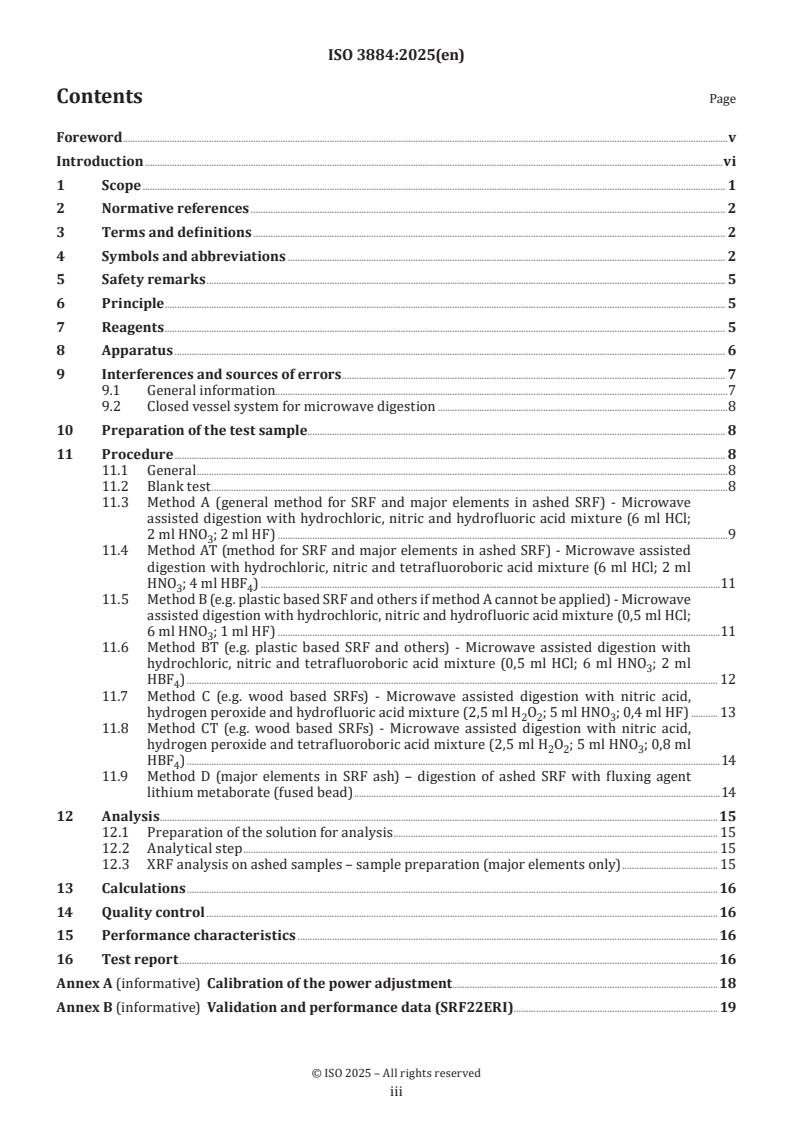
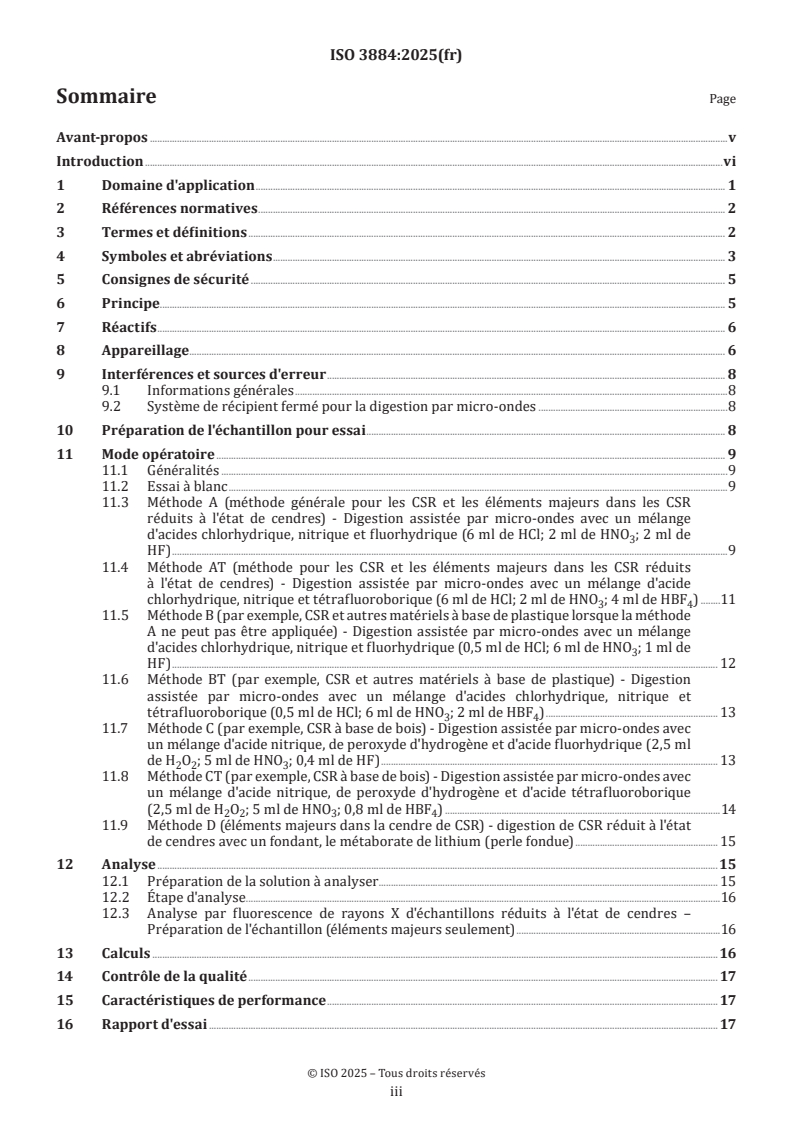
Contents Page
Foreword .v
Introduction .vi
1 Scope . 1
2 Normative references . 2
3 Terms and definitions . 2
4 Symbols and abbreviations . 2
5 Safety remarks . 5
6 Principle . 5
7 Reagents . 5
8 Apparatus . 6
9 Interferences and sources of errors . 7
9.1 General information.7
9.2 Closed vessel system for microwave digestion .8
10 Preparation of the test sample. 8
11 Procedure . 8
11.1 General .8
11.2 Blank test .8
11.3 Method A (general method for SRF and major elements in ashed SRF) - Microwave
assisted digestion with hydrochloric, nitric and hydrofluoric acid mixture (6 ml HCl;
2 ml HNO ; 2 ml HF) .9
11.4 Method AT (method for SRF and major elements in ashed SRF) - Microwave assisted
digestion with hydrochloric, nitric and tetrafluoroboric acid mixture (6 ml HCl; 2 ml
HNO ; 4 ml HBF ) .11
3 4
11.5 Method B (e.g. plastic based SRF and others if method A cannot be applied) - Microwave
assisted digestion with hydrochloric, nitric and hydrofluoric acid mixture (0,5 ml HCl;
6 ml HNO ; 1 ml HF) .11
11.6 Method BT (e.g. plastic based SRF and others) - Microwave assisted digestion with
hydrochloric, nitric and tetrafluoroboric acid mixture (0,5 ml HCl; 6 ml HNO ; 2 ml
HBF ) . 12
11.7 Method C (e.g. wood based SRFs) - Microwave assisted digestion with nitric acid,
hydrogen peroxide and hydrofluoric acid mixture (2,5 ml H O ; 5 ml HNO ; 0,4 ml HF) . 13
2 2 3
11.8 Method CT (e.g. wood based SRFs) - Microwave assisted digestion with nitric acid,
hydrogen peroxide and tetrafluoroboric acid mixture (2,5 ml H O ; 5 ml HNO ; 0,8 ml
2 2 3
HBF ) .14
11.9 Method D (major elements in SRF ash) – digestion of ashed SRF with fluxing agent
lithium metaborate (fused bead) .14
12 Analysis . .15
12.1 Preparation of the solution for analysis . 15
12.2 Analytical step . 15
12.3 XRF analysis on ashed samples – sample preparation (major elements only) . 15
13 Calculations .16
14 Quality control .16
15 Performance characteristics . 16
16 Test report .16
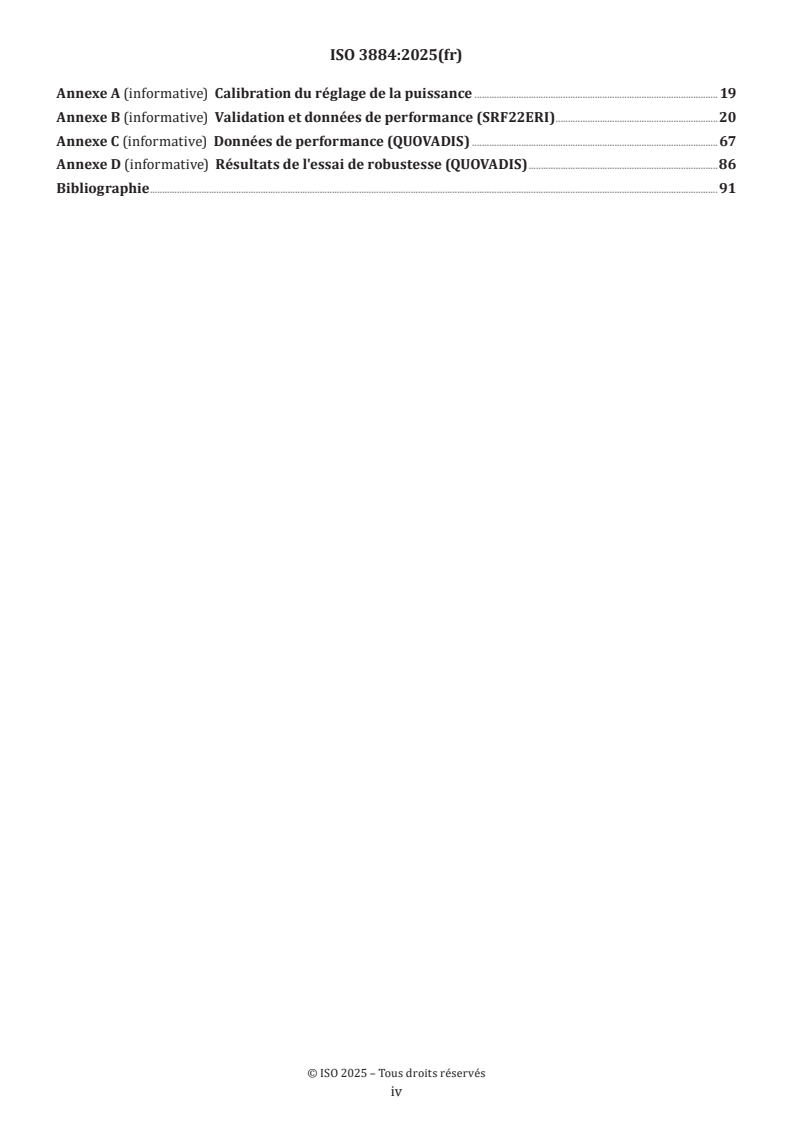
Annex A (informative) Calibration of the power adjustment .18
Annex B (informative) Validation and performance data (SRF22ERI) . 19
iii
Annex C (informative) Performance data (QUOVADIS) .65
Annex D (informative) Results of ruggedness testing (QUOVADIS) .78
Bibliography .82
iv
Foreword
ISO (the International Organization for Standardization) is a worldwide federation of national standards
bodies (ISO member bodies). The work of preparing International Standards is normally carried out through
ISO technical committees. Each member body interested in a subject for which a technical committee
has been established has the right to be represented on that committee. International organizations,
governmental and non-governmental, in liaison with ISO, also take part in the work. ISO collaborates closely
with the International Electrotechnical Commission (IEC) on all matters of electrotechnical standardization.
The procedures used to develop this document and those intended for its further maintenance are described
in the ISO/IEC Directives, Part 1. In particular, the different approval criteria needed for the different types
of ISO document should be noted. This document was drafted in accordance with the editorial rules of the
ISO/IEC Directives, Part 2 (see www.iso.org/directives).
ISO draws attention to the possibility that the implementation of this document may involve the use of (a)
patent(s). ISO takes no position concerning the evidence, validity or applicability of any claimed patent
rights in respect thereof. As of the date of publication of this document, ISO had not received notice of (a)
patent(s) which may be required to implement this document. However, implementers are cautioned that
this may not represent the latest information, which may be obtained from the patent database available at
www.iso.org/patents. ISO shall not be held responsible for identifying any or all such patent rights.
Any trade name used in this document is information given for the convenience of users and does not
constitute an endorsement.
For an explanation of the voluntary nature of standards, the meaning of ISO specific terms and expressions
related to conformity assessment, as well as information about ISO's adherence to the World Trade
Organization (WTO) principles in the Technical Barriers to Trade (TBT), see www.iso.org/iso/foreword.html.
This document was prepared by Technical Committee ISO/TC 300, Solid recovered materials, including
solid recovered fuels, in collaboration with the European Committee for Standardization (CEN) Technical
Committee CEN/TC 343, Solid recovered materials, including solid recovered fuels, in accordance with the
Agreement on technical cooperation between ISO and CEN (Vienna Agreement).
Any feedback or questions on this document should be directed to the user’s national standards body. A
complete listing of these bodies can be found at www.iso.org/members.html.
v
Introduction
Accurate determination of the element content in solid recovered fuels is important for environmental and
technical reasons both in the production and combustion stage. Some of the elements determined by the
[1]
application of one of the methods in this document are included in ISO 21640 while other elements can
have environmental implications both for emissions and for the bottom and fly ashes disposal or recovery.
Furthermore, the determination of elements such as Al, Ca, Fe, Mg, P, K, Si, Na and Ti can be helpful to predict
the melting behaviour and slagging of the ash.
The methods described in this document provide multi-element digestions for a wide range of solid
recovered fuels. The elements that are extractable and determined by these procedures can in many
instances be described as ‘total element contents’, although this will be matrix dependent. After digestion,
a number of analytical techniques can be used for the accurate determination of major and minor element
contents, e.g. inductively coupled plasma with optical or mass detection (ICP-OES, ICP-MS), graphite furnace
atomic absorption spectrometry (GF-AAS) and specific direct methods (e.g. for mercury, sulfur).
Alternatively, X-ray fluorescence can be used as a fast method for a qualitative overview of ash forming
elements and impurities of solid recovered fuels. After suitable calibration, X-ray fluorescence is very
useful for determining major elements or even minor elements (except mercury and beryllium) in solid
recovered fuels according to ISO 22940. For calibration of X-ray fluorescence, it is important to use several
solid recovered fuel reference materials or solid recovered fuel samples that were carefully characterized
after total digestion and measurement by ICP-OES, ICP-MS, GF-AAS or by other techniques such as elemental
[2]
analysis using combustion technology on sulfur (see ISO 21663 ).
After ashing of solid recovered fuels, X-ray fluorescence allows the simultaneous determination of major
elements (Al, Ca, Fe, Mg, P, K, Si, Na, Ti) in the ashes after matrix-based calibration (procedures for this are
described in ISO 22940 and EN 15309).
vi
International Standard ISO 3884:2025(en)
Solid recovered fuels — Methods for the determination of the
content of elements (Al, Ca, Fe, K, Mg, Na, P, S, Si, Ti, As, Ba, Be,
Cd, Co, Cr, Cu, Hg, Mo, Mn, Ni, Pb, Sb, Se, Sn, Tl, V, Zn)
1 Scope
This document specifies methods for the determination of major and minor element concentrations in solid
recovered fuels after digestion by the use of different acid mixtures and by addition of a fluxing agent for
solid recovered fuel (SRF) ash.
a) Method A: Microwave assisted digestion with hydrochloric, nitric and hydrofluoric acid mixture (6 ml
HCl; 2 ml HNO ; 2 ml HF) followed by boric acid complexation;
b) Method AT: Microwave assisted digestion with hydrochloric, nitric and tetrafluoroboric acid mixture
(6 ml HCl; 2 ml HNO ; 4 ml HBF );
3 4
c) Method B: Microwave assisted digestion with hydrochloric, nitric and hydrofluoric acid mixture (0,5 ml
HCl; 6 ml HNO ; 1 ml HF) followed by boric acid complexation;
d) Method BT: Microwave assisted digestion with hydrochloric, nitric and tetrafluoroboric acid mixture
(0,5 ml HCl; 6 ml HNO ; 2 ml HBF );
3 4
e) Method C: Microwave assisted digestion with nitric acid, hydrogen peroxide and hydrofluoric acid
mixture (2,5 ml H O ; 5 ml HNO ; 0,4 ml HF) and optional boric acid complexation;
2 2 3
f) Method CT: Microwave assisted digestion with nitric acid, hydrogen peroxide and tetrafluoroboric acid
mixture (2,5 ml H O ; 5 ml HNO ; 0,8 ml HBF );
2 2 3 4
g) Method D: Digestion of the ashed SRF sample with fluxing agent lithium metaborate in an oven at
1 050 °C.
This document is applicable for the following major and minor/trace elements:
— Major elements: aluminium (Al), calcium (Ca), iron (Fe), potassium (K), magnesium (Mg), sodium (Na),
phosphorus (P), sulfur (S), silicon (Si) and titanium (Ti).
— Minor/trace elements: arsenic (As), barium (Ba), beryllium (Be), cadmium (Cd), cobalt (Co), chromium
(Cr), copper (Cu), mercury (Hg), molybdenum (Mo), manganese (Mn), nickel (Ni), lead (Pb), antimony
(Sb), selenium (Se), tin (Sn), thallium (Tl), vanadium (V) and zinc (Zn).
Method A is applicable for general use for SRF and ashed SRFs, but the amount of the test portion can be
very low in case of high concentration of organic matter. Method AT can be used if an alternative to HF is
necessary.
Method B with a higher volume of nitric acid is applicable for SRFs with high organic matter (e.g. suitable
for high plastic content) that can be difficult to digest with less nitric acid or as a substitute for method A if
appropriate equipment is not available. Method BT can be used if an alternative to HF is necessary.
Method C with combination of nitric acid and hydrogen peroxide and addition of hydrofluoric acid is
applicable for wood based SRFs (e.g. demolition wood) or when there is a need for comparability to solid
biofuel standards. Method CT can be used if an alternative to HF is necessary.
Method D is specifically applicable for determination of major elements in ashed SRF samples.
XRF can be used for the analysis of major elements (Al, Ca, Fe, K, Mg, Na, P, S, Si, Ti) after ashing (815 °C)
of the samples and several major and minor/trace elements in SRF can be analysed by XRF after suitable
calibration provided that the concentration levels are above instrumental detection limits of the XRF
instrumentation and after proper preliminary testing and validation.
Digestion methods with HF and subsequent boric acid complexation or application of method D are applicable
for determination of Si and Ti (better digestion efficiency).
Alternative digestion methods can be applied, if their performance is proved to be comparable with those of
the methods described in this document.
2 Normative references
The following documents are referred to in the text in such a way that some or all of their content constitutes
requirements of this document. For dated references, only the edition cited applies. For undated references,
the latest edition of the referenced document (including any amendments) applies.
ISO 21637, Solid recovered fuels — Vocabulary
ISO 21660-3, Solid recovered fuels — Determination of moisture content using the oven dry method — Part 3:
Moisture in general analysis sample
ISO 22940:2021, Solid recovered fuels — Determination of elemental composition by X-ray fluorescence
EN 15309:2007, Characterization of waste and soil — Determination of elemental composition by X-ray
fluorescence
3 Terms and definitions
For the purposes of this document, the terms and definitions given in ISO 21637 and the following apply.
ISO and IEC maintain terminology databases for use in standardization at the following addresses:
— ISO Online browsing platform: available at https:// www .iso .org/ obp
— IEC Electropedia: available at https:// www .electropedia .org/
3.1
digestion
mineralization of the organic matter of a sample and dissolution of its mineral part, more or less completely,
when reacted with a reagent mixture
3.2
microwave unit
whole microwave digestion system (oven and associated equipment)
4 Symbols and abbreviations
A ash content at 815 °C on a dry basis (A_DB)
db
Al aluminium (AL)
Al aluminium in ashed SRF (ALASH)
ash
Ca calcium (CA)
Ca calcium in ashed SRF (CAASH)
ash
DM dry mass (DM)
Fe iron (FE)
Fe iron in ashed SRF (FEASH)
ash
K potassium (K)
K potassium in ashed SRF (KASH)
ash
Mg magnesium (MG)
Mg magnesium in ashed SRF (MGASH)
ash
Na sodium (NA)
Na sodium in ashed SRF (NAASH)
ash
P phosphorus (P)
P phosphorus in ashed SRF (PASH)
ash
S sulfur (S)
S sulfur in ashed SRF (SASH)
ash
Si silicon (SI)
Si silicon in ashed SRF (SIASH)
ash
Ti titanium (TI)
Ti titanium in ashed SRF (TIASH)
ash
As arsenic (AS)
Ba barium (BA)
Be beryllium (BE)
Cd cadmium (CD)
Co cobalt (CO)
Cr chromium (CR)
Cu copper (CU)
Hg mercury (HG)
Mo molybdenum (MO)
Mn manganese (MN)
Ni nickel (NI)
Pb lead (PB)
Sb antimony (SB)
Se selenium (SE)
Sn tin (SN)
Tl thallium (TL)
V vanadium (V)
Zn zinc (ZN)
GF-AAS Graphite Furnace-Atomic Absorption Spectrometry
HG-AAS Hydride Generation-Atomic Absorption Spectrometry
CV-AAS Cold Vapour-Atomic Absorption Spectrometry
ICP-OES Inductively coupled plasma-Optical Emission Spectrometry
ICP-MS Inductively coupled plasma-Mass Spectrometry
PTFE polytetrafluorethylene
PFA perfluoroalkoxy (e.g. PFA liner)
TFM tetrafluoroethylene, modified (e.g. TFM liner)
XRF X-ray fluorescence
SRF Solid recovered fuels
CRM certified reference material
RM reference material
(d) dry basis
l number of laboratories after outlier rejection (Annex C: number of outlier-free indi-
vidual analytical values per level)
n number of individual test results after outlier rejection (Annex C: number of labora-
tories after outlier elimination)
o percentage of outliers (Annex C: percentage of outliers from the replicate determi-
nation)
Mean(REF) mean value (reference laboratories)
Mean overall mean of results (without outliers)
Recovery rate recovery rate calculated by division of the overall mean value of results (without
outliers) by the mean value of reference laboratories, multiplied by 100 %
η recovery rate (Annex C)
s reproducibility standard deviation
R
C coefficient of variation of reproducibility
V,R
s repeatability standard deviation
r
C coefficient of variation of repeatability
V,r
RSD relative standard deviation (Annex C)
CV Coefficient of variation (Annex D)
HCl hydrochloric acid
HNO nitric acid
HBF Tetrafluoroboric acid
H O hydrogen peroxide
2 2
HF hydrofluoric acid
5 Safety remarks
Safety when handling potentially hazardous material is dealt with by the applicable (inter-)national
regulations.
In addition, the following information is given:
— Only experienced personnel can use the microwave apparatus, following the operating and safety
instructions described in the manufacturer manual;
— The microwave unit cavity shall be built in a way that even in case of leakage or explosion of the vessels
the safety of the operators can be guaranteed. Household instruments are not suitable for laboratory use.
— Most of the reagents used within this document are strongly corrosive and toxic. Safety precautions are
absolutely necessary due to strong corrosive reagents, high temperature and high pressure;
— All procedures have to be performed in a hood or in closed force-ventilated equipment. By the use of
strong oxidising reagents, the formation of explosive intermediates is possible, especially when dealing
with samples with a high organic content. Do not open pressurised vessels before they have cooled down.
Avoid contact with the chemicals and the gaseous reaction products.
6 Principle
The test portion is digested using one of the proposed methods with a suitable acid mixture or by addition
of a fluxing agent (ashed SRF). The digested sample is then analysed by the most appropriate spectrometric
technique, such as inductively coupled plasma with optical or mass detection (ICP-OES, ICP-MS) or atomic
absorption (GF-AAS, CV-AAS, HG-AAS). Alternatively, specific direct methods can be applied after validation
(e.g. for determination of mercury or sulfur or for direct determination of elements by XRF).
[3]
For XRF analysis of major elements in the ashed SRF, the sample is ashed at 815 °C (ISO 21656 ) and the
ash is homogenized in a ball mill to obtain a uniform size dimension of the particles. The ash is then pressed
in the form of pellets (ISO 22940, EN 15309) or fused with lithium metaborate (EN 15309). Both techniques
are suitable for the analysis by XRF. Coal ash and other ashes of various origins can be used for instrument
calibration.
7 Reagents
7.1 General
All reagents and acids used shall be of recognized analytical grade or verify the content of the elements to be
analysed to avoid high blank values for subsequent analytical measurements. Throughout the procedure, a test
blank solution shall be used applying all steps with the same amount of acids or reagents, but without a sample.
7.2 Water, < 0,055 µS/cm, (e.g. deionized water)
7.3 Nitric acid (HNO ), approximately 15 mol/l, 65 % to 70 % (mass/mass).
7.4 Hydrofluoric acid (HF), approximately 23 mol/l, 40 % to 45 % (w/w).
7.5 Hydrochloric acid (HCl), approximately 12 mol/l, 35 % to 37 % (w/w).
7.6 Diluted Hydrochloric acid (HCl), approximately 2 mol/l. Dissolve 166,5 ml of HCl 37 % (7.5) in water
and dilute to 1 l with water (7.2).
7.7 Boric acid (H BO ), solid.
3 3
7.8 Boric acid (H BO ) solution, e.g. 4 % (w/w). Dissolve 40 g of boric acid (7.7) in water and dilute to 1 l
3 3
of water (7.2).
7.9 Hydrogen peroxide (H O ), 30 % (w/w).
2 2
7.10 Lithium metaborate (LiBO ), solid.
7.11 Tetrafluoroboric acid (HBF ), approximately 6 mol/l, 38 % to 50 % (w/w).
8 Apparatus
8.1 General
Usual laboratory apparatus along with the following shall be used. All volumetric flasks and digestion vessels
shall be adequately cleaned and stored in order to avoid any contamination, particularly with respect to low
concentration of the elements of interest.
8.2 Microwave unit, temperature and/or power-controlled, closed vessels
8.2.1 Digestion vessels, for pressurized microwave digestion of appropriate volume, reagent-,
temperature- and pressure-resistant and capable of containing the mixture of sample and digest solution.
The vessel shall be suitable for the safe application in the temperature and pressure range applied, capable
of withstanding pressures of at least 3 000 kPa.
Digestion vessels made of modified polytetrafluorethene (PTFE), e.g. TFM or PFA liner, and equipped with a
safety pressure releasing system to avoid explosion of the vessel shall be used. The inner wall of the vessel
shall be inert and shall not release contaminations to the digest solutions.
NOTE It can be necessary to periodically clean the digestion vessels with a suitable surfactant to remove
persistent deposits.
8.2.2 Microwave unit, temperature-controlled, corrosion resistant and well ventilated.
All electronics shall be protected against corrosion for safe operation. Use a laboratory-grade microwave
oven with temperature feedback control mechanisms.
The microwave digestion system shall be able to control the temperature with an accuracy of at least ±5 °C
and automatically adjust the microwave field output power within 2 s of sensing. Temperature sensors shall
be accurate to ±2 °C, including the final reaction temperature of 190 °C ± 10 °C. Temperature feedback control
provides the primary performance mechanism for the method. Due to the variability in sample matrix types
and microwave digestion equipment (i.e. different vessel types and microwave designs), control of the
temperature during digestion is important for reproducible microwave heating and comparable data.
The accuracy of the temperature measurement system shall be periodically tested at an elevated
temperature according to the manufacturers’ instructions. If the temperature deviates by more than
2 °C from the temperature measured by an external, calibrated temperature measurement system, the
microwave temperature measurement system shall be re-calibrated.
8.2.3 Microwave unit, power-controlled, corrosion resistant and well ventilated.
All electronics shall be protected against corrosion for safe operation. A laboratory-grade microwave oven
with temperature feedback control mechanisms shall be used.
The microwave unit shall be able to provide programmable power which can be programmed to within
±10 W of the required power. Typical units provide a nominal power of 600 W to 1 200 W. If necessary
(referring to manufacturers’ specifications), calibration of the microwave unit shall be performed (see
Annex A).
The microwave unit shall be designed in a way that guarantees homogeneous heating of the samples.
The microwave unit shall include a temperature and/or pressure control system.
8.3 Sample containers, plastic containers or glass containers (when no free hydrofluoric acid is
present)
8.4 Filter, usually with a pore size of 0,45 µm and resistant to the employed acid mixture and of
adequate purity
8.5 Centrifuge, minimum 3 000 r/min
8.6 Volumetric flasks, usually of nominal capacity of 50 ml (microwave digestion) or 100 ml, or 250 ml
(fluxing agent)
8.7 Magnetic stirrer with heating function and PTFE stirring bone
8.8 Press, in accordance with ISO 22940:2021, 7.2 or EN 15309:2007, 6.3
8.9 Analytical balance, with an accuracy of 0,1 mg or better
8.10 Muffle furnace for temperatures of 1 050 °C
8.11 Platinum crucible, e.g. Pt/Au (5 % (mass/mass))
8.12 Inductively coupled plasma. Normal commercial instrumentation with optical or mass spectrometric
detector (ICP-OES, ICP-MS).
8.13 X-ray fluorescence Spectrometer. Energy or wavelength dispersion system suitable for qualitative
and (semi-)quantitative analysis of the elements listed in this document (with the exception of Beryllium
and Mercury).
8.14 Atomic Absorption Spectrometer. Normal commercial instrumentation, equipped with graphite
furnace or hydride generation systems or cold vapour (GF-AAS, HG-AAS, CV-AAS).
9 Interferences and sources of errors
9.1 General information
The use of glassware shall be excluded when free hydrofluoric acid is present.
In the case of filtration of the digested solution, it is necessary to take care that the filtration procedure does
not introduce contaminants.
Ensure that the entire test portion is brought into contact with the acid mixture in the digestion vessel.
Some elements of interest can be lost due to precipitation with ions present in the digest solutions, e.g. low
soluble chlorides, fluorides and sulphates.
9.2 Closed vessel system for microwave digestion
The upper limits of mass of the test portion according to the manufacturer’s specifications shall be taken
into account.
Very reactive or volatile materials that can create high pressures when heated can cause a venting of the
vessels with potential loss of sample and analytes.
After digestion, the vessels shall be cooled to room temperature before opening.
10 Preparation of the test sample
The sample preparation for heterogeneous materials as SRF is critical. The test sample is the general analysis
[4]
test sample with a nominal top size of 0,5 mm or less, following the procedure according to IS0 21646 and
shall be selected in a way that it is representative for the laboratory sample.
Depending on the used digestion method, the amount of test portion ranges between 0,2 g and 0,5 g SRF-
sample or 0,1 g ashed SRF-sample.
NOTE A nominal top size of 1 mm or less can be sufficient, when a significantly higher amount of sample intake
for the digestion step is feasible (at least 1 g).
Determine the moisture content of separate portions of the general analysis test sample of SRF in accordance
with ISO 21660-3 at 105 °C. Whereas the determination is carried out on a dry basis (as for ashed SRF-
samples), the moisture content shall be determined during the drying step in accordance with ISO 21660-3
at 105 °C.
11 Procedure
11.1 General
The mass of the test portion for a single digestion and the set temperature or pressure-programme shall
comply with the specifications of the manufacturer of the digestion unit. Use TFM and PFA liners (after
a cleaning run) for total digestion and check the power and temperature calibration of the microwave
digestion unit regularly to ensure functionality and reproducible results.
If the required amount of representative test portion exceeds the manufacturer’s specifications, the test
portion shall be divided into smaller quantities and digested separately. The individual digests shall be
combined prior to analysis.
When hydrofluoric acid has been used for digestion, a subsequent complexation run can be necessary to
complex free fluorides.
Addition of 11 ml cold-saturated boric acid solution (approx. 4 % H BO ) per ml used hydrofluoric acid is
3 3
recommended.
11.2 Blank test
A reagent blank test digestion shall be carried out in parallel with the samples, using the same procedure
and the same quantities of all the reagents as in the determination of the samples, but omitting the test
portion. The laboratory shall define acceptable limits.
NOTE The measurement of a blank solution is needed to determine the contribution of the digestion acid mixture,
digestion vessels and filter used to the measured value.
11.3 Method A (general method for SRF and major elements in ashed SRF) - Microwave
assisted digestion with hydrochloric, nitric and hydrofluoric acid mixture (6 ml HCl; 2 ml
HNO; 2 ml HF)
a) Weigh between 0,2 g to 0,5 g of the SRF sample or 0,1 g of ashed SRF sample, to the nearest of 0,1 mg,
prepared according to Clause 10 and transfer it into the vessel (8.2.1). If necessary, the sample can be
moistened with a minimum amount of water (7.2).
The amount of the test sample depends on the amount of organic matter. The maximum amount of
organic carbon shall not exceed 0,15 g when 8 ml of HCl and HNO is used. Per additional 0,1 g organic
carbon (more than this 0,15 g), 1 ml of additional concentrated HNO (7.3) shall be added before the
digestion process is started.
Referring to the manufacturer’s instructions, the upper limits of mass of the test portion shall be taken
into account.
b) Add (6,0 ± 0,1) ml hydrochloric acid (7.5) followed by (2,0 ± 0,1) ml nitric acid (7.3) and (2,0 ± 0,1) ml
hydrofluoric acid (7.4).
If a vigorous reaction occurs, allow the reaction to cease before capping the vessel.
c) Cap the digestion vessel according to the manufacturer’s instructions. Place samples in all available
positions in the microwave for sample vessels.
If a lower number of samples are available compared to the vessel positions, use vessels filled with the
same amount of the acid mixture without sample to fill all the available vessel slots. This is to ensure
the same microwave energy absorption occurs during each digestion procedure. This method is an
operationally defined method, designed to achieve consistent digestion of samples by specific reaction
conditions.
Temperature profile for temperature- or power-controlled microwave unit, closed vessels:
Microwave heating (acid digestion):
— Step 1: Ramp to 190 °C over 15 min to 20 min;
— Step 2: Hold for 20 min at 190 °C;
— Step 3: Cool down (20 min).
NOTE 1 The stated temperature refers to the digestion solution. The high temperature serves to accelerate the
digestion reaction and therefore results in a better digestion efficiency.
1) Microwave unit, temperature-controlled, closed vessels: The temperature of the digestion mixture in
each vessel shall be raised with a heating rate of approximately 10 °C/min to 15 °C/min to (190 ± 10) °C
and remain at (190 ± 10) °C for (20 ± 1) min. Afterwards cool down to room temperature.
2) Microwave unit, power-controlled, closed vessels: According to the manufacturers’ manual a suitable
power programme is selected for the numbers of vessels and adjusted to ensure consistent reaction
conditions to reach at least 190 °C in 15 until 20 min and to remain at maximum temperature for at least
(20 ± 1) min. Afterwards, cool down to room temperature.
WARNING — A too high temperature increase in the microwave assisted digestion can cause a
vigorous, exothermic reaction in the digestion solution with high pressure increase and blow-
off of the security valve. Losses of analytes are then possible. Therefore, it is mandatory to follow
manufacturer’s instructions.
If necessary due to manufacturer’s instruction, the maximum temperature can be decreased and the
programme has to be adjusted (e.g. longer hold time when a lower maximum temperature must be set).
A temperature increase of 10 °C leads to a halving of the reaction time, at the same time a higher temperature
also leads to an increase in the oxidation potential of the acid mixtures, which has a positive effect on the
digestion efficiency.
d) Verify the different kind of condition for the effectiveness of digestion for SRF samples and for (certified)
reference material/quality control samples by comparison of the results with another laboratory that
works according to the conditions listed above. Alternative kinds of digestion methods can be applied, if
their performance is proved to be comparable with those of the methods described in this document.
e) At the end of the microwave programme (temperature-controlled or power-controlled, closed vessels),
allow the vessels to cool according to the manufacturer's instructions before removing them from the
microwave system. Cooling of the vessels can be accelerated by internal or external cooling devices.
After reaching room temperature, check if the microwave vessels maintained their seal throughout the
digestion.
Temperature profile for temperature- or power-controlled microwave unit, closed vessels:
Microwave heating (boric acid complexation):
— Step 1: Ramp to 150 °C over 10 min - 15 min;
— Step 2: Hold for 10 min at 150 °C;
— Step 3: Cool down (20 min).
NOTE 2 The stated temperature refers to the digestion solution.
WARNING — A too high temperature increase can cause a vigorous, exothermic reaction in the
digestion solution with high pressure increase and blow-off of the security valve. Losses of analytes
are then possible.
f) Boric acid complexation:
Carefully uncap and vent each vessel in a well-ventilated fume hood according to the manufacturer's
instructions, then add a solution containing 650 mg boric acid for 2 ml of HF (e.g. 22 ml of 4 % m/m
(7.8) for 2 ml of HF). Cap the vessels and put them into the microwave unit and start the boric acid
complexation programme (see above). The temperature of the boric acid digestion mixture in each
vessel shall be raised with a heating rate of approximately 10 °C/min to (150 ± 10) °C and remain at
(150 ± 10) °C for (10 ± 1) min. Afterwards allow the vessels to cool down to room temperature according
to the manufacturer’s instructions.
g) Transfer quantitatively the solution content of each vessel into a suitable sized volumetric flask (e.g.
50 ml) and add water (7.2) to the volume mark. Alternatively, another procedure can be applied, such that
the adjustment to volume (e.g. 50 ml) with the solid residue still present shall be carried out immediately
after digestion.
If the measurement solution contains suspended particles which can clog nebulizers or interfere with
an injection of the sample into the instrument, the sample can be centrifuged or filtered (8.4).
The composition of the residue is controlled by XRF or any other suitable technique: if a significant
amount of the elements of interest is detected, an alternative digestion method for the dissolution of
the residual material is necessary. The control on the residue can be avoided if its composition is known
from previous analyses of the same kind of materials or on the basis of experience.
The measurement solution is now ready for the determination of the elements of interest using appropriate
elemental analysis techniques.
11.4 Method AT (method for SRF and major elements in ashed SRF) - Microwave assisted
digestion with hydrochloric, nitric and tetrafluoroboric acid mixture (6 ml HCl; 2 ml HNO;
4 ml HBF )
a) Weigh between 0,2 g to 0,5 g of the SRF sample or 0,1 g of ashed SRF sample, to the nearest of 0,1 mg,
prepared according to Clause 10 and transfer it into the vessel (8.2.1). If necessary, the sample can be
moistened with a minimum amount of water (7.2).
The amount of the test sample depends on the amount of organic matter. The maximum amount of
organic carbon shall not exceed 0,15 g when 8 ml of HCl and HNO is used. Per additional 0,1 g organic
carbon (more than this 0,15 g), 1 ml of additional concentrated HNO (7.3) shall be added before the
digestion process is started.
Referring to the manufacturer’s instructions, the upper limits of mass of the test portion shall be taken
into account.
b) Add (6,0 ± 0,1) ml hydrochloric acid (7.5) followed by (2,0 ± 0,1) ml nitric acid (7.3) and (4,0 ± 0,2) ml
tetrafluoroboric acid (7.11).
If a vigorous reaction occurs, allow the reaction to cease before capping the vessel.
c) Cap the digestion vessel according to the manufacturer’s instructions. Place the digestion vessels with
samples in all available positions in the microwave.
If a lower number of samples are available compared to the vessel positions, use vessels filled with the
same amount of the acid mixture without sample to fill all the available vessel slots. This is to ensure
the same microwave energy absorption occurs during each digestion procedure. This method is an
operationally defined method, designed to achieve consistent digestion of samples by specific reaction
conditions.
d) Define the microwave programme to achieve the temperature profile cited in 11.3 for temperature-
controlled or power-controlled, closed vessels and digest the samples in the microwave unit.
e) At the end of the microwave programme (temperature-controlled or power-controlled, closed vessels),
allow the vessels to cool according to the manufacturer's instructions before removing them from the
microwave system. Cooling of the vessels can be accelerated by internal or external cooling devices.
After reaching room temperature, check if the microwave vessels maintained their seal throughout the
digestion.
f) Finally, transfer quantitatively the solution content of each vessel into a suitable sized volumetric flask
(e.g. 50 ml) and add water (7.2) to the volume mark. Alternatively, another procedure can be applied,
such that the adjustment to volume (e.g. 50 ml) with the solid residue still present shall be carried out
immediately after digestion.
11.5 Method B (e.g. plastic based SRF and others if method A cannot be applied) - Microwave
assisted digestion with hydrochloric, nitric and hydrofluoric acid mixture (0,5 ml HCl; 6 ml
HNO; 1 ml HF)
a) Weigh 0,3 g of the sample, to the nearest of 0,1 mg, prepared according to Clause 10 and transfer it into
the vessel (8.2.1). If necessary, the sample can be moistened with a minimum amount of water (7.2).
Referring to the manufacturer’s instructions, the upper limits of mass of the test portion shall be taken
into account.
Add (0,5 ± 0,05) ml hydrochloric acid (7.5) followed by (6,0 ± 0,1) ml nitric acid (7.3) and (1,0 ± 0,1) ml
hydrofluoric acid (7.4).
If a vi
...
Norme
internationale
ISO 3884
Première édition
Combustibles solides de
2025-04
récupération — Méthodes de
détermination de la teneur en
éléments (Al, Ca, Fe, K, Mg, Na, P, S,
Si, Ti, As, Ba, Be, Cd, Co, Cr, Cu, Hg,
Mo, Mn, Ni, Pb, Sb, Se, Sn, Tl, V, Zn)
Solid recovered fuels — Methods for the determination of the
content of elements (Al, Ca, Fe, K, Mg, Na, P, S, Si, Ti, As, Ba, Be, Cd,
Co, Cr, Cu, Hg, Mo, Mn, Ni, Pb, Sb, Se, Sn, Tl, V, Zn)
Numéro de référence
DOCUMENT PROTÉGÉ PAR COPYRIGHT
© ISO 2025
Tous droits réservés. Sauf prescription différente ou nécessité dans le contexte de sa mise en œuvre, aucune partie de cette
publication ne peut être reproduite ni utilisée sous quelque forme que ce soit et par aucun procédé, électronique ou mécanique,
y compris la photocopie, ou la diffusion sur l’internet ou sur un intranet, sans autorisation écrite préalable. Une autorisation peut
être demandée à l’ISO à l’adresse ci-après ou au comité membre de l’ISO dans le pays du demandeur.
ISO copyright office
Case postale 401 • Ch. de Blandonnet 8
CH-1214 Vernier, Genève
Tél.: +41 22 749 01 11
E-mail: copyright@iso.org
Web: www.iso.org
Publié en Suisse
ii
Sommaire Page
Avant-propos .v
Introduction .vi
1 Domaine d'application . 1
2 Références normatives . 2
3 Termes et définitions . 2
4 Symboles et abréviations . 3
5 Consignes de sécurité . 5
6 Principe. 5
7 Réactifs . 6
8 Appareillage . 6
9 Interférences et sources d'erreur . 8
9.1 Informations générales .8
9.2 Système de récipient fermé pour la digestion par micro-ondes .8
10 Préparation de l'échantillon pour essai . 8
11 Mode opératoire . 9
11.1 Généralités .9
11.2 Essai à blanc .9
11.3 Méthode A (méthode générale pour les CSR et les éléments majeurs dans les CSR
réduits à l'état de cendres) - Digestion assistée par micro-ondes avec un mélange
d'acides chlorhydrique, nitrique et fluorhydrique (6 ml de HCl; 2 ml de HNO ; 2 ml de
HF) .9
11.4 Méthode AT (méthode pour les CSR et les éléments majeurs dans les CSR réduits
à l'état de cendres) - Digestion assistée par micro-ondes avec un mélange d'acide
chlorhydrique, nitrique et tétrafluoroborique (6 ml de HCl; 2 ml de HNO ; 4 ml de HBF ) .11
3 4
11.5 Méthode B (par exemple, CSR et autres matériels à base de plastique lorsque la méthode
A ne peut pas être appliquée) - Digestion assistée par micro-ondes avec un mélange
d'acides chlorhydrique, nitrique et fluorhydrique (0,5 ml de HCl; 6 ml de HNO ; 1 ml de
HF) . 12
11.6 Méthode BT (par exemple, CSR et autres matériels à base de plastique) - Digestion
assistée par micro-ondes avec un mélange d'acides chlorhydrique, nitrique et
tétrafluoroborique (0,5 ml de HCl; 6 ml de HNO ; 2 ml de HBF ) . 13
3 4
11.7 Méthode C (par exemple, CSR à base de bois) - Digestion assistée par micro-ondes avec
un mélange d'acide nitrique, de peroxyde d'hydrogène et d'acide fluorhydrique (2,5 ml
de H O ; 5 ml de HNO ; 0,4 ml de HF) . 13
2 2 3
11.8 Méthode CT (par exemple, CSR à base de bois) - Digestion assistée par micro-ondes avec
un mélange d'acide nitrique, de peroxyde d'hydrogène et d'acide tétrafluoroborique
(2,5 ml de H O ; 5 ml de HNO ; 0,8 ml de HBF ) .14
2 2 3 4
11.9 Méthode D (éléments majeurs dans la cendre de CSR) - digestion de CSR réduit à l'état
de cendres avec un fondant, le métaborate de lithium (perle fondue) . 15
12 Analyse .15
12.1 Préparation de la solution à analyser . 15
12.2 Étape d'analyse .16
12.3 Analyse par fluorescence de rayons X d'échantillons réduits à l'état de cendres –
Préparation de l'échantillon (éléments majeurs seulement) .16
13 Calculs .16
14 Contrôle de la qualité . 17
15 Caractéristiques de performance . 17
16 Rapport d'essai . 17
iii
Annexe A (informative) Calibration du réglage de la puissance . 19
Annexe B (informative) Validation et données de performance (SRF22ERI) .20
Annexe C (informative) Données de performance (QUOVADIS) . 67
Annexe D (informative) Résultats de l'essai de robustesse (QUOVADIS) .86
Bibliographie .91
iv
Avant-propos
L'ISO (Organisation internationale de normalisation) est une fédération mondiale d'organismes nationaux
de normalisation (comités membres de l'ISO). L'élaboration des Normes internationales est en général
confiée aux comités techniques de l'ISO. Chaque comité membre intéressé par une étude a le droit de faire
partie du comité technique créé à cet effet. Les organisations internationales, gouvernementales et non
gouvernementales, en liaison avec l'ISO participent également aux travaux. L'ISO collabore étroitement avec
la Commission électrotechnique internationale (IEC) en ce qui concerne la normalisation électrotechnique.
Les procédures utilisées pour élaborer le présent document et celles destinées à sa mise à jour sont
décrites dans les Directives ISO/IEC, Partie 1. Il convient, en particulier, de prendre note des différents
critères d'approbation requis pour les différents types de documents ISO. Le présent document
a été rédigé conformément aux règles de rédaction données dans les Directives ISO/IEC, Partie 2
(voir www.iso.org/directives).
L'ISO attire l'attention sur le fait que la mise en application du présent document peut entraîner l'utilisation
d'un ou de plusieurs brevets. L'ISO ne prend pas position quant à la preuve, à la validité et à l'applicabilité
de tout droit de propriété revendiqué à cet égard. À la date de publication du présent document, l'ISO
n'avait pas reçu notification qu'un ou plusieurs brevets pouvaient être nécessaires à sa mise en application.
Toutefois, il y a lieu d'avertir les responsables de la mise en application du présent document que des
informations plus récentes sont susceptibles de figurer dans la base de données de brevets, disponible à
l'adresse www.iso.org/brevets. L’ISO ne saurait être tenue pour responsable de ne pas avoir identifié tout ou
partie de tels droits de brevet.
Les appellations commerciales éventuellement mentionnées dans le présent document sont données pour
information, par souci de commodité, à l'intention des utilisateurs et ne sauraient constituer un engagement.
Pour une explication de la nature volontaire des normes, la signification des termes et expressions
spécifiques de l'ISO liés à l'évaluation de la conformité, ou pour toute information au sujet de l'adhésion de
l'ISO aux principes de l’Organisation mondiale du commerce (OMC) concernant les obstacles techniques au
commerce (OTC), voir www.iso.org/avant-propos.
Le présent document a été élaboré par le comité technique ISO/TC 300, Matières solides de récupération,
y compris les combustibles solides de récupération, en collaboration avec le comité technique CEN/TC 343,
Combustibles solides de récupération, du Comité européen de normalisation (CEN), conformément à l'Accord
de coopération technique entre l'ISO et le CEN (Accord de Vienne).
Il convient que l'utilisateur adresse tout retour d'information ou toute question concernant le présent
document à l'organisme national de normalisation de son pays. Une liste exhaustive desdits organismes se
trouve à l'adresse www.iso.org/fr/members.html.
v
Introduction
La détermination exacte de la teneur en éléments dans les combustibles solides de récupération est
importante pour des raisons environnementales et techniques, tant au stade de la production qu'au stade
de la combustion. Certains des éléments déterminés par l'application de l'une des méthodes décrites dans le
[1]
présent document sont inclus dans l'ISO 21640, tandis que d'autres éléments peuvent avoir des implications
environnementales à la fois pour les émissions et pour l'élimination ou la récupération des mâchefers et des
cendres volantes. En outre, la détermination d'éléments tels que l'Al, le Ca, le Fe, le Mg, le P, le K, le Si, le Na et
le Ti peut être utile pour prédire le comportement de fusion et de scorification des cendres.
Les méthodes décrites dans le présent document fournissent des digestions à éléments multiples pour une
large gamme de combustibles solides de récupération. Les éléments extractibles déterminés par ces modes
opératoires peuvent dans de nombreux cas être décrits comme des «teneurs élémentaires totales», bien que
cela dépende de la matrice. Après la digestion, un certain nombre de techniques analytiques peuvent être
utilisées pour déterminer avec précision les teneurs en éléments majeurs et mineurs, par exemple le plasma
couplé par induction avec détection optique ou de masse (ICP-OES, ICP-MS), la spectrométrie d'absorption
atomique avec four à graphite (GF-AAS) et des méthodes directes spécifiques (par exemple pour le mercure,
pour le soufre).
La fluorescence de rayons X peut également être utilisée comme méthode rapide pour obtenir un aperçu
qualitatif des éléments formant des cendres et des impuretés des combustibles solides de récupération.
Après un étalonnage approprié, la fluorescence de rayons X est très utile pour déterminer les éléments
majeurs ou même mineurs (à l'exception du mercure et du béryllium) dans les combustibles solides de
récupération, conformément à l'ISO 22940. Pour l'étalonnage de la fluorescence de rayons X, il est important
d'utiliser plusieurs matériaux de référence de combustibles solides de récupération ou des échantillons
de combustibles solides de récupération qui ont été soigneusement caractérisés après digestion totale et
mesurage par ICP-OES, ICP-MS, GF-AAS ou par d'autres techniques telles que l'analyse élémentaire utilisant
[2]
la technologie de combustion sur le soufre (voir l'ISO 21663 ).
Après réduction à l'état de cendres des combustibles solides de récupération, la fluorescence de rayons X
permet la détermination simultanée des éléments majeurs (Al, Ca, Fe, Mg, P, K, Si, Na, Ti) dans les cendres
après un étalonnage basé sur la matrice (les modes opératoires pour cette opération sont décrits dans
l'ISO 22940 et l'EN 15309).
vi
Norme internationale ISO 3884:2025(fr)
Combustibles solides de récupération — Méthodes de
détermination de la teneur en éléments (Al, Ca, Fe, K, Mg, Na,
P, S, Si, Ti, As, Ba, Be, Cd, Co, Cr, Cu, Hg, Mo, Mn, Ni, Pb, Sb, Se,
Sn, Tl, V, Zn)
1 Domaine d'application
Le présent document spécifie les méthodes pour la détermination des concentrations en éléments majeurs
et mineurs dans les combustibles solides de récupération après digestion par l'utilisation de différents
mélanges d'acides et par l'ajout d'un fondant pour la cendre de combustible solide de récupération (CSR).
a) Méthode A: Digestion assistée par micro-ondes avec un mélange d'acides chlorhydrique, nitrique et
fluorhydrique (6 ml de HCl, 2 ml de HNO et 2 ml de HF) suivie d'une complexation de l'acide borique.
b) Méthode AT: Digestion assistée par micro-ondes avec un mélange d'acides chlorhydrique, nitrique et
tétrafluoroborique (6 ml de HCl, 2 ml de HNO et 4 ml de HBF ).
3 4
c) Méthode B: Digestion assistée par micro-ondes avec un mélange d'acides chlorhydrique, nitrique et
fluorhydrique (0,5 ml de HCl, 6 ml de HNO3 et 1 ml de HF) suivie d'une complexation de l'acide borique.
d) Méthode BT: Digestion assistée par micro-ondes avec un mélange d'acides chlorhydrique, nitrique et
tétrafluoroborique (0,5 ml de HCl, 6 ml de HNO et 2 ml de HBF ).
3 4
e) Méthode C: Digestion assistée par micro-ondes avec un mélange d'acide nitrique, de peroxyde
d'hydrogène et d'acide fluorhydrique (2,5 ml de H O , 5 ml de HNO et 0,4 ml de HF) et d'une complexation
2 2 3
optionnelle de l'acide borique.
f) Méthode CT: Digestion assistée par micro-ondes avec un mélange d'acide nitrique, de peroxyde
d'hydrogène et d'acide tétrafluoroborique (2,5 ml de H O , 5 ml de HNO et 0,8 ml de HBF ).
2 2 3 4
g) Méthode D: Digestion de l'échantillon de CSR réduit à l'état de cendres avec un fondant de type
métaborate de lithium dans un four à 1 050 °C.
Le présent document s'applique aux éléments majeurs et mineurs/traces suivants:
— éléments majeurs: aluminium (Al), calcium (Ca), fer (Fe), potassium (K), magnésium (mg), sodium (Na),
phosphore (P), soufre (S), silicium (Si) et titane (Ti);
— éléments mineurs/traces: arsenic (As), baryum (Ba), béryllium (Be), cadmium (Cd), cobalt (Co), chrome
(Cr), cuivre (Cu), mercure (Hg), molybdène (Mo), manganèse (Mn), nickel (Ni), plomb (Pb), antimoine
(Sb), sélénium (Se), étain (Sn), thallium (Tl), vanadium (V) et zinc (Zn).
La méthode A est applicable pour une utilisation générale pour les CSR et les CSR réduits à l'état de cendres,
mais la quantité de la prise d'essai peut être très faible en cas de forte concentration de matière organique.
La méthode AT peut être utilisée si une alternative au HF est nécessaire.
La méthode B, avec un volume d'acide nitrique plus important, est applicable pour les CSR à forte teneur
en matière organique (teneur élevée en matières plastiques par exemple) qui peuvent être difficiles à
digérer avec moins d'acide nitrique, ou comme substitut à la méthode A si l'équipement approprié n'est pas
disponible. La méthode BT peut être utilisée si une alternative au HF est nécessaire.
La méthode C, une combinaison d'acide nitrique et de peroxyde d'hydrogène avec ajout d'acide fluorhydrique,
est applicable pour les CSR à base de bois (bois de démolition, par exemple) ou lorsqu'il est nécessaire de les
comparer aux normes relatives aux biocarburants solides. La méthode CT peut être utilisée si une alternative
au HF est nécessaire.
La méthode D est applicable spécifiquement à la détermination des éléments majeurs dans les échantillons
de CSR réduits à l'état de cendres.
La fluorescence de rayons X (XRF)peut être utilisée pour l'analyse des éléments majeurs (Al, Ca, Fe,
K, Mg, Na, P, S, Si, Ti) après réduction à l'état de cendres (815 °C) des échantillons, et plusieurs éléments
majeurs et mineurs/traces dans les CSR peuvent être analysés par XRF après un étalonnage approprié, à la
condition que les niveaux de concentration soient supérieurs aux limites de la détection instrumentale par
l'instrumentation par fluorescence de rayons X et après les essais et une validation préliminaires appropriés.
Les méthodes de digestion avec du HF et une complexation ultérieure de l'acide borique ou l'application de la
méthode D sont applicables pour la détermination du Si et du Ti (meilleure efficacité de digestion).
Des méthodes différentes de digestion peuvent être appliquées s'il est prouvé que leurs performances sont
comparables à celles des méthodes décrites dans le présent document.
2 Références normatives
Les documents suivants sont cités dans le texte de sorte qu'ils constituent, pour tout ou partie de leur
contenu, des exigences du présent document. Pour les références datées, seule l'édition citée s'applique. Pour
les références non datées, la dernière édition du document de référence s'applique (y compris les éventuels
amendements).
ISO 21637, Combustibles solides de récupération — Vocabulaire
ISO 21660-3, Combustibles solides de récupération — Détermination de l'humidité par la méthode de séchage à
l'étuve — Partie 3: Humidité de l'échantillon pour analyse générale
ISO 22940:2021, Combustibles solides de récupération — Détermination de la composition élémentaire par
fluorescence de rayons X
EN 15309:2007, Caractérisation des déchets et du sol — Détermination de la composition élémentaire par
fluorescence X
3 Termes et définitions
Pour les besoins du présent document, les termes et les définitions de l'ISO 21637 ainsi que les suivants
s'appliquent.
L'ISO et l'IEC tiennent à jour des bases de données terminologiques destinées à être utilisées en normalisation,
consultables aux adresses suivantes:
— ISO Online browsing platform: disponible à l'adresse https:// www .iso .org/ obp
— IEC Electropedia: disponible à l'adresse https:// www .electropedia .org/
3.1
digestion
minéralisation de la matière organique d'un échantillon et dissolution de sa partie minérale, plus ou moins
totale, lors de la mise en présence avec un mélange réactif
3.2
unité à micro-ondes
ensemble du dispositif de digestion à micro-ondes (four et équipement associé)
4 Symboles et abréviations
A teneur en cendres à 815 °C sur une base sur sec (A_DB)
db
Al aluminium (AL)
Al aluminium dans des CSR réduits à l'état de cendres (ALASH)
ash
Ca calcium (CA)
Ca calcium dans des CSR réduits à l'état de cendres (CAASH)
ash
MS masse sèche (MS)
Fe fer (FE)
Fe fer dans des CSR réduits à l'état de cendres (FEASH)
ash
K potassium (K)
K potassium dans des CSR réduits à l'état de cendres (KASH)
ash
Mg magnésium (MG)
Mg magnésium dans des CSR réduits à l'état de cendres (MGASH)
ash
Na sodium (NA)
Na sodium dans des CSR réduits à l'état de cendres (NAASH)
ash
P phosphore (P)
P phosphore dans des CSR réduits à l'état de cendres (PASH)
ash
S soufre (S)
S soufre dans des CSR réduits à l'état de cendres (SASH)
ash
Si silicium (SI)
Si silicium dans des CSR réduits à l'état de cendres (SIASH)
ash
Ti titane (TI)
Ti titane dans des CSR réduits à l'état de cendres (TIASH)
ash
As arsenic (AS)
Ba baryum (BA)
Be béryllium (BE)
Cd cadmium (CD)
Co cobalt (CO)
Cr chrome (CR)
Cu cuivre (CU)
Hg mercure (HG)
Mo molybdène (MO)
Mn manganèse (MN)
Ni nickel (NI)
Pb plomb (PB)
Sb antimoine (SB)
Se sélénium (SE)
Sn étain (SN)
Tl thallium (TL)
V vanadium (V)
Zn zinc (ZN)
GF-AAS Spectrométrie d'absorption atomique avec four à graphite
HG-AAS Spectrométrie d'absorption atomique à génération d'hydrures
CV-AAS Spectrométrie d'absorption atomique de vapeur froide
ICP-OES Spectrométrie d'émission optique avec plasma induit par haute fréquence
ICP-MS Spectrométrie de masse avec plasma couplé par induction
PTFE polytétrafluoroéthylène
PFA perfluoroalkoxylalcane (par exemple, conduit en PFA)
TFM tétrafluoroéthylène, modifié (par exemple, conduit en TFM)
XRF fluorescence de rayons X
CSR combustibles solides de récupération
MRC matériau de référence certifié
MR matériau de référence
(d) base anhydre
l nombre de laboratoires après exclusion des valeurs aberrantes (Annexe C: nombre
de valeurs analytiques individuelles sans observation aberrante par niveau)
n nombre de résultats d'essais individuels après exclusion des valeurs aberrantes
(Annexe C: nombre de laboratoires après rejet des valeurs aberrantes)
o pourcentage de valeurs aberrantes (Annexe C: pourcentage de valeurs aberrantes
provenant de dosages répétés)
Valeur moyenne (REF) valeur moyenne (laboratoires de référence)
Moyenne moyenne totale des résultats (hors valeurs aberrantes)
Taux de récupération taux de récupération calculé en divisant la valeur moyenne totale des résultats
(hors valeurs aberrantes) par la valeur moyenne des laboratoires de référence, et
en multipliant la fraction par 100 %
η taux de récupération (Annexe C)
s écart-type de reproductibilité
R
C coefficient de variation de la reproductibilité
V,R
s écart-type de répétabilité
r
C coefficient de variation de la répétabilité
V,r
RSD écart-type relatif (Annexe C)
CV coefficient de variation (Annexe D)
HCl acide chlorhydrique
HNO acide nitrique
HBF acide tétrafluoroborique
H O peroxyde d'hydrogène
2 2
HF acide fluorhydrique
5 Consignes de sécurité
La sécurité lors de la manipulation de matières potentiellement dangereuses est régie par les réglementations
(inter-)nationales applicables.
En outre, les informations suivantes sont fournies:
— seul un personnel expérimenté peut utiliser l'appareil à micro-ondes, en suivant les instructions de
fonctionnement et de sécurité décrites dans le manuel du fabricant;
— la cavité de l'unité à micro-ondes doit être construite de manière à garantir la sécurité des opérateurs
même en cas de fuite ou d'explosion des récipients. Les instruments domestiques ne sont pas adaptés à
une utilisation en laboratoire;
— les réactifs utilisés dans le présent document sont fortement corrosifs et toxiques. Des précautions de
sécurité sont absolument nécessaires en raison de ces réactifs fortement corrosifs, de la température
élevée et de la haute pression;
— tous les modes opératoires sont à effectuer sous une hotte ou dans un équipement fermé à ventilation
forcée. L'utilisation de réactifs fortement oxydants peut entraîner la formation de produits intermédiaires
explosifs, notamment lors du traitement d'échantillons à forte teneur en substances organiques. Ne pas
ouvrir les récipients sous pression avant qu'ils n'aient refroidi. Éviter tout contact avec les produits
chimiques et les produits de réaction gazeux.
6 Principe
La prise d'essai est digérée par l'une des méthodes proposées avec un mélange acide approprié ou par
l'ajout d'un fondant (CSR réduit à l'état de cendres). L'échantillon digéré est ensuite analysé par la technique
spectrométrique la plus appropriée, par exemple le plasma couplé par induction avec détection optique ou
de masse (ICP-OES, ICP-MS) ou l'absorption atomique (GF-AAS, CV-AAS, HG-AAS). Des méthodes directes de
substitution peuvent être appliquées après validation (pour la détermination du mercure ou du soufre ou
pour la détermination directe des éléments par XRF, par exemple).
Pour une analyse par fluorescence de rayons X (XRF) des éléments majeurs dans les CSR réduits à l'état de
[3]
cendres, l'échantillon est réduit à l'état de cendres à 815 °C (ISO 21656 ) et la cendre est homogénéisée
dans un broyeur à boulets afin d'obtenir des particules de taille uniforme. La cendre est ensuite pressée
sous la forme de granulés (ISO 22940, EN 15309) ou fusionnée avec du métaborate de lithium (EN 15309).
Ces deux méthodes sont adaptées à une analyse par fluorescence de rayons X (XRF). Les cendres de charbon
et d'autres cendres d'origines diverses peuvent être utilisées pour l'étalonnage de l'instrument.
7 Réactifs
7.1 Généralités
Tous les réactifs et acides utilisés doivent être de qualité analytique reconnue. Si nécessaire, vérifier la teneur
des éléments à analyser afin d'éviter des valeurs à blanc élevées pour les mesurages analytiques ultérieurs.
Pendant toute la durée du mode opératoire, une solution d'essai à blanc doit être utilisée en appliquant
toutes les étapes avec la même quantité d'acides ou de réactifs, mais sans échantillon.
7.2 Eau, < 0,055 µS/cm, (par exemple eau désionisée).
7.3 Acide nitrique (HNO ), environ 15 mol/l, de 65 % à 70 % (masse/masse).
7.4 Acide fluorhydrique (HF), environ 23 mol/l, de 40 % à 45 % (m/m).
7.5 Acide chlorhydrique (HCl), environ 12 mol/l, de 35 % à 37 % (m/m).
7.6 Acide chlorhydrique dilué (HCl), environ 2 mol/l. Dissoudre 166,5 ml de HCl à 37 % (7.5) dans de
l'eau et compléter à 1 l avec de l'eau (7.2).
7.7 Acide borique (H BO ), solide.
3 3
7.8 Solution d'acide borique (H BO ), par exemple à 4 % (m/m). Dissoudre 40 g d'acide borique (7.7)
3 3
dans de l'eau et compléter à 1 l avec de l'eau (7.2).
7.9 Peroxyde d'hydrogène (H O ), 30 % (m/m).
2 2
7.10 Métaborate de lithium (LiBO ), solide.
7.11 Acide tétrafluoroborique (HBF ), environ 6 mol/l, de 38 % à 50 % (m/m).
8 Appareillage
8.1 Généralités
L'appareillage de laboratoire habituel doit être utilisé, ainsi que ce qui suit. Toutes les fioles jaugées et tous les
récipients de digestion doivent être convenablement nettoyés et stockés afin d'éviter toute contamination,
en particulier lorsqu'il y a une faible concentration de l'élément présentant un intérêt.
8.2 Unité à micro-ondes avec régulation de la température ou de la puissance, récipients fermés
8.2.1 Récipients de digestion, pour digestion par micro-ondes sous pression d'un volume approprié,
résistant au réactif, à la température et à la pression et pouvant contenir le mélange de l'échantillon et de la
solution de digestion. Le récipient doit être utilisable en toute sécurité dans la gamme de températures et de
pressions appliquée, et doit pouvoir supporter des pressions d'au moins 3 000 kPa.
Des récipients de digestion en polytétrafluoréthylène modifié (PTFE), par exemple conduit en TFM ou PFA,
et qui sont équipés d'un système de protection contre la surpression permettant d'éviter leur explosion
doivent être utilisés. La paroi interne du récipient doit être inerte et ne doit pas libérer de contaminants
dans les solutions de digestion.
NOTE Il peut être nécessaire de nettoyer périodiquement les récipients de digestion à l'aide d'un agent tensioactif
approprié afin d'éliminer les dépôts tenaces.
8.2.2 Unité à micro-ondes, avec régulation de la température, résistant à la corrosion et bien
ventilée.
Toute l'électronique doit être protégée contre la corrosion pour un fonctionnement en toute sécurité. Utiliser
un four à micro-ondes de laboratoire équipé d'une régulation de la puissance couplée à une mesure de la
température.
Le système de digestion par micro-ondes doit être capable de réguler la température avec une exactitude
d'au moins ±5 °C et de régler automatiquement la puissance de sortie du champ de micro-ondes dans les 2 s
qui suivent la détection. Les capteurs de température doivent avoir une exactitude de ±2 °C, y compris pour
la température finale de réaction de 190 °C ± 10 °C. La régulation de la puissance couplée à une mesure de
la température constitue le principal mécanisme de performance de la méthode. En raison de la variabilité
des types de matrices d'échantillons et de l'équipement de digestion par micro-ondes (c'est-à-dire différents
types de récipients et différentes conceptions de micro-ondes), la régulation de la température pendant
la digestion est importante pour la reproductibilité du chauffage aux micro-ondes et la comparabilité des
données.
L'exactitude du système de mesure de la température doit être testée périodiquement à une température
élevée conformément aux instructions du fabricant. Si la température s'écarte de plus de 2 °C de la
température mesurée par un système de mesure de la température externe étalonné, il faut étalonner à
nouveau le système de mesure de la température du four à micro-ondes.
8.2.3 Unité à micro-ondes avec régulation de la puissance, résistant à la corrosion et bien ventilée.
Toute l'électronique doit être protégée contre la corrosion pour un fonctionnement en toute sécurité. Un
four à micro-ondes de laboratoire équipé d'une régulation de la puissance couplée à une mesure de la
température doit être utilisé.
L'unité à micro-ondes doit pouvoir fournir une puissance programmable qui peut être programmée à ±10 W
de la puissance requise. Les unités types fournissent une puissance nominale de 600 W à 1 200 W. Si
nécessaire (en se référant aux spécifications du fabricant), l'étalonnage de l'unité à micro-ondes doit être
effectué (voir l'Annexe A).
L'unité à micro-ondes doit être conçue de manière à garantir un chauffage homogène des échantillons.
L'unité à micro-ondes doit comprendre un système de contrôle de la température et/ou de la pression.
8.3 Récipients à échantillons, récipients en plastique ou récipients en verre (en l'absence d'acide
fluorhydrique libre).
8.4 Filtre, ayant généralement une taille de pores de 0,45 µm, résistant au mélange d'acides utilisé et
devant être d'une pureté appropriée.
8.5 Centrifugeuse, minimum 3 000 r/min.
8.6 Fioles jaugées, habituellement d'une capacité nominale de 50 ml (digestion par micro-ondes) ou
100 ml ou 250 ml (fondant).
8.7 Agitateur magnétique avec fonction de chauffage et barre d'agitation en PTFE.
8.8 Presse, conformément à l'ISO 22940:2021, 7.2 ou à l'EN 15309:2007, 6.3.
8.9 Balance analytique, d'une exactitude de 0,1 mg ou mieux.
8.10 Four à moufle pour des températures de 1 050 °C.
8.11 Creuset de platine, par exemple Pt/Au (5 % (masse/masse)).
8.12 Plasma couplé par induction. Instrumentation normale du commerce munie d'un détecteur
spectrométrique optique ou de masse (ICP OES, ICP-MS).
8.13 Spectromètre à fluorescence de rayons X. Système de dispersion d'énergie ou de longueur d'onde
adapté à l'analyse qualitative et (semi)quantitative des éléments énumérés dans le présent document
(à l'exception du béryllium et du mercure).
8.14 Spectromètre à absorption atomique. Instrumentation normale du commerce, munie d'un four à
graphite ou de systèmes de génération d'hydrures ou de systèmes à vapeur froide (GF-AAS, HG-AAS, CV-AAS).
9 Interférences et sources d'erreur
9.1 Informations générales
L'utilisation d'articles en verre doit être exclue en présence d'acide fluorhydrique libre.
En cas de filtration de la solution digérée, il convient de veiller à ce que la procédure de filtration n'introduise
pas de contaminants.
S'assurer que toute la prise d'essai est mise en contact avec le mélange acide dans le récipient de digestion.
Certains éléments présentant un intérêt peuvent être perdus en raison d'une précipitation avec des ions
présents dans les solutions de digestion, par exemple les chlorures, fluorures et sulfates peu solubles.
9.2 Système de récipient fermé pour la digestion par micro-ondes
Les masses limites supérieures de la prise d'essai indiquées dans les instructions du fabricant doivent être
prises en compte.
Les matières très réactives ou volatiles, qui peuvent créer des pressions élevées lorsqu'elles sont chauffées,
peuvent provoquer un écoulement des récipients avec une perte potentielle d'échantillons et d'analytes.
Après la digestion, les récipients doivent être refroidis à température ambiante avant d'être ouverts.
10 Préparation de l'échantillon pour essai
Pour des matériaux hétérogènes tels que le CSR, la préparation de l'échantillon est importante. L'échantillon
pour essai est l'échantillon pour analyse générale, il a une taille nominale de 0,5 mm ou inférieure selon
[4]
le mode opératoire conforme à l'ISO 21646 et doit être sélectionné de manière à être représentatif de
l'échantillon de laboratoire.
Selon la méthode de digestion utilisée, la quantité de la prise d'essai est située entre 0,2 g et 0,5 g pour un
échantillon de CSR ou est de 0,1 g pour un échantillon de CSR réduit à l'état de cendres.
NOTE Une dimension supérieure nominale de 1 mm ou moins peut être suffisante lorsqu'une quantité de prise
d'échantillon beaucoup plus importante pour l'étape de digestion est possible (au moins 1 g).
Déterminer la teneur en eau de portions distinctes de l'échantillon pour essai pour analyse générale du CSR
conformément à l'ISO 21660-3 à 105 °C. Si la détermination est effectuée sur une base sur sec (comme pour
les échantillons de CSR réduits à l'état de cendres), la teneur en eau doit être déterminée durant l'étape de
séchage conformément à l'ISO 21660-3 à 105 °C.
11 Mode opératoire
11.1 Généralités
La masse de la prise d'essai pour une digestion unique, ainsi que la température définie ou le programme de
pression doivent être conformes aux spécifications du fabricant de l'unité de digestion. Utiliser des conduits
en TFM et en PFA (après les avoir nettoyés) pour la digestion totale et vérifier régulièrement l'étalonnage de
la puissance et de la température de l'unité de digestion par micro-ondes afin d'assurer la fonctionnalité et
la reproductibilité des résultats.
Si la quantité requise de la prise d'essai représentative dépasse les spécifications du fabricant, la prise d'essai
doit être divisée en plus petites quantités, chacune digérée séparément. Les différentes digestions doivent
être combinées avant l'analyse.
Lorsque de l'acide fluorhydrique a été utilisé pour la digestion, un cycle de complexation ultérieur peut être
nécessaire pour transformer en complexes les fluorures libres.
Il est recommandé d'ajouter 11 ml de solution d'acide borique saturée à froid (H BO à environ 4 %) par ml
3 3
d'acide fluorhydrique utilisé.
11.2 Essai à blanc
Un essai de digestion à blanc doit être effectué parallèlement aux échantillons, en suivant le même mode
opératoire et en utilisant les mêmes quantités de réactifs que pour la détermination des échantillons, mais
sans inclure la prise d'essai. Le laboratoire doit définir les limites acceptables.
NOTE La mesure d'une solution à blanc est nécessaire pour déterminer la contribution à la valeur mesurée du
mélange d'acides de digestion, des récipients de digestion et du filtre utilisés.
11.3 Méthode A (méthode générale pour les CSR et les éléments majeurs dans les CSR
réduits à l'état de cendres) - Digestion assistée par micro-ondes avec un mélange d'acides
chlorhydrique, nitrique et fluorhydrique (6 ml de HCl; 2 ml de HNO; 2 ml de HF)
a) Peser, à 0,1 mg près, entre 0,2 g et 0,5 g de l'échantillon de CSR ou 0,1 g de l'échantillon de CSR réduit
à l'état de cendres, préparé conformément à l'Article 10, et le transférer dans le récipient (8.2.1). Si
nécessaire, l'échantillon peut être humecté avec une faible quantité d'eau (7.2).
La quantité de l'échantillon pour essai dépend de la quantité de matière organique. La quantité maximale
de carbone organique ne doit pas dépasser 0,15 g lorsque 8 ml de HCl et de HNO sont utilisés. Pour 0,1 g
de carbone organique supplémentaire (au-delà de 0,15 g), 1 ml de HNO concentré supplémentaire (7.3)
doit être ajouté avant le début du processus de digestion.
Les masses limites supérieures de la prise d'essai indiquées dans les instructions du fabricant doivent
être prises en compte.
b) Ajouter (6,0 ± 0,1) ml d'acide chlorhydrique (7.5), puis (2,0 ± 0,1) ml d'acide nitrique (7.3) et (2,0 ± 0,1) ml
d'acide fluorhydrique (7.4).
Si une réaction vigoureuse se produit, laisser la réaction se terminer avant de boucher le récipient.
c) Fermer le récipient de digestion conformément aux instructions du fabricant. Placer des échantillons
dans tous les emplacements disponibles de l'appareil à micro-ondes pour récipients d'échantillons.
Si les emplacements ne sont pas tous occupés par des échantillons, utiliser des récipients sans
échantillon remplis d'une quantité équivalente du mélange d'acides pour remplir tous les emplacements
de récipients disponibles. Cela permet de s'assurer qu'une même absorption de l'énergie des micro-
ondes se produit lors de chaque phase de digestion. Cette méthode, correspondant à un mode opératoire
défini, est conçue pour que la digestion de l'échantillon soit homogène dans des conditions réactionnelles
spécifiques.
Profil de température pour l'unité à micro-ondes à récipients fermés avec régulation de la température ou
de la puissance:
Chauffage aux micro-ondes (digestion acide):
— étape 1: Augmenter la température jusqu'à 190 °C pendant 15 à 20 minutes;
— étape 2: Maintenir à 190 °C pendant 20 minutes;
— étape 3: Laisser refroidir (20 min).
NOTE 1 La température indiquée se rapporte à la solution de digestion. La température élevée permet d'accélérer la
réaction de digestion et donc d'améliorer l'efficacité de la digestion.
1) Unité à micro-ondes avec régulation de la température, récipients fermés: La température du mélange
de digestion contenu dans chaque récipient doit être augmentée à une vitesse de chauffage comprise
entre 10 °C/min et 15 °C/min environ jusqu'à (190 ± 10) °C et être maintenue à (190 ± 10) °C pendant
(20 ± 1) min. Laisser refroidir à température ambiante.
2) Unité à micro-ondes avec régulation de la puissance, récipients fermés: Conformément au manuel du
fabricant, un programme de puissance approprié est sélectionné pour le nombre de récipients et ajusté
pour assurer des conditions de réaction homogènes afin d'atteindre au moins 190 °C en 15 minutes à
20 minutes et de rester à la température maximale pendant au moins (20 ± 1) minutes. Refroidir ensuite
à la température ambiante.
AVERTISSEMENT — Une trop grande augmentation de la température dans la digestion assistée par
micro-ondes peut entraîner une réaction exothermique vigoureuse dans la solution de digestion,
avec une augmentation importante de la pression et la rupture de la soupape de sécurité. Des pertes
d'analytes sont alors possibles. Il est donc obligatoire de suivre les instructions du fabricant.
Si les instructions du fabricant l'exigent, la température maximale peut être diminuée et le programme
doit alors être adapté (par exemple, délai plus long lorsqu'une température maximale plus basse doit être
programmée).
Une augmentation de la température de 10 °C entraîne une réduction de moitié du temps de réaction, et une
température plus haute augmente le potentiel d'oxydation des mélanges d'acides, ce qui a un effet positif sur
l'efficacité de la digestion.
d) Vérifier les différentes conditions d'efficacité de la digestion pour les échantillons de CSR et pour les
matériaux de référence (certifiés)/échantillons de contrôle qualité en comparant les résultats avec
ceux d'un autre laboratoire qui travaille selon les conditions énumérées ci-dessus. D'autres types de
méthodes de digestion peuvent être appliqués s'il est prouvé que leurs performances sont comparables
à celles des méthodes décrites dans le présent document.
e) À la fin du programme de micro-ondes (récipients fermés avec régulation de la température ou de
la puissance), laisser refroidir les récipients conformément aux instructions du fabricant, avant de
les retirer de l'appareil à micro-ondes. Le refroidissement des récipients peut être accéléré par des
dispositifs de refroidissement internes ou externes. Lorsque les récipients du micro-ondes ont atteint la
température ambiante, vérifier qu'ils ont conservé leur étanchéité pendant toute la durée de la digestion.
Profil de température pour l'unité à micro-ondes à récipients fermés avec régulat
...