

ISO 16122-5:2020
(Main)Agricultural and forestry machines — Inspection of sprayers in use — Part 5: Aerial spray systems
General Information
- Abstract
This document specifies the requirements, test methods and verification of the inspection of aerial fixed wing and rotary aircraft spray systems for agriculture, forestry, turf, and vegetation control in transport access ways (such as gas and electric lines), with regard to minimizing the potential risk of environmental contamination during use. This document applies only to manned aerial aircraft. It does not cover aircraft safety and design criteria for air worthiness, aircraft registration, pilot or operator requirements, all of which are specified separately by countries or regions. This document relates mainly to the condition of the equipment with respect to its potential risk for the environment and its performance to achieve good applications. The general requirements of ISO 16122-1 apply where appropriate, including for the protection of inspectors during an inspection.
- Status
- Published
- Publication Date
- 30-Mar-2020
- Technical Committee
- ISO/TC 23/SC 6 - Equipment for crop protection
- Drafting Committee
- ISO/TC 23/SC 6/WG 20 - Aerial sprayers
- Current Stage
- 9093 - International Standard confirmed
- Start Date
- 12-Jun-2025
- Completion Date
- 29-Aug-2026
Buy Documents


ISO 16122-5:2020 - Agricultural and forestry machines -- Inspection of sprayers in use
ISO 16122-5:2020 - Agricultural and forestry machines — Inspection of sprayers in use — Part 5: Aerial spray systems/31/2020


ISO 16122-5:2020 - Matériel agricole et forestier -- Contrôle des pulvérisateurs en service
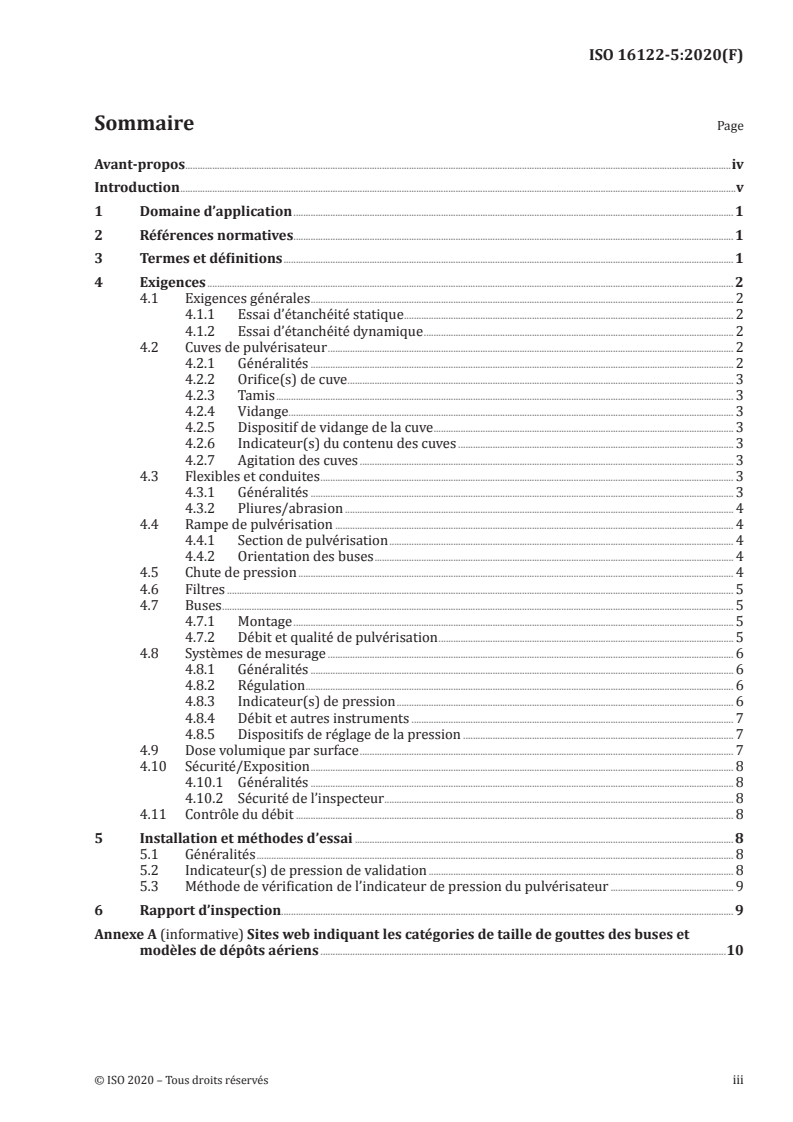
ISO 16122-5:2020 - Matériel agricole et forestier — Contrôle des pulvérisateurs en service — Partie 5: Systèmes aériens de pulvérisation/31/2020
Overview
ISO 16122-5:2020 - "Agricultural and forestry machines - Inspection of sprayers in use - Part 5: Aerial spray systems" defines requirements, test methods and verification procedures for inspecting manned aerial spray systems (fixed-wing and rotary aircraft) used in agriculture, forestry, turf and vegetation control. The standard focuses on minimizing the risk of environmental contamination from spray systems in sensitive areas such as transport access ways (e.g., gas and electric corridors). It addresses the condition and performance of spray equipment, not aircraft airworthiness, pilot licensing or registration, which remain subject to national regulations.
Key topics and technical requirements
The standard covers inspection scope and practical test methods - emphasizing visual and functional checks - including:
Leak testing
- Static leak test: tank filled to nominal capacity with pump off; visual inspection for leaks.
- Dynamic leak test: system pressurised to maximum obtainable pressure; inspect for leaks during operation.
Tank requirements
- Tank surfaces free from cuts or abrasion; no loose parts.
- Openings > 400 mm require secured bars/gratings (mesh openings ≤ 400 mm); lids tightly sealed.
- Strainers: 20‑mesh recommended for transfer; strainers must be undamaged/unblocked.
- Emptying devices must permit safe collection of residual liquid without environmental contamination.
- Tank contents indicators readable from pilot/operator positions.
- Agitation/recirculation systems must maintain an obviously disturbed liquid surface at ≥ half nominal volume.
Hoses, lines and boom
- Pressurised hoses marked with maximum working pressure.
- Protective screens to prevent cockpit exposure from leaks.
- Quick-acting shut-off valves to allow depressurization or return flow to tank.
- Nozzle mounting, flow rate and spray quality checks; boom sectioning and nozzle orientation verification.
Measuring and control systems
- Validation of pressure indicators, flow-rate instruments and pressure-adjusting devices.
- Verification of volume rate per area and pressure drop characteristics.
Safety and inspection process
- Inspector protection and safety procedures follow ISO 16122-1.
- Inspection report format, test facility requirements and verification methods are specified.
- Annex includes nozzle droplet-size resources and aerial deposition models.
Applications and users
ISO 16122-5 is used by:
- Agricultural aviation operators and contractors
- Sprayer inspection bodies and maintenance technicians
- Equipment manufacturers and OEMs of aerial spray systems
- Environmental regulators, forestry managers and utility corridor managers
- Certification and compliance auditors implementing best practices to reduce environmental contamination
Practical benefits include improved spray accuracy, reduced off-target drift, safer operations for pilots/inspectors, and documented compliance with recognized inspection methods.
Related standards
- ISO 16122-1 (General inspection requirements)
- ISO 5681 (Crop protection vocabulary)
- ISO 5682-1 and ISO 5682-2 (Nozzle and distribution test methods)
Keywords: ISO 16122-5:2020, aerial spray systems, inspection of sprayers, agricultural aviation, environmental contamination, sprayer inspection, aerial application.
Relations
- Effective Date
- 08-Apr-2026
- Effective Date
- 12-Feb-2026
- Consolidates
ISO 18103:2015 - Superfine woven wool fabric labelling — Requirements for Super S code definition - Effective Date
- 06-Jun-2022
- Consolidated By
ISO 8740:2025 - Fasteners — Parallel grooved pins, with chamfer point — Full-length diamond grooves - Effective Date
- 06-Jun-2022
Buy Documents
ISO 16122-5:2020 - Agricultural and forestry machines -- Inspection of sprayers in use
ISO 16122-5:2020 - Agricultural and forestry machines — Inspection of sprayers in use — Part 5: Aerial spray systems/31/2020
ISO 16122-5:2020 - Matériel agricole et forestier -- Contrôle des pulvérisateurs en service
ISO 16122-5:2020 - Matériel agricole et forestier — Contrôle des pulvérisateurs en service — Partie 5: Systèmes aériens de pulvérisation/31/2020
Get Certified
Connect with accredited certification bodies for this standard

BSI Group
BSI (British Standards Institution) is the business standards company that helps organizations make excellence a habit.

Bureau Veritas
Bureau Veritas is a world leader in laboratory testing, inspection and certification services.

DNV
DNV is an independent assurance and risk management provider.
Sponsored listings
Frequently Asked Questions
ISO 16122-5:2020 is a standard published by the International Organization for Standardization (ISO). Its full title is "Agricultural and forestry machines — Inspection of sprayers in use — Part 5: Aerial spray systems". This standard covers: This document specifies the requirements, test methods and verification of the inspection of aerial fixed wing and rotary aircraft spray systems for agriculture, forestry, turf, and vegetation control in transport access ways (such as gas and electric lines), with regard to minimizing the potential risk of environmental contamination during use. This document applies only to manned aerial aircraft. It does not cover aircraft safety and design criteria for air worthiness, aircraft registration, pilot or operator requirements, all of which are specified separately by countries or regions. This document relates mainly to the condition of the equipment with respect to its potential risk for the environment and its performance to achieve good applications. The general requirements of ISO 16122-1 apply where appropriate, including for the protection of inspectors during an inspection.
This document specifies the requirements, test methods and verification of the inspection of aerial fixed wing and rotary aircraft spray systems for agriculture, forestry, turf, and vegetation control in transport access ways (such as gas and electric lines), with regard to minimizing the potential risk of environmental contamination during use. This document applies only to manned aerial aircraft. It does not cover aircraft safety and design criteria for air worthiness, aircraft registration, pilot or operator requirements, all of which are specified separately by countries or regions. This document relates mainly to the condition of the equipment with respect to its potential risk for the environment and its performance to achieve good applications. The general requirements of ISO 16122-1 apply where appropriate, including for the protection of inspectors during an inspection.
ISO 16122-5:2020 is classified under the following ICS (International Classification for Standards) categories: 13.020.99 - Other standards related to environmental protection; 65.060.40 - Plant care equipment. The ICS classification helps identify the subject area and facilitates finding related standards.
ISO 16122-5:2020 has the following relationships with other standards: It is inter standard links to EN ISO 16122-1:2025, EN ISO 16122-5:2020, ISO 18103:2015, ISO 8740:2025. Understanding these relationships helps ensure you are using the most current and applicable version of the standard.
ISO 16122-5:2020 is available in PDF format for immediate download after purchase. The document can be added to your cart and obtained through the secure checkout process. Digital delivery ensures instant access to the complete standard document.
Standards Content (Sample)
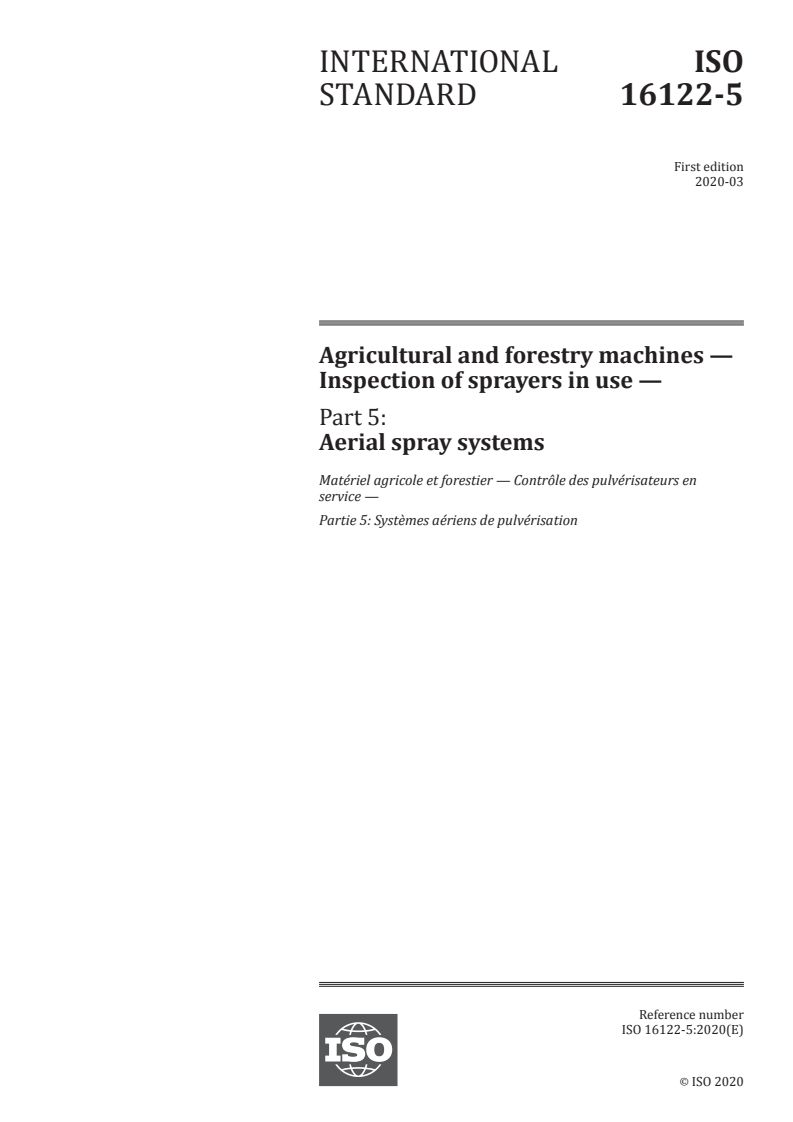
INTERNATIONAL ISO
STANDARD 16122-5
First edition
2020-03
Agricultural and forestry machines —
Inspection of sprayers in use —
Part 5:
Aerial spray systems
Matériel agricole et forestier — Contrôle des pulvérisateurs en
service —
Partie 5: Systèmes aériens de pulvérisation
Reference number
©
ISO 2020
© ISO 2020
All rights reserved. Unless otherwise specified, or required in the context of its implementation, no part of this publication may
be reproduced or utilized otherwise in any form or by any means, electronic or mechanical, including photocopying, or posting
on the internet or an intranet, without prior written permission. Permission can be requested from either ISO at the address
below or ISO’s member body in the country of the requester.
ISO copyright office
CP 401 • Ch. de Blandonnet 8
CH-1214 Vernier, Geneva
Phone: +41 22 749 01 11
Fax: +41 22 749 09 47
Email: copyright@iso.org
Website: www.iso.org
Published in Switzerland
ii © ISO 2020 – All rights reserved
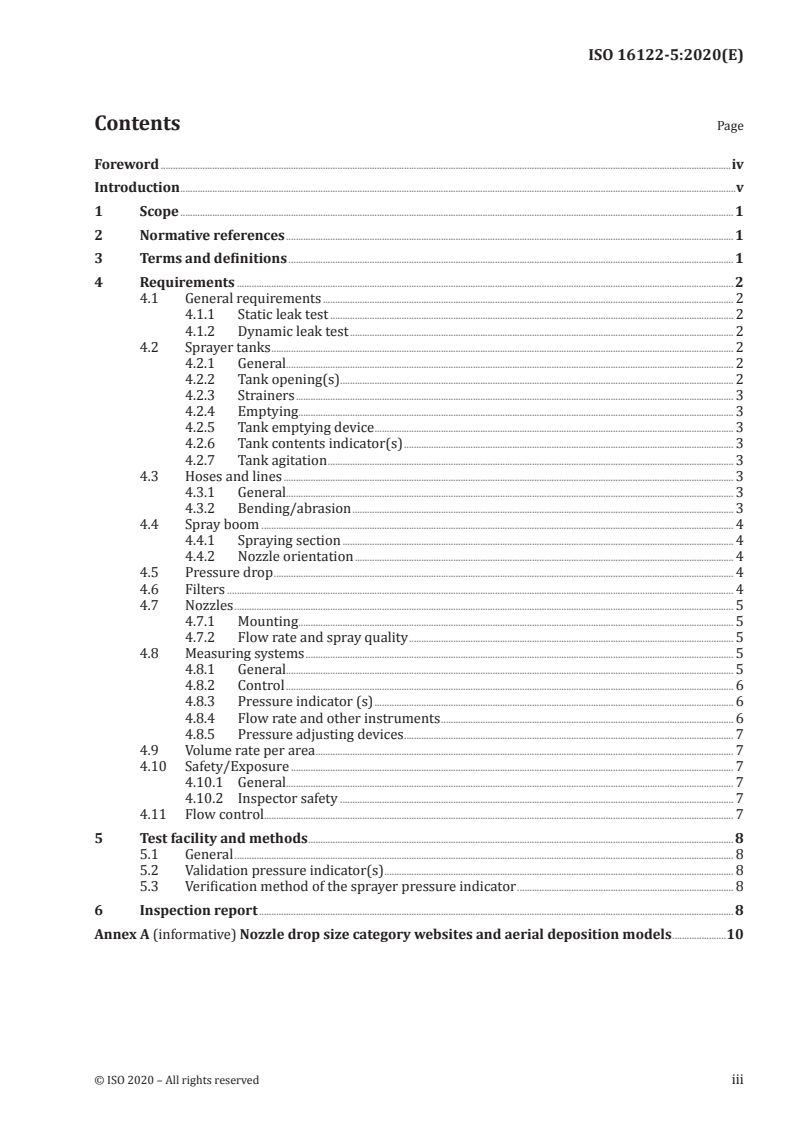
Contents Page
Foreword .iv
Introduction .v
1 Scope . 1
2 Normative references . 1
3 Terms and definitions . 1
4 Requirements . 2
4.1 General requirements . 2
4.1.1 Static leak test . 2
4.1.2 Dynamic leak test . 2
4.2 Sprayer tanks . 2
4.2.1 General. 2
4.2.2 Tank opening(s) . 2
4.2.3 Strainers . 3
4.2.4 Emptying. 3
4.2.5 Tank emptying device . 3
4.2.6 Tank contents indicator(s) . 3
4.2.7 Tank agitation . 3
4.3 Hoses and lines . 3
4.3.1 General. 3
4.3.2 Bending/abrasion . 3
4.4 Spray boom . 4
4.4.1 Spraying section . 4
4.4.2 Nozzle orientation . 4
4.5 Pressure drop . 4
4.6 Filters . 4
4.7 Nozzles . 5
4.7.1 Mounting . 5
4.7.2 Flow rate and spray quality . 5
4.8 Measuring systems . 5
4.8.1 General. 5
4.8.2 Control . 6
4.8.3 Pressure indicator (s) . 6
4.8.4 Flow rate and other instruments . 6
4.8.5 Pressure adjusting devices . 7
4.9 Volume rate per area . 7
4.10 Safety/Exposure . 7
4.10.1 General. 7
4.10.2 Inspector safety . 7
4.11 Flow control. 7
5 Test facility and methods . 8
5.1 General . 8
5.2 Validation pressure indicator(s) . 8
5.3 Verification method of the sprayer pressure indicator . 8
6 Inspection report . 8
Annex A (informative) Nozzle drop size category websites and aerial deposition models .10
Foreword
ISO (the International Organization for Standardization) is a worldwide federation of national standards
bodies (ISO member bodies). The work of preparing International Standards is normally carried out
through ISO technical committees. Each member body interested in a subject for which a technical
committee has been established has the right to be represented on that committee. International
organizations, governmental and non-governmental, in liaison with ISO, also take part in the work.
ISO collaborates closely with the International Electrotechnical Commission (IEC) on all matters of
electrotechnical standardization.
The procedures used to develop this document and those intended for its further maintenance are
described in the ISO/IEC Directives, Part 1. In particular the different approval criteria needed for the
different types of ISO documents should be noted. This document was drafted in accordance with the
editorial rules of the ISO/IEC Directives, Part 2 (see www .iso .org/ directives).
Attention is drawn to the possibility that some of the elements of this document may be the subject of
patent rights. ISO shall not be held responsible for identifying any or all such patent rights. Details of
any patent rights identified during the development of the document will be in the Introduction and/or
on the ISO list of patent declarations received (see www .iso .org/ patents).
Any trade name used in this document is information given for the convenience of users and does not
constitute an endorsement.
For an explanation on the voluntary nature of standards, the meaning of ISO specific terms and
expressions related to conformity assessment, as well as information about ISO's adherence to the World
Trade Organization (WTO) principles in the Technical Barriers to Trade (TBT) see the following URL:
www .iso .org/ iso/ foreword .html.
This document was prepared by Technical Committee ISO/TC 23, Tractors and machinery for agriculture
and forestry, Subcommittee SC 6, Equipment for crop protection.
A list of all parts in the ISO 16122 series can be found on the ISO website.
Any feedback or questions on this document should be directed to the user’s national standards body. A
complete listing of these bodies can be found at www .iso .org/ members .html.
iv © ISO 2020 – All rights reserved
Introduction
Significant areas are sprayed globally by fixed wing and rotary aircraft in order to overcome serious
pest threats to agriculture and forestry. Aerial application is used where difficult terrain or crop
(forests) dictate as well as for timely application to large areas in order to maximize efficient use of
crop protection products and minimize environmental impact. This document specifies requirements
and methods for their inspection in use of such spray systems. Industry stakeholders such as the USA
National Agricultural Aviation Association (NAAA) and their partner National Agricultural Aviation
Research and Education Fund have provided input to the development.
INTERNATIONAL STANDARD ISO 16122-5:2020(E)
Agricultural and forestry machines — Inspection of
sprayers in use —
Part 5:
Aerial spray systems
1 Scope
This document specifies the requirements, test methods and verification of the inspection of aerial
fixed wing and rotary aircraft spray systems for agriculture, forestry, turf, and vegetation control in
transport access ways (such as gas and electric lines), with regard to minimizing the potential risk of
environmental contamination during use.
This document applies only to manned aerial aircraft. It does not cover aircraft safety and design
criteria for air worthiness, aircraft registration, pilot or operator requirements, all of which are
specified separately by countries or regions.
This document relates mainly to the condition of the equipment with respect to its potential risk for the
environment and its performance to achieve good applications.
The general requirements of ISO 16122-1 apply where appropriate, including for the protection of
inspectors during an inspection.
2 Normative references
The following documents are referred to in the text in such a way that some or all of their content
constitutes requirements of this document. For dated references, only the edition cited applies. For
undated references, the latest edition of the referenced document (including any amendments) applies.
ISO 5681, Equipment for crop protection — Vocabulary
ISO 5682-1:2017, Equipment for crop protection — Spraying equipment — Part 1: Test methods for
sprayer nozzles
ISO 5682-2:2017, Equipment for crop protection — Spraying equipment — Part 2: Test methods to assess
the horizontal transverse distribution for hydraulic sprayers
ISO 16122-1:2015, Agricultural and forestry machinery — Inspection of sprayers in use — Part 1: General
3 Terms and definitions
For the purposes of this document, the terms and definitions given in ISO 5681 and the following apply.
ISO and IEC maintain terminological databases for use in standardization at the following addresses:
— ISO Online browsing platform: available at https:// www .iso .org/ obp
— IEC Electropedia: available at http:// www .electropedia .org/
3.1
fixed wing aircraft
aircraft with fixed wings approved by local or national authority and equipped for the application of
plant protection products and fertilizers, on crops, including forestry and grasslands
3.2
rotary aircraft
helicopter (rotary propelled) aircraft approved by local or national authority, and equipped for the
application of plant protection products and fertilizers, on crops, including forestry and grasslands
3.3
global navigation satellite system
GNSS
generic term for satellite navigation systems that provide autonomous geospatial positioning with
global coverage
[SOURCE: ISO/TS 11356:2011, 3.2]
4 Requirements
4.1 General requirements
The spray system shall be cleaned and free from any damage that could cause spray liquid to leak from
the tank, its lid (which shall be in good condition), its fittings, the pump, pipework and nozzles.
Compliance shall be checked by visual inspection.
4.1.1 Static leak test
A test for static leaks shall be performed with the tank filled to its nominal capacity with the aircraft
parked on a level horizontal surface and the pump not running.
Compliance shall be checked by visual inspection.
4.1.2 Dynamic leak test
There shall be no visible leakage from pipes or hoses including their couplings when tested up to the
maximum obtainable pressure from the system. If the following testing requires disassembly this test
shall be
...
INTERNATIONAL ISO
STANDARD 16122-5
First edition
2020-03
Agricultural and forestry machines —
Inspection of sprayers in use —
Part 5:
Aerial spray systems
Matériel agricole et forestier — Contrôle des pulvérisateurs en
service —
Partie 5: Systèmes aériens de pulvérisation
Reference number
©
ISO 2020
© ISO 2020
All rights reserved. Unless otherwise specified, or required in the context of its implementation, no part of this publication may
be reproduced or utilized otherwise in any form or by any means, electronic or mechanical, including photocopying, or posting
on the internet or an intranet, without prior written permission. Permission can be requested from either ISO at the address
below or ISO’s member body in the country of the requester.
ISO copyright office
CP 401 • Ch. de Blandonnet 8
CH-1214 Vernier, Geneva
Phone: +41 22 749 01 11
Fax: +41 22 749 09 47
Email: copyright@iso.org
Website: www.iso.org
Published in Switzerland
ii © ISO 2020 – All rights reserved
Contents Page
Foreword .iv
Introduction .v
1 Scope . 1
2 Normative references . 1
3 Terms and definitions . 1
4 Requirements . 2
4.1 General requirements . 2
4.1.1 Static leak test . 2
4.1.2 Dynamic leak test . 2
4.2 Sprayer tanks . 2
4.2.1 General. 2
4.2.2 Tank opening(s) . 2
4.2.3 Strainers . 3
4.2.4 Emptying. 3
4.2.5 Tank emptying device . 3
4.2.6 Tank contents indicator(s) . 3
4.2.7 Tank agitation . 3
4.3 Hoses and lines . 3
4.3.1 General. 3
4.3.2 Bending/abrasion . 3
4.4 Spray boom . 4
4.4.1 Spraying section . 4
4.4.2 Nozzle orientation . 4
4.5 Pressure drop . 4
4.6 Filters . 4
4.7 Nozzles . 5
4.7.1 Mounting . 5
4.7.2 Flow rate and spray quality . 5
4.8 Measuring systems . 5
4.8.1 General. 5
4.8.2 Control . 6
4.8.3 Pressure indicator (s) . 6
4.8.4 Flow rate and other instruments . 6
4.8.5 Pressure adjusting devices . 7
4.9 Volume rate per area . 7
4.10 Safety/Exposure . 7
4.10.1 General. 7
4.10.2 Inspector safety . 7
4.11 Flow control. 7
5 Test facility and methods . 8
5.1 General . 8
5.2 Validation pressure indicator(s) . 8
5.3 Verification method of the sprayer pressure indicator . 8
6 Inspection report . 8
Annex A (informative) Nozzle drop size category websites and aerial deposition models .10
Foreword
ISO (the International Organization for Standardization) is a worldwide federation of national standards
bodies (ISO member bodies). The work of preparing International Standards is normally carried out
through ISO technical committees. Each member body interested in a subject for which a technical
committee has been established has the right to be represented on that committee. International
organizations, governmental and non-governmental, in liaison with ISO, also take part in the work.
ISO collaborates closely with the International Electrotechnical Commission (IEC) on all matters of
electrotechnical standardization.
The procedures used to develop this document and those intended for its further maintenance are
described in the ISO/IEC Directives, Part 1. In particular the different approval criteria needed for the
different types of ISO documents should be noted. This document was drafted in accordance with the
editorial rules of the ISO/IEC Directives, Part 2 (see www .iso .org/ directives).
Attention is drawn to the possibility that some of the elements of this document may be the subject of
patent rights. ISO shall not be held responsible for identifying any or all such patent rights. Details of
any patent rights identified during the development of the document will be in the Introduction and/or
on the ISO list of patent declarations received (see www .iso .org/ patents).
Any trade name used in this document is information given for the convenience of users and does not
constitute an endorsement.
For an explanation on the voluntary nature of standards, the meaning of ISO specific terms and
expressions related to conformity assessment, as well as information about ISO's adherence to the World
Trade Organization (WTO) principles in the Technical Barriers to Trade (TBT) see the following URL:
www .iso .org/ iso/ foreword .html.
This document was prepared by Technical Committee ISO/TC 23, Tractors and machinery for agriculture
and forestry, Subcommittee SC 6, Equipment for crop protection.
A list of all parts in the ISO 16122 series can be found on the ISO website.
Any feedback or questions on this document should be directed to the user’s national standards body. A
complete listing of these bodies can be found at www .iso .org/ members .html.
iv © ISO 2020 – All rights reserved
Introduction
Significant areas are sprayed globally by fixed wing and rotary aircraft in order to overcome serious
pest threats to agriculture and forestry. Aerial application is used where difficult terrain or crop
(forests) dictate as well as for timely application to large areas in order to maximize efficient use of
crop protection products and minimize environmental impact. This document specifies requirements
and methods for their inspection in use of such spray systems. Industry stakeholders such as the USA
National Agricultural Aviation Association (NAAA) and their partner National Agricultural Aviation
Research and Education Fund have provided input to the development.
INTERNATIONAL STANDARD ISO 16122-5:2020(E)
Agricultural and forestry machines — Inspection of
sprayers in use —
Part 5:
Aerial spray systems
1 Scope
This document specifies the requirements, test methods and verification of the inspection of aerial
fixed wing and rotary aircraft spray systems for agriculture, forestry, turf, and vegetation control in
transport access ways (such as gas and electric lines), with regard to minimizing the potential risk of
environmental contamination during use.
This document applies only to manned aerial aircraft. It does not cover aircraft safety and design
criteria for air worthiness, aircraft registration, pilot or operator requirements, all of which are
specified separately by countries or regions.
This document relates mainly to the condition of the equipment with respect to its potential risk for the
environment and its performance to achieve good applications.
The general requirements of ISO 16122-1 apply where appropriate, including for the protection of
inspectors during an inspection.
2 Normative references
The following documents are referred to in the text in such a way that some or all of their content
constitutes requirements of this document. For dated references, only the edition cited applies. For
undated references, the latest edition of the referenced document (including any amendments) applies.
ISO 5681, Equipment for crop protection — Vocabulary
ISO 5682-1:2017, Equipment for crop protection — Spraying equipment — Part 1: Test methods for
sprayer nozzles
ISO 5682-2:2017, Equipment for crop protection — Spraying equipment — Part 2: Test methods to assess
the horizontal transverse distribution for hydraulic sprayers
ISO 16122-1:2015, Agricultural and forestry machinery — Inspection of sprayers in use — Part 1: General
3 Terms and definitions
For the purposes of this document, the terms and definitions given in ISO 5681 and the following apply.
ISO and IEC maintain terminological databases for use in standardization at the following addresses:
— ISO Online browsing platform: available at https:// www .iso .org/ obp
— IEC Electropedia: available at http:// www .electropedia .org/
3.1
fixed wing aircraft
aircraft with fixed wings approved by local or national authority and equipped for the application of
plant protection products and fertilizers, on crops, including forestry and grasslands
3.2
rotary aircraft
helicopter (rotary propelled) aircraft approved by local or national authority, and equipped for the
application of plant protection products and fertilizers, on crops, including forestry and grasslands
3.3
global navigation satellite system
GNSS
generic term for satellite navigation systems that provide autonomous geospatial positioning with
global coverage
[SOURCE: ISO/TS 11356:2011, 3.2]
4 Requirements
4.1 General requirements
The spray system shall be cleaned and free from any damage that could cause spray liquid to leak from
the tank, its lid (which shall be in good condition), its fittings, the pump, pipework and nozzles.
Compliance shall be checked by visual inspection.
4.1.1 Static leak test
A test for static leaks shall be performed with the tank filled to its nominal capacity with the aircraft
parked on a level horizontal surface and the pump not running.
Compliance shall be checked by visual inspection.
4.1.2 Dynamic leak test
There shall be no visible leakage from pipes or hoses including their couplings when tested up to the
maximum obtainable pressure from the system. If the following testing requires disassembly this test
shall be
...
NORME ISO
INTERNATIONALE 16122-5
Première édition
2020-03
Matériel agricole et forestier —
Contrôle des pulvérisateurs en
service —
Partie 5:
Systèmes aériens de pulvérisation
Agricultural and forestry machines — Inspection of sprayers in use —
Part 5: Aerial spray systems
Numéro de référence
©
ISO 2020
DOCUMENT PROTÉGÉ PAR COPYRIGHT
© ISO 2020
Tous droits réservés. Sauf prescription différente ou nécessité dans le contexte de sa mise en œuvre, aucune partie de cette
publication ne peut être reproduite ni utilisée sous quelque forme que ce soit et par aucun procédé, électronique ou mécanique,
y compris la photocopie, ou la diffusion sur l’internet ou sur un intranet, sans autorisation écrite préalable. Une autorisation peut
être demandée à l’ISO à l’adresse ci-après ou au comité membre de l’ISO dans le pays du demandeur.
ISO copyright office
Case postale 401 • Ch. de Blandonnet 8
CH-1214 Vernier, Genève
Tél.: +41 22 749 01 11
Fax: +41 22 749 09 47
E-mail: copyright@iso.org
Web: www.iso.org
Publié en Suisse
ii © ISO 2020 – Tous droits réservés
Sommaire Page
Avant-propos .iv
Introduction .v
1 Domaine d’application . 1
2 Références normatives . 1
3 Termes et définitions . 1
4 Exigences . 2
4.1 Exigences générales . 2
4.1.1 Essai d’étanchéité statique . 2
4.1.2 Essai d’étanchéité dynamique . 2
4.2 Cuves de pulvérisateur . 2
4.2.1 Généralités . 2
4.2.2 Orifice(s) de cuve . 3
4.2.3 Tamis . 3
4.2.4 Vidange. 3
4.2.5 Dispositif de vidange de la cuve . 3
4.2.6 Indicateur(s) du contenu des cuves . 3
4.2.7 Agitation des cuves . 3
4.3 Flexibles et conduites . 3
4.3.1 Généralités . 3
4.3.2 Pliures/abrasion . 4
4.4 Rampe de pulvérisation . 4
4.4.1 Section de pulvérisation . 4
4.4.2 Orientation des buses . 4
4.5 Chute de pression . 4
4.6 Filtres . 5
4.7 Buses . 5
4.7.1 Montage . 5
4.7.2 Débit et qualité de pulvérisation . 5
4.8 Systèmes de mesurage . 6
4.8.1 Généralités . 6
4.8.2 Régulation . 6
4.8.3 Indicateur(s) de pression . 6
4.8.4 Débit et autres instruments . 7
4.8.5 Dispositifs de réglage de la pression . 7
4.9 Dose volumique par surface . 7
4.10 Sécurité/Exposition . 8
4.10.1 Généralités . 8
4.10.2 Sécurité de l’inspecteur . . 8
4.11 Contrôle du débit . 8
5 Installation et méthodes d’essai . 8
5.1 Généralités . 8
5.2 Indicateur(s) de pression de validation . 8
5.3 Méthode de vérification de l’indicateur de pression du pulvérisateur . 9
6 Rapport d’inspection. 9
Annexe A (informative) Sites web indiquant les catégories de taille de gouttes des buses et
modèles de dépôts aériens .10
Avant-propos
L’ISO (Organisation internationale de normalisation) est une fédération mondiale d’organismes
nationaux de normalisation (comités membres de l’ISO). L’élaboration des Normes internationales est
en général confiée aux comités techniques de l’ISO. Chaque comité membre intéressé par une étude
a le droit de faire partie du comité technique créé à cet effet. Les organisations internationales,
gouvernementales et non gouvernementales, en liaison avec l’ISO participent également aux travaux.
L’ISO collabore étroitement avec la Commission électrotechnique internationale (IEC) en ce qui
concerne la normalisation électrotechnique.
Les procédures utilisées pour élaborer le présent document et celles destinées à sa mise à jour sont
décrites dans les Directives ISO/IEC, Partie 1. Il convient, en particulier de prendre note des différents
critères d’approbation requis pour les différents types de documents ISO. Le présent document a été
rédigé conformément aux règles de rédaction données dans les Directives ISO/IEC, Partie 2 (voir www
.iso .org/ directives).
L’attention est attirée sur le fait que certains des éléments du présent document peuvent faire l’objet de
droits de propriété intellectuelle ou de droits analogues. L’ISO ne saurait être tenue pour responsable
de ne pas avoir identifié de tels droits de propriété et averti de leur existence. Les détails concernant
les références aux droits de propriété intellectuelle ou autres droits analogues identifiés lors de
l’élaboration du document sont indiqués dans l’Introduction et/ou dans la liste des déclarations de
brevets reçues par l’ISO (voir www .iso .org/ brevets).
Les appellations commerciales éventuellement mentionnées dans le présent document sont données
pour information, par souci de commodité, à l’intention des utilisateurs et ne sauraient constituer un
engagement.
Pour une explication de la nature volontaire des normes, la signification des termes et expressions
spécifiques de l’ISO liés à l’évaluation de la conformité, ou pour toute information au sujet de l’adhésion
de l’ISO aux principes de l’Organisation mondiale du commerce (OMC) concernant les obstacles
techniques au commerce (OTC), voir le lien suivant: www .iso .org/ iso/ fr/ avant -propos.
Le présent document a été élaboré par le comité technique ISO/TC 23, Tracteurs et matériels agricoles et
forestiers, sous-comité SC 6, Matériel de protection des cultures.
Une liste de toutes les parties de la série ISO 16122 se trouve sur le site web de l’ISO.
Il convient que l’utilisateur adresse tout retour d’information ou toute question concernant le présent
document à l’organisme national de normalisation de son pays. Une liste exhaustive desdits organismes
se trouve à l’adresse www .iso .org/ fr/ members .html.
iv © ISO 2020 – Tous droits réservés
Introduction
D’importantes surfaces sont pulvérisées à l’échelle mondiale par des aéronefs à voilure fixe ou tournante
afin de maîtriser les menaces graves que les ravageurs font peser sur l’agriculture et la foresterie.
Des applications par voie aérienne sont employées dans le cas des terrains ou des cultures (forêts)
difficiles à traiter ou en cas d’application opportune sur de vastes surfaces afin de maximiser l’efficacité
de l’utilisation des produits de protection des cultures et de réduire le plus possible leur impact
environnemental. Le présent document spécifie les exigences et les méthodes pour la vérification en
service de tels systèmes de pulvérisation. Les parties prenantes industrielles telles que l’Association
nationale de l’aviation agricole (NAAA) des États-Unis et leur partenaire, le Fonds de recherche et
d’éducation de l’aviation nationale agricole, ont fourni des données pour son élaboration.
NORME INTERNATIONALE ISO 16122-5:2020(F)
Matériel agricole et forestier — Contrôle des
pulvérisateurs en service —
Partie 5:
Systèmes aériens de pulvérisation
1 Domaine d’application
Le présent document spécifie les exigences, les méthodes d’essai et la vérification de l’inspection
des systèmes de pulvérisation par aéronef à voilure fixe ou tournante destinés à l’agriculture, à la
foresterie, aux surfaces engazonnées et au contrôle de la végétation sur les voies de transport (comme
les lignes électriques et les conduites de gaz) en vue de réduire le plus possible le risque potentiel de
contamination environnementale pendant leur utilisation.
Le présent document s’applique uniquement aux aéronefs pilotés. Il ne couvre pas la sécurité des
aéronefs, ni les critères de navigabilité, l’immatriculation des aéronefs, les exigences relatives aux
pilotes ou aux opérateurs, qui sont précisés séparément par chaque pays ou région.
Le présent document concerne principalement la condition de l’équipement vis-à-vis de son risque
potentiel pour l’environnement et de sa performance pour obtenir de bonnes applications.
Les exigences générales de l’ISO 16122-1 s’appliquent le cas échéant, y compris pour la protection des
inspecteurs lors d’une inspection.
2 Références normatives
Les documents suivants sont cités dans le texte de sorte qu’ils constituent, pour tout ou partie de leur
contenu, des exigences du présent document. Pour les références datées, seule l’édition citée s’applique.
Pour les références non datées, la dernière édition du document de référence s’applique (y compris les
éventuels amendements).
ISO 5681, Matériel de protection des cultures — Vocabulaire
ISO 5682-1:2017, Matériel de protection des cultures — Équipement de pulvérisation — Partie 1: Méthodes
d'essai des buses de pulvérisation
ISO 5682-2:2017, Matériel de protection des cultures — Équipement de pulvérisation — Partie 2: Méthodes
d’essai pour évaluer la distribution transversale horizontale des pulvérisateurs à jet projeté
ISO 16122-1:2015, Matériel agricole et forestier — Contrôle des pulvérisateurs en service — Partie 1:
Généralités
3 Termes et définitions
Pour les besoins du présent document, les termes et définitions de l’ISO 5681 ainsi que les suivants,
s’appliquent.
L’ISO et l’IEC tiennent à jour des bases de données terminologiques destinées à être utilisées en
normalisation, consultables aux adresses suivantes:
— ISO Online browsing platform: disponible à l’adresse https:// www .iso .org/ obp;
— IEC Electropedia: disponible à l’adresse http:// www .electropedia .org/ .
3.1
aéronef à voilure fixe
aéronef à voilure fixe approuvé par une autorité locale ou nationale et équipé pour l’application de
produits de protection des plantes et d’engrais sur les cultures, y compris les forêts et les prairies
3.2
aéronef à voilure tournante
hélicoptère (à propulsion par voilure tournante) approuvé par une autorité locale ou nationale et
équipé pour l’application de produits de protection des plantes et d’engrais sur les cultures, y compris
les forêts et les prairies
3.3
système mondial de navigation par satellite
GNSS
terme générique des systèmes de navigation par satellite qui fournissent une localisation géospatiale
autonome à couverture mondiale
[SOURCE: ISO/TS 11356:2011, 3.2]
4 Exigences
4.1 Exigences générales
Le système de pulvérisation doit être nettoyé et exempt de tout dommage susceptible d’entraîner une
fuite de liquide de pulvérisation de la cuve, de son couvercle (qui doit être en bon état), de ses raccords,
de la pompe, de la tuyauterie et des buses.
La conformité doit être vérifiée par inspection visuelle.
4.1.1 Essai d’étanchéité statique
Un essai d’étanchéité statique doit être effectué avec la cuve remplie à sa capacité nominale, l’aéronef
étant stationné sur une surface horizontale et la pompe à l’arrêt.
La conformité doit être vérifiée par inspection visuelle.
4.1.2 Essai d’étanchéité dynamique
Il ne doit pas y avoir de fuite visible provenant des canalisations ou des flexibles, y compris les raccords,
lorsqu’ils sont soumis à l’essai jusqu’à la pression maximale qu’il est possible d’obtenir du système. Si les
essais suivants exigent un démontage, le présent essai doit être répété une fois le remontage effectué.
La conformité doit être vérifiée par inspection visuelle et essai de fonctionnement.
4.2 Cuves de pulvérisateur
4.2.1 Généralités
La surface des cuves doit être exempte d’entailles ou d’abrasions externes et internes susceptibles de
compromettre l’intégrité de leurs parois. Il convient qu’il n’y ait pas de pièces détachées dans la cuve de
pulvérisation.
La conformité doit être vérifiée par: inspection visuelle.
2 © ISO 2020 – Tous droits réservés
4.2.2 Orifice(s) de cuve
Tout orifice de cuve supérieur à 400 mm de diamètre doit être muni d’une barre ou d’une grille
caillebotis fixe pouvant uniquement être déposée à l’aide d’outils. Les ouvertures ménagées dans la
grille ne doivent pas dépasser les 400 mm afin d’empêcher l’exposition de l’opérateur.
Tout couvercle de l’ouverture doit être hermétiquement fermé pour éviter les débordements.
La conformité doit être vérifiée par: mesurage et inspection visu
...
NORME ISO
INTERNATIONALE 16122-5
Première édition
2020-03
Matériel agricole et forestier —
Contrôle des pulvérisateurs en
service —
Partie 5:
Systèmes aériens de pulvérisation
Agricultural and forestry machines — Inspection of sprayers in use —
Part 5: Aerial spray systems
Numéro de référence
©
ISO 2020
DOCUMENT PROTÉGÉ PAR COPYRIGHT
© ISO 2020
Tous droits réservés. Sauf prescription différente ou nécessité dans le contexte de sa mise en œuvre, aucune partie de cette
publication ne peut être reproduite ni utilisée sous quelque forme que ce soit et par aucun procédé, électronique ou mécanique,
y compris la photocopie, ou la diffusion sur l’internet ou sur un intranet, sans autorisation écrite préalable. Une autorisation peut
être demandée à l’ISO à l’adresse ci-après ou au comité membre de l’ISO dans le pays du demandeur.
ISO copyright office
Case postale 401 • Ch. de Blandonnet 8
CH-1214 Vernier, Genève
Tél.: +41 22 749 01 11
Fax: +41 22 749 09 47
E-mail: copyright@iso.org
Web: www.iso.org
Publié en Suisse
ii © ISO 2020 – Tous droits réservés
Sommaire Page
Avant-propos .iv
Introduction .v
1 Domaine d’application . 1
2 Références normatives . 1
3 Termes et définitions . 1
4 Exigences . 2
4.1 Exigences générales . 2
4.1.1 Essai d’étanchéité statique . 2
4.1.2 Essai d’étanchéité dynamique . 2
4.2 Cuves de pulvérisateur . 2
4.2.1 Généralités . 2
4.2.2 Orifice(s) de cuve . 3
4.2.3 Tamis . 3
4.2.4 Vidange. 3
4.2.5 Dispositif de vidange de la cuve . 3
4.2.6 Indicateur(s) du contenu des cuves . 3
4.2.7 Agitation des cuves . 3
4.3 Flexibles et conduites . 3
4.3.1 Généralités . 3
4.3.2 Pliures/abrasion . 4
4.4 Rampe de pulvérisation . 4
4.4.1 Section de pulvérisation . 4
4.4.2 Orientation des buses . 4
4.5 Chute de pression . 4
4.6 Filtres . 5
4.7 Buses . 5
4.7.1 Montage . 5
4.7.2 Débit et qualité de pulvérisation . 5
4.8 Systèmes de mesurage . 6
4.8.1 Généralités . 6
4.8.2 Régulation . 6
4.8.3 Indicateur(s) de pression . 6
4.8.4 Débit et autres instruments . 7
4.8.5 Dispositifs de réglage de la pression . 7
4.9 Dose volumique par surface . 7
4.10 Sécurité/Exposition . 8
4.10.1 Généralités . 8
4.10.2 Sécurité de l’inspecteur . . 8
4.11 Contrôle du débit . 8
5 Installation et méthodes d’essai . 8
5.1 Généralités . 8
5.2 Indicateur(s) de pression de validation . 8
5.3 Méthode de vérification de l’indicateur de pression du pulvérisateur . 9
6 Rapport d’inspection. 9
Annexe A (informative) Sites web indiquant les catégories de taille de gouttes des buses et
modèles de dépôts aériens .10
Avant-propos
L’ISO (Organisation internationale de normalisation) est une fédération mondiale d’organismes
nationaux de normalisation (comités membres de l’ISO). L’élaboration des Normes internationales est
en général confiée aux comités techniques de l’ISO. Chaque comité membre intéressé par une étude
a le droit de faire partie du comité technique créé à cet effet. Les organisations internationales,
gouvernementales et non gouvernementales, en liaison avec l’ISO participent également aux travaux.
L’ISO collabore étroitement avec la Commission électrotechnique internationale (IEC) en ce qui
concerne la normalisation électrotechnique.
Les procédures utilisées pour élaborer le présent document et celles destinées à sa mise à jour sont
décrites dans les Directives ISO/IEC, Partie 1. Il convient, en particulier de prendre note des différents
critères d’approbation requis pour les différents types de documents ISO. Le présent document a été
rédigé conformément aux règles de rédaction données dans les Directives ISO/IEC, Partie 2 (voir www
.iso .org/ directives).
L’attention est attirée sur le fait que certains des éléments du présent document peuvent faire l’objet de
droits de propriété intellectuelle ou de droits analogues. L’ISO ne saurait être tenue pour responsable
de ne pas avoir identifié de tels droits de propriété et averti de leur existence. Les détails concernant
les références aux droits de propriété intellectuelle ou autres droits analogues identifiés lors de
l’élaboration du document sont indiqués dans l’Introduction et/ou dans la liste des déclarations de
brevets reçues par l’ISO (voir www .iso .org/ brevets).
Les appellations commerciales éventuellement mentionnées dans le présent document sont données
pour information, par souci de commodité, à l’intention des utilisateurs et ne sauraient constituer un
engagement.
Pour une explication de la nature volontaire des normes, la signification des termes et expressions
spécifiques de l’ISO liés à l’évaluation de la conformité, ou pour toute information au sujet de l’adhésion
de l’ISO aux principes de l’Organisation mondiale du commerce (OMC) concernant les obstacles
techniques au commerce (OTC), voir le lien suivant: www .iso .org/ iso/ fr/ avant -propos.
Le présent document a été élaboré par le comité technique ISO/TC 23, Tracteurs et matériels agricoles et
forestiers, sous-comité SC 6, Matériel de protection des cultures.
Une liste de toutes les parties de la série ISO 16122 se trouve sur le site web de l’ISO.
Il convient que l’utilisateur adresse tout retour d’information ou toute question concernant le présent
document à l’organisme national de normalisation de son pays. Une liste exhaustive desdits organismes
se trouve à l’adresse www .iso .org/ fr/ members .html.
iv © ISO 2020 – Tous droits réservés
Introduction
D’importantes surfaces sont pulvérisées à l’échelle mondiale par des aéronefs à voilure fixe ou tournante
afin de maîtriser les menaces graves que les ravageurs font peser sur l’agriculture et la foresterie.
Des applications par voie aérienne sont employées dans le cas des terrains ou des cultures (forêts)
difficiles à traiter ou en cas d’application opportune sur de vastes surfaces afin de maximiser l’efficacité
de l’utilisation des produits de protection des cultures et de réduire le plus possible leur impact
environnemental. Le présent document spécifie les exigences et les méthodes pour la vérification en
service de tels systèmes de pulvérisation. Les parties prenantes industrielles telles que l’Association
nationale de l’aviation agricole (NAAA) des États-Unis et leur partenaire, le Fonds de recherche et
d’éducation de l’aviation nationale agricole, ont fourni des données pour son élaboration.
NORME INTERNATIONALE ISO 16122-5:2020(F)
Matériel agricole et forestier — Contrôle des
pulvérisateurs en service —
Partie 5:
Systèmes aériens de pulvérisation
1 Domaine d’application
Le présent document spécifie les exigences, les méthodes d’essai et la vérification de l’inspection
des systèmes de pulvérisation par aéronef à voilure fixe ou tournante destinés à l’agriculture, à la
foresterie, aux surfaces engazonnées et au contrôle de la végétation sur les voies de transport (comme
les lignes électriques et les conduites de gaz) en vue de réduire le plus possible le risque potentiel de
contamination environnementale pendant leur utilisation.
Le présent document s’applique uniquement aux aéronefs pilotés. Il ne couvre pas la sécurité des
aéronefs, ni les critères de navigabilité, l’immatriculation des aéronefs, les exigences relatives aux
pilotes ou aux opérateurs, qui sont précisés séparément par chaque pays ou région.
Le présent document concerne principalement la condition de l’équipement vis-à-vis de son risque
potentiel pour l’environnement et de sa performance pour obtenir de bonnes applications.
Les exigences générales de l’ISO 16122-1 s’appliquent le cas échéant, y compris pour la protection des
inspecteurs lors d’une inspection.
2 Références normatives
Les documents suivants sont cités dans le texte de sorte qu’ils constituent, pour tout ou partie de leur
contenu, des exigences du présent document. Pour les références datées, seule l’édition citée s’applique.
Pour les références non datées, la dernière édition du document de référence s’applique (y compris les
éventuels amendements).
ISO 5681, Matériel de protection des cultures — Vocabulaire
ISO 5682-1:2017, Matériel de protection des cultures — Équipement de pulvérisation — Partie 1: Méthodes
d'essai des buses de pulvérisation
ISO 5682-2:2017, Matériel de protection des cultures — Équipement de pulvérisation — Partie 2: Méthodes
d’essai pour évaluer la distribution transversale horizontale des pulvérisateurs à jet projeté
ISO 16122-1:2015, Matériel agricole et forestier — Contrôle des pulvérisateurs en service — Partie 1:
Généralités
3 Termes et définitions
Pour les besoins du présent document, les termes et définitions de l’ISO 5681 ainsi que les suivants,
s’appliquent.
L’ISO et l’IEC tiennent à jour des bases de données terminologiques destinées à être utilisées en
normalisation, consultables aux adresses suivantes:
— ISO Online browsing platform: disponible à l’adresse https:// www .iso .org/ obp;
— IEC Electropedia: disponible à l’adresse http:// www .electropedia .org/ .
3.1
aéronef à voilure fixe
aéronef à voilure fixe approuvé par une autorité locale ou nationale et équipé pour l’application de
produits de protection des plantes et d’engrais sur les cultures, y compris les forêts et les prairies
3.2
aéronef à voilure tournante
hélicoptère (à propulsion par voilure tournante) approuvé par une autorité locale ou nationale et
équipé pour l’application de produits de protection des plantes et d’engrais sur les cultures, y compris
les forêts et les prairies
3.3
système mondial de navigation par satellite
GNSS
terme générique des systèmes de navigation par satellite qui fournissent une localisation géospatiale
autonome à couverture mondiale
[SOURCE: ISO/TS 11356:2011, 3.2]
4 Exigences
4.1 Exigences générales
Le système de pulvérisation doit être nettoyé et exempt de tout dommage susceptible d’entraîner une
fuite de liquide de pulvérisation de la cuve, de son couvercle (qui doit être en bon état), de ses raccords,
de la pompe, de la tuyauterie et des buses.
La conformité doit être vérifiée par inspection visuelle.
4.1.1 Essai d’étanchéité statique
Un essai d’étanchéité statique doit être effectué avec la cuve remplie à sa capacité nominale, l’aéronef
étant stationné sur une surface horizontale et la pompe à l’arrêt.
La conformité doit être vérifiée par inspection visuelle.
4.1.2 Essai d’étanchéité dynamique
Il ne doit pas y avoir de fuite visible provenant des canalisations ou des flexibles, y compris les raccords,
lorsqu’ils sont soumis à l’essai jusqu’à la pression maximale qu’il est possible d’obtenir du système. Si les
essais suivants exigent un démontage, le présent essai doit être répété une fois le remontage effectué.
La conformité doit être vérifiée par inspection visuelle et essai de fonctionnement.
4.2 Cuves de pulvérisateur
4.2.1 Généralités
La surface des cuves doit être exempte d’entailles ou d’abrasions externes et internes susceptibles de
compromettre l’intégrité de leurs parois. Il convient qu’il n’y ait pas de pièces détachées dans la cuve de
pulvérisation.
La conformité doit être vérifiée par: inspection visuelle.
2 © ISO 2020 – Tous droits réservés
4.2.2 Orifice(s) de cuve
Tout orifice de cuve supérieur à 400 mm de diamètre doit être muni d’une barre ou d’une grille
caillebotis fixe pouvant uniquement être déposée à l’aide d’outils. Les ouvertures ménagées dans la
grille ne doivent pas dépasser les 400 mm afin d’empêcher l’exposition de l’opérateur.
Tout couvercle de l’ouverture doit être hermétiquement fermé pour éviter les débordements.
La conformité doit être vérifiée par: mesurage et inspection visu
...