

ISO 6182-4:2019
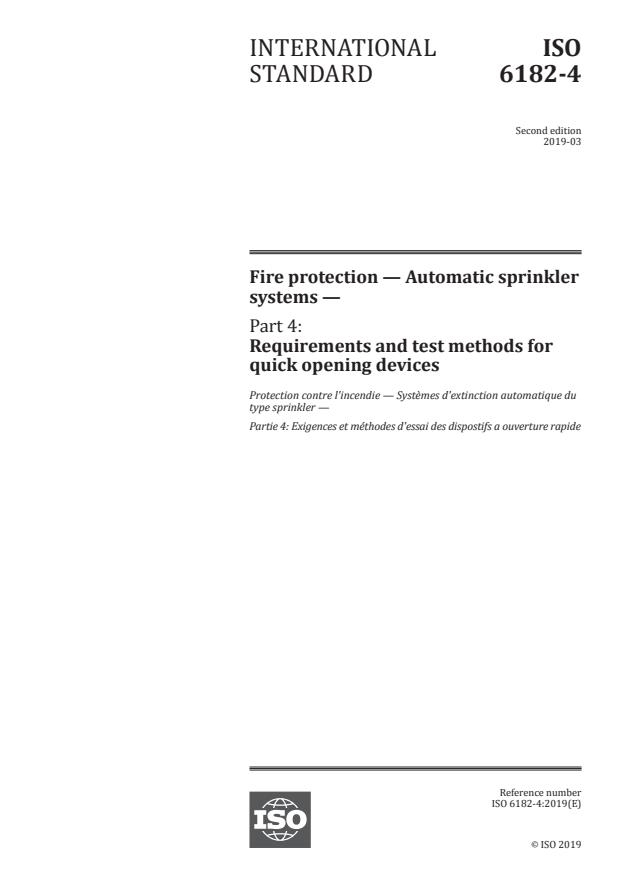
(Main)Fire protection — Automatic sprinkler systems — Part 4: Requirements and test methods for quick opening devices
General Information
- Abstract
This document specifies the performance and testing requirements for accelerators used with dry pipe valves in fire protection systems to hasten the operation of the valves when one or more sprinklers operate.
- Status
- Withdrawn
- Publication Date
- 25-Feb-2019
- Technical Committee
- ISO/TC 21/SC 5 - Fixed firefighting systems using water
- Drafting Committee
- ISO/TC 21/SC 5/WG 10 - Valves
- Current Stage
- 9599 - Withdrawal of International Standard
- Start Date
- 07-Jul-2025
- Completion Date
- 29-Aug-2026
Buy Documents
ISO 6182-4:2019 - Fire protection -- Automatic sprinkler systems
ISO 6182-4:2019 - Fire protection — Automatic sprinkler systems — Part 4: Requirements and test methods for quick opening devices/26/2019
Overview
ISO 6182-4:2019 - Fire protection - Automatic sprinkler systems - Part 4: Requirements and test methods for quick opening devices - specifies performance and test requirements for accelerators (quick-opening devices) used with dry pipe valves. The standard ensures these devices reliably hasten valve operation when one or more sprinklers operate, improving response time in dry-pipe sprinkler systems.
Key topics and technical requirements
- Scope and definitions: Defines accelerator, antiflooding device, holding chamber, rated working pressure and service pressure.
- Rated working pressure: Minimum rated working pressure is 1.2 MPa (12 bar).
- Leakage tests:
- Pneumatic leak test: 0.7 MPa for 1 minute (no leakage).
- Hydrostatic leak test: 2× rated working pressure for 5 minutes (no leakage).
- Strength tests: All parts must withstand 4× rated working pressure for 5 minutes without permanent distortion.
- Component durability: Springs and diaphragms must survive 5 000 cycles of normal operation (≤ 6 cycles/min). Sealing elements must show no damage after operational tests.
- Materials and construction: Bodies/covers require corrosion resistance at least equivalent to cast iron; non-metallic body parts limited (no plastics with melting point < 650 °C except for pipe jointing). Bearings and moving surfaces must be corrosion-resistant or fitted with corrosion-resistant inserts.
- Non‑metallic ageing: Air-oven and warm-water ageing procedures are specified (e.g., air-oven ageing example: 120 °C ±2 °C for 180 days or adjusted with the provided time–temperature formula). After ageing, devices must still meet leakage and operation requirements.
- Operational requirements: Must not falsely trip incompatible dry pipe valve types; must operate the intended valve when system air-pressure decay rate (caused by sprinklers with k‑factor 80) exceeds a specified rate. Equilibrium time ≤ 3 minutes.
- Clearances and protection: Minimum clearance 3.0 mm; orifices smaller than 3 mm require strainers/filters with openings ≤ 70% of the protected opening and total filter area ≥ 20× protected area.
- Production testing and marking: Manufacturer quality control required; every unit must pass aerostatic and operation tests and be marked and supplied with installation instructions.
Applications and who uses it
ISO 6182-4:2019 is intended for:
- Fire protection engineers and system designers specifying dry pipe sprinkler systems.
- Manufacturers of accelerators/quick-opening devices and dry pipe valves ensuring product compliance.
- Test laboratories performing type and production testing.
- Authorities having jurisdiction and facility managers verifying installation safety and performance.
Keywords: ISO 6182-4:2019, automatic sprinkler systems, quick opening devices, accelerators, dry pipe valves, fire protection standards, performance tests.
Related standards
- ISO 6182 series (other parts covering automatic sprinkler systems)
- ISO 49 (malleable cast iron fittings)
- ISO 898-1 and ISO 898-2 (mechanical properties of fasteners)
Relations
- Effective Date
- 16-Sep-2023
- Effective Date
- 04-Nov-2015
Buy Documents
ISO 6182-4:2019 - Fire protection -- Automatic sprinkler systems
ISO 6182-4:2019 - Fire protection — Automatic sprinkler systems — Part 4: Requirements and test methods for quick opening devices/26/2019
Get Certified
Connect with accredited certification bodies for this standard

CIS Institut d.o.o.
Personal Protective Equipment (PPE) certification body. Notified Body NB-2890 for EU Regulation 2016/425 PPE.

Kiwa BDA Testing
Building and construction product certification.
Kmetijski inštitut Slovenije
Agricultural Institute of Slovenia. Soil testing, plant health, agricultural product analysis.
Sponsored listings
Frequently Asked Questions
ISO 6182-4:2019 is a standard published by the International Organization for Standardization (ISO). Its full title is "Fire protection — Automatic sprinkler systems — Part 4: Requirements and test methods for quick opening devices". This standard covers: This document specifies the performance and testing requirements for accelerators used with dry pipe valves in fire protection systems to hasten the operation of the valves when one or more sprinklers operate.
This document specifies the performance and testing requirements for accelerators used with dry pipe valves in fire protection systems to hasten the operation of the valves when one or more sprinklers operate.
ISO 6182-4:2019 is classified under the following ICS (International Classification for Standards) categories: 13.220.20 - Fire protection. The ICS classification helps identify the subject area and facilitates finding related standards.
ISO 6182-4:2019 has the following relationships with other standards: It is inter standard links to ISO 6182-2:2025, ISO 6182-4:1993. Understanding these relationships helps ensure you are using the most current and applicable version of the standard.
ISO 6182-4:2019 is available in PDF format for immediate download after purchase. The document can be added to your cart and obtained through the secure checkout process. Digital delivery ensures instant access to the complete standard document.
Standards Content (Sample)
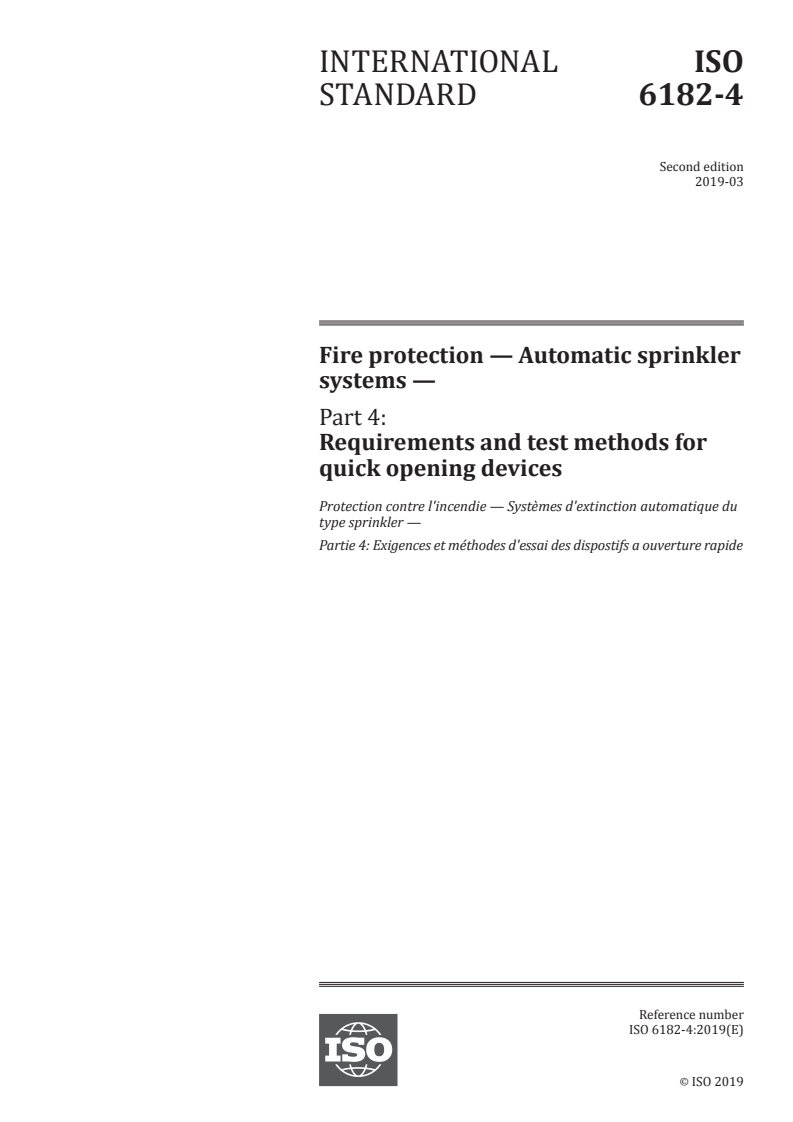
INTERNATIONAL ISO
STANDARD 6182-4
Second edition
2019-03
Fire protection — Automatic sprinkler
systems —
Part 4:
Requirements and test methods for
quick opening devices
Protection contre l'incendie — Systèmes d'extinction automatique du
type sprinkler —
Partie 4: Exigences et méthodes d'essai des dispostifs a ouverture rapide
Reference number
©
ISO 2019
© ISO 2019
All rights reserved. Unless otherwise specified, or required in the context of its implementation, no part of this publication may
be reproduced or utilized otherwise in any form or by any means, electronic or mechanical, including photocopying, or posting
on the internet or an intranet, without prior written permission. Permission can be requested from either ISO at the address
below or ISO’s member body in the country of the requester.
ISO copyright office
CP 401 • Ch. de Blandonnet 8
CH-1214 Vernier, Geneva
Phone: +41 22 749 01 11
Fax: +41 22 749 09 47
Email: copyright@iso.org
Website: www.iso.org
Published in Switzerland
ii © ISO 2019 – All rights reserved
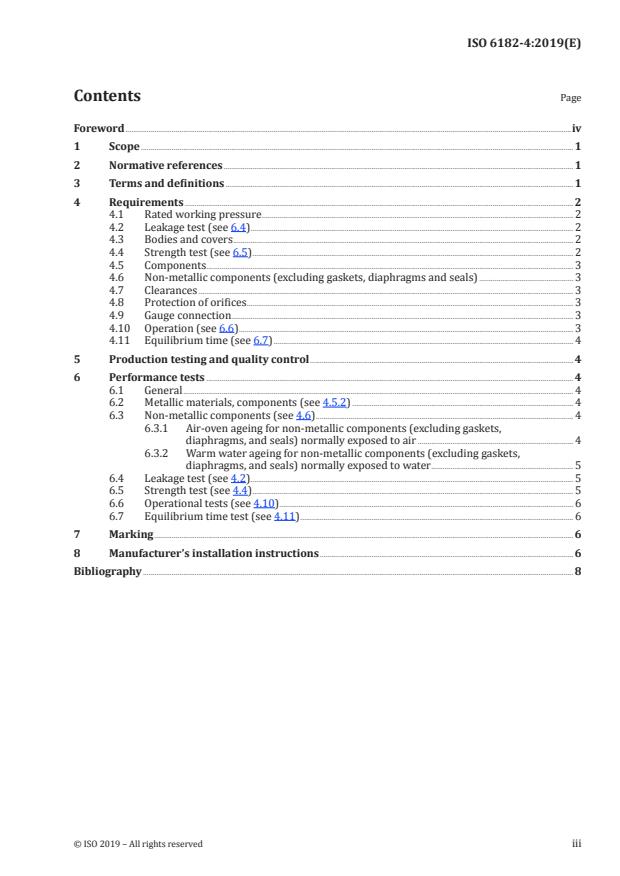
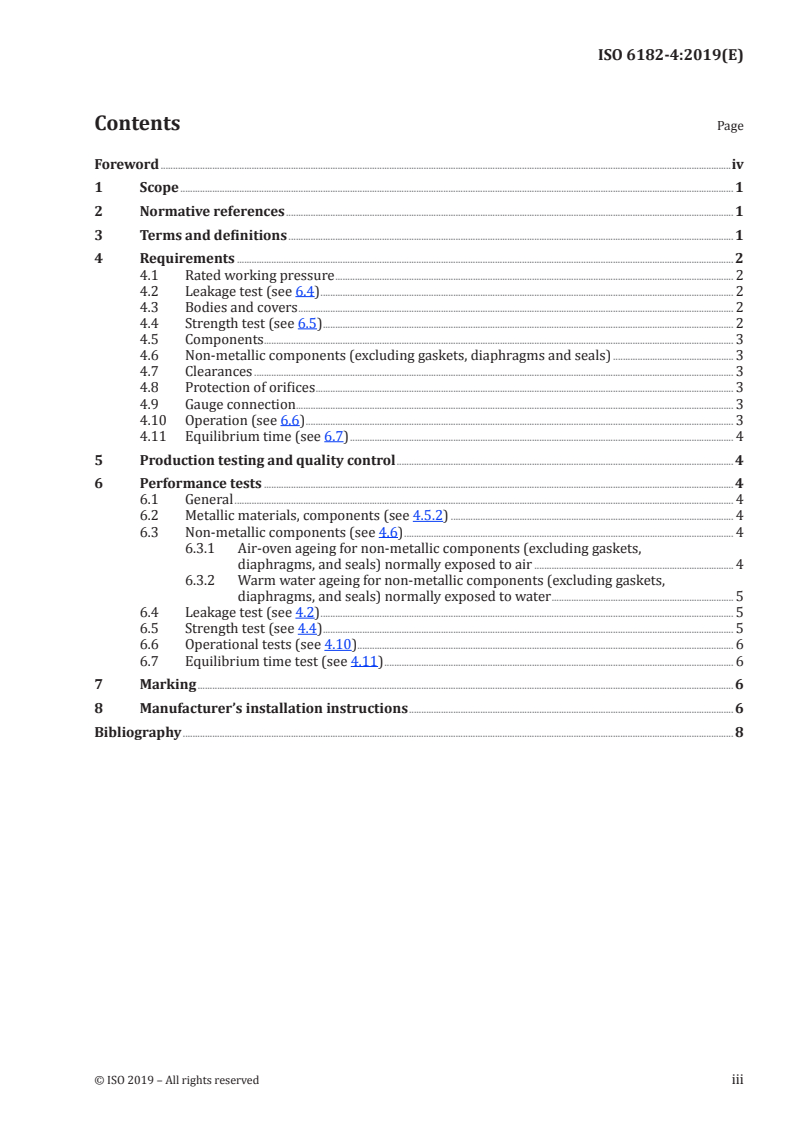
Contents Page
Foreword .iv
1 Scope . 1
2 Normative references . 1
3 Terms and definitions . 1
4 Requirements . 2
4.1 Rated working pressure . 2
4.2 Leakage test (see 6.4) . 2
4.3 Bodies and covers . 2
4.4 Strength test (see 6.5) . 2
4.5 Components . 3
4.6 Non-metallic components (excluding gaskets, diaphragms and seals) . 3
4.7 Clearances . 3
4.8 Protection of orifices . 3
4.9 Gauge connection. 3
4.10 Operation (see 6.6) . 3
4.11 Equilibrium time (see 6.7) . 4
5 Production testing and quality control . 4
6 Performance tests . 4
6.1 General . 4
6.2 Metallic materials, components (see 4.5.2) . 4
6.3 Non-metallic components (see 4.6) . 4
6.3.1 Air-oven ageing for non-metallic components (excluding gaskets,
diaphragms, and seals) normally exposed to air . 4
6.3.2 Warm water ageing for non-metallic components (excluding gaskets,
diaphragms, and seals) normally exposed to water . 5
6.4 Leakage test (see 4.2) . 5
6.5 Strength test (see 4.4) . 5
6.6 Operational tests (see 4.10) . 6
6.7 Equilibrium time test (see 4.11) . 6
7 Marking . 6
8 Manufacturer’s installation instructions . 6
Bibliography . 8
Foreword
ISO (the International Organization for Standardization) is a worldwide federation of national standards
bodies (ISO member bodies). The work of preparing International Standards is normally carried out
through ISO technical committees. Each member body interested in a subject for which a technical
committee has been established has the right to be represented on that committee. International
organizations, governmental and non-governmental, in liaison with ISO, also take part in the work.
ISO collaborates closely with the International Electrotechnical Commission (IEC) on all matters of
electrotechnical standardization.
The procedures used to develop this document and those intended for its further maintenance are
described in the ISO/IEC Directives, Part 1. In particular, the different approval criteria needed for the
different types of ISO documents should be noted. This document was drafted in accordance with the
editorial rules of the ISO/IEC Directives, Part 2 (see www .iso .org/directives).
Attention is drawn to the possibility that some of the elements of this document may be the subject of
patent rights. ISO shall not be held responsible for identifying any or all such patent rights. Details of
any patent rights identified during the development of the document will be in the Introduction and/or
on the ISO list of patent declarations received (see www .iso .org/patents).
Any trade name used in this document is information given for the convenience of users and does not
constitute an endorsement.
For an explanation of the voluntary nature of standards, the meaning of ISO specific terms and
expressions related to conformity assessment, as well as information about ISO's adherence to the
World Trade Organization (WTO) principles in the Technical Barriers to Trade (TBT) see www .iso
.org/iso/foreword .html.
This document was prepared by Technical Committee ISO/TC 21, Equipment for fire protection and fire
fighting, Subcommittee SC 5, Fixed firefighting systems using water.
This second edition cancels and replaces the first edition (ISO 6182-4:1993), which has been technically
revised.
A list of all the parts in the ISO 6182 series, can be found on the ISO website.
Any feedback or questions on this document should be directed to the user’s national standards body. A
complete listing of these bodies can be found at www .iso .org/members .html.
iv © ISO 2019 – All rights reserved
INTERNATIONAL STANDARD ISO 6182-4:2019(E)
Fire protection — Automatic sprinkler systems —
Part 4:
Requirements and test methods for quick opening devices
1 Scope
This document specifies the performance and testing requirements for accelerators used with dry pipe
valves in fire protection systems to hasten the operation of the valves when one or more sprinklers
operate.
2 Normative references
The following documents are referred to in the text in such a way that some or all of their content
constitutes requirements of this document. For dated references, only the edition cited applies. For
undated references, the latest edition of the referenced document (including any amendments) applies.
ISO 49, Malleable cast iron fittings threaded to ISO 7-1
ISO 898-1, Mechanical properties of fasteners made of carbon steel and alloy steel — Part 1: Bolts, screws
and studs with specified property classes — Coarse thread and fine pitch thread
ISO 898-2, Mechanical properties of fasteners made of carbon steel and alloy steel — Part 2: Nuts with
specified property classes — Coarse thread and fine pitch thread
3 Terms and definitions
For the purposes of this document, the following terms and definitions apply.
ISO and IEC maintain terminological databases for use in standardization at the following addresses:
— IEC Electropedia: available at http: //www .electropedia .org/
— ISO Online browsing platform: available at http: //www .iso .org/obp
3.1
accelerator
quick-opening device which hastens the operation of a dry pipe valve using mechanical means other
than by reducing installation pipework pressure
Note 1 to entry: For the purposes of this document, the term accelerator refers to an accelerator and any (internal
or external) antiflooding device (3.2).
3.2
antiflooding device
device intended to prohibit excessive water or other foreign matter from entering any relevant part or
parts of the accelerator where this might prevent subsequent operation
3.3
corrosion-resistant material
metallic material of bronze, brass, copper-nickel alloys metal, austenitic stainless steel, or equivalent,
or plastic material conforming with the requirements of this document
3.4
rated working pressures
maximum service pressure at which an accelerator is intended to operate
3.5
service pressure
static water pressure at the inlet to a dry pipe valve when the accelerator and the dry pipe valve are in
the ready condition
3.6
holding chamber
chamber pressurized with system air pressure which actuates an accelerator upon a sufficient rate of
loss of system air pressure
4 Requirements
4.1 Rated working pressure
The rated working pressure shall be not less than 1,2 MPa (12 bar).
4.2 Leakage test (see 6.4)
4.2.1 There shall be no leakage of an accelerator when a pneumatic pressure of 0,7 MPa (7 bar) is
applied for 1 min in accordance with 6.4.1.
4.2.2 There shall be no leakage of an accelerator when an internal hydrostatic pressure of twice the
rated working pressure is applied for 5 min when tested in accordance with 6.4.2.
4.3 Bodies and covers
4.3.1 Accelerator bodies and covers shall be made of a material having a corrosion resistance at least
equivalent to cast iron.
4.3.2 The dimension of all connections shall conform with the applicable requirements of international
standards. If international standards are not applicable, national standards shall be permitted to be used.
4.3.3 Non-metallic materials, other than gaskets and pipe seals, or metals with a melting point of
...
INTERNATIONAL ISO
STANDARD 6182-4
Second edition
2019-03
Fire protection — Automatic sprinkler
systems —
Part 4:
Requirements and test methods for
quick opening devices
Protection contre l'incendie — Systèmes d'extinction automatique du
type sprinkler —
Partie 4: Exigences et méthodes d'essai des dispostifs a ouverture rapide
Reference number
©
ISO 2019
© ISO 2019
All rights reserved. Unless otherwise specified, or required in the context of its implementation, no part of this publication may
be reproduced or utilized otherwise in any form or by any means, electronic or mechanical, including photocopying, or posting
on the internet or an intranet, without prior written permission. Permission can be requested from either ISO at the address
below or ISO’s member body in the country of the requester.
ISO copyright office
CP 401 • Ch. de Blandonnet 8
CH-1214 Vernier, Geneva
Phone: +41 22 749 01 11
Fax: +41 22 749 09 47
Email: copyright@iso.org
Website: www.iso.org
Published in Switzerland
ii © ISO 2019 – All rights reserved
Contents Page
Foreword .iv
1 Scope . 1
2 Normative references . 1
3 Terms and definitions . 1
4 Requirements . 2
4.1 Rated working pressure . 2
4.2 Leakage test (see 6.4) . 2
4.3 Bodies and covers . 2
4.4 Strength test (see 6.5) . 2
4.5 Components . 3
4.6 Non-metallic components (excluding gaskets, diaphragms and seals) . 3
4.7 Clearances . 3
4.8 Protection of orifices . 3
4.9 Gauge connection. 3
4.10 Operation (see 6.6) . 3
4.11 Equilibrium time (see 6.7) . 4
5 Production testing and quality control . 4
6 Performance tests . 4
6.1 General . 4
6.2 Metallic materials, components (see 4.5.2) . 4
6.3 Non-metallic components (see 4.6) . 4
6.3.1 Air-oven ageing for non-metallic components (excluding gaskets,
diaphragms, and seals) normally exposed to air . 4
6.3.2 Warm water ageing for non-metallic components (excluding gaskets,
diaphragms, and seals) normally exposed to water . 5
6.4 Leakage test (see 4.2) . 5
6.5 Strength test (see 4.4) . 5
6.6 Operational tests (see 4.10) . 6
6.7 Equilibrium time test (see 4.11) . 6
7 Marking . 6
8 Manufacturer’s installation instructions . 6
Bibliography . 8
Foreword
ISO (the International Organization for Standardization) is a worldwide federation of national standards
bodies (ISO member bodies). The work of preparing International Standards is normally carried out
through ISO technical committees. Each member body interested in a subject for which a technical
committee has been established has the right to be represented on that committee. International
organizations, governmental and non-governmental, in liaison with ISO, also take part in the work.
ISO collaborates closely with the International Electrotechnical Commission (IEC) on all matters of
electrotechnical standardization.
The procedures used to develop this document and those intended for its further maintenance are
described in the ISO/IEC Directives, Part 1. In particular, the different approval criteria needed for the
different types of ISO documents should be noted. This document was drafted in accordance with the
editorial rules of the ISO/IEC Directives, Part 2 (see www .iso .org/directives).
Attention is drawn to the possibility that some of the elements of this document may be the subject of
patent rights. ISO shall not be held responsible for identifying any or all such patent rights. Details of
any patent rights identified during the development of the document will be in the Introduction and/or
on the ISO list of patent declarations received (see www .iso .org/patents).
Any trade name used in this document is information given for the convenience of users and does not
constitute an endorsement.
For an explanation of the voluntary nature of standards, the meaning of ISO specific terms and
expressions related to conformity assessment, as well as information about ISO's adherence to the
World Trade Organization (WTO) principles in the Technical Barriers to Trade (TBT) see www .iso
.org/iso/foreword .html.
This document was prepared by Technical Committee ISO/TC 21, Equipment for fire protection and fire
fighting, Subcommittee SC 5, Fixed firefighting systems using water.
This second edition cancels and replaces the first edition (ISO 6182-4:1993), which has been technically
revised.
A list of all the parts in the ISO 6182 series, can be found on the ISO website.
Any feedback or questions on this document should be directed to the user’s national standards body. A
complete listing of these bodies can be found at www .iso .org/members .html.
iv © ISO 2019 – All rights reserved
INTERNATIONAL STANDARD ISO 6182-4:2019(E)
Fire protection — Automatic sprinkler systems —
Part 4:
Requirements and test methods for quick opening devices
1 Scope
This document specifies the performance and testing requirements for accelerators used with dry pipe
valves in fire protection systems to hasten the operation of the valves when one or more sprinklers
operate.
2 Normative references
The following documents are referred to in the text in such a way that some or all of their content
constitutes requirements of this document. For dated references, only the edition cited applies. For
undated references, the latest edition of the referenced document (including any amendments) applies.
ISO 49, Malleable cast iron fittings threaded to ISO 7-1
ISO 898-1, Mechanical properties of fasteners made of carbon steel and alloy steel — Part 1: Bolts, screws
and studs with specified property classes — Coarse thread and fine pitch thread
ISO 898-2, Mechanical properties of fasteners made of carbon steel and alloy steel — Part 2: Nuts with
specified property classes — Coarse thread and fine pitch thread
3 Terms and definitions
For the purposes of this document, the following terms and definitions apply.
ISO and IEC maintain terminological databases for use in standardization at the following addresses:
— IEC Electropedia: available at http: //www .electropedia .org/
— ISO Online browsing platform: available at http: //www .iso .org/obp
3.1
accelerator
quick-opening device which hastens the operation of a dry pipe valve using mechanical means other
than by reducing installation pipework pressure
Note 1 to entry: For the purposes of this document, the term accelerator refers to an accelerator and any (internal
or external) antiflooding device (3.2).
3.2
antiflooding device
device intended to prohibit excessive water or other foreign matter from entering any relevant part or
parts of the accelerator where this might prevent subsequent operation
3.3
corrosion-resistant material
metallic material of bronze, brass, copper-nickel alloys metal, austenitic stainless steel, or equivalent,
or plastic material conforming with the requirements of this document
3.4
rated working pressures
maximum service pressure at which an accelerator is intended to operate
3.5
service pressure
static water pressure at the inlet to a dry pipe valve when the accelerator and the dry pipe valve are in
the ready condition
3.6
holding chamber
chamber pressurized with system air pressure which actuates an accelerator upon a sufficient rate of
loss of system air pressure
4 Requirements
4.1 Rated working pressure
The rated working pressure shall be not less than 1,2 MPa (12 bar).
4.2 Leakage test (see 6.4)
4.2.1 There shall be no leakage of an accelerator when a pneumatic pressure of 0,7 MPa (7 bar) is
applied for 1 min in accordance with 6.4.1.
4.2.2 There shall be no leakage of an accelerator when an internal hydrostatic pressure of twice the
rated working pressure is applied for 5 min when tested in accordance with 6.4.2.
4.3 Bodies and covers
4.3.1 Accelerator bodies and covers shall be made of a material having a corrosion resistance at least
equivalent to cast iron.
4.3.2 The dimension of all connections shall conform with the applicable requirements of international
standards. If international standards are not applicable, national standards shall be permitted to be used.
4.3.3 Non-metallic materials, other than gaskets and pipe seals, or metals with a melting point of
...