


ISO 18400-105
(Main)Soil quality — Sampling — Part 105: Packaging, transport, storage and preservation of samples
Soil quality — Sampling — Part 105: Packaging, transport, storage and preservation of samples
ISO 18400-105:2017 establishes general principles for packing, preservation, transport and delivery of samples of soil and related materials with an emphasis on requirements for when chemical analysis of the samples is required, but with the intention that the general procedures are to be adapted as appropriate when other forms of testing are required (e.g. biological testing, physical tests on disturbed or undisturbed samples). Special procedures for specific sampling purposes are given in other parts of ISO 18400 (see also 7.2). ISO 18400-105:2017 is intended to be read in conjunction with ISO 18512.
Qualité du sol — Échantillonnage — Partie 105: Conditionnement, transport, stockage et conservation des échantillons
ISO 18400-105:2017 établit les principes généraux relatifs à l'emballage, la conservation, le transport et la livraison d'échantillons de sols et de matériaux de sols associés; elle met l'accent sur les exigences applicables lorsqu'une analyse chimique des échantillons est requise, mais avec l'objectif que les procédures générales doivent être adaptées et appropriées lorsque d'autres types d'essais sont exigés (par exemple essais biologiques, essais physiques sur des échantillons remaniés ou non remaniés). Des procédures particulières pour des échantillonnages spécifiques sont données dans d'autres parties de l'ISO 18400 (voir également 7.2). ISO 18400-105:2017 est destiné à être lu conjointement avec l'ISO 18512.
General Information
- Status
- Not Published
- Technical Committee
- ISO/TC 190/SC 7 - Impact assessment
- Drafting Committee
- ISO/TC 190/SC 7 - Impact assessment
- Current Stage
- 6000 - International Standard under publication
- Start Date
- 02-Sep-2025
- Completion Date
- 14-Feb-2026
Relations
- Effective Date
- 24-Dec-2022
Overview
ISO 18400-105:2025, titled "Soil quality - Sampling - Part 105: Packaging, transport, storage and preservation of samples," is an international standard developed by ISO/TC 190/SC 7. It provides general principles and requirements for the proper packaging, preservation, transport, and delivery of soil and related material samples. While primarily focused on samples intended for chemical analysis, its principles apply broadly and can be adapted for biological and physical testing.
This standard emphasizes maintaining sample integrity from the point of collection through transport and storage to ensure that laboratory analyses accurately represent in-situ conditions. It aligns closely with related standards like ISO 18512, addressing laboratory storage and handling.
Key Topics
Scope and Purpose
ISO 18400-105 addresses general procedures ensuring soil samples-especially those analyzed chemically-are preserved during handling, minimizing physical, chemical, or biological changes prior to analysis.Sampling Plan Integration
Integration into the sampling plan requires concerted communication with testing laboratories to define appropriate container types, preservation methods, and storage durations tailored to the intended analyses.Sample Containers
Selecting suitable containers is critical. Containers must:- Be compatible with soil properties and target analytes
- Prevent contamination or loss of volatile compounds
- Support short- or long-term storage (preferably both)
- Avoid materials like plastic bags for organic compound analyses
The standard provides guidance on container materials such as glass jars, aluminum cans, fluorinated polymer containers (e.g., PTFE), and their advantages and limitations.
Labelling and Identification
Samples must be labelled with unambiguous, durable codes (e.g., water-resistant barcodes) applied on both the container body and lid to ensure traceability throughout storage and transport.Preservation Techniques
Methods include:- Cooling and freezing samples to inhibit chemical or biological changes
- Airtight storage to minimize exposure to air and moisture
- Use of nitrogen atmosphere containers when applicable
Special attention is required for hazardous samples and to prevent degradation of volatile organic components.
Transport and Delivery
Samples should be transported expediently (ideally within 24 hours) under conditions preventing alteration. The standard outlines recommendations for general and special transport scenarios.
Applications
ISO 18400-105 is essential for environmental laboratories, soil scientists, environmental consultants, and regulatory agencies involved in soil quality assessments. Key applications include:
- Ensuring accurate chemical analysis results in soil contamination investigations
- Maintaining biological activity and diversity in samples used for microbiological testing
- Supporting physical property testing of disturbed or undisturbed soil samples
- Facilitating international cooperation and data comparability through standardized sample handling
- Assisting laboratories in developing protocols for sample reception, storage, and preservation
By following ISO 18400-105, organizations can minimize sample degradation and data variability, improving confidence in soil quality evaluations for risk assessment, remediation planning, and research.
Related Standards
ISO 18400-105 is part of the broader ISO 18400 series on soil sampling and quality. Important related standards include:
- ISO 11074 – Soil quality: Vocabulary essential for consistent terminology understanding
- ISO 18400-301:2023 – Sampling and on-site semi-quantitative determination of volatile organic compounds (VOCs) in field investigations
- ISO 18512 – Guidelines on storage, preservation, and handling of soil samples prior to laboratory testing
- ISO 18400-206 – Sampling for biological testing concerning microbiological processes and diversity
- Additional parts within the ISO 18400 series covering soil sampling methods, physical testing, and contamination assessment
Utilizing this network of standards enables a comprehensive, harmonized approach to soil quality monitoring and research.
Key Terms: soil sampling, soil quality standards, sample preservation, soil sample transport, chemical analysis of soil, volatile organic compounds, soil laboratory procedures, soil container selection, ISO soil standards, environmental soil testing
Buy Documents
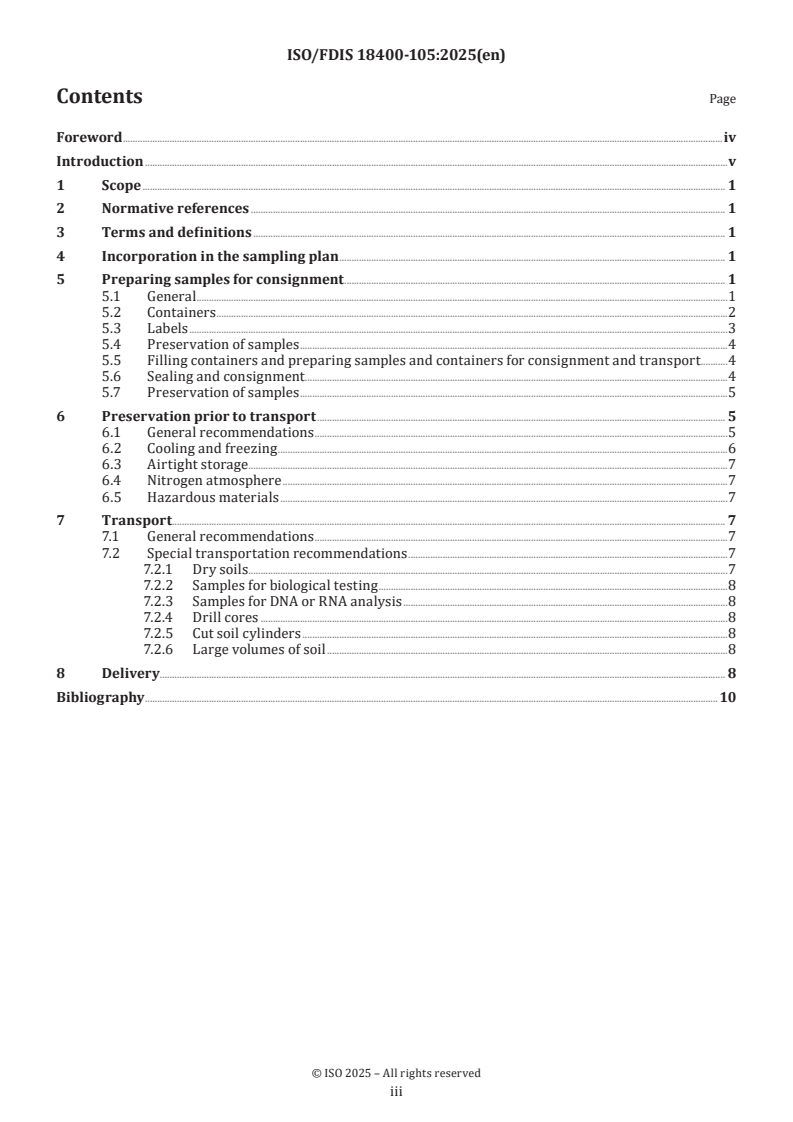
ISO/FDIS 18400-105 - Soil quality — Sampling — Part 105: Packaging, transport, storage and preservation of samples Released:23. 06. 2025

REDLINE ISO/FDIS 18400-105 - Soil quality — Sampling — Part 105: Packaging, transport, storage and preservation of samples Released:23. 06. 2025
ISO/FDIS 18400-105 - Qualité du sol — Échantillonnage — Partie 105: Conditionnement, transport, stockage et conservation des échantillons Released:25. 07. 2025
Get Certified
Connect with accredited certification bodies for this standard

NSF International
Global independent organization facilitating standards development and certification.

CIS Institut d.o.o.
Personal Protective Equipment (PPE) certification body. Notified Body NB-2890 for EU Regulation 2016/425 PPE.

Kiwa BDA Testing
Building and construction product certification.
Sponsored listings
Frequently Asked Questions
ISO 18400-105 is a draft published by the International Organization for Standardization (ISO). Its full title is "Soil quality — Sampling — Part 105: Packaging, transport, storage and preservation of samples". This standard covers: ISO 18400-105:2017 establishes general principles for packing, preservation, transport and delivery of samples of soil and related materials with an emphasis on requirements for when chemical analysis of the samples is required, but with the intention that the general procedures are to be adapted as appropriate when other forms of testing are required (e.g. biological testing, physical tests on disturbed or undisturbed samples). Special procedures for specific sampling purposes are given in other parts of ISO 18400 (see also 7.2). ISO 18400-105:2017 is intended to be read in conjunction with ISO 18512.
ISO 18400-105:2017 establishes general principles for packing, preservation, transport and delivery of samples of soil and related materials with an emphasis on requirements for when chemical analysis of the samples is required, but with the intention that the general procedures are to be adapted as appropriate when other forms of testing are required (e.g. biological testing, physical tests on disturbed or undisturbed samples). Special procedures for specific sampling purposes are given in other parts of ISO 18400 (see also 7.2). ISO 18400-105:2017 is intended to be read in conjunction with ISO 18512.
ISO 18400-105 is classified under the following ICS (International Classification for Standards) categories: 13.080.05 - Examination of soils in general. The ICS classification helps identify the subject area and facilitates finding related standards.
ISO 18400-105 has the following relationships with other standards: It is inter standard links to ISO 18400-105:2017. Understanding these relationships helps ensure you are using the most current and applicable version of the standard.
ISO 18400-105 is available in PDF format for immediate download after purchase. The document can be added to your cart and obtained through the secure checkout process. Digital delivery ensures instant access to the complete standard document.
Standards Content (Sample)
FINAL DRAFT
International
Standard
ISO/FDIS 18400-105
ISO/TC 190/SC 7
Soil quality — Sampling —
Secretariat: DIN
Part 105:
Voting begins on:
2025-07-07
Packaging, transport, storage and
preservation of samples
Voting terminates on:
2025-09-01
Qualité du sol — Échantillonnage —
Partie 105: Conditionnement, transport, stockage et conservation
des échantillons
RECIPIENTS OF THIS DRAFT ARE INVITED TO SUBMIT,
WITH THEIR COMMENTS, NOTIFICATION OF ANY
RELEVANT PATENT RIGHTS OF WHICH THEY ARE AWARE
AND TO PROVIDE SUPPOR TING DOCUMENTATION.
IN ADDITION TO THEIR EVALUATION AS
BEING ACCEPTABLE FOR INDUSTRIAL, TECHNO-
LOGICAL, COMMERCIAL AND USER PURPOSES, DRAFT
INTERNATIONAL STANDARDS MAY ON OCCASION HAVE
TO BE CONSIDERED IN THE LIGHT OF THEIR POTENTIAL
TO BECOME STAN DARDS TO WHICH REFERENCE MAY BE
MADE IN NATIONAL REGULATIONS.
Reference number
ISO/FDIS 18400-105:2025(en) © ISO 2025
FINAL DRAFT
ISO/FDIS 18400-105:2025(en)
International
Standard
ISO/FDIS 18400-105
ISO/TC 190/SC 7
Soil quality — Sampling —
Secretariat: DIN
Part 105:
Voting begins on:
Packaging, transport, storage and
preservation of samples
Voting terminates on:
Qualité du sol — Échantillonnage —
Partie 105: Conditionnement, transport, stockage et conservation
des échantillons
RECIPIENTS OF THIS DRAFT ARE INVITED TO SUBMIT,
WITH THEIR COMMENTS, NOTIFICATION OF ANY
RELEVANT PATENT RIGHTS OF WHICH THEY ARE AWARE
AND TO PROVIDE SUPPOR TING DOCUMENTATION.
© ISO 2025
IN ADDITION TO THEIR EVALUATION AS
All rights reserved. Unless otherwise specified, or required in the context of its implementation, no part of this publication may
BEING ACCEPTABLE FOR INDUSTRIAL, TECHNO-
LOGICAL, COMMERCIAL AND USER PURPOSES, DRAFT
be reproduced or utilized otherwise in any form or by any means, electronic or mechanical, including photocopying, or posting on
INTERNATIONAL STANDARDS MAY ON OCCASION HAVE
the internet or an intranet, without prior written permission. Permission can be requested from either ISO at the address below
TO BE CONSIDERED IN THE LIGHT OF THEIR POTENTIAL
or ISO’s member body in the country of the requester.
TO BECOME STAN DARDS TO WHICH REFERENCE MAY BE
MADE IN NATIONAL REGULATIONS.
ISO copyright office
CP 401 • Ch. de Blandonnet 8
CH-1214 Vernier, Geneva
Phone: +41 22 749 01 11
Email: copyright@iso.org
Website: www.iso.org
Published in Switzerland Reference number
ISO/FDIS 18400-105:2025(en) © ISO 2025
ii
ISO/FDIS 18400-105:2025(en)
Contents Page
Foreword .iv
Introduction .v
1 Scope . 1
2 Normative references . 1
3 Terms and definitions . 1
4 Incorporation in the sampling plan . 1
5 Preparing samples for consignment . 1
5.1 General .1
5.2 Containers .2
5.3 Labels .3
5.4 Preservation of samples .4
5.5 Filling containers and preparing samples and containers for consignment and transport.4
5.6 Sealing and consignment .4
5.7 Preservation of samples .5
6 Preservation prior to transport . 5
6.1 General recommendations .5
6.2 Cooling and freezing .6
6.3 Airtight storage . .7
6.4 Nitrogen atmosphere .7
6.5 Hazardous materials .7
7 Transport . . 7
7.1 General recommendations .7
7.2 Special transportation recommendations .7
7.2.1 Dry soils.7
7.2.2 Samples for biological testing .8
7.2.3 Samples for DNA or RNA analysis .8
7.2.4 Drill cores .8
7.2.5 Cut soil cylinders .8
7.2.6 Large volumes of soil .8
8 Delivery . . 8
Bibliography .10
iii
ISO/FDIS 18400-105:2025(en)
Foreword
ISO (the International Organization for Standardization) is a worldwide federation of national standards
bodies (ISO member bodies). The work of preparing International Standards is normally carried out through
ISO technical committees. Each member body interested in a subject for which a technical committee
has been established has the right to be represented on that committee. International organizations,
governmental and non-governmental, in liaison with ISO, also take part in the work. ISO collaborates closely
with the International Electrotechnical Commission (IEC) on all matters of electrotechnical standardization.
The procedures used to develop this document and those intended for its further maintenance are described
in the ISO/IEC Directives, Part 1. In particular, the different approval criteria needed for the different types
of ISO documents should be noted. This document was drafted in accordance with the editorial rules of the
ISO/IEC Directives, Part 2 (see www.iso.org/directives).
ISO draws attention to the possibility that the implementation of this document may involve the use of (a)
patent(s). ISO takes no position concerning the evidence, validity or applicability of any claimed patent
rights in respect thereof. As of the date of publication of this document, ISO had not received notice of (a)
patent(s) which may be required to implement this document. However, implementers are cautioned that
this may not represent the latest information, which may be obtained from the patent database available at
www.iso.org/patents. ISO shall not be held responsible for identifying any or all such patent rights.
Any trade name used in this document is information given for the convenience of users and does not
constitute an endorsement.
For an explanation of the voluntary nature of standards, the meaning of ISO specific terms and expressions
related to conformity assessment, as well as information about ISO’s adherence to the World Trade
Organization (WTO) principles in the Technical Barriers to Trade (TBT), see www.iso.org/iso/foreword.html.
This document was prepared by Technical Committee ISO/TC 190, Soil quality, Subcommittee SC 7, Impact
assessment.
This second edition cancels and replaces the first edition (ISO 18400-105:2017), which has been technically
revised.
The main changes are as follows:
— general editorial revision;
— update of references (e.g. ISO 18400-301:2023) and changes in main text resulting from that.
A list of all parts in the ISO 18400 series can be found on the ISO website.
Any feedback or questions on this document should be directed to the user’s national standards body. A
complete listing of these bodies can be found at www.iso.org/members.html.
iv
ISO/FDIS 18400-105:2025(en)
Introduction
Samples of soils and related materials can change as a result of physical processes and chemical or biological
reactions occurring between the time of sampling and the time of testing. This is especially true of soils
contaminated with volatile constituents. The extent of these changes is a function of the chemical and
biological characteristics of the sample, its temperature, its exposure to light, the nature of the container
in which it is placed, the time between sampling and analysis, the conditions to which it is subjected,
and seasonal conditions. The characteristics of a sample can change considerably in a few hours. Special
procedures for specific sampling purposes are given in other parts of the ISO 18400 series (see also 7.2).
This document is intended to be read in conjunction with ISO 18512.
An important part of the sampling plan is to consider the possible extent of these changes and to prescribe
the process of packaging, preservation, transport, and delivery in such a way that the samples are still
representative when delivered to the laboratory.
This document is part of a series on sampling standards for soil. The role/position of the documents in this
series within a complete investigation programme is shown in Figure 1.
v
ISO/FDIS 18400-105:2025(en)
NOTE 1 The numbers in circles define the key elements (1 to 7) of the investigation programme.
NOTE 2 The figure displays a generic process which can be amended when necessary.
Figure 1 — Links between the essential elements of an investigation programme
vi
FINAL DRAFT International Standard ISO/FDIS 18400-105:2025(en)
Soil quality — Sampling —
Part 105:
Packaging, transport, storage and preservation of samples
1 Scope
This document establishes general principles for packing, preservation and transport of samples of soil and
related materials. This document establishes requirements for when chemical analysis of the samples is
required. General procedures can be adapted as appropriate when other forms of testing are required (e.g.
biological testing, physical tests on disturbed or undisturbed samples).
2 Normative references
The following documents are referred to in the text in such a way that some or all of their content constitutes
requirements of this document. For dated references, only the edition cited applies. For undated references,
the latest edition of the referenced document (including any amendments) applies.
ISO 11074, Soil quality — Vocabulary
ISO 18400-301:2023, Soil quality — Sampling — Part 301: Sampling and on site semi-quantitative
determinations of volatile organic compounds in field investigations
3 Terms and definitions
For the purposes of this document, the terms and definitions given in ISO 11074 apply.
ISO and IEC maintain terminology databases for use in standardization at the following addresses:
— ISO Online browsing platform: available at https:// www .iso .org/ obp
— IEC Electropedia: available at https:// www .electropedia .org/
4 Incorporation in the sampling plan
The project manager should prescribe containers and establish preservation techniques and storage times
in consultation with the test laboratory and include this information in the sampling plan.
The laboratory performing the analysis or other tests should be consulted to ensure that appropriate
containers, preservation and handling techniques are used and that any requirements specific to the
proposed analytical method(s) or other test methods are taken into account (see 7.2 for transportation
requirements for some special situations).
5 Preparing samples for consignment
5.1 General
All staff who handle samples, including any labelling and packaging, should be aware of their nature and
of possible hazards resulting from their handling (see ISO 18400-103). Samples should be transported to
the laboratory and scheduled for analysis as quickly as possible to minimize any potential for physical,
ISO/FDIS 18400-105:2025(en)
chemical, or biological changes before examination, usually within 24 h from sampling or in accordance
with laboratory requirements for time-dependent analytes. See ISO 18512 for guidance on how laboratories
should store and preserve samples for laboratory determinations including suitable storage periods under
various conditions.
5.2 Containers
A container should be compatible with the nature of the soil sample and the constituents to be analysed.
Any sample container used should not cause contamination of the sample, it should not adsorb any sample
components (for example organic compounds), and it should not allow losses of volatile components.
Preferably, containers that can serve for long-term storage should be selected (procedures for storage are
given in ISO 18512). Repacking will then not be necessary if longer term storage is required.
When the sample containers are supplied by the laboratory to which the samples are to be sent, it shall be
checked that they are sufficiently large to give room to the sample size. This can be determined following the
guidance in ISO 18400-104 and in Table 1, which provides a summary of the advantages and disadvantages
of containers in common usage.
NOTE 1 The size of sample required, and hence the size of container required, will depend on a variety of factors
including the nature of the soil (e.g. particle sizes) and the purpose for which the sample is required (e.g. the range of
tests to be carried out). Guidance on minimum samples sizes is provided in ISO 18400-104.
NOTE 2 When soils that might be contaminated are to be analysed or otherwise tested, it can be necessary to take
more than one sample from a sampling location in order to properly preserve sample integrity prior to analysis and to
permit a full range of potential contaminants to be determined.
Plastic bags shall not be used when analysis for organic compounds is to be carried out.
Sample containers should be clean and dry. The choice of cleaning method will depend on container material
and on the constituents to be analysed, and the cleaning method should not contaminate the container with
regard to the constituents to be analysed or cause harm to the environment or human health.
Where organic compounds are to be determined, inert containers, which prevent loss by adsorption or
volatilization, should be used. Where no volatile organic compounds (VOCs) are present, a wide-mouthed
amber glass jar may be used, but if VOCs are present, sampling and handling should be done in accordance
with ISO 18400-301.
Uncertainty about whether a compound should be regarded as volatile or not should trigger a specific quality
scheme to ensure that packaging, storing, etc. does not introduce bias, cross contamination, or other forms
of unacceptable errors.
Different sizes and types of container should always be available on site, so that if unexpected materials are
encountered, they can be properly sampled.
Collection, handling and storage of soil under aerobic conditions for the assessment of microbiological
processes, biomass and diversity in the laboratory, should be carried out in accordance with ISO 18400-206
(see also 7.2.2).
NOTE 3 Special procedures for the sampling for biological testing are required if it is necessary to preserve
anaerobic or reducing conditions.
ISO/FDIS 18400-105:2025(en)
Table 1 — Suitability of containers for analytical samples
f
Substances present in the sample Analytical requirements
Non-
Solvents
volatile
and other
and Volatile
Container Advan- Disadvan-
Oils organic Oils
Alka- Inor- Inor- semi- organic
material tages tages
Acid and com- and
line ganics ganics volatile com-
tars pounds tars
organic pounds
including
com-
VOCs
pounds
Low Easily
a a a
Plastic bag ++ ++ ++ ‒ ‒ + ‒ ‒ ‒
costs damaged
Plastic Removing
Low
b
bucket or ++ ++ ++ ‒ ‒ ++ ‒ ‒ ‒ excess air is
costs
tub not possible
Wide-
mouthed
glass
c,d,e c,d,e
++ ‒ ++ ++ ++ ++ ++ + +‒ Inert Fragile
c,d
bottles
(screw-
capped)
Cost
Aluminium
Aluminium
cans
‒ ‒ + ++ ++ ++ ++ + + — contamination
(screw-
affected by
capped)
acids/alkali
Fluorinated
polymer
++ ++ ++ ++ ++ ++ ++ ++ ++ Inert High cost
containers,
e.g. PTFE
+
+ very suitable
+
can be suitable
‒ unsuitable
a
Should not be used for contaminated land investigation samples.
b
Should not be used for contaminated land investigation samples if analysis for organic contamination can be required.
c
ISO 18400-301 does not recommend the use of glass jars without preservation with a solvent.
d
Use of PTFE septum can be appropriate.
e
A small jar of about 60 ml capacity
...
2025-05-06
ISO/FDIS 18400-105:2025(en)
ISO/TC 190/SC 7
Secretariat: DIN
Date: 2025-06-23
Soil quality — Sampling —
Part 105:
Packaging, transport, storage and preservation of samples
Qualité du sol — Échantillonnage —
Partie 105: EmballageConditionnement, transport, stockage et conservation des échantillons
Document type: International Standard
Document subtype:
Document stage: (50) Approval
Document language: E
O:\Documents\TC190\SC002\062364 - ISO_NP 18400-105 (Ed
1)\60.00\320\C062364e_converted.doc STD Version 2.5a
FDIS stage
ISO/FDIS 18400-105:2025(en)
All rights reserved. Unless otherwise specified, or required in the context of its implementation, no part of this publication
may be reproduced or utilized otherwise in any form or by any means, electronic or mechanical, including photocopying,
or posting on the internet or an intranet, without prior written permission. Permission can be requested from either ISO
at the address below or ISO’s member body in the country of the requester.
ISO copyright office
CP 401 • Ch. de Blandonnet 8
CH-1214 Vernier, Geneva
Phone: + 41 22 749 01 11
Fax: +41 22 749 09 47
EmailE-mail: copyright@iso.org
Website: www.iso.orgwww.iso.org
Published in Switzerland
iii
ISO/FDIS 18400-105:2025(en)
Contents Page
Foreword . v
Introduction . vi
1 Scope . 1
2 Normative references . 1
3 Terms and definitions . 1
4 Incorporation in the sampling plan . 1
5 Preparing samples for consignment . 2
5.1 General . 2
5.2 Containers . 2
5.3 Labels . 4
5.4 Preservation of samples . 4
5.5 Filling containers and preparing samples and containers for consignment and transport 4
5.6 Sealing and consignment . 5
5.7 Preservation of samples . 5
6 Preservation prior to transport . 6
6.1 General recommendations . 6
6.2 Cooling and freezing . 7
6.3 Airtight storage . 7
6.4 Nitrogen atmosphere . 8
6.5 Hazardous materials . 8
7 Transport . 8
7.1 General recommendations . 8
7.2 Special transportation recommendations . 8
8 Delivery . 9
Bibliography . 11
iv
ISO/FDIS 18400-105:2025(en)
Foreword
ISO (the International Organization for Standardization) is a worldwide federation of national standards
bodies (ISO member bodies). The work of preparing International Standards is normally carried out through
ISO technical committees. Each member body interested in a subject for which a technical committee has been
established has the right to be represented on that committee. International organizations, governmental and
non-governmental, in liaison with ISO, also take part in the work. ISO collaborates closely with the
International Electrotechnical Commission (IEC) on all matters of electrotechnical standardization.
The procedures used to develop this document and those intended for its further maintenance are described
in the ISO/IEC Directives, Part 1. In particular, the different approval criteria needed for the different types of
ISO documents should be noted. This document was drafted in accordance with the editorial rules of the
ISO/IEC Directives, Part 2 (see www.iso.org/directives).
ISO draws attention to the possibility that the implementation of this document may involve the use of (a)
patent(s). ISO takes no position concerning the evidence, validity or applicability of any claimed patent rights
in respect thereof. As of the date of publication of this document, ISO had not received notice of (a) patent(s)
which may be required to implement this document. However, implementers are cautioned that this may not
represent the latest information, which may be obtained from the patent database available at
www.iso.org/patents. ISO shall not be held responsible for identifying any or all such patent rights.
Any trade name used in this document is information given for the convenience of users and does not
constitute an endorsement.
For an explanation of the voluntary nature of standards, the meaning of ISO specific terms and expressions
related to conformity assessment, as well as information about ISO'sISO’s adherence to the World Trade
Organization (WTO) principles in the Technical Barriers to Trade (TBT), see www.iso.org/iso/foreword.html.
This document was prepared by Technical Committee ISO/TC 190, Soil quality, Subcommittee SC 7, Impact
assessment, within Working Group 13, Sampling.
This second edition cancels and replaces the first edition (ISO 18400-105:2017), which has been technically
revised.
The main changes are as follows:
— — Generalgeneral editorial revision;
— — Updateupdate of references (e.g. ISO 18400-301:2023) and changes in main text resulting from that.
A list of all parts in the ISO 18400 series can be found on the ISO website.
Any feedback or questions on this document should be directed to the user’s national standards body. A
complete listing of these bodies can be found at www.iso.org/members.html.
v
ISO/FDIS 18400-105:2025(en)
Introduction
Samples of soils and related materials can change as a result of physical processes and chemical or biological
reactions occurring between the time of sampling and the time of testing. This is especially true of soils
contaminated with volatile constituents. The extent of these changes is a function of the chemical and
biological characteristics of the sample, its temperature, its exposure to light, the nature of the container in
which it is placed, the time between sampling and analysis, the conditions to which it is subjected, and seasonal
conditions. The characteristics of a sample can change considerably in a few hours. Special procedures for
specific sampling purposes are given in other parts of the ISO 18400 series (see also 7.27.2).).
This document is intended to be read in conjunction with ISO 18512.
An important part of the sampling plan is to consider the possible extent of these changes and to prescribe the
process of packaging, preservation, transport, and delivery in such a way that the samples are still
representative when delivered to the laboratory.
This document is part of a series on sampling standards for soil. The role/position of the documents in this
series within a complete investigation programme is shown in Figure 1Figure 1.
vi
ISO/FDIS 18400-105:2025(en)
vii
ISO/FDIS 18400-105:2025(en)
NOTE 1 The numbers in circles in Figure 1 define the key elements (1 to 7) of the investigation programme.
NOTE 2 Figure 1The figure displays a generic process which can be amended when necessary.
Figure 1 — Links between the essential elements of an investigation programme
viii
DRAFT INTERNATIONAL STANDARD ISO/FDIS 18400-105:2025(en)
Soil quality — Sampling —
Part 105:
Packaging, transport, storage and preservation of samples
1 Scope
This document establishes general principles for packing, preservation and transport of samples of soil and
related materials. This document establishes requirements for when chemical analysis of the samples is
required. but with the intention that the generalGeneral procedures are tocan be adapted as appropriate when
other forms of testing are required (e.g. biological testing, physical tests on disturbed or undisturbed samples).
2 Normative references
The following documents are referred to in the text in such a way that some or all of their content constitutes
requirements of this document. For dated references, only the edition cited applies. For undated references,
the latest edition of the referenced document (including any amendments) applies.
ISO 11074, Soil quality — Vocabulary
ISO 18400-301:2023, Soil quality - — Sampling - — Part 301: Sampling and on site semi-quantitative
determinations of volatile organic compounds in field investigations
3 Terms and definitions
For the purposes of this document, the terms and definitions given in ISO 11074 apply.
ISO and IEC maintain terminology databases for use in standardization at the following addresses:
— — IEC Electropedia: available at
— — ISO Online browsing platform: available at https://www.iso.org/obp
— IEC Electropedia: available at https://www.electropedia.org/
4 Incorporation in the sampling plan
The project manager should prescribe containers and establish preservation techniques and storage times in
consultation with the test laboratory and include this information in the sampling plan.
The laboratory performing the analysis or other tests should be consulted to ensure that appropriate
containers, preservation and handling techniques are used and that any requirements specific to the proposed
analytical method(s) or other test methods are taken into account (see 7.27.2 for transportation requirements
for some special situations).
ISO/FDIS 18400-105:2025(en)
5 Preparing samples for consignment
5.1 General
All staff who handle samples, including any labelling and packaging, should be aware of their nature and of
possible hazards resulting from their handling (see ISO 18400--103). Samples should be transported to the
laboratory and scheduled for analysis as quickly as possible to minimize any potential for physical, chemical,
or biological changes before examination, usually within 24 h from sampling or in accordance with laboratory
requirements for time-dependent analytes. See ISO 18512 for guidance on how laboratories should store and
preserve samples for laboratory determinations including suitable storage periods under various conditions.
5.2 Containers
A container should be compatible with the nature of the soil sample and the constituents to be analysed. Any
sample container used should not cause contamination of the sample, it should not adsorb any sample
components (for example, organic compounds), and it should not allow losses of volatile components.
Containers should preferably be selectedPreferably, containers that can serve for long-term storage should be
selected (procedures for storage are given in ISO 18512). Repacking will then not be necessary if longer term
storage is required.
When the sample containers are supplied by the laboratory to which the samples are to be sent, it shall be
checked that they are sufficiently large to give room to the sample size as. This can be determined following
[6]
the guidance in ISO 18400-104 and in Table 1 . Table 1, which provides a summary of the advantages and
disadvantages of containers in common usage.
NOTE 1 The size of sample required, and hence the size of container required, will depend on a variety of factors
including the nature of the soil (e.g. particle sizes) and the purpose for which the sample is required (e.g. the range of
[6]
tests to be carried out). Guidance on minimum samples sizes is provided in ISO 18400--104 .
NOTE 2 When soils that might be contaminated are to be analysed or otherwise tested, it can be necessary to take
more than one sample from a sampling location in order to properly preserve sample integrity prior to analysis and to
permit a full range of potential contaminants to be determined.
Plastic bags shall not be used when analysis for organic compounds is to be carried out.
Sample containers should be clean and dry. The choice of cleaning method will depend on container material
and on the constituents to be analysed, and the cleaning method should not contaminate the container with
regard to the constituents to be analysed or cause harm to the environment or human health.
Where organic compounds are to be determined, inert containers, which prevent loss by adsorption or
volatilization, should be used. Where no volatile organic compounds (VOCs) are present, a wide-mouthed
amber glass jar may be used, but if VOCs are present, sampling and handling should be done in accordance
with ISO 18400-301.
Uncertainty about whether a compound should be regarded as volatile or not should trigger a specific quality
scheme to ensure that packaging, storing, etc. does not introduce bias, cross contamination, or other forms of
unacceptable errors.
Different sizes and types of container should always be available on site, so that if unexpected materials are
encountered, they can be properly sampled.
Collection, handling and storage of soil under aerobic conditions for the assessment of microbiological
processes, biomass and diversity in the laboratory, should be carried out in accordance with ISO 18400-206
(see also 7.2.27.2.2).).
ISO/FDIS 18400-105:2025(en)
NOTE 3 Special procedures for the sampling for biological testing are required if it is necessary to preserve anaerobic
or reducing conditions.
Table 1 — Suitability of containers for analytical samples
f
Substances present in the sample Analytical requirements
Non-
Solvents volatil
and e and Volatil
Adva
other semi- e
Container Disadvantag
Alk Inor Oils Inor Oils
ntage
Aci organic volatil organi
material es
alin ganic and ganic and
s
d compou e c
e s tars s tars
nds organi compo
includin c unds
g VOCs compo
unds
Low Easily
a a a
Plastic bag ++ ++ ++ +
-‒ -‒ -‒ -‒ -‒
costs damaged
Plastic Removing
Low
b
bucket or ++ ++ ++ ++ excess air is
-‒ -‒ -‒ -‒ -‒
costs
tub not possible
Wide-
mouthed
glass
+-+‒
c,d,e
++ ++ ++ ++ ++ ++ + Inert Fragile
-‒
c,d
bottles c,d,e
(screw-
capped)
Cost
Aluminium
Aluminium
cans
+ ++ ++ ++ ++ + + — contaminatio
-‒ -‒
(screw-
n affected by
capped)
acids/alkali
Fluorinate
d
polymer ++ ++ ++ ++ ++ ++ ++ ++ ++ Inert High cost
containers,
e.g. PTFE
++ Very+ + very suitable.
+ Can can be suitable.
- Unsuitable.
‒ unsuitable
a
Should not be used for contaminated land investigation samples.
b
Should not be used for contaminated land investigation samples if analysis for organic contamination can be required.
c [15]
ISO 18400-301 does not recommend the use of glass jars without preservation with a solvent.
d
Use of PTFE septum can be appropriate.
e
A small jar of about 60 ml capacity is commonly used as it is then easier to ensure close packing of fine soils when this is considered
necessary.
f
The substance is present but there is not necessarily a requirement to analyse for it. However, use of an inappropriate container
can compromise the results of those analyses that are to be carried out.
ISO/FDIS 18400-105:2025(en)
5.3 Labels
All samples should carry a legible, unambiguous code ensuring the identity of the sample, e.g. a water-resistant
barcode glued to the side.
NOTE 1 Codes that are short and simple can be preferable and more easily applied in the field.
Samples should be labelled on the side of the container and the lid (but not on the lid alone).
Tie-on labels or adhesive labels may be used (provided in the latter case that there is adequate adhesion of
the label under field conditions).
NOTE 2 Writing directly on the container is not always durable and can cause problems.
Care should be taken that the sample code remains clearly legible whatever the storage period is and that it
resists heat and cold, solar radiation, abrasion, water, and chemical reactions. Cleaning of dirty labels should
not lead to loss of information or contamination of the sample.
The labels used should be resistant to external influences (rain, contamination, etc.) and to future treatment
(abrasion, handling, contact with chemicals, etc.). The labels should be large enough to contain all the relevant
information in a legible form. Some commercially available adhesive labels and marker pens contain organic
solvents, so care should be taken to avoid absorption of these solvents.
5.4 Preservation of samples
Detailed guidance on the preservation of samples is provided in Clause 6Clause 6.
Preservation and handling of soil and other solid samples should generally be dealt with on a method-specific
...
PROJET FINAL
Norme
internationale
ISO/FDIS 18400-105
ISO/TC 190/SC 7
Qualité du sol — Échantillonnage —
Secrétariat: DIN
Partie 105:
Début de vote:
2025-07-07
Conditionnement, transport,
stockage et conservation des
Vote clos le:
2025-09-01
échantillons
Soil quality — Sampling —
Part 105: Packaging, transport, storage and preservation of
samples
LES DESTINATAIRES DU PRÉSENT PROJET SONT
INVITÉS À PRÉSENTER, AVEC LEURS OBSERVATIONS,
NOTIFICATION DES DROITS DE PROPRIÉTÉ DONT ILS
AURAIENT ÉVENTUELLEMENT CONNAISSANCE ET À
FOURNIR UNE DOCUMENTATION EXPLICATIVE.
OUTRE LE FAIT D’ÊTRE EXAMINÉS POUR
ÉTABLIR S’ILS SONT ACCEPTABLES À DES FINS
INDUSTRIELLES, TECHNOLOGIQUES ET COM-MERCIALES,
AINSI QUE DU POINT DE VUE DES UTILISATEURS, LES
PROJETS DE NORMES
INTERNATIONALES DOIVENT PARFOIS ÊTRE CONSIDÉRÉS
DU POINT DE VUE DE LEUR POSSI BILITÉ DE DEVENIR DES
NORMES POUVANT
SERVIR DE RÉFÉRENCE DANS LA RÉGLEMENTATION
NATIONALE.
Numéro de référence
ISO/FDIS 18400-105:2025(fr) © ISO 2025
PROJET FINAL
ISO/FDIS 18400-105:2025(fr)
Norme
internationale
ISO/FDIS 18400-105
ISO/TC 190/SC 7
Qualité du sol — Échantillonnage —
Secrétariat: DIN
Partie 105:
Début de vote:
Conditionnement, transport, 2025-07-07
stockage et conservation des
Vote clos le:
2025-09-01
échantillons
Soil quality — Sampling —
Part 105: Packaging, transport, storage and preservation of
samples
LES DESTINATAIRES DU PRÉSENT PROJET SONT
INVITÉS À PRÉSENTER, AVEC LEURS OBSERVATIONS,
NOTIFICATION DES DROITS DE PROPRIÉTÉ DONT ILS
AURAIENT ÉVENTUELLEMENT CONNAISSANCE ET À
FOURNIR UNE DOCUMENTATION EXPLICATIVE.
DOCUMENT PROTÉGÉ PAR COPYRIGHT
OUTRE LE FAIT D’ÊTRE EXAMINÉS POUR
ÉTABLIR S’ILS SONT ACCEPTABLES À DES FINS
© ISO 2025 INDUSTRIELLES, TECHNOLOGIQUES ET COM-MERCIALES,
AINSI QUE DU POINT DE VUE DES UTILISATEURS, LES
Tous droits réservés. Sauf prescription différente ou nécessité dans le contexte de sa mise en œuvre, aucune partie de cette
PROJETS DE NORMES
INTERNATIONALES DOIVENT PARFOIS ÊTRE CONSIDÉRÉS
publication ne peut être reproduite ni utilisée sous quelque forme que ce soit et par aucun procédé, électronique ou mécanique,
DU POINT DE VUE DE LEUR POSSI BILITÉ DE DEVENIR DES
y compris la photocopie, ou la diffusion sur l’internet ou sur un intranet, sans autorisation écrite préalable. Une autorisation peut
NORMES POUVANT
être demandée à l’ISO à l’adresse ci-après ou au comité membre de l’ISO dans le pays du demandeur.
SERVIR DE RÉFÉRENCE DANS LA RÉGLEMENTATION
NATIONALE.
ISO copyright office
Case postale 401 • Ch. de Blandonnet 8
CH-1214 Vernier, Genève
Tél.: +41 22 749 01 11
E-mail: copyright@iso.org
Web: www.iso.org
Publié en Suisse Numéro de référence
ISO/FDIS 18400-105:2025(fr) © ISO 2025
ii
ISO/FDIS 18400-105:2025(fr)
Sommaire Page
Avant-propos .iv
Introduction .v
1 Domaine d’application . 1
2 Références normatives . 1
3 Termes et définitions . 1
4 Intégration au plan d’échantillonnage . 1
5 Préparation des échantillons pour l’expédition . 2
5.1 Généralités .2
5.2 Récipients .2
5.3 Étiquettes .4
5.4 Conservation des échantillons .4
5.5 Remplissage des récipients et préparation des échantillons et des récipients pour
l’expédition et le transport .4
5.6 Conditionnement et expédition .5
5.7 Conservation des échantillons .5
6 Conservation avant transport . 6
6.1 Recommandations générales .6
6.2 Réfrigération et congélation .7
6.3 Stockage à l’abri de l’air .8
6.4 Stockage sous atmosphère d’azote .8
6.5 Matériaux dangereux .8
7 Transport . . 8
7.1 Recommandations générales .8
7.2 Recommandations particulières relatives au transport .9
7.2.1 Sols secs .9
7.2.2 Échantillons pour essais biologiques .9
7.2.3 Échantillons pour analyses d’ADN ou d’ARN .9
7.2.4 Carottes .9
7.2.5 Cylindres de sols découpés.9
7.2.6 Grands volumes de sol .9
8 Livraison . 9
Bibliographie .11
iii
ISO/FDIS 18400-105:2025(fr)
Avant-propos
L’ISO (Organisation internationale de normalisation) est une fédération mondiale d’organismes nationaux
de normalisation (comités membres de l’ISO). L’élaboration des Normes internationales est en général
confiée aux comités techniques de l’ISO. Chaque comité membre intéressé par une étude a le droit de
faire partie du comité technique créé à cet effet. Les organisations internationales, gouvernementales
et non gouvernementales, en liaison avec l’ISO participent également aux travaux. L’ISO collabore
étroitement avec la Commission électrotechnique internationale (IEC) en ce qui concerne la normalisation
électrotechnique.
Les procédures utilisées pour élaborer le présent document et celles destinées à sa mise à jour sont
décrites dans les Directives ISO/IEC, Partie 1. Il convient, en particulier de prendre note des différents
critères d’approbation requis pour les différents types de documents ISO. Le présent document
a été rédigé conformément aux règles de rédaction données dans les Directives ISO/IEC, Partie 2
(voir www.iso.org/directives).
L’ISO attire l’attention sur le fait que la mise en application du présent document peut entraîner l’utilisation
d’un ou de plusieurs brevets. L’ISO ne prend pas position quant à la preuve, à la validité et à l’applicabilité de
tout droit de brevet revendiqué à cet égard. À la date de publication du présent document, l’ISO n’avait pas
reçu notification qu’un ou plusieurs brevets pouvaient être nécessaires à sa mise en application. Toutefois,
il y a lieu d’avertir les responsables de la mise en application du présent document que des informations
plus récentes sont susceptibles de figurer dans la base de données de brevets, disponible à l’adresse
www.iso.org/brevets. L’ISO ne saurait être tenue pour responsable de ne pas avoir identifié de tels droits de
propriété et averti de leur existence.
Les appellations commerciales éventuellement mentionnées dans le présent document sont données pour
information, par souci de commodité, à l’intention des utilisateurs et ne sauraient constituer un engagement.
Pour une explication de la nature volontaire des normes, la signification des termes et expressions
spécifiques de l’ISO liés à l’évaluation de la conformité, ou pour toute information au sujet de l’adhésion de
l’ISO aux principes de l’Organisation mondiale du commerce (OMC) concernant les obstacles techniques au
commerce (OTC), voir www.iso.org/avant-propos.
Le présent document a été élaboré par le comité technique ISO/TC 190, Qualité du sol, sous-comité SC 7,
Évaluation des impacts.
Cette deuxième édition annule et remplace la première édition (ISO 18400-105:2017), qui a fait l’objet d’une
révision technique.
Les principales modifications sont les suivantes:
— révision rédactionnelle générale;
— mise à jour de références (par exemple, ISO 18400-301:2023) et modifications en conséquence dans le
corps du texte.
Une liste de toutes les parties de la série ISO 18400 se trouve sur le site web de l’ISO.
Il convient que l’utilisateur adresse tout retour d’information ou toute question concernant le présent
document à l’organisme national de normalisation de son pays. Une liste exhaustive desdits organismes
se trouve à l’adresse www.iso.org/fr/members.html.
iv
ISO/FDIS 18400-105:2025(fr)
Introduction
Les échantillons de sol et de matériaux associés peuvent subir des modifications par suite de processus
physiques et de réactions chimiques ou biologiques ayant lieu entre le prélèvement et les essais. Cela
est particulièrement vrai pour des sols pollués contenant des composés volatils. L’importance de ces
modifications dépend des caractéristiques chimiques et biologiques de l’échantillon, de sa température,
de son exposition à la lumière, de la nature du récipient dans lequel il est placé, du temps qui sépare le
prélèvement de l’analyse, des conditions auxquelles il est soumis et des conditions saisonnières. Les
caractéristiques d’un échantillon peuvent, en quelques heures, varier de façon considérable. Des procédures
particulières pour des échantillonnages spécifiques sont données dans d’autres parties de la série ISO 18400
(voir également 7.2).
Le présent document est destiné à être lu conjointement avec l’ISO 18512.
Une partie importante du plan d’échantillonnage consiste à considérer l’importance de ces modifications et
à prescrire le processus de conditionnement, de conservation, de transport et de livraison de sorte que les
échantillons soient encore représentatifs lorsqu’ils sont livrés au laboratoire.
Le présent document fait partie d’une série de normes d’échantillonnage des sols. Le rôle/la fonction des
documents de cette série au sein du programme d’investigation complet est présenté(e) à la Figure 1.
v
ISO/FDIS 18400-105:2025(fr)
NOTE 1 Les chiffres encerclés définissent les éléments clés (1 à 7) du programme d’investigation.
NOTE 2 La figure présente un processus générique qui peut être modifié si nécessaire.
Figure 1 — Liens entre les éléments essentiels d’un programme d’investigation
vi
PROJET FINAL Norme internationale ISO/FDIS 18400-105:2025(fr)
Qualité du sol — Échantillonnage —
Partie 105:
Conditionnement, transport, stockage et conservation des
échantillons
1 Domaine d’application
Le présent document établit les principes généraux relatifs au conditionnement, à la conservation et au
transport d’échantillons de sol et de matériaux associés. Il établit les exigences applicables lorsqu’une
analyse chimique des échantillons est requise. Les procédures générales peuvent être adaptées suivant le
cas lorsque d’autres types d’essais sont exigés (par exemple essais biologiques, essais physiques sur des
échantillons remaniés ou non remaniés).
2 Références normatives
Les documents suivants sont cités dans le texte de sorte qu’ils constituent, pour tout ou partie de leur
contenu, des exigences du présent document. Pour les références datées, seule l’édition citée s’applique. Pour
les références non datées, la dernière édition du document de référence s’applique (y compris les éventuels
amendements).
ISO 11074, Qualité du sol — Vocabulaire
ISO 18400-301:2023, Qualité du sol — Échantillonnage — Partie 301: Échantillonnage et mesures semi-
quantitatives sur site des composés organiques volatils dans le cadre d’investigations sur le terrain
3 Termes et définitions
Pour les besoins du présent document, les termes et les définitions de l’ISO 11074 s’appliquent.
L’ISO et l’IEC tiennent à jour des bases de données terminologiques destinées à être utilisées en normalisation,
consultables aux adresses suivantes:
— ISO Online browsing platform: disponible à l’adresse https:// www .iso .org/ obp
— IEC Electropedia: disponible à l’adresse https:// www .electropedia .org/
4 Intégration au plan d’échantillonnage
Il convient que le chef de projet prescrive des récipients et définisse des techniques de conservation et
des durées de stockage en concertation avec le laboratoire d’essai et inclue ces informations dans le plan
d’échantillonnage.
Il convient de consulter le laboratoire réalisant l’analyse ou d’autres essais pour s’assurer que les récipients
et les techniques de conservation et de manipulation appropriés sont utilisés et que toutes les exigences
propres à la ou aux méthodes d’analyse proposées ou à d’autres méthodes d’essai sont prises en compte
(voir 7.2 pour les exigences relatives au transport pour certaines situations particulières).
ISO/FDIS 18400-105:2025(fr)
5 Préparation des échantillons pour l’expédition
5.1 Généralités
Il convient que toutes les personnes qui manipulent des échantillons, y compris pour l’étiquetage et pour
le conditionnement, soient informées de la nature de ces échantillons et des dangers éventuels liés à leur
manipulation (voir l’ISO 18400-103). Il convient que les échantillons soient transportés au laboratoire et
soumis à l’analyse aussi rapidement que possible afin de réduire autant que possible l’éventualité d’une
modification physique, chimique ou biologique avant l’examen, et généralement dans un délai de 24 h après
le prélèvement, ou conformément aux exigences du laboratoire pour les composés à analyser qui évoluent
avec le temps. Voir l’ISO 18512 pour des recommandations relatives à la manière dont il convient que les
laboratoires stockent et conservent des échantillons destinés aux déterminations en laboratoire, ainsi
qu’aux durées de stockage appropriées dans différentes conditions.
5.2 Récipients
Il convient que le récipient soit compatible avec la nature de l’échantillon de sol et des composés à
analyser. Il convient qu’aucun récipient d’échantillon utilisé ne provoque de contamination de l’échantillon,
n’adsorbe de composés de l’échantillon (par exemple composés organiques) et ne permette la perte de
composés volatils.
De préférence, il convient de choisir des récipients pouvant servir à un stockage de longue durée
(des procédures de stockage sont décrites dans l’ISO 18512). Il ne sera donc pas nécessaire de reconditionner
l’échantillon si un stockage de longue durée est requis.
Lorsque les récipients d’échantillons sont fournis par le laboratoire auquel ces échantillons doivent être
envoyés, il faut vérifier qu’ils sont suffisamment grands pour offrir un volume suffisant vis-à-vis de la
taille d’échantillon. Cette dernière peut être définie en suivant les recommandations de l’ISO 18400-104 et
le récipient choisi d’après le Tableau 1, qui fournit un récapitulatif des avantages et des inconvénients des
récipients d’usage courant.
NOTE 1 La taille d’échantillon requise, et donc la taille du récipient requis, dépendront de divers facteurs,
notamment la nature du sol (par exemple la granulométrie) ainsi que l’objectif pour lequel l’échantillon est exigé (par
exemple la série d’essais à effectuer). L’ISO 18400-104 fournit des recommandations relatives aux tailles minimales
d’échantillon.
NOTE 2 Lorsque des sols susceptibles d’être pollués doivent être analysés ou soumis à essai, il peut se révéler
nécessaire de prélever plus d’un échantillon dans un emplacement d’échantillonnage afin de préserver l’intégrité de
l’échantillon avant l’analyse et de permettre de déterminer une gamme complète de polluants potentiels.
Les sachets en plastique ne doivent pas être utilisés si l’analyse doit porter sur des composés organiques.
Il convient que les récipients d’échantillons soient propres et secs. Le choix de la méthode de nettoyage
dépendra du matériau du récipient et des composés à analyser et il convient que la méthode choisie ne
contamine pas le récipient eu égard aux composés à analyser et ne nuise pas à l’environnement ou à la santé
humaine.
Si des composés organiques doivent être mesurés, il convient d’utiliser des récipients en matériaux inertes
qui évitent les pertes par adsorption ou volatilisation. Si aucun composé organique volatil (COV) n’est
présent, un flacon en verre ambré à col large peut être utilisé; si des COV sont présents, il convient d’effectuer
l’échantillonnage et la manipulation conformément à l’ISO 18400-301.
Pour lever toute incertitude quant à la nature volatile d’un composé, il convient de mettre en œuvre une
démarche qualité spécifique permettant de s’assurer que le conditionnement, le stockage, etc. n’introduisent
pas de biais, de contamination croisée, ou autres formes d’erreurs inacceptables.
Il convient que des récipients de différents types et de différentes tailles soient toujours disponibles sur site
afin de pouvoir prélever correctement des matériaux imprévus rencontrés sur le site.
ISO/FDIS 18400-105:2025(fr)
Il convient de réaliser la collecte, la manipulation et la conservation, dans des conditions aérobies, de sols
destinés à l’évaluation de paramètres biologiques fonctionnels et structurels en laboratoire conformément à
l’ISO 18400-206 (voir également 7.2.2).
NOTE 3 Des procédures particulières pour l’échantillonnage en vue d’essais biologiques sont requises s’il est
nécessaire de préserver des conditions anaérobies ou réductrices.
Tableau 1 — Aptitude à l’emploi des récipients destinés aux échantillons pour analyse
Substances présentes dans l’échan- Exigences relatives aux ana-
f
tillon lyses
Matériau
Inconvé-
du réci- Avantages
nients
pient
Sachet en Faibles Détérioration
a a a
++ ++ ++ ‒ ‒ + ‒ ‒ ‒
plastique coûts facile
L’élimination
Récipient
Faibles de l’air en
b
ou seau en ++ ++ ++ ‒ ‒ ++ ‒ ‒ ‒
coûts excès n’est
plastique
pas possible
Flacons
en verre à
c,d
large col
c,d,e c,d,e
++ ‒ ++ ++ ++ ++ ++ + +‒ Inertes Fragiles
(munis
d’un bou-
chon à vis)
Coût Conta-
Boîtes en
mination par
aluminium
l’aluminium
(munies ‒ ‒ + ++ ++ ++ ++ + + —
affectée par
d’un bou-
les acides/
chon à vis)
bases
Récipients
en poly-
mères fluo-
++ ++ ++ ++ ++ ++ ++ ++ ++ Inertes Coût élevé
rés, par
exemple
PTFE
++ convient très bien
+ peut convenir
‒ ne convient pas
a
Il convient de ne pas utiliser ce type de récipient pour des échantillons de sol pollué.
b
Il convient de ne pas utiliser ce type de récipient pour des échantillons de sol pollué si une analyse de la pollution
organique peut être requise.
c
Conformément à l’ISO 18400-301, l’utilisation de flacons en verre sans solvant de préservation n’est pas recommandée.
d
L’utilisation d’un septum en PTFE peut être appropriée.
e
Un petit flacon d’une capacité d’environ 60 ml est couramment utilisé car il permet, si nécessaire, de bien tasser les
particules fines de sol.
f
La substance est présente, mais il n’y a pas nécessairement une exigence d’analyse la concernant. Toutefois, l’utili-
sation d’un récipient inadapté peut compromettre les résultats des analyses à effectuer.
Acide
Base
Composés inorga-
niques
Huiles et goudrons
Solvants et autres
composés orga-
niques, y compris
des COV
Composés inorga-
niques
Huiles et goudrons
Composés orga-
niques non volatils
et semi-volatils
Composés orga-
niques volatils
ISO/FDIS 18400-105:2025(fr)
5.3 Étiquettes
Il convient que tous les échantillons portent un code lisible et dépourvu d’ambiguïté assurant leur
identification, par exemple un code-barre résistant à l’eau collé sur le côté.
NOTE 1 L’utilisation de codes courts et simples peut être recommandée car ils sont plus faciles à appliquer sur le
terrain.
Il convient d’apposer les étiquettes sur le côté et sur le couvercle du récipient (et pas uniquement sur le
couvercle).
Il est admis d’utiliser des étiquettes fixées par un lien ou adhésives (à condition que, dans ce dernier cas,
une bonne fixation de l’étiquette soit assurée dans les conditions de terrain).
NOTE 2 La durabilité de l’écriture directe sur le récipient n’est pas toujours garantie et peut poser des problèmes.
Il convient de veiller à ce que le code de l’échantillon reste clairement lisible quelle que soit la durée du
stockage et qu’il résiste à la chaleur et au froid, au rayonnement solaire, à l’abrasion
...
Questions, Comments and Discussion
Ask us and Technical Secretary will try to provide an answer. You can facilitate discussion about the standard in here.
Loading comments...