

ISO 24201:2025
(Main)Oil and gas industries including lower carbon energy — Tertiary outfitting structures
General Information
- Abstract
This document provides a uniform reference for tertiary structure items when a tertiary structure is designed and constructed in offshore oil and gas projects. This document covers topside systems for fixed or floating offshore projects not covered by class requirements. This document can be applicable for hull systems and onshore projects when there is consent from relevant stakeholders. This document does not provide class rules from classification societies. This document provides requirements on dimensions of the items but does not include requirements on clearances with other structures. The following tertiary outfitting designs for equipment items are covered in this document: — handrails; — safety gate; — stairs; — spiral stairs; — vertical ladder; — grating; — access hole (manhole); — connection method.
- Status
- Published
- Publication Date
- 24-Mar-2025
- Technical Committee
- ISO/TC 67 - Materials, equipment and offshore structures for petroleum, petrochemical and natural gas industries
- Drafting Committee
- ISO/TC 67/WG 13 - Bulk materials for offshore projects
- Parallel Committee
- ISO/TC 8/SC 8 - Ship design
- Current Stage
- 6060 - International Standard published
- Start Date
- 25-Mar-2025
- Due Date
- 23-Mar-2025
- Completion Date
- 25-Mar-2025
Buy Documents

ISO 24201:2025 - Oil and gas industries including lower carbon energy — Tertiary outfitting structures Released:25. 03. 2025

ISO 24201:2025 - Industries du pétrole et du gaz, y compris les énergies a faible teneur en carbone — Structures d'équipement tertiaire Released:25. 03. 2025
Overview
ISO 24201:2025 - Oil and gas industries including lower carbon energy - Tertiary outfitting structures is the first edition (2025) international standard that provides a uniform reference for tertiary outfitting items used in offshore oil, gas and lower-carbon energy projects. The standard applies primarily to topside systems for fixed and floating offshore projects and can be applied to hull systems or onshore projects with stakeholder consent. It defines dimensional requirements and design guidance for tertiary outfitting structures but does not replace classification society rules or specify clearances between items and other structures.
Key topics and technical requirements
ISO 24201:2025 organizes requirements by outfitting type and material (steel and aluminium). Key technical topics covered include:
- Handrails
- General configurations, end treatments, removable types, structural requirements and testing.
- Self-closing safety gates
- Design intent, structural criteria and test requirements.
- Stairs and spiral stairs
- Widths, headroom, nosing, treads, landings, structural requirements and testing.
- Vertical ladders
- Stile/rung requirements, spacing to obstructions, fall-protection devices, structural checks and tests.
- Grating
- Opening sizes, penetrations, material considerations and testing protocols.
- Access holes (manholes)
- Dimensional and functional requirements for safe access.
- Connection methods
- Selection of fastening types, prevention of self-loosening, nut and bolt guidance, grating fasteners and allowable capacities.
- Material-specific sections
- Separate requirements and tests for steel outfitting and aluminium outfitting to reflect different structural and fabrication properties.
The standard focuses on dimensions, structural requirements, and test methods rather than prescriptive clearance rules or classification society regulations.
Practical applications
ISO 24201 is intended to be used during design, fabrication, installation and inspection of tertiary outfitting on offshore platforms, FPSOs and other marine structures. Typical applications include:
- Defining handrail and stair geometry for topsides and walkways
- Specifying ladder and fall-protection arrangements for access systems
- Selecting grating types and fasteners for deck openings
- Standardizing manhole sizes and connection methods across projects
- Supporting procurement specifications and fabrication shop drawings
Who should use this standard
- Design engineers and naval architects working on offshore and lower-carbon energy facilities
- Offshore project managers and procurement teams specifying outfitting items
- Fabrication contractors and weld/assembly shops
- Safety engineers, inspectors and maintenance teams verifying compliance
- Asset owners seeking consistent tertiary outfitting across fleets
Related standards and notes
- ISO 24201:2025 complements (but does not replace) classification society rules and other ISO standards relevant to offshore structures and safety.
- When applying the standard to hull systems or onshore projects, obtain consent from relevant stakeholders as indicated by the document scope.
Keywords: ISO 24201, tertiary outfitting structures, offshore oil and gas, lower carbon energy, handrails, stairs, vertical ladders, grating, safety gate, access hole, connection method, topsides, outfitting design standards.
Buy Documents
ISO 24201:2025 - Oil and gas industries including lower carbon energy — Tertiary outfitting structures Released:25. 03. 2025
ISO 24201:2025 - Industries du pétrole et du gaz, y compris les énergies a faible teneur en carbone — Structures d'équipement tertiaire Released:25. 03. 2025
Get Certified
Connect with accredited certification bodies for this standard

Element Materials Technology
Materials testing and product certification.

ABS Group Brazil
ABS Group certification services in Brazil.

ABS Quality Evaluations Inc.
American Bureau of Shipping quality certification.
Sponsored listings
Frequently Asked Questions
ISO 24201:2025 is a standard published by the International Organization for Standardization (ISO). Its full title is "Oil and gas industries including lower carbon energy — Tertiary outfitting structures". This standard covers: This document provides a uniform reference for tertiary structure items when a tertiary structure is designed and constructed in offshore oil and gas projects. This document covers topside systems for fixed or floating offshore projects not covered by class requirements. This document can be applicable for hull systems and onshore projects when there is consent from relevant stakeholders. This document does not provide class rules from classification societies. This document provides requirements on dimensions of the items but does not include requirements on clearances with other structures. The following tertiary outfitting designs for equipment items are covered in this document: — handrails; — safety gate; — stairs; — spiral stairs; — vertical ladder; — grating; — access hole (manhole); — connection method.
This document provides a uniform reference for tertiary structure items when a tertiary structure is designed and constructed in offshore oil and gas projects. This document covers topside systems for fixed or floating offshore projects not covered by class requirements. This document can be applicable for hull systems and onshore projects when there is consent from relevant stakeholders. This document does not provide class rules from classification societies. This document provides requirements on dimensions of the items but does not include requirements on clearances with other structures. The following tertiary outfitting designs for equipment items are covered in this document: — handrails; — safety gate; — stairs; — spiral stairs; — vertical ladder; — grating; — access hole (manhole); — connection method.
ISO 24201:2025 is classified under the following ICS (International Classification for Standards) categories: 75.180.10 - Exploratory, drilling and extraction equipment. The ICS classification helps identify the subject area and facilitates finding related standards.
ISO 24201:2025 is available in PDF format for immediate download after purchase. The document can be added to your cart and obtained through the secure checkout process. Digital delivery ensures instant access to the complete standard document.
Standards Content (Sample)
International
Standard
ISO 24201
First edition
Oil and gas industries including
2025-03
lower carbon energy — Tertiary
outfitting structures
Industries du pétrole et du gaz, y compris les énergies à faible
teneur en carbone — Structures d'équipement tertiaire
Reference number
© ISO 2025
All rights reserved. Unless otherwise specified, or required in the context of its implementation, no part of this publication may
be reproduced or utilized otherwise in any form or by any means, electronic or mechanical, including photocopying, or posting on
the internet or an intranet, without prior written permission. Permission can be requested from either ISO at the address below
or ISO’s member body in the country of the requester.
ISO copyright office
CP 401 • Ch. de Blandonnet 8
CH-1214 Vernier, Geneva
Phone: +41 22 749 01 11
Email: copyright@iso.org
Website: www.iso.org
Published in Switzerland
ii
Contents Page
Foreword .vii
Introduction .viii
1 Scope . 1
2 Normative references . 1
3 Terms, definitions and abbreviated terms . 3
3.1 Terms and definition .3
3.2 Abbreviated terms .4
4 Requirements and specifications for steel outfitting . 4
4.1 General .4
4.2 Handrails .5
4.2.1 General .5
4.2.2 General requirements .6
4.2.3 End of handrails .7
4.2.4 Removable type handrails .8
4.2.5 Alternative dimension and thickness of handrail .10
4.2.6 Structural requirements .11
4.2.7 Tests of handrails .11
4.3 Self-closing safety gate .11
4.3.1 General .11
4.3.2 Structural requirements . 13
4.3.3 Tests of handrails . 13
4.4 Stairs . 13
4.4.1 General . 13
4.4.2 General requirements .14
4.4.3 Stair width and headroom clearances .14
4.4.4 Nosing .16
4.4.5 Treads and landings .16
4.4.6 Structural requirements .19
4.4.7 Tests of stairs .19
4.5 Spiral stairs .19
4.5.1 General .19
4.5.2 General requirements .19
4.5.3 Sizes of stairs . 20
4.5.4 Nosing . 22
4.5.5 Treads and landings . 22
4.6 Vertical ladders . 23
4.6.1 General . 23
4.6.2 General requirements . 25
4.6.3 Stiles (stringer) . 29
4.6.4 Rungs . 29
4.6.5 Spacing between the ladder and any permanent obstruction . 29
4.6.6 Fall protection device. 30
4.6.7 Structure requirements .31
4.6.8 Tests of vertical ladders .31
4.7 Grating .31
4.7.1 General .31
4.7.2 General requirements .32
4.7.3 Grating openings . 33
4.7.4 Penetrations . 34
4.7.5 Tests of gratings . 35
4.8 Access hole (manhole) . 35
4.8.1 General . 35
4.9 Connection method . 38
4.9.1 General . 38
iii
4.9.2 Selection connection method for steel outfitting . 38
4.9.3 Self-loosening prevention . 39
4.9.4 Nuts fastening . 39
4.9.5 Height of nut . 40
4.9.6 Grating fastener . 40
4.9.7 Bolt location and direction .41
4.9.8 Allowable capacity .42
5 Requirements and specifications for aluminium outfitting .42
5.1 General .42
5.2 Handrails .43
5.2.1 General .43
5.2.2 General requirements . 44
5.2.3 Shape of rails and fasteners . 44
5.2.4 End of handrails .45
5.2.5 Removable type handrails .47
5.2.6 Handrails on stairs . 48
5.2.7 Structural requirements .52
5.2.8 Tests of handrails .52
5.3 Safety gate . 53
5.3.1 General . 53
5.3.2 Structural requirements . 54
5.3.3 Tests of handrails . 54
5.4 Stairs . 54
5.4.1 General . 54
5.4.2 General requirements . 56
5.4.3 Stair width and headroom clearances . 56
5.4.4 Nosing . 56
5.4.5 Treads and landings . 58
5.4.6 Structural requirements .59
5.4.7 Tests of stairs .59
5.5 Vertical ladders .59
5.5.1 General .59
5.5.2 General requirements .61
5.5.3 Stiles (stringer) .61
5.5.4 Rungs .61
5.5.5 Spacing between the ladder and any permanent obstruction .62
5.5.6 Fall protection device.62
5.5.7 Structure requirements .62
5.5.8 Tests of vertical ladders .62
5.6 Grating .62
5.6.1 General .62
5.6.2 General requirements . 63
5.6.3 Grating openings . 64
5.6.4 Penetrations . 64
5.6.5 Tests of gratings . 64
6 Material requirement for carbon steel tertiary outfitting structure .64
6.1 Material designation for tertiary structure . 64
6.2 Manufacturing . 65
6.3 Test and inspection . 65
6.3.1 Chemical composition . 65
6.3.2 Mechanical test . 65
6.3.3 Specification of dimensional tolerance .67
6.3.4 Inspection and repair .67
6.4 Identification .67
6.5 Material table and MDS .67
6.6 Material certificate . 68
7 Material requirement for aluminium tertiary outfitting structure .68
iv
7.1 General . 68
7.2 Material designation for tertiary structure . 69
7.3 Manufacturing . 69
7.4 Test and inspection . 69
7.4.1 Chemical composition . . 69
7.4.2 Mechanical test . 69
7.4.3 Specification of dimensional tolerance .70
7.4.4 Inspection and repair .71
7.5 Identification .71
7.6 Material table and MDS .71
7.7 Material certificate . 72
8 Welding requirements .73
8.1 General . 73
8.2 Welder qualification . 73
8.3 Welding consumables or filler material . 73
8.4 Welding procedures . 73
8.5 Qualification of welding procedures . 73
8.5.1 General requirements . 73
8.5.2 Assembly of test pieces, examination and tests .74
8.5.3 Testing . 77
8.5.4 Retesting . 79
8.5.5 Approval range . 80
8.5.6 Welding procedure qualification record (WPQR) . 86
9 Quality control and inspection .86
9.1 Qualification requirement of inspector . . 86
9.1.1 Basis for qualification . 86
9.1.2 Term of effectiveness . . . 86
9.1.3 Associate inspector . 86
9.1.4 Eye examination . 86
9.1.5 Verification authority . . 86
9.2 Qualification of NDT inspector . 87
9.3 Execution methods for the extent of inspection. 87
9.4 Extent of inspection per method . 87
9.5 Acceptance limitation. 87
9.5.1 VT and MT acceptance criteria for structural steel welds . 87
9.5.2 UT acceptance criteria for structural steel welds . 89
9.6 Welding inspection report . 90
9.7 Visual inspection in procurement .91
9.7.1 General .91
9.7.2 Checklist .91
9.7.3 Inspection volumes .91
9.8 Visual inspection after installation .91
9.8.1 General .91
9.8.2 Checklist . 92
9.8.3 Inspection point . 92
10 Test procedure .94
10.1 General . 94
10.2 Handrails . 94
10.2.1 General requirement . 94
10.2.2 Test preparation . 94
10.2.3 Test condition . 95
10.2.4 Test sequence. 96
10.2.5 Failure criteria. 97
10.3 Stairs . 97
10.3.1 General requirement . . 97
10.3.2 Test preparation . 97
10.3.3 Test condition . 97
v
10.3.4 Test sequence. 98
10.3.5 Failure criteria. 99
10.4 Vertical ladder . 99
10.4.1 General requirement . 99
10.4.2 Test preparation . 99
10.4.3 Test condition . 100
10.4.4 Test sequence. 101
10.4.5 Failure criteria. 102
10.5 Grating . 102
10.5.1 General requirement . 102
10.5.2 Test preparation . 103
10.5.3 Test condition . 103
10.5.4 Test sequence. 104
10.5.5 Failure criteria. 105
Annex A (informative) Quality control plan (QCP) for steel outfitting of tertiary item .106
Annex B (informative) Practical drawings of steel outfitting items for fabrication .114
Annex C (informative) Access hole (manhole) code components design details .127
Annex D (informative) Practical drawings of access hole (manhole) for fabrication .132
Annex E (informative) Practical drawings of aluminium outfitting items for fabrication .138
Annex F (normative) Material data sheets (MDS) for structural steel or tertiary outfitting
structures .177
Annex G (normative) Material data sheets (MDS) for structural aluminium or tertiary outfitting
structures . 184
Annex H (informative) Recommended welding procedure specification (WPS) . 188
Annex I (informative) Test report .190
Bibliography .193
vi
Foreword
ISO (the International Organization for Standardization) is a worldwide federation of national standards
bodies (ISO member bodies). The work of preparing International Standards is normally carried out through
ISO technical committees. Each member body interested in a subject for which a technical committee
has been established has the right to be represented on that committee. International organizations,
governmental and non-governmental, in liaison with ISO, also take part in the work. ISO collaborates closely
with the International Electrotechnical Commission (IEC) on all matters of electrotechnical standardization.
The procedures used to develop this document and those intended for its further maintenance are described
in the ISO/IEC Directives, Part 1. In particular, the different approval criteria needed for the different types
of ISO document should be noted. This document was drafted in accordance with the editorial rules of the
ISO/IEC Directives, Part 2 (see www.iso.org/directives).
ISO draws attention to the possibility that the implementation of this document may involve the use of (a)
patent(s). ISO takes no position concerning the evidence, validity or applicability of any claimed patent
rights in respect thereof. As of the date of publication of this document, ISO had not received notice of (a)
patent(s) which may be required to implement this document. However, implementers are cautioned that
this may not represent the latest information, which may be obtained from the patent database available at
www.iso.org/patents. ISO shall not be held responsible for identifying any or all such patent rights.
Any trade name used in this document is information given for the convenience of users and does not
constitute an endorsement.
For an explanation of the voluntary nature of standards, the meaning of ISO specific terms and expressions
related to conformity assessment, as well as information about ISO's adherence to the World Trade
Organization (WTO) principles in the Technical Barriers to Trade (TBT), see www.iso.org/iso/foreword.html.
This document was prepared by Technical Committee ISO/TC 67, Oil and gas industries including lower
carbon energy.
Any feedback or questions on this document should be directed to the user’s national standards body. A
complete listing of these bodies can be found at www.iso.org/members.html.
vii
Introduction
This document aims to reduce the number and variations in requirements to the minimum necessary to
reflect a common and global best practice based upon existing standards and requirements. In addition,
standard inventory for shapes and dimensions referred to as specifications are proposed in this document.
Exemptions where requirements in common standards for tertiary items applied in offshore oil & gas
projects are not met in this document are clearly stated.
The main benefits of more standardized tertiary items are expected to be reduced delivery time, more
streamlined and efficient engineering, and construction as well as improved cross use of tertiary items
between projects. A risk-based approach has been used when defining the proposed requirements and
recommendations. The underpinning factors for determining the proposed conditions are to provide
an acceptable safety level for people in combination with cost efficient solutions for implementing the
requirements.
Material requirements are addressed in Clause 6 for carbon steel and Clause 7 for aluminium.
viii
International Standard ISO 24201:2025(en)
Oil and gas industries including lower carbon energy —
Tertiary outfitting structures
1 Scope
This document provides a uniform reference for tertiary structure items when a tertiary structure is
designed and constructed in offshore oil and gas projects. This document covers topside systems for fixed
or floating offshore projects not covered by class requirements. This document can be applicable for hull
systems and onshore projects when there is consent from relevant stakeholders. This document does not
provide class rules from classification societies.
This document provides requirements on dimensions of the items but does not include requirements on
clearances with other structures.
The following tertiary outfitting designs for equipment items are covered in this document:
— handrails;
— safety gate;
— stairs;
— spiral stairs;
— vertical ladder;
— grating;
— access hole (manhole);
— connection method.
2 Normative references
The following documents are referred to in the text in such a way that some or all of their content constitutes
requirements of this document. For dated references, only the edition cited applies. For undated references,
the latest edition of the referenced document (including any amendments) applies.
ISO 148-1, Metallic materials — Charpy pendulum impact test — Part 1: Test method
ISO 898-1, Mechanical properties of fasteners made of carbon steel and alloy steel — Part 1: Bolts, screws and
studs with specified property classes — Coarse thread and fine pitch thread
ISO 898-2, Fasteners — Mechanical properties of fasteners made of carbon steel and alloy steel — Part 2: Nuts
with specified property classes
ISO 898-3, Mechanical properties of fasteners made of carbon
...
Norme
internationale
ISO 24201
Première édition
Industries du pétrole et du gaz,
2025-03
y compris les énergies à faible
teneur en carbone — Structures
d'équipement tertiaire
Oil and gas industries including lower carbon energy — Tertiary
outfitting structures
Numéro de référence
DOCUMENT PROTÉGÉ PAR COPYRIGHT
© ISO 2025
Tous droits réservés. Sauf prescription différente ou nécessité dans le contexte de sa mise en œuvre, aucune partie de cette
publication ne peut être reproduite ni utilisée sous quelque forme que ce soit et par aucun procédé, électronique ou mécanique,
y compris la photocopie, ou la diffusion sur l’internet ou sur un intranet, sans autorisation écrite préalable. Une autorisation peut
être demandée à l’ISO à l’adresse ci-après ou au comité membre de l’ISO dans le pays du demandeur.
ISO copyright office
Case postale 401 • Ch. de Blandonnet 8
CH-1214 Vernier, Genève
Tél.: +41 22 749 01 11
E-mail: copyright@iso.org
Web: www.iso.org
Publié en Suisse
ii
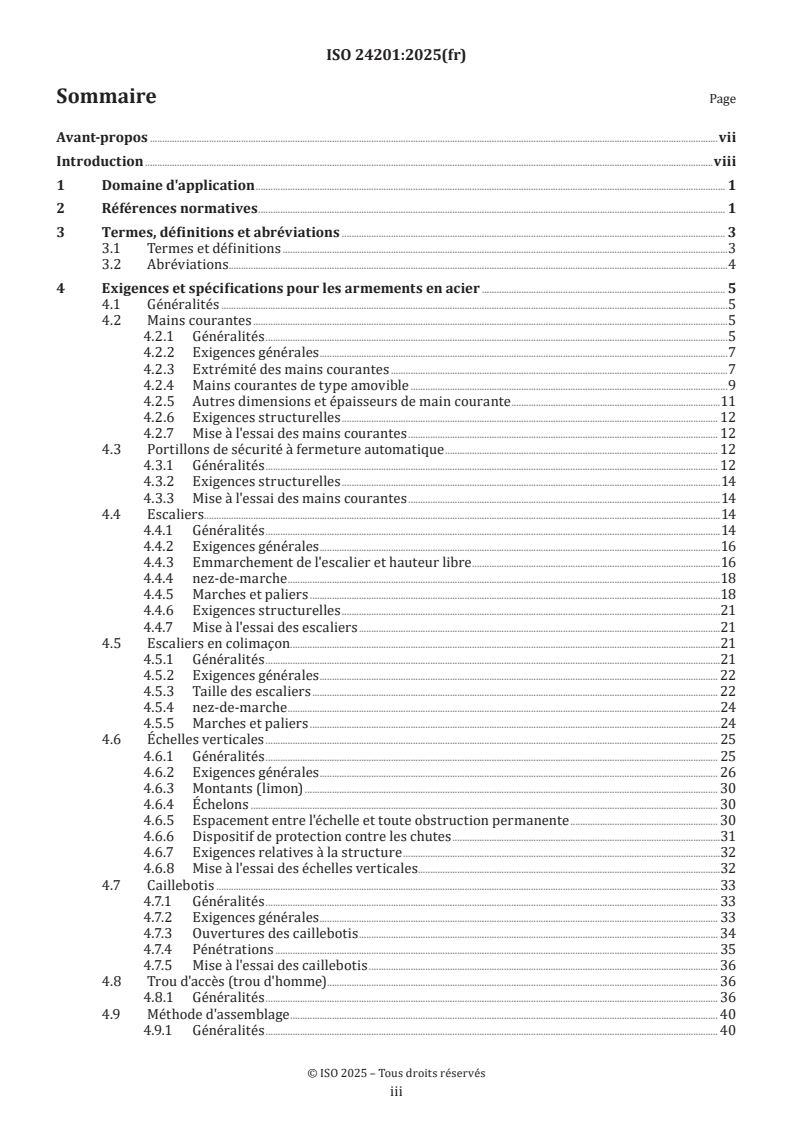
Sommaire Page
Avant-propos .vii
Introduction .viii
1 Domaine d'application . 1
2 Références normatives . 1
3 Termes, définitions et abréviations . 3
3.1 Termes et définitions .3
3.2 Abréviations.4
4 Exigences et spécifications pour les armements en acier . 5
4.1 Généralités .5
4.2 Mains courantes .5
4.2.1 Généralités .5
4.2.2 Exigences générales .7
4.2.3 Extrémité des mains courantes .7
4.2.4 Mains courantes de type amovible .9
4.2.5 Autres dimensions et épaisseurs de main courante .11
4.2.6 Exigences structurelles . 12
4.2.7 Mise à l'essai des mains courantes . 12
4.3 Portillons de sécurité à fermeture automatique . 12
4.3.1 Généralités . 12
4.3.2 Exigences structurelles .14
4.3.3 Mise à l'essai des mains courantes .14
4.4 Escaliers.14
4.4.1 Généralités .14
4.4.2 Exigences générales .16
4.4.3 Emmarchement de l'escalier et hauteur libre .16
4.4.4 nez-de-marche .18
4.4.5 Marches et paliers .18
4.4.6 Exigences structurelles .21
4.4.7 Mise à l'essai des escaliers .21
4.5 Escaliers en colimaçon.21
4.5.1 Généralités .21
4.5.2 Exigences générales . 22
4.5.3 Taille des escaliers . 22
4.5.4 nez-de-marche .24
4.5.5 Marches et paliers .24
4.6 Échelles verticales . 25
4.6.1 Généralités . 25
4.6.2 Exigences générales . 26
4.6.3 Montants (limon) . 30
4.6.4 Échelons . 30
4.6.5 Espacement entre l'échelle et toute obstruction permanente . 30
4.6.6 Dispositif de protection contre les chutes .31
4.6.7 Exigences relatives à la structure .32
4.6.8 Mise à l'essai des échelles verticales .32
4.7 Caillebotis . 33
4.7.1 Généralités . 33
4.7.2 Exigences générales . 33
4.7.3 Ouvertures des caillebotis . 34
4.7.4 Pénétrations . 35
4.7.5 Mise à l'essai des caillebotis . 36
4.8 Trou d'accès (trou d'homme). 36
4.8.1 Généralités . 36
4.9 Méthode d'assemblage . 40
4.9.1 Généralités . 40
iii
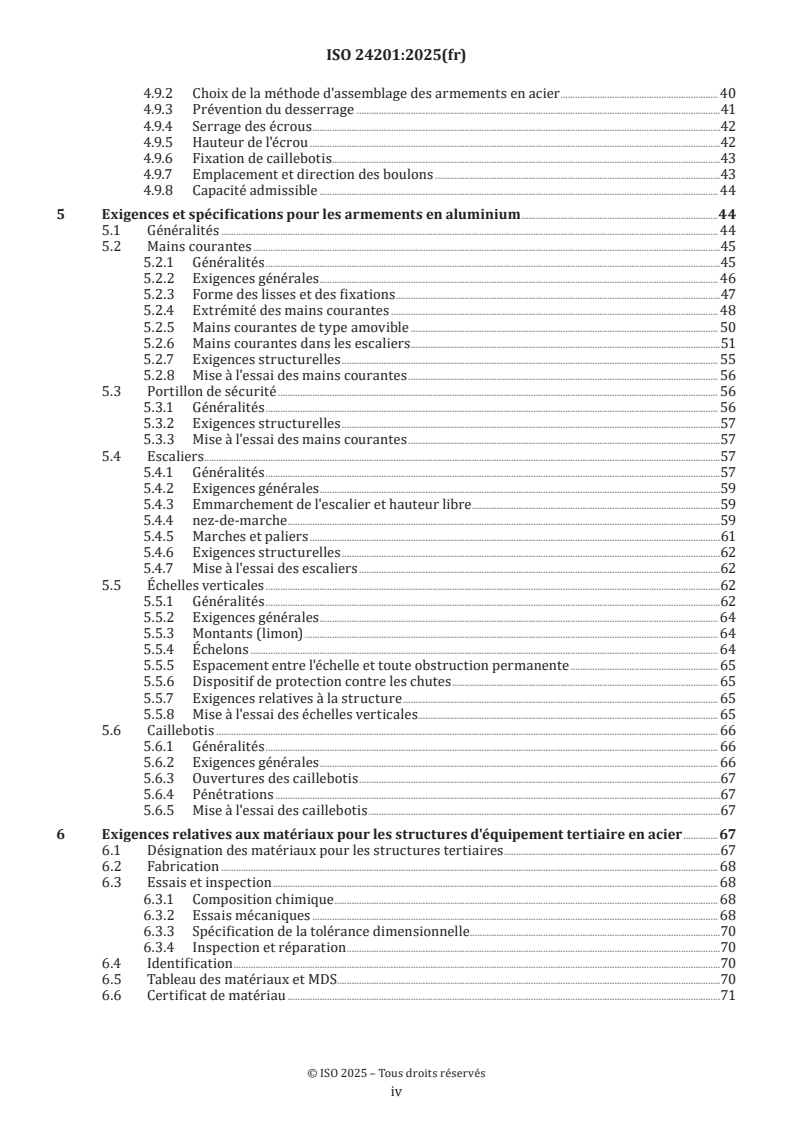
4.9.2 Choix de la méthode d'assemblage des armements en acier . 40
4.9.3 Prévention du desserrage .41
4.9.4 Serrage des écrous .42
4.9.5 Hauteur de l'écrou .42
4.9.6 Fixation de caillebotis .43
4.9.7 Emplacement et direction des boulons .43
4.9.8 Capacité admissible . 44
5 Exigences et spécifications pour les armements en aluminium .44
5.1 Généralités . 44
5.2 Mains courantes .45
5.2.1 Généralités .45
5.2.2 Exigences générales . 46
5.2.3 Forme des lisses et des fixations .47
5.2.4 Extrémité des mains courantes . 48
5.2.5 Mains courantes de type amovible . 50
5.2.6 Mains courantes dans les escaliers .51
5.2.7 Exigences structurelles . 55
5.2.8 Mise à l'essai des mains courantes . 56
5.3 Portillon de sécurité . 56
5.3.1 Généralités . 56
5.3.2 Exigences structurelles .57
5.3.3 Mise à l'essai des mains courantes .57
5.4 Escaliers.57
5.4.1 Généralités .57
5.4.2 Exigences générales .59
5.4.3 Emmarchement de l'escalier et hauteur libre .59
5.4.4 nez-de-marche .59
5.4.5 Marches et paliers .61
5.4.6 Exigences structurelles .62
5.4.7 Mise à l'essai des escaliers .62
5.5 Échelles verticales .62
5.5.1 Généralités .62
5.5.2 Exigences générales . 64
5.5.3 Montants (limon) . 64
5.5.4 Échelons . 64
5.5.5 Espacement entre l'échelle et toute obstruction permanente . 65
5.5.6 Dispositif de protection contre les chutes . 65
5.5.7 Exigences relatives à la structure . 65
5.5.8 Mise à l'essai des échelles verticales . 65
5.6 Caillebotis . 66
5.6.1 Généralités . 66
5.6.2 Exigences générales . 66
5.6.3 Ouvertures des caillebotis .67
5.6.4 Pénétrations .67
5.6.5 Mise à l'essai des caillebotis .67
6 Exigences relatives aux matériaux pour les structures d'équipement tertiaire en acier .67
6.1 Désignation des matériaux pour les structures tertiaires .67
6.2 Fabrication . 68
6.3 Essais et inspection . 68
6.3.1 Composition chimique . 68
6.3.2 Essais mécaniques . 68
6.3.3 Spécification de la tolérance dimensionnelle.70
6.3.4 Inspection et réparation .70
6.4 Identification .70
6.5 Tableau des matériaux et MDS.70
6.6 Certificat de matériau .71
iv
7 Exigences relatives aux matériaux pour les structures d'équipement tertiaire en
aluminium .72
7.1 Généralités . 72
7.2 Désignation des matériaux pour les structures tertiaires . 72
7.3 Fabrication . 72
7.4 Essais et inspection . 72
7.4.1 Composition chimique . 72
7.4.2 Essais mécaniques . 73
7.4.3 Spécification de la tolérance dimensionnelle.74
7.4.4 Inspection et réparation .74
7.5 Identification .74
7.6 Tableau des matériaux et MDS. 75
7.7 Certificat de matériau . 75
8 Exigences relatives au soudage . 76
8.1 Généralités .76
8.2 Qualification des soudeurs .76
8.3 Produits consommables pour le soudage ou le matériau d'apport .76
8.4 Modes opératoires de soudage .76
8.5 Qualification des modes opératoires de soudage . 77
8.5.1 Exigences générales . 77
8.5.2 Assemblage des éprouvettes, examen et essai . 77
8.5.3 Essai . 81
8.5.4 Contre-essais . 82
8.5.5 Domaine de validité . 83
8.5.6 Procès-verbal de qualification des modes opératoires de soudage (PV-QMOS) . 89
9 Contrôle qualité et inspection .89
9.1 Exigence de qualification de l'inspecteur . 89
9.1.1 Base de la qualification . 89
9.1.2 Terme d'efficacité . 89
9.1.3 Inspecteur adjoint . 89
9.1.4 Examen de la vue. 90
9.1.5 Autorité de vérification . 90
9.2 Qualification de l'inspecteur de NDT. 90
9.3 Méthodes d'exécution de l'étendue de l'inspection . 90
9.4 Étendue de l'inspection par méthode . 90
9.5 Limite d'acceptation .91
9.5.1 Critères d'acceptation VT et MT pour les soudures d'acier de construction .91
9.5.2 Critères d'acceptation UT pour les soudures d'acier de construction . 93
9.6 Rapport d'inspection des soudures . 94
9.7 Contrôle visuel dans le cadre de l'approvisionnement . 94
9.7.1 Généralités . 94
9.7.2 Liste de contrôle . 94
9.7.3 Volumes d'inspection . 94
9.8 Contrôle visuel après installation . 95
9.8.1 Généralités . 95
9.8.2 Liste de contrôle . 95
9.8.3 Point de contrôle . . 95
10 Mode opératoire d'essai .97
10.1 Généralités . 97
10.2 Mains courantes . 97
10.2.1 Exigences générales . 97
10.2.2 Préparation de l'essai . 97
10.2.3 Conditions d'essai . 98
10.2.4 Séquence d'essai. 100
10.2.5 Critères de défaillance . 100
10.3 Escaliers. 101
10.3.1 Exigences générales . 101
v
10.3.2 Préparation de l'essai . 101
10.3.3 Conditions d'essai . 101
10.3.4 Séquence d'essai. 102
10.3.5 Critères de défaillance . 103
10.4 Échelles verticales . 103
10.4.1 Exigences générales . 103
10.4.2 Préparation de l'essai . 103
10.4.3 Conditions d'essai . 104
10.4.4 Séquence d'essai. 106
10.4.5 Critères de défaillance . 106
10.5 Caillebotis . 107
10.5.1 Exigences générales . 107
10.5.2 Préparation de l'essai . 107
10.5.3 Conditions d'essai . 107
10.5.4 Séquence d'essai. 109
10.5.5 Critères de défaillance . 109
Annexe A (informative) Quality control plan (QCP) for steel outfitting of tertiary item .111
Annexe B (informative) Practical drawings of steel outfitting items for fabrication .119
Annexe C (informative) Access hole (manhole) code components design details .132
Annexe D (informative) Practical drawings of access hole (manhole) for fabrication .137
Annexe E (informative) Practical drawings of aluminium outfitting items for fabrication .143
Annexe F (normative) Fiches techniques de matériau (MDS) pour acier de construction ou
structure d'équipement tertiaire .182
Annexe G (normative) Fiches techniques de matériau (MDS) pour aluminium de construction
ou structure d'équipement tertiaire . 189
Annexe H (informative) Recommended welding procedure specification (WPS) .192
Annexe I (informative) Test report .194
Bibliographie .197
vi
Avant-propos
L'ISO (Organisation internationale de normalisation) est une fédération mondiale d'organismes nationaux
de normalisation (comités membres de l'ISO). L'élaboration des Normes internationales est en général
confiée aux comités techniques de l'ISO. Chaque comité membre intéressé par une étude a le droit de faire
partie du comité technique créé à cet effet. Les organisations internationales, gouvernementales et non
gouvernementales, en liaison avec l'ISO participent également aux travaux. L'ISO collabore étroitement avec
la Commission électrotechnique internationale (IEC) en ce qui concerne la normalisation électrotechnique.
Les procédures utilisées pour élaborer le présent document et celles destinées à sa mise à jour sont
décrites dans les Directives ISO/IEC, Partie 1. Il convient, en particulier, de prendre note des différents
critères d'approbation requis pour les différents types de documents ISO. Le présent document
a été rédigé conformément aux règles de rédaction données dans les Directives ISO/IEC, Partie 2
(voir www.iso.org/directives).
L'ISO attire l'attention sur le fait que la mise en application du présent document peut entraîner l'utilisation
d'un ou de plusieurs brevets. L'ISO ne prend pas position quant à la preuve, à la validité et à l'applicabilité
de tout droit de propriété revendiqué à cet égard. À la date de publication du présent document, l'ISO
n'avait pas reçu notification qu'un ou plusieurs brevets pouvaient être nécessaires à sa mise en application.
Toutefois, il y a lieu d'avertir les responsables de la mise en application du présent document que des
informations plus récentes sont susceptibles de figurer dans la base de données de brevets, disponible à
l'adresse www.iso.org/brevets. L'ISO ne saurait être tenue pour responsable de ne pas avoir identifié tout ou
partie de tels droits de brevet.
Les appellations commerciales éventuellement mentionnées dans le présent document sont données pour
information, par souci de commodité, à l'intention des utilisateurs et ne sauraient constituer un engagement.
Pour une explication de la nature volontaire des normes, la signification des termes et expressions
spécifiques de l'ISO liés à l'évaluation de la conformité, ou pour toute information au sujet de l'adhésion de
l'ISO aux principes de l'Organisation mondiale du commerce (OMC) concernant les obstacles techniques au
commerce (OTC), voir www.iso.org/avant-propos.
Le présent document a été élaboré par le comité technique ISO/TC 67, Industries du pétrole et du gaz, y
compris les énergies à faible teneur en carbone.
Il convient que l'utilisateur adresse tout retour d'information ou toute question concernant le présent
document à l'organisme national de normalisation de son pays. Une liste exhaustive desdits organismes se
trouve à l'adresse www.iso.org/fr/members.html.
vii
Introduction
Le présent document vise à réduire le nombre et les variations des exigences au minimum nécessaire pour
refléter de bonnes pratiques communes et globales fondées sur les normes et des exigences existantes.
En outre, un inventaire standard des formes et des dimensions, désigné sous le nom de spécifications, est
proposé dans le présent document. Les exemptions, pour lesquelles des exigences de normes communes
applicables aux éléments tertiaires utilisés dans les projets pétroliers et gaziers en mer ne sont pas satisfaites
dans le présent document, sont clairement indiquées.
Une plus grande normalisation des éléments tertiaires devrait avoir pour principaux avantages de réduire
les délais de livraison, de rationaliser et de rendre plus efficaces l'ingénierie et la construction, ainsi que
d'améliorer l'utilisation croisée des éléments tertiaires entre les projets. Une approche fondée sur le risque
a été utilisée pour définir les exigences et les recommandations proposées. Les facteurs sous-jacents pour
la détermination des conditions proposées permettent de fournir un niveau de sécurité acceptable pour les
personnes en combinaison avec des solutions économiques concernant la mise en œuvre des exigences.
Les exigences relatives aux matériaux sont abordées à l'Article 6 pour l'acier au carbone et à l'Article 7 pour
l'aluminium.
viii
Norme internationale ISO 24201:2025(fr)
Industries du pétrole et du gaz, y compris les énergies à faible
teneur en carbone — Structures d'équipement tertiaire
1 Domaine d'application
Le présent document fournit une référence uniforme pour les éléments de structure tertiaire lorsqu'une
structure tertiaire est conçue et construite dans le cadre de projets pétroliers et gaziers en mer. Le présent
document couvre les systèmes des structures Top Sides dans le cadre de projets en mer fixes ou flottants
non couverts par les exigences de classe. Le présent document peut s'appliquer aux systèmes de coque et
aux projets à terre lorsque les parties prenantes concernées donnent leur accord. Le présent document ne
fournit pas les règles de classe des sociétés de classification.
Le présent document fournit les exigences relatives aux dimensions des éléments, mais pas celles relatives
aux dégagements par rapport à d'autres structures.
Les conceptions d'équipements tertiaires suivantes pour les articles d'équipement sont couvertes par le
présent document:
— mains courantes;
— portillons de sécurité;
— escaliers;
— escaliers en colimaçon;
— échelles verticales;
— caillebotis;
— trous d'accès (trous d'homme);
— méthodes d'assemblage.
2 Références normatives
Les documents suivants sont cités dans le texte de sorte qu'ils constituent, pour tout ou partie de leur
contenu, des exigences du présent document. Pour les références datées, seule l'édition citée s'applique. Pour
les références non datées, la dernière édition du document de référence s'applique (y compris les éventuels
amendements).
ISO 148-1, Matériaux métalliques — Essai de flexion par choc sur éprouvette Charpy — Partie 1: Méthode d'essai
ISO 898-1, Caractéristiques mécaniques des éléments de fixation en acier au carbone et en acier allié — Partie 1:
Vis, goujons et tiges filetées de classes de qualité spécifiées — Filetages à pas gros et filetages à pas fin
ISO 898-2, Fixations — Caractéristiques mécaniques des fixations en acier au carbone et en acier allié — Partie
2: Écrous de classes de qualité spécifiées
ISO 898-3, Caractéristiques mécaniques des fixations en acier au carbone et en acier allié — Partie 3: Rondelles
de forme plane de classes de qualité spécifiées
ISO 2566-1, Acier —
...