

ISO 21814:2019
(Main)Fine ceramics (advanced ceramics, advanced technical ceramics) — Methods for chemical analysis of aluminium nitride powders
General Information
- Abstract
This document specifies methods for the chemical analysis of fine aluminium nitride powders used as the raw material for fine ceramics. This document stipulates the determination methods of the aluminium, total nitrogen, boron, calcium, copper, iron, magnesium, manganese, molybdenum, nickel, potassium, silicon, sodium, titanium, tungsten, vanadium, zinc, zirconium, carbon, chlorine, fluorine, and oxygen contents in aluminium nitride powders. The aluminium content is determined by using either an acid pressure decomposition-CyDTA-zinc back titration method or an acid digestion-inductively coupled plasma-optical emission spectrometry (ICP-OES) method. The total nitrogen content is determined by using an acid pressure decomposition-distillation separation-acidimetric titration method, a direct decomposition-distillation separation-acidimetric titration method, or an inert gas fusion-thermal conductivity method. The boron, calcium, copper, iron, magnesium, manganese, molybdenum, nickel, potassium, silicon, sodium, titanium, tungsten, vanadium and zinc contents are determined by using an acid digestion-ICP-OES method or an acid pressure decomposition-ICP-OES method. The sodium and potassium contents are determined via an acid pressure decomposition-flame emission method or an acid pressure decomposition-atomic absorption spectrometry method. The oxygen content is determined by using an inert gas fusion-IR absorption spectrometry method, while that of carbon is determined via a combustion-IR absorption spectrometry method or a combustion-conductometry method. The chlorine and fluorine contents are determined by using a pyrohydrolysation method followed by ion chromatography or spectrophotometry.
- Status
- Published
- Publication Date
- 30-Jan-2019
- Technical Committee
- ISO/TC 206 - Fine ceramics
- Drafting Committee
- ISO/TC 206/WG 3 - Chemical analysis
- Current Stage
- 9092 - International Standard to be revised
- Start Date
- 03-Oct-2024
- Completion Date
- 29-Aug-2026
Buy Documents



ISO 21814:2019 - Fine ceramics (advanced ceramics, advanced technical ceramics) -- Methods for chemical analysis of aluminium nitride powders

ISO 21814:2019 - Fine ceramics (advanced ceramics, advanced technical ceramics) — Methods for chemical analysis of aluminium nitride powders/31/2019



ISO 21814:2019 - Fine ceramics (advanced ceramics, advanced technical ceramics) — Methods for chemical analysis of aluminium nitride powders Released:19. 01. 2023
Overview
ISO 21814:2019 specifies standardized methods for chemical analysis of aluminium nitride (AlN) powders used as raw materials for fine ceramics (advanced/technical ceramics). The standard defines how to prepare test samples, report analytical values, and determine a broad set of elemental and impurity contents so results are reproducible and suitable for quality control, materials characterization and regulatory or customer specifications.
Keywords: ISO 21814, aluminium nitride powders, chemical analysis, fine ceramics, quality control, ICP‑OES, inert gas fusion
Key topics and technical requirements
- Scope of analytes: aluminium, total nitrogen, boron, calcium, copper, iron, magnesium, manganese, molybdenum, nickel, potassium, silicon, sodium, titanium, tungsten, vanadium, zinc, zirconium, carbon, chlorine, fluorine and oxygen.
- Sample preparation: guidance on sampling, drying and weighing to obtain representative, traceable test samples prior to analysis.
- Aluminium determination: two accepted approaches - an acid pressure decomposition + CyDTA–zinc back titration method or acid digestion + ICP‑OES.
- Total nitrogen: options include acid pressure decomposition → distillation → acidimetric titration, direct decomposition → distillation → titration, or inert gas fusion with thermal conductivity detection.
- Trace elements (B, Ca, Cu, Fe, Mg, Mn, Mo, Ni, K, Si, Na, Ti, W, V, Zn, Zr): determined mainly by acid digestion or acid pressure decomposition followed by ICP‑OES.
- Alkali metals (Na, K): can also be measured by flame emission or atomic absorption spectrometry after acid pressure decomposition.
- Oxygen and carbon: oxygen by inert gas fusion with IR absorption, carbon by combustion with IR absorption or combustion‑conductometry.
- Halogens (Cl, F): determined by pyrohydrolysis followed by ion chromatography or spectrophotometry.
- Reporting and quality checks: number of analyses, blank tests, recovery checks and expression of analytical values are specified to ensure data validity.
Applications and users
- Ceramic manufacturers and raw material suppliers use ISO 21814 for incoming material inspection and supplier qualification.
- Analytical and testing laboratories adopt the methods for routine compositional analysis and inter-laboratory comparability.
- R&D teams in electronics, thermal management and power devices use it for materials characterization during formulation and process optimization.
- Quality assurance and certification bodies rely on standardized methods for compliance and product specifications.
Keywords: materials characterization, quality assurance, analytical laboratory methods
Related standards
- Labs using ISO 21814 commonly reference ISO methods for sampling, calibration and instrumentation standards (e.g., ICP‑OES, combustion analyzers, inert gas fusion) and national accreditation requirements (e.g., ISO/IEC 17025) to support method validity and traceability.
Buy Documents
ISO 21814:2019 - Fine ceramics (advanced ceramics, advanced technical ceramics) -- Methods for chemical analysis of aluminium nitride powders
ISO 21814:2019 - Fine ceramics (advanced ceramics, advanced technical ceramics) — Methods for chemical analysis of aluminium nitride powders/31/2019
ISO 21814:2019 - Fine ceramics (advanced ceramics, advanced technical ceramics) — Methods for chemical analysis of aluminium nitride powders Released:19. 01. 2023
Frequently Asked Questions
ISO 21814:2019 is a standard published by the International Organization for Standardization (ISO). Its full title is "Fine ceramics (advanced ceramics, advanced technical ceramics) — Methods for chemical analysis of aluminium nitride powders". This standard covers: This document specifies methods for the chemical analysis of fine aluminium nitride powders used as the raw material for fine ceramics. This document stipulates the determination methods of the aluminium, total nitrogen, boron, calcium, copper, iron, magnesium, manganese, molybdenum, nickel, potassium, silicon, sodium, titanium, tungsten, vanadium, zinc, zirconium, carbon, chlorine, fluorine, and oxygen contents in aluminium nitride powders. The aluminium content is determined by using either an acid pressure decomposition-CyDTA-zinc back titration method or an acid digestion-inductively coupled plasma-optical emission spectrometry (ICP-OES) method. The total nitrogen content is determined by using an acid pressure decomposition-distillation separation-acidimetric titration method, a direct decomposition-distillation separation-acidimetric titration method, or an inert gas fusion-thermal conductivity method. The boron, calcium, copper, iron, magnesium, manganese, molybdenum, nickel, potassium, silicon, sodium, titanium, tungsten, vanadium and zinc contents are determined by using an acid digestion-ICP-OES method or an acid pressure decomposition-ICP-OES method. The sodium and potassium contents are determined via an acid pressure decomposition-flame emission method or an acid pressure decomposition-atomic absorption spectrometry method. The oxygen content is determined by using an inert gas fusion-IR absorption spectrometry method, while that of carbon is determined via a combustion-IR absorption spectrometry method or a combustion-conductometry method. The chlorine and fluorine contents are determined by using a pyrohydrolysation method followed by ion chromatography or spectrophotometry.
This document specifies methods for the chemical analysis of fine aluminium nitride powders used as the raw material for fine ceramics. This document stipulates the determination methods of the aluminium, total nitrogen, boron, calcium, copper, iron, magnesium, manganese, molybdenum, nickel, potassium, silicon, sodium, titanium, tungsten, vanadium, zinc, zirconium, carbon, chlorine, fluorine, and oxygen contents in aluminium nitride powders. The aluminium content is determined by using either an acid pressure decomposition-CyDTA-zinc back titration method or an acid digestion-inductively coupled plasma-optical emission spectrometry (ICP-OES) method. The total nitrogen content is determined by using an acid pressure decomposition-distillation separation-acidimetric titration method, a direct decomposition-distillation separation-acidimetric titration method, or an inert gas fusion-thermal conductivity method. The boron, calcium, copper, iron, magnesium, manganese, molybdenum, nickel, potassium, silicon, sodium, titanium, tungsten, vanadium and zinc contents are determined by using an acid digestion-ICP-OES method or an acid pressure decomposition-ICP-OES method. The sodium and potassium contents are determined via an acid pressure decomposition-flame emission method or an acid pressure decomposition-atomic absorption spectrometry method. The oxygen content is determined by using an inert gas fusion-IR absorption spectrometry method, while that of carbon is determined via a combustion-IR absorption spectrometry method or a combustion-conductometry method. The chlorine and fluorine contents are determined by using a pyrohydrolysation method followed by ion chromatography or spectrophotometry.
ISO 21814:2019 is classified under the following ICS (International Classification for Standards) categories: 81.060.30 - Advanced ceramics. The ICS classification helps identify the subject area and facilitates finding related standards.
ISO 21814:2019 is available in PDF format for immediate download after purchase. The document can be added to your cart and obtained through the secure checkout process. Digital delivery ensures instant access to the complete standard document.
Standards Content (Sample)
INTERNATIONAL ISO
STANDARD 21814
First edition
2019-02
Fine ceramics (advanced ceramics,
advanced technical ceramics) —
Methods for chemical analysis of
aluminium nitride powders
Céramiques techniques — Méthodes d’analyse chimique des poudres
de nitrure d'aluminium
Reference number
©
ISO 2019
© ISO 2019
All rights reserved. Unless otherwise specified, or required in the context of its implementation, no part of this publication may
be reproduced or utilized otherwise in any form or by any means, electronic or mechanical, including photocopying, or posting
on the internet or an intranet, without prior written permission. Permission can be requested from either ISO at the address
below or ISO’s member body in the country of the requester.
ISO copyright office
CP 401 • Ch. de Blandonnet 8
CH-1214 Vernier, Geneva
Phone: +41 22 749 01 11
Fax: +41 22 749 09 47
Email: copyright@iso.org
Website: www.iso.org
Published in Switzerland
ii © ISO 2019 – All rights reserved
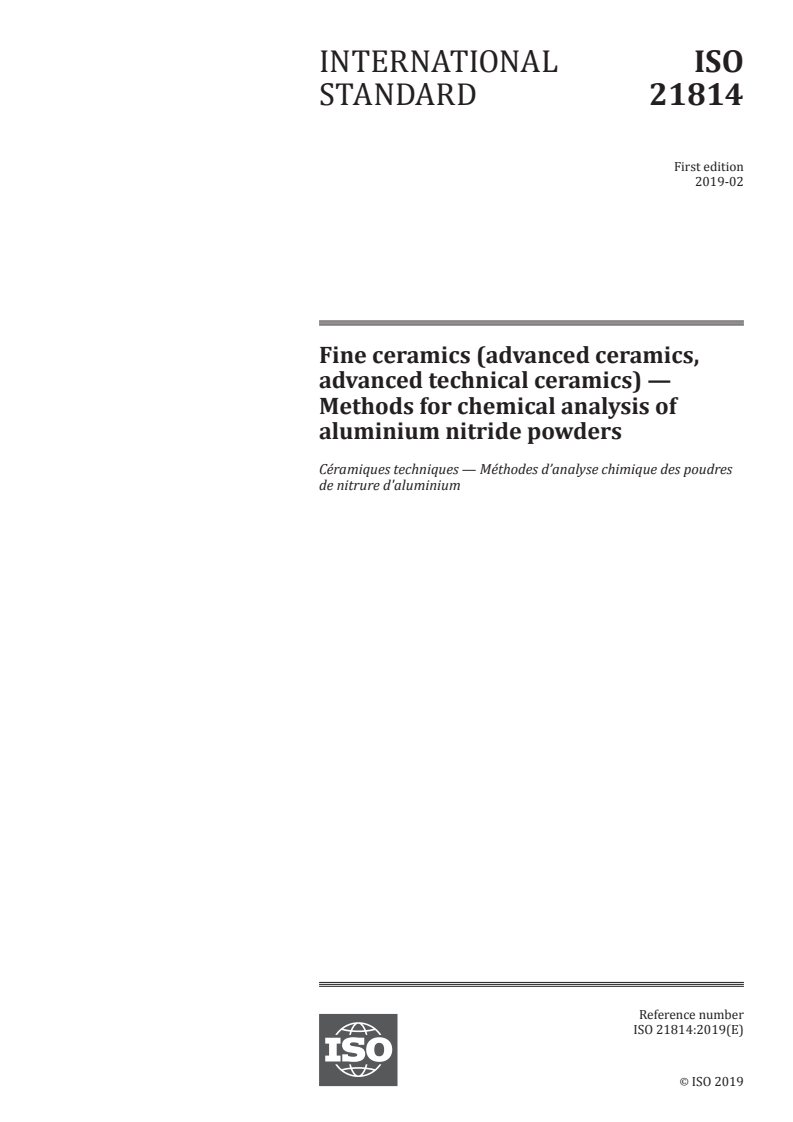
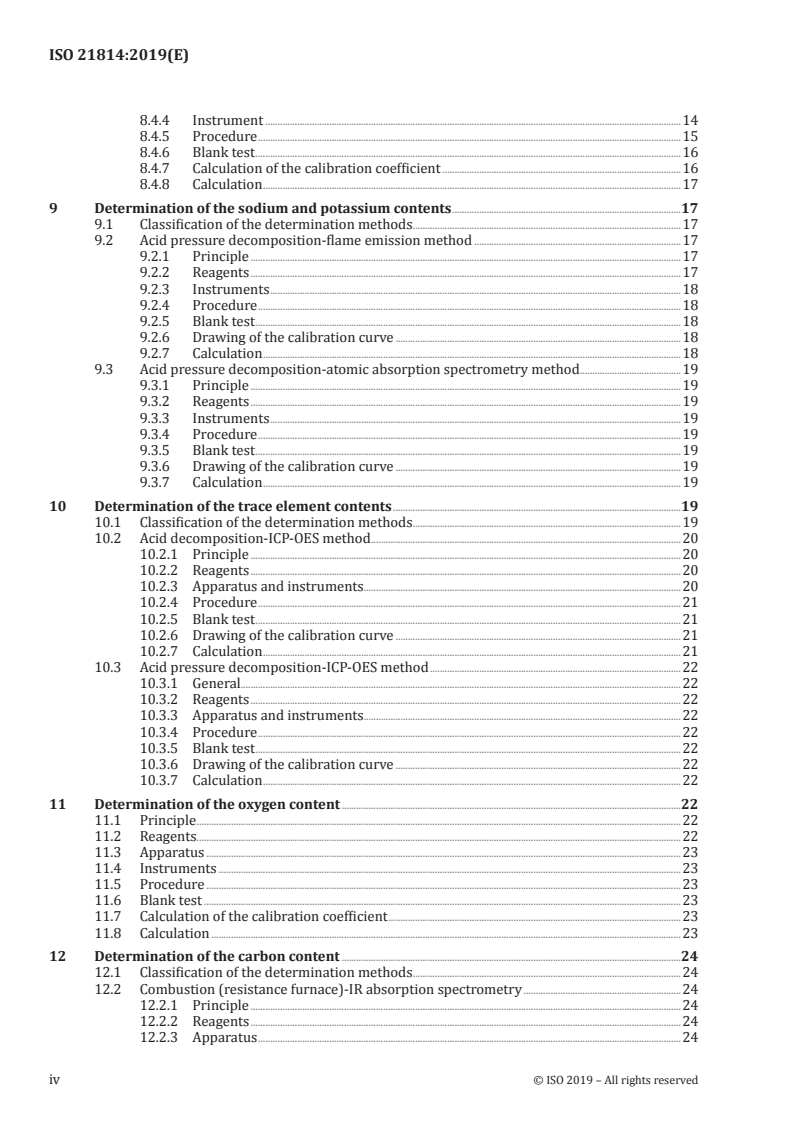
Contents Page
Foreword .vi
1 Scope . 1
2 Normative references . 1
3 Terms and definitions . 2
4 Analytes and ranges . 2
5 Preparation of the test sample . 2
5.1 General . 2
5.2 Sampling . 3
5.3 Drying . 3
5.4 Weighing . 3
6 Reporting the analytical values . 3
6.1 Number of analyses. 3
6.2 Blank test . 3
6.3 Evaluation of the analytical values. 3
6.4 Expression of the analytical values . 3
7 Determination of the aluminium content . 4
7.1 Classification of the determination methods . 4
7.2 Acid decomposition-ICP-OES method . 4
7.2.1 Principle . 4
7.2.2 Reagents . 4
7.2.3 Apparatus and instruments. 4
7.2.4 Procedure . 5
7.2.5 Blank test . 5
7.2.6 Drawing of the calibration curve . 5
7.2.7 Calculation . 5
7.3 Acid pressure decomposition-CyDTA-zinc back titration method . 5
7.3.1 Principle . 5
7.3.2 Reagents . 6
7.3.3 Apparatus and instruments. 6
7.3.4 Procedure . 8
7.3.5 Blank test . 8
7.3.6 Calculation . 8
8 Determination of the total nitrogen content . 8
8.1 Classification of the determination methods . 8
8.2 Acid pressure decomposition-distillation separation-acidimetric titration method . 9
8.2.1 Principle . 9
8.2.2 Reagents . 9
8.2.3 Apparatus .10
8.2.4 Procedure .12
8.2.5 Recovery measurement .12
8.2.6 Calculation .13
8.3 Direct decomposition-distillation separation-acidimetric titration method .13
8.3.1 Principle .13
8.3.2 Reagents .13
8.3.3 Apparatus .13
8.3.4 Procedure .13
8.3.5 Recovery measurement .13
8.3.6 Calculation .13
8.4 Inert gas fusion-thermal conductivity method .13
8.4.1 Principle .13
8.4.2 Reagents .14
8.4.3 Apparatus .14
8.4.4 Instrument .14
8.4.5 Procedure .15
8.4.6 Blank test .16
8.4.7 Calculation of the calibration coefficient .16
8.4.8 Calculation .17
9 Determination of the sodium and potassium contents .17
9.1 Classification of the determination methods .17
9.2 Acid pressure decomposition-flame emission method .17
9.2.1 Principle .17
9.2.2 Reagents .17
9.2.3 Instruments .18
9.2.4 Procedure .18
9.2.5 Blank test .18
9.2.6 Drawing of the calibration curve .18
9.2.7 Calculation .18
9.3 Acid pressure decomposition-atomic absorption spectrometry method .19
9.3.1 Principle .19
9.3.2 Reagents .19
9.3.3 Instruments .19
9.3.4 Procedure .19
9.3.5 Blank test .19
9.3.6 Drawing of the calibration curve .19
9.3.7 Calculation .19
10 Determination of the trace element contents .19
10.1 Classification of the determination methods .19
10.2 Acid decomposition-ICP-OES method .20
10.2.1 Principle .20
10.2.2 Reagents .20
10.2.3 Apparatus and instruments.20
10.2.4 Procedure .21
10.2.5 Blank test .21
10.2.6 Drawing of the calibration curve .21
10.2.7 Calculation .21
10.3 Acid pressure decomposition-ICP-OES method .22
10.3.1 General.22
10.3.2 Reagents .22
10.3.3 Apparatus and instruments.22
10.3.4 Procedure .22
10.3.5 Blank test .22
10.3.6 Drawing of the calibration curve .22
10.3.7 Calculation .22
11 Determination of the oxygen content .22
11.1 Principle .22
11.2 Reagents.22
11.3 Apparatus .23
11.4 Instruments .23
11.5 Procedure .23
11.6 Blank test .23
11.7 Calculation of the calibration coefficient .23
11.8 Calculation .23
12 Determination of the carbon content .24
12.1 Classification of the determination methods .24
12.2 Combustion (resistance furnace)-IR absorption spectrometry .24
12.2.1 Principle .24
12.2.2 Reagents .24
12.2.3 Apparatus .24
iv © ISO 2019 – All rights reserved
12.2.4 Instrument .24
12.2.5 Procedure .25
12.2.6 Blank test .26
12.2.7 Calculation of the calibration coefficient .26
12.2.8 Calculation .27
12.3 Combustion (radio frequency heating furnace)-thermal conductometry .27
12.3.1 Principle .27
12.3.2 Reagents .27
12.3.3 Apparatus .27
12.3.4 Instrument .27
12.3.5 Procedure .28
12.3.6 Blank test .29
12.3.7 Calculation of the calibration coefficient .29
12.3.8 Calculation .29
12.4 Combustion (radio frequency heating furnace)-IR absorption spectrometry .29
12.4.1 Principle .29
12.4.2 Reagents .29
12.4.3 Apparatus .29
12.4.4 Instrument .29
12.4.5 Procedure .30
12.4.6 Blank test .31
12.4.7 Calculation of the calibration coefficient .31
12.4.8 Calculation .31
13 Determination of the fluorine and chlorine contents .31
13.1 Principle .31
13.2 Reagents.31
13.3 Apparatus and instruments .32
13.4 Procedure .33
13.4.1 Extraction of fluorine and chlorine from the sample .33
13.4.2 Determination of the fluorine and chlorine contents .33
13.5 Blank test .33
13.6 Drawing of the calibration curve .34
13.7 Calculation .34
14 Test report .34
Annex A (informative) Analytical results obtained from the round robin test .35
Bibliography .36
Foreword
ISO (the International Organization for Standardization) is a worldwide federation of national standards
bodies (ISO member bodies). The work of preparing International Standards is normally carried out
through ISO technical committees. Each member body interested in a subject for which a technical
committee has been established has the right to be represented on that committee. International
organizations, governmental and non-governmental, in liaison with ISO, also take part in the work.
ISO collaborates closely with the International Electrotechnical Commission (IEC) on all matters of
electrotechnical standardization.
The procedures used to develop this document and those intended for its further maintenance are
described in the ISO/IEC Directives, Part 1. In particular the different approval criteria needed for the
different types of ISO documents should be noted. This document was drafted in accordance with the
editorial rules of the ISO/IEC Directives, Part 2 (see www .iso .org/directives).
Attention is drawn to the possibility that some of the elements of this document may be the subject of
patent rights. ISO shall not be held responsible for identifying any or all such patent rights. Details of
any patent rights identified during the development of the document will be in the Introduction and/or
on the ISO list of patent declarations received (see www .iso .org/patents).
Any trade name used in this document is information given for the convenience of users and does not
constitute an endorsement.
For an explanation on the voluntary nature of standards, the meaning of ISO specific terms and
expressions related to conformity assessment, as well as information about ISO's adherence to the
World Trade Organization (WTO) principles in the Technical Barriers to Trade (TBT) see the following
URL: www .iso .org/iso/foreword .html.
This document was prepared by Technical Committee ISO/TC 206, Fine ceramics.
Any feedback or questions on this document should be directed to the user’s national standards body. A
complete listing of these bodies can be found at www .iso .org/members .html.
vi © ISO 2019 – All rights reserved
INTERNATIONAL STANDARD ISO 21814:2019(E)
Fine ceramics (advanced ceramics, advanced technical
ceramics) — Methods for chemical analysis of aluminium
nitride powders
1 Scope
This document specifies methods for the chemical analysis of fine aluminium nitride powders used as
the raw material for fine ceramics.
This document stipulates the determination methods of the aluminium, total nitrogen, boron, calcium,
copper, iron, magnesium, manganese, molybdenum, nickel, potassium, silicon, sodium, titanium,
tungsten, vanadium, zinc, zirconium, carbon, chlorine, fluorine, and oxygen contents in aluminium
nitride powders. The aluminium content is determined by using either an acid pressure decomposition-
CyDTA-zinc back titration method or an acid digestion-inductively coupled plasma-optical emission
spectrometry (ICP-OES) method. The total nitrogen content is determined by using an acid pressure
decomposition-distillation separation-acidimetric titration method, a direct decomposition-distillation
separation-acidimetric titration method, or an inert gas fusion-thermal conductivity method. The
boron, calcium, copper, iron, magnesium, manganese, molybdenum, nickel, potassium, silicon,
sodium, titanium, tungsten, vanadium and zinc contents are determined by using an acid digestion-
ICP-OES method or an acid pressure decomposition-ICP-OES method. The sodium and potassium
contents are determined via an acid pressure decomposition-flame emission method or an acid
pressure decomposition-atomic absorption spectrometry method. The oxygen content is determined
by using an inert gas fusion-IR absorption spectrometry method, while that of carbon is determined
via a combustion-IR absorption spectrometry method or a combustion-conductometry method. The
chlorine and fluorine contents are determined by using a pyrohydrolysation method followed by ion
chromatography or spectrophotometry.
2 Normative references
The following documents are referred to in the text in such a way that some or all of their content
constitutes requirements of this document. For dated references, only the edition cited applies. For
undated references, the latest edition of the referenced document (including any amendments) applies.
ISO 2828, Aluminium oxide primarily used for the production of aluminium — Determination of fluorine
content — Alizarin complexone and lanthanum chloride spectrophotometric method
ISO 3696, Water for analytical laboratory use — Specification and test methods
ISO 8656-1, Refractory products — Sampling of raw materials and unshaped products — Part 1:
Sampling scheme
ISO 21068-3:2008, Chemical analysis of silicon-carbide-containing raw materials and refractory
products — Part 3: Determination of nitrogen, oxygen and metallic and oxidic constituents
ISO 21438-2, Workplace atmospheres — Determination of inorganic acids by ion chromatography —
Part 2: Volatile acids, except hydrofluoric acid (hydrochloric acid, hydrobromic acid and nitric acid)
ISO 21438-3, Workplace atmospheres — Determination of inorganic acids by ion chromatography —
Part 3: Hydrofluoric acid and particulate fluorides
ISO 26845:2008, Chemical analysis of refractories — General requirements for wet chemical analysis,
atomic absorption spectrometry (AAS) and inductively coupled plasma atomic emission spectrometry (ICP-
AES) methods
3 Terms and definitions
No terms and definitions are listed in this document.
ISO and IEC maintain terminological databases for use in standardization at the following addresses:
— ISO Online browsing platform: available at https: //www .iso .org/obp
— IEC Electropedia: available at http: //www .electropedia .org/
4 Analytes and ranges
a) Aluminium (Al), range of 40 % to 70 % (mass fraction).
b) Total nitrogen (T.N), range of 20 % to 40 % (mass fraction).
c) Boron (B), range of 0,001 % to 0,03 % (mass fraction).
d) Calcium (Ca), range of 0,001 % to 0,03 % (mass fraction).
e) Copper (Cu), range of 0,001 % to 0,03 % (mass fraction).
f) Iron (Fe), range of 0,001 % to 0,03 % (mass fraction).
g) Magnesium (Mg), range of 0,001 % to 0,03 % (mass fraction).
h) Manganese (Mn), range of 0,001 % to 0,03 % (mass fraction).
i) Molybdenum (Mo), range of 0,001 % to 0,03 % (mass fraction).
j) Nickel (Ni), range of 0,001 % to 0,03 % (mass fraction).
k) Potassium (K), range of 0,001 % to 0,03 % (mass fraction).
l) Silicon (Si), range of 0,001 % to 0,03 % (mass fraction).
m) Sodium (Na), range of 0,001 % to 0,03 % (mass fraction).
n) Titanium (Ti), range of 0,001% to 0,03 % (mass fraction).
o) Tungsten (W), range of 0,001 % to 0,03 % (mass fraction).
p) Vanadium (V), range of 0,001 % to 0,03 % (mass fraction).
q) Zinc (Zn), range of 0,001 % to 0,03 % (mass fraction).
r) Carbon (C), range of 0,01 % to 6 % (mass fraction).
s) Chlorine (Cl), range of 0,001 % to 0,5 % (mass fraction).
t) Fluorine (F), range of 0,001 % to 0,2 % (mass fraction).
u) Oxygen (O), range of 0,05 % to 5 % (mass fraction).
5 Preparation of the test sample
5.1 General
The sample preparation method shall be in accordance with ISO 8656-1, unless otherwise mutually
agreed upon by the analyser and customer.
2 © ISO 2019 – All rights reserved
5.2 Sampling
The sample shall be collected in accordance with ISO 8656-1.
5.3 Drying
Place 10 g sample into a flat-type weighing bottle (60 mm × 30 mm) and spread it uniformly over the
bottom of the bottle. Place the bottle in an air bath at 110 °C ± 5 °C for 2 h, uncovered, and cool in a
desiccator (desiccant: magnesium perchlorate), covered, for 1 h.
5.4 Weighing
Weigh the sample to the nearest 0,1 mg of the required quantity using a balance.
6 Reporting the analytical values
6.1 Number of analyses
Analyse the sample twice on different days.
6.2 Blank test
Upon analysis, perform a blank test to correct the measured values.
6.3 Evaluation of the analytical values
When the difference between the two analytical values does not exceed the tolerance value (Table 1),
the average value shall be reported. When the difference between the two analytical values exceeds the
tolerance value, perform two additional analyses. When the difference of these further two analyses
does not exceed the tolerance value, the average value thereof shall be reported. If the difference also
exceeds the tolerance value, the median of four analytical values shall be reported.
6.4 Expression of the analytical values
The analytical values shall be presented in % (mass fraction), in dryness.
a) Aluminium, total nitrogen, and oxygen: express the results in four figures to two decimal places.
b) Others: express the results to three decimal places.
Table 1 — Tolerances for the analytical values
Units: % (mass fraction)
Si, Ti, Fe, Ca, Mg, V, Mo, W, Cu,
Component Al Total N O C
Ni, Zn, Mn, B, Na, K, F, Cl
a c e
0,20 0,20 0,001
Tolerance 0,05 0,005
b d f
0,30 0,40 0,005
a
Acid pressure decomposition-CyDTA-zinc back titration method.
b
Acid decomposition-ICP-OES method.
c
Acid pressure decomposition (or direct decomposition)-distillation separation-acidimetric titration method.
d
Inert gas fusion-thermal conductivity method.
e
Applicable to content of less than 0,01 % (mass fraction).
f
Applicable to content of not less than 0,01 % (mass fraction).
7 Determination of the aluminium content
7.1 Classification of the determination methods
Method A, acid decomposition-ICP-OES method.
Method B, acid pressure decomposition-CyDTA-zinc back titration method.
If analytical results with four significant figures are required, use method B; if two or three significant
figures are required, method A can be used.
7.2 Acid decomposition-ICP-OES method
7.2.1 Principle
A portion of the sample is decomposed in water, sulfuric acid, and hydrogen peroxide. After making up
to the required volume, the emission intensity of the aluminium present in the test solution is measured
by ICP-OES at one or more of the wavelengths: 396,15 nm, 309,28 nm and 394,40 nm.
7.2.2 Reagents
Reagents of analytical grade shall be used. Reagent solutions shall be preserved in plastic bottles.
7.2.2.1 Water, grade 1 or superior as specified in ISO 3696.
7.2.2.2 Sulfuric acid (1+9, 1+180).
7.2.2.3 Hydrochloric acid (1+1, 1+3).
7.2.2.4 Aluminium stock solution (Al 10 mg/ml).
Wash the surface of the aluminium (more than 99,999 % purity by mass fraction) with a hydrochloric
acid solution (1+3). Wash the oxidised layer with water, ethanol (99,5 %), and diethyl ether. Dry the
aluminium in a desiccator (desiccant: magnesium perchlorate). Weigh 5 g aluminium in a PTFE beaker
and cover with a PTFE watch glass. Add 50 ml hydrochloric acid solution (1+1) and heat to dissolve on
a steam bath. After cooling, transfer the solution to a 500 ml volumetric flask, dilute with water to the
mark and mix well.
NOTE The SI traceable commercial standard solution is also available.
7.2.2.5 Aluminium standard solution (Al 1 mg/ml).
Place 10 ml aluminium stock solution (7.2.2.4) in a 100 ml plastic volumetric flask. Dilute with sulfuric
acid (1+180) to the mark and mix well.
7.2.3 Apparatus and instruments
Use ordinary laboratory apparatus and instruments for the chemical analyses in accordance with
ISO 26845:2008, Clause 4.
7.2.3.1 ICP-OES.
4 © ISO 2019 – All rights reserved
7.2.4 Procedure
7.2.4.1 Sample decomposition
Weigh 0,30 g test sample and transfer it into a 250 ml beaker. Add 15 ml water, 20 ml sulfuric acid,
and 10 ml hydrogen peroxide. Covering the beaker with a watch glass and heat at 280 °C until the test
sample has been completely dissolved. After cooling, transfer the solution to a 500 ml volumetric flask,
dilute with water to the mark and mix well.
NOTE If the test sample is not completely dissolved, add a little more hydrogen peroxide and continue
heating to dissolve the sample. Alternatively, you may apply the acid pressure decomposition method (7.3).
7.2.4.2 Measurement
Transfer a 10 ml aliquot of the stock solution to a 100 ml volumetric flask, dilute with water to the
mark and mix well. Spray a portion of the test solution into the flame of the ICP–OES and measure
the emission intensity for aluminium at one or more of the wavelengths: 396,15 nm, 309,28 nm and
394,40 nm.
7.2.5 Blank test
Perform the operation described in 7.2.4 without taking a sample to obtain the blank test value.
7.2.6 Drawing of the calibration curve
Transfer 0 ml, 1 ml, 2 ml, 3 ml, 4 ml, and 5 ml aliquots of the aluminium standard solution (7.2.2.5)
separately to six 100 ml volumetric flasks. To each flask add 10 ml sulfuric acid (1+10), dilute with
water to the mark and mix well.
Spray a portion of each solution into the flame of the ICP–OES and measure the emission intensity for
aluminium at one or more of wavelengths: 396,15 nm, 309,28 nm and 394,40 nm. Interferences may be
encountered. Carefully choose the optimum wavelength that is free from concomitants.
7.2.7 Calculation
Determine the concentration of the aluminium in the test solution and blank from the calibration curve.
Calculate the aluminium content, Al, expressed as a percent mass fraction, from Formula (1).
Al =− AA //m ××500 10 100 (1)
()
where
Al is the aluminium content, in % (mass fraction);
A is the mass of aluminium in the test solution, in g;
A is the mass of aluminium in the blank solution, in g;
m is the mass of the sample, in g.
7.3 Acid pressure decomposition-CyDTA-zinc back titration method
7.3.1 Principle
A sample is pressure-decomposed with sulfuric acid in a decomposition vessel, to which excess CyDTA
solution is added. After adjusting the pH with hexamethylenetetramine, the solution is titrated with a
zinc standard solution using xylenol orange as an indicator.
7.3.2 Reagents
Reagents of analytical grade shall be used. The reagent solutions shall be preserved in plastic bottles.
Use the reagents described in 7.2.2 together with the following:
7.3.2.1 Hexamethylenetetramine solution (200 g/l).
7.3.2.2 CyDTA solution (0,02 mol/l).
Add 16 ml sodium hydroxide solution (100 g/l) and 300 ml water to 7,3 g cyclohexanediaminetetraacetic
acid (hydrate) and heat until dissolved. After cooling, transfer the solution to a 1 000 ml volumetric
flask, dilute with water to the mark and mix well.
7.3.2.3 Zinc standard solution (0,02 mol/l).
7.3.2.4 Xylenol orange solution (1 g/l).
7.3.2.5 Sulfuric acid (1+2).
7.3.3 Apparatus and instruments
Use ordinary laboratory apparatus and instruments for the chemical analyses in accordance with
ISO 26845:2008, Clause 4.
7.3.3.1 Platinum crucible (20 ml).
7.3.3.2 Pressure decomposition vessel, in general a commercial pressure decomposition vessel may
be used.
An example is presented in Figure 1. Use the vessels exclusively for this analysis to avoid cross-
contamination.
6 © ISO 2019 – All rights reserved
Key
1 centre screw
2 screw cap
3 top plate
4 PTFE cap
5 cylinder
6 PTFE bottle
7 bottom plate
Figure 1 — Example of a sealed decomposition vessel
7.3.3.3 Air bath, capable of heating at 200 °C ± 5 °C.
7.3.4 Procedure
7.3.4.1 Sample decomposition
Weigh 0,75 g sample in a platinum crucible and add 15 ml sulfuric acid (1+2). Place the crucible into a
pressure decomposition vessel and close according to the manufacturer instructions. If an antistatic
device is available during weighing, the sample can be directly weighed into the vessel. Place the vessel
into an air bath and heat at 200 °C ± 5 °C for 16 h. Acid pressure decomposition under microwave
irradiation can also be performed if available.
After cooling, disassemble the vessel. Use plastic tweezers to take out the platinum crucible, and
transfer the solution to a 100 ml plastic beaker. Wash the platinum crucible, polytetrafluoroethylene
(PTFE) bottle, and plastic tweezers with 5 ml hydrochloric acid (1+1) and warm water. Next, add water
to the 100 ml plastic beaker to cool the solution to room temperature. Transfer the solution to a 100 ml
volumetric flask, dilute with water to the mark and mix well.
7.3.4.2 CyD
...
INTERNATIONAL ISO
STANDARD 21814
First edition
2019-02
Fine ceramics (advanced ceramics,
advanced technical ceramics) —
Methods for chemical analysis of
aluminium nitride powders
Céramiques techniques — Méthodes d’analyse chimique des poudres
de nitrure d'aluminium
Reference number
©
ISO 2019
© ISO 2019
All rights reserved. Unless otherwise specified, or required in the context of its implementation, no part of this publication may
be reproduced or utilized otherwise in any form or by any means, electronic or mechanical, including photocopying, or posting
on the internet or an intranet, without prior written permission. Permission can be requested from either ISO at the address
below or ISO’s member body in the country of the requester.
ISO copyright office
CP 401 • Ch. de Blandonnet 8
CH-1214 Vernier, Geneva
Phone: +41 22 749 01 11
Fax: +41 22 749 09 47
Email: copyright@iso.org
Website: www.iso.org
Published in Switzerland
ii © ISO 2019 – All rights reserved
Contents Page
Foreword .vi
1 Scope . 1
2 Normative references . 1
3 Terms and definitions . 2
4 Analytes and ranges . 2
5 Preparation of the test sample . 2
5.1 General . 2
5.2 Sampling . 3
5.3 Drying . 3
5.4 Weighing . 3
6 Reporting the analytical values . 3
6.1 Number of analyses. 3
6.2 Blank test . 3
6.3 Evaluation of the analytical values. 3
6.4 Expression of the analytical values . 3
7 Determination of the aluminium content . 4
7.1 Classification of the determination methods . 4
7.2 Acid decomposition-ICP-OES method . 4
7.2.1 Principle . 4
7.2.2 Reagents . 4
7.2.3 Apparatus and instruments. 4
7.2.4 Procedure . 5
7.2.5 Blank test . 5
7.2.6 Drawing of the calibration curve . 5
7.2.7 Calculation . 5
7.3 Acid pressure decomposition-CyDTA-zinc back titration method . 5
7.3.1 Principle . 5
7.3.2 Reagents . 6
7.3.3 Apparatus and instruments. 6
7.3.4 Procedure . 8
7.3.5 Blank test . 8
7.3.6 Calculation . 8
8 Determination of the total nitrogen content . 8
8.1 Classification of the determination methods . 8
8.2 Acid pressure decomposition-distillation separation-acidimetric titration method . 9
8.2.1 Principle . 9
8.2.2 Reagents . 9
8.2.3 Apparatus .10
8.2.4 Procedure .12
8.2.5 Recovery measurement .12
8.2.6 Calculation .13
8.3 Direct decomposition-distillation separation-acidimetric titration method .13
8.3.1 Principle .13
8.3.2 Reagents .13
8.3.3 Apparatus .13
8.3.4 Procedure .13
8.3.5 Recovery measurement .13
8.3.6 Calculation .13
8.4 Inert gas fusion-thermal conductivity method .13
8.4.1 Principle .13
8.4.2 Reagents .14
8.4.3 Apparatus .14
8.4.4 Instrument .14
8.4.5 Procedure .15
8.4.6 Blank test .16
8.4.7 Calculation of the calibration coefficient .16
8.4.8 Calculation .17
9 Determination of the sodium and potassium contents .17
9.1 Classification of the determination methods .17
9.2 Acid pressure decomposition-flame emission method .17
9.2.1 Principle .17
9.2.2 Reagents .17
9.2.3 Instruments .18
9.2.4 Procedure .18
9.2.5 Blank test .18
9.2.6 Drawing of the calibration curve .18
9.2.7 Calculation .18
9.3 Acid pressure decomposition-atomic absorption spectrometry method .19
9.3.1 Principle .19
9.3.2 Reagents .19
9.3.3 Instruments .19
9.3.4 Procedure .19
9.3.5 Blank test .19
9.3.6 Drawing of the calibration curve .19
9.3.7 Calculation .19
10 Determination of the trace element contents .19
10.1 Classification of the determination methods .19
10.2 Acid decomposition-ICP-OES method .20
10.2.1 Principle .20
10.2.2 Reagents .20
10.2.3 Apparatus and instruments.20
10.2.4 Procedure .21
10.2.5 Blank test .21
10.2.6 Drawing of the calibration curve .21
10.2.7 Calculation .21
10.3 Acid pressure decomposition-ICP-OES method .22
10.3.1 General.22
10.3.2 Reagents .22
10.3.3 Apparatus and instruments.22
10.3.4 Procedure .22
10.3.5 Blank test .22
10.3.6 Drawing of the calibration curve .22
10.3.7 Calculation .22
11 Determination of the oxygen content .22
11.1 Principle .22
11.2 Reagents.22
11.3 Apparatus .23
11.4 Instruments .23
11.5 Procedure .23
11.6 Blank test .23
11.7 Calculation of the calibration coefficient .23
11.8 Calculation .23
12 Determination of the carbon content .24
12.1 Classification of the determination methods .24
12.2 Combustion (resistance furnace)-IR absorption spectrometry .24
12.2.1 Principle .24
12.2.2 Reagents .24
12.2.3 Apparatus .24
iv © ISO 2019 – All rights reserved
12.2.4 Instrument .24
12.2.5 Procedure .25
12.2.6 Blank test .26
12.2.7 Calculation of the calibration coefficient .26
12.2.8 Calculation .27
12.3 Combustion (radio frequency heating furnace)-thermal conductometry .27
12.3.1 Principle .27
12.3.2 Reagents .27
12.3.3 Apparatus .27
12.3.4 Instrument .27
12.3.5 Procedure .28
12.3.6 Blank test .29
12.3.7 Calculation of the calibration coefficient .29
12.3.8 Calculation .29
12.4 Combustion (radio frequency heating furnace)-IR absorption spectrometry .29
12.4.1 Principle .29
12.4.2 Reagents .29
12.4.3 Apparatus .29
12.4.4 Instrument .29
12.4.5 Procedure .30
12.4.6 Blank test .31
12.4.7 Calculation of the calibration coefficient .31
12.4.8 Calculation .31
13 Determination of the fluorine and chlorine contents .31
13.1 Principle .31
13.2 Reagents.31
13.3 Apparatus and instruments .32
13.4 Procedure .33
13.4.1 Extraction of fluorine and chlorine from the sample .33
13.4.2 Determination of the fluorine and chlorine contents .33
13.5 Blank test .33
13.6 Drawing of the calibration curve .34
13.7 Calculation .34
14 Test report .34
Annex A (informative) Analytical results obtained from the round robin test .35
Bibliography .36
Foreword
ISO (the International Organization for Standardization) is a worldwide federation of national standards
bodies (ISO member bodies). The work of preparing International Standards is normally carried out
through ISO technical committees. Each member body interested in a subject for which a technical
committee has been established has the right to be represented on that committee. International
organizations, governmental and non-governmental, in liaison with ISO, also take part in the work.
ISO collaborates closely with the International Electrotechnical Commission (IEC) on all matters of
electrotechnical standardization.
The procedures used to develop this document and those intended for its further maintenance are
described in the ISO/IEC Directives, Part 1. In particular the different approval criteria needed for the
different types of ISO documents should be noted. This document was drafted in accordance with the
editorial rules of the ISO/IEC Directives, Part 2 (see www .iso .org/directives).
Attention is drawn to the possibility that some of the elements of this document may be the subject of
patent rights. ISO shall not be held responsible for identifying any or all such patent rights. Details of
any patent rights identified during the development of the document will be in the Introduction and/or
on the ISO list of patent declarations received (see www .iso .org/patents).
Any trade name used in this document is information given for the convenience of users and does not
constitute an endorsement.
For an explanation on the voluntary nature of standards, the meaning of ISO specific terms and
expressions related to conformity assessment, as well as information about ISO's adherence to the
World Trade Organization (WTO) principles in the Technical Barriers to Trade (TBT) see the following
URL: www .iso .org/iso/foreword .html.
This document was prepared by Technical Committee ISO/TC 206, Fine ceramics.
Any feedback or questions on this document should be directed to the user’s national standards body. A
complete listing of these bodies can be found at www .iso .org/members .html.
vi © ISO 2019 – All rights reserved
INTERNATIONAL STANDARD ISO 21814:2019(E)
Fine ceramics (advanced ceramics, advanced technical
ceramics) — Methods for chemical analysis of aluminium
nitride powders
1 Scope
This document specifies methods for the chemical analysis of fine aluminium nitride powders used as
the raw material for fine ceramics.
This document stipulates the determination methods of the aluminium, total nitrogen, boron, calcium,
copper, iron, magnesium, manganese, molybdenum, nickel, potassium, silicon, sodium, titanium,
tungsten, vanadium, zinc, zirconium, carbon, chlorine, fluorine, and oxygen contents in aluminium
nitride powders. The aluminium content is determined by using either an acid pressure decomposition-
CyDTA-zinc back titration method or an acid digestion-inductively coupled plasma-optical emission
spectrometry (ICP-OES) method. The total nitrogen content is determined by using an acid pressure
decomposition-distillation separation-acidimetric titration method, a direct decomposition-distillation
separation-acidimetric titration method, or an inert gas fusion-thermal conductivity method. The
boron, calcium, copper, iron, magnesium, manganese, molybdenum, nickel, potassium, silicon,
sodium, titanium, tungsten, vanadium and zinc contents are determined by using an acid digestion-
ICP-OES method or an acid pressure decomposition-ICP-OES method. The sodium and potassium
contents are determined via an acid pressure decomposition-flame emission method or an acid
pressure decomposition-atomic absorption spectrometry method. The oxygen content is determined
by using an inert gas fusion-IR absorption spectrometry method, while that of carbon is determined
via a combustion-IR absorption spectrometry method or a combustion-conductometry method. The
chlorine and fluorine contents are determined by using a pyrohydrolysation method followed by ion
chromatography or spectrophotometry.
2 Normative references
The following documents are referred to in the text in such a way that some or all of their content
constitutes requirements of this document. For dated references, only the edition cited applies. For
undated references, the latest edition of the referenced document (including any amendments) applies.
ISO 2828, Aluminium oxide primarily used for the production of aluminium — Determination of fluorine
content — Alizarin complexone and lanthanum chloride spectrophotometric method
ISO 3696, Water for analytical laboratory use — Specification and test methods
ISO 8656-1, Refractory products — Sampling of raw materials and unshaped products — Part 1:
Sampling scheme
ISO 21068-3:2008, Chemical analysis of silicon-carbide-containing raw materials and refractory
products — Part 3: Determination of nitrogen, oxygen and metallic and oxidic constituents
ISO 21438-2, Workplace atmospheres — Determination of inorganic acids by ion chromatography —
Part 2: Volatile acids, except hydrofluoric acid (hydrochloric acid, hydrobromic acid and nitric acid)
ISO 21438-3, Workplace atmospheres — Determination of inorganic acids by ion chromatography —
Part 3: Hydrofluoric acid and particulate fluorides
ISO 26845:2008, Chemical analysis of refractories — General requirements for wet chemical analysis,
atomic absorption spectrometry (AAS) and inductively coupled plasma atomic emission spectrometry (ICP-
AES) methods
3 Terms and definitions
No terms and definitions are listed in this document.
ISO and IEC maintain terminological databases for use in standardization at the following addresses:
— ISO Online browsing platform: available at https: //www .iso .org/obp
— IEC Electropedia: available at http: //www .electropedia .org/
4 Analytes and ranges
a) Aluminium (Al), range of 40 % to 70 % (mass fraction).
b) Total nitrogen (T.N), range of 20 % to 40 % (mass fraction).
c) Boron (B), range of 0,001 % to 0,03 % (mass fraction).
d) Calcium (Ca), range of 0,001 % to 0,03 % (mass fraction).
e) Copper (Cu), range of 0,001 % to 0,03 % (mass fraction).
f) Iron (Fe), range of 0,001 % to 0,03 % (mass fraction).
g) Magnesium (Mg), range of 0,001 % to 0,03 % (mass fraction).
h) Manganese (Mn), range of 0,001 % to 0,03 % (mass fraction).
i) Molybdenum (Mo), range of 0,001 % to 0,03 % (mass fraction).
j) Nickel (Ni), range of 0,001 % to 0,03 % (mass fraction).
k) Potassium (K), range of 0,001 % to 0,03 % (mass fraction).
l) Silicon (Si), range of 0,001 % to 0,03 % (mass fraction).
m) Sodium (Na), range of 0,001 % to 0,03 % (mass fraction).
n) Titanium (Ti), range of 0,001% to 0,03 % (mass fraction).
o) Tungsten (W), range of 0,001 % to 0,03 % (mass fraction).
p) Vanadium (V), range of 0,001 % to 0,03 % (mass fraction).
q) Zinc (Zn), range of 0,001 % to 0,03 % (mass fraction).
r) Carbon (C), range of 0,01 % to 6 % (mass fraction).
s) Chlorine (Cl), range of 0,001 % to 0,5 % (mass fraction).
t) Fluorine (F), range of 0,001 % to 0,2 % (mass fraction).
u) Oxygen (O), range of 0,05 % to 5 % (mass fraction).
5 Preparation of the test sample
5.1 General
The sample preparation method shall be in accordance with ISO 8656-1, unless otherwise mutually
agreed upon by the analyser and customer.
2 © ISO 2019 – All rights reserved
5.2 Sampling
The sample shall be collected in accordance with ISO 8656-1.
5.3 Drying
Place 10 g sample into a flat-type weighing bottle (60 mm × 30 mm) and spread it uniformly over the
bottom of the bottle. Place the bottle in an air bath at 110 °C ± 5 °C for 2 h, uncovered, and cool in a
desiccator (desiccant: magnesium perchlorate), covered, for 1 h.
5.4 Weighing
Weigh the sample to the nearest 0,1 mg of the required quantity using a balance.
6 Reporting the analytical values
6.1 Number of analyses
Analyse the sample twice on different days.
6.2 Blank test
Upon analysis, perform a blank test to correct the measured values.
6.3 Evaluation of the analytical values
When the difference between the two analytical values does not exceed the tolerance value (Table 1),
the average value shall be reported. When the difference between the two analytical values exceeds the
tolerance value, perform two additional analyses. When the difference of these further two analyses
does not exceed the tolerance value, the average value thereof shall be reported. If the difference also
exceeds the tolerance value, the median of four analytical values shall be reported.
6.4 Expression of the analytical values
The analytical values shall be presented in % (mass fraction), in dryness.
a) Aluminium, total nitrogen, and oxygen: express the results in four figures to two decimal places.
b) Others: express the results to three decimal places.
Table 1 — Tolerances for the analytical values
Units: % (mass fraction)
Si, Ti, Fe, Ca, Mg, V, Mo, W, Cu,
Component Al Total N O C
Ni, Zn, Mn, B, Na, K, F, Cl
a c e
0,20 0,20 0,001
Tolerance 0,05 0,005
b d f
0,30 0,40 0,005
a
Acid pressure decomposition-CyDTA-zinc back titration method.
b
Acid decomposition-ICP-OES method.
c
Acid pressure decomposition (or direct decomposition)-distillation separation-acidimetric titration method.
d
Inert gas fusion-thermal conductivity method.
e
Applicable to content of less than 0,01 % (mass fraction).
f
Applicable to content of not less than 0,01 % (mass fraction).
7 Determination of the aluminium content
7.1 Classification of the determination methods
Method A, acid decomposition-ICP-OES method.
Method B, acid pressure decomposition-CyDTA-zinc back titration method.
If analytical results with four significant figures are required, use method B; if two or three significant
figures are required, method A can be used.
7.2 Acid decomposition-ICP-OES method
7.2.1 Principle
A portion of the sample is decomposed in water, sulfuric acid, and hydrogen peroxide. After making up
to the required volume, the emission intensity of the aluminium present in the test solution is measured
by ICP-OES at one or more of the wavelengths: 396,15 nm, 309,28 nm and 394,40 nm.
7.2.2 Reagents
Reagents of analytical grade shall be used. Reagent solutions shall be preserved in plastic bottles.
7.2.2.1 Water, grade 1 or superior as specified in ISO 3696.
7.2.2.2 Sulfuric acid (1+9, 1+180).
7.2.2.3 Hydrochloric acid (1+1, 1+3).
7.2.2.4 Aluminium stock solution (Al 10 mg/ml).
Wash the surface of the aluminium (more than 99,999 % purity by mass fraction) with a hydrochloric
acid solution (1+3). Wash the oxidised layer with water, ethanol (99,5 %), and diethyl ether. Dry the
aluminium in a desiccator (desiccant: magnesium perchlorate). Weigh 5 g aluminium in a PTFE beaker
and cover with a PTFE watch glass. Add 50 ml hydrochloric acid solution (1+1) and heat to dissolve on
a steam bath. After cooling, transfer the solution to a 500 ml volumetric flask, dilute with water to the
mark and mix well.
NOTE The SI traceable commercial standard solution is also available.
7.2.2.5 Aluminium standard solution (Al 1 mg/ml).
Place 10 ml aluminium stock solution (7.2.2.4) in a 100 ml plastic volumetric flask. Dilute with sulfuric
acid (1+180) to the mark and mix well.
7.2.3 Apparatus and instruments
Use ordinary laboratory apparatus and instruments for the chemical analyses in accordance with
ISO 26845:2008, Clause 4.
7.2.3.1 ICP-OES.
4 © ISO 2019 – All rights reserved
7.2.4 Procedure
7.2.4.1 Sample decomposition
Weigh 0,30 g test sample and transfer it into a 250 ml beaker. Add 15 ml water, 20 ml sulfuric acid,
and 10 ml hydrogen peroxide. Covering the beaker with a watch glass and heat at 280 °C until the test
sample has been completely dissolved. After cooling, transfer the solution to a 500 ml volumetric flask,
dilute with water to the mark and mix well.
NOTE If the test sample is not completely dissolved, add a little more hydrogen peroxide and continue
heating to dissolve the sample. Alternatively, you may apply the acid pressure decomposition method (7.3).
7.2.4.2 Measurement
Transfer a 10 ml aliquot of the stock solution to a 100 ml volumetric flask, dilute with water to the
mark and mix well. Spray a portion of the test solution into the flame of the ICP–OES and measure
the emission intensity for aluminium at one or more of the wavelengths: 396,15 nm, 309,28 nm and
394,40 nm.
7.2.5 Blank test
Perform the operation described in 7.2.4 without taking a sample to obtain the blank test value.
7.2.6 Drawing of the calibration curve
Transfer 0 ml, 1 ml, 2 ml, 3 ml, 4 ml, and 5 ml aliquots of the aluminium standard solution (7.2.2.5)
separately to six 100 ml volumetric flasks. To each flask add 10 ml sulfuric acid (1+10), dilute with
water to the mark and mix well.
Spray a portion of each solution into the flame of the ICP–OES and measure the emission intensity for
aluminium at one or more of wavelengths: 396,15 nm, 309,28 nm and 394,40 nm. Interferences may be
encountered. Carefully choose the optimum wavelength that is free from concomitants.
7.2.7 Calculation
Determine the concentration of the aluminium in the test solution and blank from the calibration curve.
Calculate the aluminium content, Al, expressed as a percent mass fraction, from Formula (1).
Al =− AA //m ××500 10 100 (1)
()
where
Al is the aluminium content, in % (mass fraction);
A is the mass of aluminium in the test solution, in g;
A is the mass of aluminium in the blank solution, in g;
m is the mass of the sample, in g.
7.3 Acid pressure decomposition-CyDTA-zinc back titration method
7.3.1 Principle
A sample is pressure-decomposed with sulfuric acid in a decomposition vessel, to which excess CyDTA
solution is added. After adjusting the pH with hexamethylenetetramine, the solution is titrated with a
zinc standard solution using xylenol orange as an indicator.
7.3.2 Reagents
Reagents of analytical grade shall be used. The reagent solutions shall be preserved in plastic bottles.
Use the reagents described in 7.2.2 together with the following:
7.3.2.1 Hexamethylenetetramine solution (200 g/l).
7.3.2.2 CyDTA solution (0,02 mol/l).
Add 16 ml sodium hydroxide solution (100 g/l) and 300 ml water to 7,3 g cyclohexanediaminetetraacetic
acid (hydrate) and heat until dissolved. After cooling, transfer the solution to a 1 000 ml volumetric
flask, dilute with water to the mark and mix well.
7.3.2.3 Zinc standard solution (0,02 mol/l).
7.3.2.4 Xylenol orange solution (1 g/l).
7.3.2.5 Sulfuric acid (1+2).
7.3.3 Apparatus and instruments
Use ordinary laboratory apparatus and instruments for the chemical analyses in accordance with
ISO 26845:2008, Clause 4.
7.3.3.1 Platinum crucible (20 ml).
7.3.3.2 Pressure decomposition vessel, in general a commercial pressure decomposition vessel may
be used.
An example is presented in Figure 1. Use the vessels exclusively for this analysis to avoid cross-
contamination.
6 © ISO 2019 – All rights reserved
Key
1 centre screw
2 screw cap
3 top plate
4 PTFE cap
5 cylinder
6 PTFE bottle
7 bottom plate
Figure 1 — Example of a sealed decomposition vessel
7.3.3.3 Air bath, capable of heating at 200 °C ± 5 °C.
7.3.4 Procedure
7.3.4.1 Sample decomposition
Weigh 0,75 g sample in a platinum crucible and add 15 ml sulfuric acid (1+2). Place the crucible into a
pressure decomposition vessel and close according to the manufacturer instructions. If an antistatic
device is available during weighing, the sample can be directly weighed into the vessel. Place the vessel
into an air bath and heat at 200 °C ± 5 °C for 16 h. Acid pressure decomposition under microwave
irradiation can also be performed if available.
After cooling, disassemble the vessel. Use plastic tweezers to take out the platinum crucible, and
transfer the solution to a 100 ml plastic beaker. Wash the platinum crucible, polytetrafluoroethylene
(PTFE) bottle, and plastic tweezers with 5 ml hydrochloric acid (1+1) and warm water. Next, add water
to the 100 ml plastic beaker to cool the solution to room temperature. Transfer the solution to a 100 ml
volumetric flask, dilute with water to the mark and mix well.
7.3.4.2 CyD
...
NORME ISO
INTERNATIONALE 21814
Première édition
2019-02
Céramiques techniques — Méthodes
d’analyse chimique des poudres de
nitrure d'aluminium
Fine ceramics (advanced ceramics, advanced technical ceramics) —
Methods for chemical analysis of aluminium nitride powders
Numéro de référence
DOCUMENT PROTÉGÉ PAR COPYRIGHT
© ISO 2019
Tous droits réservés. Sauf prescription différente ou nécessité dans le contexte de sa mise en œuvre, aucune partie de cette
publication ne peut être reproduite ni utilisée sous quelque forme que ce soit et par aucun procédé, électronique ou mécanique,
y compris la photocopie, ou la diffusion sur l’internet ou sur un intranet, sans autorisation écrite préalable. Une autorisation peut
être demandée à l’ISO à l’adresse ci-après ou au comité membre de l’ISO dans le pays du demandeur.
ISO copyright office
Case postale 401 • Ch. de Blandonnet 8
CH-1214 Vernier, Genève
Tél.: +41 22 749 01 11
E-mail: copyright@iso.org
Web: www.iso.org
Publié en Suisse
ii
Sommaire Page
Avant-propos . vi
1 Domaine d’application . 1
2 Références normatives .1
3 Termes et définitions . 2
4 Analytes et plages . 2
5 Préparation de l’échantillon pour essai . 3
5.1 Généralités . 3
5.2 Prélèvement . 3
5.3 Séchage . 3
5.4 Pesée . 3
6 Consignation des valeurs analytiques . 3
6.1 Nombre d’analyses . 3
6.2 Essai à blanc . 3
6.3 Évaluation des valeurs analytiques . 3
6.4 Expression des valeurs analytiques . 3
7 Détermination de la teneur en aluminium . 4
7.1 Classification des méthodes de détermination . 4
7.2 Méthode par décomposition en milieu acide / ICP-OES . 4
7.2.1 Principe. 4
7.2.2 Réactifs . 4
7.2.3 Appareillage et instruments . 5
7.2.4 Mode opératoire . . 5
7.2.5 Essai à blanc. 5
7.2.6 Tracé de la courbe d’étalonnage. 5
7.2.7 Calcul . 6
7.3 Méthode par décomposition sous pression en milieu acide / CyDTA / titrage
en retour au zinc . 6
7.3.1 Principe. 6
7.3.2 Réactifs . 6
7.3.3 Appareillage et instruments . 6
7.3.4 Mode opératoire . . 7
7.3.5 Essai à blanc. 8
7.3.6 Calcul . 8
8 Détermination de la teneur en azote total . 8
8.1 Classification des méthodes de détermination . 8
8.2 Méthode par décomposition sous pression en milieu acide / séparation
par distillation / titrage acidimétrique . 9
8.2.1 Principe. 9
8.2.2 Réactifs . 9
8.2.3 Appareillage. 10
8.2.4 Mode opératoire . .12
8.2.5 Mesurage du taux de récupération .12
8.2.6 Calcul . 13
8.3 Méthode par décomposition directe / séparation par distillation / titrage
acidimétrique . 13
8.3.1 Principe.13
8.3.2 Réactifs . 13
8.3.3 Appareillage. 13
8.3.4 Mode opératoire . .13
8.3.5 Mesurage du taux de récupération . 13
8.3.6 Calcul . 13
8.4 Méthode par fusion sous gaz inerte / conductivité thermique . 14
iii
8.4.1 Principe. 14
8.4.2 Réactifs . 14
8.4.3 Appareillage. 14
8.4.4 Instrument .15
8.4.5 Mode opératoire . . 16
8.4.6 Essai à blanc. 16
8.4.7 Calcul du coefficient d’étalonnage . 16
8.4.8 Calcul . 17
9 Détermination des teneurs en sodium et en potassium .17
9.1 Classification des méthodes de détermination . 17
9.2 Méthode par décomposition sous pression en milieu acide / émission de flamme . 17
9.2.1 Principe. 17
9.2.2 Réactifs . 18
9.2.3 Instruments . 18
9.2.4 Mode opératoire . . 18
9.2.5 Essai à blanc. 19
9.2.6 Tracé de la courbe d’étalonnage. 19
9.2.7 Calcul . 19
9.3 Méthode par décomposition sous pression en milieu acide / spectrométrie
d’absorption atomique . 19
9.3.1 Principe. 19
9.3.2 Réactifs . 19
9.3.3 Instruments . 19
9.3.4 Mode opératoire . . 19
9.3.5 Essai à blanc.20
9.3.6 Tracé de la courbe d’étalonnage. 20
9.3.7 Calcul . 20
10 Détermination des teneurs en éléments traces .20
10.1 Classification des méthodes de détermination . 20
10.2 Méthode par décomposition en milieu acide / ICP-OES . 20
10.2.1 Principe. 20
10.2.2 Réactifs .20
10.2.3 Appareillage et instruments . 21
10.2.4 Mode opératoire . . 21
10.2.5 Essai à blanc.22
10.2.6 Tracé de la courbe d’étalonnage. 22
10.2.7 Calcul . 22
10.3 Méthode par décomposition sous pression en milieu acide / ICP-OES .22
10.3.1 Généralités .22
10.3.2 Réactifs . 22
10.3.3 Appareillage et instruments . 22
10.3.4 Mode opératoire . .23
10.3.5 Essai à blanc.23
10.3.6 Tracé de la courbe d’étalonnage. 23
10.3.7 Calcul . 23
11 Détermination de la teneur en oxygène .23
11.1 Principe . 23
11.2 Réactifs . 23
11.3 Appareillage . 23
11.4 Instruments. 23
11.5 Mode opératoire . 24
11.6 Essai à blanc . 24
11.7 Calcul du coefficient d’étalonnage . 24
11.8 Calcul . 24
12 Détermination de la teneur en carbone .24
12.1 Classification des méthodes de détermination . 24
iv
12.2 Combustion (four à résistance) / spectrométrie d’absorption IR . 25
12.2.1 Principe. 25
12.2.2 Réactifs . 25
12.2.3 Appareillage. 25
12.2.4 Instrument . 25
12.2.5 Mode opératoire . 27
12.2.6 Essai à blanc. 27
12.2.7 Calcul du coefficient d’étalonnage . 27
12.2.8 Calcul .28
12.3 Combustion (four à chauffage par radiofréquences) / conductimétrie thermique .28
12.3.1 Principe.28
12.3.2 Réactifs .28
12.3.3 Appareillage.28
12.3.4 Instrument .28
12.3.5 Mode opératoire .29
12.3.6 Essai à blanc.30
12.3.7 Calcul du coefficient d’étalonnage .30
12.3.8 Calcul . 30
12.4 Combustion (four à chauffage par radiofréquences) / spectrométrie d’absorption IR .30
12.4.1 Principe.30
12.4.2 Réactifs . 30
12.4.3 Appareillage. 30
12.4.4 Instrument .30
12.4.5 Mode opératoire . 31
12.4.6 Essai à blanc. 32
12.4.7 Calcul du coefficient d’étalonnage . 32
12.4.8 Calcul . 32
13 Détermination des teneurs en fluor et en chlore .32
13.1 Principe . 32
13.2 Réactifs . 32
13.3 Appareillage et instruments . 33
13.4 Mode opératoire .34
13.4.1 Extraction du fluor et du chlore de l’échantillon .34
13.4.2 Détermination des teneurs en fluor et en chlore .34
13.5 Essai à blanc . 35
13.6 Tracé de la courbe d’étalonnage . 35
13.7 Calcul . 35
14 Rapport d’essai .35
Annexe A (informative) Résultats analytiques obtenus lors de l’essai comparatif
interlaboratoires .36
Bibliographie .37
v
Avant-propos
L'ISO (Organisation internationale de normalisation) est une fédération mondiale d'organismes
nationaux de normalisation (comités membres de l'ISO). L'élaboration des Normes internationales est
en général confiée aux comités techniques de l'ISO. Chaque comité membre intéressé par une étude
a le droit de faire partie du comité technique créé à cet effet. Les organisations internationales,
gouvernementales et non gouvernementales, en liaison avec l'ISO participent également aux travaux.
L'ISO collabore étroitement avec la Commission électrotechnique internationale (IEC) en ce qui
concerne la normalisation électrotechnique.
Les procédures utilisées pour élaborer le présent document et celles destinées à sa mise à jour sont
décrites dans les Directives ISO/IEC, Partie 1. Il convient, en particulier, de prendre note des différents
critères d'approbation requis pour les différents types de documents ISO. Le présent document a
été rédigé conformément aux règles de rédaction données dans les Directives ISO/IEC, Partie 2 (voir
www.iso.org/directives).
L'attention est attirée sur le fait que certains des éléments du présent document peuvent faire l'objet de
droits de propriété intellectuelle ou de droits analogues. L'ISO ne saurait être tenue pour responsable
de ne pas avoir identifié de tels droits de propriété et averti de leur existence. Les détails concernant
les références aux droits de propriété intellectuelle ou autres droits analogues identifiés lors de
l'élaboration du document sont indiqués dans l'Introduction et/ou dans la liste des déclarations de
brevets reçues par l'ISO (voir www.iso.org/brevets).
Les appellations commerciales éventuellement mentionnées dans le présent document sont données
pour information, par souci de commodité, à l’intention des utilisateurs et ne sauraient constituer un
engagement.
Pour une explication de la nature volontaire des normes, la signification des termes et expressions
spécifiques de l'ISO liés à l'évaluation de la conformité, ou pour toute information au sujet de l'adhésion
de l'ISO aux principes de l’Organisation mondiale du commerce (OMC) concernant les obstacles
techniques au commerce (OTC), voir www.iso.org/avant-propos.
Le présent document a été élaboré par le comité technique ISO/TC 206, Céramiques techniques.
Il convient que l’utilisateur adresse tout retour d’information ou toute question concernant le présent
document à l’organisme national de normalisation de son pays. Une liste exhaustive desdits organismes
se trouve à l’adresse www.iso.org/fr/members.html.
vi
NORME INTERNATIONALE ISO 21814:2019(F)
Céramiques techniques — Méthodes d’analyse chimique
des poudres de nitrure d'aluminium
1 Domaine d’application
Le présent document spécifie des méthodes d’analyse chimique des poudres de nitrure d’aluminium
utilisées comme matière première pour les céramiques techniques.
Le présent document stipule les méthodes de détermination des teneurs en aluminium, azote total,
bore, calcium, cuivre, fer, magnésium, manganèse, molybdène, nickel, potassium, silicium, sodium,
titane, tungstène, vanadium, zinc, zirconium, carbone, chlore, fluor et oxygène des poudres de nitrure
d’aluminium. La teneur en aluminium est déterminée à l’aide d’une méthode par décomposition
sous pression en milieu acide / CyDTA / titrage en retour au zinc, ou d’une méthode par digestion
acide / spectrométrie d’émission optique avec plasma à couplage inductif (ICP-OES). La teneur totale en
azote est déterminée à l’aide d’une méthode par décomposition sous pression en milieu acide / séparation
par distillation / titrage acidimétrique, d’une méthode par décomposition directe: séparation par
distillation / titrage acidimétrique, ou d’une méthode par fusion sous gaz inerte / conductivité
thermique. Les teneurs en bore, calcium, cuivre, fer, magnésium, manganèse, molybdène, nickel,
potassium, silicium, sodium, titane, tungstène, vanadium et zinc sont déterminées à l’aide d’une méthode
par digestion acide / ICP-OES ou d’une méthode par décomposition sous pression en milieu acide / ICP-
OES. Les teneurs en sodium et potassium sont déterminées à l’aide d’une méthode par décomposition
sous pression en milieu acide / émission de flamme, ou d’une méthode par décomposition sous pression
en milieu acide / spectrométrie d’absorption atomique. La teneur en oxygène est déterminée à l’aide
d’une méthode par fusion sous gaz inerte / spectrométrie d’absorption IR, tandis que la teneur en
carbone est déterminée à l’aide d’une méthode par combustion / spectrométrie d’absorption IR ou d’une
méthode par conduction / conductimétrie. Les teneurs en chlore et en fluor sont déterminées à l’aide
d’une méthode par pyrohydrolyse suivie d’une chromatographie ionique ou d’une spectrophotométrie.
2 Références normatives
Les documents suivants sont cités dans le texte de sorte qu’ils constituent, pour tout ou partie de leur
contenu, des exigences du présent document. Pour les références datées, seule l’édition citée s’applique.
Pour les références non datées, la dernière édition du document de référence s’applique (y compris les
éventuels amendements).
ISO 2828, Oxyde d'aluminium principalement utilisé pour la production de l'aluminium — Dosage du fluor
— Méthode spectrophotométrique au complexone d'alizarine et chlorure de lanthane
ISO 3696, Eau pour laboratoire à usage analytique — Spécification et méthodes d'essai
ISO 8656-1, Produits réfractaires — Échantillonnage des matières premières et des matériaux non façonnés
préparés — Partie 1: Schéma d'échantillonnage
ISO 21068-3:2008, Analyse chimique des matières premières et des produits réfractaires contenant du
carbure de silicium — Partie 3: Dosage de l'azote, de l'oxygène et des constituants métalliques et oxydés
ISO 21438-2, Air des lieux de travail — Détermination des acides inorganiques par chromatographie
ionique — Partie 2: Acides volatils, sauf acide fluorhydrique (acide chlorhydrique, acide bromhydrique et
acide nitrique)
ISO 21438-3, Air des lieux de travail — Détermination des acides inorganiques par chromatographie
ionique — Partie 3: Acide fluorhydrique et fluorures particulaires
ISO 26845:2008, Analyse chimique des matériaux réfractaires — Exigences générales pour les méthodes
d'analyse chimique par voie humide, par spectrométrie d'absorption atomique (AAS) et par spectrométrie
d'émission atomique avec plasma induit par haute fréquence (ICP-AES)
3 Termes et définitions
Aucun terme n’est défini dans le présent document.
L’ISO et l’IEC tiennent à jour des bases de données terminologiques destinées à être utilisées en
normalisation, consultables aux adresses suivantes:
— ISO Online browsing platform: disponible à l’adresse https:// www .iso .org/ obp
— IEC Electropedia: disponible à l’adresse https:// www .electropedia .org/
4 Analytes et plages
a) Aluminium (Al), plage de 40 % à 70 % (en fraction massique).
b) Azote total (N.T), plage de 20 % à 40 % (en fraction massique).
c) Bore (B), plage de 0,001 % à 0,03 % (en fraction massique).
d) Calcium (Ca), plage de 0,001 % à 0,03 % (en fraction massique).
e) Cuivre (Cu), plage de 0,001 % à 0,03 % (en fraction massique).
f) Fer (Fe), plage de 0,001 % à 0,03 % (en fraction massique).
g) Magnésium (Mg), plage de 0,001 % à 0,03 % (en fraction massique).
h) Manganèse (Mn), plage de 0,001 % à 0,03 % (en fraction massique).
i) Molybdène (Mo), plage de 0,001 % à 0,03 % (en fraction massique).
j) Nickel (Ni), plage de 0,001 % à 0,03 % (en fraction massique).
k) Potassium (K), plage de 0,001 % à 0,03 % (en fraction massique).
l) Silicium (Si), plage de 0,001 % à 0,03 % (en fraction massique).
m) Sodium (Na), plage de 0,001 % à 0,03 % (en fraction massique).
n) Titane (Ti), plage de 0,001 % à 0,03 % (en fraction massique).
o) Tungstène (W), plage de 0,001 % à 0,03 % (en fraction massique).
p) Vanadium (V), plage de 0,001 % à 0,03 % (en fraction massique).
q) Zinc (Zn), plage de 0,001 % à 0,03 % (en fraction massique).
r) Carbone (C), plage de 0,01 % à 6 % (en fraction massique).
s) Chlore (Cl), plage de 0,001 % à 0,5 % (en fraction massique).
t) Fluor (F), plage de 0,001 % à 0,2 % (en fraction massique).
u) Oxygène (O), plage de 0,05 % à 5 % (en fraction massique).
5 Préparation de l’échantillon pour essai
5.1 Généralités
La méthode de préparation des échantillons doit être conforme à l’ISO 8656-1, sauf accord contraire
entre la personne en charge de l’analyse et le client.
5.2 Prélèvement
L’échantillon doit être prélevé conformément à l’ISO 8656-1.
5.3 Séchage
Placer 10 g d’échantillon dans un flacon à tare plat (60 mm × 30 mm) et l’étaler uniformément sur le fond
du flacon. Placer le flacon dans un bain d’air à 110 °C ± 5 °C pendant 2 h, non couvert, puis le refroidir
dans un dessiccateur (avec du perchlorate de magnésium comme dessiccant), couvert, pendant 1 h.
5.4 Pesée
Peser la quantité d’échantillon requise à 0,1 mg près à l’aide d’une balance.
6 Consignation des valeurs analytiques
6.1 Nombre d’analyses
Analyser deux fois l’échantillon sur deux jours différents.
6.2 Essai à blanc
Lors de l’analyse, réaliser un essai à blanc pour corriger les valeurs mesurées.
6.3 Évaluation des valeurs analytiques
Si la différence entre les deux valeurs analytiques ne dépasse pas la valeur de la tolérance (Tableau 1),
consigner la valeur moyenne. Si la différence entre les deux valeurs analytiques dépasse la valeur
de la tolérance, effectuer deux analyses supplémentaires. Si la différence entre ces deux analyses
supplémentaires ne dépasse pas la valeur de la tolérance, consigner la valeur moyenne de ces deux
analyses supplémentaires. Si la différence dépasse également la valeur de la tolérance, consigner la
médiane de quatre valeurs analytiques.
6.4 Expression des valeurs analytiques
Les valeurs analytiques doivent être présentées en % (en fraction massique), à sec.
a) Aluminium, azote total et oxygène: exprimer les résultats avec quatre chiffres, dont deux chiffres
après la virgule.
b) Autres éléments: exprimer les résultats avec trois chiffres après la virgule.
Tableau 1 — Tolérances applicables aux valeurs analytiques
Unités: % (en fraction massique)
Si, Ti, Fe, Ca, Mg, V, Mo, W, Cu,
Élément Al N total O C
Ni, Zn, Mn, B, Na, K, F, Cl
a c e
0,20 0,20 0,001
Tolérance 0,05 0 005
b d f
0,30 0,40 0,005
a
Méthode par décomposition sous pression en milieu acide / CyDTA / titrage en retour au zinc.
b
Méthode par décomposition en milieu acide / ICP-OES.
c
Méthode par décomposition sous pression en milieu acide (ou décomposition directe) / séparation par distillation /
titrage acidimétrique.
d
Méthode par fusion sous gaz inerte / conductivité thermique.
e
Applicable aux teneurs inférieures à 0,01 % (en fraction massique).
f
Applicable aux teneurs supérieures ou égales à 0,01 % (en fraction massique).
7 Détermination de la teneur en aluminium
7.1 Classification des méthodes de détermination
Méthode A: décomposition en milieu acide / ICP-OES.
Méthode B: décomposition sous pression en milieu acide / CyDTA / titrage en retour au zinc.
Si des résultats analytiques avec quatre chiffres significatifs sont requis, utiliser la méthode B; si deux
ou trois chiffres significatifs sont requis, la méthode A peut être utilisée.
7.2 Méthode par décomposition en milieu acide / ICP-OES
7.2.1 Principe
Une partie de l’échantillon est décomposée dans de l’eau, de l’acide sulfurique et du peroxyde
d’hydrogène. Après ajustement au volume requis, l’intensité d’émission de l’aluminium présent dans la
solution d’essai est mesurée par ICP-OES à une ou plusieurs des longueurs d’onde suivantes: 396,15 nm,
309,28 nm et 394,40 nm.
7.2.2 Réactifs
Utiliser des réactifs de qualité analytique. Conserver les solutions de réactifs dans des flacons en
plastique.
7.2.2.1 Eau, de qualité 1 ou supérieure comme spécifié dans l’ISO 3696.
7.2.2.2 Acide sulfurique (1+9, 1+180).
7.2.2.3 Acide chlorhydrique (1+1, 1+3).
7.2.2.4 Solution mère d’aluminium (Al à 10 mg/ml).
Laver la surface de l’aluminium (de pureté supérieure à 99,999 % en fraction massique) avec une
solution d’acide chlorhydrique (1+3). Laver la couche oxydée avec de l’eau, de l’éthanol (99,5 %) et
de l’éther diéthylique. Sécher l’aluminium dans un dessiccateur (avec du perchlorate de magnésium
comme dessiccant). Peser 5 g d’aluminium dans un bécher en PTFE et couvrir d’un verre de montre en
PTFE. Ajouter 50 ml de solution d’acide chlorhydrique (1+1) et chauffer pour dissoudre dans un bain de
vapeur. Après refroidissement, transvaser la solution dans une fiole jaugée de 500 ml, diluer avec de
l’eau jusqu’au trait et homogénéiser.
NOTE Une solution étalon du commerce traçable jusqu’au système international est également disponible.
7.2.2.5 Solution étalon d’aluminium (Al à 1 mg/ml).
Introduire 10 ml de solution mère d’aluminium (7.2.2.4) dans une fiole jaugée en plastique de 100 ml.
Diluer avec de l’acide sulfurique (1+180) jusqu’au trait et homogénéiser.
7.2.3 Appareillage et instruments
Utiliser les appareils et les instruments courants de laboratoire pour l’analyse chimique conformément
à l’ISO 26845:2008, Article 4.
7.2.3.1 ICP-OES.
7.2.4 Mode opératoire
7.2.4.1 Décomposition de l’échantillon
Peser 0,30 g d’échantillon pour essai et l’introduire dans un bécher de 250 ml. Ajouter 15 ml d’eau,
20 ml d’acide sulfurique et 10 ml de peroxyde d’hydrogène. Couvrir le bécher avec un verre de montre
et chauffer à 280 °C jusqu’à dissolution complète de l’échantillon pour essai. Après refroidissement,
transvaser la solution dans une fiole jaugée de 500 ml, diluer avec de l’eau jusqu’au trait et homogénéiser.
NOTE Si l’échantillon pour essai n’est pas complètement dissous, ajouter un peu plus de peroxyde
d’hydrogène et continuer à chauffer pour dissoudre l’échantillon. Il est également permis d’appliquer la méthode
de décomposition sous pression en milieu acide (7.3).
7.2.4.2 Mesurage
Transférer une aliquote de 10 ml de la solution mère dans une fiole jaugée de 100 ml, diluer avec de l’eau
jusqu’au trait et homogénéiser. Pulvériser une partie de la solution d’essai dans la flamme de l’ICP-OES
et mesurer l’intensité d’émission correspondant à l’aluminium à une ou plusieurs des longueurs d’onde
suivantes: 396,15 nm, 309,28 nm et 394,40 nm.
7.2.5 Essai à blanc
Effectuer l’opération décrite en 7.2.4 sans prélever d’échantillon pour obtenir la valeur de l’essai à blanc.
7.2.6 Tracé de la courbe d’étalonnage
Transférer des aliquotes de 0 ml, 1 ml, 2 ml, 3 ml, 4 ml et 5 ml de la solution étalon d’aluminium (7.2.2.5)
dans six fioles jaugées de 100 ml distinctes. Dans chaque fiole, ajouter 10 ml d’acide sulfurique (1+10),
diluer avec de l’eau jusqu’au trait et homogénéiser.
Pulvériser une partie de chaque solution dans la flamme de l’ICP-OES et mesurer l’intensité d’émission
correspondant à l’aluminium à une ou plusieurs des longueurs d’onde suivantes: 396,15 nm, 309,28 nm
et 394,40 nm. Des interférences peuvent survenir. Choisir soigneusement la longueur d’onde optimale,
exempte d’interférences dues à des éléments concomitants.
7.2.7 Calcul
Déterminer la concentration en aluminium de la solution d’essai et le blanc à partir de la courbe
d’étalonnage. Calculer la teneur en aluminium, Al, exprimée en pourcentage en fraction massique, à
l’aide de la Formule (1).
Al =−AA //m ××500 10 100 (1)
()
où
Al est la teneur en aluminium, en % (en fraction massique);
A est la masse d’aluminium dans la solution d’essai, en g;
A est la masse d’aluminium dans l
...