


ISO 18203
(Main)Steel - Determination of the thickness of surface-hardened layers
Steel - Determination of the thickness of surface-hardened layers
ISO 18203:2016 specifies a method of measuring the case hardening depth, surface hardening depth, nitriding hardness depth and total thickness of surface hardening depth obtained, e.g. thermal (flame and induction hardening, electron beam hardening, laser beam hardening, etc.) or thermochemical (carbonitriding, carburizing and hardening, hardening and nitriding, etc.) treatment.
Acier — Détermination de l'épaisseur des couches durcies superficielles
ISO 18203:2016 spécifie une méthode de mesure de la profondeur de cémentation, la profondeur de durcissement de la surface, la profondeur de la dureté de nitruration et l'épaisseur totale de la profondeur de durcissement de la surface obtenue par exemple, par des traitements thermiques (durcissement par flamme et par induction, durcissement par faisceau d'électrons et par faisceau laser etc.) ou thermochimiques (carbonitruration, cémentation et durcissement, durcissement et nitruration, etc.).
General Information
- Status
- Not Published
- Current Stage
- 6000 - International Standard under publication
- Start Date
- 12-Dec-2025
- Completion Date
- 07-Jan-2026
Relations
- Effective Date
- 10-Feb-2024
Overview
ISO 18203:2025 is the international standard that defines the precise methods for determining the thickness of surface-hardened layers in steel. This standard covers measurements of case hardening depth (CHD), surface hardening depth (SHD), nitriding hardness depth (NHD), and the total thickness of surface hardening depth (THD). It applies to steel components treated by various surface hardening processes such as thermal techniques-including flame, induction, electron beam, and laser beam hardening-and thermochemical treatments like carbonitriding, carburizing, and nitriding.
Developed by ISO/TC 17/SC 7 and published under ISO's stringent editorial and technical protocols, ISO 18203:2025 builds upon and revises the previous edition from 2016 with enhanced definitions, measurement procedures, and standardized test loads. This ensures consistent and reliable assessment of surface-hardened layers critical to the mechanical performance and lifespan of steel products.
Key Topics
Scope of Measurement
The standard specifically addresses the measurement of surface-hardened layer thicknesses resulting from diverse heat treatment methods. It details how to measure CHD, SHD, NHD, and THD using hardness testing and microscopic observation.Measurement Principles and Methods
ISO 18203:2025 describes the principles of hardness measurements to determine layer depth, including the use of Vickers and Knoop hardness tests practiced under standardized conditions. It emphasizes:- Testing core hardness by averaging multiple hardness measurements at a defined depth.
- Interpolation methods for accurate depth computation in layer boundaries.
- Procedures for arbitration cases to resolve measurement discrepancies.
Standardized Hardness Testing Apparatus and Conditions
The document specifies the apparatus and calibration requirements based on referenced documents such as ISO 4545 and ISO 6507 for hardness testing equipment verification, promoting reproducibility.Test Specimen Preparation
It details sample preparation, including surface finishing and measurement positioning, to guarantee precise and repeatable results.Evaluation and Reporting
Guidelines are provided for the calculation, analysis, and documentation of surface-hardened layer thicknesses, ensuring results are communicated clearly and consistently.
Applications
ISO 18203:2025 is essential for industries relying on the integrity and performance of surface-hardened steels. Key applications include:
Automotive Industry
Verification of hardened components such as gears, shafts, and bearings to assure durability and resistance to wear.Aerospace Engineering
Quality assurance of surface treatments in aerospace steel components where precise hardness depths influence fatigue strength.Tool Manufacturing
Assessment of hardening layers on cutting tools and dies to optimize performance and lifespan.Industrial Machinery Maintenance
Monitoring of surface treatment efficacy for rotating and sliding parts subject to mechanical stress.Quality Control Labs
Routine testing of steel components post heat or thermochemical treatment to maintain compliance with product specifications.
Related Standards
ISO 18203:2025 references and complements several key international standards for metallic materials hardness testing and calibration:
- ISO 4545-2 – Metallic materials - Knoop hardness test: Verification and calibration of testing machines.
- ISO 6507-1 – Metallic materials - Vickers hardness test: Test method specification.
- ISO 6507-2 – Metallic materials - Vickers hardness test: Verification and calibration of testing machines.
- ISO 4885 – Heat treatments of steel: Carburizing of steel (related to case hardening processes).
Together, these standards provide a comprehensive framework for ensuring precise surface hardness and layer thickness measurements, critical for steel quality assurance worldwide.
By adhering to ISO 18203:2025, manufacturers, testers, and engineers gain a validated method to evaluate surface-hardened layers effectively-ensuring the performance, safety, and reliability of steel components across a wide range of applications. This standard serves as a cornerstone for consistent surface treatment quality assessment in modern steel industries.


ISO/FDIS 18203 - Steel — Determination of the thickness of surface-hardened layers Released:10/2/2025
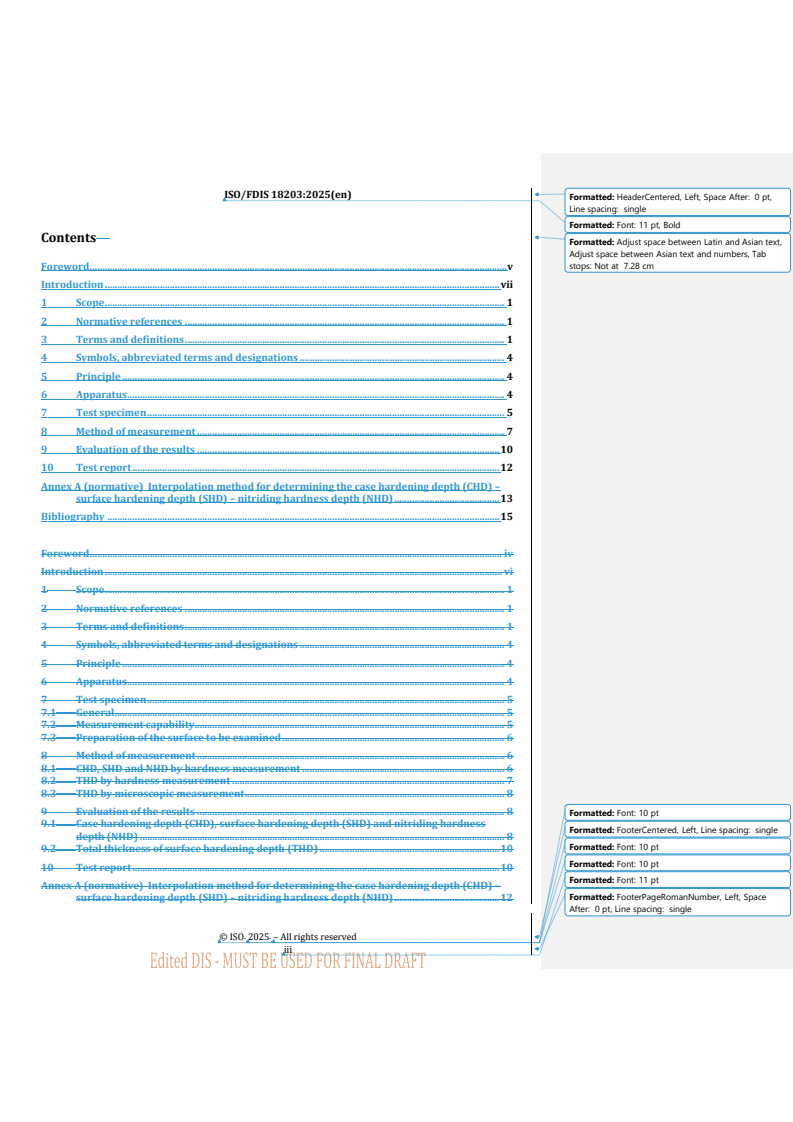
REDLINE ISO/FDIS 18203 - Steel — Determination of the thickness of surface-hardened layers Released:10/2/2025
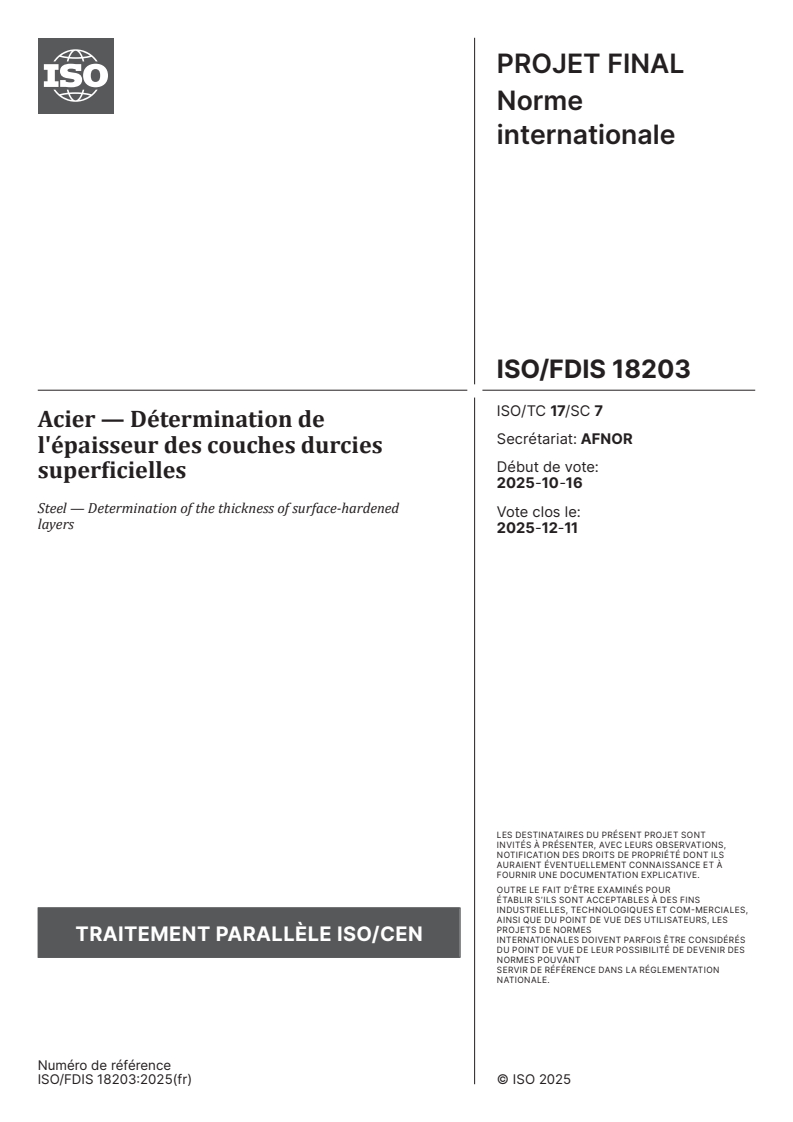

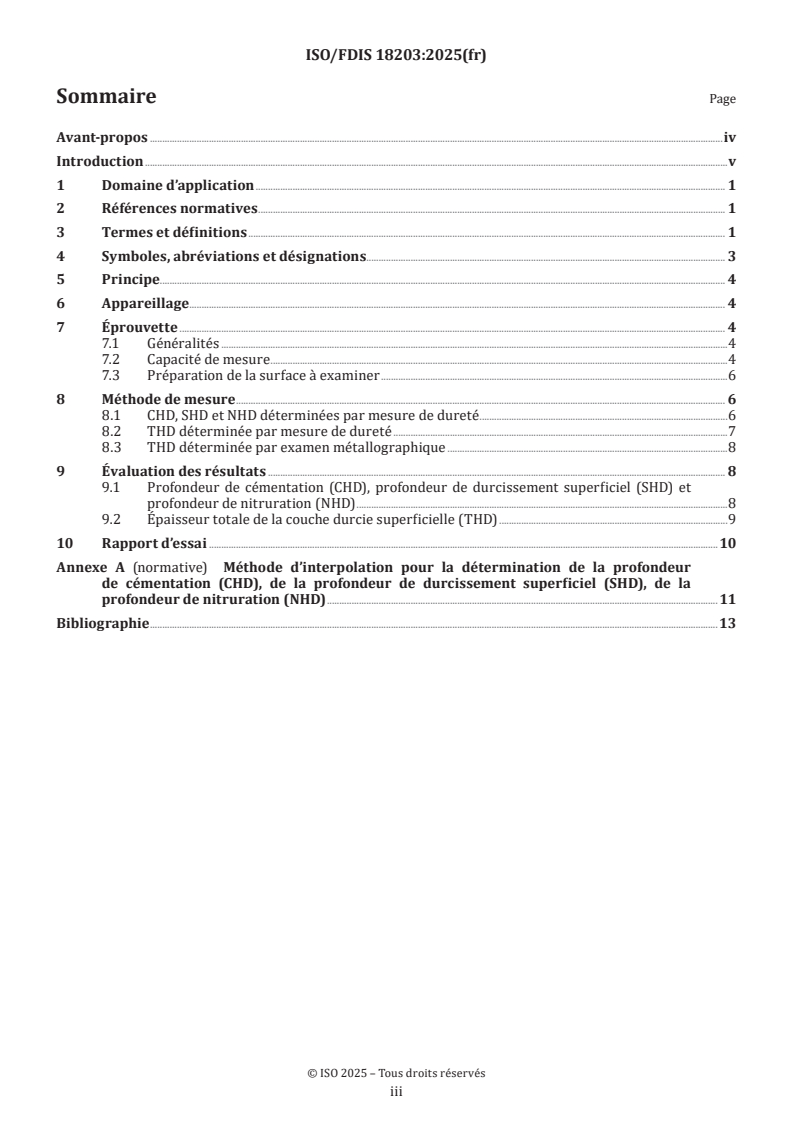
ISO/FDIS 18203 - Acier — Détermination de l'épaisseur des couches durcies superficielles Released:10/15/2025
Frequently Asked Questions
ISO 18203 is a draft published by the International Organization for Standardization (ISO). Its full title is "Steel - Determination of the thickness of surface-hardened layers". This standard covers: ISO 18203:2016 specifies a method of measuring the case hardening depth, surface hardening depth, nitriding hardness depth and total thickness of surface hardening depth obtained, e.g. thermal (flame and induction hardening, electron beam hardening, laser beam hardening, etc.) or thermochemical (carbonitriding, carburizing and hardening, hardening and nitriding, etc.) treatment.
ISO 18203:2016 specifies a method of measuring the case hardening depth, surface hardening depth, nitriding hardness depth and total thickness of surface hardening depth obtained, e.g. thermal (flame and induction hardening, electron beam hardening, laser beam hardening, etc.) or thermochemical (carbonitriding, carburizing and hardening, hardening and nitriding, etc.) treatment.
ISO 18203 is classified under the following ICS (International Classification for Standards) categories: 77.040.99 - Other methods of testing of metals. The ICS classification helps identify the subject area and facilitates finding related standards.
ISO 18203 has the following relationships with other standards: It is inter standard links to ISO 18203:2016. Understanding these relationships helps ensure you are using the most current and applicable version of the standard.
ISO 18203 is available in PDF format for immediate download after purchase. The document can be added to your cart and obtained through the secure checkout process. Digital delivery ensures instant access to the complete standard document.
Standards Content (Sample)
FINAL DRAFT
International
Standard
ISO/FDIS 18203
ISO/TC 17/SC 7
Steel — Determination of the
Secretariat: AFNOR
thickness of surface-hardened
Voting begins on:
layers
2025-10-16
Acier — Détermination de l'épaisseur des couches durcies
Voting terminates on:
superficielles
2025-12-11
RECIPIENTS OF THIS DRAFT ARE INVITED TO SUBMIT,
WITH THEIR COMMENTS, NOTIFICATION OF ANY
RELEVANT PATENT RIGHTS OF WHICH THEY ARE AWARE
AND TO PROVIDE SUPPOR TING DOCUMENTATION.
IN ADDITION TO THEIR EVALUATION AS
BEING ACCEPTABLE FOR INDUSTRIAL, TECHNO
ISO/CEN PARALLEL PROCESSING LOGICAL, COMMERCIAL AND USER PURPOSES, DRAFT
INTERNATIONAL STANDARDS MAY ON OCCASION HAVE
TO BE CONSIDERED IN THE LIGHT OF THEIR POTENTIAL
TO BECOME STAN DARDS TO WHICH REFERENCE MAY BE
MADE IN NATIONAL REGULATIONS.
Reference number
ISO/FDIS 18203:2025(en) © ISO 2025
FINAL DRAFT
ISO/FDIS 18203:2025(en)
International
Standard
ISO/FDIS 18203
ISO/TC 17/SC 7
Steel — Determination of the
Secretariat: AFNOR
thickness of surface-hardened layers
Voting begins on:
Acier — Détermination de l'épaisseur des couches durcies
superficielles
Voting terminates on:
RECIPIENTS OF THIS DRAFT ARE INVITED TO SUBMIT,
WITH THEIR COMMENTS, NOTIFICATION OF ANY
RELEVANT PATENT RIGHTS OF WHICH THEY ARE AWARE
AND TO PROVIDE SUPPOR TING DOCUMENTATION.
© ISO 2025
IN ADDITION TO THEIR EVALUATION AS
All rights reserved. Unless otherwise specified, or required in the context of its implementation, no part of this publication may
BEING ACCEPTABLE FOR INDUSTRIAL, TECHNO
ISO/CEN PARALLEL PROCESSING
LOGICAL, COMMERCIAL AND USER PURPOSES, DRAFT
be reproduced or utilized otherwise in any form or by any means, electronic or mechanical, including photocopying, or posting on
INTERNATIONAL STANDARDS MAY ON OCCASION HAVE
the internet or an intranet, without prior written permission. Permission can be requested from either ISO at the address below
TO BE CONSIDERED IN THE LIGHT OF THEIR POTENTIAL
or ISO’s member body in the country of the requester.
TO BECOME STAN DARDS TO WHICH REFERENCE MAY BE
MADE IN NATIONAL REGULATIONS.
ISO copyright office
CP 401 • Ch. de Blandonnet 8
CH-1214 Vernier, Geneva
Phone: +41 22 749 01 11
Email: copyright@iso.org
Website: www.iso.org
Published in Switzerland Reference number
ISO/FDIS 18203:2025(en) © ISO 2025
ii
ISO/FDIS 18203:2025(en)
Contents Page
Foreword .iv
Introduction .v
1 Scope . 1
2 Normative references . 1
3 Terms and definitions . 1
4 Symbols, abbreviated terms and designations . 3
5 Principle . 4
6 Apparatus . 4
7 Test specimen . 4
7.1 General .4
7.2 Measurement capability . .4
7.3 Preparation of the surface to be examined .5
8 Method of measurement . 6
8.1 CHD, SHD and NHD by hardness measurement .6
8.2 THD by hardness measurement .6
8.3 THD by microscopic measurement .7
9 Evaluation of the results . 7
9.1 Case hardening depth (CHD), surface hardening depth (SHD) and nitriding hardness
depth (NHD) .7
9.2 Total thickness of surface hardening depth (THD) .9
10 Test report . 9
Annex A (normative) Interpolation method for determining the case hardening depth (CHD) –
surface hardening depth (SHD) – nitriding hardness depth (NHD) .11
Bibliography .13
iii
ISO/FDIS 18203:2025(en)
Foreword
ISO (the International Organization for Standardization) is a worldwide federation of national standards
bodies (ISO member bodies). The work of preparing International Standards is normally carried out through
ISO technical committees. Each member body interested in a subject for which a technical committee
has been established has the right to be represented on that committee. International organizations,
governmental and non-governmental, in liaison with ISO, also take part in the work. ISO collaborates closely
with the International Electrotechnical Commission (IEC) on all matters of electrotechnical standardization.
The procedures used to develop this document and those intended for its further maintenance are described
in the ISO/IEC Directives, Part 1. In particular, the different approval criteria needed for the different types
of ISO documents should be noted. This document was drafted in accordance with the editorial rules of the
ISO/IEC Directives, Part 2 (see www.iso.org/directives).
ISO draws attention to the possibility that the implementation of this document may involve the use of (a)
patent(s). ISO takes no position concerning the evidence, validity or applicability of any claimed patent
rights in respect thereof. As of the date of publication of this document, ISO had not received notice of (a)
patent(s) which may be required to implement this document. However, implementers are cautioned that
this may not represent the latest information, which may be obtained from the patent database available at
www.iso.org/patents. ISO shall not be held responsible for identifying any or all such patent rights.
Any trade name used in this document is information given for the convenience of users and does not
constitute an endorsement.
For an explanation of the voluntary nature of standards, the meaning of ISO specific terms and expressions
related to conformity assessment, as well as information about ISO's adherence to the World Trade
Organization (WTO) principles in the Technical Barriers to Trade (TBT), see www.iso.org/iso/foreword.html.
This document was prepared by Technical Committee ISO/TC 17, Steel, Subcommittee SC 7, Methods of
testing (other than mechanical tests and chemical analysis), in collaboration with the European Committee
for Standardization (CEN) Technical Committee CEN/TC 459/SC 1, Test methods for steel (other than chemical
analysis), in accordance with the Agreement on technical cooperation between ISO and CEN (Vienna
Agreement).
This second edition cancels and replaces the first edition (ISO 18203:2016), which has been technically
revised.
The main changes are as follows:
— removal of the reference to shot peening;
— removal of the compound layer thickness (CLT);
— introduction of standard test loads for the determination of hardness depths, and the procedure for
measurements in the event of arbitration;
— extension of Table 1 by Rockwell test methods;
— extension of Table 2 by further abbreviations;
— precise definition of how the core hardness shall be tested;
— determination of the edge distance of the first hardness impression from the edge;
— explanation of how to determine the total thickness of surface hardening depth THD.
Any feedback or questions on this document should be directed to the user’s national standards body. A
complete listing of these bodies can be found at www.iso.org/members.html.
iv
ISO/FDIS 18203:2025(en)
Introduction
There are several ways of creating a surface-hardened layer in steel, but the measurement of its thickness
follows the same principle, regardless of the chemical composition or heat treatment of the sample. This
document presents the basic principle of determining the thickness of surface-hardened layers as well as the
differences particular to the different methods of creating the surface-hardened layer.
No method of estimating uncertainty is presented in this document. As real applications of this procedure
accrue, the need may arise to address this topic in future revisions.
v
FINAL DRAFT International Standard ISO/FDIS 18203:2025(en)
Steel — Determination of the thickness of surface-
hardened layers
1 Scope
This document specifies a method of measuring the case hardening depth, surface hardening depth,
nitriding hardness depth and total thickness of surface hardening depth obtained using, e.g. thermal
(flame and induction hardening, electron beam hardening, laser beam hardening, etc.) or thermochemical
(carbonitriding, carburizing and hardening, hardening and nitriding, etc.) treatment.
2 Normative references
The following documents are referred to in the text in such a way that some or all of their content constitutes
requirements of this document. For dated references, only the edition cited applies. For undated references,
the latest edition of the referenced document (including any amendments) applies.
ISO 4545-2, Metallic materials — Knoop hardness test — Part 2: Verification and calibration of testing machines
ISO 6507-1, Metallic materials — Vickers hardness test — Part 1: Test method
ISO 6507-2, Metallic materials — Vickers hardness test — Part 2: Verification and calibration of testing machines
3 Terms and definitions
For the purposes of this document, the following terms and definitions apply.
ISO and IEC maintain terminology databases for use in standardization at the following addresses:
— ISO Online browsing platform: available at https:// www .iso .org/ obp
— IEC Electropedia: available at https:// www .electropedia .org/
3.1
case hardening depth
CHD
perpendicular distance between the surface and the layer having a hardness of 550 HV or equivalent Knoop
hardness of 550 HK
Note 1 to entry: For steels which present a hardness higher than 450 HV at a distance three times of the case hardening
depth (determined with a limiting hardness value of 550 HV in accordance with ISO 6507-1 or equivalent Knoop
hardness of 550 HK in accordance with ISO 4545-1) from the surface, a limiting hardness value higher than 550 HV, in
steps of 25 units, can be selected for the determination of the case hardening depth by agreement between interested
parties.
Note 2 to entry: To measure the core hardness, five individual hardness measurements should be made, and the
average value of these measurements should be taken. To determine the depth for the core hardness measurement,
use three times the upper value of the case depth tolerance.
+04,
EXAMPLE CHD 10, = depth for core hardness 4,2 mm. If this is not geometrically possible (e.g. in case the
−0
workpiece is too thin), separate agreements can be made to specify the core hardness check position. The core hardness
is only determined once for several hardness curves and is taken for all hardness curves measured on the sample.
Note 3 to entry: In general, case hardening consists of carburizing or carbonitriding followed by quench hardening
(see ISO 4885).
ISO/FDIS 18203:2025(en)
Note 4 to entry: A distinction shall be made between the case hardening hardness depth CHD in the case-hardened
condition only and the CHD in the case-hardened and tempered condition. This shall be noted in the report. If the
surface hardness after tempering is so tolerated that the rule of the distance of 100 HV between core hardness and
limit hardness cannot be complied, separate agreements shall be made for this.
3.2
surface hardening depth
SHD
distance between the surface and the layer where HV is equal to the value specified by the term “hardness limit”
Note 1 to entry: Recommended hardness limit values are listed in Table 1.
Table 1 — Recommended hardness limit values of SHD
Minimum surface hardness in HV, HRC, HRA or HRN
Hardness limit
HV
HV HRC HRA HR15N HR30N HR45N
250 300 to 330 30 to 33 65 to 67 75, 76 51 to 53 32 to 35
275 335 to 355 34 to 36 68 77, 78 54, 55 36 to 38
300 360 to 385 37 to 39 69, 70 79 56 to 58 39 to 41
325 390 to 420 40 to 42 71 80, 81 58 to 62 42 to 46
350 425 to 455 43 to 45 72, 73 82, 83 63, 64 47 to 49
375 460 to 480 46, 47 74 84 65, 66 50 to 52
400 485 to 515 48 to 50 75 85 67, 68 53, 54
425 520 to 545 51, 52 76 86 69, 70 55 to 57
450 550 to 575 53 77 87 71 59, 59
475 580 to 605 54, 55 78 89 72, 73 60, 61
500 610 to 635 56, 57 79 - 74 62, 63
525 640 to 665 58 80 90 75, 76 64, 65
550 670 to 705 59, 60 81 - 77 66, 67
575 710 to 730 61 82 91 78 68
600 735 to 765 62 - - 79 69
625 770 to 795 63 83 92 80 70
650 800 to 835 64, 65 - - 81 71, 72
675 840 to 865 66 84 - 82 73
This table shall not be used as a table of comparison of hardness values.
In ISO 15787 it is noted that Vickers hardness values are ending with 5 or 0, and Rockwell values with a full number. See
ISO 15787:2016, Figures2 to39.
Note 2 to entry: Hardness limit is a function of the minimum surface hardness required for the part, given by the
following Formula (1):
HL = A × H (1)
msh
where
HL is the hardness limit;
A is a coefficient (usually 0,8);
H is the minimum surface hardness (lowest value of the tolerance).
msh
If the required minimum surface hardness is not specified, the parties involved shall agree on the limit hardness to be used.
Note 3 to entry: 0,80 is usually used for A. Other values can be applied.
Note 4 to entry: SHD measurement should be applied for parts which, in the surface hardened condition, have a
hardness less than (hardness limit – 100 HV) at a distance 3 × minimum SHD tolerance from the surface. Where these
conditions are not satisfied, the definition of SHD should be agreed between interested parties.
ISO/FDIS 18203:2025(en)
Note 5 to entry: To measure the core hardness, five individual hardness measurements should be made, and the
average value of these measurements should be taken. To determine the depth for the core hardness measurement,
+10,
use the triple value of the upper hardness surface depth tolerance, e.g. SHD 20, = depth for core hardness
−0
measurement 9,0 mm. If this is geometrically not possible (e.g. in case the workpiece is too thin), separate agreements
should be made to specify the core hardness check position. The core hardness is only determined once for several
hardness curves and is taken for all hardness curves measured on the sample.
3.3
nitriding hardness depth
NHD
distance from the surface of nitride layer to the point where the material hardness limit is 50 HV above core
hardness
Note 1 to entry: To determine the depth for the core hardness measurement, use the triple value of the upper hardness
+03,
nitriding depth tolerance. E.g. NHD 05, = depth for core hardness measurement 2,4 mm. If this is geometrically
−0
not possible (e.g. in case the workpiece is too thin), separate agreements should be made to specify the core hardness
check position.
Note 2 to entry: To measure the core hardness, five individual hardness measurements should be made, and the
average value of these measurements should be taken and rounded to the nearest multiple of 10 HV. The core hardness
is only determined once for several hardness curves and is taken
...
Style Definition
ISO/FDIS 18203:2025(en) .
Formatted: zzCover large
ISO/TC 17/SC 7
Formatted: Left: 1.5 cm, Right: 1.5 cm, Bottom: 1 cm,
Section start: New page, Header distance from edge:
Secretariat: AFNOR
1.27 cm, Footer distance from edge: 1.27 cm
Date: 2025-09 Formatted
...
Formatted: Cover Title_A1
Steel — Determination of the thickness of surface-hardened layers
Acier — Détermination de l'épaisseur des couches durcies superficielles
Formatted
...
FDIS stage
ISO #####-#:####(X/FDIS 18203:2025(en)
Formatted: Font: 11 pt, Bold
Formatted: Font: 11 pt, Bold
Formatted: HeaderCentered, Left, Space After: 0 pt,
Line spacing: single
Formatted: Default Paragraph Font
All rights reserved. Unless otherwise specified, or required in the context of its implementation, no part of this publication
may be reproduced or utilized otherwise in any form or by any means, electronic or mechanical, including photocopying, Formatted: Indent: Left: 0 cm, Right: 0 cm, Space
or posting on the internet or an intranet, without prior written permission. Permission can be requested from either ISO Before: 0 pt, No page break before, Adjust space
at the address below or ISO’s member body in the country of the requester. between Latin and Asian text, Adjust space between
Asian text and numbers
ISO copyright office
Formatted: Default Paragraph Font
CP 401 • Ch. de Blandonnet 8
CH-1214 Vernier, Geneva
Phone: + 41 22 749 01 11
Formatted: French (Switzerland)
EmailE-mail: copyright@iso.org
Formatted: French (Switzerland)
Website: www.iso.orgwww.iso.org
Formatted: French (Switzerland)
Published in Switzerland
Formatted: French (Switzerland)
Formatted: English (United Kingdom)
Formatted: Font: 10 pt
Formatted: Font: 10 pt
Formatted: FooterPageRomanNumber, Space After: 0
pt, Line spacing: single
Formatted: Font: 11 pt
ii © ISO #### 2025 – All rights reserved
ii
ISO/FDIS 18203:2025(en)
Formatted: HeaderCentered, Left, Space After: 0 pt,
Line spacing: single
Formatted: Font: 11 pt, Bold
Contents
Formatted: Adjust space between Latin and Asian text,
Adjust space between Asian text and numbers, Tab
stops: Not at 7.28 cm
Foreword . v
Introduction . vii
1 Scope . 1
2 Normative references . 1
3 Terms and definitions . 1
4 Symbols, abbreviated terms and designations . 4
5 Principle . 4
6 Apparatus . 4
7 Test specimen . 5
8 Method of measurement . 7
9 Evaluation of the results . 10
10 Test report . 12
Annex A (normative) Interpolation method for determining the case hardening depth (CHD) –
surface hardening depth (SHD) – nitriding hardness depth (NHD) . 13
Bibliography . 15
Foreword . iv
Introduction . vi
1 Scope . 1
2 Normative references . 1
3 Terms and definitions . 1
4 Symbols, abbreviated terms and designations . 4
5 Principle . 4
6 Apparatus . 4
7 Test specimen . 5
7.1 General . 5
7.2 Measurement capability . 5
7.3 Preparation of the surface to be examined . 6
8 Method of measurement . 6
8.1 CHD, SHD and NHD by hardness measurement . 6
8.2 THD by hardness measurement . 7
8.3 THD by microscopic measurement . 8
9 Evaluation of the results . 8
Formatted: Font: 10 pt
9.1 Case hardening depth (CHD), surface hardening depth (SHD) and nitriding hardness
Formatted: FooterCentered, Left, Line spacing: single
depth (NHD) . 8
Formatted: Font: 10 pt
9.2 Total thickness of surface hardening depth (THD) . 10
Formatted: Font: 10 pt
10 Test report . 10
Formatted: Font: 11 pt
Annex A (normative) Interpolation method for determining the case hardening depth (CHD) –
Formatted: FooterPageRomanNumber, Left, Space
surface hardening depth (SHD) – nitriding hardness depth (NHD) . 12
After: 0 pt, Line spacing: single
© ISO 2025 – All rights reserved
iii
ISO #####-#:####(X/FDIS 18203:2025(en)
Formatted: Font: 11 pt, Bold
Formatted: HeaderCentered, Left, Space After: 0 pt,
Line spacing: single
Bibliography . 14
Formatted: Font: 11 pt, Bold
Formatted: Font: 10 pt
Formatted: Font: 10 pt
Formatted: FooterPageRomanNumber, Space After: 0
pt, Line spacing: single
Formatted: Font: 11 pt
iv © ISO #### 2025 – All rights reserved
iv
ISO/FDIS 18203:2025(en)
Formatted: Font: 11 pt, Bold
Formatted: HeaderCentered, Left, Space After: 0 pt,
Line spacing: single
Foreword
Formatted: Adjust space between Latin and Asian text,
Adjust space between Asian text and numbers
ISO (the International Organization for Standardization) is a worldwide federation of national standards
bodies (ISO member bodies). The work of preparing International Standards is normally carried out through
ISO technical committees. Each member body interested in a subject for which a technical committee has been
established has the right to be represented on that committee. International organizations, governmental and
non-governmental, in liaison with ISO, also take part in the work. ISO collaborates closely with the
International Electrotechnical Commission (IEC) on all matters of electrotechnical standardization.
The procedures used to develop this document and those intended for its further maintenance are described
in the ISO/IEC Directives, Part 1. In particular, the different approval criteria needed for the different types of
ISO documents should be noted. This document was drafted in accordance with the editorial rules of the
ISO/IEC Directives, Part 2 (see www.iso.org/directives).
Formatted: English (United Kingdom)
Field Code Changed
ISO draws attention to the possibility that the implementation of this document may involve the use of (a)
patent(s). ISO takes no position concerning the evidence, validity or applicability of any claimed patent rights
in respect thereof. As of the date of publication of this document, ISO had not received notice of (a) patent(s)
which may be required to implement this document. However, implementers are cautioned that this may not
represent the latest information, which may be obtained from the patent database available at
www.iso.org/patents.www.iso.org/patents. ISO shall not be held responsible for identifying any or all such
patent rights.
Any trade name used in this document is information given for the convenience of users and does not
constitute an endorsement.
For an explanation of the voluntary nature of standards, the meaning of ISO specific terms and expressions
related to conformity assessment, as well as information about ISO's adherence to the World Trade
Organization (WTO) principles in the Technical Barriers to Trade (TBT), see www.iso.org/iso/foreword.html.
Field Code Changed
Formatted: English (United Kingdom)
This document was prepared by Technical Committee ISO/TC 17, Steel, Subcommittee SC 7, Methods of testing
(other than mechanical tests and chemical analysis), in collaboration with the European Committee for
Formatted: Font: Not Italic
Standardization (CEN) Technical Committee CEN/TC 459/SC 1, Test methods for steel (other than chemical
analysis), in accordance with the Agreement on technical cooperation between ISO and CEN (Vienna
Formatted: Font: Not Italic
Agreement).
This second edition cancels and replaces the first edition (ISO 18203:2016), which has been technically
Formatted: Default Paragraph Font
revised.
Formatted: Default Paragraph Font
Formatted: Default Paragraph Font
The main changes are as follows:
— — removal of the reference to shot peening;
Formatted: Adjust space between Latin and Asian text,
Adjust space between Asian text and numbers, Tab
— — removal of the compound layer thickness (CLT);
stops: Not at 0.7 cm + 1.4 cm + 2.1 cm + 2.8 cm +
3.5 cm + 4.2 cm + 4.9 cm + 5.6 cm + 6.3 cm + 7 cm
— — introduction of standard test loads for the determination of hardness depths, and the procedure for
measurements in the event of arbitration;
Formatted: Font: 10 pt
— — extension of Table 1Table 1 by Rockwell test methods;
Formatted: FooterCentered, Left, Line spacing: single
— — extension of Table 2Table 2 by further abbreviations;
Formatted: Font: 10 pt
— — precise definition of how the core hardness shall be tested; Formatted: Font: 10 pt
Formatted: Font: 11 pt
— — determination of the edge distance of the first hardness impression from the edge;
Formatted: FooterPageRomanNumber, Left, Space
After: 0 pt, Line spacing: single
© ISO 2025 – All rights reserved
v
ISO #####-#:####(X/FDIS 18203:2025(en)
Formatted: Font: 11 pt, Bold
Formatted: Font: 11 pt, Bold
Formatted: HeaderCentered, Left, Space After: 0 pt,
— — explanation of how to determine the total thickness of surface hardening depth THD.
Line spacing: single
Any feedback or questions on this document should be directed to the user’s national standards body. A
Formatted: Adjust space between Latin and Asian text,
complete listing of these bodies can be found at www.iso.org/members.htmlwww.iso.org/members.html.
Adjust space between Asian text and numbers
Formatted: Font: 10 pt
Formatted: Font: 10 pt
Formatted: FooterPageRomanNumber, Space After: 0
pt, Line spacing: single
Formatted: Font: 11 pt
vi © ISO #### 2025 – All rights reserved
vi
ISO/FDIS 18203:2025(en)
Formatted: HeaderCentered, Left, Space After: 0 pt,
Line spacing: single
Formatted: Font: 11 pt, Bold
Introduction
There are several ways of creating a surface-hardened layer in steel, but the measurement of its thickness
follows the same principle, regardless of the chemical composition or heat treatment of the sample. This
document presents the basic principle of determining the thickness of surface-hardened layers as well as the
differences particular to the different methods of creating the surface-hardened layer.
No method of estimating uncertainty is presented in this document. As real applications of this procedure
accrue, the need may arise to address this topic in future revisions.
Formatted: Font: 10 pt
Formatted: FooterCentered, Left, Line spacing: single
Formatted: Font: 10 pt
Formatted: Font: 10 pt
Formatted: Font: 11 pt
Formatted: FooterPageRomanNumber, Left, Space
After: 0 pt, Line spacing: single
© ISO 2025 – All rights reserved
vii
Final Draft International Standard ISO/FDIS 18203:2025(en)
Formatted: Main Title 1, Space After: 0 pt, Adjust
Steel — Determination of the thickness of surface-hardened layers
space between Latin and Asian text, Adjust space
between Asian text and numbers
1 Scope
Formatted: Adjust space between Latin and Asian text,
Adjust space between Asian text and numbers
This document specifies a method of measuring the case hardening depth, surface hardening depth, nitriding
hardness depth and total thickness of surface hardening depth obtained using, e.g. thermal (flame and
induction hardening, electron beam hardening, laser beam hardening, etc.) or thermochemical
(carbonitriding, carburizing and hardening, hardening and nitriding, etc.) treatment.
2 Normative references
The following documents are referred to in the text in such a way that some or all of their content constitutes
requirements of this document. For dated references, only the edition cited applies. For undated references,
the latest edition of the referenced document (including any amendments) applies.
Formatted: Default Paragraph Font
Formatted: Default Paragraph Font
ISO 4545--2, Metallic materials — Knoop hardness test — Part 2: Verification and calibration of testing
machines
Formatted: Default Paragraph Font
Formatted: Default Paragraph Font, Font: Italic
ISO 6507--1, Metallic materials — Vickers hardness test — Part 1: Test method
Formatted: Adjust space between Latin and Asian text,
Adjust space between Asian text and numbers, Tab
ISO 6507--2, Metallic materials — Vickers hardness test — Part 2: Verification and calibration of testing
stops: Not at 0.7 cm + 1.4 cm + 2.1 cm + 2.8 cm +
machines
3.5 cm + 4.2 cm + 4.9 cm + 5.6 cm + 6.3 cm + 7 cm
3 Terms and definitions Formatted: Default Paragraph Font
Formatted: Default Paragraph Font
For the purposes of this document, the following terms and definitions apply.
Formatted: Default Paragraph Font
ISO and IEC maintain terminology databases for use in standardization at the following addresses:
Formatted: Default Paragraph Font, Font: Italic
Formatted: Default Paragraph Font
— — ISO Online browsing platform: available at https://www.iso.org/obphttps://www.iso.org/obp
Formatted: Default Paragraph Font
— — IEC Electropedia: available at https://www.electropedia.org/https://www.electropedia.org/
Formatted: Default Paragraph Font
Formatted: Default Paragraph Font, Font: Italic
3.1 3.1
case hardening depth
Formatted: Adjust space between Latin and Asian text,
CHD
Adjust space between Asian text and numbers
perpendicular distance between the surface and the layer having a hardness of 550 HV or equivalent Knoop
Formatted: Adjust space between Latin and Asian text,
hardness of 550 HK
Adjust space between Asian text and numbers, Tab
stops: Not at 0.7 cm + 1.4 cm + 2.1 cm + 2.8 cm +
Note 1 to entry: For steels which present a hardness higher than 450 HV at a distance three times of the case hardening
3.5 cm + 4.2 cm + 4.9 cm + 5.6 cm + 6.3 cm + 7 cm
depth (determined with a limiting hardness value of 550 HV in accordance with ISO 6507-1 or equivalent Knoop
Formatted: TermNum2, Adjust space between Latin
hardness of 550 HK in accordance with ISO 4545-1) from the surface, a limiting hardness value higher than 550 HV, in
and Asian text, Adjust space between Asian text and
steps of 25 units, can be selected for the determination of the case hardening depth by agreement between interested
numbers
parties.
Formatted: Adjust space between Latin and Asian text,
Note 2 to entry: To measure the core hardness, five individual hardness measurements should be made, and the average
Adjust space between Asian text and numbers, Tab
value of these measurements should be taken. To determine the depth for the core hardness measurement, use three
stops: Not at 0.7 cm + 1.4 cm + 2.1 cm + 2.8 cm +
times the upper value of the case depth tolerance.
3.5 cm + 4.2 cm + 4.9 cm + 5.6 cm + 6.3 cm + 7 cm
Formatted: Left, Space After: 0 pt, Line spacing: single
Formatted: Font: 11 pt
ISO/FDIS 18203:2025(en)
Formatted: Font: Bold
Formatted: HeaderCentered
0,4 +0,4
1,0
EXAMPLE CHD 1,0 = depth for core hardness 4,2 mm. If this is not geometrically possible (e.g. in case
−0
0
the workpiece is too thin), separate agreements can be made to specify the core hardness check position. The core
hardness is only determined once for several hardness curves and is taken for all hardness curves measured on the
sample. Formatted: Default Paragraph Font
Formatted: Default Paragraph Font
Note 3 to entry: In general, case hardening consists of carburizing or carbonitriding followed by quench hardening (see
ISO 4885). Formatted: TermNum2, Adjust space between Latin
and Asian text, Adjust space between Asian text and
Note 4 to entry: A distinction shall be made between the case hardening hardness depth CHD in the case-hardened numbers
condition only and the CHD in the case-hardened and tempered condition. This shall be noted in the report. If the surface
Formatted
...
hardness after tempering is so tolerated that the rule of the distance of 100 HV between core hardness and limit hardness
cannot be complied, separate agreements shall be made for this. Formatted: English (United Kingdom)
Formatted
...
3.2 3.2
Formatted Table
surface hardening depth
SHD Formatted: English (United Kingdom)
distance between the surface and the layer where HV is equal to the value specified by the term “hardness
Formatted
...
limit”
Formatted
...
Note 1 to entry: Recommended hardness limit values are listed in Table 1.Table 1.
Formatted
...
Formatted
...
Table 1 — Recommended hardness limit values of SHD
Formatted
...
Minimum surface hardness in HV, HRC, HRA or HRN
Hardness limit
Formatted
...
HV
HV HRC HRA HR15N HR30N HR45N
Formatted
...
250 300 to 330 30 to 33 65 to 67 75, 76 51 to 53 32 to 35
Formatted
...
275 335 to 355 34 to 36 68 77, 78 54, 55 36 to 38
Formatted
...
300 360 to 385 37 to 39 69, 70 79 56 to 58 39 to 41
Formatted
...
325 390 to 420 40 to 42 71 80, 81 58 to 62 42 to 46
Formatted
...
350 425 to 455 43 to 45 72, 73 82, 83 63, 64 47 to 49
Formatted
...
375 460 to 480 46, 47 74 84 65, 66 50 to 52
Formatted
...
400 485 to 515 48 to 50 75 85 67, 68 53, 54
Formatted
...
425 520 to 545 51, 52 76 86 69, 70 55 to 57 Formatted
...
Formatted
450 550 to 575 53 77 87 71 59, 59
...
Formatted
475 580 to 605 54, 55 78 89 72, 73 60, 61
...
Formatted
500 610 to 635 56, 57 79 - 74 62, 63 .
Formatted
...
525 640 to 665 58 80 90 75, 76 64, 65
Formatted
...
550 670 to 705 59, 60 81 - 77 66, 67
Formatted: Default Paragraph Font
575 710 to 730 61 82 91 78 68
Formatted: Default Paragraph Font
600 735 to 765 62 - - 79 69
Formatted: Default Paragraph Font
625 770 to 795 63 83 92 80 70
Formatted: Default Paragraph Font
650 800 to 835 64, 65 - - 81 71, 72
Formatted: Font: 9 pt
675 840 to 865 66 84 - 82 73
Formatted: Font: 10 pt
This table shall not be used as a table of comparison of hardness values.
Formatted: Font: 10 pt
In ISO 15787 it is noted that Vickers hardness values are ending with 5 or 0, and Rockwell values with a full number. See Figures 2
to 39 in ISO 15787:20012016, Figures2 to39.
Formatted
...
Formatted: Font: 11 pt
2 © ISO #### 2025 – All rights reserved
ISO/FDIS 18203:2025(en)
Formatted: HeaderCentered, Left, Space After: 0 pt,
Line spacing: single
Formatted: Font: 11 pt, Bold
Note 1 2 to entry: Hardness limit is a function of the minimum surface hardness required for the part, given by the
Formatted: Space Before: 6 pt, Adjust space between
following Formula (1):0:
Latin and Asian text, Adjust space between Asian text
and numbers, Tab stops: Not at 0.7 cm + 1.4 cm + 2.1
HL = A × H (1)
msh
cm + 2.8 cm + 3.5 cm + 4.2 cm + 4.9 cm + 5.6 cm +
6.3 cm + 7 cm
where
Formatted: label
HL is the hardness limit;
A is a coefficient (usually 0,8);
H is the minimum surface hardness (lowest value of the tolerance).
msh
HL is the hardness limit;
A is a coefficient (usually 0,8);
H is the minimum surface hardness (lowest value of the tolerance).
msh
If the required minimum surface hardness is not specified, the parties involved shall agree on the limit hardness to be
Formatted: Note
used.
Note 2 3 to entry: 0,80 is usually used for A. Other values can be applied.
Formatted: Adjust space between Latin and Asian text,
Adjust space between Asian text and numbers, Tab
Note 3 4 to entry: SHD measurement should be applied for parts which, in the surface hardened condition, have a
stops: Not at 0.7 cm + 1.4 cm + 2.1 cm + 2.8 cm +
hardness less than (hardness limit – 100 HV) at a distance 3 × minimum SHD tolerance from the surface. Where these
3.5 cm + 4.2 cm + 4.9 cm + 5.6 cm + 6.3 cm + 7 cm
conditions are not satisfied, the definition of SHD should be agreed between interested parties.
Note 4 5 to entry: To measure the core hardness, five individual hardness measurements should be made, and the
average value of these measurements should be taken. To determine the depth for the core hardness measurement, use
1,0
+1,0
the triple value of the upper hardness surface depth tolerance, e.g. SHD 2,0 2,0 = depth for core hardness
−0
0
measurement 9,0 mm. If this is geometrically not possible (e.g. in case the workpiece is too thin), separate agreements
should be made to specify the core hardness check position. The core hardness is only determined once for several
hardness curves and is taken for all hardness curves measured on the sample.
3.3 3.3
Formatted: TermNum2, Adjust space between Latin
nitriding hardness depth
and Asian text, Adjust space between Asian text and
NHD numbers
distance from the surface of nitride layer to the point where the material hardness limit is 50 HV above core
hardness
Formatted: Adjust space between Latin and Asian text,
Adjust space between Asian text and numbers, Tab
Note 1 to entry: To determine the depth for the core hardness measurement, use the triple value of the upper hardness
stops: Not at 0.7 cm + 1.4 cm + 2.1 cm + 2.8 cm +
0,3
+0,3
nitriding depth tolerance. E.g. NHD 0,5 0,5 = depth for core hardness measurement 2,4 mm. If this is
−0
0 3.5 cm + 4.2 cm + 4.9 cm + 5.6 cm + 6.3 cm + 7 cm
geometrically not possible (e.g. in case the workpiece is too thin), separate agreements should be made to specify the
Formatted: TermNum2, Adjust space between Latin
core hardness check position.
and Asian text, Adjust space between Asian text and
numbers
Note 2 to entry: To measure the core hardness, five individual hardness measurements should be made, and the average
Formatted: Adjust space between Latin and Asian text,
value of these measurements should be taken and rounded to the nearest multiple of 10 HV. The core hardness is only
Adjust space between Asian text and numbers, Tab
determined once for several hardness curves and is taken for all hardness curves measured on the sample.
stops: Not at 0.7 cm + 1.4 cm + 2.1 cm + 2.8 cm +
3.5 cm + 4.2 cm + 4.9 cm + 5.6 cm + 6.3 cm + 7 cm
3.4 3.4
total thickness of surface hardening depth
Formatted: Font: 10 pt
THD
Formatted: FooterCentered, Left, Line spacing: single
distance from the examined surface to the limit that shows the same hardness as the core hardness
Formatted: Font: 10 pt
Note 1 to entry: The distance is often measured by the microstructural method, which is the distance from the surface
Formatted: Font: 10 pt
examined to the limit beyond which no visible structure variation is detected, as compared with the structure of the
Formatted: Font: 11 pt
unaffected metal. The microstructural method does not measure as deep as the hardness method.
Formatted: FooterPageNumber, Left, Space After: 0 pt,
Line spacing: single
© ISO 2025 – All rights reserved
ISO/FDIS 18203:2025(en)
Formatted: Font: Bold
Formatted: HeaderCentered
Note 2 to entry: To measure the core hardness, five individual hardness measurements should be made, and the average
value of these measurements should be taken and rounded to the nearest multiple of 10 HV. The core hardness is only
determined once for several hardness curves and is taken for all hardness curves measured on the sample.
Formatted: Adjust space between Latin and Asian text,
4 Symbols, abbreviated terms and designations
Adjust space between Asian text and numbers
Formatted: None, Adjust space between Latin and
The symbols and abbreviated terms used in this document and their corresponding designations are given in
Asian text, Adjust space between Asian text and
Table 2.Table 2.
numbers
Table 2 — Symbols, abbreviations and designations
Formatted: Adjust space between Latin and Asian text,
Adjust space between Asian text and numbers
Symbol/
Unit Designation
Formatted Table
abbreviation
Formatted: Font: Not Bold
d mm distance of the centre of each impression from the surface
i
Formatted: Font: Not Bold
Δd mm distance of the centre of two adjacent impression
Formatted: Font: Not Bold
CH HV / HK core hardness
Formatted: Font: Not Bold
HD mm hardness depth
Formatted: Adjust space between Latin and Asian text,
ΔW mm distance between the measurement series
Adjust space between Asian text and numbers
W mm maximum range of 1,5 mm in which the measurement series may be set
Formatted: Adjust space between Latin and Asian text,
Adjust space between Asian text and numbers
CHD mm case hardening depth
Formatted: Adjust space between Latin and Asian text,
SHD mm surface hardening depth
Adjust space between Asian text and numbers
NHD mm nitriding hardness depth
Formatted: Adjust space between Latin and Asian text,
THD mm total thickness of surface hardening depth Adjust space between Asian text and numbers
Formatted
HL HV hardness limit
...
Formatted
...
5 Principle
Formatted: Font: Not Italic
Formatted
...
The case hardening depth, surface hardening depth and nitriding hardness depth shall be determined from
the gradient of hardness on a cross-section normal to the surface.
Formatted
...
Formatted
...
They shall be derived graphically from a curve representing the variation in hardness as a function of the
Formatted
distance from the surface of the part. .
Formatted
...
The total thickness of surface hardening depth shall be determined from the structure variation observed by
Formatted: Font: Not Italic
micrographic method or by measuring hardness variation.
Formatted
...
6 Apparatus
Formatted
...
Formatted: Default Paragraph Font
The hardness testing machine for determining Vickers hardness shall be verified and calibrated in accordance
with ISO 6507--2. Formatted: Default Paragraph Font
Formatted: Default Paragraph Font
The hardness testing machine for determining Knoop hardness shall be verified and calibrated in accordance
Formatted: Default Paragraph Font
with ISO 4545--2.
Formatted: Default Paragraph Font
For microscopic measurements, microscopes should be calibrated with an object micrometre.
Formatted: Default Paragraph Font
Formatted: Font: 10 pt
Formatted: Font: 10 pt
Formatted
...
Formatted: Font: 11 pt
4 © ISO #### 2025 – All rights reserved
ISO/FDIS 18203:2025(en)
Formatted: Font: 11 pt, Bold
Formatted: HeaderCentered, Left, Space After: 0 pt,
Line spacing: single
7 Test specimen
7.1 General
Formatted: Adjust space between Latin and Asian text,
Adjust space between Asian text and numbers, Tab
The hardness test to determin
...
PROJET FINAL
Norme
internationale
ISO/FDIS 18203
ISO/TC 17/SC 7
Acier — Détermination de
Secrétariat: AFNOR
l'épaisseur des couches durcies
Début de vote:
superficielles
2025-10-16
Steel — Determination of the thickness of surface-hardened
Vote clos le:
layers
2025-12-11
LES DESTINATAIRES DU PRÉSENT PROJET SONT
INVITÉS À PRÉSENTER, AVEC LEURS OBSERVATIONS,
NOTIFICATION DES DROITS DE PROPRIÉTÉ DONT ILS
AURAIENT ÉVENTUELLEMENT CONNAISSANCE ET À
FOURNIR UNE DOCUMENTATION EXPLICATIVE.
OUTRE LE FAIT D’ÊTRE EXAMINÉS POUR
ÉTABLIR S’ILS SONT ACCEPTABLES À DES FINS
INDUSTRIELLES, TECHNOLOGIQUES ET COM-MERCIALES,
AINSI QUE DU POINT DE VUE DES UTILISATEURS, LES
PROJETS DE NORMES
TRAITEMENT PARALLÈLE ISO/CEN
INTERNATIONALES DOIVENT PARFOIS ÊTRE CONSIDÉRÉS
DU POINT DE VUE DE LEUR POSSI BILITÉ DE DEVENIR DES
NORMES POUVANT
SERVIR DE RÉFÉRENCE DANS LA RÉGLEMENTATION
NATIONALE.
Numéro de référence
ISO/FDIS 18203:2025(fr) © ISO 2025
PROJET FINAL
ISO/FDIS 18203:2025(fr)
Norme
internationale
ISO/FDIS 18203
ISO/TC 17/SC 7
Acier — Détermination de
Secrétariat: AFNOR
l'épaisseur des couches durcies
Début de vote:
superficielles
2025-10-16
Steel — Determination of the thickness of surface-hardened
Vote clos le:
layers
2025-12-11
LES DESTINATAIRES DU PRÉSENT PROJET SONT
INVITÉS À PRÉSENTER, AVEC LEURS OBSERVATIONS,
NOTIFICATION DES DROITS DE PROPRIÉTÉ DONT ILS
AURAIENT ÉVENTUELLEMENT CONNAISSANCE ET À
FOURNIR UNE DOCUMENTATION EXPLICATIVE.
DOCUMENT PROTÉGÉ PAR COPYRIGHT
OUTRE LE FAIT D’ÊTRE EXAMINÉS POUR
ÉTABLIR S’ILS SONT ACCEPTABLES À DES FINS
© ISO 2025 INDUSTRIELLES, TECHNOLOGIQUES ET COM-MERCIALES,
AINSI QUE DU POINT DE VUE DES UTILISATEURS, LES
Tous droits réservés. Sauf prescription différente ou nécessité dans le contexte de sa mise en œuvre, aucune partie de cette
PROJETS DE NORMES
TRAITEMENT PARALLÈLE ISO/CEN
INTERNATIONALES DOIVENT PARFOIS ÊTRE CONSIDÉRÉS
publication ne peut être reproduite ni utilisée sous quelque forme que ce soit et par aucun procédé, électronique ou mécanique,
DU POINT DE VUE DE LEUR POSSI BILITÉ DE DEVENIR DES
y compris la photocopie, ou la diffusion sur l’internet ou sur un intranet, sans autorisation écrite préalable. Une autorisation peut
NORMES POUVANT
être demandée à l’ISO à l’adresse ci-après ou au comité membre de l’ISO dans le pays du demandeur.
SERVIR DE RÉFÉRENCE DANS LA RÉGLEMENTATION
NATIONALE.
ISO copyright office
Case postale 401 • Ch. de Blandonnet 8
CH-1214 Vernier, Genève
Tél.: +41 22 749 01 11
E-mail: copyright@iso.org
Web: www.iso.org
Publié en Suisse Numéro de référence
ISO/FDIS 18203:2025(fr) © ISO 2025
ii
ISO/FDIS 18203:2025(fr)
Sommaire Page
Avant-propos .iv
Introduction .v
1 Domaine d’application . 1
2 Références normatives . 1
3 Termes et définitions . 1
4 Symboles, abréviations et désignations . 3
5 Principe. 4
6 Appareillage . 4
7 Éprouvette . 4
7.1 Généralités .4
7.2 Capacité de mesure .4
7.3 Préparation de la surface à examiner .6
8 Méthode de mesure . 6
8.1 CHD, SHD et NHD déterminées par mesure de dureté .6
8.2 THD déterminée par mesure de dureté .7
8.3 THD déterminée par examen métallographique .8
9 Évaluation des résultats . 8
9.1 Profondeur de cémentation (CHD), profondeur de durcissement superficiel (SHD) et
profondeur de nitruration (NHD) .8
9.2 Épaisseur totale de la couche durcie superficielle (THD) .9
10 Rapport d’essai . 10
Annexe A (normative) Méthode d’interpolation pour la détermination de la profondeur
de cémentation (CHD), de la profondeur de durcissement superficiel (SHD), de la
profondeur de nitruration (NHD) .11
Bibliographie .13
iii
ISO/FDIS 18203:2025(fr)
Avant-propos
L’ISO (Organisation internationale de normalisation) est une fédération mondiale d'organismes nationaux
de normalisation (comités membres de l'ISO). L'élaboration des Normes internationales est en général
confiée aux comités techniques de l'ISO. Chaque comité membre intéressé par une étude a le droit de faire
partie du comité technique créé à cet effet. Les organisations internationales, gouvernementales et non
gouvernementales, en liaison avec l'ISO participent également aux travaux. L'ISO collabore étroitement avec
la Commission électrotechnique internationale (IEC) en ce qui concerne la normalisation électrotechnique.
Les procédures utilisées pour élaborer le présent document et celles destinées à sa mise à jour sont
décrites dans les Directives ISO/IEC, Partie 1. Il convient, en particulier, de prendre note des différents
critères d'approbation requis pour les différents types de documents ISO. Le présent document a
été rédigé conformément aux règles de rédaction données dans les Directives ISO/IEC, Partie 2 (voir
www.iso.org/directives).
L'ISO attire l’attention sur le fait que la mise en application du présent document peut entraîner l’utilisation
d’un ou de plusieurs brevets. L’ISO ne prend pas position quant à la preuve, à la validité et à l’applicabilité de
tout droit de propriété revendiqué à cet égard. À la date de publication du présent document, l’ISO n’avait pas
reçu notification qu’un ou plusieurs brevets pouvaient être nécessaires à sa mise en application. Toutefois,
il y a lieu d’avertir les responsables de la mise en application du présent document que des informations
plus récentes sont susceptibles de figurer dans la base de données de brevets, disponible à l'adresse
www.iso.org/brevets. L’ISO ne saurait être tenue pour responsable de ne pas avoir identifié tout ou partie de
tels droits de propriété.
Les appellations commerciales éventuellement mentionnées dans le présent document sont données pour
information, par souci de commodité, à l’intention des utilisateurs et ne sauraient constituer un engagement.
Pour une explication de la nature volontaire des normes, la signification des termes et expressions
spécifiques de l'ISO liés à l'évaluation de la conformité, ou pour toute information au sujet de l'adhésion de
l'ISO aux principes de l’Organisation mondiale du commerce (OMC) concernant les obstacles techniques au
commerce (OTC), voir www.iso.org/avant-propos.
Le présent document a été élaboré par le comité technique ISO/TC 17, Acier, sous-comité SC 7, Méthodes
d’essais (autres que les essais mécaniques et l’analyse chimique), en collaboration avec le comité technique CEN/
TC 459/SC 1, Méthodes d’essai des aciers (autres que l'analyse chimique), du Comité européen de normalisation
(CEN) conformément à l’Accord de coopération technique entre l’ISO et le CEN (Accord de Vienne).
Cette deuxième édition annule et remplace la première édition (ISO 18203:2016), qui a fait l’objet d’une
révision technique.
Les modifications sont les suivantes:
— suppression de la référence au grenaillage de précontrainte;
— suppression de l’épaisseur de la couche composite CLT;
— introduction des forces d’essai normalisées pour la détermination des profondeurs de durcissement, et
de la procédure de mesure en cas d’arbitrage;
— Tableau 1 complété avec les méthodes d’essais Rockwell;
— Tableau 2 complété avec d’autres abréviations;
— définition précise de la méthode d’essai de la dureté à cœur;
— détermination de la distance au bord de la première empreinte de dureté à partir du bord;
— explication sur la détermination de l’épaisseur totale de la couche durcie superficielle THD.
Il convient que l’utilisateur adresse tout retour d’information ou toute question concernant le présent
document à l’organisme national de normalisation de son pays. Une liste exhaustive desdits organismes se
trouve à l’adresse www.iso.org/members.html.
iv
ISO/FDIS 18203:2025(fr)
Introduction
Il existe plusieurs façons de créer une couche durcie superficielle dans l'acier, mais la mesure de son épaisseur
suit le même principe, quelle que soit la composition chimique ou le traitement thermique de l'échantillon.
Le présent document présente le principe de base de la détermination de l'épaisseur des couches durcies
superficielles ainsi que les différences propres aux différentes méthodes de création de la couche durcie
superficielle.
Aucune méthode d'estimation de l'incertitude n'est présentée dans le présent document. Étant donné que les
applications réelles de cette procédure se multiplient, il pourrait s'avérer nécessaire d'aborder ce sujet dans
de futures révisions.
v
PROJET FINAL Norme internationale ISO/FDIS 18203:2025(fr)
Acier — Détermination de l'épaisseur des couches durcies
superficielles
1 Domaine d’application
Le présent document spécifie une méthode de mesure de la profondeur de cémentation, de la profondeur de
durcissement superficiel, de la profondeur de nitruration et de l’épaisseur totale de durcissement superficiel
obtenues par exemple, par des traitements thermiques (durcissement par flamme et par induction,
durcissement par faisceau d’électrons et par faisceau laser, etc.) ou thermochimiques (carbonitruration,
cémentation et durcissement, durcissement et nitruration, etc.).
2 Références normatives
Les documents suivants sont cités dans le texte de sorte qu’ils constituent, pour tout ou partie de leur
contenu, des exigences du présent document. Pour les références datées, seule l’édition citée s’applique. Pour
les références non datées, la dernière édition du document de référence s'applique (y compris les éventuels
amendements).
ISO 4545-2, Matériaux métalliques — Essai de dureté Knoop — Partie 2: Vérification et étalonnage des
machines d'essai
ISO 6507-1, Matériaux métalliques — Essai de dureté Vickers — Partie 1: Méthode d'essai
ISO 6507-2, Matériaux métalliques — Essai de dureté Vickers — Partie 2: Vérification et étalonnage des
machines d'essai
3 Termes et définitions
Pour les besoins du présent document, les termes et définitions suivants s’appliquent.
L’ISO et l’IEC tiennent à jour des bases de données terminologiques destinées à être utilisées en normalisation,
consultables aux adresses suivantes:
— ISO Online browsing platform: disponible à l'adresse https:// www .iso .org/ obp
— IEC Electropedia: disponible à l'adresse https:// www .electropedia .org/
3.1
profondeur de cémentation
CHD
distance perpendiculaire entre la surface et la couche ayant une dureté de 550 HV ou une dureté équivalente
Knoop de 550 HK
Note 1 à l'article: Pour les aciers qui présentent une dureté supérieure à 450 HV à une distance à la surface égale à trois
fois la profondeur de cémentation (déterminée avec une valeur limite de dureté de 550 HV conformément à l’ISO 6507-1
ou une dureté équivalente Knoop de 550 HK conformément à l’ISO 4545-1), une valeur limite de dureté supérieure à
550 HV – par paliers de 25 unités – peut être choisie pour la détermination de la profondeur de cémentation par accord
entre les parties intéressées.
Note 2 à l'article: Pour mesurer la dureté à cœur, il convient d’effectuer cinq mesures individuelles de dureté et de
prendre la valeur moyenne de ces mesures. Pour déterminer la profondeur de la mesure de dureté à cœur, utiliser une
valeur égale à trois fois la valeur supérieure tolérée pour la profondeur de cémentation.
ISO/FDIS 18203:2025(fr)
+04,
EXEMPLE CHD 10, = profondeur de la dureté à cœur 4,2 mm. Si cela n'est pas géométriquement possible (par
−0
exemple, si la pièce est trop fine), des accords séparés peuvent être conclus pour spécifier la position de contrôle de la
dureté à cœur. La dureté à cœur n'est déterminée qu’une seule fois pour plusieurs courbes de dureté et est considérée
pour toutes les courbes de dureté mesurées sur l'échantillon.
Note 3 à l'article: En général, une opération de cémentation consiste en une cémentation ou carbonitruration suivie
d’un traitement de durcissement par trempe (voir l’ISO 4885) .
Note 4 à l'article: Une distinction doit être faite entre la profondeur de cémentation CHD à l'état cémenté uniquement
et la CHD à l'état cémenté et revenu. Cette distinction doit être notée dans le rapport. Si la dureté superficielle après
revenu est tolérée à un point tel que la règle de la distance de 100 HV entre la dureté à cœur et la dureté limite ne peut
être respectée, des accords séparés doivent être conclus à cet effet.
3.2
profondeur de durcissement superficiel
SHD
distance entre la surface et la couche pour laquelle la dureté HV est égale à la valeur spécifiée par le terme
«limite de dureté»
Note 1 à l'article: Les valeurs limites de dureté recommandées sont données dans le Tableau 1.
Tableau 1 — Valeurs limites de dureté recommandées de SHD
Dureté de surface minimum en HV, HRC, HRA ou HRN
Limite de
dureté HV
HV HRC HRA HR15N HR30N HR45N
250 300 à 330 30 à 33 65 à 67 75, 76 51 à 53 32 à 35
275 335 à 355 34 à 36 68 77, 78 54, 55 36 à 38
300 360 à 385 37 à 39 69, 70 79 56 à 58 39 à 41
325 390 à 420 40 à 42 71 80, 81 58 à 62 42 à 46
350 425 à 455 43 à 45 72, 73 82, 83 63, 64 47 à 49
375 460 à 480 46, 47 74 84 65, 66 50 à 52
400 485 à 515 48 à 50 75 85 67, 68 53, 54
425 520 à 545 51, 52 76 86 69, 70 55 à 57
450 550 à 575 53 77 87 71 59, 59
475 580 à 605 54, 55 78 89 72, 73 60, 61
500 610 à 635 56, 57 79 - 74 62, 63
525 640 à 665 58 80 90 75, 76 64, 65
550 670 à 705 59, 60 81 - 77 66, 67
575 710 à 730 61 82 91 78 68
600 735 à 765 62 - - 79 69
625 770 à 795 63 83 92 80 70
650 800 à 835 64, 65 - - 81 71, 72
675 840 à 865 66 84 - 82 73
Ce tableau ne doit pas être utilisé comme un tableau de comparaison des valeurs de dureté.
Dans l’ISO 15787, il est noté que les valeurs de dureté Vickers se terminent par 5 ou 0, et les valeurs Rockwell par un nombre
entier. Voir ISO 15787:2016, Figures 2 à 39.
Note 2 à l'article: La limite de dureté est une fonction de la dureté de surface minimum requise pour la pièce, donnée
par la Formule 1 suivante:
ISO/FDIS 18203:2025(fr)
HL = A × H (1)
msh
où
HL est la limite de dureté;
A est un coefficient (en général 0,8);
H est la dureté de surface minimum (valeur minimale de la tolérance).
msh
Si la dureté de surface minimum requise n’est pas spécifiée, les parties impliquées doivent convenir d’une limite de
dureté à utiliser.
Note 3 à l'article: 0,80 est généralement utilisé pour A. D’autres valeurs peuvent être appliquées.
Note 4 à l'article: Il convient d’appliquer les mesures SHD aux pièces qui, à l'état durci en surface, ont une dureté
inférieure à (limite de dureté – 100 HV) à une distance de (3 × la tolérance SHD minimale) de la surface. Lorsque ces
conditions ne sont pas remplies, il convient d’établir un accord entre les parties intéressées sur la définition du SHD.
Note 5 à l'article: Pour mesurer la dureté à cœur, il convient d’effectuer cinq mesures individuelles de dureté et de
prendre la valeur moyenne de ces mesures. Pour déterminer la profondeur de la mesure de dureté à cœur, utiliser une
+10,
valeur égale à trois fois la valeur supérieure tolérée de durcissement superficiel, par exemple SHD 20, = profondeur
−0
de la mesure de la dureté à cœur 9,0 mm. Si cela n'est pas géométriquement possible (par exemple, si la pièce est trop
fine), il convient de conclure des accords séparés pour spécifier la position de contrôle de la dureté à cœur. La dureté à
cœur n'est déterminée qu’une seule fois pour plusieurs courbes de dureté et est considérée pour toutes les courbes de
dureté mesurées sur l'échantillon.
3.3
profondeur de nitruration
NHD
distance entre la surface de la couche nitrurée et le point où la limite de dureté du matériau est supérieure
de 50 HV de la dureté à cœur
Note 1 à l'article: Pour déterminer la profondeur de la mesure de la dureté à cœur, utiliser une valeur égale à trois fois
+03,
la valeur supérieure tolérée de la profondeur de nitruration. Par exemple NHD 05, = profondeur de la mesure de la
−0
dureté à cœur 2,4 mm. Si cela n'est pas géométriquement possible (par exemple, si la pièce est trop fine), il convient de
conclure des accords séparés pour spécifier la position de contrôle de la dureté à cœur.
Note 2 à l'article: Pour mesurer la dureté à cœur, il convient d’effectuer cinq mesures individuelles de dureté, et il
convient de prendre la valeur moyenne de ces mesures et de l’arrondir au multiple le plus proche de 10 HV. La dureté à
cœur n'est déterminée qu’une seule fois pour plusieurs courbes de dureté et est considérée pour toutes les courbes de
dureté mesurées sur l'échantillon.
3.4
épaisseur totale de la couche durcie superficielle
THD
distance entre la surface examinée et la limite qui indique une dureté identique à celle du cœur
Note 1 à l'article: La
...
Questions, Comments and Discussion
Ask us and Technical Secretary will try to provide an answer. You can facilitate discussion about the standard in here.
Loading comments...