

ISO/IEC 25000:2014
(Main)Systems and software engineering — Systems and software Quality Requirements and Evaluation (SQuaRE) — Guide to SQuaRE
General Information
- Abstract
ISO/IEC 25000:2014 provides guidance for the use of the new series of International Standards named Systems and software Quality Requirements and Evaluation (SQuaRE). The purpose of ISO/IEC 25000:2014 is to provide a general overview of SQuaRE contents, common reference models and definitions, as well as the relationship among the documents, allowing users of the Guide a good understanding of those series of standards, according to their purpose of use. It also contains an explanation of the transition process between the old ISO/IEC 9126 and the ISO/IEC 14598 series and SQuaRE.
- Status
- Published
- Publication Date
- 13-Mar-2014
- Technical Committee
- ISO/IEC JTC 1/SC 7 - Software and systems engineering
- Drafting Committee
- ISO/IEC JTC 1/SC 7/WG 6 - Software Product and System Quality
- Current Stage
- 9093 - International Standard confirmed
- Start Date
- 08-Jan-2026
- Completion Date
- 29-Aug-2026
Buy Documents
ISO/IEC 25000:2014 - Systems and software engineering -- Systems and software Quality Requirements and Evaluation (SQuaRE) -- Guide to SQuaRE
ISO/IEC 25000:2014 - Systems and software engineering — Systems and software Quality Requirements and Evaluation (SQuaRE) — Guide to SQuaRE/14/2014
Overview
ISO/IEC 25000:2014 - Guide to SQuaRE - is the introductory guide to the Systems and software Quality Requirements and Evaluation (SQuaRE) family. It provides a high‑level roadmap and common reference models, terms and definitions for the SQuaRE series so users can apply the standards consistently. The Guide explains the organization of SQuaRE, the relationship among parts, and the transition from the predecessor standards ISO/IEC 9126 and ISO/IEC 14598.
Key topics and technical scope
ISO/IEC 25000:2014 focuses on guidance rather than prescriptive technical requirements. Major technical topics covered include:
- Organization of the SQuaRE series - overview of divisions and document structure (quality management, quality model, measurement, requirements, evaluation, and extension slots).
- Common reference models and terminology - unified definitions for attributes, measures, indicators, evaluation modules, measurement process, context of use and related concepts.
- Quality model coverage - introduction of systems product quality and a data quality model aligned with software product quality concepts.
- Quality measurement framework - alignment and harmonization with ISO/IEC 15939 (software product quality measurement reference model) and introduction of Quality Measure Elements.
- Quality requirements and evaluation - guidance for specifying quality requirements and performing product evaluation using validated measures and evaluation modules.
- Transition guidance - explanation of migrating from ISO/IEC 9126/14598 to SQuaRE, highlighting improvements and harmonization.
Practical applications and who uses it
ISO/IEC 25000:2014 is intended for organizations and professionals involved in defining, measuring and evaluating system and software product quality:
- Developers - to structure product quality requirements, choose quality measures, and align design/test activities with a common quality model.
- Acquirers and procurers - to specify measurable quality requirements in contracts and to evaluate supplier deliverables.
- Independent evaluators and testers - to plan and execute quality evaluations using standardized evaluation modules and measures.
- Quality engineers and measurement program leads - to establish measurement processes, indicators and metrics consistent with SQuaRE and ISO/IEC 15939. Practical uses include requirements specification, quality planning, metric selection, product acceptance testing, procurement criteria and benchmarking.
Related standards
- ISO/IEC 2500n - Quality Management Division
- ISO/IEC 2501n - Quality Model Division
- ISO/IEC 2502n - Quality Measurement Division
- ISO/IEC 2503n - Quality Requirements Division
- ISO/IEC 2504n - Quality Evaluation Division
- ISO/IEC 15939 - Software product Quality Measurement Reference Model (harmonized with SQuaRE)
- Historical: ISO/IEC 9126 and ISO/IEC 14598 (superseded by SQuaRE)
Keywords: ISO/IEC 25000:2014, SQuaRE, software quality, quality requirements, quality evaluation, quality measurement, quality model.
Relations
- Effective Date
- 17-Aug-2013
Buy Documents
ISO/IEC 25000:2014 - Systems and software engineering -- Systems and software Quality Requirements and Evaluation (SQuaRE) -- Guide to SQuaRE
ISO/IEC 25000:2014 - Systems and software engineering — Systems and software Quality Requirements and Evaluation (SQuaRE) — Guide to SQuaRE/14/2014
Get Certified
Connect with accredited certification bodies for this standard

BSI Group
BSI (British Standards Institution) is the business standards company that helps organizations make excellence a habit.

BSCIC Certifications Pvt. Ltd.
Established 2006, accredited by NABCB, JAS-ANZ, EIAC, IAS. CDSCO Notified Body.

Intertek India Pvt. Ltd.
Delivers Assurance, Testing, Inspection & Certification since 1993 with 26 labs and 32 offices.
Sponsored listings
Frequently Asked Questions
ISO/IEC 25000:2014 is a standard published by the International Organization for Standardization (ISO). Its full title is "Systems and software engineering — Systems and software Quality Requirements and Evaluation (SQuaRE) — Guide to SQuaRE". This standard covers: ISO/IEC 25000:2014 provides guidance for the use of the new series of International Standards named Systems and software Quality Requirements and Evaluation (SQuaRE). The purpose of ISO/IEC 25000:2014 is to provide a general overview of SQuaRE contents, common reference models and definitions, as well as the relationship among the documents, allowing users of the Guide a good understanding of those series of standards, according to their purpose of use. It also contains an explanation of the transition process between the old ISO/IEC 9126 and the ISO/IEC 14598 series and SQuaRE.
ISO/IEC 25000:2014 provides guidance for the use of the new series of International Standards named Systems and software Quality Requirements and Evaluation (SQuaRE). The purpose of ISO/IEC 25000:2014 is to provide a general overview of SQuaRE contents, common reference models and definitions, as well as the relationship among the documents, allowing users of the Guide a good understanding of those series of standards, according to their purpose of use. It also contains an explanation of the transition process between the old ISO/IEC 9126 and the ISO/IEC 14598 series and SQuaRE.
ISO/IEC 25000:2014 is classified under the following ICS (International Classification for Standards) categories: 35.080 - Software. The ICS classification helps identify the subject area and facilitates finding related standards.
ISO/IEC 25000:2014 has the following relationships with other standards: It is inter standard links to ISO/IEC 25000:2005. Understanding these relationships helps ensure you are using the most current and applicable version of the standard.
ISO/IEC 25000:2014 is available in PDF format for immediate download after purchase. The document can be added to your cart and obtained through the secure checkout process. Digital delivery ensures instant access to the complete standard document.
Standards Content (Sample)
INTERNATIONAL ISO/IEC
STANDARD 25000
Second edition
2014-03-15
Systems and software engineering —
Systems and software Quality
Requirements and Evaluation
(SQuaRE) — Guide to SQuaRE
Ingénierie des systèmes et du logiciel — Exigences de qualité des
systèmes et du logiciel et évaluation (SQuaRE) — Guide de SQuaRE
Reference number
©
ISO/IEC 2014
© ISO/IEC 2014
All rights reserved. Unless otherwise specified, no part of this publication may be reproduced or utilized otherwise in any form
or by any means, electronic or mechanical, including photocopying, or posting on the internet or an intranet, without prior
written permission. Permission can be requested from either ISO at the address below or ISO’s member body in the country of
the requester.
ISO copyright office
Case postale 56 • CH-1211 Geneva 20
Tel. + 41 22 749 01 11
Fax + 41 22 749 09 47
E-mail copyright@iso.org
Web www.iso.org
Published in Switzerland
ii © ISO/IEC 2014 – All rights reserved
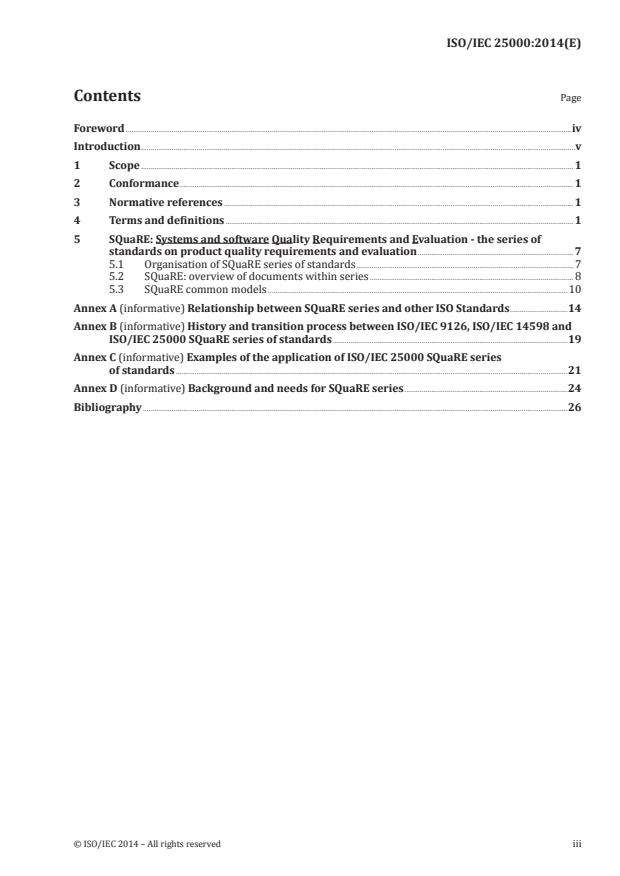
Contents Page
Foreword .iv
Introduction .v
1 Scope . 1
2 Conformance . 1
3 Normative references . 1
4 Terms and definitions . 1
5 SQuaRE: Systems and software Quality Requirements and Evaluation - the series of
standards on product quality requirements and evaluation .7
5.1 Organisation of SQuaRE series of standards . 7
5.2 SQuaRE: overview of documents within series . 8
5.3 SQuaRE common models .10
Annex A (informative) Relationship between SQuaRE series and other ISO Standards .14
Annex B (informative) History and transition process between ISO/IEC 9126, ISO/IEC 14598 and
ISO/IEC 25000 SQuaRE series of standards .19
Annex C (informative) Examples of the application of ISO/IEC 25000 SQuaRE series
of standards .21
Annex D (informative) Background and needs for SQuaRE series .24
Bibliography .26
© ISO/IEC 2014 – All rights reserved iii
Foreword
ISO (the International Organization for Standardization) and IEC (the International Electrotechnical
Commission) form the specialized system for worldwide standardization. National bodies that are
members of ISO or IEC participate in the development of International Standards through technical
committees established by the respective organization to deal with particular fields of technical
activity. ISO and IEC technical committees collaborate in fields of mutual interest. Other international
organizations, governmental and non-governmental, in liaison with ISO and IEC, also take part in the
work. In the field of information technology, ISO and IEC have established a joint technical committee,
ISO/IEC JTC 1.
International Standards are drafted in accordance with the rules given in the ISO/IEC Directives, Part 2.
The main task of the joint technical committee is to prepare International Standards. Draft International
Standards adopted by the joint technical committee are circulated to national bodies for voting.
Publication as an International Standard requires approval by at least 75 % of the national bodies
casting a vote.
Attention is drawn to the possibility that some of the elements of this document may be the subject of
patent rights. ISO and IEC shall not be held responsible for identifying any or all such patent rights.
ISO/IEC 25000 was prepared by Joint Technical Committee ISO/IEC JTC 1, Information technology,
Subcommittee SC 7, Software and systems engineering.
This second edition cancels and replaces the first edition (ISO/IEC 25000:2005), of which it constitutes
a minor revision.
The SQuaRE series of standards consists of the following divisions under the general title Systems and
Software Quality Requirements and Evaluation (SQuaRE):
— ISO/IEC 2500n, Quality Management Division,
— ISO/IEC 2501n, Quality Model Division,
— ISO/IEC 2502n, Quality Measurement Division,
— ISO/IEC 2503n, Quality Requirements Division, and
— ISO/IEC 2504n, Quality Evaluation Division.
ISO/IEC 25050 to ISO/IEC 25099 are reserved to be used for SQuaRE extension International Standards
and/or Technical Reports.
iv © ISO/IEC 2014 – All rights reserved
Introduction
Computers are being used in an increasingly wide variety of application areas, and their intended and
correct operation is often critical for business success and/or human safety. Developing or selecting
high quality systems and products is therefore of prime importance. Comprehensive specification and
evaluation of systems and software product quality is a key factor in ensuring adequate quality. This can
be achieved by defining appropriate quality characteristics, while taking account of the intended use
of the systems and software product. It is important that every relevant system and software product
quality characteristic is specified and evaluated, whenever possible using validated or widely accepted
measures.
As quality characteristics and associated measures can be useful not only for evaluating a systems
and software product but also for defining quality requirements, the predecessor of SQuaRE,
ISO/IEC 9126:1991 has been replaced by two related multipart International Standards: ISO/IEC 9126
(Software product quality) and ISO/IEC 14598 (Software product evaluation). The following points
derived from practical use of both series gave the logical impulse for creating the new SQuaRE series of
International Standards:
— Both ISO/IEC 9126 and ISO/IEC 14598 have common normative, referential and functional roots.
— ISO/IEC 9126 and ISO/IEC 14598 form a complementary set of standards.
— The independent life cycles of both series have created inconsistencies between them.
The general goal of creating the SQuaRE set of International Standards was to move to a logically
organized, enriched and unified series covering two main processes: software quality requirements
specification and systems and software quality evaluation, supported by a systems and software
quality measurement process. The purpose of the SQuaRE set of International Standards is to assist
those developing and acquiring systems and software products with the specification and evaluation
of quality requirements. It establishes criteria for the specification of systems and software product
quality requirements, their measurement, and evaluation. It includes a two-part quality model for
aligning customer definitions of quality with attributes of the development process. In addition, the
series provides recommended measures of systems and software product quality attributes that can be
used by developers, acquirers, and evaluators.
It has to be stressed that the SQuaRE series of International Standards is dedicated to systems and
software product quality only. SQuaRE ISO/IEC 2500n — Quality Management Division addresses
systems and software product quality requirements specification, measurement and evaluation, and
is separate and distinct from the “Quality Management” of processes, which is defined in the ISO 9000
family of standards.
The major benefits of the SQuaRE series over its predecessor standards include:
— the coordination of guidance on systems and software product quality measurement and evaluation,
— guidance for the specification of systems and software product quality requirements, and
— harmonization with ISO/IEC 15939 in the form of Software product Quality Measurement Reference
Model presented in ISO/IEC 25020, Software engineering — Software product Quality Requirements
and Evaluation (SQuaRE) — Measurement reference model and guide.
The major differences between ISO/IEC 9126, ISO/IEC 14598 and SQuaRE series of International
Standards are:
— the introduction of the new general reference model,
— the introduction of dedicated, detailed guides for each division,
— the introduction of systems product quality,
— the introduction of a data quality model,
© ISO/IEC 2014 – All rights reserved v
— the introduction of Quality Measure Elements within Quality Measurement Division,
— the introduction of the Quality Requirements Division,
— incorporation and revision of the evaluation processes,
— the introduction of guidance of practical use in form of examples,
— coordination and harmonization of the content with ISO/IEC 15939.
SQuaRE consists of the following five divisions:
— ISO/IEC 2500n - Quality Management Division,
— ISO/IEC 2501n - Quality Model Division,
— ISO/IEC 2502n - Quality Measurement Division,
— ISO/IEC 2503n - Quality Requirements Division,
— ISO/IEC 2504n - Quality Evaluation Division, and
— ISO/IEC 25050 to ISO/IEC 25099 - Extension division
SQuaRE provides:
— Terms and definitions,
— Reference models,
— General guide,
— Individual division guides, and
— International Standards for requirements specification, planning and management, measurement
and evaluation purposes.
SQuaRE includes International Standards on quality model and measures, as well as on quality
requirements and evaluation.
SQuaRE replaces the ISO/IEC 9126 series and the ISO/IEC 14598 series.
This part of SQuaRE series of standards is an International Standard with the goal of providing a
common set of reference models, terminology, definitions and guidance for practical use of the associated
standards and technical reports.
vi © ISO/IEC 2014 – All rights reserved
INTERNATIONAL STANDARD ISO/IEC 25000:2014(E)
Systems and software engineering — Systems and software
Quality Requirements and Evaluation (SQuaRE) — Guide to
SQuaRE
1 Scope
This International Standard provides guidance for the use of the new series of International Standards
named Systems and software Quality Requirements and Evaluation (SQuaRE). The purpose of this
Guide is to provide a general overview of SQuaRE contents, common reference models and definitions,
as well as the relationship among the documents, allowing users of the Guide a good understanding of
those series of standards, according to their purpose of use. This International Standard also contains
an explanation of the transition process between the old ISO/IEC 9126 and the ISO/IEC 14598 series and
SQuaRE.
The SQuaRE series of International Standards is intended for, but not limited to, developers, acquirers
and independent evaluators of systems and software products, particularly those responsible for
defining systems and software quality requirements and for systems and software product evaluation.
It is recommended that users of SQuaRE as well as ISO/IEC 14598 and ISO/IEC 9126 series of standards
also use this International Standard as a guide to execute their tasks.
2 Conformance
There is no particular conformance clause for this document. Users, for their intended use of SQuaRE
series of Standards should follow individual conformance clauses stated in each document of the series.
3 Normative references
This International Standard does not require any normative references. All informative references are
presented in the Bibliography.
4 Terms and definitions
For the purposes of this document, the following definitions apply.
NOTE The definitions are common to all parts of SQuaRE series of International Standards.
4.1
attribute
inherent property or characteristic of an entity that can be distinguished quantitatively or qualitatively
by human or automated means
Note 1 to entry: Based on ISO/IEC 15939:2007.
Note 2 to entry: ISO 9000 distinguishes two types of attributes: a permanent characteristic existing inherently in
something; and an assigned characteristic of a product, process or system (e.g. the price of a product, the owner
of a product). The assigned characteristic is not an inherent quality characteristic of that product, process or
system.
© ISO/IEC 2014 – All rights reserved 1
4.2
context of use
users, tasks, equipment (hardware, software and materials), and the physical and social environments
in which a product is used
[SOURCE: ISO 9241-11:1998]
4.3
custom software
software product developed for a specific application from a user requirements specification
4.4
data
reinterpretable representation of information in a formalized manner suitable for communication,
interpretation or processing
[SOURCE: ISO/IEC 25012:2008]
4.5
data quality
degree to which the characteristics of data satisfy stated and implied needs when used under specified
conditions
4.6
developer
individual or organisation that performs development activities (including requirements analysis,
design, testing through acceptance) during the system or software life cycle process
[SOURCE: ISO/IEC 12207:2008, modified]
4.7
end user
individual person who ultimately benefits from the outcomes of the system or software
Note 1 to entry: The end user may be a regular operator of the system or software product or a casual user such
as a member of the public.
4.8
evaluation method
procedure describing actions to be performed by the evaluator in order to obtain results for the specified
measurement applied to the specified product components or on the product as a whole
4.9
evaluation module
package of evaluation technology for measuring systems and software quality characteristics,
subcharacteristics or attributes
Note 1 to entry: The package includes evaluation methods and techniques, inputs to be evaluated, data to be
measured and collected and supporting procedures and tools.
4.10
evaluator
individual or organisation that performs an evaluation
4.11
external measure of system or software quality
measure of the degree to which a system or software product enables its behaviour to satisfy stated and
implied needs for the system including the software to be used under specified conditions
Note 1 to entry: Attributes of the behaviour can be verified and/or validated by executing the system or software
product during testing and operation.
2 © ISO/IEC 2014 – All rights reserved
EXAMPLE The number of failures found during testing is an external measure of software quality related to
the number of faults present in the computer system. The two measures are not necessarily identical since testing
may not find all faults, and a fault may give rise to apparently different failures in different circumstances.
4.12
implied needs
needs that may not have been stated but are actual needs
Note 1 to entry: Some implied needs only become evident when the system or software product is used in
particular conditions.
EXAMPLE Implied needs include: needs not stated but implied by other stated needs and needs not stated
because they are considered to be evident or obvious.
4.13
indicator
measure that provides an estimate or evaluation of specified attributes derived from a model with
respect to defined information needs
[SOURCE: ISO/IEC 15939:2007]
Note 1 to entry: In ISO/IEC 14598 this definition was: “a measure that can be used to estimate or predict another
measure”.
4.14
information need
insight necessary to manage objectives, goals, risks, and problems
[SOURCE: ISO/IEC 15939:2007]
4.15
intermediate system or software product
product of the system or software development process that is used as input to another stage of its
development process
EXAMPLE Intermediate software products can include static and dynamic models, other documents and
source code.
4.16
internal measure of software quality
measure of the degree to which a set of static attributes of a software product satisfies stated and
implied needs for the software product to be used under specified conditions
Note 1 to entry: Static attributes include those that relate to the software architecture, structure and its
components.
Note 2 to entry: Static attributes can be verified by review, inspection, simulation and/or automated tools.
EXAMPLE Complexity measures and the number, severity, and failure frequency of faults found in a walk
through are internal software quality measures made on the product itself.
4.17
maintainer
individual or organisation that performs maintenance activities
Note 1 to entry: Based on the definition in ISO/IEC 12207:2008.
4.18
measure (noun)
variable to which a value is assigned as the result of measurement
Note 1 to entry: The term “measures” is used to refer collectively to base measures, derived measures, and
indicators.
© ISO/IEC 2014 – All rights reserved 3
[SOURCE: ISO/IEC 15939:2007]
4.19
measure (verb)
make a measurement
[SOURCE: ISO/IEC 14598-1:1999]
4.20
measurement
set of operations having the object of determining a value of a measure
[SOURCE: ISO/IEC 15939:2007]
Note 1 to entry: Measurement can include assigning a qualitative category such as the language of a source
program (ADA, C, Java, etc.).
4.21
measurement process
process for establishing, planning, performing and evaluating systems and software measurement
within an overall project or organisational measurement structure
[SOURCE: ISO/IEC 15939:2007]
4.22
process
system of activities, which use resources to transform inputs into outputs
[SOURCE: ISO 9000:2005]
4.23
product
artifact that is produced, is quantifiable, and can be either an end item in itself or a component item
[SOURCE: Guide to the Project Management Body of Knowledge (PMBOK) Fourth Edition: 2008]
Note 1 to entry: ISO 9000:2005 defines four agreed generic product categories: hardware (e.g. engine mechanical
part); software (e.g. computer program); services (e.g. transport); and processed materials (e.g. lubricant).
Hardware and processed materials are generally tangible products, while software or services are generally
intangible. Most products comprise elements belonging to different generic product categories. Whether the
product is then called hardware, processed material, software, or service depends on the dominant element.
Results could be components, systems, software, services, rules, documents, or many other items. The result
could in some cases be many related individual results.
4.24
quality in use
degree to which a product or system can be used by specific users to meet their needs to achieve specific
goals with effectiveness, efficiency, freedom from risk and satisfaction in specific contexts of use
Note 1 to entry: Before the product is released, quality in use can be specified and measured in a test environment
designed and used exclusively by the intended users for their goals and contexts of use, e.g. User Acceptance
Testing Environment.
4.25
quality in use measure
measure of the degree to which a product or system can be used by specific users to meet their needs
to achieve specific goals with effectiveness, efficiency, freedom from risk, satisfaction and context
coverage in specific contexts of use
4 © ISO/IEC 2014 – All rights reserved
4.26
quality measure element
measure defined in terms of a property and the measurement method for quantifying it, including
optionally the transformation by a mathematical function
[SOURCE: ISO/IEC 25021:2012]
Note 1 to entry: The system or software quality characteristic or subcharacteristic of the entity is derived
afterwards by calculating a software quality measure.
4.27
quality model
defined set of characteristics, and of relationships between them, which provides a framework for
specifying quality requirements and evaluating quality
4.28
rating
action of mapping the measured value to the appropriate rating level. Used to determine the rating level
associated with the system or software product for a specific quality characteristic
4.29
rating level
scale point on an ordinal scale, which is used to categorise a measurement scale
Note 1 to entry: The rating level enables software product to be classified (rated) in accordance with the stated
or implied needs.
Note 2 to entry: Appropriate rating levels may be associated with the different views of quality i.e. Users’,
Managers’ or Developers’.
4.30
scale
ordered set of values, continuous or discrete, or a set of categories to which the attribute is mapped
[SOURCE: ISO/IEC 15939:2007]
EXAMPLE Types of scales are: a nominal scale which corresponds to a set of categories; an ordinal scale
which corresponds to an ordered set of scale points; an interval scale which corresponds to an ordered scale
with equidistant scale points; and a ratio scale which not only has equidistant scale point but also possesses an
absolute zero. Measures using nominal or ordinal scales produce qualitative data, and measures using interval
and ratio scales produce quantitative data.
4.31
software product
set of computer programs, procedures, and possibly associated documentation and data
[SOURCE: ISO/IEC 12207:2008]
Note 1 to entry: Products include intermediate products, and products intended for users such as developers and
maintainers.
Note 2 to entry: In SQuaRE standards software quality has the same meaning as software product quality.
4.32
software product evaluation
technical operation that consists of producing an assessment of one or more characteristics of a software
product according to a specified procedure
© ISO/IEC 2014 – All rights reserved 5
4.33
software quality
capability of software product to satisfy stated and implied needs when used under specified conditions
Note 1 to entry: This definition differs from the ISO 9000:2005 quality definition mainly because the software
quality definition refers to the satisfaction of stated and implied needs, while the ISO 9000 quality definition
refers to the satisfaction of requirements.
4.34
software quality characteristic
category of software quality attributes that bears on software quality
Note 1 to entry: Software quality characteristics may be refined into multiple levels of subcharacteristics and
finally into software quality attributes.
4.35
software quality evaluation
systematic examination of the extent to which a software product is capable of satisfying stated and
implied needs
4.36
stakeholder
individual or organisation having a right, share, claim or interest in a system or in its possession of
characteristics that meet their needs and expectations
[SOURCE: ISO/IEC 15288:2008]
Note 1 to entry: Stakeholders include, but are not limited to, end users, end user organisations, supporters,
developers, producers, trainers, maintainers, disposers, acquirers, supplier organisations and regulatory bodies.
4.37
supplier
individual or organisation that enters into a contract with the acquirer for the supply of a system,
software product or software service under the terms of the contract
[SOURCE: ISO/IEC 12207:2008]
4.38
system
combination of interacting elements organised to achieve one or more stated purposes
[SOURCE: ISO/IEC 15288:2008]
Note 1 to entry: A system may be considered as a product or as the services it provides.
Note 2 to entry: In practice, the interpretation of its meaning is frequently clarified by the use of an associative
noun, e.g. aircraft system. Alternatively the word system may be substituted simply by a context dependent
synonym, e.g. aircraft, though this may then obscure a system principles perspective.
4.39
target of process
system, software product or task executed by system or software product to which measurement or
evaluation process is applied
4.40
user
individual or organisation that uses the system or software to perform a specific function
[SOURCE: ISO/IEC 15939:2007]
Note 1 to entry: Users may include operators, recipients of the results of operating the system or software, or
developers or maintainers of system or software.
6 © ISO/IEC 2014 – All rights reserved
4.41
validation
confirmation, through the provision of objective evidence, that the requirements for a specific intended
use or application have been fulfilled
[SOURCE: ISO 9000:2005]
Note 1 to entry: Validation in a life cycle context is the set of activities ensuring and gaining confidence that a
system is able to accomplish its intended use, goals and objectives. [ISO/IEC 12207:2008]
4.42
value
number or category assigned to an attribute of an entity by making a measurement
4.43
verification
confirmation, through the provision of objective evidence, that specified requirements have been
fulfilled
[SOURCE: ISO 9000:2005]
Note 1 to entry: Verification in a life cycle context is a set of activities that compares a product of the life cycle
against the required characteristics for that product. This may include, but is not limited to, specified requirements,
design description and the system itself. [ISO/IEC 12207:2008]
5 SQuaRE: Systems and software Quality Requirements and Evaluation - the se-
ries of standards on product quality requirements and evaluation
5.1 Organisation of SQuaRE series of standards
This clause presents an overview of the structure and the contents of SQuaRE series of standards. The
objective is to give the users of this series of standards necessary information allowing the efficient
choice of applicable documents.
Figure 1 — Organisation of SQuaRE series of standards
© ISO/IEC 2014 – All rights reserved 7
Figure 1 illustrates the organisation of the SQuaRE series representing families of standards, further
called Divisions.
The Divisions within SQuaRE model are:
— ISO/IEC 2500n - Quality Management Division. The International Standards that form this
division define all common models, terms and definitions referred to by all other standards from
the SQuaRE series. Referring paths (guidance through SQuaRE documents) and high level practical
suggestions in applying proper standards to specific application cases offer help to all types of
users. The division also provides requirements and guidance for a supporting function, which is
responsible for the management of product requirements specification and evaluation.
— ISO/IEC 2501n - Quality Model Division. The International Standards that form this division
present detailed quality models for systems and software product, quality in use and data. Practical
guidance on the use of the quality model is also provided.
— ISO/IEC 2502n - Quality Measurement Division. The International Standards that form this
division include a system and software product quality measurement reference model, mathematical
definitions of quality measures, and practical guidance for their application. This division presents
internal measures of software quality, external measures of system or software product quality
and quality in use measures. Quality measure elements forming foundations for the latter measures
are defined and presented.
— ISO/IEC 2503n - Quality Requirements Division. The International Standard that forms this
division helps specifying quality requirements. These quality requirements can be used in
the process of quality requirements elicitation for a product to be developed or as inputs for an
evaluation process. The requirements definition process is mapped to technical processes defined
in ISO/IEC 15288:2008.
— ISO/IEC 2504n - Quality Evaluation Division. The International Standards that form this division
provide requirements, recommendations and guidelines for product evaluation, whether performed
by independent evaluators, acquirers or developers. The support for documenting a measure as an
Evaluation Module is also presented.
— ISO/IEC 25050-25099-Extension Division. SQuaRE extension (ISO/IEC 25050 to ISO/IEC 25099) is
designated to contain system or software product quality International Standards and/or Technical
Reports that address specific application domains or that can be used to complement one or more
SQuaRE International Standards.
5.2 SQuaRE: overview of documents within series
The SQuaRE series of standards consists of 14 documents grouped in 5 Divisions within SQuaRE
model. This clause presents a short overview of all documents with their classification to Divisions. The
documents incorporate provisions from documents mentioned in brackets.
5.2.1 ISO/IE C 2500n - Quality Management Division
— 25000 - Guide to SQuaRE: Provides the SQuaRE architecture model, terminology, documents overview,
intended users and associated parts of the series as well as reference models (ISO/IEC 9126-1 and
ISO/IEC 14598-1).
— 25001 - Planning and management: Provides requirements and guidance for a supporting function,
which is responsible for the management of system or software product requirements specification
and evaluation. (ISO/IEC 14598-2).
5.2.2 ISO/IEC 2501n - Quality Model Division
— 25010 - Quality model: describes the model for system and software product quality and quality
in use. The document presents characteristics and subcharacteristics for product quality and for
quality in use (ISO/IEC 9126-1 and ISO/IEC 14598-1).
8 © ISO/IEC 2014 – All rights reserved
— 25012- Data quality model: defines a general data quality model for data retained in a structured
format within a computer system. The data quality model defined in this International Standard can
be used to establish data quality requirements, define data quality measures, or plan and perform
data quality evaluations.
5.2.3 ISO/IEC 2502n - Quality Measurement Division
— 25020 - Measurement reference model and guide: presents introductory explanation and a
reference model that is common to quality measure elements, measures of internal software
quality, external system and software quality and quality in use. Also provides guidance to users for
selecting or developing, and applying measures from the International Standards (ISO/IEC 9126-1,
ISO/IEC TR 9126-2, ISO/IEC TR 9126-3, ISO/IEC TR 9126-4 and ISO/IEC 14598-1). On the date of its
publication the document was dedicated to software only, but its content applies to systems as well.
— 25021 – Quality measure elements: presents definitions and specifications of a set of recommended
base and derived measures, which are intended to be used during the whole system or software
development life cycle. The document describes a set of measures that can be used as an input for
the internal software quality, external system or software quality or system or software quality in
use measurement.
— 25022 – Measurement of quality in use: describes a set of measures for measuring quality in use
in terms of characteristics and subcharacteristics defined in ISO/IEC 25010, and is intended to be
used together with ISO/IEC 25010. Provides guidance to use the measures of systems and software
quality in use (ISO/IEC TR 9126-4).
— 25023 – Measurement of system and software product quality: defines quality measures for
quantitatively measuring system and software product quality in terms of characteristics and
subcharacteristics defined in ISO/IEC 25010, and is intended to be used together with ISO/IEC 25010
(ISO/IEC TR 9126-2, -3).
— 25024 – Measurement of data quality: defines quality measures for quantitatively measuring data
quality in terms of characteristics defined in ISO/IEC 25012.
5.2.4 ISO/IEC 2503n - Quality Requirements Division
— 25030 – Quality requirements: provides requirements and guidance for the process used to specify
quality requirements, as well as requirements and recommendations for quality.
5.2.5 ISO/IEC 2504n - Quality Evaluation Division
— 25040 – Evaluation process: contains requirements and recommendations for the evaluation
of system or software product quality and clarifies the general concepts. It provides a process
description for evaluating system or software product quality and states the requirements for the
application of this process (ISO/IEC 14598-1),
— 25041 - Evaluation guide for developers, acquirers and independent evaluators: contains specific
requirements and recommendations for developers, acquirers and evaluators (ISO/IEC 14598-3, -4,
-5),
— 25045 – Evaluation modules for recoverability: provides the specification to evaluate the
subcharacteristic of recoverability defined under the characteristic of reliability of the quality model.
It determines the external measures of systems and software quality of resiliency and autonomic
recovery index when the information system composed of one or more software products’ execution
transactions is subjected to a series of disturbances.
5.2.6 ISO/IEC 25050 to 25099 -SQuaRE extension
— 25051 – Requirements for quality of Ready to Use Software Product (RUSP) and instructions for
testing: establishes quality requirements for RUSP; requirements for test documentation for the
© ISO/IEC 2014 – All rights reserved 9
testing of RUSP, including test plan, test description, and test results; and instruction for conformity
evaluation of RUSP (ISO/IEC 12119).
— 25060 – Common Industry Format (CIF) for usability: General framework for usability-related
information: describes a potential family of standards, named the Common Industry Formats (CIF),
that document the specification and evaluation of the usability of interactive systems. Provides
a general overview of the CIF Framework and contents, definitions, and the relationship of the
framework elements.
— 25062 – Common Industry Format (CIF) for usability test reports: intended to be used to report the
measures obtained from a test of usability as defined in ISO 9241-11: effectiveness, efficiency and
satisfaction in a specified context of use.
— 25063 – Common Industry Format (CIF) for usability: Context of use description: specifies the
contents of both high-level and detailed descriptions of context of use for an existing, intended,
designed or implemented system
— 25064 – Common Industry Format (CIF) for usability: User needs report: describes the Common
Industry Format (CIF) for reporting user needs. This document provides specifications for the
contents and sample format of user needs reports, including the content elements to be provided.
— 25065 - Common Industry Format (CIF) for usability: User Requirements Specification: describes
the Common Industry Format (CIF) for User Requirements Specifications. This international
standard provides specification of the format and contents of user requirements specifications, and
the relationship of elements
— 25066 - Common Industry Format (CIF) for usability: Usability Evaluation Report: describes the
Common Industry Format (CIF) for Evaluation Reports. The purpose of this standard is to provide
specifications for the contents of evaluation reports, including definitions and the relationship of
elements.
5.3 SQuaRE common models
5.3.1 General
The following subclauses present all common models used within the SQuaRE series of standards. As
these models form a basis for practical navigation through the series they are further referred by all
dedicated and/or detailed standard documents. The following models are presented:
— SQuaRE general reference model – navigation guide through SQuaRE series of standards as a
function of user’s task(s),
— System and software quality life cycle model - the views of internal quality, external quality and
quality in use during the system or software life cycle,
— Quality model structure – categorisation of systems and software quality into characteristics,
subcharacteristics and quality attributes.
10 © ISO/IEC 2014 – All rights reserved
Figure 2 — SQuaRE general reference model
5.3.2 SQuaRE general reference model
SQuaRE general reference model (Figure 2) was created to help the users navigate through SQuaRE
series of standards.
The choice of the appropriate standards and documents from the SQuaRE series depends upon the
user’s role and information needs. It is recommended that all users initially consult the general guidance
(ISO/IEC 25000) in addition to the parts that are relevant to their specific information need and role.
NOTE the requirements specification and evaluation processes are not yet addressing data quality evaluation
© ISO/IEC 2014 – All rights reserved 11
5.3.3 System and software product quality life cycle model
The system and software product quality life cycle model (Figure 3) addresses system and software
product quality in three principal phases of its life cycle: product under development, product in
operation and product in use.
— The phase of a product under development is the subject of internal measures of software quality.
— The phase of a product in operation is the subject of external measures of system and software
quality, and
— The phase of a product in use is the subject of software measures of quality in use.
Figure 3 — Systems and software product quality life cycle model
The systems and software product quality life cycle model also indicates that the implementation of
systems and software quality requires a process similar to the system or software development process
for each type of quality: requirements, implementation and validation of the results.
Quality in use requirements specify the required level of quality from the end user’s point of view. These
requirements are derived from needs of each context of use. Quality in use requirements are used as
the target for validation of the system or software product by the user. Requirements for quality in use
characteristics should be stated in the quality requirements specification using quality in use measures
and used as criteria when a product is evaluated.
NOTE Quality in use requirements contribute to identifying and defining external system or software quality
requirements.
External system or software quality requirements specify the required level of quality from the
external view. They include requirements derived from user quality requirements, including quality
in use requirements. External system or software quality requirements are used as the target for
technical verification and validation of the system or software product. Requirements for external
12 © ISO/IEC 2014 – All rights reserved
system or software quality characteristics should be stated quantitatively in the quality requirements
specification using external measures and used as criteria when a product is evaluated.
NOTE 1 External system or software quality requirements contribute to identifying and defining internal
software quality requirements
NOTE 2 External software quality evaluation can be used to predict quality in use.
Internal software quality requirements specify the level of required quality from the internal view of
the product. They include requirements derived from external system or software quality requirements.
Internal software quality requirements are used to specify properties of intermediate software products.
Internal software quality requirements may also be applied to deliverable, non-executable software
products such as documentation and manuals. Internal software quality requirements can be used as
targets for verification at various stages of development. They can also be used for defining strategies
of development and criteria for evaluation and verification during development. This includes the use of
additional measures (e.g. for reusability), which are outside of the scope of SQuaRE series of standards.
Internal quality requirements should be specified quantitatively in terms of internal measures.
NOTE 1 Internal software quality evaluation can be used to predict external software quality.
5.3.4 Quality model structure
SQuaRE quality model categorises system and software quality into characteristics which are further
subdivided into subcharacteristics and/or quality attributes.
SQuaRE quality model consists of three parts, the model for system and software product quality, the
model for quality in use and the model for data quality, being presented in details in ISO/IEC 25010
– Systems and software engineering: Software and Software Quality Requirements and Evaluation
(SQuaRE) – System and software quality models and ISO/IEC 25012 – Systems and software engineering:
Software and Software Quality Requirements and Evaluation (SQuaRE)– data quality model. In these
documents the detailed definitions for each quality characteristic and the subcharacteristics of the
system or software product and data are given.
© ISO/IEC 2014 – All rights reserved 13
Annex A
(informative)
Relationship between SQuaRE series and other ISO Standards
A.1 ISO/IEC 12207:20 08
This standard establishes a common framework for software life cycle processes, with well-defined
terminology. It contains processes, activities and tasks that are to be applied during the supply,
development, operation and maintenance of software products.
During the development process, the developer shall establish and document software requirements,
including the quality characteristics specifications. Guidance for specifying quality characteristics may
be found in ISO/IEC 25010. ISO/IEC 25022, ISO/IEC 25023 and ISO/IEC 25024 can be used to support
assigning quantitative target values for the quality requirements. SQuaRE series of International
Standards can also be used during the development process in order to evaluate intermediate and final
software products.
A.2 ISO/IEC 15504 series of standards
ISO/IEC 15504 is a 10 part standard based on experiences gained in the SPICE Project. It can be used for
software process assessment and process capability determination.
The first basic assumption is that the quality of a software product is
...
INTERNATIONAL ISO/IEC
STANDARD 25000
Second edition
2014-03-15
Systems and software engineering —
Systems and software Quality
Requirements and Evaluation
(SQuaRE) — Guide to SQuaRE
Ingénierie des systèmes et du logiciel — Exigences de qualité des
systèmes et du logiciel et évaluation (SQuaRE) — Guide de SQuaRE
Reference number
©
ISO/IEC 2014
© ISO/IEC 2014
All rights reserved. Unless otherwise specified, no part of this publication may be reproduced or utilized otherwise in any form
or by any means, electronic or mechanical, including photocopying, or posting on the internet or an intranet, without prior
written permission. Permission can be requested from either ISO at the address below or ISO’s member body in the country of
the requester.
ISO copyright office
Case postale 56 • CH-1211 Geneva 20
Tel. + 41 22 749 01 11
Fax + 41 22 749 09 47
E-mail copyright@iso.org
Web www.iso.org
Published in Switzerland
ii © ISO/IEC 2014 – All rights reserved
Contents Page
Foreword .iv
Introduction .v
1 Scope . 1
2 Conformance . 1
3 Normative references . 1
4 Terms and definitions . 1
5 SQuaRE: Systems and software Quality Requirements and Evaluation - the series of
standards on product quality requirements and evaluation .7
5.1 Organisation of SQuaRE series of standards . 7
5.2 SQuaRE: overview of documents within series . 8
5.3 SQuaRE common models .10
Annex A (informative) Relationship between SQuaRE series and other ISO Standards .14
Annex B (informative) History and transition process between ISO/IEC 9126, ISO/IEC 14598 and
ISO/IEC 25000 SQuaRE series of standards .19
Annex C (informative) Examples of the application of ISO/IEC 25000 SQuaRE series
of standards .21
Annex D (informative) Background and needs for SQuaRE series .24
Bibliography .26
© ISO/IEC 2014 – All rights reserved iii
Foreword
ISO (the International Organization for Standardization) and IEC (the International Electrotechnical
Commission) form the specialized system for worldwide standardization. National bodies that are
members of ISO or IEC participate in the development of International Standards through technical
committees established by the respective organization to deal with particular fields of technical
activity. ISO and IEC technical committees collaborate in fields of mutual interest. Other international
organizations, governmental and non-governmental, in liaison with ISO and IEC, also take part in the
work. In the field of information technology, ISO and IEC have established a joint technical committee,
ISO/IEC JTC 1.
International Standards are drafted in accordance with the rules given in the ISO/IEC Directives, Part 2.
The main task of the joint technical committee is to prepare International Standards. Draft International
Standards adopted by the joint technical committee are circulated to national bodies for voting.
Publication as an International Standard requires approval by at least 75 % of the national bodies
casting a vote.
Attention is drawn to the possibility that some of the elements of this document may be the subject of
patent rights. ISO and IEC shall not be held responsible for identifying any or all such patent rights.
ISO/IEC 25000 was prepared by Joint Technical Committee ISO/IEC JTC 1, Information technology,
Subcommittee SC 7, Software and systems engineering.
This second edition cancels and replaces the first edition (ISO/IEC 25000:2005), of which it constitutes
a minor revision.
The SQuaRE series of standards consists of the following divisions under the general title Systems and
Software Quality Requirements and Evaluation (SQuaRE):
— ISO/IEC 2500n, Quality Management Division,
— ISO/IEC 2501n, Quality Model Division,
— ISO/IEC 2502n, Quality Measurement Division,
— ISO/IEC 2503n, Quality Requirements Division, and
— ISO/IEC 2504n, Quality Evaluation Division.
ISO/IEC 25050 to ISO/IEC 25099 are reserved to be used for SQuaRE extension International Standards
and/or Technical Reports.
iv © ISO/IEC 2014 – All rights reserved
Introduction
Computers are being used in an increasingly wide variety of application areas, and their intended and
correct operation is often critical for business success and/or human safety. Developing or selecting
high quality systems and products is therefore of prime importance. Comprehensive specification and
evaluation of systems and software product quality is a key factor in ensuring adequate quality. This can
be achieved by defining appropriate quality characteristics, while taking account of the intended use
of the systems and software product. It is important that every relevant system and software product
quality characteristic is specified and evaluated, whenever possible using validated or widely accepted
measures.
As quality characteristics and associated measures can be useful not only for evaluating a systems
and software product but also for defining quality requirements, the predecessor of SQuaRE,
ISO/IEC 9126:1991 has been replaced by two related multipart International Standards: ISO/IEC 9126
(Software product quality) and ISO/IEC 14598 (Software product evaluation). The following points
derived from practical use of both series gave the logical impulse for creating the new SQuaRE series of
International Standards:
— Both ISO/IEC 9126 and ISO/IEC 14598 have common normative, referential and functional roots.
— ISO/IEC 9126 and ISO/IEC 14598 form a complementary set of standards.
— The independent life cycles of both series have created inconsistencies between them.
The general goal of creating the SQuaRE set of International Standards was to move to a logically
organized, enriched and unified series covering two main processes: software quality requirements
specification and systems and software quality evaluation, supported by a systems and software
quality measurement process. The purpose of the SQuaRE set of International Standards is to assist
those developing and acquiring systems and software products with the specification and evaluation
of quality requirements. It establishes criteria for the specification of systems and software product
quality requirements, their measurement, and evaluation. It includes a two-part quality model for
aligning customer definitions of quality with attributes of the development process. In addition, the
series provides recommended measures of systems and software product quality attributes that can be
used by developers, acquirers, and evaluators.
It has to be stressed that the SQuaRE series of International Standards is dedicated to systems and
software product quality only. SQuaRE ISO/IEC 2500n — Quality Management Division addresses
systems and software product quality requirements specification, measurement and evaluation, and
is separate and distinct from the “Quality Management” of processes, which is defined in the ISO 9000
family of standards.
The major benefits of the SQuaRE series over its predecessor standards include:
— the coordination of guidance on systems and software product quality measurement and evaluation,
— guidance for the specification of systems and software product quality requirements, and
— harmonization with ISO/IEC 15939 in the form of Software product Quality Measurement Reference
Model presented in ISO/IEC 25020, Software engineering — Software product Quality Requirements
and Evaluation (SQuaRE) — Measurement reference model and guide.
The major differences between ISO/IEC 9126, ISO/IEC 14598 and SQuaRE series of International
Standards are:
— the introduction of the new general reference model,
— the introduction of dedicated, detailed guides for each division,
— the introduction of systems product quality,
— the introduction of a data quality model,
© ISO/IEC 2014 – All rights reserved v
— the introduction of Quality Measure Elements within Quality Measurement Division,
— the introduction of the Quality Requirements Division,
— incorporation and revision of the evaluation processes,
— the introduction of guidance of practical use in form of examples,
— coordination and harmonization of the content with ISO/IEC 15939.
SQuaRE consists of the following five divisions:
— ISO/IEC 2500n - Quality Management Division,
— ISO/IEC 2501n - Quality Model Division,
— ISO/IEC 2502n - Quality Measurement Division,
— ISO/IEC 2503n - Quality Requirements Division,
— ISO/IEC 2504n - Quality Evaluation Division, and
— ISO/IEC 25050 to ISO/IEC 25099 - Extension division
SQuaRE provides:
— Terms and definitions,
— Reference models,
— General guide,
— Individual division guides, and
— International Standards for requirements specification, planning and management, measurement
and evaluation purposes.
SQuaRE includes International Standards on quality model and measures, as well as on quality
requirements and evaluation.
SQuaRE replaces the ISO/IEC 9126 series and the ISO/IEC 14598 series.
This part of SQuaRE series of standards is an International Standard with the goal of providing a
common set of reference models, terminology, definitions and guidance for practical use of the associated
standards and technical reports.
vi © ISO/IEC 2014 – All rights reserved
INTERNATIONAL STANDARD ISO/IEC 25000:2014(E)
Systems and software engineering — Systems and software
Quality Requirements and Evaluation (SQuaRE) — Guide to
SQuaRE
1 Scope
This International Standard provides guidance for the use of the new series of International Standards
named Systems and software Quality Requirements and Evaluation (SQuaRE). The purpose of this
Guide is to provide a general overview of SQuaRE contents, common reference models and definitions,
as well as the relationship among the documents, allowing users of the Guide a good understanding of
those series of standards, according to their purpose of use. This International Standard also contains
an explanation of the transition process between the old ISO/IEC 9126 and the ISO/IEC 14598 series and
SQuaRE.
The SQuaRE series of International Standards is intended for, but not limited to, developers, acquirers
and independent evaluators of systems and software products, particularly those responsible for
defining systems and software quality requirements and for systems and software product evaluation.
It is recommended that users of SQuaRE as well as ISO/IEC 14598 and ISO/IEC 9126 series of standards
also use this International Standard as a guide to execute their tasks.
2 Conformance
There is no particular conformance clause for this document. Users, for their intended use of SQuaRE
series of Standards should follow individual conformance clauses stated in each document of the series.
3 Normative references
This International Standard does not require any normative references. All informative references are
presented in the Bibliography.
4 Terms and definitions
For the purposes of this document, the following definitions apply.
NOTE The definitions are common to all parts of SQuaRE series of International Standards.
4.1
attribute
inherent property or characteristic of an entity that can be distinguished quantitatively or qualitatively
by human or automated means
Note 1 to entry: Based on ISO/IEC 15939:2007.
Note 2 to entry: ISO 9000 distinguishes two types of attributes: a permanent characteristic existing inherently in
something; and an assigned characteristic of a product, process or system (e.g. the price of a product, the owner
of a product). The assigned characteristic is not an inherent quality characteristic of that product, process or
system.
© ISO/IEC 2014 – All rights reserved 1
4.2
context of use
users, tasks, equipment (hardware, software and materials), and the physical and social environments
in which a product is used
[SOURCE: ISO 9241-11:1998]
4.3
custom software
software product developed for a specific application from a user requirements specification
4.4
data
reinterpretable representation of information in a formalized manner suitable for communication,
interpretation or processing
[SOURCE: ISO/IEC 25012:2008]
4.5
data quality
degree to which the characteristics of data satisfy stated and implied needs when used under specified
conditions
4.6
developer
individual or organisation that performs development activities (including requirements analysis,
design, testing through acceptance) during the system or software life cycle process
[SOURCE: ISO/IEC 12207:2008, modified]
4.7
end user
individual person who ultimately benefits from the outcomes of the system or software
Note 1 to entry: The end user may be a regular operator of the system or software product or a casual user such
as a member of the public.
4.8
evaluation method
procedure describing actions to be performed by the evaluator in order to obtain results for the specified
measurement applied to the specified product components or on the product as a whole
4.9
evaluation module
package of evaluation technology for measuring systems and software quality characteristics,
subcharacteristics or attributes
Note 1 to entry: The package includes evaluation methods and techniques, inputs to be evaluated, data to be
measured and collected and supporting procedures and tools.
4.10
evaluator
individual or organisation that performs an evaluation
4.11
external measure of system or software quality
measure of the degree to which a system or software product enables its behaviour to satisfy stated and
implied needs for the system including the software to be used under specified conditions
Note 1 to entry: Attributes of the behaviour can be verified and/or validated by executing the system or software
product during testing and operation.
2 © ISO/IEC 2014 – All rights reserved
EXAMPLE The number of failures found during testing is an external measure of software quality related to
the number of faults present in the computer system. The two measures are not necessarily identical since testing
may not find all faults, and a fault may give rise to apparently different failures in different circumstances.
4.12
implied needs
needs that may not have been stated but are actual needs
Note 1 to entry: Some implied needs only become evident when the system or software product is used in
particular conditions.
EXAMPLE Implied needs include: needs not stated but implied by other stated needs and needs not stated
because they are considered to be evident or obvious.
4.13
indicator
measure that provides an estimate or evaluation of specified attributes derived from a model with
respect to defined information needs
[SOURCE: ISO/IEC 15939:2007]
Note 1 to entry: In ISO/IEC 14598 this definition was: “a measure that can be used to estimate or predict another
measure”.
4.14
information need
insight necessary to manage objectives, goals, risks, and problems
[SOURCE: ISO/IEC 15939:2007]
4.15
intermediate system or software product
product of the system or software development process that is used as input to another stage of its
development process
EXAMPLE Intermediate software products can include static and dynamic models, other documents and
source code.
4.16
internal measure of software quality
measure of the degree to which a set of static attributes of a software product satisfies stated and
implied needs for the software product to be used under specified conditions
Note 1 to entry: Static attributes include those that relate to the software architecture, structure and its
components.
Note 2 to entry: Static attributes can be verified by review, inspection, simulation and/or automated tools.
EXAMPLE Complexity measures and the number, severity, and failure frequency of faults found in a walk
through are internal software quality measures made on the product itself.
4.17
maintainer
individual or organisation that performs maintenance activities
Note 1 to entry: Based on the definition in ISO/IEC 12207:2008.
4.18
measure (noun)
variable to which a value is assigned as the result of measurement
Note 1 to entry: The term “measures” is used to refer collectively to base measures, derived measures, and
indicators.
© ISO/IEC 2014 – All rights reserved 3
[SOURCE: ISO/IEC 15939:2007]
4.19
measure (verb)
make a measurement
[SOURCE: ISO/IEC 14598-1:1999]
4.20
measurement
set of operations having the object of determining a value of a measure
[SOURCE: ISO/IEC 15939:2007]
Note 1 to entry: Measurement can include assigning a qualitative category such as the language of a source
program (ADA, C, Java, etc.).
4.21
measurement process
process for establishing, planning, performing and evaluating systems and software measurement
within an overall project or organisational measurement structure
[SOURCE: ISO/IEC 15939:2007]
4.22
process
system of activities, which use resources to transform inputs into outputs
[SOURCE: ISO 9000:2005]
4.23
product
artifact that is produced, is quantifiable, and can be either an end item in itself or a component item
[SOURCE: Guide to the Project Management Body of Knowledge (PMBOK) Fourth Edition: 2008]
Note 1 to entry: ISO 9000:2005 defines four agreed generic product categories: hardware (e.g. engine mechanical
part); software (e.g. computer program); services (e.g. transport); and processed materials (e.g. lubricant).
Hardware and processed materials are generally tangible products, while software or services are generally
intangible. Most products comprise elements belonging to different generic product categories. Whether the
product is then called hardware, processed material, software, or service depends on the dominant element.
Results could be components, systems, software, services, rules, documents, or many other items. The result
could in some cases be many related individual results.
4.24
quality in use
degree to which a product or system can be used by specific users to meet their needs to achieve specific
goals with effectiveness, efficiency, freedom from risk and satisfaction in specific contexts of use
Note 1 to entry: Before the product is released, quality in use can be specified and measured in a test environment
designed and used exclusively by the intended users for their goals and contexts of use, e.g. User Acceptance
Testing Environment.
4.25
quality in use measure
measure of the degree to which a product or system can be used by specific users to meet their needs
to achieve specific goals with effectiveness, efficiency, freedom from risk, satisfaction and context
coverage in specific contexts of use
4 © ISO/IEC 2014 – All rights reserved
4.26
quality measure element
measure defined in terms of a property and the measurement method for quantifying it, including
optionally the transformation by a mathematical function
[SOURCE: ISO/IEC 25021:2012]
Note 1 to entry: The system or software quality characteristic or subcharacteristic of the entity is derived
afterwards by calculating a software quality measure.
4.27
quality model
defined set of characteristics, and of relationships between them, which provides a framework for
specifying quality requirements and evaluating quality
4.28
rating
action of mapping the measured value to the appropriate rating level. Used to determine the rating level
associated with the system or software product for a specific quality characteristic
4.29
rating level
scale point on an ordinal scale, which is used to categorise a measurement scale
Note 1 to entry: The rating level enables software product to be classified (rated) in accordance with the stated
or implied needs.
Note 2 to entry: Appropriate rating levels may be associated with the different views of quality i.e. Users’,
Managers’ or Developers’.
4.30
scale
ordered set of values, continuous or discrete, or a set of categories to which the attribute is mapped
[SOURCE: ISO/IEC 15939:2007]
EXAMPLE Types of scales are: a nominal scale which corresponds to a set of categories; an ordinal scale
which corresponds to an ordered set of scale points; an interval scale which corresponds to an ordered scale
with equidistant scale points; and a ratio scale which not only has equidistant scale point but also possesses an
absolute zero. Measures using nominal or ordinal scales produce qualitative data, and measures using interval
and ratio scales produce quantitative data.
4.31
software product
set of computer programs, procedures, and possibly associated documentation and data
[SOURCE: ISO/IEC 12207:2008]
Note 1 to entry: Products include intermediate products, and products intended for users such as developers and
maintainers.
Note 2 to entry: In SQuaRE standards software quality has the same meaning as software product quality.
4.32
software product evaluation
technical operation that consists of producing an assessment of one or more characteristics of a software
product according to a specified procedure
© ISO/IEC 2014 – All rights reserved 5
4.33
software quality
capability of software product to satisfy stated and implied needs when used under specified conditions
Note 1 to entry: This definition differs from the ISO 9000:2005 quality definition mainly because the software
quality definition refers to the satisfaction of stated and implied needs, while the ISO 9000 quality definition
refers to the satisfaction of requirements.
4.34
software quality characteristic
category of software quality attributes that bears on software quality
Note 1 to entry: Software quality characteristics may be refined into multiple levels of subcharacteristics and
finally into software quality attributes.
4.35
software quality evaluation
systematic examination of the extent to which a software product is capable of satisfying stated and
implied needs
4.36
stakeholder
individual or organisation having a right, share, claim or interest in a system or in its possession of
characteristics that meet their needs and expectations
[SOURCE: ISO/IEC 15288:2008]
Note 1 to entry: Stakeholders include, but are not limited to, end users, end user organisations, supporters,
developers, producers, trainers, maintainers, disposers, acquirers, supplier organisations and regulatory bodies.
4.37
supplier
individual or organisation that enters into a contract with the acquirer for the supply of a system,
software product or software service under the terms of the contract
[SOURCE: ISO/IEC 12207:2008]
4.38
system
combination of interacting elements organised to achieve one or more stated purposes
[SOURCE: ISO/IEC 15288:2008]
Note 1 to entry: A system may be considered as a product or as the services it provides.
Note 2 to entry: In practice, the interpretation of its meaning is frequently clarified by the use of an associative
noun, e.g. aircraft system. Alternatively the word system may be substituted simply by a context dependent
synonym, e.g. aircraft, though this may then obscure a system principles perspective.
4.39
target of process
system, software product or task executed by system or software product to which measurement or
evaluation process is applied
4.40
user
individual or organisation that uses the system or software to perform a specific function
[SOURCE: ISO/IEC 15939:2007]
Note 1 to entry: Users may include operators, recipients of the results of operating the system or software, or
developers or maintainers of system or software.
6 © ISO/IEC 2014 – All rights reserved
4.41
validation
confirmation, through the provision of objective evidence, that the requirements for a specific intended
use or application have been fulfilled
[SOURCE: ISO 9000:2005]
Note 1 to entry: Validation in a life cycle context is the set of activities ensuring and gaining confidence that a
system is able to accomplish its intended use, goals and objectives. [ISO/IEC 12207:2008]
4.42
value
number or category assigned to an attribute of an entity by making a measurement
4.43
verification
confirmation, through the provision of objective evidence, that specified requirements have been
fulfilled
[SOURCE: ISO 9000:2005]
Note 1 to entry: Verification in a life cycle context is a set of activities that compares a product of the life cycle
against the required characteristics for that product. This may include, but is not limited to, specified requirements,
design description and the system itself. [ISO/IEC 12207:2008]
5 SQuaRE: Systems and software Quality Requirements and Evaluation - the se-
ries of standards on product quality requirements and evaluation
5.1 Organisation of SQuaRE series of standards
This clause presents an overview of the structure and the contents of SQuaRE series of standards. The
objective is to give the users of this series of standards necessary information allowing the efficient
choice of applicable documents.
Figure 1 — Organisation of SQuaRE series of standards
© ISO/IEC 2014 – All rights reserved 7
Figure 1 illustrates the organisation of the SQuaRE series representing families of standards, further
called Divisions.
The Divisions within SQuaRE model are:
— ISO/IEC 2500n - Quality Management Division. The International Standards that form this
division define all common models, terms and definitions referred to by all other standards from
the SQuaRE series. Referring paths (guidance through SQuaRE documents) and high level practical
suggestions in applying proper standards to specific application cases offer help to all types of
users. The division also provides requirements and guidance for a supporting function, which is
responsible for the management of product requirements specification and evaluation.
— ISO/IEC 2501n - Quality Model Division. The International Standards that form this division
present detailed quality models for systems and software product, quality in use and data. Practical
guidance on the use of the quality model is also provided.
— ISO/IEC 2502n - Quality Measurement Division. The International Standards that form this
division include a system and software product quality measurement reference model, mathematical
definitions of quality measures, and practical guidance for their application. This division presents
internal measures of software quality, external measures of system or software product quality
and quality in use measures. Quality measure elements forming foundations for the latter measures
are defined and presented.
— ISO/IEC 2503n - Quality Requirements Division. The International Standard that forms this
division helps specifying quality requirements. These quality requirements can be used in
the process of quality requirements elicitation for a product to be developed or as inputs for an
evaluation process. The requirements definition process is mapped to technical processes defined
in ISO/IEC 15288:2008.
— ISO/IEC 2504n - Quality Evaluation Division. The International Standards that form this division
provide requirements, recommendations and guidelines for product evaluation, whether performed
by independent evaluators, acquirers or developers. The support for documenting a measure as an
Evaluation Module is also presented.
— ISO/IEC 25050-25099-Extension Division. SQuaRE extension (ISO/IEC 25050 to ISO/IEC 25099) is
designated to contain system or software product quality International Standards and/or Technical
Reports that address specific application domains or that can be used to complement one or more
SQuaRE International Standards.
5.2 SQuaRE: overview of documents within series
The SQuaRE series of standards consists of 14 documents grouped in 5 Divisions within SQuaRE
model. This clause presents a short overview of all documents with their classification to Divisions. The
documents incorporate provisions from documents mentioned in brackets.
5.2.1 ISO/IE C 2500n - Quality Management Division
— 25000 - Guide to SQuaRE: Provides the SQuaRE architecture model, terminology, documents overview,
intended users and associated parts of the series as well as reference models (ISO/IEC 9126-1 and
ISO/IEC 14598-1).
— 25001 - Planning and management: Provides requirements and guidance for a supporting function,
which is responsible for the management of system or software product requirements specification
and evaluation. (ISO/IEC 14598-2).
5.2.2 ISO/IEC 2501n - Quality Model Division
— 25010 - Quality model: describes the model for system and software product quality and quality
in use. The document presents characteristics and subcharacteristics for product quality and for
quality in use (ISO/IEC 9126-1 and ISO/IEC 14598-1).
8 © ISO/IEC 2014 – All rights reserved
— 25012- Data quality model: defines a general data quality model for data retained in a structured
format within a computer system. The data quality model defined in this International Standard can
be used to establish data quality requirements, define data quality measures, or plan and perform
data quality evaluations.
5.2.3 ISO/IEC 2502n - Quality Measurement Division
— 25020 - Measurement reference model and guide: presents introductory explanation and a
reference model that is common to quality measure elements, measures of internal software
quality, external system and software quality and quality in use. Also provides guidance to users for
selecting or developing, and applying measures from the International Standards (ISO/IEC 9126-1,
ISO/IEC TR 9126-2, ISO/IEC TR 9126-3, ISO/IEC TR 9126-4 and ISO/IEC 14598-1). On the date of its
publication the document was dedicated to software only, but its content applies to systems as well.
— 25021 – Quality measure elements: presents definitions and specifications of a set of recommended
base and derived measures, which are intended to be used during the whole system or software
development life cycle. The document describes a set of measures that can be used as an input for
the internal software quality, external system or software quality or system or software quality in
use measurement.
— 25022 – Measurement of quality in use: describes a set of measures for measuring quality in use
in terms of characteristics and subcharacteristics defined in ISO/IEC 25010, and is intended to be
used together with ISO/IEC 25010. Provides guidance to use the measures of systems and software
quality in use (ISO/IEC TR 9126-4).
— 25023 – Measurement of system and software product quality: defines quality measures for
quantitatively measuring system and software product quality in terms of characteristics and
subcharacteristics defined in ISO/IEC 25010, and is intended to be used together with ISO/IEC 25010
(ISO/IEC TR 9126-2, -3).
— 25024 – Measurement of data quality: defines quality measures for quantitatively measuring data
quality in terms of characteristics defined in ISO/IEC 25012.
5.2.4 ISO/IEC 2503n - Quality Requirements Division
— 25030 – Quality requirements: provides requirements and guidance for the process used to specify
quality requirements, as well as requirements and recommendations for quality.
5.2.5 ISO/IEC 2504n - Quality Evaluation Division
— 25040 – Evaluation process: contains requirements and recommendations for the evaluation
of system or software product quality and clarifies the general concepts. It provides a process
description for evaluating system or software product quality and states the requirements for the
application of this process (ISO/IEC 14598-1),
— 25041 - Evaluation guide for developers, acquirers and independent evaluators: contains specific
requirements and recommendations for developers, acquirers and evaluators (ISO/IEC 14598-3, -4,
-5),
— 25045 – Evaluation modules for recoverability: provides the specification to evaluate the
subcharacteristic of recoverability defined under the characteristic of reliability of the quality model.
It determines the external measures of systems and software quality of resiliency and autonomic
recovery index when the information system composed of one or more software products’ execution
transactions is subjected to a series of disturbances.
5.2.6 ISO/IEC 25050 to 25099 -SQuaRE extension
— 25051 – Requirements for quality of Ready to Use Software Product (RUSP) and instructions for
testing: establishes quality requirements for RUSP; requirements for test documentation for the
© ISO/IEC 2014 – All rights reserved 9
testing of RUSP, including test plan, test description, and test results; and instruction for conformity
evaluation of RUSP (ISO/IEC 12119).
— 25060 – Common Industry Format (CIF) for usability: General framework for usability-related
information: describes a potential family of standards, named the Common Industry Formats (CIF),
that document the specification and evaluation of the usability of interactive systems. Provides
a general overview of the CIF Framework and contents, definitions, and the relationship of the
framework elements.
— 25062 – Common Industry Format (CIF) for usability test reports: intended to be used to report the
measures obtained from a test of usability as defined in ISO 9241-11: effectiveness, efficiency and
satisfaction in a specified context of use.
— 25063 – Common Industry Format (CIF) for usability: Context of use description: specifies the
contents of both high-level and detailed descriptions of context of use for an existing, intended,
designed or implemented system
— 25064 – Common Industry Format (CIF) for usability: User needs report: describes the Common
Industry Format (CIF) for reporting user needs. This document provides specifications for the
contents and sample format of user needs reports, including the content elements to be provided.
— 25065 - Common Industry Format (CIF) for usability: User Requirements Specification: describes
the Common Industry Format (CIF) for User Requirements Specifications. This international
standard provides specification of the format and contents of user requirements specifications, and
the relationship of elements
— 25066 - Common Industry Format (CIF) for usability: Usability Evaluation Report: describes the
Common Industry Format (CIF) for Evaluation Reports. The purpose of this standard is to provide
specifications for the contents of evaluation reports, including definitions and the relationship of
elements.
5.3 SQuaRE common models
5.3.1 General
The following subclauses present all common models used within the SQuaRE series of standards. As
these models form a basis for practical navigation through the series they are further referred by all
dedicated and/or detailed standard documents. The following models are presented:
— SQuaRE general reference model – navigation guide through SQuaRE series of standards as a
function of user’s task(s),
— System and software quality life cycle model - the views of internal quality, external quality and
quality in use during the system or software life cycle,
— Quality model structure – categorisation of systems and software quality into characteristics,
subcharacteristics and quality attributes.
10 © ISO/IEC 2014 – All rights reserved
Figure 2 — SQuaRE general reference model
5.3.2 SQuaRE general reference model
SQuaRE general reference model (Figure 2) was created to help the users navigate through SQuaRE
series of standards.
The choice of the appropriate standards and documents from the SQuaRE series depends upon the
user’s role and information needs. It is recommended that all users initially consult the general guidance
(ISO/IEC 25000) in addition to the parts that are relevant to their specific information need and role.
NOTE the requirements specification and evaluation processes are not yet addressing data quality evaluation
© ISO/IEC 2014 – All rights reserved 11
5.3.3 System and software product quality life cycle model
The system and software product quality life cycle model (Figure 3) addresses system and software
product quality in three principal phases of its life cycle: product under development, product in
operation and product in use.
— The phase of a product under development is the subject of internal measures of software quality.
— The phase of a product in operation is the subject of external measures of system and software
quality, and
— The phase of a product in use is the subject of software measures of quality in use.
Figure 3 — Systems and software product quality life cycle model
The systems and software product quality life cycle model also indicates that the implementation of
systems and software quality requires a process similar to the system or software development process
for each type of quality: requirements, implementation and validation of the results.
Quality in use requirements specify the required level of quality from the end user’s point of view. These
requirements are derived from needs of each context of use. Quality in use requirements are used as
the target for validation of the system or software product by the user. Requirements for quality in use
characteristics should be stated in the quality requirements specification using quality in use measures
and used as criteria when a product is evaluated.
NOTE Quality in use requirements contribute to identifying and defining external system or software quality
requirements.
External system or software quality requirements specify the required level of quality from the
external view. They include requirements derived from user quality requirements, including quality
in use requirements. External system or software quality requirements are used as the target for
technical verification and validation of the system or software product. Requirements for external
12 © ISO/IEC 2014 – All rights reserved
system or software quality characteristics should be stated quantitatively in the quality requirements
specification using external measures and used as criteria when a product is evaluated.
NOTE 1 External system or software quality requirements contribute to identifying and defining internal
software quality requirements
NOTE 2 External software quality evaluation can be used to predict quality in use.
Internal software quality requirements specify the level of required quality from the internal view of
the product. They include requirements derived from external system or software quality requirements.
Internal software quality requirements are used to specify properties of intermediate software products.
Internal software quality requirements may also be applied to deliverable, non-executable software
products such as documentation and manuals. Internal software quality requirements can be used as
targets for verification at various stages of development. They can also be used for defining strategies
of development and criteria for evaluation and verification during development. This includes the use of
additional measures (e.g. for reusability), which are outside of the scope of SQuaRE series of standards.
Internal quality requirements should be specified quantitatively in terms of internal measures.
NOTE 1 Internal software quality evaluation can be used to predict external software quality.
5.3.4 Quality model structure
SQuaRE quality model categorises system and software quality into characteristics which are further
subdivided into subcharacteristics and/or quality attributes.
SQuaRE quality model consists of three parts, the model for system and software product quality, the
model for quality in use and the model for data quality, being presented in details in ISO/IEC 25010
– Systems and software engineering: Software and Software Quality Requirements and Evaluation
(SQuaRE) – System and software quality models and ISO/IEC 25012 – Systems and software engineering:
Software and Software Quality Requirements and Evaluation (SQuaRE)– data quality model. In these
documents the detailed definitions for each quality characteristic and the subcharacteristics of the
system or software product and data are given.
© ISO/IEC 2014 – All rights reserved 13
Annex A
(informative)
Relationship between SQuaRE series and other ISO Standards
A.1 ISO/IEC 12207:20 08
This standard establishes a common framework for software life cycle processes, with well-defined
terminology. It contains processes, activities and tasks that are to be applied during the supply,
development, operation and maintenance of software products.
During the development process, the developer shall establish and document software requirements,
including the quality characteristics specifications. Guidance for specifying quality characteristics may
be found in ISO/IEC 25010. ISO/IEC 25022, ISO/IEC 25023 and ISO/IEC 25024 can be used to support
assigning quantitative target values for the quality requirements. SQuaRE series of International
Standards can also be used during the development process in order to evaluate intermediate and final
software products.
A.2 ISO/IEC 15504 series of standards
ISO/IEC 15504 is a 10 part standard based on experiences gained in the SPICE Project. It can be used for
software process assessment and process capability determination.
The first basic assumption is that the quality of a software product is
...