

ISO 15883-4:2018
(Main)Washer-disinfectors — Part 4: Requirements and tests for washer-disinfectors employing chemical disinfection for thermolabile endoscopes
General Information
- Abstract
This document specifies the particular requirements, including performance criteria for washer-disinfectors (WD) that are intended to be used for cleaning and chemical disinfection of thermolabile endoscopes. This document also specifies the performance requirements for the cleaning and disinfection of the washer-disinfector and its components and accessories which can be required to achieve the necessary performance criteria. The methods, instrumentation and instructions required for type testing, works testing, validation (installation, operational and performance qualification on first installation), routine control and monitoring, and requalification of WD periodically and after essential repairs, are also specified. NOTE 1 In addition, Annex A gives guidance on an appropriate division of responsibility for the range of activities covered by this document. NOTE 2 WD complying with this document can also be used for cleaning and chemical disinfection of other thermolabile re-usable medical devices for which the device manufacturer has recommended and validated this method of disinfection. WD complying with the requirements of this document are not intended for cleaning and disinfection of medical devices, including endoscopic accessories, which are heat stable and can be disinfected or sterilized by thermal methods (see ISO 15883-1:2006+Amd 1:2014, 4.1.5). The specified performance requirements of this document do not ensure the inactivation or removal of the causative agent(s) (prion protein) of transmissible spongiform encephalopathies. NOTE 3 If it is considered that prion protein might be present, particular care is needed in the choice of cleaning agents and disinfectants to ensure that the chemicals used do not react with the prion protein and/or other protein in a manner that can inhibit its removal or inactivation from the load or washer-disinfector. NOTE 4 This document can be used by prospective purchasers and manufacturers as the basis of agreement on the specification of the WD, manufacturers of endoscopes, cleaning products, and disinfecting products.
- Status
- Published
- Publication Date
- 11-Nov-2018
- Technical Committee
- ISO/TC 198 - Sterilization of health care products
- Drafting Committee
- ISO/TC 198 - Sterilization of health care products
- Current Stage
- 9092 - International Standard to be revised
- Start Date
- 22-Jul-2024
- Completion Date
- 29-Aug-2026
Buy Documents
ISO 15883-4:2018 - Washer-disinfectors — Part 4: Requirements and tests for washer-disinfectors employing chemical disinfection for thermolabile endoscopes/12/2018
ISO 15883-4:2018 - Laveurs désinfecteurs — Partie 4: Exigences et essais pour les laveurs désinfecteurs destinés à la désinfection chimique des endoscopes thermolabiles/12/2018
Overview
ISO 15883-4:2018 - "Washer‑disinfectors - Part 4" defines requirements and tests for washer‑disinfectors (WD) employing chemical disinfection for thermolabile endoscopes. It sets performance criteria, testing methods and documentation needed to ensure effective cleaning and chemical disinfection of heat‑sensitive reusable endoscopes and associated WD components. The standard also covers type testing, works testing, validation (IQ/OQ/PQ on first installation), routine monitoring, and periodic requalification after major repairs. NOTE: it is not intended for heat‑stable devices processed by thermal sterilization and does not guarantee prion removal/inactivation.
Key topics and technical requirements
- Performance requirements for cleaning and chemical disinfection stages, including flushing, washing, post‑wash rinsing, final rinsing, purging and drying.
- Device channel irrigation: verification of automated irrigation systems for endoscope channels to ensure internal surfaces are effectively processed.
- Leak testing and channel integrity checks to protect endoscopes and WD from fluid ingress or cross‑contamination.
- Disinfectant efficacy and dosing: requirements for selecting, validating and monitoring chemical disinfectants and dosing systems.
- Process monitoring and instrumentation: guidance on thermometric testing, flow and pressure measurement, and process controls to demonstrate reproducible cycles.
- Water treatment and final rinse quality: requirements for water treatment equipment, microbial monitoring and disinfection of liquid transport systems.
- Testing procedures for conformity: type testing, cleaning and disinfection efficacy tests, chemical dosing tests, drying and channel non‑obstruction/connection tests.
- Documentation and manufacturer information: required labeling, instructions for use, maintenance and performance verification data. Annex A offers guidance on division of responsibilities among stakeholders.
- Limitations and safety notes: specific caution about prion protein risks and device manufacturer validation when applying WD to other thermolabile medical devices.
Applications and users
ISO 15883-4 is used to:
- Specify procurement requirements for hospitals and clinics buying washer‑disinfectors for thermolabile endoscopes.
- Guide WD manufacturers in product design, type testing and regulatory submission.
- Support validation teams (IQ/OQ/PQ), biomedical engineers and infection prevention professionals in establishing validated cleaning/disinfection processes.
- Inform endoscope and disinfectant manufacturers when validating compatibility and recommended reprocessing methods.
- Aid regulatory bodies and auditors assessing compliance with medical device reprocessing standards.
Related standards
- ISO 15883‑1:2006+Amd 1:2014 - general requirements for washer‑disinfectors (referenced in Part 4).
- Other parts of the ISO 15883 series addressing thermal disinfection, specific device types and test methods.
Keywords: ISO 15883-4:2018, washer-disinfectors, chemical disinfection, thermolabile endoscopes, cleaning validation, leak test, channel irrigation, disinfectant efficacy, WD validation.
Relations
- Effective Date
- 04-Mar-2026
- Effective Date
- 04-Mar-2026
- Effective Date
- 12-Feb-2026
- Consolidated By
ISO 3166-1:2020 - Codes for the representation of names of countries and their subdivisions — Part 1: Country code - Effective Date
- 06-Jun-2022
- Effective Date
- 09-Mar-2013
Buy Documents
ISO 15883-4:2018 - Washer-disinfectors — Part 4: Requirements and tests for washer-disinfectors employing chemical disinfection for thermolabile endoscopes/12/2018
ISO 15883-4:2018 - Laveurs désinfecteurs — Partie 4: Exigences et essais pour les laveurs désinfecteurs destinés à la désinfection chimique des endoscopes thermolabiles/12/2018
Get Certified
Connect with accredited certification bodies for this standard

BSI Group
BSI (British Standards Institution) is the business standards company that helps organizations make excellence a habit.

TÜV Rheinland
TÜV Rheinland is a leading international provider of technical services.

TÜV SÜD
TÜV SÜD is a trusted partner of choice for safety, security and sustainability solutions.
Sponsored listings
Frequently Asked Questions
ISO 15883-4:2018 is a standard published by the International Organization for Standardization (ISO). Its full title is "Washer-disinfectors — Part 4: Requirements and tests for washer-disinfectors employing chemical disinfection for thermolabile endoscopes". This standard covers: This document specifies the particular requirements, including performance criteria for washer-disinfectors (WD) that are intended to be used for cleaning and chemical disinfection of thermolabile endoscopes. This document also specifies the performance requirements for the cleaning and disinfection of the washer-disinfector and its components and accessories which can be required to achieve the necessary performance criteria. The methods, instrumentation and instructions required for type testing, works testing, validation (installation, operational and performance qualification on first installation), routine control and monitoring, and requalification of WD periodically and after essential repairs, are also specified. NOTE 1 In addition, Annex A gives guidance on an appropriate division of responsibility for the range of activities covered by this document. NOTE 2 WD complying with this document can also be used for cleaning and chemical disinfection of other thermolabile re-usable medical devices for which the device manufacturer has recommended and validated this method of disinfection. WD complying with the requirements of this document are not intended for cleaning and disinfection of medical devices, including endoscopic accessories, which are heat stable and can be disinfected or sterilized by thermal methods (see ISO 15883-1:2006+Amd 1:2014, 4.1.5). The specified performance requirements of this document do not ensure the inactivation or removal of the causative agent(s) (prion protein) of transmissible spongiform encephalopathies. NOTE 3 If it is considered that prion protein might be present, particular care is needed in the choice of cleaning agents and disinfectants to ensure that the chemicals used do not react with the prion protein and/or other protein in a manner that can inhibit its removal or inactivation from the load or washer-disinfector. NOTE 4 This document can be used by prospective purchasers and manufacturers as the basis of agreement on the specification of the WD, manufacturers of endoscopes, cleaning products, and disinfecting products.
This document specifies the particular requirements, including performance criteria for washer-disinfectors (WD) that are intended to be used for cleaning and chemical disinfection of thermolabile endoscopes. This document also specifies the performance requirements for the cleaning and disinfection of the washer-disinfector and its components and accessories which can be required to achieve the necessary performance criteria. The methods, instrumentation and instructions required for type testing, works testing, validation (installation, operational and performance qualification on first installation), routine control and monitoring, and requalification of WD periodically and after essential repairs, are also specified. NOTE 1 In addition, Annex A gives guidance on an appropriate division of responsibility for the range of activities covered by this document. NOTE 2 WD complying with this document can also be used for cleaning and chemical disinfection of other thermolabile re-usable medical devices for which the device manufacturer has recommended and validated this method of disinfection. WD complying with the requirements of this document are not intended for cleaning and disinfection of medical devices, including endoscopic accessories, which are heat stable and can be disinfected or sterilized by thermal methods (see ISO 15883-1:2006+Amd 1:2014, 4.1.5). The specified performance requirements of this document do not ensure the inactivation or removal of the causative agent(s) (prion protein) of transmissible spongiform encephalopathies. NOTE 3 If it is considered that prion protein might be present, particular care is needed in the choice of cleaning agents and disinfectants to ensure that the chemicals used do not react with the prion protein and/or other protein in a manner that can inhibit its removal or inactivation from the load or washer-disinfector. NOTE 4 This document can be used by prospective purchasers and manufacturers as the basis of agreement on the specification of the WD, manufacturers of endoscopes, cleaning products, and disinfecting products.
ISO 15883-4:2018 is classified under the following ICS (International Classification for Standards) categories: 11.080.10 - Sterilizing equipment. The ICS classification helps identify the subject area and facilitates finding related standards.
ISO 15883-4:2018 has the following relationships with other standards: It is inter standard links to EN ISO 15883-1:2025, EN ISO 15883-7:2025, EN ISO 15883-4:2018, ISO 3166-1:2020, ISO 15883-4:2008. Understanding these relationships helps ensure you are using the most current and applicable version of the standard.
ISO 15883-4:2018 is available in PDF format for immediate download after purchase. The document can be added to your cart and obtained through the secure checkout process. Digital delivery ensures instant access to the complete standard document.
Standards Content (Sample)
INTERNATIONAL ISO
STANDARD 15883-4
Second edition
2018-11
Washer-disinfectors —
Part 4:
Requirements and tests for washer-
disinfectors employing chemical
disinfection for thermolabile
endoscopes
Laveurs désinfecteurs —
Partie 4: Exigences et essais pour les laveurs désinfecteurs destinés à
la désinfection chimique des endoscopes thermolabiles
Reference number
©
ISO 2018
© ISO 2018
All rights reserved. Unless otherwise specified, or required in the context of its implementation, no part of this publication may
be reproduced or utilized otherwise in any form or by any means, electronic or mechanical, including photocopying, or posting
on the internet or an intranet, without prior written permission. Permission can be requested from either ISO at the address
below or ISO’s member body in the country of the requester.
ISO copyright office
CP 401 • Ch. de Blandonnet 8
CH-1214 Vernier, Geneva
Phone: +41 22 749 01 11
Fax: +41 22 749 09 47
Email: copyright@iso.org
Website: www.iso.org
Published in Switzerland
ii © ISO 2018 – All rights reserved
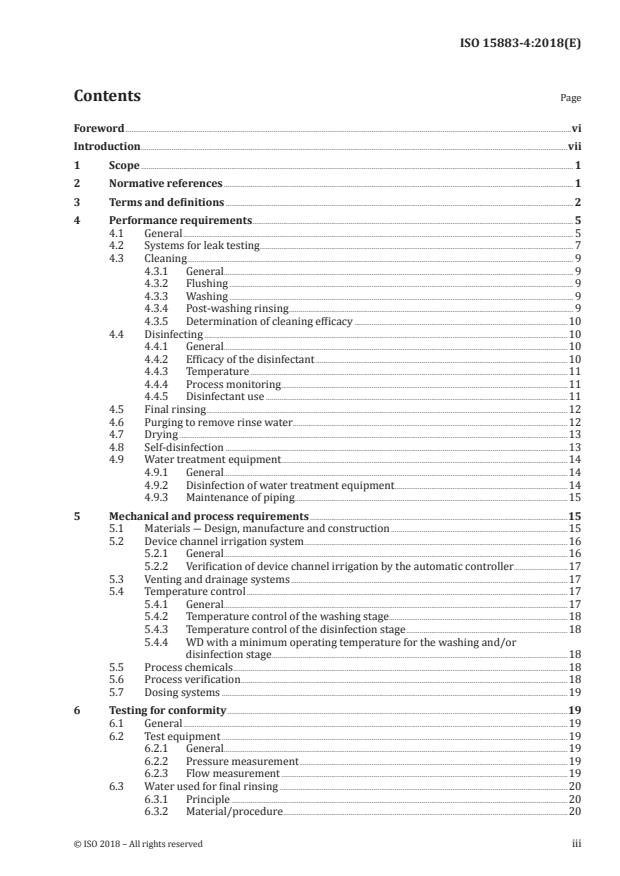
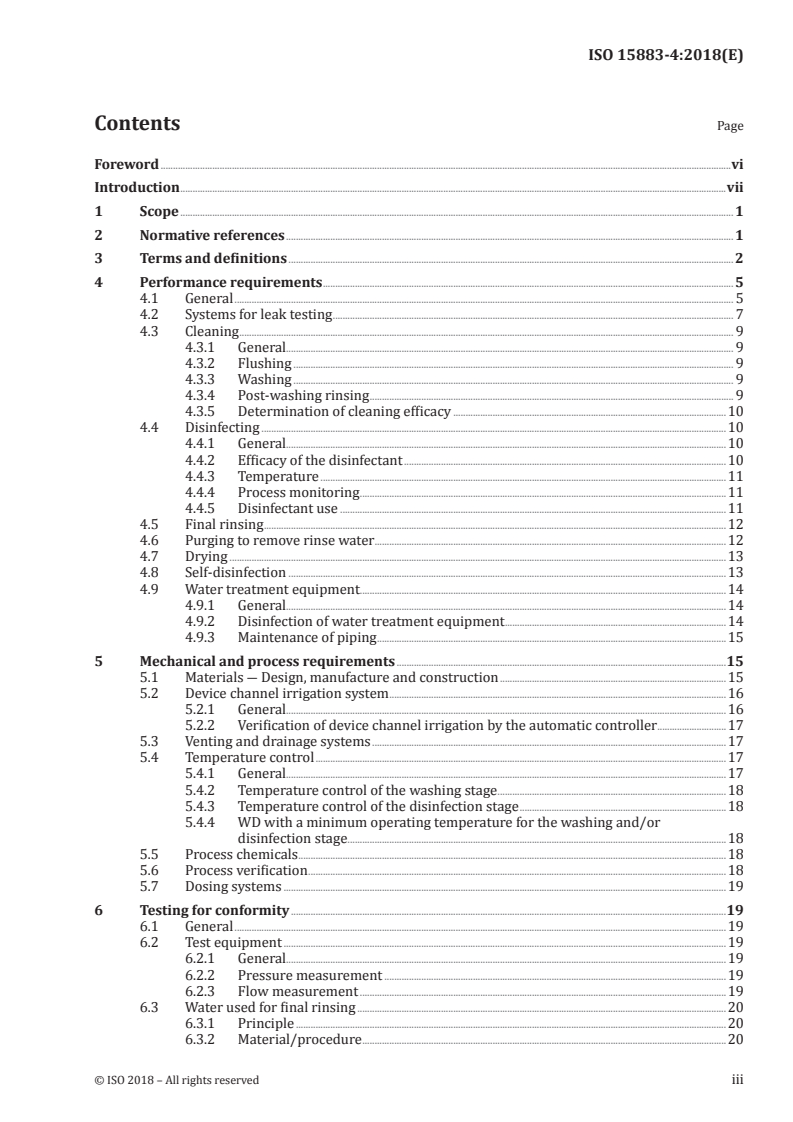
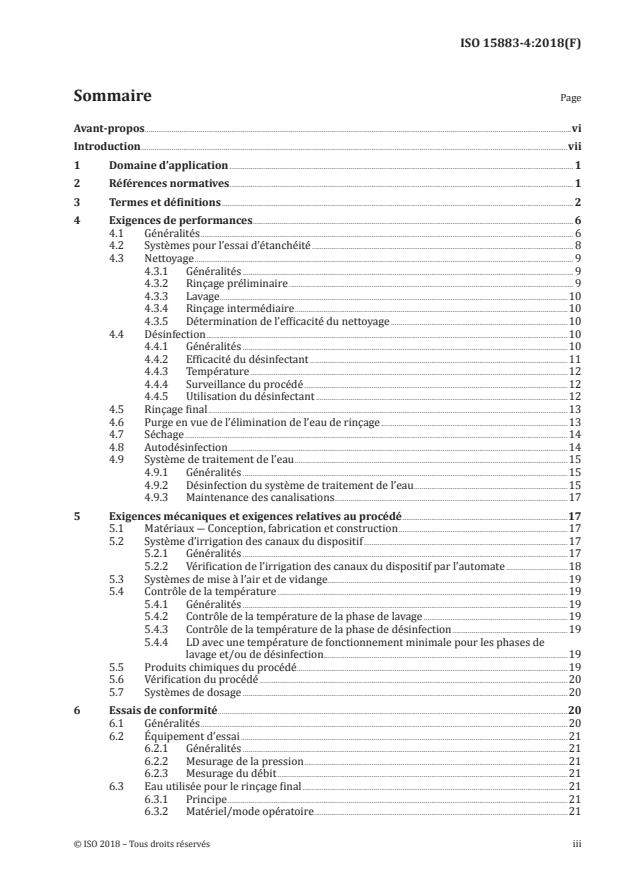
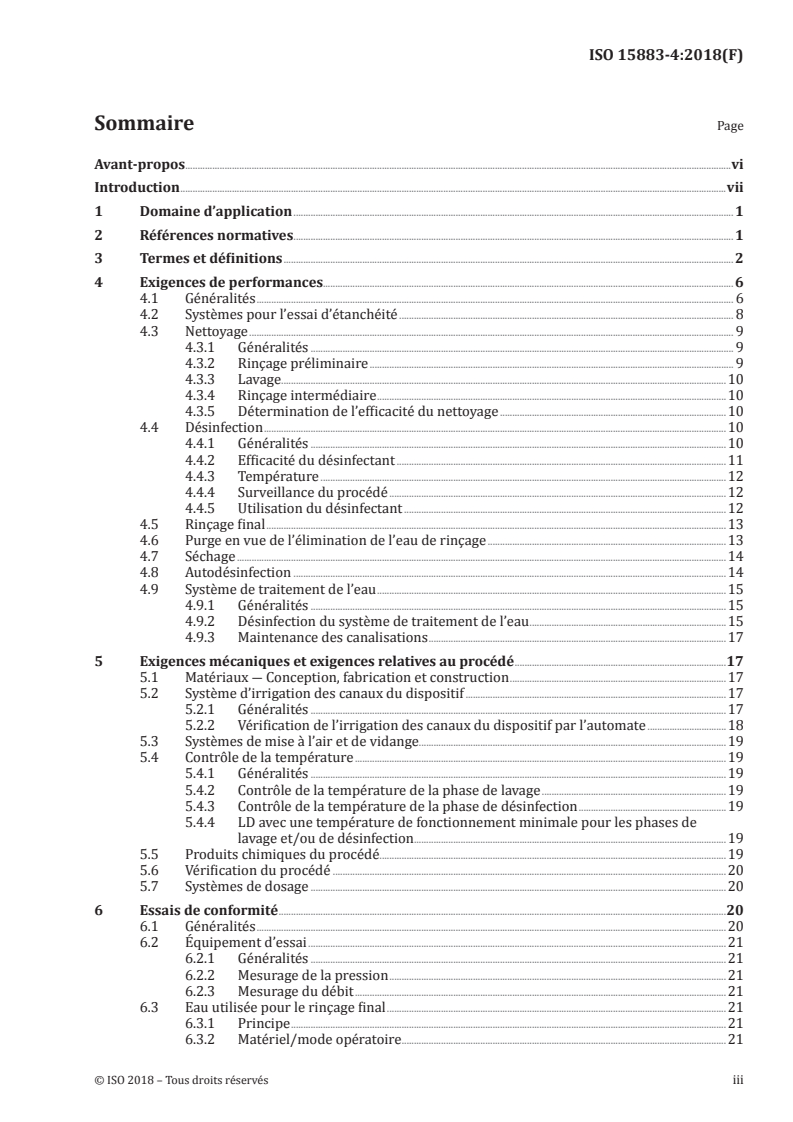
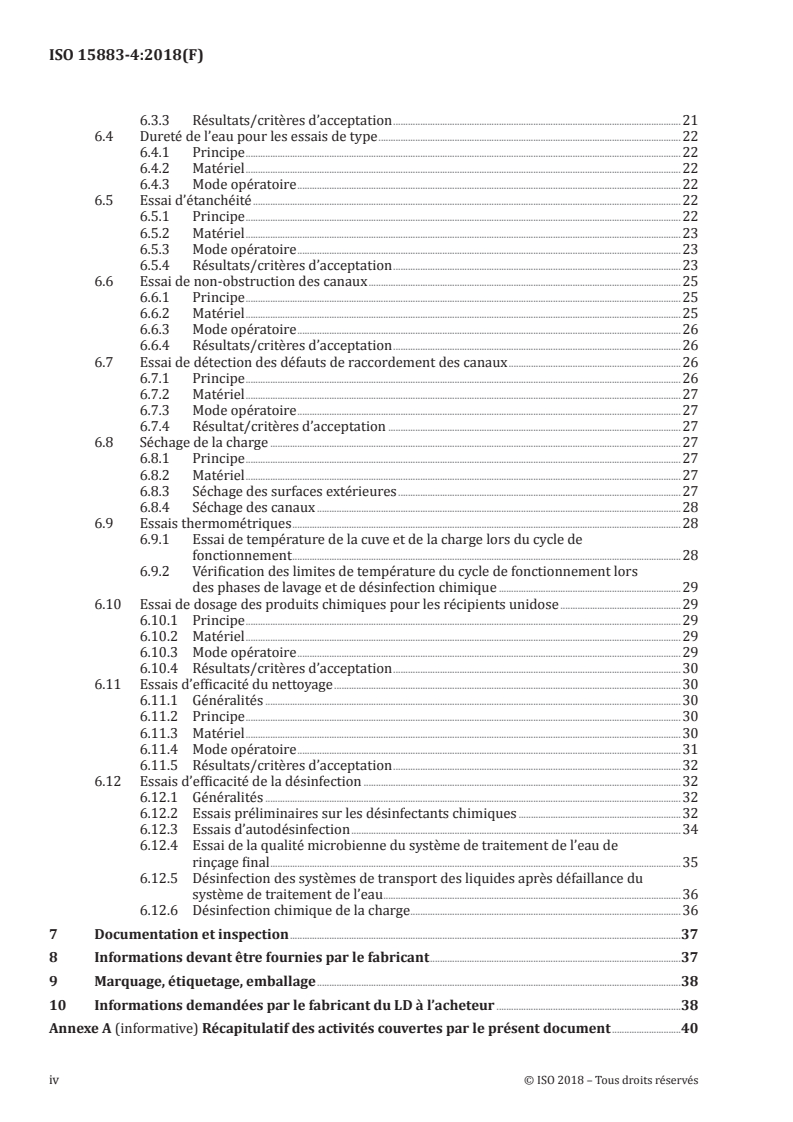
Contents Page
Foreword .vi
Introduction .vii
1 Scope . 1
2 Normative references . 1
3 Terms and definitions . 2
4 Performance requirements . 5
4.1 General . 5
4.2 Systems for leak testing . 7
4.3 Cleaning . 9
4.3.1 General. 9
4.3.2 Flushing . 9
4.3.3 Washing . 9
4.3.4 Post-washing rinsing . 9
4.3.5 Determination of cleaning efficacy .10
4.4 Disinfecting .10
4.4.1 General.10
4.4.2 Efficacy of the disinfectant .10
4.4.3 Temperature .11
4.4.4 Process monitoring .11
4.4.5 Disinfectant use .11
4.5 Final rinsing .12
4.6 Purging to remove rinse water .12
4.7 Drying .13
4.8 Self-disinfection .13
4.9 Water treatment equipment.14
4.9.1 General.14
4.9.2 Disinfection of water treatment equipment .14
4.9.3 Maintenance of piping .15
5 Mechanical and process requirements .15
5.1 Materials ― Design, manufacture and construction .15
5.2 Device channel irrigation system .16
5.2.1 General.16
5.2.2 Verification of device channel irrigation by the automatic controller .17
5.3 Venting and drainage systems .17
5.4 Temperature control .17
5.4.1 General.17
5.4.2 Temperature control of the washing stage .18
5.4.3 Temperature control of the disinfection stage .18
5.4.4 WD with a minimum operating temperature for the washing and/or
disinfection stage . .18
5.5 Process chemicals .18
5.6 Process verification .18
5.7 Dosing systems .19
6 Testing for conformity .19
6.1 General .19
6.2 Test equipment .19
6.2.1 General.19
6.2.2 Pressure measurement .19
6.2.3 Flow measurement .19
6.3 Water used for final rinsing .20
6.3.1 Principle .20
6.3.2 Material/procedure .20
6.3.3 Results/acceptance criteria .20
6.4 Hardness of water used during type testing .20
6.4.1 Principle .20
6.4.2 Material .20
6.4.3 Procedure .21
6.5 Leak test .21
6.5.1 Principle .21
6.5.2 Material .21
6.5.3 Procedure .21
6.5.4 Results/acceptance criteria .22
6.6 Channels non-obstruction test .24
6.6.1 Principle .24
6.6.2 Material .24
6.6.3 Procedure .25
6.6.4 Results/acceptance criteria .25
6.7 Channels non-connection test .25
6.7.1 Principle .25
6.7.2 Material .26
6.7.3 Procedure .26
6.7.4 Result/acceptance criteria .26
6.8 Load dryness .26
6.8.1 Principle .26
6.8.2 Material .26
6.8.3 Exterior surface drying .26
6.8.4 Channel drying .27
6.9 Thermometric tests .27
6.9.1 Test for chamber and load temperature during operating cycle .27
6.9.2 Test for operating cycle temperature limits on washing and chemical
disinfection stages .28
6.10 Chemical dosing tests for single-dose containers .28
6.10.1 Principle .28
6.10.2 Material .28
6.10.3 Procedure .28
6.10.4 Results/acceptance criteria .29
6.11 Tests of cleaning efficacy .29
6.11.1 General.29
6.11.2 Principle .29
6.11.3 Material .29
6.11.4 Procedure .30
6.11.5 Results/acceptance criteria .30
6.12 Tests of disinfection efficacy .30
6.12.1 General.30
6.12.2 Preliminary tests on chemical disinfectants .31
6.12.3 Self-disinfection tests .33
6.12.4 Test of microbial quality of final rinse water treatment equipment .34
6.12.5 Disinfection of liquid transport systems following failure of water
treatment equipment .34
6.12.6 Chemical disinfection of the load.35
7 Documentation and inspection .36
8 Information to be supplied by the manufacturer .36
9 Marking, labelling and packaging .37
10 Information to be requested from the purchaser by the manufacturer .37
Annex A (informative) Summary of activities covered by this document .38
Annex B (normative) Microbiological testing of the efficacy of chemical disinfection of the load .40
Annex C (normative) Summary of test programmes .44
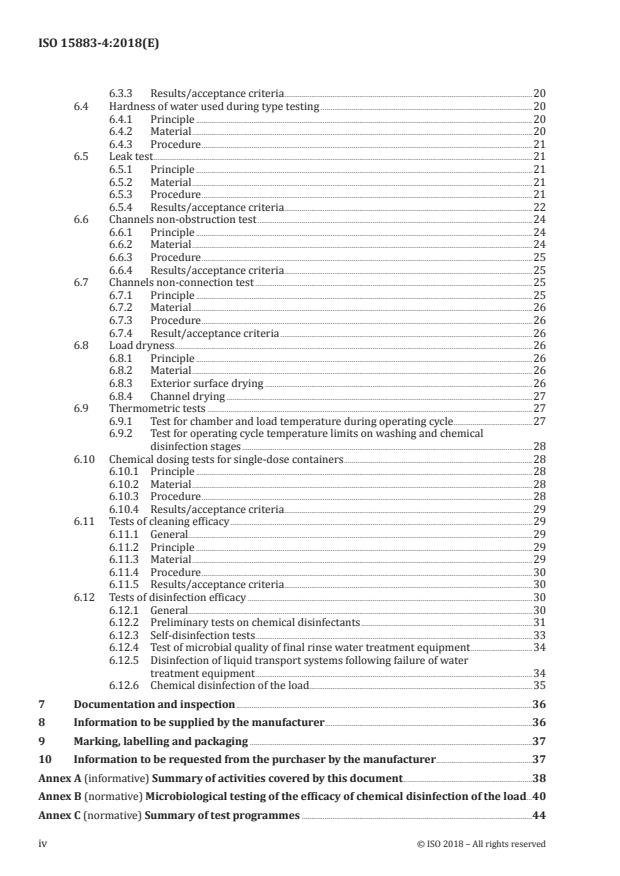
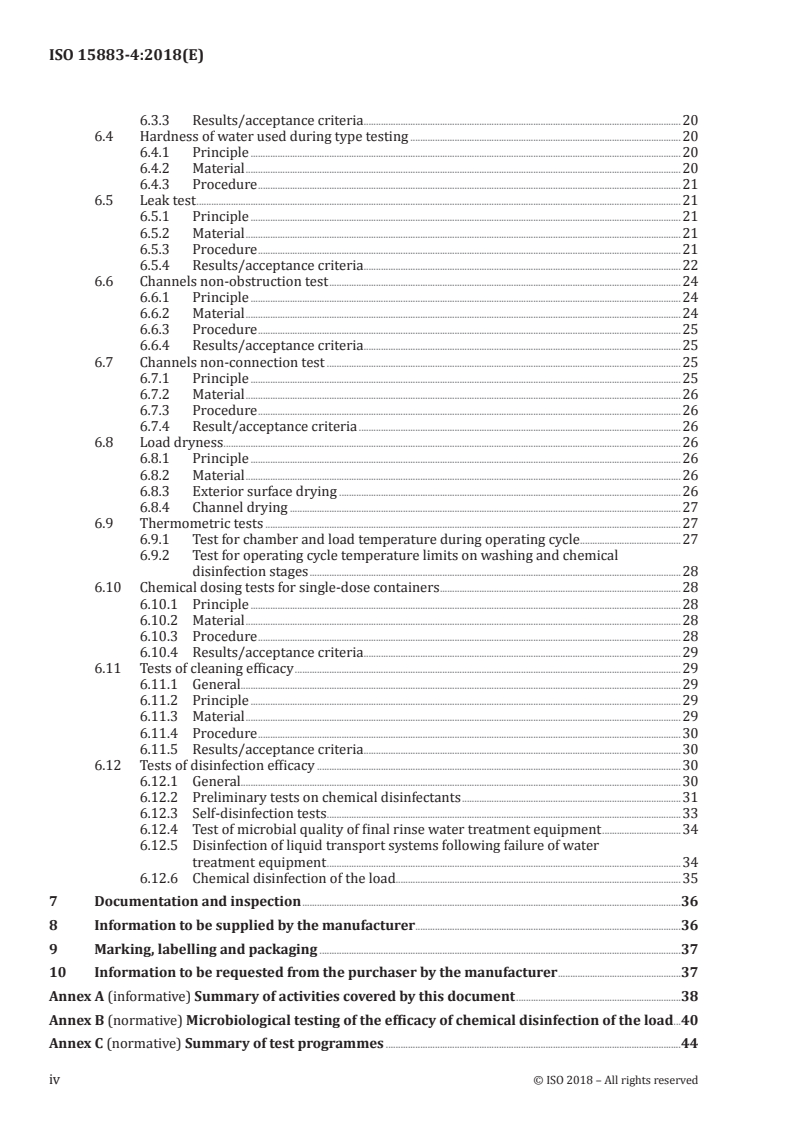
iv © ISO 2018 – All rights reserved
Annex D (normative) Methods for microbiological evaluation of disinfection of liquid
transport system.48
Annex E (normative) Tests for microbial contamination of final rinse water.53
Annex F (informative) Additional notes on microbiological testing of chemical disinfection
processes .55
Annex G (informative) Typical specifications of trumpet valves and connection ports .57
Annex H (normative) Establishing endoscope type test groups .63
Annex I (informative) Establishing endoscope product families .76
Bibliography .80
Foreword
ISO (the International Organization for Standardization) is a worldwide federation of national standards
bodies (ISO member bodies). The work of preparing International Standards is normally carried out
through ISO technical committees. Each member body interested in a subject for which a technical
committee has been established has the right to be represented on that committee. International
organizations, governmental and non-governmental, in liaison with ISO, also take part in the work.
ISO collaborates closely with the International Electrotechnical Commission (IEC) on all matters of
electrotechnical standardization.
The procedures used to develop this document and those intended for its further maintenance are
described in the ISO/IEC Directives, Part 1. In particular, the different approval criteria needed for the
different types of ISO documents should be noted. This document was drafted in accordance with the
editorial rules of the ISO/IEC Directives, Part 2 (see www .iso .org/directives).
Attention is drawn to the possibility that some of the elements of this document may be the subject of
patent rights. ISO shall not be held responsible for identifying any or all such patent rights. Details of
any patent rights identified during the development of the document will be in the Introduction and/or
on the ISO list of patent declarations received (see www .iso .org/patents).
Any trade name used in this document is information given for the convenience of users and does not
constitute an endorsement.
For an explanation of the voluntary nature of standards, the meaning of ISO specific terms and
expressions related to conformity assessment, as well as information about ISO's adherence to the
World Trade Organization (WTO) principles in the Technical Barriers to Trade (TBT) see www .iso
.org/iso/foreword .html.
This document was prepared by Technical Committee ISO/TC 198, Sterilization of health care products.
This second edition cancels and replaces the first edition (ISO 15883-4:2008), which has been
technically revised. The main changes compared to the previous edition are as follows:
— additional annexes for establishing endoscope type test groups and endoscope product families
have been included.
A list of all the parts in the ISO 15883 series can be found on the ISO website.
Any feedback or questions on this document should be directed to the user’s national standards body. A
complete listing of these bodies can be found at www .iso .org/members .html.
vi © ISO 2018 – All rights reserved
Introduction
This introduction is intended to be read in conjunction with the introduction to ISO 15883-1.
The washer-disinfectors specified in this document are intended to process devices that can be
immersed in water or aqueous solutions. For some devices this will require that, prior to processing,
relevant parts of the device are protected from immersion in accordance with the device manufacturer’s
operating instructions.
Fields of application within the scope of the ISO series include laboratory, veterinary, dental and
pharmaceutical applications and other specific applications, such as washer-disinfectors for bedsteads
and transport carts and the disinfection of crockery and cutlery intended for use with immunologically
compromised patients.
Requirements for washer-disinfectors for other applications are specified in other parts of ISO 15883.
Safety requirements for washer-disinfectors are given in IEC 61010-2-040.
In respect of the potential adverse effects on the quality of water intended for human consumption
caused by the washer-disinfector and its intended use, it is noteworthy that:
a) until verifiable international criteria are adopted, the existing national regulations concerning the
use and/or characteristics of the washer-disinfectors remain in force, and
b) the ISO 15883 series provides no information as to whether the washer-disinfectors can be used
without restriction in any of the ISO member states.
INTERNATIONAL STANDARD ISO 15883-4:2018(E)
Washer-disinfectors —
Part 4:
Requirements and tests for washer-disinfectors employing
chemical disinfection for thermolabile endoscopes
1 Scope
This document specifies the particular requirements, including performance criteria for washer-
disinfectors (WD) that are intended to be used for cleaning and chemical disinfection of thermolabile
endoscopes.
This document also specifies the performance requirements for the cleaning and disinfection of the
washer-disinfector and its components and accessories which can be required to achieve the necessary
performance criteria.
The methods, instrumentation and instructions required for type testing, works testing, validation
(installation, operational and performance qualification on first installation), routine control and
monitoring, and requalification of WD periodically and after essential repairs, are also specified.
NOTE 1 In addition, Annex A gives guidance on an appropriate division of responsibility for the range of
activities covered by this document.
NOTE 2 WD complying with this document can also be used for cleaning and chemical disinfection of other
thermolabile re-usable medical devices for which the device manufacturer has recommended and validated this
method of disinfection.
WD complying with the requirements of this document are not intended for cleaning and disinfection
of medical devices, including endoscopic accessories, which are heat stable and can be disinfected or
sterilized by thermal methods (see ISO 15883-1:2006+Amd 1:2014, 4.1.5).
The specified performance requirements of this document do not ensure the inactivation or removal of
the causative agent(s) (prion protein) of transmissible spongiform encephalopathies.
NOTE 3 If it is considered that prion protein might be present, particular care is needed in the choice of
cleaning agents and disinfectants to ensure that the chemicals used do not react with the prion protein and/or
other protein in a manner that can inhibit its removal or inactivation from the load or washer-disinfector.
NOTE 4 This document can be used by prospective purchasers and manufacturers as the basis of agreement
on the specification of the WD, manufacturers of endoscopes, cleaning products, and disinfecting products.
2 Normative references
The following documents are referred to in the text in such a way that some or all of their content
constitutes requirements of this document. For dated references, only the edition cited applies. For
undated references, the latest edition of the referenced document (including any amendments) applies.
ISO 14971, Medical devices — Application of risk management to medical devices
ISO 15883-1:2006+Amd 1:2014, Washer-disinfectors — Part 1: General requirements, terms and definitions
and tests
ISO/TS 15883-5:2005, Washer-disinfectors — Part 5: Test soils and methods for demonstrating cleaning
efficacy
IEC 61010-2-040, Safety requirements for electrical equipment for measurement, control, and laboratory
use — Part 2-040: Particular requirements for sterilizers and washer-disinfectors used to treat medical
materials
EN 12353, Chemical disinfectants and antiseptics — Preservation of test organisms used for the
determination of bactericidal (including Legionella), mycobactericidal, sporicidal, fungicidal and virucidal
(including bacteriophages) activity
EN 13727, Chemical disinfectants and antiseptics — Quantitative suspension test for the evaluation of
bactericidal activity in the medical area — Test method and requirements (phase 2, step 1)
3 Terms and definitions
For the purposes of this document, the terms and definitions given in ISO 15883-1 and the following apply.
ISO and IEC maintain terminological databases for use in standardization at the following addresses:
— ISO Online browsing platform: available at http: //www .iso .org/obp
— IEC Electropedia: available at http: //www .electropedia .org/
3.1
air break
physical separation in water supply pipes to prevent back flow from equipment
[SOURCE: ISO 11139:2018, 3.8]
3.2
analyte
chemical substance that is the subject of chemical analysis
[SOURCE: ISO 11139:2018, 3.12]
3.3
block
group of channels comprising part of an endoscope with specified lengths, diameters and
interconnections
[SOURCE: ISO 11139:2018, 3.30]
3.4
channel separator
device used to keep apart interconnected fluid pathways
EXAMPLE A device inserted in a trumpet valve cylinder where multiple channels meet in order to separate
the air and water pathways in the air/water valve assembly.
[SOURCE: ISO 11139:2018, 3.40]
3.5
colony forming unit
CFU
visible aggregation of microorganisms arising from a single cell or multiple cells
[SOURCE: ISO 11139:2018, 3.53]
3.6
disinfecting agent
physical or chemical agent used for disinfection
[SOURCE: ISO 11139:2018, 3.83]
2 © ISO 2018 – All rights reserved
3.7
disinfection
process to inactivate viable microorganisms to a level previously specified as appropriate for a
defined purpose
[SOURCE: ISO 11139:2018, 3.84]
3.8
endoscope connector
device to interface with the fluid entry port of a channel of an endoscope that, where applicable, includes
the tubing connected to the channel irrigation system of the washer-disinfector
[SOURCE: ISO 11139:2018, 3.94]
3.9
endoscope leak test
set of actions to identify a loss of integrity
Note 1 to entry: The test is intended to establish that the surface covering the device and/or lining a device
channel is intact to the extent necessary to maintain a slightly positive pressure.
[SOURCE: ISO 11139:2018, 3.95, modified — Note 1 to entry has been added.]
3.10
endoscope port
part of an endoscope to which the irrigation system of the washer-disinfector is connected to irrigate
all or part of a channel
[SOURCE: ISO 11139:2018, 3.96]
3.11
endoscope product family
group of endoscopes with comparable design, including the number, construction and purpose of the
different endoscope channels
[SOURCE: ISO 11139:2018, 3.97]
3.12
endoscope surrogate device
item designed to represent construction elements of endoscope specific characteristics affecting the
flow conditions in endoscope channels
Note 1 to entry: Elements can include channel length and diameter, connectors, channel separators, port closures,
return valves, etc.
[SOURCE: ISO 11139:2018, 3.98]
3.13
endoscope type test group
endoscopes for which the general channel design and specific characteristics affecting the flow
conditions in the endoscope are similar
Note 1 to entry: The general channel design includes lengths and diameters. Characteristics affecting the flow
conditions in the endoscope are, for example, connectors, channel separators, port closures, return valves.
Note 2 to entry: Similar implies that small variations can be possible. Endoscopes that show small variations in
channel specifications that do not lead to a significant variation in the flow and pressure characteristic through
the channels could be in the same endoscope type test group.
[SOURCE: ISO 11139:2018, 3.99]
3.14
inoculated carrier
supporting material on or in which a specified number of viable test microorganisms has been deposited
[SOURCE: ISO 11139:2018, 3.144]
3.15
irrigation plan
stipulated direction of flow of process fluids through the specified
channels of an endoscope
[SOURCE: ISO 11139:2018, 3.148]
3.16
liquid transport systems
components of equipment used to store, pump or transport water and/or
solutions, excluding pipework before the air break
[SOURCE: ISO 11139:2018, 3.154]
3.17
microbial inactivation factor
measured change in microbial population caused by the lethal effect of the disinfection or
sterilization process
Note 1 to entry: It is expressed as log .
[SOURCE: ISO 11139:2018, 3.173]
3.18
microbial reduction factor
extent to which the bioburden is reduced in tenfold increments
Note 1 to entry: It is expressed as log .
Note 2 to entry: This can be caused by the combination of the microbial inactivation factor and the physical
removal of microorganisms.
[SOURCE: ISO 11139:2018, 3.174, modified — Note 2 to entry has been added.]
3.19
microbial resistance
ability of a microorganism or population of microorganisms to withstand a microbial reduction process
Note 1 to entry: This refers to resistance of microorganisms to disinfectants used in a WD.
[SOURCE: ISO 11139:2018, 3.175, modified — Note 1 to entry has been added.]
3.20
minimum effective concentration
MEC
lowest concentration of a chemical or product, used in a specified process, that achieves a claimed
activity
[SOURCE: ISO 11139:2018, 3.177]
3.21
minimum recommended concentration
MRC
lowest concentration of a chemical or product specified for use in a process
[SOURCE: ISO 11139:2018, 3.178]
4 © ISO 2018 – All rights reserved
3.22
obstruction
partial or complete blockage
[SOURCE: ISO 11139:2018, 3.187]
3.23
port closure
device to close an endoscope port during processing in order to maintain the flow of
process fluids throughout the length of the endoscope
EXAMPLE To close the suction valve port.
[SOURCE: ISO 11139:2018, 3.198]
3.24
self-disinfection cycle
operating cycle intended to disinfect all liquid transport systems’ piping, chamber(s), tanks and other
components which come into contact with the water and/or solutions used for cleaning, disinfecting
and rinsing the load
Note 1 to entry: The self-disinfection cycle is used without a load in a washer-disinfector.
[SOURCE: ISO 11139:2018, 3.249]
3.25
thermolabile
readily damaged by heat
[SOURCE: ISO 11139:2018, 3.302]
3.26
washer-disinfector accessory
items or attachments, including connectors, required to process a medical device in a washer-disinfector
[SOURCE: ISO 11139:2018, 3.320]
4 Performance requirements
4.1 General
4.1.1 The WD shall conform to ISO 15883-1:2006+Amd 1:2014 with the exception of the following
subclauses:
a) 4.2.3 (washing stage, modified by 4.3.3 of this document);
b) 4.3.1 (specification for thermal disinfection of the load carrier and chamber walls during a standard
cleaning and disinfection cycle is not applicable to this document);
c) 4.3.3 (chemical and thermal disinfection, modified by 5.4 of this document);
d) 5.3.2.5 (microbial quality of final rinse water, modified by 4.5 of this document);
e) 5.11.4 (process verification, modified by 5.6 of this document);
f) 6.4.2.1 (test for quality of final rinse water – sampling, modified by 6.3 and Annex E of this
document);
g) 6.5.6 (test for chamber venting to prevent pressurization by steam is not applicable to this
document);
h) 6.8.2 (load temperature test, modified by 6.9.1 of this document);
i) 6.8.3 (chamber wall temperature test, replaced by 6.9.1 of this document);
j) 6.10.2 (cleaning efficacy test 1; modified by 6.11 of this document).
Means shall be provided to position temperature sensors for test purposes. Depending on the type of
washer design the manufacturer can decide to follow ISO 15883-1:2006+Amd 1:2014, 5.1.11 or provide
an alternative solution better fit to the purpose.
4.1.2 Each device, including any device channels and/or cavities, shall be processed by the WD as
follows:
a) leak testing (where appropriate) in accordance with 4.2;
b) cleaning (which may include several stages) in accordance with 4.3;
c) disinfecting in accordance with 4.4;
d) final rinsing in accordance with 4.5;
e) purging of rinse water in accordance with 4.6;
f) drying (when appropriate) in accordance with 4.7.
4.1.3 After the complete process in the WD the endoscope shall be safe for its intended use. The
combination of the cleaning, disinfection and rinsing process shall be designed to achieve this condition,
recognizing the high level of microbial and other contamination that might exist, see References [33],
[34] and [35]. It shall be necessary to take into account other factors such as the design of connectors.
This capability shall be demonstrated during type testing for endoscopes that the WD is designed to
process [see also 8 a), 8 b) and 8 c)].
Where the disinfection of the water supplied to the WD is performed by adding a low dosage of a
disinfectant to the water, compliance with this document shall be demonstrated with and without
the water disinfectant. Any variation in water disinfectant concentration due to local environmental
conditions that might change the result of the test shall be taken into account.
Demonstration of the capability of the complete cycle efficacy shall be provided during additional type
testing by employing a modification of the methods described in Annex B with added test soil and/or
ISO/TS 15883-5:2005, Annex I, using the organism(s) previously established during in vitro tests as
most resistant to the disinfectant under in-use conditions and on endoscopes that are representative
for each relevant endoscope type test group [see 8 a) and Annex H].
According to the nature of the most resistant microorganism selected the minimum log reduction
obtained after a complete standard cycle for that microorganism(s) shall be:
— 9 log for vegetative bacteria;
— 6 log for fungal spores;
— 6 log for mycobacteria; or
— 4 log for bacterial endospores.
NOTE 1 In order to limit the work load the type tests can be performed on representative endoscopes from
endoscope type test groups (see Annex H to establish relevant endoscope type test groups).
NOTE 2 The efficacy of the process (including cleaning and disinfection) depends on a number of factors which
include:
a) the nature (characteristics) of the device being processed;
b) the extent and nature of the soiling to be removed;
6 © ISO 2018 – All rights reserved
c) the temperature of the process;
d) the mechanical energy (type, output);
e) purging to remove rinse water;
f) the detergent system;
g) the nature, volume, concentration and temperature of the cleaning and disinfectant solutions and their
ability to wet the surfaces to be cleaned and disinfected;
h) the duration of the various process stages;
i) the removal of suspended soil.
4.1.4 The instructions for use of the WD shall recommend that the actions necessary to ensure effective
and safe processing of the endoscope and its accessories in the WD be followed, e.g. leak testing, any pre-
treatment, manual cleaning and/or disassembly, of the endoscope [see 8 k) 8)].
It shall be specified, which of the pre-treatment steps, as listed in the endoscope manufacturer’s
processing instructions for use, shall be performed in order to ensure effective and safe processing of
the endoscope.
NOTE National guidelines can require certain pre-cleaning steps (e.g. brushing of endoscopes channels prior
to processing inside WD).
4.1.5 The value of any process variable that affects the efficacy of the cycle shall be pre-set and
adjustment shall require the use of a key, code or tool (see also ISO 15883-1:2006+Amd 1:2014, 5.18.3,
5.18.8 and 5.18.12).
4.1.6 The means to control the total volume of water admitted per stage shall be controlled to a
manufacturer defined level of accuracy.
4.1.7 The means to control the volume of process chemicals admitted shall deliver the set volume to an
accuracy of ± 5 % or better.
4.1.8 When the WD uses two or more different process chemicals, means other than labelling and/or
colour coding alone of connectors, containers and/or tubing, shall be provided to ensure that connection
is made to the correct container of process chemical.
4.1.9 The instructions for use of the WD shall include a recommendation that heat-stable endoscopic
accessories for thermolabile medical devices should be thermally disinfected and/or sterilized.
4.1.10 The design of the washer-disinfector or any device or washer-disinfector accessories provided
with the WD shall not impair the quality of the water supplying the WD.
4.2 Systems for leak testing
4.2.1 These requirements shall apply only to WD intended to process endoscopes that require a test to
verify that the device is watertight.
NOTE This test is intended to demonstrate that the endoscope will not be damaged by liquid ingress during
the WD operating cycle. It is regarded only as a test of the integrity of the endoscope when all parameters of
the WD leak test (e.g. pressure, duration, maximum leak accepted) are consistent with those specified for the
endoscope.
4.2.2 The WD shall be provided with either:
a) means to carry out an automatic leak test on the endoscope which shall be completed before the
load comes into contact with process fluids in the WD;
or
b) instructions for use that include the requirement to carry out the test manually prior to processing
through the WD.
NOTE 1 An alternative method specified for the endoscope can be used for determining the integrity of the
endoscope when appropriate.
NOTE 2 WD with an automatic leak test can include a user selectable option to repeat the leak test at the end
of the process and/or independently of a normal process cycle.
NOTE 3 An automated leak test is the preferred option.
4.2.3 For WD having an automatic leak test, the automatic controller shall prevent the continuation
of the operating cycle and operate an audible and visible alarm indicating a leak test failure if a leak is
detected in an endoscope.
Variations in temperature that might adversely affect the sensitivity of the leak test and the temperature
range permitted in the WD during the automatic leak test, if fitted, shall be stated [see 8 g)].
NOTE 1 A leak test failure indicates that the device is likely to be damaged by further processing. However,
a satisfactory leak test does not provide absolute assurance that the device will not be damaged by furthe
...
INTERNATIONAL ISO
STANDARD 15883-4
Second edition
2018-11
Washer-disinfectors —
Part 4:
Requirements and tests for washer-
disinfectors employing chemical
disinfection for thermolabile
endoscopes
Laveurs désinfecteurs —
Partie 4: Exigences et essais pour les laveurs désinfecteurs destinés à
la désinfection chimique des endoscopes thermolabiles
Reference number
©
ISO 2018
© ISO 2018
All rights reserved. Unless otherwise specified, or required in the context of its implementation, no part of this publication may
be reproduced or utilized otherwise in any form or by any means, electronic or mechanical, including photocopying, or posting
on the internet or an intranet, without prior written permission. Permission can be requested from either ISO at the address
below or ISO’s member body in the country of the requester.
ISO copyright office
CP 401 • Ch. de Blandonnet 8
CH-1214 Vernier, Geneva
Phone: +41 22 749 01 11
Fax: +41 22 749 09 47
Email: copyright@iso.org
Website: www.iso.org
Published in Switzerland
ii © ISO 2018 – All rights reserved
Contents Page
Foreword .vi
Introduction .vii
1 Scope . 1
2 Normative references . 1
3 Terms and definitions . 2
4 Performance requirements . 5
4.1 General . 5
4.2 Systems for leak testing . 7
4.3 Cleaning . 9
4.3.1 General. 9
4.3.2 Flushing . 9
4.3.3 Washing . 9
4.3.4 Post-washing rinsing . 9
4.3.5 Determination of cleaning efficacy .10
4.4 Disinfecting .10
4.4.1 General.10
4.4.2 Efficacy of the disinfectant .10
4.4.3 Temperature .11
4.4.4 Process monitoring .11
4.4.5 Disinfectant use .11
4.5 Final rinsing .12
4.6 Purging to remove rinse water .12
4.7 Drying .13
4.8 Self-disinfection .13
4.9 Water treatment equipment.14
4.9.1 General.14
4.9.2 Disinfection of water treatment equipment .14
4.9.3 Maintenance of piping .15
5 Mechanical and process requirements .15
5.1 Materials ― Design, manufacture and construction .15
5.2 Device channel irrigation system .16
5.2.1 General.16
5.2.2 Verification of device channel irrigation by the automatic controller .17
5.3 Venting and drainage systems .17
5.4 Temperature control .17
5.4.1 General.17
5.4.2 Temperature control of the washing stage .18
5.4.3 Temperature control of the disinfection stage .18
5.4.4 WD with a minimum operating temperature for the washing and/or
disinfection stage . .18
5.5 Process chemicals .18
5.6 Process verification .18
5.7 Dosing systems .19
6 Testing for conformity .19
6.1 General .19
6.2 Test equipment .19
6.2.1 General.19
6.2.2 Pressure measurement .19
6.2.3 Flow measurement .19
6.3 Water used for final rinsing .20
6.3.1 Principle .20
6.3.2 Material/procedure .20
6.3.3 Results/acceptance criteria .20
6.4 Hardness of water used during type testing .20
6.4.1 Principle .20
6.4.2 Material .20
6.4.3 Procedure .21
6.5 Leak test .21
6.5.1 Principle .21
6.5.2 Material .21
6.5.3 Procedure .21
6.5.4 Results/acceptance criteria .22
6.6 Channels non-obstruction test .24
6.6.1 Principle .24
6.6.2 Material .24
6.6.3 Procedure .25
6.6.4 Results/acceptance criteria .25
6.7 Channels non-connection test .25
6.7.1 Principle .25
6.7.2 Material .26
6.7.3 Procedure .26
6.7.4 Result/acceptance criteria .26
6.8 Load dryness .26
6.8.1 Principle .26
6.8.2 Material .26
6.8.3 Exterior surface drying .26
6.8.4 Channel drying .27
6.9 Thermometric tests .27
6.9.1 Test for chamber and load temperature during operating cycle .27
6.9.2 Test for operating cycle temperature limits on washing and chemical
disinfection stages .28
6.10 Chemical dosing tests for single-dose containers .28
6.10.1 Principle .28
6.10.2 Material .28
6.10.3 Procedure .28
6.10.4 Results/acceptance criteria .29
6.11 Tests of cleaning efficacy .29
6.11.1 General.29
6.11.2 Principle .29
6.11.3 Material .29
6.11.4 Procedure .30
6.11.5 Results/acceptance criteria .30
6.12 Tests of disinfection efficacy .30
6.12.1 General.30
6.12.2 Preliminary tests on chemical disinfectants .31
6.12.3 Self-disinfection tests .33
6.12.4 Test of microbial quality of final rinse water treatment equipment .34
6.12.5 Disinfection of liquid transport systems following failure of water
treatment equipment .34
6.12.6 Chemical disinfection of the load.35
7 Documentation and inspection .36
8 Information to be supplied by the manufacturer .36
9 Marking, labelling and packaging .37
10 Information to be requested from the purchaser by the manufacturer .37
Annex A (informative) Summary of activities covered by this document .38
Annex B (normative) Microbiological testing of the efficacy of chemical disinfection of the load .40
Annex C (normative) Summary of test programmes .44
iv © ISO 2018 – All rights reserved
Annex D (normative) Methods for microbiological evaluation of disinfection of liquid
transport system.48
Annex E (normative) Tests for microbial contamination of final rinse water.53
Annex F (informative) Additional notes on microbiological testing of chemical disinfection
processes .55
Annex G (informative) Typical specifications of trumpet valves and connection ports .57
Annex H (normative) Establishing endoscope type test groups .63
Annex I (informative) Establishing endoscope product families .76
Bibliography .80
Foreword
ISO (the International Organization for Standardization) is a worldwide federation of national standards
bodies (ISO member bodies). The work of preparing International Standards is normally carried out
through ISO technical committees. Each member body interested in a subject for which a technical
committee has been established has the right to be represented on that committee. International
organizations, governmental and non-governmental, in liaison with ISO, also take part in the work.
ISO collaborates closely with the International Electrotechnical Commission (IEC) on all matters of
electrotechnical standardization.
The procedures used to develop this document and those intended for its further maintenance are
described in the ISO/IEC Directives, Part 1. In particular, the different approval criteria needed for the
different types of ISO documents should be noted. This document was drafted in accordance with the
editorial rules of the ISO/IEC Directives, Part 2 (see www .iso .org/directives).
Attention is drawn to the possibility that some of the elements of this document may be the subject of
patent rights. ISO shall not be held responsible for identifying any or all such patent rights. Details of
any patent rights identified during the development of the document will be in the Introduction and/or
on the ISO list of patent declarations received (see www .iso .org/patents).
Any trade name used in this document is information given for the convenience of users and does not
constitute an endorsement.
For an explanation of the voluntary nature of standards, the meaning of ISO specific terms and
expressions related to conformity assessment, as well as information about ISO's adherence to the
World Trade Organization (WTO) principles in the Technical Barriers to Trade (TBT) see www .iso
.org/iso/foreword .html.
This document was prepared by Technical Committee ISO/TC 198, Sterilization of health care products.
This second edition cancels and replaces the first edition (ISO 15883-4:2008), which has been
technically revised. The main changes compared to the previous edition are as follows:
— additional annexes for establishing endoscope type test groups and endoscope product families
have been included.
A list of all the parts in the ISO 15883 series can be found on the ISO website.
Any feedback or questions on this document should be directed to the user’s national standards body. A
complete listing of these bodies can be found at www .iso .org/members .html.
vi © ISO 2018 – All rights reserved
Introduction
This introduction is intended to be read in conjunction with the introduction to ISO 15883-1.
The washer-disinfectors specified in this document are intended to process devices that can be
immersed in water or aqueous solutions. For some devices this will require that, prior to processing,
relevant parts of the device are protected from immersion in accordance with the device manufacturer’s
operating instructions.
Fields of application within the scope of the ISO series include laboratory, veterinary, dental and
pharmaceutical applications and other specific applications, such as washer-disinfectors for bedsteads
and transport carts and the disinfection of crockery and cutlery intended for use with immunologically
compromised patients.
Requirements for washer-disinfectors for other applications are specified in other parts of ISO 15883.
Safety requirements for washer-disinfectors are given in IEC 61010-2-040.
In respect of the potential adverse effects on the quality of water intended for human consumption
caused by the washer-disinfector and its intended use, it is noteworthy that:
a) until verifiable international criteria are adopted, the existing national regulations concerning the
use and/or characteristics of the washer-disinfectors remain in force, and
b) the ISO 15883 series provides no information as to whether the washer-disinfectors can be used
without restriction in any of the ISO member states.
INTERNATIONAL STANDARD ISO 15883-4:2018(E)
Washer-disinfectors —
Part 4:
Requirements and tests for washer-disinfectors employing
chemical disinfection for thermolabile endoscopes
1 Scope
This document specifies the particular requirements, including performance criteria for washer-
disinfectors (WD) that are intended to be used for cleaning and chemical disinfection of thermolabile
endoscopes.
This document also specifies the performance requirements for the cleaning and disinfection of the
washer-disinfector and its components and accessories which can be required to achieve the necessary
performance criteria.
The methods, instrumentation and instructions required for type testing, works testing, validation
(installation, operational and performance qualification on first installation), routine control and
monitoring, and requalification of WD periodically and after essential repairs, are also specified.
NOTE 1 In addition, Annex A gives guidance on an appropriate division of responsibility for the range of
activities covered by this document.
NOTE 2 WD complying with this document can also be used for cleaning and chemical disinfection of other
thermolabile re-usable medical devices for which the device manufacturer has recommended and validated this
method of disinfection.
WD complying with the requirements of this document are not intended for cleaning and disinfection
of medical devices, including endoscopic accessories, which are heat stable and can be disinfected or
sterilized by thermal methods (see ISO 15883-1:2006+Amd 1:2014, 4.1.5).
The specified performance requirements of this document do not ensure the inactivation or removal of
the causative agent(s) (prion protein) of transmissible spongiform encephalopathies.
NOTE 3 If it is considered that prion protein might be present, particular care is needed in the choice of
cleaning agents and disinfectants to ensure that the chemicals used do not react with the prion protein and/or
other protein in a manner that can inhibit its removal or inactivation from the load or washer-disinfector.
NOTE 4 This document can be used by prospective purchasers and manufacturers as the basis of agreement
on the specification of the WD, manufacturers of endoscopes, cleaning products, and disinfecting products.
2 Normative references
The following documents are referred to in the text in such a way that some or all of their content
constitutes requirements of this document. For dated references, only the edition cited applies. For
undated references, the latest edition of the referenced document (including any amendments) applies.
ISO 14971, Medical devices — Application of risk management to medical devices
ISO 15883-1:2006+Amd 1:2014, Washer-disinfectors — Part 1: General requirements, terms and definitions
and tests
ISO/TS 15883-5:2005, Washer-disinfectors — Part 5: Test soils and methods for demonstrating cleaning
efficacy
IEC 61010-2-040, Safety requirements for electrical equipment for measurement, control, and laboratory
use — Part 2-040: Particular requirements for sterilizers and washer-disinfectors used to treat medical
materials
EN 12353, Chemical disinfectants and antiseptics — Preservation of test organisms used for the
determination of bactericidal (including Legionella), mycobactericidal, sporicidal, fungicidal and virucidal
(including bacteriophages) activity
EN 13727, Chemical disinfectants and antiseptics — Quantitative suspension test for the evaluation of
bactericidal activity in the medical area — Test method and requirements (phase 2, step 1)
3 Terms and definitions
For the purposes of this document, the terms and definitions given in ISO 15883-1 and the following apply.
ISO and IEC maintain terminological databases for use in standardization at the following addresses:
— ISO Online browsing platform: available at http: //www .iso .org/obp
— IEC Electropedia: available at http: //www .electropedia .org/
3.1
air break
physical separation in water supply pipes to prevent back flow from equipment
[SOURCE: ISO 11139:2018, 3.8]
3.2
analyte
chemical substance that is the subject of chemical analysis
[SOURCE: ISO 11139:2018, 3.12]
3.3
block
group of channels comprising part of an endoscope with specified lengths, diameters and
interconnections
[SOURCE: ISO 11139:2018, 3.30]
3.4
channel separator
device used to keep apart interconnected fluid pathways
EXAMPLE A device inserted in a trumpet valve cylinder where multiple channels meet in order to separate
the air and water pathways in the air/water valve assembly.
[SOURCE: ISO 11139:2018, 3.40]
3.5
colony forming unit
CFU
visible aggregation of microorganisms arising from a single cell or multiple cells
[SOURCE: ISO 11139:2018, 3.53]
3.6
disinfecting agent
physical or chemical agent used for disinfection
[SOURCE: ISO 11139:2018, 3.83]
2 © ISO 2018 – All rights reserved
3.7
disinfection
process to inactivate viable microorganisms to a level previously specified as appropriate for a
defined purpose
[SOURCE: ISO 11139:2018, 3.84]
3.8
endoscope connector
device to interface with the fluid entry port of a channel of an endoscope that, where applicable, includes
the tubing connected to the channel irrigation system of the washer-disinfector
[SOURCE: ISO 11139:2018, 3.94]
3.9
endoscope leak test
set of actions to identify a loss of integrity
Note 1 to entry: The test is intended to establish that the surface covering the device and/or lining a device
channel is intact to the extent necessary to maintain a slightly positive pressure.
[SOURCE: ISO 11139:2018, 3.95, modified — Note 1 to entry has been added.]
3.10
endoscope port
part of an endoscope to which the irrigation system of the washer-disinfector is connected to irrigate
all or part of a channel
[SOURCE: ISO 11139:2018, 3.96]
3.11
endoscope product family
group of endoscopes with comparable design, including the number, construction and purpose of the
different endoscope channels
[SOURCE: ISO 11139:2018, 3.97]
3.12
endoscope surrogate device
item designed to represent construction elements of endoscope specific characteristics affecting the
flow conditions in endoscope channels
Note 1 to entry: Elements can include channel length and diameter, connectors, channel separators, port closures,
return valves, etc.
[SOURCE: ISO 11139:2018, 3.98]
3.13
endoscope type test group
endoscopes for which the general channel design and specific characteristics affecting the flow
conditions in the endoscope are similar
Note 1 to entry: The general channel design includes lengths and diameters. Characteristics affecting the flow
conditions in the endoscope are, for example, connectors, channel separators, port closures, return valves.
Note 2 to entry: Similar implies that small variations can be possible. Endoscopes that show small variations in
channel specifications that do not lead to a significant variation in the flow and pressure characteristic through
the channels could be in the same endoscope type test group.
[SOURCE: ISO 11139:2018, 3.99]
3.14
inoculated carrier
supporting material on or in which a specified number of viable test microorganisms has been deposited
[SOURCE: ISO 11139:2018, 3.144]
3.15
irrigation plan
stipulated direction of flow of process fluids through the specified
channels of an endoscope
[SOURCE: ISO 11139:2018, 3.148]
3.16
liquid transport systems
components of equipment used to store, pump or transport water and/or
solutions, excluding pipework before the air break
[SOURCE: ISO 11139:2018, 3.154]
3.17
microbial inactivation factor
measured change in microbial population caused by the lethal effect of the disinfection or
sterilization process
Note 1 to entry: It is expressed as log .
[SOURCE: ISO 11139:2018, 3.173]
3.18
microbial reduction factor
extent to which the bioburden is reduced in tenfold increments
Note 1 to entry: It is expressed as log .
Note 2 to entry: This can be caused by the combination of the microbial inactivation factor and the physical
removal of microorganisms.
[SOURCE: ISO 11139:2018, 3.174, modified — Note 2 to entry has been added.]
3.19
microbial resistance
ability of a microorganism or population of microorganisms to withstand a microbial reduction process
Note 1 to entry: This refers to resistance of microorganisms to disinfectants used in a WD.
[SOURCE: ISO 11139:2018, 3.175, modified — Note 1 to entry has been added.]
3.20
minimum effective concentration
MEC
lowest concentration of a chemical or product, used in a specified process, that achieves a claimed
activity
[SOURCE: ISO 11139:2018, 3.177]
3.21
minimum recommended concentration
MRC
lowest concentration of a chemical or product specified for use in a process
[SOURCE: ISO 11139:2018, 3.178]
4 © ISO 2018 – All rights reserved
3.22
obstruction
partial or complete blockage
[SOURCE: ISO 11139:2018, 3.187]
3.23
port closure
device to close an endoscope port during processing in order to maintain the flow of
process fluids throughout the length of the endoscope
EXAMPLE To close the suction valve port.
[SOURCE: ISO 11139:2018, 3.198]
3.24
self-disinfection cycle
operating cycle intended to disinfect all liquid transport systems’ piping, chamber(s), tanks and other
components which come into contact with the water and/or solutions used for cleaning, disinfecting
and rinsing the load
Note 1 to entry: The self-disinfection cycle is used without a load in a washer-disinfector.
[SOURCE: ISO 11139:2018, 3.249]
3.25
thermolabile
readily damaged by heat
[SOURCE: ISO 11139:2018, 3.302]
3.26
washer-disinfector accessory
items or attachments, including connectors, required to process a medical device in a washer-disinfector
[SOURCE: ISO 11139:2018, 3.320]
4 Performance requirements
4.1 General
4.1.1 The WD shall conform to ISO 15883-1:2006+Amd 1:2014 with the exception of the following
subclauses:
a) 4.2.3 (washing stage, modified by 4.3.3 of this document);
b) 4.3.1 (specification for thermal disinfection of the load carrier and chamber walls during a standard
cleaning and disinfection cycle is not applicable to this document);
c) 4.3.3 (chemical and thermal disinfection, modified by 5.4 of this document);
d) 5.3.2.5 (microbial quality of final rinse water, modified by 4.5 of this document);
e) 5.11.4 (process verification, modified by 5.6 of this document);
f) 6.4.2.1 (test for quality of final rinse water – sampling, modified by 6.3 and Annex E of this
document);
g) 6.5.6 (test for chamber venting to prevent pressurization by steam is not applicable to this
document);
h) 6.8.2 (load temperature test, modified by 6.9.1 of this document);
i) 6.8.3 (chamber wall temperature test, replaced by 6.9.1 of this document);
j) 6.10.2 (cleaning efficacy test 1; modified by 6.11 of this document).
Means shall be provided to position temperature sensors for test purposes. Depending on the type of
washer design the manufacturer can decide to follow ISO 15883-1:2006+Amd 1:2014, 5.1.11 or provide
an alternative solution better fit to the purpose.
4.1.2 Each device, including any device channels and/or cavities, shall be processed by the WD as
follows:
a) leak testing (where appropriate) in accordance with 4.2;
b) cleaning (which may include several stages) in accordance with 4.3;
c) disinfecting in accordance with 4.4;
d) final rinsing in accordance with 4.5;
e) purging of rinse water in accordance with 4.6;
f) drying (when appropriate) in accordance with 4.7.
4.1.3 After the complete process in the WD the endoscope shall be safe for its intended use. The
combination of the cleaning, disinfection and rinsing process shall be designed to achieve this condition,
recognizing the high level of microbial and other contamination that might exist, see References [33],
[34] and [35]. It shall be necessary to take into account other factors such as the design of connectors.
This capability shall be demonstrated during type testing for endoscopes that the WD is designed to
process [see also 8 a), 8 b) and 8 c)].
Where the disinfection of the water supplied to the WD is performed by adding a low dosage of a
disinfectant to the water, compliance with this document shall be demonstrated with and without
the water disinfectant. Any variation in water disinfectant concentration due to local environmental
conditions that might change the result of the test shall be taken into account.
Demonstration of the capability of the complete cycle efficacy shall be provided during additional type
testing by employing a modification of the methods described in Annex B with added test soil and/or
ISO/TS 15883-5:2005, Annex I, using the organism(s) previously established during in vitro tests as
most resistant to the disinfectant under in-use conditions and on endoscopes that are representative
for each relevant endoscope type test group [see 8 a) and Annex H].
According to the nature of the most resistant microorganism selected the minimum log reduction
obtained after a complete standard cycle for that microorganism(s) shall be:
— 9 log for vegetative bacteria;
— 6 log for fungal spores;
— 6 log for mycobacteria; or
— 4 log for bacterial endospores.
NOTE 1 In order to limit the work load the type tests can be performed on representative endoscopes from
endoscope type test groups (see Annex H to establish relevant endoscope type test groups).
NOTE 2 The efficacy of the process (including cleaning and disinfection) depends on a number of factors which
include:
a) the nature (characteristics) of the device being processed;
b) the extent and nature of the soiling to be removed;
6 © ISO 2018 – All rights reserved
c) the temperature of the process;
d) the mechanical energy (type, output);
e) purging to remove rinse water;
f) the detergent system;
g) the nature, volume, concentration and temperature of the cleaning and disinfectant solutions and their
ability to wet the surfaces to be cleaned and disinfected;
h) the duration of the various process stages;
i) the removal of suspended soil.
4.1.4 The instructions for use of the WD shall recommend that the actions necessary to ensure effective
and safe processing of the endoscope and its accessories in the WD be followed, e.g. leak testing, any pre-
treatment, manual cleaning and/or disassembly, of the endoscope [see 8 k) 8)].
It shall be specified, which of the pre-treatment steps, as listed in the endoscope manufacturer’s
processing instructions for use, shall be performed in order to ensure effective and safe processing of
the endoscope.
NOTE National guidelines can require certain pre-cleaning steps (e.g. brushing of endoscopes channels prior
to processing inside WD).
4.1.5 The value of any process variable that affects the efficacy of the cycle shall be pre-set and
adjustment shall require the use of a key, code or tool (see also ISO 15883-1:2006+Amd 1:2014, 5.18.3,
5.18.8 and 5.18.12).
4.1.6 The means to control the total volume of water admitted per stage shall be controlled to a
manufacturer defined level of accuracy.
4.1.7 The means to control the volume of process chemicals admitted shall deliver the set volume to an
accuracy of ± 5 % or better.
4.1.8 When the WD uses two or more different process chemicals, means other than labelling and/or
colour coding alone of connectors, containers and/or tubing, shall be provided to ensure that connection
is made to the correct container of process chemical.
4.1.9 The instructions for use of the WD shall include a recommendation that heat-stable endoscopic
accessories for thermolabile medical devices should be thermally disinfected and/or sterilized.
4.1.10 The design of the washer-disinfector or any device or washer-disinfector accessories provided
with the WD shall not impair the quality of the water supplying the WD.
4.2 Systems for leak testing
4.2.1 These requirements shall apply only to WD intended to process endoscopes that require a test to
verify that the device is watertight.
NOTE This test is intended to demonstrate that the endoscope will not be damaged by liquid ingress during
the WD operating cycle. It is regarded only as a test of the integrity of the endoscope when all parameters of
the WD leak test (e.g. pressure, duration, maximum leak accepted) are consistent with those specified for the
endoscope.
4.2.2 The WD shall be provided with either:
a) means to carry out an automatic leak test on the endoscope which shall be completed before the
load comes into contact with process fluids in the WD;
or
b) instructions for use that include the requirement to carry out the test manually prior to processing
through the WD.
NOTE 1 An alternative method specified for the endoscope can be used for determining the integrity of the
endoscope when appropriate.
NOTE 2 WD with an automatic leak test can include a user selectable option to repeat the leak test at the end
of the process and/or independently of a normal process cycle.
NOTE 3 An automated leak test is the preferred option.
4.2.3 For WD having an automatic leak test, the automatic controller shall prevent the continuation
of the operating cycle and operate an audible and visible alarm indicating a leak test failure if a leak is
detected in an endoscope.
Variations in temperature that might adversely affect the sensitivity of the leak test and the temperature
range permitted in the WD during the automatic leak test, if fitted, shall be stated [see 8 g)].
NOTE 1 A leak test failure indicates that the device is likely to be damaged by further processing. However,
a satisfactory leak test does not provide absolute assurance that the device will not be damaged by furthe
...
NORME ISO
INTERNATIONALE 15883-4
Deuxième édition
2018-11
Laveurs désinfecteurs —
Partie 4:
Exigences et essais pour les
laveurs désinfecteurs destinés à la
désinfection chimique des endoscopes
thermolabiles
Washer-disinfectors —
Part 4: Requirements and tests for washer-disinfectors employing
chemical disinfection for thermolabile endoscopes
Numéro de référence
©
ISO 2018
DOCUMENT PROTÉGÉ PAR COPYRIGHT
© ISO 2018
Tous droits réservés. Sauf prescription différente ou nécessité dans le contexte de sa mise en œuvre, aucune partie de cette
publication ne peut être reproduite ni utilisée sous quelque forme que ce soit et par aucun procédé, électronique ou mécanique,
y compris la photocopie, ou la diffusion sur l’internet ou sur un intranet, sans autorisation écrite préalable. Une autorisation peut
être demandée à l’ISO à l’adresse ci-après ou au comité membre de l’ISO dans le pays du demandeur.
ISO copyright office
Case postale 401 • Ch. de Blandonnet 8
CH-1214 Vernier, Genève
Tél.: +41 22 749 01 11
Fax: +41 22 749 09 47
E-mail: copyright@iso.org
Web: www.iso.org
Publié en Suisse
ii © ISO 2018 – Tous droits réservés
Sommaire Page
Avant-propos .vi
Introduction .vii
1 Domaine d’application . 1
2 Références normatives . 1
3 Termes et définitions . 2
4 Exigences de performances. 6
4.1 Généralités . 6
4.2 Systèmes pour l’essai d’étanchéité . 8
4.3 Nettoyage . 9
4.3.1 Généralités . 9
4.3.2 Rinçage préliminaire . 9
4.3.3 Lavage . . .10
4.3.4 Rinçage intermédiaire .10
4.3.5 Détermination de l’efficacité du nettoyage .10
4.4 Désinfection .10
4.4.1 Généralités .10
4.4.2 Efficacité du désinfectant .11
4.4.3 Température .12
4.4.4 Surveillance du procédé .12
4.4.5 Utilisation du désinfectant .12
4.5 Rinçage final .13
4.6 Purge en vue de l’élimination de l’eau de rinçage .13
4.7 Séchage .14
4.8 Autodésinfection .14
4.9 Système de traitement de l’eau .15
4.9.1 Généralités .15
4.9.2 Désinfection du système de traitement de l’eau .15
4.9.3 Maintenance des canalisations .17
5 Exigences mécaniques et exigences relatives au procédé .17
5.1 Matériaux ― Conception, fabrication et construction .17
5.2 Système d’irrigation des canaux du dispositif .17
5.2.1 Généralités .17
5.2.2 Vérification de l’irrigation des canaux du dispositif par l’automate .18
5.3 Systèmes de mise à l’air et de vidange.19
5.4 Contrôle de la température .19
5.4.1 Généralités .19
5.4.2 Contrôle de la température de la phase de lavage .19
5.4.3 Contrôle de la température de la phase de désinfection .19
5.4.4 LD avec une température de fonctionnement minimale pour les phases de
lavage et/ou de désinfection.19
5.5 Produits chimiques du procédé .19
5.6 Vérification du procédé .20
5.7 Systèmes de dosage .20
6 Essais de conformité .20
6.1 Généralités .20
6.2 Équipement d’essai .21
6.2.1 Généralités .21
6.2.2 Mesurage de la pression .21
6.2.3 Mesurage du débit .21
6.3 Eau utilisée pour le rinçage final .21
6.3.1 Principe .21
6.3.2 Matériel/mode opératoire .21
6.3.3 Résultats/critères d’acceptation .21
6.4 Dureté de l’eau pour les essais de type .22
6.4.1 Principe .22
6.4.2 Matériel .22
6.4.3 Mode opératoire .22
6.5 Essai d’étanchéité .22
6.5.1 Principe .22
6.5.2 Matériel .23
6.5.3 Mode opératoire .23
6.5.4 Résultats/critères d’acceptation .23
6.6 Essai de non-obstruction des canaux .25
6.6.1 Principe .25
6.6.2 Matériel .25
6.6.3 Mode opératoire .26
6.6.4 Résultats/critères d’acceptation .26
6.7 Essai de détection des défauts de raccordement des canaux .26
6.7.1 Principe .26
6.7.2 Matériel .27
6.7.3 Mode opératoire .27
6.7.4 Résultat/critères d’acceptation .27
6.8 Séchage de la charge .27
6.8.1 Principe .27
6.8.2 Matériel .27
6.8.3 Séchage des surfaces extérieures .27
6.8.4 Séchage des canaux .28
6.9 Essais thermométriques .28
6.9.1 Essai de température de la cuve et de la charge lors du cycle de
fonctionnement .28
6.9.2 Vérification des limites de température du cycle de fonctionnement lors
des phases de lavage et de désinfection chimique .29
6.10 Essai de dosage des produits chimiques pour les récipients unidose .29
6.10.1 Principe .29
6.10.2 Matériel .29
6.10.3 Mode opératoire .29
6.10.4 Résultats/critères d’acceptation .30
6.11 Essais d’efficacité du nettoyage .30
6.11.1 Généralités .30
6.11.2 Principe .30
6.11.3 Matériel .30
6.11.4 Mode opératoire .31
6.11.5 Résultats/critères d’acceptation .32
6.12 Essais d’efficacité de la désinfection .32
6.12.1 Généralités .32
6.12.2 Essais préliminaires sur les désinfectants chimiques .32
6.12.3 Essais d’autodésinfection .34
6.12.4 Essai de la qualité microbienne du système de traitement de l’eau de
rinçage final .35
6.12.5 Désinfection des systèmes de transport des liquides après défaillance du
système de traitement de l’eau .36
6.12.6 Désinfection chimique de la charge .36
7 Documentation et inspection .37
8 Informations devant être fournies par le fabricant .37
9 Marquage, étiquetage, emballage .38
10 Informations demandées par le fabricant du LD à l’acheteur .38
Annexe A (informative) Récapitulatif des activités couvertes par le présent document .40
iv © ISO 2018 – Tous droits réservés
Annexe B (normative) Essais microbiologiques d’efficacité de la désinfection chimique
de la charge .42
Annexe C (normative) Récapitulatif des programmes d’essai .46
Annexe D (normative) Méthodes d’évaluation microbiologique de la désinfection du
système de transport des liquides .50
Annexe E (normative) Essais relatifs à la contamination microbienne de l’eau du rinçage final .55
Annexe F (informative) Notes complémentaires relatives aux essais microbiologiques sur
les procédés de désinfection chimique .57
Annexe G (informative) Spécifications types des cages à pistons et des orifices de raccordement 59
Annexe H (normative) Définition de groupes d’endoscopes pour essais de type .65
Annexe I (informative) Définition de familles d’endoscopes .75
Bibliographie .79
Avant-propos
L’ISO (Organisation internationale de normalisation) est une fédération mondiale d’organismes
nationaux de normalisation (comités membres de l’ISO). L’élaboration des Normes internationales est
en général confiée aux comités techniques de l’ISO. Chaque comité membre intéressé par une étude
a le droit de faire partie du comité technique créé à cet effet. Les organisations internationales,
gouvernementales et non gouvernementales, en liaison avec l’ISO participent également aux travaux.
L’ISO collabore étroitement avec la Commission électrotechnique internationale (IEC) en ce qui
concerne la normalisation électrotechnique.
Les procédures utilisées pour élaborer le présent document et celles destinées à sa mise à jour sont
décrites dans les Directives ISO/IEC, Partie 1. Il convient, en particulier de prendre note des différents
critères d’approbation requis pour les différents types de documents ISO. Le présent document a été
rédigé conformément aux règles de rédaction données dans les Directives ISO/IEC, Partie 2 (voir www
.iso. org/directives).
L’attention est attirée sur le fait que certains des éléments du présent document peuvent faire l’objet de
droits de propriété intellectuelle ou de droits analogues. L’ISO ne saurait être tenue pour responsable
de ne pas avoir identifié de tels droits de propriété et averti de leur existence. Les détails concernant
les références aux droits de propriété intellectuelle ou autres droits analogues identifiés lors de
l’élaboration du document sont indiqués dans l’Introduction et/ou dans la liste des déclarations de
brevets reçues par l’ISO (voir www. iso. org/brevets).
Les appellations commerciales éventuellement mentionnées dans le présent document sont données
pour information, par souci de commodité, à l’intention des utilisateurs et ne sauraient constituer un
engagement.
Pour une explication de la nature volontaire des normes, la signification des termes et expressions
spécifiques de l’ISO liés à l’évaluation de la conformité, ou pour toute information au sujet de l’adhésion
de l’ISO aux principes de l’Organisation mondiale du commerce (OMC) concernant les obstacles
techniques au commerce (OTC), voir le lien suivant: www. iso. org/iso/fr/avant- propos. html.
Le présent document a été élaboré par le comité technique ISO/TC 198, Stérilisation des produits de santé.
Cette deuxième édition annule et remplace la première édition (ISO 15883-4:2008), qui a fait l’objet
d’une révision technique. Les principales modifications par rapport à l’édition précédente sont les
suivantes:
— inclusion d’annexes supplémentaires pour définir les groupes d’endoscopes pour essais de type et
les familles d’endoscopes.
Une liste de toutes les parties de la série ISO 15883 se trouve sur le site Web de l’ISO.
Il convient que l’utilisateur adresse tout retour d’information ou toute question concernant le présent
document à l’organisme national de normalisation de son pays. Une liste exhaustive desdits organismes se
trouve à l’adresse www. iso. org/fr/members. html.
vi © ISO 2018 – Tous droits réservés
Introduction
Cette introduction est destinée à être lue conjointement avec l’introduction de l’ISO 15883-1.
Les laveurs désinfecteurs spécifiés dans le présent document sont destinés à traiter des dispositifs
qui peuvent être immergés dans l’eau ou dans des solutions aqueuses. Pour certains dispositifs, il sera
nécessaire de protéger, avant le traitement et conformément aux instructions du fabricant, les parties
du dispositif susceptibles d’être endommagées par cette immersion.
Le domaine d’application de la série de normes ISO inclut les laboratoires, la médecine vétérinaire, l’art
dentaire et la pharmacie, ainsi que d’autres applications spécifiques telles que les laveurs désinfecteurs
pour les châlits et les chariots et la désinfection de la vaisselle et des couverts destinés à être utilisés
avec des patients immunodéprimés.
Les exigences applicables aux laveurs désinfecteurs utilisés pour toute autre application sont spécifiées
dans les autres parties de l’ISO 15883.
Les exigences de sécurité pour les laveurs désinfecteurs sont spécifiées dans l’IEC 61010-2-040.
En ce qui concerne les éventuels effets indésirables des laveurs désinfecteurs et de leur usage prévu sur
la qualité de l’eau destinée à la consommation humaine, il est à noter que:
a) jusqu’à l’adoption de critères internationaux vérifiables, les réglementations nationales en vigueur
relatives à l’utilisation et/ou aux caractéristiques des laveurs désinfecteurs s’appliquent; et
b) la série de l’ISO 15883 ne fournit aucune information concernant l’existence de restrictions
d’utilisation pour les laveurs désinfecteurs dans les pays membres de l’ISO.
NORME INTERNATIONALE ISO 15883-4:2018(F)
Laveurs désinfecteurs —
Partie 4:
Exigences et essais pour les laveurs désinfecteurs destinés
à la désinfection chimique des endoscopes thermolabiles
1 Domaine d’application
Le présent document spécifie les exigences particulières, notamment les critères de performance,
relatives aux laveurs désinfecteurs (LD) destinés à être utilisés pour le nettoyage et la désinfection
chimique des endoscopes thermolabiles.
Le présent document spécifie également les exigences de performance relatives au nettoyage et à la
désinfection du laveur désinfecteur ainsi que de ses composants et accessoires qui peuvent être
nécessaires pour atteindre les critères de performance requis.
Les méthodes, l’instrumentation et les instructions nécessaires pour les essais de type, de
fonctionnement, la validation (qualification de l’installation, opérationnelle et des performances lors
de la première installation), le contrôle de routine, la surveillance et la requalification des LD réalisés
périodiquement et à la suite de réparations majeures sont également spécifiées.
NOTE 1 En outre, l’Annexe A donne des recommandations relatives à un partage approprié des responsabilités
en ce qui concerne les différentes activités traitées par le présent document.
NOTE 2 Les LD conformes au présent document peuvent également être utilisés pour le nettoyage et la
désinfection chimique d’autres dispositifs médicaux thermolabiles réutilisables pour lesquels le fabricant a
recommandé et validé cette méthode de désinfection.
Les LD conformes aux exigences du présent document ne sont pas destinés à être utilisés pour le
nettoyage et la désinfection des dispositifs médicaux, y compris les accessoires des endoscopes,
qui sont thermostables et qui peuvent être désinfectés ou stérilisés par des méthodes thermiques
(voir l’ISO 15883-1:2006+Amd 1:2014, 4.1.5).
Les exigences de performance spécifiées dans le présent document ne permettent pas de garantir
l’inactivation ou l’élimination du ou des agents pathogènes (protéine du prion) à l’origine des
encéphalopathies spongiformes transmissibles.
NOTE 3 En cas de suspicion d’une possible présence de la protéine de prion sur la charge à traiter, une
attention particulière est requise pour le choix des désinfectants et des détergents à employer afin de s’assurer
que les produits chimiques utilisés ne réagissent pas avec la protéine du prion et/ou toute autre protéine d’une
manière susceptible d’inhiber son inactivation ou son élimination de la charge ou du laveur désinfecteur.
NOTE 4 Le présent document peut être utilisé par des fabricants ou des acheteurs potentiels comme une base
d’accord entre les spécifications des fabricants de LD, d’endoscopes, de produits de nettoyage et de produits
désinfectants.
2 Références normatives
Les documents suivants cités dans le texte constituent, pour tout ou partie de leur contenu, des
exigences du présent document. Pour les références datées, seule l’édition citée s’applique. Pour les
références non datées, la dernière édition du document de référence s’applique (y compris les éventuels
amendements).
ISO 14971, Dispositifs médicaux — Application de la gestion des risques aux dispositifs médicaux
ISO 15883-1:2006+Amd 1:2014, Laveurs désinfecteurs — Partie 1: Exigences générales, termes et
définitions et essais
ISO/TS 15883-5:2005, Laveurs désinfecteurs — Partie 5: Essais de souillures et méthodes pour démontrer
l'efficacité de nettoyage
IEC 61010-2-040, Règles de sécurité pour appareils électriques de mesurage, de régulation et de
laboratoire — Partie 2-040: Exigences particulières pour stérilisateurs et laveurs désinfecteurs utilisés
pour traiter le matériel médical
EN 12353, Antiseptiques et désinfectants chimiques — Conservation des microorganismes d’essai utilisés
pour la détermination de l’activité bactéricide (Legionella incluses), mycobactéricide, sporicide, fongicide et
virucide (bactériophages inclus)
EN 13727, Antiseptiques et désinfectants chimiques — Essai quantitatif de suspension pour l’évaluation de
l’activité bactéricide en médecine — Méthode d’essai et prescriptions (phase 2, étape 1)
3 Termes et définitions
Pour les besoins du présent document, les termes et définitions donnés de l’ISO 15883-1 ainsi que les
suivants, s’appliquent.
L’ISO et l’IEC tiennent à jour des bases de données terminologiques destinées à être utilisées en
normalisation, consultables aux adresses suivantes:
— ISO Online browsing platform: disponible à l’adresse https: //www .iso .org/obp
— IEC Electropedia: disponible à l’adresse http: //www .electropedia .org/
3.1
disconnexion
séparation physique dans le circuit d’alimentation en eau afin d’empêcher le reflux d’eau provenant d’un
équipement
[SOURCE: ISO 11139:2018, 3.8]
3.2
analyte
substance chimique faisant l’objet d’une analyse chimique
[SOURCE: ISO 11139:2018, 3.12]
3.3
ensemble
groupe de canaux comprenant une partie d’un endoscope avec des longueurs, diamètres
et interfaces spécifiés
[SOURCE: ISO 11139:2018, 3.30]
3.4
séparateur de canaux
dispositif utilisé pour maintenir séparés des voies de fluides raccordées entre elles
EXEMPLE Un dispositif inséré dans un cylindre de cage à pistons où plusieurs canaux se rejoignent dans le
but de séparer les voies d’air et d’eau dans l’assemblage du piston air/eau.
[SOURCE: ISO 11139:2018, 3.40]
2 © ISO 2018 – Tous droits réservés
3.5
unité formant colonie
UFC
agrégation visible de micro-organismes se développant à partir d’une ou de plusieurs cellules
[SOURCE: ISO 11139:2018, 3.53]
3.6
agent désinfectant
agent physique ou chimique servant à désinfecter
[SOURCE: ISO 11139:2018, 3.83]
3.7
désinfection
procédé d’inactivation des micro-organismes viables à un niveau spécifié au préalable et adapté à un
objectif donné
[SOURCE: ISO 11139:2018, 3.84]
3.8
raccord d’endoscope
dispositif connecté à l’orifice d’entrée de fluide d’un canal d’un endoscope qui, le cas échéant, inclut le
tube raccordé au système d’irrigation des canaux du laveur désinfecteur
[SOURCE: ISO 11139:2018, 3.94]
3.9
essai d’étanchéité d’un endoscope
ensemble de mesures visant à identifier une perte d’intégrité
Note 1 à l'article: L’essai est destiné à établir que la surface recouvrant le dispositif et/ou tapissant un canal du
dispositif est intacte de façon à maintenir une légère pression positive.
[SOURCE: ISO 11139:2018, 3.95, modifiée — La Note 1 à l’article a été ajoutée.]
3.10
orifice d’endoscope
partie d’un endoscope à laquelle est raccordé le système d’irrigation du laveur désinfecteur afin
d’irriguer tout ou partie des canaux
[SOURCE: ISO 11139:2018, 3.96]
3.11
famille d’endoscopes
groupe d’endoscopes présentant une conception comparable, notamment concernant le nombre, la
structure et l’utilisation prévue des différents canaux de l’endoscope
[SOURCE: ISO 11139:2018, 3.97]
3.12
dispositif de substitution pour endoscope
article conçu pour représenter les éléments de construction des caractéristiques particulières de
l’endoscope affectant les conditions de circulation des fluides dans les canaux d’un endoscope
Note 1 à l'article: Les éléments de construction peuvent inclure la longueur et le diamètre du canal, les raccords,
les séparateurs de canaux, les fermetures d’orifice, les clapets anti-retour, etc.
[SOURCE: ISO 11139:2018, 3.98]
3.13
groupe d’endoscopes pour essais de type
endoscopes pour lesquels la conception générale des canaux et les caractéristiques particulières
affectant les conditions d’écoulement dans l’endoscope sont similaires
Note 1 à l'article: La conception générale des canaux comprend les longueurs et les diamètres. Les caractéristiques
affectant les conditions d’écoulement dans l’endoscope sont, par exemple, les raccords, les séparateurs de canaux,
les fermetures d’orifice, les clapets anti-retour.
Note 2 à l'article: Le terme «similaire» implique que de petites variations peuvent être possibles. Les endoscopes
présentant de petites variations dans leurs spécifications de canaux qui n’entraînent pas de variation
significative de la caractéristique de débit et de pression dans les canaux peuvent être classés dans le même
groupe d’endoscopes pour essais de type.
[SOURCE: ISO 11139:2018, 3.99]
3.14
porte-germes inoculé
support sur ou dans lequel a été déposé un nombre spécifié de micro-organismes d’essai viables
[SOURCE: ISO 11139:2018, 3.144]
3.15
plan d’irrigation
sens stipulé de l’écoulement des fluides du procédé dans les
canaux spécifiés d’un endoscope
[SOURCE: ISO 11139:2018, 3.148]
3.16
systèmes de transport des liquides
composants d’un équipement utilisé pour stocker, pomper ou transporter de
l’eau et/ou des solutions, à l’exception des canalisations situées avant la disconnexion
[SOURCE: ISO 11139:2018, 3.154]
3.17
taux d’inactivation de la flore microbienne
modification mesurée de la population microbienne due à l’effet létal du procédé de désinfection ou de
stérilisation
Note 1 à l'article: Il est exprimé en unités log .
[SOURCE: ISO 11139:2018, 3.173]
3.18
taux de réduction de la flore microbienne
valeur de réduction de la charge microbienne en puissance de dix
Note 1 à l'article: Il est exprimé en unités log .
Note 2 à l'article: Cela peut être dû à l’effet combiné de l’inactivation de la flore microbienne et de l’élimination
physique des micro-organismes.
[SOURCE: ISO 11139:2018, 3.174, modifiée — La Note 2 à l’article a été ajoutée]
3.19
résistance microbienne
capacité d’un micro-organisme ou d’une population de micro-organismes à résister à un procédé de
réduction microbienne
Note 1 à l'article: Cela fait référence à la résistance des micro-organismes aux désinfectants utilisés dans un LD.
4 © ISO 2018 – Tous droits réservés
[SOURCE: ISO 11139:2018, 3.175, modifiée — La Note 1 à l’article a été ajoutée.]
3.20
concentration minimale efficace
CME
plus faible concentration d’une substance chimique ou d’un produit utilisée dans un procédé spécifié
qui permet d’obtenir une activité revendiquée
[SOURCE: ISO 11139:2018, 3.177]
3.21
concentration minimale recommandée
CMR
plus faible concentration d’une substance chimique ou d’un produit spécifiée pour utilisation dans
un procédé
[SOURCE: ISO 11139:2018, 3.178]
3.22
obstruction
blocage partiel ou total
[SOURCE: ISO 11139:2018, 3.187]
3.23
fermeture d’orifice
dispositif permettant de fermer un orifice de l’endoscope au cours du traitement afin de
maintenir le débit des fluides du procédé sur toute la longueur de l’endoscope
EXEMPLE Pour fermer l’orifice du piston d’aspiration.
[SOURCE: ISO 11139:2018, 3.198]
3.24
cycle d’autodésinfection
cycle de fonctionnement destiné à désinfecter toutes les canalisations du système de transport des
liquides, la ou les cuves, les réservoirs et les autres composants en contact avec l’eau et/ou les solutions
utilisées pour le nettoyage, la désinfection et le rinçage de la charge
Note 1 à l'article: Le cycle d’autodésinfection est utilisé sans charge dans un laveur désinfecteur.
[SOURCE: ISO 11139:2018, 3.249]
3.25
thermolabile
facilement endommagé par la chaleur
[SOURCE: ISO 11139:2018, 3.302]
3.26
accessoire de laveur désinfecteur
éléments ou dispositifs, y compris les raccords, requis pour traiter un dispositif médical dans un laveur
désinfecteur
[SOURCE: ISO 11139:2018, 3.320]
4 Exigences de performances
4.1 Généralités
4.1.1 Le LD doit être conforme à l’ISO 15883-1:2006+Amd 1:2014, à l’exception des paragraphes
suivants:
a) 4.2.3 (phase de lavage, modifiée par 4.3.3 du présent document);
b) 4.3.1 (la spécification pour la désinfection thermique du support de charge et des parois de la
cuve au cours d’un cycle standard de nettoyage et de désinfection ne s’applique pas au présent
document);
c) 4.3.3 (désinfection chimique et thermique, modifiée par 5.4 du présent document);
d) 5.3.2.5 (qualité microbienne de l’eau de rinçage final, modifié par 4.5 du présents document);
e) 5.11.4 (vérification du procédé, modifié par 5.6 du présent document);
f) 6.4.2.1 (essai de qualité de l’eau de rinçage final – échantillonnage, modifié par 6.3 et l’Annexe E du
présent document);
g) 6.5.6 (l’essai de mise à l’air des cuves afin de prévenir leur pressurisation par la vapeur ne s’applique
pas au présent document);
h) 6.8.2 (essai de température de la charge, modifié par 6.9.1 du présent document);
i) 6.8.3 (essai de température de la paroi des cuves, modifié par 6.9.1 du présent document);
j) 6.10.2 (essai 1 d’efficacité du nettoyage, modifié par 6.11 du présent document).
Des moyens doivent être fournis pour positionner des capteurs de température à des fins
d’essai. En fonction du type de conception du laveur, le fabricant peut décider de suivre
l’ISO 15883-1:2006+Amd 1:2014, 5.1.11 ou de fournir une autre solution mieux adaptée à l’objectif.
4.1.2 Chaque dispositif, y compris les canaux et/ou les cavités du dispositif, doit être traité dans le LD
comme suit:
a) essai d’étanchéité (le cas échéant), conformément à 4.2;
b) nettoyage (qui peut comprendre plusieurs étapes), conformément à 4.3;
c) désinfection, conformément à 4.4;
d) rinçage final, conformément à 4.5;
e) purge de l’eau de rinçage, conformément à 4.6;
f) séchage (le cas échéant), conformément à 4.7.
4.1.3 Au terme de l’ensemble de ces étapes dans le LD, l’endoscope doit être sans danger pour son
utilisation prévue. La combinaison des procédés de nettoyage, de désinfection et de rinçage doit permettre
d’atteindre cet objectif, tout en reconnaissant que de hauts niveaux de contamination microbienne et de
toute autre nature peuvent exister; voir References [33], [34] et [35]. Il est nécessaire de prendre en
compte d’autres facteurs, comme la conception des raccords. Cette capacité doit être démontrée au cours
des essais de type pour les endoscopes destinés à être traités par le LD [voir également 8 a), 8 b) et 8 c)].
Lorsque la désinfection de l’eau alimentant le LD est réalisée en ajoutant un faible dosage de
désinfectant à l’eau, la conformité au présent document doit être démontrée aussi bien avec que sans
le désinfectant de l’eau. Toute variation de la concentration de désinfectant de l’eau résultant des
6 © ISO 2018 – Tous droits réservés
conditions environnementales locales qui est susceptible d’altérer le résultat de l’essai doit être prise
en compte.
La démonstration de la capacité de l’efficacité du cycle complet doit être fournie lors des essais de type
supplémentaires en ayant recours à une modification des méthodes décrites dans l’Annexe B avec
ajout d’un essai de souillure et/ou l’ISO/TS 15883-5:2005, Annexe I, et en utilisant le ou les organismes
préalablement définis dans les essais in vitro comme étant les plus résistants au désinfectant en
conditions d’utilisation et sur des endoscopes représentatifs de chaque groupe d’endoscopes pour
essais de type [voir 8 a) et l’Annexe H].
Selon la nature du micro-organisme le plus résistant sélectionné, la réduction en unités log minimale
obtenue après un cycle normal complet pour ce(s) micro-organisme(s) doit être de:
— 9 unités log pour les bactéries végétatives;
— 6 unités log pour les spores fongiques;
— 6 unités log pour les mycobactéries; ou
— 4 unités log pour les endospores bactériennes.
NOTE 1 Afin de limiter la charge de travail, les essais de type peuvent être réalisés sur des endoscopes
représentatifs issus de groupes d’endoscopes pour essais de type (voir l’Annexe H pour définir des groupes
d’endoscopes pour essais de type pertinents).
NOTE 2 L’efficacité du procédé (notamment le nettoyage et la désinfection) dépend d’un certain nombre de
facteurs, notamment:
a) la nature (caractéristiques) du dispositif traité;
b) la quantité et la nature des souillures à éliminer;
c) la température du procédé;
d) l’énergie mécanique (type, importance);
e) la purge pour éliminer l’eau de rinçage;
f) le système de détergent;
g) la nature, le volume, la concentration et la température des solutions de nettoyage et de désinfection et leur
capacité à mouiller les surfaces à nettoyer et à désinfecter;
h) la durée des diverses phases du processus;
i) l’élimination des souillures en suspension.
4.1.4 Les instructions d’utilisation du LD doivent recommander que les mesures nécessaires pour
garantir le traitement sûr et efficace de l’endoscope et de ses accessoires dans le LD soient suivies,
par exemple, d’essais d’étanchéité, d’un prétraitement quelconque, d’un nettoyage manuel et/ou d’un
démontage de l’endoscope [voir 8 k) 8)].
Les étapes de prétraitement, énumérées dans les instructions du fabricant relatives au traitement de
l’endoscope, qui doivent être réalisées afin de garantir un traitement sûr et efficace de l’endoscope
doivent être spécifiées.
NOTE Les lignes directrices nationales peuvent exiger certaines étapes de pré-nettoyage (par exemple
brossage des canaux des endoscopes avant traitement dans le LD).
4.1.5 La valeur de toute variable du procédé affectant l’efficacité d’un cycle doit être préréglée
et son réglage doit impliquer l’utilisation d’une clé, d’un code ou d’un outil (voir également
l’ISO 15883-1:2006+Amd 1:2014, 5.18.3, 5.18.8 et 5.18.12).
4.1.6 Le dispositif de contrôle du volume total de l’eau admis à chaque phase doit être contrôlé selon
un
...
NORME ISO
INTERNATIONALE 15883-4
Deuxième édition
2018-11
Laveurs désinfecteurs —
Partie 4:
Exigences et essais pour les
laveurs désinfecteurs destinés à la
désinfection chimique des endoscopes
thermolabiles
Washer-disinfectors —
Part 4: Requirements and tests for washer-disinfectors employing
chemical disinfection for thermolabile endoscopes
Numéro de référence
©
ISO 2018
DOCUMENT PROTÉGÉ PAR COPYRIGHT
© ISO 2018
Tous droits réservés. Sauf prescription différente ou nécessité dans le contexte de sa mise en œuvre, aucune partie de cette
publication ne peut être reproduite ni utilisée sous quelque forme que ce soit et par aucun procédé, électronique ou mécanique,
y compris la photocopie, ou la diffusion sur l’internet ou sur un intranet, sans autorisation écrite préalable. Une autorisation peut
être demandée à l’ISO à l’adresse ci-après ou au comité membre de l’ISO dans le pays du demandeur.
ISO copyright office
Case postale 401 • Ch. de Blandonnet 8
CH-1214 Vernier, Genève
Tél.: +41 22 749 01 11
Fax: +41 22 749 09 47
E-mail: copyright@iso.org
Web: www.iso.org
Publié en Suisse
ii © ISO 2018 – Tous droits réservés
Sommaire Page
Avant-propos .vi
Introduction .vii
1 Domaine d’application . 1
2 Références normatives . 1
3 Termes et définitions . 2
4 Exigences de performances. 6
4.1 Généralités . 6
4.2 Systèmes pour l’essai d’étanchéité . 8
4.3 Nettoyage . 9
4.3.1 Généralités . 9
4.3.2 Rinçage préliminaire . 9
4.3.3 Lavage . . .10
4.3.4 Rinçage intermédiaire .10
4.3.5 Détermination de l’efficacité du nettoyage .10
4.4 Désinfection .10
4.4.1 Généralités .10
4.4.2 Efficacité du désinfectant .11
4.4.3 Température .12
4.4.4 Surveillance du procédé .12
4.4.5 Utilisation du désinfectant .12
4.5 Rinçage final .13
4.6 Purge en vue de l’élimination de l’eau de rinçage .13
4.7 Séchage .14
4.8 Autodésinfection .14
4.9 Système de traitement de l’eau .15
4.9.1 Généralités .15
4.9.2 Désinfection du système de traitement de l’eau .15
4.9.3 Maintenance des canalisations .17
5 Exigences mécaniques et exigences relatives au procédé .17
5.1 Matériaux ― Conception, fabrication et construction .17
5.2 Système d’irrigation des canaux du dispositif .17
5.2.1 Généralités .17
5.2.2 Vérification de l’irrigation des canaux du dispositif par l’automate .18
5.3 Systèmes de mise à l’air et de vidange.19
5.4 Contrôle de la température .19
5.4.1 Généralités .19
5.4.2 Contrôle de la température de la phase de lavage .19
5.4.3 Contrôle de la température de la phase de désinfection .19
5.4.4 LD avec une température de fonctionnement minimale pour les phases de
lavage et/ou de désinfection.19
5.5 Produits chimiques du procédé .19
5.6 Vérification du procédé .20
5.7 Systèmes de dosage .20
6 Essais de conformité .20
6.1 Généralités .20
6.2 Équipement d’essai .21
6.2.1 Généralités .21
6.2.2 Mesurage de la pression .21
6.2.3 Mesurage du débit .21
6.3 Eau utilisée pour le rinçage final .21
6.3.1 Principe .21
6.3.2 Matériel/mode opératoire .21
6.3.3 Résultats/critères d’acceptation .21
6.4 Dureté de l’eau pour les essais de type .22
6.4.1 Principe .22
6.4.2 Matériel .22
6.4.3 Mode opératoire .22
6.5 Essai d’étanchéité .22
6.5.1 Principe .22
6.5.2 Matériel .23
6.5.3 Mode opératoire .23
6.5.4 Résultats/critères d’acceptation .23
6.6 Essai de non-obstruction des canaux .25
6.6.1 Principe .25
6.6.2 Matériel .25
6.6.3 Mode opératoire .26
6.6.4 Résultats/critères d’acceptation .26
6.7 Essai de détection des défauts de raccordement des canaux .26
6.7.1 Principe .26
6.7.2 Matériel .27
6.7.3 Mode opératoire .27
6.7.4 Résultat/critères d’acceptation .27
6.8 Séchage de la charge .27
6.8.1 Principe .27
6.8.2 Matériel .27
6.8.3 Séchage des surfaces extérieures .27
6.8.4 Séchage des canaux .28
6.9 Essais thermométriques .28
6.9.1 Essai de température de la cuve et de la charge lors du cycle de
fonctionnement .28
6.9.2 Vérification des limites de température du cycle de fonctionnement lors
des phases de lavage et de désinfection chimique .29
6.10 Essai de dosage des produits chimiques pour les récipients unidose .29
6.10.1 Principe .29
6.10.2 Matériel .29
6.10.3 Mode opératoire .29
6.10.4 Résultats/critères d’acceptation .30
6.11 Essais d’efficacité du nettoyage .30
6.11.1 Généralités .30
6.11.2 Principe .30
6.11.3 Matériel .30
6.11.4 Mode opératoire .31
6.11.5 Résultats/critères d’acceptation .32
6.12 Essais d’efficacité de la désinfection .32
6.12.1 Généralités .32
6.12.2 Essais préliminaires sur les désinfectants chimiques .32
6.12.3 Essais d’autodésinfection .34
6.12.4 Essai de la qualité microbienne du système de traitement de l’eau de
rinçage final .35
6.12.5 Désinfection des systèmes de transport des liquides après défaillance du
système de traitement de l’eau .36
6.12.6 Désinfection chimique de la charge .36
7 Documentation et inspection .37
8 Informations devant être fournies par le fabricant .37
9 Marquage, étiquetage, emballage .38
10 Informations demandées par le fabricant du LD à l’acheteur .38
Annexe A (informative) Récapitulatif des activités couvertes par le présent document .40
iv © ISO 2018 – Tous droits réservés
Annexe B (normative) Essais microbiologiques d’efficacité de la désinfection chimique
de la charge .42
Annexe C (normative) Récapitulatif des programmes d’essai .46
Annexe D (normative) Méthodes d’évaluation microbiologique de la désinfection du
système de transport des liquides .50
Annexe E (normative) Essais relatifs à la contamination microbienne de l’eau du rinçage final .55
Annexe F (informative) Notes complémentaires relatives aux essais microbiologiques sur
les procédés de désinfection chimique .57
Annexe G (informative) Spécifications types des cages à pistons et des orifices de raccordement 59
Annexe H (normative) Définition de groupes d’endoscopes pour essais de type .65
Annexe I (informative) Définition de familles d’endoscopes .75
Bibliographie .79
Avant-propos
L’ISO (Organisation internationale de normalisation) est une fédération mondiale d’organismes
nationaux de normalisation (comités membres de l’ISO). L’élaboration des Normes internationales est
en général confiée aux comités techniques de l’ISO. Chaque comité membre intéressé par une étude
a le droit de faire partie du comité technique créé à cet effet. Les organisations internationales,
gouvernementales et non gouvernementales, en liaison avec l’ISO participent également aux travaux.
L’ISO collabore étroitement avec la Commission électrotechnique internationale (IEC) en ce qui
concerne la normalisation électrotechnique.
Les procédures utilisées pour élaborer le présent document et celles destinées à sa mise à jour sont
décrites dans les Directives ISO/IEC, Partie 1. Il convient, en particulier de prendre note des différents
critères d’approbation requis pour les différents types de documents ISO. Le présent document a été
rédigé conformément aux règles de rédaction données dans les Directives ISO/IEC, Partie 2 (voir www
.iso. org/directives).
L’attention est attirée sur le fait que certains des éléments du présent document peuvent faire l’objet de
droits de propriété intellectuelle ou de droits analogues. L’ISO ne saurait être tenue pour responsable
de ne pas avoir identifié de tels droits de propriété et averti de leur existence. Les détails concernant
les références aux droits de propriété intellectuelle ou autres droits analogues identifiés lors de
l’élaboration du document sont indiqués dans l’Introduction et/ou dans la liste des déclarations de
brevets reçues par l’ISO (voir www. iso. org/brevets).
Les appellations commerciales éventuellement mentionnées dans le présent document sont données
pour information, par souci de commodité, à l’intention des utilisateurs et ne sauraient constituer un
engagement.
Pour une explication de la nature volontaire des normes, la signification des termes et expressions
spécifiques de l’ISO liés à l’évaluation de la conformité, ou pour toute information au sujet de l’adhésion
de l’ISO aux principes de l’Organisation mondiale du commerce (OMC) concernant les obstacles
techniques au commerce (OTC), voir le lien suivant: www. iso. org/iso/fr/avant- propos. html.
Le présent document a été élaboré par le comité technique ISO/TC 198, Stérilisation des produits de santé.
Cette deuxième édition annule et remplace la première édition (ISO 15883-4:2008), qui a fait l’objet
d’une révision technique. Les principales modifications par rapport à l’édition précédente sont les
suivantes:
— inclusion d’annexes supplémentaires pour définir les groupes d’endoscopes pour essais de type et
les familles d’endoscopes.
Une liste de toutes les parties de la série ISO 15883 se trouve sur le site Web de l’ISO.
Il convient que l’utilisateur adresse tout retour d’information ou toute question concernant le présent
document à l’organisme national de normalisation de son pays. Une liste exhaustive desdits organismes se
trouve à l’adresse www. iso. org/fr/members. html.
vi © ISO 2018 – Tous droits réservés
Introduction
Cette introduction est destinée à être lue conjointement avec l’introduction de l’ISO 15883-1.
Les laveurs désinfecteurs spécifiés dans le présent document sont destinés à traiter des dispositifs
qui peuvent être immergés dans l’eau ou dans des solutions aqueuses. Pour certains dispositifs, il sera
nécessaire de protéger, avant le traitement et conformément aux instructions du fabricant, les parties
du dispositif susceptibles d’être endommagées par cette immersion.
Le domaine d’application de la série de normes ISO inclut les laboratoires, la médecine vétérinaire, l’art
dentaire et la pharmacie, ainsi que d’autres applications spécifiques telles que les laveurs désinfecteurs
pour les châlits et les chariots et la désinfection de la vaisselle et des couverts destinés à être utilisés
avec des patients immunodéprimés.
Les exigences applicables aux laveurs désinfecteurs utilisés pour toute autre application sont spécifiées
dans les autres parties de l’ISO 15883.
Les exigences de sécurité pour les laveurs désinfecteurs sont spécifiées dans l’IEC 61010-2-040.
En ce qui concerne les éventuels effets indésirables des laveurs désinfecteurs et de leur usage prévu sur
la qualité de l’eau destinée à la consommation humaine, il est à noter que:
a) jusqu’à l’adoption de critères internationaux vérifiables, les réglementations nationales en vigueur
relatives à l’utilisation et/ou aux caractéristiques des laveurs désinfecteurs s’appliquent; et
b) la série de l’ISO 15883 ne fournit aucune information concernant l’existence de restrictions
d’utilisation pour les laveurs désinfecteurs dans les pays membres de l’ISO.
NORME INTERNATIONALE ISO 15883-4:2018(F)
Laveurs désinfecteurs —
Partie 4:
Exigences et essais pour les laveurs désinfecteurs destinés
à la désinfection chimique des endoscopes thermolabiles
1 Domaine d’application
Le présent document spécifie les exigences particulières, notamment les critères de performance,
relatives aux laveurs désinfecteurs (LD) destinés à être utilisés pour le nettoyage et la désinfection
chimique des endoscopes thermolabiles.
Le présent document spécifie également les exigences de performance relatives au nettoyage et à la
désinfection du laveur désinfecteur ainsi que de ses composants et accessoires qui peuvent être
nécessaires pour atteindre les critères de performance requis.
Les méthodes, l’instrumentation et les instructions nécessaires pour les essais de type, de
fonctionnement, la validation (qualification de l’installation, opérationnelle et des performances lors
de la première installation), le contrôle de routine, la surveillance et la requalification des LD réalisés
périodiquement et à la suite de réparations majeures sont également spécifiées.
NOTE 1 En outre, l’Annexe A donne des recommandations relatives à un partage approprié des responsabilités
en ce qui concerne les différentes activités traitées par le présent document.
NOTE 2 Les LD conformes au présent document peuvent également être utilisés pour le nettoyage et la
désinfection chimique d’autres dispositifs médicaux thermolabiles réutilisables pour lesquels le fabricant a
recommandé et validé cette méthode de désinfection.
Les LD conformes aux exigences du présent document ne sont pas destinés à être utilisés pour le
nettoyage et la désinfection des dispositifs médicaux, y compris les accessoires des endoscopes,
qui sont thermostables et qui peuvent être désinfectés ou stérilisés par des méthodes thermiques
(voir l’ISO 15883-1:2006+Amd 1:2014, 4.1.5).
Les exigences de performance spécifiées dans le présent document ne permettent pas de garantir
l’inactivation ou l’élimination du ou des agents pathogènes (protéine du prion) à l’origine des
encéphalopathies spongiformes transmissibles.
NOTE 3 En cas de suspicion d’une possible présence de la protéine de prion sur la charge à traiter, une
attention particulière est requise pour le choix des désinfectants et des détergents à employer afin de s’assurer
que les produits chimiques utilisés ne réagissent pas avec la protéine du prion et/ou toute autre protéine d’une
manière susceptible d’inhiber son inactivation ou son élimination de la charge ou du laveur désinfecteur.
NOTE 4 Le présent document peut être utilisé par des fabricants ou des acheteurs potentiels comme une base
d’accord entre les spécifications des fabricants de LD, d’endoscopes, de produits de nettoyage et de produits
désinfectants.
2 Références normatives
Les documents suivants cités dans le texte constituent, pour tout ou partie de leur contenu, des
exigences du présent document. Pour les références datées, seule l’édition citée s’applique. Pour les
références non datées, la dernière édition du document de référence s’applique (y compris les éventuels
amendements).
ISO 14971, Dispositifs médicaux — Application de la gestion des risques aux dispositifs médicaux
ISO 15883-1:2006+Amd 1:2014, Laveurs désinfecteurs — Partie 1: Exigences générales, termes et
définitions et essais
ISO/TS 15883-5:2005, Laveurs désinfecteurs — Partie 5: Essais de souillures et méthodes pour démontrer
l'efficacité de nettoyage
IEC 61010-2-040, Règles de sécurité pour appareils électriques de mesurage, de régulation et de
laboratoire — Partie 2-040: Exigences particulières pour stérilisateurs et laveurs désinfecteurs utilisés
pour traiter le matériel médical
EN 12353, Antiseptiques et désinfectants chimiques — Conservation des microorganismes d’essai utilisés
pour la détermination de l’activité bactéricide (Legionella incluses), mycobactéricide, sporicide, fongicide et
virucide (bactériophages inclus)
EN 13727, Antiseptiques et désinfectants chimiques — Essai quantitatif de suspension pour l’évaluation de
l’activité bactéricide en médecine — Méthode d’essai et prescriptions (phase 2, étape 1)
3 Termes et définitions
Pour les besoins du présent document, les termes et définitions donnés de l’ISO 15883-1 ainsi que les
suivants, s’appliquent.
L’ISO et l’IEC tiennent à jour des bases de données terminologiques destinées à être utilisées en
normalisation, consultables aux adresses suivantes:
— ISO Online browsing platform: disponible à l’adresse https: //www .iso .org/obp
— IEC Electropedia: disponible à l’adresse http: //www .electropedia .org/
3.1
disconnexion
séparation physique dans le circuit d’alimentation en eau afin d’empêcher le reflux d’eau provenant d’un
équipement
[SOURCE: ISO 11139:2018, 3.8]
3.2
analyte
substance chimique faisant l’objet d’une analyse chimique
[SOURCE: ISO 11139:2018, 3.12]
3.3
ensemble
groupe de canaux comprenant une partie d’un endoscope avec des longueurs, diamètres
et interfaces spécifiés
[SOURCE: ISO 11139:2018, 3.30]
3.4
séparateur de canaux
dispositif utilisé pour maintenir séparés des voies de fluides raccordées entre elles
EXEMPLE Un dispositif inséré dans un cylindre de cage à pistons où plusieurs canaux se rejoignent dans le
but de séparer les voies d’air et d’eau dans l’assemblage du piston air/eau.
[SOURCE: ISO 11139:2018, 3.40]
2 © ISO 2018 – Tous droits réservés
3.5
unité formant colonie
UFC
agrégation visible de micro-organismes se développant à partir d’une ou de plusieurs cellules
[SOURCE: ISO 11139:2018, 3.53]
3.6
agent désinfectant
agent physique ou chimique servant à désinfecter
[SOURCE: ISO 11139:2018, 3.83]
3.7
désinfection
procédé d’inactivation des micro-organismes viables à un niveau spécifié au préalable et adapté à un
objectif donné
[SOURCE: ISO 11139:2018, 3.84]
3.8
raccord d’endoscope
dispositif connecté à l’orifice d’entrée de fluide d’un canal d’un endoscope qui, le cas échéant, inclut le
tube raccordé au système d’irrigation des canaux du laveur désinfecteur
[SOURCE: ISO 11139:2018, 3.94]
3.9
essai d’étanchéité d’un endoscope
ensemble de mesures visant à identifier une perte d’intégrité
Note 1 à l'article: L’essai est destiné à établir que la surface recouvrant le dispositif et/ou tapissant un canal du
dispositif est intacte de façon à maintenir une légère pression positive.
[SOURCE: ISO 11139:2018, 3.95, modifiée — La Note 1 à l’article a été ajoutée.]
3.10
orifice d’endoscope
partie d’un endoscope à laquelle est raccordé le système d’irrigation du laveur désinfecteur afin
d’irriguer tout ou partie des canaux
[SOURCE: ISO 11139:2018, 3.96]
3.11
famille d’endoscopes
groupe d’endoscopes présentant une conception comparable, notamment concernant le nombre, la
structure et l’utilisation prévue des différents canaux de l’endoscope
[SOURCE: ISO 11139:2018, 3.97]
3.12
dispositif de substitution pour endoscope
article conçu pour représenter les éléments de construction des caractéristiques particulières de
l’endoscope affectant les conditions de circulation des fluides dans les canaux d’un endoscope
Note 1 à l'article: Les éléments de construction peuvent inclure la longueur et le diamètre du canal, les raccords,
les séparateurs de canaux, les fermetures d’orifice, les clapets anti-retour, etc.
[SOURCE: ISO 11139:2018, 3.98]
3.13
groupe d’endoscopes pour essais de type
endoscopes pour lesquels la conception générale des canaux et les caractéristiques particulières
affectant les conditions d’écoulement dans l’endoscope sont similaires
Note 1 à l'article: La conception générale des canaux comprend les longueurs et les diamètres. Les caractéristiques
affectant les conditions d’écoulement dans l’endoscope sont, par exemple, les raccords, les séparateurs de canaux,
les fermetures d’orifice, les clapets anti-retour.
Note 2 à l'article: Le terme «similaire» implique que de petites variations peuvent être possibles. Les endoscopes
présentant de petites variations dans leurs spécifications de canaux qui n’entraînent pas de variation
significative de la caractéristique de débit et de pression dans les canaux peuvent être classés dans le même
groupe d’endoscopes pour essais de type.
[SOURCE: ISO 11139:2018, 3.99]
3.14
porte-germes inoculé
support sur ou dans lequel a été déposé un nombre spécifié de micro-organismes d’essai viables
[SOURCE: ISO 11139:2018, 3.144]
3.15
plan d’irrigation
sens stipulé de l’écoulement des fluides du procédé dans les
canaux spécifiés d’un endoscope
[SOURCE: ISO 11139:2018, 3.148]
3.16
systèmes de transport des liquides
composants d’un équipement utilisé pour stocker, pomper ou transporter de
l’eau et/ou des solutions, à l’exception des canalisations situées avant la disconnexion
[SOURCE: ISO 11139:2018, 3.154]
3.17
taux d’inactivation de la flore microbienne
modification mesurée de la population microbienne due à l’effet létal du procédé de désinfection ou de
stérilisation
Note 1 à l'article: Il est exprimé en unités log .
[SOURCE: ISO 11139:2018, 3.173]
3.18
taux de réduction de la flore microbienne
valeur de réduction de la charge microbienne en puissance de dix
Note 1 à l'article: Il est exprimé en unités log .
Note 2 à l'article: Cela peut être dû à l’effet combiné de l’inactivation de la flore microbienne et de l’élimination
physique des micro-organismes.
[SOURCE: ISO 11139:2018, 3.174, modifiée — La Note 2 à l’article a été ajoutée]
3.19
résistance microbienne
capacité d’un micro-organisme ou d’une population de micro-organismes à résister à un procédé de
réduction microbienne
Note 1 à l'article: Cela fait référence à la résistance des micro-organismes aux désinfectants utilisés dans un LD.
4 © ISO 2018 – Tous droits réservés
[SOURCE: ISO 11139:2018, 3.175, modifiée — La Note 1 à l’article a été ajoutée.]
3.20
concentration minimale efficace
CME
plus faible concentration d’une substance chimique ou d’un produit utilisée dans un procédé spécifié
qui permet d’obtenir une activité revendiquée
[SOURCE: ISO 11139:2018, 3.177]
3.21
concentration minimale recommandée
CMR
plus faible concentration d’une substance chimique ou d’un produit spécifiée pour utilisation dans
un procédé
[SOURCE: ISO 11139:2018, 3.178]
3.22
obstruction
blocage partiel ou total
[SOURCE: ISO 11139:2018, 3.187]
3.23
fermeture d’orifice
dispositif permettant de fermer un orifice de l’endoscope au cours du traitement afin de
maintenir le débit des fluides du procédé sur toute la longueur de l’endoscope
EXEMPLE Pour fermer l’orifice du piston d’aspiration.
[SOURCE: ISO 11139:2018, 3.198]
3.24
cycle d’autodésinfection
cycle de fonctionnement destiné à désinfecter toutes les canalisations du système de transport des
liquides, la ou les cuves, les réservoirs et les autres composants en contact avec l’eau et/ou les solutions
utilisées pour le nettoyage, la désinfection et le rinçage de la charge
Note 1 à l'article: Le cycle d’autodésinfection est utilisé sans charge dans un laveur désinfecteur.
[SOURCE: ISO 11139:2018, 3.249]
3.25
thermolabile
facilement endommagé par la chaleur
[SOURCE: ISO 11139:2018, 3.302]
3.26
accessoire de laveur désinfecteur
éléments ou dispositifs, y compris les raccords, requis pour traiter un dispositif médical dans un laveur
désinfecteur
[SOURCE: ISO 11139:2018, 3.320]
4 Exigences de performances
4.1 Généralités
4.1.1 Le LD doit être conforme à l’ISO 15883-1:2006+Amd 1:2014, à l’exception des paragraphes
suivants:
a) 4.2.3 (phase de lavage, modifiée par 4.3.3 du présent document);
b) 4.3.1 (la spécification pour la désinfection thermique du support de charge et des parois de la
cuve au cours d’un cycle standard de nettoyage et de désinfection ne s’applique pas au présent
document);
c) 4.3.3 (désinfection chimique et thermique, modifiée par 5.4 du présent document);
d) 5.3.2.5 (qualité microbienne de l’eau de rinçage final, modifié par 4.5 du présents document);
e) 5.11.4 (vérification du procédé, modifié par 5.6 du présent document);
f) 6.4.2.1 (essai de qualité de l’eau de rinçage final – échantillonnage, modifié par 6.3 et l’Annexe E du
présent document);
g) 6.5.6 (l’essai de mise à l’air des cuves afin de prévenir leur pressurisation par la vapeur ne s’applique
pas au présent document);
h) 6.8.2 (essai de température de la charge, modifié par 6.9.1 du présent document);
i) 6.8.3 (essai de température de la paroi des cuves, modifié par 6.9.1 du présent document);
j) 6.10.2 (essai 1 d’efficacité du nettoyage, modifié par 6.11 du présent document).
Des moyens doivent être fournis pour positionner des capteurs de température à des fins
d’essai. En fonction du type de conception du laveur, le fabricant peut décider de suivre
l’ISO 15883-1:2006+Amd 1:2014, 5.1.11 ou de fournir une autre solution mieux adaptée à l’objectif.
4.1.2 Chaque dispositif, y compris les canaux et/ou les cavités du dispositif, doit être traité dans le LD
comme suit:
a) essai d’étanchéité (le cas échéant), conformément à 4.2;
b) nettoyage (qui peut comprendre plusieurs étapes), conformément à 4.3;
c) désinfection, conformément à 4.4;
d) rinçage final, conformément à 4.5;
e) purge de l’eau de rinçage, conformément à 4.6;
f) séchage (le cas échéant), conformément à 4.7.
4.1.3 Au terme de l’ensemble de ces étapes dans le LD, l’endoscope doit être sans danger pour son
utilisation prévue. La combinaison des procédés de nettoyage, de désinfection et de rinçage doit permettre
d’atteindre cet objectif, tout en reconnaissant que de hauts niveaux de contamination microbienne et de
toute autre nature peuvent exister; voir References [33], [34] et [35]. Il est nécessaire de prendre en
compte d’autres facteurs, comme la conception des raccords. Cette capacité doit être démontrée au cours
des essais de type pour les endoscopes destinés à être traités par le LD [voir également 8 a), 8 b) et 8 c)].
Lorsque la désinfection de l’eau alimentant le LD est réalisée en ajoutant un faible dosage de
désinfectant à l’eau, la conformité au présent document doit être démontrée aussi bien avec que sans
le désinfectant de l’eau. Toute variation de la concentration de désinfectant de l’eau résultant des
6 © ISO 2018 – Tous droits réservés
conditions environnementales locales qui est susceptible d’altérer le résultat de l’essai doit être prise
en compte.
La démonstration de la capacité de l’efficacité du cycle complet doit être fournie lors des essais de type
supplémentaires en ayant recours à une modification des méthodes décrites dans l’Annexe B avec
ajout d’un essai de souillure et/ou l’ISO/TS 15883-5:2005, Annexe I, et en utilisant le ou les organismes
préalablement définis dans les essais in vitro comme étant les plus résistants au désinfectant en
conditions d’utilisation et sur des endoscopes représentatifs de chaque groupe d’endoscopes pour
essais de type [voir 8 a) et l’Annexe H].
Selon la nature du micro-organisme le plus résistant sélectionné, la réduction en unités log minimale
obtenue après un cycle normal complet pour ce(s) micro-organisme(s) doit être de:
— 9 unités log pour les bactéries végétatives;
— 6 unités log pour les spores fongiques;
— 6 unités log pour les mycobactéries; ou
— 4 unités log pour les endospores bactériennes.
NOTE 1 Afin de limiter la charge de travail, les essais de type peuvent être réalisés sur des endoscopes
représentatifs issus de groupes d’endoscopes pour essais de type (voir l’Annexe H pour définir des groupes
d’endoscopes pour essais de type pertinents).
NOTE 2 L’efficacité du procédé (notamment le nettoyage et la désinfection) dépend d’un certain nombre de
facteurs, notamment:
a) la nature (caractéristiques) du dispositif traité;
b) la quantité et la nature des souillures à éliminer;
c) la température du procédé;
d) l’énergie mécanique (type, importance);
e) la purge pour éliminer l’eau de rinçage;
f) le système de détergent;
g) la nature, le volume, la concentration et la température des solutions de nettoyage et de désinfection et leur
capacité à mouiller les surfaces à nettoyer et à désinfecter;
h) la durée des diverses phases du processus;
i) l’élimination des souillures en suspension.
4.1.4 Les instructions d’utilisation du LD doivent recommander que les mesures nécessaires pour
garantir le traitement sûr et efficace de l’endoscope et de ses accessoires dans le LD soient suivies,
par exemple, d’essais d’étanchéité, d’un prétraitement quelconque, d’un nettoyage manuel et/ou d’un
démontage de l’endoscope [voir 8 k) 8)].
Les étapes de prétraitement, énumérées dans les instructions du fabricant relatives au traitement de
l’endoscope, qui doivent être réalisées afin de garantir un traitement sûr et efficace de l’endoscope
doivent être spécifiées.
NOTE Les lignes directrices nationales peuvent exiger certaines étapes de pré-nettoyage (par exemple
brossage des canaux des endoscopes avant traitement dans le LD).
4.1.5 La valeur de toute variable du procédé affectant l’efficacité d’un cycle doit être préréglée
et son réglage doit impliquer l’utilisation d’une clé, d’un code ou d’un outil (voir également
l’ISO 15883-1:2006+Amd 1:2014, 5.18.3, 5.18.8 et 5.18.12).
4.1.6 Le dispositif de contrôle du volume total de l’eau admis à chaque phase doit être contrôlé selon
un
...