

ISO 11408:1999
(Main)Chemical conversion coatings — Black oxide coating on iron and steel — Specification and test methods
General Information
- Abstract
This International Standard specifies requirements for black oxide coatings on iron and steel (including cast and wrought iron, carbon steel, low alloyed steel and stainless steel). Black oxide coatings can be used to diminish friction between sliding or bearing surfaces or for decorative purposes or to reduce light reflection. Such coatings, with or without supplementary preservative treatment, may be used where a black surface is required. Only very limited corrosion protection is obtained under mildly corrosive conditions even with preservative treatment. This International Standard does not specify requirements for the condition, finish or surface roughness of the substrate prior to black oxidizing.
- Status
- Published
- Publication Date
- 18-Aug-1999
- Technical Committee
- ISO/TC 107/SC 8 - Chemical conversion coatings
- Drafting Committee
- ISO/TC 107/SC 8 - Chemical conversion coatings
- Current Stage
- 9093 - International Standard confirmed
- Start Date
- 09-Sep-2026
- Completion Date
- 19-Sep-2026
Buy Documents

ISO 11408:1999 - Chemical conversion coatings -- Black oxide coating on iron and steel -- Specification and test methods
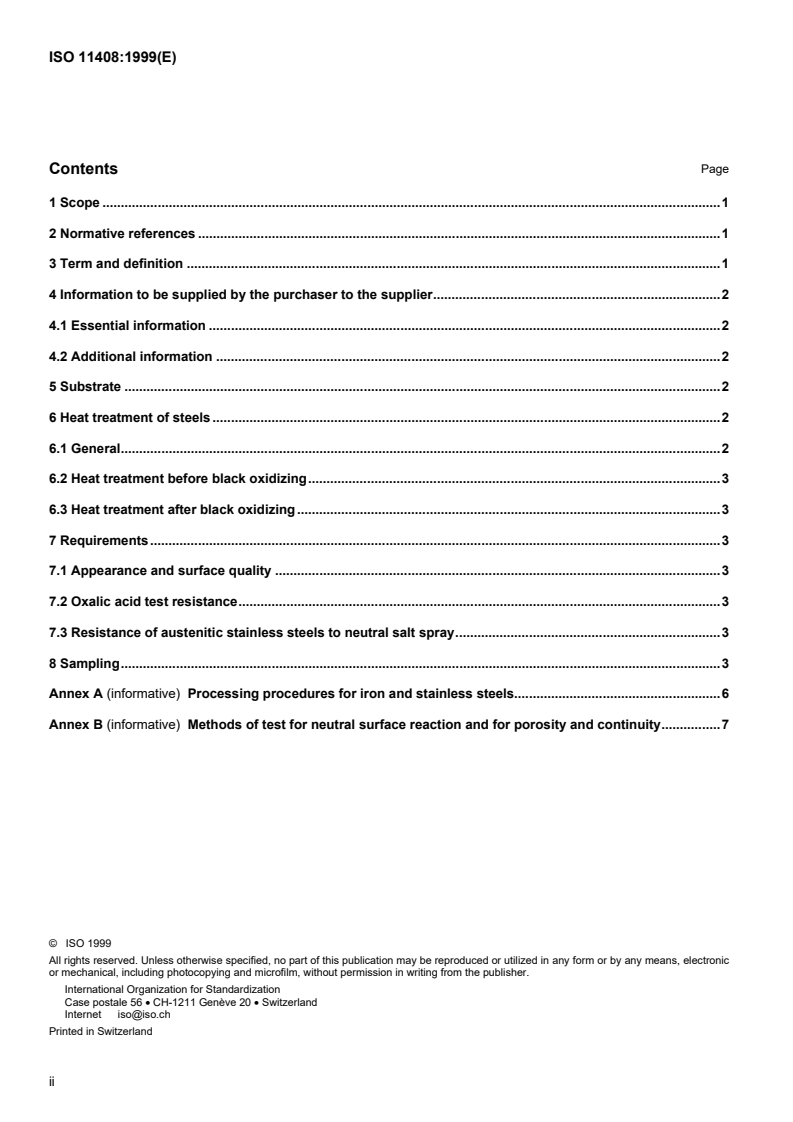
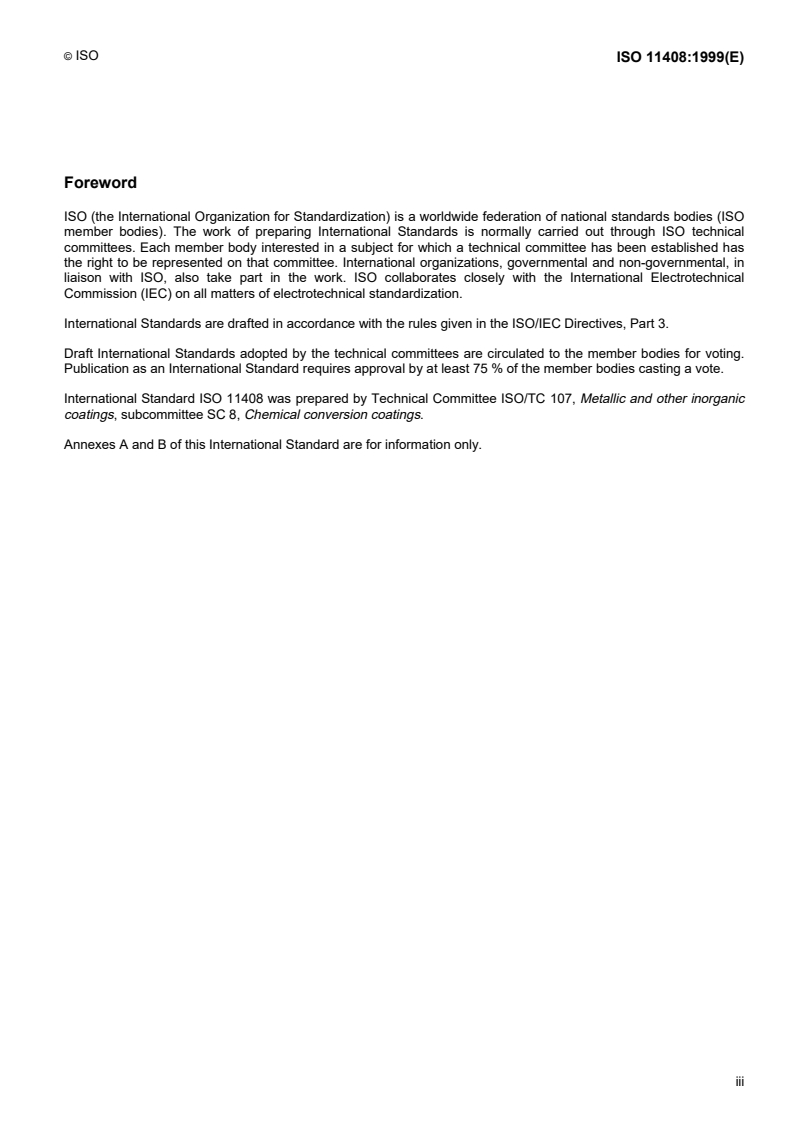

ISO 11408:1999 - Chemical conversion coatings — Black oxide coating on iron and steel — Specification and test methods/19/1999
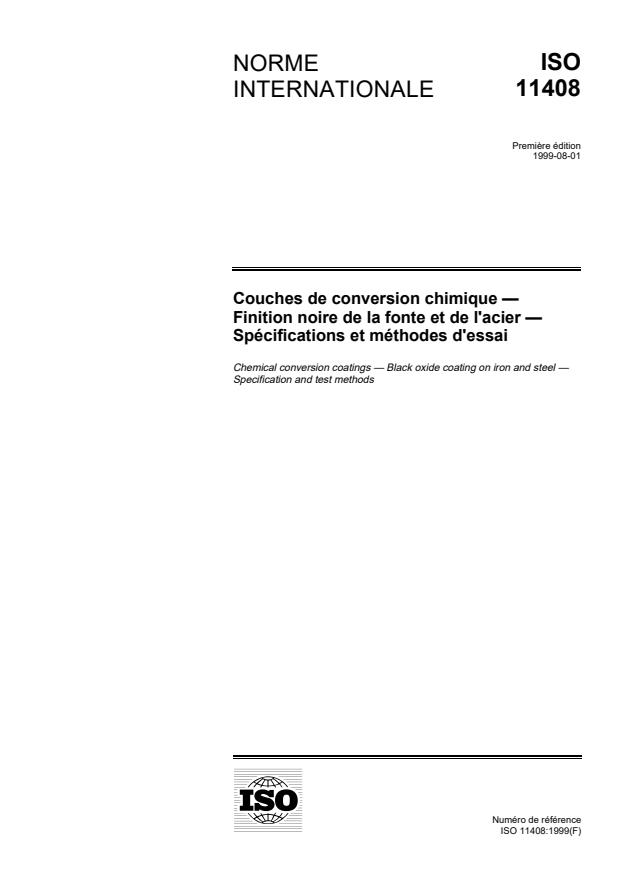
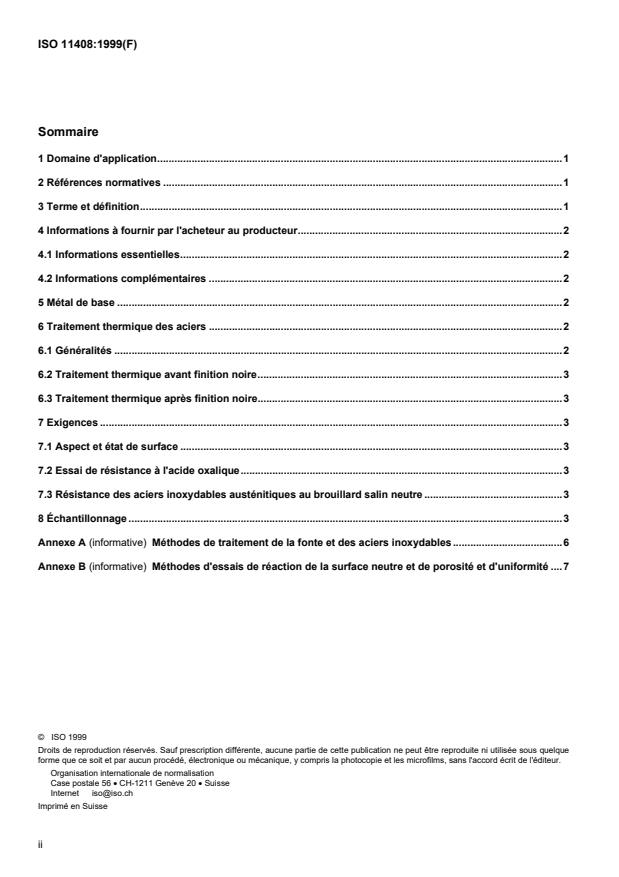

ISO 11408:1999 - Couches de conversion chimique -- Finition noire de la fonte et de l'acier -- Spécifications et méthodes d'essai
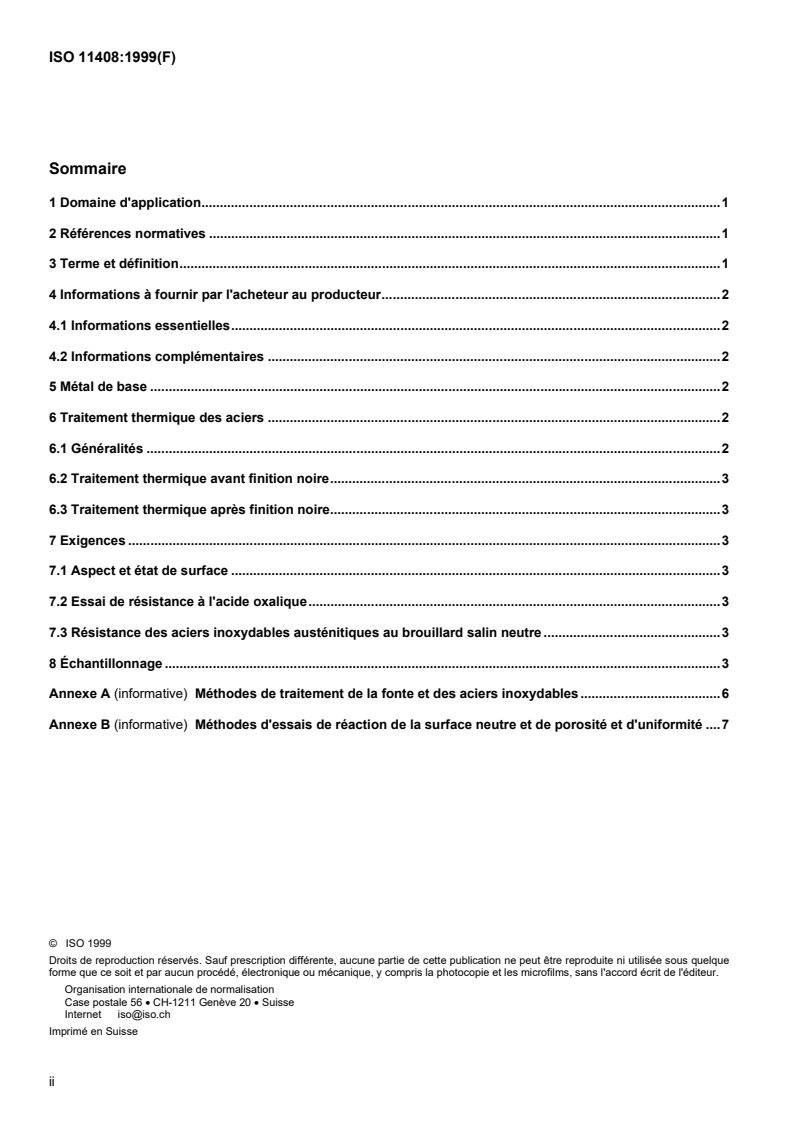

ISO 11408:1999 - Couches de conversion chimique — Finition noire de la fonte et de l'acier — Spécifications et méthodes d'essai/19/1999
ISO 11408:1999 - Overview
ISO 11408:1999 specifies requirements and test methods for black oxide coating (a chemical conversion coating) applied to iron and steel - including cast and wrought iron, carbon steels, low-alloy steels and stainless steels. The standard covers intended uses such as reducing friction between sliding surfaces, decorative finishes and reducing light reflection. It notes that only very limited corrosion protection is provided, even when supplementary preservative treatments (oil, wax, lacquer) are applied. The standard does not set requirements for substrate finish or surface roughness.
Key topics and technical requirements
- Scope and ordering information: Purchasers must provide ISO 11408 reference, significant surfaces to be coated, substrate nature and condition, sampling plan and appearance criteria.
- Appearance and surface quality: Coating must be free of red oxide spots and not overall reddish-brown; wiping with filter paper must not produce reddish or green smut. Non-uniformity is permitted in locally treated areas (welds, hardened zones).
- Oxalic acid test: Detailed procedure - dissolve 50 g oxalic acid per litre of water, place ~3 drops (0.2 ml) on a flat coated spot; reaction must occur within 30 s to 8 min and be evaluated against reference images. This checks coating quality.
- Neutral salt spray (NSS) resistance: For austenitic stainless steels, the unpreserved significant surface must withstand 96 h in NSS (per ISO 9227) without visible corrosion.
- Heat treatment: Pre- and post-coating heat treatments to reduce hydrogen embrittlement risk are referenced (see ISO 9587 and ISO 9588). Surface-hardened parts require post-coating tempering between 190 °C and 220 °C for at least 2 h.
- Sampling and inspection: Lot sampling follows ISO 4519 attribute-based plans. Annex B describes test methods for neutral surface reaction (phenolphthalein) and porosity/continuity (CuSO4 immersion or droplet).
- Processing guidance: Informative Annex A provides typical processing procedures for various steel grades.
Practical applications and users
Who uses ISO 11408:
- Manufacturers and processors that apply black oxide coatings to fasteners, sliding components, decorative hardware and optical housings.
- Quality engineers and inspection personnel defining test methods (oxalic acid, NSS, porosity tests) and acceptance criteria.
- Purchasers and specifiers who need to include coating requirements in procurement documents and drawings. Practical value:
- Ensures consistent appearance, basic surface performance and comparability between suppliers.
- Helps manage risks like hydrogen embrittlement via referenced heat-treatment requirements.
Related standards
- ISO 2064 - coating thickness definitions
- ISO 4519 - sampling procedures for inspection by attributes
- ISO 9227 - salt spray (NSS) corrosion testing
- ISO 9587 / ISO 9588 - pre- and post-treatment for hydrogen embrittlement prevention
Keywords: ISO 11408, black oxide coating, chemical conversion coatings, iron and steel, oxalic acid test, neutral salt spray, porosity test, hydrogen embrittlement, sampling, surface quality.
Buy Documents
ISO 11408:1999 - Chemical conversion coatings -- Black oxide coating on iron and steel -- Specification and test methods
ISO 11408:1999 - Chemical conversion coatings — Black oxide coating on iron and steel — Specification and test methods/19/1999
ISO 11408:1999 - Couches de conversion chimique -- Finition noire de la fonte et de l'acier -- Spécifications et méthodes d'essai
ISO 11408:1999 - Couches de conversion chimique — Finition noire de la fonte et de l'acier — Spécifications et méthodes d'essai/19/1999
Get Certified
Connect with accredited certification bodies for this standard

DVS-ZERT GmbH
German welding certification society.
CARES (UK Certification Authority for Reinforcing Steels)
UK certification for reinforcing steels and construction.
EWF/IIW (European/International Welding Federation)
International welding personnel certification.
Sponsored listings
Frequently Asked Questions
ISO 11408:1999 is a standard published by the International Organization for Standardization (ISO). Its full title is "Chemical conversion coatings — Black oxide coating on iron and steel — Specification and test methods". This standard covers: This International Standard specifies requirements for black oxide coatings on iron and steel (including cast and wrought iron, carbon steel, low alloyed steel and stainless steel). Black oxide coatings can be used to diminish friction between sliding or bearing surfaces or for decorative purposes or to reduce light reflection. Such coatings, with or without supplementary preservative treatment, may be used where a black surface is required. Only very limited corrosion protection is obtained under mildly corrosive conditions even with preservative treatment. This International Standard does not specify requirements for the condition, finish or surface roughness of the substrate prior to black oxidizing.
This International Standard specifies requirements for black oxide coatings on iron and steel (including cast and wrought iron, carbon steel, low alloyed steel and stainless steel). Black oxide coatings can be used to diminish friction between sliding or bearing surfaces or for decorative purposes or to reduce light reflection. Such coatings, with or without supplementary preservative treatment, may be used where a black surface is required. Only very limited corrosion protection is obtained under mildly corrosive conditions even with preservative treatment. This International Standard does not specify requirements for the condition, finish or surface roughness of the substrate prior to black oxidizing.
ISO 11408:1999 is classified under the following ICS (International Classification for Standards) categories: 25.220.20 - Surface treatment. The ICS classification helps identify the subject area and facilitates finding related standards.
ISO 11408:1999 is available in PDF format for immediate download after purchase. The document can be added to your cart and obtained through the secure checkout process. Digital delivery ensures instant access to the complete standard document.
Standards Content (Sample)
INTERNATIONAL ISO
STANDARD 11408
First edition
1999-08-01
Chemical conversion coatings — Black
oxide coating on iron and steel —
Specification and test methods
Couches de conversion chimique — Finition noire de la fonte et de l'acier —
Spécifications et méthodes d'essai
A
Reference number
Contents Page
1 Scope .1
2 Normative references .1
3 Term and definition .1
4 Information to be supplied by the purchaser to the supplier.2
4.1 Essential information .2
4.2 Additional information .2
5 Substrate .2
6 Heat treatment of steels .2
6.1 General.2
6.2 Heat treatment before black oxidizing.3
6.3 Heat treatment after black oxidizing.3
7 Requirements.3
7.1 Appearance and surface quality .3
7.2 Oxalic acid test resistance.3
7.3 Resistance of austenitic stainless steels to neutral salt spray.3
8 Sampling.3
(informative)
Annex A Processing procedures for iron and stainless steels.6
Annex B (informative) Methods of test for neutral surface reaction and for porosity and continuity.7
© ISO 1999
All rights reserved. Unless otherwise specified, no part of this publication may be reproduced or utilized in any form or by any means, electronic
or mechanical, including photocopying and microfilm, without permission in writing from the publisher.
International Organization for Standardization
Case postale 56 • CH-1211 Genève 20 • Switzerland
Internet iso@iso.ch
Printed in Switzerland
ii
© ISO
Foreword
ISO (the International Organization for Standardization) is a worldwide federation of national standards bodies (ISO
member bodies). The work of preparing International Standards is normally carried out through ISO technical
committees. Each member body interested in a subject for which a technical committee has been established has
the right to be represented on that committee. International organizations, governmental and non-governmental, in
liaison with ISO, also take part in the work. ISO collaborates closely with the International Electrotechnical
Commission (IEC) on all matters of electrotechnical standardization.
International Standards are drafted in accordance with the rules given in the ISO/IEC Directives, Part 3.
Draft International Standards adopted by the technical committees are circulated to the member bodies for voting.
Publication as an International Standard requires approval by at least 75 % of the member bodies casting a vote.
International Standard ISO 11408 was prepared by Technical Committee ISO/TC 107, Metallic and other inorganic
coatings, subcommittee SC 8, Chemical conversion coatings.
Annexes A and B of this International Standard are for information only.
iii
INTERNATIONAL STANDARD © ISO ISO 11408:1999(E)
Chemical conversion coatings — Black oxide coating on
iron and steel — Specification and test methods
1 Scope
This International Standard specifies requirements for black oxide coatings on iron and steel (including cast and
wrought iron, carbon steel, low alloyed steel and stainless steel). Black oxide coatings can be used to diminish
friction between sliding or bearing surfaces or for decorative purposes or to reduce light reflection. Such coatings,
with or without supplementary preservative treatment, may be used where a black surface is required. Only very
limited corrosion protection is obtained under mildly corrosive conditions even with preservative treatment.
This International Standard does not specify requirements for the condition, finish or surface roughness of the
substrate prior to black oxidizing.
2 Normative references
The following normative documents contain provisions which, through reference in this text, constitute provisions of
this International Standard. For dated references, subsequent amendments to, or revisions of, any of these
publications do not apply. However, parties to agreements based on this International Standard are encouraged to
investigate the possibility of applying the most recent editions of the normative documents listed below. For undated
references, the latest edition of the normative document referred to applies. Members of ISO and IEC maintain
registers of currently valid International Standards.
ISO 2064:1996, Metallic and other inorganic coatings — Definitions and conventions concerning the measurement
of thickness.
ISO 4519, Metallic and other inorganic coatings — Sampling procedures for inspection by attributes.
ISO 9227, Corrosion tests in artificial atmospheres — Salt spray tests.
ISO 9587, Metallic and other inorganic coatings — Pre-treatments of iron and steel to reduce the risk of hydrogen
embrittlement.
ISO 9588, Metallic and other inorganic coatings — Post-coating treatments of iron and steel for reducing the risk of
hydrogen embrittlement.
3 Term and definition
For the purposes of this International Standard, the following term and definition apply.
3.1
significant surface
part of the article covered or to be covered by the coating and for which the coating is essential for serviceability
and/or appearance and where the coating has to meet all of the specified requirements
[ISO 2064:1996, definition 3.1]
© ISO
4 Informa
...
INTERNATIONAL ISO
STANDARD 11408
First edition
1999-08-01
Chemical conversion coatings — Black
oxide coating on iron and steel —
Specification and test methods
Couches de conversion chimique — Finition noire de la fonte et de l'acier —
Spécifications et méthodes d'essai
A
Reference number
Contents Page
1 Scope .1
2 Normative references .1
3 Term and definition .1
4 Information to be supplied by the purchaser to the supplier.2
4.1 Essential information .2
4.2 Additional information .2
5 Substrate .2
6 Heat treatment of steels .2
6.1 General.2
6.2 Heat treatment before black oxidizing.3
6.3 Heat treatment after black oxidizing.3
7 Requirements.3
7.1 Appearance and surface quality .3
7.2 Oxalic acid test resistance.3
7.3 Resistance of austenitic stainless steels to neutral salt spray.3
8 Sampling.3
(informative)
Annex A Processing procedures for iron and stainless steels.6
Annex B (informative) Methods of test for neutral surface reaction and for porosity and continuity.7
© ISO 1999
All rights reserved. Unless otherwise specified, no part of this publication may be reproduced or utilized in any form or by any means, electronic
or mechanical, including photocopying and microfilm, without permission in writing from the publisher.
International Organization for Standardization
Case postale 56 • CH-1211 Genève 20 • Switzerland
Internet iso@iso.ch
Printed in Switzerland
ii
© ISO
Foreword
ISO (the International Organization for Standardization) is a worldwide federation of national standards bodies (ISO
member bodies). The work of preparing International Standards is normally carried out through ISO technical
committees. Each member body interested in a subject for which a technical committee has been established has
the right to be represented on that committee. International organizations, governmental and non-governmental, in
liaison with ISO, also take part in the work. ISO collaborates closely with the International Electrotechnical
Commission (IEC) on all matters of electrotechnical standardization.
International Standards are drafted in accordance with the rules given in the ISO/IEC Directives, Part 3.
Draft International Standards adopted by the technical committees are circulated to the member bodies for voting.
Publication as an International Standard requires approval by at least 75 % of the member bodies casting a vote.
International Standard ISO 11408 was prepared by Technical Committee ISO/TC 107, Metallic and other inorganic
coatings, subcommittee SC 8, Chemical conversion coatings.
Annexes A and B of this International Standard are for information only.
iii
INTERNATIONAL STANDARD © ISO ISO 11408:1999(E)
Chemical conversion coatings — Black oxide coating on
iron and steel — Specification and test methods
1 Scope
This International Standard specifies requirements for black oxide coatings on iron and steel (including cast and
wrought iron, carbon steel, low alloyed steel and stainless steel). Black oxide coatings can be used to diminish
friction between sliding or bearing surfaces or for decorative purposes or to reduce light reflection. Such coatings,
with or without supplementary preservative treatment, may be used where a black surface is required. Only very
limited corrosion protection is obtained under mildly corrosive conditions even with preservative treatment.
This International Standard does not specify requirements for the condition, finish or surface roughness of the
substrate prior to black oxidizing.
2 Normative references
The following normative documents contain provisions which, through reference in this text, constitute provisions of
this International Standard. For dated references, subsequent amendments to, or revisions of, any of these
publications do not apply. However, parties to agreements based on this International Standard are encouraged to
investigate the possibility of applying the most recent editions of the normative documents listed below. For undated
references, the latest edition of the normative document referred to applies. Members of ISO and IEC maintain
registers of currently valid International Standards.
ISO 2064:1996, Metallic and other inorganic coatings — Definitions and conventions concerning the measurement
of thickness.
ISO 4519, Metallic and other inorganic coatings — Sampling procedures for inspection by attributes.
ISO 9227, Corrosion tests in artificial atmospheres — Salt spray tests.
ISO 9587, Metallic and other inorganic coatings — Pre-treatments of iron and steel to reduce the risk of hydrogen
embrittlement.
ISO 9588, Metallic and other inorganic coatings — Post-coating treatments of iron and steel for reducing the risk of
hydrogen embrittlement.
3 Term and definition
For the purposes of this International Standard, the following term and definition apply.
3.1
significant surface
part of the article covered or to be covered by the coating and for which the coating is essential for serviceability
and/or appearance and where the coating has to meet all of the specified requirements
[ISO 2064:1996, definition 3.1]
© ISO
4 Informa
...
NORME ISO
INTERNATIONALE 11408
Première édition
1999-08-01
Couches de conversion chimique —
Finition noire de la fonte et de l'acier —
Spécifications et méthodes d'essai
Chemical conversion coatings — Black oxide coating on iron and steel —
Specification and test methods
A
Numéro de référence
Sommaire
1 Domaine d'application.1
2 Références normatives .1
3 Terme et définition.1
4 Informations à fournir par l'acheteur au producteur.2
4.1 Informations essentielles.2
4.2 Informations complémentaires .2
5 Métal de base .2
6 Traitement thermique des aciers .2
6.1 Généralités .2
6.2 Traitement thermique avant finition noire.3
6.3 Traitement thermique après finition noire.3
7 Exigences .3
7.1 Aspect et état de surface .3
7.2 Essai de résistance à l'acide oxalique.3
7.3 Résistance des aciers inoxydables austénitiques au brouillard salin neutre .3
8 Échantillonnage .3
(informative)
Annexe A Méthodes de traitement de la fonte et des aciers inoxydables.6
Annexe B (informative) Méthodes d'essais de réaction de la surface neutre et de porosité et d'uniformité .7
© ISO 1999
Droits de reproduction réservés. Sauf prescription différente, aucune partie de cette publication ne peut être reproduite ni utilisée sous quelque
forme que ce soit et par aucun procédé, électronique ou mécanique, y compris la photocopie et les microfilms, sans l'accord écrit de l'éditeur.
Organisation internationale de normalisation
Case postale 56 • CH-1211 Genève 20 • Suisse
Internet iso@iso.ch
Imprimé en Suisse
ii
© ISO
Avant-propos
L'ISO (Organisation internationale de normalisation) est une fédération mondiale d'organismes nationaux de
normalisation (comités membres de l'ISO). L'élaboration des Normes internationales est en général confiée aux
comités techniques de l'ISO. Chaque comité membre intéressé par une étude a le droit de faire partie du comité
technique créé à cet effet. Les organisations internationales, gouvernementales et non gouvernementales, en
liaison avec l'ISO participent également aux travaux. L'ISO collabore étroitement avec la Commission
électrotechnique internationale (CEI) en ce qui concerne la normalisation électrotechnique.
Les Normes internationales sont rédigées conformément aux règles données dans les Directives ISO/CEI, Partie 3.
Les projets de Normes internationales adoptés par les comités techniques sont soumis aux comités membres pour
vote. Leur publication comme Normes internationales requiert l'approbation de 75 % au moins des comités
membres votants.
La Norme internationale ISO 11408 a été élaborée par le comité technique ISO/TC 107, Revêtements métalliques
et autres revêtements non organiques, sous-comité SC 8, Couches de conversion.
Les annexes A et B de la présente Norme internationale sont données uniquement à titre d'information.
iii
NORME INTERNATIONALE © ISO ISO 11408:1999(F)
Couches de conversion chimique — Finition noire de la
fonte et de l'acier — Spécifications et méthodes d'essai
1 Domaine d'application
La présente Norme internationale spécifie les exigences concernant la finition noire de la fonte et de l'acier (fonte
corroyée, acier au carbone, aciers faiblement alliés et acier inoxydable). La finition noire peut être utilisée pour
réduire le frottement entre les surfaces de glissement ou d'appui ou à des fins de décoration, ou encore pour
réduire la réflexion de la lumière. La finition noire, avec ou sans traitement de protection supplémentaire, peut être
utilisée dans tous les cas où une surface noire est demandée. Avec traitement de protection, on n'obtient qu'un très
faible niveau de résistance à la corrosion, même dans des situations faiblement corrosives.
La présente Norme internationale ne spécifie aucune exigence concernant l'état de surface, la finition ou la rugosité
du métal de base avant la finition noire.
2 Références normatives
Les documents normatifs suivants contiennent des dispositions qui par suite de la référence qui y est faite,
constituent des dispositions valables pour la présente Norme internationale. Pour les références datées, les
amendements ultérieurs ou les révisions de ces publications ne s’appliquent pas. Toutefois, les parties prenantes
aux accords fondés sur la présente Norme internationale sont invitées à rechercher la possibilité d'appliquer les
éditions les plus récentes des documents normatifs indiqués ci-après. Pour les références non datées, la dernière
édition du document normatif en référence s’applique. Les membres de l'ISO et de la CEI possèdent le registre des
Normes internationales en vigueur.
ISO 2064:1996, Revêtements métalliques et autres revêtements inorganiques — Définitions et principes concernant
le mesurage de l’épaisseur.
ISO 4519, Dépôts électrolytiques et finitions apparentées — Méthodes d’échantillonnage pour le contrôle par
attributs.
ISO 9227, Essais de corrosion en atmosphères artificielles — Essais aux brouillards salins.
ISO 9587, Revêtement métalliques et autres revêtements inorganiques — Prétraitements du fer ou de l’acier pour
diminuer le risque de fragilisation par l’hydrogène.
ISO 9588, Revêtements métalliques et autres revêtements inorganiques — Traitements après revêtement sur le fer
ou l’acier pour diminuer le risque de fragilisation par l’hydrogène.
3 Terme et définition
Pour les besoins de la présente Norme internationale, le terme et la définition suivants s'appliquent.
3.1
surface significative
partie de l'article couverte ou devant être couverte par le revêtement et pour laquelle le revêtement joue un rôle
essentiel quant à l'usage et/ou à l'aspect de l'article et doit satisfaire à toutes les exigences spécifiées
[ISO 2064:1996, définition 3.1]
© ISO
4 Informations à fournir par l'acheteur au producteur
4.1 Informations essentielles
Lorsque l'acheteur commande d'appliquer à des articles une finition noire conformément à la présente Norme
internationale, il doit fournir au producteur les informations suivantes:
a) le numéro de la présente Norme inter
...
NORME ISO
INTERNATIONALE 11408
Première édition
1999-08-01
Couches de conversion chimique —
Finition noire de la fonte et de l'acier —
Spécifications et méthodes d'essai
Chemical conversion coatings — Black oxide coating on iron and steel —
Specification and test methods
A
Numéro de référence
Sommaire
1 Domaine d'application.1
2 Références normatives .1
3 Terme et définition.1
4 Informations à fournir par l'acheteur au producteur.2
4.1 Informations essentielles.2
4.2 Informations complémentaires .2
5 Métal de base .2
6 Traitement thermique des aciers .2
6.1 Généralités .2
6.2 Traitement thermique avant finition noire.3
6.3 Traitement thermique après finition noire.3
7 Exigences .3
7.1 Aspect et état de surface .3
7.2 Essai de résistance à l'acide oxalique.3
7.3 Résistance des aciers inoxydables austénitiques au brouillard salin neutre .3
8 Échantillonnage .3
(informative)
Annexe A Méthodes de traitement de la fonte et des aciers inoxydables.6
Annexe B (informative) Méthodes d'essais de réaction de la surface neutre et de porosité et d'uniformité .7
© ISO 1999
Droits de reproduction réservés. Sauf prescription différente, aucune partie de cette publication ne peut être reproduite ni utilisée sous quelque
forme que ce soit et par aucun procédé, électronique ou mécanique, y compris la photocopie et les microfilms, sans l'accord écrit de l'éditeur.
Organisation internationale de normalisation
Case postale 56 • CH-1211 Genève 20 • Suisse
Internet iso@iso.ch
Imprimé en Suisse
ii
© ISO
Avant-propos
L'ISO (Organisation internationale de normalisation) est une fédération mondiale d'organismes nationaux de
normalisation (comités membres de l'ISO). L'élaboration des Normes internationales est en général confiée aux
comités techniques de l'ISO. Chaque comité membre intéressé par une étude a le droit de faire partie du comité
technique créé à cet effet. Les organisations internationales, gouvernementales et non gouvernementales, en
liaison avec l'ISO participent également aux travaux. L'ISO collabore étroitement avec la Commission
électrotechnique internationale (CEI) en ce qui concerne la normalisation électrotechnique.
Les Normes internationales sont rédigées conformément aux règles données dans les Directives ISO/CEI, Partie 3.
Les projets de Normes internationales adoptés par les comités techniques sont soumis aux comités membres pour
vote. Leur publication comme Normes internationales requiert l'approbation de 75 % au moins des comités
membres votants.
La Norme internationale ISO 11408 a été élaborée par le comité technique ISO/TC 107, Revêtements métalliques
et autres revêtements non organiques, sous-comité SC 8, Couches de conversion.
Les annexes A et B de la présente Norme internationale sont données uniquement à titre d'information.
iii
NORME INTERNATIONALE © ISO ISO 11408:1999(F)
Couches de conversion chimique — Finition noire de la
fonte et de l'acier — Spécifications et méthodes d'essai
1 Domaine d'application
La présente Norme internationale spécifie les exigences concernant la finition noire de la fonte et de l'acier (fonte
corroyée, acier au carbone, aciers faiblement alliés et acier inoxydable). La finition noire peut être utilisée pour
réduire le frottement entre les surfaces de glissement ou d'appui ou à des fins de décoration, ou encore pour
réduire la réflexion de la lumière. La finition noire, avec ou sans traitement de protection supplémentaire, peut être
utilisée dans tous les cas où une surface noire est demandée. Avec traitement de protection, on n'obtient qu'un très
faible niveau de résistance à la corrosion, même dans des situations faiblement corrosives.
La présente Norme internationale ne spécifie aucune exigence concernant l'état de surface, la finition ou la rugosité
du métal de base avant la finition noire.
2 Références normatives
Les documents normatifs suivants contiennent des dispositions qui par suite de la référence qui y est faite,
constituent des dispositions valables pour la présente Norme internationale. Pour les références datées, les
amendements ultérieurs ou les révisions de ces publications ne s’appliquent pas. Toutefois, les parties prenantes
aux accords fondés sur la présente Norme internationale sont invitées à rechercher la possibilité d'appliquer les
éditions les plus récentes des documents normatifs indiqués ci-après. Pour les références non datées, la dernière
édition du document normatif en référence s’applique. Les membres de l'ISO et de la CEI possèdent le registre des
Normes internationales en vigueur.
ISO 2064:1996, Revêtements métalliques et autres revêtements inorganiques — Définitions et principes concernant
le mesurage de l’épaisseur.
ISO 4519, Dépôts électrolytiques et finitions apparentées — Méthodes d’échantillonnage pour le contrôle par
attributs.
ISO 9227, Essais de corrosion en atmosphères artificielles — Essais aux brouillards salins.
ISO 9587, Revêtement métalliques et autres revêtements inorganiques — Prétraitements du fer ou de l’acier pour
diminuer le risque de fragilisation par l’hydrogène.
ISO 9588, Revêtements métalliques et autres revêtements inorganiques — Traitements après revêtement sur le fer
ou l’acier pour diminuer le risque de fragilisation par l’hydrogène.
3 Terme et définition
Pour les besoins de la présente Norme internationale, le terme et la définition suivants s'appliquent.
3.1
surface significative
partie de l'article couverte ou devant être couverte par le revêtement et pour laquelle le revêtement joue un rôle
essentiel quant à l'usage et/ou à l'aspect de l'article et doit satisfaire à toutes les exigences spécifiées
[ISO 2064:1996, définition 3.1]
© ISO
4 Informations à fournir par l'acheteur au producteur
4.1 Informations essentielles
Lorsque l'acheteur commande d'appliquer à des articles une finition noire conformément à la présente Norme
internationale, il doit fournir au producteur les informations suivantes:
a) le numéro de la présente Norme inter
...