

ISO 17607-6:2023
(Main)Steel structures — Execution of structural steelwork — Part 6: Bolting
General Information
- Abstract
This document defines the general requirements for structural bolting in the execution of structural steelwork as structures or as fabricated components, in conjunction with ISO 17607-1. Additional requirements to be addressed in the execution of structural steelwork, as structures or as fabricated components, can be found in other parts of ISO 17607.
- Status
- Published
- Publication Date
- 07-Dec-2023
- Technical Committee
- ISO/TC 167 - Steel and aluminium structures
- Drafting Committee
- ISO/TC 167/WG 3 - Execution of steel structures
- Current Stage
- 6060 - International Standard published
- Start Date
- 08-Dec-2023
- Due Date
- 11-Feb-2023
- Completion Date
- 08-Dec-2023
Overview - ISO 17607-6:2023 (Steel structures - Bolting)
ISO 17607-6:2023 defines the general requirements for structural bolting used in the execution of steel structures and fabricated components. It is part of the ISO 17607 series and is intended to be used together with ISO 17607-1. The standard covers constituent products, hole and surface preparation, assembly, pretensioning and tightening methods, inspection, testing, correction and documentation needed to claim conformity.
Keywords: ISO 17607-6, structural bolting, steel structures, bolted joints, pretensioned bolts, bolt tightening, slip-resistant joints.
Key topics and technical requirements
- Execution specification & quality requirements: Defines responsibilities, execution levels and quality documentation needed before and during erection.
- Constituent products: Requirements for bolts, nuts, washers, direct tension indicators (DTIs), coatings and atmospheric corrosion‑resistant components; verification, identification, packaging and storage.
- Hole and surface preparation: Dimensions and tolerances for boltholes, faying surface preparation for bearing and slip‑resistant joints, and precautions before assembly.
- Assembly and joint types: Joint classification, fit, shims/packing plates, snugging, tightening sequences and use of fit/temporary bolts.
- Pretensioned and non‑pretensioned bolting: Procedures and minimum pretension requirements; pretensioning methods specified in normative annexes - torque method, combined method, spline‑drive twist‑off, direct tension indicator method, and turn‑of‑nut method.
- Tools and calibration: Requirements for pretensioning tools, k‑factor calibration and pre‑installation verification testing.
- Inspection, testing & correction: Inspection stages (pre‑erection, pre‑installation, post‑installation), testing of pretensioned bolts, handling excessive coatings, replacement and reconditioning.
- Annexes & test methods: Normative annexes provide slip factors, nominal pretension tables, calibration and test procedures, and a bolt tightening qualification procedure (BTQP).
Practical applications and who uses this standard
ISO 17607-6 is used by:
- Structural engineers and design offices specifying bolted connections in buildings, bridges and industrial structures
- Fabricators and erectors implementing bolting procedures and quality control
- Contractors, site supervisors and QA/QC inspectors performing assembly and inspection
- Procurement and QA teams specifying and verifying bolting products (DTIs, pretensioned assemblies, coatings)
- Testing laboratories and calibration services for pretensioning tools
Using this standard improves safety, reliability and traceability of bolted joints and supports compliance with project specifications and national regulations.
Related standards
- ISO 17607-1 (general execution requirements for structural steelwork) - to be used in conjunction with ISO 17607-6
- EN 14399 series (referenced for pretensioned bolt calibration in the annexes)
For specification, procurement and on‑site execution of bolted steelwork, ISO 17607-6:2023 is the authoritative reference for consistent, verifiable structural bolting practice.
Relations
- Effective Date
- 16-Oct-2025
- Effective Date
- 24-Dec-2022
Get Certified
Connect with accredited certification bodies for this standard

DIBt (Deutsches Institut für Bautechnik)
German Institute for Building Technology.
DIN CERTCO
DIN Group product certification.

Aboma Certification B.V.
Specialized in construction, metal, and transport sectors.
Sponsored listings
Frequently Asked Questions
ISO 17607-6:2023 is a standard published by the International Organization for Standardization (ISO). Its full title is "Steel structures — Execution of structural steelwork — Part 6: Bolting". This standard covers: This document defines the general requirements for structural bolting in the execution of structural steelwork as structures or as fabricated components, in conjunction with ISO 17607-1. Additional requirements to be addressed in the execution of structural steelwork, as structures or as fabricated components, can be found in other parts of ISO 17607.
This document defines the general requirements for structural bolting in the execution of structural steelwork as structures or as fabricated components, in conjunction with ISO 17607-1. Additional requirements to be addressed in the execution of structural steelwork, as structures or as fabricated components, can be found in other parts of ISO 17607.
ISO 17607-6:2023 is classified under the following ICS (International Classification for Standards) categories: 91.080.13 - Steel structures. The ICS classification helps identify the subject area and facilitates finding related standards.
ISO 17607-6:2023 has the following relationships with other standards: It is inter standard links to ISO 10721-2:1999/Cor 1:1999, ISO 10721-2:1999. Understanding these relationships helps ensure you are using the most current and applicable version of the standard.
ISO 17607-6:2023 is available in PDF format for immediate download after purchase. The document can be added to your cart and obtained through the secure checkout process. Digital delivery ensures instant access to the complete standard document.
Standards Content (Sample)
INTERNATIONAL ISO
STANDARD 17607-6
First edition
2023-12
Steel structures — Execution of
structural steelwork —
Part 6:
Bolting
Structures en acier – Exécution des charpentes et ossatures en
acier —
Partie 6: Boulonnage
Reference number
© ISO 2023
All rights reserved. Unless otherwise specified, or required in the context of its implementation, no part of this publication may
be reproduced or utilized otherwise in any form or by any means, electronic or mechanical, including photocopying, or posting on
the internet or an intranet, without prior written permission. Permission can be requested from either ISO at the address below
or ISO’s member body in the country of the requester.
ISO copyright office
CP 401 • Ch. de Blandonnet 8
CH-1214 Vernier, Geneva
Phone: +41 22 749 01 11
Email: copyright@iso.org
Website: www.iso.org
Published in Switzerland
ii
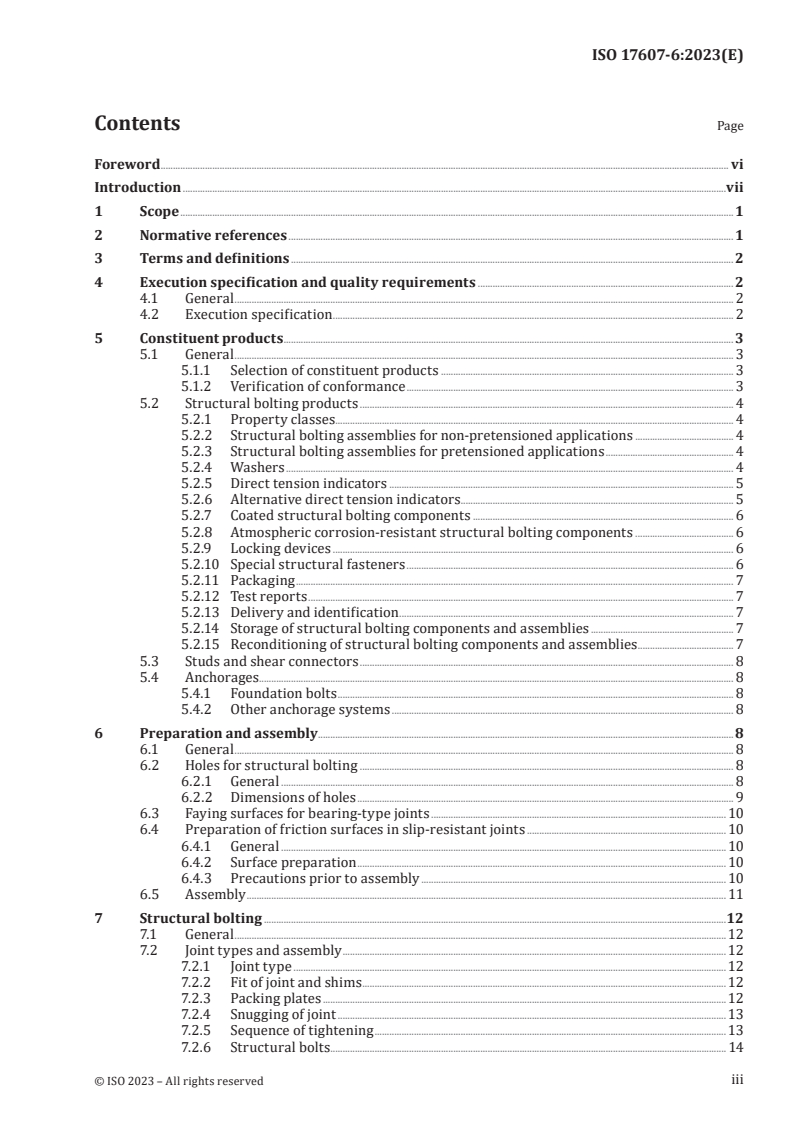
Contents Page
Foreword . vi
Introduction .vii
1 Scope . 1
2 Normative references . 1
3 Terms and definitions . 2
4 Execution specification and quality requirements . 2
4.1 General . 2
4.2 Execution specification . 2
5 Constituent products . 3
5.1 General . 3
5.1.1 Selection of constituent products . 3
5.1.2 Verification of conformance . 3
5.2 Structural bolting products . 4
5.2.1 Property classes. 4
5.2.2 Structural bolting assemblies for non-pretensioned applications . 4
5.2.3 Structural bolting assemblies for pretensioned applications . 4
5.2.4 Washers . 4
5.2.5 Direct tension indicators . 5
5.2.6 Alternative direct tension indicators . 5
5.2.7 Coated structural bolting components . 6
5.2.8 Atmospheric corrosion-resistant structural bolting components . 6
5.2.9 Locking devices . 6
5.2.10 Special structural fasteners . 6
5.2.11 Packaging . 7
5.2.12 Test reports . 7
5.2.13 Delivery and identification . 7
5.2.14 Storage of structural bolting components and assemblies . 7
5.2.15 Reconditioning of structural bolting components and assemblies . 7
5.3 Studs and shear connectors . 8
5.4 Anchorages. 8
5.4.1 Foundation bolts . 8
5.4.2 Other anchorage systems . 8
6 Preparation and assembly . .8
6.1 General . 8
6.2 Holes for structural bolting . 8
6.2.1 General . 8
6.2.2 Dimensions of holes . 9
6.3 Faying surfaces for bearing-type joints . 10
6.4 Preparation of friction surfaces in slip-resistant joints . 10
6.4.1 General . 10
6.4.2 Surface preparation . 10
6.4.3 Precautions prior to assembly . 10
6.5 Assembly . 11
7 Structural bolting .12
7.1 General .12
7.2 Joint types and assembly . 12
7.2.1 Joint type . 12
7.2.2 Fit of joint and shims .12
7.2.3 Packing plates .12
7.2.4 Snugging of joint . 13
7.2.5 Sequence of tightening . 13
7.2.6 Structural bolts. 14
iii
7.2.7 Nuts . 14
7.2.8 Washers . 15
7.2.9 Locking methods . 17
7.3 Tightening of non-pretensioned bolts . 18
7.4 Tightening of pretensioned bolts . 18
7.4.1 Bolting procedure for pretensioned bolts . 18
7.4.2 Pretensioning tools . 18
7.4.3 Minimum pretension . 19
7.4.4 Bolting assembly k-class calibration . 19
7.4.5 k-factor . 19
7.4.6 Pre-installation verification testing . 20
7.4.7 Torque method .20
7.4.8 Combined method .20
7.4.9 Spline-drive twist-off method . 20
7.4.10 Direct tension indicator method . 20
7.4.11 Turn-of-nut method . . .20
7.5 Fit bolts . 20
7.6 Temporary bolts . 21
7.7 Loss of pretension . 21
7.8 Reuse of structural bolts . 22
7.9 Use of special fasteners . .22
7.10 Galling and seizure of stainless-steel structural bolts . 23
8 Inspection, testing, and correction .23
8.1 General .23
8.2 Structural bolting inspection .23
8.2.1 Inspection prior to erection of steelwork . 23
8.2.2 Inspection prior to installation of bolts . 24
8.2.3 Inspection after installation of bolts . 24
8.2.4 Inspection of pretensioned bolts . 24
8.2.5 Inspection of special structural fasteners and special methods . 27
8.3 Correction .28
8.3.1 Excessive coating thickness .28
8.3.2 Replacement of structural bolting components and assemblies .28
9 Documents required to claim conformity to this document .28
9.1 General .28
9.2 Declaration of conformity .28
Annex A (normative) Additional information, list of options and requirements related to
the execution levels.29
Annex B (normative) Bolting component, assembly and coating standards .34
Annex C (normative) Nominal hole clearances for bolts .38
Annex D (normative) Bolted friction surface slip factors .41
Annex E (normative) Nominal minimum pretension .43
Annex F (normative) Threads in grip, thread protrusion, and use of taper washers .45
Annex G (normative) Pre-installation verification testing for pretensioned bolting
assemblies .47
Annex H (normative) Calibration test for the EN 14399 series pretensioned bolts under
site conditions . .48
Annex I (normative) Pretensioning bolting assemblies — Torque method .53
Annex J (normative) Pretensioning bolting assemblies — Combined method .55
Annex K (normative) Pretensioning bolting assemblies — Spline-drive twist-off method .59
Annex L (normative) Pretensioning bolting assemblies — Direct tension indicator method .60
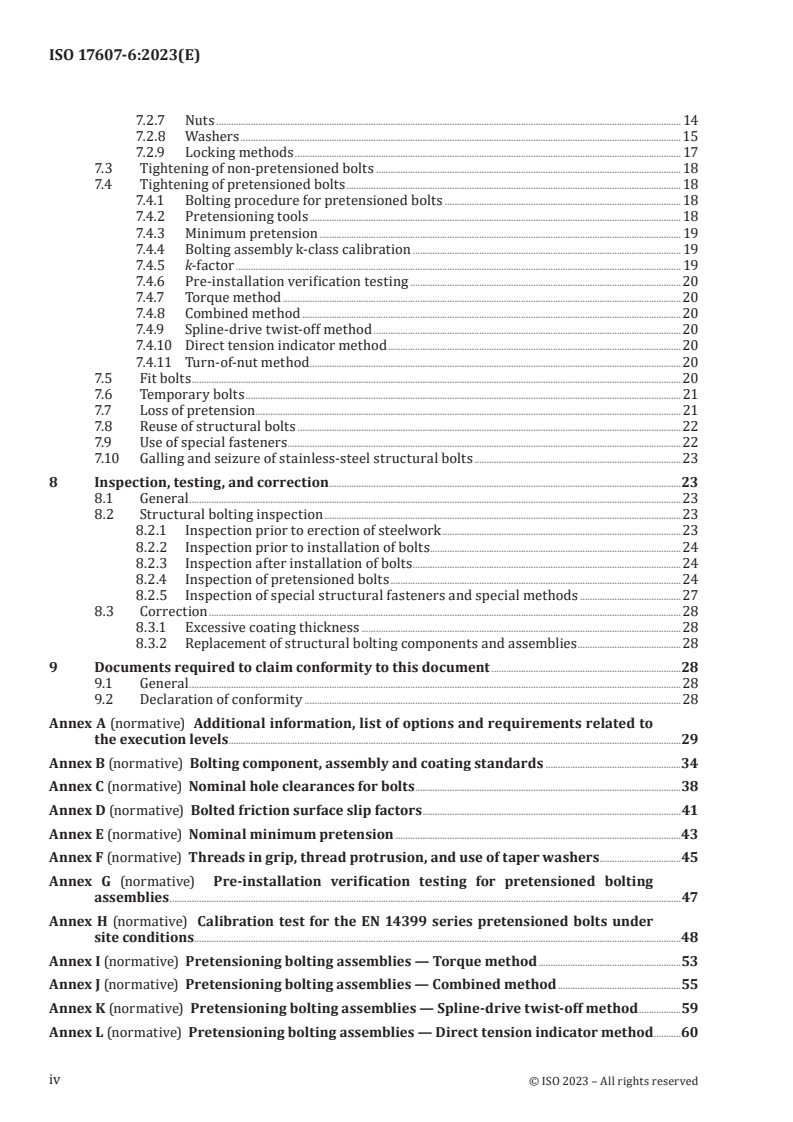
iv
Annex M (normative) Pretensioning bolting assemblies — Turn-of-nut method .61
Annex N (informative) Bolt tightening qualification procedure (BTQP) .63
Annex O (normative) Method for structural bolting inspection .73
Annex P (normative) Test to determine slip factor .78
Annex Q (informative) Test to determine loss of pretension .85
Bibliography .87
v
Foreword
ISO (the International Organization for Standardization) is a worldwide federation of national standards
bodies (ISO member bodies). The work of preparing International Standards is normally carried out
through ISO technical committees. Each member body interested in a subject for which a technical
committee has been established has the right to be represented on that committee. International
organizations, governmental and non-governmental, in liaison with ISO, also take part in the work.
ISO collaborates closely with the International Electrotechnical Commission (IEC) on all matters of
electrotechnical standardization.
The procedures used to develop this document and those intended for its further maintenance are
described in the ISO/IEC Directives, Part 1. In particular, the different approval criteria needed for the
different types of ISO documents should be noted. This document was drafted in accordance with the
editorial rules of the ISO/IEC Directives, Part 2 (see www.iso.org/directives).
ISO draws attention to the possibility that the implementation of this document may involve the use
of (a) patent(s). ISO takes no position concerning the evidence, validity or applicability of any claimed
patent rights in respect thereof. As of the date of publication of this document, ISO had not received
notice of (a) patent(s) which may be required to implement this document. However, implementers are
cautioned that this may not represent the latest information, which may be obtained from the patent
database available at www.iso.org/patents. ISO shall not be held responsible for identifying any or all
such patent rights.
Any trade name used in this document is information given for the convenience of users and does not
constitute an endorsement.
For an explanation of the voluntary nature of standards, the meaning of ISO specific terms and
expressions related to conformity assessment, as well as information about ISO's adherence to
the World Trade Organization (WTO) principles in the Technical Barriers to Trade (TBT), see
www.iso.org/iso/foreword.html.
This document was prepared by Technical Committee ISO/TC 167, Steel and aluminium structures.
This first edition cancels and replaces ISO 10721-2:1999, which has been technically revised.
A list of all parts in the ISO 17607 series can be found on the ISO website.
Any feedback or questions on this document should be directed to the user’s national standards body. A
complete listing of these bodies can be found at www.iso.org/members.html.
vi
Introduction
Specific requirements for the achievement of structures that are optimal with respect to safety, the
state of the economy, development and general values of a nation are given in the appropriate regional
or national standards, if they exist.
Many nations do not have their own standards for structural steelwork. Some reference other national
or regional standards. Some permit the project’s standard to be selected by the owner, designer or
constructor of the structure. Some do not require any standards to be followed.
The ISO 17607 series of standards on the execution of structural steelwork was developed to serve
as a means to provide a set of requirements and guidance for projects that are constructed without a
governing regional or national standard. The ISO 17607 series can also serve to reduce trade barriers.
Additional requirements to be addressed in the execution of structural steelwork, as structures or as
fabricated components, can be found in the other parts of the series:
— ISO 17607-1 (General requirements and terms and definitions);
— ISO 17607-2 (Steels);
— ISO 17607-3 (Fabrication);
— ISO 17607-4 (Erection);
— ISO 17607-5 (Welding).
vii
INTERNATIONAL STANDARD ISO 17607-6:2023(E)
Steel structures — Execution of structural steelwork —
Part 6:
Bolting
1 Scope
This document defines the general requirements for structural bolting in the execution of structural
steelwork as structures or as fabricated components, in conjunction with ISO 17607-1.
Additional requirements to be addressed in the execution of structural steelwork, as structures or as
fabricated components, can be found in other parts of ISO 17607.
2 Normative references
The following documents are referred to in the text in such a way that some or all of their content
constitutes requirements of this document. For dated references, only the edition cited applies. For
undated references, the latest edition of the referenced document (including any amendments) applies.
ISO 898-1, Mechanical properties of fasteners made of carbon steel and alloy steel — Part 1: Bolts, screws
and studs with specified property classes — Coarse thread and fine pitch thread
ISO 898-2, Mechanical properties of fasteners made of carbon steel and alloy steel – Part 2: Nuts with
specified property classes – Coarse thread and fine pitch thread
ISO 898-3, Mechanical properties of fasteners made of carbon steel and alloy steel — Part 3: Flat washers
with specified property classes
ISO 2859-5, Sampling procedures for inspection by attributes — Part 5: System of sequential sampling
plans indexed by acceptance quality limit (AQL) for lot-by-lot inspection
ISO 3506-1, Mechanical properties of corrosion-resistant stainless-steel fasteners — Part 1: Bolts, screws
and studs
ISO 3506-2, Mechanical properties of corrosion-resistant stainless-steel fasteners — Part 2: Nuts
ISO 4014, Hexagon head bolts - Product grades A and B
ISO 4017, Fasteners – Hexagon head screws – Product grades A and B
ISO 4032, Hexagon nuts (style 1) - Product grades A and B
ISO 4033, Hexagon nuts, (style 2) - Product grades A and B
ISO 4042, Fasteners — Electroplated coating systems
ISO 6789-1, Assembly tools for screws and nuts — Hand torque tools — Requirements and test methods for
design conformance testing, quality conformance testing and recalibration procedure
ISO 7089, Plain washers — Normal series — Product grade A
ISO 7090, Plain washers, chamfered — Normal series — Product grade A
ISO 7091, Plain washers — Normal series — Product grade C
ISO 7092, Plain washers — Small series — Product grade A
ISO 7093-1, Plain washers — Large series — Part 1: Product grade A
ISO 7093-2, Plain washers — Large series — Part 2: Product grade C
ISO 7094, Plain washers — Extra large series — Product grade C
ISO 10683, Fasteners — Non-electrolytically applied zinc flake coating systems
ISO 10684, Fasteners — Hot dip galvanized coatings
ISO 14713-3, Zinc coatings — Guidelines and recommendations for the protection against corrosion of iron
and steel in structures — Part 3: Sherardizing
ISO 16228, Fasteners — Types of inspection documents
ISO 17607-1, Steel structures — Execution of structural steelwork — Part 1: General requirements and
vocabulary
ISO 17607-2, Steel structures — Execution of structural steelwork — Part 2: Steels
ISO 17607-3, Steel structures — Execution of structural steelwork — Part 3: Fabrication
ISO 17607-4, Steel structures — Execution of structural steelwork — Part 4: Erection
ISO 17607-5, Steel structures — Execution of structural steelwork — Part 5: Welding
3 Terms and definitions
For the purposes of this document, the terms and definitions given in ISO 17607-1 apply.
ISO and IEC maintain terminology databases for use in standardization at the following addresses:
— ISO Online browsing platform: available at https:// www .iso .org/ obp
— IEC Electropedia: available at https:// www .electropedia .org/
4 Execution specification and quality requirements
4.1 General
See ISO 17607-1 for execution levels, identification, traceability, and quality requirements.
4.2 Execution specification
National standards and documents that provide technically equivalent conditions may be used, in
whole or in part, in place of referenced ISO standards or requirements of this document. In these cases,
the technically equivalent national standards and documents, and deviations from the requirements of
this document, shall be referenced in the execution specification.
The necessary information and technical requirements for execution of structural bolting shall be
agreed on and complete before commencement.
The execution specification shall include the following items (see Annex A) as relevant:
a) required additional information, see A.1;
b) options that may be specified, see A.2;
c) quality requirements related to execution levels, see A.3.
There shall be procedures for making alterations to a previously agreed execution specification.
5 Constituent products
5.1 General
5.1.1 Selection of constituent products
See ISO 17607-1 for selection of constituent products.
5.1.2 Verification of conformance
See ISO 17607-1 for verification of conformance with the order and either relevant standards or
specified requirements, or both.
Inspection documents shall be supplied in accordance with ISO 16228, as listed in Table 2, with the
information in Table 1 as required.
Table 1 — Inspection reporting for structural bolting products, by requirement
Type of requirement
Reported
Required limit(s) ex-
Method of control
pressed as:
Chemical composition Min and max, as applicable Measured value
Min Minimum value measured
Mechanical properties Max if applicable Maximum value measured
(yield strength, tensile strength, hardness)
Minimum and maximum
Min and max
value measured
Mechanical property
Pass/Fail Conform
(proof load)
Surface condition
Pass/Fail Conform
(carburization/decarburization)
Min Minimum value measured
Measurement Max Maximum value measured
(Geometry, tolerances)
Minimum and maximum
Min & max
value measured
Go
Dimensional attribute
No-Go Conform
(gauge)
Go/No-Go
Bolting assemblies for preloading
k-class, if applicable k-class
(k-value or COV, or both, if required)
Inspection
Pass/Fail Conform
(VT, MT)
Table 2 — Inspection documents for structural bolting products according to ISO 16228
a
Constituent product Inspection documents
b
Structural bolting assemblies suitable for pretensioning F3.1
Structural bolting assemblies F2.1
c c c
Bolts , nuts , or washers F2.1
a
If assemblies are marked with a manufacturing lot number and the manufacturer can trace the measured characteristic
values from the internal (factory) production control records on the basis of this number, the F3.1 inspection certificate or
F2.1 declaration of conformity may be omitted.
b
The inspection documents shall include the results of the suitability tests, if required.
c
Applicable if bolts, nuts or washers are supplied for use in non-pretensioned applications, or not as a component of a
bolting assembly.
5.2 Structural bolting products
5.2.1 Property classes
Property classes of bolts and nuts and, if appropriate, coatings, shall be specified together with any
required options within the product standard.
Structural bolting components and assemblies shall be selected from Annex B.
The mechanical properties shall be specified for:
a) carbon and alloy steel bolting assemblies with larger diameters than those specified in ISO 898-1,
ISO 898-2 and ISO 898-3;
b) austenitic or austenitic-ferritic stainless-steel bolting assemblies with larger diameters than those
specified in ISO 3506-1 and ISO 3506-2, or those specified in other relevant national standards;
c) atmospheric corrosion-resistant bolting assemblies.
5.2.2 Structural bolting assemblies for non-pretensioned applications
Bolts, nuts, washers, and bolting assemblies that conform to the appropriate product standards as given
in Table B.1 through Table B.5 may be used for non-pretensioned applications.
5.2.3 Structural bolting assemblies for pretensioned applications
High-strength structural bolts, nuts, washers and bolting assemblies that conform to the appropriate
product standards as given in Table B.1 through Table B.3 may be used for pretensioned applications.
Unless specified in the execution specification, stainless-steel bolts shall not be used in pretensioned
applications. If used in pretensioned applications, they shall be treated as special fasteners.
5.2.4 Washers
5.2.4.1 General
Washers that conform to the appropriate product standards as given in Table B.3, or are included as a
part of bolting assemblies as given in Table B.1 or Table B.2, may be used for pretensioned applications.
Washers that conform to the appropriate product standards as given in Table B.3 or Table B.5, or are
included as a part of bolting assemblies as given in Table B.1, Table B.2, or Table B.4, may be used for
non-pretensioned applications.
5.2.4.2 Taper washers
Taper washers shall conform with the relevant product standard for flat washers, except for dimensions
applicable to shape, which shall be specified.
NOTE Taper washers are also known as bevelled washers.
5.2.4.3 Plate washers
Plate washers shall be dimensioned with nominal clearances according to Annex C and have dimensions
that ensure that the washer overlaps the connected component by at least as much as a standard plain
washer would when used with standard round holes.
5.2.5 Direct tension indicators
Direct tension indicators and associated hardened nut face and bolt face washers that conform to the
appropriate product standards as given in Table B.6 may be used.
When direct tension indicators are used with bolts loaded in axial tension, the potential loss of
[91]
pretension should be considered .
Direct tension indicators shall not be used with stainless-steel bolts.
If direct tension indicators are used with atmospheric corrosion-resistant bolts, the direct tension
indicators shall also be atmospheric corrosion resistant.
NOTE Type 3 direct tension indicators in accordance with ASTM F959/F959M can be suitable as atmospheric
corrosion resistant.
5.2.6 Alternative direct tension indicators
Alternative direct tension indicators other than those listed in Table B.6 may be used if permitted by
the execution specification.
a) Detailed installation instructions shall be available in a supplemental specification that shall
provide, as a minimum, for the:
1) required character and frequency of pre-installation verification;
2) alignment of bolt holes to permit insertion of the bolt without undue damage to the threads;
3) placement of bolting assemblies in all types and sizes of holes, including placement and
orientation of the direct tension indicator and other washers;
4) systematic assembly of the joint, progressing from the most rigid part of the joint until the
connected plies are in firm contact;
5) subsequent systematic pretensioning of all bolts in the joint, progressing from the most rigid
part of the joint in a manner that will minimize relaxation of previously pretensioned bolts.
b) Detailed inspection instructions shall be available in a supplemental specification that shall
provide, as a minimum, for:
1) observation of the required pre-installation verification testing;
2) subsequent routine observation to ensure the proper use of alternative direct tension
indicators.
5.2.7 Coated structural bolting components
The corrosion resistance of coated structural bolting components shall be comparable to that specified
for the connected components.
Hot-dip galvanized coatings, non-electrolytically applied zinc flake coatings, electroplated coatings,
or other coatings of structural bolting components appropriate with the product standards given
in Table B.9 may be used, or, in the absence thereof, with the bolting component manufacturer's
recommendation.
Protective coatings of structural bolting components shall conform with the requirements of the
relevant product standard or, in the absence thereof, with the manufacturer's recommendation.
For bolts of property class 10.9 or equivalent tensile strength or higher, electroplated coatings shall not
be used.
NOTE Attention is drawn to the risk of hydrogen embrittlement of electroplated or hot dip galvanized bolts
of property class 10.9 or equivalent tensile strength or higher.
5.2.8 Atmospheric corrosion-resistant structural bolting components
The chemical composition of the material of atmospheric corrosion-resistant structural bolting
components shall be specified.
5.2.9 Locking devices
If required, devices shall be specified that effectively prevent loosening or loss of pretension of the
assembly if subjected to impact, significant vibration, or cyclic loading.
NOTE 1 The use of wedge-locking washers, and the use of double-nutting with proper tightening techniques,
have been shown to minimize loss of bolt pretension from self-loosening. Locking devices cannot prevent loss of
pretension from relaxation or creep.
To prevent nuts from becoming disengaged from bolts, prevailing torque nuts from ISO 7040, ISO 7042,
ISO 7719, and ISO 10511, and the performance requirements given in ISO 2320, can be used unless
otherwise specified.
NOTE 2 ISO 2320 includes a test to determine either the performance properties or the torque/clamp force
properties, or both, for prevailing torque type steel nuts.
5.2.10 Special structural fasteners
When permitted by the execution specification, special structural fasteners may be used:
— if the property class does not exceed grade 10.9 (or equivalent tensile strength);
— if the bolting component type is subjected to initial testing representative of the product type to
demonstrate that its performance is suitable.
Initial testing parameters should include relevant testing requirements for comparable products listed
in Annex B.
Detailed installation instructions shall be available in a supplemental specification in accordance with
7.9.
NOTE 1 The use of special fasteners is addressed in 7.9.
NOTE 2 Resin injection bolts are classified as special fasteners and are addressed in EN 1090-2.
5.2.11 Packaging
Structural bolting components shall be suitably packed for transportation and shall be identified in
accordance with the relevant product standard. The contents of all packages shall be clearly displayed.
NOTE Consideration for packaging suitability can include needs for handling, durability, water resistance,
puncture resistance, and related concerns.
5.2.12 Test reports
If required, the manufacturer or supplier test reports documenting conformance to the applicable
specifications for all components used in structural bolting shall be available on delivery and before
assembly or erection of structural steel.
5.2.13 Delivery and identification
Structural bolting components and bolting assemblies shall be delivered in unopened and complete
packages.
Structural bolting components and bolting assemblies according to 5.2.2 to 5.2.5 shall be marked,
delivered and identified in accordance with the requirements of the relevant product standard.
Atmospheric corrosion resistant bolting assemblies, foundation bolts, locking devices, plate washers,
and special fasteners shall be marked in accordance with the product standard, if applicable, delivered
in suitable packaging, and identified as follows:
a) labelled such that the content is readily identifiable;
b) labelled or documented in accordance with the relevant product standard with the following
information in a legible and durable form:
— manufacturer’s identification and, if relevant, lot numbers;
— type of structural bolting component and material and, if appropriate, its assembly;
— protective coating, if applicable.
5.2.14 Storage of structural bolting components and assemblies
Structural bolting components and assemblies shall be divided by grade, size, length and lot number.
They shall be protected from dirt and moisture in closed containers in a protected shelter at the site of
installation.
The manufacturer’s instructions shall be followed when stacking packages.
Only as many bolting components that are anticipated to be installed during the work shift shall be
taken from protected storage. Components that are not incorporated into the work shall be returned
to protected storage at the end of the work shift. Components shall not be cleaned or modified from the
as-delivered condition.
High-strength bolts shall be handled carefully to prevent thread damage. In addition to thread damage,
spline-drive assemblies shall be handled carefully to prevent spline damage.
5.2.15 Reconditioning of structural bolting components and assemblies
Bolting components to be installed using torque control methods, including spline-drive assemblies,
that accumulate rust, dirt, or moisture, shall not be incorporated into the work unless they are
requalified through testing.
Spline-drive assemblies and those bolting components to be installed using torque control methods
that fail requalification testing, shall be returned to the manufacturer or supplier for reconditioning,
including cleaning, relubrication, and retesting, unless these operations are permitted by the execution
specification to be performed by others. Such reconditioning shall follow written procedures with
requirements for lubrication products, batch control, process control, sampling, and a suitable
test method to verify that the reconditioned assemblies provide the required pretension within the
permitted range, if any.
5.3 Studs and shear connectors
Threaded studs for arc stud welding shall be in accordance with ISO 17607-5.
Requirements for other types of shear connectors for bolted connections shall be classified as special
fasteners.
5.4 Anchorages
5.4.1 Foundation bolts
The mechanical properties of rods used as foundation bolts shall be in accordance with ISO 898-1,
ISO 3506-1 or fabricated from hot-rolled carbon, low-alloy, or stainless steel. The execution specification
shall specify the required properties.
Unless otherwise specified in the execution specification, steel reinforcing bars shall not be used. When
permitted in the execution specification, steel reinforcing bars shall be of a weldable grade, and the
grade shall be specified in the execution specification.
5.4.2 Other anchorage systems
The execution specification shall specify if proprietary products shall be used.
6 Preparation and assembly
6.1 General
This clause applies to holes for connections with bolts, pins, and foundation bolts.
6.2 Holes for structural bolting
6.2.1 General
The nominal clearance shall be selected from Annex C. Unless specified in the execution specification,
the nominal clearance for bolt holes shall be as specified in Table C.1.
The nominal clearances for bolts and for pins not intended to act in fitted conditions shall be specified
in the execution specification. The nominal clearance is:
— for round holes, the difference between the nominal hole diameter and the nominal bolt diameter;
— for slotted holes, the difference between the length or the width of the hole and the nominal bolt
diameter.
NOTE 1 Annex C provides information on nominal clearances as stated in several national standards.
NOTE 2 The nominal hole diameter combined with the nominal diameter of the bolt to be used in the hole,
determines whether the hole is standard or oversized. The terms "short" and "long" applied to slotted holes refer
to two types of holes used for the structural design of pretensioned bolts, and with limitation, non-pretensioned
bolts. These terms are also used to designate clearances for non-pretensioned bolts.
The execution specification shall specify special dimensions for movement joints.
...