

ISO 5642:2024
(Main)Tea polyphenol extracts — Definition and basic requirements
General Information
- Abstract
This document specifies a method for the classification of grades of tea polyphenol extracts according to an analysis of their chemical characteristics. This document specifies requirements for tea polyphenol extracts in solid form.
- Status
- Published
- Publication Date
- 05-May-2024
- Technical Committee
- ISO/TC 34/SC 8 - Tea
- Drafting Committee
- ISO/TC 34/SC 8 - Tea
- Current Stage
- 6060 - International Standard published
- Start Date
- 06-May-2024
- Due Date
- 14-Oct-2024
- Completion Date
- 06-May-2024
Overview
ISO 5642:2024 establishes the international standard for tea polyphenol extracts, defining their classification and specifying basic quality requirements. These extracts, derived from Camellia sinensis leaves through green extraction processes, are valued for their high antioxidant content, particularly catechins and total polyphenols. This standard applies specifically to tea polyphenol extracts in solid form, providing a globally recognized framework for grading and quality assessment based on chemical characteristics.
The standard supports consistent product quality, facilitates international trade, and promotes the sustainable development of the tea industry. By defining clear chemical thresholds and testing methods, ISO 5642:2024 addresses the need for reliable classification essential to health, food, cosmetic, and medicinal applications.
Key Topics
Definition of Tea Polyphenol Extracts
Solid form extracts primarily comprising catechins derived from fresh tea leaves or tea products through accepted extraction, purification, and drying techniques.Classification Grades
Tea polyphenol extracts are classified into three grades (TP-I, TP-II, TP-III) based on total polyphenol and catechin content, reflecting quality and extraction methods used.Chemical Requirements
- Total Polyphenols: Minimum of 40% (TP-I), 70% (TP-II), and 80% (TP-III) by mass fraction.
- Total Catechins: Minimum of 20% (TP-I), 40% (TP-II), and 50% (TP-III).
- Caffeine Content: Maximum limits set at 15% (TP-I) and 5% (TP-II and TP-III).
- Total Ash: Should not exceed 10% (TP-I), 5% (TP-II), and 3% (TP-III).
- Moisture Content: Maximum of 6% across all grades.
Sampling and Testing Methods
Samples are to be collected in accordance with ISO 7516, with chemical analysis performed via standardized ISO test methods:- ISO 14502-1 for total polyphenols (colorimetric method).
- ISO 14502-2 for catechins (high-performance liquid chromatography).
- ISO 10727 for caffeine content.
- ISO 7514 for total ash.
- ISO 7513 for moisture content.
Applications
ISO 5642:2024 plays a pivotal role in various industries where tea polyphenol extracts are utilized:
Food and Beverage Industry
Ensures quality control of tea-derived antioxidant ingredients used in health supplements, functional foods, and beverages.Pharmaceutical and Nutraceutical Fields
Provides standardized extract grades critical for manufacturing consistent and efficacious botanical formulations with known polyphenol content.Cosmetic Industry
Supports the use of tea polyphenol extracts in skincare and cosmetic products by verifying purity and active compound levels.International Trade and Supply Chain
Facilitates global commerce of tea polyphenol extracts by harmonizing quality criteria, reducing trade barriers, and promoting fair exchange.Sustainability and Industry Development
Aids in addressing overproduction challenges in tea-growing regions by promoting value-added extraction processes and sustainable resource utilization.
Related Standards
ISO 5642:2024 references several complementary standards critical for comprehensive quality assurance:
- ISO 7513 – Moisture determination of instant tea products.
- ISO 7514 – Total ash content determination for instant tea.
- ISO 7516 – Sampling methods for instant tea in solid form.
- ISO 10727 – Caffeine content determination via high-performance liquid chromatography.
- ISO 14502-1 – Determination of total polyphenols using the Folin-Ciocalteu reagent.
- ISO 14502-2 – Catechins content determination in green tea by HPLC.
Adopting ISO 5642:2024 alongside these standards ensures rigorous testing, uniform classification, and quality consistency of tea polyphenol extracts worldwide.
By implementing ISO 5642:2024, manufacturers, traders, and end-users of tea polyphenol extracts can confidently rely on a standardized approach to product quality-optimizing health benefits, ensuring regulatory compliance, and enhancing sustainability within the global tea industry.
Get Certified
Connect with accredited certification bodies for this standard

BSI Group
BSI (British Standards Institution) is the business standards company that helps organizations make excellence a habit.

Bureau Veritas
Bureau Veritas is a world leader in laboratory testing, inspection and certification services.

DNV
DNV is an independent assurance and risk management provider.
Sponsored listings
Frequently Asked Questions
ISO 5642:2024 is a standard published by the International Organization for Standardization (ISO). Its full title is "Tea polyphenol extracts — Definition and basic requirements". This standard covers: This document specifies a method for the classification of grades of tea polyphenol extracts according to an analysis of their chemical characteristics. This document specifies requirements for tea polyphenol extracts in solid form.
This document specifies a method for the classification of grades of tea polyphenol extracts according to an analysis of their chemical characteristics. This document specifies requirements for tea polyphenol extracts in solid form.
ISO 5642:2024 is classified under the following ICS (International Classification for Standards) categories: 67.140.10 - Tea. The ICS classification helps identify the subject area and facilitates finding related standards.
ISO 5642:2024 is available in PDF format for immediate download after purchase. The document can be added to your cart and obtained through the secure checkout process. Digital delivery ensures instant access to the complete standard document.
Standards Content (Sample)
International
Standard
ISO 5642
First edition
Tea polyphenol extracts —
2024-05
Definition and basic requirements
Extraits des polyphénols du thé — Définition et exigences
fondamentales
Reference number
© ISO 2024
All rights reserved. Unless otherwise specified, or required in the context of its implementation, no part of this publication may
be reproduced or utilized otherwise in any form or by any means, electronic or mechanical, including photocopying, or posting on
the internet or an intranet, without prior written permission. Permission can be requested from either ISO at the address below
or ISO’s member body in the country of the requester.
ISO copyright office
CP 401 • Ch. de Blandonnet 8
CH-1214 Vernier, Geneva
Phone: +41 22 749 01 11
Email: copyright@iso.org
Website: www.iso.org
Published in Switzerland
ii
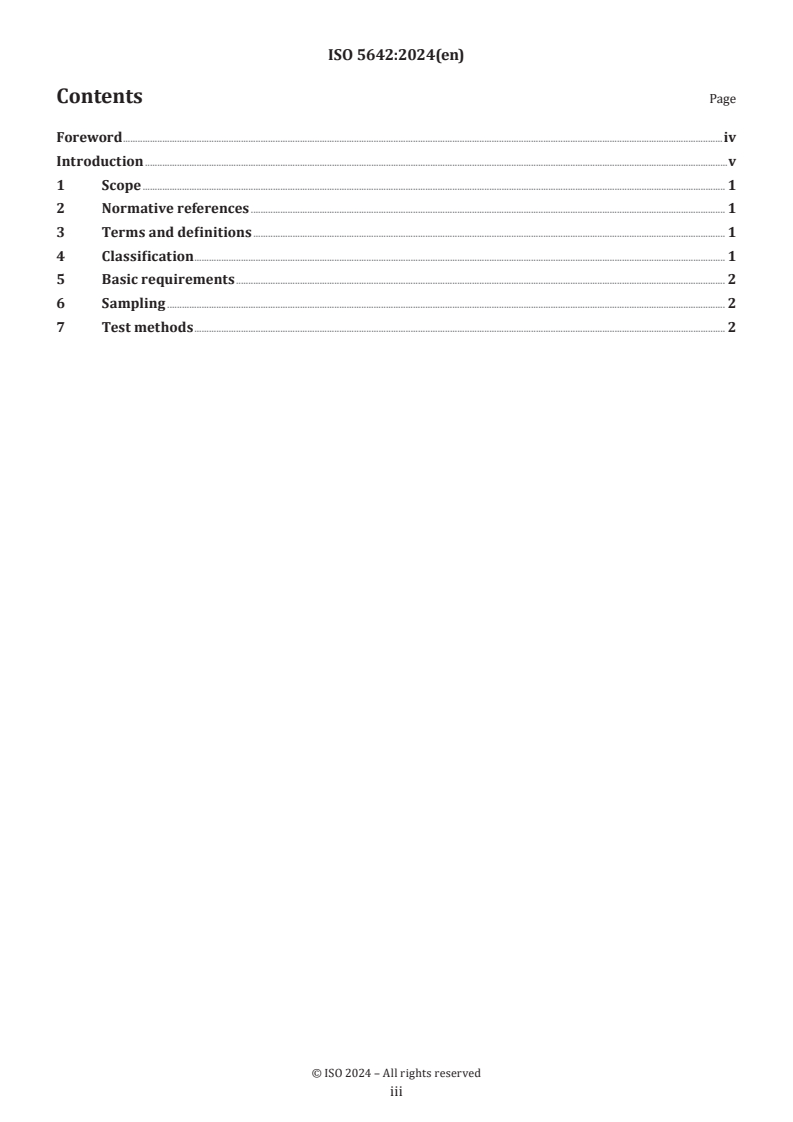
Contents Page
Foreword .iv
Introduction .v
1 Scope . 1
2 Normative references . 1
3 Terms and definitions . 1
4 Classification . 1
5 Basic requirements . 2
6 Sampling . 2
7 Test methods . 2
iii
Foreword
ISO (the International Organization for Standardization) is a worldwide federation of national standards
bodies (ISO member bodies). The work of preparing International Standards is normally carried out through
ISO technical committees. Each member body interested in a subject for which a technical committee
has been established has the right to be represented on that committee. International organizations,
governmental and non-governmental, in liaison with ISO, also take part in the work. ISO collaborates closely
with the International Electrotechnical Commission (IEC) on all matters of electrotechnical standardization.
The procedures used to develop this document and those intended for its further maintenance are described
in the ISO/IEC Directives, Part 1. In particular, the different approval criteria needed for the different types
of ISO document should be noted. This document was drafted in accordance with the editorial rules of the
ISO/IEC Directives, Part 2 (see www.iso.org/directives).
ISO draws attention to the possibility that the implementation of this document may involve the use of (a)
patent(s). ISO takes no position concerning the evidence, validity or applicability of any claimed patent
rights in respect thereof. As of the date of publication of this document, ISO had not received notice of (a)
patent(s) which may be required to implement this document. However, implementers are cautioned that
this may not represent the latest information, which may be obtained from the patent database available at
www.iso.org/patents. ISO shall not be held responsible for identifying any or all such patent rights.
Any trade name used in this document is information given for the convenience of users and does not
constitute an endorsement.
For an explanation of the voluntary nature of standards, the meaning of ISO specific terms and expressions
related to conformity assessment, as well as information about ISO’s adherence to the World Trade
Organization (WTO) principles in the Technical Barriers to Trade (TBT), see www
...